


Connect with us
DAPA Banner
DAPA Coin
DAPA
COIN PAYMENT ASSET
PRIVACY · BLOCKDAG · HOMOMORPHIC ENCRYPTION · RUST
ElGamal Encrypted MINE DAPA
🚫 GENESIS SOLD OUT
DAPAPAY COMING

Tech

Apple’s AI spend remains flat as OpenAI loses $1.25 for every $1

Published

on

As OpenAI prepares an IPO, information suggests it is bleeding money. Apple, on the other hand, continues to benefit from AI without all of the spend.

If you didn’t predict it already, you could sense that AI was past its sell-by date when you watched the 2026 Google I/O conference. Half the hyped new technologies seemed worthless or at best old hat, and half were yet again preposterous exaggerations about saving the human race from something or other.

What never changes is that AI is both said to be this staggering technology right now and, if you press a little, to well, no, it isn’t, but it’s going to be someday. You just have to believe, and to spend money.

And this is where we are now. Companies keep spending incredible sums of money, but according to The Information, OpenAI itself has lost $1.22 for every $1 it made in revenue.

Advertisement

The firm does predict that it will hit $30 billion in revenue for the whole of 2026. But according to the Wall Street Journal, it’s going to spend around $600 billion on servers and datacenters in the next few years.

This includes around $100 billion just on datacenter capacity. Between now and around 2033, it has committed to $1.4 trillion in deals with processor manufacturers and cloud providers.

That money is not going to come out of CEO Sam Altman’s pocket. Instead, OpenAI hopes to get help from the federal government. It wants the government to guarantee financing for the processors it needs.

“This is where we’re looking for an ecosystem of banks, private equity, maybe even governmental, the ways governments can come to bear,” said OpenAI CFO Sarah Friar. “[That] can really drop the cost of the financing but also increase the loan-to-value, so the amount of debt you can take on top of an equity portion.”

Advertisement

Friar said that in November 2025, and at the same time denied that the company was planning an Initial Public Offering (IPO) to raise money. Now CNBC reports that the firm will be filing for an IPO in the next few weeks, although it continues to deny this.

Three people seated on stage in a panel discussion, with brown chairs and small side tables holding glasses of water, against a background of shimmering water.

Sam Altman [left] and Jony Ive [center] speaking to Laurene Powell Jobs – Image Credit: Emerson Collective/YouTube

OpenAI also continues to seek out funding, most recently securing $122 billion in March 2026 to keep things going. It claimed previously that it would have gigantic losses every year until 2030.

But it’s okay, it’s fine, because in 2030 we will all apparently see that OpenAI was right. Through advertising in ChatGPT, OpenAI says it will create around $100 billion that year.

Advertisement

No more worlds to copy

AI stole the entire world’s published knowledge to create its Large Language Models, and it’s been allowed to do it. AI firms repeatedly say that if they had been forced to pay for what they did, they would not exist.

Throughout all of this, the only answer to that has been yes, you wouldn’t exist. Then there are stronger answers to how AI firms have subsequently protested that their own work is being stolen.

Your heart bleeds for them, but then you are an AI user. You have found out firsthand that AI is actually brilliant at certain really specific things. You’ve also found out how pointlessly wrong it is about the simplest things.

AI is so useful that you probably have certain tools you rely on already, such as AI transcription of recordings. But AI hasn’t written the next great novel — though it may have written a prize-winning short story — and the only life-changing impact it has had is on those people who’ve lost their jobs.

Advertisement

Companies are shedding workers on the belief that AI can replace them. Some are finding out that this belief was premature, if not idiotic. Just ask the Pizza Hut franchisee who says they’ve lost $100 million because of a botched AI kitchen management system.

There are signs that firms are hiring people back. But they’re hiring them back at lower salaries than before.

Companies are not learning that this gets them staff who can’t do the job either.

But then companies are still spending similar sums to OpenAI in this dream of AI wonderment. Or at least this nightmare of being overtaken by rivals.

Advertisement

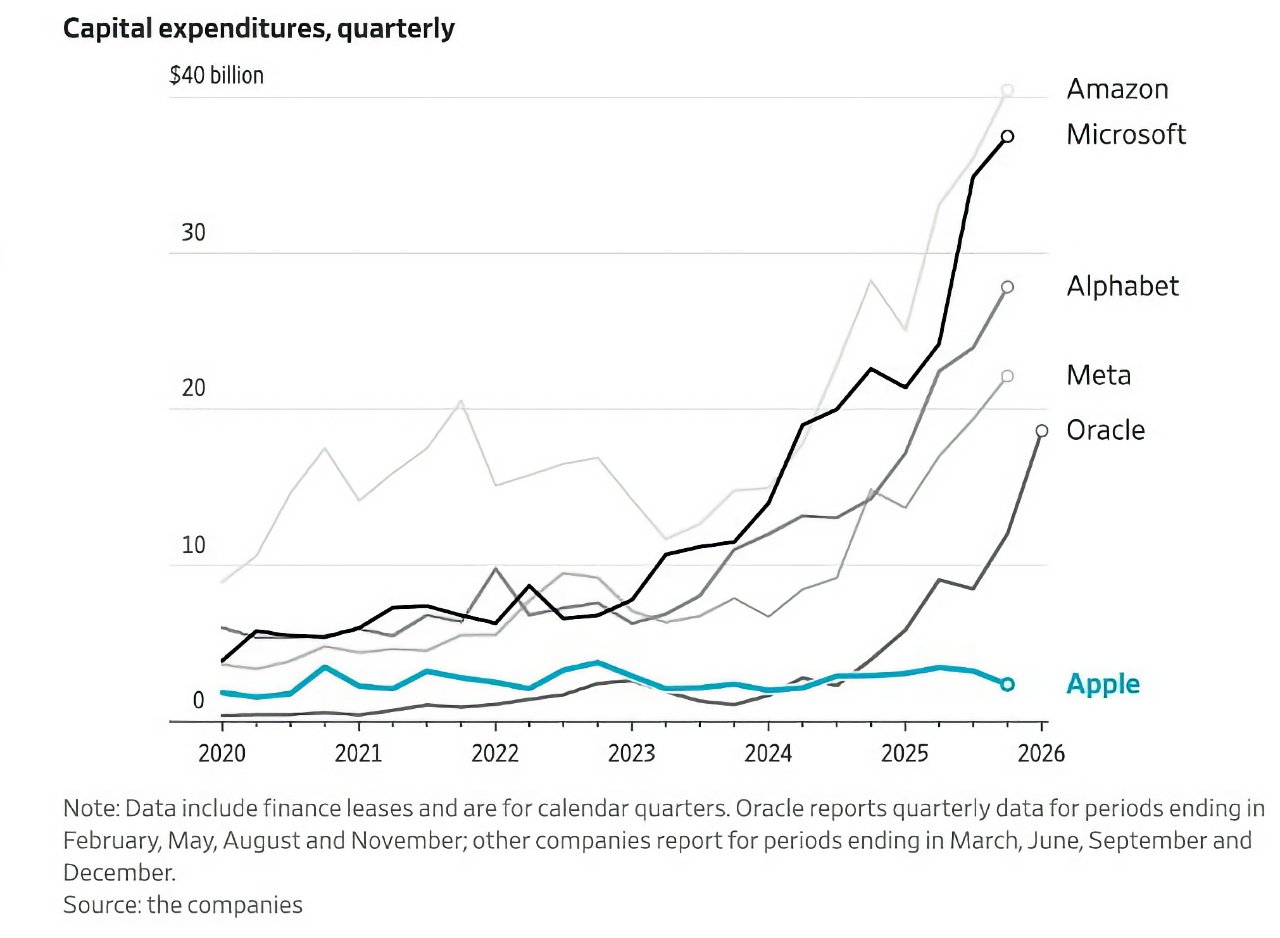
According to FastCompany, AI spending for 2026 amongst the biggest technology firms is:

  • Amazon: $200 billion
  • Microsoft: $190 billion
  • Google/Alphabet: $180 billion to $190 billion
  • Meta: $125 billion to $145 billion

Spot the missing company

That same list of technology firms’ spending on AI included one more company. The figure has to be estimated, but it is Apple at around $13 billion for the year.

This is the company that for years has been practically mocked for being behind in AI. It’s also, though, the firm that is predicted to make a cool $1 billion for doing practically nothing.

That’s the sum Apple is expected to earn from the App Store and its share of the sales of apps such as OpenAI’s ChatGPT.

Speaking of ChatGPT, OpenAI is reportedly considering suing Apple because its integration into Apple Intelligence has not earned it enough money. But this deal is the one that sees Apple Intelligence send anonymized data to ChatGPT and demands that none of it be retained for training.

If it can’t profit from a user’s personal details, and it can’t even train on what they ask for, it’s hard to conceive how OpenAI thought this would be a cash cow.

Advertisement

OpenAI may have hoped that its deal with Apple would expand out in some way. If so, it too fell foul of the nonsense it peddles about some far-off brilliant future.

There’d be irony in that, but it’s hard to be amused when the prospect of AI has created as much damage to employment as if it really could do what it’s promised.

But then, it may be equally presumptive to say we’ve got as far with AI as we’re going to get. After all, OpenAI has this Jony Ive AI device that will be coming out.

Some day.

Advertisement

Source link

Continue Reading
Click to comment

You must be logged in to post a comment Login

Leave a Reply

Tech

Managing watts with bits for Ireland’s solar decade

Published

on

Calvin Lan, CEO of Huawei Ireland, discusses the work to be done on Ireland’s commitment to an ambitious 8GW of solar capacity by 2030.

In November 2025, Ireland’s national solar capacity crossed 2GW of capacity for the first time. It was a milestone that would have seemed ambitious just a few years earlier, and one that Huawei Ireland, which supplies inverter systems and grid management technology to many of the those installations, has watched closely.

For Calvin Lan, CEO of Huawei Ireland, that milestone was very much a starting point, not a destination. Ireland, as a country, has committed to an ambitious 8GW of solar capacity by 2030, so there’s much work left to do.

“The gap between where we are and where we need to be is significant,” says Lan. The technology to close the divide exists. The question is whether Irish organisations will move quickly enough to use it, he says.

Advertisement

An economic issue

Green energy is not, primarily, a sustainability conversation, but an economic one, says Lan. Ireland’s energy costs are among the highest in Europe, and the companies moving on solar and storage now will be in a far more competitive position to those that wait, he says.

Research published by Huawei Ireland last year found that more than 60pc of Irish businesses expect green technology to improve their operational efficiency. Lan finds the nature of those conversations more telling than the headline figure.

“Customers are now asking specific, operational questions about solar or storage deployments, return on investment, integration with existing infrastructure. That is a meaningful change from where we were even two or three years ago.”

The shift is visible in Huawei Ireland’s own business. Demand for solar and energy storage technologies has grown steadily as a share of overall revenue over the past two to three years, says Lan, who adds that this is a market-wide phenomenon.

Advertisement

Solar energy, he notes, is already part of daily life for many in Ireland, powering homes, farms and businesses across the country, and cutting both bills and emissions in the process.

However, there is still reluctance in some sectors, he notes. “Companies want to understand what their competitors are doing before committing. That is a natural instinct, but in a market moving this quickly it carries a real cost.”

The organisations that are moving fastest, he says, are not doing so purely for sustainability reasons. “They are doing it because it makes financial sense. Energy costs are a competitive issue.”

Managing watts with bits

Huawei does not manufacture solar panels. Its position in the energy market is built on inverter systems, storage technology and the data infrastructure that manages them.

Advertisement

“We are first and foremost an ICT company,” Lan explains. “We are electrical engineers who have taken over 30 years of expertise and billions invested in research and development, and applied them directly to the energy challenge. The way we think about it is managing watts with bits.”

That convergence of digital and energy infrastructure is, in his view, where the most consequential innovation in the sector is currently happening. “You simply cannot manage a complex energy system without the data infrastructure to run it. Digital is the enabler of everything else.”

It is also where Huawei’s specific advantage lies, he says – a company that has spent three decades building the architecture for managing complex data flows is now applying that expertise to managing complex energy flows.

The grid challenge

One of the less visible challenges in Ireland’s energy transition is what happens to grid stability as renewable generation grows. Traditional power systems depend on large synchronous generators for inertia, a physical resistance to sudden frequency changes that keeps the network stable. As fossil fuel plants are retired, that inertia decreases, and the grid becomes harder to manage.

Advertisement

Conventional renewable inverters are ‘grid-following’. They read the signal from the network and synchronise to it, but cannot stabilise the system independently. ‘Grid-forming’ inverters work differently. They can generate and regulate stable voltage and frequency on their own, effectively functioning as what engineers describe as a virtual synchronous machine.

“That means they can support grid stability even when very few traditional generators are online,” Lan says, “which is increasingly relevant as Ireland’s renewable share grows and the grid becomes more complex to manage. It is one of the more exciting developments in the sector right now, and I think it will genuinely surprise people who have not encountered it before.”

Huawei’s SUN2000-330KTL, which won Best Renewable Energy Product at the SEAI Energy Show in April, incorporates these capabilities, Lan says. The company is also launching the SUN2000-506KTL, a new utility-scale system forming part of the FusionSolar 9.0 platform, which combines high power density with advanced grid-forming capability and is designed to deliver higher yields at lower system cost.

The time is now

Lan argues that now is the time for Irish organisations to make the key transition decisions and that there are real costs to deferring them.

Advertisement

“The transition is achievable, not eventually, but now,” he says. “I think there is still a tendency to treat green energy as a long-term strategic priority rather than an immediate operational one. The organisations that are moving fastest are not doing it purely for sustainability reasons. They are doing it because it makes financial sense.”

When it comes to accelerating adoption, Lan says real-life case studies matter more than arguments. Seeing a solar deployment working at scale in Ireland, in a comparable business, shortens the decision cycle faster than any amount of policy discussion, he argues.

“The technology exists. The case studies are real. What accelerates adoption is confidence, and confidence comes from seeing it done.”

He points too to the skills dimension, one that tends to get less attention in the energy debate than investment or policy. The engineering and data capabilities required to design, deploy and manage green energy infrastructure are in short supply globally, he says.

Advertisement

“For students considering where to build a career, green tech is one of the most important fields you could choose to work in,” he says. “The skills required are in short supply globally, which means demand for them will only grow.”

Huawei has been in Ireland for nearly 20 years. Lan was speaking to SiliconRepublic.com ahead of the company’s annual Innovation Day – themed ‘Powering a Greener Future’ this year – at UCD O’Reilly Hall on 3 June. The event aims to to bring together developers, engineers, policymakers and businesses to see what is already working at scale, in Ireland and on the global stage.

Don’t miss out on the knowledge you need to succeed. Sign up for the Daily Brief, Silicon Republic’s digest of need-to-know sci-tech news.

Advertisement

Source link

Continue Reading

Tech

Today’s NYT Connections Hints, Answers for May 23 #1077

Published

on

Looking for the most recent Connections answers? Click here for today’s Connections hints, as well as our daily answers and hints for The New York Times Mini Crossword, Wordle, Connections: Sports Edition and Strands puzzles.


Today’s NYT Connections puzzle has two very pop-culture-themed categories that movie fans should appreciate. Read on for clues and today’s Connections answers.

The Times has a Connections Bot, like the one for Wordle. Go there after you play to receive a numeric score and to have the program analyze your answers. Players who are registered with the Times Games section can now nerd out by following their progress, including the number of puzzles completed, win rate, number of times they nabbed a perfect score and their win streak.

Advertisement

Read more: Hints, Tips and Strategies to Help You Win at NYT Connections Every Time

Hints for today’s Connections groups

Here are four hints for the groupings in today’s Connections puzzle, ranked from the easiest yellow group to the tough (and sometimes bizarre) purple group.

Yellow group hint: Shag is another one.

Advertisement

Green group hint: Don’t wait.

Blue group hint: Spider-Man and Captain America, too.

Purple group hint: May the Force be with you.

Answers for today’s Connections groups

Yellow group: Hairdos.

Advertisement

Green group: More readily.

Blue group: Marvel characters.

Purple group: Words after “The” in “Star Wars” movie titles.

Read more: Wordle Cheat Sheet: Here Are the Most Popular Letters Used in English Words

Advertisement

What are today’s Connections answers?

completed NYT Connections puzzle for May 23, 2026

The completed NYT Connections puzzle for May 23, 2026.

NYT/Screenshot by CNET

The yellow words in today’s Connections

The theme is hairdos. The four answers are beehive, bouffant, chignon and pompadour.

The green words in today’s Connections

The theme is more readily. The four answers are first, preferably, rather and sooner.

Advertisement

The blue words in today’s Connections

The theme is Marvel characters. The four answers are Daredevil, Hawkeye, Nightcrawler and Wolverine.

The purple words in today’s Connections

The theme is words after “The” in “Star Wars” movie titles. The four answers are Empire, Force, Last and Phantom.

Source link

Advertisement
Continue Reading

Tech

AirPods Pro 3 Drop to $199 in Amazon Memorial Day 2026 Sale

Published

on

AirPods Pro 3 are down to $199 for Memorial Day weekend.

Amazon’s Memorial Day sale delivers a $50 price cut on AirPods Pro 3, with the entire AirPods line eligible for discounts.

Apple AirPods Pro 3 are on sale for $199 at Amazon today, which matches the lowest price seen this quarter.

Buy AirPods Pro 3 for $199

Advertisement

If you’re looking for the lowest price across the AirPods line, Amazon has AirPods 4 without ANC on sale for $99, while AirPods Max 2 are marked down to $509 in select colors. That’s the best price we’ve seen on the 2026 over-ear headphones release.

Today’s top AirPods offers

Even more Apple deals for Memorial Day weekend

Lowest Apple prices

Save across Apple product lines.

There are plenty of Memorial Day weekend sales going on across Apple’s product lines. Here’s a sampling of our top picks, with hundreds of bargains available in the AppleInsider Apple Price Guide.

Advertisement

Source link

Continue Reading

Tech

The Reason Ford’s 6.0 Power Stroke Diesel Makes That Turbo Whistle

Published

on


Since its introduction in 2003, the Ford 6.0 Power Stroke diesel engine has received a somewhat mixed response from drivers. Though the engine was built with advanced performance technology to keep Ford competitive, it experienced some common problems and several reliability issues as well. But one of the more distinctive features of the engine is the distinctive whistle, which comes from the turbine side of the engine’s turbocharger.

The turbocharger’s 10-blade design specifically is what’s responsible for the noise. The whistle is actually the result of air flowing through and interacting with the blades themselves. The sound, which is high-pitched and unmistakable among many Ford owners, isn’t quite the same as the whistle in later versions. That’s because the company eventually utilized a 13-blade design to help soften the sound. The whistle is still there, but it’s not as pronounced as in the original 2003 version of the engine.

While some drivers may not be happy about the whistle, others consider it to be iconic. In fact, the whistle has become one of the defining aspects of the Ford 6.0 Power Stroke diesel engine. It’s so popular that some pickup truck owners have tried to duplicate it with different engines over the years. However, there’s nothing quite like the original, which is still heard on U.S. highways more than 20 years after its introduction.

Advertisement

How to replicate Ford’s 6.0 Power Stroke Diesel turbo whistle

It’s possible to get a similar whistle sound to that of the 6.0 Power Stroke engine, the worst Ford diesel engine, according to drivers. It all comes down to increasing airflow, and one of the quickest ways to do that is to put in a high-flow air filter. This naturally allows for more air to pass through the engine, thus producing a more noticeable turbo whistle. The muffler can be modified or removed, reducing airflow restriction and allowing sounds to come through more clearly. A straight-pipe exhaust system could intensify the sound even more.

Advertisement

A turbo whistle attachment can be added to the exhaust system, as it’s designed to create a high-pitched whistle as air flows through it. If drivers want to go the extra mile for the whistle, they can upgrade to a larger turbocharger. This can also increase the volume of the sound.

However, it’s important to note that making any modifications to a truck’s exhaust system may violate federal or local emissions standards. Also, modifying the exhaust could affect the manufacturer’s warranty. That’s why it’s important to know what’s allowed beforehand, especially for drivers considering a bulletproofed Ford 6.0 engine. This means knowing what the regulations are and being familiar with the vehicle warranty ahead of time.

Advertisement


Source link

Continue Reading

Tech

Today’s NYT Wordle Hints, Answer and Help for May 23 #1799

Published

on

Looking for the most recent Wordle answer? Click here for today’s Wordle hints, as well as our daily answers and hints for The New York Times Mini Crossword, Connections, Connections: Sports Edition and Strands puzzles.


Today’s Wordle puzzle is a fun word with many meanings. If you need a new starter word, check out our list of which letters show up the most in English words. If you need hints and the answer, read on.

Read more: New Study Reveals Wordle’s Top 10 Toughest Words of 2025

Advertisement

Today’s Wordle hints

Before we show you today’s Wordle answer, we’ll give you some hints. If you don’t want a spoiler, look away now.

Wordle hint No. 1: Repeats

Today’s Wordle answer has one repeated letter.

Wordle hint No. 2: Vowels

Today’s Wordle answer has one vowel.

Wordle hint No. 3: First letter

Today’s Wordle answer begins with C.

Advertisement

Wordle hint No. 4: Last letter

Today’s Wordle answer ends with K.

Wordle hint No. 5: Meaning

Today’s Wordle answer can mean to throw or toss something. It’s also a nickname for Charles. It’s also a cut of beef.

TODAY’S WORDLE ANSWER

Today’s Wordle answer is CHUCK.

Advertisement

Yesterday’s Wordle answer

Yesterday’s Wordle answer, May 22, No. 1798, was VOCAL.

Recent Wordle answers

May 18, No. 1794: LOATH

May 19, No. 1795: DUSTY

May 20, No. 1796: WRECK

Advertisement

May 21, No. 1797: AGREE

Source link

Advertisement
Continue Reading

Tech

UK MPs slam digital ID rollout as a ‘fiasco’ after botched launch

Published

on

Public Sector

Government’s ‘rushed’ plans damaged public confidence before ministers had even explained how the system would work

Britain’s digital ID push has been mauled by MPs after the government unveiled plans that appeared to arrive several steps ahead of actual policy.

A report from Parliament’s Home Affairs Committee this week concluded the government’s handling of mandatory digital ID plans was “rushed, poorly thought out and failed to make a convincing case.” It warned that ministers had already undermined public confidence with what MPs described as a rushed and inadequate announcement.

Advertisement

According to the committee, there was “no rigorous policy development and no public consultation ahead of the announcement,” which left ministers struggling to answer basic questions about privacy, implementation, safeguards, and how the system would actually operate in practice.

The report said the proposal “came out of the blue, causing alarm and uncertainty” and warned that the government’s “incoherent approach to policy development cannot be repeated if public trust is to be rebuilt.”

The committee stopped short of opposing digital identity outright. Instead, MPs argued that digital ID could still improve access to public services, but only if ministers stop treating national identity infrastructure like a last-minute product launch and start acting as though the public might reasonably want to know what they are signing up for.

Opposition to the wider scheme has been building for months. Greater Manchester mayor Andy Burnham previously warned that tying digital ID to employment checks risked creating a “backdoor national ID system,” while privacy campaigners and civil liberties groups have repeatedly raised concerns about surveillance, data sharing, and function creep since the plans were first unveiled last year.

Advertisement

The government’s approach to consultation has also come under fire. Last month, it barred journalists from joining a digital identity advisory panel event, which did little to quell accusations that ministers were trying to build critical pieces of national identity infrastructure behind closed doors.

Chair of the committee Dame Karen Bradley described the government’s early efforts as “nothing short of a fiasco,” adding: “To the public this announcement came out of the blue and made little sense.”

The report also highlighted growing concern around digital right-to-work checks, which ministers still intend to make mandatory even after backing away from compulsory government-issued ID cards earlier this year. MPs warned this could effectively mean UK citizens would need either a passport or a digital ID simply in order to work legally.

“It is vital that this change is not just treated as an afterthought to digital ID,” the committee wrote, warning that the implications for people without passports had barely been addressed in consultation documents.

Advertisement

The committee also warned that rebuilding confidence may prove difficult given what it diplomatically called the government’s “poor track record of digital transformation.”

In other words, MPs aren’t entirely convinced the same government that brought Britain some of its more memorable public sector IT disasters should be trusted to build national identity infrastructure. ®

Source link

Advertisement
Continue Reading

Tech

A hacker group is poisoning open source code at an unprecedented scale

Published

on

A so-called software supply chain attack, in which hackers corrupt a legitimate piece of software to hide their own malicious code, was once a relatively rare event but one that haunted the cybersecurity world with its insidious threat of turning any innocent application into a dangerous foothold in a victim’s network. Now one group of cybercriminals has turned that occasional nightmare into a near-weekly episode, corrupting hundreds of open source tools, extorting victims for profit, and sowing a new level of distrust in an entire ecosystem used to create the world’s software.

On Tuesday night, open source code platform GitHub announced that it had been breached by hackers in one such software supply chain attack: A GitHub developer had installed a “poisoned” extension for VSCode, a plug-in for a commonly used code editor that, like GitHub itself, is owned by Microsoft. As a result, the hackers behind the breach, an increasingly notorious group called TeamPCP, claim to have accessed around 4,000 of GitHub’s code repositories. GitHub’s statement confirmed that it had found at least 3,800 compromised repositories while noting that, based on its findings so far, they all contained GitHub’s own code, not that of customers.

“We are here today to advertise GitHub’s source code and internal orgs for sale,” TeamPCP wrote on BreachForums, a forum and marketplace for cybercriminals. “Everything for the main platform is there and I very am happy to send samples to interested buyers to verify absolute authenticity.”

The GitHub breach is just the latest incident in what has become the longest-running spree of software supply chain attacks ever, with no end in sight. According to cybersecurity firm Socket, which focuses on software supply chains, TeamPCP has, in just the last few months, carried out 20 “waves” of supply chain attacks that have hidden malware in more than 500 distinct pieces of software, or well over a thousand counting all of the various versions of the code that TeamPCP has hijacked.

Advertisement

Source link

Continue Reading

Tech

Caltech Could Lose Control of JPL For First Time In Decades

Published

on

NASA plans to open competition for the contract to operate JPL for the first time in nearly a century, meaning Caltech’s historic role managing the iconic deep-space lab could come to an end when its current agreement expires in 2028. According to JPL, Caltech has managed the lab since the its inception in the 1930s, and has done so for NASA since the agency was established in 1958. Space.com reports: According to the JPL statement, Caltech has been preparing for this possible transition since last summer, so the news “comes as no surprise.” But the potential change is part of a larger shakeup for the agency. Earlier this morning, NASA announced a major reorganization, which is separate from the JPL news. “To support the agency’s ambitious short- and long-term goals, NASA is taking action to increase specialization at centers and integrate mission directorates, elevating delivery of technically excellent work,” the agency said in a statement today.

JPL is NASA’s lead center for the robotic exploration of Mars and other deep-space locales. The agency has worked with JPL through Caltech as a manager for nearly 70 years. Though JPL still counts as one of NASA’s field centers, it’s run as a contracted FFRDC (federally funded research and development center). This status has allowed the lab to function slightly differently than other NASA centers; it has a unique sort of independence, though NASA has always had significant oversight of the lab. “As an FFRDC, JPL operates under a special contractual and governance framework designed to ensure that its work is performed in the public interest and aligned with national priorities,” NASA has stated. “The FFRDC model enables NASA to retain access to this depth of capability while maintaining a clear separation between government decision-making authority and contractor execution responsibilities.”

Opening up the competition for institutions beyond Caltech to operate JPL could mean significant changes for everything from day-to-day mission management to big NASA science programs. Until now, JPL and Caltech have been heavily intertwined, with mission personnel, scientists, leadership, and others working closely “across the pond” between JPL and Caltech. JPL mission and program meetings often include Caltech employees and sometimes even take place on its Pasadena campus.

Source link

Advertisement
Continue Reading

Tech

Peec, one of Berlin’s rising startups, more than doubled annualized revenue in months to $10M, sources say

Published

on

One of Berlin’s rising-star, early stage startups, Peec AI, just crossed $10 million in annualized revenue, according to internal dashboard data seen and verified by TechCrunch.

Peec AI raised its $21 million Series A six months ago. While CEO Marius Meiners wouldn’t disclose its valuation to me at that time (only revealing that it was above $100 million), he did say the startup had grown its revenue to more than $4 million in the 10 months since its launch.

So, it has more than doubled its revenue trajectory, and at a faster pace.

Peec helps brands track and improve their visibility in AI searches. While based in Berlin, it recently opened an office in New York. 

Advertisement

It’s also serving as proof of one of the key market shifts happening in Europe’s tech scene. 

“Founders these days track revenue much more closely,” Antler partner Christoph Klink was telling me just a couple of days ago. Sitting in a hotel lobby bar during an event-laden week for the tech ecosystem, the Berlin-based VC had offhand mentioned Peec AI as one of the most successful companies in his portfolio, alongside Lovable and others. 

My next question was how he defined success, which led to a discussion of recent market cycles. Compared to six years ago, he said, the big change is that success is now defined by growth, not valuation.

Having learned lessons from 2021’s frothiness and subsequent painful return to reality, investors now know that revenue can’t be an afterthought. The corollary is that it isn’t something you can just check on every couple of weeks, Klink told me. 

Advertisement

Startups now tend to keep running dashboards on revenue progress, sometimes — as is the case at Peec — visible to all employees.

For some founders, this has required some adjusting; but others were born just for this new cycle.

Peec AI’s product takes the same approach as SEO dashboards, except it helps brands track generative engine optimization (GEO) — visualizing whether they show up when users type a certain set of prompts into ChatGPT and the like. 

But as Meiners then told me, he is also a former esports athlete who once ranked among the top 100 League of Legends players. This explains why he would share a revenue tracker with his whole company: his background gave him a unique take on what makes a winning team.

Advertisement

Talent is the first ingredient, and Peec AI took an innovative approach to hiring in Berlin’s competitive market. 

Like many startups in the Bay Area, but very few in Europe, it invested in billboards to pitch itself not only to prospective clients, but also to applicants. In our conversation, Klink had recalled with a smile that these billboards were more often than not strategically placed in front of other tech companies across the city.

What those billboards say may differ, but they are part of a narrative that attempts to position Peec AI as a company worth jumping ship for. According to Klink, this signaling is particularly important in the current AI cycle, where companies and investors are piggybacking on trends that are only just emerging — such as AI search.

This bet on undercurrents applies to many startups Klink has invested in, which is why he understands why portfolio companies like Peec AI — and Lovable — not only closely track ARR, but also sometimes publicly disclose revenue milestones despite having absolutely no obligation to do so. 

Advertisement

“That’s a way to show it’s working,” Klink said. “It also shows a focus on growth that sets the culture.”

When you purchase through links in our articles, we may earn a small commission. This doesn’t affect our editorial independence.

Source link

Advertisement
Continue Reading

Tech

Tech Moves: Xbox names CTO; Smartsheet gets first AI chief; Amazon VP departs for DoorDash

Published

on

Scott Van Vliet. (LinkedIn Photo)

Microsoft’s Xbox promoted Scott Van Vliet to the role of chief technology officer. Van Vliet, based in the Los Angeles area, has been with the company across two stints totaling more than seven years, with work on Teams and Azure Communication Services.

“I’ve been a gamer my whole life and an Xbox fan since day one, so this is a rare opportunity to bring together two things I care deeply about: building platforms and gaming,” Van Vliet said on LinkedIn.

The leadership change comes three months after Asha Sharma took over as Xbox CEO — a move that surprised some given her limited video game industry background. Van Vliet’s appointment adds gaming experience to Xbox’s top ranks.

Since Sharma took the helm, Microsoft has canceled its AI-powered Copilot assistant for Xbox and added four executives from CoreAI, the company’s engineering group where she previously worked.

Drew Garner. (LinkedIn Photo)

Drew Garner was promoted to a newly created chief AI officer role at Smartsheet, the Bellevue, Wash., enterprise software company best known for helping businesses organize and track work. The announcement is just the latest C-suite change for the company.

Garner said on LinkedIn that his mission stays the same, using “AI that earns its keep with the people doing real work.”

Advertisement

Garner became Smartsheet’s VP of engineering in November, just after Rajeev “Raj” Singh took the helm as CEO. The two have significant overlaps in their resumes, with Garner rising to the role of CTO at Accolade during Singh’s tenure as leader of the healthcare platform. And Garner was a senior director at Concur, the Bellevue-based travel expense giant that Singh co-founded.

Tim Castree. (LinkedIn Photo)

— After nearly five years at Amazon, Tim Castree has left to become chief marketing officer at DoorDash. While the food and retail delivery platform is already a large-scale operation, “there’s still a real entrepreneurial energy that fuels the company, and I loved the idea of joining a business where so much of the growth journey is still in front of us,” he said on LinkedIn.

Castree, based in Ohio, was most recently VP of EU Prime and Marketing at Amazon, overseeing brand, performance and growth marketing across more than 15 European markets.

Stephan Betz is also leaving Amazon after more than 18 years with the company across two stints. He served as director of software engineering and product for Last Mile Tech, most recently focused on driver assistance and safety technologies, including software powering Amazon’s Rivian EVs. Betz is based in Santa Cruz, Calif.

“What’s next? I am going to take a very long, maybe permanent, break and look for ways to give back in these unprecedented times of change,” he said on LinkedIn.

Advertisement

Betz has also held roles at Microsoft, Google, Groupon and Netflix.

Bryan Sherman is joining Amazon director of Global Partner Development, focusing on Amazon Ads. Sherman works out of Amazon’s New York office and was previously with Monks, the London-based advertising company.

Katerie Chapman. (LinkedIn Photo)

Seattle Children’s has appointed Katerie Chapman as senior VP and chief operating officer. Chapman spent 23 years at Virginia Mason Medical Center, rising from administrative intern to president of the Seattle health organization, before joining Kaufman Hall as managing director. She comes to Seattle Children’s from that role.

“(Chapman’s) deep roots in the healthcare community and her proven track record in leading high-performing teams make her the ideal person to lead our operations as we continue to grow and innovate for the patients and families we serve,” said Dr. Christopher Longhurst, CEO of Seattle Children’s.

— Three University of Washington professors have been elected to the American Academy of Arts and Sciences in recognition for their leadership in work that supports research, public policy and the common good.

Advertisement
  • Magdalena Balazinska, director of the Paul G. Allen School of Computer Science & Engineering, was elected for her work in data management and data science and for her leadership in the field.
  • Shwetak Patel of the Allen School and the Department of Electrical & Computer Engineering was elected for his work in ubiquitous computing, human-computer interaction and sensor-enabled systems.  
  • Daniel Schindler of the School of Aquatic and Fishery Sciences was elected for his research on the impacts of climate change, urbanization and land use on freshwater ecosystems.

Pacific Northwest National Laboratory announced two promotions to its senior research leadership team:

  • Douglas Mans is now associate laboratory director for PNNL’s science mission areas, spanning the physical, computational, Earth and biological sciences.
  • Daniel Stephens has been named associate laboratory director for PNNL’s National Security Directorate.

Dr. Toshio Tsukiyama, professor and associate director of Fred Hutch’s Basic Sciences Division, has received the inaugural David and Deborah Lycette Endowed Chair for Cancer Research. Tsukiyama, who has been with Fred Hutch for nearly three decades, studies cell function in pursuit of new strategies for targeting cancer cells with novel therapies.

Michael Waggoner, founder and former CEO of Corumat, a sustainable packaging startup based in Yakima, Wash., has a new role following the company’s recent closure. Waggoner has joined Simplexity Product Development, a robotics engineering firm, as a senior design engineer.

Source link

Continue Reading

Trending

Copyright © 2025