Retrieval-augmented generation (RAG) has become the de facto standard for grounding large language models (LLMs) in private data. The standard architecture — chunking documents, embedding them into a vector database, and retrieving top-k results via cosine similarity — is effective for unstructured semantic search.
However, for enterprise domains characterized by highly interconnected data (supply chain, financial compliance, fraud detection), vector-only RAG often fails. It captures similarity but misses structure. It struggles with multi-hop reasoning questions like, “How will the delay in Component X impact our Q3 deliverable for Client Y?” because the vector store doesn’t “know” that Component X is part of Client Y’s deliverable.
This article explores the graph-enhanced RAG pattern. Drawing on my experience building high-throughput logging systems at Meta and private data infrastructure at Cognee, we will walk through a reference architecture that combines the semantic flexibility of vector search with the structural determinism of graph databases.
The problem: When vector search loses context
Vector databases excel at capturing meaning but discard topology. When a document is chunked and embedded, explicit relationships (hierarchy, dependency, ownership) are often flattened or lost entirely.
Advertisement
Consider a supply chain risk scenario. While this is a hypothetical example, it represents the exact class of structural problems we see constantly in enterprise data architectures:
Structured data: A SQL database defining that Supplier A provides Component X to Factory Y.
Unstructured data: A news report stating, “Flooding in Thailand has halted production at Supplier A’s facility.”
A standard vector search for “production risks” will retrieve the news report. However, it likely lacks the context to link that report to Factory Y’s output. The LLM receives the news but cannot answer the critical business question: “Which downstream factories are at risk?”
In production, this manifests as hallucination. The LLM attempts to bridge the gap between the news report and the factory but lacks the explicit link, leading it to either guess relationships or return an “I don’t know” response despite the data being present in the system.
The pattern: Hybrid retrieval
To solve this, we move from a “Flat RAG” to a “Graph RAG” architecture. This involves a three-layer stack:
Advertisement
Ingestion (The “Meta” Lesson): At Meta, working on the Shops logging infrastructure, we learned that structure must be enforced at ingestion. You cannot guarantee reliable analytics if you try to reconstruct structure from messy logs later. Similarly, in RAG, we must extract entities (nodes) and relationships (edges) during ingestion. We can use an LLM or named entity recognition (NER) model to extract entities from text chunks and link them to existing records in the graph.
Storage: We use a graph database (like Neo4j) to store the structural graph. Vector embeddings are stored as properties on specific nodes (e.g., a RiskEvent node).
Retrieval: We execute a hybrid query:
Reference implementation
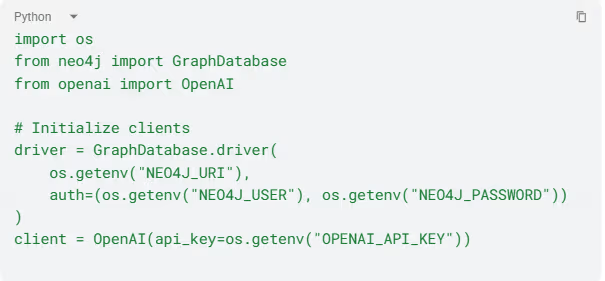
Let’s build a simplified implementation of this supply chain risk analyzer using Python, Neo4j, and OpenAI.
1. Modeling the graph
We need a schema that connects our unstructured “risk events” to our structured “supply chain” entities.
2. Ingestion: Linking structure and semantics
In this step, we assume the structural graph (suppliers -> factories) already exists. We ingest a new unstructured “risk event” and link it to the graph.
3. The hybrid retrieval query
This is the core differentiator. Instead of just returning the top-k chunks, we use Cypher to perform a vector search to find the event, and then traverse to find the downstream impact.
The output: Instead of a generic text chunk, the LLM receives a structured payload:
This allows the LLM to generate a precise answer: “The flooding at TechChip Inc puts Assembly Plant Alpha at risk.”
Advertisement
Production lessons: Latency and consistency
Moving this architecture from a notebook to production requires handling trade-offs.
1. The latency tax
Graph traversals are more expensive than simple vector lookups. In my work on product image experimentation at Meta, we dealt with strict latency budgets where every millisecond impacted user experience. While the domain was different, the architectural lesson applies directly to Graph RAG: You cannot afford to compute everything on the fly.
Mitigation: We use semantic caching. If a user asks a question similar (cosine similarity > 0.85) to a previous query, we serve the cached graph result. This reduces the “graph tax” for common queries.
2. The “stale edge” problem
In vector databases, data is independent. In a graph, data is dependent. If Supplier A stops supplying Factory Y, but the edge remains in the graph, the RAG system will confidently hallucinate a relationship that no longer exists.
Advertisement
Mitigation: Graph relationships must have Time-To-Live (TTL) or be synced via Change Data Capture (CDC) pipelines from the source of truth (the ERP system).
Infrastructure decision framework
Should you adopt Graph RAG? Here is the framework we use at Cognee:
Use vector-only RAG if:
The corpus is flat (e.g., a chaotic Wiki or Slack dump).
Questions are broad (“How do I reset my VPN?”).
Latency < 200ms is a hard requirement.
Use graph-enhanced RAG if:
The domain is regulated (finance, healthcare).
“Explainability” is required (you need to show the traversal path).
The answer depends on multi-hop relationships (“Which indirect subsidiaries are affected?”).
Conclusion
Graph-enhanced RAG is not a replacement for vector search, but a necessary evolution for complex domains. By treating your infrastructure as a knowledge graph, you provide the LLM with the one thing it cannot hallucinate: The structural truth of your business.
Daulet Amirkhanov is a software engineer at UseBead.
Advertisement
Welcome to the VentureBeat community!
Our guest posting program is where technical experts share insights and provide neutral, non-vested deep dives on AI, data infrastructure, cybersecurity and other cutting-edge technologies shaping the future of enterprise.
Read more from our guest post program — and check out our guidelines if you’re interested in contributing an article of your own!
A cybersecurity researcher has released a proof-of-concept exploit for a Windows privilege escalation zero-day dubbed “MiniPlasma” that lets attackers gain SYSTEM privileges on fully patched Windows systems.
The exploit was published by a researcher known as Chaotic Eclipse, or Nightmare Eclipse, who released both the source code and a compiled executable on GitHub after claiming that Microsoft failed to properly patch a previously reported 2020 vulnerability.
According to the researcher, the flaw impacts the ‘cldflt.sys‘ Cloud Filter driver and its ‘HsmOsBlockPlaceholderAccess‘ routine, which was originally reported to Microsoft by Google Project Zero researcher James Forshaw in September 2020.
At the time, the flaw was assigned the CVE-2020-17103 identifier and reportedly fixed in December 2020.
Advertisement
“After investigating, it turns out the exact same issue that was reported to Microsoft by Google project zero is actually still present, unpatched,” explains Chaotic Eclipse.
“I’m unsure if Microsoft just never patched the issue or the patch was silently rolled back at some point for unknown reasons. The original PoC by Google worked without any changes.”
BleepingComputer tested the exploit on a fully patched Windows 11 Pro system running the latest May 2026 Patch Tuesday updates.
In our test, we used a standard user account, and after running the exploit, it opened a command prompt with SYSTEM privileges, as shown in the image below.
Advertisement
MiniPlasma exploit successfully gave Windows SYSTEM privileges Source: BleepingComputer
Will Dormann, principal vulnerability analyst at Tharros, also confirmed the exploit works in his tests on the latest public version of Windows 11. However, he said that the flaw does not work in the latest Windows 11 Insider Preview Canary build.
The exploit appears to abuse how the Windows Cloud Filter driver handles registry key creation through an undocumented CfAbortHydration API. Forshaw’s original report said that the flaw could allow arbitrary registry keys to be created in the .DEFAULT user hive without proper access checks, potentially enabling privilege escalation.
While Microsoft reports having fixed the bug as part of its December 2020 Microsoft Patch Tuesday, Chaotic Eclipse now claims the vulnerability can still be exploited.
BleepingComputer contacted Microsoft about this additional zero-day and will update this story if we receive a response.
Researcher behind the recent string of Windows zero-days
MiniPlasma is the latest in a string of Windows zero-day disclosures published by the researcher over the past several weeks.
Advertisement
The disclosure spree began in April with BlueHammer, a Windows local privilege escalation flaw tracked as CVE-2026-33825, followed by another privilege escalation vulnerability, RedSun, and a Windows Defender DoS tool, UnDefend.
After their disclosure, all three vulnerabilities were spotted being exploited in attacks. According to the researcher, Microsoft silently patched the RedSun issue without assigning it a CVE identifier.
YellowKey is a BitLocker bypass affecting Windows 11 and Windows Server 2022/2025 that spawns a command shell that gives access to unlocked drives protected by TPM-only BitLocker configurations.
Advertisement
Chaotic Eclipse has previously stated that they are publicly disclosing these Windows zero-days in protest of Microsoft’s bug bounty and vulnerability-handling process.
“Normally, I would go through the process of begging them to fix a bug but to summarize, I was told personally by them that they will ruin my life and they did and I’m not sure if I was the only who had this horride experience or few people did but I think most would just eat it and cut their losses but for me, they took away everything,” alleged the researcher.
“They mopped the floor with me and pulled every childish game they could. It was soo bad at some point I was wondering if I was dealing with a massive corporation or someone who is just having fun seeing me suffer but it seems to be a collective decision.”
Microsoft previously told BleepingComputer that it supports coordinated vulnerability disclosure and is committed to investigating reported security issues and protecting customers through updates.
Advertisement
Automated pentesting tools deliver real value, but they were built to answer one question: can an attacker move through the network? They were not built to test whether your controls block threats, your detection rules fire, or your cloud configs hold.
This guide covers the 6 surfaces you actually need to validate.
Tesla’s energy storage business is the elder statesman, at more than a decade old. Growth in its Powerwall (battery storage for homes) and Megapack (battery storage for utilities and commercial facilities) sales has, in recent years, helped to compensate for a drop in EV sales, though last quarter saw a sudden drop in energy revenue. Still, Tesla is moving forward with its plans to launch a Houston facility dedicated to a new, larger Megapack later this year.
In total, 11 battery cell manufacturing plants are being retooled for energy storage, according to a March count by BloombergNEF, with eight of those in the US.
Drive Time
One reason investors are so bullish about battery energy storage is their continued enthusiasm for AI. AI companies need data centers, and data centers need energy. Batteries are a great fit for data centers, says Shan Tomouk, who leads battery energy storage research at Benchmark Mineral Intelligence, a research firm focused on battery supply chains. Batteries can help directly power the very energy-hungry centers, which constantly run servers and other hardware, but also the cooling systems that keep them functioning.
The storage systems can also be a fit for data centers that mostly depend on other energy sources, like natural gas. Battery energy storage systems can serve as a backup power source if something goes down and can help data centers manage large and wild power fluctuations related to AI training. They can also kick in to help reduce demand on the grid, lowering costs not just for data centers, but everyone else who depends on the same system—an important upside in communities already hostile to the tech.
Advertisement
“If the huge market of data centers keeps growing every year, it does make sense for automakers to pivot,” Tomouk says. He expects it will. “In the US, there’s a real drive to build data centers, to keep the US as the number one in terms of AI.”
For automakers backing away from EVs, there’s another possible upside to battery storage, even if the pivot doesn’t completely work out. “If automakers aren’t making money from storage and not making money from EVs, they would prefer not to make money from storage because they’re not competing with their own gas car production,” says Gil Tal, who directs the EV Research Center at UC Davis’ Institute of Transportation Studies. “It makes perfect sense, unfortunately.”
Prototypes of the Jaguar Type 01 rolled quietly through the winding streets of Monaco this weekend, parked in plain view just hours before the Formula E race weekend kicked off. The four-door electric grand tourer wore a bold camouflage wrap in red, white, and beige, with its new name printed large across the roof so no one could miss it. Crowds gathered along the harbor and narrow roads caught sight of the long hood, slim headlights, and clean lines that mark the start of something fresh for the British brand.
Designers have chosen a truly game-changing body shape, eliminating the standard front grille. Thin daytime running lights sitting above real LED headlights dominate the front appearance, while ingenious pop-out door handles make the sides look very sleek. From the right angle, the car’s rear appears completely sealed, with the exception of a small aperture for the trunk. Inside, you can see a steering wheel with thick horizontal spokes and buttons and controls strategically placed for your thumbs. A large digital screen swoops across the dashboard, accompanied by a really nice instrument display far in front of the driver.
BUILD 2 SUPERCARS – Young racing enthusiasts ages 10 years old and up can construct the LEGO Speed Champions Lamborghini Revuelto & Huracán STO…
AUTHENTIC LAMBORGHINI DETAILS – Kids can recreate signature design elements including aggressive air intakes, aerodynamic wings, and iconic Y-shaped…
2 DRIVER MINIFIGURES – Each buildable Lamborghini model car comes with a driver minifigure wearing a dedicated outfit and helmet for thrilling race…
The engineers equipped the car with three electric motors that create over a thousand horsepower and 1300 Newton-meters of torque. The battery pack has a capacity of 120 kilowatt hours. Those stats suggest the car has real straight-line speed and smooth passing ability, but the goal is to create a luxury grand tourer that is all about long-distance cruising in style, rather than a track-day ripper. Jaguar developed and produced the entire thing in Britain, staying true to its roots.
Advertisement
The car’s name is actually rather easy. The term “Type” refers to masterpieces such as the Le Mans-winning C-type and the super-elegant E-type. The zero plainly represents zero tailpipe emissions due to its electric motor. The one is the first step in Jaguar’s new direction, as that same signature number appears as a thin row of horizontal lines where the hood meets the windscreen, a throwback to last year’s Type 00 prototype. That detail will most likely appear on all of their future vehicles.
The timing of the road car’s reveal with the Monaco E-Prix made complete sense. Jaguar Racing competes in the series, and they have won four of the first eight races this season. Mitch Evans and António Félix da Costa have each won two races, giving the team some considerable momentum heading into the double-header on the same streets where the new road car will be on display. The prototypes served as a bridge between their race cars and the next commercial model, reminding everyone that Jaguar still values performance at all levels.
We won’t know the full details on the Type 01 until September, but these veiled prototypes on the Côte d’Azur provide a rather clear indication of where the brand is headed. Owners who used to shop Bentley or Rolls-Royce now have a new British alternative based on electric power, modern design, and plenty of presence, the kind of car that turns heads in places like Monaco. [Source]
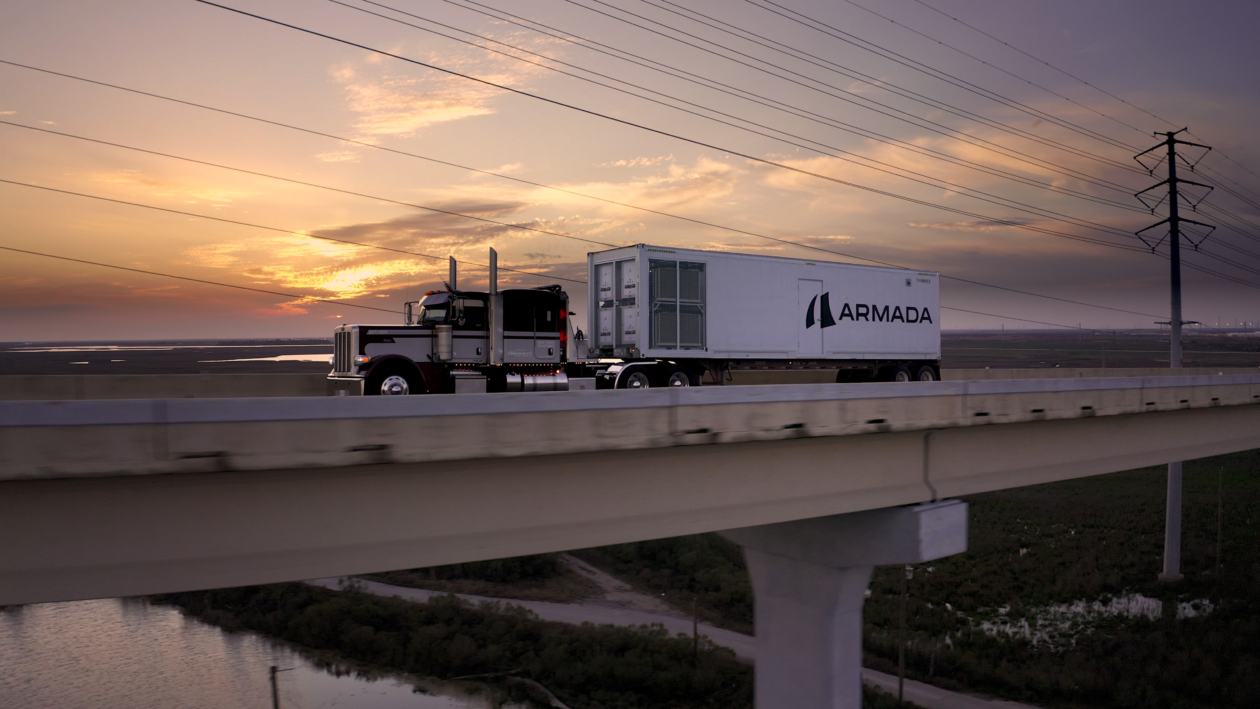
An Armada Galleon portable data center in transit. The company has grown its Bellevue, Wash., engineering team to about 120 people as demand increases for AI infrastructure that can operate in remote environments. (Armada Photo)
A heavily-funded San Francisco-based startup by the name of Armada is quietly building a major engineering presence in Bellevue, Wash., as demand surges for AI infrastructure that can operate beyond the walls of traditional data centers.
The 4-year-old company, which builds rugged computing systems that enable satellite connectivity in remote settings like oil fields, mines and military sites, now employs about 120 people at Bellevue’s Sunset Corporate Campus along the I-90 corridor.
Armada raised $131 million in funding last summer, including backing from Microsoft, Founder’s Fund, Lux Capital and others. Total funding stands at more than $200 million.
How its technology is used: Armada is trying to solve a growing problem in the AI era: bringing powerful computing to places where internet connectivity is unreliable, nonexistent or too sensitive to rely on outside networks.
That includes the U.S. Navy’s littoral combat ship USS Cooperstown, the Alaska Department of Transportation and Public Facilities — and, closer to home, the vast evergreen forests of Washington state.
Advertisement
The Washington State Department of Natural Resources, which coordinates wildfire response across 5.6 million acres, is using Armada’s Atlas platform to centralize Starlink internet systems and give emergency crews more reliable connectivity in the remote areas, where traditional broadband is limited. This has become critical as wildfire operations increasingly rely on drones, satellite imagery and real-time data.
In addition, Armada builds portable, modular data centers, which it calls Galleons, that bring connectivity to the edge of the network. Instead of sending data back and forth to centralized data centers, it lets customers process and analyze information locally, in real time.
That matters because AI systems increasingly require large amounts of computing power and near-instant responses. In environments with poor connectivity, relying on distant cloud infrastructure can introduce delays, security concerns or operational risks.
Armada’s Seattle-area operations: The Bellevue office serves as the hub of the company’s hardware and software engineering teams.
Advertisement
Armada chose the Seattle area three years ago for the engineering center, due to the concentration of experienced engineers from companies like Microsoft and Amazon who know how to “build and operate at massive scale,” said Justin O’Kelly, head of communications at Armada, via email.
“Practically speaking, this region has something you don’t always find in a tech hub: engineers who have shipped real products at scale, not just written code,” O’Kelly said.
Because Armada’s systems are deployed in settings like mines and military sites, they have to work without fail — there’s no IT department to call in the field. The platform is designed to let organizations run AI-powered operations anywhere, even without existing internet connectivity.
The Bellevue office is led by Kenny Hsu, who serves as chief business officer, and Prag Mishra, chief AI officer. Mishra previously spent more than a decade at Amazon, working on Prime Air, Amazon Health and Amazon Logistics, and before that was the head of research for the Bing Geospatial program at Microsoft. Hsu previously ran revenue operations at AuditBoard, which sold to Hg for $3 billion in 2024.
Advertisement
The 400-person company currently has more than 20 open positions in AI engineering, infrastructure, security, and product management in Bellevue.
Microsoft partnership: The startup has also expanded its relationship with Microsoft, whose venture arm, M12, invested in the company’s early rounds.
More recently, Armada signed an agreement to combine Microsoft’s Azure Local and Foundry Local with its modular infrastructure, aimed at running AI systems in edge environments where data can’t leave the site.
The partnership reflects a broader shift, where companies are racing to deploy AI systems outside traditional cloud environments, closer to where data is actually generated.
Advertisement
That trend has become especially important in defense technology, where connectivity can’t always be guaranteed and sensitive data cannot be compromised.
Big picture: Armada’s expansion in the region speaks to a growing trend around defense tech.
Seattle-based Overland AI raised $100 million in funding earlier this year to continue to meet demand for its autonomous ground vehicles used by the U.S. military.
Inside a makeshift workshop in Gaza, rebuilt after it was damaged by Israeli air strikes, Suleiman Abu Hassanin stands among piles of broken concrete, trying to give them a new form. His voice over the phone sounds tired, carrying the weight of what he is trying to do: rebuild in a place where building materials are no longer available.
Gaza’s construction crisis did not begin with the latest war. For years, the Israeli blockade restricted the entry of cement, steel, and other building materials, slowing reconstruction efforts across the enclave. But after nearly two years of intensified bombardment, the scale of destruction has pushed the system far beyond collapse.
According to UN estimates, Gaza now contains more than 60 million tons of rubble, while hundreds of thousands of displaced people continue to live in tents with little protection from heat or winter chill and no clear prospect for reconstruction.
In that environment, rubble is no longer just debris. It is becoming one of the only construction resources left.
Advertisement
One local response is Green Rock, a project led by Abu Hassanin that aims to recycle the remains of destroyed buildings into usable Lego-like bricks. Similar interlocking brick systems have been used elsewhere, including in parts of Europe and in post-conflict settings such as Sudan and Iraq. But in Gaza, the project emerges under very different conditions: not as an architectural experiment, but as a response to the near disappearance of conventional reconstruction materials.
Abu Hassanin says the idea was born out of necessity rather than innovation. “We were facing a simple equation: destruction without solutions,” he says. “So we tried to turn it into a resource.”
The process involves crushing and sorting rubble, then mixing it with local soil and alternative binding materials developed inside Gaza before compressing it into blocks using a machine built by hand. The resulting interlocking bricks can be assembled without traditional mortar, reducing reliance on cement, which remains scarce.
Lego-like interlocking bricks made from recycled rubble inside the Green Rock workshop in Gaza.
Advertisement
Photograph: Hassan Herzallah
Under normal conditions, this type of brick would require some cement, around 7 to 12 percent. But because access to it remains heavily restricted, the team says it developed a version using locally available replacement materials instead. Engineer Wajdi Jouda helped define the brick’s size and structure to meet engineering standards and connected the team with technical expertise from outside Gaza.
Get caught up on the latest technology and startup news from the past week. Here are the most popular stories on GeekWire for the week of May 10, 2026.
Microsoft’s new vulnerability-scanning system, codenamed MDASH, scored 88.45% on the CyberGym benchmark, surpassing single-model systems from Anthropic and OpenAI by using more than 100 specialized AI agents across multiple models. … Read More
Talairis Law Group is built around the idea that AI can handle much of the work that associates at big law firms have traditionally done — and that startups shouldn’t have to pay big law prices for it. … Read More
A senior director of AI at Microsoft left to join OpenAI; a former AI2 leader has taken a role at Meta and other Pacific Northwest tech moves. … Read More
Microsoft veteran Jon Friedman was named the tech giant’s first chief design officer; Susan Loosmore resigns as T-Mobile EVP; and OfferUp’s chief growth officer departs. … Read More
For three decades, Seattle’s tech industry has been an extraordinary economic engine, transforming the region into a global center for cloud computing, e-commerce and artificial intelligence. … Read More
Shawn Bice, who left AWS for Microsoft’s security organization in 2022, is returning to Amazon as VP of AI Services to lead the Automated Reasoning Group under Swami Sivasubramanian’s Agentic AI organization. … Read More
Looking for the most recent regular Connections answers? Click here for today’s Connections hints, as well as our daily answers and hints for The New York Times Mini Crossword, Wordle and Strands puzzles.
Today’s Connections: Sports Edition is a tough one. The purple category requires you to mentally add some letters to four words to turn them into sports-related words. If you’re struggling with the puzzle but still want to solve it, read on for hints and the answers.
Connections: Sports Edition is published by The Athletic, the subscription-based sports journalism site owned by The Times. It doesn’t appear in the NYT Games app, but it does in The Athletic’s own app. Or you can play it for free online.
Hints for today’s Connections: Sports Edition groups
Here are four hints for the groupings in today’s Connections: Sports Edition puzzle, ranked from the easiest yellow group to the tough (and sometimes bizarre) purple group.
Yellow group hint: Not going up.
Advertisement
Green group hint: Gridiron plan.
Blue group hint: Pacific Northwest teams.
Purple group hint: Add two letters to form a baseball team’s name.
Answers for today’s Connections: Sports Edition groups
Yellow group: Slide.
Advertisement
Green group: Football running plays.
Blue group: An Oregon athlete.
Purple group: MLB teams, minus the last two letters.
Lately, Kegel has been steadily improving its automation, to the point where today’s machines do the entire job without any human intervention.
The lanes you and I bowl on as amateurs are oiled very differently from the ones pros use.
At your local bowling center, public lanes are oiled in what’s referred to as a “high” ratio: The level of oil present in the middle of a lane is eight to 10 times higher than what’s on the outside. At the far left and right of the lane, many public bowling alleys have no oil at all.
“On a normal pattern at your normal bowling center, there is some autocorrect,” Tackett says. Because the edges of the lane have very little oil, shots that drift to either side will slow down; if the ball has been thrown with the proper spin to guide it back toward the middle of the lane, it will curl more effectively on the drier surface. “It makes it easier to hit the pocket.”
Advertisement
(By “the pocket,” Tacket means that sweet spot at the front corner of the standard 10-pin configuration. For right-handed bowlers that’s the space between the first and third pins slightly right of center; for lefties, it’s on the left side.)
In the pros, though, the patterns are far tougher. Instead of 8:1 or even 10:1 ratios of oil in the middle of the lane to the outside, the PBA uses ratios of 3:1 and under—even as low as nearly 1:1 in some cases. Learning how each board is oiled at the start of a match allows the pros to map their ideal shots. “You have to be a lot more precise, not only with where you’re placing the ball on the lane, but with your speed that you’re throwing it and the revolutions that you’re applying to the ball,” Tackett says.
Oil patterns also vary in terms of their length up the 60-foot lane. Many common patterns run for the first 40 feet before the oil tapers off near the pins, but several variations exist.
As lane oil technology has improved, understanding and adjusting to lane oil patterns and ratios has become an outsize tactical element for professional bowlers. Tackett likens it in some ways to golf.
Advertisement
“An oil pattern basically adds water and trees and bunkers,” he says. “It’s adding obstacles to the lane.”
The PBA, the sport’s governing body, likes those comparisons. Rather than using the latest advances in lane oil tech to standardize lanes across every PBA competition, the organization takes the opposite approach, intentionally using varying conditions across different events to challenge top bowlers.
“It forces players to think, adapt, and create, which is how we test greatness,” says Tom Clark, PBA commissioner, via email. “It’s what makes the sport more exciting, interesting, and entertaining every single week.”
The PBA has a library of 20 lane oil patterns for the 2026 season from Kegel, which use varying ratios, lengths, and even specific oil formulations, each of which has its own character. A different pattern is used at virtually every event through the season. For instance, the PBA Tournament of Champions on the week of April 20 used the “Don Johnson 40” pattern, named for famed bowler Don Johnson, with the “40” signifying the length of the pattern in feet.
Tiny underwater cables keep entire island nations online as sabotage fears and accidental damage push global internet stability dangerously closer collapse
Report finds five island nations depend entirely on one vulnerable underwater internet cable
Accidental ship anchoring causes most global undersea cable failures every year
Smaller island nations remain dangerously exposed to complete nationwide internet blackouts
A new report has highlighted how all 48 island nations worldwide, including major economies such as the United Kingdom, Japan, and Indonesia, rely on just 126 undersea cables for their internet connectivity.
These cables are often no thicker than a garden hose, making them surprisingly vulnerable to accidental damage or deliberate sabotage.
The International Cable Protection Committee reports 150 to 200 faults on undersea cables each year, with 70 to 80% resulting from accidental human activities like anchoring, while the others stem from technical failures, natural disasters, or suspected malicious actions that are difficult to prove.
Latest Videos From
Advertisement
Which island nations face the highest risk of being cut off?
To determine the level of vulnerability of these island nations, Comparitech analyzed three factors, including the number of cable connections, fishing activity levels, and proximity to active armed conflicts.
The study attributed scores ranging from 0, which represents the least risk, up to 8, which represents the most severe exposure.
New Zealand scored 0 due to having more than 10 different cables, no engagement in armed conflict, and relatively modest industrial fishing activity.
Iceland emerged as the most at-risk European nation with an overall score of 5. Brunei and Bahrain each scored 6, making them the most vulnerable Asian island nations in the study.
Advertisement
Sign up to the TechRadar Pro newsletter to get all the top news, opinion, features and guidance your business needs to succeed!
Five of the smaller, less populated island nations are connected by just a single undersea cable with no backup option available.
Tuvalu relies on the 668-kilometer VAKA cable, which is merely a spur off a larger regional system.
Nauru’s initial connection feeds into the 2,250 kilometer East Micronesia Cable System, which must link into other networks to reach Guam.
Advertisement
Kiribati depends heavily on a spur of the 13,700-kilometer Southern Cross NEXT cable for all of its connectivity needs.
All nations with a single cable are highly at risk because any disruption to that cable means total blackout for the entire country.
For example, in 2022, Tonga lost internet access nationwide for over five weeks after an undersea volcano severed its only cable connection.
Advertisement
Geopolitical tensions are making the ocean floor a new battlefield
The growing geopolitical sensitivity around subsea cables, alongside reported reconnaissance show how these systems are increasingly viewed as strategic military assets.
Iran’s Islamic Revolutionary Guard Corps recently revealed it had mapped cable locations throughout the Strait of Hormuz, placing regional digital infrastructure at significant risk.
The UK military has tracked Russian submarines performing reconnaissance on cables in the North Atlantic Ocean.
Advertisement
China has successfully tested a cable cutting device that works at depths of up to 4,000 meters using advanced manned and unmanned submersibles.
The vulnerability of island nations to undersea cable disruption is less a question of if outages will occur and more a question of when and how severely they will be felt.
Connectivity is highly concentrated, and in some cases dependent on single systems or indirect spur branches that offer no redundancy when trouble strikes.
While major economies like the United Kingdom or Japan benefit from extensive redundancy and multiple landing points, smaller and more remote nations remain structurally exposed to complete isolation.
Advertisement
This exposure is compounded by the difficulty of monitoring and protecting infrastructure that spans thousands of kilometers of ocean floor.
Repair fleets have only four dedicated ships worldwide, while cable ownership concentrates among a few operators, making new systems too costly for small nations.
Until smaller nations gain alternative connections or dedicated repair vessels, they stay one broken cable from digital darkness, a vulnerability adversaries are already mapping.
Amazon’s decision to cut support for older Kindles has pushed some longtime owners toward jailbreaking, a route many never expected to consider.
From May 20, 2026, Kindle devices released in 2012 or earlier will no longer be able to buy, borrow, or download new books directly from Amazon. Books already downloaded will still work, but the store experience is basically being switched off for these devices. Reports now suggest that some users are looking at jailbreaks as a way to keep older Kindles useful instead of replacing hardware that still works.
Why are Kindle owners turning to jailbreaks?
The frustration is not just about losing store access. On Reddit, many users are treating this as another “buying isn’t owning” moment. Several owners say their old Kindles still work perfectly for reading, which makes the shutdown feel unnecessary. Many users see this as a right-to-repair and ownership issue. If an old Kindle still turns on, has a working screen, battery, and buttons, they argue it should not be pushed toward retirement because Amazon has ended software support.
A Kindle jailbreak means removing some of Amazon’s software restrictions so users can install community-made tools and manage the device more freely. In this case, owners are mainly interested in keeping older Kindles useful for reading, sideloading books, and avoiding forced updates that could close those workarounds.
Advertisement
What are the risks of jailbreaking a Kindle?
Jailbreaking is not a clean fix for everyone. The process can fail if users install the wrong files, follow bad instructions, or use a method that does not match their Kindle model or firmware version. In the worst case, the device can become unstable or stop working properly.
Steven Winkelman / Digital Trends
In many places, modifying a device for personal use may not automatically be treated as illegal. But using it to break DRM, remove copy protection, or sell modified Kindles can create legal trouble.
Even if Amazon’s decision makes sense from a support and maintenance perspective, it has landed badly with many users. People are tired of electronics being treated as disposable once official support ends. For some older Kindle owners, Jailbreaking is one way to keep those devices out of the e-waste pile.







































































You must be logged in to post a comment Login