The AWOL Vision Aetherion Max takes the company’s previous projector and improves everything. Its lower throw ratio means it can sit closer to a wall, while still giving you a huge image, and its higher brightness makes it even easier to watch during the day, while maximising HDR content. A new lens and PixelLock technology deliver rock-solid, super sharp image, with this projector capable of delivering that true cinematic experience when you want it, although it can work as a simple TV replacement in all other cases. It’s a little fiddly to set up, but that aside if you want a massive screen in your home and don’t want the hassle or routing cables to a long-throw projector, the AWOL Vision Aetherion Max is quite brilliant
Bright image
Very sharp image
Excellent contrast, perfect for HDR
Slightly fiddly to set up
Anti-RBE mode causes a high-pitched sound
Key Features
Advertisement
Review Price:
£3199
Low throw ration
Advertisement
With a throw ratio 0f 0.2:1 this projector can display a 100-inch image from 6.2-inches away
Very bright
Advertisement
At 3300 ISO Lumens, this projector can be watched duringt he day
Introduction
I’m a big fan of UST projectors, having swapped out a TV for a 100-inch screen and the AWOL Vision LTV-3500 Pro. As good as that set-up is, there are a few little niggling things about it, so I was keen to give the replacement, the AWOL Vision Aetherion Max, a try.
Smaller, sharper and able to sit closer to the screen, the new projector has fewer compromises while delivering a stunning viewing experience. Is it time you ditched a TV? Read my full review to find out.
Advertisement
Advertisement
Design
Motorised lens cover
Three HDMI 2.1 inputs
As good as the LTV-3500 Pro was, it was quite a large, box-like projector. More functional than a slick modern device designed to sit in a living room. The AWOL Vision Aetherion Max immediately fixes that: it’s sleeker, smaller and lighter than its predecessor, taking up a lot less room.
Image Credit (Trusted Reviews)
There’s a brand-new lens assembly, too, with a throw ratio of just 0.2:1 vs the 0.25:1 of the LTV-3500 Pro. It might not sound like much, but the difference is big in my living room. With the LTV-3500 Pro, I had to pull the TV cabinet out quite a way from the wall to fill a 100-inch screen; with the Aetherion Max, the cabinet is just a couple of inches from the wall.
With this throw ratio, the projector needs to be 6.2 inches from the screen to get a 100-inch image. Overall, that lets the Aetherion Max fit more naturally into the living room without it protruding into everyday life (metaphorically and literally).
Looking around the projector, there are a few other big changes. First, there’s now a mechanical lens cover that slides over the glass when the projector turns off. That’s good, as this cover prevents hair and dust from settling on the lens.
Advertisement
Advertisement
With UST projectors, anything that settles on the lens is dramatically enhanced on screen, and I’d often find odd distortion patterns on the LST-3500 Pro thanks to cat hair. Now, I have fewer problems like this, and I only occasionally need to clean the lens.
At the back of the projector are the inputs, with three HDMI 2.1 inputs, one of which supports eARC. There’s also a USB-C DisplayPort input for connecting a laptop or tablet.
Image Credit (Trusted Reviews)
I would have preferred one more HDMI input, as I ran out of ports: Sky Q, Sonos ARC and a 4K Ultra HD Blu-ray player are my fill, so I have to swap cables around when I want to use the PS5.
This level of ports is pretty standard for a projector of this type, but TVs generally have more.
Advertisement
Advertisement
With the previous projectors, AWOL Vision provided media streaming via a supplied Amazon Fire TV Stick that plugged into a hidden compartment at the back. With this new model, you get Google TV built in. Overall, it’s a neater solution, although there is a restriction that I’ll come to later.
The power button has been moved to the side, replacing the touch-sensitive button on top of the old one. That’s a little change that may seem of no significance to most, but it’s one that I appreciate: I have a cat that loves to jump up onto the projector, and would turn the LTV-3500 Pro on by accident.
Image Credit (Trusted Reviews)
Most of the time, you’ll use the Bluetooth remote, which has an integrated microphone for activating Google’s voice assistant. It’s a nice remote: clean and simple, backlit, and with shortcut buttons to launch YouTube, Netflix, Disney+ and Prime Video.
Image Credit (Trusted Reviews)
Features
Runs Google TV
Needs to be manually aligned
Advertisement
Rather than running a basic operating system for image adjustment, with streaming handled by a Fire TV Stick, the AWOL Vision Aetherion Max runs Google TV. That’s not a huge surprise, and Google TV powers the majority of smart projectors that I’ve reviewed, including AWOL Vision’s sister brand’s Valerion VisionMaster Pro 2.
The advantage is a simpler setup process with everything in one place, and you can even use your phone to connect your Google Account. Google TV works here as it does elsewhere: it has a large, simple interface with apps neatly laid out, and it works smoothly on this projector.
Advertisement
Image Credit (Trusted Reviews)
You get all of the apps that you’d expect, except BBC iPlayer. There’s a licensing issue between the BBC and Google, and nothing that AWOL Vision (or, indeed, other projector manufacturers) can do about it. It’s a frustrating problem, and means you’ll need another source if you want these apps (I have to use my Sky Q box when I want to watch iPlayer).
Most smart projectors have automatic setup routines to get a square picture, but the AWOL Vision Aetherion Max does not. Instead, you need to manually get a square picture by physically adjusting the image, with manual keystone correction available if you do need to finetune the image.
Image Credit (Trusted Reviews)
Advertisement
Avoiding digital correction makes for a better picture overall, even if it is more fiddly. And, it is more fiddly.
With the keystone correction box on-screen, acting as a guide, the projector needs to be rotated left and right to line it up, and its feet can be adjusted to tilt the projector to get a square picture.
Image Credit (Trusted Reviews)
It’s worth paying attention to the screen, too. I’ve got a fixed 100-inch screen, but the wall of my Victorian home it’s mounted on is far from straight, so the screen needs to be adjusted on its mounts to level it, and I need a small wedge in the centre to keep the screen from bowing. It’s a lot of manual fiddling and gentle moving to get everything lined up.
With everything square, there’s then manual focus to take care of. The on-screen display has concentric boxes in each corner, and your job is to get each one in focus. As the projector sits so close to the screen, the focus is slightly harder to get right than on the LTV-3500 Pro, and needs some finetuning to get it spot on.
Advertisement
Image Credit (Trusted Reviews)
Advertisement
There’s quite a bit of time involved in getting the main image right, and should someone knock the projector, the image gets thrown off, and you’ll need to manually readjust the AWOL Vision Aetherion Max again.
I think it’s worth it, but if you don’t want any hassle and just want a perfect, aligned image from the start, a UST projector is not for you.
The AWOL Vision Aetherion Max takes many of its menus and features from the Valerion line-up. There are multiple picture modes including Standard, Sports, Game, Cinema and Filmmaker modes, plus HDR content gets its own modes.
For HDR10 there’s HDR Standard, HDR Bright and HDR Dark, while Dolby Vision gets Dolby Vision Custom, Dolby Vision Bright and Dolby Vision Dark. I found that the standard or custom versions were best, with the Dark and Bright options causing the projector to omit a high-pitched buzz.
Advertisement
Image Credit (Trusted Reviews)
Apparently, this is caused by the Anti-RBE (rainbow effect) technology, which is activated in certain modes. A firmware update that will allow this feature to be turned off is being developed, but for now, it’s a curious and slightly annoying bug.
Advertisement
Once a mode has been selected, there are loads of additional options to cycle through. Enhanced Black Level is worth turning on; it adjusts the laser power based on the current scene to improve contrast.
Image Credit (Trusted Reviews)
There’s also an option to adjust the iris. The default mode has the iris fully open for maximum brightness, but I like the first setting, which adjusts the iris to enhance dark scenes at the expense of a bit of brightness.
Dolby Vision content is adjusted on a per-scene basis, according to the metadata, but if you have other HDR content, there’s an option to use the tone mapping option, which really helps bring out detail in the mid-range. For completeness, there’s also IMAX Enhanced built in.
There are dedicated Filmmaker and IMAX modes built in. With the Content Type Auto Detection, the projector can switch to the right mode if the content has the corresponding tags.
Advertisement
Image Credit (Trusted Reviews)
Advertisement
I’d skip the Brightness Enhancer option; it adds an odd colour cast to the image without really making it brighter. Plus, it comes with a warning that this can reduce laser backlight life.
I quite like the Low options for AI Contrast and AI Super Resolution. The former brings out a bit more detail across the image, and the latter gently sharpens without overprocessing the image.
There’s then a full colour tuner to go through, so you can have this projector fully calibrated.
Image Credit (Trusted Reviews)
As with the Valerion range, there’s an AI menu, which brings up the option for AI Scene, which adapts picture quality automatically (I’m not a huge fan and turned it off); Dark Detail, to enhance dark parts of the image; and Super Resolution to boost sharpness (I left both on, but see how you get on).
Image Credit (Trusted Reviews)
Advertisement
Finally, there’s motion compensation, which I left on on its lowest setting, as it can just take out a bit of jerkiness from some footage.
Advertisement
Picture Quality
Very bright image
Super sharp
Excellent colour reproduction
The AWOL Vision LTV-3500 Pro was bright (3000 ISO Lumen), but the AWOL Vision Aetherion Max is even brighter at 3300 ISO Lumen. That’s the kind of brightness that means this projector can be watched in the day, with curtains open, making it a real TV replacement.
But, as I’ll come to, this level of brightness is also built for the searing highlights of some HDR content: something that projectors often struggle with.
As is common for a projector like this, it’s a DLP model, using a 0.47-inch DMD chip, which has a native resolution of 1920×1080 (Full HD). XPR technology is used to shift the sensor four times per second to build up a 4K image.
With a good base resolution, XPR works perfectly, and the final image looks as sharp here as it does on a TV with a native 4K resolution. Even small text is sharp.
Advertisement
Advertisement
Overall sharpness is better here than with the LTV-3500 Pro. That’s down to a new DLP controller, the new sapphire glass lens assembly, and AWOL Vision’s PixelLock that maintains individual pixel stability.
New to this model is the anti-RBE technology, which helps reduce the rainbow effect. As noted above, this turns on automatically for some picture modes, but causes the projector to emit a high-pitched buzz. I haven’t particularly noticed a bad rainbow effect even with the feature turned off.
Image quality is beautiful across the board, and a step up from even that of the LTV-3500 Pro. With the brightness on offer here, HDR scenes that thrive on peak brightness work well here.
In Deadpool vs Wolverine, the ‘flame on’ scene bursts off the screen and almost hurts your eyes, as it should. But, the level of detail in the Human Torch’s face is spot on. This is the cinematic experience that a projector should be able to deliver.
Advertisement
Image Credit (Trusted Reviews)
In purely dark scenes, the level of detail that the projector can resolve is impressive, with a claimed 6000:1 native contrast ratio (up from 1500:1 on the LTV-3500 Pro). The baby ape’s face from the start of Kingdom of the Planet of the Apes is resolved perfectly, with each line visible and even strands of air.
Advertisement
Image Credit (Trusted Reviews)
As the funeral progresses, there is a high-contrast scene, which the AWOL Vision Aetherion Max handles brilliantly. The flames of the funeral pyre burn bright, but the apes in the foreground can all be seen clearly; cheaper projectors tend to be able to show one or the other, but not both.
Image Credit (Trusted Reviews)
This scene also shows what a good job the image processing does. Look carefully at the ash flying from the fire, and it’s sharp and clear; most projectors end up slightly blurring this detail.
Image Credit (Trusted Reviews)
Similarly, the running wheel scene in Guardians of the Galaxy Vol. 3 is shown with the brightness of the wheel, but the shadow detail is resolved right to the back of the frame.
Advertisement
Image Credit (Trusted Reviews)
Colours are brilliant: rich where needed but clean and realistic, giving a refined appearance.
Fast motion and panning prove to be no issue, as you can tell from the image below of the eagle grabbing a fish. There’s intentional motion blur but no judder or tearing in the image.
Image Credit (Trusted Reviews)
When used for regular TV, the AWOL Vision Aetherion Max will have to deal with some lower-quality images. For example, rewatching Poirot, the projector had to deal with a 4:3, SD image.
This kind of content makes you realise how far TV has come, but the AWOL Vision Aetherion Max does a pretty good job with it. There’s noise in the image (from the source), but the upscaling is pretty good, all things considered.
Advertisement
Advertisement
Image Credit (Trusted Reviews)
I did find that Sky Q UHD images, in particular, benefited from the colour enhancement feature; they looked a little washed out. With this mode turned on, content, such as football, looked great.
Image Credit (Trusted Reviews)
The AWOL Vision Aetherion Max supports Variable Refresh Rate (VRR), with support for AMD FreeSync. Turning this feature on locks the projector to 1080p and disables 4K inputs, but gives you a refresh rate of up to 240Hz.
It’s really a question of what you want. For me, on my PS5, I’d rather have a 4K image, which is smooth enough for the types of games I’m playing, rather than dropping down resolution.
There’s also Auto Low Latency Mode (ALLM). Turn this on in your games console and the projector will automatically switch to its Game mode (input lag of 1ms at 4K, according to AWOL Vision).
Advertisement
Advertisement
Sound Quality
Loud, clear audio
Expandable to full surround sound
Audio is provided by two 25W full-range drivers and two 20W tweeters. It’s a decent mix, and firmly pushes the AWOL Vision Aetherion Max into high-end TV quality. There’s enough bass to do soundtracks justice, and clear audio for speech.
Stereo separation isn’t quite there, as there’s not enough space between the speakers, but that’s to be expected. At this price, I’d definitely pair the projector with a full surround sound system.
You can do this via the HDMI eARC output, but the AWOL Vision Aetherion Max is also compatible with the AWOL Vision ThunderBeat 4.1.2 system, with the projector taking over centre speaker duties.
Should you buy it?
You want a projector to replace a TV
Advertisement
Sitting where your TV would go, this projector can give you a huge screen with full cinematic quality.
Advertisement
You want something easier to set up
If you don’t want to fiddly around with manual adjustment, a long-through projector with automatic setup may be more for you.
Advertisement
Advertisement
Final Thoughts
A bold and brilliantly designed UST projector, the AWOL Vision Aetherion Max sits closer to the wall than its predecessor and its competition, giving you a bigger picture without sacrificing floor space.
Impressively, it does this while maintaining sharpness, producing a super detailed 4K image. With brightness high enough to let you watch in daylight, while making the most of HDR, this projector can replace your TV for daily viewing while still delivering a full cinematic experience.
If you want something you can move around, or you have a dedicated cinema room that needs a long-throw projector, read our guide to the best projectors.
Advertisement
How We Test
We test every projector we review thoroughly over an extended period of time. We use industry-standard tests to compare features properly. We’ll always tell you what we find. We never, ever, accept money to review a product.
Find out more about how we test in our ethics policy.
Tested for more than a week Tested with real-world use
FAQs
Does the AWOL Vision Aetherion Max support VRR?
Yes, you can use Variable Refresh Rate, but only at 1080p, and 4K mode is disabled.
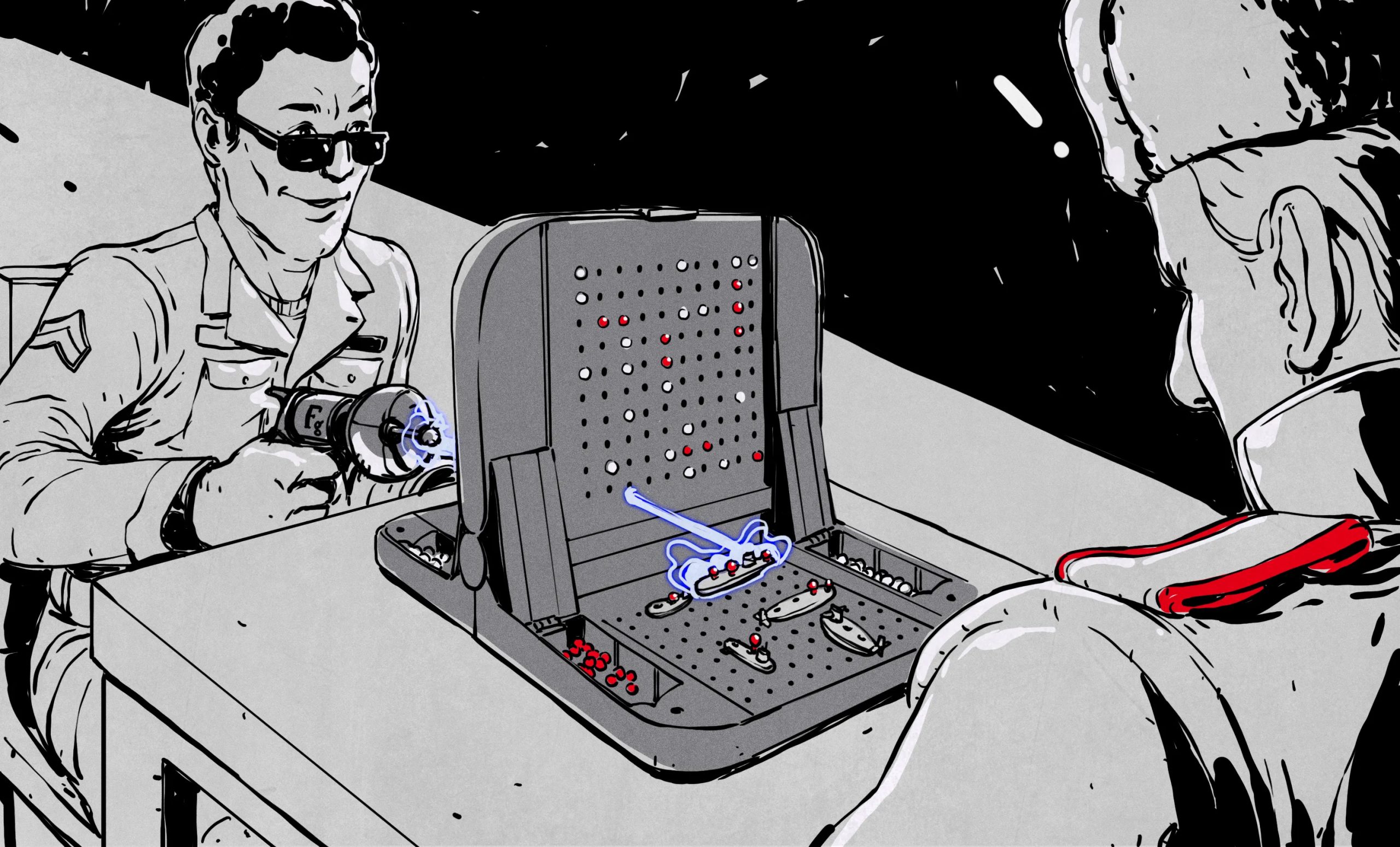
Among so many other technological advances, the Cold War saw the advent of the ballistic missile submarine. The concept was simple—pack enough nuclear warheads to destroy a small civilization into a compact metal tube, and then hide it underwater. The oceans would act as a cloak for your fleet of world-enders, and keep your enemies forever on their toes. A terrifying machine that could both start and end a war with the push of a button.
Most nation states are populated by humans with the will to live. Thus, there has been a great incentive to find ways to keep tabs on these sunken doombringers. Great efforts have gone into improving sonar and magnetic detection methods over the decades, which are the bread and butter of sub hunting to this day. However, military researchers have also explored the prospect of whether submarines could be detected via their effect on the gravitational field alone.
Do You Feel It?
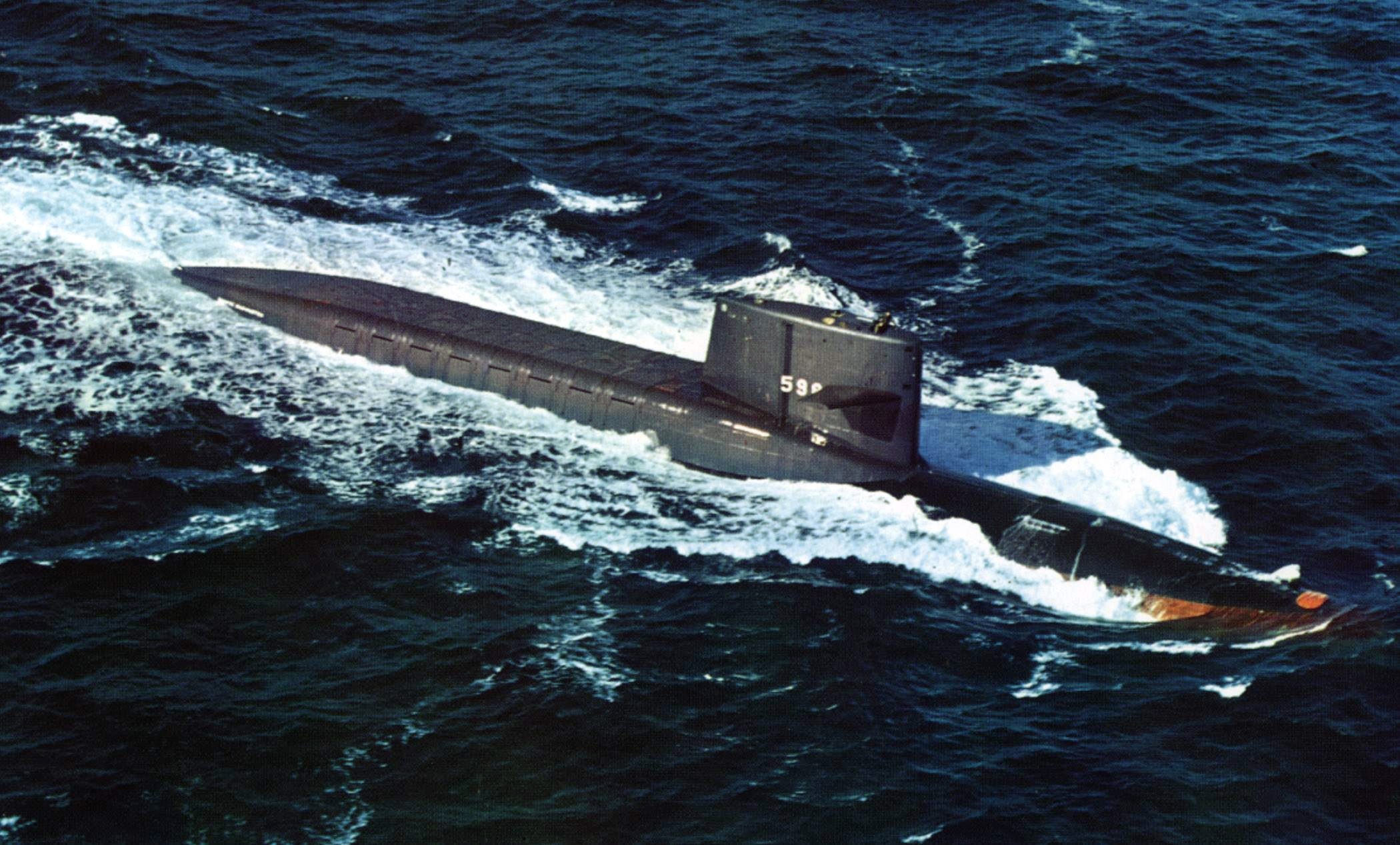
Ballistic missile submarines can carry enough nuclear weapons to ruin almost everybody’s day, all at once. Thus, there is a great incentive for novel solutions on how to keep track of them. Credit: US Navy, public domain
The simple matter is that every object with mass has its own gravitational field. We don’t typically think about it, because gravity is the weakest of the fundamental forces. On anything less than a planetary scale, it’s generally not obvious to us in our daily lives. However, submarines are quite heavy and large, particularly those that are armed with a complement of nuclear-capable ballistic missiles. Thus is raised the prospect of detecting these massive objects via their perturbations to the local gravitational field. This has been a hot-button news item in military commentary circles of late, with much bluster that advanced measurement equipment could potentially render the ocean transparent and reveal the locations of submarines at great distances.
Naturally, it’s difficult to comment accurately on top-secret military capabilities from a civilian viewpoint. Such a technology would be game-changing in a strategic sense, to the point that any nation state with such a capability would have great reason to keep its existence strictly hidden. However, there is some literature on the topic that is in the public domain, which discusses just how hard this feat would be to execute in practice. A great example is a report prepared by the Pacific-Sierra Research Corporation in 1989, under the sponsorship of the Naval Air Development Center.
How It Works
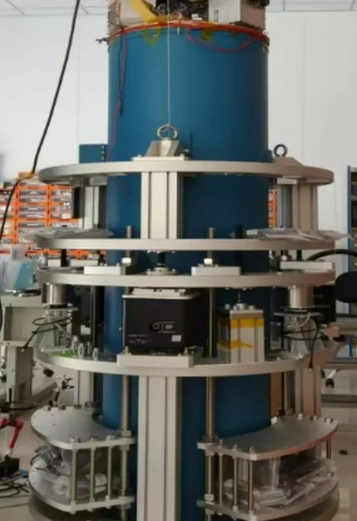
A Chinese research effort has built a gradiometer of great sensitivity, which lead to widespread speculation around its potential military applications. Credit: CAS
When it comes to detecting the gravitational anomaly of a submarine, you might think it would be easy given the sheer mass of such a craft. However, the way submarines operate frustrates this at a very fundamental level. In normal operation, a submarine is neutrally buoyant, displacing an amount of water roughly equal to its own mass. Thus, the submarine is not really distinguishable from the water around it in terms of its first-order effect on the gravitational field, being roughly as heavy as the water that would otherwise be there.
There is a wrinkle, though, in that a submarine is bottom-heavy for the sake of stability. This does create a variance in the gravitational field versus the otherwise uniform field in open water, and it’s one that could theoretically be detectable with a sensitive enough apparatus.
Advertisement
The device used for measuring gravitational variation is called a gravimeter. They are essentially a special-case variant of accelerometer, specifically designed to very accurately measure the local acceleration due to gravity at a single point. Then there is the gravity gradiometer, which measures the spatial rate of change of gravitational acceleration. By virtue of measuring acceleration gradients, a gradiometer is not sensitive to the acceleration perturbations of a moving platform, making it particularly useful for use in a moving frame of reference such as towing behind a ship or aircraft. Various types of each instrument exist, from portable units to high accuracy laboratory instruments; creating an exhaustive list of all variants is outside the scope of this article. The real question is, based on the gravitational anomaly generated by a large submarine, to what useful range could a gravimeter or gradiometer detect one?
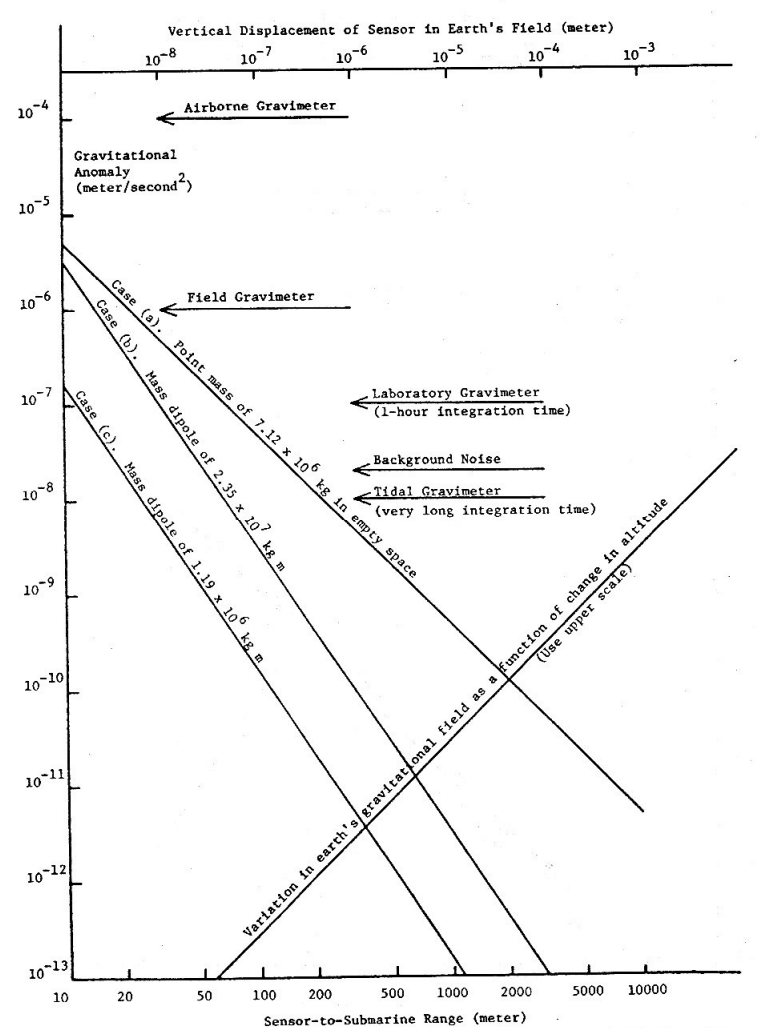
A graph highlighting the challenge of detecting submarines via gravimetry. In 1989, the best gravimeters might have been able to detect a submarine within 30 meters or so—a militarily useless figure. There have been improvements in technology since, but short of an increase in capability of many orders of magnitude, gravitational methods of detection remain difficult to execute at range. Credit: research paper
Unfortunately, the maths says that you have to get very, very close. In the 1989 study, calculations suggested the best gravimeters and gradiometers in the world would maybe be able to pick up a large submarine from a distance of tens of meters, at best. The simple problem being that the gravitational anomaly generated by an underwater submarine, and the gradient of that anomaly, are both so small, that even highly sensitive instruments would struggle to pick it up when the submarine is practically in visual range. Even if the problem were simplified, and one were trying to detect a submarine as a heavy point mass in empty space, detection ranges would stretch to somewhere in the range of 100 meters at most. Of course, this would be largely irrelevant due to the neutral buoyancy considerations explained above.
It’s true that technology has moved on since 1989. We have more advanced gravimeters and gradiometers available now, including quantum units with greater sensitivity than ever. And yet, even with these advances, it would be still be a struggle to detect a submarine at useful range. Sensitivities would have to jump by four or five orders of magnitude to enable detection at ranges of 1000 meters. Even still, if this were achieved with some highly classified system, it would still be relatively limited in capability versus more established techniques in magnetic or acoustic detection.
The parameters of the problem, combined with the sheer weakness of gravitational forces, means that gravitational detection is not some silver bullet for tracking enemy submarines at great range. While it would be desirable to have some kind of sensor that could reveal where these nuclear weapon platforms are lurking at all times, that technology seems beyond the reach of even the most capable navies at this time. For now, strategic planners will continue to sweat over the threat these weapons pose, never quite knowing whether they’re lurking just off the coast or half a world away.
e2Value co-founder Todd Rissel argues that AI-powered property valuation only works when grounded in decades of historical context, construction trends, economic cycles, and shifting cost environments, that shape what replacement cost actually means today.
For many participants across insurance and property ecosystems, current valuation challenges did not emerge from a single moment or event. Multiple economic cycles, demographic shifts, evolving construction practices, and changing consumer expectations have accumulated over time, creating a landscape that can sometimes feel difficult to fully trace. Limited visibility into how these layers developed has made present-day valuation conversations increasingly nuanced. Within this environment, e2Value has focused on studying the long arc of property intelligence, using historical context alongside modern technology to support a more informed view of valuation.
Advertisement
Current discussions around property valuation often begin with present conditions, although a broader historical lens offers an important perspective. “In earlier decades, people generally saw homeownership through a simpler financial lens,” Todd Rissel, co-founder and CEO of e2Value, says. “A house was viewed as simply a place to live, and estimating its value tended to feel more straightforward because prices, replacement costs, and household budgets usually stayed closer together.”
Over time, economic expansion, rising residential values, and changing patterns of household wealth introduced additional layers of complexity. According to Rissel, during the 1980s and 1990s, evolving building standards, energy-related considerations, and increased private investment into residential markets contributed to an environment where homes became larger financial commitments for many families. Property ownership increasingly carried dimensions extending beyond shelter and into long-term wealth accumulation.
As these changes unfolded, distinctions between purchase price, market value, replacement cost, and appreciation became more difficult for consumers to separate. A home’s purchase price could reflect market demand and neighborhood dynamics, while replacement cost involves an entirely different calculation based on the availability of labor, quality of materials, and local market conditions.
Rissel offers a broader perspective on this evolution. He says, “Every economic era leaves behind a set of assumptions that people tend to hold onto. Those assumptions can keep shaping decisions long after the conditions that formed them have shifted.”
Additional economic developments introduced another layer of complexity. For many years, rising incomes and broad access to capital moved alongside increasing property values. Following the financial disruption of the late 2000s, that relationship entered a different phase. Property values remained elevated across many regions while access to capital moved through a period of recalibration, creating a longer-term adjustment across housing and financial systems.
Advertisement
Valuation standards increasingly became part of a larger conversation involving affordability, underwriting, and risk assessment as those conditions continued to develop. Consumers often encountered difficulty distinguishing between the value associated with purchasing a home and the cost associated with rebuilding that same structure.
Present conditions reflect the accumulation of these historical developments. According to Deloitte’s 2026 Insurance Industry Outlook report, insurers are navigating expanding complexity linked to catastrophic events, changing customer expectations, and rapidly evolving technology environments. The report also notes that technology priorities are increasingly focused on strengthening data foundations and creating systems capable of supporting meaningful AI implementation.
This progression naturally brings AI into the discussion. Across insurance ecosystems, AI has generated significant interest because of its ability to process extensive amounts of information and identify patterns across large datasets. EY reports that many senior leaders are reevaluating enterprise AI strategies with greater emphasis on long-term value creation, data quality, and future adaptability.
Still, technology itself represents only part of the equation. AI systems rely heavily on the information used to train and guide them. Historical context becomes particularly important because valuation is influenced by decades of construction practices, regional patterns, economic cycles, and changing cost environments.
Advertisement
Rissel explains this relationship through a broader lens. “Technology can organize and process information at remarkable speed, although meaningful insight often begins with understanding where the information originated and why it matters,” he says. “Data gains value when context travels alongside it.”
This perspective aligns closely with e2Value’s own role within the valuation ecosystem. Since its founding in 2000, the company has focused on preserving historical property intelligence while integrating modern modeling capabilities into its valuation platforms. That role extends beyond creating software designed to generate estimates.
“We’ve spent years examining how structures behave as economic assets that are influenced by construction practices, local market dynamics, material costs, labor conditions, and broader macroeconomic patterns,” Rissel shares. Through that work, the company developed valuation methodologies intended to reflect the larger environment surrounding a property instead of viewing a structure only as an isolated collection of components.
That perspective has also influenced how e2Value interacts with different parts of the insurance ecosystem. Across underwriting, risk evaluation, claims environments, and portfolio management discussions, valuation increasingly functions as a source of insight that supports larger decisions. Replacement cost estimates can influence coverage discussions, portfolio assessments, and broader conversations surrounding risk exposure. As data expectations continue expanding across the industry, connecting those elements within a unified framework has become increasingly important.
Advertisement
Overall, the long arc of valuation shows that today’s complexity is a product of decades of shifting economics, construction practices, and consumer expectations. As Rissel emphasizes, assumptions formed in earlier eras still shape how people interpret value, even as conditions evolve. In this environment, e2Value helps insurers, underwriters, and property stakeholders navigate a landscape where replacement cost, market value, and risk are increasingly intertwined by grounding advanced modeling in the context that gives data meaning.
An anonymous reader quotes a report from Reuters: Elon Musk’s Starlink and Amazon’s low-earth-orbit satellite business may be able to acquire some European mobile satellite spectrum next year, two people with direct knowledge of the matter said on Tuesday. But they said two-thirds of the satellite spectrum that allows mobile devices and vehicles to communicate seamlessly even in remote locations, would be reserved for European companies.
U.S. companies Viasat and EchoStar hold licenses that are due to expire in May 2027 and the European Commission has been considering how to allocate future spectrum at the same time as the bloc pushes to reduce reliance on U.S. tech. The European Union’s IRIS2 multi-orbit array of 290 satellites, a response to Starlink, will be among the European companies to receive some spectrum, the sources said. British and Norwegian companies can also bid for a license, the people said. Details of the proposal, set to be announced on Wednesday, could still change at a meeting of commissioners on the day, one of the sources. Commission spokesman Thomas Regnier said EU-wide satellite connectivity was “synonymous with resilience, security, and capability” given the current geopolitical context.
“Satellite connectivity is a key piece of our technological sovereignty, our security, and our defense, as also highlighted by IRIS2,” he added.
What do you do when you’re one of the world’s top Smart TV and Connected TV platforms? You double down on what people love about your system while making the whole user experience even more streamlined and personalized for each individual viewer.
While Android TV/Google TV may lead the global streaming TV platforms in overall market share, Roku is #1 in North America, with more than a third of all streaming viewers. With a combination of streaming sticks which can turn any TV into a Smart TV, Roku branded Smart TVs and partnerships with TV makers such as Hisense, Philips, and ONN, Roku has established itself as the go-to streaming platform for over 100 million TV viewers and movie lovers.
While alternative Smart TV platforms like Amazon’s Fire TV and Google TV tend to push certain streaming services or shopping services over others, Roku has earned high marks from its users for providing a more service-agnostic user experience. And the company seems to be leaning into this philosophy with significant updates to its user interface.
A panel of Roku executives discuss what went into the Roku’s new Home Screen.
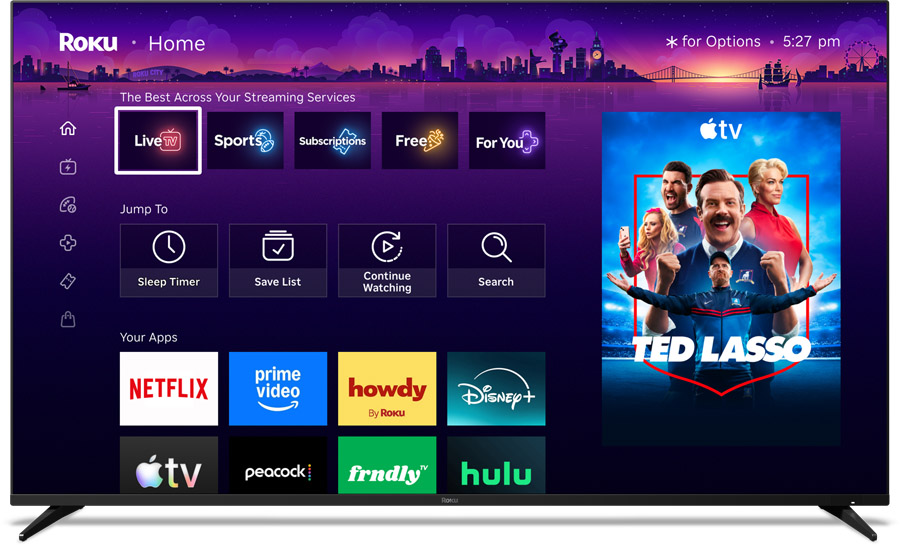
At an event in New York City this morning, Roku unveiled a new version of their Home Screen which promises a more dynamic, smarter experience. Featuring more relevant recommendations and faster pathways to content, the new Roku Home Screen is designed to reduce friction, maintain Roku’s signature simplicity, and help viewers find their next favorite movie or TV show with ease.
While Roku typically makes running tweaks to their user interface and home screen to improve the overall user experience, today’s update to the Home Screen is the most substantial and significant update we’ve seen to the platform in the past ten years.
Advertisement
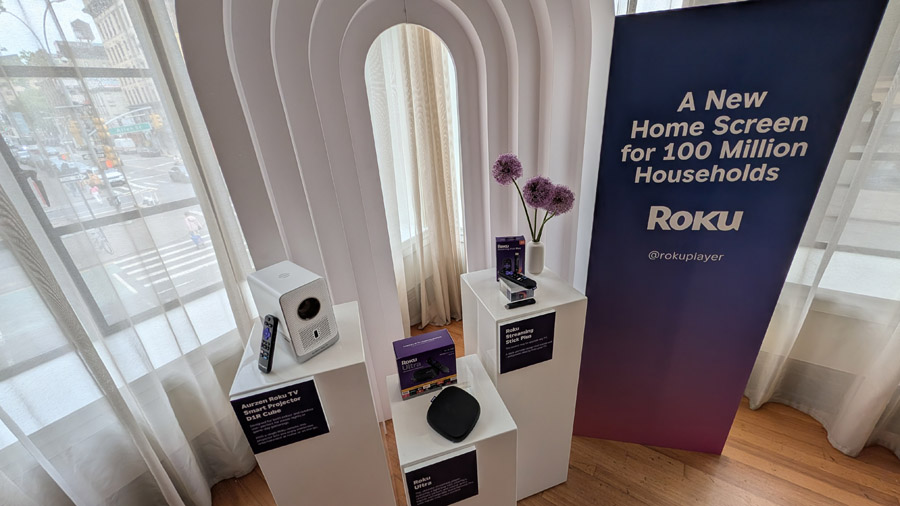
Roku is now available in projectors, TVs, streaming sticks and streaming boxes. The company had several of these on display at the launch event in Manhattan on May 27, 2026.
Company reps told us that the change wasn’t made just for the sake of change, but was informed by direct customer feedback as well as detailed analysis of viewer behavior, with the end goal of streamlining and optimizing the user experience. The new personalized Home Screen tackles the biggest challenges in streaming, while offering a tailored, content-forward way to start watching.
Roku executives at the event stressed that they wanted to make sure they maintained the snappy, responsive feel that Roku users love while improving every element of the user experience. The company has done extensive testing with employees, and actual customers over its development, even allowing customers to opt in early to explore the new features and provide feedback. to the development team along the way.
“When we set out to rethink the Home Screen, we knew we should listen to the people who use it every day,” said Anthony Wood, Roku’s Founder and CEO. “So we talked to the viewers, we tested extensively, and we pushed until the design and the data lined up for a meaningful update. Now, our new Home Screen puts entertainment at the center of everything, while staying true to Roku’s simple, intuitive roots. More than 100 million households will feel the difference the moment they turn on their TV—and it opens up a better, more powerful experience for our partners as well.”
To take things from abstract to actual, one specific data point was critical in inspiring this set of changes: A majority of Roku customers (82%) said they would love it if they turned on their TV and the show they wanted to watch was right on their Home Screen. The new Roku Home Screen does just that, recommending content based on the viewer’s past activity and interests, helping the viewer get up and watching the content they crave quicker. Out of the billions of potential Home Screen layouts, the new system is designed to offer just what you want to see, when you want to see it, for each individual viewer.
Preston Smalley, Roku’s Vice President of Viewer Product, told event attendees that the net effect of the change has been moving from a static Home Screen to a fluid experience that is more dynamic and personalized around each individual user and which changes based on evolving tastes and needs. In Preston’s words, “We want the UI to recede into the background. We want the content to really shine.”
Highlights of the New Home Screen Include:
Advertisement
Advertisement. Scroll to continue reading.
Quick Access for your most used apps, continuously adapting to your routine
An intelligence-driven and expanded content-first “Top Picks for You” section
New genre-based destinations such as:
“For You,” built on your interests and filled with fresh personalized picks
“Subscriptions,” allowing for a convenient way to browse and discover from across all your subscriptions in one place
Search in key destinations with relevant suggestions and results
A streamlined collapsible menu
Elevated shortcuts for everyday actions including Save List, Continued Watching, and more
“Your Daily Scoop,” a dynamic row that brings you a curated digest of breakout shows and cultural trends
A “Roku City” tile, taking you to an interactive version of your favorite screensaver
The new Roku Home Screen begins rolling out today (May 27, 2026) across all Roku TVs and streaming devices in the United States. Expansion to additional countries will follow in the coming months.
The Bottom Line
Any time we hear about a major user interface redesign rolling out to all devices, we wonder whether it will be a home run, which users of the platform embrace, or it will lead to the disaster that plagued Sonos just a few years ago. From what we saw at the event, we believe the new Home Screen redesign builds on the simple service-agnostic user interface that has built up Roku’s loyal fan base over the years. If the rollout goes well, these changes should help cement the platform’s popularity in the coming years.
The Portal app lets you stream PS5 games to Apple Vision Pro in stereoscopic 3D with 4K upscaling. Here’s how it works, what I’ve been playing, and whether it’s worth the premium subscription.
Apple Vision Pro is an excellent gaming platform, at least when you can find games to run on it. While I’d prefer to have a great selection of VR games, the ability to use PlayStation Remote Play is a decent middle ground.
I’ll say up front that playing PlayStation 5 is still best on a home entertainment system with good audio and video. However, the Portal app makes Apple Vision Pro a close second option.
The app is available on iPhone, iPad, and Apple Vision Pro. There is a premium subscription, and it is a bit pricey, but it’s totally worth it for the functionality.
Advertisement
The app will let you stream from the PS5 in 1080p at 60fps for free. If you want all of the bonus features, you have to pay $5.99 a month, $59.99 a year, or $199.99 lifetime.
I’m fairly tempted by that lifetime offer, but for now I’m paying monthly when I know I’ll have time to use the app. Perhaps this developer would benefit from adopting Apple’s new annual lock-in subscription option.
What you can do in Portal
Portal can be used to access PlayStation and Xbox cloud gaming, PlayStation Remote Play, and even UVC play via the Apple developer strap. This story is focused on PS Remote Play.
The reason I’m writing about Portal is because it has some unique features just for Apple Vision Pro that I haven’t seen in any other app.
Advertisement
Its premium features include:
GPU-based 4K upscaling
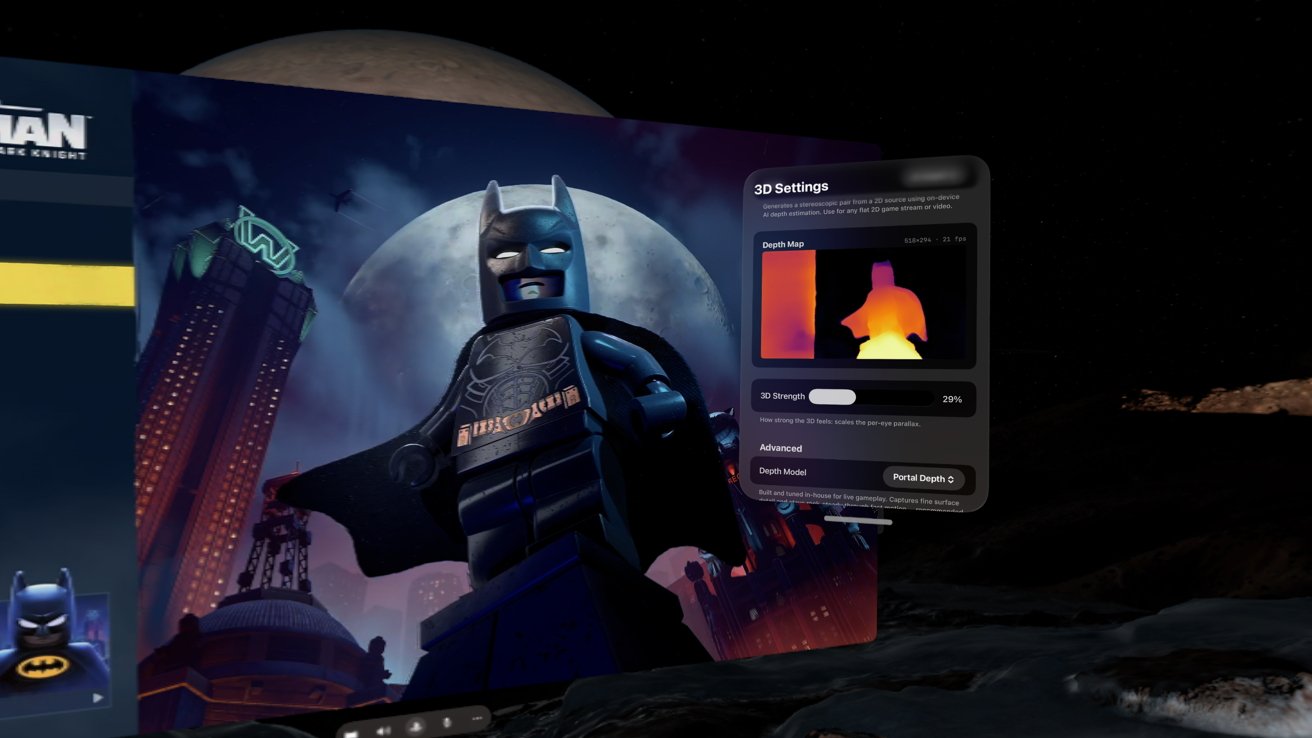
3D depth map conversion using AI
Super Frame Rate at 120FPS using ML enhancements
HDR streaming output
Immersive mode with large display
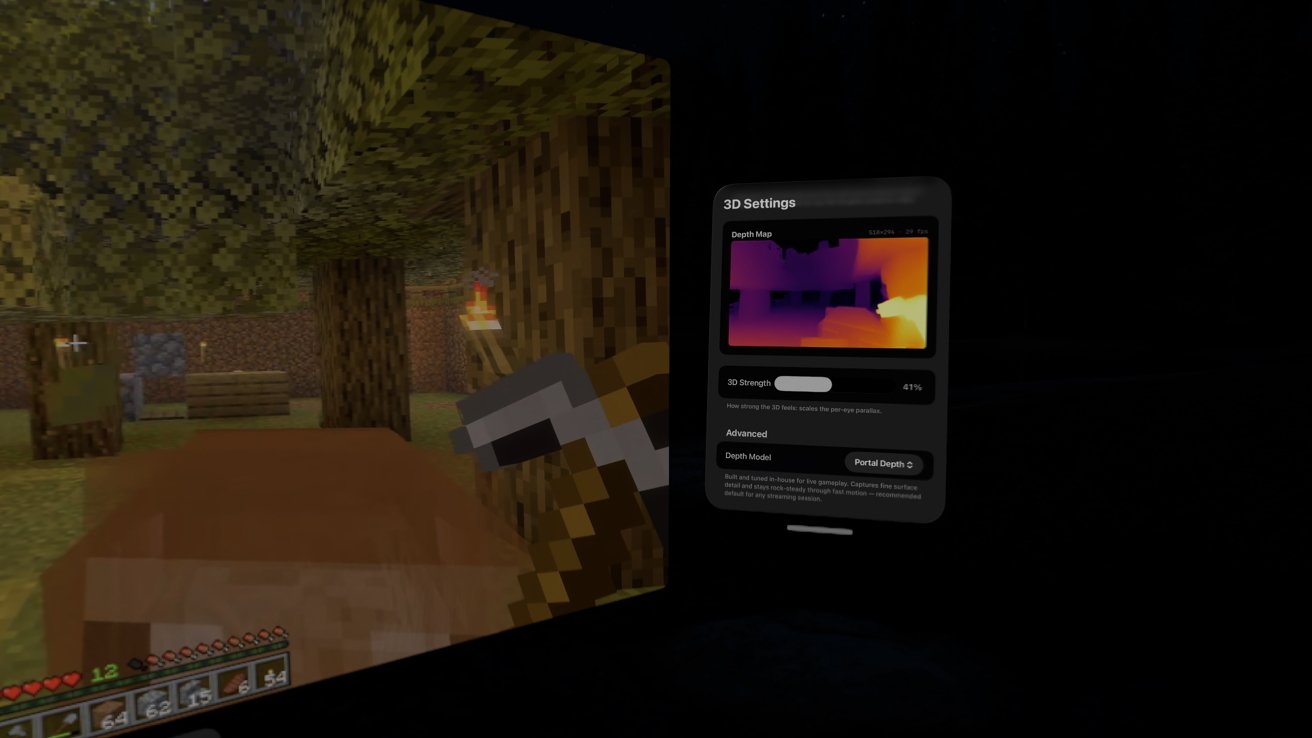
You can absolutely use 4K upscaling and stereoscopic 3D in tandem. However, try to activate 3D and Super Frame Rate and you’ll hard crash the Apple Vision Pro, so don’t do that.
So, using these settings, I am able to stream my PS5 Pro to Apple Vision Pro in a 4K-equivalent stream while viewing the content in stereoscopic 3D. It’s quite the experience, especially in the immersive view.
Generating a 3D depth map on the fly with AI processing
I do wish the immersive view included the ability to have the display hover over the lake in Mount Hood, but I’m sure that’s a limitation due to it not being video.
Advertisement
The 3D effect isn’t perfect, but it’s enough for now and will likely get better in the future. I’ve had worse 3D experiences on actual 3D TVs with active glasses, to be fair.
I tested the features in Minecraft. Yes, the 15-year-old game that I still play regularly on my PS5 Pro. Fight me.
The 3D rendering was interesting. It made the UI pop out as the top level, and everything else gained some depth.
You can control the depth settings, so set it to the point that looks best for your eyes. I’ve found that less is more when it comes to the depth intensity slider.
Advertisement
‘Lego Batman’ looks great with 4K upscaling and 3D depth
I also played the new Lego Batman game with the 3D setting. Since this is a newer game with incredible details in the Lego bricks (sounds silly, but trust me), the 4K 3D really popped.
While I’m not going to go out of my way to play PlayStation games this way, I do think this is an excellent alternative to playing in my den. Perhaps if I want to play in my bedroom or if the den TV is otherwise occupied, I know I’ll have a way to enjoy my PS5 games with a whole new dimension added on top.
Portal is an excellent example of what can be accomplished on Apple Vision Pro, and I’d love to see more apps like it. Let’s hope Apple can attract more developers to the platform with WWDC 2026.
Advertisement
If anything, this has made my desire for a native version of Minecraft specifically for Apple Vision Pro even greater. I know Microsoft won’t bother, but at least I have a good way to play it in the meantime.
For more on Vision Pro gaming, watch for Mike Wuerthele’s piece on Steam streaming — including a 3D SteamVR test with a new video card.
According to a new survey from GBAO Strategies distributed by the United Food and Commercial Workers International Union, 65% of American voters think ESLs will cause grocery prices to increase, while 68% think surveillance pricing will have the same result. Read Entire Article Source link
Third-party UK Visa Portal website exposed 100,000 docs in an unsecured cloud repository
Cybercriminals with access to the affected PII could conduct identity theft or fraud
Victims advised to protect and monitor accounts, and await notification
UK Visa Portal, a third-party website separate from the official government offering, has reportedly left thousands of highly sensitive documents exposed in a major data leak.
Affected documents and details include passports, photos, verification selfies and other application information, leaving victims widely open to identity theft and potential financial fraud.
The issue happened as a result of documents being stored on an unsecured server without password protection, meaning anyone with a direct link could access and view them.
Latest Videos From
Advertisement
UK Visa Portal applications exposed
The data exposure was caused specifically by a misconfigured cloud storage repository that was entirely public – but worse than that, it’s also been revealed that the file directory structure allowed used a predictable URL, meaning attackers could easily guess or work out the link even if they didn’t have it in the first place.
Most evidently, primary passport pages exposing full names, passport numbers, nationalities, dates of birth, places of birth, and issue and expiry dates were included in the leak, but accompanying documents providing home addresses, contact numbers, email addresses and more provided attackers with even more PII.
TechCrunch reports at least 100,000 documents were available without restrictions, and as of May 26 2026, the issue had still not been addressed.
Many victims likely accessed the third-party website erroneously, believing this was the correct way to obtain an Electronic Travel Authorization – a process that the UK government offers in-house for a £20 fee.
Advertisement
Sign up to the TechRadar Pro newsletter to get all the top news, opinion, features and guidance your business needs to succeed!
Individuals who may have used the platform are being advised to monitor and protect their credit accounts and to secure online accounts with additional layers like multi-factor authentication and passkeys. Data protection laws also legally require affected individuals to be notified – it’s unclear if contact has already been made.
Karin Verspoor of RMIT University explores how AI is impacting research in STEM.
Many of the most exciting discoveries in science involve highly specialised knowledge and making connections between far-flung facts. Scientists must combine deep analysis with broad reasoning strategies.
As in many information-rich tasks, researchers are looking to artificial intelligence (AI) systems to speed up their work. AI tools may be able to support key steps such as generating ideas, reviewing existing work and analysing data.
The latest systems use large language models (LLMs) to allow scientists to interact naturally and directly with the vast body of knowledge captured in words in the scientific literature.
Advertisement
But as twonew systems described in papers just published in Nature show, when it comes to science, language alone can only go so far.
What AI is doing to science
A number of organisations, such as Sakana AI, are trying to automate the entire scientific process. To date, these efforts have largely focused on computer science, where ‘experiments’ mainly involved designing and writing code.
However, the Agents4Science conference organised at Stanford last October showcased a broader range of AI-generated papers. They covered topics from mechanical engineering and protein design to a system called BadScientist which deliberately produced “convincing but unsound” research.
AI systems clearly can’t be trusted to conduct the full process of science on their own. But how about using AI to help scientists get more done more quickly?
This is the intent of the two new systems described in Nature: Robin, made by non-profit Future House, and Co-Scientist, from Google DeepMind.
Both systems aim to accelerate scientific discovery, working in collaboration with a scientist. Both are also ‘multi-agent’ AI systems, meaning they are built as a collection of specialised agents each targeting specific steps of the scientific discovery process, coordinated by a ‘supervisor’ agent.
The agents that comprise Co-Scientist aim to mirror abstract cognitive tasks, such as a ‘reflection agent’ that acts as a critical scientific peer reviewer assessing the quality of a hypothesis. ‘Ranking agents’ debate research hypotheses in ‘tournaments’, using multiple interacting LLMs to simulate a discussion about the relative merits of two hypotheses.
Advertisement
Robin’s agents, on the other hand, are more tuned to specific tasks relevant to drug repurposing, aiming to identify new drugs for a given disease. One agent focuses on selecting experimental tests, while another analyses complex biomedical data.
How do the results stack up?
Co-Scientist can assess the quality of its generated proposals, using a method called the Elo rating which is best known for ranking chess players. Co-Scientist’s self-ratings of the novelty and impact of its outputs align quite well with the preferences of human experts and judgements by other LLM systems.
In a drug repurposing experiment, Co-Scientist selected 30 drug candidates as promising treatments for a kind of cancer called acute myeloid leukemia. Expert (human) oncologists refined the list, and five drugs were tested in the lab. Of these, three showed some positive results and one seemed to show particular promise.
Other experiments showed the potential of Co-Scientist to explore combinations of multiple drugs.
Advertisement
Notably, the predictions of Co-Scientist were not compared with the plethora of targeted computational and machine learning methods for drug repurposing that have been developed over decades of computational biology research. This means we don’t know whether the new general-purpose tool outperforms more specific AI approaches.
Both systems stop short of validating their hypotheses directly, which would involve real physical experiments. Both also rely heavily on human input to define the key scientific question, sense-check predictions and prioritise predictions for further investigation.
Co-Scientist focuses primarily on generating hypotheses through elaborate reasoning agents, leaving validation and interpretation to subsequent steps. Robin also uses an agent to analyse data produced from real-world experiments.
Robin was used to propose 30 drug candidates for a condition called dry age-related macular degeneration. The top five were selected for testing.
Advertisement
Robin also made proposals for the experiments, with several suggestions overridden by the human scientists. Through several rounds of brainstorming and analysis, two drugs were identified as promising.
Testing of Robin’s individual agents showed those that dug through earlier research were better at the task than general-purpose LLMs. The analytical agent did less well on questions about statistics and bioinformatics, and relied heavily on human-supplied prompts.
The limits of language alone
AI can help scientists to navigate the vast amount of documented knowledge humans have acquired over the millennia. Use of computation to find patterns in large datasets, to integrate dispersed information, and to drive new discoveries from existing literature has already contributed to scientific progress for decades.
New models such as Robin and Co-Scientist represent a shift towards working directly in the realm of the language of science, rather than the realm of raw data. This allows more natural collaborations between scientist and machine, through language-based ‘discussions’.
Advertisement
However, more natural doesn’t necessarily mean more effective. Language-based communication can be imprecise and ambiguous, where science must be specific.
Models that combine the best of these worlds are on the horizon. These aim to link structured quantitative data to the concepts and relationships that describe the core facts beneath it.
Such models ground scientific reasoning in the structure of knowledge. They allow scientific evidence ranging from genomic sequences and protein structures to cellular imaging to be connected.
Words are how science is communicated. AI tools that facilitate making sense of the information that is hidden in all of those words are surely valuable. But the complexity of the natural world means that AI (co-) scientists will only be truly effective when they can go beyond connecting words together, to modelling the full complexity of the systems those words describe.
Karin Verspoor is dean of the School of Computing Technologies at RMIT University. She works at the intersection of science and technology, applying artificial intelligence methods to analysis and interpretation of biological and clinical data, focusing particularly on natural language processing of unstructured text data. She is a fellow of the Australian Academy of Technological Sciences and Engineering and the Australasian Institute of Digital Health. She is also the co-founder and Victoria node lead of the Australian Alliance for Artificial Intelligence in Healthcare.
Don’t miss out on the knowledge you need to succeed. Sign up for the Daily Brief, Silicon Republic’s digest of need-to-know sci-tech news.
As we get out of the house, the gear-obsessed WIRED Reviews team is writing about our favorite bags and EDCs. Today, reviewer Louryn Stramperaves about her Osprey Farpoint 40 backpack. You can also read other Bag Check stories where WIRED writers share their carryall of choice.
While planning our 20-day trip to Asia in 2018, my boyfriend at the time was adamant that neither of us would check any luggage. As a proud overpacker, this intention both shocked and horrified me. I love options and hate paring things down. I wanted to bring 30 pairs of shoes and 348 pairs of underwear; I certainly did not want to painstakingly build a capsule wardrobe and strategically compile packing cubes. Ultimately, though, I agreed to the single-bag trip, and the Osprey Farpoint 40 quickly converted me to legitimately loving the light-travel life.
If you want the perfect backpack, or the most durable suitcase, or the best tote for toting your toteables, my colleagues have plenty of recommendations worth browsing. But if you seek a bag that makes carrying-on (to the plane, train, or automobile) and carrying-off (from hotel to hostel to hotel again) a blissfully pain-free experience, the Farpoint is my favorite.
Photograph: Louryn Strampe
Osprey
Farpoint 40L Travel Backpack
Advertisement
During that nearly three-week trip in 2018, my boyfriend and I were constantly on the move, visiting Shanghai, Tokyo, Osaka, Kyoto, Busan, Seoul, and Hong Kong. We took multiple flights and trains, and we stayed in both spacious rooms and cramped quarters. In the years since, I’ve taken my Osprey Farpoint to the East and West Coasts of the United States. It’s lived with me in three homes, joined me on dozens of road trips, and stayed with me in hundreds of hotels. I’ve used it for trips as long as three weeks and as quick as a single night. I’ve thrown it down flights of stairs, sat atop it on subways, used it to shield my head from the rain, crammed it into overstuffed vehicle trunks, and packed it to the brim nearly every time I’ve taken it anywhere. It’s still working just as well as it did on that first trip.
Needless to say, this bag is cavernous. Its 40-liter capacity lets you load it up to the brink of being too hefty to carry, but I’ve never had a problem bringing it onto a plane, partially thanks to the compression straps that help you squish down the silhouette. (Per Osprey’s website, the Farpoint meets domestic carry-on size requirements.) And it offers so many pockets, they’re difficult to track.
The outer shell has two mesh spaces that are perfect for shoes or water bottles, plus a smaller compartment where I like to stash my keys and passport. The pack itself features two main chambers, the first of which is a laptop compartment, complete with a zippered sleeve ideal for an e-reader or a tablet. The largest body pocket features two built-in compression straps to help you achieve that “sit on the top of the suitcase to close it” effect once you’re ready to zip up. On the opposite side, there’s another zippered mesh pocket that spans the entirety of the shell, which I use to stash my socks, underwear, toiletries, and other items that I need handy but don’t want mixed in with my clothes.
Somehow, the Farpoint makes it not only possible but also comfortable to carry everything I might need. Yes, when you wear a stuffed-to-the-brim Farpoint, you’ll resemble a turtle peeking out from under a shell. But you won’t need to move slowly, thanks to its stabilizing design. The shoulder and hip straps are padded, and there are clip straps for your hips and chest. The chest strap also has a built-in whistle, which won’t necessarily boost your comfort, but it might come in handy if you’re hiking. (I mostly use the whistle for funsies or to bother my campmates at festivals.)
Samsung’s 10.5%-of-profit bonus formula is only the second written profit-share agreement at a major Korean firm. Kakao’s union is already asking for more.
Samsung Electronics’ unionised workforce voted in favour of the government-mediated pay agreement on Wednesday, formally closing the deal that narrowly survived an injunction filing from a smaller non-chip union on Tuesday. The vote settles, in the immediate term, the largest labour dispute in the global semiconductor industry.
The wider effect is more durable: the agreement marks the first major win for a Samsung union in the company’s 56-year history, and it is being read across Korean industry as a structural shift in how labour bargaining works.
The substance of the deal is what makes it unusual. Samsung has agreed in writing to allocate 10.5% of its semiconductor operating profit to special bonuses for chip workers. It is, on Reuters’ count, only the second time a major South Korean company has put a fixed-percentage profit-share commitment into a binding labour agreement.
Advertisement
The 💜 of EU tech
The latest rumblings from the EU tech scene, a story from our wise ol’ founder Boris, and some questionable AI art. It’s free, every week, in your inbox. Sign up now!
Some memory-division employees will receive total bonus packages worth around $416,000 over the agreement period. The non-chip Donghaeng union, which had filed the injunction at Suwon District Court, has signalled it intends to keep pressing for a revised allocation regardless of the vote.
The wider Korean labour picture has moved with it. Workers at Kakao and four of its affiliates have threatened to strike if their demands, including a 13–15% profit-share allocation, are not met. Other major Korean employers are reportedly fielding similar requests from their own unions.
Advertisement
The Samsung settlement has, in effect, created a precedent the rest of the chaebol system will now be benchmarked against.
Two structural conditions made the deal possible. The first is the AI-driven memory supercycle. Samsung’s memory division has been generating profits on a scale the company has rarely seen, and the gap between what the division produces and what its workers had been paid was visible to everyone involved.
The second is the loss of workforce to SK Hynix, where the AI-memory boom has been concentrated and where bonuses have been larger for years. According to the Samsung union, chip workers had begun leaving for SK Hynix in numbers that made the bonus gap commercially unsustainable.
The Korean chaebol bargaining model has historically been resistant to fixed-percentage profit-sharing on the grounds that it imports the cyclicality of the underlying business into the labour cost line. The Samsung deal accepts that trade-off: the bonus pool falls automatically when memory profits fall.
Advertisement
Workers, in turn, have agreed to the contingent floor on their payouts (memory must generate at least 200 trillion won between 2026 and 2028 and 100 trillion won between 2029 and 2035 for the full payout). It is a recognisably modern profit-share structure, of the kind Western technology firms have used for years, transplanted onto a chaebol balance sheet for the first time.
The political question is whether this is the start of a structural shift or a memory-cycle-specific anomaly. Korean economists have argued for years that the chaebol system’s relatively weak wage-growth performance during good years was a function of the labour-bargaining frame rather than of profitability.
The Samsung deal tests that argument empirically. If memory profits hold, the formula delivers genuinely large worker payouts and the new pattern spreads. If memory profits revert, the union side’s structural complaint, that a one-off cycle-linked bonus is not a sustainable wage policy, returns with it.
Samsung shares closed up modestly on Wednesday. The Korean labour ministry, which brokered the original agreement, said it expects similar mediated settlements at other major firms within months.






























































You must be logged in to post a comment Login