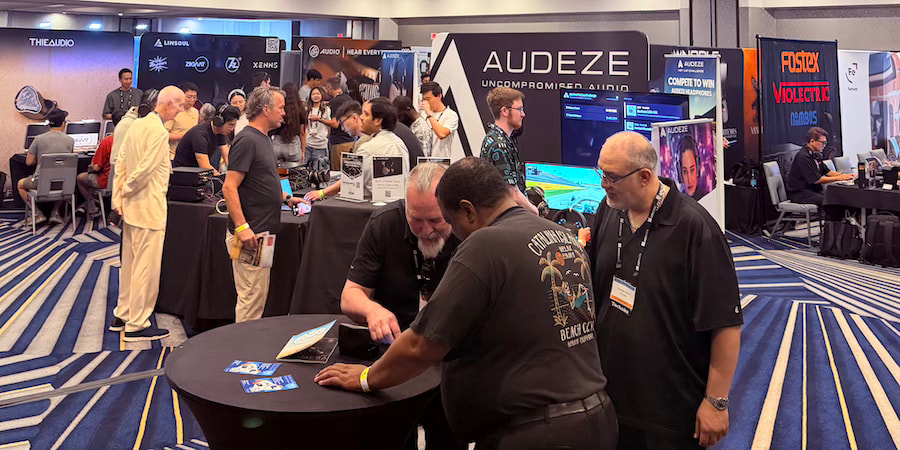
CanJam SoCal arrived a little earlier on the calendar this year, which may have beaten the usual avalanche of September product launches to the punch. The show at the Irvine Marriott felt larger than ever, both in attendance and the number of booths and listening rooms, but there were fewer headline launches from major brands such as Focal, Audeze, HiFiMAN, Dan Clark Audio and others than we have seen in previous years.
That doesn’t mean there wasn’t a lot of new gear. There certainly was. Much of the activity, however, came from smaller boutique manufacturers and the rapidly expanding IEM sector, where seemingly everyone has a new driver configuration, tuning philosophy or flagship that costs more than your first car.
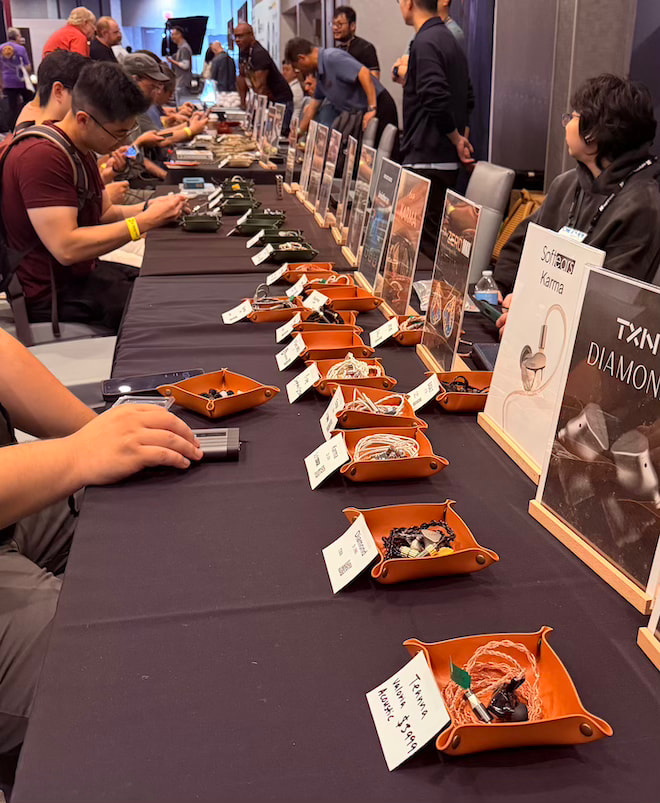
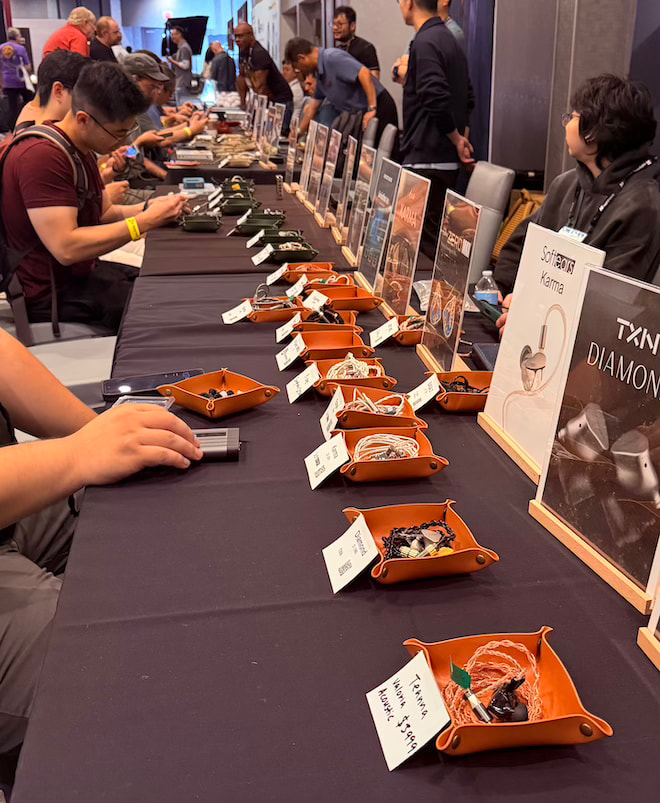
There was no shortage of IEMs at CanJam SoCal 2026
Our resident IEM expert, Aaron Sigal, tackled that increasingly competitive category in our separate CanJam SoCal 2026 IEM Roundup, leaving me to wander in the opposite direction. I quickly fell down the rabbit hole at the extreme high-end of Head-Fi, where the concept of a price ceiling has apparently been abandoned.
At the other end of the market, FiiO, Fosi Audio, iFi, SMSL, Topping, SIVGA and others continue to offer tremendous performance for the money. Personal audio is increasingly being pulled toward two extremes: remarkably affordable equipment that would have been considered high-end not that long ago, and flagship headphones, IEMs, DACs and amplifiers that can push a complete desktop system well beyond $50,000. Spend enough time in the wrong room at CanJam and $10,000 starts sounding almost reasonable. It isn’t.
Rather than chasing everything new, I used CanJam SoCal 2026 as an opportunity to hear products and complete systems we have not spent much time with before. These are show impressions rather than full reviews, and some of the listening environments were less than ideal, but the following systems were the ones I kept thinking about after leaving Irvine.
Advertisement
RAAL 1995 MAGNA EVO I + Allnic HPA-300B + D-15000 Signature DAC
System Price: ~$46,600
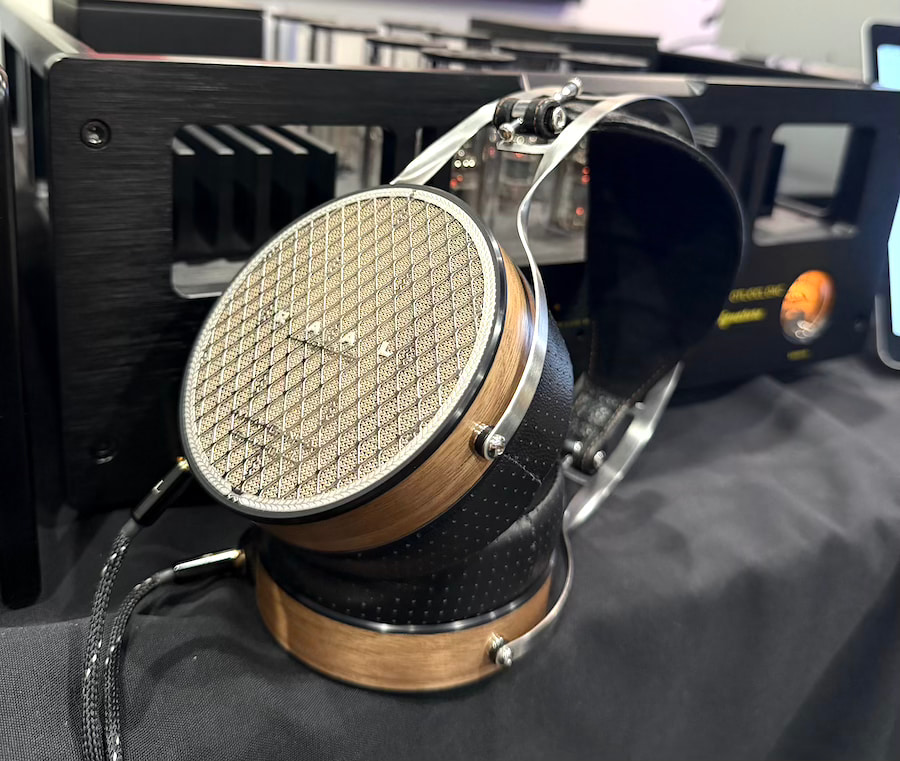
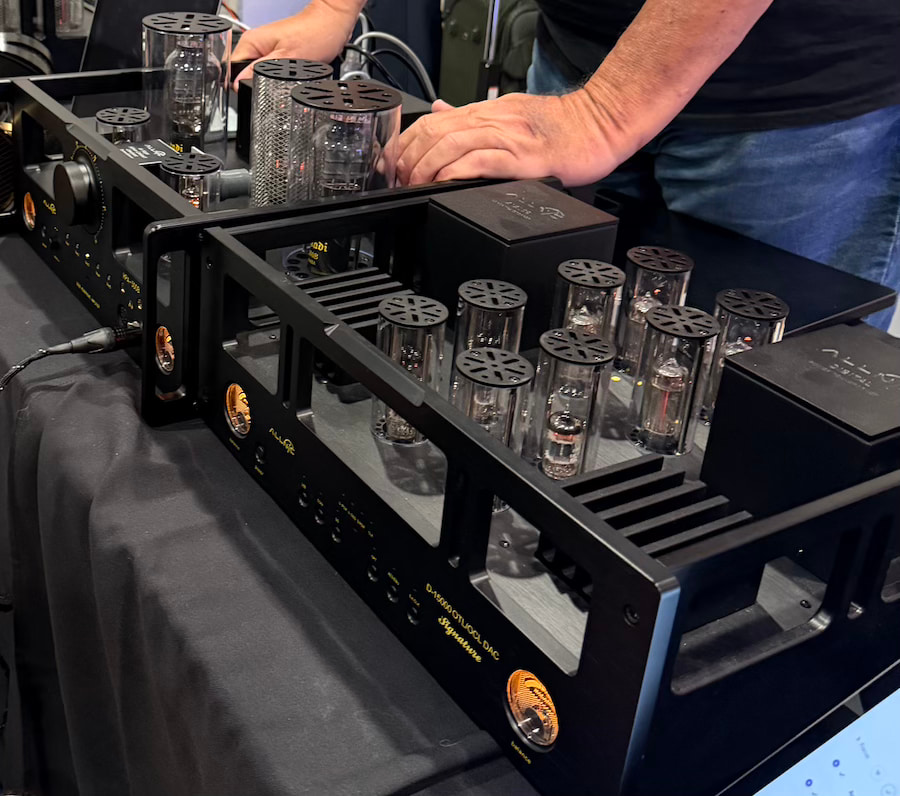
When cost is almost beside the point, there was something very special about listening to the RAAL 1995 MAGNA EVO I ribbon headphones, quoted around $7,000 in the show configuration, with Allnic Audio’s HPA-300B ($13,200) tube amplifier and D-15000 Signature OTL/OCL DAC ($26,400).
The MAGNA EVO I is not another planar magnetic headphone wearing a different hat. Its R²e1 transducer uses complementary tuned dual True-Ribbon drivers made from corrugated pure aluminum, with a combined 16.8 cm² surface area and a native impedance of just 0.038 ohms. That unusual electrical load requires either one of RAAL’s matching interfaces or amplification specifically designed for direct-drive operation.
That is where the Allnic HPA-300B becomes particularly interesting. The pure Class A amplifier uses a pair of 300B output tubes and can produce up to 8 watts, while a factory RAAL Direct Drive option can be specified at no additional charge. The D-15000 is equally unconventional, combining dual-mono ESS ES9039PRO DACs with Allnic’s full-tube OTL/OCL analog output stage.
The speed, detail and realism of this system were hard to overstate, but what surprised me was how little it sounded like the stereotypical analytical ribbon setup I expected. There was body, energy and real physical impact behind the presentation, without sacrificing the transient speed that makes ribbon headphones so compelling.
Advertisement
Was that the 300B tubes, the direct-drive implementation, the DAC or simply unusually good system synergy? Probably some combination of all four. I tried the MAGNA EVO I with a less expensive Allnic amplifier and an Immersiv DAC afterward, and while still excellent, the same drive and impact were not quite there.
Advertisement. Scroll to continue reading.
I also found the MAGNA EVO I more comfortable than RAAL’s flagship IMMANIS, which matters when the goal is to listen for hours rather than survive a 15-minute demonstration. At nearly $47,000 for the system, nobody is going to call this sensible. Mesmerizing is another matter.
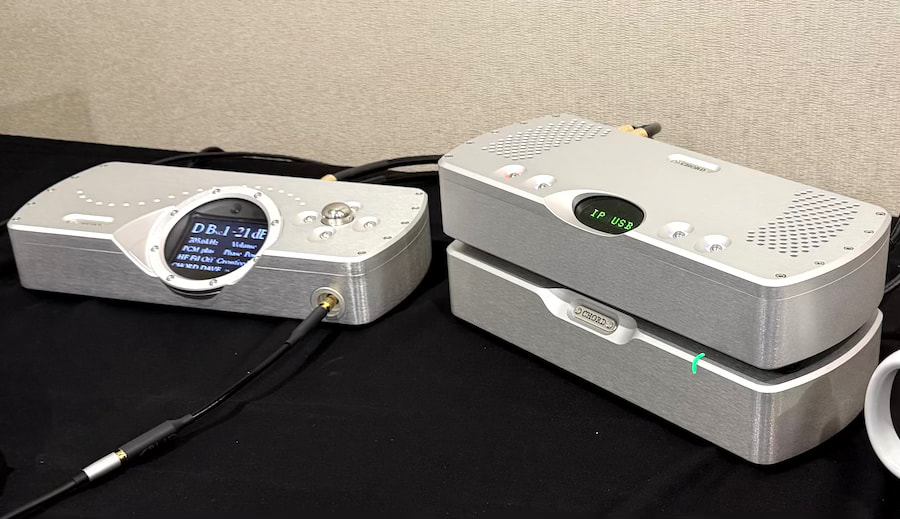
Chord Quartet + DAVE + Meze Audio ARTA
Chord Electronics DAVE (left) with QUARTET (right)
System Price: $56,895
Rob Watts spent years developing the Chord Electronics Quartet ($35,995), and there is considerably more going on inside it than the word “upscaler” might suggest.
Advertisement
Quartet uses Chord’s new four-million-tap Blackbird WTA filter running across five Xilinx FPGAs with 3,700 DSP cores. Chord says that represents roughly five times the FPGA processing power of its DAVE DAC, not that Quartet somehow makes DAVE five times better. Digital signals can be processed at sample rates up to 768 kHz, while an integrated Pulse Array ADC also allows analog sources to be converted and processed through the same architecture.
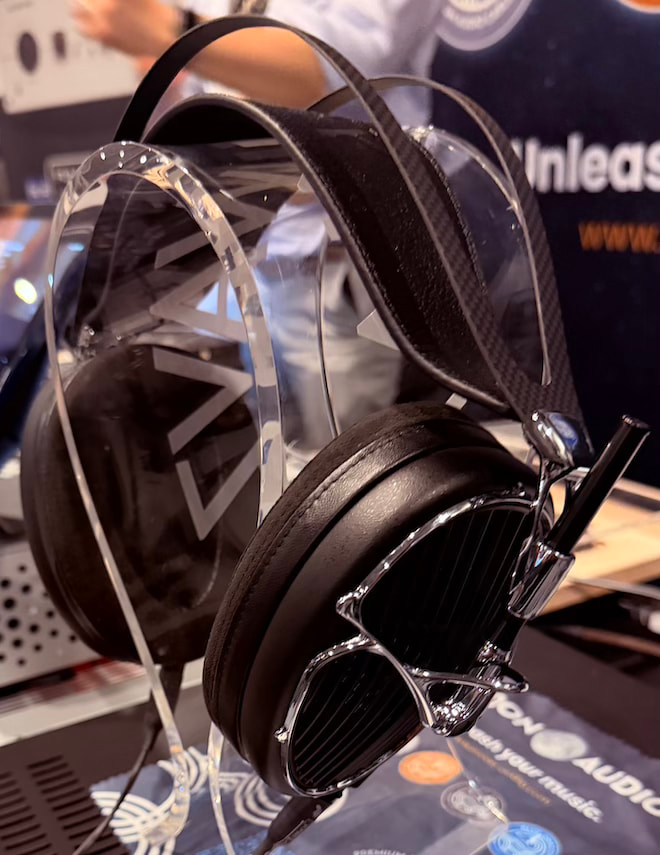
The CanJam system combined Quartet with DAVE ($14,900) and the new Meze Audio ARTA ($6,000). ARTA uses Rinaro’s MZ5 HΩ high-impedance planar magnetic driver, rated at 225 ohms and 98 dB SPL/mW. Unlike most modern planar headphones, it is designed around a high-voltage, lower-current operating model and benefits from serious desktop amplification.
Meze Audio ARTA (photo from Moon Audio Booth)
I was able to compare Quartet in pass-thru mode with its upscaling engaged, but the roughly three-second delay in the demonstration made rapid A/B comparisons difficult. The differences were subtle enough that I would not pretend a noisy show environment allowed me to define exactly what Quartet was doing to familiar recordings.
The more convincing demonstration involved a recording Chord had recently captured at Glenwood Studios using its developing A/D technology. Quartet itself incorporates Chord’s Pulse Array ADC, and the company is also exploring professional applications for the technology, although nothing beyond that should be considered a finalized product announcement.
What I heard was one of the most lifelike recordings I can remember hearing at an audio show. I have been fortunate enough to hear live feeds during recording sessions, and the immediacy of this demonstration reminded me of that experience more than conventional playback. There was an almost unsettling sense that the performers existed on the other side of the headphones rather than inside a recording.
Advertisement
Meze’s ARTA certainly deserves some of the credit here. Whatever one ultimately thinks about spending almost $36,000 on an upscaler, this was one of those demonstrations where I stopped thinking about the equipment for a few minutes.
Wow. Just wow.
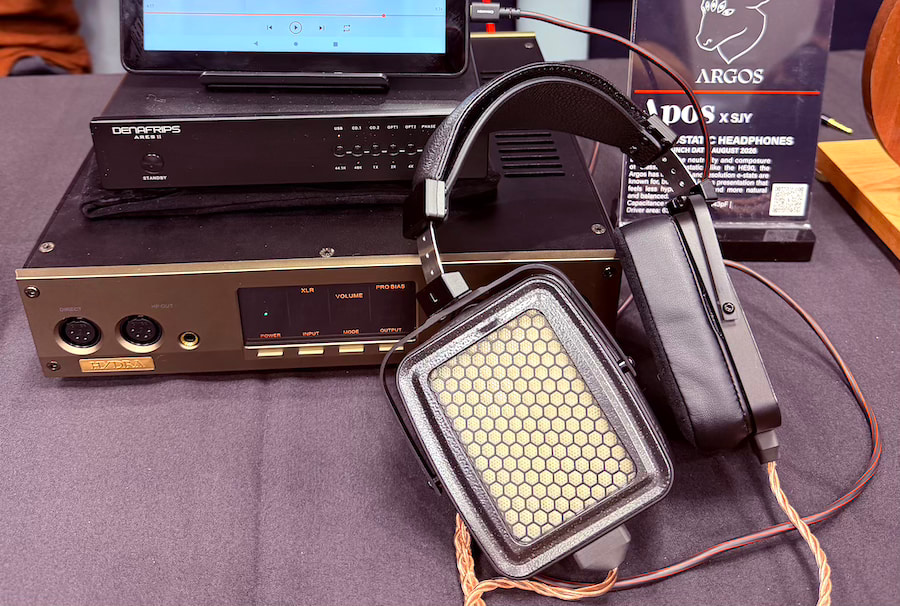
SJY Argos + Apos x ES Lab HYDRA + Denafrips Ares II
The source was a Denafrips Ares II, an older discrete R-2R DAC that offers both non-oversampling and oversampling modes. It originally sold for under $1,000, but its latest generation version, Ares 15th, retails for $1,199.
The Argos uses a 6,375 mm² electrostatic transducer operating at the standard 580V Pro Bias voltage and terminates in a conventional 5-pin electrostatic connector. At 431 grams without its cable, it is also considerably easier to wear than some of the more ambitious flagships crowding the category.
The HYDRA may be the more unusual component. Its dedicated electrostatic section supplies the required 580V DC bias through Japanese-made step-up transformers, but there is also a conventional Class AB amplifier producing 20 watts per channel into 8 ohms. That allows one chassis to drive Pro Bias electrostatics, dynamic and planar magnetic headphones, and suitable passive loudspeakers.
Perhaps it was system synergy again, but the entire setup was full of surprises. The Argos sounded exceptionally revealing and airy while retaining a slightly warm tonal balance, which is not something I automatically associate with electrostatics. Bass extension and weight were also far better than I expected.
Advertisement
Dave Brubeck’s “Take Five” became one of my regular comparison tracks during the weekend, and the drums and hi-hats through the Argos were exceptionally fast and convincing. The bass was not merely present; it was tight, textured and had enough weight to keep the recording from becoming another impressive but overly lean electrostatic demonstration.
The Argos and HYDRA cost $4,000 together before the DAC, which is certainly not inexpensive. Compared with some of the electrostatic systems occupying the summit of Head-Fi, however, this felt like one of the stronger system values at CanJam.
Grado Signature S550 + Chord Hugo 2
System Price: $3,590
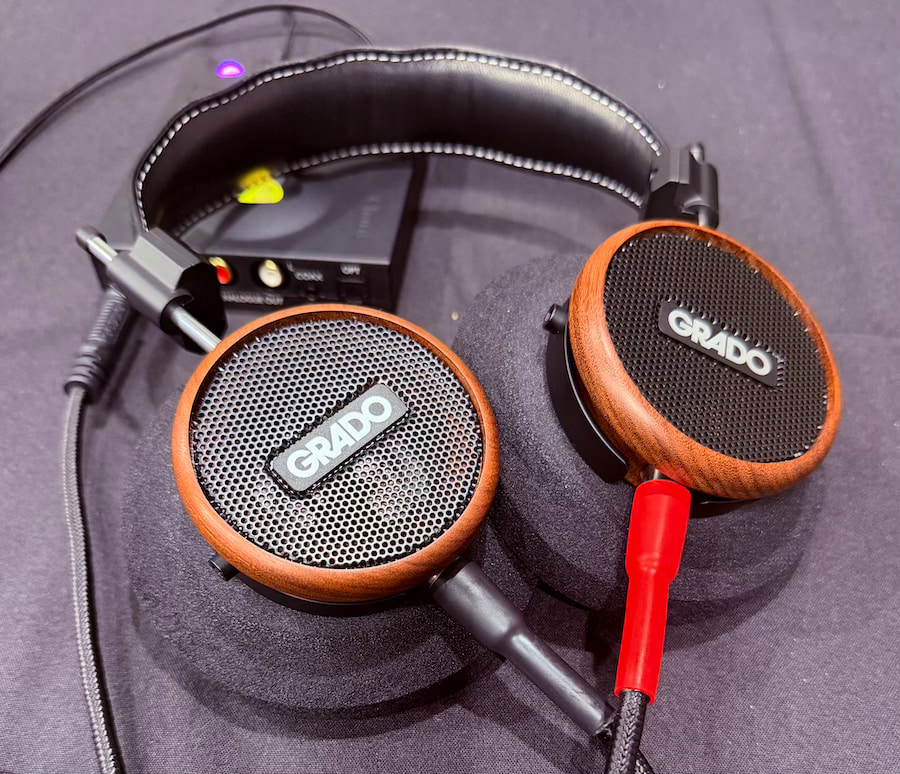
At $995, the Grado Signature S550 is currently the least expensive model in the company’s Signature Series, and pairing it with Chord’s Hugo 2 ($2,595) produced one of the more enjoyable and relatively sane systems I heard all weekend.
The S550 uses Grado’s 50mm S2 dynamic driver in an open-air design, with a nominal impedance of 38 ohms, 112 dB sensitivity and detachable Signature Silver cable. At 335 grams, it is also refreshingly light compared with many high-end planar and electrostatic designs.
Advertisement
The stock B cushions place the drivers very close to the ears, and the fit can feel snug until the headband is adjusted properly. That close positioning contributes to the immediate Grado presentation, but listeners who prefer a roomier fit can experiment with the larger G cushions. As with most Grados, changing pads also changes the presentation, so comfort is not the only variable.
Hugo 2 remains a remarkably capable partner despite having been around for years. Its FPGA DAC uses a 49,152-tap WTA filter and a Class A output stage, with enough flexibility to function as a portable DAC, headphone amplifier or desktop source.
The combination was rich, immediate and easy to enjoy. After spending time with systems costing ten or fifteen times as much, the S550 and Hugo 2 were a useful reminder that one does not have to approach the price of a compact car to assemble a seriously entertaining headphone rig.
Advertisement. Scroll to continue reading.
Advertisement
Relatively speaking, of course. We are still talking about $3,590 worth of headphone equipment.
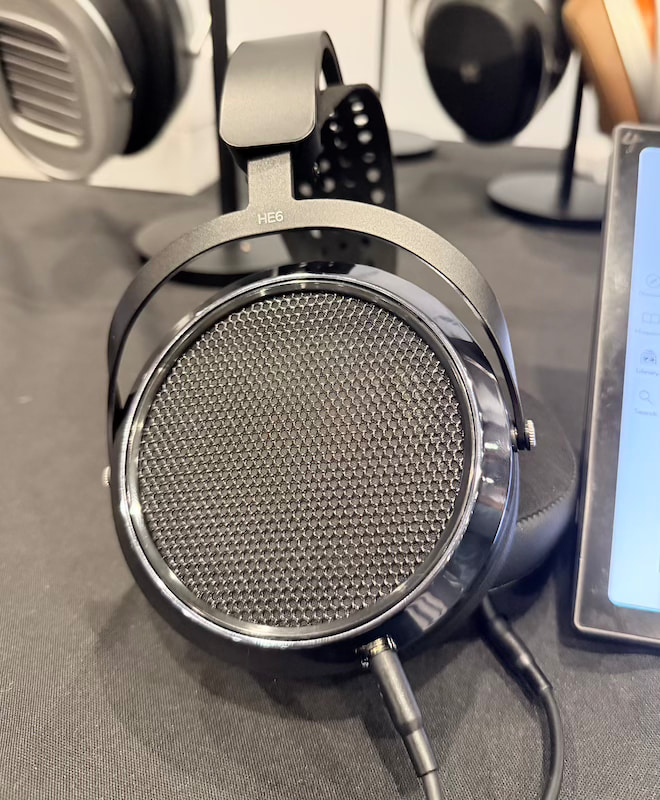
Year after year, HiFiMAN finds some way to pull me back into its booth, and the HE6 Remastered ($1,899) with the GOLDENWAVE SERENADE Wireless DAC/headphone amplifier ($999) was one of the easier systems to recommend from the show.
The HE6 Remastered is an open-back planar magnetic design rated at 50 ohms with a sensitivity of only 83.5 dB, so “easy to listen to” should not be confused with “easy to drive.” It remains a demanding headphone from an amplification perspective and weighs 522 grams, although I found the fit more comfortable than that number might suggest.
SERENADE makes a lot of sense as its partner. The wireless version combines HiFiMAN’s HYMALAYA Pro R-2R DAC architecture with a balanced Class A headphone amplifier capable of delivering up to 4 watts into 32 ohms. It also adds network connectivity to a component that can serve as both DAC and headphone amplifier.
Advertisement
Sonically, this was one of the easiest systems at CanJam to settle into. The HE6 Remastered sounded balanced and detailed without pushing detail so far forward that I wanted to remove it after three tracks. There was enough resolution to keep things interesting, but it did not strike me as fatiguing.
At just under $2,900 for the complete DAC, amplifier and headphone combination, this is the one from the list that feels closest to something a relatively normal audiophile might actually purchase.
Put it on your audition list.
oBravo H2040BT-A and H2040BT-R: The Wireless Surprise
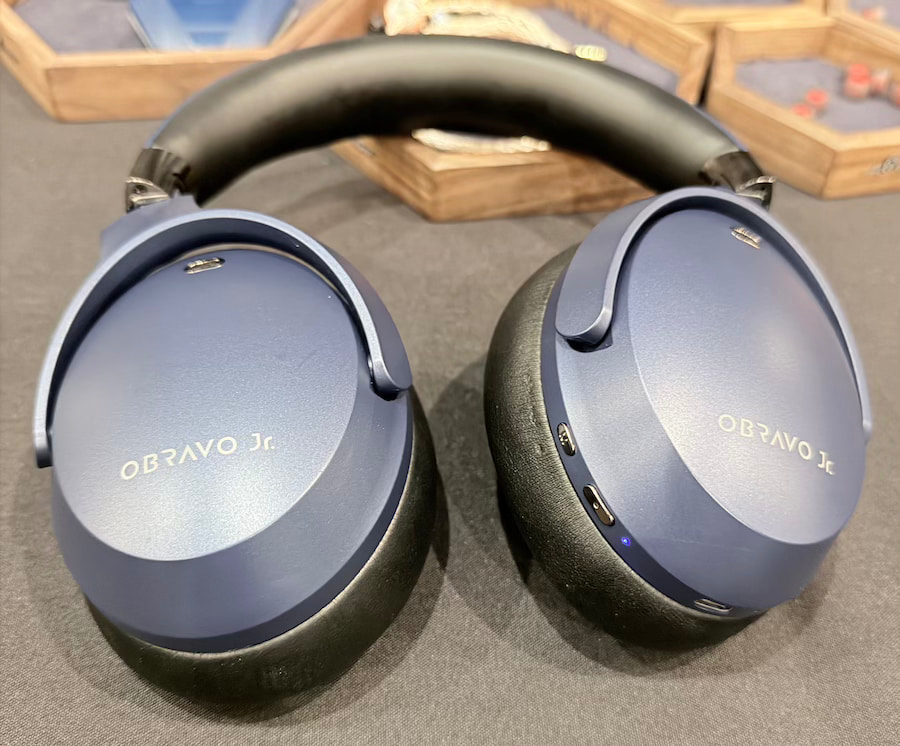
There were plenty of capable wireless headphones at CanJam this year, but oBravo managed to hide one of the more interesting demonstrations in a pair of headphones that could easily be mistaken for something far more conventional.
The H2040BT-A combines a dynamic driver with an Air Motion Transformer, while the visually similar H2040BT-R substitutes a planar tweeter. Hybrid driver systems are hardly unusual in IEMs anymore, but using these technologies inside wireless over-ear headphones is still decidedly uncommon.
Advertisement
The plastic housings did not exactly scream “boutique audiophile engineering,” but listening quickly changed the conversation. The H2040BT-A’s AMT delivered considerably more top-end resolution and speed than I expected from a Bluetooth headphone, while the dynamic driver kept the bass substantial without letting it overwhelm everything above it.
The less expensive planar hybrid was also surprisingly capable and probably the more obvious value of the two.
Advertisement. Scroll to continue reading.
There is one problem: U.S. pricing and availability remain unclear. We were quoted $699 for the H2040BT-A and $299 for the H2040BT-R at CanJam, but I have not been able to locate either model through a U.S. retailer. Audio Concierge currently lists them in the U.K. at £699 and £299, respectively.
Advertisement
Until oBravo clarifies its U.S. rollout, consider these two headphones worth watching rather than something we can tell American readers to go out and buy today.
The Bottom Line
CanJam SoCal 2026 did not deliver the same volume of major headphone launches we have seen in some previous years, but that ended up making the show more interesting for a different reason. Instead of racing from one new flagship announcement to another, I spent more time listening to complete systems and combinations that I might otherwise have missed.
The RAAL 1995 MAGNA EVO I and Allnic stack delivered the most intoxicating ribbon demonstration I heard all weekend, while the Chord, DAVE and Meze ARTA system showed just how far digital processing and headphone playback can be pushed when budget becomes almost irrelevant. Neither system makes any financial sense to most people, but that has never stopped the extreme high end before.
The SJY Argos and HYDRA were probably the biggest surprise. Electrostatic systems often require expensive, specialized hardware and still leave some listeners wishing for greater bass weight. This combination delivered the speed and openness I expected while sounding fuller and warmer than anticipated, and the HYDRA’s ability to drive electrostatics, conventional headphones and loudspeakers makes it genuinely useful.
Advertisement
Grado and HiFiMAN provided the reality check. Neither system is cheap, but both demonstrated how much performance is now available around $3,000 for a complete desktop setup. In a category where $6,000 headphones and $35,000 digital processors barely raise an eyebrow, that almost qualifies as fiscal responsibility.
And that may have been the larger story of CanJam SoCal 2026. Personal audio continues to stretch in both directions. Affordable equipment keeps getting better, while the summit of the category keeps moving higher and becoming more expensive.
The gap between those worlds is widening.
Fortunately, great sound still exists on both sides of it.
Last October, Google said it would bring an Iowa nuclear power plant back from the dead. Now, the facility’s owner, NextEra Energy, has received a $1.9 billion loan from the U.S. Department of Energy to finance the refurbishment.
The sizable loan is the second of its kind, suggesting that the Trump administration views revived nuclear power as a key source of electricity for tech companies seeking to power their AI data centers. Last year, the Department of Energy extended a $1 billion loan to Constellation Energy to restart a reactor at Three Mile Island.
James Danly, Deputy Secretary of Energy, said that the Iowa power plant’s restart in 2029 will “drive down electricity costs,” though he did not explain how. Just 50 megawatts will be set aside for the local power cooperative, NextEra CEO John Ketchum said during an earnings call last year. That capacity would cover 18% of Iowa’s demand growth since 2021, the year before ChatGPT was released.
Google is reportedly looking to build up to six data centers near the Duane Arnold Energy Center, which hasn’t operated since 2020 when an intense rainstorm damaged the power plant. Rather than repair it, NextEra decided to mothball it. At the time, cheap natural gas was flooding the market, making nuclear power economically unappealing.
Advertisement
A lot has changed in the last six years, though. After decades of little growth in demand, the sudden rise of AI coupled with broader electrification of the economy meant that utilities and power providers were suddenly scrambling to find new generating sources of electricity. New data centers are expected to nearly triple the sector’s electricity demand by 2035.
Shuttered nuclear power plants are becoming one of the tech industry’s favorite choices to quickly provide clean, firm power.
Microsoft signed a deal with Constellation Energy two years ago to restart a reactor at Three Mile Island that last operated in 2019. The reactor is scheduled to restart in 2028 and generate 835 megawatts.
Another facility in Illinois, Constellation Energy’s Clinton Clean Energy Center, was in danger of closing down before its parent found a new customer in Meta, which is buying all of the clean energy attributes from the 1.1 gigawatt power plant. The arrangement will see Clinton sending its electrons to the local grid, while Meta will use the certificates to offset emissions it is producing elsewhere. The tech giant’s Hyperion AI data center, for example, will need 10 natural gas power plants to operate. If completed, the data center will consume more electricity than all of South Dakota.
Advertisement
Duane Arnold is smaller, but in the process of refurbishment, NextEra will squeeze an additional 14 megawatts from the facility, bringing the total to 615 megawatts.
Altogether, the three power plants represent the lowest hanging fruit in the U.S. There might be one or two more, according to a report from UtilityDive, though those candidates, including San Onofre in California, have been shuttered for longer and would require more work to bring back online.
When you purchase through links in our articles, we may earn a small commission. This doesn’t affect our editorial independence.
We’ve well established how the $111 billion Paramount and Warner Brothers merger is terrible for labor, creatives, consumers, and markets. But the kind of behaviors Paramount leadership have been engaged in to sell the deal also give a pretty clear indication what kind of company we’re dealing with, and why they shouldn’t be allowed to control an even bigger slice of U.S. media.
Paramount’s also been caught using an “astroturf” — or fake grass roots organization — to try and make it appear that the giant merger has more public support than it does.
The Intercept notes that the company has been employing the use of a nonprofit named Neighbors for Strong Communities to bombard California residents with text messages urging them to pressure on California AG Rob Bonta to drop his antitrust lawsuit against the company, claiming that enforcing antitrust law will be bad for Californians:
Advertisement
“In text messages to Californians that went out earlier this week, Neighbors for Strong Communities asked recipients to send Bonta messages raising the concern that his opposition to the merger will cost the state thousands of jobs — because of Ellison’s reported threat to move Paramount to Texas.”
In reality, mergers like this — particularly when involving Warner Brothers — have a long history of resulting in mass layoffs, higher prices, and lower-quality product as the merged company tries to pay down debt from the deal. There’s also nothing stopping Ellison from offshoring film and TV production if the deal is approved, continuing an existing trend for Hollywood.
A coalition of consumer rights groups under the banner of the Committee For The First Amendment (which actually defends consumers and discloses its funding) say the astroturf group was only formed three months ago by industry lobbyists and refuses to disclose its donors:
“The sender organization’s website is less than three months old. It discloses no founders, board members, staff, or funders, and the organization does not appear in ProPublica’s nonprofit database. Its newly updated address (1902-A Lincoln Blvd, Suite 1314, Santa Monica, CA) is a private PO Box at a UPS store. These are classic hallmarks of a corporate-backed astroturf campaign designed to manufacture the appearance of grassroots opposition.”
As is always the case with these groups, there’s usually no discernable paper trail, allowing both Paramount and Neighbors for Strong Communities to confidently insist the entire effort is authentic. And when you have to covertly pay organizations to support your giant merger, you just know the giant merger is great for everyone involved.
Stoke Space’s Nova Pathfinder upper stage flight article No. 1 sits at the company’s factory in Kent, Wash. (Stoke Space Photo)
Stoke Space says it has raised roughly $1 billion to get ready for the first launch of its fully reusable Nova rocket — and to scale up the rocket’s design for even bigger payloads.
To accommodate its grander ambitions, the Kent, Wash.-based startup is also scaling up its rocket test facility in Moses Lake, 175 miles to the east.
“We have confidence in the foundation that we’ve laid today, and now it’s time to scale,” Stoke Space CEO and co-founder Andy Lapsa told GeekWire.
The newly announced Series E financing round was co-led by Point72 Ventures and Spark Capital, with participation from General Innovation, Glade Brook Capital, US Innovation Technology, Washington Harbour Partners, Woven Capital, Y Combinator and other investors.
The final figure will be “within rounding error” of a billion dollars, Lapsa said. “Not quite, or a little more,” he said. “The speed with which this has come together is very fast.”
Lapsa said that scaling up the Nova rocket’s design was always part of Stoke Space’s game plan, but that the timeline is being accelerated in response to the growing demand for launches and the shrinking availability of launch opportunities.
Advertisement
The timing of Stoke’s pivot to a bigger launch vehicle wasn’t sparked by a single event, Lapsa said. “The pressure has been growing over the last couple of years,” he said. “It certainly hasn’t slowed down recently.”
From Pathfinder to Block 2
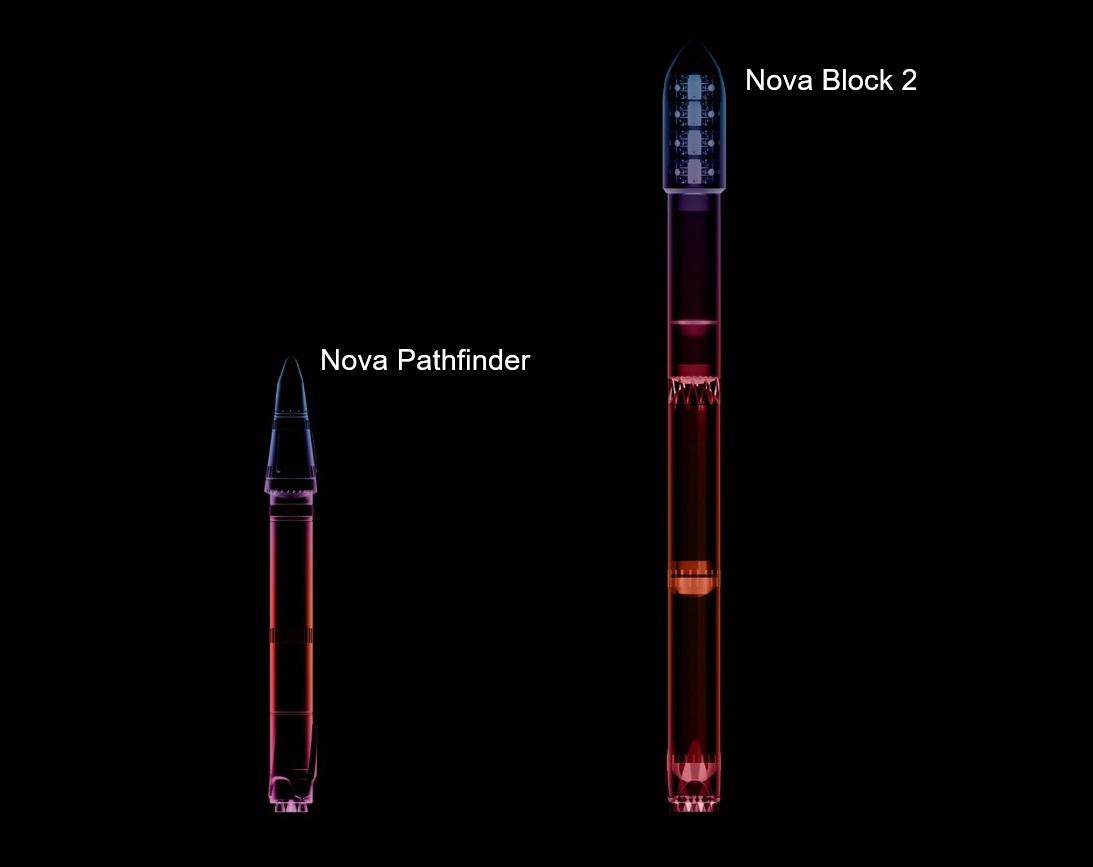
This infographic compares the designs for Nova Pathfinder and Nova Block 2. (Stoke Space Illustration)
The revised plan calls for Stoke to begin launching missions with the initially designed rocket, now known as Nova Pathfinder. Pathfinder’s first stage will be powered by seven of Stoke’s Zenith engines, and the upper stage’s Andromeda engine will have a ring of 24 thrust chambers integrated into an actively cooled metallic heat shield. The rocket will be capable of putting 3 metric tons of payload into low Earth orbit, or LEO.
Pathfinder’s first launch is now scheduled for early 2027 — a slight slip from earlier expectations. It will carry a spacecraft for AstroForge, a California-based asteroid mining company. “We’re going out to the asteroid belt, and yeah, Astroforge is our partner for that one,” Lapsa said. “They’re looking to prospect and ultimately mine asteroids, and bring back rare earths and other important materials.”
The super-sized version of Stoke’s rocket, known as Nova Block 2, is due to make its debut in 2029. Its first stage will have twice as many Zenith engines as Pathfinder. Its upper stage will have 12 independent engines, each with two thrust chambers. That will increase Nova’s lift capability by a factor of five, enabling up to 15 metric tons of payload to be delivered to LEO. More than 4 tons can be sent to geosynchronous transfer orbit, or GTO.
Both versions of the Nova rocket are designed to be fully reusable, with the first-stage booster flying itself down to a recovery ship and the upper stage making a separate re-entry. Stoke is only the second company in the space industry to pursue that strategy. SpaceX has designed its Starship launch system for dual-stage reusability but hasn’t yet reached that goal.
Stoke is developing an active-cooling system for upper-stage reusability. Some of the rocket’s cryogenically cooled liquid hydrogen propellant is circulated through channels in the upper stage’s metallic heat shield to absorb the intense heat of atmospheric re-entry. SpaceX has been experimenting with different heat shield strategies for Starship, but some experts have expressed doubts about SpaceX’s approach.
Both versions of Stoke’s rocket are designed to fill a market niche that’s different from Starship’s. The Nova rockets’ capabilities fall close to both ends of the medium-lift spectrum, while SpaceX’s super-heavy-lift Starship is designed to loft 100 to 150 tons of payload to LEO.
Advertisement
Expanding the infrastructure
Stoke Space tested its Zenith rocket engines and Nova Pathfinder’s first stage in Moses Lake in June. (Stoke Space Photo)
Stoke Space’s 168,000-square-foot factory and headquarters facility in Kent was designed from the beginning to manufacture rockets that are bigger than Nova Pathfinder.
“We bring in raw sheet metal, we build our core and we ship a rocket,” Lapsa said. “We can use the same methods and effectively the same tooling to build larger diameters and larger lengths, and that’s very intentional.”
The company’s rocket test facility in Moses Lake is being expanded from 75 to 550 acres to accommodate work on two types of rockets simultaneously.
“We’ve done, I would say, an extremely efficient job at leveraging the 75 acres that we use today,” Lapsa said. “The expansion across the street is going to enable us to test again at rate. … Certain of our facilities have an overlapping blast radius, so they interfere with each other. A big advantage of being able to spread our wings a little bit, and get a little bit more space, is that those test stands can operate in full independence of each other.”
Stoke’s launch facilities at Cape Canaveral Space Force Station in Florida can also accommodate a dual-track approach. A new payload processing facility at the Cape is intentionally sized to support both Nova Pathfinder and Block 2.
Advertisement
In June, Stoke Space’s Moses Lake facility completed what the company called proto-qualification testing of the first-stage booster for its first Nova Pathfinder rocket. “The second stage will ship out pretty soon,” Lapsa said. “That goes to Moses Lake. … This will be acceptance testing of the structure, and then we’ll do a static hot-fire test out there to fully shake down the second stage, and then it ships out to Cape Canaveral.”
The booster is being prepared for shipping to the Cape as well. “We’ll repeat the wet dress rehearsals that we did in Moses Lake, but we’ll do it on the launch pad itself,” Lapsa said. “Then we’ll do the same thing: static fire test on the first stage down there, and then the two stages go together, and we go to space.”
Stoke Space has built a facility at Space Launch Complex 14 at Cape Canaveral Space Force Station in Florida. (Stoke Space Photo)
Lapsa said Stoke currently has about 400 employees. “It’s approximately 50 in Moses Lake, 50 in Cape Canaveral. We have a handful of remotes, and then everybody else is in Kent,” he said.
Even though Stoke Space hasn’t yet launched a rocket, the startup’s steady progress toward that milestone — and its long-term vision for total rocket reusability — have been impressive enough to keep investors on board.
Advertisement
“Having supported Stoke through multiple stages of its growth, we believe this company has demonstrated both the exceptional technical progress and the ambition to build a launch system capable of serving the market at industrial scale,” Chris Morales, partner at Point72 Ventures, said today in a news release.
“Full reusability is the inevitable end state of the market, providing an order-of-magnitude cost and service advantage over partially reusable rockets,” said Clay Fisher, general partner at Spark Capital. “Stoke had the right thesis seven years ago and has paired that prescient vision with a blistering pace of execution. As a result, they stand uniquely positioned to give customers more choice and capacity when they need it, and to unlock an enormous new economy in space.”
Lapsa said he’s grateful for the vote of confidence.
“We’re humbled by the investment, having great partners behind us,” he said. “It’s an incredibly critical and important moment for us as a civilization to get right. I think space development is really, really important for our ability as a civilization to continue to scale and continue raising the quality of life that we enjoy — and we’re thrilled to be part of it.”
When I showed my 21-year-old daughter a new pair of Sony headphones I was reviewing, she said, “Yeah, I know dad. They’re Sony. My roommate has a pair just like them.” She wasn’t exactly right – I had the WH-1000XM6, where her roommate had the earlier WH-1000XM4 (to be fair, they do look very similar). But the fact that my daughter clearly recognized something I was reviewing by name – and it wasn’t an Apple product – was unusual.
#TikTokMadeMeBuyIt
It turns out Sony has been quite effective at selling to Millennial and Gen Z consumers by partnering with influencers and online personalities on social media sites like TikTok, Instagram and YouTube. But it’s the headphones themselves that seal the deal. Top notch noise cancellation allows college students and remote workers to concentrate on their study or work, or enjoy their music – even when things get a bit distracting in the real world. And Sony’s stylish color choices complement the current understated style of clothing and “Athleisure” wear that has grown in popularity among younger consumers. But it is the sound quality that sets them apart: nicely balanced and musical – even when noise cancellation is engaged – with the option to customize the sound to your specific tastes.
This week, Sony is expanding its on-ear and over-ear headphone line-up with three new models, intended to appeal to younger consumers who care not only about how their headphones look, but how they sound. The model that stood out to me, at the company’s launch event last month, was the WH-1000XM4C (M4 2nd Generation). It is a lower cost version of the previous flagship first released in 2020, the WH-1000XM4, with slightly lower playback time, at a price tag that’s $50 lower than its predecessor. The original XM4 sold for $349, but the new XM4C will be available at a list price of $299. With the inevitable discounts that will follow over the various holiday sales, we expect these headphones to be very popular indeed.
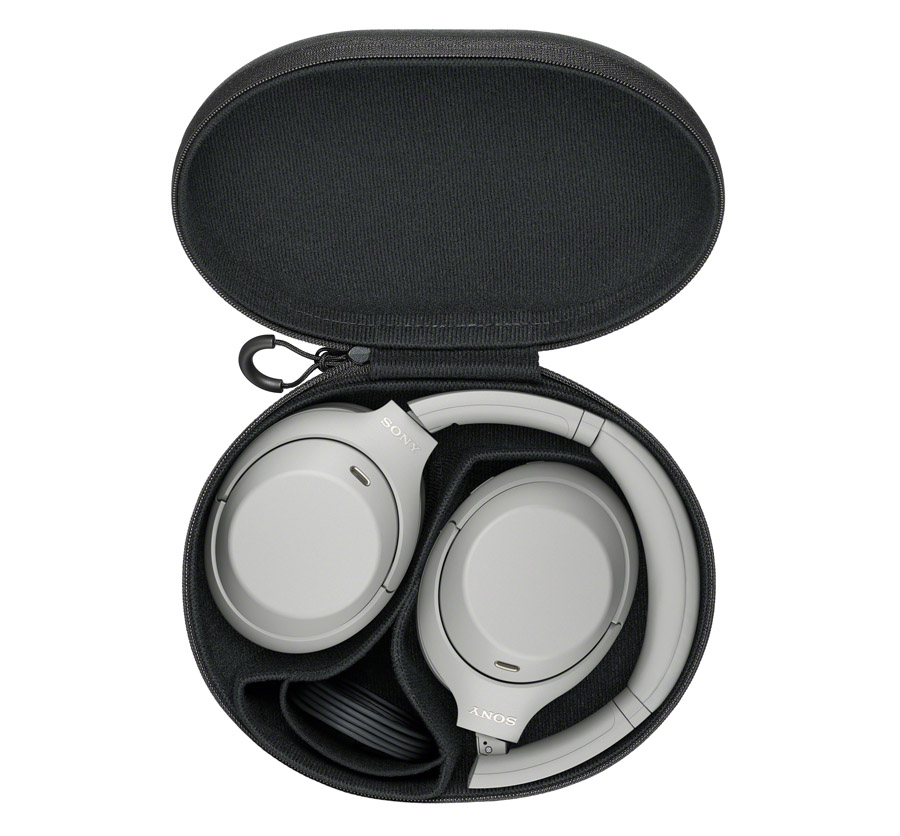
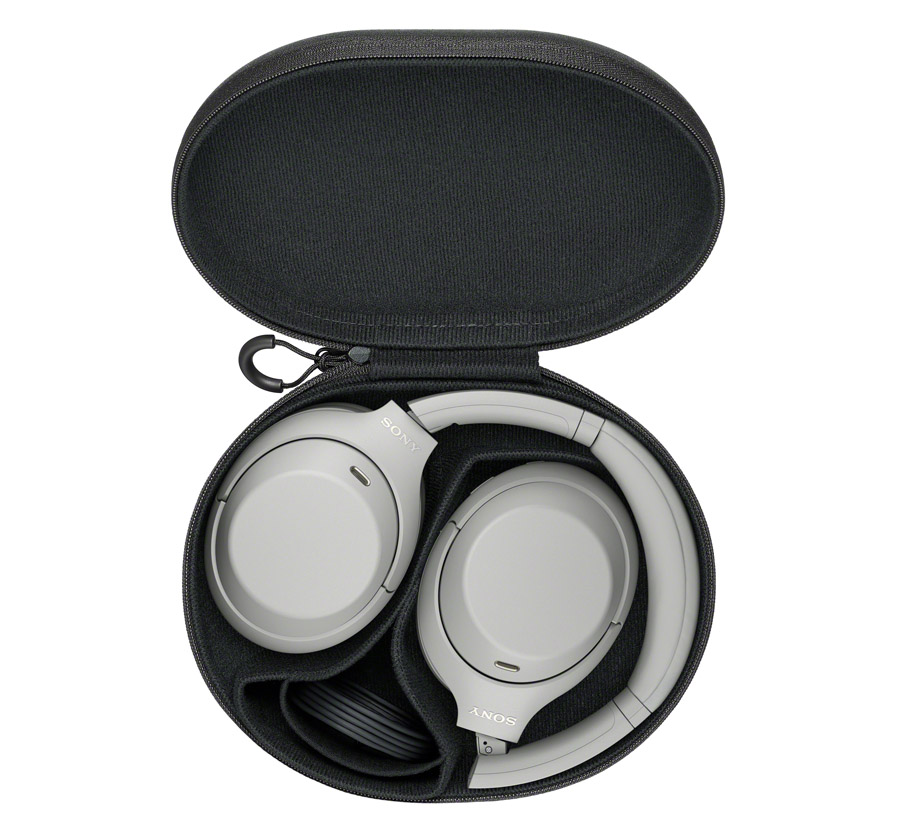
The XM4C features a foldable design that keeps the included travel case fairly slim.
The XM4C is lightweight and foldable, and comes with a sturdy case that is well-suited for travel. It features 27 hours of playback on a full charge (compared to 30 hours on the original XM4), but otherwise the specs are similar to the earlier version. If you forget to charge it before a run or a study session, a 3-minute quick charge will get you around an hour of playback time. The unit features five built-in microphones both for noise cancellation and for improved call quality. The XM4C features a new 10-band EQ available in the Sony Sound Connect app for precise customization of sound.
The lavender version of the XM4C will be exclusive to the Sony store and Amazon. Behind it are the black and platinum silver versions.
The XM4C is available at a suggested list price of $299.99 in three colorways: Black, Platinum Silver (off-white) and Lavender. The lavender version will be exclusive to Sony and Amazon, while the black and platinum silver options will be more widely available at authorized Sony retailers.
Less Expensive, But Certainly Not “Cheap”
For those who want a hint of that Sony style and performance at even lower price points, Sony is offering new versions of their popular CH series over-ear and on-ear headphones, the WH-CH730N and WH-CH530.
Advertisement
The WH-CH730N wireless over-ear headphones deliver high quality sound and noise cancellation, now with a lighter, foldable design. The new model features longer battery life and improved call quality, compared to its predecessor the CH720N.
Sony’s WH-CH730N is now available in five colors.
The CH730N is rated to last for up to 50 hours on a full charge, with noise cancellation on. A 3-minute quick charge will get you around 1 hour of playback. High quality built-in beamforming microphones and AI noise reduction enable clear voice and video calls.
Sony’s WH-CH730N over-ear headphone in its new “Oat” colorway (don’t call it beige!).
WH-CH730N is available now in Black, White, Pink, and Blue from September 2026 with a suggested price of $179.99 USD / $249.99 CAD at Sony, Amazon, Best Buy, and other authorized retailers. A new “Oat” color (looks beige to me) will be exclusive to Sony and Amazon.
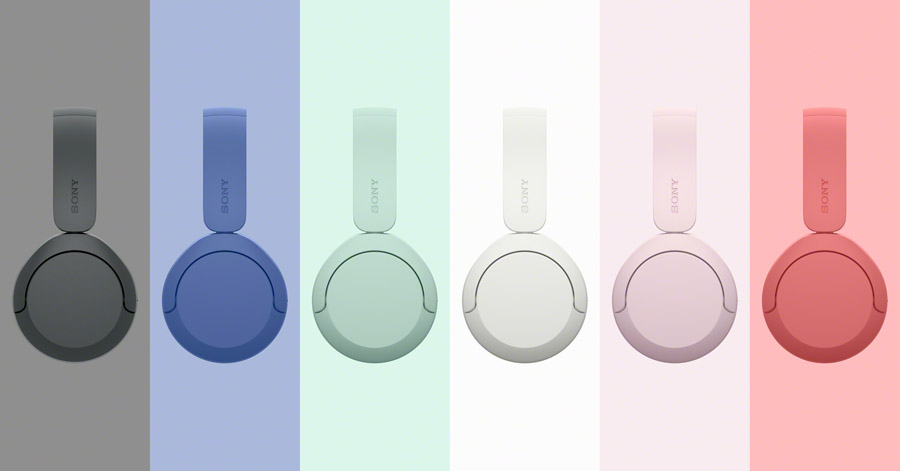
The WH-CH530 on-ear headphones will be available in six colors.
The budget-priced WH-CH530 on-ear headphones lack noise cancellation, but feature similar sound quality to their big brother at a lower price point. They will be available in six “playful” colors, sure to appeal to younger music lovers. The CH530 lasts up to 55 hours on a charge, and includes a quick charge option for about 1.5 hours of listening time with just a 3-minute charge. The CH530 features clear call quality thanks to AI voice recognition and noise reduction.
WH-CH530 is available now in Black, Cobalt, White, and Pink, from September 2026 with a suggested price of $69.99 USD / $99.99 CAD at Sony, Amazon, Best Buy, and other authorized Sony retailers. The Coral and Mint color options will be exclusively available from Sony and Amazon.
Advertisement. Scroll to continue reading.
Sony WH-CH530 in its “Mint” color option.
In the words of Masaaki Hori, Vice President of personal entertainment, Sony Electronics North America: “The release of the WH-1000XM4C reflects continued consumer interest in a headphone model recognized globally for its combination of noise cancelling performance, sound quality, and comfort. Alongside the WH-CH730N and WH-CH530, as well as the recently announced 1000X THE COLLEXION and acclaimed WH-1000XM6, the WH-1000XM4C further strengthens our wireless headphone lineup, giving consumers a clear range of choices designed to meet different needs and budgets.”
Hello, Kitty!
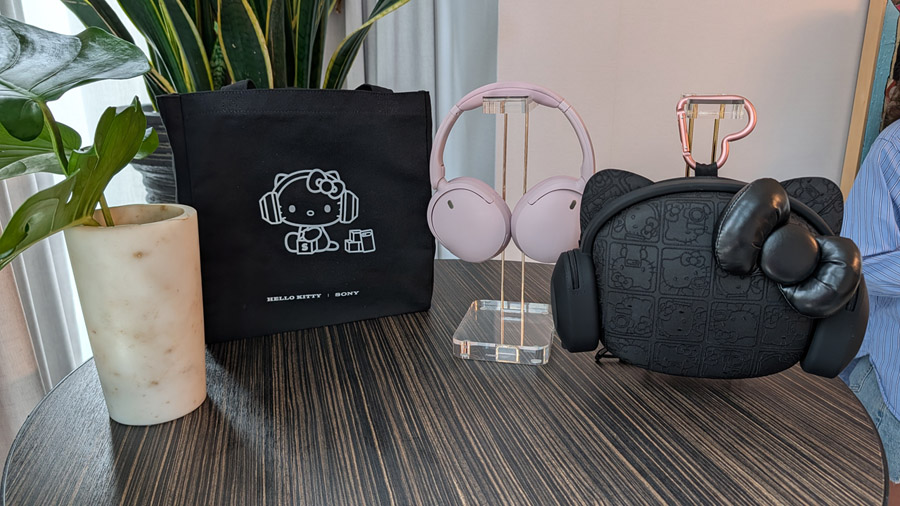
But wait! There’s more! Sony also announced an exclusive collaboration with Hello Kitty with limited-edition headphone bundles that will include an exclusive Hello Kitty carrying case and tote bag and will be available in limited quantities for pre-order exclusively online at the Sony store. The collaboration will feature selected Sony headphone models, including the current flagship WH-1000XM6, WH-CH730N and WH-CH530.
Advertisement
Sony is collaborating with Hello Kitty for an exclusive limited edition bundle that includes a Hello Kitty themed case and tote bag, paired with Sony headphones (pictured here are the WH-1000XM6 headphones in pink).
Launched in the 1970s, the “Hello Kitty” brand has broad appeal not just among teens and young adults, but even among 30-somethings and 40-somethings who are looking for a little nostalgia and comfort in this chaotic world.
The Bottom Line
Sony is killing it in the on-ear and over-ear headphone market among younger consumers. But not every college student or young professional can afford the $450 price of the current flagship XM6 or even the $350 price tag of the XM4. By offering the XM4C with nearly identical performance and style at a lower price point, Sony will likely have a winner on their hands. And for those with more moderate budgets, the CH530 and CH730N offer a taste of that Sony performance at a much lower price tag. Also, the partnership with “Hello Kitty” seems perfectly suited to the target demographic of these headphones. Sony headphones seem to be well poised for a strong holiday sales performance in 2026.
Stay tuned for a full review of the WH-1000XM4C coming soon.
Where to Buy WH-1000XM4C
Where to Buy Sony Headphones
Note: All Sony headphones are also available direct from Sony Electronics. To get notified when the Limited Edition Hello Kitty headphones are available, sign-up here.
For a diehard fan of Donnie Darko, meeting director and screenwriter Richard Kelly is a thrill in itself. But to first encounter him as a silhouette in a darkened movie theater is to feel almost like a character in one of his films—unmoored by indefinite space and physics, questioning your altered perception.
It’s a hot Friday in mid-August when I sit down with Kelly, 51, at Santa Monica’s Aero Theatre, a beloved repertory venue that makes a key appearance in Donnie Darko, his remarkable debut feature. Released in October 2001 with virtually no marketing due to the tragic events of 9/11 weeks prior (the plot hinges on a plane accident), it couldn’t get a toehold at the box office. But in the months and years that followed, the film became a hit on the home video market and gained a fervent cult fandom thanks to its unique supernatural mystery.
To mark its 25th anniversary, the movie will enjoy another limited theatrical run, beginning on October 2, the date that launches mentally disturbed suburban teenager Donnie Darko (Jake Gyllenhaal) on a surreal journey that may or may not lead to the end of the world. Kelly has just finished recording an intro for the new 4K restoration, and snippets of it play without sound on the big screen as we talk.
“My memories of this film run the entire spectrum from fear to love,” Kelly jokes, alluding to the corny pop psychology peddled by Patrick Swayze’s self-help guru in the film. This occasion, Kelly says, is all about the “love,” as he couldn’t be more grateful to “all the people who have continued to support” his work.
Advertisement
That camp should be pleased to hear that on December 15, Kelly will publish his mammoth first novel, The Philosophy of Time Travel, available for preorder now. The 800-page volume picks up right where the movie left off and is intended to set the stage for a film sequel as well. “It’s been very inspiring for me to remain focused on continuing the journey that began 25 years ago, on my own creative terms,” Kelly says. “This film has defined my entire career, but at the same time, it’s set a benchmark in the sense of the movies that I want to continue to make.”
Here, the auteur revisits the unforgettable dreamscape that put him on the map, and considers the artistic possibilities still ahead.
On when he realized Donnie Darko was becoming a cult hit:
There was one specific moment, I think in March of 2002, when I was in New York City. I was walking through the East Village, and I walked past a pizza restaurant called Two Boots, and my poster for Donnie Darko was hanging in their window. I saw the poster and I was like, “What’s going on? This is bizarre. Why does a pizza restaurant have a movie poster?” I went inside and I asked the manager, and he said, “Well, we have a little theater in the back, the Pioneer, and we’re playing your movie every Saturday night at midnight—and it’s selling out.”
Advertisement
I showed up the next Saturday night at about two in the morning, when the movie was finishing. I expected there’d be maybe 10 people there, and he wasn’t joking, it was sold out, and there were people with camcorders and lights in my face, and Michael Musto from the Village Voicewas there. I was just completely bowled over by the fact that there were people who cared, who were really, really connecting with the movie. That was the moment I knew that it wasn’t over, that the movie was going to have a second wind.
Impressive brightness, vibrant colour and a host of image processing technologies make the Bravia 7 II an excellent Mini LED TV, but does it really live up to Sony’s True RGB hype?
Compelling HDR peak brightness
Cool PlayStation gaming functionality
Solid smart TV experience
It’s a big, bulky beast
Limited viewing angle
No HDR10+ or Dolby Vision IQ
SQUIRREL_PLAYLIST_10208749
Advertisement
Key Features
Review Price:
£1999
Advertisement
Google TV
All the apps including the UK catch-up versions
Advertisement
True RGB
Sony’s version of ‘proper’ RGB backlighting
Advertisement
My Cinema
Customise the TV’s performance based on what you watch
Introduction
The Bravia 7 II is the more affordable of Sony’s two new True RGB Mini LED TVs, and it arrives on the back of considerable hoopla. Behind the scenes, Sony has been touting its latest TV technology as the next big thing, promising greater contrast, improved colour accuracy and more precise control of blooming.
Advertisement
The idea behind True RGB is straightforward. Conventional Mini LED TVs use a white LED backlight combined with a Quantum Dot colour filter layer. Sony’s True RGB system instead uses independently controlled red, green and blue LEDs in the backlight.
Easy to explain, but not so easy to accomplish.
Much like Spandau Ballet, I know this much is true.
Advertisement
Advertisement
So just how effective is the technology, and are the results good enough to convince discerning buyers to ghost OLED in favour of something brighter?
Price
The 55-inch Sony Bravia 7 II (K-55XR75M2) tested here initially launched at £1,999 in the UK, but has quickly dropped to £1,699 (a recognition that the bullish tag was unsustainable). US and Australian pricing is set at $1,499 (down from a debut at $2,099) and AU$2,499 respectively.
The Bravia 7 II is also available in 50-, 65-, 75-, 85- and 98-inch screen sizes, the latter topping out at £6,999.
That makes the 55-incher an interesting proposition. It’s more expensive than the highly regarded LG C6 OLED (£1,599) but less pricey than Sony’s own Bravia 8 II 55-inch QD-OLED (£1,899). In the run up to its launch, Sony has consistently positioned True RGB as its premium TV offering, above OLED in its range. That seems to have flipped.
Advertisement
If you’re slightly confused, you’re not alone.
Advertisement
Design
Big and weighty
Mirage Stand
Let’s not beat about the bush – for a 55-incher, the Bravia 7 II is a substantial beast.
It weighs a grimace-inducing 18.4kg and the chassis, which measures 122.8 x 78.4 x 20.9cm with stand attached, has unapologetic depth. It’s not an easy wall mount.
I’ll assume that bulk is largely down to the novel True RGB Mini LED backlight – there’s clearly a lot of hardware packed behind the panel.
Advertisement
Its dress-sense is relatively restrained. A narrow black bezel surrounds the panel, with a textured plastic finish to the rear.
Image Credit (Trusted Reviews)
Advertisement
The central stand is the most interesting aspect of its design. The screen sits on what Sony describes as a Mirage Stand, so named because it uses a translucent central panel able to diffuse the visibility of whatever lies behind it.
The effect is clever. Cables are sufficiently distorted to make them difficult to identify. Sony appears to be trying to create the impression that the screen is floating above its pedestal.
It’s an intriguing piece of industrial design.
Advertisement
Image Credit (Trusted Reviews)
Connectivity
HDMI 4K/120Hz support
Hybrid optical connection
Terrestrial and Satellite tuners
Is it possible to be impressed and disappointed at the same time?
Advertisement
The Bravia 7 II is well served to support high frame rate gaming, and boasts Variable Refresh Rate and Auto Low Latency Mode compliances, but only two of its four HDMI inputs are so equipped, and one of those has to serve as the eARC connection if you’re hooking up an external sound system.
There’s no digital optical audio output, instead we get a hybrid 3.5mm optical audio output with S-Centre speaker input, plus a couple of USB ports.
Image Credit (Trusted Reviews)
Ethernet LAN connection is provided, alongside Wi-Fi and Bluetooth 5.3.
The TV comes with two remote controls, one a button heavy standard zapper, the other a more premium pointer with fewer buttons and fast access keys for Crunchyroll, Netflix, Disney Plus, Prime Video, YouTube and Sony Pictures Core.
Advertisement
User Experience
Advertisement
Google TV remains one of the more polished smart TV platforms available, and it provides the front end here.
What we see isn’t too dissimilar from other executions of the platform on rival screens and media players. Curated rails offer local programming, trending shows and selected movies.
Image Credit (Trusted Reviews)
App coverage is strong, with Netflix, Prime Video, BBC iPlayer, ITVX, Channel 4, Channel 5, Disney+, YouTube, BBC Sounds, Sony Pictures Core, Tubi and Crunchyroll among the available services.
The Bravia 7 II also incorporates Google’s Gemini assistant.
Advertisement
UK terrestrial TV is served by YouView. There’s no Freely onboard, which is a shame. The TV does, however, have both terrestrial and satellite tuners, so there’s a choice of aerials.
Advertisement
Features
XR Clear Image AI upscaling
My Cinema mode
Picture processing remains one of Sony’s traditional strengths, and the Bravia 7 II brings several of the company’s established technologies together.
XR Motion Clarity continues to impress. Motionflow can be left on Auto or adjusted using a pair of sliders. Movement is smooth with very few visible processing artefacts.
The television also uses XR Clear Image AI for upscaling. This analyses the quality of the source material and attempts to reconstruct lost detail and textures. It’s all very clever, and easy to take for granted.
If the Bravia 7 II was a posh meal out, you’d be worried about the bill. It’s a visual feast, with innovative ingredients.
HDR is where the True RGB system makes its strongest argument. In Professional mode, our 55-inch Bravia 7 II produced a measured peak brightness of 2,101 nits, in a 10% window.
Most obviously, this means specular highlights have appreciable impact; a small source of light in a dark scene can suddenly become intensely bright. When Jack Reacher escapes the Feds via shadowy underground subway tunnels (Reacher, S4), light sources guiding his way are appropriately intense.
Advertisement
Shadow performance is equally important. The Bravia 7 II retains levels of near-black detail, and blooming control is impressive.
The Bravia 7 II may not have as many dimming zones as the flagship Bravia 9 II, but uniformity is demonstrably good. The Reacher title cards appear as white lettering against a completely black background. These black areas remain impressively inky while the white lettering stays clean and bright.
The result is remarkably similar to OLED.
Advertisement
Advertisement
Image Credit (Trusted Reviews)
Sony has long argued that the number of dimming zones is less important than how effectively they’re controlled. The Bravia 7 II gives that argument some weight.
HDR support covers HDR10, HLG and Dolby Vision, but there’s no HDR10+ or Dolby Vision IQ though.
The inherent brightness of the panel also serves SDR well too. Everyday HD images have punch and pizazz.
Punch and Pizazz would also be great names for cats. Just saying.
Colour reproduction is another strength. The AI brain behind RGB Triluminos Max appears to have been trained on jelly beans and Smarties.
Advertisement
Advertisement
Reds and greens are rich and lush, yet don’t lean into the kind of lurid oversaturation that can sometimes accompany very bright displays.
It’s worth noting that the panel isn’t glare-free. Objects, windows and light sources all reflect on screen, so plan your seating accordingly.
Unfortunately, off axis viewing is poor, with significant loss of colour and contrast when viewed from the side.
Advertisement
Picture modes include Vivid, Standard, Cinema, Professional, Calm, Photo and IMAX Enhanced. It says much that I could happily watch at least four of these without grinding my teeth.
What’s new is a My Cinema mode – I was prompted to turn this on when starting a movie on Netflix – with Director’s Cut, Daytime and Dialogue settings. Director’s Cut is essentially Sony’s interpretation of a Filmmaker Mode (which it doesn’t offer). Director’s Cut significantly reduces brightness, hence it’s a dark viewing mode, while Daytime is a more social setting.
Sound Quality
Dolby Atmos & DTS: X compatible
Voice Zoom 3
3D Surround upscaler
Advertisement
The Bravia 7 II’s integrated audio system is definitely better than the average flatscreen. 40W of amplification drives two full-range drivers and two tweeters, producing a healthy level of slam, with enough energy to make films and games enjoyable without immediately needing a soundbar.
Dolby Atmos and DTS:X are supported, and a 3D virtualiser broadens stereo material to create a wider presentation.
Advertisement
Dialogue receives particular attention through Voice Zoom 3. The AI system identifies speech and can increase or reduce its level. I really didn’t find it very useful, but if you occasionally struggle to follow dialogue in dramas, it’s doubtless going to be helpful.
Bass performance is, inevitably, limited. A low frequency measurement revealed a hum at 31.5Hz (at 100 per cent volume), followed by a more confident response at 50Hz. There’s a honking character to the mid-to-lower bass, which means the system lacks the authority of a good external audio setup, but it succeeds in beefing up the mix.
A soundbar or AV system would still be my recommendation for anyone buying the Bravia 7 II, specifically for serious home cinema.
Bluetooth provides another useful option. I paired the set with Marshall Milton on-ear headphones, which was a real boon for late night private viewing.
Advertisement
Advertisement
Gaming
4K/120Hz support
PS Remote Play
Gaming Multi View
Clearly, in Sony World, TV owners only have one console, and it’s a PlayStation 5. So I guess the single HDMI for high frame rate gaming is all you need.
If you do indeed own a PS5, Sony guilds the lilly with Auto HDR Tone Mapping which automatically optimises HDR settings during the console’s initial setup.
To help key an eye on your gaming status, there’s Game Menu 2, a handy pop-up display that provides adjustments and assistance. This can also be used to search for YouTube videos and access Gaming Multi View.
The set’s overall gaming presentation is top notch. Sharp, colourful and contrasty, it looks great with serious shooters and colourful platformers. Motion is crisp and free from smearing.
Advertisement
Thankfully, you don’t need to faff around with menus to optimise all this.
The TV automatically switches into Game Mode when consoles are connected to minimise lag and maximise responsiveness. I recorded input lag at 10.9ms (1080/60). It switches out of Game Mode when you watch a movie on the console.
Advertisement
You can also connect your PlayStation remotely. The PS Remote Play app lets you control your PS5, PS5 Pro (or PS4) from another room, or location like a friend’s house. Not new but still pretty neat.
Advertisement
SQUIRREL_PLAYLIST_10208749
Should you buy it?
A Mini LED that’s like OLED
Go ahead and pick one up if you want a uniformly bright, well-specified Mini LED TV with impressive OLED-like black-level performance…
Advertisement
If you’re more of a cineaste
Advertisement
If cinematic OLED imagery matters more to you than extreme brightness, then Sony’s own BRAVIA 8 II QD-OLED probably makes more sense – but be wary of that high-speed HDMI limitation…
Final Thoughts
The Bravia 7 II is an impressive calling card for Sony’s nascent True RGB TV tech. It delivers a picture with genuine OLED-like qualities, and offers levels of HDR brightness that OLED still struggles to match.
Advertisement
So is it worth the investment? I’m not entirely sure. I really enjoyed watching shows and movies on it. A combination of high brightness, controlled blacks and convincing colour will always win me over. Motion handling, long a Sony strength, also warrants a thumbs up.
However, movie fans need to consider the Bravia 7 II’s position within Sony’s own range. Its HDR highlights can exceed what you get from the Bravia 8 II QD-OLED, but the latter retains an advantage when it comes to an overall cinematic presentation.
For gamers, the equation becomes even more complicated. The combination of brightness, motion handling, 4K/120Hz support, VRR and Sony’s PlayStation-specific features make this a capable large-screen PS5 gaming display, but that two HDMI v2.1 limit is a potential deal breaker – unless you’re going to partner the telly with an AV receiver.
That said, for buyers looking for HDR impact, gaming and Sony’s processing expertise, the Bravia 7 II warrants very serious consideration.
Advertisement
How We Test
The Bravia 7 II True RGB Mini LED was both bench-measured and boxset-binged over a prolonged period. Sources included Blu-ray, Sky Stream, a PS5 and assorted media streaming gizmos.
My audition period also coincided with Reacher Season 4 landing on Prime Video and the launch of Lanterns on HBO Max, so many hours were duly spent glued to the various picture presets. I mixed it up with official Dolby test demos and oft-used movie clips.
It was also partnered with a Sony Bravia Theatre Bar 7 system, to check system interoperability.
Tested with real world use
Tested for several days
FAQs
Is the Sony Bravia 7 II an OLED TV?
No. The Bravia 7 II uses Sony’s new True RGB Mini LED technology. Instead of OLED pixels generating their own light, the TV uses independently controlled red, green and blue LEDs in its backlight.
Advertisement
Does the Sony Bravia 7 II need a soundbar?
You won’t need one for everyday viewing. Its 40W sound system produces a good overall balance and has reasonable impact. However, an external sound system will open the door to more immersive listening and better bass performance.
Advertisement
Advertisement
Test Data
Full Specs
Sony Bravia 7 II Review
Manufacturer
Sony
Screen Size
54.6 inches
Size (Dimensions)
x x INCHES
Size (Dimensions without stand)
784 x 1228 x 209 MM
Weight
18.4 KG
Operating System
Google TV
Release Date
2026
Model Number
K-55XR75M2
Resolution
3840 x 2160
HDR
Yes
Types of HDR
Dolby Vision, HDR10, HLG
Refresh Rate TVs
48 – 120 Hz
Ports
Two HDMI, two HDMI 2.1, 3.5mm hybrid optical audio, Ethernet, USB
AMD is building out what they are describing as an “elite” team of developers for driving Rust code “deep into the GPU stack” from firmware to drivers, shader compilers, and other GPU software in Rust. AMD Senior Fellow Harsh Meno posted this week to LinkedIn about this new effort…
And note this AMD job posting that’s active for hiring a software development engineer to work on Rust code…
“We are building next-generation systems software for AMD GPUs with Rust as a core technical direction. The work spans compilers, runtimes, low-level GPU software, firmware, developer tooling, and methods for improving the safety and correctness of complex hardware-software systems.
“Rust is not incidental to this role. You will help establish how Rust is used in performance-sensitive and high-trust parts of the GPU stack, including the compiler and tooling support, system interfaces, engineering practices, and validation methods required for production deployment. You will have the opportunity to influence both near-term implementations and the longer-term architecture for using Rust across current and future AMD platforms.”
Advertisement
“AMD also isn’t alone,” the article points out, “as NVIDIA has also been pursuing similar Rust-based initiatives for their GPU software too, including the development of the Nova Linux kernel driver written in Rust.”
The ads pointed people towards almost 50 apps combined across Google’s Play Store and Apple’s App Store. Of the 350 ads, the researchers say that around 300 of them directed people to AI image or video generator ads, with most of these apps being linked to China-based developers. Some apps had already been removed by the time WIRED started reporting this story.
Among those that would generate explicit imagery of adults were eight identical apps listed on Apple’s App Store, multiple of which were linked to Chinese developer names. When the apps opened, they would show explicit AI-generated content, including a menu of sexual scenarios, including one called “threatening knife” where a knife is held to a woman’s throat. WIRED identified another seven identical apps that shared the same design, explicit content, and listed the same developer contact details.
“The App Store was designed to be a safe and trusted place for users, and we have zero tolerance for developers who deliberately attempt to evade our review process,” says Apple spokesperson Adam Dema. “The developers mentioned in this report initially submitted apps that are compliant with the App Review Guidelines, only to later surface nudify capabilities, which are against our rules.” The company says that 17 of the 20 apps included in the research had already been removed from its store and it has taken action against the remaining three, as well as removing the seven apps WIRED found.
Google spokesperson Dan Jackson says the company does not allow apps that contain sexual content or the ability to nudify. “We continually take proactive steps to detect and remove apps with harmful content,” they say, adding that it removed all the apps included in the report. “When violations are reported to us, we investigate and take swift action, which in the case of these apps has included suspending hundreds of violating apps and restricting related search terms like ‘nudify’ on our store.”
Advertisement
“The share of Chinese developers creating nudify apps has grown year over year,” says David Pham, a former Meta employee who investigated nonconsensual imagery and abuse on its platforms. Pham says that while at Meta he observed similar ads to those discovered by the researchers and those uploading the content would constantly try to get around safety systems.
“Every time the platform or investigators would build a new detection model or a new way to have some type of enforcement, they quickly—within a day, maybe five days—built a new way to avoid detection,” Pham says. Those uploading the ads would change domains they used, obscure who posted them, and include measures such as blurring imagery or subtly changing images to avoid detection. However, Pham, who left Meta last year, says it has the funding and resources to be able to tackle the uploads. “I would like to live in a world where we’re not getting CSAM or NCII material sent directly to our phones,” he says.
Meta’s current protections against ads containing CSAM and NCII appear to need work. More than 11,000 undress ads have appeared on Meta’s platforms since February this year, according to a recent Indicator Media report, with many of these being reportedly posted by “repeat offenders.” Analysis by WIRED also found hundreds of ads including explicit content that contain similar language to those ads found by the TTP researchers. (Meta says malicious advertisers use adversarial tactics to continually try to avoid its detection systems and it has “incorporated” the language in the ads highlighted by WIRED into its moderation systems.)
One ad containing one of the teenagers that the researchers found the real-world identity of was reported to Meta when it had reached four accounts in Europe, according to the TTPs research. However, when it was removed days later, it had been seen by more than 330 users. “This is not something that it should take a small nonprofit doing research to stumble across and then have to investigate and report,” Paul from TTP says. “We’re talking about one of the most well-resourced— technologically and financially—companies on the planet.”
AI-assisted development has transformed how software gets built. Because tools can generate code, build prototypes and speed up testing, ideas that once took weeks or months to develop can now be explored in a fraction of the time.
Engineering capacity is no longer the constraint it once was. More organizations can experiment and bring new products to market faster than ever before. But building faster doesn’t guarantee better products.
Advertisement
Latest Videos FromTechRadar
Human judgement is still necessary to decide which ideas deserve investment, which features solve real customer problems and which experiments aren’t worth pursuing.
AI can dramatically shorten the journey from idea to release, but it can’t make those types of business decisions for you (yet).
Anant Gupta
Research from MIT found that while AI has fueled a surge in new apps entering mobile marketplaces, usage has not increased at the same pace. Faster development is producing more software, but it isn’t creating more customer attention. Customers haven’t suddenly found more hours in the day simply because software is easier to build.
That raises the bar for decision-makers. As AI removes many of the barriers to creating software, success increasingly depends on learning quickly from customer behavior and understanding what customers genuinely value. It’s the only way to stand out in an increasingly crowded marketplace.
Advertisement
Sign up to the TechRadar Pro newsletter to get all the top news, opinion, features and guidance your business needs to succeed!
Customer insights are your biggest asset
After every release comes the same questions. What next? Do we invest further or move on? AI has made it possible to build and ship software more quickly, but it hasn’t made those decisions any easier.
That’s why product intelligence matters. Understanding how customers behave gives decision-makers the confidence to decide where to focus their effort. Behavioural data shows what customers keep coming back to, where they struggle and where they give up. It also helps distinguish between features that attract initial interest and those that become part of customers’ everyday workflows. That distinction often says more about long-term value than launch-day engagement or anecdotal feedback.
Advertisement
It also reveals where customers complete key tasks, where they struggle and where they abandon journeys. Those signals often provide stronger evidence than customer opinion alone, because they reflect what people actually do rather than what they say they do.
Those insights make prioritization easier. They show which features deserve more investment, which ideas aren’t landing and where the next opportunity probably sits. They can also help product teams decide when to refine an existing feature, simplify an experience or stop investing in something customers aren’t using. Product decisions become grounded in how customers actually use the product, rather than internal assumptions and beliefs.
As AI lowers the barriers to building software, deeply understanding customers becomes even more valuable. The strongest organizations keep learning from the people using their products, allowing every release to build on real customer insight.
Advertisement
From AI-assisted coding to AI-assisted product improvement
AI-assisted development has changed how software is built, and product leaders are only beginning to explore what it can do beyond writing code. The next stage is using AI alongside product intelligence to strengthen the decisions that shape a product over time.
When working with large volumes of behavioral data, AI can help surface patterns more quickly, highlighting changes in customer behavior, unexpected user journeys and emerging trends that might otherwise be overlooked.
That gives decision-makers more confidence about where to focus their attention, while leaving more time to interpret what’s happening and determine the best response. Rather than spending hours searching dashboards for answers, product teams can focus on understanding the behavior, testing possible improvements and deciding which ideas are worth pursuing.
Advertisement
Every release generates new behavioral data. Instead of relying on assumptions, product management teams can use that evidence to decide what deserves attention next. Over time, each release helps inform the one that follows.
Used in this way, AI becomes part of the product improvement process as well as the development process. The combination of AI and behavioral insight helps organizations learn faster, respond with greater confidence and keep building products around what customers actually need. Focusing on what the data uncovers about what customers actual need is the best way to endear your product to your users.
AI has changed the speed of product development. But every release still depends on good product judgment, which means knowing what to improve, what to leave behind and where to invest next. Behavioral insight is the best guide for decision-makers to ensure that every release reflects what customers actually do rather than what your internal teams assume they’ll do.
This article was produced as part of TechRadar Pro Perspectives, our channel to feature the best and brightest minds in the technology industry today.
The views expressed here are those of the author and are not necessarily those of TechRadarPro or Future plc. If you are interested in contributing find out more here: https://www.techradar.com/pro/perspectives-how-to-submit
Sitting alongside your keyboard, it offers nine customizable keys to give access to AI tools and agents
Users can even create and share their own integrations
Logitech has launched a new $99 accessory it says will help programmers and coders work faster and more effectively than ever before.
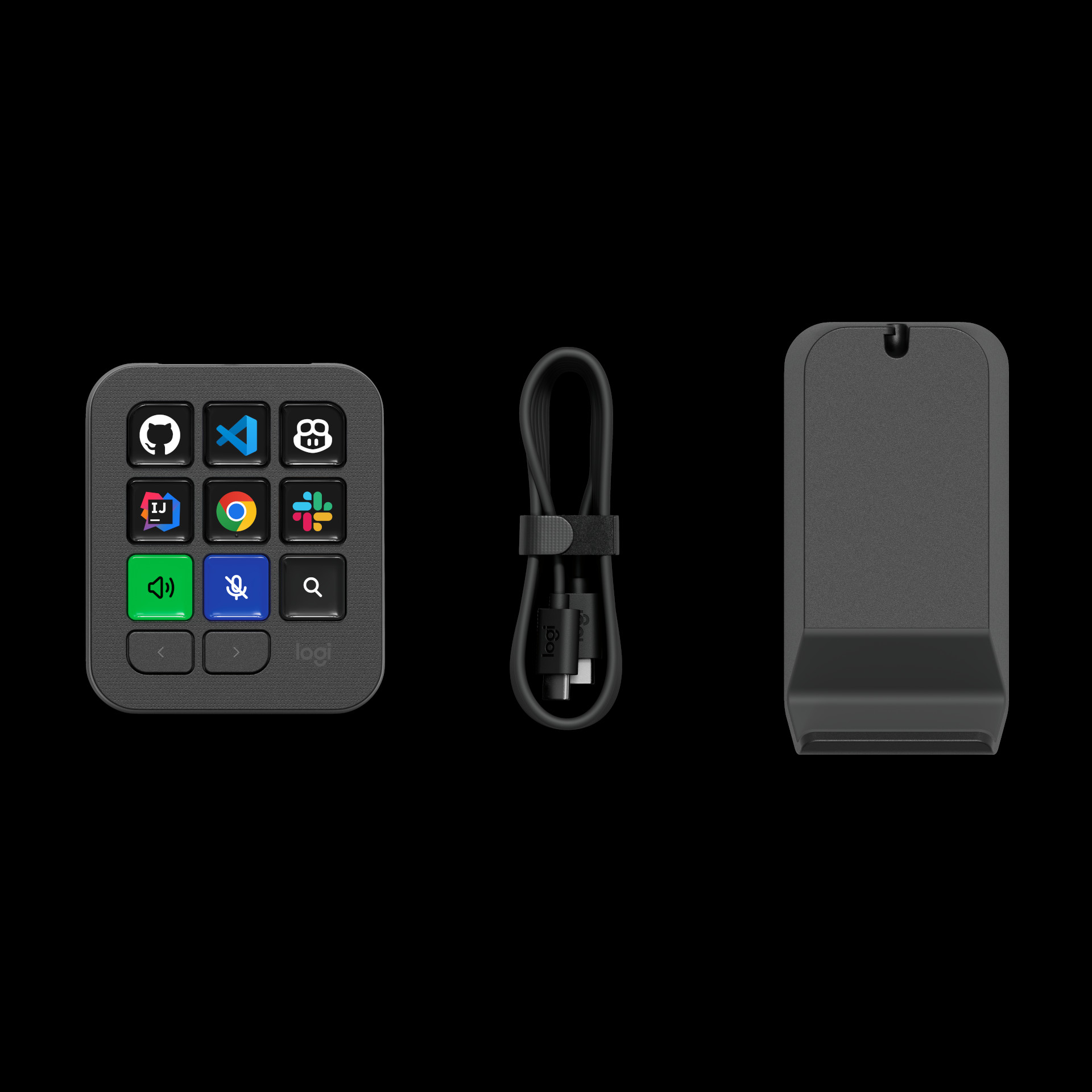
The new MX Keypad offers nine customizable full-color LCD keys which can be assigned to launching commands, running macros, and accessing AI tools.
It’s also very compact, around the same width as a Logitech mouse and weighing just 96 grams, meaning it will sit alongside a user’s keyboard without taking up too much space on your desk.
Latest Videos FromTechRadar
Advertisement
Faster and more effective access
Logitech says the MX Keypad, developed alongside GitHub and available in two color schemes, will act as a control center for users, aiming to cut down on switching between apps – although the customization options can also be used for non-coding apps.
Any of the nine keys can be configured to control one or multiple apps and agents, from running complex prompt macros to launching everyday commands, with native GitHub, VS Code and Copilot integration at launch.
Using the Logi Actions SDK, developers can even create and share their own integrations, while community-built plugins for tools including Claude Code and OpenAI Codex are already available, and plugins created and tested by developers for GitHub Copilot and Claude Code.
(Image credit: Logitech)
The MX Keypad connects using USB-C and requires macOS 13 or later, or Windows 10 or later. As is typical with Logitech devices, sustainability is also a key feature, with the MX Keypad features certified post-consumer recycled plastic, 64% for graphite, and 49% for its pale gray colored models.
Sign up to the TechRadar Pro newsletter to get all the top news, opinion, features and guidance your business needs to succeed!
“Today, coding mastery depends on how easily developers can juggle between an ever-increasing range of AI tools,” said Anatoliy Polyanker, VP and GM at Logitech. “MX Keypad puts a physical control center at your fingertips, allowing you to orchestrate your AI workflows faster and more intuitively.”
Advertisement
The MX Keypad looks to offer a more streamlined version of Logitech’s existing MX Creative Console, which provides an LCD keypad with a separate dialpad to adjust settings and move around your favorite creative apps, but costs $199.99.





















































You must be logged in to post a comment Login