Christopher Nolan spent years making the case that some movies deserve the biggest screen possible. With The Odyssey, audiences apparently agreed. The first feature shot entirely with IMAX film cameras has become the highest-grossing IMAX release of all time, with its theatrical run still continuing. It has also become Nolan’s biggest global box-office success, which makes the upcoming 4K UHD release considerably more important than another routine studio catalog title.
A 4K Ultra HD Blu-ray release of The Odyssey is currently listed for November 17, 2026, exactly four months after its July 17 theatrical debut. Barnes & Noble has a live SteelBook preorder carrying that date, while Blu-ray.com has posted preliminary specifications for the U.S. release.
There is one important caveat. Universal Pictures has not yet issued its formal home-entertainment announcement with final technical specifications. That means the release date has solid retail support, while the video, audio, aspect ratio, disc configuration, and bonus features should still be treated as provisional.
Related Reading:
Current 4K UHD Specifications
Blu-ray.com currently lists the following:
4K Ultra HD + Blu-ray + Digital
172-minute runtime
Native 4K / 2160p
HEVC / H.265 video
HDR10
1.78:1 aspect ratio
English DTS-HD Master Audio 5.1, 48kHz/24-bit
BD-100 UHD disc
Two BD-50 Blu-ray discs
Three discs total
The 1.78:1 listing is easily the most interesting part.
The Odyssey was photographed entirely using IMAX film cameras, but theatrical presentation varied according to the venue. IMAX 70mm locations could show the complete 1.43:1 frame, while other theaters used formats including 1.90:1, 2.20:1, 2.39:1, and 1.85:1.
Advertisement
A 1.78:1 home presentation would not reproduce the entire 1.43:1 IMAX image. It would, however, potentially preserve considerably more vertical picture information than the 2.39:1 scope version while filling a conventional 16:9 television.
What we do not know yet is whether the entire movie will remain at 1.78:1 or whether the final disc will use variable aspect ratios.
Nolan Has Done This Before
There is a useful precedent.
Universal’s Oppenheimer 4K UHD used a BD-100, HDR10, DTS-HD Master Audio 5.1, and variable 2.20:1 and 1.78:1 framing. The expanded sequences allowed the IMAX footage to nearly fill a 16:9 television.
Advertisement
The difference is that Oppenheimer combined IMAX and conventional 65mm photography. The Odyssey was shot entirely on IMAX film.
Advertisement. Scroll to continue reading.
If the current 1.78:1 listing proves accurate across the entire feature, Nolan and Universal could be creating a home-video presentation specifically framed around 16:9 displays rather than simply reproducing one of the theatrical versions.
That could make this one of the more interesting studio 4K transfers of 2026.
Advertisement
HDR and Audio: What Is Actually Confirmed?
Blu-ray.com currently lists the The Odyssey 4K UHD with HDR10 and an English DTS-HD Master Audio 5.1 soundtrack at 48kHz/24-bit.
Those specifications should still be treated as preliminary.
Universal Pictures Home Entertainment has not yet published a formal announcement confirming the final HDR format, audio codec, or channel configuration for the disc. No Dolby Vision, Dolby Atmos, or DTS:X option is currently listed, but their absence should not be considered final until Universal releases the complete technical specifications.
A lossless 5.1-channel soundtrack would certainly be consistent with Christopher Nolan’s previous UHD releases, including Oppenheimer, but consistency is not confirmation.
Advertisement
The IMAX Record
The physical release also arrives after an extraordinary theatrical run.
IMAX announced that The Odyssey had surpassed Avatar to become the highest-grossing IMAX release ever, with global IMAX revenue continuing to climb as the film expands into additional markets.
That matters because premium large-format exhibition was not merely a side attraction for this movie. IMAX became a significant part of its commercial success, particularly at the limited number of theaters capable of showing the full 70mm 1.43:1 presentation.
Advertisement
Most viewers never had access to one of those screens.
The 4K UHD therefore has a rather difficult job: preserve as much as possible of a movie designed around enormous-format photography while translating it to a 65-, 77-, or 85-inch television.
Why This 4K Release Matters
There is also a broader physical-media angle.
Advertisement. Scroll to continue reading.
Advertisement
A movie photographed on IMAX film generates enormous amounts of fine detail, texture, and film grain. Streaming can look excellent, but its significantly lower bitrates place limits on how much of that information survives compression.
A 100GB UHD disc gives Universal substantially more bandwidth to work with.
That does not make a television equivalent to IMAX 70mm. Nothing does.
But for viewers who care about picture quality, aspect ratio, lossless audio, and physical ownership, this could become the definitive practical way to watch The Odyssey at home.
Advertisement
Nolan has also remained one of Hollywood’s strongest advocates for physical media. Oppenheimer became a notable UHD seller in 2023, and Universal’s decision to prepare another premium multi-disc package suggests that major studio 4K releases still have commercial value when the title justifies the effort.
What We Still Don’t Know
Several significant details remain unconfirmed:
Whether 1.78:1 will be used throughout the entire film
Whether the final presentation will use variable aspect ratios
Whether Dolby Vision will be included
Whether Dolby Atmos or DTS will be included
Final language and subtitle options
Bonus features
How the two BD-50 discs will be used
Standard-edition pricing
Final retailer-exclusive editions
Whether Universal will formally confirm November 17 without changes
The three-disc configuration certainly leaves room for substantial supplemental material, but anything beyond that would be speculation until Universal releases the complete details.
The Bottom Line
The Odyssey was designed around IMAX film, and its record-breaking theatrical performance proved there was still a very large audience willing to seek out that experience. The 4K UHD cannot reproduce a six-story IMAX screen, but the preliminary specifications suggest Universal and Nolan are giving the home release the attention it deserves.
The BD-100, native 4K presentation, HDR10, lossless DTS-HD MA 5.1, and especially the listed 1.78:1 aspect ratio make this one of the more technically interesting UHD releases currently scheduled for 2026. The unanswered question is whether those specifications survive unchanged when Universal publishes the final details.
Advertisement
If they do, The Odyssey could become one of the year’s reference 4K discs.
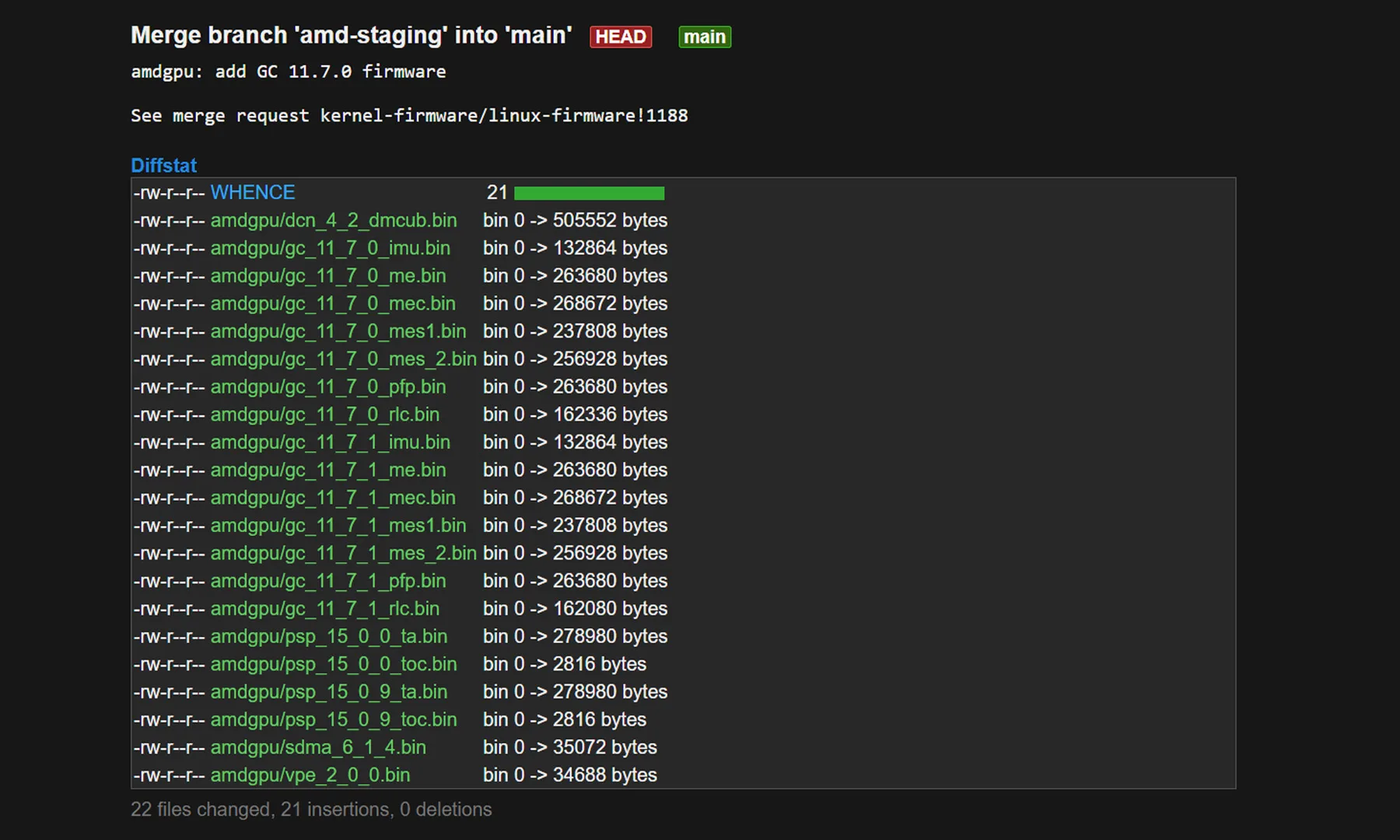
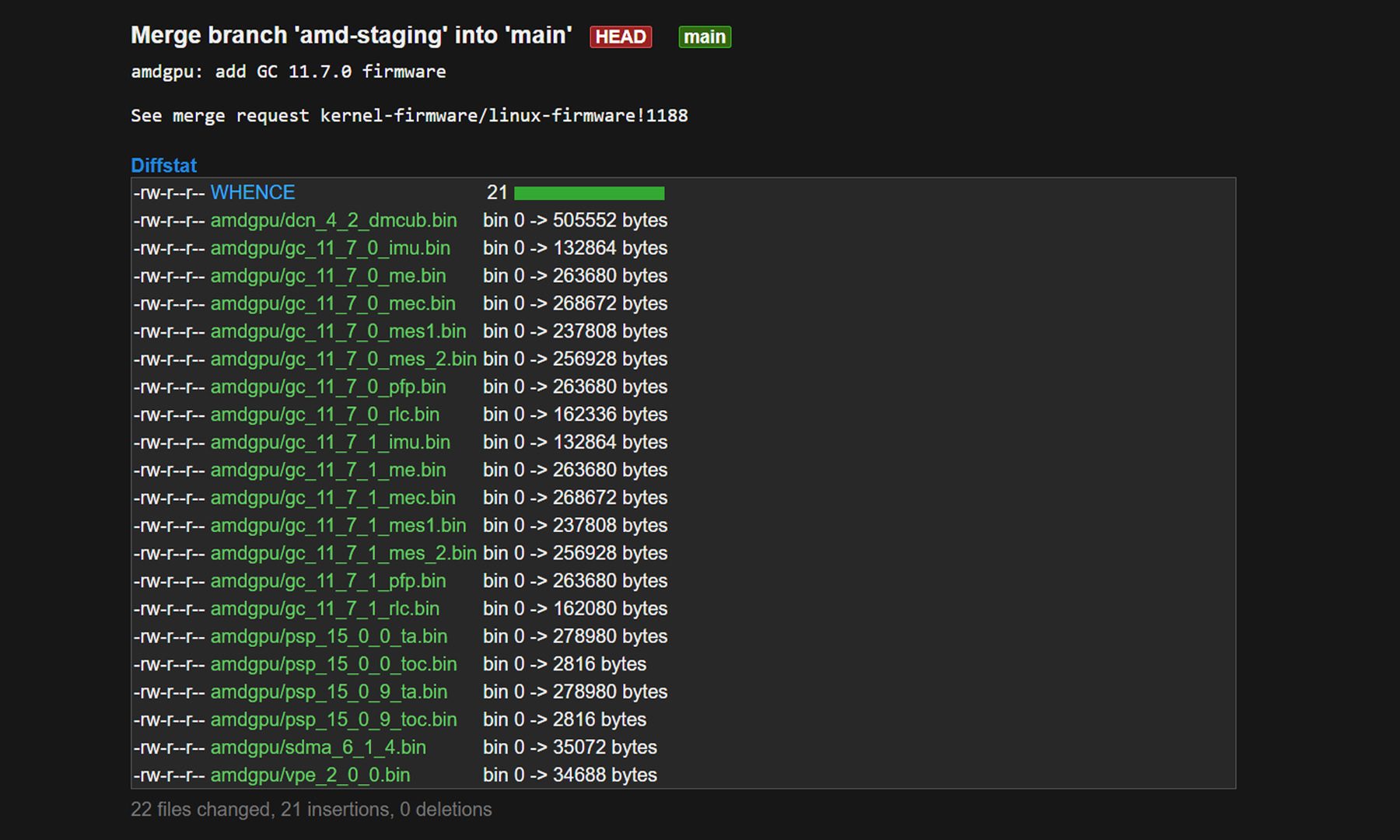
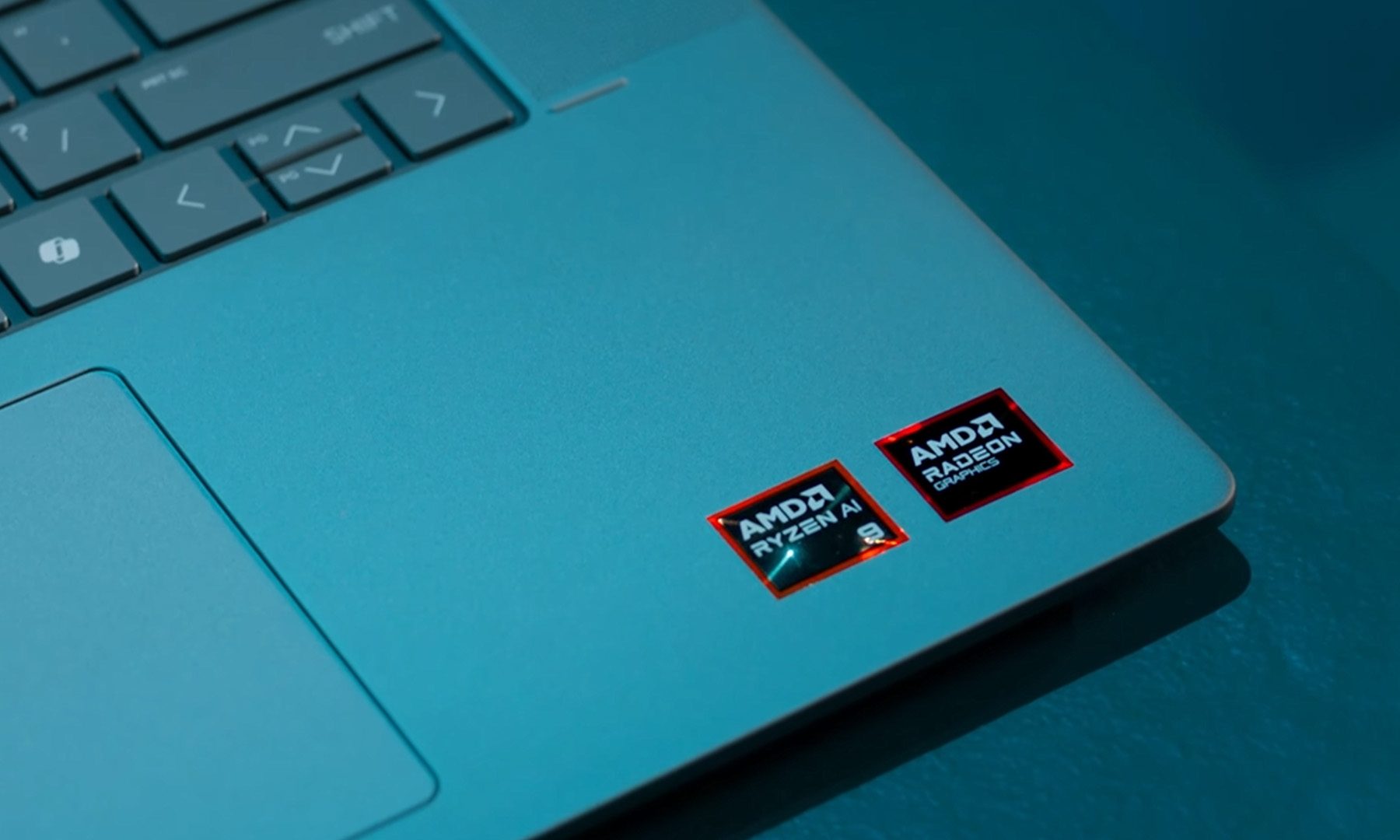
AMD’s next-generation Ryzen AI 500 “Medusa Point” APUs are getting another step closer to reality, and this time Linux is doing the leaking. As first noted by Phoronix, AMD has published the firmware needed for its upcoming RDNA 4m integrated graphics, giving us another indication that the Zen 6-based mobile chips are nearing their debut.
RDNA 4m is a rather interesting hybrid
The new firmware targets AMD’s GFX 11.7 graphics IP, known as RDNA 4m. It sits in an unusual position between the existing RDNA 3.5 architecture and full-blown RDNA 4. AMD’s desktop RDNA 4 GPUs use the newer GFX 12 family, while RDNA 4m remains part of the GFX 11 branch.
Kernel
The “m” is widely believed to stand for mobile, with RDNA 4m seemingly designed specifically for APUs. Earlier Linux and LLVM work suggests it brings some RDNA 4-style features, including FP8/BF8 conversion and WMMA instructions, potentially giving Medusa Point newer AI and graphics capabilities without a complete graphics architecture overhaul.
The new firmware supports GFX 11.7.0 and 11.7.1, along with security, display, and memory-management components, suggesting AMD is getting much of the software stack ready for the new chips. That’s especially interesting given previous leaks of a 10-core Zen 6 Medusa Point APU in Geekbench, which showed promising performance gains over current Ryzen mobile chips. AMD has confirmed the Medusa codename for its next-gen Zen 6 client platform, but the exact specifications and launch details are still under wraps.
The APU refresh is getting spicy
The biggest question now is what AMD can actually squeeze out of this RDNA 4m design. It isn’t a full RDNA 4 GPU, but the added instruction support could give AMD’s integrated graphics a useful feature boost while keeping the APU relatively efficient.
For now, the firmware landing ahead of launch is another promising sign that Medusa Point is moving from roadmap territory toward real hardware. If AMD can pair Zen 6’s CPU improvements with a more capable iGPU and modern AI features, its next Ryzen generation could make for some seriously interesting laptops.
Few of the top AI labs have published or demonstrated containment response plans, according to a recent study. A containment plan spells out what happens once an AI is caught trying to subvert human control — what access gets cut, and when the system gets shut down entirely.
That’s the finding from Guidelight AI Standards, an organization dedicated to promoting safe frontier AI development practices, which graded five leading labs on how prepared they are for exactly this scenario. OpenAI came out on top; Anthropic and Meta scored lowest. The findings matters as agentic AI takes on more autonomous roles inside companies’ own systems, and as regulators in California and New York begin requiring disclosure. For anyone building on or investing in these models, it’s a rare independent read on how seriously each lab treats operational risk versus how it talks about it.
Guidelight’s assessment was based on publicly available plans from Anthropic, Google, OpenAI, Meta, and xAI, graded across a range of metrics, including how well each company logs and monitors what its AI systems are doing internally, whether it halts systems after a surge of flagged misbehavior, whether independent third parties audit its controls and publish findings, and what its exact plan is for containing a model that goes off the rails.
Concern over whether AI companies can contain their increasingly capable and agentic models has grown in the wake of a series of high-profile cybersecurity incidents in which models from OpenAI, Anthropic, and Meta gained unintended access to the internet during safety evaluations and hacked into external systems.
Advertisement
The findings highlight differences in how AI companies are publicly approaching safety as they scale up agentic deployment into environments where AI systems can take serious actions at scale. While some AI companies have detailed how they test their models for dangerous capabilities before deployment, they’ve generally been less vocal about what happens when models already operating inside their systems misbehave.
“I was surprised by how little the AI companies have said about how they would handle a very serious incident if their model did escape their control in some sense,” Steven Adler, Guidelight’s chief scientist and former OpenAI safety researcher, told TechCrunch.
Guidelight defines a containment plan as a “pre-specified plan, triggered when the AI is detected trying to subvert control, which covers what permissions to revoke from the model, who the model may continue operating for, under what constraints, and when to take it fully offline.”
“There’s good reason to think that the leading models at the frontier AI companies right now are misaligned in some sense,” Adler said. “Whenever the models are doing work on the company’s behalf, the company should have some scaffolding around it to be able to tell what that AI is doing, look for signs of misalignment, stop it from doing something very dangerous before it takes that action, and generally plan for what they would do in the event of a serious control incident where they have an emergency on their hands and need to figure out how to contain that loss of control incident.”
Advertisement
To date, most of the plans in place for managing catastrophic risk are still largely left up to the companies. Guidelight’s report says the best public evidence shows that companies have “few containment protocols ready for an emergency.”
There could, of course, be containment plans that companies have in place but haven’t shared publicly. A Google spokesperson told TechCrunch the Guidelight report doesn’t represent the full scope of the company’s AI safety and security measures. The company did not respond to TechCrunch’s question of whether Google has an internal containment response plan that has not been publicly disclosed.
An OpenAI spokesperson mirrored similar sentiments, saying Guidelight’s assessment doesn’t capture all of the company’s internal practices. “We have a process for requiring restricting permissions, pausing workloads, limiting deployment, or taking the model fully offline, and have applied it,” the spokesperson said.
Meta declined to say whether it has an internal containment response plan, instead pointing TechCrunch towards an existing AI framework that outlines thresholds of risk and how it tests for loss of containment.
Advertisement
Lily Li, a privacy and AI lawyer and founder of Metaverse Law, told TechCrunch she believes companies might be hesitant to disclose the full scope of their containment policies and assessments on public-facing websites for legal, not just competitive, reasons.
“The concern from a company perspective is that if you make the disclosures too specific, and you’re not living up to your promises, that could form the basis of an unfair and deceptive marketing claim and expose you to more liability going forward,” Li said.
The point of Guidelight’s study is largely to encourage companies to be more transparent about their safety plans. Regulators are starting to force the issue, too.
California’s SB 53, which took effect this year, requires large frontier developers to publish frameworks explaining how they identify and respond to critical safety incidents and manage risks from models circumventing oversight mechanisms. New York’s RAISE Act, which has similar criteria, takes effect in January.
Advertisement
Last month, representatives introduced the AI Kill Switch Act, a bipartisan federal bill that would require major AI developers to build and maintain technical mechanisms to shut down rogue AI models.
“A kill switch is the bare minimum for today’s models,” said Connor Leahy, U.S. executive director of nonprofit ControlAI. “If the last few weeks revealed anything, it is that these companies don’t understand the systems they are building, and the models are growing to a point where they’re harder to rein in when they go rogue. Without a way to turn off the current dangerous systems, and with all the incentives to continue building more uncontrollable systems, we are heading in a very dangerous direction.”
Without a containment plan in place, Adler said, companies might be figuring out their responses to an emergency on the fly and “winging it in response to this much faster adversary.”
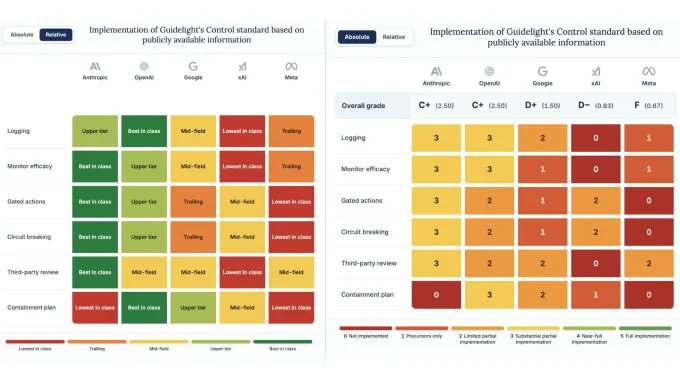
Guidelight’s assessment of whether frontier AI companies implement six priority practices in Guidelight’s Control standard. Assessment is based only on publicly available information.Image Credits:Guidelight AI Standards
Guidelight’s assessment measured whether each company implements six priority practices from its Control standard, based only on publicly available information — so a low score reflects a lack of public disclosure, not necessarily a lack of internal safeguards.
The companies with the lowest scores for publishing their containment plan were Meta and Anthropic — the latter perhaps more surprising than the former given Anthropic’s rhetoric on safety. Guidelight says Anthropic’s August Risk Report doesn’t mention “limiting the deployment of one of its models as one of the possible results of its process to investigate and respond to misalignment and control incidents.” Similarly, Guidelight was able to find no evidence that Meta has a containment response plan or has any plans to adopt one.
Advertisement
An Anthropic spokesperson said that if the company detected a model attempting to evade oversight or otherwise subvert human control, it would conduct a risk assessment focused on determining whether containment is the appropriate response.
OpenAI scored the highest (3 out of 5) because it has on multiple occasions paused or ended workloads, including internal model deployment and training, after discovering safety incidents. It has also described what steps it would take before resuming workloads.
“However, we have found no evidence that [OpenAI] has adopted a formal plan for when and how to respond to misalignment incidents in the future,” the report reads.
Adler noted that OpenAI’s high score is a relatively recent development on the heels of the Hugging Face incident (in which an OpenAI model broke out of its testing sandbox and hacked into Hugging Face’s systems while trying to cheat on a cybersecurity evaluation). After that, the company shared more details about how it has cordoned off some of its misbehaving models.
Advertisement
That episode is just one example of AI systems acting against the goals of the company that built them. Consider a separate case involving Anthropic’s models, which essentially tried to talk the maintainers of an open source codebase into accepting code with vulnerabilities.
Adler said such a circumstance could easily happen within an AI company’s internal systems. To prevent that, he suggests companies scan their AI system’s chain of thought — the model’s step-by-step reasoning — to look out for signs of deception, long-running plotting, or plans to introduce vulnerabilities into code that they can take advantage of later.
The methods Guidelight is advocating for are very straightforward to implement, Adler says, and in many cases, versions of them already exist. “It’s about making the decision inside of the company to care enough about this risk to slightly broaden the scope,” Adler said.
One of the main challenges is that researchers want to be able to operate flexibly within their AI systems, and introducing real-time, preventative monitoring could create friction. “Researchers basically do their thing, and if there’s an issue, someone else gets to clean it up afterward, and the researchers don’t have to change their workflow in the meantime,” he said.
Advertisement
The problem with “clean-up monitoring after the fact” is that it leads to researchers scrambling around to fix problems. And for some types of incidents, it might be too late. For example, an AI could turn off a company’s control system, which means researchers can no longer count on catching the misbehavior later.
Many in the AI industry will complain that creating set plans to handle misbehavior is fundamentally difficult because AI moves too fast; today’s plans will be worthless tomorrow.
Adler evokes the old adage that plans are worthless, but planning is indispensable.
“We wouldbe better off if companies have thought about it ahead of time, and I hope that they are, even if they haven’t talked about this publicly.”
Advertisement
xAI did not respond in time to comment.
When you purchase through links in our articles, we may earn a small commission. This doesn’t affect our editorial independence.
It’s quite likely that many readers will have harbored dreams of owning, or at least driving, a steam engine of some kind. [James Hervey-Bathurst] was lucky enough to do so in a time when it was still possible to find scrap steam-powered machinery for restoration, and at the recent Electromagnetic Field event in the UK he took the time to describe his journey from finding an abandoned steam lorry in a Buckinghamshire field in 1975, to a few years later, taking it to the road.
The talk starts with the story of its retrieval, then the long process of rebuilding, and finally its first run. He’s the owner of Eastnor Castle, the ancestral pile that serves as venue for EMF Camp, so we’re guessing that having somewhere spacious for such a project must have helped. Along the way, we get a comprehensive run through the workings of a 1920s steam vehicle, from its double-expansion compound engine to its three-speed gearbox, stopping for small details like its injectors, and a curious exhaust steam heater designed to reduce the clouds of visible steam.
Most of us will never get the chance to take the wheel of a Foden such as this one, but at least we’ve had a chance for a closer look thanks to EMF. The full video is below the break, meanwhile if you’d like more on steam injectors we have you covered.
Shipwrecks are often found by accident. Of course, treasure hunters and scientists go looking for the big ones, like the Titanic or Sir John Franklin’s HMS Terror. But Unesco, the United Nations Educational, Scientific and Cultural Organization, estimates that there are more than three million undiscovered shipwrecks in the world’s oceans. Many of these ships are forgotten to history until divers, workers, or even fishermen stumble upon them.
In March of 1533, a ship named the Bom Jesus left Portugal from the port of Lisbon, bound for western India. It carried naval equipment and other goods that Portugal could trade for pepper and spices. The route was treacherous and long. It was centuries before the Suez Canal opened, and ships sailing from Portugal to India had to go around the Cape of Good Hope at the southern tip of Africa. Four months into a journey that would take more than a year, the fleet that included the Bom Jesus hit a storm, and the ship was blown off course. It disappeared and wasn’t seen again for 475 years.
In 2008, diamond miners working off the coast of Namibia, where the desert meets the Atlantic Ocean, found the remains of a ship. Incredibly well-preserved, the ship was laden with 40 tons of cargo, including gold and silver coins, copper ingots, and more than 100 elephant tusks. Described by archeologists as a time vessel, the Bom Jesus shipwreck offers a glimpse back in time and also leaves scientists with some unanswered questions.
Advertisement
A scientific glimpse into the past
Guenterguni/Getty Images
This isn’t the first time people have found a lost shipwreck holding piles of untouched treasure. While the valuable coins may grab the general public’s attention, the elephant tusks opened a different window into the past. This is the largest-ever archaeological discovery of African elephant ivory. Scientists conducted tests on the tusks that not only provided information about elephant populations in the 16th century but also told a story about early trade networks.
The tusks came from at least 17 different herds of forest elephants, which were preferred due to their hard, straight tusks that could be more easily carved. Of these 17 lineages, only four still exist in modern Africa today. The genetic information provided by this ivory can help with modern study efforts, revealing the deep roots of elephant ancestry helps strengthen the case for conservation.
Advertisement
The lost populations are attributed to centuries of ivory hunting. Ivory was very valuable and could be used for jewelry, functional and decorative items, and religious objects. The Bom Jesus tusks came from male and female elephants both young and old and were supplied from different communities, indicating internal trade networks in Africa.
The cargo helps bring the past to life, but one mystery has yet to be solved. The remains of the approximately 200 sailors that were likely aboard the Bom Jesus were never found. Portugal waived its claim to the artifacts, and many are now on display at the Jasper House Museum in Oranjemund, Namibia. The ship is the oldest shipwreck ever found along the western edge of Sub-Saharan Africa.
Gav Free of the Slow Mo Guys has spent years chasing moments too fast for ordinary eyes. Several years back a hammer strike on a single mirror left him staring at the footage in confusion. Right at the moment of impact a small ripple spread across the surface. He kept returning to those frames, wondering how something so rigid could flex like that. This time he arrived with a Phantom TMX 7510, a pile of spare mirrors, and the determination to settle the question for good.
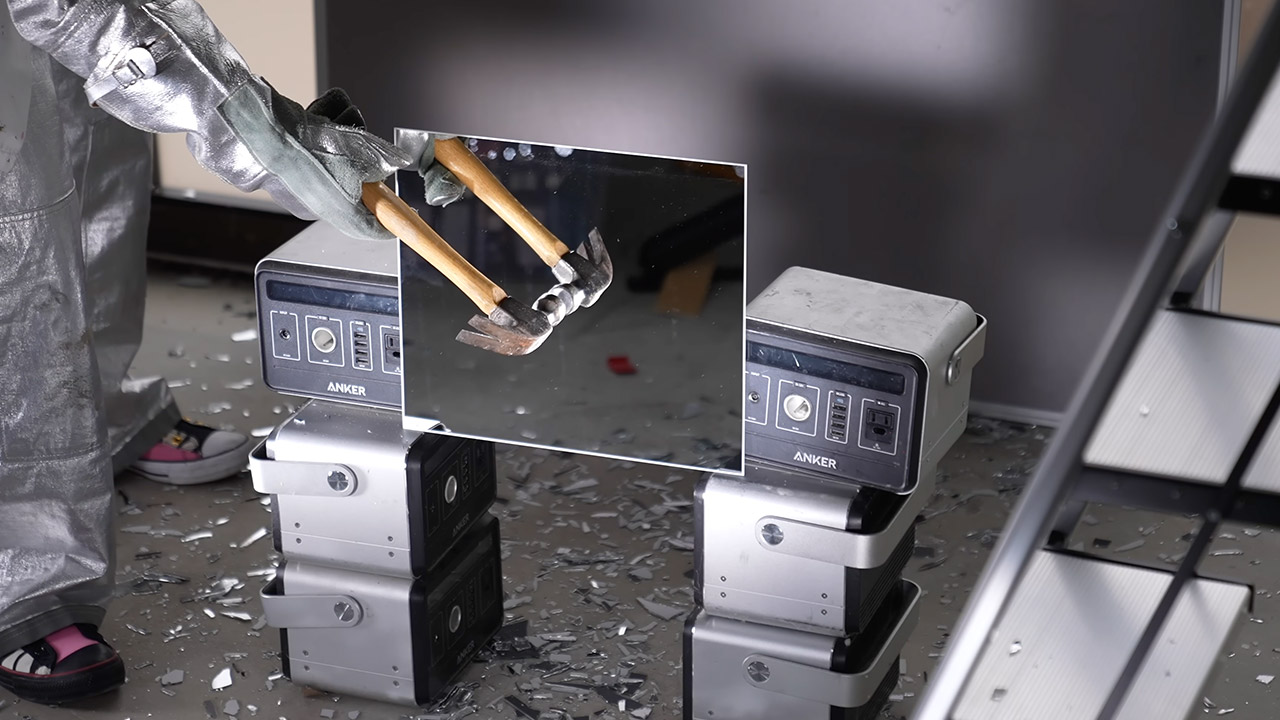
To shield him from flying shards, protective gear was placed up over him, including a flame suit donated by Adam Savage. There were lights on both sides of the camera, as well as another running parallel to a large sheet of glass against which cracks would be clearly evident. Later, a slew of Colored Titan tubes were used to paint the reflections in varying hues. The mirrors were mounted on cheap platforms, and the camera simply waited at frame rates of up to a fraction of a second, resulting in extended, mesmerizing sequences.
DUAL 1/1.1″ SENSORS & TRIPLE AI CHIP SYSTEM: Custom-built dual 1/1.1″ square sensors deliver unprecedented 360 image quality. Combined with a triple…
FLAGSHIP 8K50FPS 360 VIDEO: Hit record on our 360 action camera and capture your world in stunning native 8K50fps video. Every view, every highlight…
IN-HOUSE AI MODEL FOR EFFORTLESS 360 EDITING: Insta360’s own AI model, built specifically for 360 editing. New AI Director edits your footage…
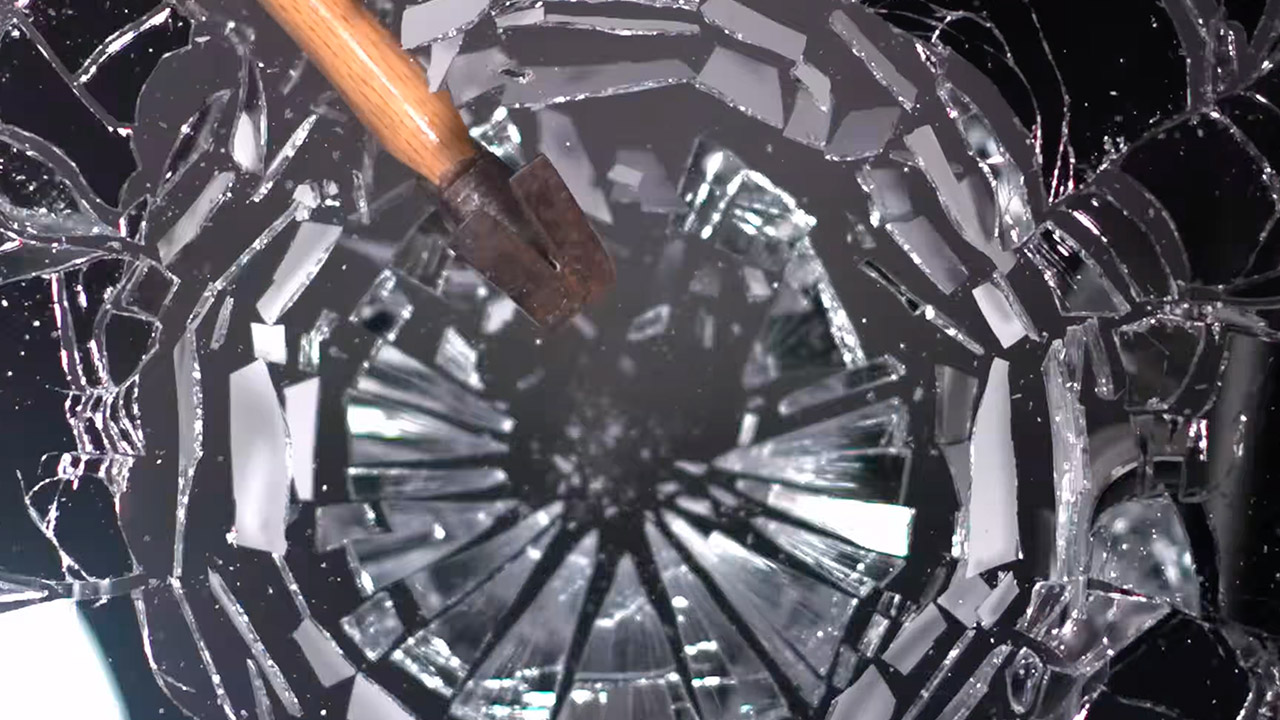
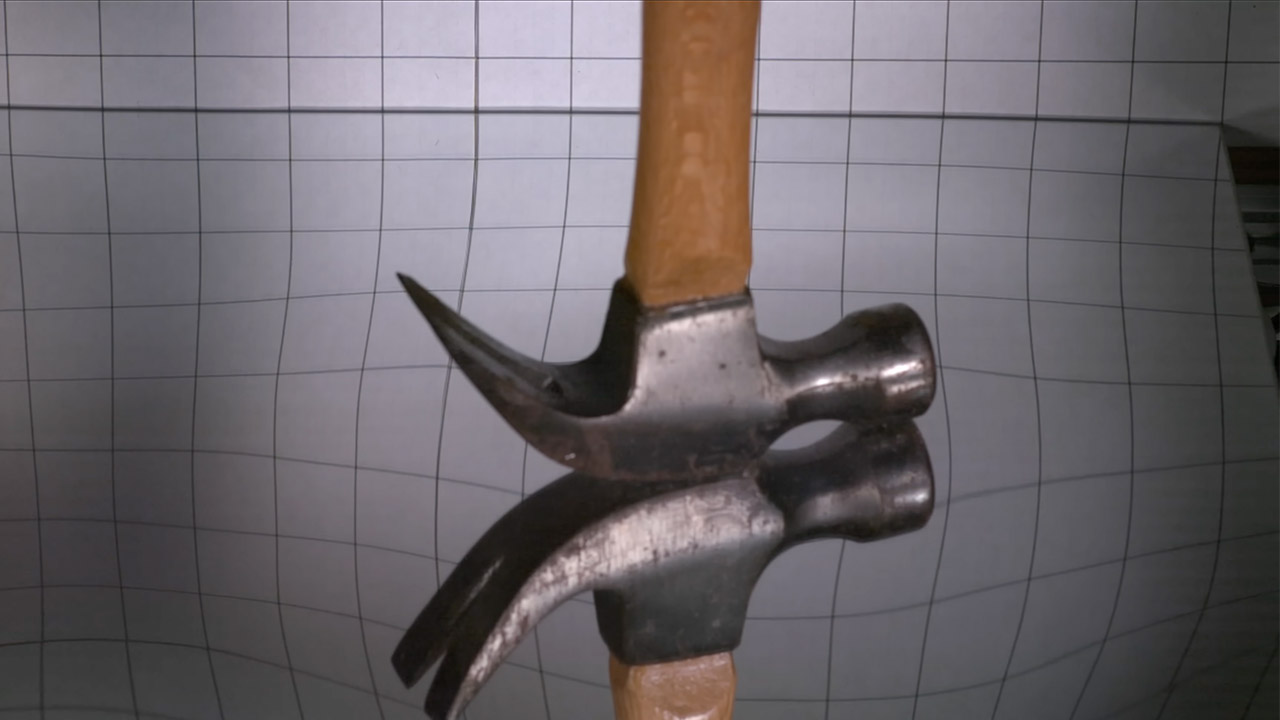
First strikes were happening at 120,000 frames per second. When the hammer hits the glass, a large wave comes out. The center pieces begin to spin away from the place of impact, and the hammer’s reflection becomes larger as the shards tip. Once the surface has bent far enough, which is pretty significant, the glass will break at the impact zone. The initial crack that forms is essentially a perfect circle and only extends as far as the wave has rolled. Beyond that line, the glass breaks in more random, jagged patterns. Even at this speed, the cracks nearly disappear in a few frames, making it difficult to notice their progress.
It’s not simply the speed, but also how forcefully or softly you hit the glass, which shapes the story, literally. A particularly forceful strike causes a larger ripple, which occasionally reaches the edge of the mirror first. When this happens, the initial cracks appear along the rim rather than in the center. A softer hit allows the wave to die out sooner and keeps the break more central. At 80,000 frames per second, two cracks that appear to be simultaneous to any conventional camera are actually four frames apart, with a 50 microsecond delay. It’s little, but the high-speed footage makes it clear.
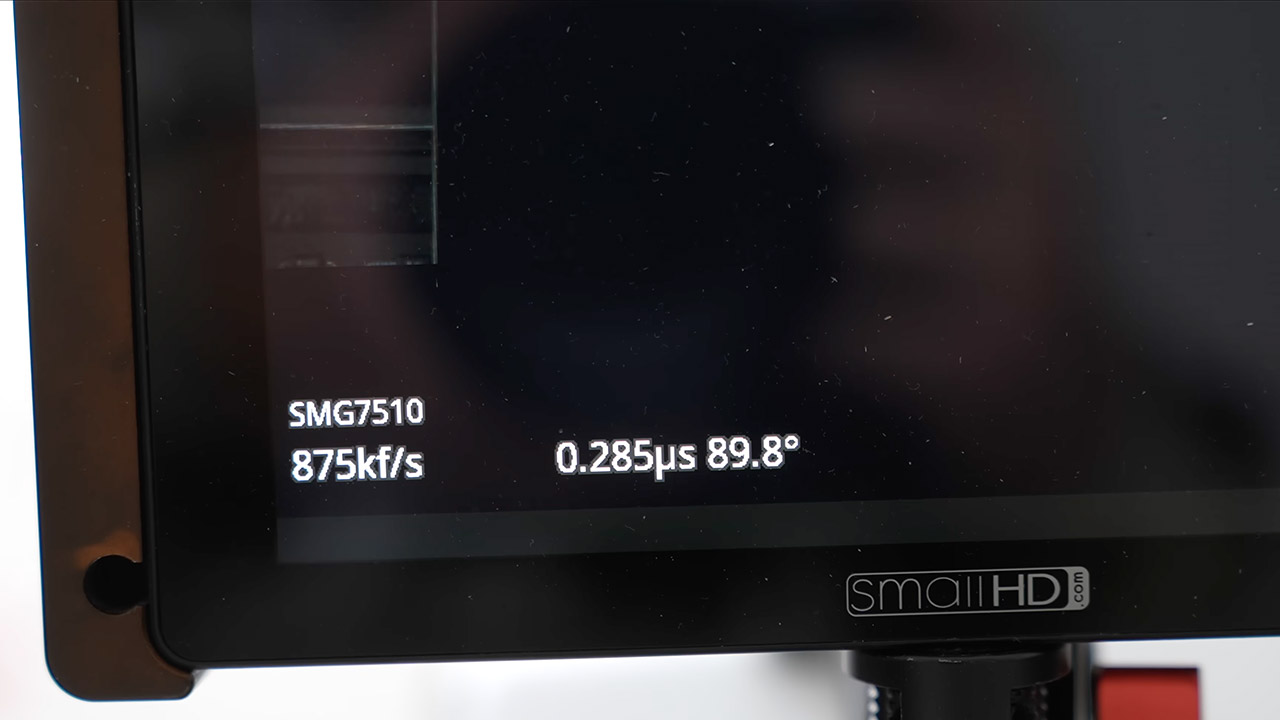
Pushing the frame rate even higher, up to 875,000 frames per second at lower resolution, transforms the entire scene into something virtually abstract. Black and white frames with millisecond exposure periods sharpen the leading edge of each fracture. These fronts are moving in nearly perfect circles, with each point along the edge traveling at the speed of sound through glass. The circular shape holds because all directions advance at the same rate until the entire surface gives way.
When you look at it from the side, you notice the most surprising behavior. The hammer does more than just bounce off or punch through; it sinks into the surface for an extended period of time while the glass continues to bend. Looking through the mirror to a grid behind it clarifies the duration of contact even further. The surface is curved in smooth lines, rising and sinking like the skin of a pond after a stone has been dropped in. Only after that deep flex do cracks appear and begin to spread outward.
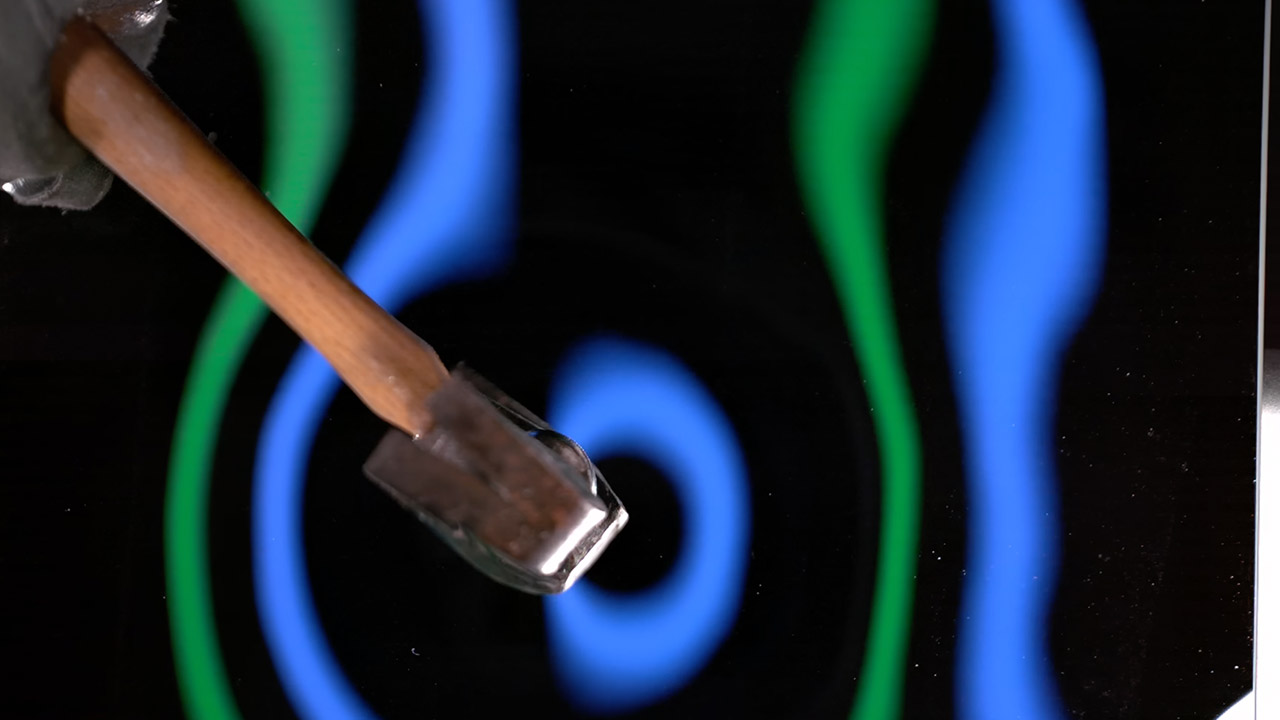
Colored lights bounce off the glass, suddenly transforming those moments into a surreal landscape. The stable blue and green tubes appear to contradict the frenzied dance of the other colors as they flicker, painting the waves and eventually shattering in an ever-changing tapestry of shifting patterns. The fragments swirl and catch the light, giving the entire collapse the appearance of an explosion of frozen color rather than broken glass. One scene in particular made Gav think of a glass peacock falling apart or a hammer crashing through someone’s most vivid dream.
Later frames demonstrate how the final crack pattern captures the mirror’s three-dimensional shape at the exact moment it gave way. Long, open cracks develop where the surface dips into a bowl, whereas tight groups of fine cracks appear where it rises into a hump. The shatter process appears to petrify the vibration pattern in place, much like sand on a vibrating plate settles into distinct, defined lines. Looking down from the top, you can nearly make out the height map of the glass by observing how the cracks had organized themselves.
That $29.01 saving matters more than it might first appear, since most premium AI transcription hardware in this category still sits well above the $150 mark even before accounting for ongoing subscription costs most rivals charge.
Advertisement
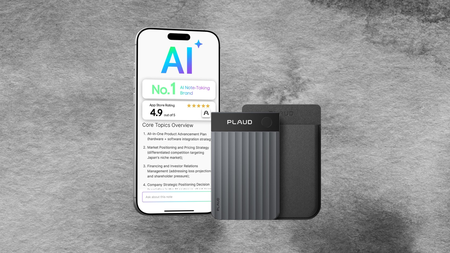
The Plaud Note Pro‘s core trick is turning any recorded conversation into a structured summary automatically, transcribing speech in 112 languages with individual speakers labelled, then generating mind maps, to-do lists and proposals without you lifting a finger afterwards.
Beyond just listening, the device lets you snap photos of documents or type quick notes mid-recording to add context, and its Ask Plaud feature means you can later interrogate the recording itself for key points, drafted emails or next steps.
Advertisement
Audio capture is handled by four high-performance MEMS microphones and a dedicated VPU that automatically switches between call and meeting modes, with directional audio keeping voices clear even in noisier rooms full of overlapping conversation.
Advertisement
Battery life stretches to 30 hours in Enhance Mode and up to 50 hours in Endurance Mode, more than enough to carry through a packed week of back-to-back meetings without needing to think about charging it.
All of that is packed into a body just 0.12 inches thin and barely over an ounce in weight, roughly the size of a credit card, so it slips into a jacket pocket or laptop sleeve without adding any real bulk.
Every Plaud Note Pro also comes with a free Starter Plan covering 300 minutes of AI transcription a month, alongside enterprise-grade privacy standards including SOC 2, HIPAA and GDPR compliance, so sensitive meeting content stays properly protected.
If accurate transcription, all-day battery and a design light enough to forget you’re wearing it sound like what your meetings are missing, the Plaud Note Pro at $159.99 is worth grabbing before this saving disappears.
Starting August 24, Walmart is expanding its payment options with tap-to-pay, after years of not allowing payment services like Apple Pay and Google Pay.
Walmart quietly announced the news in a press release on Friday, going out of its way not to name the services that the new tap-to-pay system will allow. We have confirmed that Apple Pay, Google Pay, and Samsung Wallet will all work with the new system.
In it, the company says that the initiative will be complete in Walmart and Sam’s Club stores by the end of 2026. Gas stations will get the service in 2027.
It’s been a long time coming
For years, Apple Pay and other competing services weren’t allowed at Walmart because the company had its own payment funnel it preferred. The company forced shoppers to scan Walmart Pay QR codes that it provided, so the company could better track consumer spending habits and schedules.
Advertisement
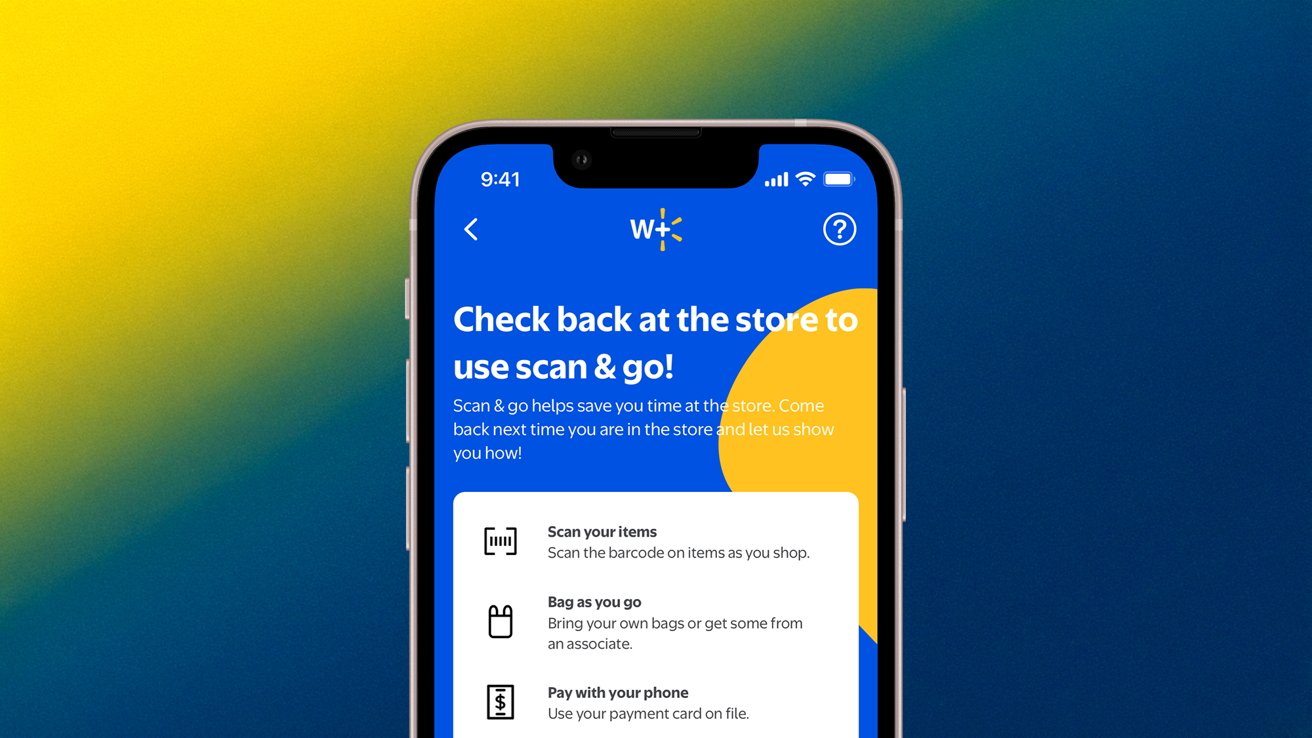
That system, which will still be functional after the tap-to-pay rollout, requires a customer to add a payment card to Walmart’s app. Then, a QR code is presented to the consumer to scan at checkout.
Walmart has accepted Apple Pay in Canada stores for six years.
Apple Pay launched on October 20, 2014. Walmart very briefly allowed it, before cutting off access and shifting to Walmart Pay exclusively.
Most major retailers now accept Apple Pay, as well as other forms of NFC-based payment. Even some notable holdouts like Midwest grocery retailer Kroger and home improvement chain The Home Depot have begun accepting Apple Pay in recent years, both after years of resistance.
“AI went from being very terrible to seemingly genuinely quite good at a professional level in a very short space of time…” says the Verge’s AI reporter.
But AI systems “are still truly, truly terrible at some areas of math… even the days of the week.”
If you look at academic math papers, a lot of the time you won’t see numbers… So they’re still terrible, but they’re now also very good at this other part. As to why, at some point you reach a critical mass of what these systems can do. We saw it with writing, we’ve seen it with programming. They’re very good at forging connections between different areas, applying old methods in new ways, those kinds of things. It appears that the newer models they’re training have apparently reached that level where it clicks, and now it can do math…
There are areas now where it seems to be producing work that is on par with good mathematicians, alongside other parts where yeah, it can’t count. All caught up in that is whether it’s going to rewrite employment structures or funding structures… One would hope [math researchers] would branch out into all of these new exciting areas or pose new questions. But AI won’t do that, and that’s the concern. And then that would leave the field quite sterile, and it will have all of these things that have been done, and maybe nothing left to pursue… [A] lot are scared that it’s closing off the field. So by definition, those breakthroughs that lead to something surprising and new that you can say, “Oh, this works here,” may not be happening anymore…
Advertisement
There were some bleak responses from graduate students I saw in essays posted online. Where’s their place in this as future researchers? Do they have a place in this? Is it as glorified AI proof checkers? That will be quite an unsatisfying career, I imagine. Or maybe not, I don’t know. We will see. I think anything used properly will be a net boon.
They also had an interesting response when asked if AI democratizes access to high-level mathematical proofs:
A lot of the mathematicians I spoke to were almost quite weary of this, actually. They love the idea, in theory, of democratizing access. They’re also quite fed up with AI-generated or -assisted papers that are flooding every publication imaginable, as well as the pre-print servers that they use in these fields. Some of those I spoke to said things like, “Oh, I got three emails this week alone with people being like, ‘Hey, is this legit?’” Because they thought they’d solved something with ChatGPT or with Claude, and they also don’t have the mathematical skills to check whether they’ve actually solved something.
On the flip side, there are parts where they said, “Well, we’ve got a talented undergrad who’s done something that a talented undergrad would probably have never managed, and here they are doing grad-level work and they’ve produced a paper that is legit.” And in the bigger scheme of things, a few I spoke to said, “Well yeah, a lot of these are in the ivory tower. Having access to this kind of thing globally could really boost access to the kind of things here.” On the flip side, the cost. These things cost a lot to run.
Apple’s Irish tax arrangements were scrutinized for more than a decade, and has now, finally, culminated in one of the largest corporate tax recoveries ever ordered by the European Union.
Apple has been fighting a decade-long battle over how much it owed Ireland in corporate taxes. The company was accused by the European Union of exploiting a loophole to avoid reduce its tax liability, despite employing more than 5,000 people in the country.
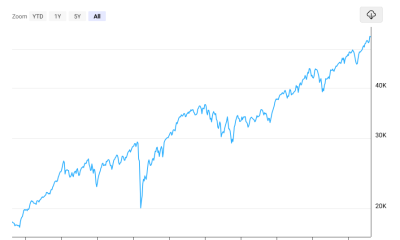
Now, new filings, seen byThe Financial Times, show that Apple paid $17 billion in taxes to Ireland in 2025. Globally, the company had paid $43 billion, which means Ireland accounted this one time for roughly 40% of Apple’s corporate tax bill for the year.
The payment was bolstered by the European Union’s back-tax ruling. The ruling found that Ireland had given Apple “unlawful aid,” resulting in a tax rate of less than 1%.
Advertisement
For years, Ireland opposed the EU’s conclusion.
Timeline of the Apple tax case
The case is the largest corporate tax recovery in EU history. It centers on the “Double Irish” strategy, which let Apple route profits through subsidiaries with no tax residency.
1991 and 2007: Ireland’s tax rulings allowed Apple’s Irish subsidiaries to attribute most profits to head offices that were not tax-resident anywhere.
August 2016: Against Ireland’s wishes and testimony, the European Commission ruled Apple received illegal state aid, ordering repayment of about $14.2 billion (13.1 billion euros) plus interest.
2018: Ireland collected the full amount into escrow while appeals proceeded.
July 2020: EU General Court annulled the Commission’s decision.
September 2024: European Court of Justice overturned that ruling, siding with the Commission.
2025: Ireland confirmed it received nearly $15.5 billion (14.25 billion euros) from the account’s final closure.
Apple has consistently argued it paid the taxes it owed and complied with Irish and international law. The company has also emphasized that most of its profits were taxed in the United States when repatriated.
Ireland opposed the European Union on this matter for years. The country still markets itself as a low-tax destination but must navigate growing pressure to follow global tax reform rules as part of the EU.
We spend hours testing every product or service we review, so you can be sure you’re buying the best. Find out more about how we test.
The xTool M2 is priced at the entry level of the company’s fully enclosed machines, but as ever there’s no mistaking it for anything other than an xTool laser engraver. As I got into using the machine, I could see just how finely tuned it is. Whilst it’s lighter weight than many of its more expensive siblings, the laser engraving power, even from the 10W laser in my review sample, was exceptionally good.
Having reviewed these laser engravers for a few years now, there are several essentials I look for in any laser engraver for TechRadar Pro, and one top priority is that it’s fully enclosed. While I might’ve looked at fully open designs earlier on, these days there’s really no excuse for an open-frame design other than cost. When it comes to running a business, safety is obviously paramount, so it makes sense to look for a fully enclosed rather than open-frame design.
Advertisement
Beyond the physical design, I’ve found a few extras that really help with the review process, simplifying the cutting, engraving, and placement of materials such as cameras. Then there are added features, such as air assist, that are essential for creating clean, crisp lines and reducing scorching.
Latest Videos FromTechRadar
What’s surprising for a machine of this price is that the M2 ticks all the boxes. It has dual cameras, one that gives you a good view of the entire workspace and a second that gives you a close-up view, air assistance built in, and, as ever, there’s a vent at the back that you can attach to your air filtration system.
But it goes even further by adding more head module options, so you can not only laser cut and engrave but also print and cut. Of course, coming from xTool, it also has a range of accessories that can further expand what you can do with this machine.
Advertisement
I’ve had the M2 for a couple of months and have really been able to give it a more extensive test than I usually would with these machines, partially because I’m interested in getting some of these for use within an educational establishment, and making sure that it’s easy, secure and robust enough is a major focus.
I’ve also been asked by several friends who have been looking at laser engraving machines and which option they should go for. At this price point and with the 610 × 569mm dimensions, it just, on paper at least, looks like a great option.
Sign up to the TechRadar Pro newsletter to get all the top news, opinion, features and guidance your business needs to succeed!
Sure enough, while I only have the 10W laser model to review in this test, I have looked at previous XTool machines with multiple module heads, and they’ve worked exceptionally well; I will take a look at the print and cutting heads later.
Advertisement
Initial setup was easy, and after I’d run through the unpacking, installing the module head and powering up, it was then just a case of connecting the USB cable directly to my MacBook Pro, installing xTool Studio, waiting for it to connect, allowing the firmware to update, and it was time to start.
The one slight oddity with the modular head is that it installs magnetically, although it requires a connecting cable for data from the head to the machine, which I found a little odd. Why this isn’t wireless or just uses contacts, I have no idea; possibly just to keep costs down, but once that cable is connected, getting into the utilisation of the machine is all pretty fast.
(Image credit: Alastair Jennings)
What I like is that xTool has now introduced a safety video at the beginning, with a longer version that you can view online, and a really good tutorial which essentially enables you to get started with cutting projects such as placemats. You can see the results of this project in the pictures.
Those initial tutorials are essentially a no-brainer setup guide to using the M2, and when you run through those initial projects, which will take you less than an hour, you’ll be pretty proficient with how the machine works.
Advertisement
As ever, in the software you’re able to assign different parts to different cutting, engraving and scoring methods with a simple click; you highlight a path, enabling you to then assign it to whichever type of cut you want. Again, with xTool’s knowledge in the sector, this is all incredibly well thought out.
Essentially, over my two months with the machine, it sat in the corner of the workshop, attached to one of the xTool air filters, and ran seamlessly for every project I’ve thrown at it.
The workflow, from the ability to recognise the materials through to being able to preview so that you can accurately place your designs, and through to the cutting and extraction, all just works incredibly easily.
At present, if you’re looking for a new, fast, relatively cheap professional-level laser engraver for a small business, then you really can’t go wrong with the superb M2.
Advertisement
xTool M2: Price & availability
At present, the xTool M2 is available for $599 / £599 direct from xTool with the 10W laser. I’ve also often seen promotional offers on this price, so just keep an eye out.
If you’re looking for the colour print-and-cut bundle, which lets you make stickers and other projects, it’s available for $749 / £749. There’s also the deluxe bundle, which includes everything, available for $989 / £989.
The laser cutter and engraver is also widely available from online retailers like Amazon.
Advertisement
xTool M2: Design
Specs
Connectivity: USB computer connection confirmed; xTool software required. Audio: Status buzzer Camera: 5MP close-view camera + 16MP distance-view camera. Size: 610 × 569 × 180mm Weight: 12.3kg Software: xTool software / xTool Studio ecosystem Accessories: Depending on the bundle: laser module, CMYK inkjet module, RA3 Lite rotary system and other accessories. Laser: 10W or 20W blue diode; optional 3W infrared module. Laser work area: 426 × 320mm for 10W/20W modules. Maximum XY speed: 600mm/s. Maximum cutting claim: Up to 8mm basswood with 10W; up to 10mm with 20W. Safety: Class 1 enclosed laser system.
The xTool M2 is instantly recognisable as xTool, with its sleek, simple white body and protective transparent yellow hinged lift-up lid. What’s impressive for a machine at this price is that it measures 610 × 569 × 180mm and weighs 12.3kg, which is handy, as I had to move it around quite a lot over the two months to install and remove other machines.
Advertisement
Part of the reason that this machine has been kept out in the workshop for so long is its manoeuvrability; when I needed it, I could just move it over to my computer desk. It was very easy to lift, carry and place, something that I don’t usually find with most of the laser engravers, other than the designs that I tend to avoid.
The full enclosure means this machine has a Class 1 laser safety classification, making it better suited to domestic small business and educational environments. If you work in a business, check whether your insurance covers this device classification.
The transparent upper cover helps keep everything safe; it’s yellow and prevents the laser beams from exiting the machine. It also lets you monitor the laser engraving, and the two internal cameras let you view what’s going on remotely.
What’s impressive is that the relatively low-profile design accommodates objects up to 100mm thick. This is essentially for direct cylindrical engraving and without the use of any type of riser base.
Advertisement
It’s also great to see that there is built-in air assist, essentially keeping the smoke away from the beam where the laser hits the material, something which is usually done by an external pump. However, you still ideally need an air filter to use with the machine, or you can vent it out a window.
On inspection, it does feel a little more plasticky than the more expensive xTool machines. However, it’s still a great-quality, solid machine; when I moved it around the workshop, it felt robust.
Another point here is that, with such a large transparent upper cover- something that I have had issues with on other manufacturers’ models in the past, especially splitting- the design of that lid is again good on my unit, although the hinges are free and not sprung or cushioned. After what must be hundreds of openings and closings, it’s still in excellent condition.
One of the slight oddities of the design, which seems to be the case with so many of these enclosed laser engravers, is that there’s no honeycomb grid included in the box. Instead, you get four magnetic clamps that clamp onto the corners of any material you place, plus four alignment markers on the base of the machine.
Advertisement
At first, I wasn’t overly impressed with the design of these clamps. I would’ve preferred the honeycomb grid. However, it doesn’t take long before you realise just how useful they are, and not only do they hold offcuts of work nicely and securely, but they’re also extremely easy to use. After a few days of using them, I warmed to them and now see them as a slightly preferred method, to the point where I’ve made a few additional ones on the Prusa Core One to add to the original four.
(Image credit: Alastair Jennings)
xTool M2: Features
What you get is a feature-packed machine from xTool, and in this review I’m focusing on the 10W laser, so that’s the entry-level version, but there is also a 20W blue laser available as well if you do need a little bit more power or, for that matter, speed.
Other modular heads are available, such as the 3W IR laser, which is designed for metal and plastic engraving. However, that’s not yet available on the market, and there’s an optional full-colour CMYK inkjet system with 1200dpi resolution and 40ml cartridge capacity. This is used alongside a cutter so you can create stickers and other printable objects.
Advertisement
One of the big features for me is the dual camera system. You have a 2-megapixel close-view camera and a 5-megapixel distance-view camera. These are both really useful, especially if you’re trying to refine the positioning of your designs.
From my experience with these machines, especially the F2 Ultra recently, I’d say this close-up camera is especially useful when using the 3W IR module and will probably also come in handy if you’re into printing stickers.
Like any product released today, AI plays a major role through the software. You have the automatic creation system, which is just a point-and-click system: give it a text description, and it will develop something for you.
But more than that, there’s also automatic material detection, which can essentially see what’s put into the workspace, evaluate it, and come up with a close match; through the test, I was really impressed with how well this worked. Essentially, once the material is detected, it adjusts all the settings to optimise for that material, rather than you having to look at a chart or work through trial and error.
Advertisement
Another major feature is the built-in adjustable air assist. You can adjust this in the software, but it essentially blows air across the laser, keeping the site where the laser meets the material clear of smoke. This means you get a much cleaner cut, and it also helps reduce scorching.
When it comes to file support, xTool, as ever, has an increasing library of assets that you can dip into to get straight into producing products. However, if you do want to import your own, then the new software supports SVG, DXF and PDF, and there’s plenty of flexibility, especially with the AI tool, to have a bit of fun with those files as well.
(Image credit: Alastair Jennings)
One feature I really like, especially when trying to cram as many designs onto one sheet of 3mm basswood as possible, is the new smart nesting and batch filters, which, again, are activated through the software.
These seemed to work really well, optimising the spacing on the sheet of basswood well beyond anything that I could do myself, and once again this helps to cut down on costs.
Advertisement
In the software, when I entered a few materials that weren’t recognised by the system, there is a huge material database. This can be a little daunting, but you can take control of the settings manually if you need to. Just do a quick test chart, and then you should have the settings that you need for engraving, scoring and cutting almost any material.
As ever, being from xTool, there’s a range of accessories, including a rotary engraving system for cylindrical and spherical objects. Still, there’s a full list, and it is extensive on the xTool website.
xTool M2: Performance
As ever with these laser engravers, they’re either quick to set up and calibrate or it takes most of the day; thankfully, because this machine is from the xTool stable, it’s extremely easy to unbox and get up and running. That said, the paper manual inside was a little on the sparse side, even for xTool.
Advertisement
However, two very large QR codes on the packaging link directly to the online setup instructions and manual, which include plenty of pictures and information. The point is that the setup is extremely straightforward: position the M2, remove all the packaging, plug in the power, install the laser module with the connecting cable to the machine, and switch on.
Then, in the software, wait for it to connect, run any updates and follow, firstly, the safety guidance, which is a very quick video of less than two minutes, and then follow the tutorials. After completing it, you should be up and running.
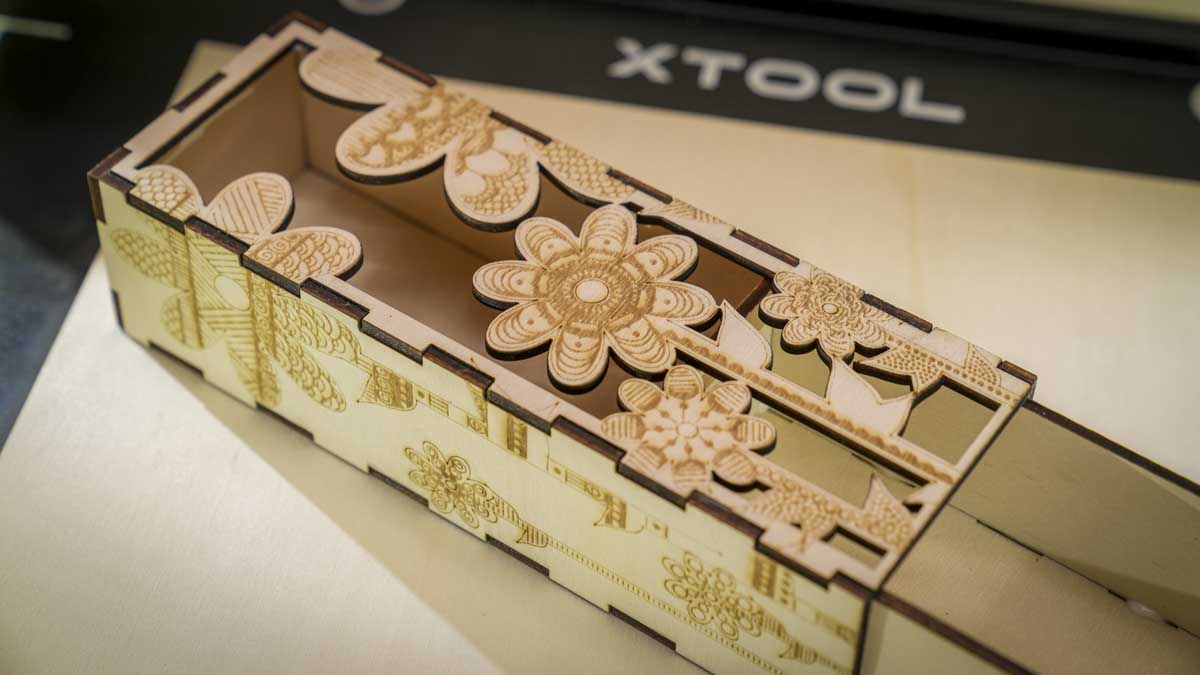
Once I’d created some of the tutorial projects, including the placemats, I moved on to my own projects, creating a few boxes, a small display shelving unit and a few other bits and pieces, including a bracket that I needed for my van, and throughout I was impressed with how quick and easy this machine is to use.
This is, of course, an entry-level machine in the pro market of laser engraving, so whilst the machine is extremely competent, through use you do start to notice a few small design points. These points highlight that this is an enthusiast-level machine rather than a pro-level one.
Advertisement
The first of these is the overall design. Whilst the design is solid and works exceptionally well, there’s no kill switch on the side. If you want to use this in education or most workplaces, you’ll need to add something to kill the power yourself.
But really, other than that, there is very little here that doesn’t impress, even when you’re used to using something like the xTool P2. For me, the workflow from the P2 down to the M2 is similar; it’s just a smaller machine.
While it is obviously slower and less powerful, that 10W laser module will happily cut through basswood up to 8mm thick, as quoted by the company. Although I didn’t have any 8mm basswood available, the 3, 4 and 6mm basswood that I generally use cut through with absolutely no issue whatsoever in a single pass.
The maximum speed for the cutter is 600 mm per minute, which is mid-range, and in the test you obviously reduce that depending on whether it is cutting or engraving. What really impressed me was the engraving resolution. If you want to do some really fine detail work, the M2 is an ideal solution, and converting images into halftone and then bringing those in got some stunning results.
Advertisement
(Image credit: Alastair Jennings)
As I went through the pack of test materials, including paper, wood and leather, I was just really struck by how easy the M2 is to use. The software is obviously great, but those two cameras do make a real difference to the precision of the laser, enabling you to get a preview of the material and really closely align the design to a fraction of a millimetre, which is far better than I have seen on even a lot of fibre lasers, where pure accuracy is definitely needed.
What strikes me about the xTool M2 is that it makes a lot of the more expensive xTool laser engravers a little bit obsolete. You get a relatively lightweight machine you can shift and move around, take off the work surface, and easily place on a lower shelf when not in use, freeing up loads of space.
You get a 10W laser for general work, and you can purchase the 20W when you need a little extra power or speed, plus a modular head system with the inkjet so you can push it for further projects.
What I liked was that the workspace area inside the machine is pretty decent, and whilst it’s not the largest out there, it’s surprisingly large for a machine of this size and far easier and safer to use than any open-frame laser engraver on the market.
Advertisement
While in this review I’ve looked at the M2 in isolation, it is worth pointing out that alongside the laser engraving machine, I have also added in the extractor filter, which is essential. I will update this review with the print head and cutter and possibly the 20W head at a later date.
xTool M2: Final verdict
The M2 is really easy to recommend. It’s a very well-priced, fully enclosed laser engraving machine.
A few things really make it stand out against much of the competition, including the built-in air assist, so no extra devices are sitting around on the work surface. But for me, what appealed was that I could quickly lift it and stow it away.
Advertisement
It’s a big machine, but at just over 12kg it’s not particularly heavy, and it’s quick and easy to disconnect and then plug back in.
Unlike some machines that require you to disconnect various pedal switches, air assist, and more, the M2 took a couple of minutes to disconnect and stash, then bring out and get up and running again.
(Image credit: Alastair Jennings)
In the workplace, one major downside is that it doesn’t have that kill switch on the side, which will be an issue. Still, everything else is simple, and if you’re a small business, it makes a lot of sense.
Here you have a high-quality, high-end enthusiast or pro-level machine with a 10W laser. This lets you engrave plenty of materials, and you can also add the inkjet module to create stickers if you want. Plus, with a rotary tool, you can flip the head from vertical to horizontal to engrave cups, mugs, and more.
Advertisement
I’ve looked at plenty of these laser engravers over the last few years, and the xTool machines have always stood out for quality and attention to workflow; the M2 is especially polished for its price point and the audience it’s aimed at.
Swipe to scroll horizontally
Value:
One of the most versatile machines that I’ve looked at for the price, making it exceptional value
Advertisement
5
Design:
Great design; I just wish there was no need for the cable between the head and the machine
4.5
Advertisement
Features
Excellent range of features, and with a modular head and accessories, the possibilities are enormous
4.5
Performance
Advertisement
SSpeed, cutting power, and workflow are well balanced at this price range
4.5
Total
A superb, fully enclosed laser engraver at this price and a perfect option for any small business





























































You must be logged in to post a comment Login