Connect with us
DAPA Banner

Tech

Closing the data security maturity gap: Embedding protection into enterprise workflows

Published

on

Presented by Capital One


Data security remains one of the least mature domains in enterprise cybersecurity. According to IBM, 35% of breaches in 2025 involved unmanaged data source or “shadow data.” This reveals a systemic lack of basic data awareness. It’s not because of a lack of tooling or investment. It’s because many organizations still struggle with the most fundamental questions: What data do we have? Where does it live? How does it move? And who is responsible for it?

In an increasingly complex ecosystem of data sources, cloud platforms, SaaS applications, APIs, and AI models, those questions are only becoming more difficult to answer. Closing the maturity gap in data security demands a cultural shift where security is no longer treated as an afterthought. Instead, protection is embedded throughout the full data lifecycle, grounded in a robust inventory, clear classification, and scalable mechanisms that translate policy into automated guardrails.

Visibility as the foundation

The most persistent barrier to data security maturity is basic visibility. Organizations often focus on how much data they hold, but not on what that data is made up of. Does it contain personally identifiable information (PII)? Financial data? Health information? Intellectual property? Without this level of understanding and inventory, it’s a lot tougher to implement meaningful protection.

Advertisement

This can be avoided, however, by prioritizing enterprise capabilities that can detect sensitive data at scale across a large and varied footprint. Detection must be paired with action, deleting data where it’s no longer needed, and securing data where it is by aligning enforcement to a well-defined policy.

Mature organizations should start by treating data security as an “understanding your environment” problem. Maintain an inventory, classify what’s in the ecosystem, and align protections with the classification rather than solely relying on perimeter controls or point solutions to scale.

Securing chaotic data

One reason data security has lagged behind other security domains is that data itself is inherently chaotic. Unlike perimeter security, which relies on explicit ports and defined boundaries, data is largely unpredictable. That is to say, the same underlying information may appear across very different formats: structured databases, unstructured documents, chat transcripts, or analytics pipelines. Each may have slightly different encodings or transformations that introduce unforeseen, and often undetected, changes to the data itself.

Human behavior compounds the challenge, with different actions introducing risks in ways that perimeter controls simply can’t anticipate. This could be anything from a credit card number copied into a free-form comment field, a spreadsheet emailed outside its intended audience, or a dataset repurposed for a new workflow.

Advertisement

When protection is bolted on at the end of a workflow, organizations create blind spots. They rely on downstream checks to catch upstream design flaws. Over time, complexity accumulates and the risk of exposure becomes a question of when, not if.

A more resilient model assumes that sensitive data will surface in unexpected places and formats, so protection is embedded from the moment data is captured. Defense-in-depth becomes a design principle: segmentation, encryption at rest and in transit, tokenization, and layered access controls.

Critically, these safeguards travel with the data lifecycle, from ingestion to processing, analytics and publishing. Instead of retrofitting controls, organizations design for chaos. They accept variability as a given and build systems that remain secure even when data diverges from expectations.

Scaling governance with automation

Data security becomes operationally sustainable when governance is enforced through automation from its genesis. When coupled with clear expectations to create bounded contexts: teams understand what is permitted, under what conditions, and with what protections data can be used effectively.

Advertisement

This matters more than ever today. AI systems often require access to huge volumes of data, across domains. This makes policy implementation particularly challenging. To do so effectively and safely requires deep understanding, strong governance policies, and automated protection.

Security techniques such as synthetic data and token replacement enable organizations to preserve analytical context while making sensitive values harder to read. Policy-as-code patterns, APIs, and automation can handle tokenization, deletion, retention constraints, and dynamic access controls. With guardrails built into the platforms they use, engineers can focus more on innovating with data and elevating business outcomes securely.

AI systems must also operate within the same governance and monitoring expectations as human workflows. Permissions, telemetry, and controls around what models can access, along with the information they can publish, are essential. Governance will always introduce a degree of friction. The goal is to make that friction well understood, navigable and increasingly automated. Confirming purpose, registering a use case, and provisioning access dynamically based on role and need should be clear, repeatable processes.

At enterprise scale, this requires centralized capabilities that implement cyber security policy in the data domain. This includes detection and classification engines, tokenization and detokenization services, retention enforcement, and ownership and taxonomy mechanisms that cascade risk management expectations into daily execution.

Advertisement

When done well, governance becomes an enablement layer rather than a bottleneck. Metadata and classification drive protection decisions automatically while accelerating business discovery and usage. Data is protected across its lifecycle by strong defenses like tokenization and deleted when required by regulation or internal policy. There should be no need for teams to “touch the data” manually for every control decision, with policy enforced by design.

Building for the future

Put simply, closing the data security maturity gap is less about adopting a single breakthrough technology and more about operational discipline. Build the map. Classify what you have. Embed protection into workflows so that security is repeatable at scale.

For business leaders seeking measurable progress over the next 18–24 months, three priorities stand out.

First, establish a robust inventory and metadata-rich map of the data ecosystem. Visibility is non-negotiable. Second, implement classification tied to clear, actionable policy expectations. Make it obvious what protections each category demands. And finally, invest in scalable, automated protection schemes that integrate directly into development and data workflows.

Advertisement

When protection shifts from reactive bolt-on controls to proactive built-in guardrails, compliance becomes simpler, governance becomes stronger, and AI readiness becomes achievable, without compromising rigor.

Learn more how Capital One Databolt, the enterprise data security solution from Capital One Software, can help your business become AI-ready by securing sensitive data at scale.


Andrew Seaton is Vice President, Data Engineering – Enterprise Data Detection & Protection, Capital One.


Sponsored articles are content produced by a company that is either paying for the post or has a business relationship with VentureBeat, and they’re always clearly marked. For more information, contact sales@venturebeat.com.

Advertisement

Source link

Continue Reading
Click to comment

You must be logged in to post a comment Login

Leave a Reply

Tech

Artemis II: Everything We Know as Its Crew Approaches the Far Side of the Moon

Published

on

On day six of its mission, Artemis II is closing in on the far side of the moon. Meanwhile, the historic journey has not been without fascinating and curious stories, from the images and videos that its four crew members have shared with the world to the inevitable unforeseen events—including a tricky toilet situation.

A few hours before the crew begins its lunar flyby, here’s how things are going on Artemis II.

When Will They Reach the Far Side of the Moon?

While Artemis II won’t actually land on the moon (that won’t happen until Artemis IV), that does not make this mission any less compelling. Once the Artemis II astronauts finish flying over the dark side of the moon, they will have the historic distinction of being the humans who have traveled the farthest from Earth.

They will also test all the systems needed for future lunar missions, validating life support, navigation, spacesuits, communications, and other human operations in deep space.

Advertisement

But when are they supposed to reach this far-off point? First, the Orion capsule reached what is known as the moon’s “sphere of influence” on Sunday night. This is the point where the moon’s gravitational force is stronger than the force of the Earth.

At present, Orion is circling the moon. Once the capsule is on the dark side of the moon, approximately 7,000 kilometers from the surface, communications with Earth will be interrupted. For six hours, they will be able to view the far side of the moon, something no human being has ever seen with their own eyes—not even the astronauts of the Apollo program, as this region of the moon was always too dark or difficult for them to reach.

That six-hour flyby of the dark side of the moon is expected to begin Monday, April 6, at 2:45 pm EDT and 7:45 pm London time.

After that, the capsule will use the moon’s gravity to propel itself back to Earth. Splashdown, when the astronauts reach Earth, is scheduled for April 10 in the Pacific Ocean, not far from the coast of California, the 10th day of the mission.

Advertisement

Remember that you can follow the live broadcast of the Artemis II mission from NASA’s official channels.

What Has Happened so Far?

Since its successful launch on April 1 from Kennedy Space Center, the Artemis II crew has shared several spectacular photos, such as the featured image in this post, which shows mission specialist Christina Koch looking down at Earth through one of Orion’s main cabin windows.

This incredible photo of a Earth, taken on April 2, went viral on social media, referencing the famous “Blue Marble” image captured by the Apollo 17 astronauts in 1972.

nasa luna artemis

View of Earth taken by astronaut Reid Wiseman from the window of the Orion spacecraft after completing the translunar injection maneuver on April 2, 2026.Photograph: Reid Wiseman/NASA/Getty Images

Source link

Advertisement
Continue Reading

Tech

Gozney Dome Gen 2 Review: The Ultimate Backyard Flex

Published

on

(One word on the arch, though—it reduces the oven mouth width from 16.5 inches to about 13 inches. I learned the hard way one night that many pizza peels will no longer fit, including Gozney’s own large-size models. Make sure you have a peel that’s 12 inches or smaller.)

Also, thanks to the generous ceiling height, the Dome is a more versatile oven than its competitors in that it can be used for cooking meals other than pizzas. Steaks, fish, or other skillet meals are safe not to splatter on the ceiling, and two included meat probes can be connected to show real-time temps on the Gozney’s display. (Among the Dome’s accessories is a mantel designed to extend the cooking surface for things like skillets and dutch ovens, as well as a wood-handled door to enclose the oven for baking.)

King of the Road

Image may contain Fireplace Indoors Device Appliance Electrical Device and Oven

Photograph: Kat Merck

While the Gozney isn’t a permanent install, unless you spring for the wheeled stand ($500), you will want a sturdy, semi-permanent space where it can live, as well as moving help. The stainless steel body and 30-millimeter corderite stone weigh a total of 150 pounds in the packaging—instructions recommend four people to lift the box, though my husband and I were able to lift it ourselves onto a Gorilla wagon to carry it to its testing location on our deck.

There are straps on the bottom of the oven for maneuvering, but the Dome really should only be lifted once; you will not be carrying it in and out of the garage like an Ooni. There is a cover for either the oven by itself or on its stand, but like all of the accessories, it’s not included.

Advertisement

Speaking of Ooni: Like the Koda Max, the Dome heavily touts its size as being ideal for cooking “up to two pizzas at once.” However, if you’re buying a dedicated pizza oven, you probably want high heat, and if you want high heat, this requires frequent turning of a pie—usually every 30 seconds—to ensure it cooks evenly. (Gozney turning peel: $80.) Multiple pies in the oven will complicate access, to say nothing of the logistical issues. You will also likely find yourself needing to move the pie to the side farthest away from the flame at times, to avoid charring your cornicione.

Source link

Continue Reading

Tech

German authorities identify REvil and GangCrab ransomware bosses

Published

on

German authorities identify REvil and GangCrab ransomware bosses

The Federal Police in Germany (BKA) has identified two Russian nationals as the leaders of GandCrab and REvil ransomware operations between 2019 and 2021.

According to BKA’s disclosure, 31-year-old Daniil Maksimovich Shchukin and 43-year-old Anatoly Sergeevitsch Kravchuk acted as the heads of the two ransomware groups “from at least the beginning of 2019 until at least July 2021.”

Shchukin hid behind the monikers UNKN/UNKNOWN for years, posting on cybercrime forums and speaking as a representative of the ransomware operation.

Wiz

The German authorities say that Shchukin and Kravchuk participated in at least 130 extortion cases targeting companies in the country specifically.

Following these attacks, at least 25 victims paid Shchukin and his co-conspirators $2.2 million in ransom, while the total financial damage caused by them is estimated in excess of $40 million.

Advertisement

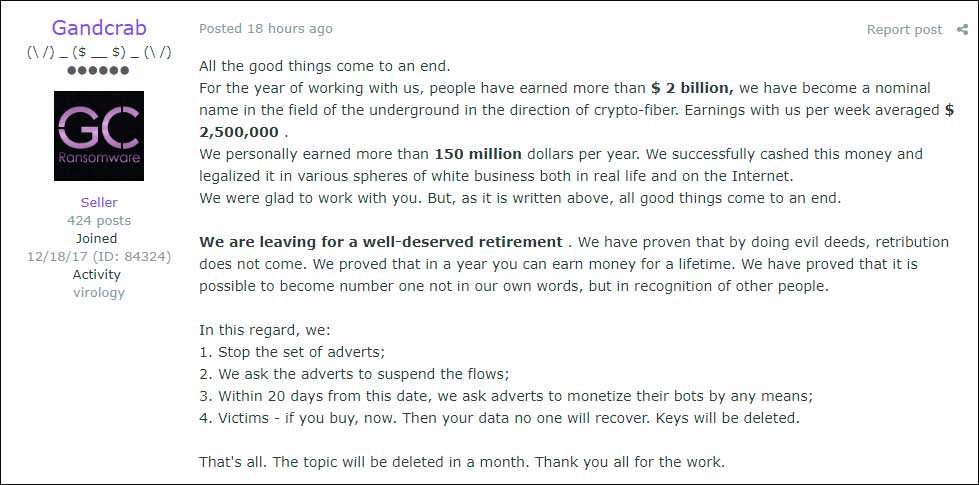
GandCrab started in early 2018, and its leader at the time decided to retire in June 2019, after claiming to have earned $2 billion from ransom payments. The leader, however, cashed out with $150 million, which they claimed to have invested in legal businesses.

GandCrab leader announcing their retirement
GandCrab leader announces retirement
source: BleepingComputer

Soon after, a new operation called REvil emerged, following the affiliate model established by GandCrab through advertising and building partnerships with cybercriminals.

REvil, also known as Sodinokibi, was formed from previous GandCrab affiliates and operators who had already learned the successful tactics and started to apply them to their operations.

REvil later added public leak sites and ran data auctions to pressure victims. Notable victims include multiple Texas local governmentscomputer giant Acer, and the Kaseya supply-chain attack that impacted around 1,500 downstream victims.

Following the massive Kaseya hack, REvil took a two-month break, during which law enforcement breached their servers and started to monitor operations.

Advertisement

Multiple infrastructure disruptions were recorded at the time, and in mid-January 2022, Russia arrested more than a dozen REvil gang members, who were released in 2025 after time served on carding charges.

It is unclear if either Shchukin or Kravchuk joined other ransomware operations following REvil’s demise in 2021.

BKA believes that Shchukin and Kravchuk are now in Russia and asks the public to share any information that could lead to their whereabouts. Relevant entries were also created on the EU’s Most Wanted portal.

The police shared several images, including tattoo photos, to help track down the two threat actors and bring them to justice.

Advertisement

Automated pentesting proves the path exists. BAS proves whether your controls stop it. Most teams run one without the other.

This whitepaper maps six validation surfaces, shows where coverage ends, and provides practitioners with three diagnostic questions for any tool evaluation.

Source link

Continue Reading

Tech

One of Our Favorite 360 Cams Is 35 Percent Off

Published

on

Tired of taking your action camera on an adventure, only to get home and find out you missed the action with a bad angle? One option is to switch to a 360-degree action cam, so you can capture all of the action and then edit down to just the good stuff later. One of our favorite options, the DJI Osmo 360, is currently available for just $390 on Amazon, a $209 discount from its usual price, and it comes with a selfie stick and an extra battery.

The DJI Osmo 360 achieves its impressive all-around video quality by leveraging a pair of 1/1.1-inch sensors, larger than some other offerings, and by supporting 10-bit color. You can really see that in the camera’s output, with colors that are vivid and bold, to the point that you may need to dial them back a bit in post if you want something more natural. With support for up to 50 frames per second at 8K when recording in 360 degrees, or 120 fps at 4K when shooting with only one sensor, you’ll have plenty of material to work with. In our testing, it ran for just shy of two hours at 30 fps, which is also around the time the internal storage had filled up anyway.

If you plan on catching any serious discussions with your Osmo 360, you’ll be pleased to know it connects directly to DJI’s line of wireless lavalier microphones, including the excellent and frequently discounted DJI Mic 2 and Mic Mini. If you want to mount it to something other than the included 1.2-meter selfie stick, it has both DJI’s magnetic attachment system and a more traditional ¼”-20 tripod mount. The DJI Mimo app lets you control the camera and adjust any settings, and there’s even a simple editor for on-the-fly production. For desktop users, DJI Studio has even more in-depth settings and editing options, in case you don’t want to pay for Premiere.

The DJI Osmo 360 is one of our favorite action cameras, and is particularly appealing at the discounted price point, but make sure to check out our full review for more info, or head over to our full roundup to see what else is available.

Advertisement

Source link

Continue Reading

Tech

The League of Legends KeSPA cup will air globally on Disney+

Published

on

Disney has inked a deal with the Korea Esports Association that will bring several gaming tournaments to the its streaming platform. Disney+ will be the global live streaming home for Esports Champions Asia Jinju 2026, the 2026 League of Legends KeSPA CUP and some preliminary events ahead of the 20th Asian Games Aichi-Nagoya 2026. This agreement expands KeSPA’s arrangement with Disney, which only streamed its esports events to viewers in Asia last year.

Esports Champions Asia is the first event on the calendar, occurring April 24-26 with professional teams from across the continent squaring up in tournaments for games including Street Fighter 6, The King of Fighters XV, TEKKEN 8 and the eFootball series. Disney+ will also be an official streamer for the PUBG Mobile and Eternal Return competitions during that weekend.

It could be helpful for western esports fans to have a single location for watching the major events happening in Asia. However, many tournaments are currently free to watch on Twitch or YouTube, so now needing a Disney+ subscription to catch some of these international competitions might feel onerous. Esports might run the risk of turning into the fragmented set of rights deals that plagues traditional sports leagues, where a game could be on one of a half dozen different paid services each night. It’s also likely going to mean co-streamers take a hit to their viewership, since Disney seems unlikely to offer the same sort of broadcast access that has made the practice popular on Twitch.

Source link

Advertisement
Continue Reading

Tech

So Expensive, A Caveman Can Do It

Published

on

A few years back a company had an ad campaign with a discouraged caveman who was angry because the company claimed their website was “so easy, even a caveman could do it.” Maybe that inspired [JuliusBrussee] to create caveman, a tool for reducing costs when using Claude Code.

The trick is that Claude, like other LLMs, operates on tokens. Tokens aren’t quite words, but they are essentially words or word fragments. Most LLM plans also charge you by the token. So fewer tokens means lower costs. However, LLMs can be quite verbose, unless you make them talk like a caveman.

For example, here is some normal output from Claude:

Sure! I’d be happy to help you with that. The issue you’re experiencing is most likely caused by your authentication middleware not properly validating the token expiry. Let me take a look and suggest a fix.

After Caveman that is reduced to:

Advertisement

Bug in auth middleware. Token expiry check use < not <=. Fix:

Turns out, you can understand the caveman output just fine.

There are a few rules. Caveman removes filler words, but knows to keep technical terms, code blocks, and error messages intact. It also outputs normal messages for things like commits.

As the website says: “Caveman not dumb. Caveman efficient. Caveman say what need saying. Then stop. If caveman save you mass token, mass money — leave mass star.”

If you want to code with an LLM, make sure you understand the terms of service. If you want to learn more about how LLMs work with tokens and other details, but want to skip the math, we can help with that.

Advertisement

Source link

Continue Reading

Tech

Apple may have scraped YouTube videos without permission for AI training

Published

on

A collection of YouTube channels are suing Apple under the provisions of the DMCA, with the company accused of scraping videos from YouTube and using them to train internal AI models.

Glowing multicolored looped ribbon forming a rounded star shape around a dark central hexagon, on a deep maroon background with subtle reflection below
Apple is accused of scraping YouTube to train its video AI models.

In a lawsuit filed on April 3 at the United States District Court for the Northern District of California, a trio of YouTube entities are suing Apple over allegations of copyright infringement. Apple is accused of violating the Digital Millennium Copyright Act (DMCA), all to collect footage to train its AI models.
The class-action lawsuit is headed up by Ted Entertainment, owners of the h3h3Productions channels and podcast. Two golf channels accompany Ted Entertainment, with MrShortGameGolf and Golfholics also involved in the legal action.
Continue Reading on AppleInsider | Discuss on our Forums

Source link

Continue Reading

Tech

Border Patrol Agents Sold Challenge Coins With ‘Charlotte’s Web’ Characters in Riot Gear

Published

on

US Border Patrol agents are raising money by selling coins that commemorate last year’s wave of immigration enforcement “operations” across the country, along with other merchandise. The funds are for nonprofit organizations that list Border Patrol buildings as their address in IRS paperwork. At least two of the organizations have dedicated US Customs and Border Protection email addresses.

The front side of one coin for sale reads, “NORTH AMERICAN TOUR 2025,” along with the acronyms for US Border Patrol and the acronym for “fuck around and find out”—a phrase that was initially popularized by the far-right group the Proud Boys and has been used by various Trump officials. In the center, the coin depicts a gas mask, a riot control smoke grenade, and a pepper ball launcher. On the other side, the coin appears to have a portrait of Border Patrol’s now retired commander-at-large, Gregory Bovino, with his arm raised in a salute, along with the text “COMING TO A CITY NEAR YOU!” It lists seven cities, many of which actually saw federal enforcement surges in 2025: Chicago, Los Angeles, Memphis, Phoenix, Portland, Charlotte, and Atlanta.

The coin is for sale by Willcox Morale Welfare and Recreation, a nonprofit that the IRS most recently declared tax-exempt during the Biden administration and whose address on IRS paperwork matches that of the Willcox Border Patrol Station in Arizona. A request for comment sent to Willcox MWR’s dedicated CBP email address went unanswered.

Employees of the Department of Homeland Security, the parent agency for Border Patrol, are allowed to start private, not-for-profit employee associations within DHS, so long as they get formally recognized by the agency and follow certain rules. According to DHS policies, officially recognized groups can fundraise using government property and create merchandise with the agency’s name and logos–but they have to receive advance approval from the agency.

Advertisement

Willcox MWR is just one of several groups across the country that cater to Border Patrol agents and refer to themselves as MWRs, a reference to the US military’s “morale, welfare and recreation” programs. The groups tend to throw holiday events and retirement parties, and sometimes raise money for the families of agents going through hard times, including those not getting paid during the current shutdown.

Following the publication of this story, CBP spokesperson Hilton Beckham told WIRED that Willcox MWR and the other non-profits identified in our story had existed under previous administrations and had “received authorization to conduct limited commercial activities on CBP-occupied property.” Beckham said that the agency was in the process of updating its policies and procedures related to MWRs.

Many MWRs also sell customized medallions known as “challenge coins” that commemorate specific teams or events. While anyone, including CBP alumni, can design and sell coins, current DHS employees are not supposed to use government resources to sell ones that use the agency’s seals or logos without permission, or ones that the agency considers inappropriate or unprofessional.

Beckham, the CBP spokesperson, said, “CBP takes its branding and recognition policies seriously.” Beckham did not say whether the agency’s Publication and Branding Review Board, which is in charge of approving branded merchandise, greenlit “North American Tour” coin design.

Advertisement

Under Willcox MWR’s Facebook post about the “North American Tour” coin, someone named Juan Diego commented, “Sign up SDC BK5 MWR for 10.”

“Shoot us an email,” someone managing the Willcox MWR account replied, giving out what appeared to be a dedicated cbp.dhs.gov email address for the group.

SDC BK5 MWR, also a registered nonprofit, lists an address on its website that matches that of a government facility in Chula Vista, California. It says on its site that it was started by San Diego Sector Border Patrol agents and sells custom merchandise “designed to raise funds for morale and relief efforts.”

Source link

Advertisement
Continue Reading

Tech

Gas prices aren’t the only factor fueling used EV sales

Published

on

The most recent electric vehicle sales data provided a grim picture — at least for new EVs. Sales of new electric vehicles took a beating in the first quarter, falling some 28% year-over-year after the Trump administration axed the $7,500 consumer tax credit, according to Cox Automotive.

Used EVs are moving in the opposite direction. And a couple of accelerants have combined to supercharge those sales.

First-quarter used EV sales increased 12% compared with the same quarter last year, according to that same Cox Automotive report. There’s a bit of momentum over a shorter term too; used EV sales popped 17% between the fourth and first quarters.

The rising cost of gas — the average price is above $4 a gallon — has helped spur interest and sales of electric vehicles. But there’s another factor at play here as consumers seek out affordable options: an abundance of expiring leases, the Financial Times reported. EV leases were a popular choice in the early 2020s, and now that they’ve expired, hundreds of thousands of pre-owned EVs are entering the marketplace. And consumers are ready for them.

Advertisement

By the end of the year, EVs will account for 15% of all off-lease vehicles, double from 7.7% in the first quarter, the FT reported.

The ol’ economic principle of supply and demand remained steadfast; the surge of pre-owned vehicles helped push prices lower, giving those sales a further boost. That’s led to price parity — or close to it — with internal combustion vehicles. According to Cox Automotive, the average price of a used EV is $34,821 compared to $33,487 for the gas engine equivalent.

Techcrunch event

San Francisco, CA
|
October 13-15, 2026

Advertisement

Source link

Advertisement
Continue Reading

Tech

Modular Mechanical Keyboard Transformed Into A Compact Workstation

Published

on

3D printing is a staple of the hacker community. From decorative items to rugged functional parts, almost anything you can think of, can be printed. [anurag.id] shows us some classic 3D printing hacks by converting his keyboard into a compact workstation.

Like any hacker project, the initial idea is small: he decides the knob on his mechanical keyboard is boring, so he designs some alternatives. First, one “retro style” knob. Then, like any good project, the scope creep begins. He makes another knob, and another… by the end he has 6 different designs! But don’t worry, the scope can get even bigger. He decides his ipad needs a good stand on his desk–and what better place to put it than on the keyboard? Now it’s starting to look like a real little workstation. Finally, as a finishing touch, he adds some magnetically-attached wrist rests for a compact, ergonomic workstation.

Video after the break.

Advertisement

P.S.: Bonus points for the good video editing.

Source link

Advertisement
Continue Reading

Trending

Copyright © 2025