Connect with us

Tech

Crypto impersonation scams grew 1,400% as AI supercharged fraud

Published

on

TL;DR

Chainalysis reports impersonation scams grew over 1,400% in 2025, with AI-linked operations generating 4.5x the revenue at 9x the activity of non-AI operations. Deepfake KYC bypasses now cost about $20 and 30 minutes, defeating standard liveness checks 58% of the time. Crypto accounts for 88% of all detected deepfake fraud globally. Enforcement has responded with $4.4B in frozen Tether and nearly 5,800 arrests across 97 countries, but none of that stops a forged identity clearing a check.

Impersonation scams grew more than 1,400% year over year in 2025, according to Chainalysis, with the average payment into those clusters rising more than 600%. Across all scam categories the average crypto payment climbed from $782 to $2,764.

An attack class does not scale like that because more people are running it. It scales because fewer people are running it with better tools.

Fraud Used to Have a Headcount Problem

An investment scam or a romance approach had to be staffed. Someone trained had to hold the conversation, in the victim’s language and across weeks. Those requirements set a ceiling on how many people a network could work at once, and for years the ceiling held.

Advertisement

Generative tooling removed it without changing the underlying deception. The con is the same one the industry has seen since the first fake exchange support agent. What changed is that the expensive part of running it stopped being expensive.

The economics are visible on-chain. Chainalysis found that operations with observable links to AI tooling vendors extracted an average of $3.2 million against $719,000 for those without, while generating 35.1 transfers a day against 3.89. That works out to roughly 4.5 times the revenue on about nine times the activity: the same operation reaching more people and converting more of them. TRM Labs separately observed close to a 500% increase in AI-enabled scam activity over the past year.

Chainalysis
Credit: Chainalysis

Code is no longer necessarily the weakest link in Web3,” says Jimmy Su, Chief Security Officer at Binance. “As smart contract security improves, attackers are shifting their attention to the people, credentials and governance systems surrounding protocols. We saw this firsthand when Binance Security helped prevent a $1.2 million governance attack on BrainTrust. Protecting a protocol today means securing not just its code, but also who can control it, how that control is exercised, and the infrastructure and people behind it.

The Verification Stack Was Built for a Different Attack

Identity checks were designed against a threat model of printed photographs, recorded video and low-grade physical spoofs. That is why liveness prompts still ask a user to blink or turn their head. The threat model moved and the prompt did not.

Vendor research from Socure puts the current cost of defeating that stack at roughly $20 and about 30 minutes, and finds that injection attacks, which feed a synthetic video stream straight to the verification interface rather than through a camera, defeat standard liveness checks about 58% of the time. Socure and Zyphe, whose figures it cites, both sell detection products in this category.

Advertisement

Across the crypto industry, impersonation scams are increasing and becoming more sophisticated,says Lior Aizik, co-founder and COO of XBO. “Scammers have impersonated me by name, using fake profiles to contact people in the industry and request money while pretending to represent XBO. These attacks rely on urgency and trust, not technology.

The volume lands disproportionately on this sector. Binance Research reports that crypto accounts for 88% of all detected deepfake fraud cases globally, that North American deepfake-related losses exceeded $410 million in the first half of 2025, and that around 80% of attacks against the exchange involve some level of KYC fraud.

Binance Research

Detection Is Automated. Recovery Is Not.

Two things are working against this volume, and only one of them is a model.

Automated screening is the first, and it mostly buys throughput rather than certainty: Binance Research reports up to a 100x efficiency gain from applying AI to KYC processing, with face-attack and liveness models retrained against each new generation of spoofing technique.

The other effective response is considerably older: coordinated enforcement and the ability to freeze funds after the fact. Binance Research puts Tether’s total frozen at more than $4.4 billion as of April 2026, and the T3 Financial Crime Unit, a joint venture with TRON and TRM Labs, at more than $300 million in its first year, including $19 million tied to the Bybit hack. Both figures come from the exchange’s research arm rather than from the issuers themselves.

Advertisement

Conventional law enforcement has scaled alongside it. INTERPOL’s Operation First Light 2026 spanned 97 countries as well as produced nearly 5,800 arrests and intercepted $293 million. Europol’s Operation Endgame froze about $47 million while taking down 326 servers and 142 domains and recovering 27 million stolen credentials.

None of that stops a forged identity clearing a check. It does mean the money can sometimes be stopped after it moves, which is something a wire transfer cannot offer and something the sector rarely bothers to argue in its own defense.

The Deception Is Old. The Price Is New.

The cons here are the ones fraud has always used. What changed is the cost of producing them, which makes the defensive question less about detecting novel attacks than about matching the rate at which familiar ones are now generated.

Reporting in this category remains incomplete, so every scam figure above should be read as a lower bound. The gap between what it costs to forge an identity and what it costs to check one is the number worth tracking, because everything else in this category follows it.

Advertisement

Source link

Continue Reading
Click to comment

You must be logged in to post a comment Login

Leave a Reply

Tech

Working on the go this summer? As a seasoned remote worker, here’s my essential kit list for productive working in the most awkward of locations

Published

on

We’re well and truly into summer travel season, and if you’re planning on integrating some remote working into your vacation, it’s worth considering your setup. My own job is largely laptop-based, and over the years I’ve done a decent amount of working away from my office desk, whether at events or in order to keep things ticking over during time off. The biggest lesson I’ve learned is that a few well-chosen remote-working accessories can make a huge difference.

I rely on a laptop riser so that I’m not hunched over a table (my back will start hurting after around an hour, and it’s all downhill from there). If my laptop is raised, I’ll then add in a portable keyboard to make typing easier — my tip is to pick one with the same proportions as your regular keyboard, so your fingers know where to go — and a wireless mouse.

Source link

Continue Reading

Tech

Zapping Rocks Unlocks Stimulated Geologic Hydrogen

Published

on

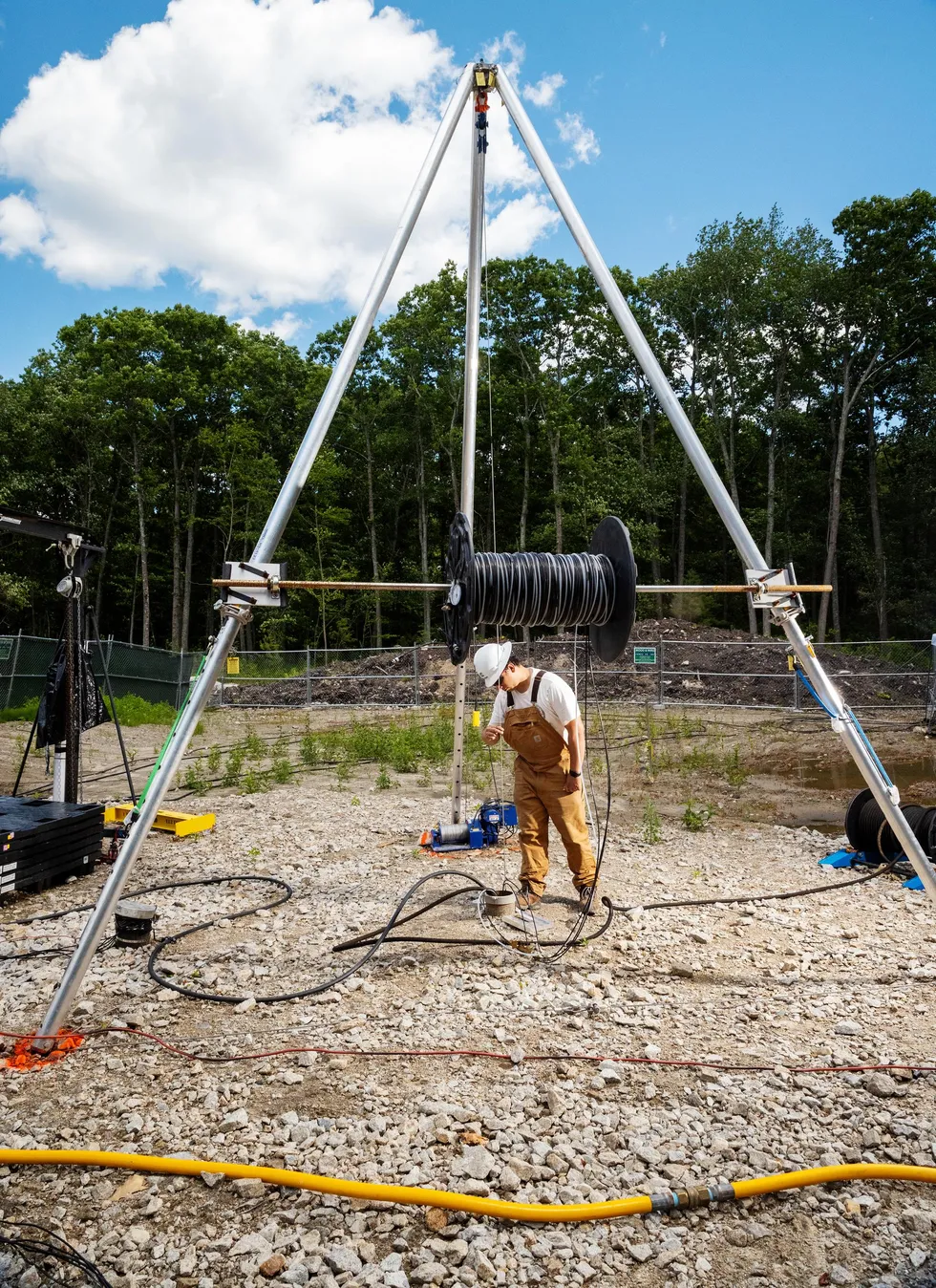
In a tranquil Boston suburb, on the far edge of a horse farm, where pasture gives way to woods, a crane lowers an enormous electrode into a borehole. The electrode, a half-meter-long cylinder with copper-tipped arms to ensure good contact with the borehole walls, descends—deeper, deeper—through layers of spongy sandstone to the hard, marbled roots of an ancient mountain range hundreds of meters below ground. Here the rock is tight; there are few cracks for water or gases to flow. But that’s about to change.

A stone’s throw away, a second electrode—a twin of the first—has been fixed in another borehole at the same depth. From above ground, a pair of high-voltage generators cabled to the two electrodes fires a series of pulses.

Tsss!…Tsss!…Tsss!…Tsss!…Tsss!….

Advertisement

Each discharge, heard faintly at the surface, is like a miniature, subterranean lightning strike. The rock between the electrodes heats. Pressure builds. Then, suddenly, the rock splits into a spiderweb of fractures.

A man in a hard hat stands over a well hole directing a rope that\u2019s been lowered from a spool overhead.On a horse farm outside of Boston, a worker sets up the well where Eden’s electrode will be lowered with a winch.Bob O’Connor

Eden GeoPower, the Massachusetts-based startup performing this peculiar field test, calls the technology electrical reservoir stimulation. The company’s tagline: “We break rocks with electricity.”

Eden’s researchers hope their rock-breaking technique will someday aid mineral mining, tap geothermal heat, or create geologic storage areas for carbon. But there’s an even more intriguing use that could create a whole new category of energy production: generating hydrogen underground.

The dream of a hydrogen-powered economy dates back to the 1970s, when petroleum shortages and rising concerns about pollution from fossil fuels sparked visions of cars, ships, planes, and industrial machines running on hydrogen instead of carbon. Hydrogen is often touted as a clean fuel because when it’s burned or consumed in fuel cells, it emits only water and heat. However, it currently takes more energy to make than it yields, and the cheapest and most common way is by reacting steam with methane, a potent greenhouse gas.

Advertisement

It’s possible to make zero-carbon hydrogen by splitting water with electrolyzers powered by renewable energy. But in most cases, the process is too expensive to be economical—a reality that burst the hydrogen-hype bubble in the early 2020s. Global demand for hydrogen in 2024 reached approximately 100 million tonnes, containing energy equal to only about 3 percent of the world’s annual energy consumption. Most of it is used as chemical feedstock for petroleum refining and for making fertilizers and plastics.

The frustrations of manufacturing clean hydrogen have convinced many entrepreneurs and scientists to instead seek the element underground. For the past half-decade, dozens of companies around the world have been hunting for buried stores of hydrogen, called natural or geologic hydrogen. But with a commercial-scale operation yet to be proved, Eden and a handful of other startups and research groups are chasing the more audacious scheme of producing geologic hydrogen artificially.

This approach, known as stimulated geologic hydrogen or engineered hydrogen, turns subterranean rock formations into giant hydrogen factories. It typically involves injecting water into iron-rich rock, which oxidizes the iron and releases hydrogen as a by-product. Fracturing the rock, as Eden is doing, creates a network of conduits for the water to reach iron-bearing minerals.

The concept of stimulated hydrogen is so new that few have had a chance to test it. Proponents say that if it works—which is a big “if”—it could provide almost unlimited energy for the indefinite future. There’s one way to find out: Start breaking rocks.

Advertisement

There’s Plenty of Underground Hydrogen

Hydrogen is the simplest and most abundant element in the universe, the stuff of stars and galaxies. Geologists have long known that Earth generates hydrogen gas through natural water-rock reactions, but until recently, the occurrence was regarded as a curiosity. The gas is so light that most experts assumed it all escaped through pores and cracks in Earth’s subsurface and didn’t accumulate in useful quantities.

A man\u2019s hands hold a metal cylinder with two capped wires sticking out. During a demonstration at Eden’s testing site near Boston, an employee displays a central component of the company’s proprietary electrode. Bob O’Connor

Inklings that they were wrong emerged in the 19th and 20th centuries, when researchers in the former Russian Empire and Soviet Union reported hydrogen seeping from mines and wells. But in the ongoing frenzy for fossil fuels, these observations were largely overlooked or forgotten. Scientists later discovered hydrogen spewing from hydrothermal vents in the seafloor and feeding so-called eternal flames, like those of Türkiye’s Mount Chimaera, where ancient athletes lit torches for the first Olympic games.

Then, in 1987, in the village of Bourakébougou, Mali, people drilling a water well noticed a breeze blowing out of the hole. According to local lore, a worker leaned in for a closer look, a lit cigarette dangling from his mouth. The air instantly ignited, burning a brilliant blue.

The crew capped the well, which stayed sealed for 25 years until, in 2012, a Malian oil and gas prospector confirmed the ground contained a large reservoir of hydrogen. The prospecting company, now called Hydroma, had a small electrical plant constructed to convert the gas into power for the village’s residents. Soon after, startups in Australia, Canada, the United States, and elsewhere began searching for more hydrogen stores. By 2025, large multinational petroleum and mining companies were getting in on the game.

Advertisement

To date, hundreds of exploratory wells have been drilled across the globe. But although researchers have documented widespread hydrogen deposits, none have proved capable of producing the gas at rates and quantities needed for commercialization. “We’ve poked a lot of holes, and nobody has found the gusher—or at least they’re not talking about it,” says Douglas Wicks, a former program director at the United States’ Advanced Research Projects Agency—Energy who now advises companies pursuing geologic hydrogen.

A pipe about the size of a fist sticking out of the ground by a few inches, with cables protruding from it. A wellhead guides multiple lines downhole: fluid hose, electric cables, rope, control for a sealing device, and sensor communication. Bob O’Connor

Wicks says that in 2022, while at ARPA-E, he got “dragged into the rabbit hole of geologic hydrogen” by Emily Yedinak, then a Fellow at the agency, who was trying to convince her colleagues to take it seriously. “I was the ultimate doubter,” Wicks says. The astronomical price of electrolyzers had made him skeptical that clean hydrogen was a viable pursuit. Plus, if Earth really did contain vast pools of hydrogen, then surely humanity, which had been digging for natural resources for thousands of years, would have found them by now, he reasoned.

But after talking with geologists—who pointed out that people historically hadn’t found hydrogen because they hadn’t been looking for it—Wicks changed his tune. “I got the epiphany that geologic hydrogen is not just an accumulation; it’s a chemical reaction,” he says. “And if it’s a chemical reaction, then it can be stimulated.”

Finding large accumulations of geologic hydrogen entails stumbling on a Goldilocks set of conditions. You need iron-rich source rocks that have already produced or are producing bountiful hydrogen. You also need porous reservoir rocks that can hold sizable quantities of gas migrating from the source rocks. And you need solid cap rocks above the reservoir that trap the gas underground.

Advertisement

To stimulate hydrogen, however, you don’t need this just-right geology. All you need are iron-rich rocks, and then you can generate the hydrogen yourself.

“These rocks are everywhere,” Wicks says. “If you look at the amount of iron that’s within drilling range of Earth’s crust, you’re talking about quadrillions of tons of hydrogen being accessible. If we’re 1 percent successful just in the United States, we could power the economy for thousands of years.” A back-of-the-envelope calculation convinced him that the cost of stimulated geologic hydrogen could easily compete with hydrogen made from methane. “If we get the technology right,” he concludes, “this could be huge.”

Wicks wasn’t the first person to propose the idea, but he was the first to allocate major funding. In 2024, under his leadership, ARPA-E awarded US $20 million to 16 teams aiming to advance stimulation technologies and research. Winning ideas included fracturing rocks with fluid pressure or mechanical stimuli, exposing them to catalysts to speed hydrogen-generating reactions, and manipulating native microbial communities to enhance production. Eden’s rock-breaking project, the lone electricity-based approach, received $900,000.

Eden GeoPower’s Underground Rock Fracturing

Paris Smalls, Eden’s CEO, founded the company in 2017 as a 23-year-old graduate student at MIT. For his Ph.D. in civil and environmental engineering, he was studying the effects of electricity on rock strength and became interested in enhanced geothermal systems, which require fracturing hot, dry rocks to circulate water through them for extracting heat. This is typically done by hydraulic fracturing, or fracking—a technique borrowed from the oil-and-gas industry that involves injecting high-pressure fluids.

Advertisement

Fracking is controversial because it can cause earthquakes and groundwater contamination, and many regions have banned the practice. From an engineering perspective, it’s also imprecise. The fractures it forms are large and difficult to control. “You can’t get enough fractures where you want because the water ends up just going through the same cracks,” Smalls explains. Electricity, he knew from his Ph.D. work, could create more extensive and finely tuned fracture networks, enabling geothermal systems to produce more heat with less environmental risk.

A set of pipes and hoses connected together on a makeshift box. To determine how permeable its fracture networks are, Eden measures fluid pressure downhole and flow rates at the surface. Bob O’Connor

Smalls immediately grasped that the same rock-breaking strategy could be used for mineral mining, carbon sequestration, and extending the life of oil and gas wells. But he hadn’t considered using it to make hydrogen. So when Wicks invited him to apply for the hydrogen program at ARPA-E, he was confused. “I didn’t get it at all,” Smalls says. “I’m like, ‘I break rocks. How am I going to generate hydrogen?’”

Not long after, Smalls met Alexis Templeton, a geomicrobiologist at the University of Colorado Boulder who had become an expert in geologic hydrogen by studying microbes that consume the gas and the mineralogical transformations that create it. “There was a lot of early interest in whether or not you could engineer the production of hydrogen from rocks,” Templeton recalls. “And the rocks with some of the best potential have all the right chemistry, but they need water. Nobody was excited to do hydraulic fracturing. So everyone was wondering, ‘Well, how are we going to get the water in?’”

Eden’s technology, Templeton understood, could be the answer. She agreed to join the company part-time as its lead geochemist, a position she held from 2023 to 2025. During that time, Eden ran its first pilot experiment, in an oil field in Oman, near where Templeton was already doing her own hydrogen research. The initial setup used DC power to send a steady flow of tens of kilowatts between electrodes in two wells. When Smalls’s team tested it in a petroleum reservoir made of soft, chalky carbonate, the rock fractured readily, increasing oil production by 30 percent.

Advertisement

But when they did the same test in hard rocks, like those needed for hydrogen and geothermal systems, they didn’t fracture much at all. So the team went back to the drawing board and came up with a fix: pulsed power.

Using Pulsed Power for Rock Fracturing

The idea of breaking things using pulsed power—short, concentrated bursts of electrical energy—originated with a mid-20th-century experiment in Soviet-era Russia. As the story goes, a physicist and inventor named Lev Yutkin was out in a thunderstorm when he saw lightning strike a log underwater. Rather than burn, as it would in air, the log exploded, as if blown up by dynamite. Intrigued, Yutkin tried to reproduce the spectacle in his lab. He placed a dinner plate in a water tank, dipped in two wire electrodes, and released a high-voltage pulse. The ensuing spark, he discovered, instantly ionized the water molecules between the electrodes into a plasma channel, which then rapidly expanded, creating a shock wave that shattered the plate.

Yutkin described the phenomenon in his 1955 book Electrohydraulic Effect. He later proposed numerous fanciful uses for it, such as cleaning pipes or breaking up kidney stones, which inspired real tools in use today, including electrohydraulic drills and rock-crushers, and a kidney-stone-busting medical device called a lithotripter. The following decades saw advances in pulsed-power systems and experimental techniques to better understand the complex physical processes involved. By the 2020s, when Smalls’s team began investigating it for subterranean rock fracturing, the technology seemed ripe for use, although that particular application had been little explored outside the laboratory.

Man sitting on a stool in a lab coat. “We essentially generate a plasma channel in the rock itself,” says Rafael Villamor-Lora, vice president of R&D at Eden. “This channel then expands very, very rapidly,” fracturing the rock with a shock wave. Bob O’Connor

Eden’s scientists first experimented with pulsed power on thumb-size hard-rock cylinders. Instead of submerging each sample in water, however, they placed a pair of electrodes at opposite ends of the cylinder and delivered pulses directly to the rock. Using this dry-pulse method, drawn from Smalls’s and others’ research, the team found they could form plasma in tiny, moist pockets between mineral grains. “We essentially generate a plasma channel in the rock itself,” explains Rafael Villamor-Lora, Eden’s vice president of research and development. With enough pulses, the fast-swelling channel, as in Yutkin’s investigation, induces a shock wave that fractures the rock.

Advertisement

To bring the technology to the field, Eden needed voltage high enough to break through meters of solid rock. The obvious solution was a Marx generator, which converts low-voltage DC power into high-voltage bursts by slowly charging and then rapidly discharging multiple capacitors in parallel. (Marx generators are commonly used in high-energy physics experiments and to simulate lightning strikes on power lines.) Eden custom-built two devices—named Zeus and Thor after the gods of thunder—which together can release a surge of several hundred kilovolts.

This time, the plan worked. In 2025, in an abandoned gold-and-silver mine in Colorado, Eden used Thor to successfully fracture a hard, igneous column, increasing its permeability tenfold.

Man in a hard hat and overalls works on a chest-high metal box that reads \u201cDanger High Voltage.\u201d Ezra Frank, a mechanical engineer at Eden, works on Zeus, Eden’s custom Marx generator. Bob O’Connor

In March this year, the company began setting up the test site on the Massachusetts horse farm to refine its systems and gather more data on how the technology performs in different geologic environments. Its engineers are also designing more powerful generators to discharge stronger and faster pulses. Because Zeus and Thor consume very little power—akin to running a toaster or two—it takes about a minute to store enough energy to fire a maximal pulse. It then takes around 100 pulses to penetrate around 10 meters of hard rock. So fracturing over longer distances or at multiple depths can take hours to days. That means Eden’s biggest cost is labor, not energy.

Smalls says Eden signed an agreement with a geologic hydrogen startup—he declined to say which one—to demonstrate electrical fracturing in a field pilot of stimulated hydrogen, which could begin late next year. Eden will need to prove its technology can help coax the gas from the ground at a profitable rate and cost.

Advertisement

“It’s no question whether we can produce hydrogen,” Villamor-Lora says. “The question is whether we can produce it fast enough to be economical.” In the lab, Eden researchers found they could generate up to four times more hydrogen from rock samples using the pulsed-power technique, compared with the amount found in unfractured samples. But that may not be enough to make stimulated hydrogen commercially viable without some additional technology.

Other Approaches to Stimulated Geologic Hydrogen

One of the biggest challenges in stimulating hydrogen is that there’s no obvious go-to recipe. Beyond the basic ingredients of water and iron, many factors affect how much hydrogen is generated and for how long, and fractures are only one factor. Laboratory studies have shown, for example, that the ideal temperature for maximizing hydrogen production is around 200 to 300 °C. Acidity, rock and water chemistry, and microbial inhabitants are other important considerations.

Making the puzzle more complex, each rock formation is different and may require different stimulation techniques or a combination of them. “There isn’t a single solution that will work everywhere,” says Alexei Tcherniak, CEO of the hydrogen startup GeoKiln. “You have to know the geology you’re operating in.”

Some promising rock formations, he points out, may already be fractured or porous enough to become saturated with water but too cool to make ample hydrogen naturally. To solve this problem, his company, based in Houston, uses a system of underground heaters originally developed for improving flow in heavy oil reservoirs and converting solid organic matter in young shale rock into extractable oil and gas. The heaters, which are commercially available, can be installed in boreholes drilled into hydrogen source rocks, similar to Eden’s electrodes. Tcherniak says that GeoKiln is ready to start field testing as soon as it can raise the capital.

Advertisement

Other researchers are exploring the use of catalysts—metal or chemical salts that speed hydrogen-generating reactions—which, they say, could replace or complement fracturing or heating to increase hydrogen production at less cost. Vema Hydrogen, for instance, is betting on a mixture of boiler-heated water and proprietary catalysts. “What I can say about our catalysts is basically what they are not, which is not toxic, not expensive, and not dangerous,” says Florian Osselin, Vema’s chief science officer. The company, also headquartered in Houston, has begun drilling pilot wells in Canada to test its mysterious brew. By injecting it into semi-permeable rock, Vema expects to achieve commercial production rates without fracturing. “We’ve done field-scale numerical simulations that give us a lot of confidence,” Osselin says.

Another stimulation method, proposed by the Denver-based startup Koloma, aims to expose more rock surface for generating hydrogen by mimicking natural weathering. The technique involves adding carbon dioxide to water and injecting the fluid at specific times to control for factors like acidity and gas concentrations. The carbon dioxide reacts with the water to form an acid that breaks down mineral chains in rock pores, thereby increasing the pores’ surface area, explains Tom Darrah, the company’s CTO, who studied and patented the method as a professor at Ohio State University. “I call it micro-pitting because the texture goes from smooth to rough,” he says. As with fracturing, more surface area means more hydrogen production—if you can get the formula right.

Rita Esuru Okoroafor, an energy resources engineer at Texas A&M University, is studying the effects of various stimulation approaches, including fracturing, catalysts, and carbon-dioxide injection, on hydrogen generation. Her data, based on laboratory tests of rock samples from around the world and numerical models of stimulated geologic hydrogen systems, suggest that none of these approaches alone will sustain hydrogen production at rates needed for long-term commercial development. “We’re still fine-tuning our models, but they’re telling us that we’re going to need a lot of fracturing, we’re going to need catalysts, and then we’re going to need restimulation,” she says.

The process of generating hydrogen, Okoroafor explains, will eventually consume all the readily available iron in exposed rock surfaces, causing production to plummet. By accelerating hydrogen generation, catalysts also accelerate its decline. “When these reactions happen very fast, they also die very fast,” she says. They also leave behind mineral precipitates that can clog existing cracks. In a recent study, she found that hydrochloric acid helps clear the debris, expose fresh rock surfaces, and reopen water pathways to restore production.

Advertisement

It’s too early to know which technologies will win out in the race for geologic hydrogen and if stimulation will even be needed to make it a viable industry. What’s more, production is just the first step toward commercialization. Many questions remain. Once hydrogen is flowing from the ground, how will the gas be purified? How will it be stored and transported? How will the industry be regulated? What are the environmental risks, and how will they be mitigated? What will be the cost?

“With all these wars and gas prices going up, we need to be preparing for the future,” Smalls says. But as is often the case with nascent technology development, life gets in the way. At the horse farm, fracturing started in June after being delayed for months, first by a snowstorm and then minor equipment failures and other logistical snags. “Everything takes longer than you think,” Smalls says. Still, he’s unfazed, ever the optimist. “I like to go after things that other people are afraid to.”

From Your Site Articles

Related Articles Around the Web

Advertisement

Source link

Continue Reading

Tech

Apple’s 20th Anniversary All-Glass iPhone Is Still on the Menu, Report Says

Published

on

Apple’s all-glass iPhone overhaul isn’t being shelved after all, according to Bloomberg reporter Mark Gurman. The long-rumored device celebrating the 20th anniversary of the original iPhone is allegedly on track for a 2027 release despite a recent analyst report indicating Apple was no longer working on the design.

Gurman reported on Tuesday that a new look will appear on iPhone Pro models next year, and that glass will be used on both the front and back of the phones. “The material will curve into the sides of the devices, with a metal band in the middle,” he wrote.

That doesn’t mean the design process for the glassier iPhone model has been without its challenges. Gurman’s source said Apple experimented with a “more aspirational” version of the phone earlier in the design process, but that was scrapped early on in favor of a phone with more metal parts.

“With that approach, the company encountered problems connecting the glass panels together,” Gurman wrote. “The design didn’t hold up when Apple had to figure out how to produce it at large volumes.”

Advertisement

The production troubles with the earlier design may have been one of the reasons that Jefferies’ analyst Edison Lee circulated a report about the all-glass iPhone’s cancellation this week.

Lee blamed a “poor production yield” for the supposed cancellation, claiming the design was being reproduced with too many defects during testing. He arrived at this conclusion based on checks of Apple’s supply chain, but it’s possible that the necessary materials changed when moving from the earlier design to a more finalized form.

Rumors have circulated about a glass-centric iPhone for years: Apple filed a patent for a phone with a “six-sided glass enclosure” in 2019. That design featured curved glass panels very similar to the ones described in Gurman’s report.

The glassy iPhone is reportedly going to be a premium product, positioned at the level of the iPhone Pro — and thanks to RAMageddon pushing hardware production costs higher, mobile phones and laptops are becoming more expensive than ever before. While Lee’s reporting on the design’s cancellation was incorrect, his assertion that the design would cost around $2,060 may be accurate.

Advertisement

The all-glass iPhone isn’t the only rumored shakeup to Apple’s mobile product line. It’s possible that the tech giant reveals its first foldable phone this year, jumping into a growing segment of the market with a device that one analyst believes might also cost more than $2,000.

A representative for Apple did not immediately respond to a request for comment.

Source link

Continue Reading

Tech

Everyone at Apple reportedly calls foldable ‘iPhone Ultra’

Published

on

A new rumor suggests that “everyone” at Apple calls the upcoming foldable iPhone the “iPhone Ultra,” though that doesn’t mean Apple will actually go with that name.

Apple keeps things like marketing names under a tight lock and key. It is rare, if ever, that the public learns about what something might be called before it is released.

However, you have to call the device something, and it seems a colloquial name has caught on internally at Apple. A social media post from Mark Gurman suggests that “everyone calls it the Ultra internally.”

The device has been referred to as the iPhone Fold here at AppleInsider, with an occasional dip into Ultra. The name is anyone’s best guess at this point, and it seems highly unlikely that the true name is known by “everyone” at Apple.

Whether they are accidentally correct or talking openly about secret product names won’t ever be known. But it won’t be long before Apple finally reveals the product and we all get to learn the name first-hand.

Naming conventions aren’t always predictable

Previous naming debates lasted right up until the product was revealed on stage. The iPhone Air was previously called “iPhone Slim” and the iPhone 16e was long believed to be an iPhone SE 4.

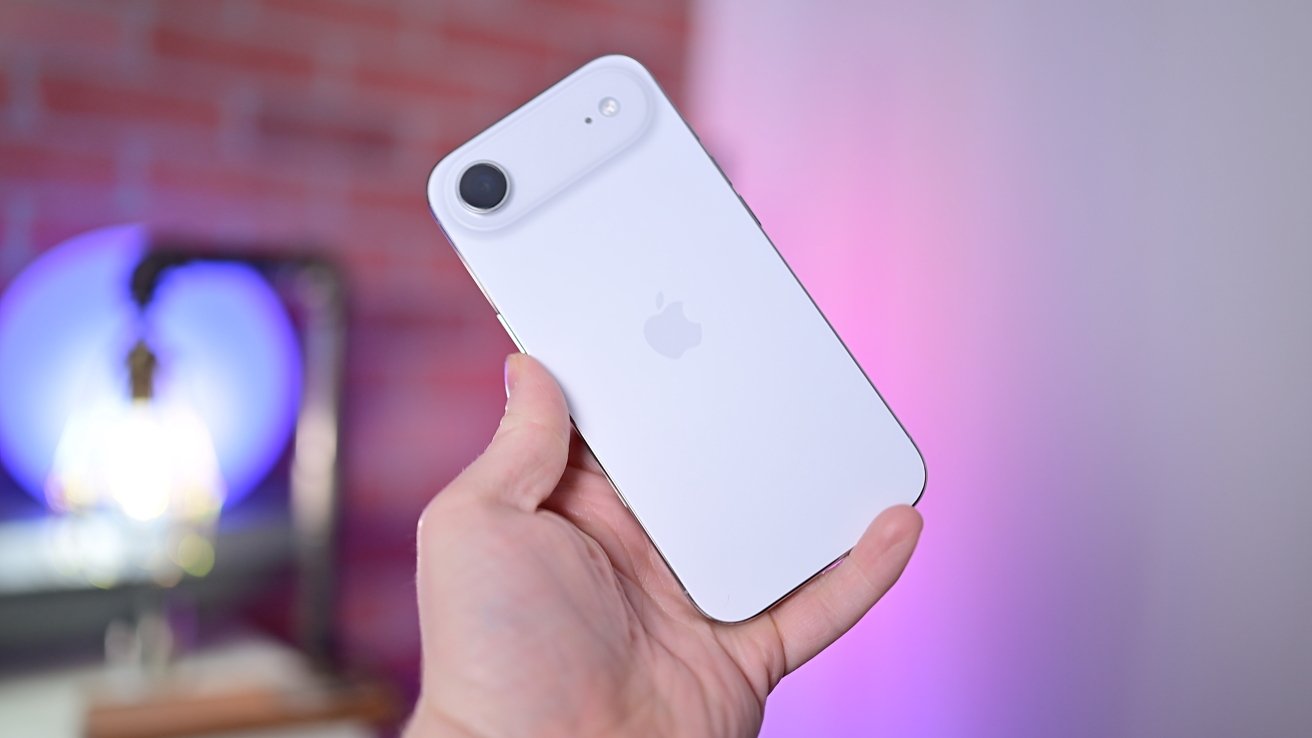
Hand holding a white iPhone with a single rear camera against a softly blurred background featuring pink and purple lighting and a partially visible brick wall

The iPhone Air name was also anyone’s guess before it launched

Advertisement

The “Ultra” moniker has been used by Apple for its Apple Silicon chips most recently. However, that term is used to refer to the highest-end of a possible product, and that won’t be the foldable iPhone in some respects.

Sure, Apple will put the best A-series chip it has in the foldable, and its display technology will be unmatched, but it may not be the “best” iPhone. The iPhone 18 Pro Max will still have a superior camera system, more rugged case, better battery life, and better cooling.

Until recently the iPhone lineup was a ladder you could climb up and down, but the iPhone Air added a branch so there are two pathways. The entry “e” model then the base model make up the bottom, then consumers choose between an iPhone Air and iPhone Pro.

The foldable iPhone will be above the Air in the lineup, not above the Pro. So, it is difficult to suggest that it would get the “Ultra” name.

Advertisement

Regardless, the folding iPhone will be the most expensive by far. Perhaps that will be enough to earn it the top-level moniker.

The iPhone 18 Pro and iPhone Fold are expected to be revealed during an event in September. Whether or not the iPhone Fold will actually ship that month is another question entirely.

Source link

Advertisement
Continue Reading

Tech

AI Could Help Fossil Fuel Companies Create More Emissions

Published

on

The emissions from powering data centers rightly get a lot of attention. But new research from former Microsoft sustainability workers cautions that the way artificial intelligence enhances productivity in the oil and gas industry could be much more damaging to the planet.

Published last week in the journal npj Climate Action, the research finds that AI use could significantly increase global energy emissions simply by enabling the fossil fuel industry to produce more oil and gas. At the low end, the research finds that the additional yearly emissions could be equal to Mexico’s; at the high end, AI boosting the fossil fuel industry could add as much greenhouse gas emissions as Russia, the world’s fourth-largest emitter.

That increase in emissions, the paper finds, outweighs the benefits AI provides to developing solar, wind, and other clean technologies. It also significantly outpaces projections of emissions from the global data center buildout.

The relationship between technology companies and fossil fuels is “a self-reinforcing effect between supply and demand,” says Will Alpine, one of the authors of the research. “One of the key insights of our paper is that you cannot treat them independently. They are two sides of the same coin.”

Advertisement

Alpine and his wife and coauthor, Holly, are former Microsoft sustainability workers with years of experience between them at the company. They quit their jobs at the start of 2024 because of the company’s continued work with the oil and gas industry and began publicly campaigning to draw attention to the relationship between AI and fossil fuels.

Oil and gas companies have been using various types of AI for decades to help find and develop underground resources more efficiently. That increases global dependence on fossil fuels and makes it harder for the world to reach its climate targets, the Alpines argue.

While tech companies measure their own emissions and that of their supply chain, they don’t tend to measure just how much their tools help to increase fossil fuel production. The Alpines refer to AI-supported greenhouse gas pollution as “enabled emissions.”

“Sustainability measures [within tech companies] are very much focused on operational emissions” rather than enabled emissions, Holly says. The new paper argues that while accounting for that pollution is important, it ignores emissions that do much more damage to the climate.

Advertisement

To get an idea of how AI can affect fossil fuel companies’ emissions, the Alpines used a complex economic model that allows researchers to introduce various factors to test out how they might play out over the broader economy. Using reports from oil and gas companies about demonstrated gains from AI tools, the Alpines modeled AI as a productivity enhancer across various sectors of the fossil fuel industry, from extraction to refining to electricity generation. They also estimated how that in turn can increase global emissions.

The modeling found that AI as a productivity enhancer for the fossil fuel industry could help increase global energy-related emissions between 1.2 to 4.8 percent. That’s significantly higher than multiple projections around emissions from data center energy use.

“The scale of this was staggering,” says Will.

Fossil fuel companies are increasingly providing power for data centers. Chevron and Microsoft recently confirmed that the oil giant would be building a large behind-the-meter gas plant in Texas to power data centers for the tech company.

Advertisement

In a call with analysts in June, Jeff Gustavson, the president of Chevron’s New Energies division, hinted that the deal would benefit Chevron’s AI capacities as well. Chevron, according to Gustavson, will “use some of that compute” generated by the power from the power plant serving Microsoft “to actually power AI inside of our company.” (“Chevron and Microsoft have worked together for years to accelerate digital transformation, leveraging the capabilities of a trusted cloud to generate insights, scale innovation, and unlock value across the organization,” Chevron spokesperson Paula Beasley told WIRED in an email, in response to several questions about the specific relationship between the oil giant and the tech company.)

Source link

Continue Reading

Tech

Back to School deals on Macs and iPads

Published

on

Apple has extended its unusually limited Back to School series of deals and they are not to be dismissed, but there are far greater discounts to be had from other resellers.

Even when it isn’t raising prices, it is a rule with Apple that it will never actually have sales on its products, except for certain regular promotions in China. So for this latest deal, it is again falling back on offering Apple gift cards alongside selected products.

So when a user buys one of these devices, they get a gift card that amounts to money off their next purchase. Consequently if someone knows they need two Apple devices, they can get money off the second one.

This year is unusual, however, as Apple has begun its Back to School promotion around a month later than usual. At least at time of writing, it’s also not promoting it outside of the education section of its website.

Advertisement

Apple had also cut the offer a little short, saying that it only ran through August 27, 2026. However, it has now extended the promotion through September 24, 2026.

The offer is available “for Qualified Purchasers only,” which suggests it’s limited to people verified to be in education.

Then, too, the range of gift cards is reduced. This year there’s no desktop Mac included and so the deals and their gift card amounts are only:

MacBook Pro: $150

Advertisement

MacBook Air: $100

iPad Pro: $100

iPad Air: $100

These savings are good, but they are substantially poorer than those from other resellers who do not limit the deals to education buyers. Plus all other resellers actually lower prices instead of having people juggle gift cards.

Advertisement

Then, too, while it has limited the offer more this time, Apple always selects only a few devices to include in its Back to School sales, where resellers do not. Resellers will have limited supplies, but they tend to offer more devices, and they also don’t usually confine them to the Back to School period, either.

Discounted Macs

There are hundreds of markdowns in our constantly-updated Mac Price Guide, and the discounts are not limited to students and faculty. You can jump straight to the individual Price Guides, broken down by screen size and chip, below.

Discounted iPads

There are also heavy discounts on iPads, without the EDU requirement, and each is detailed in our ongoing iPad Price Guide.

Looking for the catch

There is no catch on these third-party deals for Apple devices, but there is a caveat. There are always offers but none of them will ever last for long, so if you see one that’s right for you and your budget, you need to buy quickly.

Advertisement

Otherwise, these are the same devices you would get from Apple, with the same warranties.

Updated August 11, 2026 5:20 p.m.: added that Apple extended the promotion

Source link

Advertisement
Continue Reading

Tech

Contiguous US Breaks Its Record For Hottest Month Ever, NOAA Says

Published

on

An anonymous reader quotes a report from the Associated Press: The contiguous United States sizzled to its hottest month ever last month, according to the National Oceanic and Atmospheric Administration. July averaged 76.89 degrees Fahrenheit (24.94 degrees Celsius) across the Lower 48 states, eclipsing the Dust Bowl’s July 1936 by an eighth of a degree. Records go back to 1895. […] Although it was unusually cool in Alaska, hotter-than-normal conditions blanketed the Lower 48, with the most excessive heat in the Mountain West, Southwest, Northern Plains and Southeast. The heat was so widespread that every one of the Lower 48 states was at least 1 degree Fahrenheit (nearly 0.6 degrees Celsius) warmer than the 20th century average, said Russ Vose, chief of monitoring at NOAA’s National Center for Environmental Information.

[…] The biggest driver of the record heat was nighttime lows that smashed the old mark for hottest minimums by 0.7 degrees, NOAA said. Hotter nights are a classic sign of human-caused climate change, according to scientists and several studies in peer-reviewed literature. NOAA’s calculation is based on averaging 24 hours of temperature, not just highs or lows. “If you’re talking heat waves, that nighttime low is incredibly important for determining total heat stress,” [said meteorologist Jeff Masters of Yale Climate Connections]. “So if it doesn’t cool off at night, your body doesn’t have time to readjust to all the heat.” As nighttime temperatures increase, more people die and lose sleep, studies show.

The years 2021 and 1936 tie for America’s hottest summer, which is June through August. Through July, 2026 is a shade cooler than 2021, which was powered by record heat in June. Because of climate change, Masters said, “this may be one of the coolest years we’re gonna experience for the rest of our lives.” What’s needed, Masters said, is “to stop burning so many fossil fuels. We also need to be spending money to adapt to the new climate that we’ve put in place.”

Read more of this story at Slashdot.

Advertisement

Source link

Continue Reading

Tech

NASA Is Hosting a Livestream for Perseids: How to Watch the Meteor Shower

Published

on

Perseids is one of the biggest meteor showers of the year and one of the most popular since it takes place in summer, and it’s been reliably active for centuries. Many people make it out to a viewing site and spend hours enjoying a live view of the meteors. But if you can’t, NASA is hosting a livestream of the Perseids meteor shower this year. 

The livestream starts at 9 p.m. PT on Wednesday on YouTube. NASA is showing real-time sky imagery from its Automated Lunar and Meteor Observatory at the Marshall Space Flight Center in Huntsville, Alabama. The livestream will be hosted by meteoroid experts from Marshall, as well as several guest speakers who will talk about the meteor shower, its history and other fun facts. 

Perseids began its 2026 show on July 17, and it continues until Aug. 24, so if you’ve seen a meteor in the night sky here recently, there’s a good chance it was Perseids. The meteor shower peaks on the evening of Wednesday and into Thursday, which is the best part. NASA says that Perseids can output anywhere from 50 to 100 meteors per hour during the peak, which averages out to more than one per minute.

NASA hasn’t announced how long the stream will last, but the stream’s name, Up All Night, suggests it’ll last for quite a while. It may be the best way for early birds to experience Perseids after waking up. 

Advertisement

This Perseid fireball was seen over a lake in Ontario around dusk. “It was hot and muggy even after the sun went down, with lots of haze on the horizon but this Perseid was so bright it didn’t matter,” photographer Malcolm Park said.

Spaceweather.com/Malcolm Park

A full schedule of live streams for NASA

NASA typically simulcasts its streams across its YouTube channel, Twitch channel and NASA Plus, which is often also streamed on Netflix. However, Wednesday is chock-full of interesting things to look at, including a solar eclipse and even a planet parade. It seems NASA’s strategy is to divide and conquer, so the Perseids stream is only appearing on YouTube. 

The agency is also hosting a livestream for the solar eclipse on NASA Plus, Netflix, X, Amazon Prime and YouTube on Wednesday. The solar eclipse lasts all day and is visible to the northern third of the US. Those outside the path can watch the eclipse online, at least.

Source link

Advertisement
Continue Reading

Tech

Elon Musk says every future Tesla will have Starlink, starting with the Cybercab

Published

on

First look: Tesla has installed Starlink hardware in a Cybercab, adding satellite internet to the vehicle it plans to use for its robotaxi service. The company’s official Tesla Robotaxi account posted photos this week of what it called the “First Cybercab with Starlink integration.” The images show a Starlink antenna built into the rear of the roof, above the taillights, with a rectangular panel covering the dish rather than leaving it exposed on the outside.

The reveal follows an earlier preview at Tesla’s showroom in San Jose, where the company displayed the planned Starlink capability. Tesla had already said the Cybercab would use Starlink’s V5 dish, a newly launched model rated for download speeds of up to 375 Mbps.

For Tesla, the main use case is reliable connectivity for a vehicle designed to operate without a driver. The Cybercab has no steering wheel or pedals, and passengers are expected to simply get in and let Tesla’s onboard software handle the trip.

Satellite service could give the vehicle a connection in places where cellular coverage is weak or unavailable, which could help with navigation, support functions, and managing a larger robotaxi fleet.

Advertisement

Tesla’s vice president of AI software, Ashok Elluswamy, said Starlink isn’t essential to the vehicle’s safe operation. “Connectivity is primarily meant for navigation, customer service and, in general, fleet management,” he said.

Elon Musk has focused on a different use for the connection: entertainment. “Watch 4K streaming video while Cybercab takes you anywhere you want,” he wrote last month.

On Tesla’s earnings call last month, Musk said a robotaxi service needs connectivity that doesn’t depend solely on local wireless networks. “Starlink will be integrated into all our car vehicles, at least for markets that Starlink is active. Because for a Robotaxi situation, you need to have coverage everywhere. There are many places, even in Silicon Valley, where the cellular coverage is terrible or sometimes non-existent,” he said.

His comments suggest Tesla sees Starlink as more than an add-on for the Cybercab. In a separate post Sunday, Musk wrote: “All cars will have Starlink in the future. It’s the only way to get super high bandwidth to billions of vehicles.”

Advertisement

That statement could just as easily refer to Starlink’s planned mobile service rather than the dish-based broadband system shown on the Cybercab.

Starlink Mobile is designed to work through smartphones and doesn’t require a satellite dish. SpaceX has said its next-generation mobile offering will use both satellites and a ground network, and it could eventually compete with AT&T, T-Mobile, and Verizon.

The Cybercab setup is different. It uses a physical Starlink dish built into the vehicle itself, allowing it to connect directly to the satellite network. Tesla has not said when the feature will be available in production vehicles or whether the same type of hardware will be installed in other Tesla models.

Advertisement

Source link

Continue Reading

Tech

Abbott Partners With Google Health For AI-Powered Glucose Monitoring

Published

on

However, more data doesn’t necessarily mean more benefits for non-diabetics.

Health care company Abbott has entered into a partnership to connect Google Health to its Lingo continuous glucose monitor (CGM). According to the press release, this multi-year collaboration will allow users of the over-the-counter Lingo device to see their metabolic data within the Google Health app, which could help a person “make better lifestyle and nutrition choices in the moment.” The Lingo data can also be shared with the Google Health Coach, which offers AI-driven recommendations based on an individual’s information.

Lingo is explicitly intended for adults who are not using insulin. Engadget reported on the growing trend of non-diabetics using continuous glucose monitors back in 2023 and found little research that supported the benefits for that population to track blood sugar spikes so closely. 

An article from the Johns Hopkins Bloomberg School of Public Health published earlier this year reiterated that the health benefits of a CGM for non-diabetics are pretty hazy. Using the devices might keep nutrition information top of mind and lead to a person making better dietary choices. But since a non-diabetic body is capable of regulating most glucose spikes, an over-emphasis on blood sugar might just as easily lead to poor eating habits by trying to keep the readings unnecessarily low.

Advertisement

Additionally, getting a useful interpretation from results isn’t something the average person should be expected to do. When Engadget spoke with Idrees Mughal, known on TikTok as Dr. Idz, he emphasized that even as a trained medical doctor, he would want to reference additional data points to make an assessment from CGM results. For a layperson, “you don’t even know how to interpret it. So it’s going to be completely useless,” he told Engadget.

It’s possible this Abbott—Google alliance could turn up some useful insights about those non-diabetic use cases. As part of their deal, the companies will be “conducting one of the largest real-world metabolic health studies to date, integrating continuous glucose, wearable, laboratory and survey data to uncover connections between activity, sleep, wellbeing and metabolic health, informing more personalized guidance that supports healthier day-to-day decisions.” But it also wouldn’t be surprising if the findings suggest more people buy Lingo devices or subscribe to the Google Health Premium subscription. And bear in mind: it’s always worth speaking with your primary care physician before making any changes to your health habits, including diet.

Advertisement

Source link

Continue Reading

Trending

Copyright © 2025