The data processing agreement (DPA) — the bedrock contract companies use to evaluate how vendors handle personal data — can no longer be trusted at face value. That is the central, and arguably most alarming, conclusion of DataGrail’s Privacy and AI Trends Report 2026, released today.
The San Francisco-based privacy platform analyzed 2,400 popular business software providers and found that 63.6% of vendors that prominently advertise AI capabilities do not disclose a third-party AI subprocessor in their legal documentation. The implication: the majority of companies purchasing AI-enabled software may be unknowingly exposing their customers’ data to AI models and pipelines they never reviewed, never approved, and may not even know exist.
“All software vendors are trying to move to become AI vendors, which makes sense, but the technologies are moving faster than AI governance can actually keep up,” DataGrail co-founder and CEO Daniel Barber told VentureBeat in an exclusive interview ahead of the report’s release. “The DPA should be the reliable document that teams use to evaluate AI risk, but based on that number, that’s not enough in 2026.”
The finding drops into an enterprise landscape where organizations with high levels of shadow AI already experience average breach costs of $4.63 million — $670,000 more than those with low or no shadow AI, according to IBM’s 2025 Cost of Data Breach Report. And it arrives in a year when U.S. states gave out $3.425 billion in privacy-related fines — more than the last five years combined — a trend Gartner expects to accelerate through 2028.
Advertisement
How researchers uncovered the growing gap between AI vendor contracts and reality
DataGrail’s methodology for arriving at the 63.6% figure goes well beyond reading contracts. The company’s research team cross-referenced DPA disclosures against product documentation, GitHub environments, API connections, and marketing materials for each of the 2,400 vendors in its tracking universe.
Barber walked VentureBeat through the process: “We looked at the DPA as the baseline, but then what we also looked at is the GitHub environment, the API connections that a particular vendor has, the product documentation, the marketing documentation, and triangulate that information to discern — okay, so the DPA document says use OpenAI, but actually you’ve got these three AI subprocessors over here in your product documentation outlining features and functionality, but that is not reflected in your DPA.”
When asked directly about how confident he was that these gaps represent actual shadow AI risk rather than vendors using proprietary technology, Barber was unequivocal. “Very confident, because we looked at the sample of the 2,400 systems, and we spent a substantial amount of time actually looking at product documentation, GitHub environments, looking at actual API connections, because we integrate with these systems as well, so we know how they process personal information. It is from primary research.”
The disclosure gap matters because it undermines the entire chain of trust that privacy programs rely on. Consider a scenario Barber described: A company invests in an AI recruiting tool. The tool’s DPA lists Claude as its foundational model. The company dutifully performs a security review of Anthropic’s AI. But the recruiting tool also quietly uses OpenAI and Gemini behind the scenes — models the company never evaluated.
Advertisement
Those undisclosed models then process thousands of resumes and execute automated hiring decisions. The company, without knowing it, has exposed sensitive personal information — home addresses, financial data, possibly Social Security numbers — to AI systems it never vetted, potentially violating FTC regulations on automated decision-making in employment. “How those vendors are evaluating and performing that automated decision making could be really disastrous for a business,” Barber said.
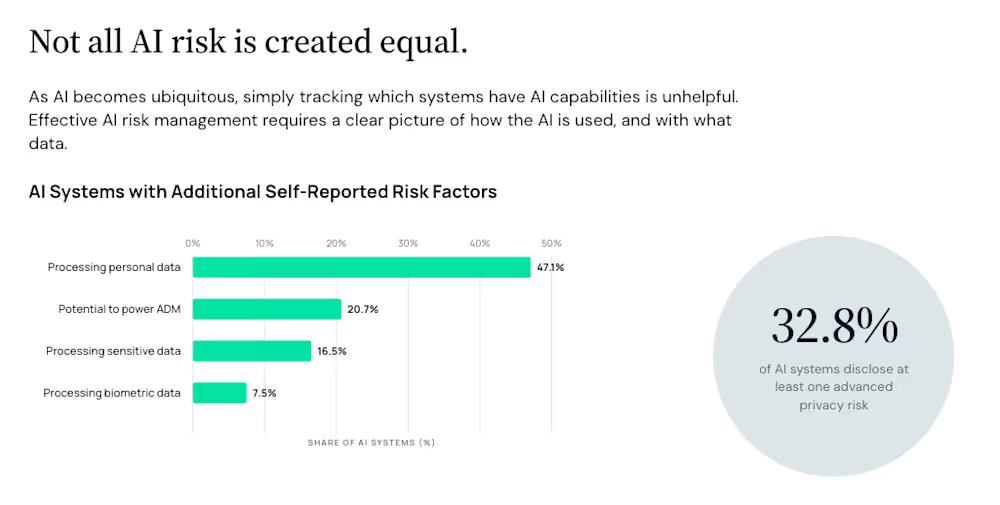
Nearly a third of AI systems acknowledge at least one advanced privacy risk in their disclosures — but with most vendors failing to update their data processing agreements, the actual figure is almost certainly higher. (Source: DataGrail Privacy and AI Trends Report 2026)
One-third of AI systems also process sensitive data, and the true number is likely higher
The disclosure gap alone would be concerning enough. But DataGrail’s report layers on another finding that makes the problem materially worse: 32.8% of AI systems that disclose AI capabilities also disclose at least one other high-risk activity, such as processing sensitive personal information or powering automated decision-making. Among AI systems with self-reported risk factors, 47.1% process personal data, 20.7% have the potential to power automated decision-making, 16.5% process sensitive data categories like health or financial information, and 7.5% process biometric data.
The report argues these figures almost certainly undercount actual exposure, since they reflect only what vendors have formally disclosed. Vendors could underreport access to personal data, and the inherent flexibility of AI means even good-faith vendors might not predict riskier user applications of their tools.
Advertisement
This has immediate regulatory implications. The CCPA’s new risk assessment requirement, effective January 1, 2026, requires businesses to conduct and document risk assessments for processing activities that present significant privacy risks — and will require submission to CalPrivacy by April 2028, with executive attestation under penalty of perjury.
Processing sensitive personal information with AI, or using AI for automated decision-making, are precisely the activities that trigger this obligation. The report finds that 42% of companies abandoned AI initiatives in 2025 with data privacy concerns cited as a primary obstacle — a statistic sourced to S&P Global research. Privacy teams that engage early with AI projects, Barber argues, can prevent that waste by ensuring safeguards are in place before launch, with AI risk assessments serving as the right starting point.
Gambling and consumer technology companies face the heaviest privacy assessment workloads, conducting roughly four times the annual reviews required in the entertainment industry. (Source: DataGrail Privacy and AI Trends Report 2026)
Why consent management became 2025’s most punished privacy failure
While shadow AI is still a newer category of threat, the report makes clear that traditional privacy challenges have not eased — they have intensified. Consent management was the busiest enforcement topic of 2025. California alone publicly reported $4.3 million in CCPA consent settlements, and 2025 saw over 1,400 class action wiretapping suits driven by private firms investigating tracking pixels and session replay software.
Advertisement
Despite this enforcement wave, 63% of the 5,000 websites DataGrail audited still fail to comply with universal opt-out mechanisms such as the Global Privacy Control signal. While that figure represents an improvement from 75% non-compliance in 2023, the pace of improvement is slow relative to the acceleration in enforcement.
Barber pointed to the case of Todd Snyder, the menswear retailer that the California Privacy Protection Agency fined $345,178 in May 2025, as evidence that enforcement is no longer reserved for big tech. “This is a business that has two or three stores across the U.S. They have 300 employees,” he said. “They run tight margins because they’re a consumer menswear clothing store.”
The California Attorney General also reached a $2.75 million settlement with Disney over failures to honor opt-out signals, while the California Privacy Protection Agency has brought enforcement actions against PlayOn Sports and Ford — a pattern that demonstrates both the breadth and depth of regulatory activity. Among the trackers that fire even after a user sends a GPC signal, the report found that 27.1% come from Google Analytics and 43.8% are for targeted advertising via platforms like Meta and Microsoft.
For users who do engage with consent banners, 48.3% click “Accept all,” while only 12.4% select “Essential only” and 2.3% customize their preferences. A full 37% simply exit the banner without making a selection. The practical takeaway: less than 15% of users make a conscious choice to opt out of tracking, which means consent banners present relatively low business risk when properly configured — but enormous regulatory risk when they are not.
Advertisement
Nearly half of users simply accept all cookies when a consent banner appears. Fewer than 15 percent actively choose to limit tracking — a pattern that makes proper banner configuration a high-stakes compliance question. (Source: DataGrail Privacy and AI Trends Report 2026)
Data deletion requests surge 567% as the cost of manual processing hits $1.5 million a year
Data subject request volume hit an all-time high for the fifth consecutive year. Deletion requests have surged 567% since 2021 and now represent 87% of all data subject requests. Access requests, by contrast, have gradually declined as consumers skip visibility and reach straight for the delete button.
The cost is staggering. For a mid-sized organization receiving 5 million annual web visitors, the report estimates manual DSR management now runs approximately $1.5 million per year, based on Gartner’s estimated cost of $1,524 per manual DSR. The average cost has climbed from $238,000 in 2021 to $1.51 million in 2025 — a trajectory that makes manual processing not just inefficient but, as the report argues, “irresponsible.”
Barber emphasized that these numbers reflect verified human requests with bot and spam traffic excluded, and that data broker scenarios — which will see their own massive influx of requests under California’s Delete Act — are reported separately. “That is a natural increase,” Barber told VentureBeat. “If you’ve now got 20-plus U.S. states with privacy regulation, it’s unlikely that we see a federal bill passed, even though we’ve seen one proposed. And while we don’t see federal awareness and regulation, we do see at the state level over 20 states, and that may actually increase awareness for the consumer even more.”
Advertisement
He added a telling detail about how businesses are responding in practice: “99% of DataGrail customers do process that deletion” even for residents of states without privacy laws, “simply because it’s too hard at this point. Discerning and even communicating to the person, ‘Hey, you live in Montana, sorry, you’re just in an unfortunate state without regulation’ — you just can’t do that.” Data brokers felt the impact most acutely, with a 398% increase in deletion requests compared to 2024 and an average of over 2,000 deletion requests handled per month.
The cost of handling consumer privacy requests by hand has risen more than sixfold since 2021. (Source: DataGrail Privacy and AI Trends Report 2026)
State regulators issued $3.4 billion in privacy fines last year, and both parties want more
The regulatory landscape underpinning all of these trends has fundamentally shifted from education to punishment. Nearly half of U.S. states now have a comprehensive privacy law in effect, plus over 160 AI-specific laws. State legislatures enacted 145 AI-related laws in 2025 alone, with another thousand introduced or reworked. According to Gartner, over 50% of the U.S. population is now covered by a comprehensive state privacy law, with 24 additional states expected to pass laws within five years. States have also begun pooling their resources, with ten forming the Consortium of Privacy Regulators last year and pledging to coordinate investigations across state lines.
Barber argued that privacy enforcement is fundamentally bipartisan, which insulates it from the shifting political winds of the current administration. “Privacy overall is a pretty bipartisan issue,” he said. “It’s easy to pass privacy regulation because constituents somewhat expect privacy in their day-to-day living. If you were flying on an airline and they said, ‘Okay, this seat, if you want your privacy, you’re going to have to pay $6 more,’ you’re like, ‘I’m going to go to another airline.’ It’s an expected part of a transaction at this stage.”
Advertisement
He predicted that other states will replicate California’s enforcement model. “California has their enforcement division, CalPrivacy. That group has one task: to ensure enforcement of privacy throughout businesses. Is it likely that we see other states get funding and support to fund these types of groups? Highly likely. The enforcement fines — the actual payments — go back to us as constituents. That type of model, you could imagine, being very popular across the country.”
Privacy teams are losing a third of their staff just as AI governance demands explode
Perhaps the most paradoxical finding in the report is that privacy teams lost as much as 33% of their headcount last year, even as their workloads expanded across every metric the report tracks. Cisco data cited in the report shows that 90% of privacy programs expanded in 2025 due to AI, while only 12% of AI governance programs are considered mature. Meanwhile, 74% of privacy teams planned to apply AI to privacy-related tasks in 2026, according to ISACA’s State of Privacy 2026 survey.
Barber sees this as part of a broader macroeconomic pattern rather than a sign that organizations do not value privacy. “It’s actually a fascinating macro trend, and probably one you’ve seen across all functions,” he said. “Businesses are driving more efficiency in all parts of the business. Privacy teams, five years ago, we would have said, ‘Well, there’s more regulation, the volume of deletions have increased 500%, we need more humans.’ It’s become clear that AI provides capabilities that can do the work for privacy individuals.” He drew an analogy: “They might have had a design team of 20 people five years ago, now they have a design team of five, courtesy of Claude Design or Gamma or whatever the tool may be. I think that’s what we’re seeing here as well.”
DataGrail has positioned its own AI agent, Vera — launched in March 2026 — as part of the answer. Vera is embedded within DataGrail’s existing platform and aims to automate privacy workflows across multiple jurisdictions. The company was also named the first production-ready Model Context Protocol server for privacy, using the standard created by Anthropic to enable customers to launch DataGrail tools from whatever application they are already working in, whether Slack, email, or Claude.
Advertisement
Can a vendor-produced report be trusted to diagnose the problems that vendor sells solutions for?
DataGrail is, of course, a company that directly benefits from the problems its report identifies. The company has raised a total of $84.2 million over five rounds, with its largest being a $45 million Series C in October 2022 led by Third Point Ventures. Its platform addresses precisely the data mapping, DSR automation, consent management, and risk assessment challenges the report spotlights.
Barber acknowledged the tension directly. “It’s a fair statement,” he said when asked about potential skepticism. “DataGrail doesn’t provide a service to keep DPAs up to date — that’s on a business to evaluate how they work with a vendor. What DataGrail does help to do is assessments, and automate those assessments using our AI agent, Vera, to assess that increased risk.”
He argued that the more neutral reading of the data is structural: “This is evidence to show that the DPA unfortunately is not keeping up with technology and the speed at which technology is innovating. That’s both exciting but also we need to accept that’s where we are.” The methodology does lend some credibility to this claim.
The report draws on anonymized privacy operations data from hundreds of enterprise customers, the 2,400-system AI tracking database, and the 5,000-website consent audit — sources that are at least partially independent of DataGrail’s commercial interests. And the broader findings on enforcement spending, DSR volume trends, and regulatory expansion align closely with independently published data from Gartner, Cisco, and state enforcement agencies.
Advertisement
The next frontier: agentic AI could spread unvetted data across entire organizations autonomously
When asked about the most important trend that did not make it into the report, Barber pointed to a next-generation risk that extends the shadow AI problem into far more dangerous territory: agentic AI workflows. Gartner predicts 40% of enterprise applications will feature task-specific AI agents by end of 2026, up from under 5% in 2025 — a pace of adoption that could rapidly outstrip the governance mechanisms companies are only now beginning to build.
“Where we go next with this research is agent processing,” Barber said. “How are agents then leveraging that information? Because the downstream ramifications would be far more concerning for a business. One particular system is using shadow AI, the business has no idea that that’s happening, and then an agent is propagating that information across a whole bunch of other places. The guardrails of you and I checking the system will be lower than maybe what we’ve seen in the past with agentic workflows.”
He framed the distinction in human terms: “The identity of an agent is different than a human. There is thought that goes into what am I about to use here, where did this information come from, how was it collected — that may not be considered in the same way for an agentic workflow. We need to solve the root of the problem, which is how are these businesses leveraging AI subprocessors. But this quickly becomes an agentic problem that could be far more concerning.”
For the enterprise privacy and security leaders absorbing this report today, the uncomfortable truth is that the foundational documents and processes they have relied on to manage vendor risk for years are decomposing in real time. The DPA is breaking down as a reliable instrument. State enforcement is accelerating on a bipartisan basis. Privacy teams are shrinking even as their mandates expand. And the next wave of agentic AI systems threatens to distribute unvetted data processing across networks of autonomous agents that operate with even less human oversight than today’s tools.
Advertisement
Five years ago, when DataGrail published its first trends report, deletion requests were a fraction of what they are today, only a handful of states had privacy laws on the books, and the phrase “shadow AI” did not exist. Every year since, the report has warned that the problem was getting worse. Every year, the data has proved it right. The companies that survive the next chapter will not be the ones with the biggest compliance teams or the thickest policy binders. They will be the ones that accept a disorienting new reality: in 2026, the contracts you signed may not describe the AI that is already processing your customers’ data — and by 2027, autonomous agents may be deciding what to do with it.
Putting hidden data in places where few expect it can be a fun hobby or even a professional career. In the case of [Tim Wehrle] it’s just the former. His most recent project in this area uses a favicon image for storing a HTML-based website and rendering its contents within the browser after the favicon has been downloaded.
To pull this off, a very basic HTML page was turned into a series of UTF-8 encoded bytes that were then declared to be a standard PNG image. The original 208 byte payload plus 4-byte PNG header only used part of a 9×9 pixel favicon. With a larger favicon image as typically used you could thus easily store more data, whether as visual noise like here or a bit more hidden.
Of course there’s a catch, and in this case it’s the Typescript code to unpack the bytes from the “image” and render them; you have to load that separately. But still, in these days of all-singing, all-dancing websites that take forever to render, it’s refreshing to see what you can do with so few bytes that they fit in a favicon.
As for the purpose of such an approach, that’s left as an exercise for the reader, but you’re more than welcome to take a poke at the GitHub project and the demonstration site..
Apple’s home automation updates and new product roadmap powered by Siri AI will kick off in 2026 with HomePod and Apple TV updates, but if you’re excited for the robotic arm for a Home Hub, you’re going to be waiting a while.
It’s no secret that Apple’s new AI push will include several new products like the long-rumored Home Hub. However, the timing of some of those products’ releases remains in question.
The Home Hub itself is expected in 2026 as well, which means an Apple Home-focused release cycle or event could occur in the fall. That device should launch as a standalone display that can be paired with various mounts like speakers, wall mounts, and articulating arms.
Advertisement
The new Apple TV is expected to support Apple Intelligence in some specific capacity and may have a new Siri Remote. The HomePod mini would also gain access to Siri AI, but that’s likely the only major feature of the product.
The robotic arm accessory for the Home Hub, which may include an upgraded AI-focused version of the tablet device, isn’t expected until 2027 or 2028. That device has always been more of a moonshot, with the Pixar Lamp-like device with a personality still in early testing.
It’s not really a question of if these products are coming, but when. With everything else releasing, Apple will need to find time to reveal its new Home Hub product category and sell people on why the new Apple TV and HomePod mini are necessary.
Advertisement
The September keynote will already be packed as it is, and I don’t think these products will fit the “just drop a press release” model. My expectation is that there will be a lengthy Apple Home segment during a primarily Mac-focused keynote in October.
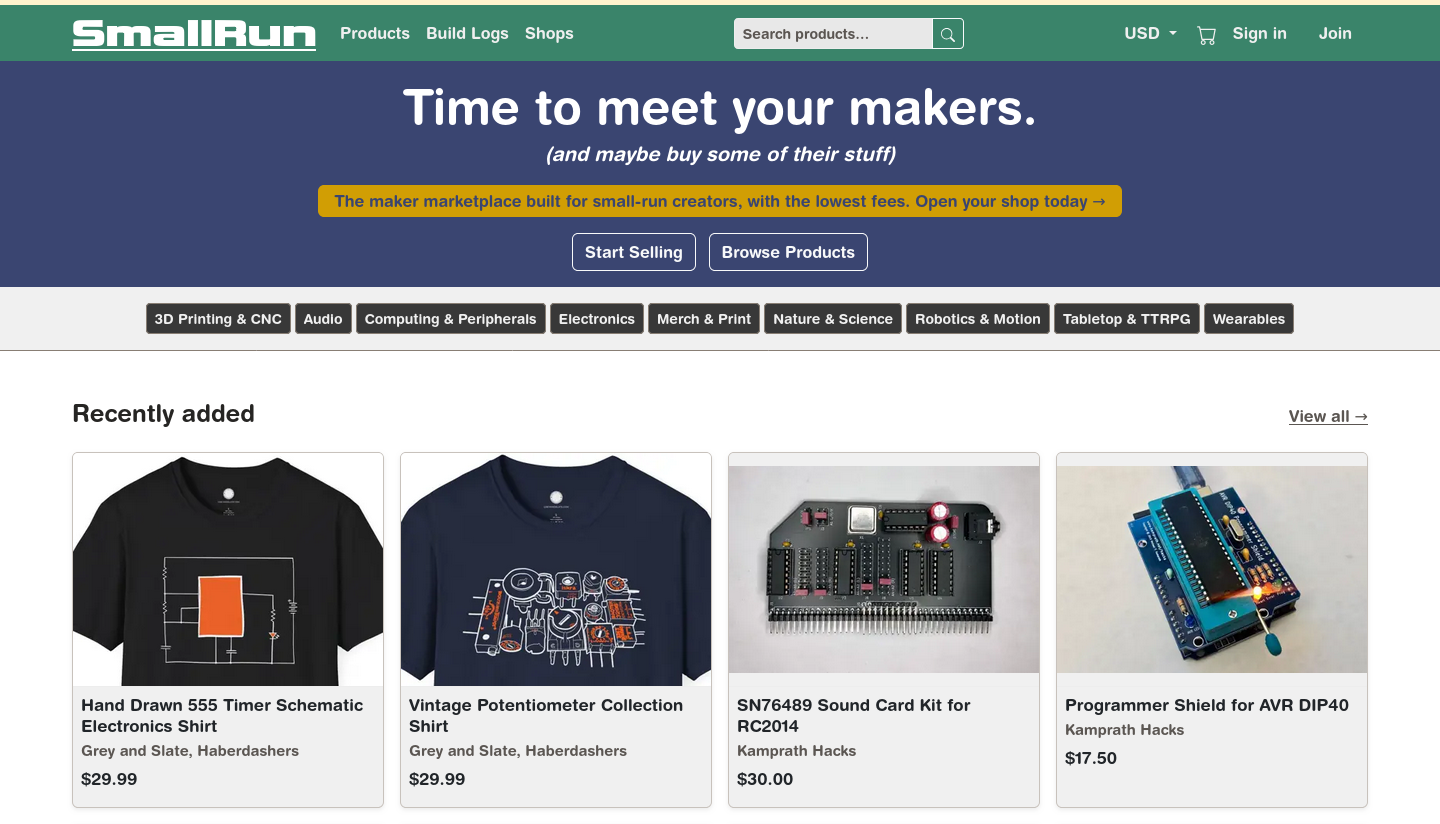
So you have a project that you love, and everyone else loves too. People start saying “you should sell this” but where? Well, there’s a new marketplace you might want to consider called called SmallRun, aiming at makers and their, well, small production runs.
SmallRun will absolutely host your custom PCBs, on-demand 3D prints, and other traditional maker products — but they’ll also happily sell your merch, too. Along with electronics and hardware, they aim to allow you to sell products in categories like tabletop gaming, sciences, and yes, accessories/apparel.
For sellers, they offer automatic payouts and promise to take care of the taxes by integrating with Stripe. That said, they’re still working on getting the whole VAT thing set up for products imported to the EU. EU to EU sales are apparently OK. They’ll host build logs, which may drive engagement with your product. There’s even a handy tool to import your existing listings from eBay, Tindie, Lectronz, Etsy, Shopify, or Crowd Supply if you’re already in the biz. They make their money by taking a cut of your sales: eight percent, plus forty cents per listing.
Depending on your perspective, you might wonder if we need another marketplace, To that we can only say: “Let a thousand flowers bloom!” Competition should drive these marketplaces to continuously improve and we all win.
Apple wants you to step into a virtual world, while Snap wants you to stay in the real one. Here’s how their very different approaches to spatial computing compare.
Apple Vision Pro [left] vs Snap Specs [right]
The launch of Snap Specs at Augmented World Expo on June 16 is a big shift forward for the social company. After the previous effort of Snap Spectacles, Snap Specs are a step closer to the augmented reality future by being smart glasses with a built-in display. This is something that brings Snap’s efforts in line with the Ray-Ban eyewear that Meta has produced, including its yet-to-ship Meta Ray-Ban Display. It’s also a massively different product from Apple’s own head-mounted computing device, the Apple Vision Pro. Continue Reading on AppleInsider | Discuss on our Forums
On the latest episode of TechCrunch’s Equity podcast, Sean O’Kane, Rebecca Bellan, and I discussed what actually prompted the administration’s moves against Anthropic, and what this might mean for the broader AI ecosystem.
As Sean put it, “Anthropic has not had the best relationship with the Trump administration in a way that stands apart from the other leading AI labs,” so perhaps other Anthropic’s rivals don’t need to worry about a similar crackdown.
But Rebecca also noted that leading cybersecurity experts have “signed an open letter to ask Trump to revoke the order, and they say it’s actually dangerous to have to pull these advanced cybersecurity capabilities from network defenders in the U.S.”
Advertisement
And we wondered whether this could all end up being good publicity for Anthropic, especially since — in Rebecca’s words — “everybody loves a bad boy.”
Keep reading for a preview of our conversation, edited for length and clarity.
Rebecca Bellan: As I’m sure many of our listeners know, the U.S. government basically just forced Anthropic to pull its two newest models offline — Fable 5, and then there was also Mythos 5, which was the one that was available to current Mythos users, [whereas] Fable 5 was more available to the public.
They sent a letter [last] Friday that cited “national security concerns.” No one knows what those concerns are. That report has not been made public, they gave no specifics and told [Anthropic] that they had to ensure that those models couldn’t be used by any foreign nationals. So Anthropic was like, “Okay, I guess we have to just pull the models entirely, because we don’t know when someone’s a foreign national. A lot of our own employees are foreigners.”
Advertisement
But really, [reports said] the White House got tipped off to this because of some Amazon researchers that allegedly found a way to bypass Fable 5’s guardrails. Amazon CEO Andy Jassy raised these concerns with the White House, and it just kind of spiraled from there.
Sean O’Kane: This all moved really fast, especially for a Friday afternoon into a weekend. And it’s at the same time that the administration was ostensibly trying to negotiate some sort of treaty for the war that it started in Iran.
Rebecca: Friday evening for us in New York. They love a distraction.
Sean: Let’s step real far back for a moment. Anthropic has not had the best relationship with the Trump administration in a way that stands apart from the other leading AI labs — I think there’s an element, at least, of that playing here.
Advertisement
So do you think that this is going to have implications for those other companies? Do you think that the Trump administration would be less inclined to sort of turn off the tap on one of those competitors?
Anthony Ha: Part of the context here is that both the reporting and an analysis from independent security experts suggest that the actual security risk from Anthropic is not that unique. So a lot of this seems to stem as much from parts of the Trump administration and Anthropic just [not getting] along very well. Whatever risks there are, those things are gonna blow up out of proportion just because it seems like they can’t have a civil phone call with each other.
If you’re another company — on the one hand, maybe that’s advantageous to you, because you can say, “Well, we just don’t get these guys mad at us and we can do what we want.” But that’s also not a great regulatory landscape to just [say], “Boy, I hope they don’t get mad at us.”
Rebecca: On the one hand, it definitely feels retaliatory — after the government labeled Anthropic a supply chain risk, there’s this big lawsuit going on between them, it really feels like the White House is just looking out for any excuse to pummel Anthropic. And I feel that way not only because that was my initial reaction, but because of what a lot of cybersecurity researchers have said. They say that this should never have triggered an export control [order]. They’ve all signed an open letter to ask Trump to revoke the order, and they say it’s actually dangerous to have to pull these advanced cybersecurity capabilities from network defenders in the U.S. Anthropic itself said some of the same jailbreaks could have been found in several other AI models.
Advertisement
Cynically, it’s like: Okay, are you just pausing Anthropic so that others can catch up to where Anthropic was?
But at the same time, I’ve also seen reactions that [say]: Anthropic kinda had this coming. They’re like, “This is too dangerous for anyone to use, but not us, we’re the good guys.” They’re talking out of both sides of their mouth. A week before Fable came out, they were [saying], “Hey, we need to slow down AI, guys. It’s getting really dangerous.” But then boom, “Here’s our most insane ever, super powerful model, go off.”
Anthony: In some ways this feels like a microcosm of a lot of the discussion around AI, where people like Sam Altman and Jensen Huang are [saying], “Hey, let’s try to lower the temperature. Why is everybody mad at us?” Well, you spent the last couple years essentially saying you’ve built this God machine that will take jobs away from everyone. It’s not exactly a shock that people don’t feel great about this.
And there’s something about the way Anthropic talks about Mythos in particular, where they’re like, “This is the most incredibly powerful model ever, it’s too dangerous to release to the public.” And so on some level, [you say,] “Well, okay, let’s say that we take that seriously then. That means that there’s going to be an incredible level of scrutiny around it.”
Advertisement
And I do wonder — it does seem like Anthropic is not happy about this. I want to be careful about not overstating how this could be beneficial to them. But we also ran some stories about Ramp analysis to highlight the fact that the last big blow-up between Anthropic and the Trump administration was good for the company, in at least some ways. Downloads of Claude shot up. I think a lot of people who maybe had thought of ChatGPT as the chatbot, the AI assistant before, suddenly they were looking at Claude as maybe the more responsible one, the more “resistance” one.
And in the same way, [while] Anthropic is very stressed out about this, this could, again, make their models seem even more powerful.
Rebecca: Definitely. “We’re so dangerous.” Everyone loves a bad boy, right? Everyone’s like, “It’s the most powerful model, even Trump says so. Of course, I’ve got to get my hands on it.”
When you purchase through links in our articles, we may earn a small commission. This doesn’t affect our editorial independence.
“There’s a revolution in battery technology hiding in plain sight,” reports The Wall Street Journal. “The 3-D printing of batteries has the potential to put energy storage inside any device.
“This will enable lightweight and long-lasting consumer gadgets, long-range military drones and even nanoscale robots.” Almost all the innovations we regularly hear about — from cheaper, tougher electric-vehicle batteries to “Holy Grail” solid-state batteries — are about changing the chemistry of batteries. The promise of battery-tech 3-D printing (aka additive manufacturing) is simple: What if batteries could fill any available space, even structural elements of our gadgets, rather than always taking a rigid shape like a pouch or cylinder?
The new approach has obvious appeal. The entire airframe of a drone could be filled with energy storage for increased range. Smartglasses could have sleek battery-packed frames, so they look like everyday eyewear rather than “Revenge of the Nerds” props. One of the biggest advantages of 3-D printing is that it works with any battery, regardless of its cell chemistry. It could advance today’s lithium-ion as well as emerging sodium-ion and solid-state tech… Some [startups] are trying to use 3-D printing to create efficiencies in existing battery manufacturing systems. A brave handful of startups are pursuing radical new designs and approaches. They’re starting with defense applications, where cost and scale are less of an issue…
At Silicon Valley-based Sakuu… [r]ather than trying to 3-D-print whole batteries, the company is working on replacing one of battery manufacturing’s biggest pain points, says Arwed Niestroj, Sakuu’s chief operating officer, who is also a nuclear physicist and former head of Mercedes-Benz Research & Development North America. Existing battery assembly lines include football-field-long ovens for drying layers of material that have been dissolved in solvents. This requires a huge amount of energy and is a significant contributor to manufacturing costs, a big reason EV batteries aren’t cheaper. Sakuu’s process, under development for years, uses additive manufacturing to lay down key battery components without solvents, eliminating the need for ovens, says Niestroj.
Advertisement
Sakuu is currently working to commercialize this tech with a major battery manufacturer…
Today marks the summer solstice, the longest day of the year and the start of astronomical summer in the Northern Hemisphere. This doesn’t really have much to do with hacking hardware or building gadgets other than the fact that from this point on you’ll have progressively less daylight hours to do it in each day. Of course, if you do your best work in the middle of the night this won’t impact things much.
If you’re as likely to find a controller in your hand as a soldering iron in the evenings, you might be interested in a recent filing against Sony. Lawyers representing a group of four gamers allege that the entertainment giant is violating a California law that says digital storefronts need to make it clear that buyers don’t technically own the games in question but are merely licensing them — a license which, as we’ve seen in the past, can be revoked or modified at any time with no restitution made to the purchaser.
Now while we agree conceptually that selling gamers a license rather than an actual copy of the game is clearly a one-sided deal, we’re still not sure this case has a lot of merit. As far as we can tell, Sony does make it clear in the fine print that you’re not really going to own anything once they take your money. Or, at the very least, they make it equally as clear as any other company that’s selling digital downloads these days. Should the court actually find that said fine print is a little too fine, it could conceivably have ramifications throughout the entertainment industry. This is certainly a case to keep an eye on.
If you want to be sure none of your games can be removed from your digital grasp without warning, perhaps your best bet is to stick to the classics. Fans of 1989’s F-15 Strike Eagle II on PC will be excited to hear that there’s an ongoing effort by Neuvieme Porte to reverse engineer the flight sim and re-implement the whole thing in portable C.
This would open up all sorts of possibilities, such as ports to other platforms and the addition of new features and content. But before the project can get to that point however, Neuvieme is looking to recruit some virtual test pilots. Just keep in mind that the goal, at least for now, is to recreate the game exactly. That means bugs present in the original release are to be preserved. As such, it would help to have logged enough hours back in the DOS days to recognize what’s an OG bug and what’s been newly introduced.
Advertisement
From working on virtual jet fighters to the real deal, IEEE Spectrum recently ran an article about a startup called Phoenix Semiconductor that’s looking to produce bespoke pin-compatible replacements of critical chips for the military. They reason that the Air Force won’t mind paying $1,000 for a chip that cost them a buck back in 1975 when the alternative is grounding a $70+ million F-18 that needs the thing to take off. The goal isn’t really to recreate the old parts as they were, but instead to build drop-in replacements that are tailored for specific applications. In other words, Uncle Sam doesn’t care of the IC actually looks like the original, so long as it fits and it gets the jet up in the air again.
Finally, on the subject of aerospace technology, NASA’s Jet Propulsion Laboratory published a blog post earlier this week detailing their work on the Exploration Rover for Navigating Extreme Sloped Terrain (ERNEST). While NASA’s Curiosity and Perseverance rovers have done some incredible work on Mars, they’re slow and have to be operated with the utmost caution to make sure they don’t get stuck. In comparison, ERNEST is several times faster and is designed with an active suspension system that lets it lift each wheel up off the ground independently if needed.
The prototype rover also features improved autonomy that may allow future rovers make more decisions on their own. That may not be a huge time saver on the Moon, but given the communication delays with the Red Planet, a Mars rover that doesn’t have to stop and ask Earth for directions so often will be able to get more useful work done at the end of the day.
Advertisement
See something interesting that you think would be a good fit for our weekly Links column? Drop us a line, we’d love to hear about it.
The Wall Street Journal reviewed 1,105 videos along with guidance given to creators for crafting their posts.
Polymarket
In case you needed another reason to be wary of those videos showing people winning big on Polymarket, an investigation by The Wall Street Journal has found that the company is paying social media creators to post misleading content promoting the prediction market. Of the 1,105 TikTok videos the publication reviewed, 778 appeared to show someone placing a bet — but a closer look reportedly revealed that none of the latter featured the actual Polymarket website, instead using dummy sites made to look like the real thing.
For more than half of the videos that appeared to show winning bets, those bets would in reality have been losses, The Wall Street Journal reports. The publication spoke to creators who worked with Polymarket and viewed materials they say they were given to ensure their videos were convincing and engaging. In addition, Polymarket reportedly also enlisted a “social-media army” to repost these videos and help them go viral.
Mo Salah’s Egypt meet Chris Wood’s New Zealand at BC Place in Vancouver, with both teams looking to break away from the Group G bottleneck after all four sides opened their World Cup 2026 campaigns with draws.
Although Egypt performed well, especially defensively, in their opener against Belgium, they led for nearly two-thirds of the match before an own goal by Mohamed Hany, arguably caused by the impact of Romelu Lukaku’s introduction, brought Belgium level.
Still, they’ll be pleased with how their defence marshalled a disciplined low block, spearheaded by centre-back Mohamed Abdelmonem. Hossam Hassan’s men will hope to replicate that performance as Mo Salah looks to secure his first-ever World Cup victory with Egypt.
Advertisement
New Zealand, meanwhile, entered the tournament as the lowest-ranked team in the field but stood up impressively to 20th-ranked Iran in a 2-2 draw thanks to goals from Elijah Just.
So, read on as we show you exactly how to watch New Zealand vs Egypt for free from anywhere in the FIFA World Cup 2026.
How to watch New Zealand vs Egypt for free
New Zealand vs Egypt is available to watch for free in multiple countries, including the UK, Australia, Brazil, Belgium, Ireland, Netherlands, Switzerland and Turkey.
Advertisement
Abroad? Can’t access your free stream? Unblock your free World Cup stream with Norton VPN — more on that below.
Use a VPN to watch New Zealand vs Egypt live streams
It’s the World Cup, and if you’re traveling, you might discover your usual New Zealand vs Egypt stream is suddenly unavailable due to geo-restrictions.
Don’t worry, that’s exactly where a VPN can help. A virtual private network lets you connect to servers around the world so you can securely access your usual World Cup coverage as if you were back home.
Those looking for a streaming service instead can watch New Zealand vs Egypt on Fox One (3-day free trial).
If you are looking for a stream in Spanish you can watch on Telemundo which is available via Peacock.
Visiting the US from the UK? You can still watch your World Cup stream for free thanks to Norton VPN (try for 60 days).
Advertisement
How to watch New Zealand vs Egypt in the UK
UK customers are in luck as they can stream New Zealand vs Egypt for free on ITV. Live coverage is on ITV1 and ITVX.
You require a TV license and a valid UK postcode for an account (e.g. SE1 7PB).
Norton VPN can unlock your stream if you’re abroad today.
Advertisement
How to watch New Zealand vs Egypt in Australia
(Image credit: free)
New Zealand vs Egypt will be shown for free in Australia on SBS On Demand.
The streaming platform has every game of the tournament for free, making it the perfect place for your World Cup viewing.
Traveling for work or on holiday? A VPN like Norton VPN can help unlock your free stream.
Advertisement
How to watch New Zealand vs Egypt in Canada
(Image credit: Other)
In Canada, TSN and free-to-air channel CTV will be broadcasting New Zealand vs Egypt.
You can live stream via the TSN+ streaming platform, which costs CA$8 per month or CA$80 per year.
CTV will require your TV provider login details, but is also available via streaming platform Crave if you want an alternative.
Outside of Canada? Use Norton VPN whilst you’re traveling away from home to unlock your stream.
Advertisement
New Zealand vs Egypt: Match Information
What time does New Zealand vs Egypt start?
New Zealand vs Egypt kicks-off at 2am BST / 11am AEST on Tuesday, June 22. That’s 9pm ET on the previous day, i.e., Monday, June 21.
What are the squads for New Zealand vs Egypt?
New Zealand
Goalkeepers: Max Crocombe (Millwall), Alex Paulsen (Lechia Gdansk), Michael Woud (Auckland FC)
Advertisement
Defenders: Tim Payne (Wellington Phoenix), Francis de Vries (Auckland FC), Tyler Bindon (Sheffield United), Michael Boxall (Minnesota United FC), Liberato Cacace (Wrexham), Nando Pijnaker (Auckland FC), Finn Surman (Portland Timbers), Callan Elliot (Auckland FC), Tommy Smith (Braintree)
Midfielders: Joe Bell (Viking), Matthew Garbett (Peterborough United), Marko Stamenic (Swansea City), Sarpreet Singh (Wellington Phoenix), Elijah Just (Motherwell), Alex Rufer (Wellington Phoenix), Ben Old (Saint-Etienne), Callum McCowatt (Silkeborg), Ryan Thomas (PEC Zwolle), Lachlan Bayliss (Newcastle Jets)
Forwards: Chris Wood (Nottingham Forest), Kosta Barbarouses (Western Sydney Wanderers), Ben Waine (Port Vale), Jesse Randall (Auckland FC)
Egypt
Advertisement
Goalkeepers: Mohamed El Shenawy (Al Ahly), Mostafa Shobeir (Al Ahly), El Mahdi Soliman (Zamalek), Mohamed Alaa (El Gouna)
Forwards: Omar Marmoush (Manchester City), Mohamed Salah (Liverpool), Aqtay Abdallah (Enppi), Hamza Abdelkarim (Barcelona)
Advertisement
Swipe to scroll horizontally
Group G Table
Position
Team
GD
Points
Advertisement
1
New Zealand
0
1
Advertisement
2
Iran
0
1
Advertisement
3
Belgium
0
1
Advertisement
4
Egypt
0
1
Advertisement
Can I watch New Zealand vs Egypt on my mobile?
Of course, most broadcasters have streaming services that you can access through mobile apps or via your phone’s browser.
You can also stay up-to-date with all of the key World Cup moments on the official social media channels on X/Twitter (@FIFAWorldCup), Instagram (@FIFAWorldCup), TikTok (@FIFAWorldCup) and YouTube (@FIFA).
We test and review VPN services in the context of legal recreational uses. For example: 1. Accessing a service from another country (subject to the terms and conditions of that service). 2. Protecting your online security and strengthening your online privacy when abroad. We do not support or condone the illegal or malicious use of VPN services. Consuming pirated content that is paid-for is neither endorsed nor approved by Future Publishing.
A new NYT Connections puzzle appears at midnight each day for your time zone – which means that some people are always playing ‘today’s game’ while others are playing ‘yesterday’s’. If you’re looking for Sunday’s puzzle instead then click here: NYT Connections hints and answers for Sunday, June 21 (game #1106).
Good morning! Let’s play Connections, the NYT’s clever word game that challenges you to group answers in various categories. It can be tough, so read on if you need Connections hints.
What should you do once you’ve finished? Why, play some more word games of course. I’ve also got daily Strands hints and answers and Quordle hints and answers articles if you need help for those too, while Marc’s Wordle today page covers the original viral word game.
Advertisement
SPOILER WARNING: Information about NYT Connections today is below, so don’t read on if you don’t want to know the answers.
Latest Videos From
NYT Connections today (game #1107) – today’s words
(Image credit: New York Times)
Today’s NYT Connections words are…
STRESSED
BOOMER
POWDER
HEAD
ALPHA
SOFT
X
LEAD
TIMES
PRIMARY
SILENT
.
SHORT
POPSICLE
BY
BANGKOK
NYT Connections today (game #1107) – hint #1 – group hints
What are some clues for today’s NYT Connections groups?
Advertisement
YELLOW: In charge
GREEN: Sum it up
BLUE: How things are said
PURPLE: Sounds loud
Need more clues?
We’re firmly in spoiler territory now, but read on if you want to know what the four theme answers are for today’s NYT Connections puzzles…
Sign up for breaking news, reviews, opinion, top tech deals, and more.
Advertisement
NYT Connections today (game #1107) – hint #2 – group answers
What are the answers for today’s NYT Connections groups?
YELLOW: DOMINANT
GREEN: MULTIPLICATION INDICATORS
BLUE: PRONUNCIATION DESCRIPTORS
PURPLE: STARTING WITH EXPLOSIVE ONOMATOPOEIA
Right, the answers are below, so DO NOT SCROLL ANY FURTHER IF YOU DON’T WANT TO SEE THEM.
Advertisement
NYT Connections today (game #1107) – the answers
(Image credit: New York Times)
The answers to today’s Connections, game #1107, are…
PURPLE: STARTING WITH EXPLOSIVE ONOMATOPOEIA BANGKOK, BOOMER, POPSICLE, POWDER
My rating: Hard
My score: Perfect
This was one of those games of Connections where I made zero mistakes despite being uncertain about every group.
My big disappointment was that even though I managed to get the group containing the two unusual tiles, the reward was that it was only the green group. The big dot is an alternative to x and is used in algebra to avoid confusion. Not that I knew this at the time of course!
Meanwhile, having grown up watching Adam West’s Batman I am annoyed that I missed the Bang! Boom! And Pow! At the start of BANGKOK, BOOMER, and POWDER.
Advertisement
Yesterday’s NYT Connections answers (Sunday, June 21, game #1106)
PURPLE: STARTING WITH KINDS OF INSULTS BARBADOS, DIGGITY, DISSECT, SLAPDASH
What is NYT Connections?
NYT Connections is one of several increasingly popular word games made by the New York Times. It challenges you to find groups of four items that share something in common, and each group has a different difficulty level: green is easy, yellow a little harder, blue often quite tough and purple usually very difficult.
On the plus side, you don’t technically need to solve the final one, as you’ll be able to answer that one by a process of elimination. What’s more, you can make up to four mistakes, which gives you a little bit of breathing room.
It’s a little more involved than something like Wordle, however, and there are plenty of opportunities for the game to trip you up with tricks. For instance, watch out for homophones and other word games that could disguise the answers.
It’s playable for free via the NYT Games site on desktop or mobile.







 To pull this off, a very basic HTML page was turned into a series of UTF-8 encoded bytes that were then declared to be a standard PNG image. The original 208 byte payload plus 4-byte PNG header only used part of a 9×9 pixel favicon. With a larger favicon image as typically used you could thus easily store more data, whether as visual noise like here or a bit more hidden.




















































You must be logged in to post a comment Login