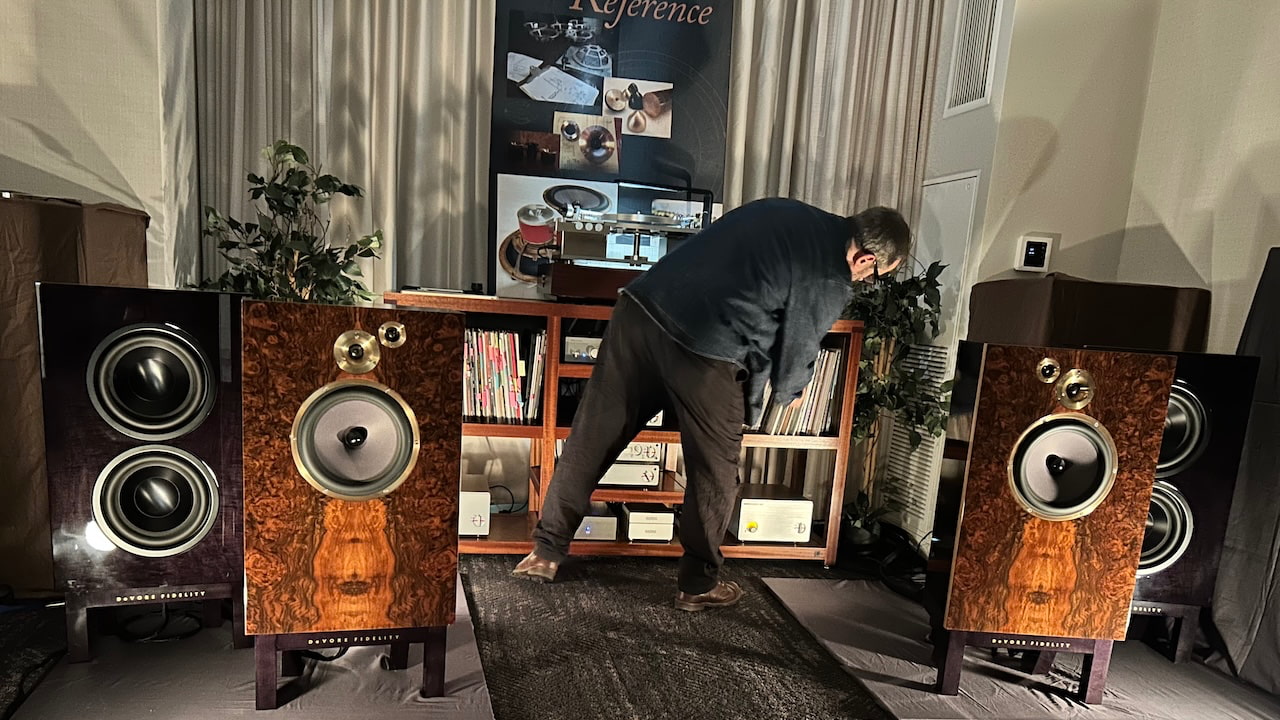
Year 26 for DeVore Fidelity and John DeVore wasn’t chasing spectacle at AXPONA 2026. He was doing something far more dangerous. In a show packed with $100,000 loudspeakers, including his own Orangutan O/Reference, most systems impressed for five minutes and then slowly gave the game away. This one didn’t follow that script. It didn’t try to overwhelm you. It didn’t ask for attention. It just sat there and delivered tone, weight, and emotional clarity in a way that made a lot of other rooms feel like expensive distractions.
That should make people uncomfortable. It should. Because once you hear it, the usual suspects asking for down payment money and ballroom sized rooms to prove their point start to feel a little less convincing.
This is a four piece system with real bandwidth and real room flexibility, but that’s not the point. It sounds like music with consequences. And at six figures, it has to do more than impress. It has to mean something.
We all claim we’re chasing the same thing, but it’s more complicated. This has always been a solitary pursuit. After decades and more than 80 shows, it’s clear the draw isn’t the gear. It’s the search. The hope that a system can deliver both emotional and intellectual connection. Not just analysis, but something that lingers after the last note fades, when the glow of the tubes slips into darkness and you’re left alone with it, letting whatever it stirred settle in. And it has to cut through whatever you brought with you into the room, including the cheap Scotch.
Advertisement
That’s where the divide really lives. Technical precision is easy to admire. Resolution, speed, imaging. We can all point to those things and agree they exist. But connection is harder. It asks more from the listener and more from the system. It demands that the music move beyond being a collection of sounds and become something personal. Something that reaches past the brain and settles somewhere deeper. That’s the part no spec sheet can quantify, and the part most systems never quite deliver.
The problem is that a lot of high-end audio, especially at the six figure level, mistakes luxury for meaning. It reminds me of riding in a Mercedes Maybach S-Class. Immaculate finishes. Impressive engineering. A price tag that clears the room. And total isolation from the experience. You’re removed from the road. Removed from the moment. Audio can fall into the same trap.
At some point, you have to feel something or the whole thing starts to ring hollow.
If you’ve never had that moment, where a system pushes you past analysis and into something uncomfortable and real, then none of this matters. The gear. The price. The endless debates online with nasty idiots. It’s just expensive insulation from the thing you said you wanted in the first place.
Advertisement
DeVore Fidelity Orangutan O/Reference: Engineering That Serves the Music
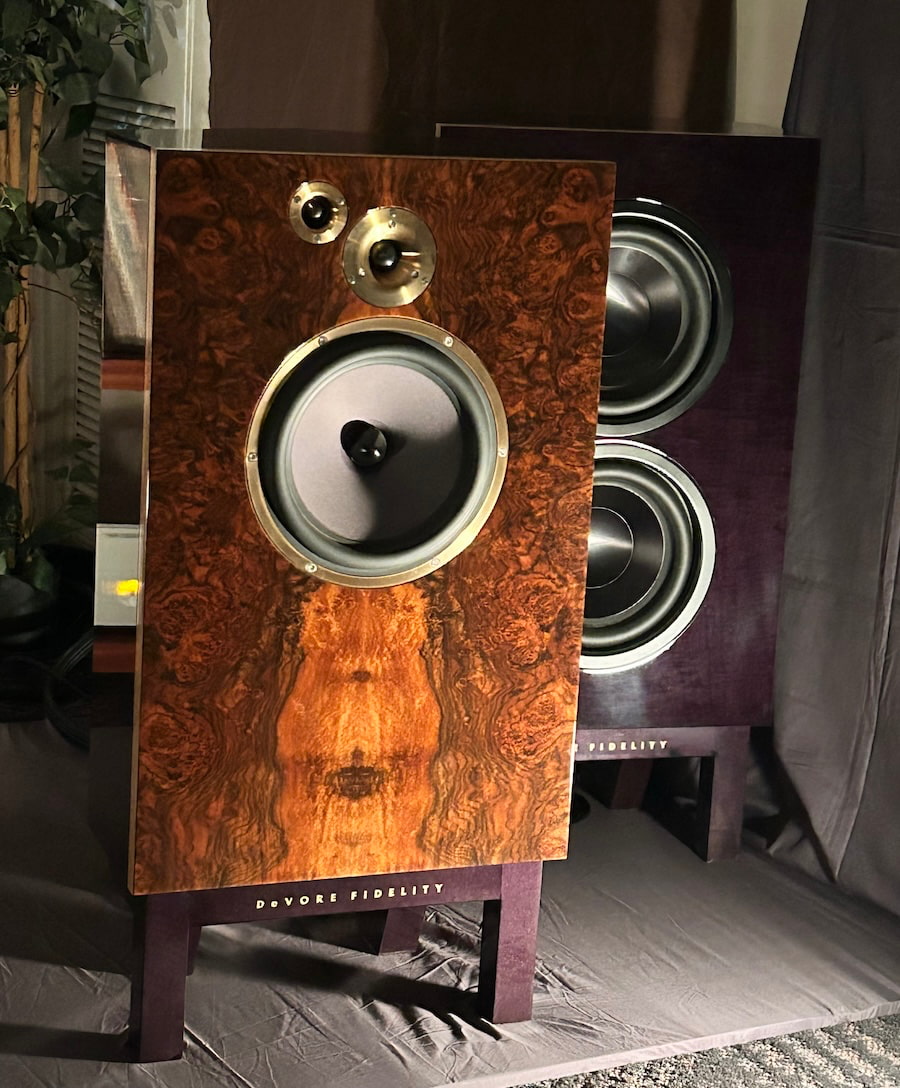
The Orangutan O/Reference is a four piece system split into the A and B modules, each with a clear role. The A handles the main range with a 10-inch paper cone woofer built around an AlNiCo motor, copper Faraday rings, and a bronze phase plug to keep distortion low and behavior consistent across the band. Above that, a 1-inch silk dome tweeter and 0.75-inch super tweeter are both horn loaded in machined bronze, which helps with sensitivity and control without pushing the top end into something aggressive. The cabinet details are not cosmetic. Bronze ports and a decoupled brass input plate are there to reduce vibration and keep things clean.
The B module takes care of the bottom end with an 11-inch aluminum woofer and a matching passive radiator tuned below 20 Hz, powered by a dedicated 700 watt Class D amplifier with an all analog control section. You get adjustable crossover, phase, and low frequency EQ, but the key is how it connects to the rest of the system. The bass section takes its signal from the same amplifier driving the A module, so the tonal balance and texture remain consistent from top to bottom. It is not doing its own thing off to the side. It follows the same chain, which makes integration far less of a guessing game.
At $99,000, none of this should surprise anyone. What does stand out is that DeVore Fidelity actually gives you a meaningful range of finish options that let the speakers work in real living spaces. That should be standard at this level, but too many brands still treat it like an afterthought. John DeVore has never had that problem. His speakers don’t dominate a room visually, even when they are capable of filling it sonically.
Advertisement. Scroll to continue reading.
They scale in a way that feels almost deceptive. Bigger than they look. More powerful than they have any right to be. And maybe most important, they invite experimentation.
Advertisement
I’ve heard DeVore systems driven by everything from low powered tubes to blowtorch solid state, across a wide range of sources, and there isn’t a single “correct” answer. That’s rare. Most speakers at this level demand a specific chain and punish you if you get it wrong. These don’t. They let you find your own way.
Where Tone Stops Being a Preference and Starts Being the Point
One of the constants in any DeVore room is that you’re not subjected to the same audiophile greatest hits you’ve heard 500 times. No safe demo tracks polished to death. If you’ve spent any time watching John DeVore speak on YouTube, you already know where that comes from. He’s direct. Intelligent. Thoughtful. He understands the subject and doesn’t hide behind it. And in the room, that translates to a kind of quiet confidence. He’s not hovering. Not steering reactions. He built it. He knows what it does.
There’s a reason his speakers divide people. Some listeners want scale, impact, and the visual statement of something that looks engineered to within an inch of its life. Polished metal. Exotic materials. A kind of precision that feels clinical. DeVore goes in a different direction. Across his lineup, including the Orangutan series, the emphasis is on how instruments and voices actually sound. Not as data points, but as living things.
Tone is the anchor. The weight of a piano. The texture of a saxophone. The human edge in a voice when it starts to crack. These speakers are not microscopes. They behave more like instruments themselves, moving air, resonating, and shaping energy in a way that feels closer to the real thing.
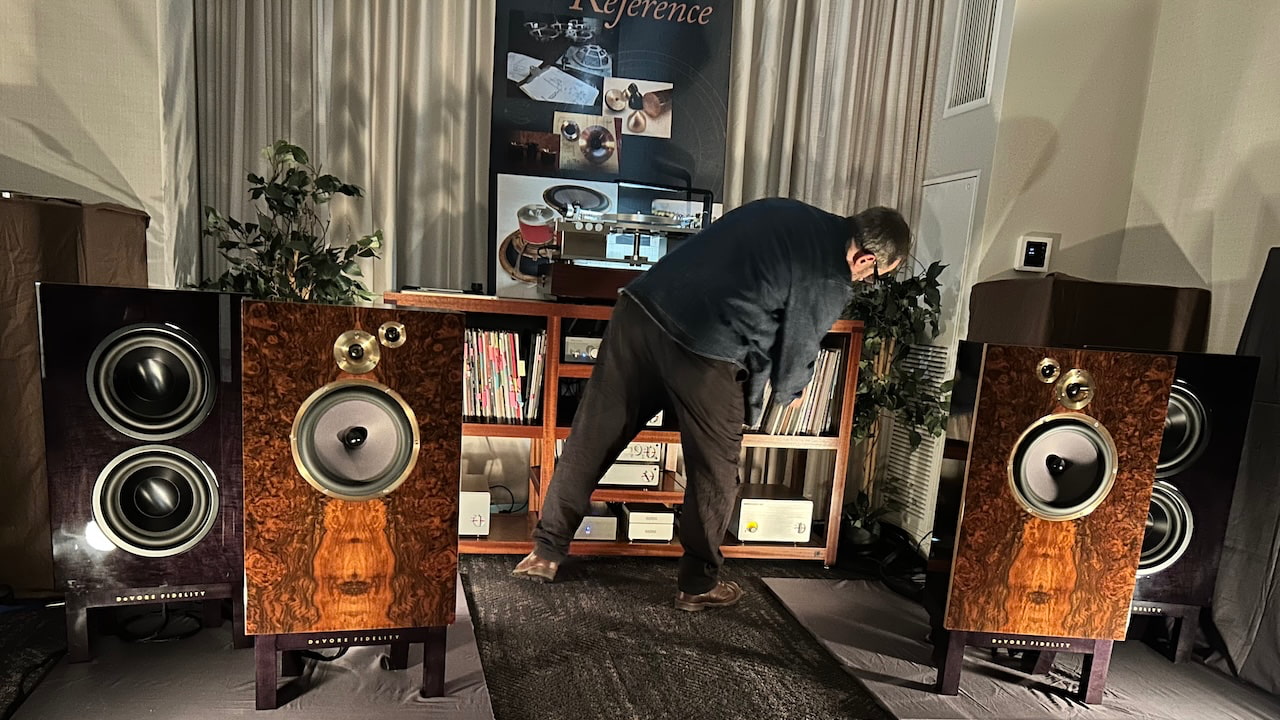
By his standards, the system looked almost restrained. A rack of Nagra electronics, not the top tier, feeding a Yuki AP-01EM with Glanz tonearms into a Phasemation phono stage and cartridges, all tied together with AudioQuest. Nothing about it leaned on excess. The sound told a different story. It was clear, grounded, and saturated with tone, with bass that filled the room without taking control of it.
Advertisement
Before I left, the gentleman running the room put on Nick Cave. Just a quiet nod and the needle dropped. That voice carries history. The piano behind it has mass and decay that can collapse into something flat if the system misses the mark. I’ve heard far more expensive setups get it wrong. This one didn’t. It held together. It felt intact.
I moved into the second row and leaned forward, resting my chin on my hands against the back of the chair in front of me. Closed my eyes and remembered her. Her soft blonde hair in my hands. Those eyes. The smile that made me feel like I could take on the entire Empire by myself. It wasn’t nostalgia. It wasn’t distant. It was right there. Immediate. And a little dangerous in how quickly it pulled me in.
When a system can pull something like that out of you without asking permission, it’s doing something very few ever manage. If you’re looking for a reason to care, that’s it. And if you’re wondering what it might take to get there, start saving.
And before anyone starts wondering if I stumbled into a pot of gold after AXPONA, between the ATC EL50 Anniversary, Quad 2912X, and these from DeVore Fidelity, let’s be clear. I’ll be reviewing a pair of Orangutan O/baby this summer. Those I can afford. The emotional aftermath is another story.
AI-native enterprise spending surged 94 per cent year on year as traditional SaaS growth cooled to eight per cent. The SaaSpocalypse erased 285 billion dollars from software valuations in February 2026, and every enterprise platform from Salesforce to a Hong Kong messaging startup called Omnichat is racing to pivot from per-seat pricing to agent-based delivery before the market decides they are legacy.
The enterprise software industry spent two decades selling seats. Buy a licence for every employee who needs access, multiply by the number of employees, and the revenue model was as predictable as the quarterly earnings calls that reported it. Then AI agents arrived, and the arithmetic broke. In the first quarter of 2026, AI-native spending surged 94 per cent year on year, according to market data cited by enterprise platforms repositioning themselves for the shift. Traditional SaaS grew at eight per cent. The gap is not narrowing. It is the gap between an industry that sells tools and an industry that sells outcomes, and the companies on the wrong side of it are running out of time to cross.
Advertisement
The reckoning
On 3 February 2026, a date the financial press now calls the SaaSpocalypse, approximately 285 billion dollars in market capitalisation was erased from software-as-a-service companies in a single 48-hour window. The trigger was not a single event but an accumulation of them: Anthropic’s release of open-source enterprise agent plugins, a wave of agentic AI product launches from Salesforce, ServiceNow, and Google, and a growing body of evidence that AI agents could compress the number of human users a company needed to operate its software. Wall Street looked at the per-seat pricing model that underpins most enterprise SaaS revenue and concluded that hundreds of companies were structurally overvalued. If one AI agent could do the work of ten employees, why would a company pay for ten seats?
The numbers have not recovered. Public SaaS growth rates have declined every quarter since their 2021 peak. For the first time in the modern era, software stocks trade at a discount to the S&P 500. Gartner predicts that by 2030, at least 40 per cent of enterprise SaaS spending will shift from per-seat pricing to usage-based, agent-based, or outcome-based models. Seat-based revenue’s share of enterprise software contracts has already fallen from 21 per cent to 15 per cent in twelve months. The model that built Salesforce, ServiceNow, Workday, and every enterprise software company that followed them is not dead, but it is no longer the default, and the companies that have not begun the transition are watching their valuations compress in real time.
The pivot
Into this environment, a Hong Kong-based omnichannel messaging company called Omnichat has announced its rebrand as an AI-native agentic customer experience platform, rechristened Omni AI. The company, which serves more than 5,000 enterprises across Asia-Pacific, the United Kingdom, and the United Arab Emirates, is replacing its rule-based automation tools with what it calls AI Employees: autonomous agents that can be onboarded with brand-specific knowledge, manage customer interactions across WhatsApp, LINE, Facebook Messenger, Instagram, WeChat, TikTok, and KakaoTalk, and execute marketing campaigns from concept to deployment using natural language instructions rather than manual configuration. The company claims two consecutive years of 130 per cent year-on-year growth in Southeast Asia and says its platform has processed more than three billion messages and generated over 100 million dollars in revenue for its clients in the past twelve months.
The 💜 of EU tech
Advertisement
The latest rumblings from the EU tech scene, a story from our wise ol’ founder Boris, and some questionable AI art. It’s free, every week, in your inbox. Sign up now!
Omnichat’s pivot is not unusual. It is exemplary. Across the enterprise software landscape, companies that built their businesses on workflow automation, customer relationship management, and marketing technology are racing to reposition themselves as AI-native platforms before the market decides they are legacy. The difference between the companies that survive the transition and those that do not will be determined not by the sophistication of their AI models, which are increasingly commoditised, but by the depth of their integration into customer workflows and the switching costs that integration creates.
Tencent launched ClawPro, an enterprise AI agent management platform built on OpenClaw, allowing businesses to deploy agents in as little as ten minutes with controls for template selection, model switching, and compliance. More than 200 organisations adopted the platform during its internal beta. Anthropic shipped a suite of pre-built AI agents for financial services, targeting anti-money-laundering investigations that previously took hours and compressing them into minutes. Salesforce rebuilt Slackbot around more than 30 new AI capabilities, transforming it from a conversational assistant into an agentic system that can transcribe meetings, monitor desktop activity, and execute tasks through third-party tools. The pattern is consistent: every major platform is embedding autonomous agents into its core product, and every startup that raised money in the past six months positioned itself as the infrastructure layer for the transition.
Advertisement
The economics
The shift from seats to outcomes changes the fundamental economics of enterprise software. Under per-seat pricing, revenue scaled linearly with headcount. A company with 10,000 employees paid for 10,000 licences. Growth came from expanding the customer base or increasing the price per seat. Under agent-based or outcome-based pricing, revenue scales with the value the software delivers rather than the number of humans who interact with it. A single AI agent that resolves a thousand customer service tickets generates more economic value than a thousand seats on a help desk platform, but it might be priced at a fraction of what those seats cost. The vendor captures a larger share of the value it creates, but the total addressable market shifts from the software budget to the labour budget, which is an order of magnitude larger.
This is the economic logic behind the 94 per cent surge in AI-native spending. Enterprises are not simply replacing old software with new software. They are replacing headcount-dependent processes with agent-driven ones, and the budget for that replacement comes from operational expenditure, not the IT line item. Deloitte predicts that more than 50 per cent of digital transformation budgets will be allocated to AI in 2026. Gartner forecasts that 40 per cent of enterprise applications will feature task-specific AI agents by the end of the year, up from less than five per cent in 2025. NeoCognition, which raised 40 million dollars in seed funding from investors including Intel CEO Lip-Bu Tan and Databricks, is building self-learning agents designed to improve over time within a vendor’s specific operational context, addressing the reliability gap that currently limits agent autonomy: current agents complete tasks as intended only about half the time.
The question
Omnichat’s rebrand captures the tension at the centre of the enterprise AI transition. The company is not a frontier AI lab. It did not build a foundation model. It raised 2.6 million dollars in total disclosed funding, a rounding error compared to the billions flowing into companies like Wonderful and Anthropic. What it has is 5,000 enterprise customers, integrations with the messaging platforms that dominate commerce in Asia, and a decade of data on how businesses communicate with their customers across WhatsApp, LINE, and WeChat. The bet is that those assets, the customer relationships, the workflow integration, the channel-specific knowledge, are more valuable in the AI-native era than the AI models themselves, which any company can access through an API.
It is the same bet that every enterprise SaaS company is making, and the market has not decided whether it is right. The SaaSpocalypse repriced the assumption that per-seat software companies would grow indefinitely. The question now is whether the companies that pivot fast enough can capture the new economics of agent-based value delivery, or whether the AI-native startups that were built for the new model from the start will take the market before the incumbents complete their transformation. Gartner says 35 per cent of point-product SaaS tools will be replaced by AI agents or absorbed within larger agent ecosystems by 2030. That is not a prediction about technology. It is a prediction about which companies will still exist. The 94 per cent growth rate in AI-native spending is not a trend line. It is a countdown, and every enterprise software company in the world is watching the clock.
Atmospheric carbon dioxide hit a new record in April, averaging about 431 parts per million at NOAA’s Mauna Loa Observatory. That’s up from under 320 ppm when the site began measurements in 1958. Scientific American reports: Greenhouse gases, such as carbon dioxide, are measured as a proportion of the total atmosphere. The numbers are presented as the number of molecules of a particular gas out of a million total molecules, or ppm. Climate scientist Zachary Labe of Climate Central, a nonprofit that researches climate change, says the new record is “depressing” but not unexpected. “It’s just another sign that carbon dioxide continues to increase in our atmosphere as our planet continues to warm,” he says. “For many climate scientists, this is just ‘here it is again, another record in the wrong direction.'”
Labe explains that the amount of CO2 in the atmosphere tends to peak in April each year as decaying plants release greenhouse gases after winter. Some of that CO2 gets reabsorbed by plants as they grow during the warmer months. But NOAA’s data show a worrying trend, with the average monthly amount of CO2 steadily increasing. […] Although the amount of CO2 in the atmosphere has continued to rise, there was a reduction in U.S. emissions in 2023 and 2024. That trend, however, was reversed in 2025, at least partially because of the increased electricity demand from artificial intelligence data centers. Still, Labe says there are reasons for optimism as the use of renewable energy sources such as solar and wind expands.
Hackers trojanized installers for the DAEMON Tools software and since April 8, delivered a backdoor to thousands of systems that downloaded the product from the official website.
The supply-chain attack led to thousands of infections in more than 100 countries. However, second-stage payloads were deployed only to a dozen machines, indicating a targeted attack aimed at high-value targets.
Among the victims receiving next-stage payloads are retail, scientific, government, and manufacturing organizations in Russia, Belarus, and Thailand.
A report today from cybersecurity company Kaspersky notes that the attack is ongoing and that trojanized software includes DAEMON Tools versions from 12.5.0.2421 through 12.5.0.2434, specifically the DTHelper.exe, DiscSoftBusServiceLite.exe, and DTShellHlp.exe binaries.
Advertisement
DAEMON Tools is a Windows utility that allows mounting disk image files as virtual drives. The software was extremely popular in the 2000s, especially among gamers and power users, but today its deployment is limited to environments where virtual drive management is required.
As of today, Kaspersky says that the attack is ongoing.
Once unsuspecting users download and execute the digitally signed trojanized installers, they trigger the malicious code embedded in the compromised binaries. The payload establishes persistence and activates a backdoor on system startup.
The server can respond with commands that instruct the system to download and execute additional payloads.
Advertisement
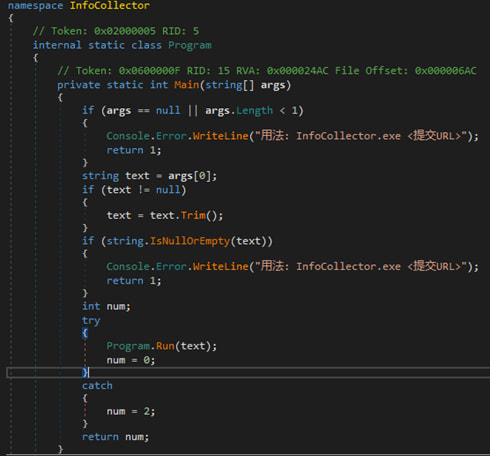
The first-stage malware is a basic information stealer that collects system data, such as hostname, MAC address, running processes, installed software, and system locale, and sends them to the attackers for victim profiling.
Basic info-stealer payload Source: Kaspersky
Based on the results, some systems receive a second stage, which is a lightweight backdoor that can execute commands, download files, and run code directly in memory.
Code snippet from the backdoor Source: Kaspersky
In at least one case targeting a Russian educational institute, Kaspersky observed the deployment of a more advanced malware strain dubbed QUIC RAT, which supports multiple communication protocols and can inject malicious code into legitimate processes.
BleepingComputer has contacted DAEMON Tools with a request for a comment on the supply chain attack, but we have not heard back by publication.
Kaspersky describes the DAEMON Tools supply-chain attack as a sufficiently sophisticated compromise that evaded detection for almost one month.
“Given the high complexity of the attack, it is paramount for organizations to carefully examine machines that had DAEMON Tools installed, for abnormal cybersecurity-related activities that occurred on or after April 8,” the researchers say.
Advertisement
Although Kaspersky does not attribute the attack to a particular threat actor, based on strings found in the first-stage payload, the researchers believe that the attacker is Chinese speaking.
Since the beginning of the year, software supply-chain attacks have been detected almost every month: eScan in January, Notepad++ in February, CPU-Z in April, and DAEMON Tools this month.
Similar attacks targeting code repositories, packages, and extensions have been even more prevalent this year, with Trivy, Checkmarx, and the Glassworm campaigns being among the most prominent.
AI chained four zero-days into one exploit that bypassed both renderer and OS sandboxes. A wave of new exploits is coming.
At the Autonomous Validation Summit (May 12 & 14), see how autonomous, context-rich validation finds what’s exploitable, proves controls hold, and closes the remediation loop.
5G is deployed. Fiber is rolling out. AI tools are embedded in everyday professional life.
And yet millions of users still experience buffering, failed transactions, and AI assistants that stall before completing a simple query.
Fabien Renaudineau
Co-CEO and Co-Founder, Mozark.
The infrastructure promise and the user reality remain stubbornly misaligned.
Article continues below
Advertisement
The reason is not bandwidth; it is measurement. We are still evaluating 21st-century networks with 20th-century monitoring logic.
QoS vs QoE: Why the Distinction Matters
Quality of Service (QoS) reflects what the network does: download speed, latency, and packet loss. Quality of Experience (QoE) reflects what the user actually feels: did the app load? Did the payment go through? Did the video stream uninterruptedly?
Advertisement
The Telecommunication Standardization Sector (ITU-T) defines QoE as “the degree of delight or annoyance” experienced by the user, intentionally shifting measurement to the human perspective.
A network that meets every technical benchmark can still fail to deliver a usable experience if the application layer, the Content Delivery Networks (CDN) routing path, or the cloud infrastructure between operator and end user introduces degradation.
Sign up to the TechRadar Pro newsletter to get all the top news, opinion, features and guidance your business needs to succeed!
This gap between technical performance and user perception is where operators lose loyalty and where traditional monitoring provides limited visibility.
Advertisement
Recognizing the Limits of Infrastructure Alone
The mobile industry has committed to an extraordinary level of investment in the pursuit of better connectivity. GSMA Intelligence estimates that operators will invest $1.5 trillion in capital-expenditure between 2023 and 2030, of which more than 90% is directed toward 5G. As of early 2024, 261 operators had launched commercial 5G across 101 countries.
The industry is also increasingly aware that infrastructure alone does not guarantee a good customer experience. Operators are integrating AI tools into network management, deploying 5G Standalone architectures that enable network slicing and quality-on-demand, and building API frameworks.
The direction is clear: the industry is moving toward experience-aware network management. The challenge is that this movement requires measurement frameworks capable of capturing experience, not just infrastructure performance.
AI Raises the Bar and Exposes Monitoring Gaps
The mass adoption of AI assistants, copilots, and generative tools introduces new experience metrics. Time to First Token (TTFT), query completion rates, and response streaming consistency. These determine whether an AI assistant is genuinely useful in a professional context. They are currently invisible to a traditional Network Operations Center.
A connection that meets every conventional QoS threshold can still make a large language model practically unusable. As enterprises embed AI into core workflows and as operators position AI connectivity as a monetization opportunity, the inability to measure AI-level QoE becomes both a commercial and a technical blind spot.
Advertisement
The Hidden Layer: CDNs and Cloud Infrastructure
One of the most underappreciated sources of experience degradation sits between the operator and the application. CDN and cloud computing infrastructure can cause buffering, slow loading, or stalled AI responses.
According to the Ericsson Mobility Report, video represents roughly 74% of global mobile network traffic as of 2024 and most of it is delivered through CDNs that no single operator controls end-to-end.
True QoE measurement must span the full stack, from the radio access network through CDN, cloud availability, and application responsiveness. Without this visibility, troubleshooting becomes guesswork.
Advertisement
Regulators Shifting from Coverage to User Experience
Regulators worldwide are moving toward experience-based oversight.
In the US, the FCC’s Measuring Broadband America program uses crowdsourced measurements via the FCC Speed Test app to capture real-world performance across both rural and urban areas.
In India, TRAI’s MySpeed app performs a similar function, enabling citizens to submit real-device measurements that feed directly into regulatory analysis.
Advertisement
These initiatives share a common logic: the most credible measurement of network quality is what citizens actually experience, collected at scale, continuously, and independently.
Digital Inclusion: What You Cannot Measure, You Cannot Fix
The digital divide has always been a policy concern. Today, it is also a measurement challenge. According to the ITU, globally, 83% of urban residents use the internet compared to 48% of rural populations.
Critically, the urban-rural ratio has remained at 1.7 for four consecutive years, unchanged despite years of infrastructure investment.
Advertisement
Two users on the same operator, in the same city, can have radically different experiences depending on device, building, or time of connection. Without continuous and granular QoE monitoring, inclusion programs risk targeting the wrong areas.
From Measurement to Action: The Case for Full-Stack, Continuous QoE
None of this is achievable with synthetic lab-based testing. Emulators do not replicate device behavior under load, and controlled tests do not capture peak-hour congestion, CDN routing decisions made in production, or the compounding effect of multiple degradation factors across the delivery chain.
Measuring QoE credibly requires testing on real devices, live operator networks, and running actual applications continuously.
Advertisement
This methodological shift, from a “full-stack, always-on” approach, creates actionable intelligence for operators, regulators, and policymakers. It ties investment to measurable improvements in real user experience rather than theoretical performance metrics.
This article was produced as part of TechRadar Pro Perspectives, our channel to feature the best and brightest minds in the technology industry today.
The views expressed here are those of the author and are not necessarily those of TechRadarPro or Future plc. If you are interested in contributing find out more here: https://www.techradar.com/pro/perspectives-how-to-submit
Sometimes, eating makes me feel like Sisyphus. Every day, I must toil up the mountain and the rock to figure out what the heck I want to eat for breakfast, lunch, and dinner. I tested Factor meals earlier this year, and they’re a solid option if you’re the type of person that doesn’t want to fuss over your food. With expansive menus and an emphasis on tracking macros and nutrition, you can simply pick out your meals, get them delivered, and then reheat them in the microwave or oven when it’s time to eat.
Texture eaters might not love Factor’s meals, which tend to be a little mushy. They’re still tasty and very filling. I suggest accompanying them with some crisp veggies, parmesan snaps, or fresh fruit to jazz up the texture a bit. If you’re the kind of person that can meal prep a week’s worth of chicken and rice and happily eat it every day, Factor is going to be right up your alley. Right now, you can save with this Factor coupon and get up to $130 off 6 boxes. Just follow one of our links above, and enjoy your discounted meal kits.
Save With Factor Coupons and Get Meals Tailored to Your Health Goals
Not only is Factor a convenient way to make protein-packed meals in minutes, they also have tons of choices tailored to your dietary needs and preferences. Different Factor meal categories you can choose from include GLP-1 Support, Low Carb, Fiber Filled, and Calorie Smart, ensuring that whatever health goal you may have, Factor has the meals to get you to reach that goal through convenient, pre-prepared meals.
Use Factor Promo Code for Keto Diet Food Delivery
If you want to get serious about your health goals, Factor makes it easy, with prepared keto meal delivery from Factor. Whatever your health goal may be, Factor’s prepared meal delivery makes it easy to stick to a keto diet plan and lose weight, using chef-prepared keto meals that are ready to eat in just a few minutes. Whether you want to use Factor for a keto diet food delivery service, or just want a healthy meal delivery plan, Factor makes it easy (and our promo codes make it cheaper).
Advertisement
Get High Protein Meals for Less
Factor is one of the easiest ways to conveniently get high-protein, chef prepared meals that are reheatable and ready in two minutes. These meals are not only packed with protein, but are also dietitian-approved and prepared by chefs. Each has 30 to 50 grams of protein per serving, making it super easy to hit those nutrition goals without any extra work in the kitchen from you. Once you decide, you’ll pick from a new rotating menu of over 100 dietitian- and chef-designed meals, including add-on options each week that are especially tailored to a high-protein diet.
Does Factor Offer Free Shipping?
Factor wants to reward adventurous (and healthy) eaters, by offering 50% off your first subscription box, plus free shipping. The offer is only valid for new Factor customers with a qualifying auto-renewing subscription purchase (and you’ll still get an $11 shipping fee on subsequent boxes).
Discover More Ways to Save With Factor
Factor offers year-round promotions and savings, so you should always keep an eye out for an opportunity to save some cash. First responders, teachers, medical providers, nurses, doctors, military members, and veterans can take advantage of the Factor Hero Discount to save 55% on their first order and up to 15% on every box for the first year. Save the most with Factor first-order discounts, and what all the fuss is about.
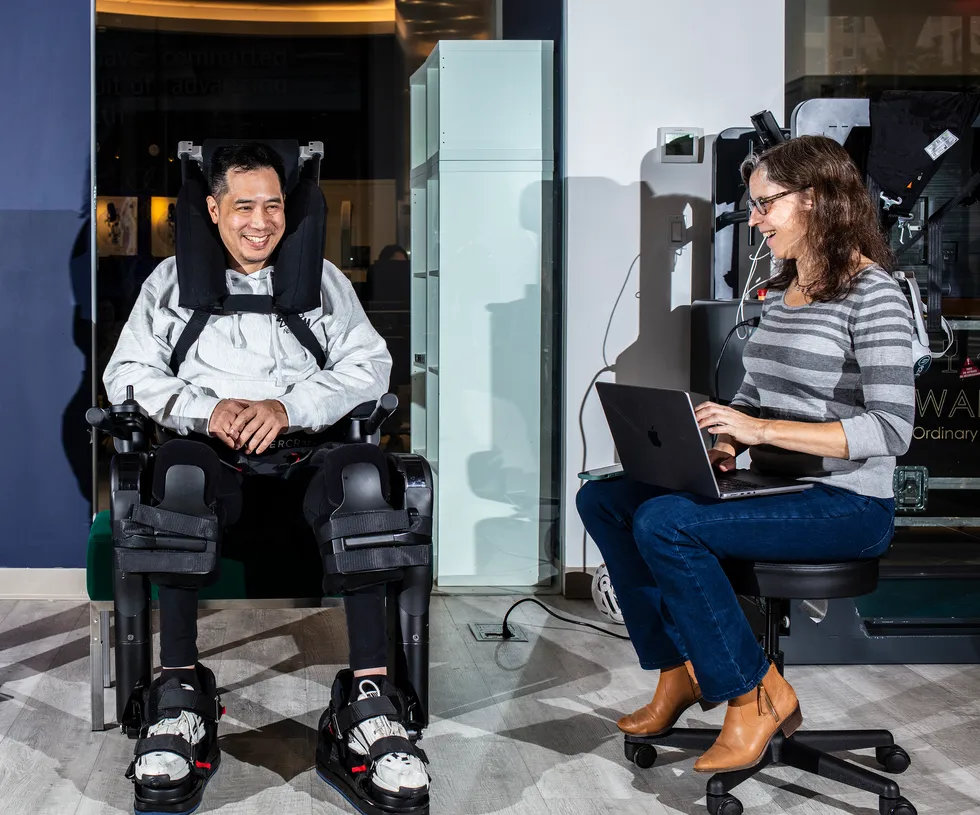
I first met Robert Woo in 2011, during his third time walking in a powered exoskeleton. The architect had been paralyzed in a construction accident four years earlier, but he was determined to get back on his feet. Watching him clunk across a rehab room in an exoskeleton prototype, the technology felt astonishing. I had the same reaction when reporting on early brain-computer interfaces (BCIs), which enabled paralyzed people to move robotic arms or communicate by thought alone. Both types of bionic technology seemed to verge on magic.
But that initial sense of awe, I’ve learned over many years of reporting on these technologies, is only a starting point. What matters is not what these systems can do in a carefully staged demo but how they perform in the real world. Do they work reliably? Can people with disabilities use them for their intended purposes? And what does it actually cost—in time, effort, and trade-offs—to do so? The question isn’t whether the technology looks impressive the first time but whether it holds up on the hundredth.
The special report in this issue, “Cyborg Tech From the Inside” takes that perspective seriously. In my feature article on Woo, an exoskeleton super-user who has spent 15 years testing these systems, the story of the technology is inseparable from the story of its use. Woo’s relentless feedback has driven steady, incremental improvements. In Edd Gent’s reporting on the pioneers testing the earliest BCIs, the experience of these extraordinary technologies likewise resolves into something more complex. As one trial participant notes, these early adopters are like the first astronauts, who barely reached space before coming back down to Earth. Together, these stories reframe these individuals not as passive medical patients but as the ultimate beta testers and co-engineers of the bionic age.
I saw the gap between demonstration and daily use firsthand when I interviewed Woo in a Manhattan showroom recently, where he was testing a new self-balancing exoskeleton from Wandercraft. The device is a striking advance that kept him upright without crutches, but it also revealed the friction of the real world. As Woo tried to walk out the door, barely an inch of slope on the Park Avenue sidewalk was enough to trigger the machine’s safety sensors and halt his progress. It was a stark reminder of how far these systems must evolve before they fit seamlessly into everyday life.
Advertisement
For the people who use them, that seamless integration is the ultimate goal. Getting there will depend not just on technical breakthroughs but on how well these systems hold up outside controlled environments, over time, and under real conditions. Looking from the inside doesn’t make these technologies any less remarkable, but it does change how we judge them—not by what they can do once for a photo but by what they can sustain over a lifetime. That’s the standard their users have been applying all along.
Our commitment to evaluating technology from the user’s perspective extends beyond this special report. To provide a necessary corrective to the “techno-solutionism” that often dominates coverage of assistive devices, IEEESpectrum created the Taenzer Fellowship for Disability-Engaged Journalism, under which six writers with disabilities are contributing articles about the devices they rely on daily. As Special Projects Director Stephen Cass notes, these journalists “aren’t afraid to ask clear-eyed questions about the tech and are deeply aware of how it impacts humans.” You can read the fellows’ work at spectrum.ieee.org/tag/taenzer-fellowship.
By OpenAI COO’s own admission last February, “we have not yet really seen AI penetrate enterprise business processes.” But for enterprise software giant SAP, whose stock has dropped significantly in 2026 in part from the “SaaSpocalypse,” the issue is still front and center.
On Monday, the European heavyweight announced its intention to acquire German AI startup Prior Labs for an undisclosed amount. Pending regulatory approval, SAP plans to invest €1 billion (approximately $1.16 billion) into the business over the next four years to grow it into an AI lab focused on structured data — the tables and databases where enterprise information typically sits.
SAP declined to disclose how much it spent on the acquisition itself, but sources told Pathfounders that this was a healthy exit: an “almost all cash” deal, with well over half a billion dollars in cash up front for the startup’s founders — Frank Hutter, Noah Hollmann, and Sauraj Gambhir.
The trio co-founded Prior Labs just 18 months ago with a focus on tabular foundation models (TFMs) — AI models that can make predictions from data that sits in tables and databases. This is potentially a better fit for enterprises than language models. It is certainly a better fit for SAP, whose widely used software products for accounting, HR, procurement and expense management rely on its database.
Advertisement
However, Germany’s most valuable company also seems be playing defense as the tech industry marches toward agentic AI. While it works to create its own AI lab, the company has blocked OpenClaw and any other agent tech that it has not explicitly authorized, The Information was first to spot.
In response to a request for comment, SAP’s press department referred TechCrunch to the company’s latest API policy, which does say that SAP “prohibits” AI agents from accessing its products through its API except for those that are “SAP-endorsed architectures.”
Authorized architectures of course include SAP’s own offering, Joule Agents, still in beta, which lets customers create their own agents. Nvidia also announced in March that SAP’s Joule supports Nvidia’s Agent Toolkit, which is software for managing agents. This toolkit is the foundation for Nvidia’s enterprise-ready, security-focused OpenClaw competitor, NemoClaw. Hence SAP customers will be authorized to use NemoClaw agents.
Techcrunch event
Advertisement
San Francisco, CA | October 13-15, 2026
For a giant incumbent player like SAP, AI is both a threat and an opportunity. “It’s all about how quickly [we can] as SAP actually also embark [on] these technologies in our R&D portfolio to keep the relative economies of scale advantage,” CFO Dominik Asam told CNBC in January.
Advertisement
SAP hasn’t been sitting on its hands. The German company invested in generative AI companies that develop language models large and small: In 2023, it backed OpenAI rival Anthropic — as well as Aleph Alpha and Cohere, which now intend to merge to form “a global AI powerhouse.”
It had also developed SAP-RPT-1, a relational pretrained transformer model. “Early on, SAP recognized that the greatest untapped opportunity in enterprise AI wasn’t large language models; it was AI built for the structured data that runs the world’s businesses,” SAP CTO Philipp Herzig declared in a statement.
But Prior Labs’ acquisition is a significant shortcut in that direction. Its TabPFN model series has experienced a lot of traction among developers. In a blog post on the deal, the startup’s founders said that its open source models have been downloaded over three million times.
In a press release, SAP promised that Prior Labs will maintain the open source versions: “The lab will operate as an independent unit to ensure research velocity while SAP provides long-term investment and a direct path to productization across the SAP portfolio with SAP AI Core and SAP Business Data Cloud as well as the agentic layer with Joule.”
Advertisement
SAP and the startup headquartered in Freiburg, Germany, hope that this investment will lead to TFMs that can grab data in the tables where it lives, combine that with language, reasoning, and domain knowledge.
More than that, they hope that Prior Labs, with this “massive boost” from SAP, can become a new “globally-leading frontier AI lab for structured data — in Europe, in the open,” founder and CEO Frank Hutter celebrated in a post on X.
In February 2025, the startup had previously raised some $9.3 million in a pre-seed funding round led by Balderton Capital — more than competitor Neuralk-AI, but a lot less than Fundamental, which emerged out of stealth with a $255 million Series A in February.
In a post on X, Balderton partner James Wise called Prior Labs’ acquisition “one of Germany’s biggest ever venture outcomes.” As for SAP, its stock is currently trading slightly upwards.
Advertisement
Meanwhile, SAP is being very strict as to the agents it will allow into its ecosystem. This is a wildly different approach than Salesforce, another incumbent caught in the SaaSpocalypse. It is allowing enterprise to choose their own agents, including OpenClaw if they so wish, with its new Headless 360 architecture.
When you purchase through links in our articles, we may earn a small commission. This doesn’t affect our editorial independence.
In a blog post, the Menlo Park-based tech giant said it is developing an advanced AI system to scan photos and videos on Facebook and Instagram, analyzing users’ bone structure, height, and other visual cues to estimate their age, while insisting that it is “not facial recognition.” The AI will… Read Entire Article Source link
One of the follow-on payloads pushed to about a dozen organizations was what Kaspersky described as a “minimalistic backdoor.” It has the ability to execute commands, download files, and run shellcode payloads in memory—making the infection harder to detect.
Kaspersky said that it observed a more complex backdoor dubbed QUIC RAT, installed on a single machine belonging to an educational institution located in Russia. Initial analysis found that it can inject payloads into the notepad.exe and conhost.exe processes and supports a variety of C2 communication protocols, including HTTP, UDP, TCP, WSS, QUIC, DNS, and HTTP/3.
The 100 infected organizations were primarily located in Russia, Brazil, Turkey, Spain, Germany, France, Italy, and China. Kaspersky’s visibility into the attack is limited because it’s based solely on telemetry provided by its own products.
Kaspersky researchers wrote:
Advertisement
The analysis shows that 10% of the affected systems belong to businesses and organizations. Attackers attempted to infect most of the affected machines only with the information collector payload. However, the other backdoor payload, which is more complex, has been observed only on a dozen machines of government, scientific, manufacturing and retail organizations located in Russia, Belarus and Thailand. This manner of deploying the backdoor to a small subset of infected machines clearly indicates that the attacker had intentions to conduct the infection in a targeted manner. However, their intent – whether it is cyberespionage or ‘big game hunting’ – is currently unclear.
Anyone who uses Daemon Tools should take time to scan the entirety of their machines using reputable antivirus software. Windows users should additionally check for indicators of compromise listed in the Kaspersky post. For more technically advanced users, Kaspersky recommends monitoring “suspicious code injections into legitimate system processes, especially when the source is executables launched from publicly accessible directories such as Temp, AppData, or Public.”
LegalZoom is one of those online legal services that in most cases can handle basic legal tasks for you. I recently tried it out to make an LLC for my cosmic country band, Steel Fringe (shameless plug), and it appears to have worked just fine (we’re still waiting on a full evaluation from legal experts for a future guide to these services). If you use a LegalZoom promo code right now, you will get a discount on the service.
I found it super easy to set up my LLC, and after about $500 and 30 minutes of my time, I was off to the races with an LLC for my band. I did make the mistake of spelling my co-bandleader’s middle name as his last name (I blame his wrongly named Instagram handle for this), so I had to toss them another $129 to fix that. My bad.
Save on top services at LegalZoom, like LLC registration, incorporation, estate plans, and more with coupons and deals from WIRED below.
Get 10% Off LLC Formation With Our LegalZoom Coupon Code
If you’re in need of basic legal services like establishing an LLC, estate planning, or other contract-based services, LegalZoom offers a very simple interface that is shockingly easy to use. I am a luddite when it comes to understanding legal jargon and steps in a process like establishing my band’s LLC, but LegalZoom’s simple interface made it shockingly easy to make sure everything was in order.
Advertisement
If you use our exclusive code for 10% off LLC Formations (found in the table above), you’ll get a nice chunk of change off the cost of setting up your small business. As you’ll read below, it’s not especially cheap to do this, even digitally, in many states. There are mandatory filing fees and other fees that can range from a few hundred to many hundreds of dollars. Take the discount!
LegalZoom Business Formation: Start Today Using Our LegalZoom Discounts
LegalZoom services expand well beyond just helping establish personal LLCs, there are also other business formations that LegalZoom can help with. Some of these include Limited Liability Company LLCs, which start at free, plus state filing fees. This is the simplest, flexible way to ensure your business protects any personal assets. There’s also Corporation (S corp or C corp), which starts at $149 plus state filing fees. This is a more complex structured formation, with the ability to issue shares, go public, or go global. There’s also help for Nonprofit (501c3) LLCs, which starts at $99 plus state filing fees. This one is designed to support a public or social benefit that’s eligible for tax breaks. And finally, Doing Business As (DBA) starts at $99 plus state filing fees. This is an efficient way to use a business name that removes the sometimes annoying upkeep of LLCs or corporations.
How Much Does It Cost to Set Up An LLC on LegalZoom?
The cost to properly set up an LLC in your state can range from $35 to $500, depending on various factors like local legislation and business registration laws. Most states charge between $50 and $200 for filing fees, so you can expect to pay somewhere in that range unless you’re from Montana ($35) or Massachusetts ($500). LegalZoom also shoves a bunch of options you probably don’t need in your face, so be sure to Google what you actually need in your state before paying extra money to … print all your documents and put them in a folder for you, or other such nonsense.
Use LegalZoom Promo Codes to Save on Estate Plans
Although it’s a little morbid, folks need to think about what will happen to their assets after they pass, and get a plan in place to protect their loved ones. LegalZoom offers estate plan services to create your will or trust easily online. There are several options available, so make sure you choose the right plan for you. Right now, if you choose the Premium Trust, you’ll get 10% off LegalZoom products, plus 25% off important attorney services. There are two will options and two trust options: the last will outlines how your assets should be distributed after death, and a living trust, a legal arrangement where a trustee manages assets. Make sure to read through the link above to know which plan is right for your needs.
Advertisement
Register a Trademark With Legalzoom
Registering a trademark is an important step in many business ventures, a necessary step that can be very confusing. Legalzoom wants to make it easier for you, by using one of their experienced trademark attorneys who can handle the oftentimes complicated process. They can perform a trademark search, provide legal advice, and prepare and file your application, so you can relax knowing you’re protected. Prices start at $899 plus federal fees for registering a trademark.
Get Online Legal Services and LegalZoom Pricing
Want to save money but also want peace of mind? Try LegalZoom’s attorney review. After you’ve completed your documents, you’ll be able to have unlimited revisions of your LegalZoom estate planning documents, with no page limit. This also includes an annual legal review with attorney help to ensure your estate plan is up to date (available after 6 months). Right now, the Personal Attorney Plan ranges from $20 for a 12-month service, or $17 for 6 months. Save 20% when you sign up today.
LegalZoom Healthcare Help
No one wants to imagine it, but it’s important and necessary to take steps to ensure you are protected and have a plan in place if and when a medical emergency happens. LegalZoom has options for affordable advance healthcare directives, starting at $39. With LegalZoom, you can complete an advanced healthcare directive easily and in advance, so that you can take control of your care when you can’t speak for yourself. LegalZoom’s healthcare directives include medical power of attorney and a living will, making it easy to ensure you’re protected in the future. Plus, you’ll be able to get guidance from experienced attorneys to ensure everything needed is in place.


























































You must be logged in to post a comment Login