From left: Expedia Group chairman Barry Diller, CEO Ariane Gorin, former CEO and current Uber CEO Dara Khosrowshahi, and founder Rich Barton at Expedia’s Explore partner conference in Las Vegas this week. (Expedia Group Photo)
From her office overlooking the atrium at Expedia Group’s sunlit headquarters campus on the Seattle waterfront, CEO Ariane Gorin puts the online travel giant’s 30-year history into three chapters, each tied to a major inflection point in the evolution of technology.
Chapter 1 was the internet itself: the 1996 launch of Expedia inside Microsoft, when a small team bet that consumers could benefit from technology previously exclusive to travel agents.
Chapter 2 was mobile: as travelers migrated from desktop to smartphone, Expedia rebuilt itself for the small screen and assembled a collection of brands through a wave of acquisitions.
Chapter 3, Gorin says, is artificial intelligence, and it’s only starting to unfold. Expedia is now positioning itself for a new reality in which different types of agents — machines, not humans — will play a role in booking travel, in some cases making the decisions entirely on their own.
“It’s exciting to get to write the future of AI and travel,” Gorin said.
Advertisement
Expedia is marking its 30th year in business this week with the launch of the Expedia Trails Fund, a philanthropic initiative to restore outdoor trails across the U.S., backed by an initial $4.3 million in grants.
The company is also bringing top executives from throughout its history — founder Rich Barton, chairman Barry Diller, and former CEO Dara Khosrowshahi — together with Gorin for its partner conference in Las Vegas. Collectively, they grew Expedia from internal division to corporate spinout to online travel giant.
What happens next, under Gorin, will depend on Expedia’s ability to reinvent itself for a fundamentally new relationship between travelers and technology — attempting to continue a pattern that has repeated itself throughout the company’s history.
Chapter 1: ‘Power to the people’
Expedia started with a question: why shouldn’t everyone see what travel agents do?
Advertisement
In 1994, Rich Barton was a 27-year-old Microsoft employee, working on a CD-ROM travel guidebook — an Encarta for travel — when he learned about the airline reservation systems that travel agents used to book flights. The systems were accessible electronically, but only to industry insiders. He started to imagine regular people using them directly.
Rich Barton speaks at Seattle University’s Albers Executive Speaker Series in 2016. (GeekWire Photo / Kevin Lisota)
“The idea was simple and almost obvious once you said it out loud: give consumers the same information the professionals have, and get out of their way,” recalled Barton, now a well-known entrepreneur and investor, who shared new details of the Expedia story for this piece.
His term for this approach would ultimately define his career: “Power to the People.”
Barton pitched the idea directly to Microsoft CEO Bill Gates and President Steve Ballmer, who gave him the green light.
Secretly building for the web
The team initially started building the product for Microsoft’s proprietary online service, MSN 1.0, a would-be competitor to AOL, which had a proprietary multimedia development environment called Blackbird. Then the web gained steam, with its open protocols and universal reach.
Advertisement
That’s when Greg Slyngstad, the original general manager of what was then called Microsoft Travel, made a pivotal call: develop the product for the open web instead of Microsoft’s walled garden.
Slyngstad “knew the web would win,” Barton said. “Because of this, we secretly built for the web, which was brilliant. Expedia would not be what it is today if not for that decision.”
An early version of Expedia from the Internet Archive.
Before it was called Expedia, the project had a very different interface. In the early days of Microsoft Travel, the hot trend in software was the social user interface, personified most memorably by the widely mocked Microsoft Bob. Barton’s team had its own version: a parrot that served as a travel planning guide.
“I can’t remember the name of the parrot now,” he said, “but I faked a travel planning scenario talking to a robot parrot in front of the whole Consumer Division — which was a hit!”
‘We had massive ambition’
A plaque still on the Microsoft campus in Redmond marks what came next: “Microsoft Expedia, Version 1.0, Shipped October 22, 1996.”
Advertisement
A marker commemorating the Expedia launch in a courtyard at Microsoft. (GeekWire Photo / Todd Bishop)
Microsoft’s annual report for 1997 described Expedia as “a free travel service on the World Wide Web and MSN which enables users to find low fares, book flights, make hotel reservations, and rent cars.”
Barton and team had a much bigger vision. “We had massive ambition,” he said. Their BHAG — or “big, hairy, audacious goal,” the term popularized by author Jim Collins around the same time — was to become “the largest seller of travel in the world.”
Expedia’s revenue went from zero to $38.7 million by 1999. At the time, it was still about half the size of Travelocity, which had gotten to market first.
‘Go do this on your own!’
But Barton was already seeing a future for Expedia outside the software giant.
“One of my core arguments was that Expedia, in success, would become a travel company first and a tech company second,” he explained. “Therefore, we simply wouldn’t fit inside a giant tech company, and that by setting us free, it would dramatically improve our chances of fulfilling our giant global dreams.”
Advertisement
So Barton made the case to Ballmer, his boss at the time, to let him and his team of “internet adventurers” spin out through an initial public offering, with Microsoft retaining a stake.
He pasted a printout of Ballmer’s headshot onto an IATA card, the credential issued by the International Air Transport Association to licensed travel agents. “Steve, do you want to be a travel agent?” Barton remembers asking. “Do you want to run the largest travel agency in the world?”
Ballmer recoiled at the idea and yelled, “No, you guys should go do this on your own!” Then he asked if he could keep the card.
And with that, the spinout was set in motion.
Advertisement
The IPO prospectus in September 1999 described Expedia’s value proposition: “one-stop travel shopping and reservation services, providing reliable, real-time access to schedule, pricing and availability information.” Travel, it said, was uniquely suited to the internet: a global market with millions of buyers, and purchases “involving large amounts of information from multiple sources.”
‘Whoops and hollers’
Expedia went public on Nov. 10, 1999. The company had 138 employees. The stock, initially priced at $14 a share, soared more than 260% on its first day of trading.
“We’re feelin’ pretty good,” said Suzi Levine, who led Expedia’s IPO communications, in a Seattle Post-Intelligencer story about the Nasdaq debut, admitting “there may have been one or two whoops and hollers” around the office. Levine went on to become the U.S. Ambassador to Switzerland under President Obama, among other high-profile government positions.
Another newspaper clipping from that week shows Barton and his wife Sarah holding their newborn son William, born the same day as the IPO. The headline: “Initial public offspring.”
Advertisement
Rich and Sarah Barton with newborn son William in November 1999, the week of Expedia’s IPO. (AP / Daytona Beach News-Journal)
Within two years, Expedia had surpassed Travelocity to become the largest online travel company. Barton left in 2003, eventually going on to co-found ventures including Zillow and Glassdoor, applying the same “power to the people” philosophy — giving consumers access to data that industries had previously kept behind walls — to real estate and the job market.
Before Barton left, controlling interest in Expedia had passed to a new owner. But the deal that made it happen nearly didn’t survive the worst moment in the history of modern travel.
Chapter 2: ‘If there’s life, there’s travel’
Barry Diller was a Hollywood legend who had built Fox Broadcasting and launched the Home Shopping Network when he turned his attention to the internet in the late 1990s.
Through his company, USA Networks, he was assembling a portfolio of online brands, and he saw travel as the biggest opportunity. Travel, he wrote in his 2025 memoir, Who Knew, looked like “the perfect business to be colonized by the internet.” He had already acquired Hotels.com when he approached Microsoft about buying its controlling stake in Expedia.
Expedia Group’s then-Vice Chairman Peter Kern, Chairman Barry Diller, and future Expedia Group CEO Ariane Gorin, then president of Expedia Business Services, on stage at a company Town Hall meeting in December 2019. (Expedia Photo)
Expedia was still losing money, and Ballmer had concluded that Microsoft shouldn’t be in internet verticals anyway, as Diller recalled in the book. With relatively little negotiation, Microsoft agreed to a deal worth about $1 billion in USA Networks stock.
They were set to close the deal in October 2001. Then, on September 11, the travel industry shut down in an instant. The deal included a material adverse change clause — a legal escape hatch that would have let Diller walk away. For weeks, his team debated whether to use it.
Advertisement
How could they pay $1 billion for a travel company when no one was traveling?
“Some people said, you shouldn’t do it, it’s too dicey, there’s no travel, the world is ending,” Diller told GeekWire in 2016, on the company’s 20th anniversary.
But then, someone in the room said, “If there’s life, there’s travel.”
“Yeah, that’s what we’ll do,” Diller recalled saying. “We’ll bet on life.”
Advertisement
The next transition
The deal closed in February 2002. Diller folded Expedia into a division of his company called IAC Travel. When the head of that division resigned, a young executive named Dara Khosrowshahi raised his hand. Khosrowshahi had first crossed paths with Diller as a junior analyst at the investment bank Allen & Company, and had been in the room during the 9/11 deliberations.
In 2005, Diller spun IAC Travel back out as a standalone public company — Expedia, Inc. — with Khosrowshahi as CEO. He moved to what he later called “the Netherlands of Seattle.” He would hold the role for 12 years, longer than any leader in the company’s history.
It was under Khosrowshahi that Expedia navigated the shift from desktop to mobile. As travelers migrated to smartphones, the company rebuilt its products for the small screen.
Advertisement
Khosrowshahi also led an acquisition spree that transformed Expedia from a single brand into a travel conglomerate, adding Orbitz, Travelocity, Trivago, and others along the way.
Competition from all corners
Even as Expedia consolidated its position in online travel, a different kind of threat was emerging. Google was pushing into travel directly through Google Flights and Google Hotels, and its search algorithm had become the dominant gateway to travel shoppers — making the search giant Expedia’s biggest advertising channel and one of its largest competitors.
Google’s position is “a reality of e-commerce,” Khosrowshahi said in a 2016 interview with GeekWire, on the company’s 20th anniversary, in the conference room at its Bellevue, Wash., headquarters. “It’s reality of the Internet, and it’s certainly a reality of this category in general. That’s not going to stop.
Then-Expedia Group CEO Dara Khosrowshahi at the company’s Bellevue HQ in 2016. (GeekWire File Photo / Kevin Lisota)
The bigger direct threat, though, was emerging from across the Atlantic. The Priceline Group — later renamed Booking Holdings — had acquired Booking.com out of Amsterdam in 2005, building a business that would eventually surpass Expedia in gross bookings.
“Priceline is our toughest competitor,” Khosrowshahi said at the time, calling it a great company that had quickly expanded its international reach. “They’re more global than we are.”
Advertisement
And then there was a competitive threat that nobody at Expedia had anticipated: the rise of vacation rentals as a category, led by Airbnb. Expedia’s response was its biggest deal yet: the 2015 acquisition of HomeAway, which would later be rebranded as Vrbo — a $3.9 billion bet on the category.
“I think the growth of Airbnb has been pretty extraordinary, and I think anyone who would say today, ‘Oh, we expected it,’ would be lying,” Khosrowshahi said in the interview.
The one exception, he acknowledged, was Airbnb founder Brian Chesky, who was known for transforming the world of lodging just as Uber’s Travis Kalanick had upended transportation.
‘You’re f’ng crazy’
The next year, Uber came calling for Dara.
Advertisement
At the time, the ride-hailing company was in turmoil — embroiled in scandals, burning billions, and in need of a leader who could steady the ship. When Khosrowshahi told Diller he’d been offered the job as Uber’s CEO, the chairman’s first reaction was to hang up on him.
But Diller called back the next day. “Speaking as the chairman of Expedia, it will be a real mistake,” Khosrowshahi recalled him saying. “But speaking as a friend, I understand why you’re interested. How can I help?” Diller then helped him prepare his presentation for the Uber board.
In a farewell email to Expedia staff, obtained by GeekWire at the time, Khosrowshahi called Diller “the toughest, smartest, most demanding, and most human boss I’ve ever had.”
Advertisement
Ketchup and mustard
One of the company’s rising executives at the time was Ariane Gorin. A Berkeley, Calif., native who grew up in a French-American family, she had moved to France in 2001 and lived in Europe for more than two decades, eventually becoming a dual French-American citizen.
The future Expedia CEO had joined the company in 2013, and her first encounter with Expedia’s leadership set the tone: she met Khosrowshahi and CFO Mark Okerstrom on Halloween, when they were dressed as ketchup and mustard. “This is the best company,” she recalls thinking.
Expedia chairman Barry Diller, center, speaks with then Expedia CEO Dara Khosrowshahi, right, and CFO Mark Okerstrom at an event marking the company’s 20th anniversary in Bellevue in 2016. (GeekWire File Photo / Todd Bishop)
Okerstrom succeeded Khosrowshahi as CEO in August 2017. By comparison, his tenure was brief, most notable for Expedia’s move from downtown Bellevue to a picturesque former biotech campus on the Seattle waterfront, and an ambitious effort to unify its technology across its growing collection of brands.
After a strategy disagreement with the board over the pace and direction of the tech revamp, Okerstrom and CFO Alan Pickerill both resigned on the same day: Dec. 4, 2019. Diller, as chairman, asserted direct operational control alongside vice chairman Peter Kern, a longtime Expedia board member.
‘I’m on the edge of revolt’
Eight days later, on December 12, 2019, Diller put his frustration with Google in writing. In an email to Google’s chief business officer, Philipp Schindler — which later surfaced in the U.S. government’s antitrust case against Google — the chairman wrote that “much of Expedia’s trouble is due to an increasingly aggressive Google.”
Advertisement
Diller cited Vrbo’s payments to Google, which had risen from $21 million in 2015 to nearly $300 million in 2019, even as the traffic Google sent to VRBO stayed roughly flat.
“Google has systematically moved every lever in its hegemony over search to disembowel our businesses,” Diller wrote, describing himself as “on the edge of revolt.”
It wouldn’t be the last time Expedia found itself subject to forces beyond its control.
‘Buy the thing’
In the meantime, Diller had been shaping the company’s new home. In the mid-2010s, he had pushed Expedia to acquire a 40-acre site on Elliott Bay, formerly occupied by Immunex, maker of the arthritis drug Enbrel. The site was vacated after Amgen bought the Seattle biotech.
Advertisement
“Once I saw it, I just said, ‘buy the thing,’” Diller said at a 2023 company event. He wanted a campus that felt horizontal, not vertical, with what he called “a lot of ability to breathe.”
Expedia Group’s Seattle waterfront campus. Barry Diller personally shaped details of the design. (GeekWire Photo / Todd Bishop)
Over five years of planning, Diller personally shaped details down to the geometric paving stones that radiate outward from the main building like airport runways. The campus included 1,000 trees, an on-site soccer pitch, and a meeting pavilion called “the Prow,” designed to rise out of the landscape like the bow of a ship.
Beyond the property line, Expedia funded improvements to a portion of the Elliott Bay Trail running alongside the campus. That gave the company a sense for how it could invest in outdoor public spaces — an early version of the work it’s now expanding nationwide.
The first of Expedia’s began moving into the campus in October 2019. By February 2020, the move was complete, at a final cost of more than $1.1 billion.
‘Travel finds a way’
In April 2020, when Kern was formally named CEO, COVID-19 had brought the industry to a halt. He used the moment to complete the overhaul of Expedia’s technology platform, unifying the patchwork of systems that had accumulated through years of acquisitions.
Advertisement
“Travel finds a way,” Kern said in a virtual appearance at the 2020 GeekWire Summit, predicting that cities would come “roaring back,” and the industry would ultimately rebound.
Peter Kern, then Expedia Group’s CEO, speaking at the company’s 2023 partner conference. (GeekWire File Photo / Todd Bishop)
In the meantime, Gorin had been building what would become one of Expedia Group’s most important business lines. In 2014, Khosrowshahi had asked if she was interested in running the company’s affiliate network, which licensed the company’s travel technology and inventory to outside partners, letting them offer Expedia-powered bookings under their own brands.
It was less than 10% of the company’s business, and nobody else wanted the job.
“B2B was not seen as a sexy part of the company,” she recalled recently.
Gorin jumped in with passport in hand. She spent her initial months in the job talking to partners around the world, developing a strategy of going where Expedia’s own consumer brands couldn’t or didn’t go, including offline retail, corporate travel, emerging markets, and anywhere else there were untapped pools of travel demand.
Advertisement
Over the next decade, she grew the B2B division from a small afterthought into one of the company’s most important businesses. Today it accounts for roughly a third of Expedia’s overall business, powering travel programs for companies like Marriott, Hilton, United, Delta, and Capital One.
It was, in retrospect, perfect preparation for what would come next.
Chapter 3: ‘The agent that roams with you’
Long before ChatGPT became a household name, the head of OpenAI was already sitting on Expedia’s board. Sam Altman joined Expedia Group’s board of directors in 2019, recruited at a time when his AI research lab was still better known in Silicon Valley than in living rooms.
In November 2022, weeks before ChatGPT was unveiled to the world, Altman appeared on stage with Diller at a private executive event for IAC, the parent media company in Diller’s portfolio. Altman demonstrated what was coming by typing a prompt asking ChatGPT about Diller’s relationship with his wife, the fashion designer Diane von Furstenberg.
Advertisement
What the AI produced was “extremely creative” and “somewhat salacious,” Diller recalled at Expedia’s 2023 partner conference. “Because we do have a history.”
More than that, it was a glimpse of the future. Diller said the preview gave Expedia an early jump on generative AI. The company was one of the first travel firms to integrate ChatGPT — both as a plugin on OpenAI’s platform and as a travel-planning assistant in its own app.
It actually wasn’t a surprise to Diller. Speaking with GeekWire back in 2016, Mr. Diller (as we were advised to call him) had described AI as “another form of magic.” Asked whether it would influence travel, he said at the time: “Of course it will. It will influence everything.”
Altman left the board in June 2023, as OpenAI consumed his full attention.
Advertisement
From B2B to B2A
When Kern stepped down in May 2024, Ariane Gorin — the executive who had been steadily expanding the company’s business-to-business reach — became Expedia Group’s CEO.
She soon had a phrase for what the AI era would require: B2A, for business to agent. But there’s a risk in this new world: a human traveler might choose Expedia out of loyalty, or brand recognition, but an AI agent making the same decision might not care about any of that.
Expedia Group CEO Ariane Gorin at the company’s Explore partner conference last year. (Expedia Group Photo)
In a recent interview at Expedia headquarters, Gorin said the company now has teams looking at what it means to market to machines: how to make sure an AI agent understands that an Expedia Gold member gets a VIP perk at a particular hotel, or that a traveler has One Key points to apply toward a trip.
Expedia has been building AI into its own products for years now. But more recently, it has been looking outward: embedding its service inside ChatGPT, Claude, and Amazon’s Alexa+, buying ads inside AI chatbots, and signing a deal to power Uber’s hotel bookings. (Khosrowshahi, who remains on the Expedia Group board, recused himself from the negotiations over that partnership.)
“I think that’s the future,” Gorin said. “It’s the agent that really roams with you.”
Advertisement
A competitive moat
It’s still early. AI-native platforms like ChatGPT account for less than 1.5% of Expedia’s overall traffic, Gorin said. But the company said on its recent earnings call that getting its brands to show up in AI responses has become its fastest-growing marketing channel.
As demonstrated by Diller’s past frustrations with Google, these external dependencies can be a double-edged sword. But there are early signs that Expedia won’t be cut out of the picture. In March, OpenAI scaled back plans to let users book travel directly inside ChatGPT.
Gorin said she wasn’t surprised, given the complexities of travel. “Trust me, it’s pretty complicated to be able to go from shopping to booking to servicing,” she said. Expedia handles 250 million customer service interactions a year, across more than 30 languages.
“I see them as partners,” more than competitive threats, she said of the major AI platforms. “I see them as an opportunity for us to attract new travelers into our ecosystem.”
Advertisement
Illustrating the ongoing importance of industry partnerships, Expedia struck a deal this spring to power hotel bookings inside the Uber app, with Vrbo vacation rentals coming later this year. Khosrowshahi, who still sits on Expedia’s board, recused himself from the deal.
Growth and challenges
The company that began in 1996 as a small team inside Microsoft is now on a different scale entirely. When Expedia went public in November 1999, it had fewer than 150 employees, about $700 million in gross bookings, and a presence in four countries.
Fast forward nearly 30 years, to the end of 2025, and Expedia had roughly 16,000 employees across nearly 50 countries, $119.6 billion in gross bookings, and a marketplace of 3.6 million lodging properties, including 2.4 million vacation rentals.
The company’s evolution has also brought challenges, including executive turnover and job cuts — with the latest round impacting 162 tech positions at the company’s headquarters earlier this year.
Advertisement
‘More travel equals more memories’
Gorin, meanwhile, has been putting her own stamp on the company.
To mark its 30th year, Expedia is launching the Expedia Trails Fund, a philanthropic initiative to restore outdoor trails and protect natural landscapes across the United States.
The initial $4.3 million will go to 11 projects, spanning destinations from Yellowstone’s Paradise Valley to Hawaii’s Kealakekua Bay, covering areas that draw more than 1 million visits annually. Expedia is partnering with The Conservation Fund, The Nature Conservancy, and Trust for Public Land, and with AllTrails to match support for the hiking app’s stewards fund.
The effort reflects growing demand among travelers for outdoor experiences, particularly among younger generations. Gorin said the company’s earlier trail work alongside its Seattle campus helped to show what could be possible at a larger scale.
Advertisement
“If our trails fund really works the way we want it to, the impact we’re going to have on trails across the U.S. and elsewhere is going to be huge,” she said.
For Gorin, the initiative connects to something deeper. A few years after she joined Expedia, her sister was diagnosed with stage four lung cancer. Before she died, she offered Gorin a piece of advice: travel more, because more travel equals more memories.
“And then she said, ‘Oh, wait a minute. You work in travel. One day, you should use that story on stage,’” Gorin recalled. She told it at her first town hall as CEO.
“We are in the business of helping people make memories,” Gorin said. The common thread among all of Expedia’s CEOs over the years, she said, is a belief in the benefits of travel for people and the world, and in the potential of technology to achieve it.
Advertisement
‘Original vision … fully realized’
But if Expedia’s founding vision was to remove the barriers to travel, isn’t there a risk of people losing control when AI puts a new intermediary into the process? Barton, the person who started it all, doesn’t buy that. He draws a direct line from the original idea to the present moment.
“Round one was radical transparency,” he said. “We blew the doors open and gave everyone access to information that used to live only in a computer on the desk of a professional.”
AI agents, Barton asserts, are “the next unlock.” Rather than replacing the human in the loop, he said, they give every traveler “the equivalent of a brilliant, tireless expert in their corner.” That makes AI an accelerant for the concept of “Power to the People,” not a replacement.
“I don’t see it as a threat. I see it as the original vision, finally fully realized,” he said. “We started by turning the screen around. Now we’re handing people the whole toolkit.”
Tech Alliance CEO Laura Ruderman addresses the crowd at the 28th annual State of Technology luncheon in Seattle. (GeekWire Photo / Todd Bishop)
It’s a complicated moment in Washington, our home state, where the tech giants are strong, the satellites are abundant, and economic growth may no longer be above average.
That was the feeling walking out of the Technology Alliance’s annual State of Technology luncheon Tuesday, where a deep dive on Amazon’s Leo business and optimism about the future of the region’s satellite industry were preceded by a McKinsey analysis that gave a sobering picture of the state’s overall economic trajectory.
Washington’s economy grew 30% over the past decade, double the national average and the highest rate in the country, according to statistics presented by McKinsey partner Sarah Miller.
But three headwinds threaten to cut that growth roughly in half, Miller cautioned in her remarks to the crowd: domestic migration has turned negative, the cost of living is outpacing incomes, and the state’s economy is unusually dependent on a handful of giant employers.
The result: the Federal Reserve projects Washington’s growth will slow to roughly the national average. That means roughly 300,000 fewer jobs than the state would otherwise generate, based on the McKinsey analysis of 3.6 million people in nongovernmental jobs statewide.
Advertisement
“Growth built on a narrow foundation, concentrated in a handful of companies, one industry, one region, carries real risk and the conditions that sustain that growth are shifting,” said Technology Alliance CEO Laura Ruderman in her opening remarks before the presentation.
The Technology Alliance was founded nearly 30 years ago when a group of business and academic leaders recognized that Washington had the raw materials to be an innovation hub but needed to get organized or risk being left behind.
“That is still our mission,” Ruderman told the crowd, “and it matters now more than ever.”
Two clear messages emerged: the state needs a comprehensive economic development strategy, and it needs to invest far more aggressively in building a homegrown workforce, with stronger funding for education.
Advertisement
Larger backdrop: The report comes amid a wider debate over Washington’s economic direction. The legislature passed a 9.9% tax on income above $1 million in March, while some prominent founders and executives have been leaving for lower-tax states, raising questions about whether the region is squandering the advantages that made it an economic powerhouse.
Miller’s analysis noted that Texas has attracted more than 300 corporate headquarters in the past decade through low taxes, affordable housing, and a friendlier business environment.
She also cited Minneapolis, which tripled its affordable housing supply to support population growth, and Illinois, which made a major public investment in a quantum and microelectronics park on Chicago’s south side.
While the state has “much to celebrate” about its economic position overall, Miller told the crowd that the firm hopes “these facts will create a burning platform for you all to work together to develop a sustainable economic development strategy for Washington.”
Advertisement
Key stats: The McKinsey analysis drilled into each headwind. In the five years before the pandemic, Washington added nearly 150,000 people through domestic migration. In the five years since the pandemic, that number flipped to negative 24,500 — meaning more people have been leaving for other parts of the U.S. than coming to Washington from other states.
People arriving in the state from outside the country are now responsible for the state’s net population growth, a vulnerability given current federal policies on immigration.
A McKinsey slide presented at the Technology Alliance luncheon shows that Washington’s top four employers account for 9% of nongovernmental jobs, two to three times the concentration of peer states.
Housing costs have risen 59% and transportation 62%, both outpacing the 33% growth in incomes. Four companies — Boeing, Microsoft, Amazon, and Providence — account for nearly one in 10 nongovernmental jobs, a concentration two to three times higher than peer states.
Roots in education: Ruderman connected the data to what she called a talent pipeline crisis. Fewer than half of Washington’s high school graduates earn a post-secondary credential within eight years, ranking the state in the bottom five nationally. The Washington Roundtable projects a shortfall of 120,000 to 135,000 skilled STEM workers over the next decade.
“You can’t build a world-class innovation economy in a state that graduates half of its kids into nothing,” Ruderman said in her opening remarks.
Advertisement
The Tech Alliance is piloting a program called STEM360 this fall in South Seattle that puts STEM professionals into high school classrooms for a full day of career immersion. Ruderman asked the room to help raise $100,000 to expand to all four high school grades at the school.
Space as a bright spot: The rest of the luncheon program offered some hope in the form of the space industry. More than 10,000 satellites have been built in Washington, two-thirds of all operational satellites worldwide were manufactured here, and private investment in the state’s space startups has topped $1.6 billion in the last 18 months, according to the presentation.
Kent Mayor Dana Ralph, left, moderates a keynote panel with Amazon Leo VP Rajeev Badyal, center, and Chris Weber, Amazon Leo’s vice president for business and product, at the Technology Alliance’s State of Technology luncheon in Seattle. (GeekWire Photo / Todd Bishop)
Amazon Leo VP Rajeev Badyal told the crowd the program started in 2018 with six engineers behind black curtains in a Bellevue office building. Today the company has launched more than 300 satellites from its Kirkland factory, can produce tens per week, and plans to begin commercial service later this year.
But even the space economy conversation circled back to the luncheon’s central theme. Badyal said the industry needs to do a better job reaching students early.
“The kids actually don’t know much about our industry,” he said.
Advertisement
Kent Mayor Dana Ralph, who moderated the keynote panel with Badyal and Chris Weber, Amazon Leo’s vice president for business and product, noted that the Kent Valley alone has more aerospace manufacturing workers than the entire state of Colorado, yet Colorado is better known as a space state.
Most users lose access June 18 – unless you’ve got enterprise creds or paid API keys
Pour one out for the Gemini Command Line Interface. Come June 18, the open source development agent will stop serving most users in favor of the new Antigravity CLI, and developers aren’t happy that the replacement is far less open than the old tool.
Google announced the Antigravity CLI at Google I/O this week, billing it as a way for the Chocolate Factory to unify its efforts in developing a command line interface for AI agents. One of the key arguments Google makes in a post about transitioning from Gemini CLI to Antigravity CLI is that the new one has improved support for multi-agent environments, but the company isn’t giving most of its users much of a choice on whether to switch.
Advertisement
“On June 18, 2026, Gemini CLI and Gemini Code Assist IDE extensions will stop serving requests for Google AI Pro and Ultra, as well as those using it free of charge using Gemini Code Assist for individuals,” the Gemini CLI team wrote in their announcement of the transition. The change also affects Gemini Code Assist for GitHub, which won’t allow new installations beginning June 18, and will stop serving requests in the following weeks.
Enterprises appear to be getting a pass, however, with Google noting that those using Gemini CLI or its IDE extensions through a Gemini Code Assist Standard or Enterprise license won’t see any changes in their access, nor will Gemini Code Assist for GitHub users accessing the tools through their enterprise Google Cloud accounts.
“Gemini CLI will remain accessible via paid Gemini and Gemini Enterprise Agent Platform API keys,” Google explained. For everyone else, sorry: It’s Antigravity CLI or bust, but don’t expect the same experience.
“There won’t be 1:1 feature parity right out of the gate” between Gemini CLI and Antigravity CLI, Google added. Agent skills, hooks, subagents, and extensions are all being supported by Antigravity CLI at launch. But other stuff may take time to arrive, if it does at all.
Advertisement
Pray we don’t alter the deal any further
Take a look at the Gemini CLI GitHub page, and you’ll find all the code that made it possible – it is an open-source project, after all. Surf over to the Antigravity CLI GitHub page and all you’ll see is a change log, readme, and a GIF file demonstrating the tool’s appearance.
That’s right: Antigravity CLI isn’t open source – at least not from what Google has published so far – and it took developers no time at all to notice.
Gemini CLI Lead Product Manager Dmitry Lyalin took to GitHub to make an announcement detailing some additional info about the forced CLI tool migration, and the comments are rife with people frustrated by the move. No small portion of the vitriol is targeted at apparent usage limits, with multiple people reporting they’d hit their weekly quota with just a couple of requests.
The issues page for Antigravity CLI similarly has numerous posts asking Google to look into usage limits. Other posts accuse Google of using open-source contributions to improve a new closed-source product and generally express frustration with Google for killing yet another thing customers relied on.
Advertisement
At the same time, Lyalin teased developers by telling them that, no, Gemini CLI isn’t truly gone if you’re willing to pay top dollar for it.
“The project remains available to the community as an Apache 2.0 licensed repository with no changes,” Lyalin noted in his GitHub post. “You will continue to see us work on GitHub as we keep Gemini CLI updated with latest model releases, bugs and security fixes for our enterprise customers.”
Now please open your wallets if you want access to this open-source product.
Google didn’t respond to questions for this story. ®
Normally, when you think of a radio transmitter, you want the strongest signal and range. But if your radio operator is secretly operating as a spy, broadcasting their position isn’t a feature; it is a liability. This fact didn’t escape World War II radio designers.
In late 1942, the British realized they needed a way for Special Operation Executive agents, resistance members, and other friendly forces to communicate with an aircraft without attracting undue attention. Two engineers from the Royal Corps of Signals developed a pair of transceivers — the S-Phone — operating around 380 MHz just for this purpose. Frequencies this high were unusual at the time, which further deterred enemy detection.
The output power was below 200 mW, and the ground equipment consisted of a dipole strapped to the operator. No transistors, so with rechargable batteries, the rig weighed about fifteen pounds and reused some parts of a paratrooper radio, Wireless Set Number 37. The other side of the connection was installed in an airplane.
Close Air Support
An S-Phone appears in “School for Danger,” a 1943 film.
The low power and directional antenna meant that it was nearly impossible to pick up any signal on the ground if you were more than a mile away. The airplane that the operator was facing, on the other hand, could pick up the voice signal up to 30 miles away. Unfortunately, they also had to be under 10,000 feet, exposing the plane to enemy fire.
Inside the S-Phone.
The highly directional gear could give the pilot a clue that he was closing on the target, and when the signal suddenly went out, it indicated that the aircraft was directly overhead the transmitter.
The Special Operation Executive had a lot of cool gear, and you can learn more about their gadgets and methods in the 1943 film “School for Danger” that you can see below. Look for the S-Phone at around the 7-minute mark. Interestingly, the two main characters are actual Special Operation Executive agents who actually did the things that are fictionalized in the movie.
Advertisement
The CryptoMuseum has a scan of the S-Phone manual. There are many interesting tidbits there. For example, the set came with a lamp that could show if the transmitter was working. These radios used early NiCad batteries. The manual goes to great lengths to explain that you should not try adding sulpheric acid to the batteries.
Joan-Eleanor
An operator using the Joan transceiver.
Where the British had the Special Operation Executive, the United States had the Office of Strategic Services. Working at RCA laboratories, OSS engineers along with [Al Gross W8PAL] who would become a pioneer in the development of walkie-talkies, pagers, and cordless telephones, designed the Joan-Elanor, named after the engineer’s wife and a WAC member.
Joan was the field tranceiver, technically SSTC-502, while Eleanor, SSTR-6, was mounted in the aircraft. Joan weighed less than four pounds, using a super-regenerative dual triode that doubled as the transmit oscillator. Originally, the radio was set for 250 MHz, but when it was found that the Germans had the ability to receive at that frequency, they pushed Joan-Eleanor to 260 MHz.
The radio had a range of about 20 miles and, unlike the S-Phone, the aircraft could fly overhead at 30,000 feet. It also took ordinary batteries, so you didn’t need a charger as the S-Phone did.
Advertisement
The system recorded transmissions on a wire recorder in the aircraft. The intent was that agents behind enemy lines could secretly transmit intelligence reports to aircraft flying what appeared to be routine reconnaissance flights.
The radio gear was usually jammed in the rear of the host aircraft, usually a DeHavilland Mosquito, along with an operator aft of the bomb bay. The operator entered the position through a side hatch and remained there the entire flight. You can see an OSS film about the system, which was classified until 1976, in the video below.
Tech
These radios had a few things in common. Both used frequencies that were uncommon at the time, making it less likely the enemy could overhear or even detect conversations. This made it less risky to speak “in the clear” so agents didn’t need incriminating code books and cumbersome encoding and decoding steps.
Advertisement
Similarly, both systems used voice, meaning that agents didn’t need to learn Morse code. They probably needed a little training to use the equipment, but that was far easier than expecting a resistance fighter to study Morse code for weeks.
While the S-Phone depended on directionality, Joan seemed content to rely on being high in frequency. Both had to be lightweight, easy to conceal, and quick to set up and take down.
The Joan radio was critical for agents going behind enemy lines. They’d be brought to an airbase in a car with blacked-out windows to prevent them from knowing where they were leaving from. They’d be given forged papers, an entrenching tool, local money in a belt, a pistol, a food package, a silk map, and, of course, a Joan radio.
52% of customers had success negotiating with Vodafone, just 37% with BT
Incentives come in the form of discounts, credits and free upgrades
Sometimes it’s better to switch than persistently chase discounts
New research has claimed some of Britain’s biggest broadband providers might be more open to negotiation than others when customers try to reduce their monthly bills.
The survey from comparison site Go.Compare found Vodafone emerged as the easiest broadband provider to haggle with – more than half (52%) of customers said they were able to successfully negotiate a better price.
This is a notable finding, because Vodafone was also one of the most complained about broadband providers per the latest Ofcom data, Go.Compare said.
Latest Videos From
Advertisement
Vodafone and EE are most likely to offer you a discount
Vodafone received 11 complaints per 100,000 compared with the UK average of 7/100,000, with faults, service and provisioning (42%) accounting for most complaints, ahead of complaints handling (24%) and billing, pricing and chargers (17%).
EE (49%), Sky (46%), Virgin Media (45%) and BT (37%) rounded up the top five, though Go.Compare’s data fails to recognize which providers are the least likely to offer discounts.
“Price is certainly a very important factor when it comes to choosing your broadband, and it’s always good to remember that providers may bring down the price – all you have to do is ask,” company spokesperson Catherine Hiley wrote.
This new data will be welcomed by British consumers after years of price hikes – inflation-linked rises, mid-contract CPI and percentage increases, and expensive out-of-contract pricing have all led to higher monthly bills.
Advertisement
Sign up to the TechRadar Pro newsletter to get all the top news, opinion, features and guidance your business needs to succeed!
Incentives don’t always mean loyalty discounts, though. Many companies choose to add bill credits or waive one-time fees like router delivery or setup. Others keep pricing unchanged, but offer upgrades like speed boosts or add-ons like signal boosters, all leading to more value for the customer.
Identifying broadband providers that are receptive to loyalty discounts
Vodafone’s high success rate is likely a result of strong competition pressures and a desire to reduce customer churn. The company is generally considered one of the less obvious options, known instead of its cellular networks, therefore it’s more likely to match competitor pricing or offer temporary discounts to fight for fiber market share.
Advertisement
BT customers, on the other hand, tend to skew older and may negotiate less frequently than challenger brand customers. Its stronger brand positioning and premium status also likely command higher monthly charges.
“It’s always a good idea to compare your options on a comparison site, as you could find a better price than what you’re quoted at renewal,” Hiley added, noting that checking Ofcom complaints data could help arm consumers with more ammunition in the fight for cheaper monthly bills.
While negotiating is a perfect solution for many, Hiley urges customers to “make sure that the quality of the service is worth the effort.” In some cases of repeated outages, persistent slow speeds, poor complaint handling and large annual price increases, it may be better to switch altogether.
Advertisement
For that, Hiley says that recording evidence, such as complaint logs and issue details, is key. “You’ll need to present this information to them when you get in touch, so the more detail you can include the better.”
With providers battling it out to acquire customers in a crowded fiber market, they’re now having to do more than ever as consumers become more willing to negotiate.
For customers weighing up whether to haggle on price or cut the cords and switch, the challenge is increasingly about balancing affordability with reliability and quality of service.
Staff are encouraged to work from home amid the layoffs
Meta is laying off around 8,000 employees globally, as part of a restructuring aimed at improving efficiency and reducing costs as the company invests heavily in artificial intelligence (AI), Bloomberg reported.
The tech giant sent out emails in Singapore at 4AM local time on Wednesday (May 20) to employees who were being laid off. Workers in the United Kingdom, the United States and elsewhere are expected to be notified early morning on the same day in their respective time zones.
In the meantime, staff are being encouraged to work from home while the company proceeds with its layoffs.
This round of cuts targets Meta’s engineering and product teams in particular, and more layoffs could follow later in 2026, people familiar with the plans said, asking not to be named as the information isn’t public.
Advertisement
Just two days prior, Meta announced in an internal memo circulated that some 7,000 workers have been reassigned to newly formed teams that are focused on AI initiatives, including products and agents.
The company had just under 80,000 employees at the end of Mar—before reassignments and layoffs—and has committed well over US$100 billion (S$128 billion) to AI capital expenditures in 2026.
“We’re now at the stage where many orgs can operate with a flatter structure with smaller teams of pods/cohorts that can move faster and with more ownership,” Meta’s head of people Janelle Gale said in the memo, which was reviewed by Bloomberg News. “We believe this will make us more productive and make the work more rewarding.”
Chief executive Mark Zuckerberg has made AI Meta’s top priority, committing all resources to keeping pace with rivals like Alphabet’s Google and OpenAI. That focus is reshaping the workforce and operations.
Advertisement
The company has weathered waves of layoffs in recent years as Zuckerberg pushes for efficiency. He has urged engineers to use AI agents for coding and other tasks, outlined plans to track employee devices to improve the technology, and even built his own AI-powered assistant to handle some CEO duties—like soliciting employee feedback.
The changes have left Meta employees frustrated and anxious. More than a thousand signed a petition to Zuckerberg and other leaders demanding the company stop collecting device data—including keystrokes, mouse movements, and screen content—to train AI. Others have taken to social media to vent about how layoff threats have hit morale and work.
Meta’s aggressive AI spending has rattled investors, who question whether the investment will pay off. While Meta has framed the layoffs as a way to “offset” major AI costs, Evercore analysts estimate the cuts will save only about US$3 billion.
That is a fraction of Meta’s projected 2026 capital expenditures—up to US$145 billion—and the hundreds of billions more it anticipates spending on AI infrastructure before the decade’s end.
Advertisement
Read other articles we’ve written on tech giants here.
CarTrawler purchased Paris insurtech Koala last year.
Expedia Group is acquiring Irish travel-tech CarTrawler to advance its goals of providing “the most complete” B2B travel platform. Details of the transaction were not disclosed.
Founded and headquartered in Dublin, CarTrawler connects more than 1,000 car rental suppliers and mobility providers with more than 300 travel brands, including more than 70 airlines.
“CarTrawler’s acquisition by Expedia Group is a testament to the strength of our technology, the drive of our people, our track record of innovation and our accelerating commercial momentum,” said Peter O’Donovan, CarTrawler’s CEO.
Advertisement
Alfonso Paredes, the president of B2B and chief commercial officer at Expedia Group said: “The CarTrawler acquisition is another huge, exciting step towards our ambition of building the most complete B2B travel platform.” The transaction is expected to be completed in the second half of 2026.
Expedia acquired Amsterdam-based global platform for activities and experiences Tiqets last December.
“Acquiring Tiqets helped us solve for activities at scale. Adding CarTrawler now extends that same strategy into car rentals, ground transport and Insurtech,” Paredes added. Last August CarTrawler acquired Paris-based B2B insurtech Koala to enter into the insurtech vertical.
Expedia’s latest deal comes after CarTrawler was first acquired by investment firm TowerBrook in 2020 after going through financial struggles resulting from the impact the Covid-19 pandemic had on the global travel industry.
Advertisement
Gordon Holmes, the chief investment officer at TowerBrook said: “We invested in CarTrawler in July 2020, confident that it would emerge from Covid-related industry dislocation as an industry champion.”
“The performance over the last six years, driven by innovation and commercial excellence, has exceeded all expectations.” TowerBrook had made a controlling equity investment of more than €100m into CarTrawler.
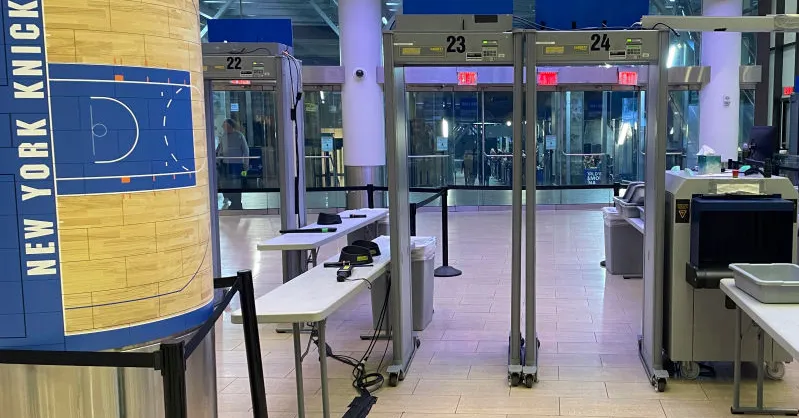
His client is a New York cop who was injured during a private security gig at Madison Square Garden. He sued the Garden on behalf of the cop.
Now John Scola, a lawyer well known for representing local police officers, is banned from the high-profile arena and several others owned by the famously controlling James Dolan.
For years, Dolan openly excluded entire law firms from his venues if a single attorney was in any sort of legal dispute with the Garden; those bans would then be enforced by Dolan’s increasingly sophisticated facial recognition system. What wasn’t entirely clear was whether Madison Square Garden was continuing to grow its legal blacklist. A letter to Scola, dated April 30 and reviewed by WIRED, suggested this practice continues. “Any tickets to MSG Venues,” the letter reads, “are hereby revoked.”
The ban also highlights the fissures in the multilayered relationship between New York City’s public servants and its most iconic arena. As WIRED reported last month, MSG security functionally acted as a second, unsanctioned surveillance force in midtown Manhattan—without the New York Police Department’s formal permission. (NYC mayor Zohran Mamdani called this expansion beyond the Garden’s walls “deeply troubling,” and promised further investigation.)
Advertisement
Dolan says that the biometric surveillance system is in place to stop dangerous actors from entering his properties—”if you’re a terrorist, [the list] will say that’s a terrorist,” he once told the local Fox affiliate—but the NYPD hasn’t shared facial recognition or any other kind of data with the Garden. The Garden did, however, add a New York police officer’s photo to the many, many others in its facial recognition database, as WIRED reported. “New Yorkers should be able to go to a game or a concert without their rights being violated,” New York attorney general Letitia James told the Pablo Torre Finds Out podcast in a statement. “My office is closely reviewing the latest reporting on Madison Square Garden surveillance tactics.”
On the other hand, the Garden does hire NYPD officers, through the city’s paid detail program, to augment its own security forces. That’s what happened in February of 2025, when a lightweight boxing match was being held at MSG’s then-named Hulu Theater. The audience was likely to be large and “requir[e] active crowd control,” according to the lawsuit, so the Garden brass figured they’d need eight off-duty cops to help. “Despite that determination,” the suit claims, “only two officers were actually present.” One of them was seven-year NYPD veteran John Przybyszewski.
At some point, an incident erupted near ringside.The rapper Lil Tjay seemed to spit in the face of a Garden security staffer who appeared to be trying to keep him from getting closer to the ring. Videos from the night show a chaotic scene. Lil Tjay’s bodyguards and entourage joined in the scuffle. According to the lawsuit, Przybyszewski claims he was knocked to the ground, pinned beneath several people.
Przybyszewski claims that when he got up, he was “in severe pain,” and was sent to the hospital in an ambulance. According to the lawsuit, “diagnostic imaging revealed significant cervical and lumbar spine injuries,” some of them “permanent.”
Advertisement
Przybyszewski blamed both the rapper and Garden officials. He sued Lil Tjay and Madison Square Garden. For a lawyer, he tapped Scola, who frequently represents NYPD officers in disputes with their bosses and the city. Scola filed his suit in February of this year. “Defendants made conscious operational decisions that placed Plaintiff directly in harm’s way. Those decisions caused his injuries,” the lawsuit claims.
Most people take the Moon for granted, not considering its slow cycle where the sun gradually illuminates different parts of it. A recent project from [Karsten Mueller] helps you keep our nearest celestial neighbor in mind by putting a tiny version on your desk. (German)
The device itself is made with a circular display, an ESP32-S3, and a simple 3D printed case. But the interesting part is the software — it’s not just a moon phase display, it actually takes your local time, latitude and longitude into account. The resulting image is an approximation of what the moon looks like if you were to look at it, even if you wouldn’t actually be able to see it, such as when it is obscured by the Earth or barely visible during the daylight sky. Initially the project actually used a photograph of the Moon that [Karsten] personally snapped, but there’s also an option to pull the imagery from NASA.
Vehicle-specific integrations, Immersive Navigation and Android-inspired widgets are small but helpful additions.
Igor Bonifacic for Engadget
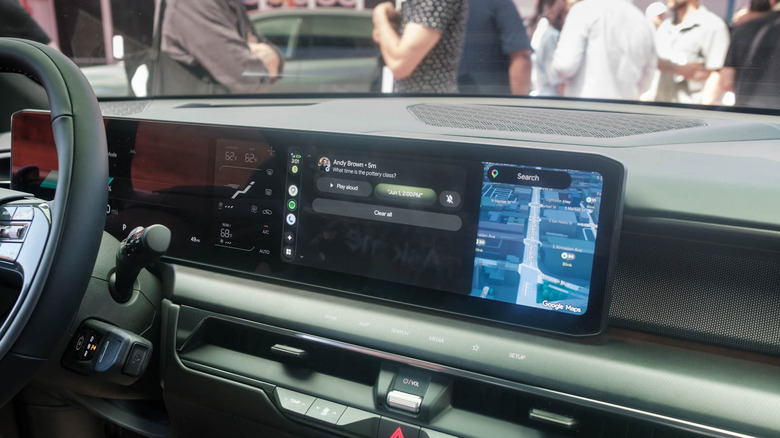
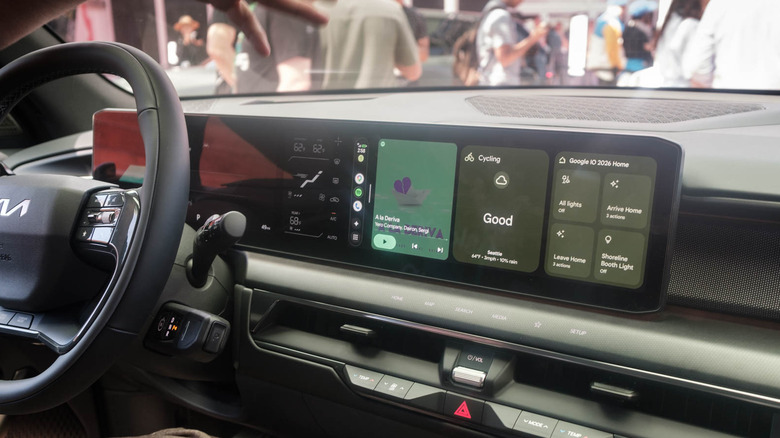
At the Android Show: I/O Edition last week, Google promised 2026 would be a big year for Android Auto, with major updates planned for how the platform looks and works across all the cars and devices where it’s available. At I/O 2026, Engadget got a chance to see some of those upgrades running off both Android Auto on a phone and a Volvo EX60 with Google built-in.
Right off the top, most of the enhancements Google announced earlier this month will be available to people whether they access them directly through their car or via a phone. I did notice some visual differences between how those features are presented. With Android Auto, you get Google’s own Material 3 Expressive across the board; with Google built-in, it’s still Material 3 Expressive, but tweaked to accommodate the automaker’s own stylings and the car’s specific hardware.
The trade-off there is Google built-in offers Gemini integration that’s only possible when manufacturers directly include the assistant in their cars, allowing you to use your voice to tweak model-specific settings. In the case of the EX60, that meant the Google employee talking me through the demo was able to tell Gemini to “darken” the car’s sun roof, and it went from transparent to opaque. The employee was also able to ask Gemini to describe footage from one of the car’s front-facing cameras. When the assistant saw the Transamerica Pyramid in the distance, it told us it was once the tallest building in San Francisco for 48 years running. It diplomatically did not mention that title was taken by the grotesque Salesforce Tower.
Advertisement
Immersive Navigation looks great
Igor Bonifacic for Engadget
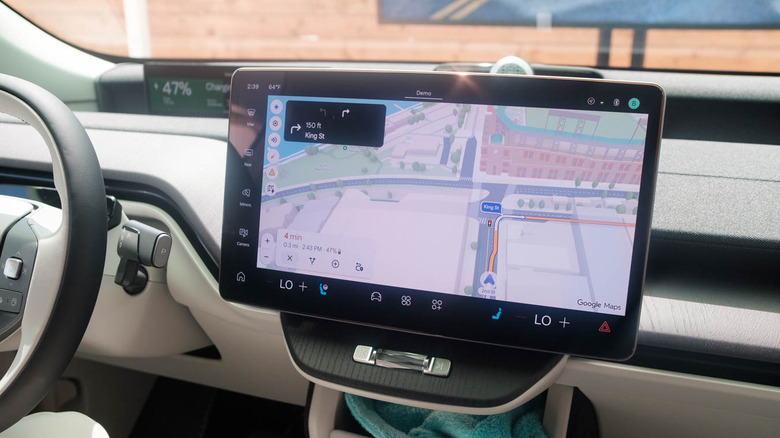
Everything else Google previously announced will be available to users of both Android Auto and Google built-in as the upgrades roll out. For instance, with Immersive Navigation, the overhaul of driving directions Google first announced in March, you can expect a similar experience no matter how you access the feature. In the demos I saw, neither car was moving, but as they drove along a virtual route, Google Maps rendered buildings in 3D to create a better sense of scale and depth. Important road elements like stop signs, traffic lights and crosswalks were prominently displayed to make them hard to miss. Gemini also produced more intuitive voice directions, saying things like “take a left at the next intersection.” It’s a slick interface that I think most Android Auto users will like a lot once they’ve had some time to acclimate.
Google was also keen to show me how the Android Auto team worked with third-party developers and other teams inside of Google to make their apps look and feel more like the experiences they offer on mobile devices. I saw this in action with Spotify, which in its latest version for Android Auto definitely looks more like it does on Android and iOS. Whether this is a welcome tweak will depend on how you feel about using a touchscreen in car, though the Google employee taking me through the demo did note the Android Auto team has guidelines around touchscreen usage designed to reduce distractions.
Advertisement
Android-like widgets come to Android Auto
Igor Bonifacic for Engadget
I also saw the Android-like widgets Google is bringing to Android Auto. They’re a small addition but there’s utility in having specific information or features just a tap or swipe away. In the demo I saw, a Google employee had one widget set up to check the weather for future bike rides. Again, it’s a small addition, but one that left me thinking why Google hadn’t added user-customizable widgets to Android Auto earlier.
The Grafana data breach was caused by a single GitHub workflow token that slipped through the rotation process following the TanStack npm supply-chain attack last week.
In the ongoing Shai-Hulud malware campaign attributed to TeamPCP hackers, dozens of TanStack packages infected with credential-stealing code were published on the npm index, compromising developer environments, including Grafana’s.
When the malicious npm package was released, Grafana’s CI/CD workflow consumed it, and the info-stealer module executed in its GitHub environment, exfiltrating GitHub workflow tokens to the attackers.
The company explains that it detected malicious activity resulting from compromised TanStack packages on May 1, and immediately deployed the incident response plan, which included rotating GitHub workflow tokens.
Advertisement
However, one token was missed in the process, and the attacker used it to gain access to the company’s private repositories.
“We performed analysis and quickly rotated a significant number of GitHub workflow tokens, but a missed token led to the attackers gaining access to our GitHub repositories,” reads Grafana’s update.
“A subsequent review confirmed that a specific GitHub workflow we originally deemed not impacted had, in fact, been compromised.”
Previously, the company confirmed that the intruders stole source code, assuring there was no customer impact, and stating that the hackers would not receive a ransom payment.
Advertisement
The continued investigation revealed that the intruder also downloaded operational information and details Grafana uses for its business.
“This includes business contact names and email addresses that would be exchanged in a professional relationship context, not information pulled from or processed through the use of production systems or the Grafana Cloud platform” – Grafana
The company stresses that this was not customer production data, and according to the latest evidence and investigation, no customer production systems or operations have been compromised.
Grafana Labs also noted that its codebase was not modified during the incident, so the code users downloaded throughout the events is considered safe, and users are not required to take any action.
Advertisement
If that evaluation changes based on new evidence from the ongoing investigation, Grafana Labs promised to notify impacted customers directly.
Automated pentesting tools deliver real value, but they were built to answer one question: can an attacker move through the network? They were not built to test whether your controls block threats, your detection rules fire, or your cloud configs hold.
This guide covers the 6 surfaces you actually need to validate.




























![These 4 Things Terrify Me About Bitcoin Right Now [URGENT!!]](https://wordupnews.com/wp-content/uploads/2026/05/1779296261_maxresdefault-80x80.jpg)





































You must be logged in to post a comment Login