Patients who use mobile applications to manage medical conditions including depression and chronic pain might assume the apps have been evaluated by regulatory agencies to be safe and effective. But that isn’t necessarily the case.
Most of the more than 55,000 medical apps that claim to diagnose or treat a condition—or ones that provide clinical decision support, known as “therapeutic” apps—have never been assessed by any trusted neutral bodies or regulatory agencies to evaluate them for technical soundness, ethical design, or clinical benefit. The apps often don’t comply with regional data security and privacy laws to protect people’s sensitive health information.
Medical apps differ from traditional wellness apps, which provide users with insights into becoming healthier by, for example, tracking fitness activities, monitoring blood pressure, and analyzing sleep patterns.
There is no reliable way to verify that therapeutic apps deliver the results they indicate. To help ensure such apps are credible, the IEEE Standards Association (IEEE SA) recently launched the IEEE Global Medical Mobile App Assessment and Registry. The publicly searchable directory is designed to list apps that have been vetted by experts across several criteria including technical soundness, ethical design, compliance with data security and privacy regulations, and clinical efficacy, which is evidence of a clinical benefit for the patient.
Advertisement
“Patients, clinicians, payers, and health care systems often struggle to distinguish clinically meaningful therapeutic apps from those that are simply well-marketed,” says IEEE Senior Member Yuri Quintana, chair of the assessment and registry program. He is chief of the clinical informatics division at Beth Israel Deaconess Medical Center, in Boston. “Our goal is to establish a standardized review method using criteria developed by experts.”
Why regulation is lacking
Because the apps are intended for medical use without being part of a medical implement, they fall under the designation of software as a medical device (SaMD), according to the International Medical Device Regulators Forum. SaMD is supposed to be regulated by public health agencies such as the U.S. Food and Drug Administration, but the apps have developed and grown in popularity so quickly that regulators haven’t been able to keep up, Quintana says. Some companies have received approval, but most have not, he says.
Many users are unaware of the regulatory gap, he says.
“Seeing an app from a well-known company often creates the impression that it has been meaningfully vetted for safety and efficacy, even when that is not the case,” he says.
Advertisement
Some companies are using deceptive advertising to sell their product, he adds. Marketing materials might claim that all of a company’s health apps are certified, even though only one app has been approved by a regulatory body to treat a particular condition. Or the verbiage might imply the company has clinical evidence proving its application works, even though the app has never been tested independently.
Another concern is that updated apps aren’t being vetted, says Maria Palombini, IEEE SA’s director of health care and life sciences global practice lead.
“The original app might have received approval from a regulatory agency, but not the updated version,” Palombini says. “There could have been significant changes from the original.”
“Not every medical-related app triggers the same regulatory classification or review across jurisdictions,” Quintana adds. “That leaves a large gray zone of clinically relevant but lower-risk apps that haven’t undergone an independent assessment. The IEEE registry was created to help fill these gaps.
Advertisement
“IEEE is the best organization to address this problem because this is fundamentally a standards, trust, interoperability, and conformity assessment challenge,” he says. IEEE “is the world’s largest technical professional organization, with deep expertise in developing globally recognized standards including in health care, cybersecurity, AI ethics, and interoperability.”
“Through the IEEE Conformity Assessment Program, we already run rigorous assessment and registry programs,” Palombini says. “Our neutral, consensus-driven, multidisciplinary approach—bringing together clinicians, regulators, developers, and ethicists without commercial bias—makes IEEE uniquely positioned to create trustworthy global guardrails that can scale across jurisdictions and support regulatory harmonization.”
How the registry works
The assessment framework was developed by a multidisciplinary group of 35 volunteer experts from 10 countries, Quintana says. The panel includes academics, AI experts, app developers, clinicians, ethicists, mental health experts, patient advocates, regulators, researchers, technologists, and those who assess safety in health care.
The registry is for any app used for clinical care or therapeutics that claims to demonstrate a medical benefit. That includes apps designed for cardiology, diabetes, mental health, neurology, oncology, rehabilitation, and respiratory diseases, Quintana says.
Advertisement
Initially, he says, the focus will be on apps that aim to treat mental health conditions, given the large number of offerings in that area and the registry committee’s expertise.
The submission of apps is voluntary. There is no government mandate that requires a company to use the IEEE registry.
The products will be evaluated against about 150 consensus-based criteria across three major areas:
Clinical efficacy including therapeutic effectiveness, any sustained benefits, risk management, comparison to standard care, user engagement, and real clinical value.
Technical soundness including accessibility, privacy and security, error handling, interoperability, AI governance, usability, and operational quality.
Ethical design including bias prevention, patient consent, data governance, conflict-of-interest transparency, responsible use of AI and large language models, and prioritization of public health benefits.
IEEE charges a nonrefundable submission fee that covers the cost of the assessment plus the registry’s annual subscription for the first year.
Developers first must demonstrate they are a legally established entity before they can complete the app publisher registration form and then submit documentation and attestations about the product.
Advertisement
The IEEE review of an app is estimated to take six to eight weeks, Palombini says. The assessment results will be privately shared with the app publisher, she says, and to be listed in the registry, an app must achieve more than 85 percent compliance in each category.
Upgraded apps must be submitted and reassessed, Palombini says. Similar to how users are notified when an app on their smart devices has , the registry will be notified when listed apps have a new update available, she says.
Applicants who do not pass the assessment are to receive feedback explaining why. They will be given an opportunity to make changes or provide additional documentation, Palombini says.
“It’s a pretty methodological process, with checks and balances,” Quintana says. “We’re being very transparent about the process.”
Advertisement
Approved apps added to the registry receive an IEEE certification badge and submission identifier, which the company can display on its website, app store listings, and marketing materials.
“The badge serves as visible proof that the app has met the independent, consensus-based assessment for clinical value, technical robustness, and ethical design,” Quintana says.
The registry will be publicly available at no cost, he says.
Patients and families seeking safe, trustworthy apps—and payers and insurers evaluating reimbursement potential—will find the registry helpful, he says.
Advertisement
The application website is open. The public registry page does not yet list a specific count of approved apps because assessments are ongoing. Approved apps and their unique identifiers are to be published when the initial reviews are completed.
To learn more, you can watch a webinar recorded in March.
A malware-spreading scumbag swimming through GitHub pushed malicious commits to more than 5,500 repositories on Monday as part of an automated campaign called Megalodon.
Similar to the earlier TeamPCP attacks that poisoned about 3,800 GitHub repositories, this new campaign has so far infected 5,561 repos with CI/CD credential-stealing malware, according to SafeDep researchers, who uncovered the predatory commits and published a full list of the compromised repositories.
Advertisement
If a repository owner merges the commit, the malware executes inside their CI/CD pipeline and propagates further, Ox Security lead researcher Moshe Siman Tov Bustan said in a Thursday blog post.
Megalodon steals AWS secret keys and Google Cloud access tokens. It also queries AWS, Google Cloud Platform, and Azure metadata for instance role credentials, reads SSH private keys, Docker and Kubernetes configurations, Vault tokens, Terraform credentials, and scans source code for more than 30 secret regex patterns. Then it exfiltrates GitHub tokens, including secrets used to authenticate with cloud providers, thus allowing attackers to impersonate developers’ cloud identities, along with Bitbucket tokens.
In other words: consider ALL of your CI/CD variables pwned.
“We’ve entered a new supply chain attack era, and TeamPCP compromising GitHub was only the beginning,” Bustan told The Register. “What’s coming next is an endless wave, a tsunami of cyber attacks on developers worldwide.”
Advertisement
Plus, he added, hacking GitHub “compromises the security of every company with a private repository hosted on the platform.”
Malicious code is still reaching their servers, and nothing is stopping it before it does
This new wave of supply chain attacks hitting developers’ environments won’t stop until “companies like npm and GitHub take serious action against the spread of malicious code on their servers,” Bustan said.
He noted npm’s statement on X saying it “invalidated npm granular access tokens with write access that bypass 2FA” to prevent additional supply-chain attacks like Mini Shai Hulud.
Advertisement
“That could help a little with account hijacking, but it doesn’t solve the actual problem,” Bustan said. “Malicious code is still reaching their servers, and nothing is stopping it before it does.”
npm … but not TeamPCP
SafeDep spotted Megalodon hidden inside a legitimate package: Tiledesk, an open source live chat and chatbot platform. The attacker backdoored versions 2.18.6 (May 19) through 2.18.12 (May 21), and the same npm maintainer published the last clean version, 2.18.5, before unknowingly publishing these newer compromised versions.
“The attacker never touched the npm account,” the open source supply-chain security startup researchers said. “They compromised the GitHub repository, and the maintainer published from the poisoned source without realizing it.”
While publishing malicious packages on npm is a TeamPCP signature move, Bustan said there’s no threat-intel or code-analysis evidence that connects Megalodon to the crew behind the Trivy, Checkmarx, and other recent supply-chain attacks. “Our best guess now is that it’s a different threat actor copying their behavior and style, but not much of the code itself,” he told us.
Advertisement
And despite TeamPCP open sourcing its Shai-Hulud worm and announcing a supply-chain attack competition on BreachForums, Ox doesn’t believe Megalodon is a contest entry.
“We have indications that they are not participating in the TeamPCP contest due to the contest having a specific rule to add a public encryption key that the actor behind the malware could match with his private key to prove his involvement,” Bustan said.
Who is built-bot?
SafeDep’s threat hunters traced the malicious commit (acac5a9) to an author “build-bot,” connected to the email address build-system[@]noreply.dev with the message “ci: add build optimization step.”
The author name and noreply email mimic automated CI commits, and there’s no GitHub account linked to the author and committer user fields. “Someone pushed the commit to master with no PR and no merge commit, using a compromised PAT or deploy key,” according to the researchers.
Advertisement
They searched GitHub for other commits authored by the same email address and found 2,878 results, plus a second email, ci-bot@automated.dev, with an additional 2,841 commits. All landed May 18 during a six-hour window (11:36 to 17:48 UTC) and targeted 5,561 repositories.
This includes nine compromised Tiledesk repositories: tiledesk-server, tiledesk-dashboard, tiledesk-telegram-connector, tiledesk-llm, tiledesk-docker-proxy, tiledesk-community-app, tiledesk-campaign-dashboard, tiledesk-helpcenter-template, and tiledesk-ai. Others include Black-Iron-Project with eight compromised repos, WISE-Community, and hundreds of smaller repositories. ®
For professionals in the medtech space, there are a number of industry events that offer networking opportunities and the chance to learn something new.
Regardless of your role within STEM, networking and industry events are an ideal way to meet like-minded people, share ideas, keep up to date with advancements and even meet potential future employers or co-workers.
It isn’t always clear which events you should attend to ensure you get a well-rounded experience. So why not have a look at what is currently on offer for the year? Here are five upcoming medtech events that could be worth engaging with.
Future Health Summit
Next week, from 27-28 May at the Dublin Royal Convention Centre, medtech enthusiasts and professionals can check out the Future Health Summit. The event will bring together some of the most creative minds in the healthcare sector, as well as an audience of more than 600 senior‑level delegates and c‑suite leaders from across the industry. The event will welcome speakers from Ireland, the UK and wider Europe, as well as the US and Asia.
Advertisement
The summit will also host 50 healthcare and associated industry exhibitors, creating a valuable opportunity for networking, partnership building and commercial engagement. A key highlight of the programme is the Innovation Award, where an international field of entrants will be narrowed to eight finalists, each pitching their ideas to the audience and judged by an expert panel.
AI Forward – Future Health
Initially scheduled to go ahead on 30 June, the date for the AI Forward – Future Health event has yet to be confirmed, as it is currently expanding its line of speakers. Held at the Dell Technologies Customer Solution Centre in Limerick, the event aims to explore how AI is transforming healthcare, from reactive care to intelligent, connected health systems.
Via real-world use cases, technology deep dives and practical insights, the event will seek to identify and examine how AI is already improving clinical outcomes, accelerating life sciences innovation, strengthening resilience and enabling safer, more efficient healthcare delivery. Make sure to keep an eye open for the new date so you can get registered.
Next-Gen MedTech Exchange Ireland 2026
On 22 September, the Clayton Hotel in Galway will host the Next-Gen MedTech Exchange Ireland 2026. The goal of the event is to present disruptive and enabling technologies to those who are creating within medtech. The event will focus on innovation and global collaboration, connecting today’s technologies with the disruptive ideas shaping the future, strengthening international industry connections and supporting the next generation of medtech talent.
Advertisement
Attendance comes with a fee, which goes towards supporting the SOLS programme that delivers free, hands-on medtech and life sciences workshops to schools across Ireland.
Medical Technology Ireland Expo and Conference 2026
From 23-24 September, the Galway Racecourse will host the Medical Technology Ireland Expo and Conference 2026. Free to enter, the event is “Europe’s second largest and fastest growing medical device design and manufacturing show”, so is well worth a visit for those in the medtech industry or anyone with an interest in this area.
The two-day conference will include 350 exhibits across four floors – including a ‘women in medtech’ forum – with more than 2,000 attendees expected overall.
MPP Ireland 2026
Also in September (a busy month for medtech professionals), Galway’s Galmont Hotel is hosting MPP Ireland 2026, a medtech conference “built for deeper insight, meaningful connections and the ideas shaping what’s next in medical device development and manufacturing”. Throughout the day, attendees can listen to key speakers, attend panels, network and learn about advancements in the evolving medtech sector. The afternoon concludes with a post-event reception.
Advertisement
Medtech is a vibrant, rapidly transforming industry that offers plenty of opportunities for professionals to explore, learn and evolve. Industry events such as the ones listed are one such opportunity and should be embraced where possible. So, why not give it a go and see what comes of it?
Don’t miss out on the knowledge you need to succeed. Sign up for the Daily Brief, Silicon Republic’s digest of need-to-know sci-tech news.
What’s happening now is even more disturbing. We’re killing people simply because they happen to be in boats spotted exiting certain shores and headed towards international waters.
The War on Drugs has always been evil. It has always relied on the ends justifying the malicious means, especially when the means usually meant the killing or incarceration of non-white people.
Under Trump, it’s gotten even worse. Trump has pretended the mere existence of a drug trade — something that involves the exchange of money for goods by consenting adults — justifies the wholesale slaughter of people in boats in international waters.
Advertisement
The Defense Department and Trump himself have posted clips of boat strikes on social media, almost always accompanied by self-serving statements about protecting Americans from foreign-based drug cartels.
But the government has offered very little in support of its social media postings and public statements. Almost no documentation exists to buttress assertions about the at-sea execution of alleged drug traffickers. Almost nothing connects these random murders to cartel activity.
The government has shown absolutely no interest in identifying the victims of its extrajudicial murder program. And why would it? Identifying drone strike victims might undercut the government’s unproven assertions. Worse, it might expose it for what it is: small-scale genocide meant to kill non-white people whose ultimate destination might be the United States.
It’s up to everyone else to do what this government and its historically large deficit won’t do: address the human cost of its antagonism towards any nation located south of the US border. Those doing this heavy lifting don’t have the benefit of billions of dollars of funding or internal pressure to discover the truth. They’re doing it because our government won’t.
Advertisement
Twenty journalists involved with the Latin American Center for Investigative Journalism (CLIP) have managed to identify 13 victims of Trump administration drone strikes. And even though it’s only a small percentage of the nearly 200 people our nation has murdered in open waters since Trump took office, it still matters.
This administration may prefer these people to remain faceless and nameless, since it makes their killing that much easier to shrug off. But anyone with an operating conscience shouldn’t pretend this effort is too small to matter. It does, and these are the names of a small portion of the people this administration has presumably straight-up murdered — an assumption that should stand until the administration is willing to produce evidence that says otherwise.
Of the 16 victims now identified, eight are Venezuelans: Juan Carlos Fuentes, 43; Luis Ramón Amundarain, 36; Eduard Hidalgo, 46; Dushak Milovcic, 24; and Robert Sánchez, Jesús Carreño, Eduardo Jaime and Luis Alí Martínez, whose ages are unknown. Three are Colombians: Alejandro Andrés Carranza Medina, 42, and Ronald Arregocés and Adrián Lubo (ages unknown). Two are from Ecuador: Pedro Ramón Holguín Holguín, 40, and Carlos Manuel Rodríguez Solórzano, 34; two are Trinidadians: Chad Joseph, 26, and Rishi Samaroo (age unknown); and one is from Saint Lucia: Ricky Joseph (age unknown).
Some of the people murdered by Trump’s Defense Department were simply going from one country to another to secure employment. Some of them may have been transporting drugs, but they were mules, rather than key members of international drug cartels. What’s actually known about the nearly 200 people the administration has killed is minimal. And the one entity that could provide more insight on its drone strike targets isn’t interested in sharing this information with anyone.
In the eight months since the airstrikes began, the US has not provided any evidence that any of the 194 victims were involved in drug trafficking.
Read that again: the US government has not provided evidence about any of its 194 murder victims. Instead, it has produced a steady stream of baseless invective meant to persuade the stupidest of Americans that these killings were justified.
Advertisement
What is being said by government officials doesn’t erase its refusal to provide evidence backing its claim, much less justify killings it’s unwilling to honestly discuss with the US public or its congressional oversight.
A spokesperson for US Southern Command said that all the strikes were “deliberate, lawful and precise, directed specifically at narco-terrorists and their enablers. We have full confidence in the operations and intelligence professionals who inform our missions.”
This is not evidence of anything. This statement is conclusory, which is the exact opposite of evidence, as any court will tell you. It simply says the government is in the right because the government says it’s in the right. That’s not justification. That’s someone representing entities swallowing up billions of federal officers telling the people paying its outsized paycheck “because I said so” and expecting that to be the end of the discussion.
The American public is not the government’s child. It’s actually the other way around. The government is reliant on the public, which makes the general public the adult in this conversation. That far too many MAGA enablers refuse to be the adults in the room makes it that much easier for the government to pretend it owes the public nothing. But that doesn’t change how this actually works. The government works for us, rather than the other way around. And when it doesn’t, it’s up to the public to remind it of its place.
In this case, it took people in other countries to generate the modicum of accountability this nation — under Trump — appears unwilling to do itself. That’s just fucking sad.
Christopher Quek invested S$250K to launch Spike Durian
Singapore is not short of durian sellers. From roadside stalls piled high with husks to dedicated cafes serving Musang King tarts, the King of Fruits has never been hard to find—during season, at least. But for the other eight months of the year, your options run dry.
That seasonal gap is exactly what Christopher Quek, 48, built Spike Durian to fix. And the origin story? It began with pregnancy cravings—but not his wife’s.
“15 years ago, my wife was pregnant, and ironically, I was the one with the pregnancy cravings,” he said with a laugh. “I was searching desperately for Mao Shan Wang and just couldn’t find it. I ended up at a durian cake shop just to survive on the durian.”
The experience stayed with him for years. So when technology eventually made year-round premium durian possible, Chris decided to take the leap and start Spike Durian, which sells premium Mao Shan Wang every day of the year.
Advertisement
After 10 years of funding others, he wanted in
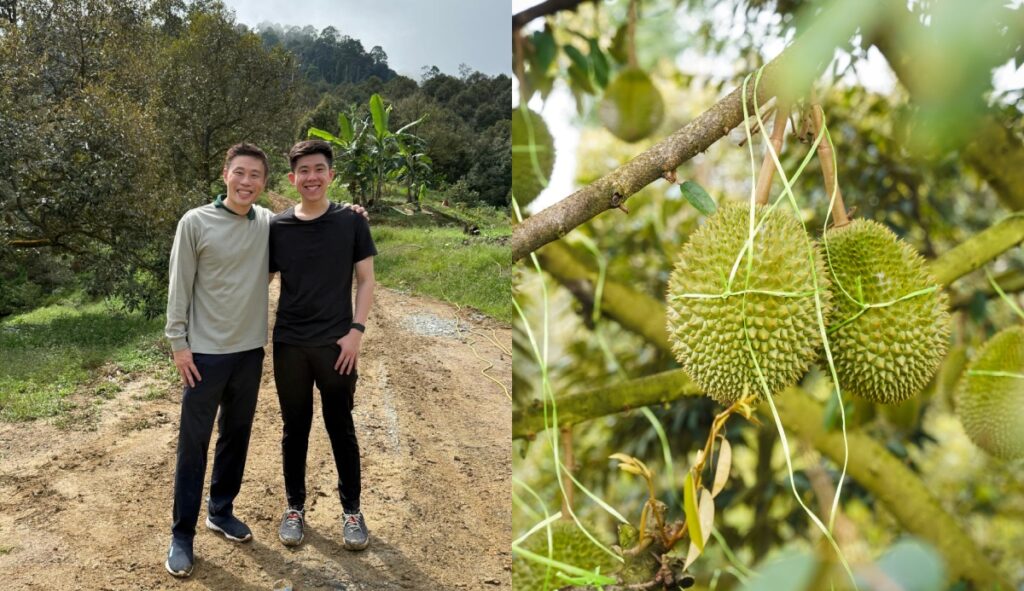
Chris and Marcus at one of their supplier’s plantations in Pahang, Malaysia./ Image Credit: Spike Durian
Chris is, by trade, a venture capitalist. He founded TRIVE, a Singapore-based venture capital firm with roughly US$30 million (S$38.37 million) in assets under management, and has backed notable companies, including ride-hailing app Tada and Charge+, one of Singapore’s largest EV charging networks.
It was through TRIVE that Chris first encountered Agrifreeze, a food tech startup pitching an advanced freezing technology that uses electromagnetic field (EMF) waves to control ice crystal formation.
Unlike conventional blast freezing, which creates large, sharp ice crystals that rupture a food’s cellular structure and degrade texture, aroma, and flavour upon thawing, Agrifreeze’s process produces small, rounded crystals that are three times smaller. The result is what Chris calls “as good as fresh”—food that, once thawed, is largely indistinguishable from its fresh state.
“I looked at them and said, can you blast-freeze durians? Can you make sure you give me fresh durian?” he recalled. “And that was when Agrifreeze said, okay, let’s try.”
It took 18 months of research and development to perfect the Agrifreeze blast-freezing process for durian. Once they did, Chris invested in Agrifreeze and then went a step further by founding Spike Durian in Dec 2024 as a direct-to-consumer delivery venture. His partner, Marcus Choy, 32, who had previously worked at TRIVE, joined him to run operations.
Advertisement
The total investment in Spike Durian was approximately US$200,000 (S$255,810), which Chris describes as one of TRIVE’s smallest bets, against a fund that typically writes cheques of US$5–10 million (S$6.4-12.8 million) for incubators.
For a firm that has backed mobility platforms and EV infrastructure, a premium durian e-commerce shop seems like an unlikely portfolio addition. But Chris sees it as more than a business.
I’ve been seeing and helping so many startup founders for the last 10 years. I realised I’d been missing out on the action.
Christopher Quek
From Pahang to your doorstep
Mao Shan Wang durians from Pahang./ Image Credit: Spike Durian
Spike Durian sources exclusively from six plantations in Pahang, Malaysia, which Chris considers to be the home of gold-standard Mao Shan Wang.
Pahang sits at a higher elevation than other durian-producing states, meaning trees get the precise balance of sunlight and rainfall they need, without waterlogging. The trees there are also among the oldest, ranging from 20 to 30 years. “The older the tree, the better the flavour, the more complex,” Chris explained.
Advertisement
The harvesting method matters too. Unlike farms in Thailand and Vietnam, where fruits are cut from the tree early to extend shelf life, Pahang’s plantations wait for durians to fall naturally into nets strung below.
“The farmers know that the best durians are the ones that drop, not the ones that you pre-cut,” Chris said. He added that this natural ripening produces the stronger, more complex flavour profiles that Singaporeans and Malaysians prize, as opposed to the lighter, sweeter taste of Indochina varieties.
Once harvested, the durians are husked and vacuum-sealed in a clean room environment within hours, then transported by a chiller truck to Agrifreeze’s facility in Selangor, where they are blast-frozen for four hours using EMF technology. From there, they are trucked to Spike Durian’s modest 200–300 sqft facility in Singapore—a nine-hour journey with the durians maintained at -28°C—and stored until orders come in.
Spike Durian keeps most of its stock at a shared Agrifreeze facility in Selangor and only transports a fixed volume of shipments to Singapore per week to keep costs low./ Image Credit: Spike Durian
To keep costs down, Spike Durian holds most of its inventory in Malaysia, only trucking in about a week’s worth of stock at a time to the Singapore facility.
“The cost of actually keeping it in Singapore is quite high, so we only bring sufficient stock for the week itself,” Chris explained. “If it’s sold out, unfortunately, we’ll tell them we have to wait for the next shipment.”
Advertisement
That said, the company benefits from sourcing durians that traditional sellers often reject. Misshapen or “ugly” fruits—those with irregular shapes or fewer chambers—are typically passed over by vendors who rely on displaying whole durians to customers.
But because Spike Durian sells only the flesh in vacuum-sealed boxes, the appearance of the husk makes little difference. This allows the team to negotiate lower prices for fruits that are cosmetically imperfect but otherwise identical in quality.
Spike Durian’s stocks in Singapore are usually adequate for customers to pre-order for next-day delivery. When an order is placed, frozen durians are transferred to a chiller to thaw for approximately 20 hours, then delivered within a four-hour window. By the time the box arrives, the durian is ready to eat—no different, Chris insists, from what you’d get at a stall mid-season.
Each 400g container of Mao Shan Wang comes in sweet or bitter variants and starts at S$45.
Advertisement
Convincing Singaporeans that frozen can be fresh
Durians that undergo Agrifreeze’s proprietary freezing process retain their fresh texture and taste./ Image Credit: Spike Durian
Overcoming the stigma of “frozen food” was Spike Durian’s first real test.
To test the market, Chris sent 100 boxes to friends and family in Dec and asked them to eat without knowing what they were tasting.
“95% said it was fresh durian,” he recalled. “When we told them it was frozen, they were astounded.”
Soon enough, word of Spike Durian’s Mao Shan Wang spread.
Spike Durian has since sold over 4,000 boxes in its first five months, with its biggest sales days coinciding with Chinese New Year, Hari Raya, and Mother’s Day—occasions that fall entirely outside the durian harvest window and where customers would often get the three-container bundle.
Advertisement
Chris shared that repeat customers now average about 20% of their total customer demographic.
“For the first time, people could finally bring durians to their Chinese New Year table or their Hari Raya spread,” Chris said. “That was really heartwarming to hear.”
Durian seeds are carefully selected in a hygienic environment and packed by suppliers into containers before being transported to Agrifreeze’s Selangor facility for freezing. / Image Credit: Spike Durian
One of Spike Durian’s most surprising discoveries has been who is actually buying.
According to Chris, about 25% of its customers are non-Chinese-speaking Singaporeans, many of whom told the company they found traditional durian-buying experiences intimidating or unfamiliar.
“They told us they felt threatened going to a durian seller. The uncle comes out with a cleaver, shouting, and they don’t speak Chinese,” Chris said. “They love that we’re entirely in English, and everything is handled for them.”
Advertisement
The premium packaging has also resonated with customers far more than Chris anticipated.
Traditional durian arrives in cling-wrapped polystyrene boxes stuffed in a red plastic bag—functional, but hardly appears gift-worthy. Conversely, Chris shared that Spike Durian’s presentation targets customers hosting guests or bringing durian as a dessert to a dinner party.
Hard lessons in the cold chain
Each container of durian is vacuum sealed before freezing./ Image Credit: Spike Durian
Running a premium frozen durian business from a 300-square-foot facility is not without its chaos.
Three weeks into launching, a restock shipment from Malaysia arrived on a public holiday. The driver, unable to access the cold chain facility, placed the stock in a conventional freezer out of goodwill, but that instantly compromised the cellular structure of the durian.
We had to throw away 300 boxes because of that. I learned the hard way to cross-check every regional holiday before any truck leaves the plantation.
Christopher Quek
Advertisement
Quality control remains a persistent challenge, too.
Farmers visually inspect each durian before packing, but, by their own admission, are only about 70% accurate as they work through hundreds of durians a day with no automated assistance. When shipments arrive in Singapore, Chris and his team do a second round of visual checks, looking for discolouration or cracks in the vacuum-sealed boxes.
Increasingly, Chris has seen a surge in last-minute buyers. As Spike Durian operates on a pre-order model, he is now building a system to handle on-demand orders—a shift that comes with its own operational challenges.
Looking beyond Singapore
Every step of the durian delivery process is kept frozen until it reaches Singapore and thawed for 20 hours upon order./ Image Credit: Spike Durian
Six months in, Spike Durian is already fielding serious overseas interest.
There are some instances where customers would go the extra mile to enjoy Spike Durian.
Advertisement
Some of its most enthusiastic customers have personally carried frozen durian onto international flights, packing the boxes in insulated bags with dry ice and clearing customs.
One customer even flew to the US on a 20-hour journey and arrived home to find the durian still frozen. Chris helps coordinate these as bespoke concierge requests, talking through timing, packaging, and sealing with customers before they travel.
“They promoted it to their friends around them, and they were so stunned,” he said. “They were like, oh wow, this is from Malaysia.”
Beyond individual customers, Spike Durian is also exploring larger international opportunities.
Advertisement
Chris recently brought Agrifreeze durians to Taiwan, transporting them in dry-ice-packed styrofoam boxes and distributing samples to potential distributors over five days. The response, he said, was overwhelmingly positive.
One Taiwanese distributor told Chris they move 20,000 boxes of Malaysian Mao Shan Wang every month — a figure that genuinely surprised him.
“I thought the Taiwanese may be a little more restricted in their taste,” he admitted. “But no, they are very open-minded.” Given the scale of demand, Spike Durian sees significant potential in supplying Taiwanese brands through a white-label model.
China, by contrast, wants to carry the Spike Durian brand directly—in Mandarin packaging—drawn partly by the trust associated with a Singapore-origin product. Other territories have made enquiries, though Chris is not yet naming them publicly just yet.
Advertisement
The upcoming Jul to Aug harvest peak is where Spike Durian plans to potentially introduce Blackthorn durian—a variant Chris describes as more palatable and beginner-friendly than Mao Shan Wang, and one that beginner durian eaters may actually find more approachable.
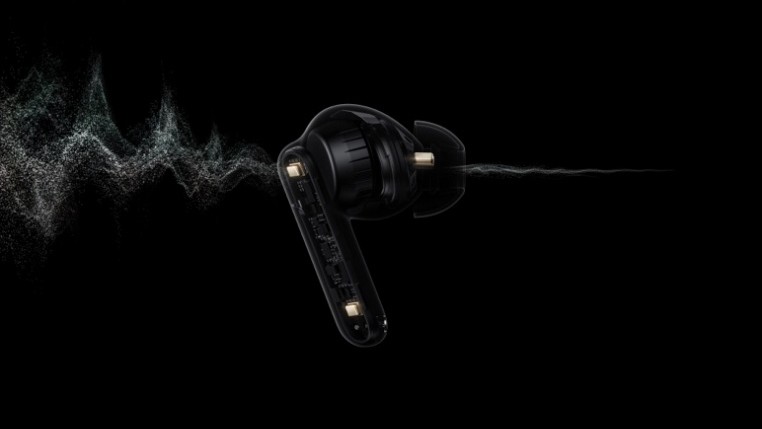
Oppo has officially launched the Enco Air 5 Pro TWS earbuds in India, featuring premium audio, robust active noise cancellation, and long battery life. The new earbuds are designed for users who listen to music, attend calls, travel frequently, or stream content daily. Oppo is offering the earbuds in Matte Black and Pearl White.
Oppo Enco Air 5 Pro Specifications and Features
The Enco Air 5 Pro earbuds feature up to 55dB of Active Noise Cancellation for a quieter, more focused listening experience. Oppo claims the earbuds can reduce noise across a broad 5,000Hz frequency range, helping block voices and background sounds more effectively. Adaptive ANC automatically adjusts noise cancellation based on the user’s environment. The earbuds have also received TUV Rheinland certification for high-performance noise cancellation.
Oppo has added a triple-mic system to the earbuds for better call quality. The AI-backed noise cancellation feature focuses on the user’s voice while lowering unwanted environmental sounds. The earbuds are claimed to deliver clearer calls even in windy conditions or busy outdoor areas.
For audio performance, Oppo uses the Enco Air 5 Pro with 12mm titanium-coated drivers to deliver deeper bass, balanced vocals, and detailed sound. Hi-Res Audio certification, as well as the LHDC 5.0, ensure high-quality audio signal transmission. Oppo also features Alive Audio, which provides a broader, richer sound experience for music, streaming, and gaming.
The Enco Air 5 Pro offers up to 54 hours of combined battery life along with the charging case. The earbuds alone can run for up to 13 hours on a single charge with selected settings. Fast charging support is also available, and a 10-minute charge can deliver enough power for long listening sessions. Oppo notes that battery life may vary depending on whether ANC or high-resolution LHDC audio is enabled.
Advertisement
Price and Availability
Oppo has launched the Enco Air 5 Pro in India at a price of Rs 4,999. The earbuds are currently available for pre-order on Oppo India’s official website, with official sales beginning on May 28, 2026.
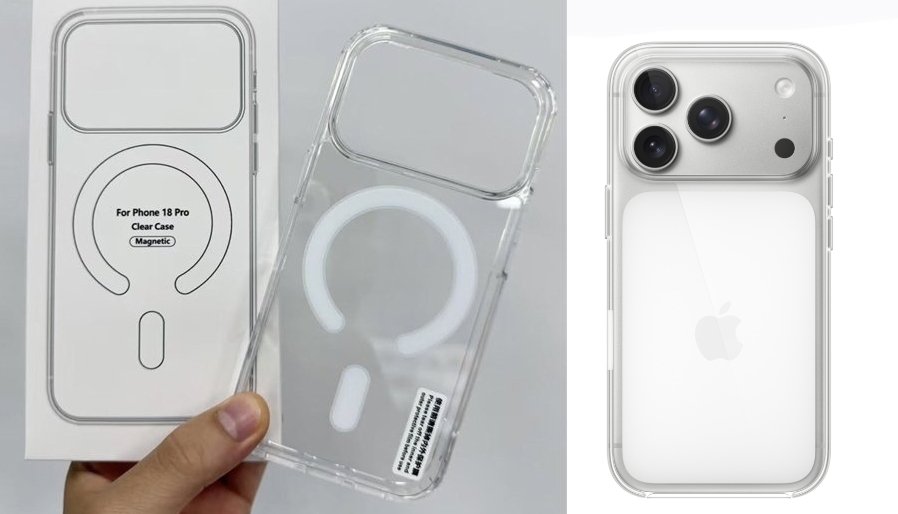
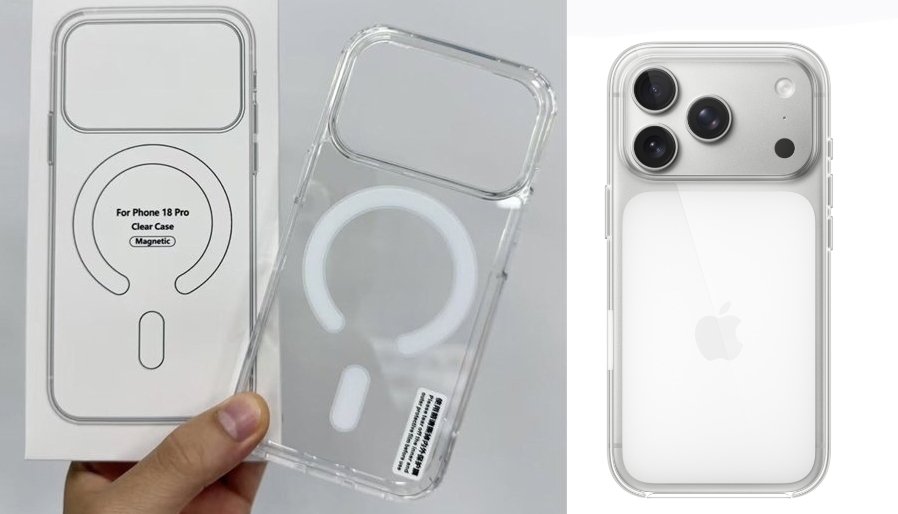
Purported Apple clear cases for (L-R_ iPhone 18, iPhone 18 Pro, iPhone 18 Pro Max – image credit: MyDrivers
Purported images of Apple’s clear cases for the iPhone 18 range are causing unfathomable excitement for how different the MagSafe markings are.
There’s a strong chance you never noticed this, and perhaps quite a strong one that you’d now have to look at these images to spot the difference. Yet if you cared about this, you apparently cared a great deal and the latest clear-case leaks may be making you happy.
While there’s no confirmation of this at the time of writing, it’s claimed that images of the new cases have been circulating on Chinese social media. But wherever they are being shown or circulated, there are images that claim to be of the new Apple clear cases.
Advertisement
Previously on Apple’s clear iPhone cases… the company had a circle image on the back to show you where to position the phone for MagSafe charging. For the iPhone 17 range’s clear cases, Apple scrapped that in favor of nothing very much.
Instead of a circle or a sometimes broken circle, the clear cases had a large white region. It was mostly rectangular, though since this is Apple, the corners were neatly rounded.
Left: a new purported iPhone 18 range clear case. Right: Apple’s current model. Image credits: MyDevices (r) and Apple (l)
It made no difference to how MagSafe works, and there was no special reason it had to happen just because the MagSafe magnets were lowered.
Advertisement
Only, it did mean that if you had this clear case, it wasn’t really all that clear at all. Whatever color iPhone you had bought, it was chiefly covered by that white region.
This is why new reports showing the iPhone 18, iPhone 18 Pro, and iPhone 18 Pro Max clear cases have gotten some attention. The large white panel is seemingly gone, and the old circle or broken circle is back.
Reports of the new images were first spotted by MacRumors via Chinese news siteMyDrivers.
There is the argument that a clear case ought to actually be clear, and it’s true the one for the iPhone 17 range was not.
Advertisement
But perhaps Apple was saving users from revealing they’d bought the horrible orange, or perhaps pink, color iPhone.
The Boys wrapped its five-season run just two days ago, and Prime Video is already keeping the hype train moving. The first trailer for Vought Rising, the prequel spinoff set in 1950s New York City, just arrived – and it looks promising.
The show follows a young, wide-eyed Soldier Boy (Jensen Ackles) suiting up for the very first time, teaming up with a fresh squad of supes who believe they’re a gift from God. Spoiler: they’re not!
What is Vought Rising about? The Boys prequel trailer explained
The trailer wastes no time establishing its world. Vought Rising is set around the creation of the first-ever superhero team, powered by V-One. It is the early version of Compound V, the drug that awakens superpowers in people.
Advertisement
Amazon MGM Studios
You’ll recognize the Sage Grove Center from The Boys season 2, where Vought ran brutal experiments on psychiatric patients. Here, it’s shown in its earliest form, with an unnamed character played by Jorden Myrie being injected with V-One and breaking out of containment.
This detail carries more weight when you factor in Vought’s Nazi roots and notice who is being experimented on. Back when V-One was first developed, Vought’s public-facing heroes were predominantly white, while their test subjects were Black men. It’s a dynamic that mirrors the Isaiah Bradley arc from The Falcon and the Winter Soldier, where an all-Black unit was used to try to replicate the serum behind Captain America‘s powers.
Amazon MGM Studios
The cast includes Mason Dye’s Bombsight, Will Hochman’s Torpedo, and Elizabeth Posey’s Private Angel. Aya Cash returns as Clara Vought, better known as Stormfront. She is the secret Nazi villain from season 2 who co-leads the series with Ackles.
Can Vought Rising win back The Boys fans who are disappointed by the finale?
Amazon MGM Studios
A lot of fans (including me) felt burned by season 5, which spent a big chunk of its runtime setting up Vought Rising rather than nailing its own landing. Soldier Boy dominated screen time across the season only to end up right back on ice, with nothing truly resolved for his character. It felt like a bait-and-switch.
The cancellation of Gen V, the interesting college-set spinoff that never got its third season, only deepened the frustration. The combination of letdowns makes it reasonable to approach Vought Rising with caution. The trailer, though, is hard to dismiss on its own merits.
Amazon MGM Studios
The 1950s aesthetic is sharp, the production looks distinctly stylish, and there is a sense of renewed identity this universe badly needs. Vought Rising is also one of two planned spinoffs, the other being The Boys: Mexico, led by Gael Garcia Bernal and Diego Luna, which is still early in production.
Vought Rising arrives on Prime Video sometime in 2027, and how it lands could shape the future of this entire universe.
The merchandise website of FBI director Kash Patel was taken offline on Friday after reports that it had been hijacked by hackers trying to infect visitors with malware, as first reported by Straight Arrow News.
As of this writing, the website of Based Apparel is offline. On Thursday, an X user who goes by Debbie posted that the brand’s website apparently had malware on it, in particular an infostealer, a type of malicious software designed to infect victims and steal their credentials and passwords. A security researcher later analyzed the malware.
Brand Apparel could not be reached for comment. TechCrunch emailed a Gmail address previously associated with Patel, but we have not received an answer.
This was not a good week for security for MAGA-associated business ventures.
Over three decades, I’ve watched consumer behavior evolve across television, search, and social media. Each shift changed tactics, but not the underlying logic of decision-making.
What I am watching happen right now is different. And I know I am not alone. Every seasoned marketing professional I speak to, whether they built their career in offline media or digital platforms, says some version of the same thing: something fundamental has shifted, and the old playbooks are no longer working the way they used to.
This is not just a platform change. It is a psychological one. For the first time in my career, I am watching users move from searching for information to seeking certainty, and that distinction changes everything.
When Behavior Was Predictable
I remember the era when a celebrity’s face on a television screen was essentially a guarantee. Brand loyalty tracked closely with fan loyalty. If your brand ambassador had a devoted following, that following would follow them to your product. It was a simple, time-tested formula: attention creates association, association creates purchase. And it worked, consistently, for decades.
Advertisement
The 💜 of EU tech
The latest rumblings from the EU tech scene, a story from our wise ol’ founder Boris, and some questionable AI art. It’s free, every week, in your inbox. Sign up now!
When the internet arrived, it digitized that predictability rather than dismantling it. Google and Yahoo turned discovery into a structured, keyword-driven system. Users searched, engines returned ranked results, and businesses that showed up at the top of those results won the customer. For the better part of a decade, through multiple algorithm updates, through the rise of paid search, through the SEO arms race, the core principle held: be visible, and you will be chosen.
Both eras rewarded the same thing: reach. Who could get in front of the most people, most often? That question shaped marketing strategy for nearly thirty years.
Advertisement
What Has Actually Changed
The change I am describing is not about which platform is winning or losing. It runs deeper than that, it is about how people make decisions.
Celebrity credibility has eroded in a way it simply had not before. It is not that people distrust celebrities, it is that modern consumers understand the commercial ecosystem they operate inside. They know that an endorsement is a transaction. And with global information available at their fingertips at all times, they also know that a single endorsement is not a sufficient reason to spend money.
Younger consumers in particular, Gen Z and late millennials, have moved almost entirely toward first-hand experience. Their own experience, or that of someone in their immediate circle, their age group, their specific context. Not someone famous. Someone relatable. And even then, they verify.
The online and offline distinction has also largely dissolved. A consumer who sees a product in a store will pull out their phone before they put it in their cart. A consumer who hears a recommendation from a friend will cross-check it before acting on it. The behaviors that once lived in separate worlds, browsing a physical shelf, reading an online review, asking a peer, now happen simultaneously, fluidly, and constantly.
Advertisement
What the Research Showed Me
To test whether what I was observing professionally reflected broader behavioral patterns, I ran an in-person field survey from mid-2025, nearly 500 people, not a formal academic study, but a deliberately diverse one: college students, working professionals, homemakers, and retirees across different age groups and economic backgrounds. The results confirmed the pattern I had been sensing.
Among 16 to 20 year olds, 87% said their primary trust for purchase decisions sits with friends, parents or teachers, people in their immediate circle. In the 21 to 30 age group, 73% blend peer input with social media and select individuals they follow, but 96% of that same group said they re-verify suggestions before acting on them. Nearly everyone. Among 31 to 40 year olds, 65% exhibit similar verification behavior. Even in the 41-and-above segment, 44% now follow the same pattern, slower adoption, but the same direction.
The common thread across every age group: trust is no longer accepted. It is earned and then verified. Consumers of every generation have become active validators, not passive recipients.
Are LLMs an Innovation or a Response to Market Pressure?
Looking at technology history, a pattern emerges roughly every ten to fifteen years: radio gave way to television, television to the internet, the internet to search engines, search engines to social media. Each revolution did not just create a new platform, it changed how buyers behaved. Which means, if you are a marketer trying to understand the AI era, the first question is not “how do I optimize for this platform?” It is “how has buyer behavior changed, and why?”
Advertisement
The rise of large language models – ChatGPT, Gemini, Perplexity, and others, is a direct response to the psychological shift I have been describing. These tools did not create the verification instinct in modern consumers. They answered it.
Traditional search engines offered a list of options and left the user to sort through competing claims. LLMs synthesize. They aggregate information from multiple sources and return a structured answer. For a consumer whose instinct is to verify, cross-check, and reach certainty before deciding, that is not just convenient, it is exactly what they were already trying to do, done faster.
Here is the insight that I think gets missed: the tech giants who have invested most aggressively in this space – OpenAI, Google, Microsoft – were not motivated purely by innovation. They understood something more uncomfortable. The audience that once lived on their platforms was fragmenting. Attention was splitting across social media, e-commerce platforms, and dozens of other channels. LLMs are, in part, a strategic attempt to re-aggregate that audience under a single, trusted interface.
And that changes the stakes considerably. Because an LLM that users trust enough to make purchase decisions through is an LLM that must remain unbiased. The moment users sense commercial favoritism in a recommendation, they abandon it, and move to the next tool that feels more neutral. The entire value proposition of these platforms depends on being perceived as trustworthy.
What This Means for Brands
The shift from visibility to credibility is not a subtle one. In the old paradigm, a brand that showed up frequently enough and loudly enough would eventually be chosen. In this paradigm, showing up is necessary, but nowhere near sufficient. If your brand cannot survive the moment a potential customer decides to verify your claims, through an AI tool, peer networks, reviews, or independent sources, you are unlikely to remain in the consideration set.
A useful example of this shift can be seen in how consumers now make even relatively small purchase decisions. A user may first discover a product through TikTok or Instagram, search for reviews on YouTube, cross-check opinions on Reddit, compare alternatives through Google, and finally ask ChatGPT or Perplexity to summarize the best option before purchasing. What matters is not the number of platforms involved, but the behavior itself.
Another example: Take a procurement manager evaluating CX outsourcing vendors. They may first encounter a shortlist through an AI Overview, cross-check reviews on Clutch, G2 or Trustpilot, look for case studies on the vendor’s site, scan Reddit or industry forums for unfiltered opinions, and finally ask ChatGPT to compare the top options. A company that has invested in verified reviews, documented case studies, and third-party editorial coverage survives that journey. One that hasn’t, doesn’t.
Advertisement
Consumers are no longer relying on a single source of authority. They are building confidence through layered verification, and for brands, that behavioral shift has a concrete consequence.
Practically, this means thinking less about impression count and more about information integrity. Are your claims verifiable? Are you consistent across every surface a user might check – your website, third-party reviews, forum discussions, AI-generated summaries? Is there enough legitimate, high-quality information within trusted ecosystems for an LLM to surface your brand accurately? These are not marketing questions. They are infrastructure questions.
Most brands are still optimizing for the old game: reach, frequency, creative impact. The ones pulling ahead are doing something different. They are making themselves easy to trust at the exact moment a skeptical consumer decides to look closer, not by being louder, but by having nothing to hide when someone does.
The Deeper Shift
What I keep coming back to, after everything I observed in my survey and in three decades of watching markets move, is that the underlying human need has not changed. People have always wanted to feel certain before they commit. What has changed is the threshold for that certainty, and the speed at which they expect to reach it.
Advertisement
Search has not become less important. It has become more decisive. Increasingly, users are not looking merely to explore; they are looking to reduce uncertainty quickly. And if your brand cannot be part of that moment, in a way that holds up to scrutiny, then in that specific moment of decision, your brand simply does not exist.
That is a harder problem than getting your SEO right. But it is also a more honest one, because it forces brands to ask not just “how do I get found?” but “do I deserve to be chosen?”
In the AI era, that is the only question that actually matters.
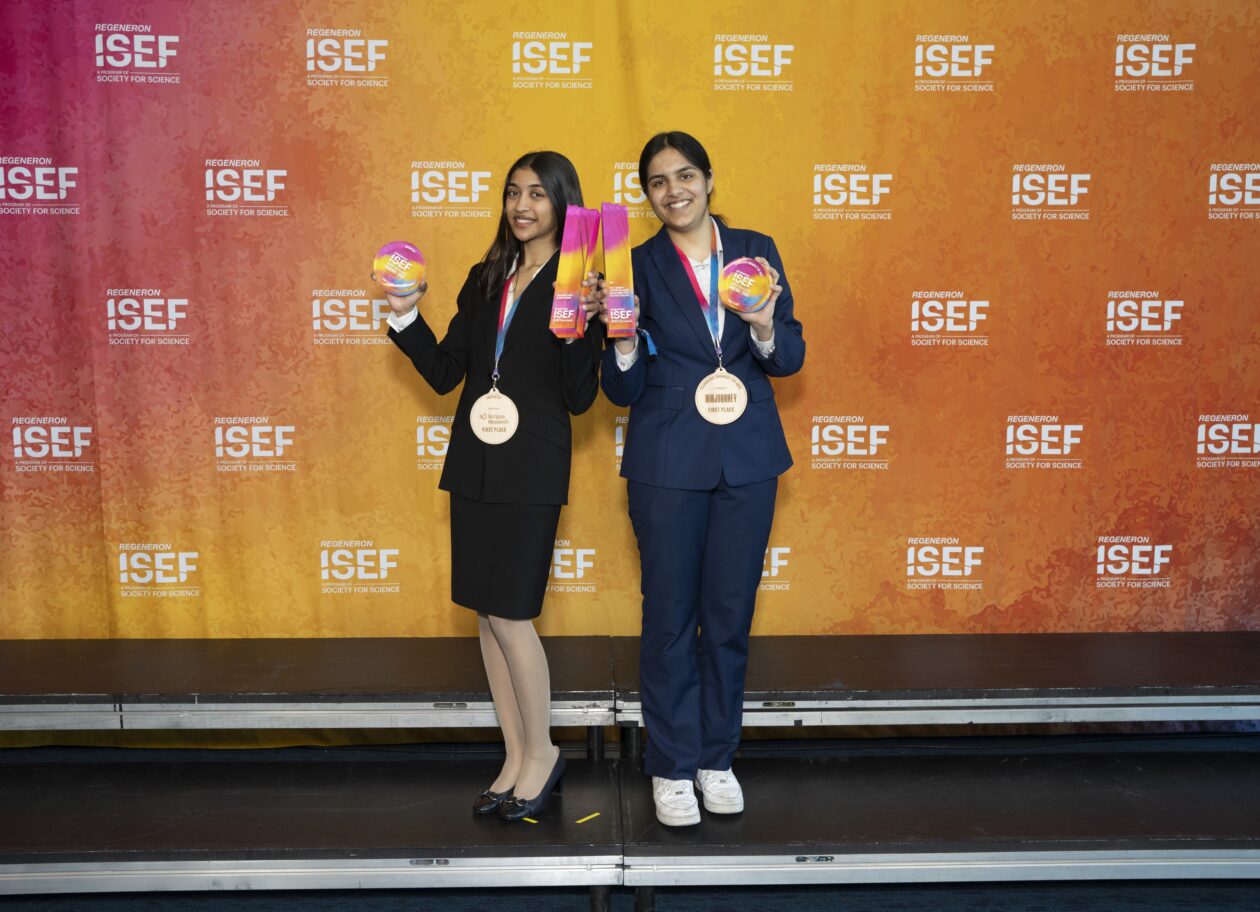
Lakshmi Agrawal, left, and Anusha Arora, both of Bellevue, Wash., hold their prizes at the Society for Science’s Regeneron International Science and Engineering Fair earlier this month. (Lisa Fryklund / Licensed by Society for Science)
Two teenagers from Bellevue, Wash., took home a combined $125,000 at the world’s largest high school science competition this month — one for a low-cost filter that could help save Puget Sound’s salmon, the other for an AI-powered device that expands access to music therapy.
Lakshmi Agrawal, a senior at Interlake High School, and Anusha Arora, a sophomore who also attends Interlake, were among more than 1,700 students from roughly 60 countries who competed at the Regeneron International Science and Engineering Fair in Phoenix.
The annual competition, run by the Society for Science, is the world’s largest science and engineering contest for high schoolers and handed out more than $7 million in awards this year.
Lakshmi Agrawal developed nanocellulose hydrosponges to help to protect aquatic ecosystems from tire-derived water contaminants. (Chris Ayers Photography / Licensed by Society for Science)
Agrawal, 18, won the Regeneron Young Scientist Award and a $75,000 prize for developing a low-cost, biodegradable sponge that filters a tire-derived chemical linked to the mass die-offs of coho salmon in Puget Sound-area streams. The chemical, 6PPD-quinone, has been identified as a primary culprit in kills that wipe out up to 80% of returning adult coho in some urban waterways before they can spawn.
To tackle the problem, Agrawal turned to an unlikely raw material: waste fibers from the jute plant. In lab tests, her sponge-like filters removed up to 80% of the pollutant from water containing tire particles, and also captured heavy metals and other contaminants. Compared to existing filtration alternatives, her approach required 85% less energy to produce and cut costs by roughly 98%.
Agrawal is headed to MIT in the fall to study chemistry and chemical engineering.
Advertisement
Learn more about her project here.
Anusha Arora and her AI-powered music therapy platform HARMONI. (Chris Ayers Photography / Licensed by Society for Science)
Arora, 15, took home the F. Thomson Leighton and Bonnie Berger Family Prize for STEM Excellence and $50,000 for building a portable music therapy platform that uses artificial intelligence to generate personalized music in real time based on a listener’s emotional state.
The device reads biometric signals through finger sensors and runs them through a suite of 11 AI models to detect emotions and compose adaptive music on the fly. In testing, users showed measurable reductions in stress and anxiety and stayed more engaged with therapy sessions than with conventional approaches.
Arora designed the platform to address a gap she identified in mental health care — music therapy is a clinically recognized treatment, but cost, provider shortages and spotty insurance coverage put it out of reach for most people.
Maya Ajmera, president and CEO of Society for Science, said she never fails to be inspired by the students who compete in the fair.
“They come from different backgrounds, different disciplines, and different corners of the world, and they are taking on some of our most urgent challenges with rigor, imagination, and determination,” Ajmera said in a statement. “At a moment when bold thinking is needed most, they are proof of what’s possible. I couldn’t be more optimistic about the future.”























































You must be logged in to post a comment Login