Threat actors are targeting systems with high-performance computers in an ongoing cryptojacking campaign spread through a coordinated SEO poisoning operation that also manipulated AI chatbot recommendations.
The compromise occurs through malicious download pages for utility software typically installed by owners of powerful systems, like CrystalDiskInfo, HWMonitor, Display Driver Uninstaller, FurMark, K-Lite Codec Pack, and PDFgear.
Once a system is infected, the attacker gets persistent access on the machine by deploying the legitimate remote management ScreenConnect tool, which could later be used to install additional malware.
Microsoft researchers discovered the campaign and determined that the attack begins when users look for one of the aforementioned utilities and are presented with malicious links boosted in search rankings through SEO poisoning.
Advertisement
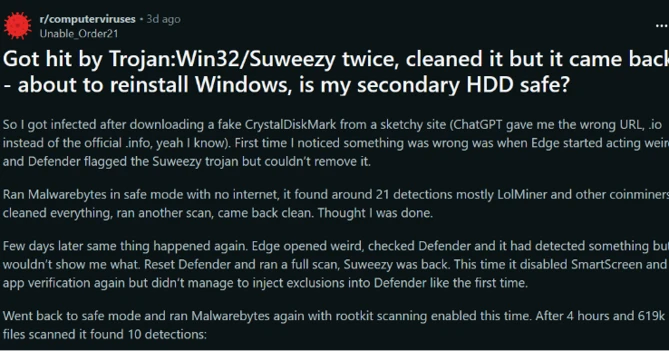
However, some reports in April indicated that users were directed to the malicious domains after interacting with AI-based assistants.
“In these cases, users querying AI chatbots for software download recommendations were presented with links to attacker‑controlled domains within generated responses,” Microsoft says.
Claim that ChatGPT directed to malicious URL for downloading CrystalDiskMark source: Microsoft
The malicious download is a ZIP archive hosted on a subdomain at gleeze[.]com, a domain that has been flagged in the past for being associated with phishing websites.
According to Microsoft, the archive includes the legitimate executable for the legitimate utility as well as a malicious DLL that is automatically loaded when launching the benign binary.
The researchers found that the DLL uses msiexec.exe to install vcredist_x64.dll, which is a package installer for the ScreenConnect remote access tool.
Advertisement
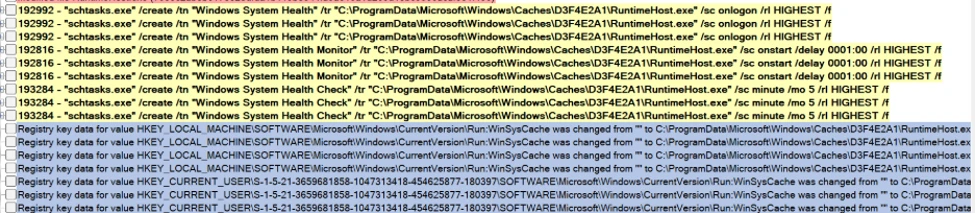
After establishing a ScreenConnect session with the compromised client, the threat actor drops another binary named SimpleRunPE.exe that copies itself as RuntimeHost.exe into a folder hidden in Explorer.
The purpose of the executable is to establish “six persistence mechanisms across multiple Windows autostart locations.”
Malware establishing six persistence mechanism source: Microsoft
In some cases, the binary is dropped via a malicious PowerShell script and is saved locally as vlc.exe, in an attempt to impersonate the executable for the popular VideoLAN multimedia player.
Based on SimpleRunPE.exe’s Program Database (PDB) path, the researchers believe that it is a fork of a public repository for demonstrating the process hollowing technique.
The threat actor resorted to this technique for stealth and tried process hollowing into a legitimate .NET binary signed by Microsoft: InstallUtil.exe, RegAsm.exe, RegSvcs.exe, MSBuild.exe, AppLaunch.exe, AddInProcess.exe, aspnet_compiler.exe.
Advertisement
To the same purpose, the malicious binary also invokes PowerShell to add its path and process to the exclusion list in Microsoft Defender.
Additionally, the malware checks the environment for virtual machines and a set of 40 process names corresponding to analysis tools. If any are identified, the malware terminates its execution.
After completing the process hollowing stage and the malware runs inside a Microsoft-signed Windows utility, one of three mining modules is downloaded and executed.
The supported mining programs are gminer, lolMiner, and SRBMiner-MULTI, all of them designed to use graphics processing units (GPUs).
Advertisement
Microsoft says that this cryptocurrency campaign stands out for its “targeting and monetization strategy engineered from the ground up to maximize GPU mining yield per compromised device,” instead of focusing on volume.
Apart from the defenses provided by Microsoft’s tools, organizations can protect their environments using the indicators of compromise included in the report.
Automated pentesting tools deliver real value, but they were built to answer one question: can an attacker move through the network? They were not built to test whether your controls block threats, your detection rules fire, or your cloud configs hold.
This guide covers the 6 surfaces you actually need to validate.
The Wall Street Journal reviewed 1,105 videos along with guidance given to creators for crafting their posts.
Polymarket
In case you needed another reason to be wary of those videos showing people winning big on Polymarket, an investigation by The Wall Street Journal has found that the company is paying social media creators to post misleading content promoting the prediction market. Of the 1,105 TikTok videos the publication reviewed, 778 appeared to show someone placing a bet — but a closer look reportedly revealed that none of the latter featured the actual Polymarket website, instead using dummy sites made to look like the real thing.
For more than half of the videos that appeared to show winning bets, those bets would in reality have been losses, The Wall Street Journal reports. The publication spoke to creators who worked with Polymarket and viewed materials they say they were given to ensure their videos were convincing and engaging. In addition, Polymarket reportedly also enlisted a “social-media army” to repost these videos and help them go viral.
Mo Salah’s Egypt meet Chris Wood’s New Zealand at BC Place in Vancouver, with both teams looking to break away from the Group G bottleneck after all four sides opened their World Cup 2026 campaigns with draws.
Although Egypt performed well, especially defensively, in their opener against Belgium, they led for nearly two-thirds of the match before an own goal by Mohamed Hany, arguably caused by the impact of Romelu Lukaku’s introduction, brought Belgium level.
Still, they’ll be pleased with how their defence marshalled a disciplined low block, spearheaded by centre-back Mohamed Abdelmonem. Hossam Hassan’s men will hope to replicate that performance as Mo Salah looks to secure his first-ever World Cup victory with Egypt.
Advertisement
New Zealand, meanwhile, entered the tournament as the lowest-ranked team in the field but stood up impressively to 20th-ranked Iran in a 2-2 draw thanks to goals from Elijah Just.
So, read on as we show you exactly how to watch New Zealand vs Egypt for free from anywhere in the FIFA World Cup 2026.
How to watch New Zealand vs Egypt for free
New Zealand vs Egypt is available to watch for free in multiple countries, including the UK, Australia, Brazil, Belgium, Ireland, Netherlands, Switzerland and Turkey.
Advertisement
Abroad? Can’t access your free stream? Unblock your free World Cup stream with Norton VPN — more on that below.
Use a VPN to watch New Zealand vs Egypt live streams
It’s the World Cup, and if you’re traveling, you might discover your usual New Zealand vs Egypt stream is suddenly unavailable due to geo-restrictions.
Don’t worry, that’s exactly where a VPN can help. A virtual private network lets you connect to servers around the world so you can securely access your usual World Cup coverage as if you were back home.
Those looking for a streaming service instead can watch New Zealand vs Egypt on Fox One (3-day free trial).
If you are looking for a stream in Spanish you can watch on Telemundo which is available via Peacock.
Visiting the US from the UK? You can still watch your World Cup stream for free thanks to Norton VPN (try for 60 days).
Advertisement
How to watch New Zealand vs Egypt in the UK
UK customers are in luck as they can stream New Zealand vs Egypt for free on ITV. Live coverage is on ITV1 and ITVX.
You require a TV license and a valid UK postcode for an account (e.g. SE1 7PB).
Norton VPN can unlock your stream if you’re abroad today.
Advertisement
How to watch New Zealand vs Egypt in Australia
(Image credit: free)
New Zealand vs Egypt will be shown for free in Australia on SBS On Demand.
The streaming platform has every game of the tournament for free, making it the perfect place for your World Cup viewing.
Traveling for work or on holiday? A VPN like Norton VPN can help unlock your free stream.
Advertisement
How to watch New Zealand vs Egypt in Canada
(Image credit: Other)
In Canada, TSN and free-to-air channel CTV will be broadcasting New Zealand vs Egypt.
You can live stream via the TSN+ streaming platform, which costs CA$8 per month or CA$80 per year.
CTV will require your TV provider login details, but is also available via streaming platform Crave if you want an alternative.
Outside of Canada? Use Norton VPN whilst you’re traveling away from home to unlock your stream.
Advertisement
New Zealand vs Egypt: Match Information
What time does New Zealand vs Egypt start?
New Zealand vs Egypt kicks-off at 2am BST / 11am AEST on Tuesday, June 22. That’s 9pm ET on the previous day, i.e., Monday, June 21.
What are the squads for New Zealand vs Egypt?
New Zealand
Goalkeepers: Max Crocombe (Millwall), Alex Paulsen (Lechia Gdansk), Michael Woud (Auckland FC)
Advertisement
Defenders: Tim Payne (Wellington Phoenix), Francis de Vries (Auckland FC), Tyler Bindon (Sheffield United), Michael Boxall (Minnesota United FC), Liberato Cacace (Wrexham), Nando Pijnaker (Auckland FC), Finn Surman (Portland Timbers), Callan Elliot (Auckland FC), Tommy Smith (Braintree)
Midfielders: Joe Bell (Viking), Matthew Garbett (Peterborough United), Marko Stamenic (Swansea City), Sarpreet Singh (Wellington Phoenix), Elijah Just (Motherwell), Alex Rufer (Wellington Phoenix), Ben Old (Saint-Etienne), Callum McCowatt (Silkeborg), Ryan Thomas (PEC Zwolle), Lachlan Bayliss (Newcastle Jets)
Forwards: Chris Wood (Nottingham Forest), Kosta Barbarouses (Western Sydney Wanderers), Ben Waine (Port Vale), Jesse Randall (Auckland FC)
Egypt
Advertisement
Goalkeepers: Mohamed El Shenawy (Al Ahly), Mostafa Shobeir (Al Ahly), El Mahdi Soliman (Zamalek), Mohamed Alaa (El Gouna)
Forwards: Omar Marmoush (Manchester City), Mohamed Salah (Liverpool), Aqtay Abdallah (Enppi), Hamza Abdelkarim (Barcelona)
Advertisement
Swipe to scroll horizontally
Group G Table
Position
Team
GD
Points
Advertisement
1
New Zealand
0
1
Advertisement
2
Iran
0
1
Advertisement
3
Belgium
0
1
Advertisement
4
Egypt
0
1
Advertisement
Can I watch New Zealand vs Egypt on my mobile?
Of course, most broadcasters have streaming services that you can access through mobile apps or via your phone’s browser.
You can also stay up-to-date with all of the key World Cup moments on the official social media channels on X/Twitter (@FIFAWorldCup), Instagram (@FIFAWorldCup), TikTok (@FIFAWorldCup) and YouTube (@FIFA).
We test and review VPN services in the context of legal recreational uses. For example: 1. Accessing a service from another country (subject to the terms and conditions of that service). 2. Protecting your online security and strengthening your online privacy when abroad. We do not support or condone the illegal or malicious use of VPN services. Consuming pirated content that is paid-for is neither endorsed nor approved by Future Publishing.
A new NYT Connections puzzle appears at midnight each day for your time zone – which means that some people are always playing ‘today’s game’ while others are playing ‘yesterday’s’. If you’re looking for Sunday’s puzzle instead then click here: NYT Connections hints and answers for Sunday, June 21 (game #1106).
Good morning! Let’s play Connections, the NYT’s clever word game that challenges you to group answers in various categories. It can be tough, so read on if you need Connections hints.
What should you do once you’ve finished? Why, play some more word games of course. I’ve also got daily Strands hints and answers and Quordle hints and answers articles if you need help for those too, while Marc’s Wordle today page covers the original viral word game.
Advertisement
SPOILER WARNING: Information about NYT Connections today is below, so don’t read on if you don’t want to know the answers.
Latest Videos From
NYT Connections today (game #1107) – today’s words
(Image credit: New York Times)
Today’s NYT Connections words are…
STRESSED
BOOMER
POWDER
HEAD
ALPHA
SOFT
X
LEAD
TIMES
PRIMARY
SILENT
.
SHORT
POPSICLE
BY
BANGKOK
NYT Connections today (game #1107) – hint #1 – group hints
What are some clues for today’s NYT Connections groups?
Advertisement
YELLOW: In charge
GREEN: Sum it up
BLUE: How things are said
PURPLE: Sounds loud
Need more clues?
We’re firmly in spoiler territory now, but read on if you want to know what the four theme answers are for today’s NYT Connections puzzles…
Sign up for breaking news, reviews, opinion, top tech deals, and more.
Advertisement
NYT Connections today (game #1107) – hint #2 – group answers
What are the answers for today’s NYT Connections groups?
YELLOW: DOMINANT
GREEN: MULTIPLICATION INDICATORS
BLUE: PRONUNCIATION DESCRIPTORS
PURPLE: STARTING WITH EXPLOSIVE ONOMATOPOEIA
Right, the answers are below, so DO NOT SCROLL ANY FURTHER IF YOU DON’T WANT TO SEE THEM.
Advertisement
NYT Connections today (game #1107) – the answers
(Image credit: New York Times)
The answers to today’s Connections, game #1107, are…
PURPLE: STARTING WITH EXPLOSIVE ONOMATOPOEIA BANGKOK, BOOMER, POPSICLE, POWDER
My rating: Hard
My score: Perfect
This was one of those games of Connections where I made zero mistakes despite being uncertain about every group.
My big disappointment was that even though I managed to get the group containing the two unusual tiles, the reward was that it was only the green group. The big dot is an alternative to x and is used in algebra to avoid confusion. Not that I knew this at the time of course!
Meanwhile, having grown up watching Adam West’s Batman I am annoyed that I missed the Bang! Boom! And Pow! At the start of BANGKOK, BOOMER, and POWDER.
Advertisement
Yesterday’s NYT Connections answers (Sunday, June 21, game #1106)
PURPLE: STARTING WITH KINDS OF INSULTS BARBADOS, DIGGITY, DISSECT, SLAPDASH
What is NYT Connections?
NYT Connections is one of several increasingly popular word games made by the New York Times. It challenges you to find groups of four items that share something in common, and each group has a different difficulty level: green is easy, yellow a little harder, blue often quite tough and purple usually very difficult.
On the plus side, you don’t technically need to solve the final one, as you’ll be able to answer that one by a process of elimination. What’s more, you can make up to four mistakes, which gives you a little bit of breathing room.
It’s a little more involved than something like Wordle, however, and there are plenty of opportunities for the game to trip you up with tricks. For instance, watch out for homophones and other word games that could disguise the answers.
It’s playable for free via the NYT Games site on desktop or mobile.
SPONSORED POST: Come join this working afternoon for infrastructure teams
Your hybrid estate has grown more complicated since the last refresh cycle. Some workloads run in the public cloud, others never left the rack, and a few sit stuck in transition because nobody wants to be the person who broke the database. Add AI to the pile and the platform questions only get harder.
Nutanix Tech Day is a half-day event designed to help the people who have to deal with increasingly complex infrastructure.
Date: Wednesday, June 24, 2026
Advertisement
Time: 12pm to 6pm BST
Place: Prospero House, Southbank, London
Registration is free and includes lunch, refreshments, and time set aside for networking.
What you’ll learn
The agenda runs through the headline announcements and key takeaways from Nutanix .NEXT Chicago 2026. Then you’ll get technical sessions on disaster recovery, data sovereignty, hybrid multicloud management, operational automation, and enterprise AI use cases that have shifted from slideware into production budgets.
Advertisement
The tracks split so you can pick the sessions aligned to your priorities and skip the rest. If you have ever sat through a vendor day waiting for the one talk relevant to your stack, try this instead.
Customer sessions are especially worth turning up for. The Bunker and London Gatwick Airport will walk attendees through what they have done with Nutanix in production, and talking to people who run the platform day to day is the cheapest form of due diligence you will find.
Who it’s for
This event is for infrastructure engineers, technical architects, systems administrators, and cloud professionals. Security and compliance leads have reason to attend too, given the disaster recovery and data sovereignty material on the agenda.
Why attend in person?
The event puts you in a room with peers tackling the same problems and with the engineers who have run these platforms in production, the kind of conversation that rarely transfers to a video call. You can put questions directly to Nutanix specialists in an interactive setting, which tends to be the part of these days that justifies the train fare.
Advertisement
The 12pm start gives you half a day out of the office to meet some interesting people, lunch included, and a working list of things to try when you get back. The tote bag is optional.
Join Nutanix Tech Day London 2026
Discover practical insights from Nutanix experts and industry leaders on AI infrastructure, hybrid multicloud, modernisation, and operational resilience. Register now.
When did you last step off the scales feeling like you actually understood what the number meant, rather than just hoping it was moving in the right direction?
RENPHO Smart Scales are at their lowest price for Prime Day
RENPHO Smart Scales are at their lowest price for Prime Day
The RENPHO MorphoScan Smart Body Scale is built to answer that question, using Bioelectrical Impedance Analysis to track over 13 metrics including muscle mass, visceral fat, body water percentage, and metabolic age alongside your weight.
Those metrics sync automatically over Bluetooth and Wi-Fi to the RENPHO app, which converts your readings into visual trend charts so you can see week on week whether your training is shifting body composition or just fluctuating water weight.
The app connects natively with Apple Health, Fitbit, and Google Fit, so the MorphoScan slots into whatever health ecosystem you’re already using without asking you to abandon anything you’ve built up.
Advertisement
It also supports unlimited user profiles and recognises each family member automatically when they step on, meaning one device handles an entire household without anyone needing to manually switch accounts or scroll through a settings menu.
Advertisement
The platform itself is built around high-precision sensors housed in a design that sits cleanly in a modern bathroom, so it doesn’t feel like a compromise between function and the way the room looks.
The fact that over 700 verified Amazon buyers have settled on a 4.2-star average for the MorphoScan is the kind of signal that matters more than a spec sheet when you’re choosing something you’ll step on every morning.
If you’ve been tracking progress the hard way and want something that finally gives you a full picture, the £16.50 saving makes the RENPHO MorphoScan a genuinely strong buy before the Prime Day window closes on 26 June.
Data suggests firms are turning away from CEST as critics say it fails to reflect recent court rulings
Use of HMRC’s own tool for checking compliance with the UK’s controversial IR35 freelancer tax rules has fallen sharply, according to Freedom of Information data obtained by tax adviser IR35 Shield.
The Check Employment Status for Tax tool, better known as CEST, was created to help firms decide whether contractors should be taxed like employees. But usage fell 43 percent during the 2025-26 tax year, and dropped 71 percent between 2023-24 and 2024-25, from 458,894 determinations to 135,178.
Advertisement
What is IR35?
IR35 is a reform unveiled in 1999 by the UK tax authorities. The latest regulation change – which came into force in April 2021 – forces medium and large businesses in the UK to set the tax status of their contractors and freelancers. Previously this was set by the contractors themselves.
Contractors found to be within the scope of the legislation – i.e. inside IR35 – will have to pay more tax than they might expect.
The reforms are part of the government’s crackdown on so-called disguised employment, where workers behave as employees but avoid paying regular income tax and national income contributions by billing for their services through PSCs, which are taxed at lower corporate rates.
The measures first came into effect in the UK public sector in 2017. The British government hoped the reforms would recoup £440m by bringing 20,000 contractors in line.
Advertisement
HMRC reckons that only one in 10 contractors in the private sector who should be paying tax under the current rules are doing so correctly. It estimates the reforms will recoup £1.2bn a year by 2023.
The findings suggest that firms continue to abandon CEST in favor of alternative status assessment solutions and more comprehensive compliance processes, IR35 Shield said.
CEO Dave Chaplin said: “The majority of firms we speak to for the first time are either lifting blanket bans or seeking to move away from using CEST, having realized it is not compulsory to use, nor does it give them the level of certainty they need.”
The decline is not the result of changes to the tool or legislation, according to IR35 Shield.
Advertisement
“The underlying CEST logic has not been updated since November 2019 and was based on HMRC’s view of the law at that time. Despite the courts dismissing HMRC’s position in key areas, upon which the tool was based, the tool has not been updated,” Chaplin said.
IR35 Shield pointed out that HMRC lost a recent employment status case with Professional Game Match Officials Limited (PGMOL). Entering the facts of the case into CEST would have produced an indeterminate result, it said.
In 2022, the Public Accounts Committee Committee (PAC) found that central government was spending hundreds of millions of pounds to cover tax owed for individuals wrongly assessed as self-employed. “Government departments and agencies owed, or expected to owe, HMRC £263 million in 2020-21 due to incorrect administration of the rules,” the House of Commons spending watchdog said.
Part of the compliance problem was down to HMRC’s guidance and the CEST tool. “Some questions within CEST were difficult to interpret correctly, and the guidance was long, too general in scope and not integrated into CEST itself,” the PAC said.
Advertisement
In a statement sent to The Register, a spokesperson at HMRC, said:
“We always expected use of the tool to reduce as employers familiarised themselves with the 2021 off-payroll working reforms, and the majority of those who use the tool are satisfied with the service they receive.
“The tool is rigorously tested against case law and we’ll stand by the tool’s results, so long as the information provided is correct in accordance with our guidance.” ®
Electrek reports:
Tesla wants to sell modular AI data center hardware, according to a new trademark application for a product called “Megapod.” The filing describes a complete, self-contained computing system for AI workloads…
Tesla filed the “Megapod” trademark (serial number 99893717) with the U.S. Patent and Trademark Office this month, through its longtime IP counsel. It’s an intent-to-use application, meaning Tesla is claiming the name for a product it hasn’t launched yet. The goods-and-services description is unusually specific for a trademark. Megapod covers “modular data center hardware systems for artificial intelligence computing, comprised of computer servers, computer hardware for artificial intelligence data processing, networking equipment, power distribution units, and cooling systems.” It also covers “self-contained modular computing hardware systems for artificial intelligence workloads,” integrated platforms sold as a single unit — an enclosure bundling compute, power distribution, and cooling — and downloadable software to monitor, manage, and optimize those systems.
In plain terms: Tesla wants to sell a turnkey AI data center building block. Not a battery, not a chip on its own, but the full rack-and-room of servers, networking, power, and cooling that AI training and inference run on.
Tesla’s offering would have to compete with Nvidia’s liquid-cooled, rack-scale systems that simulates a giant GPU, the article points out. But “The bigger issue is that Tesla has no merchant compute-hardware business to build on.”
Advertisement
Tesla’s own AI training cluster, Cortex at Gigafactory Texas, runs on roughly 67,000 Nvidia H100-equivalent GPUs. In other words, Tesla is one of Nvidia’s customers, not a competitor selling alternative hardware… Where Tesla does have a real AI-data-center business is power, not compute. Its Megapack and new Megablock energy storage products are selling into AI data centers as grid buffers — Musk’s own xAI has bought roughly $1 billion of Megapacks to keep its training runs powered. That energy-storage strength is the one credible thread here. A Megapod that bundles Tesla’s power electronics, thermal management, and the enclosure — the “shell” around the chips rather than the chips themselves — would at least sit adjacent to a business Tesla actually runs.
Polymarket has been paying online creators to post deceptive videos that show them making lucrative bets on the prediction market, according to a new investigation in the Wall Street Journal.
The WSJ said that it analyzed 1,100 videos about Polymarket and also viewed instructional materials that the company provided to creators. Many of those videos were reportedly filmed on “near-perfect copies” of the Polymarket website, while featuring trades and winnings that were not real. The creator videos were then amplified by a “social-media army” deployed by a marketing contractor.
The WSJ said the company also told those creators not to specify that they’d been paid by Polymarket, although the creators started adding “@polymarket partner” to their bios after journalists began asking questions.
Razeen Khan, a college student and creator who worked with Polymarket until March, compared the practice to commercials that make fast food look more appealing than it is in real life: “We’re depicting what actually happens.”
Advertisement
Polymarket said it is “committed to maintaining accurate, fair, and transparent markets” and plans to conduct an audit of its promotional content.
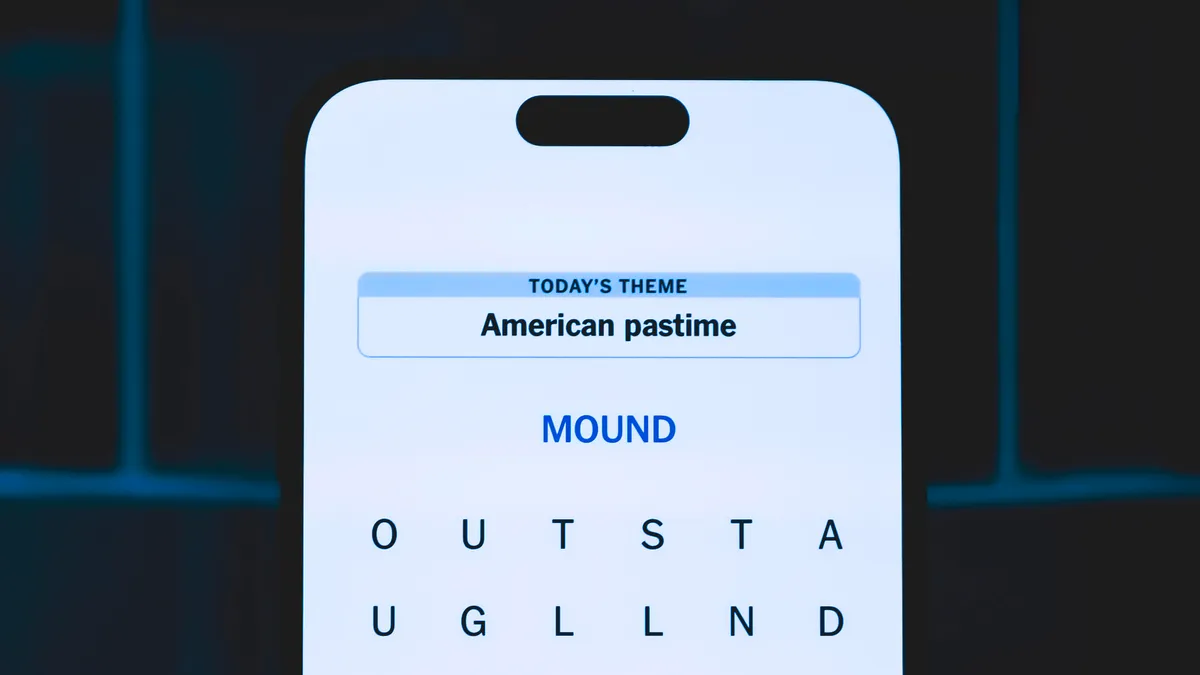
Looking for the most recent Strands answer? Click here for our daily Strands hints, as well as our daily answers and hints for The New York Times Mini Crossword, Wordle, Connections and Connections: Sports Edition puzzles.
Today’s NYT Strands puzzle has a fun topic, though it might be better suited for October. Some of the answers are difficult to unscramble, so if you need hints and answers, read on.
Your goal is to find hidden words that fit the puzzle’s theme. If you’re stuck, find any words you can. Every time you find three words of four letters or more, Strands will reveal one of the theme words. These are the words I used to get those hints but any words of four or more letters that you find will work:
These are the answers that tie into the theme. The goal of the puzzle is to find them all, including the spangram, a theme word that reaches from one side of the puzzle to the other. When you have all of them (I originally thought there were always eight but learned that the number can vary), every letter on the board will be used. Here are the nonspangram answers:
CREEPS, SHIVERS, JITTERS, WILLIES, BUTTERFLIES
Today’s Strands spangram
The completed NYT Strands puzzle for June 22, 2026.
NYT/Screenshot by CNET
Today’s Strands spangram is GOOSEBUMPS. To find it, start with the G that’s five letters down on the far-left row, and wind up and around.
Access to safe drinking water remains a challenge for billions of people worldwide, but a new invention from researchers in South Korea could make the process much simpler. A self-powered floating capsule that fits in the palm of a hand can reportedly test water quality and disinfect unsafe water without relying on batteries, external power, or chemical treatments.
A simple shake is all this water purification capsule needs
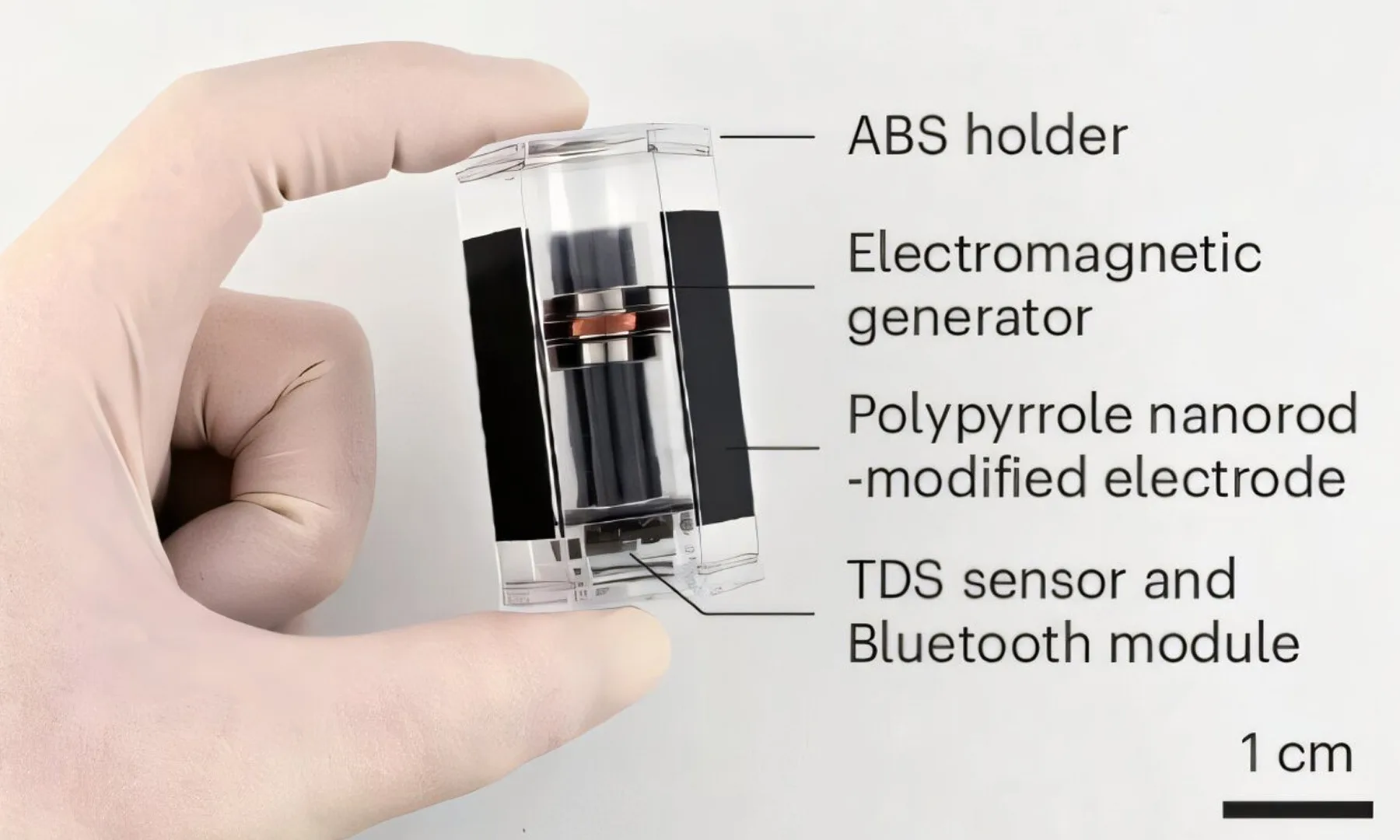
According to a recent paper published in Nature Water, the device, called the Floating-induced Detection-Guided Disinfection (FDGD) capsule, generates electricity when shaken. An internal magnet moves through a coil to produce enough power to activate a built-in sensor that measures the water’s electrical conductivity, giving users an indication of its quality through a connected smartphone or smartwatch.
Construction of an FDGD capsuleNature Water
If the water passes the initial safety check, the capsule can simply be left floating inside it. Gentle movement from waves or even walking while carrying the container generates static electricity, powering microscopic nanorods on the capsule’s surface. These create strong electrostatic forces that damage the membranes of nearby bacteria and viruses through a process known as electroporation, effectively neutralizing them without adding chemicals.
Nature Water
In laboratory testing involving containers holding up to four liters of water, researchers reported that the device successfully inactivated 99.9999% of bacteria and viruses, including E. coli, across multiple water samples. The technology was detailed in the journal Nature Water, with researchers describing it as an affordable, decentralized solution for regions where conventional water treatment infrastructure is unavailable.
The clever part isn’t the disinfection, it’s the lack of dependencies
Interestingly, plenty of portable water purifiers already exist, but most depend on disposable filters, chemicals, UV lamps, or rechargeable batteries. This capsule sidesteps all of those requirements by harvesting energy from simple physical movement, making it particularly attractive for disaster relief, camping, remote communities, or humanitarian deployments where electricity isn’t guaranteed.
Of course, the FDGD capsule is still a research prototype and has yet to prove itself outside controlled testing. But if it can be commercialized at the low cost envisioned by its creators, it could put a reliable water testing and purification tool into millions of hands. Sometimes, the biggest breakthroughs aren’t massive treatment plants or billion-dollar infrastructure projects. Sometimes, they’re small enough to fit in your pocket.

































































You must be logged in to post a comment Login