HiFiMAN helped turn planar magnetic headphones into a serious personal audio category, and the company has never been shy about taking weird swings. Nanometer-thin diaphragms, Stealth Magnets, and open-back designs that look like they escaped from an engineering lab with no adult supervision — this is familiar territory. But the HiFiMAN HE1000 WiFi is not just another wireless headphone with a luxury badge and a bigger invoice.
The high-performance wireless headphone market has already moved well past “good for Bluetooth.” The Focal Bathys MG pushed wireless ANC into more serious audiophile territory at $1,499, while the DALI IO-12 went even higher at $1,750 with its SMC driver technology and hi-fi-first tuning. Mark Levinson’s No. 5909 also helped prove that premium wireless headphones could be more than airport jewelry for people who alphabetize their boarding passes.
HiFiMAN, however, has taken a bigger and riskier step. At $2,699, the HE1000 WiFi is an open-back planar magnetic headphone with built-in WiFi streaming, Bluetooth, USB audio, Stealth Magnet drivers, and support for high-resolution playback well beyond what conventional Bluetooth headphones can deliver. It is less “wireless ANC rival” and more “high-end headphone system with the cable surgically removed.”
The question is whether WiFi streaming actually moves the HE1000 closer to wired high-end headphone performance, or whether HiFiMAN has spent two years building one of the smartest ideas in wireless headphones and left just enough unfinished to make the price sting.
Advertisement
HiFiMAN HE1000 WiFi
Specifications and Technology
The HE1000 WiFi is more than a passive planar magnetic headphone with wireless connectivity added on. HiFiMAN has integrated a complete playback chain inside the earcup, including its HYMALAYA Mini DAC, headphone amplifier, and WiFi streaming platform. The HYMALAYA Mini DAC measures only 8mm, which makes the internal packaging impressive given the limited space available inside a headphone.
The DAC section is specified with THD+N of 0.0055% and 105dB of channel separation. Via USB-C, the HE1000 WiFi supports up to 768kHz/32-bit PCM and DSD512, which is far beyond the resolution of most commercially available music files. Those figures are technically impressive, but the more relevant question is how well the DAC, amplifier, wireless platform, and planar drivers work together as a complete system.
As expected from a headphone carrying the HE1000 name, the driver section includes HiFiMAN’s nanometer-thickness diaphragm and Stealth Magnet technology. These are designed to reduce unwanted acoustic interference, improve transient response, and preserve clarity. The engineering is familiar from HiFiMAN’s higher-end planar magnetic headphones, but the WiFi implementation makes this version meaningfully different from the passive HE1000 models.
The main feature is WiFi streaming. Bluetooth has improved, and the HE1000 WiFi still supports it, but Bluetooth remains limited by codec bandwidth and compression. WiFi gives the headphone a wider path for high-resolution and lossless playback over a home or office network, which is the core argument for this product. The goal is straightforward: deliver more of the sound quality associated with a wired planar headphone while retaining the freedom of wireless listening.
Advertisement
That does not automatically make the HE1000 WiFi better than every premium Bluetooth headphone, nor does it remove the usual questions about app support, setup, stability, battery life, and daily usability. But it does give HiFiMAN a different technical angle in a category where most wireless headphones are still built around Bluetooth first. At its asking price, that difference needs to be clearly audible and easy to live with.
They can also be used over standard Bluetooth, with a Qualcomm QCC5181 chip that supports LDAC for up to 96kHz playback. That is more than enough for Spotify, YouTube, and most casual listening sessions where convenience matters more than chasing every last bit. Bluetooth also gives the HE1000 WiFi a meaningful battery life advantage over WiFi mode, but we’ll get to battery longevity shortly.
Design & Comfort
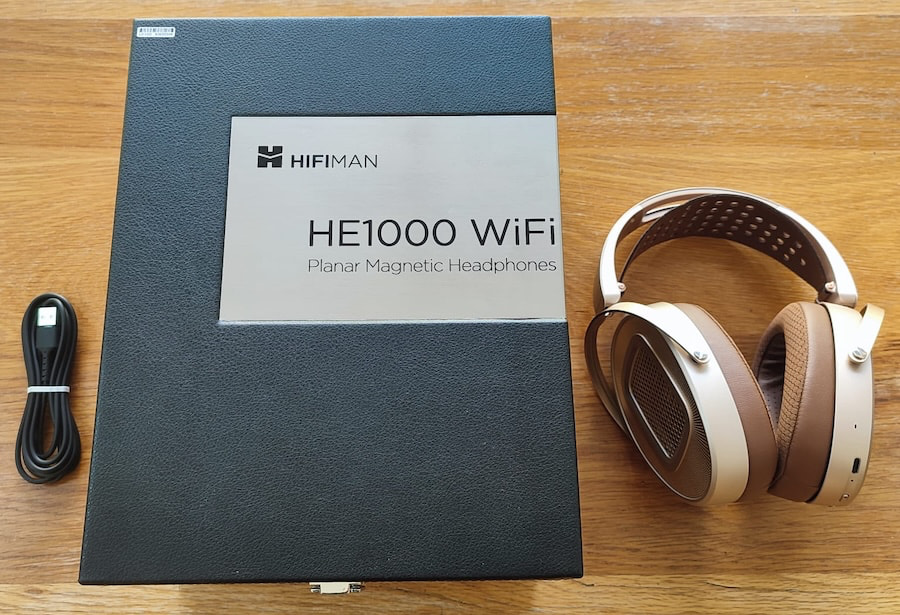
A quick word on what comes in the package. Technically, it is not really a box, but the same kind of faux leather-wrapped display case HiFiMAN has used with other HE1000 models. It looks the part, although the previous hardback owner’s manual has been replaced by a more ordinary paperback version. Accessories are also minimal: one six-foot USB-C to USB-A cable. That is about it. When the headphone is wireless, HiFiMAN clearly decided the accessory drawer did not need to audition for Hoarders.
Advertisement. Scroll to continue reading.
HiFiMAN has used its Gen. 2 headband on the HE1000 WiFi, which is a bit of a mixed bag. The upside is weight reduction, with the newer design shaving roughly 20 to 30 grams compared to some older HiFiMAN headbands. The trade-off is that it does not offer the same 360-degree earcup swivel found on the wired HE1000 and Arya models. It does feel reasonably sturdy, however, and should survive the occasional knock without requiring a grief counselor.
Advertisement
The earcups retain the familiar egg-shaped profile used across the HE1000 and Arya lines, but they are slightly deeper here to accommodate the internal circuitry. That extra depth does not hurt comfort. One of the long-standing advantages of this design is the amount of space inside the pads, with little risk of the driver or earpad pressing against the outer ear.
Materials are a mix of metal and plastic, which helps keep weight under control while still giving the HE1000 WiFi some visual connection to HiFiMAN’s higher-end models. At 452 grams, or almost exactly one pound, it is not especially light, but it is manageable for an open-back planar headphone with built-in amplification, DAC, Bluetooth, and WiFi streaming hardware.
The catch is that the build quality and finish do not fully communicate a $2,699 asking price. It feels solid enough, and comfort is generally strong, but this is not the kind of physical object that immediately makes the near-three-grand number feel self-explanatory. The HE1000 WiFi is clearly betting that the sound quality and wireless execution will do the heavy lifting. At this price, they need to.
The color? I like it, although I can see it being somewhat divisive. It is more interesting than another safe silver or black finish, and there is a faint luxury-car interior vibe to it — Rolls-Royce or Bentley from a distance, with the understanding that nobody from Crewe is losing sleep over the upholstery.
Advertisement
Comfort is far less debatable. The suspension strap distributes the weight evenly across the head, making longer listening sessions easy to manage without obvious hotspots or fatigue. Clamp force is on the firmer side, but I actually prefer that here. The HE1000 WiFi stays put when you move your head, which is rather important when the whole point is wireless freedom.
The controls are sensibly arranged and easy to understand. From top to bottom, there is a volume rocker, a function button that switches between WiFi, USB, and Bluetooth modes, and a power button. The function button includes an indicator light for the selected mode, while the power button uses colored lighting to show charging and battery status. The volume control could use finer adjustment, but the overall layout is simple and practical, which is exactly how it should be.
Battery life, unfortunately, is where things get less flattering. In my testing, the HE1000 WiFi managed roughly five hours over WiFi and about 12 hours over Bluetooth, the latter falling well short of HiFiMAN’s quoted figure of up to 23 hours. Charging takes around the claimed four hours, which is not exactly a rapid turnaround. In daily use, that means you need to charge them at the end of the night or risk starting the next day with a very expensive pair of silent earmuffs.
Most wireless headphones are easy to get running. Power them on, open the Bluetooth menu on your phone, select the model, and you are usually listening within seconds. Not exactly NASA.
Advertisement
The HE1000 WiFi is different, and not always in a good way. Connecting the headphones to my home network proved more troublesome than expected, and the process feels less polished than it should for a product at this level.
HiFiMAN seems aware of the issue, because the company has released several setup videos to guide users through the process. That helps, but it also says something. Getting the HE1000 WiFi online requires users to navigate local network pages that look rather basic, follow multiple steps, and make sure the headphones are properly connected before WiFi playback becomes available. For some audiophiles, especially those comfortable with networking and streaming hardware, this may not be a major obstacle. For everyone else, it could be the point where the WiFi promise starts to feel more like homework.
That matters because the HE1000 WiFi’s best argument is its WiFi mode. If setup friction pushes owners toward Bluetooth or wired use out of frustration, the product loses some of its reason for being. Bluetooth works, and it is useful, but nobody is spending $2,699 on these because they needed another Bluetooth headphone.
Advertisement. Scroll to continue reading.
Advertisement
There is also the issue of software support. Not every music app can cast over WiFi in the way the HE1000 WiFi requires, and some services reserve that functionality for paid tiers. Spotify and YouTube Music, for example, require premium subscriptions for casting support. That does not make the HE1000 WiFi unusable, but it does mean buyers need to understand exactly how they plan to stream before assuming WiFi playback will be seamless across every app they use.
Firmware updates are another sore spot. Bluetooth updates run through HiFiMAN’s GAIA app, but WiFi module updates require manually downloading files and uploading them through a browser-based local interface. That feels clumsy for a headphone built around WiFi.
HiFiMAN needs to fold the entire update process into one app. These issues do not ruin the HE1000 WiFi, but they do make the experience feel less polished than the hardware concept deserves.
Listening
The HiFiMAN HE1000 WiFi delivers a listening experience that very few headphones currently offer. Being able to listen to lossless music without being tied to a desk, or dealing with a cable brushing against your shirt every time you move, is genuinely liberating. You can walk around the house or office and still listen at a level that feels closer to a serious headphone rig than a typical wireless setup. Yes, you could plug a passive headphone into a DAP and get some of that mobility, but not carrying anything at all is a different proposition.
That is the HE1000 WiFi’s strongest argument. It gives you real freedom without reducing the experience to background listening. That alone helps offset some of the complaints about setup, build quality, and day-to-day usability. The better news is that the headphones also sound very good on their own terms.
Advertisement
The jump from Bluetooth to WiFi is not subtle. Detail retrieval improves, staging opens up, and the presentation feels more composed. To give the HE1000 WiFi the best possible chance, I spent most of my listening time in WiFi mode, playing lossless FLAC files from my phone.
What became clear rather quickly is that the HE1000 WiFi does not simply follow HiFiMAN’s older house sound. There is still plenty of planar speed and openness, but the tuning has moved in a slightly different direction. Let’s start with the bass.
Bass
Throughout the review process, I compared the HE1000 WiFi with the HE1000 Unveiled, which I had on hand and know well. The first meaningful difference showed up in the bass.
The HE1000 WiFi does not deliver the kind of exaggerated low-end weight found in many wireless headphones, especially ANC models, but there is a subtle midbass lift that gives music some added warmth and body. It is not overdone, and it helps the headphone sound a little fuller without turning the presentation thick or sluggish.
Advertisement
Sub-bass extension is also strong, with only a slight sense of roll-off below roughly 30Hz. On Hans Zimmer and James Newton Howard’s “Why So Serious?,” the deep 20Hz rumble was still present enough to be felt, not merely heard. That is not something every open-back planar handles convincingly, and it gives the HE1000 WiFi more low-end authority than expected.
Midrange
A bass lift usually comes with a trade-off, and with the HE1000 WiFi, that shows up in the midrange. Compared again with the HE1000 Unveiled, the wireless model sounds a little more restrained through the mids and does not deliver the same top-tier clarity or immediacy. Vocals are smooth and well controlled, but they do not step forward with the same transparency, and guitar solos do not quite dig in with the emotional pull you get from the HE1000 Unveiled or Audio-Technica ATH-ADX7000.
That is not a deal-breaker. The HE1000 WiFi has a relaxed, easygoing midrange that many listeners may actually prefer, especially for longer sessions. It is not trying to spotlight every breath, string scrape, or studio chair creak like a detective with a grudge. It is more forgiving than that.
Advertisement. Scroll to continue reading.
Advertisement
The context matters as well. We are comparing the HE1000 WiFi against serious wired audiophile headphones that live in rarefied air. The fact that HiFiMAN’s wireless implementation can stay in the conversation at all is impressive. It may not match the best passive models for midrange openness or resolution, but it gets close enough to make the cable start looking less essential.
Treble
Some previous HiFiMAN headphones, including the Arya Organic, could lean a little hot in the upper frequencies. The HE1000 WiFi avoids that trap. There is still plenty of treble energy and sparkle, but it walks the line between excitement and sharpness without turning cymbals into dental work.
Extension is excellent, with enough air and control to give woodwinds, hi-hats, and upper harmonics real presence. L’Impératrice’s “La lune” was a good example, with the faint triangle hits cutting through the mix cleanly and sounding natural rather than etched for effect.
There are no obvious peaks or dips that call attention to themselves, which helps the HE1000 WiFi maintain a more natural and cohesive presentation. HiFiMAN got the treble balance right here: lively, open, and detailed, but not aggressive enough to make you start bargaining with the volume control.
Advertisement
Soundstaging & Imaging
The HE1000 WiFi does not throw an especially wide soundstage, but what it does inside that medium-sized space is far more important. Imaging is impressively precise, especially for a wireless headphone, and placement feels stable rather than vague or artificially stretched.
As with other egg-shaped HiFiMAN designs, the tall driver geometry helps create a convincing sense of height when the recording calls for it. The center image is clearly locked in, and individual layers remain easy to follow even during busier passages.
TOOL’s “Chocolate Chip Trip” is a useful stress test here, because the track is basically Danny Carey throwing percussion, electronics, and spatial chaos around the room to see what survives. The HE1000 WiFi keeps those sounds organized, with effects appearing from distinct positions rather than collapsing into a confused blob. It may not be the widest presentation HiFiMAN has ever produced, but the focus and positional accuracy are excellent.
The Bottom Line
The HiFiMAN HE1000 WiFi is one of the more compelling wireless headphone concepts to come along in years because it does something most premium wireless models still do not: it treats sound quality as the main event, not a bonus feature hiding behind ANC, app tricks, and faux-luxury packaging.
What makes it unique is the WiFi streaming implementation. The ability to walk around the house or office listening to lossless music through an open-back planar headphone without a cable hanging off your body is not a small thing. It changes how and where you listen. The HE1000 WiFi delivers much of the speed, openness, bass control, treble refinement, and imaging precision listeners expect from a serious HiFiMAN planar design, but without chaining you to the desk like a suspect in a bad procedural.
Advertisement
It is not perfect. The setup process is clumsy, firmware updates feel less polished than they should, battery life is underwhelming, and the build quality does not fully sell the premium positioning. The midrange is also smoother and less immediate than the HE1000 Unveiled, so those expecting the same level of transparency from HiFiMAN’s best passive designs should temper expectations.
But taken as a complete product, the HE1000 WiFi is still a bold and largely successful swing. It is for listeners who want high-end planar sound with real freedom of movement, who mostly listen at home or in an office, and who are willing to tolerate some early-adopter friction for a genuinely different experience.
The bigger question is whether the less expensive Arya WiFi, which we are also reviewing, can deliver enough of the same magic for a lot less money. If it gets close, HiFiMAN may have an even more interesting problem on its hands.
Advertisement. Scroll to continue reading.
Advertisement
Pros:
Excellent sound quality for a wireless headphone
WiFi streaming delivers a clear step up over Bluetooth
Lossless playback without being tethered to a desk
Strong bass extension with tasteful midbass warmth
Smooth, non-fatiguing midrange
Treble is lively, airy, and well controlled without getting sharp
Precise imaging and strong layer separation
Comfortable for long listening sessions
Secure fit with firmer clamp force
Supports WiFi, Bluetooth, and USB modes
LDAC support over Bluetooth
Clever all-in-one design with built-in DAC, amplifier, and streamer
Cons:
Setup process is more complicated than it should be
WiFi firmware updates require an awkward browser-based process
Battery life is disappointing, especially in WiFi mode
Charging time is slow
Build quality and finish do not fully feel premium
Volume control could use finer adjustment
No 360-degree earcup swivel like some wired HiFiMAN models
Midrange lacks the clarity and immediacy of the best passive HE1000 models
Not all music apps or free service tiers support WiFi casting
Early-adopter product that still needs software polish
We may receive a commission on purchases made from links.
It’s inevitable that as you go about your lawn-trimming duties, your mower will get dirty. The deck arguably gets the worst of it, with dirt, grass clippings, and all kinds of yard debris caking on it and possibly gumming up the blade’s movement. Fortunately, lawn mower deck cleaning — one of the key steps in maintaining any lawn mower — is not only possible, but incredibly easy to handle at home. With that said, there are tools and equipment that can make it even easier while ensuring your mower’s deck is properly cleaned.
Before diving in, it should be explained why exactly it’s so important to keep a mower’s deck clean. Aside from aesthetics, a clean mower deck is less susceptible to rust and corrosion. Grass clippings and lawn debris stick to the deck largely thanks to accumulated moisture, which will eat away at the mower deck, the blade, and other metal components if left alone. This can also lead to mold growth and restrict airflow while the mower is in use, putting stress on the engine. Additionally, stuck-on deck debris could carry bacteria and fungus that, when exposed to cut grass, could infect and harm your lawn.
Advertisement
To avoid all of these drawbacks, routine lawn mower deck cleaning is essential. To get it done right, these are some of the most useful tools to have in your arsenal.
Advertisement
1. A fuel siphon pump
Before starting mower deck cleaning, you need to prepare the mower for the job. That means disconnecting the spark plug wire to prevent accidental starts and then emptying the gas tank if you haven’t already run it dry. This is essential because tipping a tank full of gas can cause fuel leakage and damage the mower’s internal components. The easiest way to clear out the tank without wasting gas is to use a designated fuel siphon pump, which isn’t hard to find. Better yet, it’s not a terribly expensive tool to get ahold of either, with websites like Amazon offering pumps for less than $10.
With your pump and gas can at the ready, you’re prepared to empty your mower’s fuel tank. For two-hose models, one hose connects to the tank while the other connects to the gas can. As seen above, some utilize a more syringe-like setup with only one hose. With the hose in the gas tank, simply squeeze or lift the handle to draw fuel out. Once the tank is completely drained of gas, you’re safe to remove the hose and close the tank. For syringe models, you can now release the gas into a gas can and subsequently begin lawn mower cleaning.
Advertisement
2. A lawn mower deck scraper
There are a few ways to remove thick layers of stuck-on debris from a lawn mower deck. For some, one of the most underrated home improvement tools, the simple scraper, is enough to get the bulk off. Meanwhile, others prefer to use the built-in mower deck wash port and let their garden hose do the work. If you really want to get as much caked-on grass off as you can and do so with a bit more ease, you could invest in a designated lawn mower deck scraper. As their name suggests, these scrapers are designed specifically for cleaning mower decks.
The key distinctions that make mower deck scrapers worthy investments are their size and shape. Some offer extended handles to make scraping the deck easier without too much bending or kneeling. There’s often a curvature of some kind to the heads of these scrapers, too, matching the contours of the mower deck to get bits of grass that a regular flat scraper might not reach. These tools range in price: a steel lawn mower deck scraper costs $9.69 on the Walmart website, while the Grass-Hawk dual-bladed mower scraper is on the high end at $19.38 at Home Depot.
Advertisement
3. A wire brush
With the aid of a scraper, most of the stuck-on lawn clippings will come off the mower deck. Still, this isn’t the end of the cleaning journey. From here, it’s a good idea to use another hand tool to refine your cleaning approach. A handheld wire brush is great for removing layers of dirt and grime that are too thin and stuck-on for a scraper to completely remove. Fortunately, this is another tool that doesn’t cost too much to add to your collection. An example like the Warner brass fine wire brush only costs $4.98 at Lowe’s.
As far as use, a wire brush isn’t difficult to figure out. Being mindful of the mower’s blades, just scrub the brush on the mower deck in a clockwise or counterclockwise direction until it looks nice and clean. To take it a step further, you could invest in an attachable long handle, provided your brush has screw holes or a peg to accept it. This way, you have some added reach and don’t have to get down on your hands and knees to vigorously scrub after every lawn mow. At any rate, don’t forget to clean out the bristles once you’re done to keep debris and bacteria from returning to the deck next time.
Advertisement
4. A pressure washer
Even with the majority of the debris cleared by the scraper and brush, it’s still worth taking one last pass at your mower deck before putting it away. As mentioned, the mower deck wash port can help with cleaning, but there’s another way to use water to your advantage. A pressure washer is a great final method to clear off your mower deck, removing any remaining dirt and grass that somehow made it past the previous two tools. A sufficiently powerful unit for such a task can cost well under $200, include everything you need to get started, and come from reputable brands like Greenworks and Westinghouse. This is a comparatively costly buy, but it gets the job done.
Advertisement
Just as there are pressure-washing mistakes that can ruin a car, there are some missteps to avoid when pressure-washing a mower deck. The biggest is spraying areas that shouldn’t be sprayed, like the engine. Introducing water into these areas can inhibit a mower’s function, creating a bigger issue than a dirty deck. There’s also the concern of too high a PSI, as you just want to clean, not remove paint or otherwise damage parts of the mower. To stay on the safe side, this more light-duty task calls for around 1,300 to 1,800 PSI, with anything over 2,000 moving into risky territory.
Advertisement
5. An outdoor blower
Yaroslav Litun/Getty Images
For the most part, a scraper, brush, and pressure washer should get just about everything off of your mower deck. With that said, there may be some hard-to-reach places they miss. On top of that, this job makes a mess, leaving you with an unsightly pile of lawn clippings on your driveway. On both fronts, an outdoor blower can make all the difference. Yes, even a cheaper, smaller, battery-powered unit that only costs around $50, like the one from Pulituo on the Walmart website, or the $98.24 Black and Decker unit from Home Depot.
First and foremost, a unit from any of the major blower brands is great for blowing grass and debris from areas on the mower that the other tools couldn’t reach. In fact, the aforementioned Black and Decker model even has a tapered cone for pushing air into small, narrow areas. As far as ground cleanup goes, blowers are generally intended to move grass and leaves off driveways and sidewalks. Of course, if you’re dealing with a pile of thick, wet grass, blowers below 100 mph may struggle. A higher-powered blower over 100 mph could be necessary, or at least some of the grass moved by hand first, with the blower used for a final clean.
California lawmakers are again considering A.B. 412, a bill that would require AI developers to identify and disclose copyrighted works used to train generative AI systems.
The problem this year is the same as last year: it’s practically impossible to comply with this law. The bill demands information that often does not exist, and cannot realistically be obtained.
EFF submitted an opposition letter to the California Senate Privacy Committee explaining why we continue to believe A.B. 412 is simply unworkable. To the extent developers do follow this law, it will have the effect of locking in the power of the largest companies in AI.
A Burden That Can’t Be Met
A.B. 412 sounds simple: just have AI developers create and keep a list of all the registered copyrighted works they use in AI training.
Advertisement
That may seem straightforward. In practice, it’s anything but.
There is no machine-readable “list” of copyrighted works at the U.S. Copyright Office. And many copyright holders can get a copyright without even depositing a publicly viewable sample of the work—for example, software companies may register copyright on proprietary code without revealing it to the public.
And on the open internet, copyright information is often incomplete, unavailable, or impossible to verify. One image may be registered with the copyright office, while the next is licensed under a free Creative Commons license (like the images that EFF creates), and the next is public domain. A message forum user might post an original story, photograph, or poem without any indication of ownership or registration status.
The bill effectively asks developers to continuously cross-reference massive batches of online data against a copyright system that simply wasn’t designed to do so. If California passes A.B. 412, its impact will go far beyond the large AI companies we read about in the headlines.
Advertisement
Not Just Big Tech
Supporters often frame this bill as a way to help creative workers have some leverage against Big Tech, but the bill reaches much further than the big AI companies.
Its definition of “developer” extends to anyone who makes a generative AI model available to Californians. That includes indie developers tinkering with an existing model, open-source initiatives, nonprofits, and other non-commercial efforts. Recent amendments added exemptions for universities and government entities, which is important, but that still leaves out a vast swathe of non-commercial tech work that’s done by people without full-time jobs in government or academia.
Large companies will hire compliance teams and lawyers to navigate these requirements. Smaller organizations and independent developers usually can’t. The result will be fewer opportunities for startups and new entrants. Faced with this massive compliance burden, some won’t even try.
Courts Are Already Deciding These Questions
The bill is premised on the idea that copyright owners currently don’t have good remedies if they’re mistreated by AI companies. That simply isn’t true. And the growing wave of federal court filings in this space proves it. Content companies that want to sue tech companies, large or small, have no problem doing so. Those courts are still working through important questions about fair use and transformative use. Some courts have already concluded that many AI training activities qualify as fair use. Others continue to evaluate the issue.
Advertisement
California lawmakers should not rush to impose new state regulation while those questions remain unresolved. This is why copyright is governed at the federal level: both creators and fair users benefit from a single set of nationwide rules.
At this point, the bill remains a solution in search of a problem. Rights holders already have powerful tools to protect their interests under existing federal law. What this bill adds isn’t clarity or transparency, but a costly and essentially impossible compliance burden that will discourage small developers and researchers.
California has been able to support both artistic creativity and tech innovation for decades now. But A.B. 412 does not strike the right balance.
If you are a California resident and interested in speaking out about this bill, you can find and contact your representatives through this website.
Don’t get me wrong — I’m pretty darn excited for a Legend of Zelda: Ocarina of Time remake. But boy, I would have been so much more excited for a sequel instead.
If you’ve somehow missed it, at the most recent Nintendo Direct, we saw a brief teaser for a Switch 2 version of Ocarina of Time. Admittedly, the brief trailer is light on details — merely showcasing a cinematic intro for the iconic adventure with some voice acting and vastly improved graphics over the Nintendo 64 original — but the promise to return to Hyrule later this year has left many (myself included) ecstatic with the hope this is Zelda’s Resident Evil 2 Remakeequivalent.
Anyone who has touched Ocarina of Time knows why it’s regarded as one of the best games ever made. It perfectly translated the previously 2D-only series’ sense of adventure into a 3D world, and even close to three decades later, Ocarina’s Hyrule is a delight to explore — with its dungeons to solve, monsters to slay, and songs to learn.
Advertisement
Latest Videos From
A return to this world with a graphical and gameplay overhaul — taking learnings from titles like Breath of the Wild — would be the perfect way to revisit the classic, and introduce it to a new generation.
The Legend of Zelda: Ocarina of Time – Nintendo Direct 6.9.2026 – YouTube
Though it doesn’t quite hold a candle to its direct sequel, Majora’s Mask.
The darker tone and the repeating three-day cycle create a claustrophobic aspect that pairs perfectly with the game’s expansive world and its various branching stories. You don’t have time to solve every problem at once, so you have to slowly piece together each puzzle through what you learn in previous cycles, and the items and abilities you unlock.
Majora’s Mask could easily have been a mess, but instead it pioneered the Groundhog Day-like genre, setting the bar for what time loop games should deliver.
Advertisement
Sign up for breaking news, reviews, opinion, top tech deals, and more.
Everything is perfect… but ultimately unfinished too.
The Legend of Zelda: Majora’s Mask Trailer – Nintendo 64 – Nintendo Switch Online – YouTube
Majora’s Mask picks up where Ocarina of Time ends, with Link on a quest to find his fairy companion Navi after she leaves him at the end of the first game.
While he does save yet another realm, his inciting quest doesn’t have a conclusion, as Majora’s Mask ends with Link venturing on once more to find his fairy friend.
While the Zelda series has had plenty more entries since these two games, it has long felt like there should be a third story in the Ocarina of Time duology — one that ties up this loose end adventure in some way.
So while I’m excited for a new Ocarina of Time, I am left desperately wishing we were getting a fresh follow-up instead, one that finally concludes this long-time Zelda series mystery rather than simply being the fourth Ocarina of Time re-release.
Why not both?
Wake me when Ocarina of Time 3 is here (Image credit: Nintendo)
My mixed feelings aside, this remake doesn’t rule out the possibility of a sequel. In fact, it could make one more likely as players are refamiliarized with the game’s story and finale.
Advertisement
Adding to my hope (read: cope) is that we’re coming up fast on TheLegend of Zelda: Ocarina of Time’s 30th anniversary — which lands at the tail end of 2028. Concluding this mystery would be quite the birthday treat for longtime fans of this game.
Now that would be quite a swift turnaround time, but the Zelda series does comfortably hit one entry every couple of years — since 2023, the franchise has actually had a release every year if you count the Switch 2 Editions of Breath of the Wild and Tears of the Kingdom.
We’ll have to wait and see what Nintendo has up its sleeve, but as I play through Ocarina of Time on my Switch 2 later this year, I’ll be desperately hoping a brand-new sequel to it is just around the corner.
If there’s one appliance that you should have above all in your collection, it’s one of the best air fryers as vetted by our team of experts.
Air fryers are so popular now that it feels as if everyone has got one. These compact cookers are an ingenious bit of engineering, as they can easily fit atop most kitchen counters whilst also cooking food faster than traditional ovens.
While there are plenty of options to suit the amount you have set aside to buy an air fryer, it’s also worth getting a sense of what you want an air fryer for ahead of time, as this can whittle down the selection process. For instance, if you’re only cooking for yourself, then you’ll get on just fine with a single-drawer air fryer, but if you’re trying to feed a family, then you’ll feel right at home with a dual-drawer unit.
Because they sit on your countertop, we recommend taking a quick measurement of how much space you actually have to work with ahead of time. The last thing you want is to spend money on an air fryer, wait for it to arrive and then, when it finally appears, you realise that it doesn’t fit within your kitchen.
Advertisement
As you can imagine, air fryers are far from the only kitchen appliance that our team of experts put to the test.
To help you build up a well-rounded set of devices that can cater to every type of food or drink request, be sure to read through our guides to the best coffee machines, best ovens and the best microwaves.
We cook real food in each air fryer, appropriate to each model, such as making chips, frying sausages and cooking frozen hash browns. This lets us compare quality between each air fryer that we test.
The best overall air fryer
Ninja Double Stack XL 9.5L Air Fryer SL400UK
Pros
Excellent results
Huge amount of cooking controls
Brilliant controls
Cons
Can be fiddly to turn food with dual-layer cooking
The best large air fryer
Ninja Foodi FlexDrawer Air Fryer 10.4L AF500UK
Pros
Easy to use
Excellent results
Huge amount of cooking space
Cons
Entire drawer has to be washed, even if you use half
The best air fryer for complete meals
Ninja Speedi 10-in-1 Rapid Cooker and Air Fryer ON400UK
Pros
Max complicated meals fast
Versatile range of cooking options
Steam air frying is incredible
Cons
Crisper plate fiddly to remove
Lower max temperature than some air fryers
The best oven and air fryer
Sage the Smart Oven Air Fry
Pros
Air fries, bakes and grills quickly
10 preset functions
22-litre capacity
Cons
Hard to clean by hand
Larger footprint than an air fryer
Pricey
The best air fryer for grilling
Tower T17076 10-in-1 Digital Air Fryer
Pros
Excellent selection of accessories
Easy to operate
Automatic programmes
Cons
Some accessories are fiddly
Maximum temperature 200ºC
Takes up space/storage issues
Best single-drawer air fryer
Dualit Air Fryer
Pros
Seven preset programmes
Good-sized cooking area
Dishwasher safe
Cons
Not suitable for large households
Substantial worktop footprint
Best for looks
Ninja Crispi Pro
Pros
Versatile functionality
Fast and even cooking
Clever glass dishes
Cons
More expensive than its predecessor by quite a margin
Best budget air fryer
Instant Pot Vortex Compact 5L Air Fryer
Pros
Great value
Easy to use
Cooks well
Cons
Crisper plate fits a little loosely
Best grill/air fryer
Ninja 5-in-1 Grill & Air Fryer EG351UK
Pros
High maximum temperature
Crispy air fry results
Powerful grill
Precision cooking with temperature probe
Cons
Doesn't reset interface when probe is unplugged
Best budget dual drawer
Cuisinart AirTwin XXL Dual-Zone Air Fryer AFD100
Pros
Great value
Lots of cooking modes
Crispy results
Cons
Doors a bit sticky
A little slow to cook
Best for crispy results
Instant Pot Vortex Dual Drawer 8L Air Fryer
Pros
Solid capacity
Reasonably fast and crispy results
Decent array of functions
Cons
Needs to pre-heat every time
Controls not as intuitive as rivals
Best for futuristic looks
Typhur Dome 2
Pros
Lots of cooking functions
Fast and even results
Space-age looks
Cons
Very expensive
Shallower basket can impede when cooking taller items
Advertisement
Advertisement
How important are temperature settings?
Most air fryers work at a standard temperature of 200°C, which is required to crisp the outside of your food. If you find air fryers with higher temperature settings, they can cook food faster, which can be handy when dealing with frozen foods.
Can an air fryer do everything a deep fat fryer can do?
Advertisement
Not quite. While you will see similar results for most food, air fryers aren’t very good when it comes to wet batters, such as for fish and chips. Here, you’ll find that the batter drips off and you won’t get even results. Most air fryers require you to remove the food and regularly shake it, too, in order to evenly coat food in oil. Some models have clever features and layouts to reduce this, but it’s something to keep in mind.
What accessories do I need?
Accessories vary by device. Some air fryers have optional basket separators, which let you cook different foods at the same time. Grill pans can help you cook other types of food. Some models even have muffin or cake trays, although you’ll probably find it easier to just use a regular oven.
Advertisement
Is size important?
Make sure that you buy an air fryer large enough for your needs. If you’ve got a large family, then you’ll want a model that can cook enough chips for you all. Most budget models suffer from small baskets that are good for one or two people, so you may need to up your budget to get a larger model. A larger basket also upgrades what you can cook, with some models even managing an entire chicken.
A knee-jerk reaction or something more? Nvidia’s market cap dropped by almost $330 billion in 24 hours as the AI giant reeled from Broadcom’s poor guidance
Nvidia’s market cap tanked a mammoth 6% following weaker-than-expected guidance from rival chipmaker Broadcom
The stock erased $330 billion in Nvidia market cap, effectively losing its $5 trillion market cap crown briefly before regaining it in the same session
The behavior is in line with how high beta, or more volatile, chip and AI-linked stocks, respond to earnings
Nvidia remains the largest stock in the market with a $5 trillion market cap, but recent movements in the market, linked to another stock market darling, Broadcom, may have shaken the belief of some of its key proponents in a market increasingly wary about AI’s lofty valuations in 2026.
Broadcom’s recent earnings report underscored strong performance with in-line forecasts that reaffirmed its positioning as one of the most important chipmakers in a market that continues to pivot resources towards AI.
Despite this, Broadcom’s softer-than-expected forecast for future chip sales might have raised eyebrows in a market expecting back-to-back earnings beats, even as investors continue to look sideways for the next AI-centric winner, with SpaceX, OpenAI, and Anthropic shaping up to be key IPOs to watch.
Latest Videos From
A hitch on the road or a deeper fault line?
NVIDIA fell 6% in a single trading session on Friday, wiping out nearly $330 billion in market cap, even as its peers (AMD, Micron, and Qualcomm) saw drawdowns of more than 9% amid investor rotation out of chip stocks.
Advertisement
While this is a far cry from the 19% Broadcom lost over 2 sessions, it does reflect increased concerns that AI growth rates will eventually taper off, even for the king of the hill.
The punishment for Nvidia ironically comes from Broadcom offering guidance of $16 billion in AI chip sales for Q3, versus a Wall Street consensus of $17.2 billion, and while some might reason that weaker sales could indicate a stronger product for Team Green, which has been selling its chips hand over fist the past few years, often being backordered months, if not years for its highest-end offerings.
There are external factors also in play here: while Nvidia initially shrugged off Broadcom’s price action, the situation was compounded by a hotter-than-expected May 2026 jobs report, gutting hopes of near-term Federal Reserve rate cuts — with some traders beginning to price in the possibility of a hike — and the combination of macro pressure, an impending Senate hearing on chip sales to China even as the US-Iran war continues to occupy global attention.
Advertisement
Sign up to the TechRadar Pro newsletter to get all the top news, opinion, features and guidance your business needs to succeed!
Mixed investor sentiment
Nvidia did recover somewhat in the following trading session, trading up 1.7% on Monday before moving down slightly on Tuesday, and continues to be down in pre-market trading at the time of writing on Wednesday as investors continue to look for a direction even as SpaceX’s IPO launches soon.
Nvidia reports its annual earnings on August 26 2026, and while investors have high hopes from what many unequivocally consider the bulwark of the AI industry, much like Broadcom’s earnings affecting the entire sector, Nvidia’s own reporting earnings could shape investor sentiment for the entire segment.
Advertisement
This could affect billions, if not trillions, of dollars in current and future investments in a sector that increasingly demands ever more accelerants to sustain its growth narrative, even as Chinese AI competitors continue to eye a larger slice of the pie.
Jon Prosser’s failure to respond to Apple’s initial lawsuit led to a default ruling against him, but Apple lawyers are willing to give him another shot if the judge approves.
Apple filed a lawsuit against Jon Prosser and Michael Ramacciotti alleging that they conspired to steal information about a pre-release version of iOS. An Apple employee, Ethan Lipnik, was fired after the event where the alleged conspirators accessed his test device.
For whatever reason, Prosser didn’t respond to Apple’s July 2025 lawsuit, leading to a default judgment being placed against him in October 2025. In the time since, Prosser has slowly begun to respond to court orders and has agreed to participate in discovery and deposition.
Since Prosser retained counsel in April and agreed to finally join in on the lawsuit against him, Apple has agreed that the default judgment should be set aside. According to the filing shared by9to5Mac, Judge Donato has to approve setting the default aside.
Advertisement
If approved, the court will convene on June 16 for Prosser’s deposition. There is no telling what the results of this case will be, but Apple may seek barring Prosser from covering Apple leaks in the future.
Even as this lawsuit has gone on, Prosser has continued to share “leaks” pertaining to Apple, though they seem to be based on existing rumors or speculation. If he had sources before, they don’t appear to be active now.
Attackers are actively exploiting CVE-2026-5027, a high-severity path traversal vulnerability in the AI development platform Langflow, to write arbitrary files on exposed servers.
Langflow is an open-source visual platform for building AI applications, AI agents, Retrieval-Augmented Generation (RAG) systems, and MCP-based workflows using a drag-and-drop interface instead of traditional coding.
CVE-2026-5027 is a high-severity path traversal flaw in Langflow’s file upload functionality that fails to properly sanitize user-supplied filenames.
“The ‘POST /api/v2/files’ endpoint does not sanitize the ‘filename’ parameter from the multipart form data, allowing an attacker to write files to arbitrary locations on the filesystem using path traversal sequences (‘../’),” explains Tenable, which discovered the flaw at the start of the year.
Advertisement
Tenable publicly disclosed the issue on March 27, 2026, more than two months after initially reporting it to the Langflow team without receiving a response.
Although Tenable did not mention a fix in its advisory, Snyk Security reported on March 30, 2026, that the issue was fixed in the langflow-base package version 0.8.3, while the Langflow application itself received a patch in version 1.9.0.
According to VulnCheck security researcher Caitlin Condon, their honeypots have now detected attackers exploiting the vulnerability to drop test files on vulnerable instances.
“Because Langflow enables unauthenticated auto-login by default, no credentials are required to reach the vulnerable endpoint, and a single unauthenticated request is sufficient to obtain a valid session token before proceeding with exploitation,” reads the researcher’s post on LinkedIn.
Advertisement
Condon added that Censys scans identified roughly 7,000 publicly exposed Langflow instances. However, Censys data includes historical scan results from the previous 12 months and may not accurately reflect the number of systems currently exposed.
Exploitation of CVE-2026-5027 comes shortly after similar activity targeting other Langflow vulnerabilities earlier this year, including CVE-2026-0770, CVE-2026-21445, and CVE-2026-33017.
Last year, the U.S. Cybersecurity & Infrastructure Security Agency (CISA) also warned about active exploitation of CVE-2025-3248, for which Condon says VulnCheck continues to observe activity, including activity linked to the Iranian threat group MuddyWater.
Langflow users are recommended to upgrade to the latest release, version 1.10.0, published earlier today.
Advertisement
Security teams log 54% of successful attacks and alert on just 14%. The rest move through your environment unseen.
The Picus whitepaper shows how breach and attack simulation tests your SIEM and EDR rules so threats stop slipping by detection.
At WWDC 2026, Apple revealed macOS 27 Golden Gate alongside its newest software lineup. The update builds on previous versions by improving Apple Intelligence, refining the user interface, and delivering a smoother overall experience. Apple has paid particular attention to performance and search improvements, areas that many users felt needed attention. Let’s take a look at the five major macOS 27 upgrades.
1. Refined Liquid Glass Design for Better Readability
The Liquid Glass design change in macOS 27 Golden Gate represents one of the biggest improvements to the interface. Apple’s design philosophy has been very mindful of ensuring that the system design is both functional and beautiful. Users now have control over the transparency and tint options in the system.
The company has redesigned the look of many application icons that offer clearer images. The company has also managed to maintain consistency in window shapes, menu bars, and toolbars of different applications. This helps ensure users have a good experience with the interface.
2. Siri Gets a Major AI-Powered Upgrade
Siri becomes much more intelligent and useful in macOS 27 Golden Gate. Apple turns Siri into a much more customized solution that is accessible via Spotlight. It will allow users to ask questions, engage in discussions via a chat box, and get assistance without disrupting their workflow.
This new Siri can understand context from its apps as well as from the activities its users perform. The program can search emails, texts, images, and other files for information that its users might be looking for. It is also equipped with visual intelligence, allowing the assistant to recognize and discuss things displayed on the computer screen.
3. Apple Intelligence Expands Across More Apps
One of the important elements of macOS 27 Golden Gate is the further expansion of Apple Intelligence to other integrated applications. Apple will include more artificial intelligence capabilities to help save time and perform tasks faster. Among the new Safari functionalities are smart tabs and notifications regarding the availability of certain products or tickets.
Now, Safari can track websites for updates, such as product stock-ups or ticket availability. On the other hand, the Passwords application can help secure online accounts by updating compromised passwords. The company has also updated Image Playground to support realistic image generation and made Shortcuts more user-friendly with text-based commands.
Advertisement
4. Faster Performance and Improved Search Experience
Apple is using macOS 27 Golden Gate to enhance efficiency and speed in the Mac user experience. The improvements Apple has made are mainly in the OS’s performance. Some of the expected changes include faster AirDrop connections, faster Safari loading, and faster file navigation.
Search capabilities will now receive some much-needed improvement. The Spotlight Search will receive an upgrade to make it more relevant and useful. It would now become easier to find documents and emails. This feature may not seem very exciting, but it can certainly improve productivity.
5. Stronger Child Safety and Parental Controls
Apple is adding features to parental control in macOS 27 Golden Gate to ensure a secure online world for kids. This new version of Screen Time provides parents with better options to regulate apps, sites, and purchases. Parents can also use time limits based on school activities and studying time.
The update makes the approval process easier using iMessage. The children can send requests for downloading a certain application or visit a site that is not allowed for children, while the parents can then either approve or decline such requests. In particular, the company added measures to increase the level of protection for its products, including FaceTime and iMessage, against inappropriate information.
On June 1, a team of scientists published a preprint scientific paper claiming they had edited human embryonic DNA with more precision than any previous attempt. As a technical achievement, the work is undoubtedly impressive, largely avoiding the errors that had accompanied earlier efforts to gene edit embryos. With further development, such embryonic editing could free future children from fatal or debilitating genetic diseases, but as the veteran science writer Carl Zimmer reported in the New York Times later that week, the real headline news was that the work “could open the way to babies engineered with particular characteristics” — designer children, in other words.
The same day the Times piece published, the AI company Anthropic published a post asserting that AI was already accelerating AI development, which the authors argue may represent an early step toward recursive self-improvement (RSI) — AI systems that design and build their own successors, faster and faster. Already most of the code that runs Anthropic’s Claude was written by Claude itself, which has helped the company’s engineers ship eight times as much code as they did two years ago. While more is not automatically better, and Claude is still far from being able to guide itself, the possibility of self-improving AI is on the horizon — and “it could come sooner than most institutions are prepared for,” as Anthropic co-founder Jack Clark and Anthropic Institute head Marina Favaro wrote.
These two writings were published by academic biologists and the employees of an AI company, in two wildly disparate disciplines, but they nonetheless point to a possible near future that is fundamentally different from the world we live in now.
Advertisement
Both events are potential key steps toward unprecedented powers — not all of which we would have firm control over: newly designed intelligences and newly designed humans. What the two share is not just consequence, but bivalence — the possibility of both the miraculous and the catastrophic. The biological precision that could eradicate an inherited disease like Huntington’s could also pave the way to a genetic caste system. The AI capability that could accelerate decades of scientific progress could also utterly disempower its makers — us.
The world may have walked through a historic door with both of these advances last week. But we can’t yet know which kind.
Take the biology step first. Strip away the headlines — which come from the media, not from the scientists themselves — and the experiment is fairly narrow.
Using so-called base editors, which make a small nick in a gene strand rather than chopping out an entire segment, as CRISPR does, Columbia University geneticist Dieter Egli and his team edited two genes: PCSK9 and HBG. You might have heard of the first one; PCSK9 produces a protein that affects the body’s ability to clear cholesterol from the blood, and certain mutations in the gene can drive LDL cholesterol levels dangerously high. HBG encodes a form of hemoglobin that the body relies on before birth and normally switches off afterward. Being able to control these genes could prevent the mutations that increase heart disease risk (PCSK9) and reactivate that fetal hemoglobin in adulthood, easing — though not curing — sickle cell disease and beta-thalassemia (HBG).
Advertisement
The researchers delivered their base editors into fertilized eggs and into two-cell human embryos, and in some cases they managed to make the edits without the chromosomal damage that had been associated with earlier attempts to edit using CRISPR.
The paper — which has yet to be peer-reviewed — is an impressive step forward in the effort to use gene editing technology on human embryo genes with greater precision. But impressive is still far from perfect, or even safe — some edits landed at the wrong spot in the genome, and relatively few of the embryos went on to develop normally. (The embryos, which had been donated by IVF patients, were developed no further than very early stages, and none were implanted.) Egli and his colleagues were clear in the paper that any notion of using the base editing technique as it is now for treatment is “premature.” But the paper does show such editing can now apparently be done without shredding chromosomes.
When the Chinese scientist He Jiankui used conventional CRISPR to edit human embryos in 2018, producing three children, his work was widely rejected not just for moral reasons, but technical ones, as his clumsy gene editing did real genetic damage. Should the new paper’s results bear out, the technical obstacles to embryo engineering begin to vanish.
No one knows what comes next. Certain genetic disorders like sickle-cell anemia can be fixed with a single gene edit, but preventing more complex health problems — or engineering the traits some people might dream about, like height or intelligence — would require editing hundreds or even thousands of genes in combinations we don’t fully understand yet. But if the technical barriers keep falling, that will only leave the moral ones — and the moral ones have rarely held back a technology for long.
Advertisement
As revolutionary as the ability to truly engineer human beings would be, biology still moves slowly. The same can’t be said for the subject of the other document released last week.
Anthropic’s post uses over 5,000 words and plenty of (I’m guessing) Claude-produced graphics to make a single point: The proportion of human work that goes into building AI is shrinking at every stage. Engineers who once wrote the code now mostly review what Claude itself writes. Experiments once designed manually are now increasingly proposed and run by the model. While humans still make the judgment call about what is worth building, Anthropic argues that even that has started to change, as employees increasingly defer to what the model proposes to do next.
A research loop that is increasingly dominated by AI itself is one that could move ever faster. Technology has always changed at the rate of human beings — how fast they can think, plan, and act. An AI capable of improving itself eliminates that speed limit, allowing for the very real possibility of it moving faster than any human or any human-run institution charged with governing it can follow. Intelligence itself goes critical — each smarter model building a smarter one, the reaction sustaining itself.
That might seem like a lot to put on a few months of internal coding data from an AI company that has a vested interest in making its models look as strong and as smart as possible. (Especially if that AI company happens to have a potentially record-breaking IPO on the horizon.) In the post, Anthropic itself concedes that simply counting lines of code only goes so far, and that speed is only at best a partial metric of success. But independent research has shown that AI models are able to spend longer and longer on a single task, which allows them to work not just quicker but deeper. We can quibble over the speed, but not on the idea that AI is moving forward, and fast.
Advertisement
Powerful and blindingly quick AI could lead to rapid economic, scientific, and medical progress — all the dreams Anthropic CEO Dario Amodei has laid out in his own writing.
But it also threatens to be existentially dangerous as well as profoundly disempowering for most of us, not unlike genetic human enhancement could be for those left out. And the potential speed of such change is so great that Anthropic makes the unusual proposal of calling for AI companies to consider collectively slowing down or even temporarily pausing frontier AI development, to enable societal structures and AI alignment research to keep up. The authors of the Anthropic post specifically cite the international regimes built to control past dangerous technology like nuclear weapons, which, for all their problems, have so far kept the world from annihilating itself. But those institutions, like the International Atomic Energy Agency, took decades of white-knuckling to build, and as the Anthropic leaders note, when it comes to self-improving AI: “We don’t have that long.”
How do we know when the world has changed?
Sometimes it’s immediate. When Otto Hahn and Fritz Strassmann achieved nuclear fission in December 1938, experts understood the implications almost immediately: A nuclear bomb would be possible. Sometimes the scientists see it, and the rest of the world doesn’t. When Jennifer Doudna and Emmanuelle Charpentier published the seminal paper detailing CRISPR in 2012, initial press attention was all but nonexistent, and the institutions that would eventually need to govern it had no idea what had just happened.
Advertisement
The hardest cases of all are the ones where even the experts can only see half of it. Fission pointed one way, toward a weapon, and the people who understood it could do little to stop it. Each of the two advances of last week points in two ways at once. The same editing technology that could spare a child from a fatal disease is one that could eventually sort children into genetic castes. The same intelligence that could give us “a country of geniuses in a data center,” as Amodei once put it, could also leave us as little more than spectators in the world.
So we are left where we began, at a threshold we cannot see past. The danger is not just that we may have walked through the wrong door. It is that we’ve walked through without noticing there was one.
As Summer Game Fest draws to a close, it’s a fitting time for reflection. Not just on the cool games we saw announced (and there were a bunch), but also on an industry that, in recent years, has reached thrilling new creative and artistic highs alongside deeply depressing lows in the form of layoffs, cancelations and studio closures. Xbox is putting its introspection out in the open.
New CEO Asha Sharma and Chief Content Officer Matt Booty penned a public memo to the gaming company’s employees to mark the first 100 days of Sharma’s tenure leading Xbox. The takeaways are pretty grim.
For starters, the simple math of Xbox’s revenue isn’t adding up to success. “Excluding Activision Blizzard King, over the past five years, we have spent over $20 billion on ongoing investments in our content, platform, and hardware subsidy, but our annual revenue has declined nearly half a billion during that time,” the execs state. “Going forward, this cannot continue.” They also acknowledge the impact of RAMaggedon: “We are currently unable to make as many consoles as players want to buy, and we need a new business model and partnerships for hardware as we remain committed to Helix.” (Helix, in this case, is Project Helix, the codename for Xbox’s new console.)
Then there’s the kicker, a renewed admission that Xbox still can’t support the many studios it acquired in the late 2010s in an effort to grow its first-party game ambitions. “We have found ourselves over extended as we executed on changing strategies in a landscape of more readily available content,” the pair said, noting elsewhere that with so many good games, not to mention the plethora of other forms of entertainment available, “Going forward, our competition is attention.”
Advertisement
While the memo stops short of saying that layoffs are coming, a report from Bloomberg emphasized the likelihood of what’s being communicated between the lines. Sources have told the publication that substantial cuts are on the horizon for Xbox. Although the piece doesn’t offer any specifics about their scope, the expectation is that layoffs will begin in July, following the end of Microsoft’s fiscal year on June 30.
It’s a brutal situation for Xbox, which already saw several thousands of jobs eliminated in 2024 and again in 2025. And even if the company does once more have to downsize and abandon promising new games this summer, that still won’t be an instant fix for its problems. It took several years of questionable decisions to dig the hole that Xbox is currently in. It’ll take several years with a patient and sustainable approach, and probably no small amount of luck, for the business to dig itself out. That’s no shade to Sharma or her predecessor Phil Spencer. That’s just the nature of being one cog in a behemoth business machine like Microsoft, where the goals of making amazing video games and video game hardware are often not aligned with the goal of making investors and shareholders happy.




































































You must be logged in to post a comment Login