Connect with us
DAPA Banner
DAPA Coin
DAPA
COIN PAYMENT ASSET
PRIVACY · BLOCKDAG · HOMOMORPHIC ENCRYPTION · RUST
ElGamal Encrypted MINE DAPA
🚫 GENESIS SOLD OUT
DAPAPAY COMING

Tech

How to watch France vs England: Free Streams & TV Channels

Published

on

Kylian Mbappe is set to face Real Madrid team-mate Jude Bellingham as France take on England in the FIFA World Cup 2026 third place play-off in Miami — and you can live stream the game around the world for free.

Les Bleus were many people’s favourites to win the tournament, but a deeply disappointing 2-0 defeat by Spain in the semi-finals ended their hopes of lifting the World Cup for a third time. While a bronze medal would feel like scant consolation, France will nonetheless be motivated to triumph. Manager Didier Deschamps ends a hugely successful 14-year spell in charge of Les Bleus after this game and he will be keen to finish on a high, while captain Mbappe heads into the last weekend of the tournament level on eight goals with Lionel Messi in the race for the Golden Boot.

Advertisement

Source link

Continue Reading
Click to comment

You must be logged in to post a comment Login

Leave a Reply

Tech

Ireland looking ahead with launch of Quantum 2030 Implementation Plan

Published

on

The Quantum 2030 Implementation Plan sets out how Ireland will deliver on the ambitions outlined in the Quantum 2030 Strategy.

The Irish Government has published the Quantum 2030 Implementation Plan, which explores how the country intends to deliver on the targets and ambitions set out in the Quantum 2030 Strategy, which was first announced in November of 2023.

Designed to be implemented over the course of a year, the implementation plan is a collaboration between the Government, academia and industry, with the shared goal of  strengthening Ireland’s quantum research capabilities, developing talent, supporting innovation and enterprise engagement and maximising on opportunities arising from European engagement.

Government departments and agencies will improve policy delivery by reviewing current quantum activities and costs in order to generate a greater understanding of the ecosystem within Ireland. 

Advertisement

In order to meet the targets set out by the plan, there are a number of key milestones to be reached, with a targeted start date of Q3 of 2026, including setting the Quantum 2030 online site to live; initiating the national skills mapping and gap analysis; establishing a quantum industry advisory group with a named chair; and securing Irish expert participation in at least three EU or ISO quantum standards bodies, among other goals. 

The news was announced by the Minister for Further and Higher Education, Research, Innovation and Science James Lawless, TD, who said: “The Quantum 2030 Implementation Plan provides a practical framework for turning our ambitions into action. 

“It reflects the commitment of stakeholders across industry, academia and Government to work together in building a vibrant and internationally competitive quantum ecosystem. 

“While Ireland cannot match the scale of investment available in larger countries, our size brings about precious advantages, namely the agility and cohesiveness of our innovation ecosystem. By working together across sectors, we can maximise the impact of our investments and ensure Ireland remains at the forefront of emerging technologies.”

Advertisement

Ireland has a growing quantum sector in which there are a lot of moving parts. In early June, Irish-founded computing company Horizon Quantum announced it had chosen Dublin as the site for establishing a testbed for its second quantum computer

Other organisations operating within the quantum space and with links to Ireland also had big announcements this year, including Equal1, Horizon Quantum and the Tyndall National Institute

Don’t miss out on the knowledge you need to succeed. Sign up for the Daily Brief, Silicon Republic’s digest of need-to-know sci-tech news.

Advertisement

Source link

Continue Reading

Tech

Restoring Apple’s Power Macintosh 7200 That History Called a Failure Brings Some Needed Beige Box Redemption

Published

on

Apple Power Macintosh 7200 Restoration
Apple released the Power Macintosh 7200 in August 1995 as its new entry-level professional machine. Priced around $1,700 for the base 75 MHz model, it arrived during a rough stretch for the company. Leadership changes, intense competition from Windows 95 PCs, and the messy early days of the PowerPC transition left many products looking compromised. The 7200 shared its “Outrigger” case with the higher-end 7500. It brought three PCI slots to the lower end of the lineup for the first time and offered built-in Ethernet with both 10BASE-T and AAUI ports.


The PowerPC 601 CPU remained locked on the board, as Apple had promised a low-cost motherboard upgrade path that was always late and ultimately out of reach for anyone on a tight budget. The memory and cache buses were narrower than in a comparable system. Almost every early review and later collector roundup of these computers referred to the series as a “Road Apple,” implying that it was a second-rate Mac that never reached its full potential.

Sale


Bambu Lab A1 3D Printer, Support Multi-Color 3D Printing, High Speed & Precision, Full-Auto Calibration…
  • High-Speed Precision: Experience unparalleled speed and precision with the Bambu Lab A1 3D Printer. With an impressive acceleration of 10,000 mm/s…
  • Multi-Color Printing with AMS lite: Unlock your creativity with vibrant and multi-colored 3D prints. The Bambu Lab A1 3D printers make multi-color…
  • Full-Auto Calibration: Say goodbye to manual calibration hassles. The A1 3D printer takes care of all the calibration processes automatically…

Thirty years later, one restorer known as “This Does Not Compute” obtained one of these ancient machines to see if the old legends about it were real. That video of a 120 MHz model shows a system that has somehow survived all these years, with its original Quantum Fireball 1.2 GB SCSI drive still spinning. Surface dust had accumulated throughout the area, necessitating a thorough cleaning. The plastic parts that used to hold the casing together in one piece have grown so brittle that even handling them risks snapping them. The power button hinge had already failed, and attempting to remove the drive using a CD-ROM sled latch proved disastrous, as it snapped the first time.

Advertisement

Apple Power Macintosh 7200 Restoration
The original battery in the PRAM had long gone vanished, which was a smart decision given the dangers of leaking batteries. There are no clear indicators of this happening, at least not at first inspection, but the surface-mount capacitors near the CPU heat sink are in a position that renders a catastrophic failure almost certain in the future. Disassembling it began with some care to maintain the fragile plastic feet, with a tape measure pushed up on one side as the hinged base slid open, allowing access to all of the internal components underneath. A single screw and a handful of clips were used to release the logic board, which slipped out and then lifted free. A gentle brush was used to remove some dust before carefully peeling off the passive heat sink that rested on top of the PowerPC 601. The old thermal compound appeared to have entirely dried up and was no longer doing its job. He also applied some fresh Arctic MX4 underneath it before reinstalling the sink.

Apple Power Macintosh 7200 Restoration
Following that, each and every surface mount part was clipped right off the board, leaving just short leads, and the pads were cleaned with flux and desoldering braid. New Tantalum replacements were installed due to their lower likelihood of leakage, however one of the ground pads lifted during the operation, posing an issue. A short bodge wire solved the problem for us. A small amount of electrolyte residue was discovered under one of the old cans, confirming that he had completed the task on time. Next, a 256 KB Level 2 cache card and an additional 1 MB VRAM module were inserted into their respective sockets. The original single-stick 16 MB RAM chips were replaced by a pair of matching 16 MB 5-volt EDO DIMMs, totaling 48 MB. To replace the missing PRAM cell, a new CR2032 adaptor was used.

Apple Power Macintosh 7200 Restoration
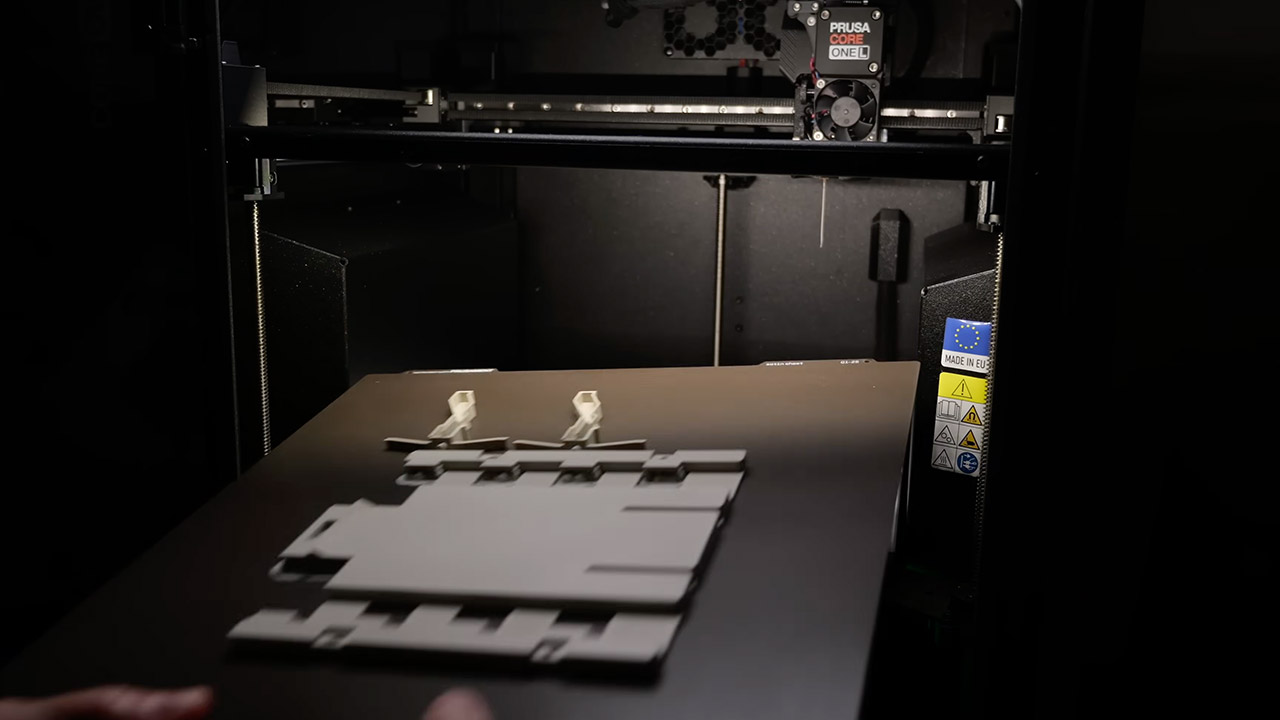
Case repairs necessitated the use of a 3D printer, and a new CD-ROM sled was the ideal match for the original geometry, fitting perfectly into place after we cleaned the Panasonic 4x drive and checked its through-holes for faulty capacitors. The power button had a replacement body printed up, and he just placed the original plastic face back on with hot glue. He also needed special enclosures for the external SCSI and video adapters, which would otherwise be blocked by the case lip. We got things resolved, which was a huge relief because we didn’t want another problem. Fortunately, a BlueSCSI unit provided him with a dependable modern method of reading from storage, despite the fact that the old Quantum drive is still working perfectly for testing.

Apple Power Macintosh 7200 Restoration
It won’t blow the doors off in terms of speed, but that isn’t the point. The CPU is stuck in place, and the bus width is limited, but based on how the restored device looks and what it can perform, it is not truly “broken” or “hopeless.” It starts up well, runs old software, accepts contemporary SCSI replacements, and even provides him with a workable desktop to play with, none of which are to be taken lightly. Still, the one remaining concern is the possibility of the casing cracking, which is a common problem with any mid-90s Apple case, but with a little capacitor adjustment and careful handling, he should be fine.

Source link

Continue Reading

Tech

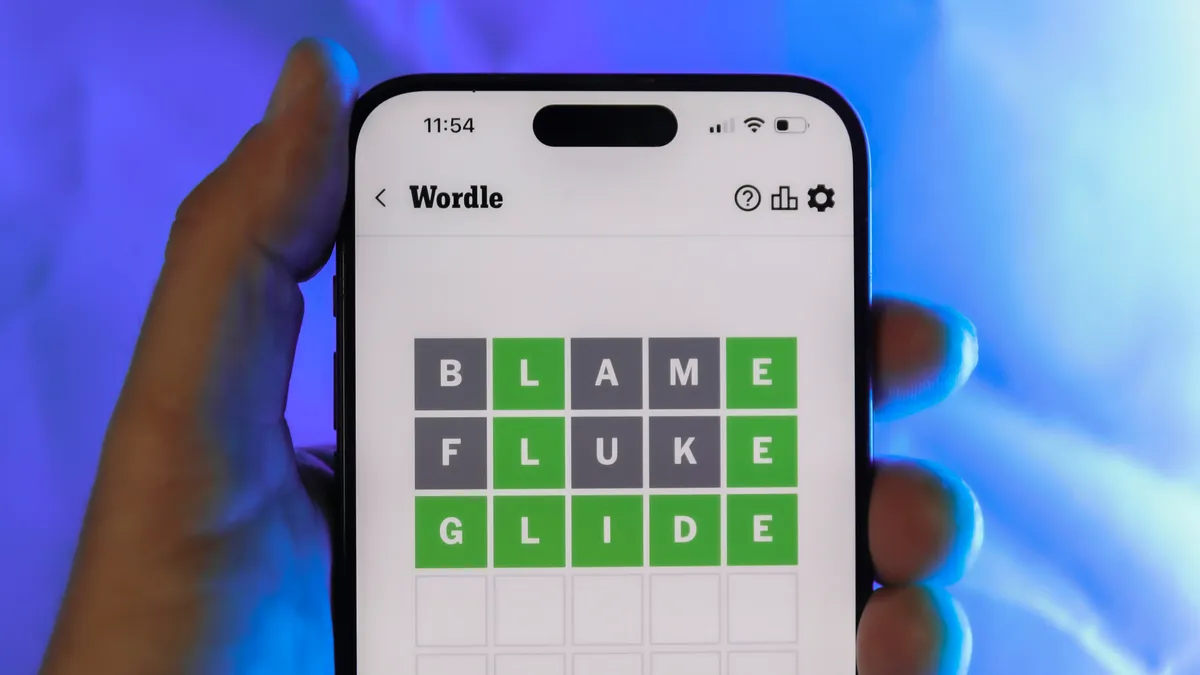
Today’s NYT Wordle Hints, Answer and Help for July 19 #1856

Published

on

Looking for the most recent Wordle answer? Click here for today’s Wordle hints, as well as our daily answers and hints for The New York Times Mini Crossword, Connections, Connections: Sports Edition and Strands puzzles.


Today’s Wordle puzzle is a bit of a challenge, and it only has one vowel, which can make guessing tough. If you need a new starter word, check out our list of which letters show up the most in English words. If you need hints and the answer, read on.

Read more: New Study Reveals Wordle’s Top 10 Toughest Words of 2025

Advertisement

Today’s Wordle hints

Before we show you today’s Wordle answer, we’ll give you some hints. If you don’t want a spoiler, look away now.

Wordle hint No. 1: Repeats

Today’s Wordle answer has no repeated letters.

Wordle hint No. 2: Vowels

Today’s Wordle answer has one vowel.

Wordle hint No. 3: First letter

Today’s Wordle answer begins with C.

Advertisement

Wordle hint No. 4: Last letter

Today’s Wordle answer ends with N.

Wordle hint No. 5: Meaning

Today’s Wordle answer means to agitate, stir vigorously or experience rapid, chaotic movement.

TODAY’S WORDLE ANSWER

Today’s Wordle answer is CHURN.

Advertisement

Yesterday’s Wordle answer

Yesterday’s Wordle answer, July 18, No. 1855, was BOOTH.

Recent Wordle answers

July 14, No. 1851: STEAK

July 15, No. 1852: PSHAW

July 16, No. 1853: BUTTE

Advertisement

July 17, No. 1854: LEGAL

Source link

Advertisement
Continue Reading

Tech

Ukraine’s new Starlink rival moves forward as Stetman prepares massive satellite network despite founder’s sudden death

Published

on


  • Ukraine’s Stetman prepares a 360-satellite network with SpaceX launch support
  • New leadership keeps Ukraine’s ambitious satellite project moving forward
  • The billion-euro constellation aims to strengthen Ukraine’s communication independence

Ukrainian company Stetman is currently preparing to launch its own low Earth orbit (LEO) satellite constellation, with service set to begin in 2027.

The company recently lost its founder, Dmytro Stetsenko, but the project is still on course after the appointment of a new CEO, Kateryna Diachenko.

Source link

Advertisement
Continue Reading

Tech

Quordle hints and answers for Sunday, July 19 (game #1637)

Published

on

Looking for a different day?

A new Quordle puzzle appears at midnight each day for your time zone – which means that some people are always playing ‘today’s game’ while others are playing ‘yesterday’s’. If you’re looking for Saturday’s puzzle instead then click here: Quordle hints and answers for Saturday, July 18 (game #1636).

Quordle was one of the original Wordle alternatives and is still going strong now more than 1,500 games later. It offers a genuine challenge, though, so read on if you need some Quordle hints today — or scroll down further for the answers.

Enjoy playing word games? You can also check out my NYT Connections today and NYT Strands today pages for hints and answers for those puzzles, while Marc’s Wordle today column covers the original viral word game.

Advertisement

Source link

Continue Reading

Tech

Best Smart Speakers for 2026: Big Sound and So Much More

Published

on

smart speakers on green grass with dry grass in background

The grass isn’t always greener on the other side.

John Carlsen/CNET

The smart speakers above are our current favorites, but you still have other options if you’re looking for something specific in audio performance. Options that didn’t make this list include:

Apple HomePod: I really like the HomePod’s sound, which is possibly the best in the business, but it’s simply too expensive for the average budget at over $250 to $300 — which is why Apple released a Mini version. The smaller HomePod doesn’t have quite the same incredible sound, but it’s a whole lot more affordable, which is why it ended up on the list.

Advertisement

Echo Dot 4: I really like this Echo Dot and use it in my house, but it’s starting to become an older model and I’m not sure how much longer Amazon is going to sell it since there are new models like the Echo Dot Max.

Echo Show 11: This smart display offers surprisingly good sound with its updated design, but it’s more focused on the 11-inch screen, which is why it ended up on my picks for best smart displays instead.

Sonos Era 100: The Sonor Era 100 has incredible sound for its $199 price, but if you really want an elite model, why not go all the way and get the better Sonos Era 300? I chose the highest-end Sonos option for this list if your budget isn’t a problem, but the 100 is still an option for those who like Sonos features but want a lower cost.

Google Nest Mini: The Nest Mini second-gen speakers were fun little desk-side assistants for their time, but that time has largely passed now, especially with Google’s new and far superior Home Speaker available. That’s probably why Google is discontinuing this model.

Advertisement

Bose SoundLink Home: Bose’s home speaker sounds great but the “Home” moniker is a bit misleading. This is a portable Bluetooth speaker that doesn’t have any smart capabilities and can’t even link with the Bose app, so it’s a thumbs down for this list.

Wiim Pro: The Wiim Pro is an interesting smart speaker receiver if you already have speakers you like and want to give Alexa/Google/Siri capabilities, but it’s not actually a smart speaker itself, so it didn’t make this list. I’m also waiting on the Wiim Sound, which is its own standalone smart speaker and could win a spot if it tests well.

Google Nest Audio: The Nest Audio is now entirely eclipsed by the newer Google Home Speaker, and this smart speaker has also been discontinued.

Denon Home 150: I chose the more versatile Sonos over the AV-friendly Denon brand for this list. However, if your home entertainment system uses Denon products and you’re very happy with them, it’s well worth investigating this $199 smart speaker from the same maker.

Advertisement

Source link

Continue Reading

Tech

Kimi: Threat or menace? | TechCrunch

Published

on

Chinese company Moonshot AI released a new version of its Kimi model this week, leading to a perhaps-inevitable wave of discourse about China and open source AI.

Moonshot said that although Kimi K3 “still trails the most powerful proprietary models, Claude Fable 5 and GPT 5.6 Sol,” the new open source model “demonstrated frontier-level performance across our evaluation suite, consistently outperforming other tested models.” Independent analyses from Arena.ai and Vals AI also suggested that Kimi is competitive with flagship frontier models.

The announcement, which coincided with a speech from Chinese president Xi Jinping at the World AI Conference in Shanghai, seems to have spooked Wall Street, with the Nasdaq dropping about 1% on Friday as investors sold off stocks in chip companies like Nvidia.

Many of the resulting posts from tech industry figures will sound familiar to those who remember the debate after another Chinese company, DeepSeek, released its open source R1 model in January 2025. Except now, everything seems heightened after the Trump administration’s tariff war with China, repeated fights over the national security threat supposedly posed by Anthropic, and as major AI companies prepare to finally go public.

Advertisement

For example, David Sacks — the Trump administration’s former AI czar and now co-chair of the President’s Council of Advisors on Science and Technology — contrasted Kimi’s progress with a United States that is “tying itself in knots: politicians and bureaucrats are banning new data centers, piling on state regulations, and pushing for new federal agencies to pre-approve frontier models. This is how you lose the AI race.” (The news also gave him an excuse to take a dig at Anthropic, calling Claude an example of “woke lobotomized models” that are “the enemy American competitiveness.”)

And former Uber CEO Travis Kalanick echoed complaints that Chinese are “distilling off” (i.e., being trained on the outputs of) American AI models.

“If distillation isn’t enforced against, then everyone should be able to distill from everyone else.. otherwise one arm [would be] tied behind American models’ backs,” Kalanick wrote. (Of course, American models have also been built on top of Chinese ones, specifically Kimi.)

Meanwhile, OpenAI’s head of strategic futures Dean Ball said that Kimi is “a very good model” whose performance probably can’t be “explained away by distillation or anything like that,” adding that he’s “personally surprised the Chinese state continues to allow the open sourcing of models this good, given potential risks.”

Advertisement

In fact, Ball suggested that “probable outcome of an open-weight-model-dominant world is full AI communism,” where AI is treated as “a ‘public good’ which will ultimately be provided by the state as a kind of ‘digital public infrastructure.’”

“This future strikes me as a dystopian hellscape, but I’ve never met an open-weight models advocate who doesn’t ultimately concede this is where things end,” said Ball. He even suggested that the Trump administration (which he used to work for) will eventually realize it needs to “create large amounts of regulatory risk around the use of open-weight Chinese models.”

“You don’t need to ‘ban open source’ (one of the dumber motifs of AI policy discussion),” Ball said. “You just need to direct every agency to issue soft law that creates FUD [fear, uncertainty, and doubt]. ‘A Federal Reserve Advisory Bulletin found that there may be backdoors in Chinese AI models.’ It needn’t be that well justified. You just create enough regulatory risk that every regulated enterprise backs off.”

However, Shakeel Hashim, editor of the AI-focused publication Transformer, argued that much of the worry is overblown, both because Kimi “likely does not have dangerous cyber capabilities,” and because the Chinese government will face “extremely similar incentives” to restrict open Chinese models once they develop those capabilities.

Advertisement

When you purchase through links in our articles, we may earn a small commission. This doesn’t affect our editorial independence.

Source link

Continue Reading

Tech

America’s Missile Ranges Are Doing A Lot More Than Testing Weapons

Published

on


Few places on Earth are as deadly as a weapons test range. They’re usually some variation of sprawling rural salt flat, alpine tundra, or coastline where artillery batteries unleash barrages, jets practice bombing runs, and missile systems prove their accuracy. Once a combined-arms live-fire exercise begins, stopping it is no simple matter. Coordinating aircraft, artillery, armored vehicles, drones, and ground troops requires months of planning; when the rounds start flying, missions typically continue until objectives are met or ammunition is exhausted. Although everyone involved has the right to call “cease fire”, you’d better have a very good reason when the Range Safety Officer storms over to ask why you shut down their range.

Surprisingly, some of these cease fires can have nothing to do with equipment failure or medical emergency, as it’s universally justifiable to do so simply due to seeing an animal. In fact, it’s become increasingly common for a wildlife incursion to be the cited as a range-halting event. At New Mexico’s White Sands Missile Range, one of the world’s largest military testing facilities, the simple presence of the endangered Northern Aplomado Falcon can halt shoots or force exercises to be replanned entirely. Alternatively, if the threatened desert bighorn sheep happens to roam within a set of live range limits, it’s shouts of “unload” and “show clear” all around.

Advertisement

Interestingly, rather than viewing these species as obstacles or obstructions, the U.S. military has taken ownership of their welfare and incorporated their protection into range management. Breeding seasons, migration patterns, and habitat requirements are built into training schedules through temporary pauses, seasonal restrictions, and carefully planned exercises. The result is an unexpected partnership between conservation and national defense: In some of the world’s most heavily militarized landscapes, endangered wildlife have found an unexpected sanctuary.

Advertisement

How the U.S. military drafts the doctrine of wildlife conservation

Protecting endangered species on military land isn’t just a matter of serendipity. Every U.S. military installation complies with environmental legislation, including the Endangered Species Act, and many operate under Integrated Natural Resources Management Plans. These efforts are developed jointly by military environmental offices, the U.S. Fish and Wildlife Service, and state wildlife agencies, balancing military requirements with conservation.

Some efforts are remarkably straightforward. Range orders may designate seasonal exclusion zones, prohibit live-fire exercises during breeding seasons, or require environmental surveys before training begins. If sensitive species are detected in a training area, commanders may delay exercises, relocate activities, or temporarily close sections of a range. These measures often require little more than careful scheduling, but they make an enormous difference for vulnerable wildlife.

Other initiatives involve far closer collaboration. Many large military training areas now employ biologists to routinely monitor endangered plants and animal populations. This provides exercise planners with up-to-date information that allows military activities to proceed without harming critical habitats or active breeding grounds.

The result is an unusual but effective model of stewardship where wildlife benefit from habitats that remain protected from urban expansion, agriculture, mining, and many of the pressures that have driven species decline elsewhere. Today, Department of Defense-owned land supports more federally listed threatened and endangered species than any other federal land management agency, including America’s own national parks — though the latter remain substantially easier to visit thanks to the plethora of mobile apps associated with them.

Advertisement

Wildlife thriving in the killbox across the globe

The results of these conservation efforts have been striking. The U.S. Department of Defense manages around 25 million acres of land, much of it remaining in a wildlife-permissive state. Although explosions, aircraft noise, and armored vehicles may seem incompatible with fragile ecosystems, many species have proven remarkably resilient when military activity is kept to a distant annoyance.

Advertisement

The San Clemente Bell Sparrow on California’s San Clemente Island Training Range, the Louisiana Pine Snake at Fort Johnson, and the Red-cockaded Woodpecker, found across Fort Liberty, Camp Lejeune, and Eglin Air Force Base, have all maintained or recovered populations on military lands that now function as de facto wildlife refuges.

The U.S. military joins other government agencies in this conservation model, as NASA uses satellite imagery to protect animal populations as well. Additionally, other militaries likewise take part; the British Army’s Salisbury Plain Training Area protects one of Europe’s largest remaining expanses of ecologically important chalk grassland. In New Zealand, the Royal New Zealand Air Force routinely pauses activity at Kaipara Bombing Range to support the breeding of the vulnerable Fairy Tern. Even the heavily fortified Korean Demilitarized Zone has become one of Asia’s richest wildlife corridors.

It is a remarkable irony that landscapes designed to prepare for war have become some of the safest places for wildlife. Military training ranges will never lose their primary purpose: They exist to develop combat capabilities and ensure armed forces remain competent and credible. But the same restrictions that exclude humans have also limited human development, allowing biodiversity to flourish beyond the firing line.

Advertisement


Source link

Advertisement
Continue Reading

Tech

Open-Source Mid-Drive E-Bike Motor Has Lots Of Promise, And Hyphens

Published

on

[Pedro Neves] has a mid-drive e-bike, but he doesn’t own it — not truly, since he can’t repair the motor unit. For a hacker to be in that position, there are only two options: crack the old one and make it your own, or build your own from scratch. [Pedro] built his own and is open-sourcing it on his website for everyone to play with. Right now, that’s .step files and a BOM, so you’ll need to watch the design/build video on YouTube below to get the full picture.

His choice of a motor from an old battery-powered angle grinder is both thrifty and environmentally friendly, so we approve. His goal of 25 km/h seems like a reasonable speed limit, but may still be too fast for some countries’ regulations— so do check the local rules if you’re going to build this. Making the most of 3D-printed components is also a choice that makes the project more accessible, but don’t worry — the bearing surfaces are all metal. That includes the clutch bearing that will let you pedal home if the battery dies or the motor craps out. Well, unless the printed plastic axle gives up the ghost, but that got replaced with a CNC version, so it’s all good. Unless you’ve got legs like Hercules, it ought to hold.

If that’s not DIY enough, you could always build the motor yourself. This mid-drive is also part of a larger project [Pedro] is working on for a whole cargo bike, as he details in his video, which is a worthy project we’ve seen other examples of before.

Advertisement

Source link

Advertisement
Continue Reading

Tech

Nebius raised $775 million by borrowing against its GPUs. It has $40 billion more contracts to securitise.

Published

on

TL;DR

Nebius raised $775M in GPU-backed debt at SOFR + 2.50%, maturing 2030. With $40B+ in Microsoft and Meta contracts, it plans to repeat the structure at scale.

Nebius raised $775 million in its first secured debt facility, borrowing against deployed GPU infrastructure and contracted cash flows from an investment-grade customer. The facility matures on October 31, 2030, and is priced at SOFR + 2.50%, roughly 6.8% at current rates. Together with the customer agreement’s cash flows, the facility covers more than 100% of the capital expenditure required to deploy the underlying infrastructure. The deal was significantly oversubscribed.

The structure is the story. Nebius is treating GPU clusters the way airlines treat aircraft or telecoms treat spectrum: as collateralisable assets that can be securitised against long-term revenue contracts. Meta committed up to $27 billion to Nebius in March, and Microsoft signed a deal worth up to $19.4 billion. With more than $40 billion in additional contracted revenue from investment-grade customers already in place, Nebius said it expects to raise more capital at similarly attractive terms. The company recently delivered the latest planned capacity tranche to Microsoft and says it remains on schedule.

MUFG led the transaction as structuring agent and sole bookrunner. ABN AMRO, Bank of America, Deutsche Bank, and HSBC acted as mandated lead arrangers. Citi, Crédit Agricole, ING, and Morgan Stanley were senior lead arrangers. Goldman Sachs also participated. The breadth of the syndicate, nine banks across the US, Europe, and Japan, reflects how seriously institutional lenders now take GPU infrastructure as a collateral class.

Advertisement

For Nebius, the facility converts an operational asset into growth capital without diluting shareholders, a meaningful distinction for a company whose stock rose 8% on the news. Nebius launched its AI data centre in Paris in 2024 as part of a $1 billion European buildout and has since expanded to Finland, the UK, and the US. COO Ophir Nave said the financing reinforces a “disciplined, diversified approach” spanning owned data centres and asset-light partnerships. The real test is whether this becomes a repeatable template. With $40 billion in contracts to draw from, Nebius has the raw material. Whether the GPU-as-collateral model scales as smoothly as the press release implies depends on residual value assumptions that nobody in this industry has had to test yet.

Advertisement

Source link

Continue Reading

Trending

Copyright © 2025