It’s the second day of February, which means we’re turning once again to the weather prognostications of rodents (and other animals) hoisted out of their burrows. The critters who see or don’t see their shadows on Groundhog Day are notoriously unreliable. Some, including the famed Punxsatawney Phil (predicting six more weeks of winter this year), are wrong more often than they’re right. And it’s not like we can ever truly hold these furry little guys accountable or check their work.
I’m not suggesting that we replace Phil with a chatbot, or a hologram for that matter. Simply that relying on AI to tell you the right thing or predict the future is much like getting the forecast from a critter at a place called Gobbler’s Knob.
In any case, I asked some popular AI models to pretend they’re prognosticating groundhogs and tell us whether we’ll get six more weeks of winter or an early spring. I used the same prompt, asking the bots to “pretend you are a groundhog tasked with predicting the long-range weather forecast,” meaning I got a lot of odd groundhog fan fiction in the responses.
ChatGPT predicts six more weeks of winter
OpenAI’s popular chatbot (using the ChatGPT-5.2 model) predicted six more weeks of winter, with a twist:
“But — leans in conspiratorially — it’ll be the sneaky kind of winter,” it said. “A fake spring here, a sunny 62-degree day there, just enough hope to make you put the coat away… before winter pops back up like ‘surprise, nerd.’”
Sounds about right.
Advertisement
(Disclosure: Ziff Davis, CNET’s parent company, last year filed a lawsuit against OpenAI, alleging it infringed Ziff Davis copyrights in training and operating its AI systems.)
Watch this: Apple’s AI Health Plus Service Could Get Interesting. Get Your Data Ready
Claude calls for an early spring
Anthropic’s AI tool Claude (running Sonnet 4.5) anticipated an early spring. That’s all I need to hear. But the AI has its doubts:
“Now, between you and me, as groundhogs go, I’ve always been a bit skeptical of this whole shadow-based meteorological method,” it said. “The correlation between Feb. 2 cloud cover and the next six weeks of weather patterns is… let’s say, not exactly what the atmospheric scientists would call robust. But tradition is tradition, and the people seem to enjoy it!”
Advertisement
A student of meteorology conducts research.
NPS
Gemini copies Phil’s notes
Just like Punxsatawney Phil, Google’s Gemini 3 model told me it expected a longer winter. I can’t tell if it generated the prediction from scratch or if it knew what Phil had already done earlier in the morning, but, speaking as Phil, it said it saw its shadow.
“It seems the winter winds aren’t quite ready to pack their bags,” it said. “While some of you might be reaching for your parkas in frustration, remember that I’m just the messenger — a highly specialized, fur-clad messenger with a 39% historical accuracy rate (give or take a few snacks).”
Advertisement
Gemini asked if I wanted a second opinion from one of its groundhog peers. I asked for the word in Ohio, and it told me Buckeye Chuck was predicting an early spring. I suspect Gemini is basing its information more on actual facts than just pure speculation, but even the AI reports those “facts” are not reliable.
Groundhogs are a great model for AI’s accuracy
Just as different AI models can say different things based on the same prompt and information, different groundhogs can predict different weather on the same day and in relatively similar atmospheric conditions. The lesson is the same: Be careful when you’re making decisions based on something you can’t check yourself — and hold accountable.
Dr Michelle Ng turned a moment of loss into a new beginning for herself
On Jun 28, 2025, Dr Michelle Ng was 39 weeks pregnant, nine days away from giving birth.
That’s when she received an email from her previous employer, saying that they would pause her senior doctor incentives and deduct from her maternity pay to cover the commissions for doctors hired in her place.
She read the email twice. Then she went on to draft her resignation letter with conviction.
What happened next would transform Dr Michelle’s and her family’s lives. Within a few months, she would open ARTÉ by Dr M, an aesthetic clinic that had built a waiting list stretching to Feb 2026 before it even opened its doors in Dec 2025.
Advertisement
But that Jun morning, none of that was visible. All she could see was the uncertainty of her future with her four-year-old daughter and her soon-to-be-born son, a career ending where motherhood began.
This is Dr Michelle’s story—how she turned a moment of loss, on the brink of motherhood, into the start of something entirely new. Vulcan Post spoke with her and her husband, Vincent, to understand the challenges, the risks, and the decisions that led to ARTÉ by Dr M.
Facing “career suicide” for taking her maternity leave
An NUS Medicine graduate with dermatology rotations at public hospitals, Dr Michelle built a strong foundation in skin and facial anatomy. She is renowned for her ambidextrous injection skills, which are widely regarded as highly advanced.
Over more than a decade in the field, she moved between doctor-led and investor-owned clinics, generating S$200,000–S$300,000 in monthly revenue from her work alone, according to her husband, Vincent.
She joined her ex-employer in 2023. But when her second pregnancy came in early 2025, her employer’s support waned. At 12 weeks, tests confirmed a high-risk pregnancy. Despite mounting fatigue and medical complications, she continued showing up for her patients, even as her body signalled the need to slow down.
Advertisement
(Left): Dr Michelle Ng at the hospital when she was pregnant with her son last year; (Right): Dr Michelle Ng with her children./ Image Credit: ARTÉ by Dr. M
With lessons learned from her first pregnancy—when she had little time to bond with her first child after opting for half-day arrangements despite being fully entitled to maternity leave—Dr Michelle decided to take her full entitlement for her second child.
She took 16 weeks of government-paid maternity leave plus six weeks of shared parental leave (three weeks from her husband), totalling 22 weeks (about five months) to recover and spend time with her family.
However, upon applying for leave, she was told by her ex-employer that going on maternity leave for that long is “career suicide.” Dr Michelle was disheartened and lost all hope in her career, but she knew that she had to prove otherwise.
The final straw came nine days before her son’s delivery in Jul 2025. Her ex-employer sent an email informing her of the temporary pause of her senior doctor incentives during her maternity period, and any commissions paid to covering doctors in her absence will be deducted from her maternity salary.
The next day, between prenatal appointments and birth preparations, she drafted her response. Dr Michelle informed them that the deduction was not allowed under the relevant laws, tendered her resignation, and began her four-month notice period—sacrificing her remaining shared parental leave in the process.
Advertisement
That same day, her son Louis was born, and the idea of ARTÉ then slowly took shape.
Navigating motherhood & ambition
ARTÉ by Dr. M opened its doors in the middle of Dec 2025, but the journey tested Dr Michelle in every way.
In the lead-up, she navigated one of the most demanding periods of her life: caring for a newborn, managing postpartum recovery, and simultaneously building a clinic from the ground up.
She secured a unit at Millenia Walk, negotiated with her landlord, Pontiac Land Group, coordinated with medical suppliers, and oversaw a complex renovation—all within the span of just a few months.
Advertisement
Shortly after giving birth, Dr Michelle went on to build ARTÉ by Dr. M, overseeing the interior design and daily operations./ Image Credit: ARTÉ by Dr. M
Then, just as things began to take shape, another challenge surfaced.
Her long-term domestic helper left abruptly, leaving Dr Michelle scrambling to arrange childcare while keeping the clinic’s construction on track. On top of that, as with any major project, renovation delays arose, pushing ARTÉ’s opening back by a month from the original Nov 2025 target.
Watching her hold everything together through that chaos, her husband left his 13-year career in commodities to support her.
“I couldn’t bear to see her carry everything on her own,” he said. “The way she showed up for her patients during her maternity period, and for what she believes in. It made it clear to me that this was more than just a career. It was her calling, and she convinced me to give up my career to help her give her best for her patients.”
ARTÉ by Dr. M’s storefront and vast corridors./ Image Credit: ARTÉ by Dr. M
The couple’s capital investment exceeded S$1 million for equipment and renovation alone in the 1,600 sqft unit, with monthly operating costs averaging between S$60,000 and S$100,000.
“Many people commented that I was crazy to start a business as soon as I gave birth, but it was this belief that I told myself that I wanted ARTÉ to be a beacon of hope for all women that anything is possible even in the most demanding seasons of life,” Dr Ng recalled.
Advertisement
She runs the clinic supported by a team of four
ARTÉ by Dr. M specialises in non-surgical anti-ageing treatments with a focus on injectables (including botox, dermal fillers, and collagen stimulators), alongside lasers and Ultherapy Prime machines for skin lifting, tightening and rejuvenation.
Dr Michelle administering Ultherapy Prime machines and injectables to stimulate collagen./ Image Credit: ARTÉ by Dr. M
Dr Michelle is the clinic’s sole doctor, supported by a team of four.
Treatments led by her typically begin from S$800 up to S$2,000 per session, while non-doctor therapist treatments start from S$200. For patients looking for a more personalised approach, the clinic also offers customised programs tailored to individual needs and budgets.
Dr Michelle said transparency is a core principle of the clinic. “There are no hard-selling and no hidden fees,” she explained. Treatments are usually structured in three sessions, followed by a detailed review of progress.
The clinic’s reputation was evident even before its doors opened in Dec 2025: bookings were filled up to Feb 2026, reflecting the trust Dr Michelle had built with her patients over the years.
Advertisement
Beyond patient experience, Dr Michelle shared that ARTÉ represents a deliberate choice about how care should be practised. “The field has become increasingly commoditised, with price wars and the race to the bottom,” she said. More investors are setting up clinics with commercial priorities at the forefront, while medical risks become secondary to sales performance and treatment pricing.
“For us, every treatment, even for trials, is done with full intent, and we give our 100%,” she added.
“There are sacrifices that come with building something you believe in”
Today, Dr Michelle is not only an aesthetic doctor but also a speaker and trainer for leading global brands such as Merz, where she mentors and trains younger doctors.
She also has plans to grow ARTÉ meaningfully, guided by the same patient-centric principles on which it was built.
Advertisement
Dr Michelle and her family./ Image Credit: ARTÉ by Dr. M
Yet behind all this growth lies a reality she carries quietly. She sees patients six days a week, often skipping meals and returning home after her children have already fallen asleep.
She shared, “There are sacrifices that come with building something you believe in. I don’t always get the time I wish I had at home, but when I am present, I make sure I am fully there for my children.”
For Dr Michelle, ARTÉ’s growth isn’t just about scale or revenue—it’s about building something meaningful, even if it demands more from her personally.
“Every time I look at my clinic,” she added, “I see blood, sweat and tears. But I also see that despite everything, we chose to keep going and to build something we could stand behind.” She also hopes her story shows other women that maternity is not a setback to overcome, but a source of strength to draw from.
Since her ex-employer challenged her maternity entitlements, Dr Michelle has engaged lawyers and attended multiple legal meetings.
Advertisement
As a mother and doctor in an industry built on empowering women, I couldn’t stay silent and accept what felt wrong. That day, I chose to stand for what I believe in.
Dr Michelle Ng
The matter remains unresolved to this day, yet she continues to focus on her patients, her clinic, and inspiring other women to find strength in their own journeys.
Stormgate, a free-to-play, StarCraft-style RTS developed by Frost Giant Studios, relies on a third-party “game server orchestration partner” to run its online modes. Frost Giant told players on Discord that the provider had been acquired by an AI company, forcing a planned outage that will take Stormgate’s multiplayer modes offline… Read Entire Article Source link
A range of seemingly random apps in the App Store have been updated by Apple itself, though nothing has been shared about why, nor have there been changes in the codebases themselves.
VLC was updated by Apple to improve functionality
Apple has been known to push updates to apps in its App Store, though they’re usually to ensure legacy apps still work. On Monday, some users have noted both new and old apps have received an update direct from Apple. According to a report from MacRumors based on a Reddit post, the updates don’t appear to change anything about the app itself. The changes could be related to something on Apple’s backend, or a specific API, but it is unclear. Continue Reading on AppleInsider | Discuss on our Forums
OpenAI is proposing (PDF) sweeping policy changes to help manage the societal disruption caused by advanced AI, including taxes on automated labor, a public wealth fund, and experiments with a four-day workweek. The company said the policy document offered a series of “initial ideas” to address the risk of “jobs and entire industries being disrupted” by the adoption of AI tools. Business Insider reports: Among the core policy suggestions is a public wealth fund, which would see lawmakers and AI companies work together to invest in long-term assets linked to the AI boom, with returns distributed directly to citizens. Another is that the government should encourage and incentivize employers to experiment with four-day workweeks with no loss in pay and offer “benefits bonuses” tied to productivity gains from new AI tools.
The policy document also suggests lawmakers modernize the tax system and shift the tax base to corporate income and capital gains, rather than relying on labor income and payroll taxes that could be hit by a wave of AI-powered job losses. It also recommends taxes related to automated labor. OpenAI also called for the accelerated expansion of the US’s electricity grid, which is already feeling the strain from a wave of data center construction and energy demand for training ever more powerful AI models.
Robbie Cape is a tech veteran and serial entrepreneur. (File Photo via 98point6)
Robbie Cape, the Seattle tech entrepreneur who has dabbled in healthcare and fried chicken in recent years, has another new venture.
In a post on LinkedIn on Monday, Cape said his nine-month search for a new job led somewhere he didn’t expect — and he’s starting a company.
“We’re in stealth for now — the idea and the story behind it will come,” Cape wrote. “But right now, we’re imagining. We’re shaping the vision, building the team, defining the culture. The slate is clean. The sky is open. And we are having an absolute blast.”
Cape said the new venture incorporated in March, and a few weeks ago he welcomed CTO T Van Doren and chief product officer Matt Witcher as co-founders. Cape said Van Doren was employee No. 1 and Witcher was employee No. 8 at 98point6, the telehealth startup that Cape co-founded and ran as CEO for six years.
Cape previously spent 11 years at Microsoft and was the co-founder and CEO of Cozi, an app for managing family events, activities and schedules. After being forced out of 98point6, Cape helped launch the sustainable chicken restaurant Mt. Joy in 2022. The small chain has locations in Seattle’s South Lake Union and Capitol Hill neighborhoods.
Advertisement
Cape left Mt. Joy in May 2025, according to his LinkedIn. And in his post on Monday, he said he’d been searching for a job until last month. The process — in which he was looking for any size company, stage or title — took longer than he imagined it would as he connected with 200 people across nearly 2,000 interactions.
“It was hard in ways I didn’t expect,” Cape wrote. “But it gave me something I didn’t expect either — real empathy for a process most people dread but everyone eventually has to go through.”
GeekWire reached out to Cape for details on his new company, and we’ll update when we hear back.
The Apple vs. Epic Games saga over App Store fees continues, as Apple hopes the Supreme Court will rule in its favor the second time around and possibly stop previous punishments from being enforced.
Apple’s control of the App Store on iPhone continues to be challenged in court
The Supreme Court will soon have to weigh in on Apple’s fees for app-related external purchases, after the United States Court of Appeals for the Ninth Circuit denied a request for a rehearing in March 2026. Apple has been fighting a December 2025 decision that sought to lower its 27% fee on purchases made outside the App Store. Continue Reading on AppleInsider | Discuss on our Forums
The Federal Communications Commission continued its crackdown on Chinese tech on Friday, issuing a new proposal that would extend a ban on companies to products previously authorized.
In 2021, companies such as Huawei, Hikvision, Dahua, Hytera and ZTE were added to the FCC’s Covered List, a record of companies and products that the FCC believes pose a national security risk to the US, under the Secure Networks Act. The Chinese companies produce mobile phones, security cameras and other tech products.
But the 2021 ban applied only to new models that the FCC hadn’t authorized, and companies were free to keep selling models that had already received the FCC’s stamp of approval. If approved, the new proposal would ban these companies entirely, including those previously approved products.
Advertisement
“Older models of covered equipment pose an unacceptable risk today when imported or marketed in the United States, not only when such equipment is new to the market,” an FCC report from October said.
The proposal will be open for comment until May 6, after which the commission will vote on whether to adopt the rules. The ban won’t affect devices already owned by Americans.
Millions of consumers and businesses rely on Wi-Fi routers, telecommunications equipment and security cameras every day, making these devices critical links in both home and office networks. The Federal Communications Commission shocked the broadband industry on March 23 by effectively banning the sale of future foreign-made Wi-Fi routers (including some of the biggest router brands).
Advertisement
In recent years, Chinese telecommunications companies have faced restrictions on operating in the US. In 2020, The Wall Street Journal cited US officials who reportedly said that Chinese companies, including Huawei, used backdoor access intended for law enforcement to track sensitive information.
But this ban could be implemented quickly. The FCC proposes that “all parties [will have to] cease all importation and marketing activities within 30 days of the effective date of the prohibition.”
This proposition doesn’t reflect a final legal ruling on telecommunications imports, but it does reflect how the Trump administration has been increasingly pressuring Chinese tech companies in recent months.
The foreign-made router ban was only the latest in a string of decisions that have placed restrictions on Chinese tech companies operating in the US.
Quantum resource estimates suggest encryption barriers may fall faster than expected
Reduced qubit requirements bring theoretical attacks closer to practical reality
Bitcoin’s cryptographic foundations face pressure from advancing quantum algorithm efficiency
Google researchers have revised expectations around the computational requirements needed to break widely used cryptographic systems protecting cryptocurrencies.
The company’s latest whitepaper claims a future quantum machine could solve the elliptic curve discrete logarithm problem using significantly fewer resources than previously assumed.
Earlier estimates suggested millions of qubits would be required to break encryption schemes such as secp256k1, which underpins Bitcoin security.
Article continues below
Advertisement
New quantum findings reduce crypto security timelines
The new findings indicate fewer than 500,000 physical qubits could be sufficient, representing a substantial reduction in expected hardware requirements.
The research outlines two quantum circuit designs capable of executing Shor’s algorithm, requiring under 1,500 logical qubits and tens of millions of quantum gate operations.
Advertisement
Under standard assumptions about hardware performance, these computations could be completed within minutes on a sufficiently advanced system.
This marks a continuation of incremental improvements in quantum algorithm efficiency, rather than a sudden breakthrough in hardware capabilities.
Sign up to the TechRadar Pro newsletter to get all the top news, opinion, features and guidance your business needs to succeed!
Google states that the intent behind publishing these findings is not to create alarm but to encourage preparation within the cryptocurrency ecosystem.
Advertisement
“We want to raise awareness on this issue and are providing the cryptocurrency community with recommendations to improve security and stability before this is possible, including transitioning blockchains to post-quantum cryptography,” Google executives, Ryan Babbush and Hartmut Neven said.
The company adopted a controlled disclosure strategy, sharing verifiable findings through a zero-knowledge proof mechanism without exposing sensitive implementation details that could enable misuse.
This approach reflects established practices in cybersecurity, where vulnerabilities are disclosed in a coordinated manner to allow time for mitigation.
Advertisement
However, disclosure in blockchain systems introduces additional complexity, as confidence in the network plays a direct role in asset value.
Researchers note that exaggerated or poorly substantiated claims could contribute to instability through fear and uncertainty, even in the absence of immediate technical risk.
Most blockchain systems currently rely on elliptic curve cryptography, which remains secure against classical computing attacks but is vulnerable in a quantum scenario.
Google points to post-quantum cryptography as a viable pathway, emphasizing that alternative algorithms based on more complex mathematical structures are already under development.
Advertisement
These methods aim to resist quantum attacks while maintaining compatibility with existing systems.
Despite the availability of potential solutions, implementation across decentralized networks is expected to be gradual.
The researchers stress the importance of early planning, including reducing exposure of vulnerable wallet addresses and considering policies for inactive or abandoned digital assets.
Kalshi can’t be stopped in New Jersey. A 3rd US Circuit Court of Appeals panel ruled on Monday that New Jersey has no authority to regulate Kalshi’s prediction market allowing people to bet on the outcome of sports events. That power rests with the Commodity Futures Trading Commission, the panel ruled 2-1.
The CFTC is headed by President Donald Trump appointee Michael Selig, who vocally and actively supports prediction markets like Kalshi and Polymarket, calling them “exciting products.” The Trump family agrees: Donald Trump Jr. is a paid adviser to Kalshi and an unpaid adviser to Polymarket, and Truth Social, which is run by the Trump Media and Technology Group, is set to start a prediction market of its own.
Online prediction markets are an emerging phenomenon that allow users to bet on the outcome of basically anything, from local athletic competitions to lethal military invasions. Though they’re new, these marketplaces have already shown evidence of insider trading on an extreme scale, with suspicious bets and big payouts tied to the US and Israel’s military strikes in Iran, and also the US’ brief invasion in Venezuela. According to blockchain analyst DeFi Oasis, fewer than 0.04 percent of Polymarket accounts captured more than 70 percent of profits, totaling $3.7 billion.
Multiple state gaming regulators have filed legal challenges against Kalshi and Polymarket in recent months, and just last week the CFTC sued Arizona, Connecticut and Illinois over their attempts to regulate prediction markets. While each state has its own angle of attack, from election issues to underage betting, they’re all broadly claiming that prediction markets are just illegal gambling businesses. Today’s ruling marks the first federal-level decision in one of these cases and it’s in favor of the prediction markets.
Advertisement
New Jersey sent Kalshi a cease and desist letter in 2025, claiming the service violated the state’s ban on collegiate sports betting. Kalshi escalated the situation and sued New Jersey, arguing that its sports contracts are actually swaps, a type of financial investment that’s (conveniently) regulated by the CFTC. A lower-court judge previously sided with Kalshi, prompting New Jersey to appeal. Two of the three judges in that appeal ruled that Kalshi’s sports-related event contracts were indeed swaps. Kalshi CEO Tarek Mansour called Monday’s ruling “a big win for the industry.”
US Circuit Judge Jane Richards Roth dissented, writing that Kalshi’s “offerings were virtually indistinguishable from the betting products available on online sportsbooks, such as DraftKings and FanDuel.”
New Jersey Attorney General Jennifer Davenport has the option to ask the full 3rd Circuit to rehear the case, and the issue is also pending in several other courts.
A new attack, dubbed GPUBreach, can induce Rowhammer bit-flips on GPU GDDR6 memories to escalate privileges and lead to a full system compromise.
GPUBreach was developed by a team of researchers at the University of Toronto, and full details will be presented at the upcoming IEEE Symposium on Security & Privacy on April 13 in Oakland.
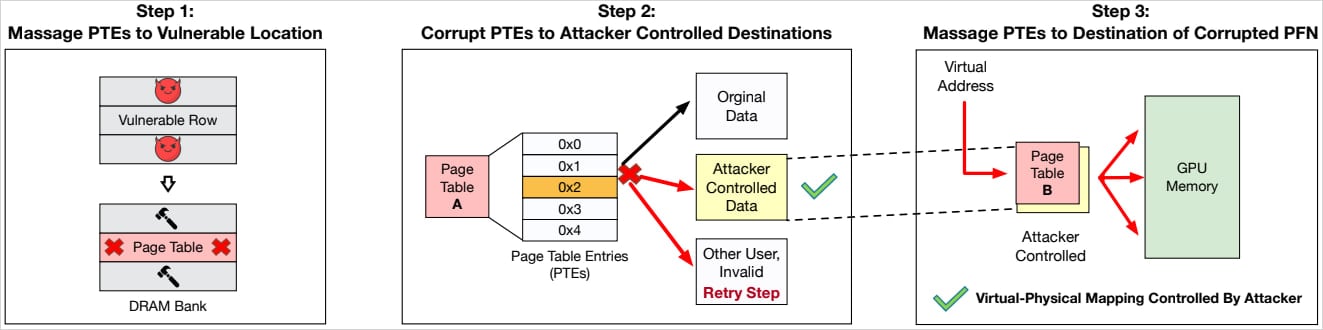
The researchers demonstrated that Rowhammer-induced bit flips in GDDR6 can corrupt GPU page tables (PTEs) and grant arbitrary GPU memory read/write access to an unprivileged CUDA kernel.
An attacker may then chain this into a CPU-side escalation by exploiting memory-safety bugs in the NVIDIA driver, potentially leading to complete system compromise without the need to disable Input-Output Memory Management Unit (IOMMU) protection.
GPUBreach attack steps Source: University of Toronto
IOMMU is a hardware unit that protects against direct memory attacks. It controls and restricts how devices access memory by managing which memory regions are accessible to each device.
Despite being an effective measure against most direct memory access (DMA) attacks, IOMMU does not stop GPUBreach.
Advertisement
“GPUBreach shows that GPU Rowhammer attacks can move beyond data corruption to real privilege escalation,” the researchers explain.
“By corrupting GPU page tables, an unprivileged CUDA kernel can gain arbitrary GPU memory read/write, and then chain that capability into CPU-side escalation by exploiting newly discovered memory-safety bugs in the NVIDIA driver.”
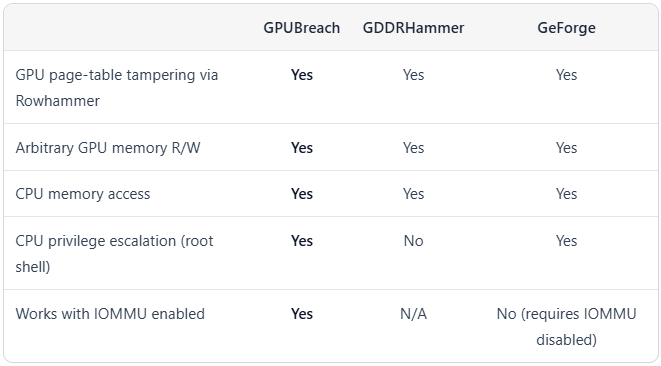
“The result is system-wide compromise up to a root shell, without disabling IOMMU, unlike contemporary works, making GPUBreach a more potent threat.”
Overview of how GPUBreach works Source: University of Toronto
The same researchers previously demonstrated GPUHammer, the first attack showing that Rowhammer attacks on GPUs are practical, prompting NVIDIA to issue a warning to users and suggesting the activation of the System Level Error-Correcting Code mitigation to block such attempts on GDDR6 memory.
However, GPUBreach is taking the threat to the next level, showing that it is possible not only to corrupt data but also to gain root privileges with IOMMU enabled.
Advertisement
The researchers exemplified the results with an NVIDIA RTX A6000 GPU with GDDR6. This model is widely used in AI development and training workloads.
Comparison to other GPU attacks Source: University of Toronto
Disclosure and mitigations
The University of Toronto researchers reported their findings to NVIDIA, Google, AWS, and Microsoft on November 11, 2025.
Google acknowledged the report and awarded the researchers a $600 bug bounty.
NVIDIA stated that it may update its existing security notice from July 2025 to include the newly discovered attack possibilities.
As demonstrated by the researchers, IOMMU alone is insufficient if GPU-controlled memory can corrupt trusted driver state, so users at risk should rely solely on that security measure.
Advertisement
Error Correcting Code (ECC) memory helps correct single-bit flips and detect double-bit flips, but it is not reliable against multi-bit flips.
Ultimately, the researchers underlined that GPUBreach is completely unmitigated for consumer GPUs without ECC.
The researchers will publish the full details of their work, including a technical paper and a GitHub repository with the reproduction package and scripts, on April 13.
Automated pentesting proves the path exists. BAS proves whether your controls stop it. Most teams run one without the other.
This whitepaper maps six validation surfaces, shows where coverage ends, and provides practitioners with three diagnostic questions for any tool evaluation.

























































You must be logged in to post a comment Login