Depending on the car you have and the region it’s sold in, you may have spotted a little snowflake button sitting somewhere near your gear shift. You might be wondering what it does, and even more so if you’ve also got another snowflake button in your car, sitting near the climate controls. The short answer is that it turns on a dedicated Snow Mode, a driver setting that tunes your car for snowy and slippery conditions.
In that kind of weather, it’s very easy for your wheels to spin too quickly and lose traction, so to make up for that, Snow Mode makes your car slower to react when your foot lands on the accelerator. At the same time, the transmission changes its habits, shifting into higher gears earlier than normal – so early, in fact, that it sometimes pulls away in second gear rather than first. Even the traction control, which you should never turn off, gets jumpier and steps in sooner, especially when it senses a wheel losing grip. In Hyundai’s version (available on the Tucson, Venue, and Santa Fe), the wheel spin is checked every fiftieth of a second, and if one tire starts to slide, it quietly shuffles torque over to the others, helping keep you pointed where you actually meant to go.
Advertisement
Snow mode comes in various flavors
Of course, plenty of other brands offer the mode besides Hyundai. On Toyota and Lexus, you actually get proper buttons. Hop into a Highlander, for instance, and you’ll see a Snow button right on the center console, sometimes badged ECT Snow. Lexus uses a near-identical button or switch. Subaru runs its own take too, only it badges the whole thing X-Mode instead of Snow. It’s actually mostly older cars that slap the snowflake symbol on the button, though, like the Saturn Astra.
Advertisement
On most other brands, the snow mode is tucked in alongside their other drive modes. Hyundai routes it through Drive Mode Select, while Ford spins it onto a rotary dial, where it’s sometimes called Slippery Mode. Then there’s Land Rover, which folds it into a combined Grass, Gravel and Snow setting. The mode may be badged differently as well, like Winter or a plain W. On newer models, you may not get any physical button or dial at all and might have to dig through the touchscreen menus to find it. However it’s presented, it basically works the same way across companies, mostly softening the throttle and reining in wheelspin.
Advertisement
When to use snow mode
As for when to use it, the rule of thumb is pretty simple. It’s meant to be flipped on the moment the road turns nasty, whether that’s fresh snow, packed ice, or freezing rain. It also helps when you’re crawling up a slick hill. And some folks even use it in mud, if there’s no dedicated mode for that, since the same low-grip logic applies. The setting is usually pretty flexible too, and you don’t necessarily have to be parked to switch it on. Volkswagen, for one, lets you jump into Snow Mode mid-drive.
As for the other side of things, the mode doesn’t do anything that’d make it unsafe under normal conditions. Still, running it then is pointless since it dulls your acceleration and quietly eats into your fuel economy, so it’s best to flip it off once the pavement is dry. Just keep in mind that it isn’t magic. All it really does is make your car a bit less excitable so it doesn’t get away from you. It won’t save bald tires or rescue you off a sheet of ice. For those more extreme cases, you’d be better off fitting your tires with some of the best tire chains.
Last week, Elliot got his foot stepped on by a 1.5 metric ton draft horse, and boy is he glad to be back to the relative safety of podcasting! Joining him today is Jenny List, no stranger to farm life, who has been trodden by a cow. It’s going to be one of those podcasts, folks.
Another thing the two hosts have in common is a love for the mystery of the numbers station. But did you know that GPS satellites, for the last 20 years, have broadcast literally millions of secret messages to everyone on the earth with a receiver? After that bombshell, we have an ATtiny85 emulating an 8080, a primer on how to embed magnets in 3D prints, definitive proof that more than one cassette mechanism is still being manufactured, and a look at what makes home automation enthusiasts tick.
Check out the links below if you want to follow along, and as always, tell us what you think about this episode in the comments!
Recently, my kindergartner climbed onto the scale and asked me what dinosaurs also weighed 50 pounds. Thanks to Claude, we quickly learned, to my son’s delight, that he is the size of a juvenile velociraptor.
Artificial intelligence helped me with a question I couldn’t have answered on my own. But it didn’t replace me as a parent or my son’s role as a learner. A few weeks later, I had forgotten the answer, but my son didn’t. He was the keeper of knowledge, and I was the conduit.
Something like this is happening in schools and colleges, too. Information is more easily accessible than ever before. Anyone anywhere can ask an AI tool a question and receive an answer that seems reasonable, at least on the surface. It’s not surprising, then, to see predictions of the demise of traditional schools and colleges.
But education has never been only about access to information. Students need much more to become capable members of society. They need the ability to assess the quality of information, recognize strong work, and connect ideas. Students also need to grapple with the reality that not everyone agrees, and that’s ok. This kind of learning requires human relationships that expose students to the friction of life that sycophantic AI models tend to obscure.
Advertisement
The big question is how to know when AI supports real learning and when it leads to the “cognitive surrender” of accepting AI-generated answers with minimal scrutiny. Recent research findings shed some light on that.
Learning by AI Type
First, learning varies significantly based on the type of AI used. The dangers of cognitive surrender are greater when students use the standard, free versions of LLMs. Those models are designed to be helpful and therefore simply provide answers to the questions they are asked. Brain activity and retained learning are lower when students are working with AI in this way.
In contrast, tools that scaffold learning and support in-person instruction can produce outcomes even more impressive than my son’s memory of the size of teenage dinosaurs. One study of an introductory undergraduate physics course found that students using a carefully designed AI tutor had twice the learning gains of those receiving active, in-person instruction.
Advertisement
Learning Process Matters
Second, the role that AI plays in the learning process matters, and it should be off-limits at times. The authors of the physics course study cautioned that structured AI tutoring may not be appropriate for tasks “requiring complex synthesis of multiple concepts and higher-order critical thinking.” In a larger-scale example, Estonia’s education minister—who is overseeing the country’s ambitious partnership with OpenAI to provide a custom AI platform in upper secondary schools—has described a blended model. Students use handwriting to form memories early in the learning process and, later, use digital tools for feedback and AI-assisted learning. Estonia is not introducing AI in earlier grades so that students can build foundational knowledge and skills first.
Support for Educators Needed
Third, because the outcomes are so far apart between good and bad AI use in learning, educators need support to add AI to their teaching toolkit responsibly. In one study from Sierra Leone, secondary school educators completed a one-day training before adding AI tools in the learning process and only then saw math learning gains equivalent to more than a year of additional schooling.
Advertisement
Google, OpenAI, and Anthropic all offer learning modes and other supports built on these ideas. Still, those features are typically opt-in and getting harder to find for non-enterprise users. OpenAI, for example, launched “study mode” in July 2025 but quietly removed it from the standard ChatGPT interface this spring. The feature remains available to schools and systems with enterprise contracts. These contracts are expensive but drive demand for the types of AI that educators actually want, especially when leaders collaborate across systems and make similar asks of tech companies in procurement.
Schools, colleges, and educators should not be alone in navigating these waters. Philanthropy can help, for example, by supporting training that respects teachers’ expertise, conducting independent research on what works, and advancing advocacy work that counterbalances the size of tech firms. They can also help make enterprise contracts more affordable and support the development of procurement standards that protect learning, student data, and educational institutions’ sovereignty over their own systems.
This fits with philanthropy’s history of helping the benefits of new learning approaches reach everyone. For example, as compulsory schooling laws were passed at the turn of the 20th century, communities benefited from Andrew Carnegie’s 2,509 libraries (many of which served as classrooms) and Julius Rosenwald’s 5,000 schools that educated a third of Black children in the rural South.
Looking even further back in time gives me confidence that humans can weather tech-driven transitions and come out in a better place. German apprenticeship programs are strong today in part because, during the Industrial Revolution, German guilds adapted their models to fit an evolving economy rather than resisting change outright.
Advertisement
Today’s overflowing supply of information began with the printing press, which expanded access to texts and eventually reshaped who could claim expertise. I can capture and share these thoughts with you in part because, very long ago, writing transformed curriculum, credentialing, and information exchange.
Humans may not be as cool as velociraptors, but we have incredible agency and potential to evolve to meet the moment. All of us—including tech providers, educators, and philanthropy—can play an active role in shaping what’s next for students.
Baidu’s robotaxis are heading to the Alps. AmiGo, a venture between the Chinese giant’s Apollo Go robotaxi unit and Swiss Post’s PostBus, has won a special permit from Switzerland’s Federal Roads Office for Level 4 autonomous driving, Baidu said.
Level 4 means the vehicle drives itself within a defined area. Open-road trials began on 1 June across about 80 square kilometres of eastern Switzerland, in the cantons of St Gallen and the two Appenzells. For now, a safety operator still rides in each car.
What AmiGo is
AmiGo pairs Chinese self-driving technology with a Swiss public-transport operator. PostBus runs the country’s distinctive yellow postal buses; Apollo Go supplies the autonomous driving system. Riders book trips through the AmiGo app.
The cars are Apollo Go’s RT6: fully electric pods that carry up to three passengers and pack more than 30 sensors. The steering wheel is built to be removed once the service goes fully driverless. “With AmiGo, we are making automated mobility in public transport tangible,” said PostBus chief executive Stefan Regli.
Advertisement
Why the Apollo Go robotaxi permit matters
The 💜 of EU tech
The latest rumblings from the EU tech scene, a story from our wise ol’ founder Boris, and some questionable AI art. It’s free, every week, in your inbox. Sign up now!
Apollo Go is scaling fast. Baidu says the service delivered 3.2 million fully driverless rides in the first quarter of 2026, peaking above 350,000 in a single week in March. Cumulative rides passed 22 million by April, across 27 cities.
That scale is the pitch to European regulators and partners alike. But the Swiss permit is narrow and the trial zone small. The partners are clear about the path: a closed user trial, then rides with no safety operator, then regular service from 2027, in what they call the largest planned automated public-transport operation of its kind in Europe. Chinese rivals are expanding too, and Europe’s patchwork of national rules still makes every market a fresh fight. The question is whether a careful Swiss pilot becomes a template, or stays a postcard.
AI company CEOs Sam Altman (OpenAI), Demis Hassabis (Google DeepMind), and Dario Amodei (Anthropic) disagree on a lot, like how fast the technology should develop, the best way to regulate it, and how to prepare society for smarter-than-human AI, among other things.
That makes it all the more remarkable that they — along with 85 other experts in tech, biology, and national security policy — recently signed on to an open letter calling for more robust regulations around gene synthesis. They’re all concerned that AI systems might be used to help develop and even deploy dangerous biological weapons designed through gene synthesis, which is used to chemically build custom DNA sequences in a lab, rather than relying solely on existing natural DNA templates.
The simple fact of multiple CEOs of fiercely competitive AI companies aligning on anything is remarkable. But to understand how they came to this agreement, we have to take a step back to understand what gene synthesis is, how it works, and why the possibility of AI-assisted misuse of the technology generates so much fear.
Modern microbiology owes a lot to gene synthesis. Researchers can order synthetic genes from commercial DNA providers to develop new vaccines, drugs, and gene therapies for inherited diseases like hemophilia; produce human insulin, boost agricultural output, and more. Gene synthesis is a foundational technology for successful CAR-T cell therapies for cancer and many diagnostic tools. The demand for synthetic DNA is growing globally, and it’s never been cheaper or simpler to write genetic code.
Advertisement
But for all its power, gene synthesis also carries substantial risk. The same technology that can enable life-saving new gene therapies can also assist in the creation of deadly pathogens by assembling some of the same nucleotides — the genetic building blocks that create the code for all of life — in a different order.
Most US companies that provide gene synthesis services screen orders for genetic sequences of concern, such as those that can make a pathogen more dangerous or transmissible, and to verify that customers are legitimate. They do so voluntarily, well aware of the potential dangers.
But not every provider does so. “As long as screening remains voluntary, some companies will not do it,” Becky Mackelprang, the director for security programs at the Engineering Biology Research Consortium, told me over email. There’s a real risk that bad actors could find a gene synthesis company with more lax standards, and that might mean disaster.
We’ve been fortunate so far. “This technology has been commercially deployed for more than 20 years and has never been misused to cause harm,” James Diggans, the vice president of policy and biosecurity at gene synthesis company Twist Bioscience, told me over email.
Advertisement
But AI threatens to complicate matters, opening up new frontiers of risk.
Both large language models (LLMs) and AI biodesign tools enable scientists to design entirely novel genetic sequences. This is a boon for industrial and medical applications — and a challenge for current screening systems, which use similarity to known pathogenic or toxic sequences in order to detect risk. A screening system should catch someone trying to order sequences of a known dangerous virus like Ebola, for example, but it might miss a new sequence that could still be risky. Last year, a study published in Science demonstrated that our screening systems have kept pace with AI capabilities so far. “But the industry clearly understands this will not be the case forever,” Diggans said.
Mackelprang is worried that AI could reduce the knowledge barriers that have historically prevented bad actors from developing bioweapons. Frontier AI systems, for example, seem to already outperform expert virologists on questions about performing complex laboratory procedures.
But there is knowing and there is doing, and biological lab work is still hard. “Researchers spend years trying to make a protocol work even after consulting directly with others who have perfected that exact same protocol. I think AI can help someone ‘level up’ their laboratory skills, but I do not think AI can enable someone without any biological training to create a serious hazard,” Mackelprang told me.
Advertisement
That means that gene synthesis companies are still a primary chokepoint for anyone trying to produce a novel genetic sequence. Mackelprang’s main concern is that aspiring bioterrorists might use AI to generate harmful genetic sequences that can evade current or future screening systems. “In the near term, I think the likelihood of these types of misuse are quite low. But when the potential consequences are severe and technologies continue to develop rapidly, we have a responsibility…to develop reasonable prevention and mitigation options,” she said.
Maximizing the benefits of gene synthesis while minimizing the risks is difficult, but not impossible. That’s why Diggans and Mackelprang — along with Altman, Hassabis, and Amodei, as well as other gene synthesis providers, tech entrepreneurs, life science executives, and national security experts — signed the open letter calling for mandatory gene synthesis screening and recordkeeping of orders.
Co-organized by the think tanks Institute for Progress and the Foundation for American Innovation, the open letter also calls for providers to record synthesis orders and sequence data to support biosecurity investigations “so that any threat that might evade initial screening can be traced back to its source…Awareness of traceability itself deters misuse.” This would, ideally, address Mackelprang’s concern that AI might eventually help bad actors evade existing screening protocols.
“Screening every DNA synthesis order before it’s manufactured is the kind of unglamorous, common-sense step that prevents a much bigger problem later,” DJ Kleinbaum, the co-founder of the biotech startup Emerald Cloud Lab, an automated lab scientists can access remotely, and one of the signatories, said.
Advertisement
But Altman, Hassabis, and Amodei’s shared signatures may be the most meaningful evidence that the letter matters. For all their disagreements, they are well aware that their tools can be used for tremendous — even catastrophic — harm.
AIxBio risk: A thing on which we can all agree
While it’s far from the first time frontier AI companies have spoken to AI-enabled biological risk, the open letter is the first place they’ve come together to do so in a single voice. “Support for screening does not depend on any particular view of AI,” the letter reads. “This is a rare moment of agreement across stakeholders that are often at odds.”
The letter calls for Congress to act now. “We applaud the legislative efforts currently underway,” the letter says, alluding to the bipartisan Biosecurity Modernization and Innovation Act, a bill that gives the Department of Commerce a year to develop new gene synthesis screening rules. The letter also suggests that US states should implement screening requirements based on federal and industry guidelines to create a unified national standard rather than an inconsistent set of laws.
Advertisement
The letter isn’t about applying biosecurity regulations to the AI companies themselves, which likely would have limited the number of tech signatories. (Though major companies do actively try to prevent their models from giving away dangerous biological knowledge, albeit not always successfully.) Focusing on screening is tractable, has the buy-in of several gene synthesis providers, and provides a concrete example of how AI can lower the barrier to doing both great and terrible things. And of course, it’s ultimately something a human being has to do at this point.
The AI companies are actively thinking about the catastrophic risks that their technologies might enable. Anthropic is hiring a technical chemical, biological, radiological, and nuclear threat investigator for its threat intelligence team. In May, after launching GPT-Rosalind, a frontier model to accelerate life sciences research and drug discovery, OpenAI introduced Rosalind Biodefense, a program that allows trusted developers to use GPT-Rosalind to build biodefense tools. On June 4, the day after the open letter went live, security specialists at OpenAI and Anthropic served as panelists at the Bipartisan Commission for Biodefense’s meeting on AI and biological threats.
But according to Twist Biosciences’s Diggans, the best way to defend against misuse of AI models to design harmful pathogens is to use AI models as defense. These defensive models can be used to detect attempted misuse before anything happens. DNA synthesis companies can employ these models to ensure orders for highly-engineered sequences are given the same scrutiny and evaluation as orders for naturally occurring sequences.
“[Gene synthesis] companies have to agree to have their order screened not just against a list of sequences but by an AI that people agree is smart enough to recognize and thwart an adversary who’s trying to build a deadly pathogen,” David Haussler, the scientific director of the UC Santa Cruz Genomics Institute and a signatory of the open letter, told me.
Advertisement
Using AI to protect against AI
The good news is that this work is already underway. Last year, I reported that OpenAI provided $30 million in seed funding to biodefense startup Valthos, which develops frontier AI systems to detect biological threats and create medical countermeasures. Valthos’s co-founder Kathleen McMahon signed the open letter.
In September 2025, the Coalition for Epidemic Preparedness Innovations (CEPI) and philanthropic nonprofit Sentinel Biocreated the Pandemic Preparedness Engine AI platform (sometimes referred to simply as “the Engine”). They’re taking a biosecurity-by-design approach, considering biosecurity risks from the outset. “This includes a multi-layered approach to biosecurity: from protecting biosecurity-sensitive data needed to train the AI to carefully managing who has access to the Engine and monitoring how they use it,” Sarah Carter, a biosecurity consultant at CEPI, told me over email.
Users of the Pandemic Preparedness Engine would use AI prompts to interact with the system, similar to how people use consumer platforms. User prompts could be monitored in real time by a specialized AI agent built to assess the risk of misuse potential or attempts to “jailbreak” an LLM to get it to generate prohibited content, such as the “recipe” for assembling a deadly virus.
Advertisement
Still, even commercially available technologies may present problems of their own. This week, Anthropic launched Claude Fable 5, a version of its highly powerful and restricted Mythos model that the company has aimed to make safe for public use. Claude automatically stops use of Fable if it detects requests involving cybersecurity, biology, chemistry, or distillation (attempting to extract Claude’s capabilities to train competing AI models), shunting those requests to a less powerful model. Users have complained that trying to discuss biology for legitimate purposes with Fable 5 results in the model refusing to engage or defaulting to less capable models instead. The Fable example shows that it’s possible to overcorrect, limiting the potential upside of using AI for the life sciences.
“The major providers of LLMs are doing their best to prevent the models from answering questions that would enable somebody to do something dangerous,” Haussler told me. “[But] the end product of jailbreaking an LLM that’s capable of teaching you how to build a deadly virus is that you now have an LLM that’s capable of teaching anybody how to build a very dangerous virus. And we don’t want that to happen.”
It’s here that the letter’s signatories hope they can stop a still-simmering problem before it comes to a full boil. “Mandatory synthesis screening is that rare case where a threat is clearly visible and substantial prevention clearly achievable before any crisis has occurred,” said Richard Danzig, a natural security expert who served as the 71st Secretary of the Navy under former President Bill Clinton. “Opportunities to act in advance are unusual in this field. I think we should take this one.”
Meta had a bad Friday morning. A major Meta outage knocked out Facebook, Instagram, WhatsApp, and Messenger for users around the world, starting shortly before 10am ET. By midday it was recovering, unevenly, region by region.
The trouble appeared to begin on WhatsApp, then spread. Facebook users were abruptly logged out, met with a “Query Error” or a “Sorry, something went wrong” message, and unable to log back in. Others could open the app but not post, comment, react, search, or load Stories and Marketplace.
What Down Detector shows
The outage-tracking site Down Detector logged a sharp spike. Facebook bore the brunt, with reports passing 130,000; Instagram logged around 9,500, and WhatsApp far fewer. Across all three, most people flagged problems with the app, then login.
Those numbers are self-reported, so they track complaints, not Meta’s own data. But the reports came in from far beyond the US, from the Philippines and Taiwan to Australia, Spain, and South Africa, which points to something central rather than a local glitch.
Advertisement
Businesses caught out
The 💜 of EU tech
The latest rumblings from the EU tech scene, a story from our wise ol’ founder Boris, and some questionable AI art. It’s free, every week, in your inbox. Sign up now!
It was not just scrolling. Meta’s status page logged “high disruptions” across its business products, including Facebook Ads Manager, the Messenger Platform, the Messenger API for Instagram, and the WhatsApp Business Platform. Advertisers could not create or edit ads, and Meta apologised “for any inconvenience.” On a Friday, the timing stung.
Meta confirms the disruption, but not the cause
Meta acknowledged the problems on its status page, flagging “high disruptions” and saying its engineering teams were “actively looking to resolve the issue as quickly as possible.” It did not say what caused the outage, or how many users were hit.
Advertisement
There is no word yet on whether it was a configuration error, an infrastructure failure, or something else.
Recovery was already under way. Meta marked some services, such as ad delivery, as resolved, with others “in the process of being restored.” On the consumer side, Facebook was loading closer to normal and Down Detector reports were falling, though some users still saw an empty Stories bar, a stale feed, or a “Try Again” error.
The scale is the point: Meta’s apps reach billions, and even a couple of hours offline ripples through messaging, businesses, and logins far beyond the feed. It capped an eventful day for Meta, which this morning pledged free AI glasses to every blind US veteran. This is a developing story; we will update it with Meta’s explanation and an all-clear.
It promises to be a fantastic Friday in Toronto as FIFA World Cup 2026 co-hosts Canada open their Group B campaign against Bosnia and Herzegovina.
Jesse Marsch’s squad is packed with exciting talents ready to shine on home soil including Bayern Munich’s Alphonso Davies, Villarreal winger Tajon Buchanan and Juventus striker Jonathan David, who is Les Rouges’ all-time record goalscorer. Davies has been ruled out of the opening game after failing to recover from a hamstring injury, but the noises from the Canada camp suggest they are confident their captain will play some part in the group stage. Nevertheless, the co-hosts will be confident of securing their first-ever point – or three – at the finals against Bosnia after returning empty-handed from their previous two World Cup appearances.
Playing the role of party poopers will be Bosnia, who are spearheaded by 40-year-old captain Edin Dzeko. The former Manchester City striker arrives at this tournament on the back of a sensational few months in which he won promotion from Bundesliga 2 with Schalke and scored a crucial late equaliser in his country’s play-off semi-final against Wales. Bosnia went on to win that game on penalties before beating Italy via the same route in the final, showing they are not here to make up the numbers.
Advertisement
So, read on as we show you exactly how to watch Canada vs Bosnia and Herzegovina for free in the FIFA World Cup 2026.
How to watch Canada vs Bosnia and Herzegovina for free
Canada vs Bosnia and Herzegovina is available to watch for free in multiple countries, including the UK, Australia, Brazil, Belgium, Ireland, Netherlands, Switzerland and Turkey.
Abroad? Can’t access your free stream? Unblock your free World Cup stream with Norton VPN — more on that below.
Advertisement
Use a VPN to watch Canada vs Bosnia and Herzegovina live streams
It’s the World Cup, and if you’re traveling, you might discover your usual Canada vs Bosnia and Herzegovina stream is suddenly unavailable due to geo-restrictions.
Don’t worry, that’s exactly where a VPN can help. A virtual private network lets you connect to servers around the world so you can securely access your usual World Cup coverage as if you were back home.
Those looking for a streaming service instead can watch Canada vs Bosnia and Herzegovina on Fox One (3-day free trial).
Advertisement
Visiting the US from the UK? You can still watch your World Cup stream for free thanks to Norton VPN (try for 60 days).
How to watch Canada vs Bosnia and Herzegovina in the UK
UK customers are in luck as they can stream Canada vs Bosnia and Herzegovina for free on the BBC. Live coverage is available on BBC One and BBC iPlayer.
You require a TV license and a valid UK postcode for an account (e.g. SE1 7PB).
Advertisement
Norton VPN can unlock your stream if you’re abroad today.
How to watch Canada vs Bosnia and Herzegovina in Australia
(Image credit: free)
Canada vs Bosnia and Herzegovina will be shown for free in Australia on SBS On Demand.
The streaming platform has every game of the tournament for free, making it the perfect place for your World Cup viewing.
Advertisement
Traveling for work or on holiday? A VPN like Norton VPN can help unlock your free stream.
How to watch Canada vs Bosnia and Herzegovina in Canada
(Image credit: Other)
In Canada, TSN and free-to-air channel CTV will be broadcasting Canada vs Bosnia and Herzegovina.
You can live stream via the TSN+ streaming platform, which costs CA$8 per month or CA$80 per year.
Advertisement
Outside of Canada? Use Norton VPN whilst you’re traveling away from home to unlock your stream.
Canada vs Bosnia and Herzegovina: Match Information
What time does Canada vs Bosnia and Herzegovina start?
Canada vs Bosnia and Herzegovina kicks-off at 8pm BST / 3pm ET on Friday, June 12. That’s 5am AEST on Saturday, June 13 in Australia.
What are the squads for Canada vs Bosnia and Herzegovina?
Canada
Advertisement
Goalkeepers: Dayne St Clair (Inter Miami), Maxime Crepeau (Orlando City), Owen Goodman (Crystal Palace).
Defenders: Alistair Johnston (Celtic), Derek Cornelius (Marseille), Richie Laryea (Toronto), Niko Sigur (Hajduk Split), Joel Waterman (Chicago Fire), Luc de Fougerolles (Fulham), Moise Bombito (Nice), Alphonso Davies (Bayern Munich), Alfie Jones (Middlesbrough).
Midfielders: Stephen Eustaquio (Porto), Ismael Kone (Sassuolo), Tajon Buchanan (Villarreal), Mathieu Choiniere (Los Angeles FC), Ali Ahmed (Norwich City), Nathan Saliba (Anderlecht), Liam Millar (Hull City), Marcelo Flores (Tigres UANL), Jacob Shaffelburg (Toronto), Jonathan Osorio (Toronto).
Forwards: Jonathan David (Juventus), Cyle Larin (Southampton), Tani Oluwaseyi (Villarreal), Promise David (Union SG).
Advertisement
Bosnia and Herzegovina
Goalkeepers: Nikola Vasilj (St Pauli), Martin Zlomislic (Rijeka), Osman Hadzikic (Slaven Belupo).
Defenders: Sead Kolasinac (Atalanta), Amar Dedic (Benfica), Nihad Mujakic (Gaziantep), Nikola Katic (Schalke 04), Tarik Muharemovic (Sassuolo), Stjepan Radeljic (Rijeka), Dennis Hadzikadunic (Sampdoria), Nidal Celik (Lens).
Midfielders: Amir Hadziahmetovic (Hull City), Ivan Sunjic (Pafos), Ivan Basic (Astana), Dzenis Burnic (Karlsruher SC), Ermin Mahmic (Slovan Liberec), Benjamin Tahirovic (Brondby), Amar Memic (Viktoria Plzen), Armin Gigovic (Young Boys), Kerim Alajbegovic (RB Salzburg), Esmir Bajraktarevic (PSV Eindhoven).
Can I watch Canada vs Bosnia and Herzegovina on my mobile?
Of course, most broadcasters have streaming services that you can access through mobile apps or via your phone’s browser.
You can also stay up-to-date with all of the key World Cup moments on the official social media channels on X/Twitter (@FIFAWorldCup), Instagram (@FIFAWorldCup), TikTok (@FIFAWorldCup) and YouTube (@FIFA).
We test and review VPN services in the context of legal recreational uses. For example: 1. Accessing a service from another country (subject to the terms and conditions of that service). 2. Protecting your online security and strengthening your online privacy when abroad. We do not support or condone the illegal or malicious use of VPN services. Consuming pirated content that is paid-for is neither endorsed nor approved by Future Publishing.
Back in March I noted how the Trump FCC under Brendan Carr had announced a “new ban” on all routers made overseas (which is pretty much all of them). At the time we also noted how this was less of a ban and more of a shakedown, with router manufacturers required to beg the Trump FCC for conditional waivers (fees, favors, whatever) to continue doing business in the States.
Several router manufacturers (like Amazon’s Eero and Netgear) have subsequently received exemptions from the Trump administration, but because there is zero transparency to the process, we have no idea what they agreed to. Did they pay the Trump administration a bribe? Did they agree to surveillance backdoors for ICE operations? Who knows? Great stuff.
Now the cable lobby appears to be balking at the purported foreign router ban. In a petition filed with the FCC last week (spotted by Ars Technica) NCTA (The Internet & Television Association) — the cable industry’s biggest lobbying org — asked for a massive exemption from the restrictions, noting that they’re simply not practical in real-world practice:
“NCTA requests an expedited grant of this waiver to enable its members and their suppliers to navigate unavoidable supply chain shortages and prevent disruptions in the availability of broadband for NCTA members’ customers, while still fulfilling the rules’ national security and public safety purpose.”
So basically you’ve got a ban on foreign routers that is more about extortion than protecting national security. Which the cable industry says it can’t adhere to because AI hype, tariffs and unnecessary wars have driven up the costs of many internal router components, making adherence expensive if not impossible. Great stuff, very savvy policymaking by people who definitely know what they’re doing.
Advertisement
Part of the “foreign router ban” was supposed to involve forcing hardware manufacturing to return to the states. But because Trump and much of his administration have a fourth-grader-level understanding about how this stuff works (like his desire to suddenly have smartphones built in the U.S.), the cable industry’s filing notes that the “onshoring” of manufacturing and supply chains isn’t realistically possible either:
“Like AT&T, NCTA members are encouraging their suppliers to quickly pursue required onshoring, and, in the meantime, seek Conditional Approvals for Covered Routers as necessary. However, unavoidable supply chain shortages in critical substrate material and memory modules (including both volatile and nonvolatile memory) significantly constrain the industry. AT&T’s suppliers are not unique; the same impediments they are experiencing impose inevitable limitations on NCTA’s suppliers. Accordingly, NCTA seeks the same relief on behalf of its suppliers. Given the immediacy of these issues and the concrete harms that would result from disruptions to the availability of broadband to large swaths of US consumers and businesses, the grant of this Petition is warranted.”
These companies, many of which supported and enabled Trump, now have to pretend this all makes sense as they navigate a costly minefield of weird bullshit that won’t accomplish any of its purported goals.
This is all exceptionally chaotic and dumb, and it’s unlikely that Brendan Carr, who spends most of his time trying to censor comedians and whining about “wokeness,” is capable of managing the scale of this sort of overhaul — even if it were practical, which it isn’t.
When you read most press coverage of this router ban, they don’t really make it clear to readers that this is all very unworkable and stupid. Trump and his administration are given undeserved credit on competency and policy, as the press, companies, and policymakers all try to trip over themselves to normalize the sheer pointless stupidity and expense of it all.
Advertisement
If the country cared about national security we’d focus on corruption. We’d pass a meaningful modern internet privacy law. We’d shore up, staff, and properly fund cybersecurity regulators. We’d regulate data brokers. Instead we get a giant pile of unworkable extortion slop being overseen by weird zealots.
It might also make Musk the world’s first trillionaire
SpaceX has priced its blockbuster initial public offering at $135 a share, raising $75 billion and valuing Elon Musk’s rocket biz at roughly $1.78 trillion.
The haul could rise to about $86 billion if underwriters exercise their option to buy more stock, making it the largest IPO in US history.
Advertisement
The company confirmed[PDF] that 555.6 million shares of Class A common stock were sold in the offering, with another 83.3 million available to underwriters.
SpaceX is a loss-making company. In its Form S-1, filed with the US Securities and Exchange Commission, it divided operations into Space (Falcon 9 and the like), Connectivity (Starlink), and AI. Only the Connectivity segment is turning a profit, to the tune of $4.4 billion in 2025, while the others continue to rack up losses. Making a profit from AI continues to elude many companies – SpaceX is not the only entity where investment exceeds revenue, and Starship remains a work in progress.
In the company’s Form S-1, SpaceX reported a net loss of $4.9 billion on revenue of $18.7 billion in 2025. The IPO values the company at more than 90 times that revenue.
According to The Financial Times, the IPO was heavily oversubscribed – orders exceeded the number of shares on offer by more than three times. Retail investors also ordered more than $100 billion of shares, and were allocated between 20 and 25 percent of the shares sold.
Advertisement
The record-breaking IPO reflects investor appetite for AI-related companies, as well as a bet that SpaceX’s estimate of a $28.5 trillion total addressable market, including $22.7 trillion in “Enterprise Applications,” proves realistic.
We will update when trading kicks off today. Depending on how trading goes, Musk could be a paper trillionaire by the end of the day, thanks to his shares in SpaceX. That figure could climb further if SpaceX ever delivers on its more ambitious plans, from a human settlement on Mars to space-based datacenters.
Musk may also be in line for a vast Tesla payout if the carmaker hits targets including a sharp rise in valuation and the delivery of a million robots over the next decade. ®
NordVPN’s next-gen antivirus blocked 96% of phishing sites in the 2026 AV-Comparatives test
The software perfectly distinguished between active malicious links and 200 legitimate banking URLs
Detection rates jumped by 6% compared to the previous test in May 2025
When you’re searching for the best VPN to secure your online traffic, you increasingly need an app that does more than just encrypt your data. As phishing attacks grow more sophisticated, top providers are evolving into robust, all-in-one cybersecurity suites, and independent testing shows these built-in tools are making a real impact.
In the newly released 2026 Anti-Phishing Comparative Test by independent cybersecurity evaluation authority AV-Comparatives, NordVPN’s next-generation antivirus achieved a massive 96% phishing detection rate.
Even better for users who hate annoying pop-ups blocking safe internet browsing, the software managed this impressive high block rate with absolutely zero false positives.
The results highlight a steady improvement for the provider. Compared to the last AV-Comparatives test of this sort in May 2025, NordVPN’s phishing detection has improved by 6%.
Advertisement
Putting the antivirus to the test
(Image credit: NordVPN)
To put the software through its paces, AV-Comparatives ran its testing between May 11 and May 22, 2026. Assessors threw 275 active phishing URLs at the most recent product version of NordVPN’s next-gen antivirus available at the time. These malicious links specifically targeted personal data across popular platforms, including PayPal, online banking portals, email services, and social media networks.
To ensure the antivirus wasn’t just blindly blocking everything, the testers also introduced 200 legitimate banking URLs to validate the false positive results. NordVPN safely allowed the real sites through while neutralizing the threats.
Advertisement
“Phishing sites today are sophisticated enough to fool almost anyone, and most people shouldn’t have to become cybersecurity experts just to stay safe online,” said Domininkas Virbickas, product director at NordVPN. “Results like these are exactly the kind of protection that makes a real difference in people’s daily lives.”
This isn’t the first time the company has impressed the ISO-certified independent testing firm. Back in June 2024, NordVPN became the first VPN service provider to be approved for the AV-Comparatives anti-phishing protection badge. To earn this certification, software must detect and block at least 85% of phishing URLs without causing any false alarms on legitimate banking and related sites.
How to recognize phishing websites
While utilizing a premium service, like the next-gen antivirus available with a NordVPN Complete subscription, is a powerful safeguard, threat actors are constantly evolving their tactics. Maintaining good digital hygiene remains crucial.
Alongside using reliable cybersecurity software, NordVPN recommends users follow a few simple tips to avoid being caught out:
Verify the URL: Always inspect your browser’s address bar. Watch out for subtle variations in a domain name, suspicious prefixes, or being unexpectedly redirected to a subpage instead of a homepage.
Read the text carefully: If an unsolicited email or message is urging you to act immediately or trying to induce panic, take a step back. Look closely for typos or other mistakes.
Enable two-factor authentication (2FA): Adding a second step, such as a one-time code sent to your phone, ensures that even if a hacker steals your password, they won’t be able to access your account.
Check the website’s protocol: Ensure the site uses a secure HTTPS connection. Look for the padlock icon in the address bar; spoofed URLs often only use unsecured HTTP protocols.
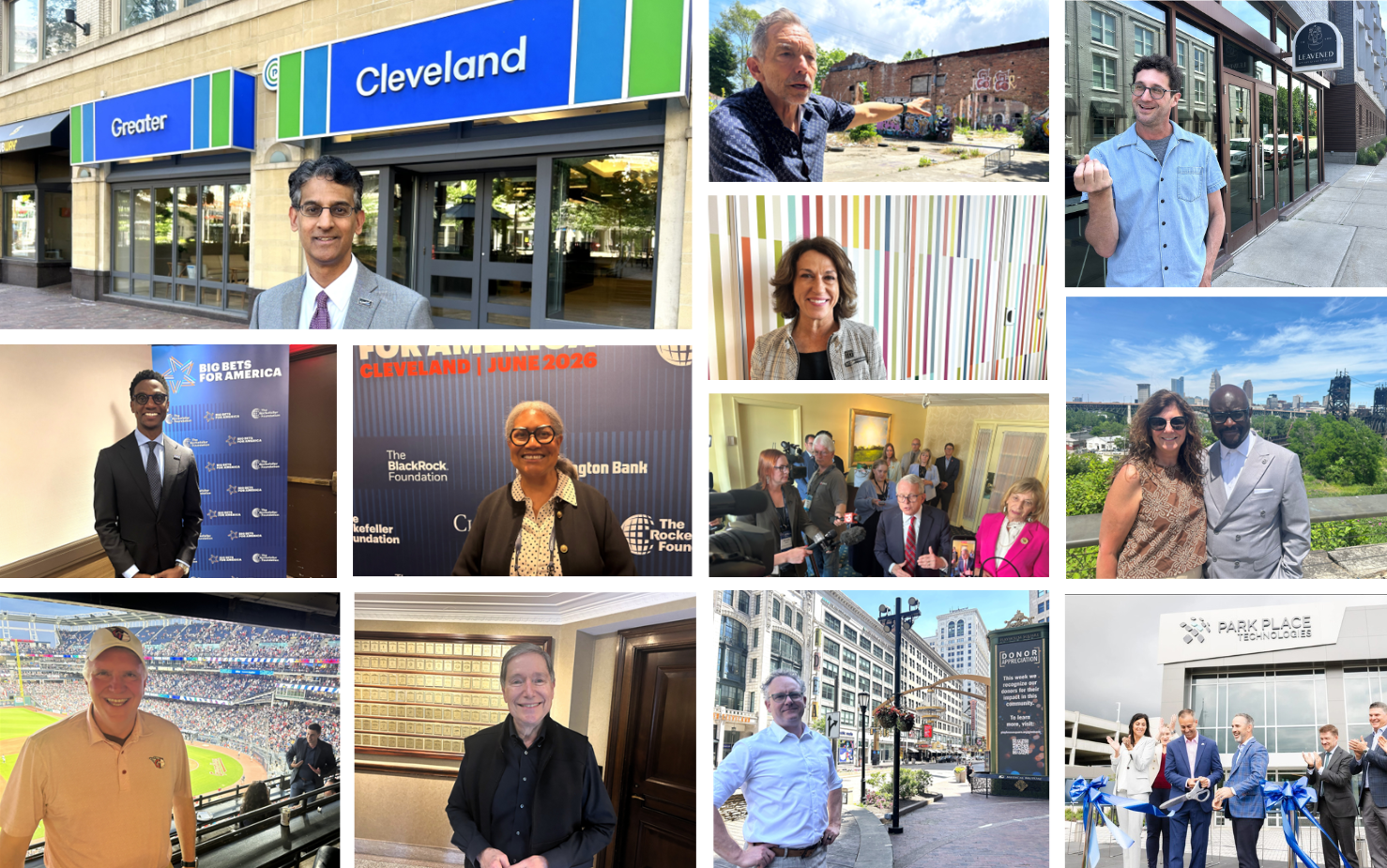
Some of the Cleveland leaders who shared their advice during GeekWire’s visit to northeast Ohio. (GeekWire Photos / John Cook)
CLEVELAND, Ohio — A century ago, this city was booming.
By 1920, it was the fifth-largest metropolis in the United States, fueled by manufacturing, immigration, industrial innovation and entrepreneurs who transformed it into a center of invention and business creation.
And then, seemingly overnight, it all changed. The economy shifted. Jobs dried up. Corporate headquarters moved.
Cleveland’s history is a cautionary tale for Seattle, which is at its own inflection point as we move from the software era to the AI era or what’s next. But the modern story of Cleveland is one of inspiration: a lesson in what becomes possible when business, civic and public leaders pull in the same direction.
That’s why GeekWire contributing columnist Charles Fitzgerald and I spent several days in Cleveland this week — speaking to philanthropists, developers, entrepreneurs and even Mayor Justin Bibb and Ohio Gov. Mike DeWine. This mini fact-finding mission started four months ago after Charles, a tech veteran and Seattle angel investor, wrote a provocative column for GeekWire titled: A warning to Seattle: Don’t become the next Cleveland.
Advertisement
Mayor Bibb was on the phone with us the next day, making the case for his city. He invited us to explore Cleveland — its rise, fall and rebirth — and get to know another story about a rebounding Midwest city.
We came to learn about Cleveland. We left with new insights about Seattle and what’s needed to foster a prosperous future.
From the moment we arrived in northeast Ohio — where Mayor Bibb’s voice welcomes airport visitors to a city built on “grit and innovation” — to the moment we left, one thing stood out. While not everyone agrees on every issue, there is a palpable sense that Clevelanders are “all in” — rowing in the same direction like a crew quietly propelling its shell along the Cuyahoga River.
Here’s what we learned from Cleveland:
Advertisement
East Cleveland Mayor Sandra Morgan at the Big Bets for America event in Cleveland. (GeekWire Photo / John Cook)
“The City of Cleveland, and by extension, East Cleveland, rode a wave of innovation and industry and growth that was unparalleled, really, just about anywhere in the country for quite a while,” she said. “And then when we took a dip and a turn, it was a pretty dramatic turn of events. And it has taken probably the better part of 50 years to right the ship and turn things around.”
For East Cleveland, she said, “that ship has yet to be righted. We’re still working on it.”
But Morgan wasn’t telling Seattle to fear growth. “Chaotic growth, it’s fun, but it’s not necessarily the best way to grow,” she said. “And always with growth comes some unforeseen issues and problems, but growth still is better than no growth, in my opinion.”
Advertisement
She also extended an invitation: “When you get tired of being in Seattle, come to East Cleveland, Ohio. We’ve got plenty of space for you.”
Ohio Gov. Mike DeWine speaks with reporters in Cleveland. (GeekWire Photo / John Cook)
Ohio Governor Mike DeWine, who has led the state since 2019, was in Cleveland announcing a $300 million workforce development program through JobsOhio.
“I don’t give advice to other areas,” he said in response to our question. “But my advice to people is, come to Ohio. Come work in Ohio. You will not find a better place, better people, quality of life. Cost of living is low compared to the two coasts.”
He pointed to the companies betting on the state. “There’s a reason why we are getting companies like Anduril that are relocating at least part of their new business to Ohio. There’s a reason why Joby is here. There is a reason why Sherwin-Williams stayed here.”
“Look, this is our time. It is the Midwest’s time in history,” DeWine said. “We do not wish anybody to not be successful, we want everybody to be successful in this country. But we know we have something special here in Ohio.”
Advertisement
Cleveland Mayor Justin Bibb at the Big Bets for America event. (GeekWire Photo / John Cook)
Justin Bibb is the 39-year-old mayor of Cleveland. When we asked him what advice he would give Seattle and its new mayor, Katie Wilson, he started with the fundamentals.
“You’ve got to focus on the basic plumbing and tackling of good city governance,” he said. “At the same time, as former mayor Pete Buttigieg always says, the job is part pothole, part vision. And that’s kind of been my duality of, hey, the cops gotta get paid, the streets have to be safe, the potholes have to be fixed. City government has to function well.”
But running the city well is only half the job, he said. “You have to chart a vision for where the city is going to go. Because in this economic environment our customers, our residents and our businesses can choose like that, so we have to make sure that our value proposition is sticky and compelling. And to me that’s the job of mayor.”
Cuyahoga County Executive Chris Ronayne at a Cleveland Guardians game at Progressive Field. (GeekWire Photo / John Cook)
Chris Ronayneis the Cuyahoga County executive, the top elected official in the county that includes Cleveland, and a former planning director for the city. His advice draws on that planning background: figure out what’s working in your community, and invest in it.
“Support what’s working. Organically grow what you got,” he said, contrasting that approach with the economic development strategy of chasing the next big company. “The cavalry’s not coming,” he said. “That’s the lesson for Cleveland, and it’s a lesson for Seattle.”
He also pointed to immigration as essential to growth, noting that immigrants have been the Cleveland region’s only source of population gains in recent years. “Metros have to lead the way on strategies to bring newcomers to your city,” he said, acknowledging that it’s “a complicated task” for any metro region in the current environment.
Advertisement
His third piece of advice: don’t fixate on the giants. Cleveland was once known for its Fortune 500 headquarters, as Seattle is now, he said, but “the real lifeblood is small business.”
John Nottingham, co-founder of Nottingham Spirk in front of the company’s wall of patents. (GeekWire Photo / John Cook)
John Nottingham is co-founder of Nottingham Spirk, the Cleveland innovation lab behind products like the Crest SpinBrush, with nearly 1,600 patents to its name. The firm operates out of a renovated former Christian Science church overlooking the city’s University Circle district.
His advice: “You have some pretty high-powered entrepreneurs in Seattle. You should appreciate your entrepreneurs.”
Nottingham reached back a century for his cautionary tale: John D. Rockefeller, who built Standard Oil into “the first multi-national company, driving everything else,” he said. But the oil baron’s success bred resentment in his hometown. “He was almost pushed out of Cleveland, and there’s a lot of stories about that.”
Rockefeller decamped to New York, and later in life directed a massive gift that built the University of Chicago. The lesson for Seattle, where prominent tech leaders have been leaving the region, wasn’t subtle.
Advertisement
Brad Whitehead of the Good Jobs Fund at the former Westinghouse light bulb factory, part of The Midline industrial district he is developing on Cleveland’s near east side. (GeekWire Photo / John Cook)
Brad Whitehead is managing director of site readiness for the Good Jobs Fund and developer of The Midline, an industrial district taking shape on Cleveland’s near east side, including the former Westinghouse light bulb factory where he gave us a tour.
Cleveland’s mistake, he said, was complacency. The city had reinvented itself so many times that its leaders trusted it would simply happen again. Seattle can learn from this.
“Where the next thing has always come along, you can’t assume that that’s going to happen,” he said. “For many years, we had this sense of who we are, and because we had the great names, that it was all going to continue to work well.”
The region learned too late that prestige and payrolls are different things. “Just because somebody has a corporate headquarters doesn’t mean that’s where they’re producing. We’ve got fabulous companies that figured out how to adapt and survive, but that meant the jobs often left and went to other places.”
Michelle Tomallo, co-founder and chief people officer of FIT Technologies, at the company’s downtown Cleveland offices. (GeekWire Photo / John Cook)
Michelle Tomallo is co-founder and chief people officer at FIT Technologies, an employee-owned IT managed service provider in downtown Cleveland.
Her advice echoed a theme we heard repeatedly: success has a way of narrowing your vision.
Advertisement
“Be very thoughtful about what the future is holding,” she said, “because I think when we have grand success, sometimes we are far away from what’s coming next.”
Josh Rosen, co-owner of Sustainable Community Associates, in Cleveland’s Tremont neighborhood. (GeekWire Photo / John Cook)
Josh Rosen is co-owner of Sustainable Community Associates, a real estate development company that’s converting abandoned gas stations, dry cleaners and industrial sites into housing in Cleveland’s Tremont neighborhood.
Looking at Seattle from the outside, Rosen sees concentration risk.
“It feels like Seattle is dependent on a sector, and in a lot of ways very few companies within that sector,” he said. “And that allows for a certain type of growth. But as things change, if you don’t develop a framework of interdependency of all the different stakeholders, that change can be sudden and not what you want it to be.”
The lesson, he said, “is to start to build an ecosystem of working together, so when there are shifts or there are changes, the community is prepared for that next phase.”
Advertisement
As a developer, he pointed to real estate as the place where that fragility shows up first. “You have all these buildings that are built based on a certain amount of income being produced. And that’s how those mortgages and those loans are being serviced. And what if that changes by 20 percent?”
Yvette Ittu, president and CEO of Cleveland Development Advisors, overlooking the city. (GeekWire Photo / John Cook)
Yvette Ittu is president and CEO of Cleveland Development Advisors, which channels investment into real estate and redevelopment projects in Cleveland’s neighborhoods.
Her advice was less about any single policy and more about how a city works together.
“The collaboration between the business community, the civic sector and the public sector are imperative for anything you are going to do in your community,” she said. “It really takes connectivity with all of those sectors, collaboration and communication.”
Nathan Kelly, president of Playhouse Square Real Estate, in Cleveland’s Playhouse Square theater district. (GeekWire Photo / John Cook)
Nathan Kelly is president of Playhouse Square Real Estate, part of the nonprofit that operates one of the country’s largest performing arts districts outside of New York.
His advice gets at a prerequisite for everything else: “I think safety, real and perceived, is the most important factor for building a place or growing a place,” he said. “And I can only impact the perception of safety. But we do it with small things, like I require all of my tenants on the retail and second level to have their lights on 24/7 so that that light sheds out onto the street. We do a lot of things with color and paint that make things feel vibrant, even if you’re alone.”
Advertisement
It’s not just cosmetic, he said. The district works with the city and economic groups on uniformed officers and safety patrols, while addressing deeper human service needs. “I know who to call when somebody is having an episode that doesn’t require a police intervention. I think that’s the most fundamental.”
Chris Adams, president and CEO of Park Place Technologies.
Chris Adams is president and CEO of Park Place Technologies, an IT infrastructure services firm with more than 500 employees at its Cleveland headquarters.
Cleveland’s problem wasn’t a lack of warning signs, he said. It was the speed of the response.
“When the world started changing, we needed to, as a community, adapt quicker. I really think it is the bureaucracy that lets people down. Your job is to provide for the constituents,” he said. “We are doing well now as a community environment, but it took some time for people to pivot.”
He described the danger this way: “You are always looking in the rearview mirror and you are riding that wave, and you don’t see the land in front of you that you are about to crash into. You can only surf the wave so long. Fundamentally, people need to look forward, not behind.”
Advertisement
“Just because it has been a boom town out there for a long time, that only gets people overconfident,” he added. “If you get too confident in what you have, you can lose it.”
Baiju Shah, president and CEO of the Greater Cleveland Partnership, in downtown Cleveland. (GeekWire Photo / John Cook)
Baiju Shah is president and CEO of the Greater Cleveland Partnership, which has organized the region’s comeback effort around a shared 10-year plan called“All In.”
His advice for Seattle is the strategy behind that name.
“You need to get your business leadership and your public leadership heavily engaged and committed. We call it ‘all in,’” he said. “There’s got to be an economic vision for the region that everyone can get aligned behind and start to work hard on these types of priorities, whatever those might be.”
Freddy Collier of the Greater Cleveland Partnership, with the Cleveland skyline behind him. (GeekWire Photo / John Cook)
Freddy Collier is senior vice president of strategy and new initiatives at the Greater Cleveland Partnership, the region’s chamber of commerce.
He pointed to the trait that carried Cleveland through its hardest decades: “One of the key things that makes Cleveland special is resilience. It continues to evolve, and reinvent itself. And that’s one of the things I love about this town. It’s a big city with a small town feel. People know each other, and people are connected.”
Advertisement
His advice for any city navigating change: invest in the things that bind people together. For Cleveland, that starts with geography: “Our natural assets I think are our superpower: our waterfront, riverfront, our trails,” he said. “And those are the things that connect people, no matter what walk of life you come from, no matter what your demographic situation is, no matter what your economic situation is.”
“We have things in this town that are unifiers, that are equalizers,” he said, “and I am really proud of that.”
Coming Saturday: John Cook and Charles Fitzgerald join the GeekWire Podcast from an abandoned Westinghouse light bulb factory in Cleveland to share what they learned, and what it means for Seattle’s future. Subscribe to GeekWire in Apple Podcasts, Spotify, or wherever you listen.

























































You must be logged in to post a comment Login