Connect with us
DAPA Banner

Tech

In the flexible work era, how can we make the most of co-working spaces?

Published

on

Zihan Wang of the University of Sussex offers advice to professionals who want to maximise their time in shared spaces.

Co-working spaces have become a familiar part of the working landscape. A convenient alternative to working from home or an employer’s office, they have become the favoured option of millions of the world’s freelancers, entrepreneurs and remote workers.

In the UK, there are over 4,000 co-working venues to choose from. Prices vary, depending on location and facilities, but with a dedicated desk costing around £200 per month, it’s worth knowing how to make the most of what these spaces offer.

So how do you choose the right co-working space for you? And how do you get the maximum benefit? Here are four practical tips to consider:

Advertisement

Identify your needs

Not all co-working spaces serve the same purpose. Some people are simply looking for a quiet desk outside the home, while others want a social environment where they can meet people, exchange ideas and build connections.

Being clear about what you want, whether it’s productivity, networking opportunities or skill development, is the first step.

Smaller, independently run spaces often place greater emphasis on community building, with managers who organise regular informal events such as ‘lunch and learn’ sessions or workshops. These environments can create more opportunities for social interaction and learning.

By contrast, larger corporate-style spaces may offer more polished facilities and business services, but with fewer opportunities for facilitated interaction. Choosing the right co-working environment means considering the type of space and how you plan to use it.

Advertisement

Give it a try

Co-working spaces are often advertised as being open and inclusive. But research I worked on with colleagues shows that experiences can vary depending on factors such as age, gender or professional background.

Some spaces will probably feel more welcoming than others, particularly ones where equality, diversity and inclusion are a deliberate part of their design and ethos.

Many spaces are now also set up with specific groups in mind. For example, some cater to female entrepreneurs, while others offer tailored support for neurodivergent workers.

Before committing, it’s worth visiting a space, attending an event, or trying a short-term pass (for a couple of days or a week) to see whether it feels like a good fit.

Advertisement

It’s more than a desk

It’s easy to treat co-working spaces as simply a place to work. But research suggests much of its value lies in the connections, community and everyday interactions it makes possible.

Casual conversations in the kitchen or spontaneous exchanges over lunch can help build communication skills, expand professional networks and spark new collaborations. Evidence suggests that these benefits tend to be particularly strong for those who are newer to a city, earlier in their careers, or working independently. They may have less established local networks or fewer everyday opportunities for office-based interaction, making them more likely to seek out social connections within co-working spaces.

If you only show up, put your headphones while you work and then leave, you may miss out on some of the main advantages of co-working – the opportunity to connect with others and become part of a community. Making the most of these spaces often means being willing to take that first step, engage with others and gradually find your own circle.

Take advantage

If your work involves specialised tools, digital technology or continuous skill development, you may need more than just Wi-Fi and coffee from a co-working space.

Advertisement

Many now offer access to specialist software and cutting-edge equipment such as 3D printers or virtual reality devices, which can be costly or difficult to access by yourself.

Some go a step further and organise workshops and training sessions, or even events that reflect the latest developments in a particular field. These resources can be particularly valuable for independent workers including freelancers and the self-employed, who may not have access to structured on-the-job training through an employer.

Using them can help you build practical, up-to-date technical and digital skills, especially as new technologies and AI continue to reshape the skills demanded in many industries. So don’t overlook what’s on offer, whether it’s a workshop, a new tool, or a piece of equipment. Making use of these opportunities can help you stay adaptable, keep learning and be better prepared for what comes next.

Overall then, co-working spaces can offer valuable opportunities to learn new skills, build networks and adapt to changing ways of working. But these benefits are not automatic and they are not the same for everyone.

Advertisement

Getting the most out of co-working often depends on how you use the space and whether it matches your needs. At its best, co-working is not just about renting a desk, but about finding an environment where you can connect, learn and grow.

The Conversation

By Zihan Wang

Zihan Wang is a research fellow in geography and innovation at the University of Sussex. Her research examines skills as a core regional capability shaping innovation, productivity, labour market dynamics, and structural transformation. Using large-scale quantitative data including online job postings, LinkedIn data, and questionnaires, she investigates how skills are developed, deployed, and transformed across places. With a sectoral focus on manufacturing and the creative industries, she aims to bridge theoretical analysis and policy development, particularly in informing place-based skills policy and industrial strategy.

Don’t miss out on the knowledge you need to succeed. Sign up for the Daily Brief, Silicon Republic’s digest of need-to-know sci-tech news.


Advertisement

Source link

Continue Reading
Click to comment

You must be logged in to post a comment Login

Leave a Reply

Tech

Market research is too slow for the AI era, so Brox built 60,000 identical ‘digital twins’ of real people you can survey instantly, repeatedly

Published

on

In a world where a viral TikTok video can cause a brand to trend globally in mere hours, the traditional market research cycle — often spanning 12 weeks — is becoming a liability.

The lag between a survey question and the answers from a wide (or targeted) pool of respondents has become a primary bottleneck for Fortune 500 decision-makers who are forced to navigate volatile geopolitical and economic shifts with data that is frequently outdated by the time it reaches a slide deck, as industry experts have observed.

Brox, a predictive human intelligence startup, recently announced a strategic funding round following a year where they reported 10X revenue growth. Their proposition is as ambitious as it is technical: the creation of a “parallel universe” populated by 60,000 digital twins of real, living human beings and their entire demographic profiles and consumer preferences, allowing enterprises to run unlimited experiments in hours rather than months.

“These digital twins are one-to-one replicas of actual, real individuals,” said Brox CEO Hamish Brocklebank in a recent video call interview with VentureBeat. “We recruit real people like a normal panel company does, pay them to interview them, and capture all the data around them — fully consent-driven.”

Advertisement

The company, currently a lean 14-person operation, is positioning itself as the antithesis of the “insane” research industry. By replacing statistical models with behavioral replicas, Brox aims to transform how the world’s largest banks and pharmaceutical giants anticipate human reactions to high-stakes global and market-shifting events, or narrow, targeted product releases and personnel news, and everything in between.

The kinds of surveys and specific questions that Brox asks its digital twins are completely open-ended and can be customized to fit any conceivable business customer’s use cases and goals.

According to Brocklebank, examples of survey questions include: “What happens if America invades Iran or Greenland? Will depositors at Bank of America put more money into their account or take more money out? Or, in pharmaceuticals, if RFK Jr. says something next week, will that make people more likely to take vaccines or less likely?”

Not synthetic people — AI copies of real ones

The core differentiator of Brox’s technology lies in the fidelity of its input data.

Advertisement

While many competitors in the “digital audience” space rely on purely synthetic identities — generic personas generated by Large Language Models (LLMs ) — Brocklebank argues that these methods inevitably produce “AI slop”.

Purely synthetic audiences often cluster around a tight distribution of answers, over-indexing for “correct” or “healthy” behaviors (such as eating broccoli) because of inherent biases in the underlying models.

Brox’s “Digital Twins” are instead one-to-one behavioral replicas of real individuals who have been recruited and interviewed with exhaustive depth. The process is intensive:

  • Deep Interviews: The company conducts hours of real and AI-driven interviews with each participant.

  • Psychological Depth: The data collection seeks to understand fundamental “decision drivers,” including upbringing, relationships, and even marital stability.

  • Data Density: For some twins, Brox maintains up to 300 pages of text data, representing what Brocklebank calls “the deepest per person data set that exists”.

To solve the “black box” problem common in AI, Brox utilizes a “reasoning chain” for its predictive outputs. When a digital twin predicts a reaction — such as how a $2 billion net-worth individual might respond to a specific interest rate hike — the model introspects and provides a step-by-step explanation for that decision.

Advertisement

This allows clients to understand not just what will happen, but the underlying psychology of why it is happening.

Scaling the “unscalable” interview

The product offering is currently live in the US, UK, Japan, and Turkey. Brox has successfully digitized specific, high-value cohorts that are traditionally difficult for researchers to access.

This includes a panel of “high-net-worth” individuals (those worth over $5 million) and specialized medical professionals like dermatologists — including a multibillionaire.

However, the largest value for customers is likely in the aggregate mass of all individuals that can be polled en masse and/or segmented across demographics, especially those of medium and lower income levels, whose purchasing power and decision-making is more constrained and whose market-

Advertisement

One of the more unique aspects of the Brox platform is its incentive structure. To ensure twins remain up-to-date, real-world counterparts are re-contacted frequently.

For high-value individuals who are not motivated by small cash payments, Brox has issued Stock Appreciation Rights (SARs), essentially making these participants “investors” in the company’s success to ensure they continue to provide high-fidelity personal updates. The platform’s use cases currently focus on two primary sectors:

  1. Pharmaceuticals: Predicting vaccine hesitancy or how physicians might react to new biologics based on shifting political climates.

  2. Finance: Simulating how depositors at major banks might move funds in response to geopolitical events, such as conflicts in the Middle East.

As for why go to the trouble of interviewing and digitally cloning real people instead of just creating wholly fictitious, synthetic audience characters and personas using LLMs and other AI models, Brocklebank offered his perspective.

“You can create 10,000 truly synthetic digital twins, but the answers will still normalize into a very tight distribution, which is not realistic when you’re actually asking real people,” Brocklebank said.

Advertisement

By maintaining a pre-built audience of 60,000 twins, the company enables clients to bypass the recruitment phase of research. A large US bank or a global pharma giant can now “query” the digital population and receive a validated analysis in a matter of hours.

Pricing and accessibility

Unlike traditional research firms that charge on a per-project or per-respondent basis, Brox operates as a high-end Software-as-a-Service (SaaS) platform with enterprise-level commercial licensing. The company avoids the “seat” or “usage” limits that often hinder rapid experimentation within large organizations.

  • Pricing Tiers: Subscriptions are sold as blanket flat fees, starting at a minimum of $100,000 per year.

  • Top-Tier Contracts: For larger deployments involving multiple teams and global data access, contracts scale up to $1.5 million per year.

  • Usage Rights: Clients are granted unlimited usage during the contract period. This allows them to run thousands of simulations without worrying about incremental costs, encouraging a culture of “testing everything” before deployment.

From a legal and privacy standpoint, the digital twins are built on a “fully consent-driven” framework. While the twins can be traced back to real human data for internal validation, the platform is designed to provide aggregated behavioral insights that protect the anonymity of the participants while maintaining the predictive power of their digital replicas.

Rejecting the rise of Kalshi, Polymarket and ‘prediction markets’

The tech industry has recently seen a surge in valuations and interest in “prediction markets” like PolyMarket and Kalshi, which allow users to bet on the outcomes of various global events.

Advertisement

However, the leadership at Brox maintains a distinct distance from these platforms, citing a “personal disdain” for betting markets from both a moral and intellectual perspective.

Brocklebank argues that while betting markets can predict outcomes (e.g., who wins an election), they offer zero utility for business decision-makers because they fail to provide the “why”.

Knowing there is a 60% chance of a certain candidate winning does not help a company adjust its consumer strategy; knowing why a specific cohort of depositors is feeling anxious does.

Investors including Scribble Ventures, Wonder Ventures, and Vela Partners have backed this “human-first” approach to AI, betting that the moat created by deep human data will prove more resilient than the commoditized models of synthetic data providers.

Advertisement

As Brox prepares for launches in the Middle East and APAC, the company is moving toward its ultimate goal: simulating the entire world as a “parallel universe” for risk-free decision-making.

Source link

Continue Reading

Tech

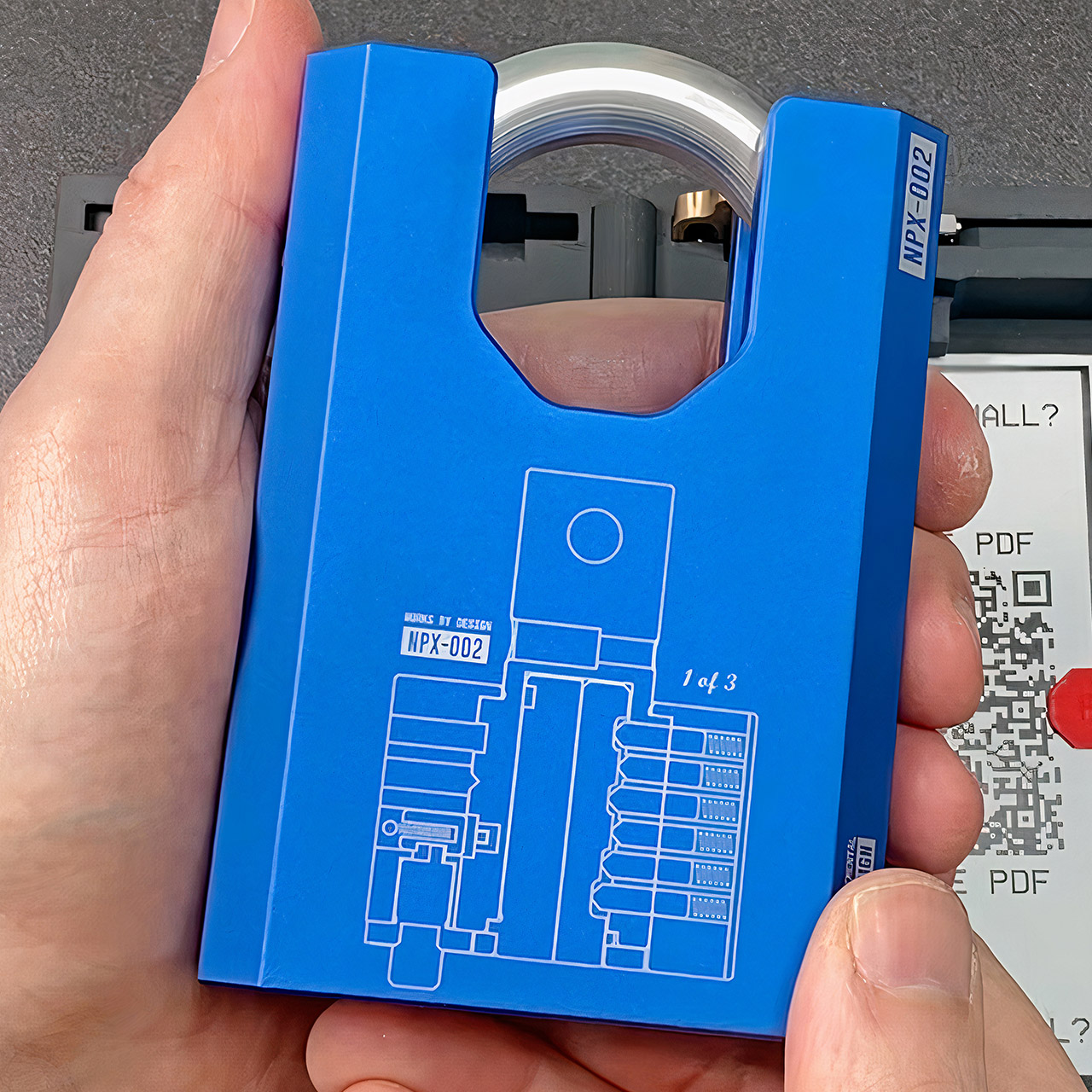
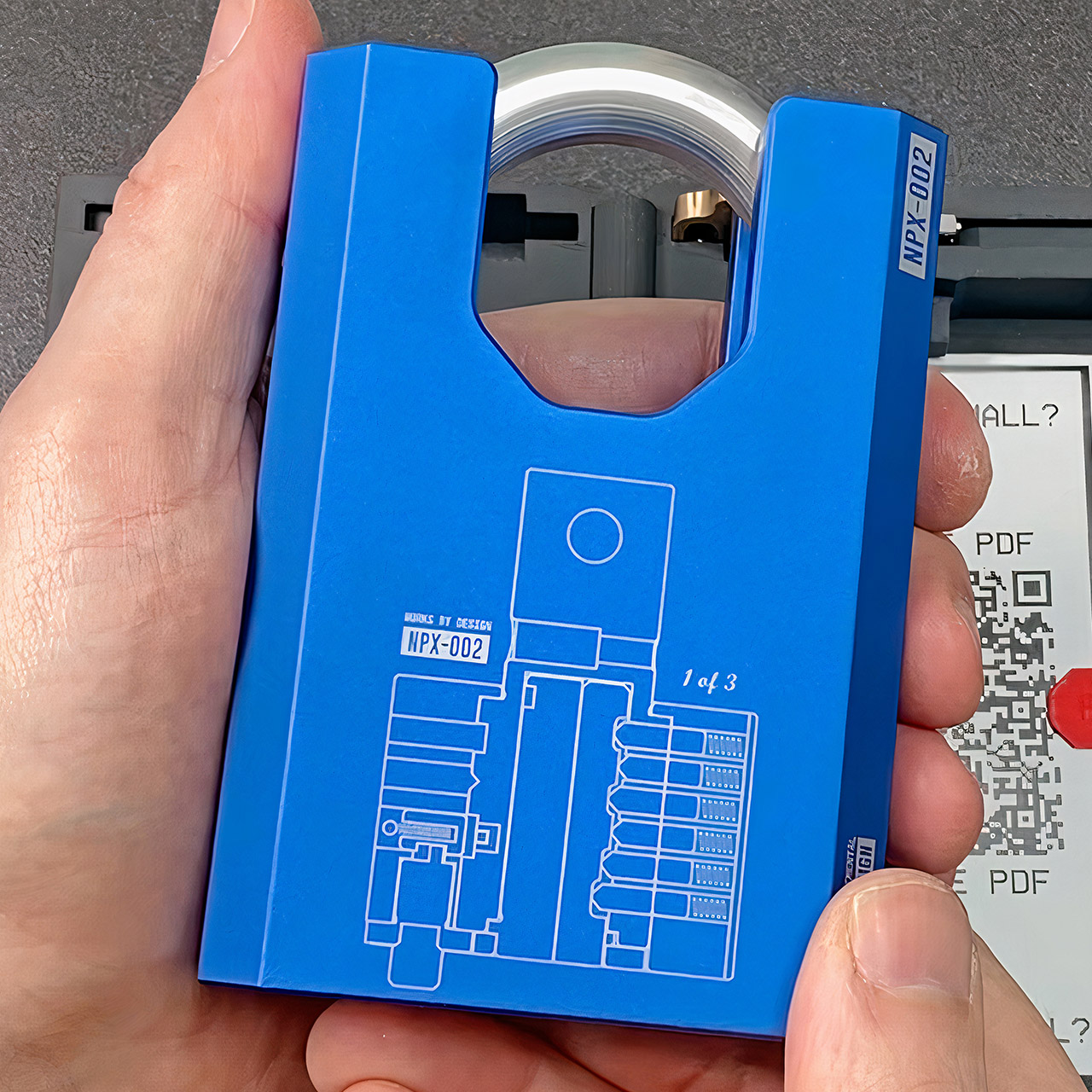
The Grind That Opened an Unpickable Works by Design NPX-002 Lock

Published

on

Picking Works by Design Unpickable NPX Lock
Lock Noob got his hands on the NPX-002 from Works by Design and wanted to put its security claims to the test to see how well they held up. The lock’s designers created this travelling key system, in which the key’s bow spins some internal gears and the actual key blade moves into place deep inside the cylinder. The key only fits perfectly in the exact position, at which point the keyway seals off, leaving no place for your standard picks or tension tools to reach the pins. To prevent the normal impressioning techniques, the brass ones had a plastic pin inserted.


He began by taking a close look at the lock, shining a light through the clear anti-tamper cover to see the key within. A quick stream of solvent was sufficient to lift the seal without causing any damage. He pulled out the key, opened the lock once, and then disassembled the cylinder to inspect all of the moving parts. After that, he put everything back together and sealed the case with tape. Bypassing it was more of a curiosity for him, as the actual test would be to pick it honestly.

Picking Works by Design Unpickable NPX Lock
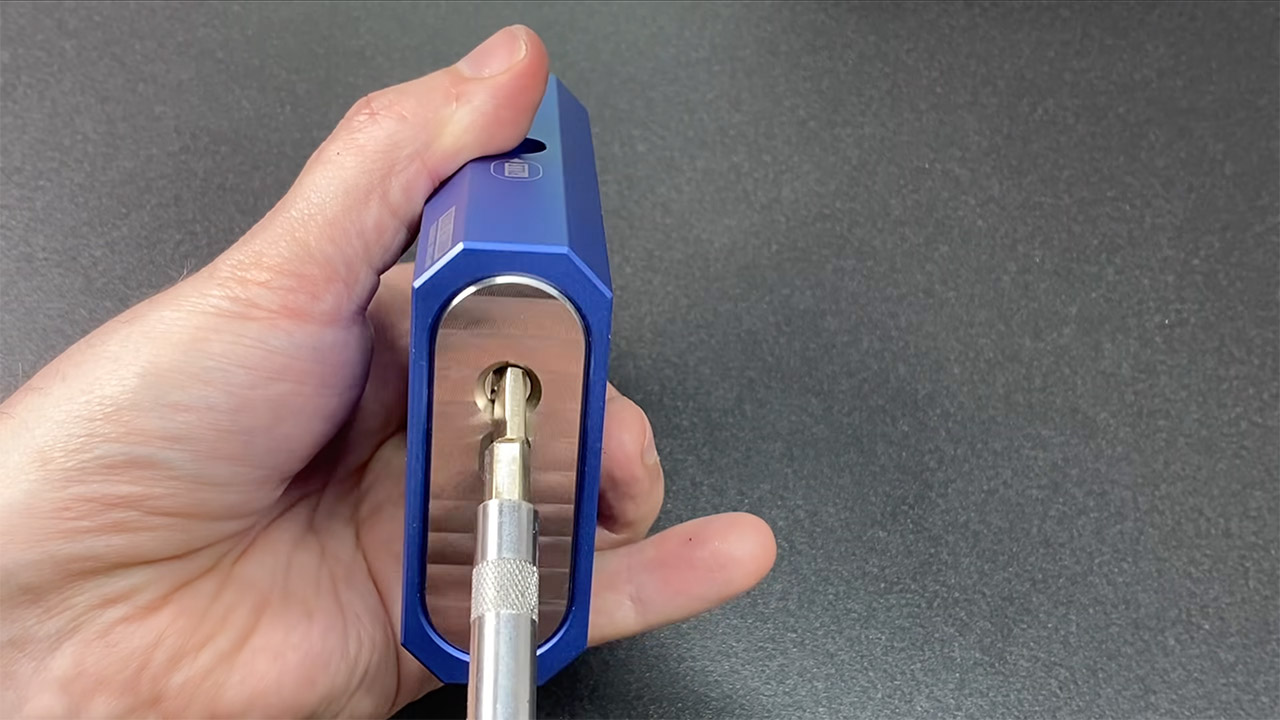
His next step was to impressioning the lock by clamping it in a vice and inserting a simple brass blank into the keyhole. He then took an old screwdriver, fitted a bespoke brass bit on it, and began applying mild twisting pressure so that the pins left a mark on the soft metal without harming the lock body. He shook the blank back and forth, watching as tiny marks appeared where the pins pressed the strongest. Each one informed him exactly where to begin filing.

Picking Works by Design Unpickable NPX Lock
The grind had settled into a regular rhythm, as you filed a bit, turned again, examined the fresh marks with a magnifying glass, and repeated. Position three refused to make a mark, which he discovered was due to the plastic pin, but he continued nevertheless, deepening the wounds where the brass was in touch. He had been turning, filing, inspecting, and repeating for two hours before he realized it. The cuts were increasing deeper in some places and shallower in others, until the blank finally matched the unknown depth.

Picking Works by Design Unpickable NPX Lock
After two hours, the cylinder gave a gritty turn, and the lock finally opened. The plastic pin had chipped somewhat at the top, but the remainder of the mechanism remained intact. He disassembled the cylinder one last time and saw the damage with his own eyes. A new plastic pin was installed, and the lock was restored to its original functionality.

Picking Works by Design Unpickable NPX Lock
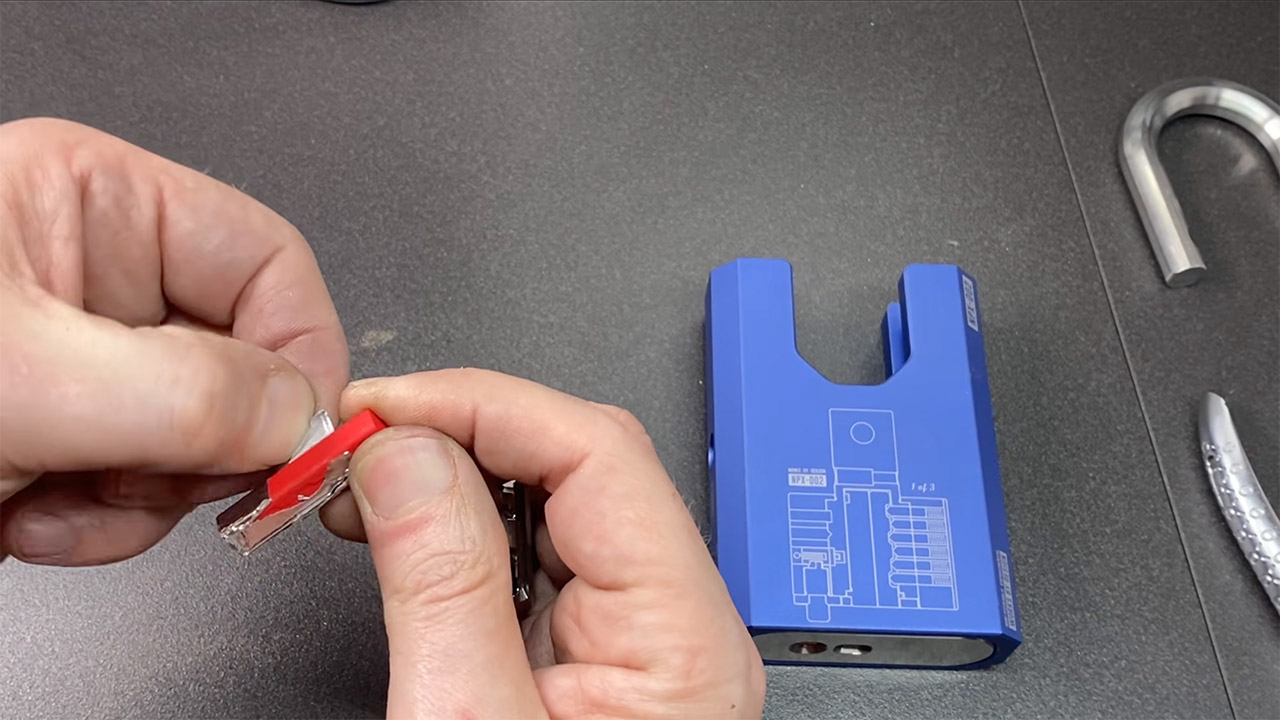
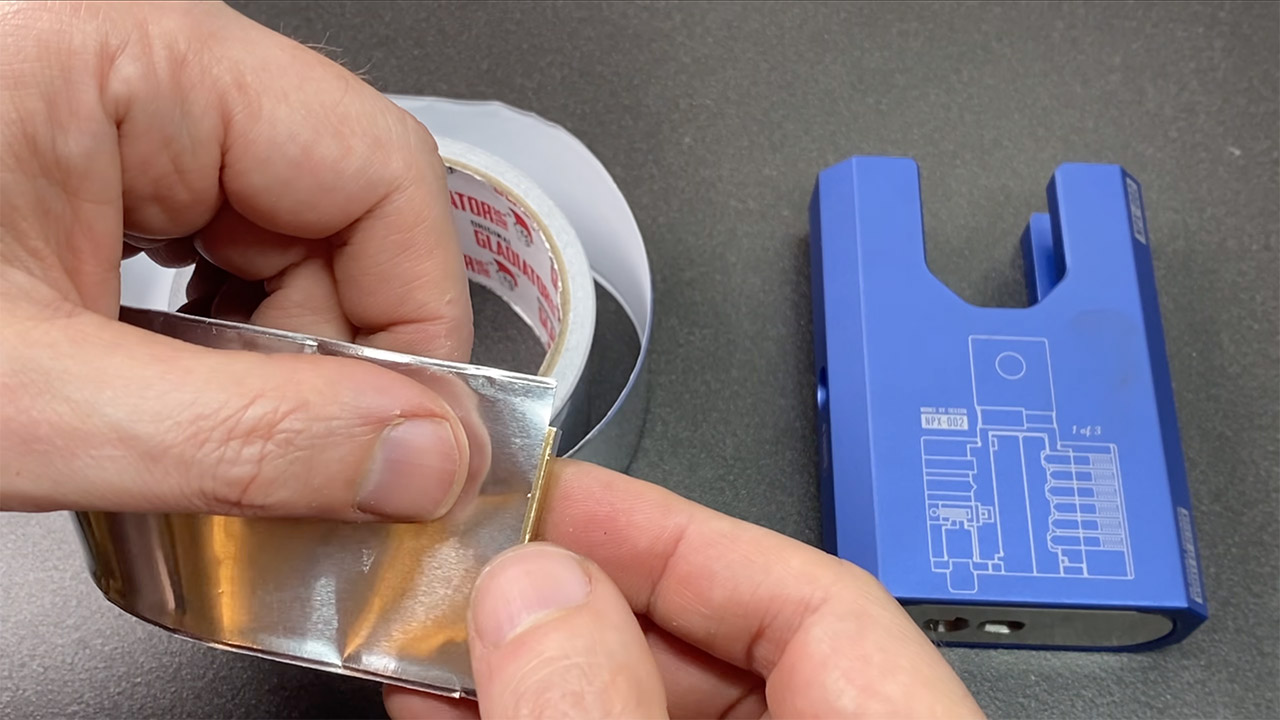
He attempted one final idea: wrap some aluminum foil around a skeleton key blank. The plan sounded fine on paper: the pins would simply press into the soft foil, leaving quick impressions. In practice the pins dropped at an angle and hit a ledge before they touched the foil. No useful marks formed. The foil method stayed on the shelf.

Source link

Advertisement
Continue Reading

Tech

Global fintech platform Currenxie to create 30 Dublin-based jobs

Published

on

The expansion follows the organisation’s recent authorisation as an electronic money institution by the Central Bank of Ireland, providing a strategic gateway to support SMEs across the continent.

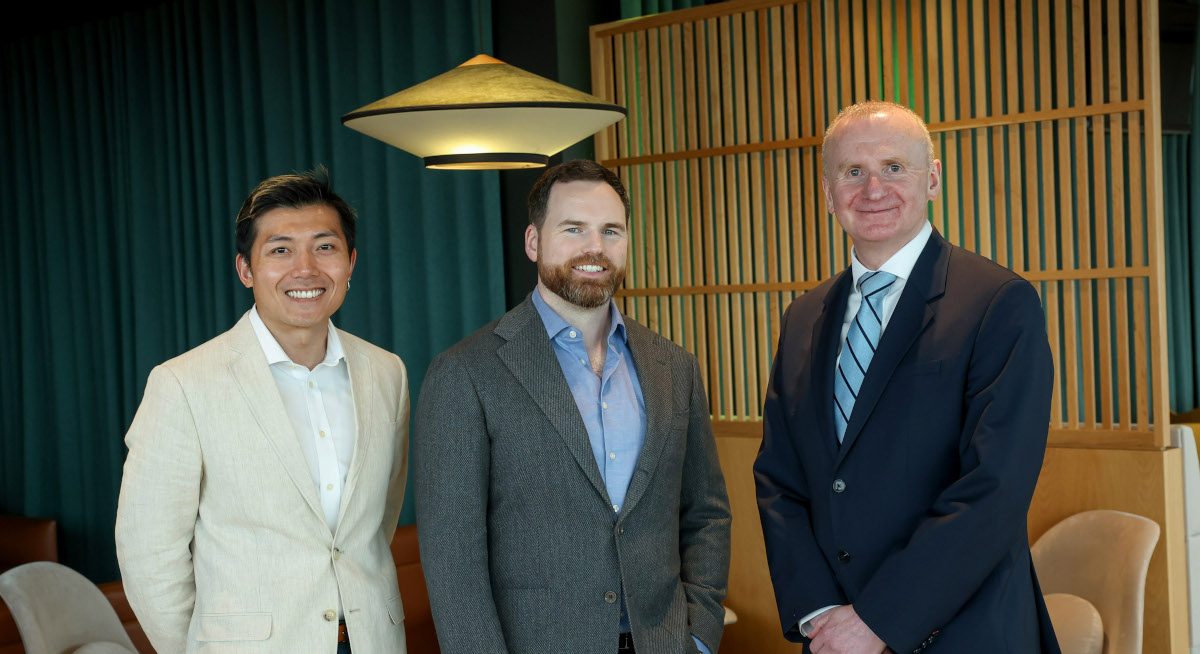
Hong Kong fintech Currenxie, which recently established an Ireland-based team, has announced plans to create 30 jobs in Dublin, which is the company’s European base of operations. The new roles will be in areas such as technology, operations, compliance, finance and client services.

The 30 jobs will be filled in the next two years and the expansion follows the company’s recent authorisation as an electronic money institution (EMI) by the Central Bank of Ireland, which Currenxie said has provided the company with a strategic gateway to support established SMEs across the continent.

Currenxie also stated that the move provides European finance leaders with the local payout and collection infrastructure needed to navigate complex global trade corridors, particularly between Europe and the Asia-Pacific region.

Advertisement

Commenting on the announcement, the Minister for Enterprise, Tourism and Employment Peter Burke, TD said: “I welcome Currenxie’s decision to establish its European operations in Dublin and their plans to create high quality jobs over the next two years. 

“The company’s decision reflects confidence in Ireland as a stable, innovative and well-regulated location from which to serve European markets.”

Michael Lohan, the CEO of IDA Ireland added: “We are delighted to welcome Currenxie as it establishes itself in Ireland. This announcement reinforces Ireland’s position as a leading location for international financial services and fintech companies, offering a highly skilled talent pool, a strong and well-regulated financial ecosystem, and direct access to customers across Europe.”

2026 has seen a positive uptick in investment within Ireland’s fintech ecosystem. In April, Dublin-based start-up Audrey AI announced the closure of a $1.8m pre-seed funding round. In early February, Dublin-based fintech company Circit secured $22m in growth equity funding to further scale its financial auditing and verification platform.

Advertisement

Don’t miss out on the knowledge you need to succeed. Sign up for the Daily Brief, Silicon Republic’s digest of need-to-know sci-tech news.

Source link

Advertisement
Continue Reading

Tech

Car Buyers Are Turning To ChatGPT To Help Them Get A Better Deal

Published

on


As artificial intelligence continues to advance, people are finding creative and useful ways to use it. One possibility: getting a good deal on a car. From finding a vehicle to negotiating with the dealer, AI could handle every step of the process, saving you time — and hopefully money. For example, ex-Apple engineer Mustafa Khan has created Negoshify, which can be downloaded on Claude or used as an app in ChatGPT. You can ask Negoshify to find a model around a certain price point in your area. It will show you available cars that match your inquiry within Negoshify’s dealership network, put down a refundable $500 reserve on the car, and even negotiate with a dealer to get you a better price. 

Some car buyers simply chat directly to ChatGPT — no additional apps needed — to make smart purchases. You can ask ChatGPT to evaluate the cars you’re considering to find out which one is the right choice for you. ChatGPT can also coach you through the negotiation process and give you advice on how to respond to dealers. One Reddit user said she ran her messages through ChatGPT, and it told her how to reword them after it decided she was losing too much leverage. “I normally can’t negotiate to save my life, so this was amazing for me,” she said. 

Advertisement

Should you be using ChatGPT to negotiate car deals for you?

Some buyers using ChatGPT have been impressed by its ability to gather information ahead of a negotiation, analyze dealer emails, and make sense of documents. There is no denying that an AI sidekick getting you a hassle-free deal on a car is a neat concept, but the technology may not be quite where it needs to be. There are a lot of things to remember if you plan to run your negotiation correspondence through ChatGPT. 

First, it can sometimes be biased depending on how you shape your prompts, or even make up things completely. “If the model’s training data has incomplete, conflicting, or insufficient information for a given query, it could generate plausible but incorrect information to ‘fill in’ the gaps,” a software engineer told TechRadar. Any feedback you get from ChatGPT should still be researched and verified before using it in a negotiation.

Another thing to consider is the biases that dealers may have towards AI. You may not get a response to your inquiry if they can tell it’s been generated by an AI program. There are some common ChatGPT phrases and styling that may be a giveaway, so steer clear of simply copying and pasting what ChatGPT tells you to say and instead rewrite it in your own words. Or maybe just stick to doing your own negotiations.

Advertisement


Source link

Advertisement
Continue Reading

Tech

Anthropic Gets in Bed With SpaceX as the AI Race Turns Weird

Published

on

Anthropic and Elon Musk’s SpaceX said on Wednesday that the two entities have signed an agreement for Anthropic to use computing resources from xAI’s data center in Memphis, Tennessee. It’s the latest tie up in an industry that is scrambling to find enough computers to run complex AI software. SpaceX and xAI were previously separate companies, but the two merged earlier this year. The combined entity, also owned by Musk, is called SpaceXAI.

Anthropic executives made the announcement on stage at the company’s annual developer conference in San Francisco. SpaceXAI also put out a blog post sharing more details about the deal, which will see Anthropic draw power from xAI’s Colossus 1 supercomputer.

The partnership comes at a pivotal time for SpaceXAI, which is seeking to go public as soon as next month. A relationship with a leading AI lab could bolster SpaceX’s credibility as it pitches investors on the potential gold mine in establishing more data centers, including in space.

Notably, Space XAI said in its blog post that Anthropic has “expressed interest” in partnering to develop “orbital AI compute capacity”—essentially, data centers in space. Having Anthropic as a potential customer could help SpaceXAI boost investor confidence that there will be buyers for its super expensive, supercomputing project.

Advertisement

Earlier this year, Musk criticized Anthropic’s AI models in a post on X, calling the company’s policies “misanthropic” and “evil,” and alleging without evidence that the AI models showed racial and sexual biases.

Now, he’s significantly changed his tune, writing on X that he “spent a lot of time last week with senior members of the Anthropic team to understand what they do to ensure Claude is good for humanity and was impressed.”

Musk’s SpaceXAI first broke ground on Colossus 1 on a former Electrolux site in 2024. The company claims that it is one of the largest and fastest AI supercomputers in the world. It includes roughly 220,000 Nvidia GPUs, ranging from Nvidia’s H100 and H200 to its newer GB200 chips. The company likes to boast that it built the super computer in 122 days.

Emissions from gas turbines at the data center have prompted numerous complaints from local residents. Last month, environmental protestors demonstrated at a nearby SpaceX investor gathering ahead of the IPO.

Advertisement

Anthropic plans to use its newfound computing power to “directly improve capacity for Claude Pro and Claude Max subscribers,” both companies said. The deal will give Anthropic access to more than 300 megawatts of new capacity, or approximately 220,000 Nvidia GPUs. In recent months, software developers have increasingly complained about rate limits and service disruptions to Claude Code, due to the physical limits of available computing resources.

As more and more people use services like OpenAI’s Codex and Anthropic’s Claude Code—sometimes running coding programs and agentic tasks for hours on end—the services are being bogged down. According to Anthropic, the average developer is now spending at least 20 hours per week running Claude Code.

Yesterday, The Information reported that Anthropic had committed to spend $200 billion on Google’s AI cloud services and TPU chips. Anthropic has also used Amazon’s cloud computing services and AI chips since 2023. Last month, Anthropic committed “more than $100 billion over the next ten years to [Amazon] technologies.” According to the Information report, contracts with Anthropic and OpenAI now account for “more than half of the $2 trillion in backlogs at major cloud providers” like Amazon, Microsoft, and Google.

Paresh Dave and Zoe Schiffer contributed to this report.

Advertisement

Source link

Continue Reading

Tech

Anthropic Is Doubling Claude Code Rate Limits After Deal With SpaceX

Published

on


Anthropic and SpaceX have struck a deal to allow the company behind Claude to use xAI’s Colossus 1 data center. As a result, Anthropic is doubling the rate limits for paid users of Claude Code and loosening other limits, the company said.

The arrangement with SpaceX allows Anthropic to use “all the compute capacity” at SpaceX’s Colossus 1 data center, which will add more than 300 megawatts of new capacity “within the month.” Anthropic also recently struck deals with Amazon and Google. As part of the deal, Anthropic has also “expressed interest in partnering with SpaceX to develop multiple gigawatts of orbital AI compute capacity,” the companies said. SpaceX recently filed paperwork with the FCC indicating it wanted to launch a million satellites in order to create an orbital data center.

Paid users of Claude Code (which includes people on Pro, Max, Team and Enterprise plans) should see immediate benefits from the deal. Anthropic is doubling the five-hour rate limits for Claude Code. It’s also removing the “peak hours” restrictions for Pro and Max users, and increasing the API rate limits “considerably” for Claude Opus models.

Advertisement

Anthropic partnering with Elon Musk’s SpaceX (which now owns xAI) may seem like an unlikely move. Musk recently called Anthropic “misanthropic and evil,” and has long been critical of its CEO Dario Amodei. But in a post on X he said that he was “impressed” with the Anthropic team and that Claude will “probably” be good. “We reserve the right to reclaim the compute if their AI engages in actions that harm humanity,” he added in another post.

Advertisement


Advertisement

Source link

Continue Reading

Tech

Apple removes more Mac mini and Mac Studio models from sale, as CEO Tim Cook warns it ‘may take several months to reach supply demand balance’

Published

on


  • More Mac models have now been pulled by Apple
  • Mac minis and Mac Studios now available in fewer configurations
  • AI and the associated memory shortage is to blame

With AI data center demand sucking up the world’s supply of RAM, consumers are feeling the effects: having already removed some configurations of the Mac Studio and Mac mini from its store last month, Apple has now reduced the available options even further.

As spotted by MacRumors, you can no longer buy Mac mini models with 32GB or 64GB of RAM, while the M3 Ultra Mac Studio with 256GB of RAM has also been taken off sale — so right now that particular computer is only available with 96GB of RAM.

Source link

Advertisement
Continue Reading

Tech

This Trump FCC Cybersecurity ‘Fix’ Is About To Make Hardware Way More Expensive For Everyone

Published

on

from the weird-and-racist-performance-art dept

Last week the Trump FCC quietly announced that it was cooking up a new ban on any labs that have testing offices in China from testing electronic ‌devices such as smartphones, cameras and computers for sale in the United States.

That’s going to create some major issues given that roughly 75% of all U.S.-bound electronics are currently tested in Chinese facilities. Many of these operations are owned by U.S. or European companies that have testing facilities in China because that’s where the lion’s share of technology is manufactured, so it’s simply more efficient for testing evolving iterations of new product.

That these companies have offices in China doesn’t inherently mean the testing labs are somehow all magically compromised and in dutiful service to the Chinese government, though that’s certainly the implication the xenophobic Trump administration is making (and has made before in previous, similar announcements).

One major problem outside of the raw logistics of it all: Carr’s planned cybersecurity fix would be significantly more expensive, driving up costs for everyone:

Advertisement

“27 of the affected facilities are Chinese subsidiaries of major Western testing firms, including Intertek, SGS, TUV Rheinland, and Bureau Veritas. Those companies operate labs in the U.S., Europe, and Taiwan that can absorb redirected work, but the shift won’t be seamless. Basic FCC certification testing runs between $400 and $1,300 at Chinese labs, compared with $3,000 to $4,000 at U.S. equivalents.”

Who is going to eat the difference in those costs? You are, of course. In addition to the higher costs from the AI boom, the tariffs, and Trump’s pointless war in Iran. Whatever companies lobbied Carr and Trump will do great. You probably won’t.

Given the terrible nature of smart IOT home security standards (more a byproduct of unregulated crony capitalism than China-based testing locations), having a more direct line of control over the testing of U.S. bound hardware makes superficial sense.

But then you have to remember that this is Brendan Carr, who does nothing authentically in the public interest, and is likely just looking to drive more business to a handful of U.S. companies that lobbied for his attention. And you have to remember that these folks, as you saw when they talked about shifting smartphone production to the States, don’t actually know what the fuck they’re doing.

The other major problem: Trump and Carr’s rabid deregulatory, anti-governance zealotry on other fronts has repeatedly worked to undermine U.S. cybersecurity, making these sorts of fixes leaky and highly performative, even if they were to be successful (which they won’t be).

Advertisement

While Carr and Trump profess to be super worried about Chinese threats to national security, with their other hand the Trump administration has gutted government cybersecurity programs (including a board investigating the biggest Chinese hack of U.S. telecom networks in history), dismantled the Cyber Safety Review Board (CSRB) (responsible for investigating significant cybersecurity incidents), and fired oodles of folks doing essential work at the Cybersecurity and Infrastructure Security Agency (CISA).

Brendan Carr is also engaged in a massive effort to destroy whatever’s left of the FCC’s consumer protection and corporate oversight authority, despite the fact that the recent historic Chinese Salt Typhoon hack (caused in large part because major telecoms were too incompetent to change default administrative passwords) was a direct byproduct of this exact type of mindless deregulation.

The Trump administration’s stacked courts are also making it extremely difficult to hold telecoms accountable for literally anything (see the Fifth Circuit’s recent reversal of a fine against AT&T for spying on customer movement), which also undermines consumer privacy and national security, and ensures zero real repercussions for companies that fail to secure their networks and sensitive data.

So, with one hand you have Carr claiming he’s “fixing cybersecurity” with stuff like this or his recent foreign router “ban” (which as we’ve noted is really a lazy extortion scheme), while with the other he’s doing everything in his power to ensure that domestic telecoms don’t really have anything even vaguely resembling meaningful privacy and security oversight.

Advertisement

Here’s where I’ll remind you that because the U.S. is too corrupt to pass even a basic modern privacy law, we also have a vast and largely unregulated data broker industry that hoovers up your every movement and online habit, then sells access to it to any random asshole (including foreign and domestic government intelligence agencies).

Here too, weird zealots like Trump and Carr have rolled back efforts to regulate data brokers or do anything about it. As authoritarian racists, they’re too blinded by personal self-enrichment and racism to have any genuine understanding of how any of this stuff actually works.

As with the TikTok “ban” (which basically involved shoveling ownership to Trump’s billionaire buddies), so much of this is heavily xenophobic, nationalistic, transactional, self-serving, and performatively detached from any actual reality. By the time the check comes due, guys like Carr and Trump will already be off to the next grift.

Filed Under: brendan carr, china, cybersecurity, fcc, privacy, security, testing

Advertisement

Source link

Continue Reading

Tech

Tin Can launches program to help schools and neighborhoods go smartphone-free together

Published

on

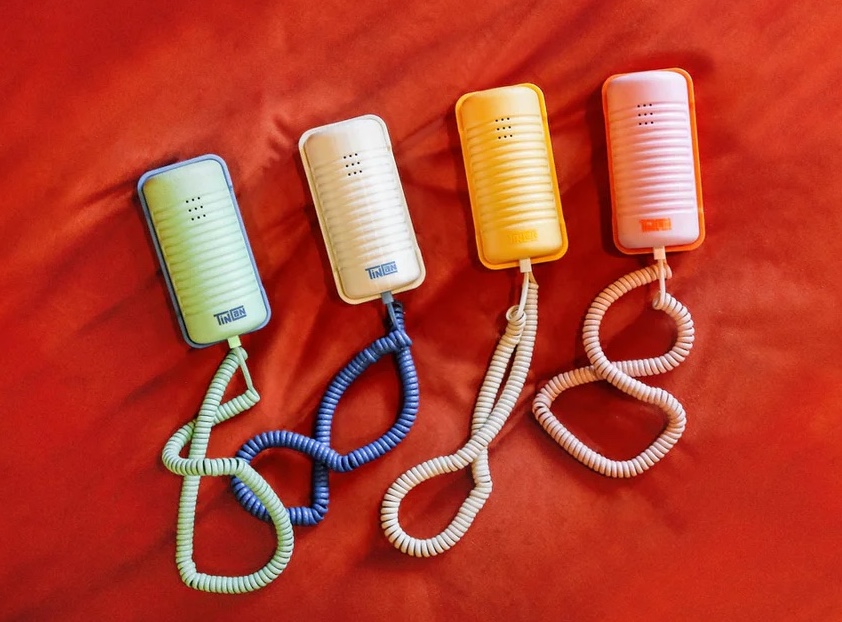
Tin Can landline phones in a variety of colors. (Tin Can Photo)

Tin Can, the Seattle startup behind the screenless, Wi-Fi-enabled landline phone for kids, is launching a new feature aimed at the groups that have been driving its rapid growth: schools, neighborhoods, and parent organizations looking to ditch smartphones together.

The company is calling it Tin Can Communities — a program that lets larger groups adopt the device all at once, with bulk pricing, onboarding support, and early access to features built specifically for group use.

Groups can order a minimum of 50 phones or more than 1,000 by reaching out to Tin Can directly with details about their organization.

“If you want to help kids build real connection, it works best when people come on together,” Tin Can CEO Chet Kittleson said. “The value multiplies quickly because kids have more people to call, and parents feel less pressure to move to a smartphone because their whole network is already on Tin Can.”

Tin Can co-founder and CEO Chet Kittleson. (Tin Can Photo)

Tin Can has been riding a wave of momentum since co-founders Kittleson, Graeme Davies and Max Blumen — all veterans of Seattle real estate startup Far Homes — launched the company in 2024. The colorful $100 phone connects to home Wi-Fi, letting kids make and receive calls from contacts approved by parents through a companion app. The company has raised $15.5 million to date, including a $12 million seed round last December.

The startup has grown to 30 employees and sold hundreds of thousands of phones since launching its flagship product in 2025 — now on its sixth production batch, shipping in June.

Advertisement

The momentum has extended beyond the parenting world: last month, late-night host Jimmy Kimmel gave the brand an unprompted shoutout during his monologue, suggesting someone get President Trump “one of those Tin Can phones like the kids have that are not on the internet.”

Wednesday’s launch comes as parents across the country have been organizing collective efforts to delay smartphone adoption — a movement built on the idea that individual decisions only go so far. Tin Can has found itself at the center of that shift, with PTAs, school administrators, and other groups asking how to get entire communities on board at once.

On San Juan Island in Washington, Alexandra and John Iarussi co-founded a nonprofit called the Mythic Farms Foundation with the sole purpose of putting a Tin Can in the hands of every kid in Friday Harbor. The first 300 families to sign up received a phone free of charge — and after one week the group had logged more than 1,500 calls and 75 hours of talk time, nearly double the typical first-week numbers for a new network, according to the company.

“Between ages 10 and 16, every child has approximately 8,760 hours that smartphones typically displace,” Alexandra Iarussi, mother of four boys, told the San Juan Journal. “Four hours a day, six years, one childhood.”

Advertisement

In Kansas City, a mom named Tracy Foster — director of the nonprofit Screen Sanity — partnered with local businesses to fundraise the purchase of nearly 200 Tin Cans for Nativity Parish School, then threw a party at a local skating rink to hand them out. Tin Can says kids from the school have called each other on 29 of the last 30 days, and the average child in the community now has nearly 30 Tin Can contacts.

Tin Can’s new initiative also comes as Seattle Public Schools this week enacted its first-ever districtwide cellphone policy, requiring K-8 students to keep phones off and stored away for the entire school day, and restricting high schoolers to phones only during lunch and passing periods.

Source link

Advertisement
Continue Reading

Tech

Ars Asks: Share your shell and show us your tricked-out terminals!

Published

on

The timer_stop function also has the job of converting the timer into a human-readable format, and it’s probably messier than it needs to be. I’m no developer, though, so this is what Past Lee settled on after a few hours of searching through examples.

Doing it in fish for folks like me

That’s for bash when I’m ssh’d into one of my Linux hosts, but I run fish on MacOS. I have a separate fish function for getting the same results there, complete with gross hacks for turning the measurement into human-readable form. I made this code, and I am unapologetic. Witness my cobbled-together StackOverflow-sourced kludge.

function fish_prompt --description 'Write out the prompt'
    # Save the last status
    set -l last_status $status

    # Calculate the command duration if available
    set -l cmd_duration ""
    if set -q CMD_DURATION
        # Convert milliseconds to microseconds for more precise comparison
        set -l duration_us (math "$CMD_DURATION * 1000")

        # Calculate different time units
        set -l us (math "$duration_us % 1000")
        set -l ms (math "floor($duration_us / 1000) % 1000")
        set -l s (math "floor($duration_us / 1000000) % 60")
        set -l m (math "floor($duration_us / 60000000) % 60")
        set -l h (math "floor($duration_us / 3600000000)")

        # Format duration string
        if test $h -gt 0
            set cmd_duration (string join '' "(" $h "h" $m "m)")
        else if test $m -gt 0
            set cmd_duration (string join '' "(" $m "m" $s "s)")
        else if test $s -ge 10
            set -l fraction (math "floor($ms / 100)")
            set cmd_duration (string join '' "(" $s "." $fraction "s)")
        else if test $s -gt 0
            set cmd_duration (string join '' "(" $s "." (printf "%03d" $ms) "s)")
        else if test $ms -ge 100
            set cmd_duration (string join '' "(" $ms "ms)")
        else if test $ms -gt 0
            set -l fraction (math "floor($us / 100)")
            set cmd_duration (string join '' "(" $ms "." $fraction "ms)")
        else
            set cmd_duration (string join '' "(" $us "us)")
        end
    end

    # Define unicode symbols for status
    set -l checkmark "✓"
    set -l cross "✗"

    # Colors
    set -l normal (set_color normal)
    set -l dark_gray (set_color 555555)
    set -l blue (set_color -o blue)
    set -l red (set_color red)
    set -l green (set_color green)
    set -l purple (set_color -o purple)

    # First line
    echo # New line
    echo -n -s $dark_gray "["(date +%T)"] $last_status " # Time in brackets and exit status

    # Status indicator with exit status
    if test $last_status -eq 0
        echo -n -s $green $checkmark
    else
        echo -n -s $red $cross
    end

    # Actually echo the duration
    echo -n -s $dark_gray " $cmd_duration"

    # Do the rest of the prompt
    echo
    set -l host_color $purple
    echo -n -s $host_color $USER "@" (prompt_hostname) $normal ":" $blue (prompt_pwd) $normal " \$ "
end

A splash of color

Spending my formative years immersed in ANSI BBS graphics has probably made me a little more fond of colorful text in my terminal than the average frumpy, button-downed admin. Look, I know some folks feel that syntax highlighting and colors in general kill comprehension and encourage skimming, but what can I say? I love them and rely on them. Perhaps I skim too much, but so be it. You can take my colorful shell tools from my cold, dead hands.

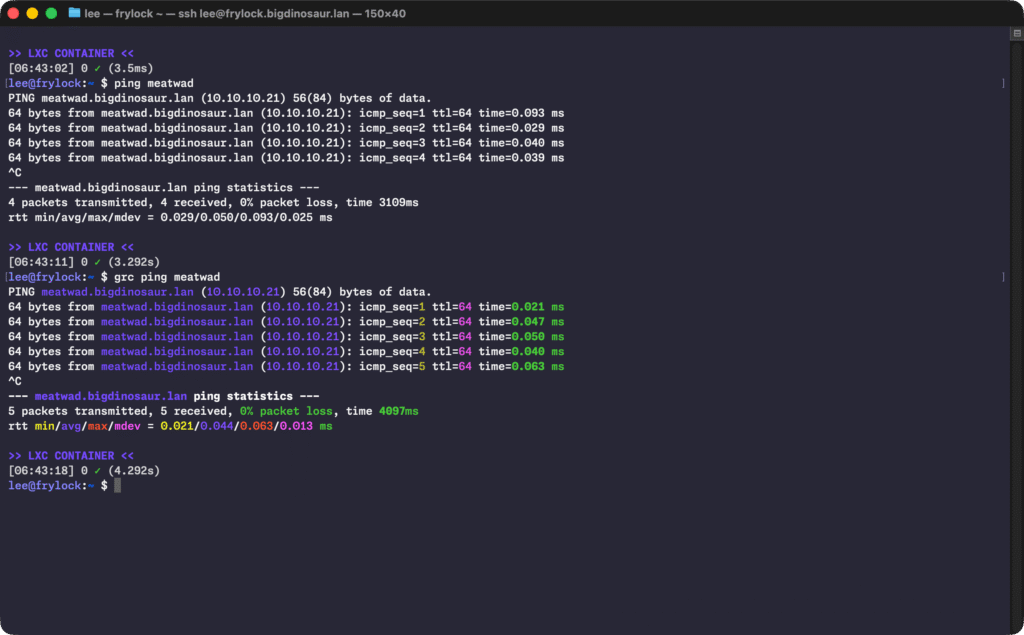
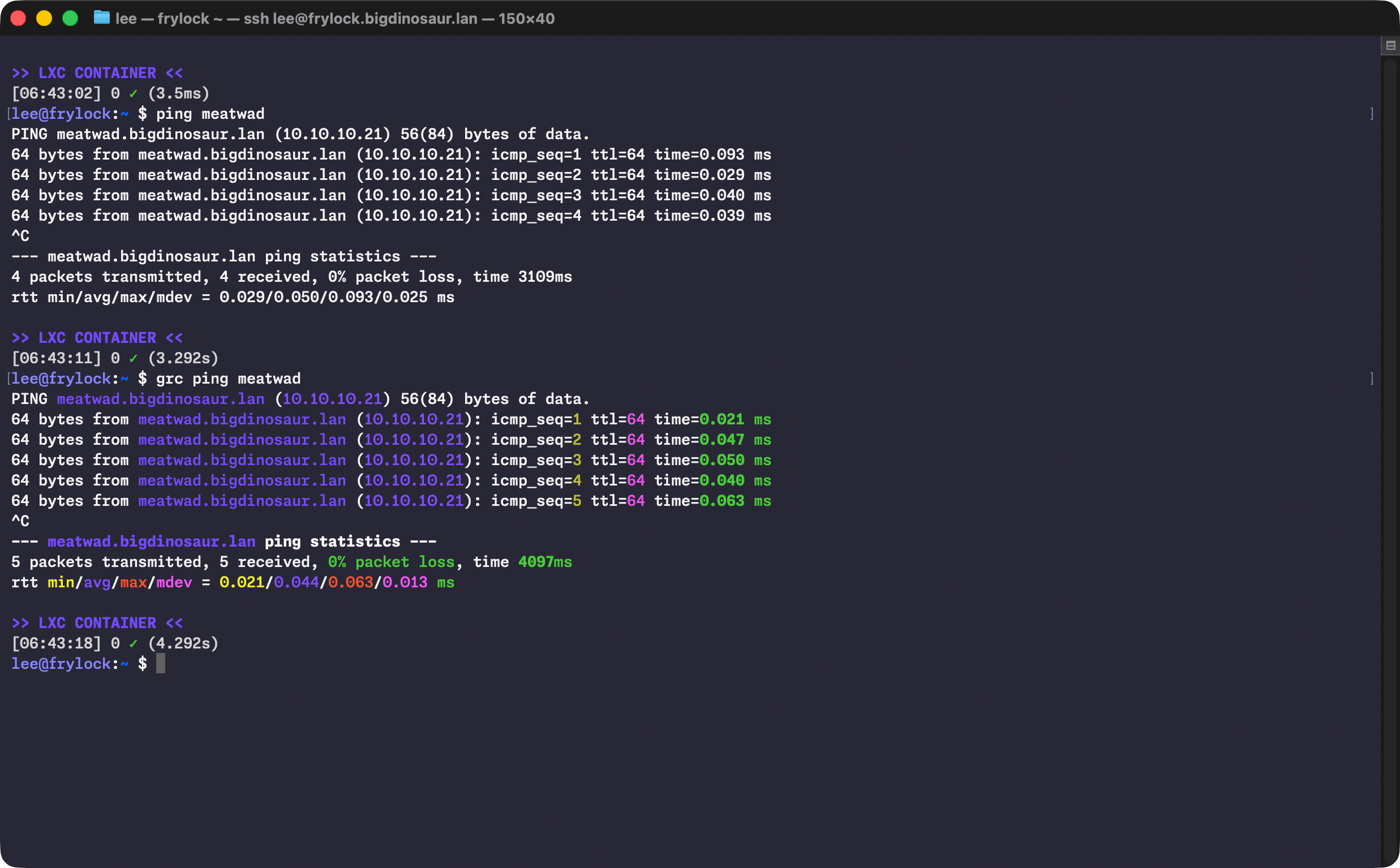
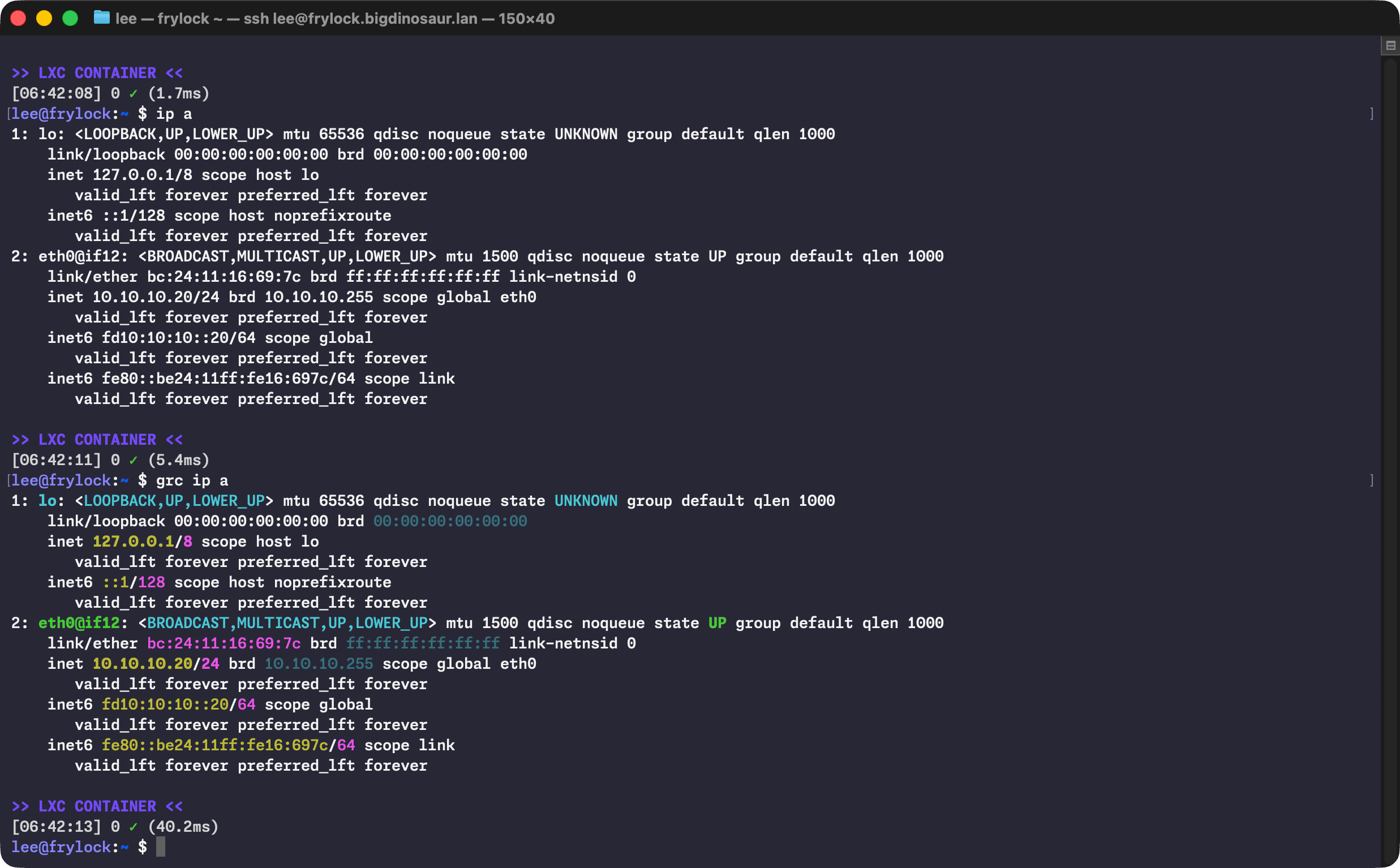
To that end, I lean on a little program called GRC (for Generic Colorizer) to add highlighting and coloration to other tools. It’s broadly available and works without any additional configuration.

Advertisement

Image showing the before and after of using GRC with ping
Nothing wrong with a little color!

Lee Hutchinson

Advertisement
Advertisement

There’s a bit of aliasing (which I keep in .bash_aliases like a good citizen) to make colorful output the defaults on some common commands:

    alias ls="ls --color=auto"
    alias ll="ls -AlFh --group-directories-first"
    alias df="grc df -h"
    alias du='grc du -h'
    alias free="grc free -h"
    alias ping='grc ping'
    alias traceroute="grc traceroute"
    alias ip='grc ip'

I’m also a big fan of making my numbers human-readable, and the -h switch is therefore applied liberally.

Advertisement

(Do note that wrapping commands like ip in GRC can sometimes do weird things if you’re piping its output into something else. Use caution. Or don’t! It’s your computer, knock yourself out!)

The terminal itself

Sharp-eyed readers will note from the screenshots that I’m using MacOS’s Terminal.app for my terminal program, despite there being far better options. I suppose the excuse I have is that I’m comfy with Terminal.app and nothing has pulled me off of it. I’ve test-driven the usual suspects—Ghostty, Alacritty, the mighty iTerm2 with its awesome tmux windowing integration, and even fancy new reinterpretations of the terminal experience like Warp.

Source link

Advertisement
Continue Reading

Trending

Copyright © 2025