Connect with us
DAPA Banner
DAPA Coin
DAPA
COIN PAYMENT ASSET
PRIVACY · BLOCKDAG · HOMOMORPHIC ENCRYPTION · RUST
ElGamal Encrypted MINE DAPA
🚫 GENESIS SOLD OUT
DAPAPAY COMING

Tech

Irish firms cut cybersecurity spend despite rising risks

Published

on

Reducing cybersecurity budget a ‘high-risk strategy’, said Saros Consulting co-founder.

Irish businesses show a split approach to security, with only half of the surveyed IT leaders admittedly increasing their cybersecurity budget, while one in four reduced spending for 2026.

This, as cybersecurity threats grow multi-fold in recent years, with bad actors increasingly employing AI tools to bolster their approach.

The insights stem from a new Saros Consulting report carried out by Censuswide, which surveyed 200 IT decision-makers in organisations in Ireland with more than 250 employees.

Advertisement

According to the survey, increased investments in cybersecurity is enabling leaders to explore new avenues to bolster their defences, with 30pc of the surveyed willing to pay bounties to experts who can expose vulnerabilities.

This is already happening in practice, with around 27pc admitting to have already done this.

Despite this, only 50pc are confident that they can detect attackers before any damage is done, while only 51pc said they have an incident response plan. And, only 54pc of those surveyed said that they test their incident response plan once or more per year.

Lacking an effective response plan often leads to significant financial and reputational damage for businesses at the hands of bad actors, with a different survey from 2025 reporting that nearly one-third of large enterprises in Ireland paid at least one ransom to cybercriminals over the year.

Advertisement

The average cost Irish businesses spent out of pocket in cyber ransoms amounted to nearly €700,000.

Meanwhile, businesses need to keep up with the constant change in the cybersecurity landscape by ramping up their own infrastructure.

In a recent interview with SiliconRepublic.com National Cyber Security Centre’s director of resilience Joseph Stephens shared his concerns around the effect advanced AI models such as Anthropic’s Mythos would have on small businesses in the country.

Censuswide, in its newest report, finds that 55pc of the surveyed IT leaders said their legacy systems are increasing their organisation’s cybersecurity risk. To tackle this, large enterprises in Ireland are dedicating 28pc of their IT budgets on mandatory system upgrades.

Advertisement

Although, 30pc of their budgets are dedicated to maintaining systems that the leaders know should be replaced.

“Reducing cybersecurity budgets at a time of increasing threat complexity is a high-risk strategy for large enterprises,” said Ray Armstrong, the co-founder and co-CEO of Saros Consulting.

“Cybersecurity underpins every aspect of modern IT strategy, from digital transformation to regulatory compliance. Organisations who deprioritise it risk exposing not only their systems, but also their customers, their reputation and their long-term resilience.”

Justin van der Spuy, also the co-founder and co-CEO of Saros Consulting, added: “There is a clear disconnect between the scale of today’s cyber threats and the decision by some large organisations to reduce investment in this area.

Advertisement

“What is needed now is strategic clarity and a long-term approach to resilience. Businesses must ensure they are supported by experienced partners who can help them navigate evolving threats and increasing regulatory complexity.”

Don’t miss out on the knowledge you need to succeed. Sign up for the Daily Brief, Silicon Republic’s digest of need-to-know sci-tech news.

Source link

Advertisement
Continue Reading
Click to comment

You must be logged in to post a comment Login

Leave a Reply

Tech

5 Cool Tech Products You Can Find On Amazon Outlet In May 2026

Published

on


We may receive a commission on purchases made from links.

For the uninitiated, Amazon Outlet is a “secret” subsection of the Amazon website where people can get significantly discounted products. Many of the products listed on Amazon Outlet come with a limitation on how long the discount is available for, or a limit on the number of products that can be discounted, marked with an “x% claimed” marker. When that marker reaches 100%, the deal will be removed. Also, Amazon Outlet deals for a particular product will only appear once every two months – this is a requirement per Amazon. Other requirements include that the seller have at least a 3.5-star rating, and that the product that is being sold should have either no reviews or at least 3 stars in reviews. 

Additionally, no used products may be sold, and the seller is required to have at least 90 days of inventory (across various products) in Amazon’s delivery fulfillment centers. On Amazon Outlet, deals are mainly categorized into “Overstock” and “Clearance” offers; while no formal definition exists for these, we can make an educated guess. Overstock will be new products that are not moving, i.e., which the seller has bought too much of, while clearance will be products marked down to make way for a newer model. That’s usually what clearance is in e-commerce.

Advertisement

Here are five tech items up for grabs on Amazon Outlet as of May 2026. Be wary — they may be gone by the time you see them.

Advertisement

HiSense Canvas

It only takes one look at the HiSense Canvas to realize that it is intended as a direct competitor to the Samsung Frame TV. For those who don’t know, the Samsung Frame was a novel new slim-profile television that turned into artwork when it was not in use — resembling a painting in an art gallery. For HiSense, you get free access to the library of artworks, while on the Samsung Frame, you have to pay a subscription after a while to retain access to these, though using your own uploaded photos remains free on both TVs. 

Furthermore, the Samsung Frame line of TVs comes with customizable bezels to better suit the aesthetics of your home, and smaller models (under 65 inches) can be optioned with a remote-controlled stand that rotates the TV from vertical to horizontal and vice versa. The HiSense Canvas on Amazon Outlet is a 144 hertz UHD panel with a matte finish, with Google TV built in, and a free wooden-finish bezel included. At the time of writing, the HiSense Canvas is on clearance on the Amazon Outlet store for the price of $1,499 marked down from its usual MSRP of $2,499. 

As per historic price data for Amazon, this is the best price of all time that the HiSense Canvas has been available for, with the average listing price on Amazon being $1,799. For its part, the 75-inch Samsung Frame version is currently retailing for $1,797 at Amazon, though its usual list price is $1,997.

Advertisement

Sony Bravia Theater System 6

The Sony Theater System 6 is not at its rock-bottom price – but it is currently listed for $598. The list price, or MSRP, is $799, with the average list price on Amazon for the past 12 months being $690, so $598 is a pretty sweet deal. For that price, you get a total of six units (hence the “6” in the name) which consist of a trio of front-firing speakers, dual rear-firing ones, and a sound bar. The total power output of the entire system is 1,000 Watts, which should be plenty for most living room situations.

If you also own a Bravia television set, you’ll be able to control the sound bar from the television itself. There’s also a feature called “Voice Zoom 3” — that also only works with compatible Bravia television units — that can boost the clarity of the dialogue of whatever’s on screen. Also, like many modern home theater sound systems, the Bravia Theater System 6 can also stream audio via a smartphone, which connects via Bluetooth. There is also an app specifically for the setup where presets can be configured and settings can be tweaked. What’s unique about the setup is that the sound is transmitted wirelessly to the dual rear speakers. Though both speakers are wired to a receiver box, this way, there’s no ugly wiring.

Advertisement

Asus Rog Strix G17

For those looking to pick up a high-performance laptop at a good price, Amazon Outlet is currently selling the Asus ROG Strix G17 for $1,359 as of May 2026. This is the lowest price that the laptop has been listed for on Amazon, with the average price hovering around $2,100, as per historical listing data. 

Advertisement

It comes with an RTX 4070 graphics card, a seventh-generation AMD Ryzen 9 CPU, one terabyte of SSD storage, and 16GB of RAM, which is more than enough RAM for Windows 11 to be used comfortably. Speaking of Windows 11, though this particular Amazon Outlet deal is for a 2023 version of the Strix G17 when Windows 10 was still supported, the new laptop will come with Windows 11 out of the box. The display panel is a 240 hertz panel that is “QHD” (or 1,440p) and is 17.3 inches in diagonal length. 

Having that clarity on a laptop panel that size is truly impressive, and the battery life is pretty decent, given that the laptop has a 90 watt-hour battery. Having owned two of these laptops (both 2023 units) the only thing I’d say is a problem is the build quality. The top casing is made from metal, but the bottom is tough plastic that is prone to scratching. The metal also scratches easily, and the small plastic vents on the sides can snap with minimal force; however, the performance per dollar is unmatched.

Advertisement

Thermal Imaging Monocular

Another cool Amazon Outlet deal for May 2026 is this Thermal Imaging Monocular from ATN, called the BlazeTrek. Like all thermal-slash-night vision aids, this monocular is designed to help you see people, animals and movement in the dark, fog, or in conditions of otherwise poor visibility. Unlike your standard-issue night vision tech though, the ATN BlazeTrek works in complete and pitch-black darkness; since it works by detecting body heat, it can see even when no light is present, whereas standard green-tinted night vision tech would fail. 

As of the end of May 2026, the ATN BlazeTrek is on sale for $862, which is its best-ever price. Even if you consider historical listing prices, the BlazeTrek usually lists on Amazon in the range of $1,000, so this Outlead deal is a steal from any angle you look at it. Readers should note that the BlazeTrek is available with two sensor sizes: 384×288 and 640×512. The smaller sensor has two magnification ranges: 2.0x to 16x magnification, and 2.7x to 21x magnification. The larger sensor has up to 13x magnification at maximum. The small sensor with the lower magnification is designated by code 319, while the small sensor with the larger 21x magnification is model code 325. It’s important to note that only model code 319 (i.e., the smaller sensor with the lowest magnification) is on sale; it’s still pretty good with a detection range of 1,000 yards or 3,000 feet.

Advertisement

Samsung Galaxy Watch Ultra (2024)

Lastly, we have the Samsung Galaxy Watch Ultra, which we should clarify is the first-generation watch. Samsung has since released a newer version, so it’s worth mentioning that this is the older, 2024 model. However, upgrades to the new model are minimal, and the newer 2026 version lists for about $549 on e-commerce platforms. The 2024 first-gen is currently on Amazon Outlet for $448, down from a listing price of $649 and a historical Amazon average price of $559,  so it’s a pretty good value proposition. It comes with a 1.5-inch screen that can get quite bright, at 3,000 nits of peak brightness, which is plenty good for outdoor viewing. 

Despite a 480p screen, battery life from the 590 mAh cell can be north of a day in most use cases (including my own from 2024 through 2026), and even longer if you turn off specific features like blood oxygen monitoring during sleep. It does all the regular things that a smartwatch does, such as heart rate, step counting, calories burned, flights of stairs climbed, and you can manually track your water and food intake on it. Other than that, a nifty feature is that it can also be used as a viewfinder for the camera on Samsung phones. Furthermore, after calibration using a machine at home, the watch ultra can also give you a fairly accurate blood pressure reading.

Advertisement


Source link

Advertisement
Continue Reading

Tech

This Bose SoundLink Flex 2 deal is almost too well-timed for summer

Published

on

In hot summer afternoons like these, the speaker you bring to your friend’s barbeque either makes the mood or kills it. The Bose SoundLinkFlex 2 does the former – its compact enough to carry, with the sound quality to back it up, and IP67 waterproofing for whatever the afternoon throws at it.

Right now it’s 35% off, down from £149.95 to £98, saving you £51.95. That’s a great price for one of the best outdoor speakers you can buy right now.

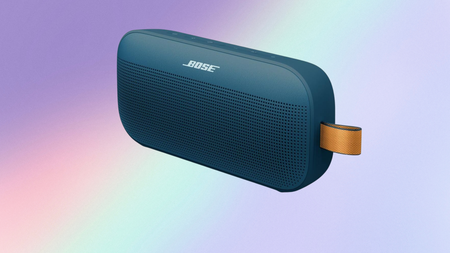
Bose Soundlink Flex on a pastel backgroundBose Soundlink Flex on a pastel background

Bose’s SoundLink Flex (2nd Gen) drops by 35% today, with a limited‑edition colourway that feels tailor‑made for outdoor BBQ listening

At under £100, the Bose Soundlink Flex is a well-rounded outdoor speaker at a price that makes it a sensible buy for the summer ahead.

Advertisement

View Deal

The colourway available here is Twilight Blue, a limited-edition finish that sits apart from the standard line up and looks pretty good.

Advertisement

But let’s be honest, you’re not worried about the colour – the sound quality is what matters, and the SoundLink Flex (2nd Gen) sounds pretty good. With a 7.5-watt output and a 50.8mm dynamic driver, you’ll get clear, balanced audio for all to hear.

The Whatsapp LogoThe Whatsapp Logo

Get Updates Straight to Your WhatsApp

Join Now

Advertisement

Advertisement

PositionIQ technology reads the orientation of the speaker automatically and adjusts the audio output accordingly, so whether it is standing upright on a table, lying flat in the grass, or hanging from a bag loop, the sound stays optimised without any manual adjustment needed.

The IP67 rating means it is both dustproof and waterproof to a meaningful degree, and the listing notes it floats, so an accidental knock into the paddling pool or a splash of beer isn’t going to kill it.

Advertisement

Bluetooth 5.3 keeps the connection stable up to nine metres away, and multipoint pairing means two devices can stay connected simultaneously, which takes the friction out of handing music duties.

Battery life reaches up to 12 hours on a single charge, which comfortably covers an afternoon and evening without needing to hunt for a cable, and the USB-C charging cable is included in the box.

This is a well-rounded outdoor speaker at a price that makes it a sensible buy for the summer ahead, and the Twilight Blue finish makes it one of the more distinctive options in this category at under £100.

SQUIRREL_PLAYLIST_10148964

Advertisement

Advertisement

Source link

Continue Reading

Tech

Amazon offers its AI shopping tech to outside retailers in new phase of agentic commerce race

Published

on

A demo of the AWS Agentic Shopping Assistant: an AI-powered style advisor operating on a retailer’s mobile site. (AWS Photo)

Amazon’s cloud division announced an AI shopping assistant for retailers, following the company’s broader blueprint of turning its internal technology into products for others.

The new tool from Amazon Web Services, the AWS Agentic Shopping Assistant, is built on the same technology that powers the Alexa for Shopping assistant on Amazon.com, formerly known as Rufus, which the company says drove nearly $12 billion in incremental sales last year.

It’s designed to let retailers create AI assistants for their own e-commerce sites that can talk with shoppers, answer questions about products, and make recommendations tailored to each store’s inventory and brand. AWS says a retailer can get one up and running in about 60 days.

The announcement is the latest move in the broader competition among tech giants to control different pieces of the AI shopping experience.

With its new release, AWS is betting that retailers will want to build their own AI shopping experiences, while leveraging the experience of Amazon’s own e-commerce platform.

The stakes are significant. Accenture estimates that by 2030, more than 30% of online commerce could run through AI agents, representing about $3.1 trillion in transactions.

Advertisement

@media (max-width: 600px) {
aside.callout { float:none !important; max-width:100% !important; margin-left:0 !important; margin-right:0 !important; }
aside.callout .callout-img { display:none !important; }
}

Amazon’s pitch requires retailers to trust its cloud division with their AI shopping infrastructure, even as Amazon’s retail arm competes against them for customers. AWS says retailers using the AWS Agentic Shopping Assistant will keep control of their own customer data, product catalogs, and business rules, with each deployment customized to the retailer’s brand.

An early retail customer is Kate Spade, the fashion and accessories brand. Its parent company, Tapestry, used the tool to launch an AI gift concierge in April that engages shoppers in conversation about the occasion, recipient, and style before recommending products.

Amazon says the concierge was built on Anthropic’s Haiku 4.5 model through Amazon Bedrock, and went through roughly 2.5 months of testing before going live.

Source link

Advertisement
Continue Reading

Tech

Samsung’s rumored Fold 8 Wide looks almost impossibly thin in new leak

Published

on

Samsung’s next big foldable may have surfaced early, and the standout change is hard to ignore. A leaked dummy unit said to show the Samsung Fold 8 Wide points to a much slimmer profile than the company’s current book-style foldables.

The short video compares the mockup with what’s described as a Galaxy S25 Edge, suggesting the foldable could close down to a surprisingly slim shape. For Samsung, that would mark a noticeable design shift after years of Fold models that packed strong hardware into bodies that still felt bulky beside newer rivals.

Still, this is not a Samsung reveal. The name, final design, specs, price, launch timing, and availability remain unconfirmed.

How thin is Samsung going

The key detail in the Samsung Fold 8 Wide leak is the folded profile. When shut, the physical model appears close to the thickness of the Galaxy S25 Edge shown beside it.

Advertisement

That detail goes straight to daily use. A slimmer Fold would be easier to pocket, easier to grip, and less awkward to use closed, which is where plenty of foldable phone tasks still happen before the inner display ever opens.

What does Wide really mean

The “Wide” name is the other clue worth watching. It suggests Samsung may be looking past thickness alone and reworking the shape of the cover screen.

The original Pixel Fold already showed how a shorter, broader shape can feel less cramped than Samsung’s older narrow Fold design. Apple’s rumored foldable has also kept the 4:3-style idea in the conversation, making the Fold 8 Wide leak feel less like a one-off and more like part of a larger shift toward squarer foldables. The leak still doesn’t confirm the final screen ratio.

The catch is that a dummy can only show proportions. It can’t confirm whether Samsung has solved the harder engineering work behind battery size, hinge strength, camera hardware, and durability.

What should buyers watch next

The next round of leaks needs to show more than a striking silhouette. Battery capacity, hinge design, camera layout, durability rating, and real dimensions will decide whether this rumored Fold 8 Wide is a practical upgrade or a sleek-looking mockup.

Advertisement

For now, the smart read is cautious optimism. The leak hints at a Fold designed less like a small tablet first and more like a phone people can live with all day. Until Samsung confirms the hardware, treat it as an early signpost rather than a buying plan.

Source link

Advertisement
Continue Reading

Tech

Eli Lilly to acquire Seattle-area biotech in $1.5 billion bet on next-generation shingles vaccine

Published

on

Curevo CEO George Simeon. (Curevo Photo)

Eli Lilly has agreed to acquire Curevo Vaccine in a deal centered on a next-generation shingles vaccine aimed at improving tolerability and boosting vaccination rates among older adults.

The deal includes up to $1.5 billion in cash for the Bothell, Wash.-based biotech, consisting of an upfront payment and a contingent milestone payment.

At the center of the acquisition is amezosvatein, Curevo’s Phase 3-ready vaccine targeting the virus that causes shingles. The candidate is designed to compete with current leading vaccines, which are highly effective but can produce side effects that discourage some patients from completing vaccination.

Shingles affects roughly one in three adults in the U.S. over a lifetime and can lead to serious complications such as chronic nerve pain. While current vaccines are widely used, tolerability has been cited as a barrier to broader uptake.

The deal is one of three acquisitions that Eli Lilly announced this week to boost the Indianapolis-based pharmaceutical giant’s infectious disease program. Curevo competes against biotech giant GlaxoSmithKline, which sells Shingrix, a shingles vaccine approved in 2017.

Advertisement

Curevo was established in 2018 as a partnership between GC Pharma, Seoul’s Mogam Institute for Biomedical Research, and Seattle’s Access to Advanced Health Institute.

The company raised $110 million in venture funding last year from Medicxi; OrbiMed; HBM Healthcare Investments; Sanofi Ventures; RA Capital Management; Janus Henderson Investors; Adjuvant Capital; and founding investor GC Biopharma.

In a Phase 2 head-to-head study, Curevo said its lead vaccine candidate reduces reported side effects (including fatigue, chills and injection-site pain) by more than half.

The companies also pointed to emerging research linking shingles infection to increased stroke risk, and shingles vaccination to potential reductions in dementia risk, underscoring the broader public health implications.

Advertisement

“There is a growing body of evidence linking protection from shingles to lowered risk of stroke and dementia,” said Daniel Skovronsky, Lilly’s chief scientific and product officer. “A vaccine that is meaningfully better tolerated could extend the reach of shingles prevention.”

Lilly’s global scale is expected to accelerate development of Curevo’s vaccine program, with amezosvatein expected to advance into late-stage development.

“Curevo is focused on improving the shingles immunization experience so more adults can benefit from protection against shingles, a serious disease with significant risk for long-term impairment of healthy living,” Curevo CEO George Simeon said in a press release. 

Source link

Advertisement
Continue Reading

Tech

CodeIntegrity raises $5M to put permanent guardrails on unpredictable AI agents

Published

on

CodeIntegrity’s co-founders are CEO Steven Jung, left, and CTO Abi Raghuram. (CodeIntegrity Photo)

The computer security startup CodeIntegrity on Wednesday announced a $5 million seed round to support its efforts to build meaningful protections for agentic AI applications.

The San Francisco-based company made a splash last year when it demonstrated how easy it was to trick AI models from multiple tech companies into sharing private information, earning a mention in The Economist last September for compromising the note-taking app Notion in less than four hours.

“Every company was aiming to launch agents into deployment, and they didn’t know how to do it safely,” said Abi Raghuram, CodeIntegrity co-founder and CTO.

The core challenge is a fundamental one. Traditional software relies on deterministic controls, meaning that if you type “X,” the computer always does “Y.” But AI agents — tools that can autonomously perform computer tasks — are non-deterministic since they’re driven by natural language models. That makes them vulnerable to “prompt injection” attacks, in which a bad actor inserts malicious text into a model and triggers the agent to do things like expose sensitive data.

To keep these agents in check, companies either employ human-in-the-loop oversight or deploy a second LLM as a judge, but neither approach is fully scalable or entirely foolproof.

Advertisement

“There’s going to be more and more agents being deployed in enterprise settings, and no one has figured (security) out yet,” said Steven Jung, CodeIntegrity co-founder and CEO. “We want to be the first one to actually provide that deterministic control for these companies.”

CodeIntegrity’s solution is to insert a permanent security guardrail called a runtime control layer. Acting as both a translator and a filter, it forces an unpredictable AI model to play by strict, predictable rules and limits which enterprise systems and data an AI agent is allowed to touch.

Raghuram and Jung met at Rose-Hulman Institute of Technology, a top undergraduate engineering school in Indiana. After a few years working separately at other employers, the two reconnected and founded CodeIntegrity in the Seattle area in May 2024. Later that year, they participated in Antler’s New York residency program for early-stage startups.

The company still has employees in Washington state, while the two co-founders recently relocated to San Francisco.

Advertisement

Cybersecurity-focused Syn Ventures led the new round, with participation from existing pre-seed investors Antler and Boost VC. The company has raised a total of $5.25 million.

CodeIntegrity’s product is currently being piloted with companies in regulated industries, with a broader public rollout planned for the future.

Other startups are tackling agentic AI security as well, including Seattle’s Certiv, which emerged from stealth in March, and California’s Raven and Manifold Security.

Raghuram, who worked at Seattle’s Truveta for more than three years, said he’s eager to recruit engineers from the area, but called San Francisco “ground zero for everything agentic LLM.”

Advertisement

“Seattle is a solid place to hire good incumbent talent from Microsoft and Amazon, which is kind of what you want with a fast-moving startup,” he said. “But as founders, if you want to be in the know-how of what’s happening in agentic land, the Bay Area is the place.”

Source link

Continue Reading

Tech

JD.com’s founder vows to protect 900,000 jobs from AI. His warehouse strategy says otherwise.

Published

on

Liu Qiangdong’s pledge to safeguard JD.com’s workforce from automation sits uncomfortably with his own ‘unmanned era’ vision and a flagship warehouse already running on four employees.


Liu Qiangdong, the founder of Chinese e-commerce giant JD.com, vowed in an internal speech this week to protect the company’s 900,000-strong workforce from AI and robotics, according to a Bloomberg report on Thursday citing a video circulating on Chinese social media.

JD.com will, on Liu’s telling, “do everything possible to safeguard employment for hundreds of thousands of staff, including blue-collar workers,” even as it accelerates the deployment of AI and autonomous logistics across the business.

The vow lands in a Chinese policy environment in which it would be unwise for a major employer to say anything else.

Advertisement

The 💜 of EU tech

The latest rumblings from the EU tech scene, a story from our wise ol’ founder Boris, and some questionable AI art. It’s free, every week, in your inbox. Sign up now!

Chinese courts ruled twice in six months in 2026 that companies cannot fire workers simply because an AI can do their jobs, holding that a strategic decision to adopt AI is not the kind of unforeseeable circumstance the Labour Contract Law contemplates as legal grounds for termination.

Beijing’s top governing bodies formalised gig-worker protections earlier this year covering more than 200 million platform workers, with binding algorithm-transparency requirements taking effect in 2027. The political costs of a large Chinese employer being seen to fire workers because of AI are now structurally high.

Advertisement

Liu’s statement is also, however, in visible tension with positions he has taken on the record over the past 12 months.

At the 2025 World Internet Conference in Wuzhen, he argued that in the coming “unmanned era,” people might only need to work one hour a week and that governments should impose a 90% tax on tech monopolies to fund the resulting social compact.

He has separately announced JD’s plan to open the world’s first fully unmanned delivery station in April 2026, integrating drones, autonomous vehicles, and household robots capable of placing parcels directly inside homes through authorised smart locks.

Liu’s public framing has alternated between “automation will replace most jobs and that is a problem to be policy-managed” and, this week, “we will protect jobs.”

Advertisement

The operational record cuts more cleanly than the rhetoric. JD.com has been one of the most aggressive deployers of warehouse robotics in Chinese e-commerce.

The company opened a fully automated warehouse in 2018 that handles 200,000 orders a day with four human employees, all of whom service the robots.

JD Logistics, the company’s separately listed delivery arm, runs Large Language Models for route optimisation and has deployed autonomous delivery vehicles, drones and robot couriers at scale across Chinese cities.

The 900,000 employees Liu now vows to protect are the result of structural overhang from JD’s decade as a labour-intensive operator, not a forward-looking plan for the role of human workers in the firm.

Advertisement

The line JD is now trying to walk is the same one the entire Chinese platform-economy sector is being asked to walk. Beijing wants the productivity gains AI offers and the employment stability the Communist Party’s political legitimacy rests on.

The two are not obviously compatible. JD’s public framing this week, that automation will cut logistics costs and unleash a “positive cycle” of higher employee pay and stronger consumer confidence, is the version most agreeable to Beijing.

Whether the cost-cutting incentives at company level actually deliver that cycle, or simply translate into fewer human couriers and warehouse staff over time, is the operational question.

The press-release framing, separate from the Bloomberg-sourced video of the internal speech, also reportedly emphasises that JD has fostered 183 different types of frontline roles, including AI trainers and robot maintenance engineers.

Advertisement

Those new categories are real but small relative to the courier-and-warehouse base. If they will absorb workers displaced from the larger roles, or simply create higher-skilled positions filled from outside the affected workforce, is the question the next several years of JD’s labour data will answer.

Neither JD.com nor Liu commented through formal channels on the Bloomberg-reported internal speech.

Source link

Advertisement
Continue Reading

Tech

You’re Probably Not Cleaning Your Washing Machine As Often As You Should

Published

on


We may receive a commission on purchases made from links.

Washing machines are among the most important appliances in our home, especially because they’re responsible for removing dust, dirt, and potential bacteria that cling to our clothes. In fact, Wonderklean cautions that dirty washing machines can also lead to a slew of health issues, ranging from respiratory problems to skin problems and allergies. And if you don’t take the time to address limescale buildup, Taps UK notes it can also jack up your electricity bill.

Common signs that your machine may already need a deep clean include foul or musty smells, whether it’s your clothes post-wash or the filter. However, it’s often a better idea to prevent this buildup before it starts. While there’s no hard-and-fast rule for precisely when it needs to be cleaned, appliance care brand Affresh recommends cleaning your washing machine once a month, or about 30 cycles, which larger households will reach much sooner. Washing machine company Whirlpool also notes that if you’ve recently done a wash with a lot of clothes bleeding, it may also be time to do a clean-up. In some cases, issues that may require specialized cleaning include mold, limescale, or residual detergent, which can be due to both how you wash your clothes and the type of water in your area.

Advertisement

Regular cleaning is one way to get the most out of your washing machine’s expected lifespan. So, if you’ve decided it’s time to make your appliance feel brand new again, here are some ways to do it, as well as methods to fix more specific problems.

Advertisement

How to clean your washing machine

Before we proceed, it’s best to check your appliance manufacturer’s care guide, which may include specific care instructions for your machine. To care for its products, Whirlpool recommends first adding washing machine tablets to an empty tub, then running a hot-water cycle, followed by a rinse-and-spin cycle. When your tub is air-drying, it says to remove the detergent dispenser drawer if your washing machine model allows it. Next, you can opt to either wipe down the drawer surface with an all-purpose cleaner or soak it in hot water.

There are also differences when cleaning front-load or top-load washing machines. For top-load washing machines, the agitator will need special attention. If the cap is not removable, Whirlpool says you should wipe it with a cloth and a mild soap. But if your model lets you remove the cap, it also says you can use a scrub brush to remove buildup.

Whether you own a top-loading or front-loading washing machine, a quick wipe-down of the door with machine-cleaning wipes can help remove any stray detergent or dust. Electrolux adds that using too much enzyme-based detergent and washing at too low a temperature also leads to deposits on seals. For front-loading washing machines, machine cleaning wipes help ensure there is no hidden mold in the seals. You can also use a damp cloth and mild soap to keep the rest of the exterior sparkling.

Advertisement

Removing limescale, mold, and residual detergent from your washing machine

Unlike your dryer, your washing machine is at a lower risk of causing a house fire, but it does have its own set of concerns, such as limescale, mold, or residual detergent. For people who live in areas with hard water, calcium and magnesium can lead to limescale. Other appliances that limescale is known to cause issues with include your coffee machine and water heater. HG says you can address limescale buildup with a descaler solution, natural vinegar, soda, or dishwasher tablet.

Wonderklean notes that the detergent dispenser, drain hose, and washing machine door are the parts of a washing machine that are most at risk of bacterial and mold growth. To address this, Samsung recommends running a spin-only cycle with an empty tub first. Next, it says to use liquid chlorine bleach, pour it into the dedicated bleach dispenser, and run a Self Clean cycle. Depending on your model, the run time can be up to 4 hours, but it’s important to wipe the inside of the tub afterward. Once that’s done, Samsung says it’s best to run another Rinse+Spin cycle and repeat the process until you no longer see any mold. Once you’re satisfied, you’ll want to leave both the door and detergent door open to let it dry.

Regularly cleaning your washing machines helps you spot warning signs before they break down. If the mold doesn’t go away after deep cleaning, Electrolux says it should be repaired by a professional technician.

Advertisement


Source link

Advertisement
Continue Reading

Tech

We have many questions about OWC’s new Stack AI speed booster

Published

on

The OWC Stack AI promises to make local processing of large LLMs easier by somehow inflating your Mac’s GPU memory across Thunderbolt. We have questions.

The majority of the AI industry consists of the big AI players, including OpenAI, Perplexity, and Anthropic, among others. However, using them can become expensive, especially for people with massive workloads and enterprise clients.

One way to trim the bills is to bring it locally, with AI models being used on a computer instead of a server. The problem there is the expense of the hardware needed for it. And, there are privacy concerns for cloud-based models too.

You can buy a Mac mini and load a model onto it, but you will be hit by a memory limitation. Since the entire model has to be held in memory, the amount installed limits the size of model you can use.

Advertisement

There are workarounds to this limitation, such as projects involving multiple Macs connected over Thunderbolt 5 to share memory and compute performance.

However, OWC thinks it can do something better.

OWC Stack AI’s memory boost

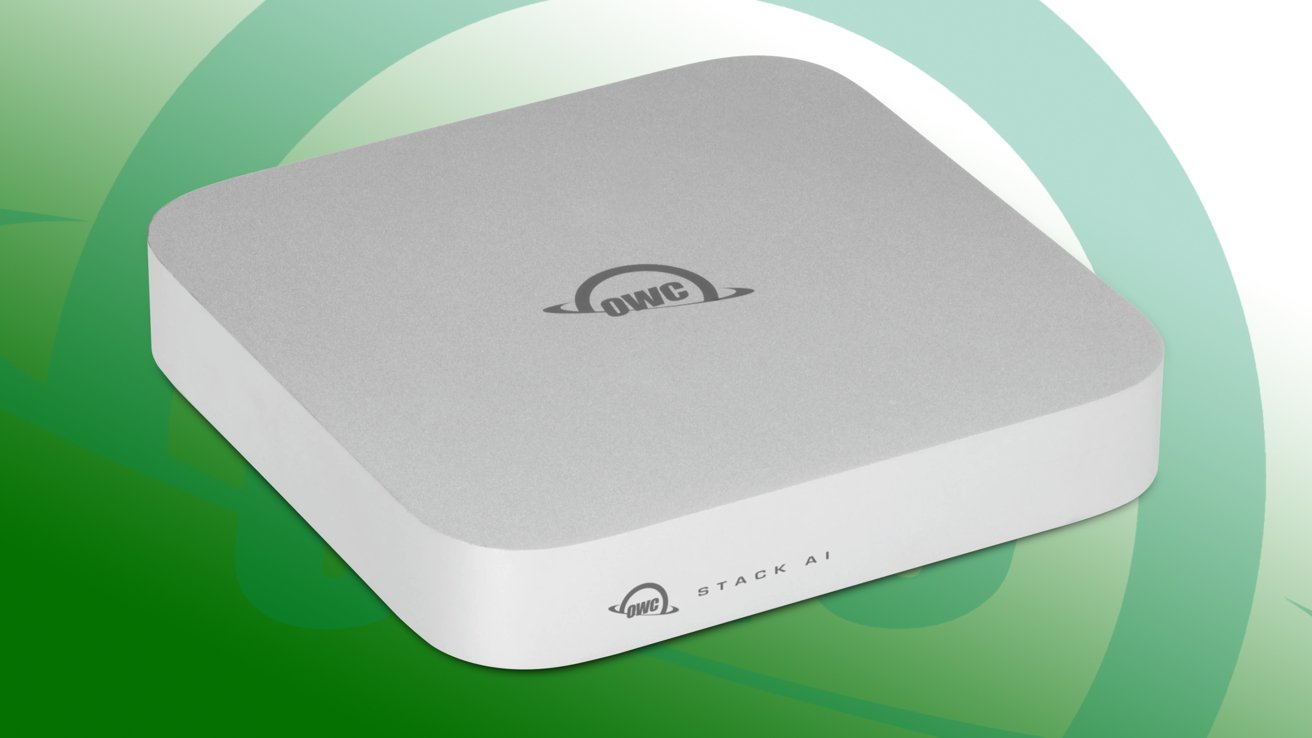
The OWC Stack AI, or the Thunderbolt 5 AI Accelerator and Storage Hub, looks pretty much like an old-style Mac mini. It’s a nondescript aluminum block that you can stack a Mac Studio on top of, similar to some other docks and hubs.

Connecting to the Mac using Thunderbolt 5, it does provide some storage capacity, but the real benefit is its ability to extend the working GPU memory. In effect, it uses onboard high-speed flash to expand the onboard VRAM of a PC’s graphics card, and eventually Apple Silicon too.

Advertisement

With more memory available to use, OWC says that the host computer can handle Large Language Models (LLMs) of a far greater size than the graphics card’s VRAM alone.

This is not the same as using an eGPU enclosure with a Mac. From OWC’s description, the AI Stack works as an external memory enhancement, not an external processor.

OWC’s announcement explains that the Stack AI will support Windows and Linux at first, with Mac support expected at some point in the future.

The company says that Thunderbolt 5 connectivity and its small size means it’s a portable and transferrable item. It can be moved between desks with a notebook, or even shared between team members.

Advertisement

When it comes to the AI ecosystem, OWC assures that it will support numerous AI agents and applications, including OpenClaw, at launch.

AppleInsider has asked OWC for more information, including how the Stack AI works, the delay for Mac support, specs, price, and exspecifications and price. This piece will be updated with further information if we get a response.

What OWC has confirmed is that it will be at the Computex Taipei trade show starting on June 2. At that point, more concrete details about the hardware will emerge beyond an early Q4 launch target. Maybe.

Local processing boon

OWC has been light on details about the Stack AI and its price. We see the potential as an extremely useful item for AI research. Certainly, it would be a good tool for businesses, and depending on price, maybe everybody else too in this day-and-age.

Advertisement

The key problem surrounding local AI processing is having enough RAM that can accommodate the models the users want to use. The other is processing the queries, once you have that memory available.

The current cluster-based projects work well, connecting to each other over Thunderbolt to share cores and memory. That is a problem for more cash-strapped users who can’t afford the tens of thousands of dollars for high memory Macs.

It is arguable that, with the introduction of the M5 chip, Apple has gone a long way to solve the processing side of things. The Neural Accelerators in each GPU core of an M5 GPU means there’s a lot more machine learning processing power available.

This makes it possible for local processing tasks to do a lot more with less. But it only improves the processing itself, not the memory limitations.

Advertisement

You can get an M5 Max 14-inch MacBook Pro with 128GB of memory, but that is a $5,099 purchase with only the necessary upgrades applied. That’s a hefty price to get that much memory.

When Apple comes out with the M5 equivalents of Mac mini and Mac Studio, there will be similar high memory capacity options on the table. But again, they will be extremely highly priced given how the industry is headed.

In May 2026, Apple’s memory prices are reasonable. It’s not clear how long that will last, given the ongoing memory crisis affecting the industry as a whole.

With a product like the Stack AI, there is the potential to buy an M5 Mac with the processing and GPU you want, but not necessarily the memory you need. The Stack AI would handle that bit for you.

Advertisement

This does, however, require OWC to price it at a level that makes sense for consumers to take that road to begin with. OWC is just as price-sensitive to memory as any other company, and that sensitivity will ultimately impact the price the Stack AI sells for.

Source link

Advertisement
Continue Reading

Tech

Apple’s 20% Globalstar stake moves to Amazon

Published

on

Apple won’t be holding onto its 20% stake in Globalstar once Amazon’s acquisition of the satellite firm concludes, with the shares set to be held by a “Grapefruit” company instead.

On April 14, Amazon agreed to acquire satellite service provider Globalstar in an $11 billion deal. The purchase adds Globalstar to Amazon’s existing satellite portfolio, which includes its Leo business.

However, Apple holds 20% of the shares in Globalstar, under a $1.1 billion commitment from 2024, which included a $400 million share purchase. Once the deal concludes, it won’t be holding onto the shares, nor the accompanying voting rights.

In a filing with the FCC dated May 26, 2026, Amazon and Globalstar ask the regulator to permit the transfer of licenses and authorizations between the two companies. This is one of the key elements needed for the acquisition to complete in the United States.

Advertisement

The filing, spotted by PCMag, explains that Amazon is creating a subsidiary to complete the merger. The subsidiary is being called “Grapefruit Acquisition Sub II, LLC.”

Apparently, someone in Amazon business development has a sense of humor.

Grapefruit will acquire Apple’s 20% in equity and voting interests for Globalstar. In the end, Globalstar, Inc. will cease to exist, with Grapefruit managing Globalstar USA LLC, Globalstar Licensee LLC, and GUSA Licensee LLC.

Satellite service continues

The document doesn’t state what Apple will receive in exchange, if anything, from the transfer and stock changes. However, it won’t be left out in the cold.

Advertisement

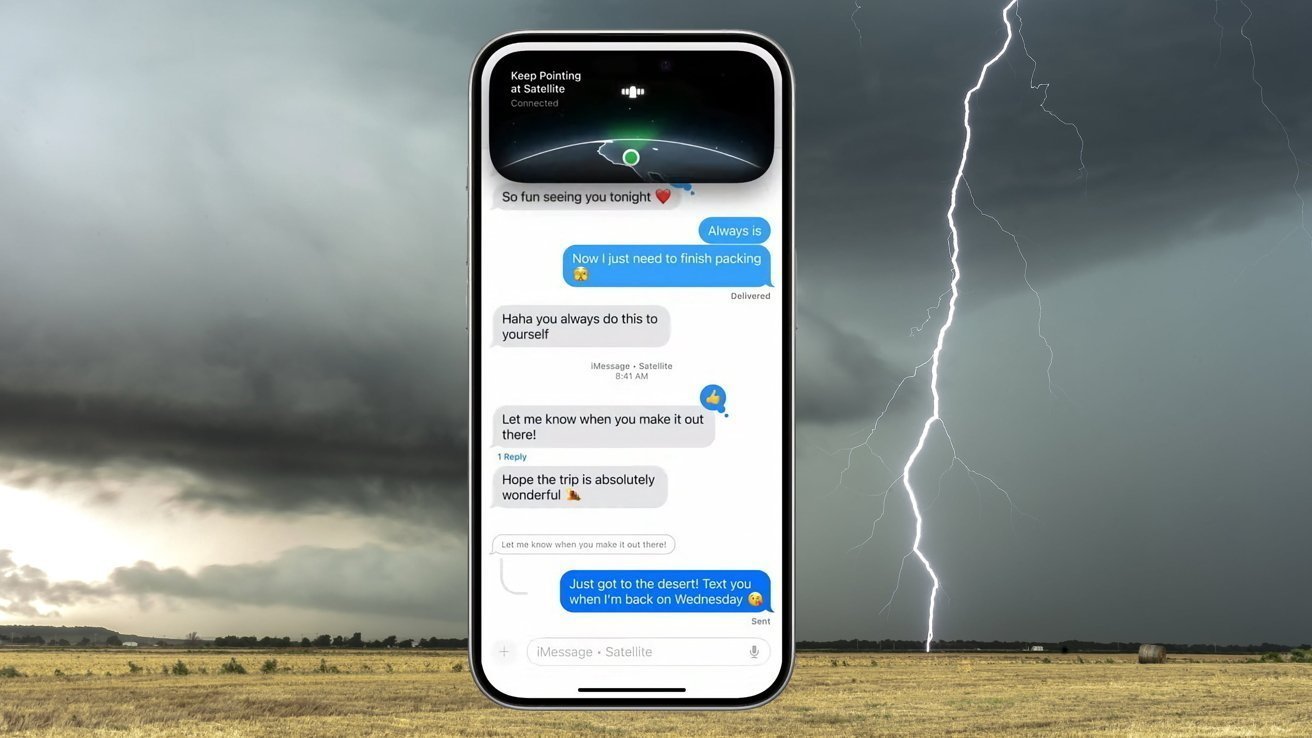
During the April announcement, Amazon insisted that Apple won’t be affected at all. An agreement was made for satellite connectivity to be maintained for current and future Apple Watch and iPhone features.

That includes features like Emergency SOS via Satellite and Roadside Assistance via Satellite.

That included using Globalstar’s existing and planned low Earth orbit satellite constellations. Amazon also said it would work with Apple to come up with future satellite services using Amazon Leo’s expanded satellite network.

In the FCC filing, Amazon reiterates its commitment to supply service and for improvements in the future. However, Amazon also plans to use its Globalstar purchase with other smartphone and mobile device producers and mobile carriers.

Advertisement

Source link

Continue Reading

Trending

Copyright © 2025