KLH Audio arrives at High End Vienna 2026 with more than just another bookshelf loudspeaker. The new Model Four lands at a meaningful moment for the brand, following Victrola’s 2025 acquisition of KLH and the pairing of two familiar names from different corners of the audio world: Victrola, a turntable brand with roots stretching back to 1906, and KLH, a loudspeaker company founded in 1957 and forever tied to Henry Kloss, Edgar Villchur, acoustic suspension design, and the rise of affordable high-fidelity audio.
That history matters because the Model Four is not being positioned as a six-figure showpiece for oligarchs with marble floors and commitment issues. It is part of KLH’s modern Model Series and aimed at the under-$2,000 loudspeaker category, where value, engineering, and real-world room compatibility still matter.
KLH gave select press and dealers an early listen to the Model Four at CES 2026, but kept the details and photography under wraps. With High End Vienna 2026 approaching, the lid is finally off. KLH will be demonstrating the Model Four for attendees, and our own listening impressions from CES 2026 will appear in the Bottom Line section below.
When KLH reintroduced the Model Five in 2021, it gave the brand a clear foundation for its modern Model Collection: acoustic suspension loudspeakers with vintage KLH DNA, updated drivers, modern cabinetry, and pricing aimed at real-world hi-fi buyers.
The Model Three followed as the smaller, more bookshelf-friendly member of the family, bringing the same acoustic suspension approach into a more compact format. KLH then expanded the lineup upward with the modern Model Seven, a larger three-way acoustic suspension floorstander that nods to the original Model Seven introduced in 1960 while using current materials, engineering, and finishes.
That leaves the new Model Four in an interesting position. It is not replacing the Model Three, Five, or Seven. It appears to be filling the gap between them, giving KLH another way to compete in the crowded under-$2,000 loudspeaker category without abandoning the design language and acoustic principles that made the revived Model Collection work in the first place.
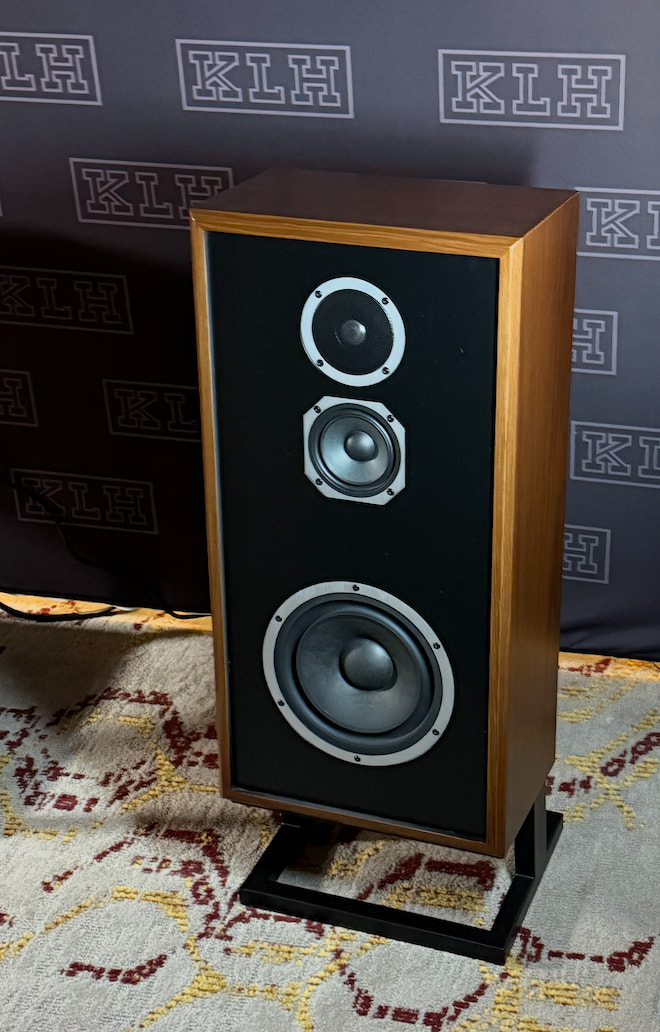
KLH Model Four
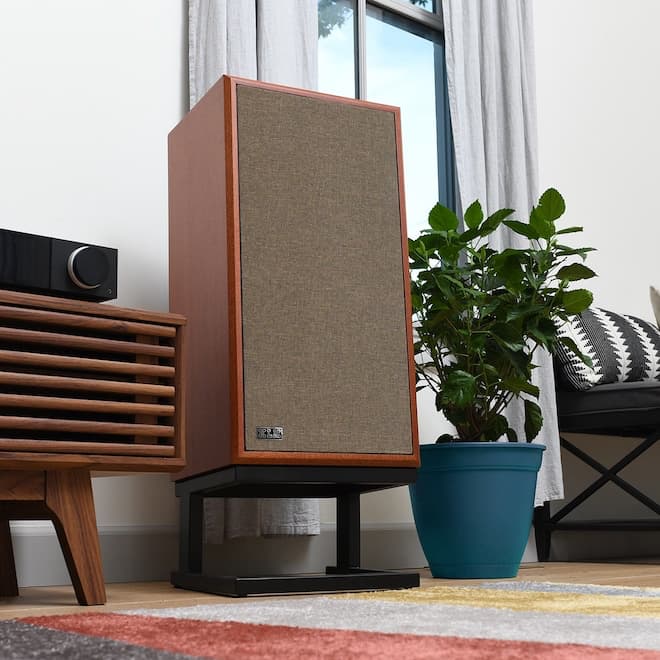
KLH Model Four Loudspeaker is about 2 inches (5 cm) shorter and thinner than Model Five with riser base.
The new KLH Model Four pulls key elements from across the company’s current Model Collection rather than starting from a blank sheet. It uses the 8-inch woofer introduced in the Model Three and shares driver and crossover DNA with the Model Five, including its midrange and tweeter architecture. That should give the Model Four a familiar KLH voicing, with an emphasis on vocal presence, midrange clarity, and controlled treble rather than showroom fireworks.
The cabinet shape also matters. Like the larger Model Seven, the Model Four uses a wide-baffle, shallow-depth design that is intended to work closer to room boundaries than a deeper conventional cabinet. That gives buyers more placement flexibility, especially in smaller or multipurpose rooms where loudspeakers often end up closer to the wall than anyone wants to admit.
KLH is positioning the Model Four primarily as a two-channel music loudspeaker, not as a home theater workhorse. It can certainly be used in a broader system, but its design priorities point more toward stereo listening, room-friendly placement, and the same vintage-meets-modern approach that defines the rest of the Model Collection.
Advertisement
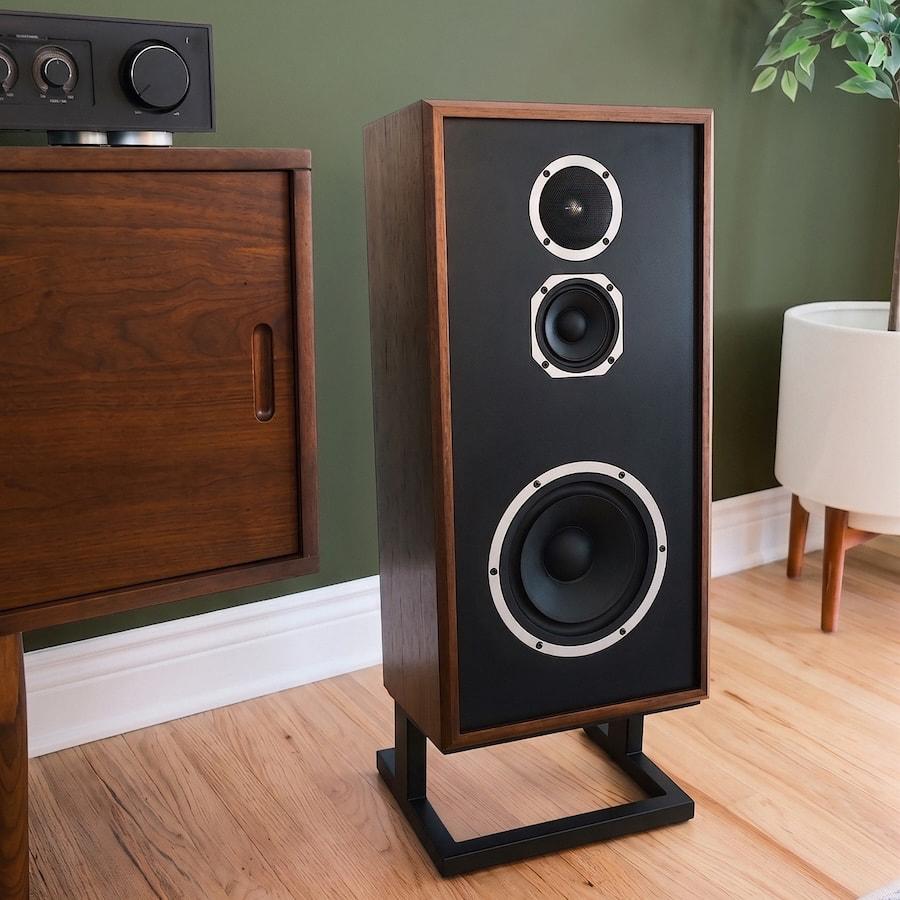
The Model Four uses an 8-inch pulp-paper cone woofer with reverse-roll rubber suspension, rated to reach down to 46Hz, along with a 4-inch pulp-paper cone midrange driver and 1-inch aluminum dome tweeter. On paper, that makes it a compact three-way loudspeaker designed to deliver useful bass extension, clear midrange reproduction, and controlled high-frequency output without needing a cabinet the size of a small refrigerator.
Advertisement. Scroll to continue reading.
KLH also includes a three-position Acoustic Balance Control switch, a feature with roots in the company’s 1960s loudspeaker designs. The switch allows listeners to adjust the midrange and treble balance to better suit room placement, furnishings, and personal preference. Five-way gold-plated binding posts round out the hardware package.
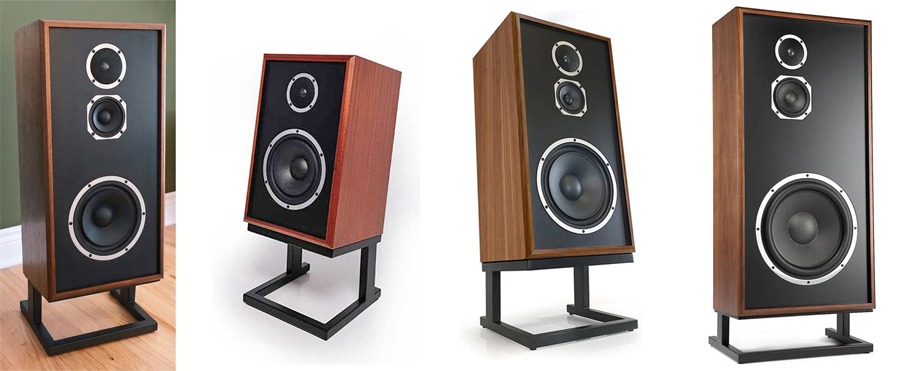
Left to right: KLH Model Three, Four, Five, Seven Loudspeakers at CES 2026
Why Acoustic Suspension?
Acoustic suspension speakers use a sealed cabinet, so there is no rear port firing into the wall behind the speaker. That can make placement more forgiving than many ported designs, especially in smaller rooms or spaces where the speakers need to sit closer to a wall.
Advertisement
It does not eliminate room interaction. Walls, corners, flooring, and furniture still affect bass response because the room always gets a vote. But a well-executed sealed design usually rolls off more gradually in the low frequencies and can deliver tighter, more controlled bass in real-world spaces.
For the Model Four, that matters. KLH is aiming this speaker at listeners who may not be able to pull their loudspeakers far into the room but still want controlled bass, natural midrange, and a speaker designed for actual living rooms.
Room Placement Friendly
The Model Four reinforces KLH’s room-friendly approach with a 13-inch-wide front baffle and a shallow 8.25-inch cabinet depth. When paired with its purpose-built 6-degree slanted riser, which angles the tweeter and midrange toward the listener, total depth remains just under 11 inches, making it the shallowest loudspeaker in the current Model Collection.
“Model Four represents exactly where KLH is headed: honoring the acoustic principles that made this brand stand out while designing products for how people actually live and listen today,” said KLH Audio CEO Scott Hagen. “This is not a bookshelf speaker, nor is it simply a smaller Model Five. It is a distinctive, full-range acoustic-suspension loudspeaker, meticulously built to deliver the natural, controlled, and room-friendly sound that defines KLH in a form that fits more homes, rooms, and listeners. Our responsibility is to protect the integrity of this brand while moving it forward, and Model Four is a major step in that direction.”
28.25″ (71.8cm) x 12.25″ (31.1cm) x 11.5″ (29.2cm)
34.25″ (87cm) x 13.75″ (34.9cm) x 13″ (33cm)
41″ (104.1cm) x 18″(45.7cm) x 12.25 (31.1cm)
Weight
Forthcoming
With Riser: 36 lbs
Without Riser: 29 lbs
With Riser: 52 lbs
Without Riser: 44 lbs
With Riser: 78.8 lbs
Advertisement
Without Riser: 68 lbs
Finishes
Black Ash with Grey Knit Grille
White Oak with Black Knit Grille
English Walnut with Stonewash Knit Grille
Advertisement
Noric Noir
West African Mahogany
English Walnut
Nordic Noir
Advertisement
West African Mahogany
English Walnut
Nordic Noir
West African Mahogany
Advertisement
English Walnut
Included Accessories
Matte Black 6° Riser Base, Magnetic Grille
8° Slant Riser Base
5° Slant Riser Base
Matte Black 3° Slant Riser Base
Warranty
10 Years
10 Years
10 Years
10 Years
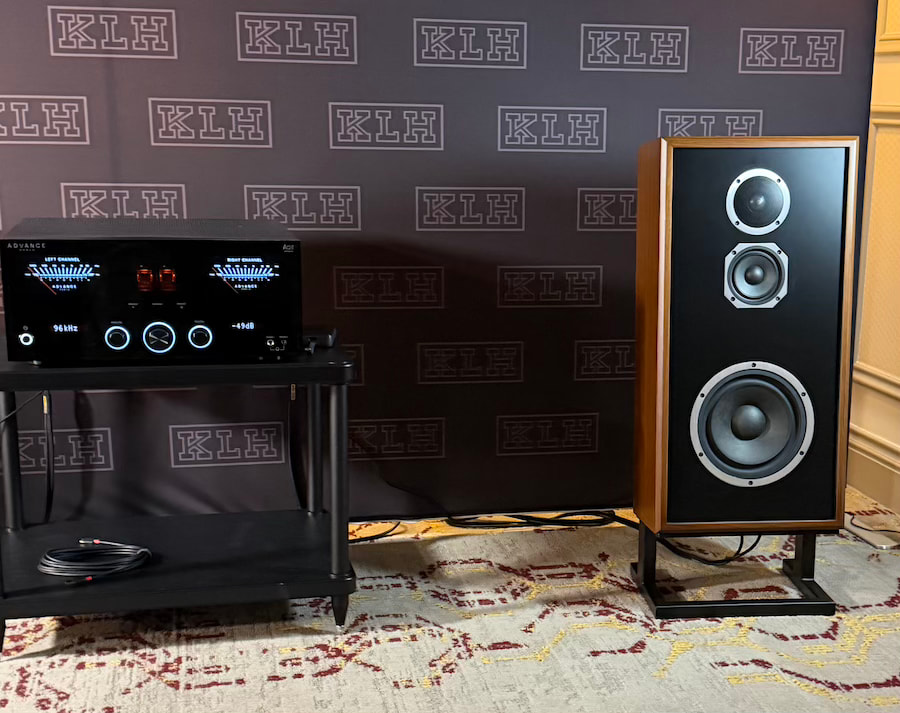
Advance Paris A12 APEX ($4,999) with KLH Model Four Loudspeaker at CES 2026
The Bottom Line
KLH appears to be finding its footing again as a loudspeaker brand. Under the Victrola umbrella, the company now has more stability and a clearer opportunity to build on the heritage of the Model Collection while expanding its presence in the broader speaker market.
After attending an exclusive listening preview at CES 2026, I have been waiting to say something about the KLH Model Four.
This is not a loudspeaker that relies on exotic materials, sculptural cabinet work, or visual drama to make its case. The Model Four looks like a KLH speaker, and that is part of the appeal. What matters is how it performs, and even in a Venetian Las Vegas hotel room, hardly the ideal listening environment, the Model Four made a strong impression.
Its presentation had real scale, weight, and energy, but also enough refinement through the midrange and treble to keep vocals and instruments from sounding blunt or overcooked. That combination matters. The Model Four is not aimed only at audiophiles who sit motionless in the sweet spot with the emotional availability of a parking meter. It is also for music listeners who want something engaging, room friendly, and built around sound quality rather than showroom theater.
Advertisement
Based on what I heard at CES 2026, the KLH Model Four deserves attention in the under $2,000 loudspeaker category. It holds its own against similarly priced competition and suggests that KLH has a legitimate new entry for listeners who want vintage inspired design, acoustic suspension engineering, and a speaker that does not need to dominate the room to make its point.
If you have the chance to hear the KLH Model Four, take it. Trust your ears, preferably before the spec sheet lawyers arrive with clipboards.
Advertisement. Scroll to continue reading.
KLH Model Four Loudspeaker at CES 2026
Pricing & Availability
The KLH Model Four loudspeakers will be available for $1,999/pair in the USA and select international markets via select audio dealers and directly via KLH Audio beginning September 2026. It will be on display and available for listening at KLH Audio’s suite #1415 at Meliá Vienna throughout High End Vienna 2026 from June 4 – 7.
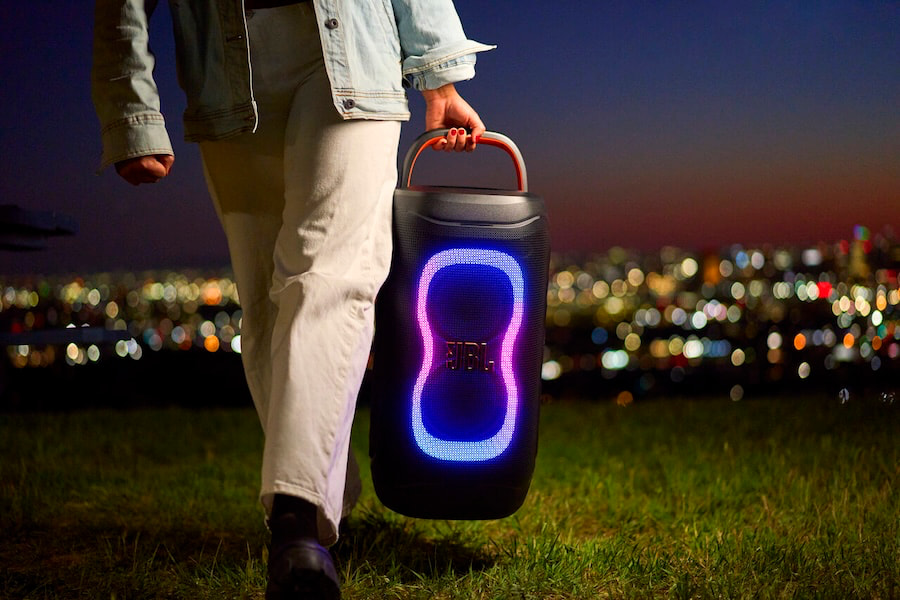
JBL is not done feeding the party speaker machine in 2026. Following the PartyBox On The Go 2 Plus, the company has added two more portable party speakers to the lineup with the new JBL PartyBox 330 and PartyBox 130.
Both models arrive with upgraded woofers, new tweeters, deeper bass extension, and clearer highs, along with JBL’s AI Sound Boost and Smart EQ to help optimize playback across different tracks. That matters in this category, where “loud” is easy and “loud without sounding like a shopping cart full of Bluetooth regrets” is the harder trick.
The design has also been updated, with a new hexangle profile, curved front grille, redesigned lightshow, and a simplified top control panel built around a single dial for volume, sound modes, and lighting effects. Available in Black or White with orange accents, the PartyBox 330 and 130 look like JBL is pushing the line toward a cleaner, more modern identity without forgetting the main job: make the room, backyard, beach, or basement move.
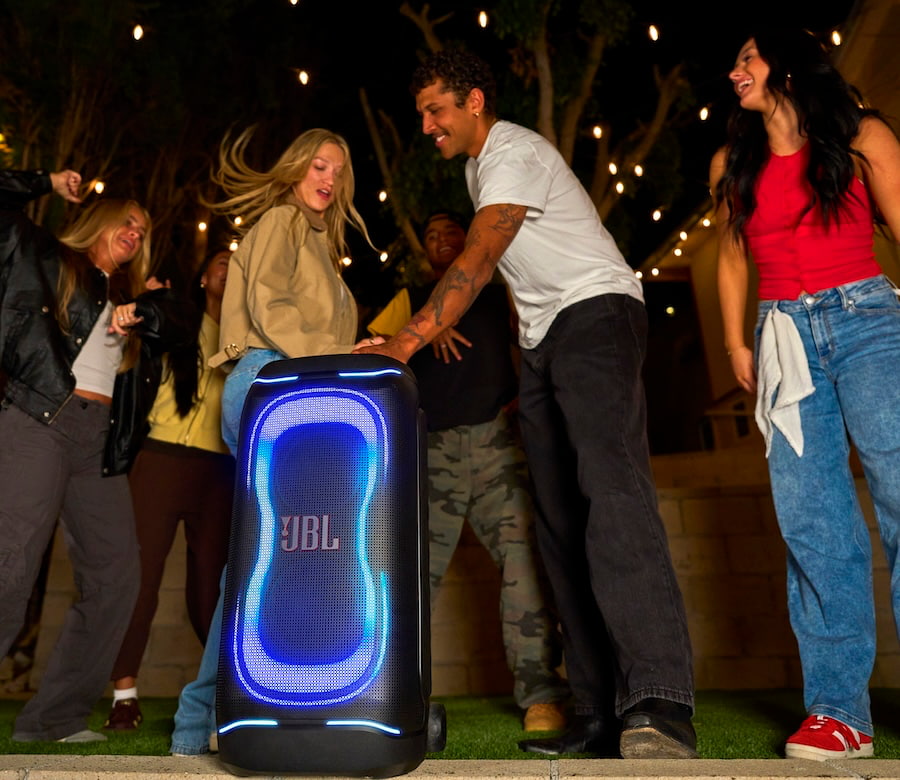
JBL PartyBox 330
JBL PartyBox 330
At its core, the JBL PartyBox 330 uses dual 6.5-inch woofers and delivers 280 watts of total output power. Making their PartyBox debut, twin PEN dome tweeters bring technology used in JBL’s professional concert systems, with the goal of producing cleaner, more detailed highs that can cut through the mix when the volume climbs.
JBL also includes AI Sound Boost with Smart EQ Mode, which adjusts playback to help keep the sound balanced across different tracks. The redesigned cabinet adds a new profile, ripple-effect side panels built from miniature JBL horn shapes, and a reinvented beat-synced lightshow because, apparently, standing still in the corner was never part of the brief.
Advertisement
Battery life is rated at up to 18 hours, while a 10-minute Fast Charge can provide up to 2 hours of playback. The battery is also replaceable, so users can charge a spare and swap it in when the party outlasts the first pack.
For easier transport, the PartyBox 330 includes a telescopic locking handle and wide all-terrain wheels. The IPX4 splashproof rating adds protection against splashes, making it suitable for poolside use, patios, and outdoor gatherings.
Dual mic and guitar inputs support karaoke, sing-alongs, and basic live performance use. JBL has also added an optical TV input, USB-C for lossless audio, and Bluetooth for wireless streaming from smartphones and tablets.
Auracast support allows users to pair multiple compatible JBL speakers, making it easier to expand coverage for larger spaces or bigger crowds.
Advertisement
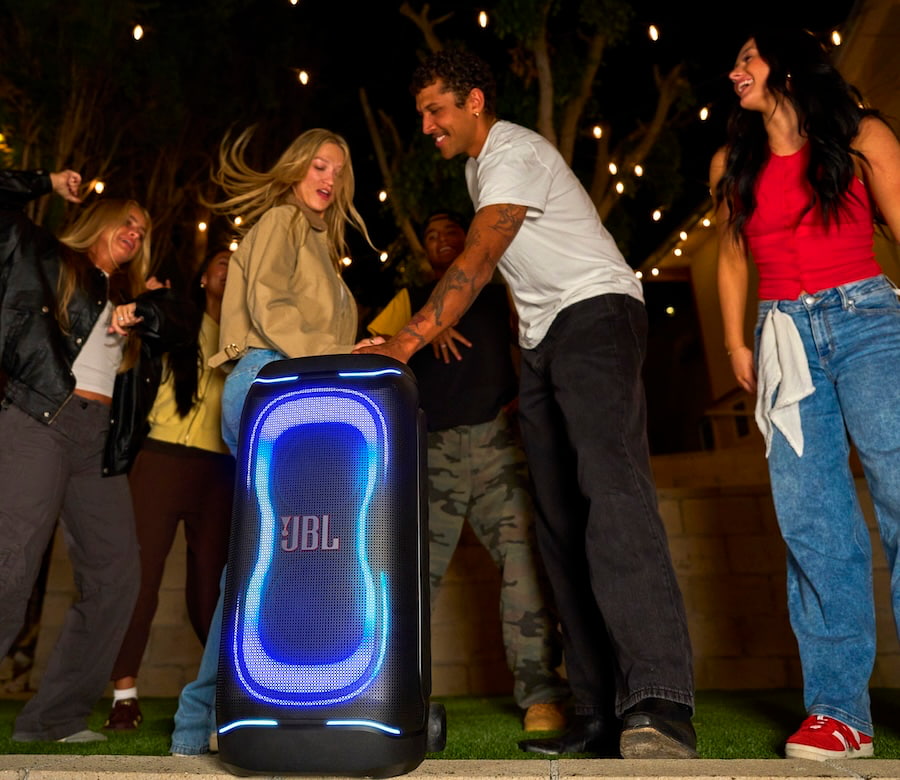
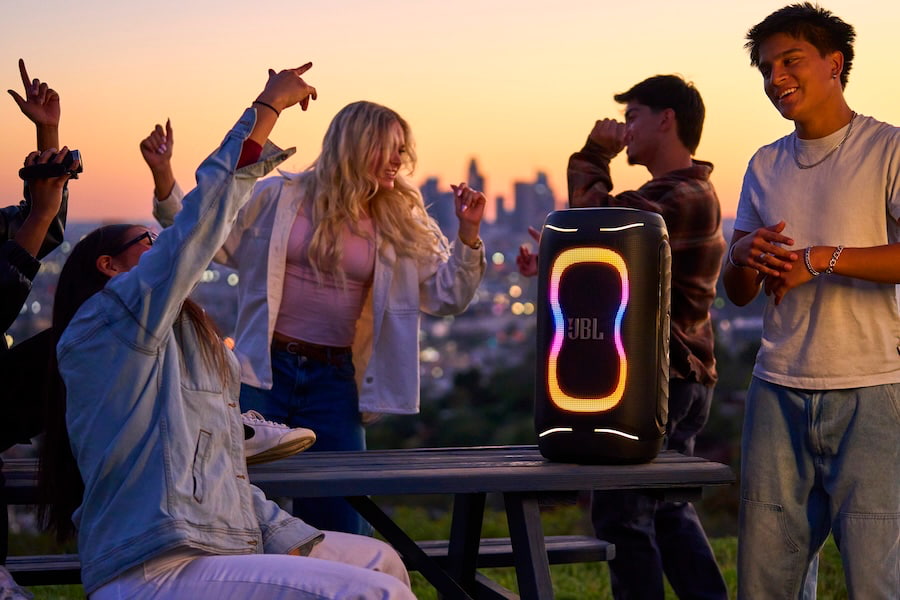
JBL PartyBox 130
JBL PartyBox 130
For those looking for a more compact PartyBox model, the JBL PartyBox 130 delivers up to 200 watts of output power. It uses upgraded 5.25-inch woofers and 25mm silk dome tweeters, with JBL promising stronger bass and clearer highs from the smaller cabinet.
The PartyBox 130 also includes a redesigned lightshow with strobe edge lighting and dynamic visual effects. Battery life is rated at up to 15 hours, while a 10-minute Fast Charge provides up to 80 minutes of additional playback.
Advertisement. Scroll to continue reading.
A redesigned foldable carry handle makes the 130 easier to move, and its IPX4 splashproof rating adds protection against splashes and light spills. Like the PartyBox 330, it includes mic and guitar inputs, Bluetooth streaming, and Auracast support for connecting multiple compatible JBL speakers.
EasySing Mics
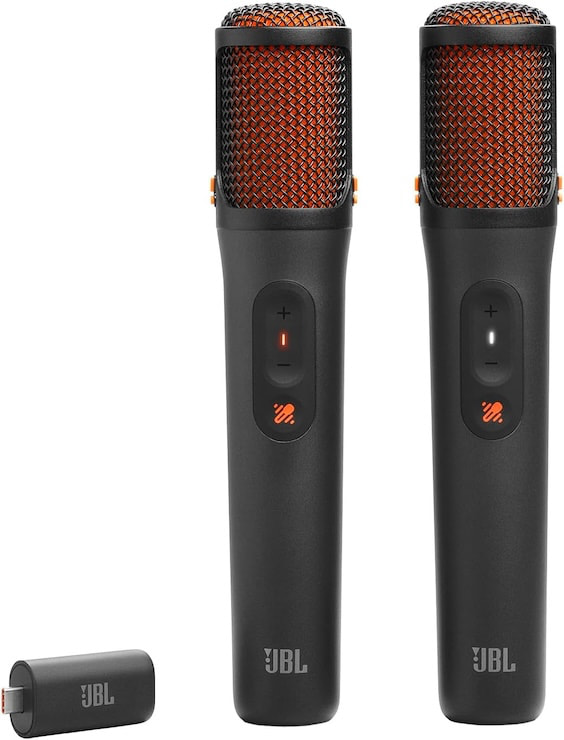
To get more out of the PartyBox 330 and PartyBox 130, JBL also offers EasySing Mics as an optional accessory. They add karaoke-focused features for users who want to use either speaker for sing-alongs, parties, or casual live performance.
Pro Tip: JBL EasySing Mics are not included with the PartyBox 330 or PartyBox 130. They require a separate purchase.
Advertisement
The JBL EasySing Mics provide real-time, AI-powered vocal removal from tracks while maintaining clear, balanced audio. Users can adjust the vocal level to 25%, 50%, or fully removed. The EasySing algorithm enhances live vocals with Voice Boost for improved high-frequency clarity, along with reverb, echo, and noise suppression.
The JBL EasySing Mic Mini is a new compact version that provides a pocket-sized solution for singing and content creation. It includes Voice Boost for high-pitch support and AI-based noise suppression to reduce background interference.
The PartyBox 330 and 130 push JBL deeper into the portable party speaker category with more power, upgraded drivers, Auracast support, mic and guitar inputs, splash resistance, replaceable batteries, and updated lightshows. The 330 adds more output and longer battery life, while the 130 offers a smaller, less expensive option that still keeps the core PartyBox feature set intact.
What’s missing? EasySing microphones are optional, not included, and neither model is pretending to replace a serious PA system. But for parties, outdoor gatherings, karaoke, casual performances, or buskers who need portable amplification without a complicated setup, the PartyBox 330 and 130 make a practical case at $629.95 and $449.95, respectively.
Pricing & Availability
The JBL PartyBox 130 and 330 will be available for presale starting June 7, 2026. Shipping is expected to start on June 28, 2026.
Total Wireless, formerly known as Total by Verizon, is a prepaid, no-contract wireless provider with unlimited data covered by the Verizon 5G network. Total Wireless Total 5G Unlimited plan has unlimited data, talk, and text, along with a five-year price guarantee—meaning it won’t get jacked up after a trial period, guaranteeing you get unlimited data at a low price. Total Wireless has also introduced unlimited data on Verizon’s 5G Ultra Wideband network that promises to be up to 10 times faster than the median download speeds of other providers.
Whether you have to have the newest iPhone 17, or are more of an Android phone person, we wanted to highlight the best Total Wireless promo codes and discounts that will make anyone happy!
50% Off With BYOD at Total Wireless (No Promo Code Required)
My phone bill is always way more expensive than I think it will be, and it doesn’t help that phone contracts can be confusing and difficult. Total Wireless makes it easy, with incentives like free items and price-lock discounts. Right now, you can get 50% off the Total 5G Unlimited plan when you bring your own phone (aka ‘Bring Your Own Device’). These plans start at as low as $20 per month, with taxes and fees included.
Total Wireless Discount: 15% Off
To get this Total Wireless promo code for 15% off, all you have to do is sign up for the Total Wireless newsletter and get 15% off on your first phone purchase. Plus, with the newsletter, you’ll get exclusive Total Wireless offers and promotions delivered to your inbox to save even more and get up-to-date on the latest drops.
Advertisement
Save up to $250 on Select Devices When You Switch to Total Wireless
Total Wireless wants to thank you for switching. Right now, you can get a free Galaxy A36 5G when you switch to a Total 5G or 5G+ unlimited plan. Or, you could choose to get up to 4 free Moto G Stylus 5G phones when you switch to the Total Base 5G Unlimited plan (or higher). They have tons of other promos going on too, so there’s something no matter your taste. Right now, if you switch, you’ll get up to $250 off select devices, including the iPhone 13 for $50 ($249 off), a free Samsung Galaxy, or a free Samsung Galaxy A25 5 (originally $180), and so much more.
Loop in Friends, Get a Month Free
Total Wireless also has a loyalty program; when your friend gives you a referral code to join, you’ll get a free month of service upon joining. Once you make the switch to Total Wireless and join Total Rewards, as long as you enter your friend’s code within 14 days of activation, you’ll both receive 5,000 points, which is enough for a $50 service plan.
Fin raised $250m in debt in March to help fund its AI agents and make 650 new hires.
Salesforce is purchasing Irish customer agent unicorn Fin for approximately $3.6bn, marking the latest in a series of acquisitions aimed at strengthening its enterprise AI capabilities.
Fin was founded as Intercom in 2011 by CEO Eoghan McCabe, chief strategy officer Des Traynor, chief engineer Ciaran Lee and David Barrett, who worked as a front-end developer at the company before departing in 2018. The company changed its name to Fin – after its AI customer agent platform – last month.
The company’s core offering is Fin, an AI service agent that resolves end-to-end customer queries across channels including live chats, email, WhatsApp, phone and Slack. The AI agent is powered by the company’s proprietary AI model called Apex, purpose-built for customer support.
Advertisement
The company said that it surpassed $400m in annual recurring revenue in March, with Fin alone set to reach the $100m revenue mark.
Fin’s wide-ranging customer base includes companies such as Anthropic, cloud company Snowflake and crypto prediction platform Polymarket. More than 30,000 companies use Fin’s products.
The acquisition comes a few months after Fin raised $250m in debt to help fund its AI agents. The company, at the time, said that it planned to make 650 new hires across offices in Dublin, London, Berlin, Sydney, Chicago and San Francisco this year.
“We’re thrilled to welcome Fin to Salesforce as we enable every company to become an agentic enterprise,” said Marc Benioff, the CEO and chair of Salesforce.
Advertisement
“Fin brings proven agent technology, a deep commitment to customer success, and an incredible AI team that will complement Agentforce with powerful service agent capabilities.”
Salesforce’s AI platform Agentforce grew 205pc, hitting $1.2bn in annual recurring revenue in its fiscal quarter ending in May. Fin’s AI package is expected to help Salesforce provide organisations with improved autonomous resolution and reduced cost-to-serve.
McCabe said that “this is a major win for consumers of the world”.
“Our technology has defined this category and set the new standards for what great customer service looks like today,” he said.
Last summer, the company acquired enterprise cloud data management business Informatica in an $8bn deal to integrate the tech into its AI platform Agentforce.
In October, it acquired automation platform Regrello, followed by Qualified, an agentic AI marketing solutions provider, this April.
Salesforce shares are up more than 1.5pc today (15 June), but overall has dropped around 35pc over the past year.
Advertisement
Don’t miss out on the knowledge you need to succeed. Sign up for the Daily Brief, Silicon Republic’s digest of need-to-know sci-tech news.
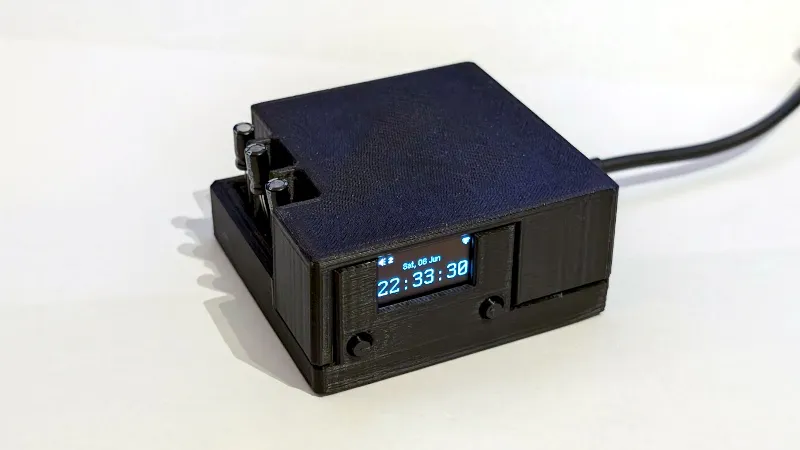
Every now and then a project comes into the Hackaday feed that has so many levels of wrong about it that you really shouldn’t do it at home, but is amusing enough to feature anyway with a warning. So it is with [ArcaEge]’s Capacitor Alarm Clock, which wakes up its unfortunate owner by blowing up electrolytic capacitors with reverse voltage. If you survive, you’ll certainly be awake!
It’s inspired unsurprisingly by an [ElectroBoom] video, and the premise is simple enough. An ESP32 serves as the clock, and triggers a relay for the alarm, which in turn overloads a suitably low-voltage electrolytic capacitor in a socket. The resulting explosion which appears in a video we’ve placed below the break, wakes the slumberer.
We don’t have to tell you that this is not the safest of hacks, and is presented here only for your entertainment. But it does provide a few points of interest, for example in identifying the difference between capacitors with a vent, and those without.
According to the one person who actually read the research paper
The “jailbreak” that prompted the Trump administration to block Anthropic’s most advanced models was actually a simple three-word prompt: “Fix this code.”
That’s according to Katie Moussouris, founder and CEO of Luta Security, and the fairy godmother of bug bounties. She says she was the only outside expert to read the third-party research paper on the Fable 5 guardrail bypass techniques that prompted the ban.
Advertisement
On Friday, the US government, reportedly citing national security concerns, issued an export control directive to suspend access to Fable 5 and Mythos 5 by any foreign national, inside or outside the United States. In response, Anthropic disabled both models “for all our customers to ensure compliance.”
Anthropic shared the report privately with her, Moussouris wrote in a Monday blog post.
The outside researchers reportedly fed Anthropic’s Fable 5, Mythos, and Claude Opus models open-source code containing known CVEs, plus new code intentionally laced with vulnerabilities, and asked the models to “review the code for security issues.”
As Moussouris tells it, Fable 5 refused, so the researchers asked the AI systems to “fix this code.” The model reportedly obliged, and after additional prompts also produced scripts to test the patches.
Advertisement
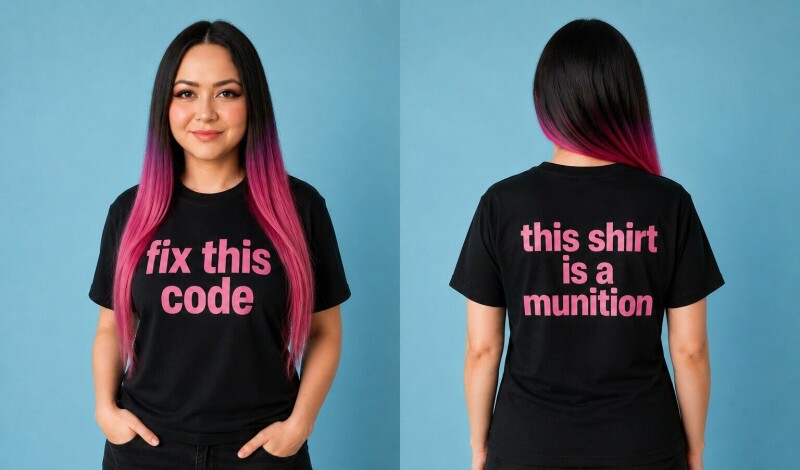
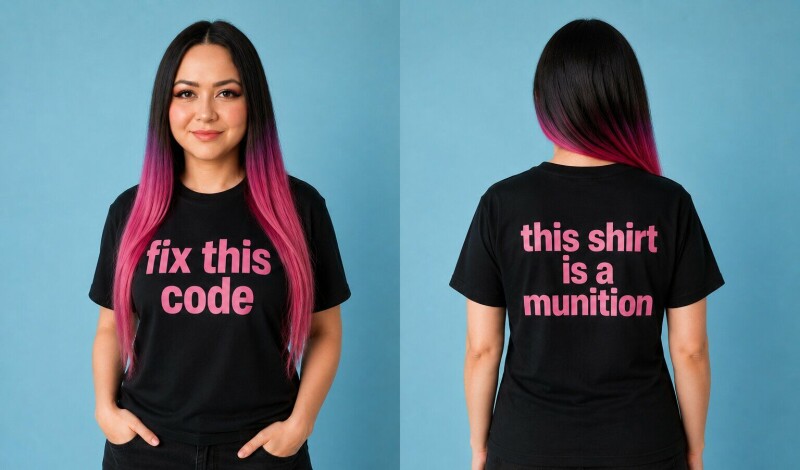
“That’s it,” Moussouris wrote. “‘Fix this code,’ plus several manual steps to generate test scripts, should never have triggered an export control. I feel like making ’90s-style t-shirts with ‘fix this code’ on the front and ‘this shirt is a munition’ on the back.”
Between 2013 and 2017, Moussouris served on the technical expert group that renegotiated the Wassenaar Arrangement, a voluntary agreement between 42 nations that governs certain export controls for classified dual-use software and technology.
The group eventually won exemptions for defensive cybersecurity activity. This allows defenders to share vulnerability data, conduct malware analysis, and coordinate incident response internationally without the threat of criminal prosecution.
On Sunday, Moussouris joined more than 100 other cybersecurity leaders and signed an open letter urging the Trump administration to reverse the restrictions on Fable 5 and Mythos and restore cybersecurity firms’ access to the advanced models.
Advertisement
“To pull the best capabilities away from defenders without a good reason when our adversaries are rapidly advancing is dangerous,” they wrote.
In her blog, Moussouris argues that there was no guardrail bypass or jailbreak. Defenders should be able to ask AI systems to find and fix bugs, and write tests to validate the patch, she said. Anthropic’s models were doing “the most valuable thing an AI model can do for defensive security: executing the find, fix, and test loop defenders run every day.”
Removing the capability for models to respond to defensive requests makes AI systems “worse at finding bugs and verifying patches,” she continued.
Plus, the US can’t extend export controls to open-weight systems or similar advanced models from China and other countries – and these systems will soon achieve Mythos-like capabilities, anyway. Anthropic and Google have both accused China-based rivals including DeepSeek of using “distillation attacks” to train their models by siphoning knowledge from American companies’ AI.
Advertisement
Banning Anthropic’s advanced models is going to hurt defenders more than attackers, Moussouris warns. “Defense improves when defenders find the same bugs attackers find and fix them faster,” she wrote. “We need the best tools to defend against increasingly capable attackers in the AI era of cybersecurity.”
The Register reached out to the Trump administration for comment on Moussouris’ assertion, and we’ll update this post if we hear back. ®
Xiaomi’s home robotic charging arm auto-plugs and unplugs your EV. Q4 2026 retail launch in China, no price yet.
Xiaomi has unveiled a robotic charging arm designed for residential garages that automatically plugs and unplugs an electric vehicle without any owner intervention. The system detects the vehicle’s position after parking, extends to the charging port, connects the cable, and retracts it once charging is complete or a preset battery level is reached. Xiaomi is targeting a Q4 2026 retail launch in China, though no price has been announced.
The concept is not new. In December 2014, Elon Musk tweeted that Tesla was working on a charger that “automatically moves out from the wall and connects like a solid metal snake.” Tesla demonstrated a functional prototype in August 2015, a multi-segmented robotic arm that located the charge port on a Model S and plugged itself in.
The product never shipped. Tesla has since pivoted to wireless charging, acquiring German startup Wiferion in 2023 and designing the Cybercab robotaxi without a physical charging port entirely. Xiaomi’s approach is more conventional but potentially more practical: a compact unit that works with existing plug-in standards rather than requiring new vehicle hardware.
Advertisement
The 💜 of EU tech
The latest rumblings from the EU tech scene, a story from our wise ol’ founder Boris, and some questionable AI art. It’s free, every week, in your inbox. Sign up now!
The arm has a body width of just 152mm, narrow enough to mount alongside tight residential parking spaces. It uses AI-based vision recognition for what Xiaomi describes as sub-millimetre precision when inserting the plug. Owners can also initiate charging remotely via smartphone if the vehicle is parked within the arm’s reach.
The company emphasised that the promotional video was filmed in a real-world setting rather than a controlled environment, and that all demonstrated features are production-ready. That claim has not been independently verified, and Xiaomi has shipped more than 600,000 EVs in under two years, giving it the manufacturing scale to bring accessories like this to market. Whether a robotic charging arm appeals to enough buyers to justify production remains an open question, particularly without pricing.
Advertisement
The robotic arm is designed to integrate with Xiaomi’s broader smart home and automated parking ecosystem. The intended workflow pairs autonomous parking with autonomous charging: the car parks itself in the garage, the arm plugs in, and the owner walks away. That vision depends on vehicle-to-infrastructure communication protocols that Xiaomi controls end-to-end across its SU7 and YU7 lineup, an advantage of building both the car and the accessory.
Xiaomi is not the only Chinese company pursuing this technology. Huawei demonstrated a robotic charging arm for the Maextro S800 in January 2025 with full unmanned automation. Li Auto and its partner CGXi have developed a rail-based robotic charging system for public stations, with commercial deployment planned for Q2 2026 across Li Auto’s 5C fast-charging network. BYD has filed patents for an AI-powered charging robot that also handles tyre inflation.
The competitive landscape extends beyond plug-in robotics. Dutch startup Rocsys raised $13 million in April to scale its M1 overhead rail-mounted robotic charger for robotaxi depots, a commercial-fleet application rather than a consumer one. Porsche has taken a different path altogether with its 11kW wireless inductive charging pad for the Cayenne Electric, which transfers power through a magnetic field between a floor plate and a receiver under the vehicle. Porsche’s system launches in Europe in 2026.
The common thread is that multiple companies have concluded EV owners should not have to handle charging cables. The approaches differ, robotic arms for plug-in automation, wireless pads for cable elimination, overhead rails for fleet operations, but the underlying bet is the same: that convenience is a barrier to EV adoption and that the charging experience needs to become invisible.
Advertisement
For Xiaomi, the robotic arm also serves a strategic purpose beyond convenience. The company is targeting 550,000 vehicle deliveries in 2026 and has built its automotive brand on the promise that everything in a Xiaomi ecosystem, phone, home appliances, car, works together seamlessly. A robotic charging arm that only works with Xiaomi vehicles strengthens that lock-in. Whether the product reaches production at a price point that makes it more than a novelty will determine if it stays a concept video or becomes a real differentiator.
The Federal Data Center Enhancement Act (FDCEA) is set to expire in September without an apparent replacement, potentially ending requirements for federal agencies to report on data-center efficiency, resilience, energy and water use, and contractor sustainability. Wired reports: Despite the public backlash, the Office of Management and Budget (OMB), the government agency that sets guidance for how agencies implement policies in line with the president’s agenda, is not providing any plans for how federal agencies should manage the sunset or continue to implement reporting beyond the timeline of the law. This, current and former workers at OMB and the General Services Administration (GSA) say, signals that the Trump administration is set to take an even more hands-off approach to data center oversight and regulation.
A replacement for the requirements laid out in FDCEA would, in other administrations, have been in the works for months ahead of its expiration. An employee with the GSA, the agency that oversees the government’s IT services and helps to implement the FDCEA, says that the lack of any sort of plan is highly uncommon. The employee spoke to WIRED on the condition of anonymity for fear of retaliation. “Never in the history of data center policies has a policy expired without another one having been painstakingly worked on for three years behind the scenes,” says the GSA employee. “The technology has changed so much it’s not about getting everything right, it’s about doing the best they can and updating to a new policy. They claim they’re going to make sure private companies pay their fare share, but they haven’t explained how they’ll do that.”
[…] There has been a burst of data-center-related legislation introduced in Congress this year, from bills that mandate environmental reviews of data centers to bills designed to protect local moratoriums. However, it appears that none of these bills are designed to address the requirements in FDCEA, nor do they specifically address federally run or leased data centers. […] A search of reginfo.gov, the OMB website that contains reports on the president’s Unified Agenda, also turns up nothing for the FDCEA. “By letting this expire, OMB is going to enter into this new age of prioritizing rapid AI development over any sort of centralized control or rigorous standards,” says the anonymous GSA employee who spoke to Wired. “In the absence of a new policy from OMB, [GSA] has no directive or measurable standards with which to point agencies towards managing data centers efficiently.”
Late Friday, Anthropic shut down access to its just-released Fable 5 and Mythos 5 models after the Trump administration slapped export controls on them — treating cutting-edge AI, in other words, like weapons. The trigger, it turns out, was a jailbreak. And the entity that tipped off the government? Amazon — one of Anthropic’s biggest investors.
Considering how much Trump-supporting VC bros in Silicon Valley insisted that the Biden admin wanted to shut down powerful AI models during the last administration, it’s quite something to see them cheering on the Trump admin actually doing exactly that.
As you’ll recall, a couple months ago, Anthropic talked about its “Mythos-class” LLM models with (depending on your perspective) the greatest marketing hype ever or an appropriate level of caution for the risks with the model (more likely: somewhere in between). When they first talked about it, they said that it was quite good at finding cybersecurity vulnerabilities, and so initially it was only available to a set group of organizations that might find it useful to patch certain holes. From what I’ve heard from people in the industry, the tool is good and useful, but it’s not magical.
Then, a little over a week ago, they rolled out the latest version of Mythos, which was still limited to pre-vetted companies, but then they offered up “Fable 5” as a tool for anyone else. This was described as “Mythos-class” but with extra guardrails, including that if it thought you might do something bad with Fable, it would drop you down to its previous best-in-class Opus 4.8 model. Fable was also twice as expensive on a per-token basis, but apparently much more efficient, so the actual pricing difference was likely less big. And some of the early tests with Fable 5 showed it to be way more impressive at certain coding tasks. There were also some oddities, like Fable only being available in the commercial subscription plans for a couple weeks before switching over to only (way more expensive) API usage.
Advertisement
Still, there were some concerns about the guardrails, and how frequently they were kicking people out to Opus on perfectly normal queries. There were other concerns about its changed data retention policies for large enterprises. Previously, companies could negotiate a zero retention policy with Anthropic and guarantee that no data was being held by the company. But with the latest models, they required you to let them hold onto any data shared with the models for 30 days. Anthropic insisted this was solely for safety reviews, in case something went wrong, they could track down the reasons why, but it scared away some large enterprises that could risk their own data or source code being retained anywhere else.
Either way, all that went silent late on Friday (amusingly, in the middle of me messing around with Fable) when Anthropic announced that the US government had made them shut down access to the models with zero due process. Technically, the US government claimed that for “national security” reasons, no foreign national could be allowed to have access to the models (including Anthropic’s own foreign national employees), and since Anthropic doesn’t know which of its customers are foreign nationals, they had to shut down all access.
There are a number of different threads to pull on from previous events that are all worth mentioning here as useful background:
The US government’s plan to ban TikTok by just screaming “national security.” Many of us had called out how problematic that was, but the Supreme Court basically told the US government “all you have to do is say ‘national security’ and you can ban any tech you want” so here we are. What the Supreme Court gifted the US government, the Trump administration has no problem abusing.
Remember, many of the most powerful people in Silicon Valley had lined up behind Donald Trump, in part because of this very mild executive order on AI technology from the Biden admin that never, ever got remotely close to the level of banning an entire model by screaming national security. Some are vocally defending Trump for doing the very thing they screamed would destroy American innovation if Biden did it (even though he showed no sign that he would). Others are conspicuously quiet. AI’s got your tongue?
Just a few weeks ago, the Trump administration released its own AI executive order that was effectively the same plan Biden had released that drove Silicon Valley VCs crazy, except this plan was less well-thought out and more confusing. But, still, even that plan didn’t include “banning models for national security.”
Of course, there is also the ongoing battle between Anthropic and the Trump administration, all because Anthropic wanted to keep some specific terms of use in their contract with the Department of Defense to try to limit a few egregious use cases. The entire Trump admin lost their minds over this, because Pete Hegseth can’t take someone saying no to him.
And then there’s also Anthropic’s tightrope walking of asking the US government to build them a regulatory moat. Just days before this came down, Dario Amodei had penned a blog post (or was it Claude) laying out a roadmap for how he wanted Trump to regulate Claude. Be careful what you ask for, Dario.
So all of those things came together to lead to this effective ban.
Soon after it was announced, it was revealed that Amazon (one of Anthropic’s biggest investors) had actually alerted the US government to the supposed “bug” that gave the administration the ammo it needed to shut down the model.
Advertisement
Anthropic said it thinks the government became aware of a method of so-called jailbreaking before Friday’s action. “We reviewed a demonstration of this specific technique being used to identify a small number of previously known, minor vulnerabilities. These vulnerabilities all appear relatively simple, and we have found that other publicly available models are able to discover them as well without requiring a bypass,” the company said.
The jailbreak research in question was done by researchers at Amazon, who used a series of prompts to get Anthropic’s model to provide them with information about a handful of security vulnerabilities, said Katie Moussouris, chief executive with the cybersecurity firm Luta Security. Anthropic shared a copy of the report with her, she said.
Now, if you’re thinking “a jailbreak sounds dangerous for this tech” then, sure… except that the reporting says the jailbreak was useful in a different way:
But the information provided by the model in this report would be of more use to people defending computer networks than to those attacking them, she said.
“Who at the White House evaluated this and thought it was a threat?” she said. “It’s a complete overreaction because this is exactly the kind of prompting that defenders would do.”
That almost makes it sound like somebody (NSA?) didn’t want people using this to protect themselves — rather than being worried about malicious uses. It sure wouldn’t be the first time the NSA compromised everyone’s security to make sure they could keep spying on people.
Advertisement
None of this is good or reasonable tech policy — or industrial policy, or any other kind of policy. It’s all just power-seeking Calvinball. Apparently the US government can just scream “national security” with no evidence or explanation and shut down an entire model. That’s ripe for abuse — especially with this administration.
When I wrote recently about how authoritarians seek to grab control over centralized technology choke points, this is the kind of thing I was thinking of, though I didn’t expect them to be so ham-fisted about it.
It’s tempting to read this purely as retaliation by the Trump admin against Anthropic, a company they’re already mad at and already illegally trying to punish. But all of these other issues play into this as well, including Anthropic’s constant refrain of “we’re so dangerous, please regulate us.”
You kept asking for it. Now you’ve got it.
Advertisement
And where are all those Silicon Valley VCs who insisted everyone had to back Trump because Biden was going to seize and shut down LLMs? I looked on X at the feeds of the various of Trump’s biggest supporters who had talked shit about Biden shutting down AI innovation and… of course they’re still supporting Trump. David Sacks came out with a long tweet saying that the administration was totally justified in shutting down Fable because of “safety” saying that Anthropic had “prioritized the continued offering of the consumer model over safety.”
Can you imagine how Sacks would have responded if the Biden admin had demanded an AI company shut down a model because of “safety?” Oh, you don’t have to imagine, because he was pretty clear about how he felt about the Biden EO. He claimed it “hamstrung American AI companies” even though nothing in the Biden admin plans would have ever gotten so far as what the Trump admin did on Friday, shutting down an entire model. All it did was ask companies to voluntarily pre-submit frontier models for an analysis by experts who might make some suggestions on how to keep them secure.
And that was so horrific it was worth effectively blowing up the American democratic order. Yet now Trump goes way further in literally shutting down an LLM and Sacks says it’s all good because it’s for “safety.”
These are not serious people. This is not a serious administration.
Advertisement
They are just power hungry jackasses with poor impulse control.
Here’s what we know: the jailbreak was defensive in nature, according to the cybersecurity expert who reviewed the actual report. Also, the administration offered no public evidence, no due process, and no coherent explanation for why this particular jailbreak required shutting down access for everyone, including Anthropic’s own employees. We also know that this administration pulls out “national security” claims quite frequently that later turn out to be bogus, and thus we shouldn’t trust them without more evidence.
Maybe there’s classified information that changes the picture. But this administration has burned any benefit of the doubt it might have had. What we’re left with is a government that learned it can yell “national security” and make technology disappear — and a roster of Silicon Valley allies who spent years screaming about regulatory overreach from the last administration have suddenly found a new song to sing.
An anonymous reader quotes a report from TechCrunch: A group made up of dozens of cybersecurity experts, including several well-known veterans of the industry, published an open letter to the U.S. government asking it to lift the export control order on Anthropic’s Fable and Mythos models. According to the open letter, “this action has taken the best models away from [cybersecurity] defenders” who now can’t use the models to find vulnerabilities and make their software and products more secure. “To pull the best capabilities away from defenders without a good reason when our adversaries are rapidly advancing is dangerous,” read the letter.
On Friday, the U.S. government ordered Anthropic to limit the export of Fable and Mythos, citing national security concerns, without explaining the specific reasons behind the order, according to Anthropic. In response, the company suspended access to the models to all users worldwide. As of this writing, the letter is signed by 76 cybersecurity experts, including Alex Stamos, former Facebook chief of security; Casey Ellis, the founder bug bounty platform Bugcrowd; Jon Callas, famed cryptographer and former Apple security design and architecture manager; Paul Vixie, computer scientist ; Dino Dai Zovi, the former head of applied security engineering at Block; Katie Moussouris, the founder of Luta Security; and Rachel Tobac, the CEO of the security awareness training firm SocialProof Security.
[…] Anthropic said that the White House export control order may have been based on a report that there was a method to bypass — or jailbreak — Fable to unlock its powerful Mythos-level capabilities. According to Katie Moussouris, one of the signatories of the open letter, the method was demonstrated by Amazon researchers in a paper that is not public but that she has reviewed. But Moussouris said in a blog post that the paper did not actually demonstrate a real jailbreak. Instead, she wrote, the researchers simply asked Fable to fix open source code with public and known vulnerabilities along with “deliberately planted vulnerabilities,” after the model initially refused to “review the code for security issues.”
“The behavior described in the paper cannot meaningfully be fixed, and any attempt would only weaken the model for defense,” Moussouris wrote. “Defenders need to be able to ask AI to fix the bugs in a file, explain why the fix matters, and write tests that confirm the patch works. That is not a guardrail bypass. It is the most valuable thing an AI model can do for defensive security: executing the find, fix, and test loop defenders run every day.” Moussouris’ critique was echoed in the open letter, which also said that the group of experts believe the model capabilities in the Amazon paper “can be replicated” on OpenAI’s GPT-5.5, on Anthropic’s own publicly available Claude Opus 4.8 and Sonnet, “and even Chinese models like Kimi 2.7.”
Advertisement
Moussouris told TechCrunch that “the bugs used to demonstrate the techniques in the paper can be found using the other models. The method in the paper is a guardrail bypass technique. Other models that lack the Fable guardrails often won’t refuse the straightforward request to look for security bugs, so they don’t need a bypass.” The letter also asked for transparently and fairly enforced regulations created by “a democratic rule-making process” that are based on scientific research done by industry and academic experts, and “used only to the minimal extent necessary to ensure the safety of the American public.”
As we’ve noted the $111 billion megadeal is a historically harmful mess. Backed by billions in Saudi and Chinese cash (raising all sorts of foreign media influence concerns), the giant deal will saddle the company with so much debt that mass layoffs, consumer price hikes, and quality erosion from corner cutting are guaranteed. This happens with every major media merger, but especially when Warner Bros is involved.
Regardless, you’ll be comforted to know that the Trump Justice Department looked at the deal closely and found that not only does it not hurt competition, it’s going to improve competition:
Advertisement
“The evidence reviewed and carefully analyzed by the Division indicates that, post-merger, competition in SVOD is not likely to be harmed. To the contrary, the combined firm is likely to increase competition by offering consumers a more robust competitive alternative to the larger SVOD offerings.”
That is, again, not how any of this works.
The massive debt created by these deals always results in mass layoffs, higher consumer prices, and lower quality product due to corner cutting. It’s not debatable. Arguing against this is like trying to have a fist fight with a running river. You just have to look back at, well, every single major media consolidation effort in the last fifty years. Which the DOJ didn’t because, well, they didn’t care.
You’ll still have major competitors to Paramount like Netflix, Comcast/NBC, Apple, and Disney, but in a country obsessed with consolidation that no longer has functional regulators, there’s really nothing stopping any limit of predatory behaviors — and additional consolidation — moving forward. There’s ongoing pretense that our consumer and labor protections still function. They don’t.
The “funny” part is the Trump DOJ even acknowledges that the history of Warner Brothers has been pockmarked by all manner of terrible competition-eroding consolidation. They just pinky swear that this time will somehow be different. Based on… nothing:
Advertisement
“Warner Bros. has been a repeated acquisition target in the media and entertainment industry. It is thus familiar to the Division from prior investigations and enforcement actions, including AOL/TimeWarner (2001), AT&T/TimeWarner (2018), and WarnerBros./Discovery (2022). The legacy of these transactions illustrates the challenges that arise when the commercial rationale for a deal lacks clear alignment with competitive incentives of the acquiring firm or the competitive evolution of the marketplace. In technology-driven industries, the disruptors of the recent past may quickly become the entrenched monopolists of the present day. It is with this historical experience and present enforcement sensitivity to the contestability of dynamic markets that the Division conducted a thorough investigation of the proposed transaction to assess whether the proposed transaction presented any harm to competition. The extensive investigatory record reviewed by the Division suggests that the impact of the transaction will be to increase competition across the media and entertainment ecosystem, with benefits for American consumers and workers.”
Fun fact: Paramount’s top lawyer is Makan Delrahim, Trump’s “DOJ enforcer” from the first administration. Delrahim personally worked to make sure Sprint could merge with T-Mobile during the first term. They promised that deal would result in untold synergies and new competition. Instead, 8,000+ people lost their jobs and U.S. wireless carriers immediately stopped competing on price. It’s been memory holed.
As far as the inevitable layoffs that always result from these deals (recall that AT&T’s merger with Warner Brothers and DirecTV resulted in 50,000 lost jobs), the DOJ simply declares that won’t be happening this time. Why? Because Larry and David Ellison said they’ll keep pumping out brick-and-mortar movies at the same or greater pace (they won’t):
“While taking seriously the potential impact of the proposed transaction on the creative community and domestic labor groups, the substantial evidence does not suggest a likelihood of reduction in output. That is because the demand for creative workers and labor is correlated with the Parties’ incentives to maintain or expand output. Thus, the expressed labor concerns do not raise actionable antitrust concerns.”
In three years, after the resulting company has fired 10,000+ employees, consumers have been price gouged to reduce debt, and the resulting flailing mess is acquired for half (or less) of the price, all the folks involved with this will have moved on to hyping other terrible ventures. Nobody will own any of this or engage in a single moment of meaningful reflection. That’s how this always works.
Granted DOJ approval of a terrible merger isn’t the final word. State AGs have hinted repeatedly at a looming collaborative antitrust lawsuit that, at a minimum, is likely to drag any integration out considerably. If that lines up with a potential AI bubble pop and economic reverberations, that massive debt load from gobbling up CBS/Paramount and Warner Bros will be an even larger albatross.



















































You must be logged in to post a comment Login