Connect with us
DAPA Banner
DAPA Coin
DAPA
COIN PAYMENT ASSET
PRIVACY · BLOCKDAG · HOMOMORPHIC ENCRYPTION · RUST
ElGamal Encrypted MINE DAPA
🚫 GENESIS SOLD OUT
DAPAPAY COMING

Tech

LAiV Crescendo VERSE Review: Chapter and Verse on This All-in-One DAC, Preamp, and Headphone Amplifier

Published

on

LAiV is a relatively new name, founded in Singapore in 2023, but the brand has moved quickly with a growing lineup of design forward, higher end components. The LAiV Crescendo VERSE marks a shift in strategy, arriving as a compact all-in-one DAC, preamplifier, and headphone amplifier priced at $849 and aimed squarely at a far more competitive segment of the market. That puts it head to head with established players like FiiO, Shanling, Topping, Schiit Audio, Eversolo, and TEAC, brands that have spent years refining affordable desktop systems that do not feel compromised.

The question is not whether LAiV can design something that looks the part. It already has. The real issue is whether the Crescendo VERSE can deliver the performance, features, and reliability expected at this price in a category where excuses do not last very long.

Technology & Specifications

The DAC section of the Crescendo VERSE is built around an R2R ladder topology, a design approach often associated with a more natural tonal balance and a less processed presentation. In simple terms, it relies on a network of precision resistors arranged in a ladder configuration, switching between R and 2R values to convert digital data into an analog voltage signal.

On paper, R2R designs do not usually win the measurement game against delta-sigma DACs, but LAiV has clearly made an effort to keep the numbers respectable. The Crescendo VERSE posts 0.008% THD+N, signal to noise ratio above 110 dB, and less than 30 µVrms of noise from the balanced headphone output. That level of performance is supported by tightly matched resistors with tolerances below 0.05 percent, which is not something every manufacturer bothers to implement at this price.

Advertisement

In terms of format support, the DAC handles up to 768 kHz PCM and DSD256, with native 1-bit DSD processing that avoids unnecessary conversion. The tradeoff is that switching between sample rates or encoding types can introduce occasional pops between tracks. If that becomes distracting, switching to Multibit mode for PCM playback eliminates the issue and allows for smoother transitions without interrupting the listening experience.

verse8

The Crescendo VERSE also includes an integrated sampling rate converter, allowing PCM files to be upsampled by 1x, 2x, 4x, 8x, or even 16x. DSD can likewise be resampled to DSD64, 128, 256, and 512 when operating in native DSD mode, giving users a fair amount of flexibility depending on how they prefer their digital processing handled.

Beyond the DAC section, LAiV has built this as a true all-in-one unit, incorporating a headphone amplifier alongside a discrete, output buffered preamplifier for use with power amplifiers or active speakers. Switching between modes and functions is handled via the included remote or the front panel controls. Operation is generally smooth, although the 20 by 7 dot matrix display limits how much information can be shown at once, which makes menu navigation less intuitive than it should be.

On the amplification side, the headphone stage delivers up to 1.1 watts and 11 Vrms in high gain. That is not class leading on paper, but it is sufficient for the vast majority of headphones. Medium and low gain settings are also available, making it flexible enough for more sensitive headphones and IEMs without introducing unnecessary noise.

It is not a power focused design, and that feels intentional. More power does not automatically translate into better sound quality. What matters is how it performs where it counts, which we will get into in the listening section. But first, let’s take a closer look at the build quality.

Advertisement
verse7

Design & Build

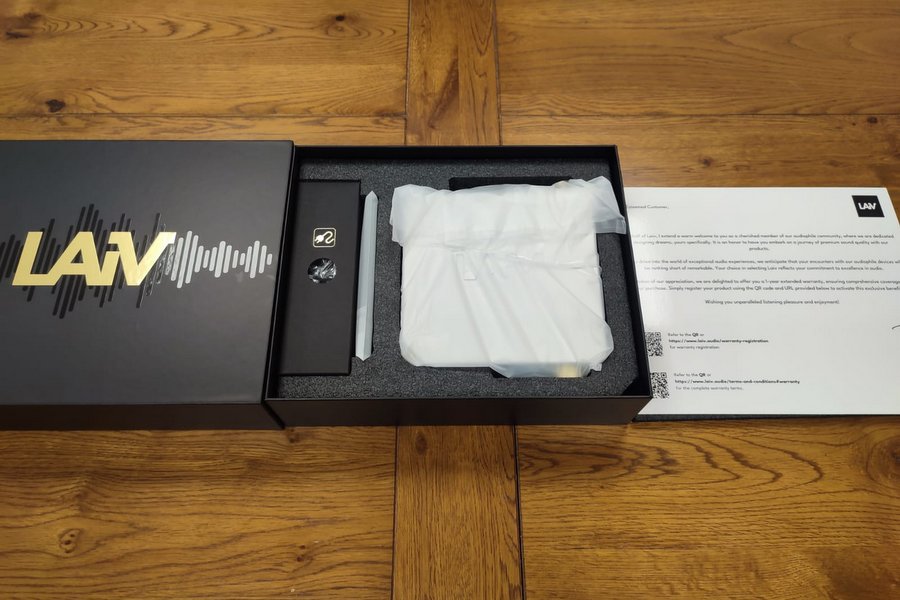
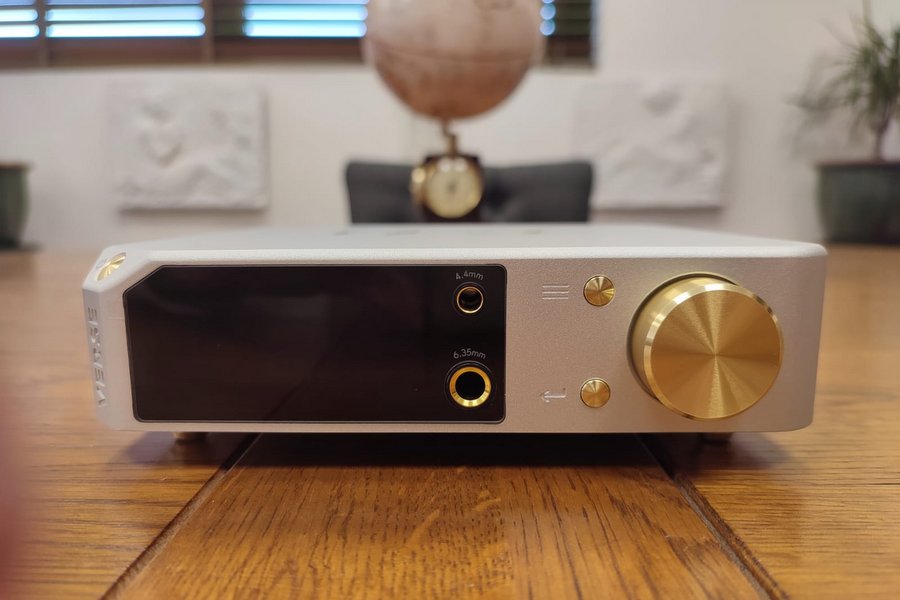
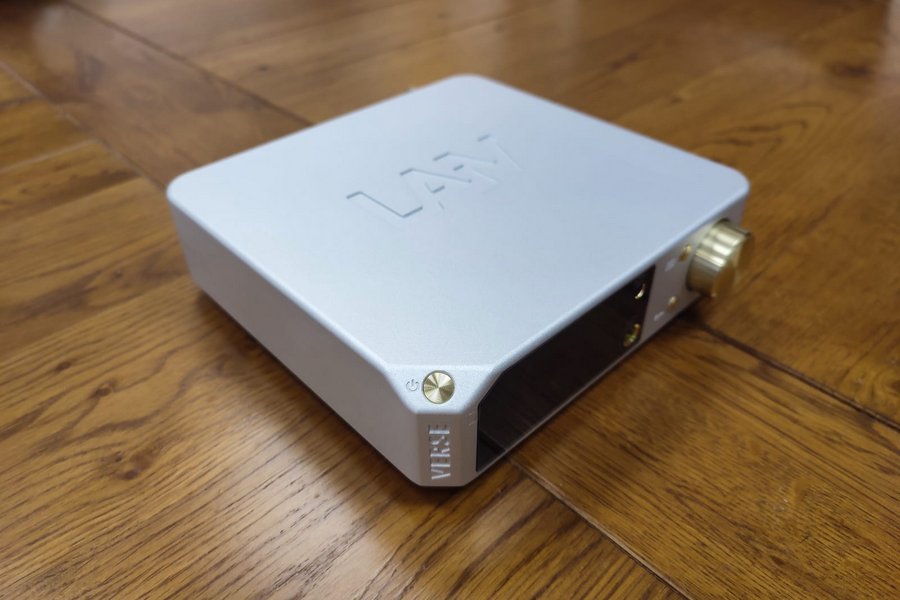
The LAiV Crescendo VERSE leans heavily into premium territory when it comes to build quality and materials. The chassis is machined from anodised aluminium, and the front LED display sits behind a sheet of tempered glass that adds a bit of polish without feeling overdone.

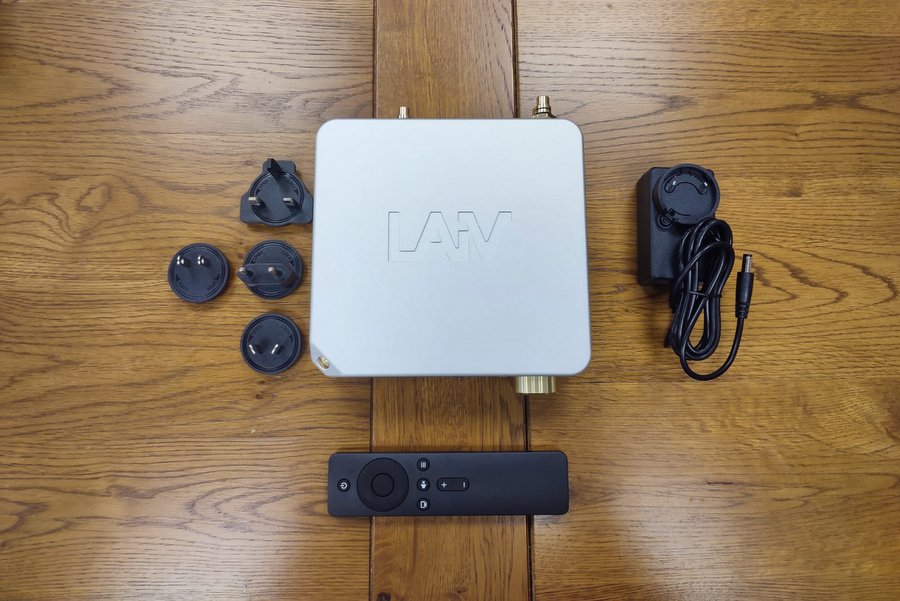
There are two finishes available: ebony black with gold accents, or sterling silver with gold buttons and knobs. The latter is what we have in for review, and it looks exactly like what LAiV is going for—angular, slightly industrial, but with enough refinement to avoid looking like lab equipment. It feels intentional rather than flashy.

Advertisement. Scroll to continue reading.

Its compact footprint helps. Measuring 188 x 168 x 50 mm (7.4 x 6.6 x 2.0 inches), the Crescendo VERSE does not dominate a desk, which makes it a far easier fit in smaller setups or cleaner, more minimalist spaces. Not everyone wants a full-width component staring them down while they work.

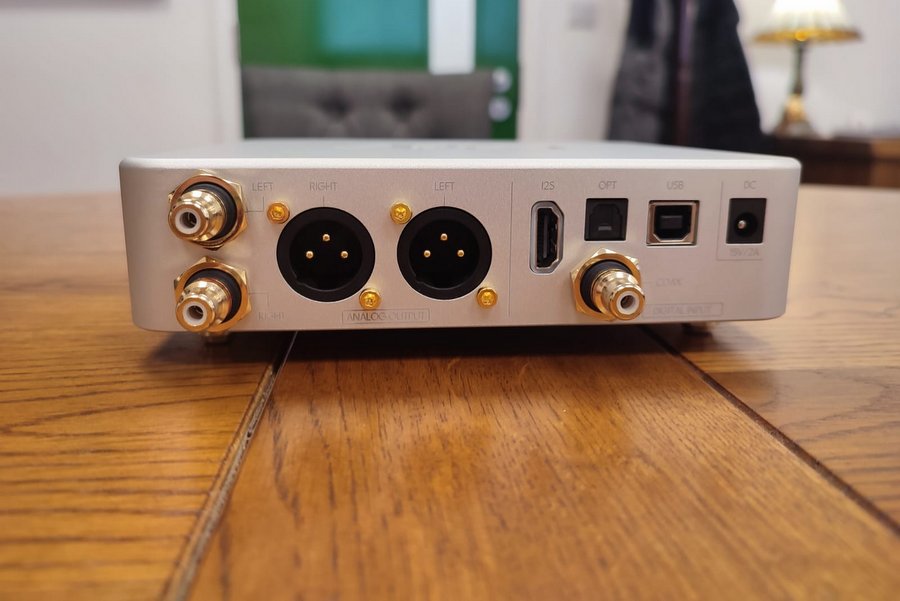
Despite the smaller size, connectivity is not an afterthought. Up front, you get both a 6.35 mm (quarter inch) and 4.4 mm balanced headphone output. Around the back, there is a full set of RCA and XLR outputs, along with four digital inputs: USB, coaxial, optical, and I2S. Power is handled via an external supply, which makes sense given the size. There was no realistic way to keep the unit this compact and fit everything internally without compromise.

Advertisement

Back on the front panel, volume is controlled via an analog knob with a smooth, well-damped feel that avoids being overly loose or stiff. The included remote works as expected, although LAiV skips the small courtesy of including AAA batteries. Not a deal breaker, but it is the kind of detail you notice when everything else is this well executed.

verse2

Listening & Headphone Synergy

The LAiV Crescendo VERSE was used both as a complete DAC and headphone amplifier and as a standalone DAC paired with several external headphone amplifiers. Source material ranged from Spotify streams to high resolution FLAC files, with listening done across a wide selection of headphones, including low impedance planar magnetics, high impedance dynamic drivers, and everything in between.

After several weeks of use, one thing became clear. Despite its R2R architecture, the Crescendo VERSE does not lean as warm as some might expect. Compared to other implementations, such as the FiiO K13 R2R, which noticeably softens the treble on something like the Beyerdynamic DT880 Edition 600 Ohm, the LAiV takes a more balanced approach. It does not round off the top end to the same degree, which will likely come as a surprise to those expecting a traditionally rich and forgiving R2R presentation.

What it does deliver is a sense of fullness and flow that feels cohesive rather than exaggerated. There is a natural ease to the way it presents music, with instruments and vocals coming across as grounded and unforced. It avoids sounding clinical without tipping too far into coloration, which is not always an easy balance to strike. R2R designs are often praised for this kind of presentation, and while not every implementation gets it right, the Crescendo VERSE makes a convincing case for why the topology still has a following.

verse5

Starting at the low end, the Crescendo VERSE reaches deep and maintains good control, even if it stops short of being the most hard-hitting or visceral option under $1,000. What stands out more is texture. Bass notes have shape and definition, giving lines a sense of weight without turning them into a blunt instrument. On Jadu Heart’s “Woman,” the low, guttural guitar work comes through with a satisfying sense of density and presence rather than sheer slam.

That same sense of body carries into the midrange, where the Crescendo VERSE does its best work. Vocals, both male and female, are presented with a natural sense of scale and focus that draws attention without feeling pushed forward. On “Alaska” by Portair, Drew Southwell’s breathy delivery cuts through cleanly, but there is still enough weight behind it to avoid sounding thin. It manages to stay clear and articulate without tipping into harshness, which is not always a given at this price.

Advertisement

Treble is handled with restraint, but in a way that feels intentional rather than rolled off. There is enough energy to resolve detail and maintain separation, but peaks are kept in check, especially with more aggressive headphones. The result is a presentation that leans relaxed and listenable over long sessions, without losing the finer details that give recordings their sense of air and nuance. Just keep the volume in check, unless fatigue is part of the plan.

As an example, I sometimes find the HiFiMAN HE1000 Unveiled a bit too forward in the treble with certain tracks, including L’Impératrice’s “La lune.” Through the Crescendo VERSE, that edge was dialed back just enough to make the synths easier to live with, without stripping away their detail or energy.

In terms of pairing, the Crescendo VERSE handled most headphones without complaint, from low impedance planars to high impedance dynamic designs. Where it begins to show its limits is with more demanding planar magnetics. Headphones like the HiFiMAN HE6se V2 need more current than the internal amplifier can comfortably provide. Paired with an external amplifier like the Aune S17 Pro, however, the Crescendo VERSE steps into a different role and performs exceptionally well. The Class A design of the S17 Pro complements the DAC’s more organic presentation, resulting in a combination that feels both controlled and musically engaging.

Imaging and soundstage are clear strengths. The Crescendo VERSE presents a well organized, layered soundstage where instruments and vocals are placed with precision rather than smeared across the field. There is a convincing sense of separation between elements, which helps complex recordings retain their structure. On TOOL’s “Chocolate Chip Trip,” a track that can quickly turn into a mess on lesser gear, individual sounds remain distinct and easy to follow, with each layer occupying its own space without collapsing into the next.

Advertisement
Advertisement. Scroll to continue reading.

The Bottom Line

The LAiV Crescendo VERSE gets a lot right for a first attempt at an all in one in this price range. Build quality is excellent, the design feels considered rather than decorative, and the feature set covers just about everything most users will need, from flexible digital inputs to balanced outputs and a capable preamp stage. The R2R DAC implementation is the real differentiator. It delivers a sound that is full, controlled, and natural without leaning too warm or soft, which helps it stand apart from both typical delta sigma designs and more colored R2R alternatives.

It is not without limitations. The internal headphone amplifier is good, but not class leading in terms of raw power, and demanding planar headphones will still benefit from an external amp. The interface, while functional, could be more intuitive, and native DSD playback comes with minor usability quirks. None of these are deal breakers, but they are worth noting in a category where the competition is deep and well established.

verse4

What makes the Crescendo VERSE compelling is how complete it feels. It is not trying to win on specs alone or overwhelm with features. Instead, it offers a refined, well integrated solution that prioritizes sound quality and usability in equal measure.

This is for listeners who want a compact, well built desktop hub that can anchor a serious headphone or small speaker system without turning their desk into a rack system. If you value a more natural presentation and do not need extreme power on tap, the Crescendo VERSE makes a strong case for itself in a crowded field.

Advertisement

Pros:

  • Excellent build quality with anodised aluminium chassis and premium finish options
  • Compact footprint that fits easily into desktop and minimalist setups
  • R2R DAC delivers a natural, cohesive, and non-fatiguing sound
  • Strong imaging and layering with a well-defined soundstage
  • Flexible connectivity including USB, coaxial, optical, I2S, RCA, and XLR
  • Integrated preamplifier adds real system versatility
  • Good gain range for a wide variety of headphones and IEMs

Cons:

  • Headphone amplifier lacks the power for more demanding planar magnetics
  • Menu system and display are not the most intuitive to navigate
  • Native DSD playback can introduce occasional pops between tracks
  • No internal power supply, relies on an external brick
  • Competitive segment with strong alternatives from established brands

Where to buy:

Source link

Continue Reading
Click to comment

You must be logged in to post a comment Login

Leave a Reply

Tech

Apple Store education purchase verification process expands to US

Published

on

Apple is updating its education program with new verification and Apple Watch elligibility

Education customers in the US will need to verify eligibility to make a discounted purchase, as Apple expands its verification process to the US and other countries.

Starting on Friday, May 8, Apple has started to more strictly enforce its education pricing. Previously, while Apple Stores would verify eligibility in person, anyone was able make discounted purchases by visiting the virtual education store.

Apple has partnered with Unidays on a new verification system. Students will be able to verify their enrollment and faculty will be able provide the appropriate documentation with the new automated process.

Advertisement

Most will receive verification instantly. In rare cases it may take up to 24 hours to be verified before you’re able to make a purchase.

This new program will apply to buyers both in-store and online. Users shopping online can go through the portal and can complete the same forms in-store. Users are able to complete the verification first before going into the store to help expedite the process.

Some countries already had a verification process. The countries gaining verification for the first time include:

  • U.S.
  • Australia
  • Canada
  • Chile
  • Hong Kong
  • Turkey

This program is also is able to verify homeschool teachers. By providing the requested information, including identification numbers and other materials, they can be approved more easily.

The new verification program will help curb people from abusing the education pricing. This is especially important on new, lower-margin items like the MacBook Neo that offers a substantial 16% discount on the base model.

Advertisement

Apple has a similar program for military member purchase. That has a different verification process, that has been in place for some time.

On Thursday, Apple also updated its education program to include Apple Watch for the first time. Discounts are about 10%.

Lower prices can be found elsewhere

There are often steeper discounts on Apple products at third-party resellers that are available to the general public, so you don’t have to go through the EDU verification process.

At press time, B&H has the standard 1TB 14-inch MacBook Pro with Apple’s M5 Pro chip marked down to $1,949 via an instant rebate and in-cart coupon. This beats the EDU price by $100.

Advertisement

The 2026 M5 MacBook Air is on sale from $949 at Amazon, which is $50 cheaper than Apple EDU pricing.

And for Apple Watch shoppers, Amazon is taking $100 off multiple Series 11 styles.

It’s worth checking out our Apple Price Guides for the latest specials across iPads, Macs, Apple Watches, and more.

Advertisement

Source link

Continue Reading

Tech

The Trump Phone Either Is Or Isn’t Closer To Delivery

Published

on

September 2025? January 2026? Delivery dates keep slipping for the Trump Organization’s “Trump Phone” — a gold-coloured Android smartphone priced at $499 (£370). But in March the Verge spotted signs the phone was moving forward:


FCC listings for a smartphone with the trade name “T1” show that it was tested late last year, and granted certification by the FCC in January… [T]he phone was submitted for testing by another company entirely: Smart Gadgets Global, LLC… Smart Gadgets Global’s website promises “Top Quality Electronics created for ‘YOUR’ customer!”
But in April the Trump phone revised its “Terms and Conditions” for preorders. The new language?
A preorder deposit provides only a conditional opportunity if Trump Mobile later elects, in its sole discretion, to offer the Device for sale. A deposit is not a purchase, does not constitute acceptance of an order, does not create a contract for sale, does not transfer ownership or title interest, does not allocate or reserve specific inventory, and does not guarantee that a Device will be produced or made available for purchase….

Estimated ship dates, launch timelines, or anticipated production schedule are non-binding estimates only. Trump Mobile does not guarantee that: the Device will be commercially released… Trump Mobile will not be responsible for delay, modification, or failure to release a Device due to causes beyond its reasonable control, including but not limited to regulatory review, carrier certification delays, component shortages, labor disruptions, governmental orders, acts of God, transportation interruptions, or third-party supplier failures…

Advertisement

If Trump Mobile cancels or discontinues the Device offering prior to sale, Trump Mobile will issue a full refund of the deposit amount paid… If Trump Mobile cancels, delays, or does not release the Device, your sole and exclusive remedy is a full refund of the deposit amount actually paid, and you waive any claim for equitable, injunctive, or specific performance relief relating to preorder priority or Device allocation.
There was an unconfirmed report on social media that the updated Terms were also emailed to customers (cited by the International Business Times). And the new language also hedges that for the gold T1 phone, “Images, prototypes, beta demonstrations, and marketing renderings are illustrative only and may not reflect final production units….”

But then eight days ago The Verge reported that phone “has just passed another milestone on its slow road to release,” described as “a requirement for any phone launching in the US…”

“The phone has received the little-known PTCRB certification, a first step toward being certified to work on major networks and be issued with IMEI numbers.”
[A]t least, I think it’s been certified. What’s actually been certified by the PTCRB is the SGG-06, a smartphone from Smart Gadgets Global, LLC, with support for 5G, 4G, 3G, and 2G networks.

Source link

Advertisement
Continue Reading

Tech

How to watch Wardley vs Dubois live stream: boxing online, full card

Published

on

  • Watch Wardley vs Dubois on DAZN (worldwide)
  • Undercard start time: Saturday, May 9 at 1pm ET / 10am PT / 6pm BST / 3am AEST (Sun)
  • Wardley vs Dubois ringwalks (approx): 6pm ET / 3pm PT / 11pm BST / 8am AEST (Sun)
  • Unlock DAZN stream with NordVPN (up to 75% Off Right Now)

The Fabio Wardley vs Daniel Dubois live stream is for Wardley’s WBO world heavyweight title and has the potential to be an all-British barnstorming classic from the Co-Op Live in Manchester. Two knockout artists who throw and land big – what’s not to like? Don’t miss it.

Source link

Continue Reading

Tech

UFC 328 live stream: how to watch Chimaev vs Strickland online

Published

on

UFC 328 live streams feature two titles up for grabs in the Octagon, with middleweights Khamzat Chimaev vs Sean Strickland headlining proceedings after a flyweight title tussle between Joshua Van vs Tatsuro Taira in the co-main event at the Prudential Center in Newark, New Jersey on Saturday night.

Source link

Advertisement
Continue Reading

Tech

Skulking in Middle-earth: Shadow of Mordor is superb, and the Nemesis System is yet to be bested by 12 years of action games

Published

on

My nerd cred, painstakingly built up over the last 30 years, is about to take a big hit. Until 2021, I’d never seen The Lord of the Rings trilogy. Until 2026, very recently, I’d never played Middle-earth: Shadow of Mordor. I’d made attempts, you understand, way back in the wilderness years of the 2010s, but it never really grabbed me. Then, just recently, I gave it another go, and, it really did.

From the Backlog

Every gamer has a backlog — and that’s no different for us at TechRadar Gaming. From the Backlog is a series about overdue first-plays, revisiting classics, returning to online experiences, or rediscovering and appreciating established favorites in new ways. Read the full series here.

Advertisement

Source link

Continue Reading

Tech

Cisco Releases Open-Source ‘DNA Test for AI Models’

Published

on

Cisco has released an open-source tool “to trace the origins of AI models,” reports SC World, “and compare model similarities for great visibility into the AI supply chain.”


[Cisco’s Model Provenance Kit] is a Python toolkit and command-line interface (CLI) that looks at signals such as metadata and weights to create a “fingerprint” for AI models that can then be compared to other model fingerprints to determine potential shared origins. “Think of Model Provenance Kit as a DNA test for AI models,” Cisco researchers wrote. “[…] Much like a DNA test reveals biological origins, the Model Provenance Kit examines both metadata and the actual learned parameters of a model (like a unique genome that comprises a model), to assess whether models share a common origin and identify signs of modification.”

The tool aims to address gaps in visibility into the AI model supply chain. For example, many organizations utilize open-source models from repositories like HuggingFace, where models could potentially be uploaded with incomplete or deceptive documentation. The Model Provenance Kit provides a way for organizations to verify claims about a model’s origins, such as claims that a model is trained from scratch, when in reality it may be copied from another model, Cisco said. This may put organizations at risk of using models with unknown biases, vulnerabilities or manipulations and make it more difficult to resolve any incidents that arise from these risks.

Thanks to Slashdot reader spatwei for sharing the news.

Advertisement

Source link

Continue Reading

Tech

Nissan Frontier Vs. Toyota Tacoma: Which Truck Depreciates Faster?

Published

on


Both the Nissan Frontier and Toyota Tacoma start around $33,000 (including destination fee) for the 2026 model year, but they won’t be worth that much for long. In fact, as soon as drivers leave the dealership, their trucks will lose some of their original value; they’ll continue to do so as the months and years tick by. Yet based on the latest data, one of these two trucks is likely to lose its value notably faster than the other.

The estimated difference in depreciation between the two trucks varies between data sources, but the overall picture remains consistent. The Tacoma is predicted to lose less of its value over a 5 year period than the Frontier, although both models hold their value well compared to best-selling full-size pickups like the Ford F-150 and Chevrolet Silverado 1500.

Advertisement

According to the latest iSeeCars study, the Frontier will lose an average of 35.5% of its value after 5 years on the road, while the Tacoma will lose just 19.9% of its value across the same period of time. That makes the Tacoma the least-depreciating pickup truck on the market according to the study, just ahead of the larger Toyota Tundra. Meanwhile, CarEdge predicts that a new Frontier will lose 37% of its value after five years, while a new Tacoma will only drop 22% in value. KBB isn’t so optimistic about either truck’s depreciation rates, predicting that the Frontier and Tacoma will lose 52.2% and 44.3% of their value respectively over the same period.

Advertisement

Value retention estimates are only a rough guide, but the Tacoma remains a winner

The difference in predicted values between sources can be attributed to a variety of factors, from differences in calculation methodology to assumptions about the average new price each buyer will be paying. The latter factor is particularly important when comparing the Frontier and Tacoma, since the Tacoma has a far bigger price difference between its base and top trims.

Although both trucks start around the same MSRP for a bare-bones, base-spec model, many buyers will be looking further up the trim range to add as much extra capability and comfort as their budget allows. The costliest trim of the 2026 Frontier is the Long Bed Pro-4X, which starts from $44,115 (including a $1,745 destination fee). That price dwarfs the top end of the Tacoma’s trim range, where the TRD Pro starts from $66,195 (also including a $1,745 destination fee).

The currently available study data doesn’t confirm whether buyers who pick a top-spec Tacoma, which retails for roughly double the price of a base variant, can expect to hold onto as much of their original investment as those who buy a base-spec truck. Nonetheless, average value retention across the model as a whole remains very high, and given that the Tacoma was crowned the most dependable midsize truck on the market by JD Power in 2026, that class-leading value retention is unlikely to change anytime soon.

Advertisement


Source link

Advertisement
Continue Reading

Tech

Prime Video follows Netflix and Disney by adding a TikTok-like ‘Clips’ feed in its app

Published

on

Amazon is adding a short-form video feed to the Prime Video app called “Clips,” the company announced on Friday.

Rolling out first in the U.S., Clips will include… well, clips of shows on Prime Video that are designed to hook a viewer and get them to give the full show a try. From that clip, users can add a title to their watchlist, share it with a friend, or navigate to rent, buy, or access the title through their subscription.

“Clips gives customers a whole new way to browse with short, personalized snippets tailored to their interests,” said Prime Video’s director of Global Application Experiences, Brian Griffin, in a press release. “Whether they have a few minutes to scroll or are looking for something to watch when they have more time, entertainment is just a tap away.”

Amazon first tested this short-form feed during the NBA season, showing highlights that users can scroll through as though they’re watching TikToks.

Advertisement

It’s not a surprise to see Prime Video make this change — Netflix, PeacockTubi, Disney, and others have recently rolled out similar experiences, which are designed to promote discovery. Netflix’s short-form feed even shares the Clips name.

Clips is first rolling out to select U.S. customers on iOS, Android, and Fire tablets, but it will be available more broadly this summer. Users can navigate to Clips by scrolling down on the Clips carousel on the Prime Video mobile home page, which will surface a full-screen vertical feed.

When you purchase through links in our articles, we may earn a small commission. This doesn’t affect our editorial independence.

Source link

Advertisement
Continue Reading

Tech

Plant Seeds Do Something Incredible When the Sound of Rain Strikes

Published

on

“Plant seeds can sense the vibrations generated by falling raindrops,” reports ScienceAlert, “and respond by waking from their state of dormancy to welcome the water, new research shows…. to germinate in ‘anticipation’ of the coming deluge.”
The finding, discovered by MIT mechanical engineers Nicholas Makris and Cadine Navarro, offers the first direct evidence that seeds and seedlings can sense and respond to sounds in nature… “The energy of the rain sound is enough to accelerate a seed’s growth,” [explains Markis].

Plants don’t have the same aural equipment we do to actually hear sounds, of course. But the study suggests that seeds respond to the same vibrations that can produce a sound experience in our human ears. Across a series of experiments, the researchers submerged nearly 8,000 rice seeds in shallow tubs of water, at a depth of around 3 centimeters (1 inch), and exposed some of them to falling water drops over periods of six days… A hydrophone recorded the acoustic vibrations produced by the drops, confirming that the experiment mimicked the vibrations produced by actual raindrops falling in nature — such as the driving downpours that can sometimes pelt Massachusetts’ puddles, ponds, and wetlands… In their study, the researchers observed that seeds exposed to the falling drops germinated up to around 37% faster, compared with seeds that did not receive the simulated rainstorm treatment but were housed in otherwise identical conditions.

More information in Scientific American and Scientific Reports.

Source link

Continue Reading

Tech

AI can now decode your Facebook ads into a full personal profile, and it is faster, cheaper, and easier than anyone expected

Published

on


  • Ad patterns alone reveal identity traits without accessing personal data directly
  • AI profiling from ads is faster, cheaper, and more scalable
  • Short browsing sessions provide enough data for accurate personal inference

The ads that appear on your screen are not chosen at random, and researchers have now proven AI can turn those ads into a detailed picture of your private life.

A team from UNSW Sydney and QUT examined more than 435,000 Facebook ads collected from 891 Australians through a citizen science project.

Source link

Advertisement
Continue Reading

Trending

Copyright © 2025