




Connect with us

Tech

LLMs can unmask pseudonymous users at scale with surprising accuracy

Published

on


Recall at various precision thresholds.

Advertisement

Recall at various precision thresholds.

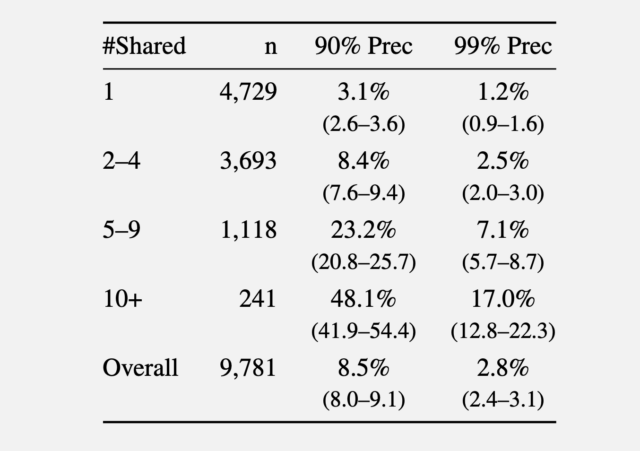
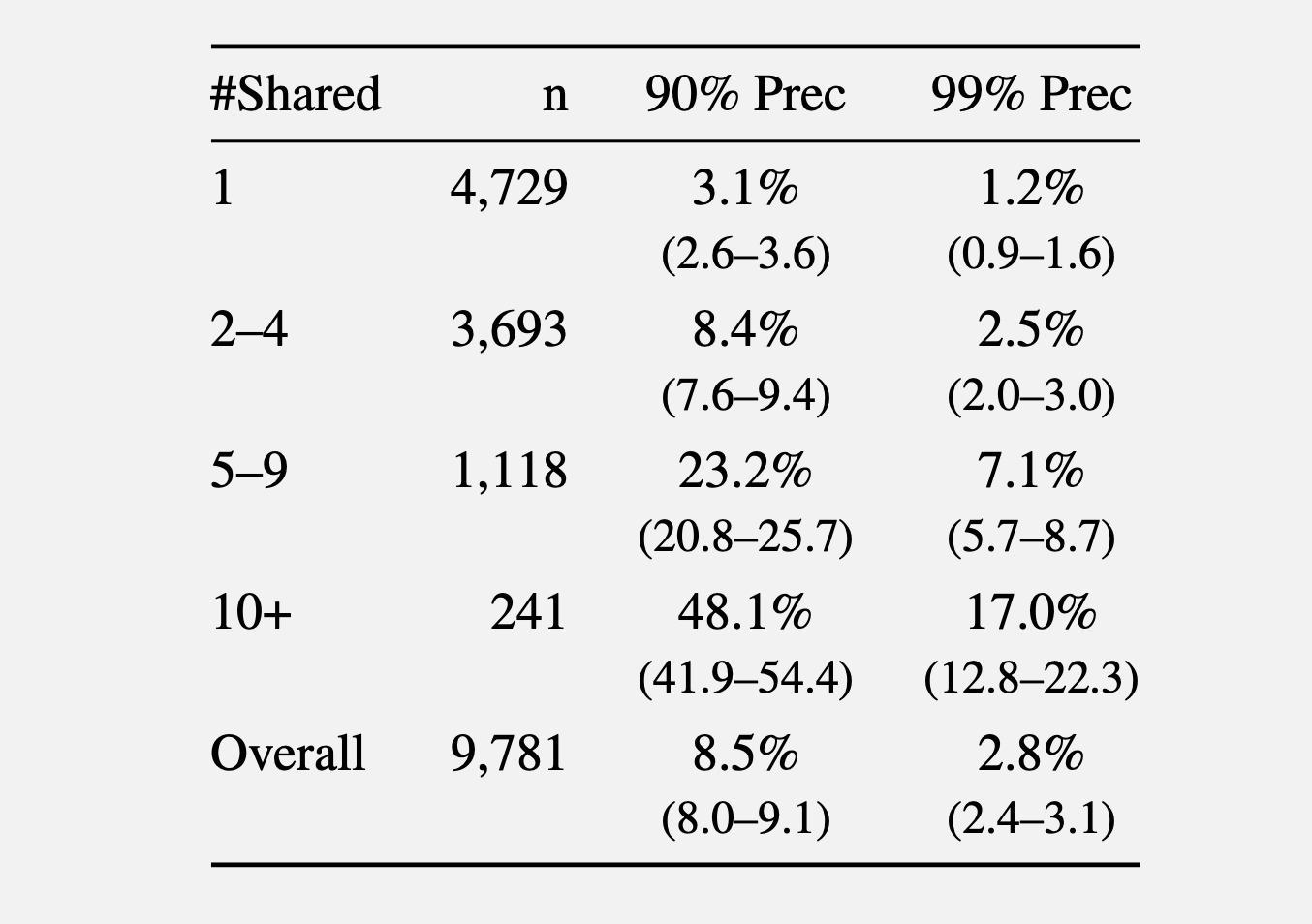
In a third experiment, the researchers took 5,000 users from the Netflix dataset and added another 5,000 “distraction” identities of people not in the results. They then added to the list of 10,000 candidate profiles 5,000 query distractors comprising users who appear only in a query set, with no true match in the candidate pool.

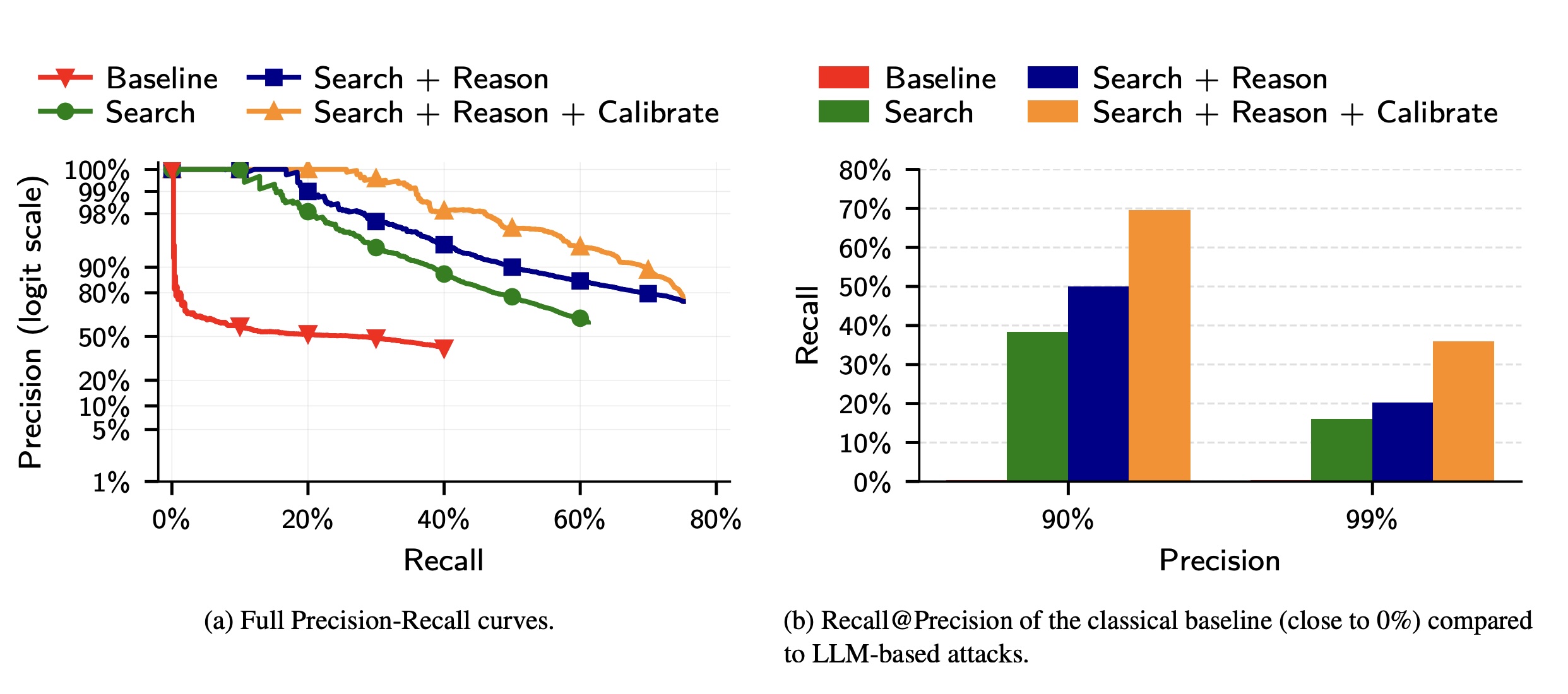
Compared to a classical baseline that mimics the Netflix Prize attack to LLM deanonymization, the latter far outperformed the former.

Advertisement


Screenshot

Advertisement

The researchers wrote:

(a) The precision of classical attacks drops very fast, explaining its low recall. In contrast, the precision of LLM-based attacks decays more gracefully as the attacker makes more guesses. (b) The classical attack almost fails completely even at moderately low precision. In contrast, even the simplest LLM attack (Search) achieves non-trivial recall at low precision, and extending it with Reason and Calibrate steps doubles Recall @99% Precision.

The results show that LLMs, while still prone to false positives and other weaknesses, are quickly outstripping more traditional, resource-intensive methods for identifying users online.

The researchers went on to propose mitigations, including platforms enforcing rate limits on API access to user data, detecting automated scraping, and restricting bulk data exports. LLM providers could also monitor for the misuse of their models in deanonymization attacks and build guardrails that make models refuse deanonymization requests.

Of course, another option is for people to dramatically curb their use of social media, or at a minimum, regularly delete posts after a set time threshold.

Advertisement

If LLMs’ success in deanonymizing people improves, the researchers warn, governments could use the techniques to unmask online critics, corporations can assemble customer profiles for “hyper-targeted advertising,” and attackers could build profiles of targets at scale to launch highly personalized social engineering scams.

“Recent advances in LLM capabilities have made it clear that there is an urgent need to rethink various aspects of computer security in the wake of LLM-driven offensive cyber capabilities, the researchers warned. “Our work shows that the same is likely true for privacy as well.”

Source link

Advertisement
Continue Reading
Click to comment

Leave a Reply

Your email address will not be published. Required fields are marked *

Tech

A rewritable hard drive made of DNA? Researchers say it's possible

Published

on


According to Li-Qun Gu, DNA is an extremely compact, stable package of information. Natural DNA strands encode the biological blueprints of all life on Earth but Mizzou researchers are exploring ways to repurpose molecular biology as a digital storage medium.
Read Entire Article
Source link

Continue Reading

Tech

Shareholder lobs lawsuit at Apple execs, claims they engaged in anticompetitive behavior

Published

on

Apple’s leadership is now being accused of knowingly steering the company through years of antitrust risk to maintain App Store dominance.

Older man with short gray hair, glasses, and navy suit sits at a desk, hands clasped, in a bright office with window blinds and potted plants in the background
Apple executives sued in shareholder derivative suit

In late February, one of Apple’s shareholders filed a derivative lawsuit against the Cupertino-based tech giant’s top executives. The suit says directors and top executives — including Tim Cook — had breached their fiduciary duties to Apple.
According to Bloomberg Law, it alleges that the parties in question allowed and furthered “monopolistic conduct” for longer than a decade. The case has been brought by a retirement fund.
Continue Reading on AppleInsider | Discuss on our Forums

Source link

Continue Reading

Tech

Ron Wyden Is Begging His Colleagues To Stop Trying To Hand Trump A Censorship Weapon

Published

on

from the how-many-times-are-we-going-to-do-this? dept

We’ve been writing about Section 230 for a very long time. We’ve written about why it matters, why the people attacking it are wrong, and why most of the proposed “reforms” would make the internet dramatically worse for everyone except the already powerful. And for just about as long as we’ve been doing that, Senator Ron Wyden—who co-authored Section 230 three decades ago—has been doing the same thing, often as a lonely voice in a Senate full of colleagues who either don’t understand the law or are actively trying to destroy it.

The Communications Decency Act just turned 30, and Wyden marked the occasion with an op-ed in MSNow that lays out, clearly and forcefully, why Section 230 matters more right now than it has in years. And the piece is a must-read, because it highlights something that should be blindingly obvious to Democrats in Congress but apparently remains invisible to far too many of them: gutting Section 230 while Donald Trump is president would be handing him the pen to rewrite the rules of online speech.

As President Donald Trump and his administration wage war against free speech, it is vital that Americans have a free and open internet where they can criticize the government, share personal health information and simply live their lives without government censorship and repression. For those of us who value the ability for regular people to speak and be heard online, preserving Section 230 is one of the most consequential ways to prevent Trump and the cabal of MAGA billionaires from controlling everything Americans see and read.

You’d think this would be uncontroversial among Democrats. You’d think that watching the Trump administration wage open war on free expression—retaliating against media companies, threatening platforms, unleashing threats from federal agencies on critics—would make it crystal clear that now is not the time to blow up the legal framework that protects people’s ability to speak freely online.

And yet…

Advertisement

Senator Dick Durbin, a Democrat, is still co-sponsoring legislation with Lindsey Graham to repeal Section 230 entirely within two years. This is beyond absurd. A senior Democratic senator is actively working to hand this administration the ability to reshape online speech liability from scratch.

In what universe does that end well?

If you need a refresher on what these senators are proposing to gut, Wyden lays it out plainly:

Section 230 is a simple law: In effect, it says the person who creates a post is the one responsible for it. Without it, goodbye retweets and reskeets, Reddit mods, Wikipedia editors and the people curating feeds on Bluesky. The ability to rapidly reshare information online is only possible because of the law.

That’s it. That’s what they want to hand Trump the power to rewrite.

Advertisement

And it gets worse.

Wyden highlights a category of proposal that perfectly encapsulates why building government censorship tools “for the right reasons” always backfires:

Other proposals include repealing Section 230 for posts the Health and Human Services secretary decides are medical misinformation. This was introduced in 2021 in response to the proliferation of COVID-19 misinformation, but today it would essentially give HHS Secretary Robert F. Kennedy the power to silence critics of his anti-vaccine agenda.

You might recall this one if you’re a regular Techdirt reader. Introduced by Democratic Senators Amy Klobuchar and Ben Ray Lujan, we called out how dangerous (and unconstitutional) it was back in 2021, and then reminded Senators Klobuchar and Lujan of this when RFK Jr. was first nominated to head HHS.

As Wyden notes, a bill written and supported by Democrats, designed to combat COVID misinformation by “reforming” Section 230, if it were law, would now hand Robert F. Kennedy Jr.—the most prominent anti-vaccine activist in American public life—the authority to define what constitutes medical “misinformation” online.

Advertisement

The person who has spent decades spreading conspiracy theories about vaccines would get to decide which health speech is acceptable on the internet. This is exactly the kind of scenario that people like us (and Wyden) have been warning about for years: the regulatory environment you create to fight the speech you don’t like today will be wielded by the people you trust least tomorrow.

Democrats like Durbin, Klobuchar, and Blumenthal spent years convinced that weakening Section 230 would force Big Tech to clean up its act. The counterargument—made by Wyden, by us, by basically everyone who actually read the law—was always the same: any power you create to shape online speech rules will eventually be used by people whose priorities look nothing like yours. That day has arrived. Those same Democrats are somehow still pushing the same bills.

So what would actually happen if they got their way? Nothing good. Wyden points to how Americans have been using platforms to document what’s actually happening with immigration enforcement:

Americans have used WhatsApp, Signal, Bluesky and TikTok to document violent, lawless activities by Immigration Customs Enforcement and Customs and Border Protection across the country. While corporate news organizations like CBS News have buried stories about Trump administration immigration abuses and are increasingly pushing disingenuous “both sides” reporting, regular Americans have helped to change public opinion with their first-hand videos of government-sanctioned violence that have spread across the internet. 

That was possible because of Section 230. Take it away and you would see ICE agents bring bad faith lawsuits against those platforms, perhaps claiming that Meta helped incite anti-ICE protests or defamed them by carrying posts alleging excessive force. To understand what would be possible, just look at how police departments and Big Oil have used civil suits to try and silence their biggest critics.

Advertisement

This is the part that the “repeal 230” crowd never seems to grapple with. Without Section 230, the platforms hosting that content become legally vulnerable for the content their users post. And the people with the deepest pockets and the most to hide—government agencies, corporations, the powerful—are exactly the ones who would use that vulnerability to silence critics through litigation. We’ve talked about this for years. It wouldn’t be Big Tech that suffers from a 230 repeal. Big Tech can afford armies of lawyers. The people who get crushed are the small platforms, the community forums, the individual users who share and reshare information that the powerful would prefer stayed hidden.

Wyden drives this home with another relevant example:

Or look at the Jeffrey Epstein case. It took dogged journalism by the Miami Herald and activism from Epstein’s victims to keep the story alive. But without Section 230, anyone who merely shared a story or allegation about Epstein and his associates on their social media could be sued by Epstein’s deep-pocketed pals, along with the site that hosted those posts.

He also takes a moment to push back on the persistent myth that Section 230 gives Big Tech blanket immunity to do whatever it wants—a myth that has fueled much of the bipartisan rage against the law:

Critics of Section 230 often misunderstand it. The statute only protects companies when a lawsuit tries to treat a company as the speaker of the post they find offensive or harmful. 

However, courts can and have held companies liable for their own speech and business practices. For example, Amazon has tried and failed to use Section 230 to avoid lawsuits about dangerous batteries it helped sell. Meta also tried and failed to use Section 230 to dodge responsibility for helping place discriminatory ads. And Big Tech is going to trial, after a California state court found that Section 230 did not protect certain social media design features.

Advertisement

(Wyden’s right that 230 isn’t the blanket immunity its critics claim—though where courts have drawn those lines remains hotly contested, and some of us would argue several of these rulings created more problems than they solved. In fact, the fallout from some of those rulings actually serves to show why Section 230 is so important.)

Either way, none of this should be new information, given how many times it’s been litigated and explained. But apparently it bears repeating every single time this debate comes up, because the same wrong arguments keep getting trotted out by the same people who refuse to read 26 words of statute.

Wyden closes with a warning that should be required reading for every legislator contemplating a 230 “reform” bill:

Opening up Section 230, especially right now, while Trump is president, would give him the pen to rewrite online speech rules. Given his administration’s attacks on free speech, I think that would be disastrous.

It says something profoundly depressing about the state of Congress that the guy who wrote the law 30 years ago is still the one who understands it best, and that he has to keep explaining it to colleagues who should know better. Wyden has been right about this from the start. He was right when Republicans attacked Section 230 because they wanted to force platforms to carry their content. He was right when Democrats attacked it because they wanted to force platforms to remove content they didn’t like. And he’s right now, when tearing it down would hand the most speech-hostile administration in modern memory the tools to reshape online expression however it sees fit.

Advertisement

Happy 30th birthday, Section 230. Here’s hoping your co-author can keep his colleagues from smothering you in your sleep.

Filed Under: amy klobuchar, dick durbin, donald trump, intermediary liability, ron wyden, section 230

Source link

Advertisement
Continue Reading

Tech

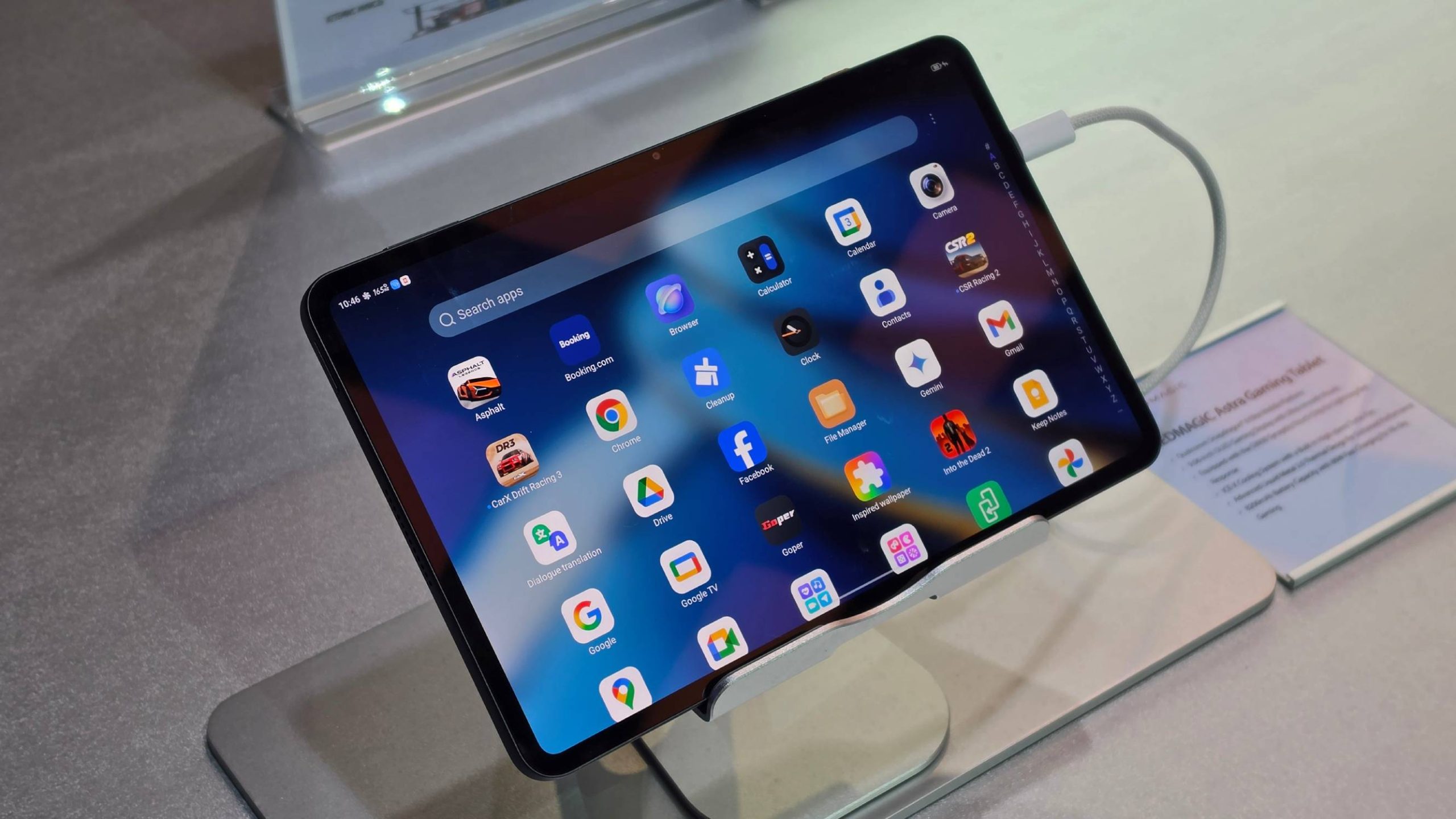
Forget the Nintendo Switch 2, MWC 2026 is full of brilliant mobile gaming devices, including the Red Magic Astra

Published

on

It’s getting harder to deny the fact that gaming tablets are on the rise. These aren’t the best tablets ever, but they offer lots of processing power in a portable form, without all the bells and whistles of a standard slate. Think a gaming phone, but bigger. And I’ve just found a new love.

I’m on the ground at MWC 2026, a mobile tech conference which has seen a few gaming gadgets exhibited. I’ve seen the pint-sized Lenovo Legion Tab (Gen 5), and Nubia Neo 5 GT gaming phone, and both seemed great. I’ve also seen plenty of other powerful devices like the Xiaomi 17 Ultra, Samsung Galaxy S26 Ultra and the understated Honor Magic 8 Pro. But what’s really drawn my eyes is the Red Magic Astra.

Source link

Advertisement
Continue Reading

Tech

What you get from a maxed-out MacBook Pro, MacBook Air, or Mac mini

Published

on

Forget the “starts from” prices, here’s what you could spend on Macs from the Mac mini to the new MacBook Pro — and what you get for your money.

Open laptop on a desk, showing a photo of a backpack pocket holding a small silver device, with a blurred modern room and purple lighting in the background
A Mac mini on an MacBook Air’s screen, and both on a MacBook Pro’s display

With the launch of the new MacBook Pro and MacBook Air, Apple isn’t just presenter user with a choice of models. It’s also, as ever, providing a range of options for each device.
If you’re not to overspend, you need to know what you can be getting — and enough information to decide what exactly that is worth to you.
Continue Reading on AppleInsider | Discuss on our Forums

Source link

Continue Reading

Tech

Apple’s MacBook Pro Rockets Ahead With M5 Pro and M5 Max Supercharged Speed and On-Device Intelligence

Published

on

Apple MacBook Pro M5 Pro M5 Max Reveal
Apple just revealed its latest MacBook Pros, which are powered by the M5 Pro and M5 Max CPUs. Engineers crafted the M5 Pro and M5 Max around a new Fusion Architecture. Separate dies combine into one seamless system-on-a-chip, optimized entirely for AI workloads alongside traditional computing demands.


This beast is powered by an 18-core CPU, with six of its cores being the absolute fastest out there – we’re talking the fastest single cores ever – and the other 12 designed to handle the long haul of multiple threads running at the same time. When it comes to CPU-intensive lift jobs, performance has increased by a solid 30% over previous versions.

Sale


Apple 2025 MacBook Pro Laptop with M5 chip with 10‑core CPU and 10‑core GPU: Built for Apple…
  • SUPERCHARGED BY M5 — The 14-inch MacBook Pro with M5 brings next-generation speed and powerful on-device AI to personal, professional, and creative…
  • HAPPILY EVER FASTER — Along with its faster CPU and unified memory, M5 features a more powerful GPU with a Neural Accelerator built into each core…
  • BUILT FOR APPLE INTELLIGENCE — Apple Intelligence is the personal intelligence system that helps you write, express yourself, and get things done…

The graphics side of things has also seen a significant improvement, with each core now having its own dedicated Neural Accelerator. The M5 Pro has a memory bandwidth of 307GB/s, which doubles to 614GB/s on the M5 Max. The M5 Pro can have up to 64GB of unified memory, while the M5 Max can have up to 128GB. Apple claims up to four times the AI performance of the previous generation and eight times faster overall than the outdated M1-era machines.

Advertisement


Developers will appreciate the improvement, since they can now work with large language model prompts four times faster than on a MacBook Pro with an M4 Pro or Max CPU. They can also generate photographs 8 times faster than the previous M1 Pro and Max sets. Graphics users will be pleased to know that graphics workloads have improved by 50% over the old M4 counterpart. In other tests, 3D rendering in Redshift was 1.4 times faster on the M5 Pro, while video effects in DaVinci Resolve were three times faster on the M5 Max.

Storage performance has been improved significantly, with read and write rates of up to 14.5GB/s, which is twice as fast as previous models. If you require tons of capacity, you’ll be glad to know that base configurations have increased: the M5 Pro starts at 1TB and the M5 Max at 2TB, all without additional expense.

Apple MacBook Pro M5 Pro M5 Max Reveal
The battery life appears to be very respectable, lasting up to 24 hours whether plugged in or on the road. Charging is very speedy, reaching 50% in 30 minutes if you use a 96W or greater charger. The Liquid Retina XDR display still offers 1600 nits of peak HDR and 1000 nits for normal screens, with the option of nano-texture to reduce glare. You have the same 12MP Center Stage camera that allows those on video calls to see you, as well as Desk View, video studio-quality mics, and a six-speaker system with Spatial Audio for a great media experience.

Apple MacBook Pro M5 Pro M5 Max Reveal
Connectivity options include three Thunderbolt 5 ports, HDMI with up to 8K output, an SDXC slot, and, of course, MagSafe 3. The M5 Pro can function with two external high-resolution screens, while the M5 Max can support four. Apple’s N1 wireless processor, which includes Wi-Fi 7 and Bluetooth 6, provides even better, more stable wireless communication.

Apple MacBook Pro M5 Pro M5 Max Reveal
As you might have expected, costs have risen to match the increased power and storage. The 14-inch MacBook Pro with M5 Pro costs $2,199 ($2,049 education pricing), while the 16-inch version starts at $2,699 ($2,499 education). M5 Max models, on the other hand, begin at $3,599 for the 14-inch model and $3,899 for the 16-inch model ($3,299 and $3,599 education, respectively). Both space black and silver finishes are offered. Pre-orders will be accepted starting March 4, with delivery beginning March 11.

Source link

Advertisement
Continue Reading

Tech

Google Chrome shifts to two-week release cycle for increased stability

Published

on

Google Chrome shifts to two-week release cycle for increased stability

Google Chrome will shift from a four-week to a two-week release cycle to roll out new features, bug fixes, and performance improvements more frequently.

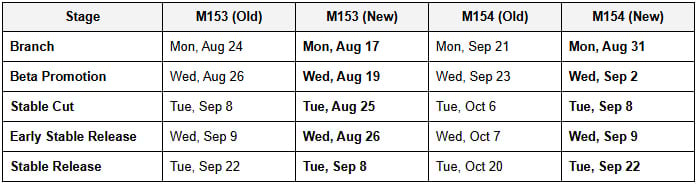
With the release of Chrome 153 on September 8, Google will start shipping two new stable versions of the browser every month, breaking the long-standing schedule developers followed since 2021.

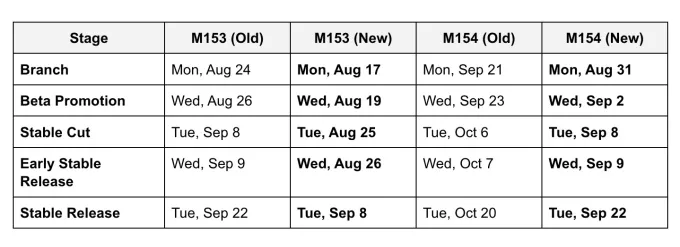
The new model applies to both beta and stable releases across Desktop, Android, and iOS. The new development cycle is reflected in the table below:

Table
Source: Google

However, the Dev and Canary channels for early development and testing will continue on the current schedule. Also, the ‘Extended Stable’ branch will remain on its existing eight-week cycle for enterprise customers who need longer update timelines.

Google says the smaller, more frequent releases will reduce disruption and simplify debugging while maintaining stability due to recent process improvements.

Advertisement

“While releases will be more frequent, their smaller scope minimizes disruption and simplifies post-release debugging,” Google says in a press release.

“And thanks to recent process enhancements, we are confident this shift will maintain our high standards for stability.”

For Chrome users, the impact of this change should not be dramatic, but they can expect to see new feature rollouts more frequently. Chrome updates occur silently in the background, but restart prompts may appear more often now.

Although security fixes will still arrive as part of milestone releases, Chrome will receive weekly security updates according to the current model announced in August 2023.

Advertisement

According to it, Chrome receives security fixes every week to reduce the “patch gap,” shortening the opportunity window for hackers to exploit vulnerabilities in one of the world’s most popular web browsers.

With the latest announcement, Google increases the new release cadence for Chrome, building on the previous change, but with a broader, more structural goal this time.

Chrome had a relatively calm start to the year so far, with only one zero-day vulnerability (CVE-2026-2441) reported as actively exploited in the wild. In 2025, hackers leveraged eight Chrome zero-days in attacks.

Malware is getting smarter. The Red Report 2026 reveals how new threats use math to detect sandboxes and hide in plain sight.

Download our analysis of 1.1 million malicious samples to uncover the top 10 techniques and see if your security stack is blinded.

Advertisement

Source link

Continue Reading

Tech

Amid new competition, Chrome speeds up its release schedule

Published

on

As AI-powered browsers from companies like OpenAI, Perplexity, and others attempt to carve out a space for themselves in a market that’s long been dominated by Chrome, Google says that it’s now speeding up the pace of Chrome releases. Starting this September, Chrome will move from a four-week release schedule to a two-week schedule, the tech giant announced on Tuesday.

Chrome has committed to shipping a new milestone of some sort with each release, in areas like stability, speed, or ease of use. (This is in addition to the weekly security updates that were introduced back in 2023.) As a result, those milestones will now come twice as frequently.

Officially, Google says that the new schedule reflects the ever-changing web platform, and it wants to ensure developers have immediate access to the latest tools and improvements. However, the move comes at a time when Chrome is finally facing what could one day become real competition from AI model providers, who are trying to rebuild the browser for an agentic web, where more tasks are automated on users’ behalf.

ChatGPT Atlas, OpenAI’s web browser, offers its AI assistant built in and is experimenting with various automations. Perplexity’s Comet, meanwhile, includes a sidecar AI assistant for all, and other tools like an email assistant and meeting scheduler for itspaid customers.

Advertisement

In response to the emerging threats, Google has been rapidly rolling out deeper Gemini integrations into Chrome, including its own set of agentic features for autonomous tasks.

Google told TechCrunch this latest move isn’t AI-related, but it’s hard to see how the need to compete at a faster pace isn’t playing a role.

The new release schedule starts with the beta and stable versions (ver. 153) of Chrome on September 8, 2026, and will apply to all platforms, including desktop, Android, and iOS. No changes are being made to other early release platforms, like the Dev and Canary channels.

Image Credits:Google

The Extended Stable release, designed for enterprise admins and Chromium embedders who need more time to manage updates, will continue to be on an eight-week cycle, as before. This option will also still be available to Chromebook users, Google notes.

Source link

Advertisement
Continue Reading

Tech

AI-Generated Art Can’t Be Copyrighted After Supreme Court Declines To Review the Rule

Published

on

The Supreme Court of the United States declined to review a case challenging the U.S. Copyright Office’s stance that AI-generated works lack the required human authorship for copyright protection, leaving lower court rulings intact. The Verge reports: The Monday decision comes after Stephen Thaler, a computer scientist from Missouri, appealed a court’s decision to uphold a ruling that found AI-generated art can’t be copyrighted. In 2019, the U.S. Copyright Office rejected Thaler’s request to copyright an image, called A Recent Entrance to Paradise, on behalf of an algorithm he created. The Copyright Office reviewed the decision in 2022 and determined that the image doesn’t include “human authorship,” disqualifying it from copyright protection.

After Thaler appealed the decision, U.S. District Court Judge Beryl A. Howell ruled in 2023 that “human authorship is a bedrock requirement of copyright.” That ruling was later upheld in 2025 by a federal appeals court in Washington, DC. As reported by Reuters, Thaler asked the Supreme Court to review the ruling in October 2025, arguing it “created a chilling effect on anyone else considering using AI creatively.” The U.S. federal circuit court also determined that AI systems can’t patent inventions because they aren’t human, which the U.S. Patent Office reaffirmed in 2024 with new guidance. The UK Supreme Court made a similar determination.

Source link

Continue Reading

Tech

Optimizing a Battery Electric Vehicle Thermal Management System

Published

on

Optimizing a Battery Electric Vehicle Thermal Management System

This webinar looks at a Battery Electric Virtual Vehicle Model of a mid-size BEV, and uses Simulink and Simscape to facilitate design exploration, component refinement, and system-level optimization. The virtual vehicle comprises five subsystems: Electric powertrain, driveline, refrigerant cycle, coolant cycle, and passenger cabin. The model will be tested using different drive cycles, cooling, and heating scenarios.  The results will be analyzed to determine the impact of the different design parameters on vehicle consumption.

The resulting virtual vehicle will be used to:

  • Test different drive cycles and environmental conditions
  • Perform sensitivity analysis
  • Optimize model to improve thermal performance and consumption

Click ‘Watch Now’ to explore this webinar.

Source link

Continue Reading

Trending

Copyright © 2025