
Tech
Ron Wyden Is Begging His Colleagues To Stop Trying To Hand Trump A Censorship Weapon


from the how-many-times-are-we-going-to-do-this? dept
We’ve been writing about Section 230 for a very long time. We’ve written about why it matters, why the people attacking it are wrong, and why most of the proposed “reforms” would make the internet dramatically worse for everyone except the already powerful. And for just about as long as we’ve been doing that, Senator Ron Wyden—who co-authored Section 230 three decades ago—has been doing the same thing, often as a lonely voice in a Senate full of colleagues who either don’t understand the law or are actively trying to destroy it.
The Communications Decency Act just turned 30, and Wyden marked the occasion with an op-ed in MSNow that lays out, clearly and forcefully, why Section 230 matters more right now than it has in years. And the piece is a must-read, because it highlights something that should be blindingly obvious to Democrats in Congress but apparently remains invisible to far too many of them: gutting Section 230 while Donald Trump is president would be handing him the pen to rewrite the rules of online speech.
As President Donald Trump and his administration wage war against free speech, it is vital that Americans have a free and open internet where they can criticize the government, share personal health information and simply live their lives without government censorship and repression. For those of us who value the ability for regular people to speak and be heard online, preserving Section 230 is one of the most consequential ways to prevent Trump and the cabal of MAGA billionaires from controlling everything Americans see and read.
You’d think this would be uncontroversial among Democrats. You’d think that watching the Trump administration wage open war on free expression—retaliating against media companies, threatening platforms, unleashing threats from federal agencies on critics—would make it crystal clear that now is not the time to blow up the legal framework that protects people’s ability to speak freely online.
And yet…
Senator Dick Durbin, a Democrat, is still co-sponsoring legislation with Lindsey Graham to repeal Section 230 entirely within two years. This is beyond absurd. A senior Democratic senator is actively working to hand this administration the ability to reshape online speech liability from scratch.
In what universe does that end well?
If you need a refresher on what these senators are proposing to gut, Wyden lays it out plainly:
Section 230 is a simple law: In effect, it says the person who creates a post is the one responsible for it. Without it, goodbye retweets and reskeets, Reddit mods, Wikipedia editors and the people curating feeds on Bluesky. The ability to rapidly reshare information online is only possible because of the law.
That’s it. That’s what they want to hand Trump the power to rewrite.
And it gets worse.
Wyden highlights a category of proposal that perfectly encapsulates why building government censorship tools “for the right reasons” always backfires:
Other proposals include repealing Section 230 for posts the Health and Human Services secretary decides are medical misinformation. This was introduced in 2021 in response to the proliferation of COVID-19 misinformation, but today it would essentially give HHS Secretary Robert F. Kennedy the power to silence critics of his anti-vaccine agenda.
You might recall this one if you’re a regular Techdirt reader. Introduced by Democratic Senators Amy Klobuchar and Ben Ray Lujan, we called out how dangerous (and unconstitutional) it was back in 2021, and then reminded Senators Klobuchar and Lujan of this when RFK Jr. was first nominated to head HHS.
As Wyden notes, a bill written and supported by Democrats, designed to combat COVID misinformation by “reforming” Section 230, if it were law, would now hand Robert F. Kennedy Jr.—the most prominent anti-vaccine activist in American public life—the authority to define what constitutes medical “misinformation” online.
The person who has spent decades spreading conspiracy theories about vaccines would get to decide which health speech is acceptable on the internet. This is exactly the kind of scenario that people like us (and Wyden) have been warning about for years: the regulatory environment you create to fight the speech you don’t like today will be wielded by the people you trust least tomorrow.
Democrats like Durbin, Klobuchar, and Blumenthal spent years convinced that weakening Section 230 would force Big Tech to clean up its act. The counterargument—made by Wyden, by us, by basically everyone who actually read the law—was always the same: any power you create to shape online speech rules will eventually be used by people whose priorities look nothing like yours. That day has arrived. Those same Democrats are somehow still pushing the same bills.
So what would actually happen if they got their way? Nothing good. Wyden points to how Americans have been using platforms to document what’s actually happening with immigration enforcement:
Americans have used WhatsApp, Signal, Bluesky and TikTok to document violent, lawless activities by Immigration Customs Enforcement and Customs and Border Protection across the country. While corporate news organizations like CBS News have buried stories about Trump administration immigration abuses and are increasingly pushing disingenuous “both sides” reporting, regular Americans have helped to change public opinion with their first-hand videos of government-sanctioned violence that have spread across the internet.
That was possible because of Section 230. Take it away and you would see ICE agents bring bad faith lawsuits against those platforms, perhaps claiming that Meta helped incite anti-ICE protests or defamed them by carrying posts alleging excessive force. To understand what would be possible, just look at how police departments and Big Oil have used civil suits to try and silence their biggest critics.
This is the part that the “repeal 230” crowd never seems to grapple with. Without Section 230, the platforms hosting that content become legally vulnerable for the content their users post. And the people with the deepest pockets and the most to hide—government agencies, corporations, the powerful—are exactly the ones who would use that vulnerability to silence critics through litigation. We’ve talked about this for years. It wouldn’t be Big Tech that suffers from a 230 repeal. Big Tech can afford armies of lawyers. The people who get crushed are the small platforms, the community forums, the individual users who share and reshare information that the powerful would prefer stayed hidden.
Wyden drives this home with another relevant example:
Or look at the Jeffrey Epstein case. It took dogged journalism by the Miami Herald and activism from Epstein’s victims to keep the story alive. But without Section 230, anyone who merely shared a story or allegation about Epstein and his associates on their social media could be sued by Epstein’s deep-pocketed pals, along with the site that hosted those posts.
He also takes a moment to push back on the persistent myth that Section 230 gives Big Tech blanket immunity to do whatever it wants—a myth that has fueled much of the bipartisan rage against the law:
Critics of Section 230 often misunderstand it. The statute only protects companies when a lawsuit tries to treat a company as the speaker of the post they find offensive or harmful.
However, courts can and have held companies liable for their own speech and business practices. For example, Amazon has tried and failed to use Section 230 to avoid lawsuits about dangerous batteries it helped sell. Meta also tried and failed to use Section 230 to dodge responsibility for helping place discriminatory ads. And Big Tech is going to trial, after a California state court found that Section 230 did not protect certain social media design features.
(Wyden’s right that 230 isn’t the blanket immunity its critics claim—though where courts have drawn those lines remains hotly contested, and some of us would argue several of these rulings created more problems than they solved. In fact, the fallout from some of those rulings actually serves to show why Section 230 is so important.)
Either way, none of this should be new information, given how many times it’s been litigated and explained. But apparently it bears repeating every single time this debate comes up, because the same wrong arguments keep getting trotted out by the same people who refuse to read 26 words of statute.
Wyden closes with a warning that should be required reading for every legislator contemplating a 230 “reform” bill:
Opening up Section 230, especially right now, while Trump is president, would give him the pen to rewrite online speech rules. Given his administration’s attacks on free speech, I think that would be disastrous.
It says something profoundly depressing about the state of Congress that the guy who wrote the law 30 years ago is still the one who understands it best, and that he has to keep explaining it to colleagues who should know better. Wyden has been right about this from the start. He was right when Republicans attacked Section 230 because they wanted to force platforms to carry their content. He was right when Democrats attacked it because they wanted to force platforms to remove content they didn’t like. And he’s right now, when tearing it down would hand the most speech-hostile administration in modern memory the tools to reshape online expression however it sees fit.
Happy 30th birthday, Section 230. Here’s hoping your co-author can keep his colleagues from smothering you in your sleep.
Filed Under: amy klobuchar, dick durbin, donald trump, intermediary liability, ron wyden, section 230



The photorealistic digital character is trained on Zuckerberg’s mannerisms, tone, and his own thinking on company strategy. He is personally involved in testing it. The effort, described by four people familiar with the matter, is separate from a ‘CEO agent’ that handles tasks for Zuckerberg directly.
Meta is building a photorealistic, AI-powered version of Mark Zuckerberg that can interact with employees in his place, the Financial Times reported on Monday, citing four people familiar with the matter.
The character is being developed by Meta’s Superintelligence Labs and is trained on Zuckerberg’s mannerisms, tone, and publicly available statements, as well as his own thinking on company strategy, so that employees, in the words of one person familiar with the project, ‘might feel more connected to the founder through interactions with it.’ Z
uckerberg is personally involved in training and testing the animated version of himself.
The effort is at an early stage and is separate from a different project, first reported by the Wall Street Journal, in which Meta is building a ‘CEO agent’ designed to help Zuckerberg himself retrieve information faster, a tool that assists him rather than stands in for him.
The AI character project is part of a broader push within Meta’s Superintelligence Labs to develop lifelike, AI-driven digital figures capable of real-time conversation. The technical challenge is substantial: achieving realism and preventing perceptible delays in conversation requires enormous computing power.
The project reflects a significant escalation of Zuckerberg’s own involvement in Meta’s AI work. According to people familiar with the matter, he has been spending five to ten hours a week writing code on various AI projects and attending technical engineering review sessions, an unusual level of hands-on engagement for a CEO running a $1.6 trillion company.
He has committed publicly to developing what he calls ‘personal superintelligence’ as Meta works to close the gap with OpenAI and Google. On a January earnings call, he said Meta was ‘elevating individual contributors and flattening teams’ through AI-native tooling.
Meta has a history with AI characters. In September 2023 it launched a range of celebrity-based chatbots, among them personas modelled on Snoop Dogg, Tom Brady, Kendall Jenner, and Naomi Osaka, all of whom licensed their likenesses, but these were discontinued in the summer of 2024 after failing to gain meaningful traction.
Meta then opened an AI Studio allowing users and creators to build their own AI characters, but ran into controversy when users began generating sexually explicit personas. Since January, Meta has restricted teenager access to AI characters. Zuckerberg’s interest in the format was reportedly sharpened by the success of AI companion startup Character.AI, particularly with younger users.
Meta is not the only company exploring AI versions of its leadership. Uber CEO Dara Khosrowshahi said during a podcast interview earlier this year that his employees had built an AI clone of him.
But the Zuckerberg project has a different scale and institutional purpose: it is being designed as a mechanism for a $1.6 trillion company’s 79,000 employees to feel a sense of connection to a founder who is, by any measure, difficult to reach.

A multifaceted decahedral black ceramic bezel and sandwich-style three-piece case—a reworking of Bremont’s signature Trip-Tick construction—house a chronometer-rated automatic chronograph movement made by Sellita, with a 62-hour power reserve.
The watch will be a passenger aboard the FLIP rover, due to launch as part of Astrobotic’s Griffin Mission One (Griffin-1), expected to land at the lunar south pole at some point in the second half of this year.
It’s a one-way mission: The rover will remain permanently on the lunar surface, with the watch ticking away as it roams the landscape. FLIP’s objectives include reaching elevated positions on the lunar terrain, gathering data on lunar dust accumulation, testing dust-mitigation coatings, and surviving a two-week lunar night in hibernation (which would be a first for a US rover).
In terms of serious timekeeping data for Bremont, the mission is frankly symbolic. The watch will be positioned vertically in a specially designed housing within the FLIP’s chassis, between its front wheels. Only the watch head, weighing 107 grams, is included, glued in place using a specialist composite, its face visible to FLIP’s HD cameras. But the hibernatory periods will mean the watch (whose mechanical movement is driven in normal circumstances by the motion of the wearer’s arm) will stop running once its 62-hour power reserve runs down.
When the FLIP is on the move again, its motion should—in theory—jolt the mechanism into action once more. Despite the gravitational pull that’s a sixth of the Earth’s, the acceleration, pitches, and tilts of the rover should swing the winding rotor, if with less torque and efficiency than on Earth.
“My guess is that the watch will function from time to time, but for short periods,” Cerrato says. “We will learn along the way. But that’s what is exciting—it projects us into a thinking process that is absolutely out of the box. Just the fact of having it there is inspiring.” However, there is little doubt that Bremont will, just like other brands with any ties to the cosmos, mine its new space connection for all it is worth.
FLIP itself, which weighs just 1,058 pounds and carries a mix of commercial and government payloads, four HD cameras, and a deployable solar array, is fundamentally a technology demonstrator for Flexible Logistics and Exploration (FLEX), Astrolab’s much larger SUV-sized rover destined to support NASA’s Artemis program. The firm developed the FLIP from scratch after NASA’s equivalent vehicle for which the Griffin-1 mission was contracted, the VIPER, was put on pause in 2024. This left Astrobotic seeking a stand-in in short order. Astrolab, which signed the contract within a month of hearing about the opportunity in the fall of 2024, took the FLIP from blank sheet to finished rover in roughly a year.
Its standout feature is its hyper-deformable wheels, minutely structured from silicone, composite, and stainless steel, which create a soft, enlarged contact surface with the terrain. “It’s like if you’re off-roading in a Jeep or Land Rover where you let some air out of the tires to go softer and spread the load over a larger area,” explains Astrolab’s founder, Jaret Matthews. While the moon’s nighttime temperatures of around -200 degrees Celsius (around -328 Fahrenheit) would cause conventional rubber tires to become glass-like and shatter, Astrolab’s solution is intended to keep the rover from sinking into the unconsolidated lunar dust—or regolith—that covers the environment.

The case is white zirconium oxide ceramic with a Ceratanium bezel and back, rated to handle temperature swings from 100 to -100 degrees Celsius (212 to -238 Fahrenheit). Indeed, the whole piece has been shaken to 10 g’s at Vast’s Long Beach facility, exceeding forces astronauts experience during ascent, and came out the other side running just fine. Price is still up in the air.

TAG Heuer Monaco Evergraph (From $25,000)
Watch brands love finding ever more recherché areas to reinvent, and the precise “snick” of a chronograph’s stop/start/reset buttons is the latest micro-battlefield in which R&D teams are duking it out. Last year, Audemars Piguet took the feel of an iPhone button as the inspiration for its Royal Oak RD#5; now TAG Heuer has its own take on push-button ergonomics.
Normally, chronograph buttons involve a cluster of levers, springs, and cams that click into place with varying degrees of precision. TAG Heuer has thrown most of that out with the Calibre TH80-00, five years in development between its TAG Heuer LAB innovation department and movement maker Vaucher Manufacture Fleurier. It replaces the traditional architecture with two flexible bistable components—essentially shape-shifting parts that snap between positions—produced via high-precision LIGA fabrication, a micro-manufacturing technique that includes lithography, electroforming, and molding.
The result? Crisper actuation that, crucially, doesn’t degrade. According to TAG, the 10,000th press feels identical to the first. Paired with TAG’s incredibly high-tech TH-Carbonspring oscillator (magnetism-resistant, 5-Hz, 70-hour reserve, COSC-certified), it’s housed in a reworked 40-mm titanium Monaco with the crown back on the left where Steve McQueen’s 1969 original had it. You get two versions: brushed titanium with blue accents or black Diamond-Like Carbon (DLC) with red. The dial is transparent acrylic, so you can watch the compliant mechanism do its thing.
.jpg)
Vacheron Constantin Overseas Dual Time Cardinal Points (Price on Request)
Vacheron Constantin’s Overseas line, among the most celebrated examples of Switzerland’s dominant “sports-luxe” genre, leans heavily into the sports side with a full-titanium, GMT-treatment across four references. Each dial is color-mapped to a compass point: white for north, brown for south, green for west, blue for east, contrasting with a bright orange, Rolex-style GMT hand for the time zone at home.
The lineage traces to a 2019 prototype built for explorer Cory Richards to wear up Everest—probably the most luxurious timepiece that has been to such places. The 41-mm case, integrated bracelet, and folding clasp are all in titanium with a matte anthracite finish on the bezel and crown. Inside is the in-house Calibre 5110 DT/3, a self-winding GMT with home-time am/pm indicator, local-time date pusher, and 60-hour reserve. Classic sports watch attributes, but here certified with the Geneva Hallmark, the highest official benchmark of fine watchmaking and hand-finishing.
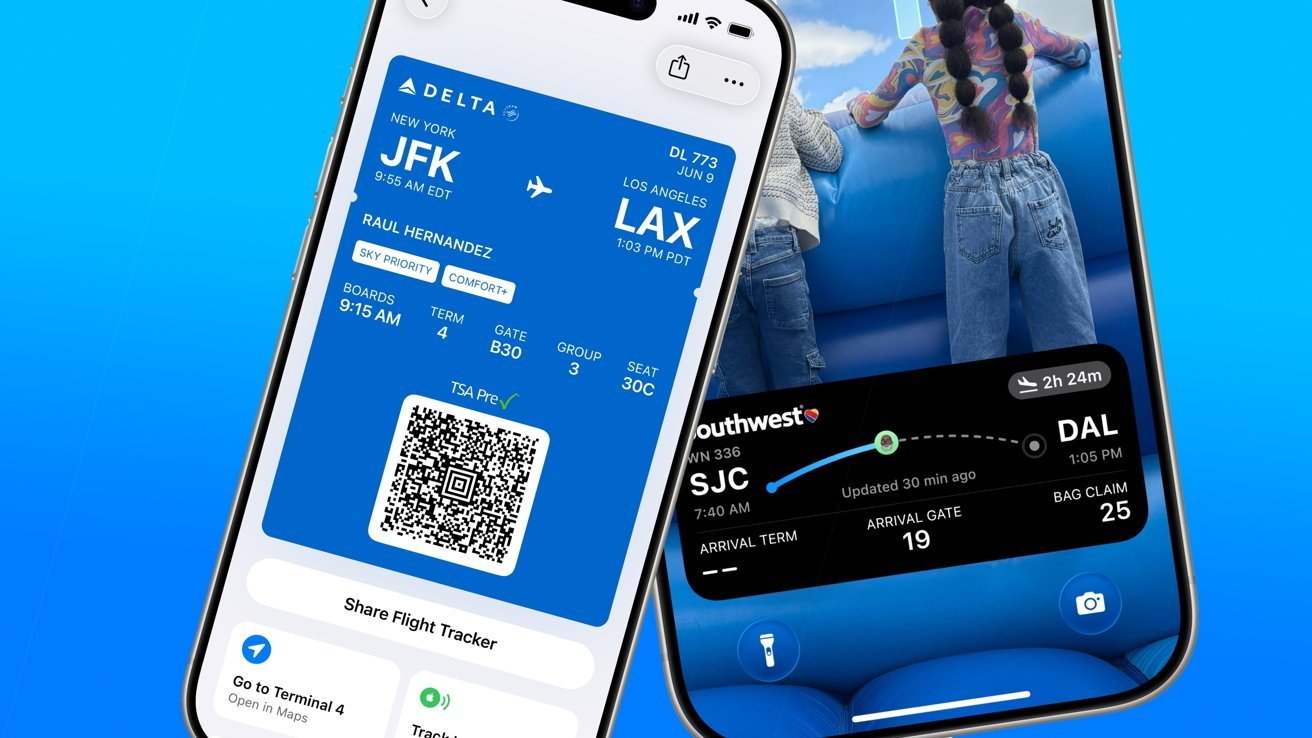
American Airlines has now become the latest company to take advantage of the revamped boarding pass system in the iOS 26 update.

American Airlines now supports the revamped iOS 26 boarding pass system.
At WWDC 2025, Apple revealed that upgraded boarding passes, with support for Live Activities and real-time flight information, would make their way to the Apple Wallet app with iOS 26. Improved support for tracking luggage with AirTags and Find My, along with maps data for airports, was touted as well.
Since then, United Airlines and Southwest Airlines have rolled out support for the iOS 26 boarding pass system, and now American Airlines has followed suit. The American Airlines iOS app was recently updated, and its release notes detail the upgraded boarding pass experience.
Continue Reading on AppleInsider | Discuss on our Forums

from the can’t-pretend-rights-just-don’t-exist dept
More of the same for the Trump administration — one that seems incapable of achieving its goals without breaking the law or disregarding the Constitution.
Hundreds of judges handling thousands of cases have already told the administration it can’t do the things it thinks it can when it comes to satisfying its anti-migrant bloodlust/Stephen Miller’s 3,000-arrests-per-day quota (they’re the same thing!). And, outside of the Fifth Circuit, where the majority seems to believe Trump should get whatever he wants, this steady stream of judicial rejections continues.
Yet another class-action suit alleging the wholesale violation of Constitutional rights has resulted in a ruling siding with the Constitution. This case is one of several being handled by the ACLU. This particular one originates in Nevada, which at least keeps it out of the hands of the Fifth Circuit. (Unfortunately, the administration knows who’s buttering its bread, which is why detainees are often shipped immediately to detention centers in Texas and Louisiana.)
The administration has only a single argument to present in its defense of its unconstitutional mandatory detention activities. It involves selectively quoting two related (yet distinct!) immigration statutes and pretending that 1+1=whatever the fuck we say it does.
One of the most concise explanations of the administration’s deliberate misreading of these statutes was delivered by Judge Dale Ho of the Southern District of New York last year. The government wants to pretend people who encounter immigration agents while crossing the border are indistinct from migrants who have already been in this country for weeks, months, or years. They’re not the same thing, but the administration insists they are, despite having only convinced the Fifth Circuit that the laws don’t actually say the things they say.
Given that detention under § 1225(b)(2) is essentially mandatory and that detention under § 1226(a) is largely discretionary, it follows that whichever statute Mr. Lopez Benitez is subject to is potentially dispositive here. That is, if Mr. Lopez Benitez was detained as a noncitizen “seeking admission” to the country under § 1225(b)(2) (as Respondents argue), his detention would be mandatory. If, instead, he was detained as a noncitizen “already in the country” under § 1226(a), then his detention is discretionary and he would be, at a minimum, entitled to an appeal before an immigration judge.
To be sure, the line between when a person is “seeking admission” as opposed to being “already in the country” is not necessarily obvious. For instance, someone who has just crossed the border may technically be “in” the country but is still treated as “an alien seeking initial entry.” Thuraissigiam, 591 U.S. at 114, 139 (holding that a noncitizen detained “within 25 yards of the border” is treated as if stopped at the border). But there is no dispute that the provisions at issue here are mutually exclusive—a noncitizen cannot be subject to both mandatory detention under 1225 and discretionary detention under § 1226, a point that Respondents conceded.
These are not the same thing. Section 1226 deals with people already in the country, who are given Constitutional protections. Section 1225 deals with people crossing the border who are met immediately by immigration agents, who don’t have access to the same due process rights.
As the court points out in this case, the language of the statutes makes it clear Section 1225 is “temporally and geographically limited to the border” by other language contained in the Immigration and Nationality Act (INA). The government, however, wants to pretend it’s indistinct from Section 1226, which deals with people who are already in the country and have been there for a significant amount of time.
The only way the government can present its defense of indefinite detention of migrants without bond hearings is to twist the wording of both statutes. The Nevada court [PDF] isn’t going to let that happen. It calls out Trump’s DOJ for its cut-and-paste antics.
The government contends that the plain language of § 1225(b)(2) requires DHS to detain all noncitizens like Plaintiffs, who are present in the U.S. without admission or parole and subject to removal proceedings, regardless of how long they have been in the country or how far from the border they are apprehended. But this Court finds that the government reads § 1225(b)(2 (A) as a fragment of statutory text in isolation.
Context matters. The government knows this, which is why its arguments remove the parts of the law it wants to use from the context that indicates its actions are illegal.
The Court finds the government’s reading of the statutory text inapposite for severalreasons. First, the government distorts the statutory text, including terms of art specially defined by Congress. Second, the government isolates and abstracts the phrases it favors in § 1225(b)(2)(A) from their context within § 1225 and the statutory scheme, while rendering language it finds inconvenient within § 1225(b)(2)(A) both contrary to ordinary meaning and needless surplusage. Finally, the government’s interpretation unnecessarily renders provisions of § 1226(c) superfluous in all but the rarest cases, unjustifiably construes Congress’ addition of § 1226(c)(1)(E) through the 2025 Laken Riley Act to be utterly ineffectual, and creates unnecessary tension between the relevant provisions, §§ 1225 and 1226.
This is what it looks like when you know you can’t win on the merits. This is the government pretending the law says what it wants it to say and hoping to slip it past a judge and under the skirts of Lady Liberty.
Courts aren’t as dumb as the Trump administration hopes. Let’s look at the statutes, the court says, but the whole thing rather than just the things the government thinks might be usable.
The Court cannot accept such a fraught interpretation when a reading devoid of such conflict, which gives each statutory phrase and section independent meaning and force, is far more plausible.
What follows is a few dozen pages making everything summarized above granular and specific. And if Trump doesn’t like it, he can always ask the legislators he treats as extraneous to rewrite the law in his favor. Take it up with Congress if you don’t like the way the law is actually written, the court says without actually saying it:
[E]ven with regards to removal proceedings as opposed to custody determinations, Congress explicitly reflected its understanding of longstanding due process precedent that recognizes the more substantial due process rights of noncitizens already present and residing in the U.S. compared to the minimal rights of noncitizens seeking to enter.
Even a Congress loaded with MAGA bitchboys isn’t going to be able to erase Constitutional protections for migrants no one really seemed to have a problem with until white Christian nationalists took over the West Wing (on two non-consecutive occasions). The current Congress is merely an afterthought in service to Federalist Society theories of unitary executive power — something that surely won’t come back to haunt them when America decides it’s time to hand the reins to the opposition party.
And that’s not all of the bad news for Trump and his enablers. The due process thing is already a known issue and one that has resulted in hundreds of losses for the administration’s lawyers. This court also points out the Fourth Amendment implications of its actions. While this doesn’t necessarily create the sort of precedent that would shut down the DHS’s extremely creative interpretation of the Constitution, it will provide plenty of citation pull-quotes for litigants challenging ICE’s warrantless arrests and home entries.
[N]o administrative warrant requirements exist in the text of § 1225(b)(2)(A) or its implementing regulations. The government’s interpretation of that provision as geographically unlimited is thus in tension with the application of the Fourth Amendment within the country’s interior, which “requires that immigration stops must be based on reasonable suspicion of illegal presence, stops must be brief, arrests must be based on probable cause, and officers must not employ excessive force.”
I’m sure this quotation of Justice Kavanaugh’s concurrence in Trump v. Illinois is deliberate. The guy behind “Kavanaugh stops” (TL;DR: looking foreign is probable cause when it comes to immigration enforcement) is being directly quoted to reject the government’s reliance on administrative warrants to bypass the Constitution. [Chef’s kiss gesture.]
Great stuff. But, as always, tempered by the realization that this administration will not stop doing illegal things just because a court has directly told them these actions are illegal. The old equation — asking forgiveness > asking permission — doesn’t really apply. This administration will do neither. It will simply DO until it becomes impossible to continue.
Don’t let that discourage you, though. Even if the co-equal branches don’t seem to be living up to the “checks and balances” hype, we’re a nation of millions spread across a considerable number of square miles. They can’t take us all at once.
Filed Under: 14th amendment, bigotry, dhs, due process, ice, mass deportation, nevada, trump administration
Companies: aclu
from the oh-no dept
With all that RFK Jr. has done, and failed to do, as the Secretary of HHS, he should be terribly busy cleaning up mess after mess. The measles outbreak that is going to cause America to lose its elimination status is still ongoing and on pace to quadruple last year’s case total, so he could work on that. He could be busy finding a CDC Director, a position left vacant well beyond the federally mandated limit of 210 days. Or a Surgeon General. Or he could be working to undo the harms and effects of the misinformation that he and Trump have been pumping into the media ecosystem.
But it seems that, despite reporting that the White House wants to rein him in so he doesn’t get the GOP murdered in the midterms, Kennedy has instead decided its time to make history as the first sitting cabinet secretary to host his very own podcast.
The show, titled “The Secretary Kennedy Podcast,” will launch next week and feature Kennedy, a longtime anti-vaccine crusader who has reshaped the country’s health policy, in conversation with doctors, scientists and agency staff, U.S. Department of Health and Human Services officials told the AP ahead of the launch. In the teaser video, in a slick HHS-branded studio with ominous music playing in the background, Kennedy bills it as a new way to expose corruption and lies that have made Americans sick.
“We’re going to name the names of the forces that obstruct the paths to public health,” Kennedy says in the nearly 90-second clip.
We all know where this is going. Before entering into government, Kennedy hosted his own podcast previously. It covered such sane topics as:
- Google and Mind Control
- Vaccines During Pregnancy (featuring anti-vaxxer Lyn Redwood)
- EMR, Cell Phones, & Cancer
- IRS: Pro-Pharma Anti-Health
- Censorship & Twitter Files with Matt Taibbi
So, you know, a conspiracy theory podcast, featuring all of Kennedy’s favorite topics. Anyone looking at this podcast as a source of information is clinically insane. This is just another megaphone through which to growl his anti-science, anti-medicine conspiratorial views. That he is making history in doing so when he has far better things he could be doing is simply the rotten cherry on top of this shit sundae.
Tyler Burger, HHS digital communications manager and the producer of the new podcast, said while Food and Drug Administration Commissioner Marty Makary has a podcast, officials believe Kennedy’s will be the first to be hosted by a sitting cabinet secretary.
“We’re kind of bringing podcasting into the government as an official form and arm of our messaging,” Burger said. He said the set for the show was pieced together largely with items the agency already had, and has the capacity for a total of four people to sit in conversation together.
While I appreciate Kennedy for giving me what will surely be much, much more about which to write, there is danger in this. You can be sure that Kennedy will not be inviting dissenting viewpoints onto his show. Anyone coming across it, with the imprimatur of a sitting Secretary as its host, may fall victim to thinking that what is being presented is official federal policy, the viewpoints of real doctors and scientists, or… you know… sane.
It won’t be any of that. I sincerely hope someone in the White House catches wind of this and puts a stop to it. Sadly, I doubt that is forthcoming.
Filed Under: donald trump, podcast, rfk jr.

At CinemaCon in Las Vegas, amid plenty of insider film industry news, Sony announced that it’s making an animated film adaptation of Bloodborne, a cult classic horror action game from the makers of Dark Souls and Elden Ring.
Sony didn’t reveal much about the animated film, keeping plot details under wraps and offering no information about its release date. It’ll will be produced by PlayStation Productions and Seán McLoughlin, better known to the world as the YouTuber JackSepticEye, though Sony didn’t elaborate on the extent of his involvement. McLoughlin has racked up millions of views for his videos playing Bloodborne and other games made by FromSoftware.
The only other hints about the Bloodborne film come from its other named producer, Lyrical Animation, the studio formed last November from adult animation firm Line Mileage. That production company had previously announced a Death Stranding feature film after its lead partners worked on animated series for adults, including Tomb Raider: The Legend of Lara Croft and Castlevania.
Bloodborne, released in 2015 on the PlayStation 4, is a gothic horror game that follows FromSoftware’s formula of high-difficulty action popularized by the Dark Souls series. In Bloodborne, players take on the role of a monster hunter who descends on the cursed city of Yharnum on the night when nightmares roam the streets.
An instant classic upon release for its tough but rewarding gameplay, iconic bosses and mysterious lore, Bloodborne has built a cult following over the years. That legacy has been complicated by the fact that publisher Sony Interactive Entertainment has neither released the game on other platforms nor remastered it. Fans remain hopeful for an update to modern consoles and PC, especially since the original PS4 release was limited to a now-archaic (and inconsistent) 30 frames per second and HD (1080p) resolution.
When I interviewed FromSoftware president Hidetaka Miyazaki — creator of Demon’s Souls, Dark Souls, Bloodborne and Elden Ring — I asked which of the games he worked on was his favorite. He said the first Dark Souls and Bloodborne “left a very big impression on me.”
Sony Pictures and PlayStation Production also announced that the Helldivers film adaptation, directed by Justin Lin (The Fast and the Furious, Star Trek Beyond) and starring Jason Momoa, will be released on Nov. 10, 2027.

Looking for the most recent Mini Crossword answer? Click here for today’s Mini Crossword hints, as well as our daily answers and hints for The New York Times Wordle, Strands, Connections and Connections: Sports Edition puzzles.
Need some help with today’s Mini Crossword? Read on for all the answers. And if you could use some hints and guidance for daily solving, check out our Mini Crossword tips.
If you’re looking for today’s Wordle, Connections, Connections: Sports Edition and Strands answers, you can visit CNET’s NYT puzzle hints page.
Read more: Tips and Tricks for Solving The New York Times Mini Crossword
Let’s get to those Mini Crossword clues and answers.
The completed NYT Mini Crossword puzzle for April 14, 2026.
Mini across clues and answers
1A clue: Word after “lily” or “launch”
Answer: PAD
4A clue: “That criticism makes total sense!”
Answer: FAIR
5A clue: Apology after a 1-/4-Down
Answer: SORRY
6A clue: Two in a double play
Answer: OUTS
7A clue: Sneaky
Answer: SLY
Mini down clues and answers
1D clue: With 4-Down, spilling wine on the carpet or bringing uninvited guests
Answer: PARTY
2D clue: Puts on TV
Answer: AIRS
3D clue: Like summers in a Mediterranean climate
Answer: DRY
4D clue: See 1-Down
Answer: FOUL
5D clue: Castaway’s call for help
Answer: SOS


An internal memo obtained by The Verge shows Xbox’s new CEO, Asha Sharma, acknowledging that Game Pass has grown too expensive. Microsoft is now exploring lower-cost subscription tiers, though no firm timeline has been set.
Read Entire Article
Source link

Blackmagic’s URSA Cine Immersive camera for Apple Vision Pro content can now be ordered, if you have $30,000. Here’s what it can do, and who it’s for.

Blackmagic’s URSA Cine immersive camera is here.
Announced back in June 2024, the high-end camera was presented as an end-to-end workflow for the Apple Immersive Video format used by the Apple Vision Pro. Apple Immersive Video delivers 8K 3D video with a 180-degree field of view, along with support for Spatial Audio.
With the Apple Vision Pro, Apple delivered immersive 3D video experiences, giving wearers the chance to re-live their favorite moments with the help of formats such as Spatial Video. Exclusive content, in a special format called Apple Immersive Video, is also offered on the headset.
Continue Reading on AppleInsider | Discuss on our Forums

“Bitcoin Will Bottom When This Happens” | Ben Cowen

Powerful new play heading to Shotts theatre

Cottesloe strata offices sold for $10m


-

 Politics4 days ago
US brings back mandatory military draft registration
-
 Sports4 days ago
Man United discover Nico Schlotterbeck transfer fee as defender reaches Dortmund agreement
-

 Fashion4 days ago
Weekend Open Thread: Veronica Beard
-

 Tech6 days ago
How Long Can You Drive With Expired Registration? What Florida Law Says
-

 Politics2 days ago
World Cup exit makes Italy enter crisis mode
-

 Politics4 days ago
Malcolm In The Middle OG Turned Down ‘Buckets Of Money’ To Appear In Reboot
-

 Crypto World5 days ago
Canary Capital Files SEC Registration for PEPE ETF
-

 Business3 days ago
Tesla Model Y Tops China Auto Sales in March 2026 With 39,827 Registrations, Beating Cheaper EVs and Gas Cars
-

 Fashion7 days ago
Let’s Discuss: DEI in 2026
-

 Crypto World6 days ago
Bitcoin recovers as US and Iran Agree a Ceasefire Deal
-

 Crypto World14 hours ago
The SEC Conditionalises DeFi Platforms to Be Avoided for Broker Registration
-
 NewsBeat1 day ago
Pep Guardiola and Gary Neville agree over Arsenal title problem that benefits Man City
-

 Business4 days ago
OpenAI Halts Stargate UK Data Centre Project Over Energy Costs and Copyright Row
-

 Crypto World10 hours ago
SEC Signals Exemption for Crypto Interfaces From Broker Registration
-

 Business3 days ago
Ireland Fuel Protests Enter Day 5 as Blockades Spark Shortages and Government Prepares Support Package
-

 Politics4 days ago
LBC Presenter Mocks Trump Over Iran War Failures
-

 Crypto World3 days ago
Federal judge blocks Arizona from bringing criminal charges against Kalshi
-

 Tech4 days ago
A version of Windows 10 released a decade ago is now eligible for additional security patches
-
 NewsBeat2 days ago
JD Vance announces ‘no agreement’ with Iran over nuclear weapons fear
-

 Business3 days ago
IMF retains floor for precautionary balances at SDR 20 billion
You must be logged in to post a comment Login