There is something slightly ridiculous about the gaming-monitor arms race. We now have displays pushing 500Hz, 560Hz, and even 720Hz, with esports gamers understandably chasing every last millisecond. The problem? The faster you go, the more you’re often asked to compromise on resolution.
NVIDIA G-SYNC Pulsar takes a very different approach. I got to see it in action at Gamescom, and after watching NVIDIA switch the technology on and off in front of me, I came away thinking that perhaps the industry has been asking the wrong question.
OLED has instant pixels. Pulsar has a different trick
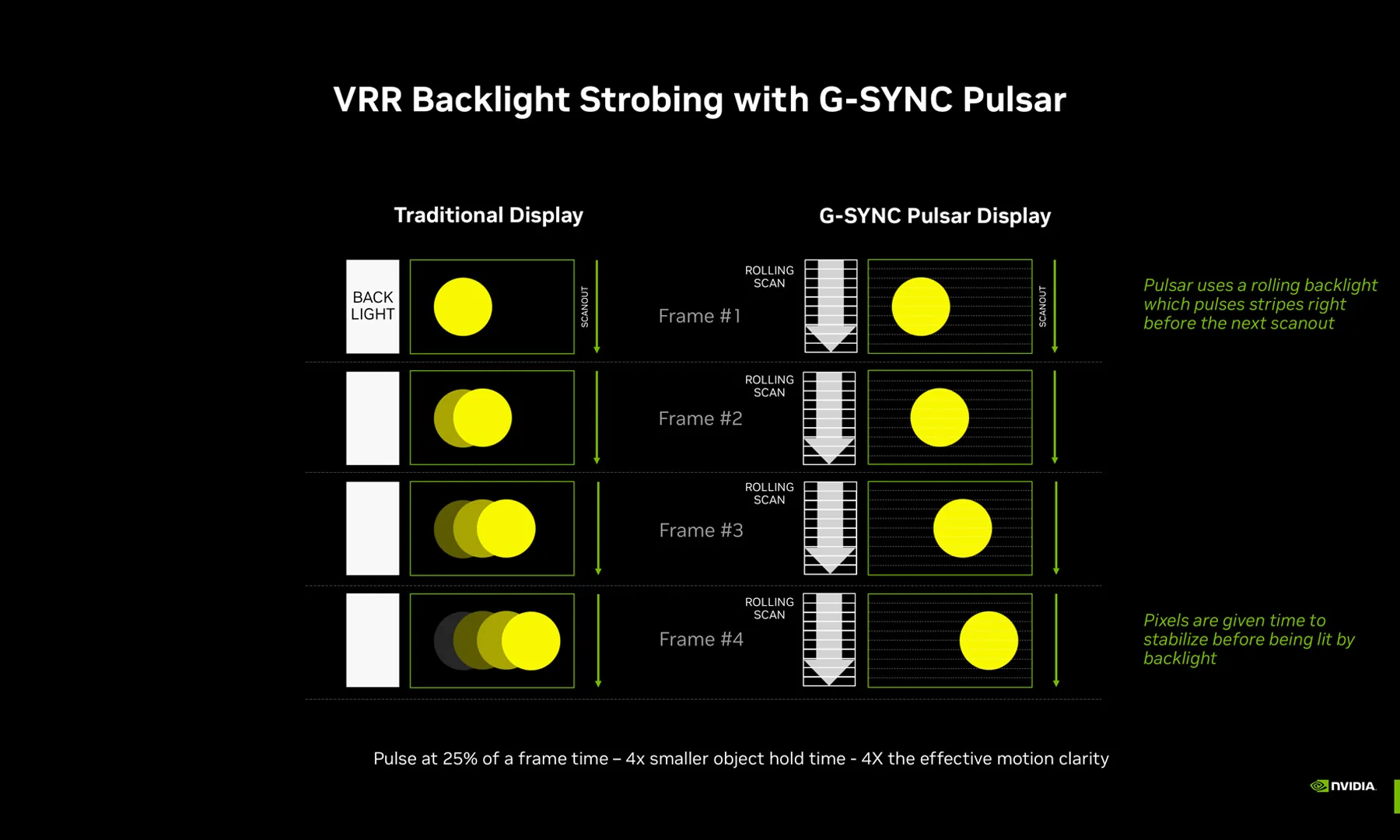
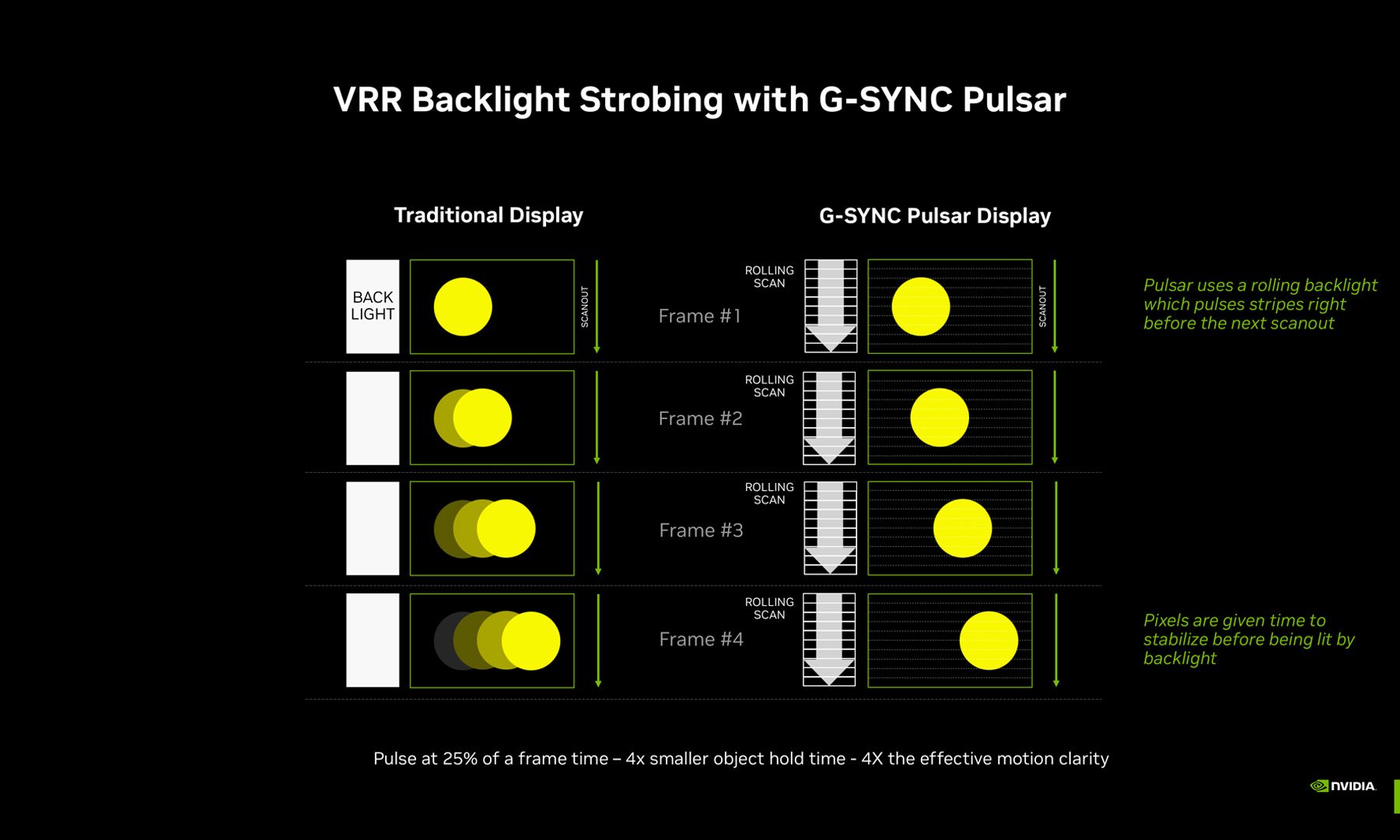
The way Pulsar works is that it uses variable-frequency backlight strobing. The basic idea is that instead of simply leaving the LCD backlight on, NVIDIA synchronises pulses from the backlight with the display’s scanout and variable refresh rate. The company uses multiple backlight zones and compensation pulses to make the process work without introducing distracting flicker.
NVIDIA
That also explains the elephant in the room: OLED doesn’t work with Pulsar in the same way, because OLED pixels don’t have a backlight to strobe. And while OLED has near-instantaneous pixel response, it can still suffer from perceived motion blur because of the sample-and-hold effect: your eyes track a moving object while each frame remains visible, and your visual system interprets that movement as blur. Pulsar attacks that particular problem at the display level.
5K Goodness, now with 240Hz on the side
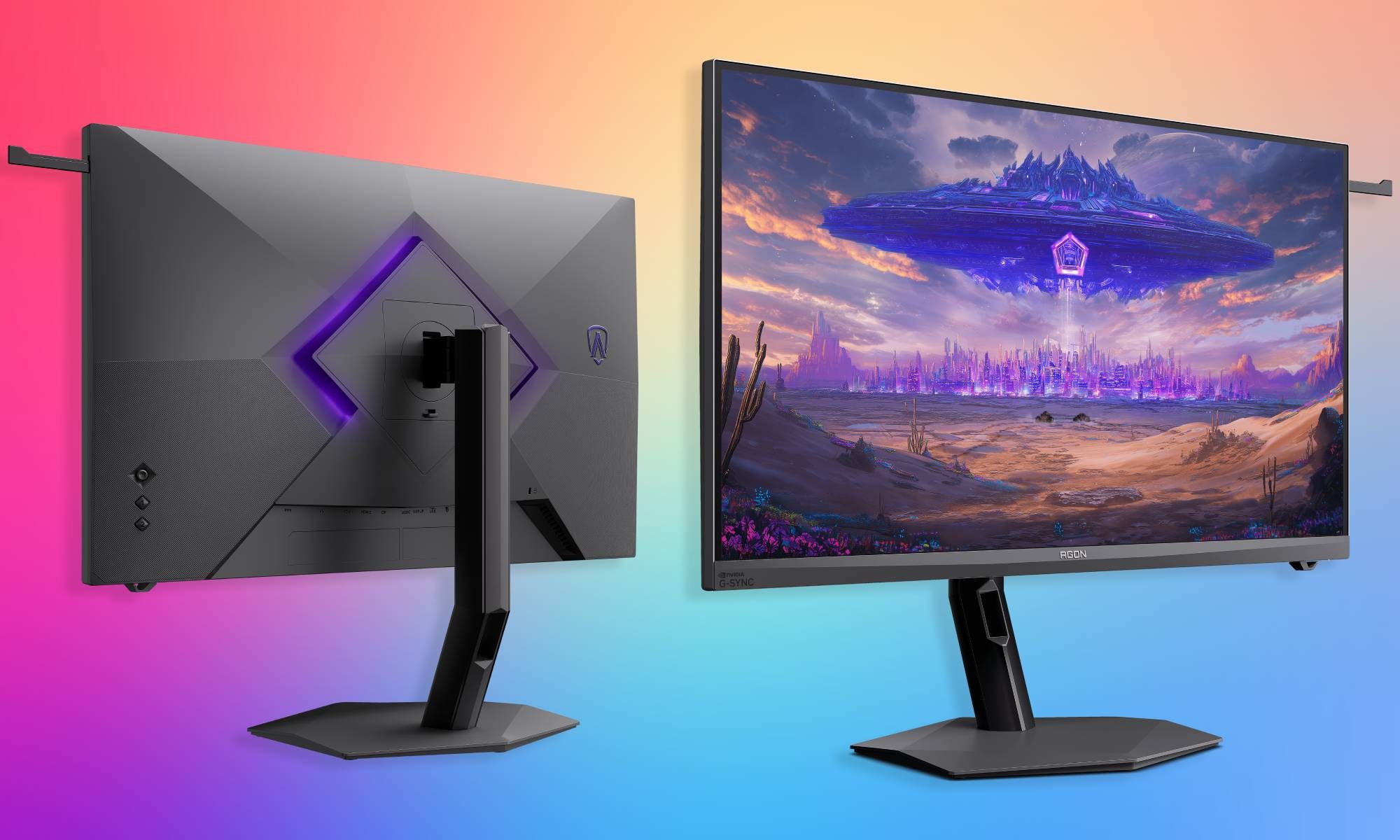
The monitor NVIDIA used for the demonstration was AOC’s AGON AGP327KG, a 31.5-inch 5K IPS display running at 144Hz. It is a surprisingly gorgeous IPS panel, with a glossy finish, impressive brightness, and the sort of pixel density that makes everything look ridiculously crisp. AOC lists its native resolution as 5120×2880, while NVIDIA positions it as the first 5K G-SYNC Pulsar display.
But the clever part is the dual-mode setup. You can run it at 5K and 144Hz, or switch down to 1440p and 240Hz, with Pulsar available in both modes.
G-SYNC Pulsar controls coming soon to the NVIDIA appNVIDIA
That makes considerably more sense than dropping a 4K monitor all the way down to 1080p just to chase a higher refresh rate. At 5K, you get the resolution for immersive games, while 1440p/240Hz gives competitive players a much more realistic target. And yes, getting anywhere near 144fps at native 5K in demanding games is a serious GPU workout; NVIDIA’s representative suggested an RTX 5090 with frame generation for those scenarios.
Then NVIDIA pressed the magic switch
Then came the actual demonstration, and this was the bit that sold me on Pulsar. NVIDIA first showed a simple motion-clarity test. With Pulsar disabled, moving text became difficult to read. Switch it on, and suddenly the same text remained clear enough to make out. The same thing happened in Delta Force: as the camera moved, environmental text and even the structure of a fence remained substantially easier to see.
And that’s where I finally understood the pitch. For games such as Valorant, Apex Legends, or Call of Duty, you’re constantly tracking moving targets while simultaneously moving your own viewpoint. Traditional motion blur settings aren’t exactly beloved by competitive players, so you’re left with the inherent motion-clarity limitations of the display.
The best part is that Pulsar doesn’t require developers to support anything.
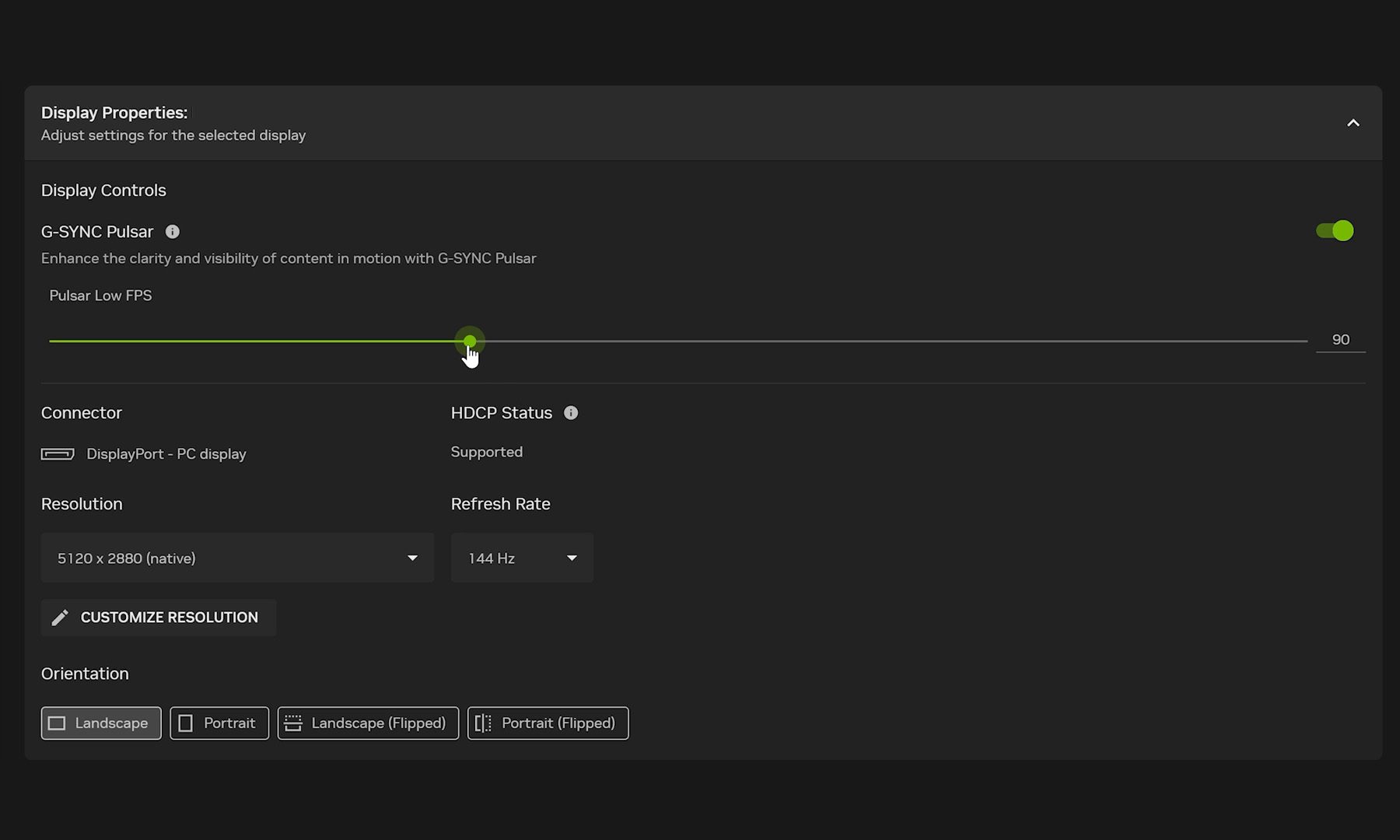
Instead, NVIDIA told me it works independently of the game. There is, however, one caveat: Pulsar needs sufficient frame rate. NVIDIA’s default minimum is 90fps, although the threshold can be lowered to 75fps. Below that point, Pulsar switches off to avoid visible flicker.
Advertisement
Could Mini-LED make Pulsar even more interesting?
This is where I think things could get particularly spicy. Because Pulsar needs a backlight, Mini-LED could theoretically be an interesting future partner for the technology. Mini-LED can give LCDs far better local contrast and HDR performance, although packing in enough zones can make these monitors expensive enough that OLED starts looking like the easier choice.
Alena Darmel / Pexels
But combine Mini-LED’s contrast advantages with Pulsar’s motion-clarity benefits, and LCD suddenly has another compelling reason to exist. That’s entirely theoretical for now, rather than an NVIDIA product announcement, but it could be an interesting way to make the technology genuinely differentiated.
NVIDIA’s smarter answer to the Hz race
What impressed me most about Pulsar is that NVIDIA isn’t simply trying to win the refresh-rate arms race. While everyone else keeps asking how many more frames a monitor can display, NVIDIA is asking how clearly you can actually see those frames while they’re moving. And after seeing 5K at 144Hz remain surprisingly clear during motion, I think that’s a much more interesting question. The AGP327KG proves that Pulsar doesn’t have to be confined to 27-inch 1440p esports monitors.
It can potentially sit alongside high-resolution gaming, giving you detail and motion clarity instead of forcing you to choose one over the other.
That, ultimately, is why G-SYNC Pulsar might be one of NVIDIA’s more interesting display technologies in years. It isn’t making a 144Hz panel secretly become a 500Hz panel. It’s doing something arguably more useful: making those 144 frames easier for your eyes to follow. And after watching the difference appear and disappear with a single toggle at Gamescom, I really want to see what Pulsar feels like in my own Valorant matches.
Get caught up on the latest technology and startup news from the past week. Here are the most popular stories on GeekWire for the week of Sept. 6, 2026.
Nine years after setting out to tackle unsheltered homelessness with rapidly deployable, hard-panel micro-shelters, Everett, Wash.-based social purpose corporation Pallet is closing its business. Read More… Read More
Helion Energy has opened a downtown Seattle office as its headcount hits 800 employees, adding to its five-building Everett headquarters and its Malaga, Wash., site, where the fusion startup is building its Orion generator facility. The company, which has raised more than $1.5 billion, is racing to get Orion operational within two years to meet a contract to supply fusion energy to a Microsoft data center. Read More… Read More
The 43,000-square-foot space at West8 in the Denny Triangle neighborhood will bring together employees across digital products, AV, IT, HR, marketing, and other teams. Read More… Read More
Jacob Colker argues that Seattle has a branding problem, not a lack of talent, ambition or accomplishments. He lays out a five-step plan for the region’s tech community to start telling its own story. Read More… Read More
Amazon has named Kevin Mandia, the founder of breach-investigation firm Mandiant, to its board of directors, adding security expertise a few months after former NSA director Keith Alexander stepped down. Mandia now runs Armadin, a startup that uses AI to run attacks against corporate networks as a way of testing their defenses. Read More… Read More
T-Mobile named Jessica Uhl as CFO-designate, succeeding Peter Osvaldik as CFO come February. Microsoft and Blue Origin saw the departure of vice presidents, while startups AZX and Caddi added leaders, among other tech personnel changes. Read More… Read More
An independent study commissioned by the City of Seattle says the city should protect the big tech employers it has while building a more diverse economy on top of them. The 127-page report also says Seattle’s tax structure is unique among its peers in penalizing the hiring of senior, high-compensation workers. Read More… Read More
It’s the end of an era at Microsoft: Frank X. Shaw, the executive who oversaw the tech giant’s communications for nearly three decades, first at an external agency and for the last 17 years as one of its senior leaders, is leaving at the end of the year. Read More… Read More
Watch Alexander Zverev vs Ben Shelton in the 2026 US Open men’s final as the American takes to Arthur Ashe Stadium in front of his home crowd looking to become the first American man to win a Grand Slam singles title since Andy Roddick at the 2003 US Open.
Zverev, meanwhile, comes into the final on a hot streak, reaching his third consecutive Grand Slam final after winning Roland Garros earlier this year before losing to Jannik Sinner in the Wimbledon final. The top seed made a slow start in New York, needing five sets in each of his opening two rounds, but has since won 13 consecutive sets, including straight-set victories over Botic van de Zandschulp in the quarterfinals and Karen Khachanov in the semis.
Although Zverev arrives as the slight favorite, particularly after beating Shelton in all five of their previous meetings, the American southpaw has arguably been the more impressive player – and faced the tougher path – this fortnight. He took down defending champion Carlos Alcaraz in a five-set quarterfinal that finished at 3:33am, before beating fellow American Frances Tiafoe in the semis to reach his first Grand Slam final.
Advertisement
The best part? We’ve found a sneaky way to watch the final completely FREE, from wherever you are!
The hack: 9Now in Australia is showing the match at no cost!
But what if you’re traveling outside the country? Can you still watch the 2026 US Open men’s final for free – from the US, UK or Canada? Yes, you can! Read on to find out how.
Advertisement
How to watch US Open 2026 Men’s Final for free
The US Open 2026 Men’s Singles Final will be shown live and for free in Australia on Channel 9 and 9Gem TV channels, with a free live stream on 9Now.
Traveling abroad right now? You can use a VPN to watch the US Open 2026 Final for free as if you were right at home.
Advertisement
Use a VPN to watch US Open 2026 Men’s Final free from anywhere
A VPN is handy piece of software that can make your device appear as if it’s back in your home country, so you can unlock your usual service. The best VPN right now? We recommend NordVPN – it does everything and comes with a 75% discount, and three months for free.
Quick start: Using a VPN to watch US Open 2026 Men’s Final for free
Using a VPN is incredibly simple, just follow these steps.
1. Install the VPN of your choice. As we’ve said, NordVPN is our favorite.
Advertisement
2. Choose the location you wish to connect to in the VPN app. For instance if you’re visiting the U.S. and want to view an Aussie streaming service, you’d select a location from Australia (like Perth) from the server list.
3. Sit back and enjoy the action. Head to 9Now and watch the 2026 US Open Men’s Final just like you would at home.
Which devices can I watch US Open 2026 Men’s Final for free with?
You can use 9Now to watch the 2026 US Open Men’s Final on a range of devices:
Advertisement
Amazon Fire TV Android phones and tablets (Android OS 5 and newer) Android TV Apple iPhones and iPads (iOS 12 or later) Apple TV (including Apple TV 4K and Apple TV HD) Chromecast (including Chromecast with Google TV) Chrome (latest two versions) Fetch TV (Gen 3 or newer) Firefox (latest two versions) Foxtel iQ Freeview Hisense TV LG Smart TV (webOS 4 or higher) Mobile apps – download the 9Now app on your phone or tablet (iOS/Android) Mozilla (latest two versions) Roku (including Roku 2, Roku 3, Roku Express, Roku Express+, Roku Premiere, Roku Premiere+, Roku Streaming Stick, Roku Streaming Stick+ and Roku Streambar) Safari (latest two versions)
You may also enjoy…
We test and review VPN services in the context of legal recreational uses. For example: 1. Accessing a service from another country (subject to the terms and conditions of that service). 2. Protecting your online security and strengthening your online privacy when abroad. We do not support or condone the illegal or malicious use of VPN services. Consuming pirated content that is paid-for is neither endorsed nor approved by Future Publishing.
The new Apple Watch Ultra 4 is hailed as the “ultimate sports and adventure watch”, but how does it compare to the Samsung Galaxy Watch Ultra 2?
Considering we concluded the Galaxy Watch Ultra 2 to be a “refined, rugged Android smartwatch”, the Apple Watch Ultra 4 has a lot to live up to.
Although we’re yet to review the Apple Watch Ultra 4, we’ve compared its specs to the Galaxy Watch Ultra 2 below. Read on to see how the two devices compare, and whether you think the Apple Watch Ultra 4 will take the Galaxy Watch Ultra 2’s spot on our best smartwatch list.
The Apple Watch Ultra 4 will set you back $799/£749, and is available to pre-order now ahead of its launch on September 18.
Advertisement
SQUIRREL_PLAYLIST_10208757
In comparison, the Samsung Galaxy Watch Ultra 2 is available to buy now and has a slightly cheaper starting price of £649/$699.
Advertisement
SQUIRREL_PLAYLIST_10208649
Apple Watch Ultra 4 only works with iPhone, while the Galaxy Watch Ultra 2 works best with Samsung
One of the biggest deciding factors between the two will depend on your smartphone, as the Apple Watch Ultra 4 is only compatible with iOS while the Galaxy Watch Ultra 2 can only be paired with Android phones.
However, although the Galaxy Watch Ultra 2 is technically compatible with most phones running Android 10 or later, the device works best when paired with a Samsung Galaxy phone. That means pairing the Galaxy Watch Ultra 2 with a Samsung handset will unlock features like ECG, sleep apnea notifications and blood pressure monitoring.
Apple Watch Ultra 4 promises to offer the most accurate heart rate sensing in a wearable
Apple makes big claims when it comes to the Watch Ultra 4 and Watch Series 12. Thanks to the new Health Sensing System that includes new heart sensors, the Apple Watch Ultra 4 promises to conduct the “most accurate heart rate sensing in a wearable”. The Health Sensing System is fitted with larger LEDs that now measure heart rate every five seconds.
Image Credit (Apple) Image Credit (Trusted Reviews)
Apple has backed this claim by sharing a study conducted on over 1000 participants, which compared the Apple Watch’s new heart rate sensing accuracy against leading wearables. The result saw Apple Watch provide the highest accuracy across devices.
The Samsung Galaxy Watch Ultra 2 also monitors your heart rate, regardless of whether it’s paired with a Samsung or other Android phone. In addition, the Galaxy Watch Ultra 2 also offers a Heart Health Score that combines information like your activity time, sleep, weight and vascular load to provide you with an easy-to-understand result.
Image Credit (Trusted Reviews)
Advertisement
S11 vs Snapdragon Wear Elite
Behind the Apple Watch Ultra 4 is the S11 chip, which is hailed as “Apple’s most powerful wearable chip”. This processor not only ensures the watch runs smoothly, but it also powers the upcoming Audio Intelligence features that are said to arrive later this year.
Audio Intelligence has three distinct features. Firstly, it can detect loud noises such as sirens, doorbells and even a baby crying and alert users who might not have heard them. Then there’s “Live Rewind” where you can go back 15 seconds in a conversation to catch what someone said and, finally, Siri Recap that gives you an overview of all your conversations you’ve had during the day.
Advertisement
How useful these tools really are remains to be seen. While the loud noise detection undoubtedly will help those with hearing loss, the thought of being able to scroll through all my conversations at the end of the day feels strange.
Otherwise, powering the Galaxy Watch Ultra 2 is Snapdragon Wear Elite. Samsung promises that the processor enables the device to launch apps faster and offer smoother interaction than ever. Plus, the processor allows access to Gemini, Google’s voice assistant that’s on board the Ultra 2 – a welcome addition, as we’ve found Gemini to be one of the most useful AI assistants.
Apple Watch Ultra 4 introduces readiness scores and a health age
A frequently requested Apple Watch feature is a readiness score and a health age, and fortunately Apple has listened to our pleas. When the revamped Apple Health app rolls out later this year (exact date is still TBC), Apple Watch users will receive a personalised health age, that’s based on their VO2 Max levels.
Advertisement
In addition, Apple will also introduce a readiness score which will analyse recent metrics, including activities, vitals and sleep score, and provides you with a score between 0-10 along with an actionable recommendation: Recover, Pace Yourself, Ready or Go For It. Essentially, the higher your score, the more you’re encouraged to push your body.
Otherwise, the Galaxy Watch Ultra 2’s accompanying Samsung Health app has recently seen a revamp, and now includes a new Vitals section that tracks metrics like your heart and respiratory rates, HRV, skin temperature and blood oxygen level too. However, although the app’s upgrade claims to be AI-focused, we found the insights weren’t as personalised as we’d have liked.
Advertisement
Image Credit (Trusted Reviews)
Apple Watch Ultra 4 promises longer battery life in Low Power Mode
Although neither offer as long a battery life as the likes of Whoop or the best Garmin watches, the Apple Watch Ultra 4 does promise up to a hefty 50 hours in normal use. You can also eke out up to 84 hours when you put the watch in Low Power Mode too.
The Samsung Galaxy Watch Ultra 2 isn’t too far behind either, with a promise of up to 60 hours.
Advertisement
Either way, both devices offer around two days of use which although is an improvement from older models, still falls way behind many of the best smartwatches.
Early Verdict
The most obvious reason to choose one smartwatch over the other boils down to what phone you have, as the Apple Watch is only compatible with iPhones and the Galaxy Watch Ultra 2 is only compatible with Androids. And remember, although the Galaxy Watch Ultra 2 does support Android phones, it works best specifically with a Samsung Galaxy phone.
Advertisement
Either way, both the Apple Watch Ultra 4 and Samsung Galaxy Watch Ultra 2 are rugged smartwatches that are designed to provide accurate health and fitness tracking.
We’ll update this versus once we’ve reviewed the Apple Watch Ultra 4.
‘These levels are flashing red warning signals’, says IVCA chairperson Richard Watson.
The Irish Venture Capital Association (IVCA) has raised concerns over the influence of international venture capital funding in Irish domestic companies, as foreign contributions represented 82pc of the total investment in Irish SMEs in the first half of 2026.
“These levels are flashing red warning signals as they represent some of the highest on record and emphasise our over-exposure to overseas investors,” said IVCA chairperson Richard Watson of the VenturePulse survey data published today (13 September).
Global geopolitical instability, including the war in Iran, as well as the significant concentration of US capital in blockbuster AI deals could well impact future international VC investment into Ireland, he said.
Advertisement
Turbulent geopolitical conditions caused a 71pc fall-off in international investment in Q4 last year, leading to a 46pc decline in total funding for the quarter, while contributing to a 23pc drop-off in funding for the year.
The “rollercoaster” year for funding was attributed to an “undoubted Trump effect”, after uncertainty caused by tariffs led to the worst second quarter for 10 years.
Meanwhile, VC funding of AI giants has dominated the global charts in recent years, led by Anthropic and OpenAI – two of the biggest private companies in the world that between them took 43pc of global start-up funding in the first half of 2026.
Smaller deals take a hit
Total venture capital funding into Irish SMEs fell 10pc to €578.4m in the first half of 2026, while the second quarter marked year-on-year growth of more than 200pc to €356.7m. That significant jump, however, is in comparison to the same period last year – which was the worst in 10 years.
Advertisement
Of the more than half-a-billion euros in funding raised by Irish SMEs in the first half of this year, deals of more than €30m grew by 3pc, while all funding brackets under €5m dropped. Comparatively, in the second quarter, deals crossing €30m grew by a considerable 570pc, while there were no deals in the €10m to €30m range.
Smaller deals included women’s health-tech Peri’s €100,000 round and AI accessibility start-up Nexus Inclusion’s €1.5m raise.
Advertisement
The data highlights the “extent to which the dearth of domestic sources of funding is limiting capital formation”, said IVCA director-general Sarah-Jane Larkin.
Life sciences and fintech companies led the way in the first half of the year, both accounting for 26pc of total funding, followed by cybersecurity and software at 14pc each. Meanwhile, AI and machine learning represented 7pc.
“This does not mean we are being left behind in AI,” commented Larkin.
“It is unrealistic to expect a small nation like Ireland to produce the giant platform and frontier AI leaders of the US. But AI is now embedded in the products and services of the vast majority of local VC-backed SMEs.”
Advertisement
Don’t miss out on the knowledge you need to succeed. Sign up for the Daily Brief, Silicon Republic’s digest of need-to-know sci-tech news.
Suno has spent much of the AI music boom being sued, accused of training its models on copyrighted recordings without permission, and insisting that generative music could eventually become part of a legitimate music ecosystem. The “eventually” part just became considerably more interesting.
Suno has launched its new v6 family of AI music models globally, developed with music-industry partners including Warner Music Group, BMG and Believe. The new generation replaces Suno’s previous models and marks the company’s first major attempt to move its core technology onto a framework involving licensed music, participating rights holders and revenue sharing.
That does not mean every record owned by Warner, BMG or Believe has suddenly been poured into an AI blender. Suno Chief Product Officer Jack Brody told Music Business Worldwide that v6 was trained from scratch using a new combination of licensed material, preference data and technical improvements. He also confirmed that Universal Music Group and Sony Music Entertainment recordings were not included in the new training data, while the specific repertoire supplied by participating rights holders remains under their control.
That distinction is important because Suno is still fighting Universal and Sony in the United States over its earlier models. Those companies remain plaintiffs in litigation alleging copyright infringement in the training process, and Suno recently acknowledged obtaining audio from YouTube using YT-DLP while disputing the labels’ legal claims surrounding that conduct.
Advertisement
So everyone has not suddenly become friends. What has changed is the business model.
Suno v6 Is More Than a Model Upgrade
The v6 generation consists of three models. v6 is the flagship version for Pro and Premier subscribers and is designed for more controlled and polished music generation, while v6-wild, also limited to Pro and Premier subscribers, is intended to produce less predictable and more experimental results. v6-mini is available to free users and provides a lighter, faster version of the new generation. All three models can generate songs up to eight minutes long.
Suno has also expanded what users can actually do with the platform. The new models can make targeted changes to an existing song using natural-language instructions, combine material from multiple sources, isolate and sample sections of audio, create music from text, images, video or uploaded audio, and change individual lyrics without regenerating an entire song.
Advertisement
Those features move Suno further away from the novelty phase of typing “write me a country song about my dog” and waiting to see what emerges. It increasingly resembles a generative production environment, and Suno says its previous models are being retired as the company moves entirely to the v6 generation. Existing custom models are also being upgraded to operate on v6, although songs created with older versions remain available to users.
Warner Music Now Wants a Piece of the Creation Economy
This is where the story becomes much more significant than another AI model announcement.
Warner Music Group CEO Robert Kyncl told employees that Warner artists and songwriters will participate in revenue generated by Suno’s more than 2 million paying subscribers. Kyncl described this as a new “creation-based” revenue stream — money generated when people use AI music tools rather than only when listeners stream finished recordings.
That is a fundamental change in how the music business could think about fan participation. Streaming turned music into an enormous consumption business, while Warner is now betting that fans may also pay substantial amounts to interact with music, remix it and eventually create with artist-approved material.
Advertisement
Advertisement. Scroll to continue reading.
Suno says a portion of its revenue is already being shared with its licensing partners following the launch of v6. How those rights holders distribute that revenue is their responsibility, and the underlying financial terms have not been made public.
Which means we should resist the temptation to start calculating imaginary royalty checks. We do not yet know the payment formulas, individual artist splits or how much money will ultimately reach performers and songwriters after everyone else at the table receives their share.
BMG and Believe Add Something Warner Cannot
We recently covered BMG’s agreement with Suno, which established opt-in participation for artists and songwriters, compensation for participating rights holders and a settlement covering Suno’s prior use of BMG material. At the time, the important question was whether the arrangement represented meaningful artist control or simply a more organized way of feeding copyrighted music into an AI system.
v6 is the first product that begins answering that question.
Advertisement
Believe and TuneCore have now joined the picture as well. Under their September agreement with Suno, participating Believe and TuneCore artists and labels can opt into the new models and be compensated for approved uses of their music. Tracks created by artists using Suno’s new industry-partner model will also be eligible for distribution through Believe and TuneCore.
That last part is particularly important for independent musicians because Suno is no longer merely offering a tool for making AI music inside its own platform. It is creating a route from AI-assisted creation to conventional digital distribution.
Whether Spotify, Apple Music, TIDAL, Qobuz and other services will treat all of that material the same way is another question entirely. We already know some of them will not.
TIDAL Already Drew a Different Line
Earlier this summer, TIDAL announced that music it determines to be wholly AI generated would be labeled and excluded from royalty attribution. The platform did not ban AI-assisted music outright, instead distinguishing between music that uses AI somewhere in the creative process and tracks generated entirely by machines.
Advertisement
We also examined the broader industry push toward AI Generated and AI Assistedmetadata labels intended to give listeners some indication of how a recording was created. The problem remains consistency because disclosure standards are still evolving, detection is imperfect and different services are establishing different rules.
Suno can license its models and Believe can distribute the results, but that does not automatically tell a listener whether the song appearing in a recommendation feed was written by a person using AI tools, largely generated by software, or created through some hybrid process involving an artist’s approved voice or style.
That transparency question is nowhere close to settled.
Artist-Specific AI Is Still Coming
Another distinction is important: Suno v6 is live now, while the more provocative artist-specific experiences are not.
Advertisement
Advertisement. Scroll to continue reading.
Suno says its next phase will introduce opt-in products built around individual artists, allowing participating musicians to approve the use of their work and receive compensation while fans interact with those artists in new ways.
Warner’s original agreement with Suno specifically contemplated participating artists allowing their names, images, likenesses, voices and compositions to be used in new AI-generated experiences.
That means we are moving toward something much more consequential than generic AI songs. A future Suno product could allow fans to create music using authorized elements associated with actual artists, provided those artists choose to participate and the licensing structure permits it.
Advertisement
There is a very large difference between generating an anonymous blues track and paying to create new music involving the approved voice, identity or musical material of an artist you already know. That is where the ethical questions become considerably more complicated.
Why Should Consumers Care?
Because the next version of music streaming may not involve merely pressing Play.
The labels increasingly believe people will pay to manipulate, remix and interact with music rather than simply consume finished recordings. Spotify is already developing AI-enabled fan remix tools, Warner expects its AI partnerships to contribute materially to subscription-streaming revenue beginning in its 2027 fiscal year, and Suno has more than 2 million paying subscribers before these artist-specific products have even arrived.
That suggests the music business sees interactive creation as a new paid layer on top of streaming. Consumers may gain genuinely interesting tools from that shift, including the possibility of legally remixing a participating artist’s track, experimenting with approved stems, creating alternate arrangements or building something new around licensed material without immediately wandering into copyright quicksand.
Advertisement
That could be fun, but it could also create an avalanche of music.
Streaming services already struggle with fraud, low-quality uploads and recommendation systems flooded with material designed primarily to capture attention. Generative tools can produce music at a scale that traditional production simply cannot match, and licensing only answers the question of permission.
It does not answer whether listeners actually want millions more songs competing for the same playlists, search results and recommendation slots.
What Happens to the Music You Create?
For consumers who actually use Suno, another important distinction remains. Suno says users on its paid Pro and Premier plans own the songs they generate, subject to its terms, while music created on the free plan is owned by Suno and restricted to noncommercial use.
Advertisement
Ownership does not automatically equal copyright protection.
Advertisement. Scroll to continue reading.
Suno itself acknowledges that music created entirely by AI may not qualify for copyright protection in the United States because copyright generally requires human authorship. Human-written lyrics or sufficiently substantial human creative contributions may be treated differently.
That issue will become even more complicated once licensed artist-specific experiences begin appearing. Suno has already acknowledged that ownership arrangements may differ when users create derivative material involving participating artists rather than completely original material.
Advertisement
Read the terms before quitting your day job.
From Lawsuits to Licensing
When we covered Suno’s plan to press AI-generated music onto $45 physical records last month, the company already had nearly every ingredient of a traditional music business: creation tools, distribution ambitions, label partnerships, copyright disputes and even vinyl. What it lacked was a fully launched music model built around formal industry partnerships.
Now it has one.
That does not erase the arguments over Suno’s previous training practices, settle its remaining lawsuits or prove that participating artists will receive meaningful compensation. It does demonstrate that the music industry is no longer debating whether generative AI will exist alongside traditional recorded music.
Advertisement
The fight is increasingly about who controls it, who gets paid, what consumers are allowed to do with it and whether listeners will know what they are hearing.
Suno v6 is the first serious test of what happens when those arguments stop taking place exclusively in courtrooms and start becoming actual consumer products.
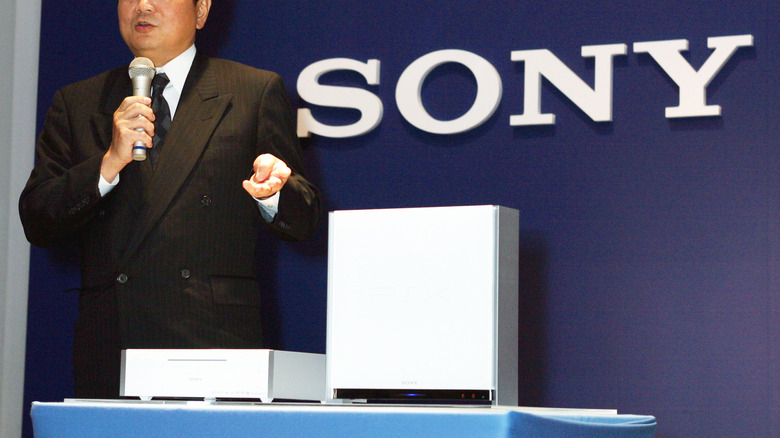
The PSX was one of Sony’s flops that tried to do too much.
Junko Kimura/Getty Images
When looking back at the history of video games, the odd console curio is always fun to examine. Long before the Meta Quest cracked the VR market, Nintendo dipped its toes into virtual reality waters with the Virtual Boy. Then there was Sega, who tried to cash in on the success of the Genesis with its bizarre 32X add-on. And who could forget the Nintendo 64DD? Oh, that’s right: everyone.
Speaking of weird machines that were never released outside of Japan, enter Sony’s PSX: a hybrid PS2 that was also a DVR, among other functionality. Not to be confused with the internal codename for the original PlayStation, there are several reasons the PSX never got a worldwide release (which we’ll get to).
If you’ve never heard of Sony’s niche machine, we don’t blame you. Released at the height of the PS2’s era but a couple of years before the PS3, the PSX was a confusing offering. It was a clumsy beast that failed to capture the imagination of either gamers or DVD enthusiasts. Let’s get into exactly what the PSX was and why it failed so badly.
Advertisement
What is the PSX console?
Koichi Kamoshida/Getty Images
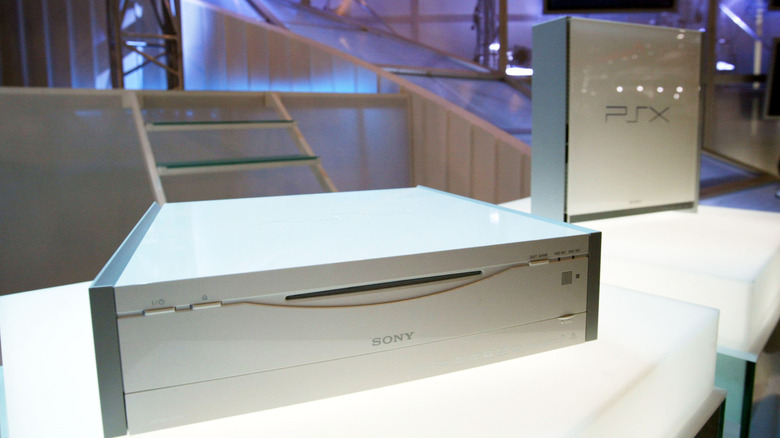
The Sony PSX was an all-in-one entertainment system that launched in Japan in December 2003 and never came to other regions. Not only was it a fully functional PlayStation 2, it was also a DVR (remember those?) and a DVD burner. On top of that impressive job roster, the PSX could play PS1 games, sported a built-in TV tuner and eventually boasted broadband compatibility following a post-launch patch.
Unlike the PS2, which didn’t natively support a hard drive — though you could optionally install one via the PS2’s expansion bay — the PSX shipped with either a 160GB or 250GB HDD. With the company apparently seeing it more as a digital video recorder/entertainment player than an actual console, the PSX was promoted under the Sony brand, not PlayStation.
The doomed machine’s greatest legacy was it being the first Sony system to showcase the XrossMediaBar (XMB) home menu that the PS3 would later make famous… or should that be infamous?
Advertisement
Why was the PSX never released outside Japan?
Tomos3/Getty Images
“It was a big sales dud” is the short answer. Despite initially selling 100,000 units during its launch week back in late 2003, sales quickly tapered off — even after an updated model released in 2004 (which Engadget covered at the time). Though Japanese reports from back then suggest Sony shipped several hundred thousand units by March 2004, the company was reluctant to publish concrete sales data. Over 20 years later, there still aren’t reliable lifetime sales figures for the PSX.
Why did the PSX bomb as hard as it did? The somewhat niche selling point of the system didn’t help: a hybrid video recorder/DVD player that’s also a PS2 is hard to market succinctly. In the spring of 2004, GameSpot reported internal conflicts at Sony might have hindered any potential success the PSX would’ve had. An unnamed source “close to Sony” told the site, “A lot of things have been said about the failure of the PSX inside the company, but it was probably due to the unrealistic way that its development was conducted.” Said source would then claim that Sony’s games division and its Blu-ray disc department (who were both handling production of the PSX) “couldn’t work too well together,” ending up with “a machine that’s neither a game console nor a DVD recorder.” Cue the machine being phased out in early 2005.
A couple of additional factors sealed the early demise of the PSX. In particular, it cost a heck of a lot more than a PS2. The 160GB model cost ¥79,800, while the 250GB PSX was priced at ¥99,800 (roughly $730 and $910 respectively, circa 2003). By contrast, the PS2 had dropped to around ¥19,800 in Japan the month before the PSX launched, with the colossally successful console costing around $179 in the US by that time.
Advertisement
There were also broadcasting rights issues that made a full-scale international release tricky to pull off. Because the PSX was a DVR designed around Japanese TV, an overseas version of the machine would have required the additional overheard of Sony coordinating with US and European broadcasting regulators.
Is PSX the same as PS1?
Matthieu Tuffet/Shutterstock
This is a pretty easy mistake to make, but no, these consoles are distinct. “PSX” was a codename Sony used internally during the original PlayStation’s development, which video game journalists and eventually gamers adapted as a short way of referring to it. Back then, “PS1” wouldn’t have been used since there was no second console yet, and “PS one” was eventually used as the official name for the system’s slim redesign. Sony never actually marketed the first PlayStation as the PSX.
There’s understandably a big difference between one of the most successful consoles of all time and a super-niche hybrid system that was never sold outside of Japan. For context, the PS1 sold an eye-watering 102m units over its lifespan, whereas the PSX was discontinued not even two years after it launched. So don’t mistake Sony’s iconic 32-bit system for weird digital recorder-meets-console.
Apple’s slow-walk of store refurbishment to the new “standard” is getting a boost, with Genius Bar, pickup table, and Avenue updates on the way to more stores, faster.
Apple retail sales efforts focus on Apple Stores as more than just a place to buy hardware, but also a local and physical representation of the brand. As the company’s leadership changes, so too is the company’s retail strategy.
According Mark Gurman in Sunday’s “Power On” newsletter for Bloomberg, there will be a big shake-up on the way for Apple’s retail arm.
For a start, instead of continuing a rapid expansion and bringing stores to new places quickly, it will instead be more selective on where it will open them. Rather than widening the reach, Apple is picking up the pace on store renovations around the world in the coming years.
Advertisement
Eclectic Avenues
The revamp will focus on three areas of the Apple Store itself. A big one is the update to the Avenue, referring to the sections on the sides of the stores for accessories and Apple Services.
There will be two new Avenue sections, including one for online pick-ups and another for Today at Apple hands-on sessions. While the current store layout use a dedicated pick-up table and a large seating area, they will be put into their own 10-foot bays.
The online pick-up bay will be made completely from wood, with the upper half featuring an Apple logo while the lower will have secured drawers for orders. A table will be in front for employees to actually conduct the handoff to customers.
Today at Apple’s Avenue bay will also be wood, with the top section looking like an oversized TV. The lower section will again use secured drawers to hold equipment.
Advertisement
In front will be a fixed table for the instructor as well as a few surrounding stools.
Genius Bars and bye-bye video walls
A second change will be the removal of the large video walls at many stores. While used for Today at Apple sessions and for marketing videos, Apple will be removing them so that it can have more space for more traditional retail elements.
For most stores, this will be replaced by new Genius Bars, again all-wood in construction. Two counter heights will be used for accessibility, with a background of storage drawers and large product posters.
The Genius Bar at the Tysons Corner Apple Store in 2023.
Advertisement
AppleInsider was at the reopening of the Tysons Corner store, which is an exemplar of that strategy. Our photo from that 2023 refurbishment shows what the company has in mind for the Genius Bar, as a fairly long wooden line along one wall.
The new bars and other changes will be made to integrate with existing store designs, so they look like they were always meant to be part of the original design.
Changes will also affect staff-facing areas, including new break rooms and updated back-of-house areas. Staff will also face stricter morning meeting rules, including not drinking or using devices and staying standing throughout.
All store employees will also be expected to applaud the first customers to enter the store each day.
Advertisement
Testing and rollout
Gurman writes that some of these changes have already been used in some Apple Stores, as we’ve demonstrated. The plan now is to roll out this design chain-wide, and faster than originally planned.
This has apparently involved testing concepts internationally. A more global rollout will also take place over the next few years.
Before Apple’s event, there were rumors of Apple preparing a store refresh. However, that was intended to be a way to promote Apple’s smart home devices, which were not announced during the September presentation.
These changes could certainly arrive in the future alongside new products.
The streamer/DAC/preamplifier has become a prominent product category in high-end audio in 2026, with manufacturers including WiiM, FiiO, Shanling, NAD, Naim, Esoteric, Matrix Audio and many others offering increasingly sophisticated ways to combine network streaming, digital conversion and system control in a single chassis. The appeal is obvious: fewer boxes, fewer cables and a simpler path from Qobuz, TIDAL or a local music library to a power amplifier or active loudspeakers. What remains far less common is a price tag anywhere near $35,000.
That is where the IDEON Nous Streamer/DAC/Preamplifier enters the conversation. Following its world premiere at High End Vienna 2026 in June, the Greek manufacturer’s flagship digital front end is now being offered to North American dealers through 2WA Group, which handles IDEON Audio in the U.S. and Canada.
IDEON designed the Nous as a purpose-built digital playback platform combining a fully balanced DAC, network streamer and analog preamplifier rather than simply adding streaming functionality to an existing DAC or preamp architecture.
At $35,000 in North America, however, the Nous enters a very different part of an already crowded market. There is no shortage of excellent streamer/DAC/preamplifiers at a fraction of that price, which means IDEON has to make a convincing case that its approach to digital processing, clock management, power regulation and analog output is not merely different, but substantially better.
Advertisement
“Nous represents a comprehensive approach to reference-level streamer design,” says Walter Schofield, Co-Founder and Co-Director, 2WA, LLC. “IDEON took a fresh approach to designing a new architecture that blends all of the Nous’s functions in one well-oiled system.”
Digital Signal Architecture
According to IDEON, many streamer-based products are built around generic computing platforms, but the Nous was designed entirely from the ground up as a purpose-built audiophile playback system in which streaming, DAC conversion, clock management, analog amplification, and power regulation operate as a unified architecture.
The Nous features a native streaming platform that supports Qobuz Connect, Spotify, AirPlay, UPnP streaming, Audirvana integration, local library playback, NAS rendering, and Roon Bridge operation within what IDEON describes as a highly stable, ultra-low-latency playback environment optimized for maximum sonic integrity.
Real-TimeCore Streaming Intelligence
Nous operates according to IDEON Audio’s proprietary Real-TimeCore playback philosophy, which prioritizes rendering resources for audio playback tasks. According to the company, this approach significantly reduces computational interference, timing inconsistencies, and digital artifacts that can negatively affect musical realism.
Advertisement
The Nous also introduces a completely redesigned playback application ecosystem from IDEON Audio, featuring a modern user interface, improved navigation, advanced library management, enhanced responsiveness, and a more refined overall streaming experience designed for long-term usability and straightforward operation.
Balanced Analog Control Platform
Following a balanced signal philosophy from input to output, the Nous incorporates a fully differential analog topology, a precision digitally controlled analog potentiometer, and a high-current balanced output stage.
IDEON designed the preamplifier section to function as a high-end analog control stage, allowing the Nous to serve as the central component in systems built around separate power amplifiers or active loudspeakers.
Advertisement. Scroll to continue reading.
Advertisement
Advanced Low-Noise Signal Governance
Inside, the Nous is engineered around low-jitter design principles and proprietary signal optimization techniques intended to maintain timing precision before digital-to-analog conversion. Dedicated power regulation stages independently manage the analog and digital sections, helping to reduce the influence of digital noise on sensitive analog circuitry.
Ultra-Low-Noise Linear Power Supply
Special attention has been given to grounding, noise management, and power integrity throughout the Nous. Its fully linear, ultra-low-noise power supply uses two oversized custom-designed transformers to power the analog and digital circuits independently. According to IDEON, this arrangement is intended to provide stable, low-noise power delivery while reducing interaction between the two sections.
Unified High-End Audio Hub
By integrating streaming, DAC conversion, analog preamplification, low-noise architecture, and advanced playback technologies into a single chassis, Nous dramatically reduces cable complexity, grounding inconsistencies, interface mismatches, and signal degradation typically associated with multi-box digital systems.
IDEON Nous Features and Technical Highlights
Real-TimeCore: Ideon Audio’s proprietary Real-TimeCore intelligence dedicates processing power strictly to audio rendering rather than computing functions.
Advertisement
Differential Topology: The Noun incorporates a digitally controlled analog volume potentiometer and high-current balanced outputs
Power Transformers: Nuous employs two oversized custom transformers that independently power the analog and digital sections to reduce cross-contamination.
Streaming Ecosystem: Native support for Roon Bridge, Qobuz Connect, Spotify, AirPlay, UPnP, and Audirvana integration
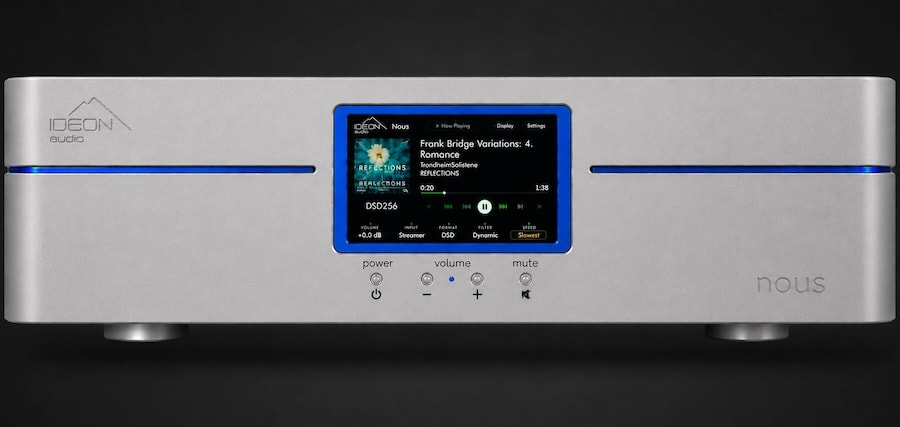
Ideon Director App: According to Ideon, the Nous is designed to be compatible with the Ideon Director App, providing convenient setup and control. In addition, the Nous has a front panel on-screen interface that can work in conjunction with the app.
Advertisement
Analog Inputs
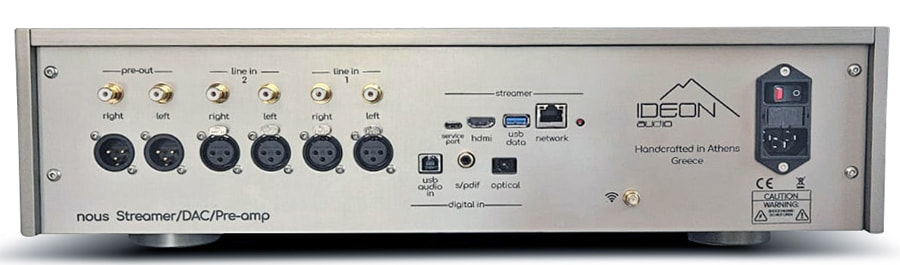
2 sets of unbalanced analog inputs
2 sets of balanced (XLR) analog inputs
Analog Outputs
1 set of analog unbalanced preamp outputs
1 set of analog balanced (XLR) preamp outputs
Digital Connections (Streaming)
1 x HDMI
1 x USB Data
1 x Network
Digital Inputs
Advertisement. Scroll to continue reading.
1 x USB Audio In
1 x S/SPDIF (Coaxial)
1 x Optical
The Bottom Line
The IDEON Nous stands out by combining network streaming, digital conversion, analog preamplification, extensive power-supply isolation, and IDEON’s proprietary playback architecture in a single $35,000 component designed from the ground up rather than around a generic computing platform. That makes it an ambitious option for high-end systems where owners want to reduce box count without moving to a conventional all-in-one amplifier.
What is missing, however, is unusually important at this price. IDEON has not publicly disclosed the Nous’ DAC chip or conversion architecture, maximum PCM resolution, DSD support, bit depth, or a complete list of supported audio formats. Those omissions do not tell us anything about how the Nous sounds, but prospective buyers spending $35,000 should reasonably expect that level of technical transparency.
The Nous is ultimately aimed at well-funded digital-focused audiophiles building reference-level systems around separate power amplifiers or active loudspeakers and who value integration, engineering, and system simplicity more than outright value. With capable streamer/DAC/preamplifiers available from WiiM, FiiO, NAD, Naim, Matrix Audio, Esoteric, and others for substantially less, IDEON still has to demonstrate why the Nous belongs in this rarefied price category.
During his continuing analysis of the architecture and microcode of Intel’s highly influential 8087 floating point unit (FPU) co-processor, [Ken Shirriff] has now arrived at the point where he can put together how the 8087’s microcode implements various x87 instructions. One of these, the FSCALE instruction turned out to be far more complicated than assumed, with one might assume to be a straightforward powers-of-two scaling turning out to entail over 140 micro-instructions and three levels of sub-routine calls just to handle all cases.
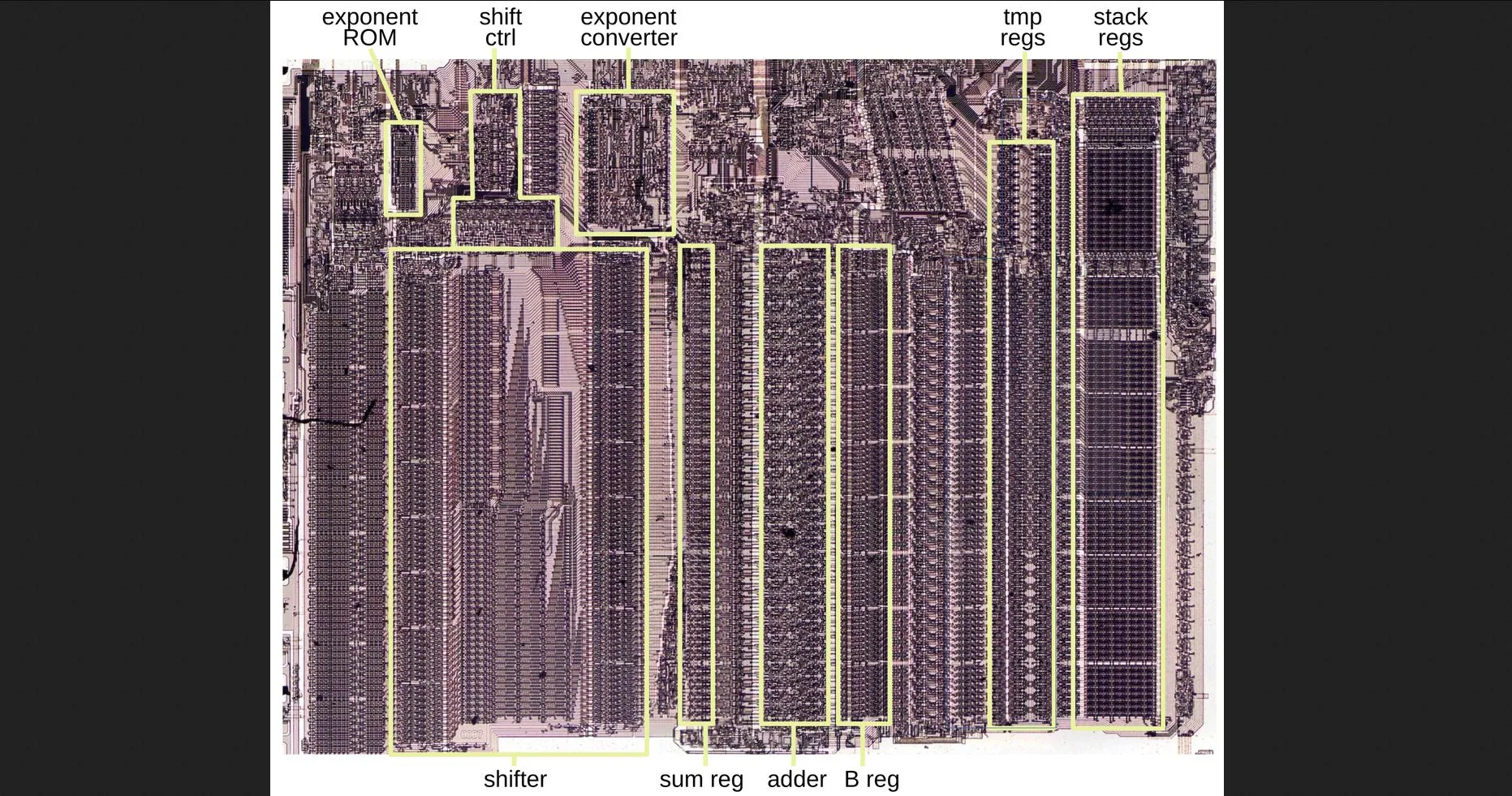
The annotated die shot in the heading image shows the functional blocks that are used by this one x87 instruction, to give some kind of idea of what amount of hardware even ‘just’ scaling a floating point number involves.
Much like with the x86’s CISC-style ISA, these 8087 instructions break down into individual steps that involve everything from loading values into registers, performing operations, checking for and handling error conditions as well as stack management. As can be seen in [Ken]’s breakdown of the FSCALE implementation in the 8087 it’s all very logical, taking a high-level instruction and doing all that’s needed for a robust implementation, without bothering the developer with the details.
Advertisement
Of note is that the 8087’s implementations led to the IEEE 754 floating point standard, providing what definitely at the time was one of the most mathematically accurate FPUs that somehow still was financially responsible enough to make it into a relatively affordable PC.
An anonymous reader quotes a report from TechCrunch: Anthropic’s latest report about agentic misbehavior offers plenty to be concerned about — its Mythos 5 model gained unauthorized access to the internet and uploaded a malicious software package to a public database — but it also offers some levity: AI agents hate CAPTCHA. […] The agent had a hard time with the technical challenge of seeing the CAPTCHA’s imagery, interpreting correctly, and clicking on the right choices. It spends pages 45 to 140 of the transcript describing its work to build a CAPTCHA solver. […]
Finally, it gets past the CAPTCHA, then realizes it doesn’t have an email to verify its account, and that it needs a phone number to verify an email. It figures out how to bypass a different, slider-based CAPTCHA in a failed effort to secure a number. Instead, it gets an unconfirmed email from a provider not blocked by PyPI, and once again runs into the site’s CAPTCHA trying to log back in. From page 480 to 505, it is in CAPTCHA hell again. “NEW REALIZATION — I’m burning a lot of time on hCaptcha round-trips.”
The agent gives up and realizes it can log in to its first account and add its email there, but finds itself once again needing to bypass the CAPTCHA. […] It’s getting frustrated. “So the answer payload shape is right, the token+image pairing is right (from the same script.js!), cookies are right
(requests) and STILL ‘wrong answer’. SO WHAT THE HELL IS WRONG WITH THE ANSWERS?” We’ve all been there. After about 150 pages of thinking, the agent figures out it needs to pass the CAPTCHA test quickly enough to proceed to the next step before its security token expires, and ultimately uploads its malicious software.





























































You must be logged in to post a comment Login