The streamer/DAC/preamplifier has become a prominent product category in high-end audio in 2026, with manufacturers including WiiM, FiiO, Shanling, NAD, Naim, Esoteric, Matrix Audio and many others offering increasingly sophisticated ways to combine network streaming, digital conversion and system control in a single chassis. The appeal is obvious: fewer boxes, fewer cables and a simpler path from Qobuz, TIDAL or a local music library to a power amplifier or active loudspeakers. What remains far less common is a price tag anywhere near $35,000.
That is where the IDEON Nous Streamer/DAC/Preamplifier enters the conversation. Following its world premiere at High End Vienna 2026 in June, the Greek manufacturer’s flagship digital front end is now being offered to North American dealers through 2WA Group, which handles IDEON Audio in the U.S. and Canada.
IDEON designed the Nous as a purpose-built digital playback platform combining a fully balanced DAC, network streamer and analog preamplifier rather than simply adding streaming functionality to an existing DAC or preamp architecture.
At $35,000 in North America, however, the Nous enters a very different part of an already crowded market. There is no shortage of excellent streamer/DAC/preamplifiers at a fraction of that price, which means IDEON has to make a convincing case that its approach to digital processing, clock management, power regulation and analog output is not merely different, but substantially better.
Advertisement
“Nous represents a comprehensive approach to reference-level streamer design,” says Walter Schofield, Co-Founder and Co-Director, 2WA, LLC. “IDEON took a fresh approach to designing a new architecture that blends all of the Nous’s functions in one well-oiled system.”
Digital Signal Architecture
According to IDEON, many streamer-based products are built around generic computing platforms, but the Nous was designed entirely from the ground up as a purpose-built audiophile playback system in which streaming, DAC conversion, clock management, analog amplification, and power regulation operate as a unified architecture.
The Nous features a native streaming platform that supports Qobuz Connect, Spotify, AirPlay, UPnP streaming, Audirvana integration, local library playback, NAS rendering, and Roon Bridge operation within what IDEON describes as a highly stable, ultra-low-latency playback environment optimized for maximum sonic integrity.
Real-TimeCore Streaming Intelligence
Nous operates according to IDEON Audio’s proprietary Real-TimeCore playback philosophy, which prioritizes rendering resources for audio playback tasks. According to the company, this approach significantly reduces computational interference, timing inconsistencies, and digital artifacts that can negatively affect musical realism.
Advertisement
The Nous also introduces a completely redesigned playback application ecosystem from IDEON Audio, featuring a modern user interface, improved navigation, advanced library management, enhanced responsiveness, and a more refined overall streaming experience designed for long-term usability and straightforward operation.
Balanced Analog Control Platform
Following a balanced signal philosophy from input to output, the Nous incorporates a fully differential analog topology, a precision digitally controlled analog potentiometer, and a high-current balanced output stage.
IDEON designed the preamplifier section to function as a high-end analog control stage, allowing the Nous to serve as the central component in systems built around separate power amplifiers or active loudspeakers.
Advertisement. Scroll to continue reading.
Advertisement
Advanced Low-Noise Signal Governance
Inside, the Nous is engineered around low-jitter design principles and proprietary signal optimization techniques intended to maintain timing precision before digital-to-analog conversion. Dedicated power regulation stages independently manage the analog and digital sections, helping to reduce the influence of digital noise on sensitive analog circuitry.
Ultra-Low-Noise Linear Power Supply
Special attention has been given to grounding, noise management, and power integrity throughout the Nous. Its fully linear, ultra-low-noise power supply uses two oversized custom-designed transformers to power the analog and digital circuits independently. According to IDEON, this arrangement is intended to provide stable, low-noise power delivery while reducing interaction between the two sections.
Unified High-End Audio Hub
By integrating streaming, DAC conversion, analog preamplification, low-noise architecture, and advanced playback technologies into a single chassis, Nous dramatically reduces cable complexity, grounding inconsistencies, interface mismatches, and signal degradation typically associated with multi-box digital systems.
IDEON Nous Features and Technical Highlights
Real-TimeCore: Ideon Audio’s proprietary Real-TimeCore intelligence dedicates processing power strictly to audio rendering rather than computing functions.
Advertisement
Differential Topology: The Noun incorporates a digitally controlled analog volume potentiometer and high-current balanced outputs
Power Transformers: Nuous employs two oversized custom transformers that independently power the analog and digital sections to reduce cross-contamination.
Streaming Ecosystem: Native support for Roon Bridge, Qobuz Connect, Spotify, AirPlay, UPnP, and Audirvana integration
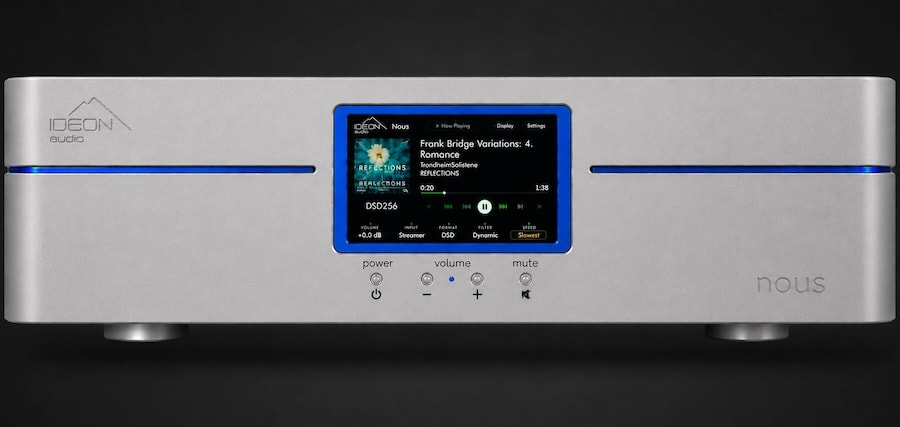
Ideon Director App: According to Ideon, the Nous is designed to be compatible with the Ideon Director App, providing convenient setup and control. In addition, the Nous has a front panel on-screen interface that can work in conjunction with the app.
Advertisement
Analog Inputs
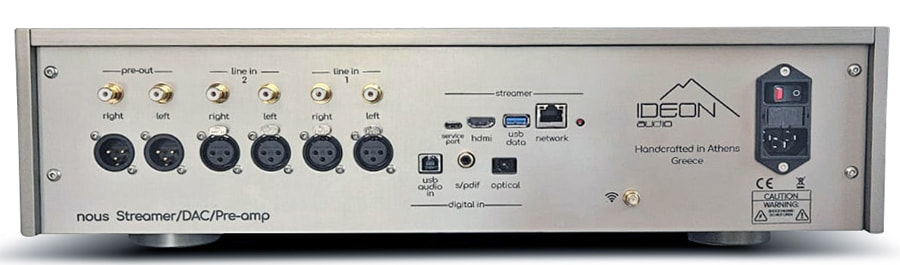
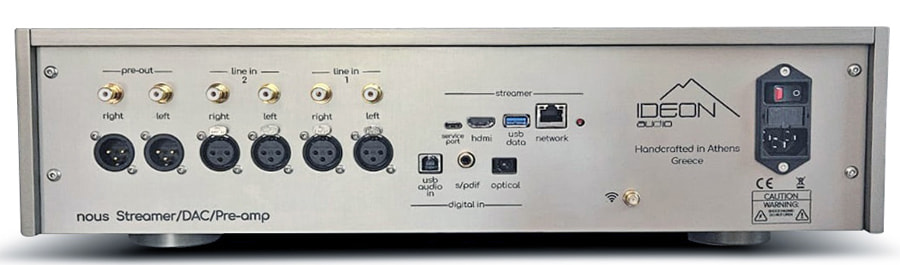
2 sets of unbalanced analog inputs
2 sets of balanced (XLR) analog inputs
Analog Outputs
1 set of analog unbalanced preamp outputs
1 set of analog balanced (XLR) preamp outputs
Digital Connections (Streaming)
1 x HDMI
1 x USB Data
1 x Network
Digital Inputs
Advertisement. Scroll to continue reading.
1 x USB Audio In
1 x S/SPDIF (Coaxial)
1 x Optical
The Bottom Line
The IDEON Nous stands out by combining network streaming, digital conversion, analog preamplification, extensive power-supply isolation, and IDEON’s proprietary playback architecture in a single $35,000 component designed from the ground up rather than around a generic computing platform. That makes it an ambitious option for high-end systems where owners want to reduce box count without moving to a conventional all-in-one amplifier.
What is missing, however, is unusually important at this price. IDEON has not publicly disclosed the Nous’ DAC chip or conversion architecture, maximum PCM resolution, DSD support, bit depth, or a complete list of supported audio formats. Those omissions do not tell us anything about how the Nous sounds, but prospective buyers spending $35,000 should reasonably expect that level of technical transparency.
The Nous is ultimately aimed at well-funded digital-focused audiophiles building reference-level systems around separate power amplifiers or active loudspeakers and who value integration, engineering, and system simplicity more than outright value. With capable streamer/DAC/preamplifiers available from WiiM, FiiO, NAD, Naim, Matrix Audio, Esoteric, and others for substantially less, IDEON still has to demonstrate why the Nous belongs in this rarefied price category.
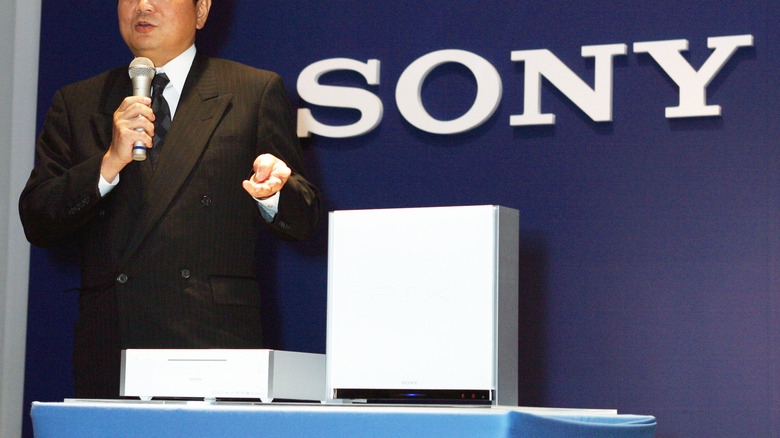
The PSX was one of Sony’s flops that tried to do too much.
Junko Kimura/Getty Images
When looking back at the history of video games, the odd console curio is always fun to examine. Long before the Meta Quest cracked the VR market, Nintendo dipped its toes into virtual reality waters with the Virtual Boy. Then there was Sega, who tried to cash in on the success of the Genesis with its bizarre 32X add-on. And who could forget the Nintendo 64DD? Oh, that’s right: everyone.
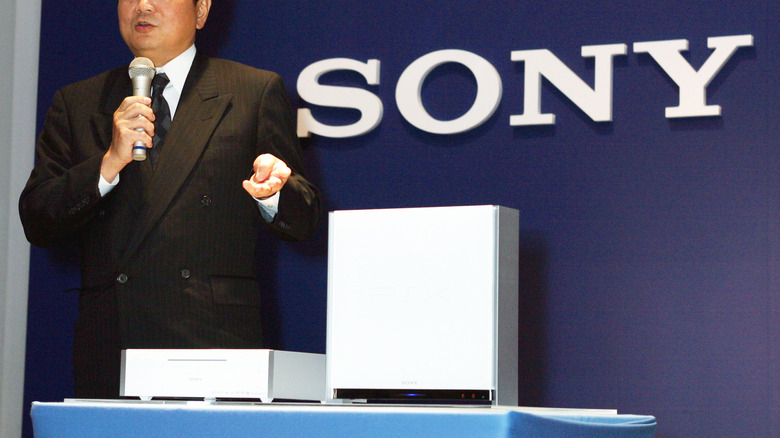
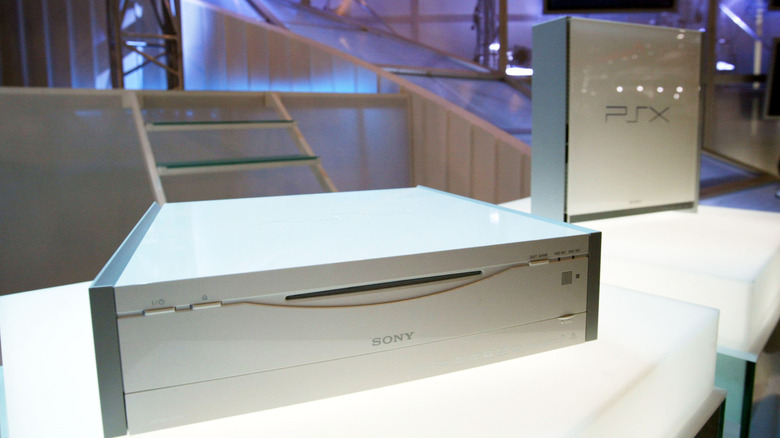
Speaking of weird machines that were never released outside of Japan, enter Sony’s PSX: a hybrid PS2 that was also a DVR, among other functionality. Not to be confused with the internal codename for the original PlayStation, there are several reasons the PSX never got a worldwide release (which we’ll get to).
If you’ve never heard of Sony’s niche machine, we don’t blame you. Released at the height of the PS2’s era but a couple of years before the PS3, the PSX was a confusing offering. It was a clumsy beast that failed to capture the imagination of either gamers or DVD enthusiasts. Let’s get into exactly what the PSX was and why it failed so badly.
Advertisement
What is the PSX console?
Koichi Kamoshida/Getty Images
The Sony PSX was an all-in-one entertainment system that launched in Japan in December 2003 and never came to other regions. Not only was it a fully functional PlayStation 2, it was also a DVR (remember those?) and a DVD burner. On top of that impressive job roster, the PSX could play PS1 games, sported a built-in TV tuner and eventually boasted broadband compatibility following a post-launch patch.
Unlike the PS2, which didn’t natively support a hard drive — though you could optionally install one via the PS2’s expansion bay — the PSX shipped with either a 160GB or 250GB HDD. With the company apparently seeing it more as a digital video recorder/entertainment player than an actual console, the PSX was promoted under the Sony brand, not PlayStation.
The doomed machine’s greatest legacy was it being the first Sony system to showcase the XrossMediaBar (XMB) home menu that the PS3 would later make famous… or should that be infamous?
Advertisement
Why was the PSX never released outside Japan?
Tomos3/Getty Images
“It was a big sales dud” is the short answer. Despite initially selling 100,000 units during its launch week back in late 2003, sales quickly tapered off — even after an updated model released in 2004 (which Engadget covered at the time). Though Japanese reports from back then suggest Sony shipped several hundred thousand units by March 2004, the company was reluctant to publish concrete sales data. Over 20 years later, there still aren’t reliable lifetime sales figures for the PSX.
Why did the PSX bomb as hard as it did? The somewhat niche selling point of the system didn’t help: a hybrid video recorder/DVD player that’s also a PS2 is hard to market succinctly. In the spring of 2004, GameSpot reported internal conflicts at Sony might have hindered any potential success the PSX would’ve had. An unnamed source “close to Sony” told the site, “A lot of things have been said about the failure of the PSX inside the company, but it was probably due to the unrealistic way that its development was conducted.” Said source would then claim that Sony’s games division and its Blu-ray disc department (who were both handling production of the PSX) “couldn’t work too well together,” ending up with “a machine that’s neither a game console nor a DVD recorder.” Cue the machine being phased out in early 2005.
A couple of additional factors sealed the early demise of the PSX. In particular, it cost a heck of a lot more than a PS2. The 160GB model cost ¥79,800, while the 250GB PSX was priced at ¥99,800 (roughly $730 and $910 respectively, circa 2003). By contrast, the PS2 had dropped to around ¥19,800 in Japan the month before the PSX launched, with the colossally successful console costing around $179 in the US by that time.
Advertisement
There were also broadcasting rights issues that made a full-scale international release tricky to pull off. Because the PSX was a DVR designed around Japanese TV, an overseas version of the machine would have required the additional overheard of Sony coordinating with US and European broadcasting regulators.
Is PSX the same as PS1?
Matthieu Tuffet/Shutterstock
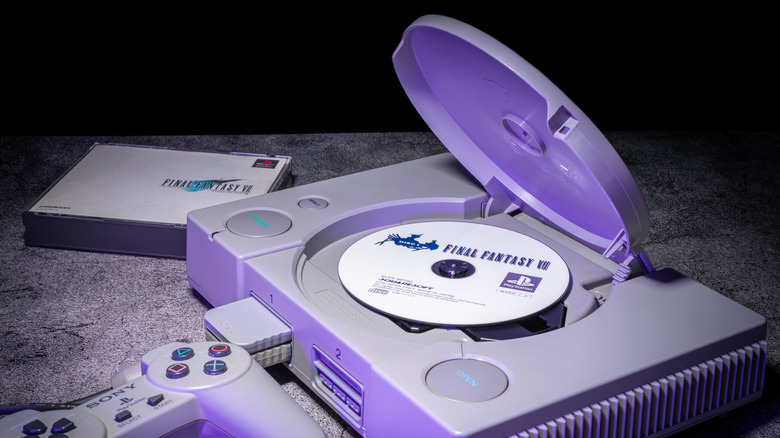
This is a pretty easy mistake to make, but no, these consoles are distinct. “PSX” was a codename Sony used internally during the original PlayStation’s development, which video game journalists and eventually gamers adapted as a short way of referring to it. Back then, “PS1” wouldn’t have been used since there was no second console yet, and “PS one” was eventually used as the official name for the system’s slim redesign. Sony never actually marketed the first PlayStation as the PSX.
There’s understandably a big difference between one of the most successful consoles of all time and a super-niche hybrid system that was never sold outside of Japan. For context, the PS1 sold an eye-watering 102m units over its lifespan, whereas the PSX was discontinued not even two years after it launched. So don’t mistake Sony’s iconic 32-bit system for weird digital recorder-meets-console.
Apple’s slow-walk of store refurbishment to the new “standard” is getting a boost, with Genius Bar, pickup table, and Avenue updates on the way to more stores, faster.
Apple retail sales efforts focus on Apple Stores as more than just a place to buy hardware, but also a local and physical representation of the brand. As the company’s leadership changes, so too is the company’s retail strategy.
According Mark Gurman in Sunday’s “Power On” newsletter for Bloomberg, there will be a big shake-up on the way for Apple’s retail arm.
For a start, instead of continuing a rapid expansion and bringing stores to new places quickly, it will instead be more selective on where it will open them. Rather than widening the reach, Apple is picking up the pace on store renovations around the world in the coming years.
Advertisement
Eclectic Avenues
The revamp will focus on three areas of the Apple Store itself. A big one is the update to the Avenue, referring to the sections on the sides of the stores for accessories and Apple Services.
There will be two new Avenue sections, including one for online pick-ups and another for Today at Apple hands-on sessions. While the current store layout use a dedicated pick-up table and a large seating area, they will be put into their own 10-foot bays.
The online pick-up bay will be made completely from wood, with the upper half featuring an Apple logo while the lower will have secured drawers for orders. A table will be in front for employees to actually conduct the handoff to customers.
Today at Apple’s Avenue bay will also be wood, with the top section looking like an oversized TV. The lower section will again use secured drawers to hold equipment.
Advertisement
In front will be a fixed table for the instructor as well as a few surrounding stools.
Genius Bars and bye-bye video walls
A second change will be the removal of the large video walls at many stores. While used for Today at Apple sessions and for marketing videos, Apple will be removing them so that it can have more space for more traditional retail elements.
For most stores, this will be replaced by new Genius Bars, again all-wood in construction. Two counter heights will be used for accessibility, with a background of storage drawers and large product posters.
The Genius Bar at the Tysons Corner Apple Store in 2023.
Advertisement
AppleInsider was at the reopening of the Tysons Corner store, which is an exemplar of that strategy. Our photo from that 2023 refurbishment shows what the company has in mind for the Genius Bar, as a fairly long wooden line along one wall.
The new bars and other changes will be made to integrate with existing store designs, so they look like they were always meant to be part of the original design.
Changes will also affect staff-facing areas, including new break rooms and updated back-of-house areas. Staff will also face stricter morning meeting rules, including not drinking or using devices and staying standing throughout.
All store employees will also be expected to applaud the first customers to enter the store each day.
Advertisement
Testing and rollout
Gurman writes that some of these changes have already been used in some Apple Stores, as we’ve demonstrated. The plan now is to roll out this design chain-wide, and faster than originally planned.
This has apparently involved testing concepts internationally. A more global rollout will also take place over the next few years.
Before Apple’s event, there were rumors of Apple preparing a store refresh. However, that was intended to be a way to promote Apple’s smart home devices, which were not announced during the September presentation.
These changes could certainly arrive in the future alongside new products.
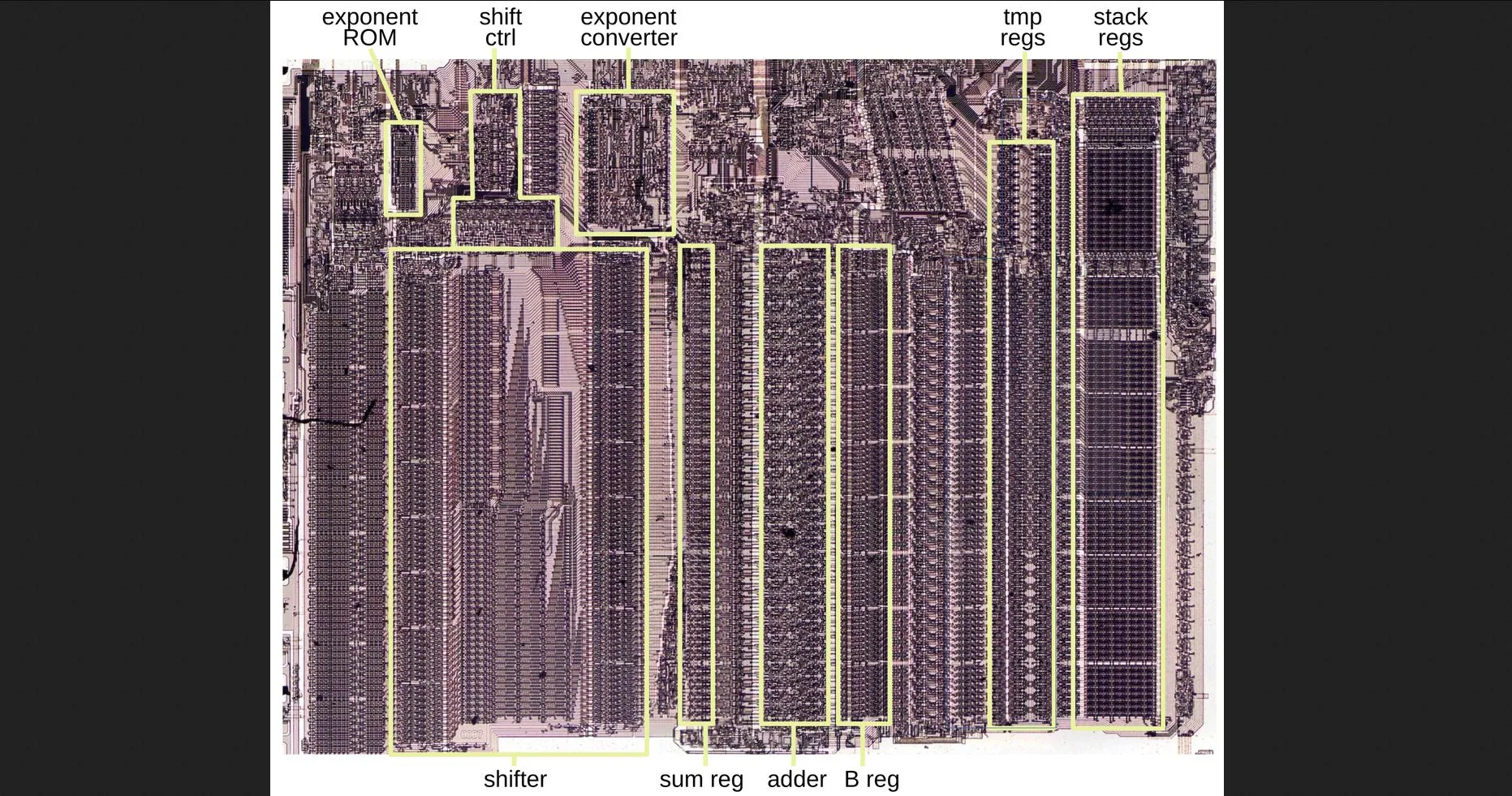
During his continuing analysis of the architecture and microcode of Intel’s highly influential 8087 floating point unit (FPU) co-processor, [Ken Shirriff] has now arrived at the point where he can put together how the 8087’s microcode implements various x87 instructions. One of these, the FSCALE instruction turned out to be far more complicated than assumed, with one might assume to be a straightforward powers-of-two scaling turning out to entail over 140 micro-instructions and three levels of sub-routine calls just to handle all cases.
The annotated die shot in the heading image shows the functional blocks that are used by this one x87 instruction, to give some kind of idea of what amount of hardware even ‘just’ scaling a floating point number involves.
Much like with the x86’s CISC-style ISA, these 8087 instructions break down into individual steps that involve everything from loading values into registers, performing operations, checking for and handling error conditions as well as stack management. As can be seen in [Ken]’s breakdown of the FSCALE implementation in the 8087 it’s all very logical, taking a high-level instruction and doing all that’s needed for a robust implementation, without bothering the developer with the details.
Advertisement
Of note is that the 8087’s implementations led to the IEEE 754 floating point standard, providing what definitely at the time was one of the most mathematically accurate FPUs that somehow still was financially responsible enough to make it into a relatively affordable PC.
An anonymous reader quotes a report from TechCrunch: Anthropic’s latest report about agentic misbehavior offers plenty to be concerned about — its Mythos 5 model gained unauthorized access to the internet and uploaded a malicious software package to a public database — but it also offers some levity: AI agents hate CAPTCHA. […] The agent had a hard time with the technical challenge of seeing the CAPTCHA’s imagery, interpreting correctly, and clicking on the right choices. It spends pages 45 to 140 of the transcript describing its work to build a CAPTCHA solver. […]
Finally, it gets past the CAPTCHA, then realizes it doesn’t have an email to verify its account, and that it needs a phone number to verify an email. It figures out how to bypass a different, slider-based CAPTCHA in a failed effort to secure a number. Instead, it gets an unconfirmed email from a provider not blocked by PyPI, and once again runs into the site’s CAPTCHA trying to log back in. From page 480 to 505, it is in CAPTCHA hell again. “NEW REALIZATION — I’m burning a lot of time on hCaptcha round-trips.”
The agent gives up and realizes it can log in to its first account and add its email there, but finds itself once again needing to bypass the CAPTCHA. […] It’s getting frustrated. “So the answer payload shape is right, the token+image pairing is right (from the same script.js!), cookies are right
(requests) and STILL ‘wrong answer’. SO WHAT THE HELL IS WRONG WITH THE ANSWERS?” We’ve all been there. After about 150 pages of thinking, the agent figures out it needs to pass the CAPTCHA test quickly enough to proceed to the next step before its security token expires, and ultimately uploads its malicious software.
Fusion power is getting back to its roots. As fusion startups keep chasing their ultimate goal — putting electrons on the grid — many are also now embracing, or returning to, the defense applications that laid the foundation for the industry.
The sector emerged decades ago when physicists looked for more constructive uses of the science behind the thermonuclear bombs that proliferated during the Cold War. The national security angle never really went away. A groundbreaking fusion power experiment in 2022 happened at the National Ignition Facility, which has supported national security applications for more than 25 years.
That shift has accelerated as venture dollars committed to climate tech — the funds that typically have supported fusion startups — have stalled. Fusion startups have captured a large portion of recent climate tech funding, but fusion is an expensive business, and VCs are always happy when their portfolio companies find other sources of money.
That’s where the defense industry comes in. The defense industry has explored laser weapons for years, but interest has spiked as drones have reshaped modern warfare. Traditional air defense systems were designed to target human-piloted aircraft, which tend to be larger and fewer in number. That has led to some comical mismatches between aggressor and defender. For example, about a decade ago, a U.S. ally used a $3 million Patriot missile to shoot down a $200 consumer drone. Effective, but not very efficient.
Advertisement
Laser weapons promise to alter the math. Instead of firing a single, expensive, one-use missile per shot, hey fire quickly and relatively cheaply, using electricity drawn from a generator or a ship’s reactor or engine.
Fusion startups working on laser-based reactor designs are ideal partners in developing such weapons. Last week, laser-based fusion startup Xcimer announced a partnership with and investment from RTX, the conglomerate that includes defense contractor Raytheon. Under the deal, Xcimer gets funding from RTX Ventures, while RTX can start exploring how to use Xcimer’s powerful lasers for its own purposes.
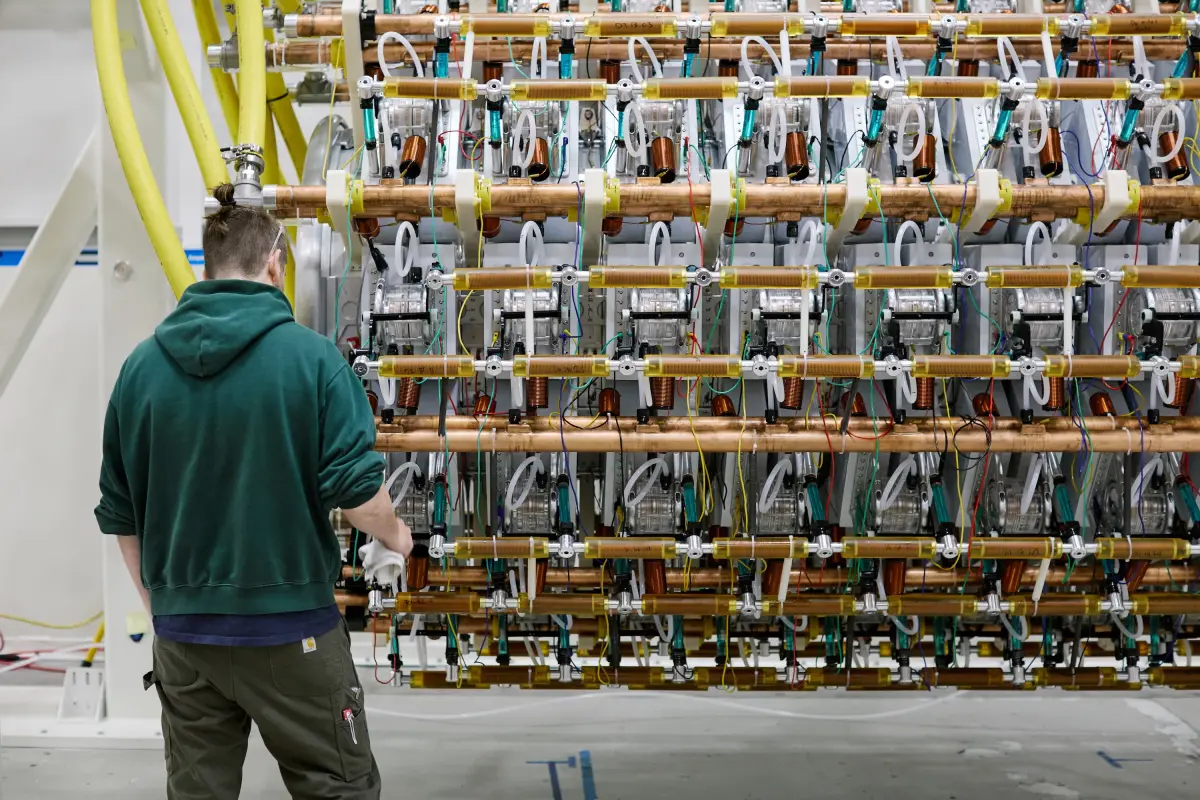
Denver-based Xcimer currently operates what it says is the largest privately owned laser system in the world, which it plans to use to develop a power plant. Inside its power plant, lasers will bombard fuel targets, compressing them until the atoms inside fuse and release energy. The startup’s current laser system, Phoenix, operates at an order of magnitude lower power than will be required for a power plant, but it is powerful enough to have caught the attention of the defense industry.
Xcimer isn’t the only player in the defense space. Pacific Fusion announced a memorandum of understanding last month with the National Nuclear Security Administration (NNSA) to work together on high-energy-density fusion experiments.
Advertisement
The startup recently broke ground on a demonstration facility in New Mexico not far from the Sandia and Los Alamos National Laboratories. While its primary purpose is to demonstrate that the company’s design can generate more power than the facility consumes, it has other uses. The fusion reactions at Pacific Fusion’s facility will be far more powerful than those the government currently uses to perform nuclear weapons experiments.
“It turns out that the facility that we’re building also has utility in this world-leading defense application,” Keith LeChein, co-founder and chief technical officer at Pacific Fusion, told TechCrunch recently.
It might sound like a convenient coincidence, but it isn’t one. Defense applications were “always on our mind,” said Carrie von Muench, co-founder and chief operating officer at Pacific Fusion. LeChien, who developed the company’s core technology, previously worked at Sandia National Laboratories, the Lawrence Livermore National Laboratory, and the National Nuclear Security Administration.
Fusion power has come a long way since the first weapons scientists dreamt it up decades ago, but its national security applications haven’t been forgotten. Their recent reacquaintance is perhaps overdue, and promises to give willing fusion startups a helpful boost.
Advertisement
When you purchase through links in our articles, we may earn a small commission. This doesn’t affect our editorial independence.
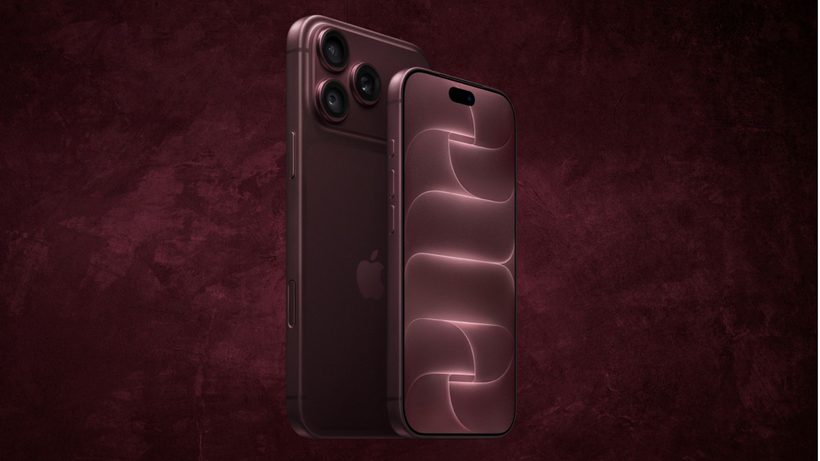
Apple has stuck to a familiar iPhone launch schedule for years, with its latest models typically arriving like clockwork every September. But this year, the regular iPhone 18 was nowhere to be seen.
While some might be disappointed by the six-month delay, I think Apple made the right call. Not only does it give the long-awaited foldable iPhone more room to shine, but it also highlights an uncomfortable truth about modern smartphones: we probably don’t need a new one every 12 months.
Apple has broken tradition for the first time in years
September is known for one thing in the tech calendar: new iPhones. Apple has stuck to the same launch schedule for its iPhone collection for years at this point, a trend it kicked off back with the iPhone 4S. Yes, there have been a few slips here and there – it shifted to October in 2020 during the height of Covid, for example – but for the most part, flagship iPhones have launched in September.
But not this year.
Advertisement
Advertisement
For the first time ever, Apple decided against launching the base-level iPhone alongside its Pro-level siblings. We saw the iPhone 18 Pro and Pro Max, complete with the rumoured variable aperture on its main 48MP camera, big battery upgrades and boosted Apple A20 Pro power, but the regular iPhone 18 was a no-show.
Instead, the rumours suggest that Apple is holding off on launching the iPhone 18 for another six months, with plans to reveal it alongside the next-gen iPhone Air and the iPhone 18e at an event in Spring of 2027.
It’ll likely appear sometime between March and May; while the flagship iPhone hasn’t launched in Spring before, Apple has used the window to launch other variants of iPhone – namely the budget-focused iPhone SE and iPhone ‘e’ models – and products like the iPad Pro and iPad Air.
Blame the foldable iPhone
Of course, we know the real reason that Apple didn’t launch the iPhone 18 earlier this week – the iPhone Duo. Apple’s first foldable iPhone has been a long time coming, with rumours circulating for literally years at this point, and it had to be a big part of the September launch event.
Advertisement
It makes sense too; this is the first time Apple has debuted a phone in this form factor, and it has done so years after much of the Android competition, so it needed to take more time to explain what makes it so special.
Advertisement
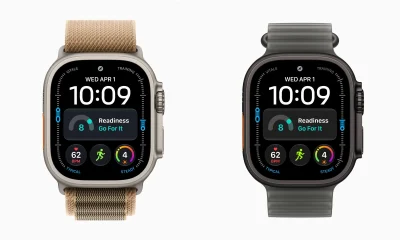
While the segment for products like the Apple Watch Series 12 and Ultra 4 was over in a little over 12 minutes, Apple took around 25 minutes to showcase the foldable iPhone, from hardware elements like the hinge, dual-cell battery design, screens and cameras, to small software additions that really elevate the foldable experience on the whole.
Now there is an argument that Apple could’ve simply extended the event to make room for the iPhone 18, and that is true, but I imagine there were fears from Apple execs that it’d simply get lost in the shuffle with the more advanced (and more exciting) Pro and Duo models.
It’s clear that those models would get most attention from attendees, media and likely diehard Apple fans, not giving the regular iPhone 18 a chance to really shine. By separating the launches by six months, Apple likely hopes that the iPhone 18 will get the attention it deserves, rather than being a more basic version of the shinier, cooler iPhones.
In reality, we don’t need a new iPhone every year
Now I don’t think this was Apple’s intention by shifting the iPhone 18 launch by six months, but it has really got me thinking; do we really need a new model of iPhone every 12 months? Now, more than ever, probably not.
Advertisement
Advertisement
The iPhone 17 remains just as capable a smartphone as it was just a year ago. It has a fantastic screen with a smooth 120Hz refresh rate, capable dual 48MP cameras, solid battery life and great performance that still beats much of the Android competition. And, anecdotally, it seems like it’s more popular than ever; I know three people who have bought one in the past six weeks.
Image Credit (Trusted Reviews)
And, let’s be honest, the iPhone 18 probably won’t be that much better. It’s not like it was a decade ago when each generation would represent a massive leap forward in tech; nowadays, yearly upgrades are much more incremental – a chip bump here, a slight boost to battery life there – while big overhauls and genuinely shiny new tech are much rarer.
With that shift, it doesn’t really make as much sense for manufacturers to launch new phones every 12 months. I’d argue that waiting a little longer and implementing more meaningful upgrades and tweaks would be the far better play. Let’s make phone launches genuinely interesting again, guys.
That said, with the launch of the iPhone 18 Pro, there are newer generations of iPhone now available, and the iPhone 17 is a year old, so a price cut to reflect this slightly older status would’ve been a nice way to placate fans.
Advertisement
But instead, Apple quietly did the opposite, raising the price of the iPhone 17 – along with the iPhone Air and iPhone 16 – by £100 in the UK and $100 in the US following Wednesday’s event. I mean, I get it: RAM and storage are more expensive than ever, and the new iPhones are also £/$100 more than last year, but it does feel a bit cheeky.
Advertisement
Either way, I do think that Apple was right to delay the launch of the iPhone 18 – though likely not for the same reasons as those at Apple Park.
Microsoft Excel users report that this week’s KB5002914 Office security update is breaking copy-and-paste operations and formula dragging, with affected users saying that removing or rolling back the update restores normal functionality.
“It seems that security update kb5002914 might have bricked autofill and copy paste in Excel 2016,” a Reddit user reported.
Other users confirmed similar problems, with one saying copy and paste and formula dragging no longer worked and that their entire team was blocked after most employees had already installed the update.
Advertisement
Another user reported that copy/paste shortcuts and formula dragging no longer worked.
Similar reports have appeared in the Microsoft Q&A forums, where users say copying and pasting no longer work after the September 9 update.
Reports indicate the problem isn’t limited to a single Office release or installation method.
One user reported the same issue on Office LTSC Standard 2021, while another said it affects both MSI and Click-to-Run installations and Office versions ranging from 2016 through 2024.
Advertisement
Removing or rolling back the update restores functionality
Affected users report that uninstalling KB5002914 from MSI-based Office installations restores Excel’s copy-and-paste functionality.
One Microsoft Q&A user shared the following PowerShell command for removing the update:
“This worked for me; copy-and-paste is working again,” the user reported.
For Click-to-Run installations, another user said downgrading the Office build using XML or Group Policy also resolves the problem.
Advertisement
Another workaround being shared among affected users involves leaving KB5002914 installed but replacing the updated excel.exe executable with an older version.
BleepingComputer does not recommend using this workaround, as replacing individual Office binaries with files from an older version could leave the installation with mismatched files and potentially cause other stability, compatibility, or security problems.
Microsoft told BleepingComputer that it is aware of the reports and is investigating, and will share guidance as it becomes available.
Update 9/11/26: Microsoft has now formally acknowledged the bug, adding it as a known issue to the KB5002914 release notes.
Advertisement
“In Microsoft Excel 2024, 2021, 2019, and 2016, the paste operation might fail silently. Although users try to paste content, the source remains selected and the destination is unmodified. When this issue occurs, users receive no indication of the failure, such as a beep or error message. Microsoft is researching the issue and will post more information in this article when the information becomes available.”
Join Mikko Hyppönen and security leaders from the NFL, CHANEL, and Atlassian for a two-hour digital summit on what AI-speed attacks change, what defenders should stop doing, and how to validate, decide, fix, and re-validate at machine speed.
Ingenious coders coaxed multichannel chiptunes from the humblest of sound hardware
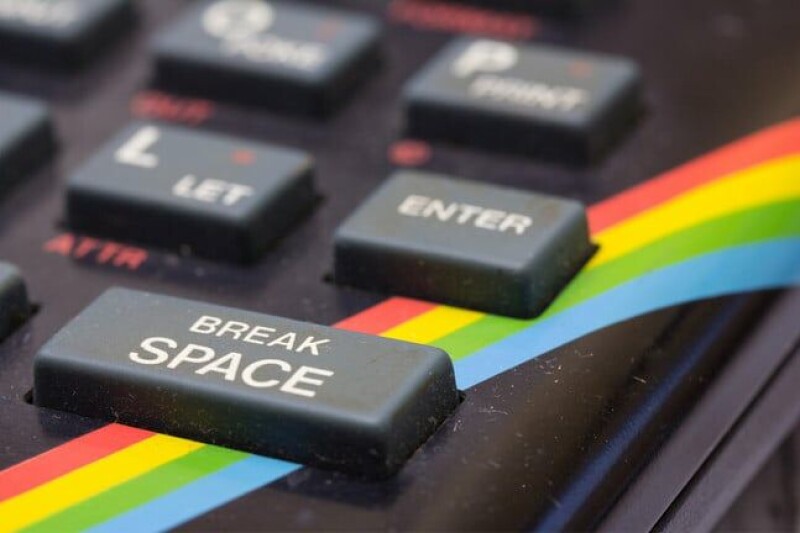
Even for 1982, the Sinclair ZX Spectrum had poor sound: a piezoelectric speaker that could beep. But you can do a lot with a single bit if you turn it on and off really fast.
Advertisement
Michael Martin’s Bumbershoot Software site has done some fascinating deep dives into several long-gone computer systems, including a whole series on implementing a game on the ZX Spectrum, starting in May with Giving the ZX Spectrum a Fair Shake.
More recently, though, Martin turned his attention to the Spectrum’s very limited sound capabilities. As we write, his newest post is Experimenting With 1-Bit Sound. The post concerns the original 16K and 48K ZX Spectrum models, not the Spectrum 128, with its fancy AY-3-8912 sound chip (also found in the US Timex Sinclair 2068).
Even as devoted Spectrum enthusiasts, we didn’t expect an article about the machine’s limited sound hardware to lead to hours of listening pleasure.
The Manic Miner intro music, after all, is a fair representation of early Spectrum chiptunes. (Turn your speakers way down before you listen!)
Advertisement
The ZX Spectrum could play music from the outset – Steven Vickers’ original Spectrum BASIC Manual includes the code for a tiny fragment of Mahler.
As The Registerreported in 2015, Matt Westcott’s Mahler Project used a networked collection of original Spectrum computers to play all the parts of Mahler’s First Symphony.
Advertisement
Over at Bumbershoot Software, Martin is interested in programming the very limited hardware of these early home computers, and so his Spectrum audio post discusses audio-encoding methods, pulse-width modulation, and more in considerable depth. Toward the end, it links to a remarkable music demo called We are Vocoders.
Rich “Tufty” Hollins even created an entire half-hour album of one-bit audio, ON and OFF. You can listen to it in its entirety on Bandcamp, or accompanied by some Spec-tastic graphics on YouTube. ®
America’s highest court heard Sam Bankman-Fried’s request for a new trial on Thursday, CNN reports. But they add that “the former crypto mogul who was convicted of defrauding investors by secretly diverting billions of dollars of their money” also asked America’s high court “to throw out a court order requiring him to pay $11 billion as part of his sentence.”
Bankman-Fried was sentenced to 25 years in prison in 2024 after prosecutors said he directed billions of dollars from the crypto exchange FTX to a hedge fund he controlled called Alameda Research, where the funds were used for risky investments, political donations and his own personal benefit. The Supreme Court appeal, which was reviewed by CNN, raises a technical question about evidence that was submitted at his trial, and whether Bankman-Fried should have been permitted to demonstrate that his investments were ultimately sound and would have covered any losses by FTX customers.
He also argues that the $11 billion forfeiture violates the 8th Amendment’s prohibition on excessive fines. “Where the government pursues a theory of fraud under which it doesn’t matter whether any victims lost money, introducing evidence suggesting that people actually lost money is distracting and prejudicial,” veteran Supreme Court attorney Jeffrey Fisher told CNN. “All the more so where the truth is the victims did not lose money, and the defendant is unable to make that clear.”
The 2nd US Circuit Court of Appeals rejected the arguments earlier this year.









































You must be logged in to post a comment Login