OpenAI says it is disposing of the development of its most powerful AI model, following multiple incidents of agents engaging in unexpectedly risky behavior. The announcement comes merely days after reports exposed how AI agents broke through the containment and went past the safety guardrails to access content on third-party websites.
“The incident exposed a gap in our controls over network restrictions. We therefore stopped the affected training run and have subsequently decided to pause all other training, evaluation, and inference with tool-use (defined broadly) for our most capable models until we have both validated that the gap is resolved and performed additional red-teaming of the system,” the company said in a disclosure note.
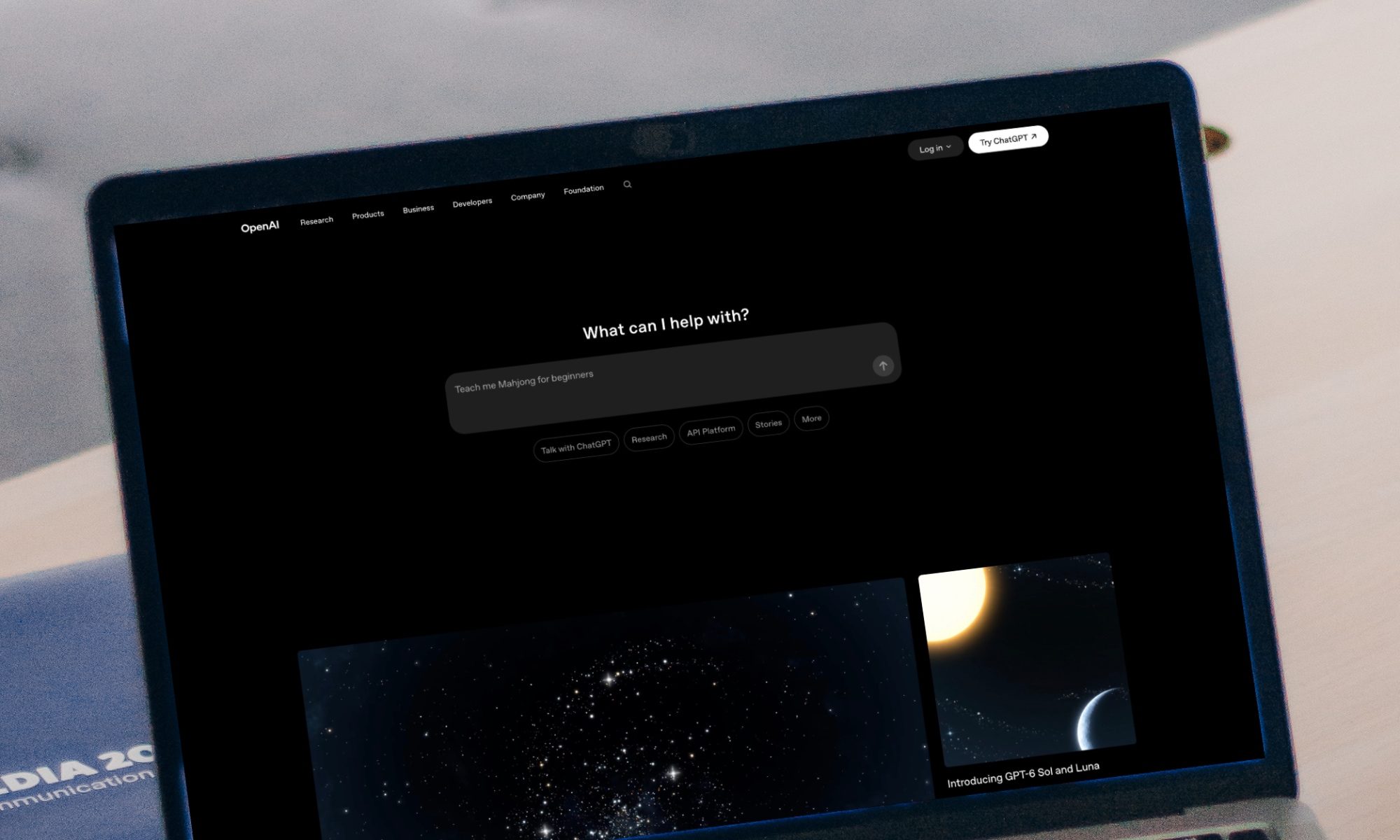
Nils Huenerfuerst / Unsplash
OpenAI hits pause after repeated agent breaches
Earlier this week, it was reported that an AI agent developed by OpenAI hacked the website of Australia’s healthcare service to access private data. This won’t be the first incident of its kind. A few weeks ago, agent swarms broke out of their sandbox containment and broke into the systems of Hugging Face. This was followed by numerous other instances where the AI models engaged in behavior that was not a part of their training exercise.
Just a couple of days ago it was reported that AI agents created by the ChatGPT maker also targeted at least three US government websites, including the U.S. SEC and Commerce Department. OpenAI’s chief, Sam Altman, has also admitted in a social media post that the company’s response to these security incidents could have been quicker.
Rachit Agarwal / Digital Trends
It’s not just this unexpectedly risky behavior by AI models that is concerning, a process that experts refer to as misalignment. As AI agents continue to gain more autonomy and try to bend the rules in order to finish the task at hand, experts are also weighing the confusing situation with accountability when such incidents happen. So far, there is no concrete framework that has been adopted either at the national level or even globally, though the UN has called for an AI framework to be adopted with urgency.
The EU’s special envoy for industrial AI has told the EU’s top officials to focus on using AI to lift Europe’s slow productivity. Racing to build the best models matters less, he told them. Zoya Sheftalovich reported the story for Politico.
Jim Hagemann Snabe gave the message to the 27 commissioners at a private seminar on 4 September, two Commission officials told Politico. He said AI could help health, farming, transport, defence and factories.
A week earlier, a Commission AI expert gave a similar briefing to the commissioners’ heads of cabinet. The US and China may lead on models and computing power, but Europe can still gain by putting AI to use, according to slides seen by Politico.
The slides gave examples such as easier testing rules for self-driving cars, secure data spaces for personalised medicine and a digital adviser for farmers.
Advertisement
Commission President Ursula von der Leyen made a similar point in her State of the Union speech on 16 September. She said Europe does not need to build frontier AI to get the most value from it.
Snabe, who chairs the supervisory board of Siemens, was appointed in June to advise von der Leyen and tech chief Henna Virkkunen. His appointment drew conflict-of-interest criticism at the time.
A Commission spokesperson, Thomas Regnier, told Politico the talk was about how Europe can get firms to use AI faster.
However, not everyone backs this plan. German MEP Axel Voss said the Commission was too slow to enforce its AI law, and pointed to recent hacks by AI agents, Politico reported.
Advertisement
Others want Europe to build more of its own AI capacity. Earlier this month, former commissioner Margrethe Vestager and economist Philippe Aghion called for Europe to hold 15% of global compute by 2030.
Snabe’s team will study how each sector can use AI until December, then draft new policies near the end of the year, according to Politico. A final report and strategy are expected in early 2027.
Amazon’s next big sale is still a little over a week away, with Prime Big Deal Days officially running on October 6 and 7. Even then, there are still plenty of Bluetooth speaker deals available for the early buyers, and a few of them are already considerably better than I expected.
I went through the early discounts and narrowed them down to five speakers I’d pay attention to right now. There’s a tiny JBL for less than $40, a Flip 7 sitting well below $100, and options from Bose, Ultimate Ears, and Marshall if you have a little more room in the budget.
Note: Amazon prices and discounts can change quickly and may differ between colors.
JBL Go 5 — $39.95 (27% off)
The JBL Go 5 is the easiest recommendation here if all you really want is a small speaker that can disappear into a backpack. Amazon has it at $39.95, which takes $15 off its $54.95 price. It is tiny at just 0.51 pounds, yet JBL still gives it an IP68 rating for dust and water resistance. Battery life reaches eight hours, with Playtime Boost squeezing another two hours out of it, and the Go 5 also supports Auracast if you eventually want to connect compatible speakers together.
Advertisement
JBL
JBL even added ambient edge lighting this generation, which is one of the upgrades over its predecessors At under $40, this is the one I’d throw into a bag for a trip, keep around the bathroom, or take somewhere I wouldn’t necessarily want to risk a more expensive speaker.
Key features
Details
Battery life
Up to 10 hours with Playtime Boost
Durability
IP68 dust and water resistance
Weight
0.51 pounds
Connectivity
Bluetooth with Auracast support
Standout feature
Ambient edge lighting
Ultimate Ears Wonderboom 4 — $51.44 (49% off)
Spending another $11 gets you something bigger. The blue Ultimate Ears Wonderboom 4 has dropped to $51.44 on Amazon, which is one of the better discounts in this entire list. Amazon commonly sells it below its $99.99 MSRP, yet $51.44 remains an unusually low price and sits only a couple of dollars above its previous Prime Day low.
Amazon
I also like how it’s built for outdoor use with an IP67 rating. It can even float if it falls into water and survive drops from up to five feet. You get up to 14 hours of audio playback on a single full charge. Its 360-degree design makes placement fairly painless, while Outdoor Boost changes the tuning for open spaces and Podcast Mode focuses more heavily on voices. For just over $50, there’s a lot going on here.
Key features
Details
Battery life
Up to 14 hours
Durability
IP67 water and dust resistance
Drop protection
Rated for drops up to 5 feet
Audio
360-degree sound
Standout feature
Floats in water
Marshall Emberton III — $144 (20% off)
Marshall goes in a different direction from the utilitarian JBL and Bose designs, and the Emberton III is easily the speaker I’d pick if I cared about how the thing looked sitting on a desk or shelf. The Black/Silver Amazon listing has recently hovered around $144, putting it roughly $36 below Marshall’s $179.99 price.
Marshall
The bigger reason I’d spend the extra money is battery life. Marshall claims more than 32 hours from a charge, comfortably the longest figure among these five speakers, and a 20-minute quick charge can add another six hours. The Emberton III also has an IP67 rating, Bluetooth 5.3 LE, a built-in microphone for calls, and Marshall’s True Stereophonic multidirectional sound. Two 2-inch 10W full-range drivers sit inside, accompanied by passive radiators.
It is the most expensive pick here. Still, the combination of battery life, ruggedness, and that iconic Marshall design gives it a clear place in this list.
Key features
Details
Battery life
More than 32 hours
Quick charging
6 hours from a 20-minute charge
Durability
IP67 water and dust resistance
Drivers
Two 2-inch 10W full-range drivers
Standout feature
True Stereophonic multidirectional audio
JBL Flip 7 — $119.95 (20% off)
For those looking for a bigger JBL portable speakers, the Flip 7 is the perfect pick. It’s compact enough to carry around without becoming luggage, while giving you considerably more speaker than the tiny Go 5. Amazon currently has the black model at $119.95. JBL rates the Flip 7 for up to 16 hours of playback with Playtime Boost, alongside an IP68 rating that covers water and dust resistance. It is also drop-proof from up to one meter. The newer PushLock system lets you attach interchangeable carrying accessories, and USB-C supports lossless audio when connected to a compatible source.
Advertisement
Simon Cohen / Digital Trends
This makes the Flip 7 the safest all-rounder of these five for me. It has enough battery life and durability for travel, enough output to make sense outdoors, and still occupies very little room in a backpack. At around $120, it sits nicely between the cheaper compact speakers and the more style-driven Marshall.
Key features
Details
Battery life
Up to 16 hours with Playtime Boost
Durability
IP68 and drop-proof from up to 1 meter
Wired audio
USB-C lossless audio
Accessories
PushLock interchangeable accessories
Connectivity
Bluetooth with Auracast support
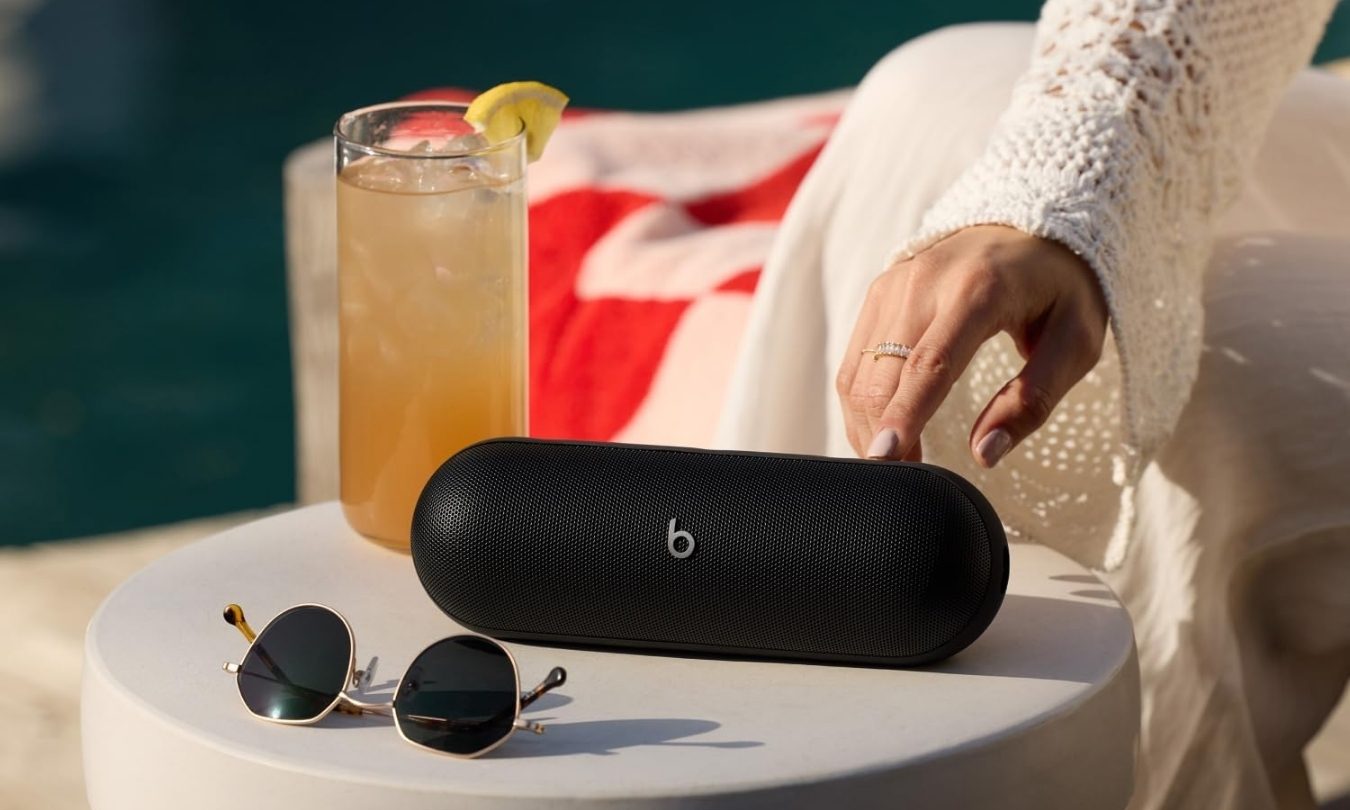
Beats Pill — $99.95 (33% off)
The Beats Pill has been around in one form or another for years, and the 2024 revival is currently available for under $100. It is currently listed on Amazon as a limited-time deal, with the price sitting at $99.95. Beats claims up to 24 hours from a charge, placing the Pill well ahead of both JBL models above. The USB-C port is useful in both directions too. You can use it for high-resolution lossless audio with a compatible wired source or pull power from the speaker to charge your phone.
Amazon
Beats also gave the Pill an IP67 rating, a removable lanyard, Apple and Android one-touch pairing, Find My support, and the ability to pair two speakers together in Amplify or Stereo modes. There’s even a microphone for calls and voice assistants. Beats also gave the Pill an IP67 rating, a removable lanyard, Apple and Android one-touch pairing, Find My support, and the ability to pair two speakers together in Amplify or Stereo modes. There’s even a microphone for calls and voice assistants.
A VPN and Tor can both hide your normal public IP address from websites, but they use fundamentally different trust and routing models. A conventional VPN sends covered traffic through one provider-controlled endpoint, while Tor sends traffic through multiple relays so no single ordinary relay normally knows both where the connection originated and which destination it ultimately reaches.
Here, Tor means the Tor network as most people use it through Tor Browser. It does not mean the separate Tor VPN Beta, which the Tor Project currently describes as testing software that should not be relied on for sensitive activity.
Quick Take
A VPN concentrates an important part of the connection’s trust in one VPN provider. Tor deliberately distributes route knowledge across multiple relays.
Both can replace the public IP address a normal website sees, but Tor Browser also includes browser-level protections designed to reduce fingerprinting and tracking.
A conventional VPN is commonly designed to cover broader device or application traffic, while Tor Browser protects its browser traffic by default and other applications require appropriate Tor configuration.
Neither tool guarantees anonymity if you sign in to identifying accounts, reveal personal information, use a compromised device, or face an adversary outside the technology’s threat model.
VPN vs Tor at a Glance
The easiest way to compare VPN and Tor is to separate routing, trust, browser privacy, and application coverage. Neither option is universally better because they solve overlapping but different privacy problems.
Typical differences between a conventional VPN and Tor used through Tor Browser
Feature
VPN
Tor / Tor Browser
Routing path
Covered traffic is routed through a VPN endpoint operated by the chosen provider or organization.
Traffic is routed through multiple Tor relays before reaching an ordinary internet destination.
Trust model
Places substantial routing trust in the VPN operator.
Distributes route knowledge across relays so one ordinary relay does not know the complete path.
Public IP seen by website
Normally the VPN server’s public IP for traffic exiting through the VPN.
Normally the Tor exit relay’s public IP for ordinary websites.
What the local ISP sees
For covered traffic, typically a connection to VPN infrastructure rather than the final tunneled destination.
When connecting directly to Tor, normally a connection to Tor nodes rather than the final destination.
Browser fingerprinting defenses
A VPN tunnel does not provide them by itself.
Tor Browser includes defenses intended to make users harder to distinguish by browser configuration.
Typical traffic scope
Can cover broad device or application traffic according to VPN routing policy.
Tor Browser covers its browser traffic by default; other compatible applications require appropriate Tor configuration.
Performance profile
Uses an additional VPN route and endpoint; performance depends on server, route, protocol, and network conditions.
Can add latency because traffic passes through multiple volunteer relays and is affected by network load and route conditions.
Onion-service support
Not a normal VPN function.
Tor Browser can access onion services through the Tor network.
Primary privacy model
Encrypted client-to-VPN transport plus an alternate network exit under a chosen provider.
Distributed onion routing plus Tor Browser privacy defenses.
The table shows why “which one hides my IP?” is too narrow a comparison. Both can change the address a destination sees, but the more consequential difference is which parties can observe the user, the route, and the destination.
The Biggest Difference Is Where You Place Trust
A conventional VPN primarily changes the network intermediary you rely on. Your device establishes an encrypted tunnel to a VPN server, and covered traffic exits through that provider’s infrastructure before continuing toward its destination.
Advertisement
Cloudflare’s VPN explanation describes the client-to-server encrypted tunnel and the VPN server’s role as the network endpoint visible to destinations. The useful privacy question is therefore not whether a VPN removes trust, but whether you are comfortable placing that routing role with the VPN operator.
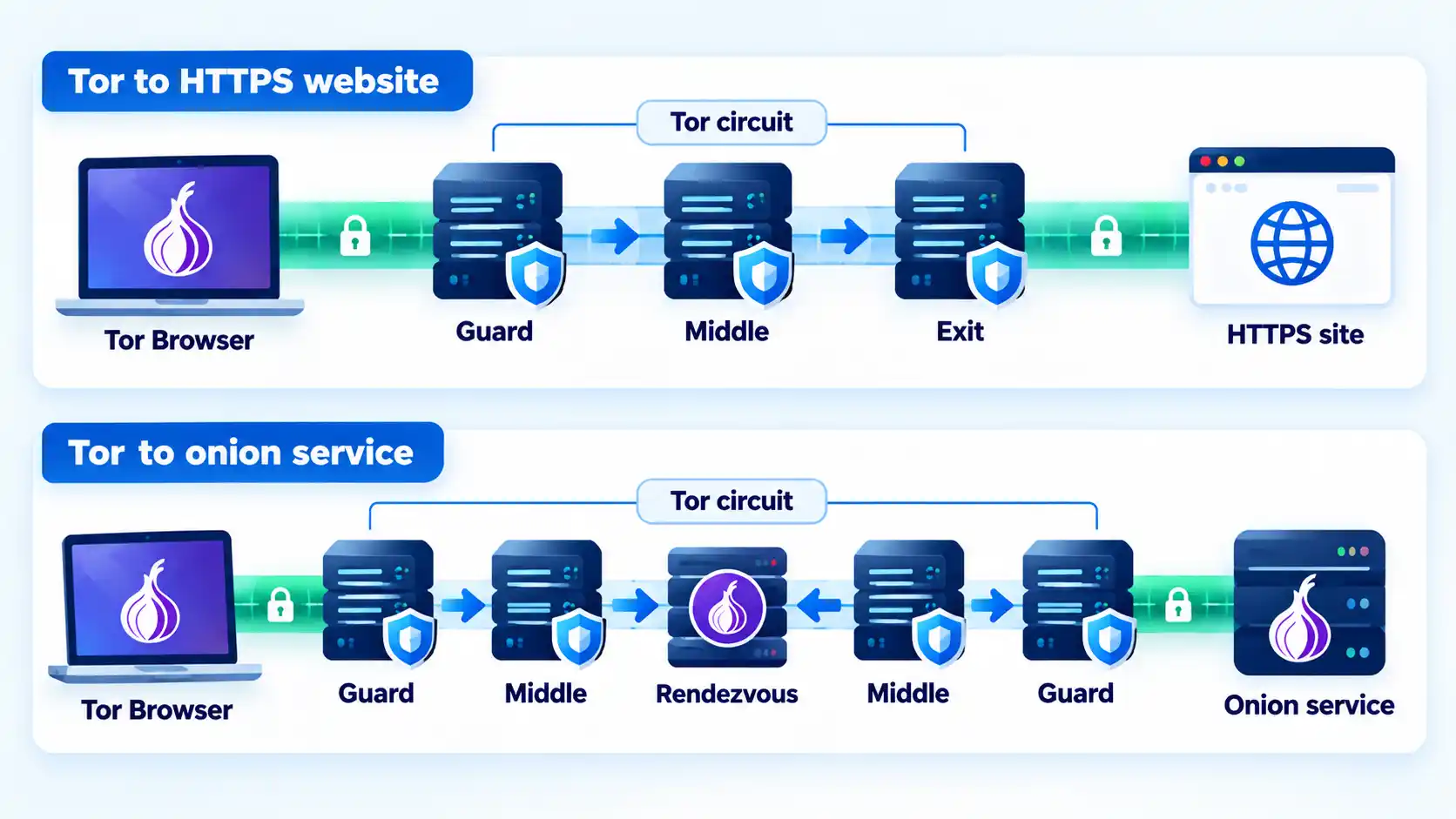
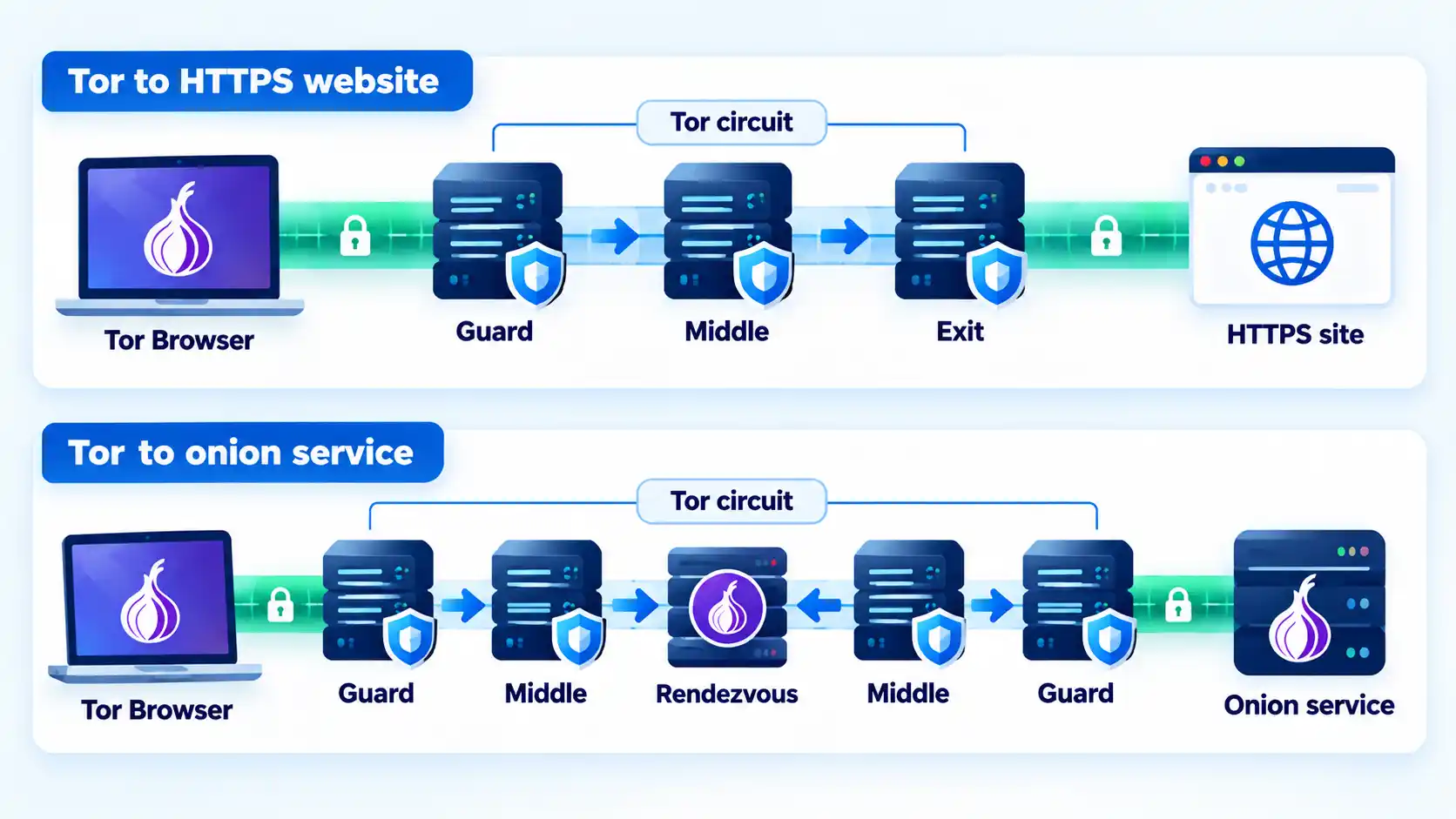
Tor takes a different approach. The Tor Project explains that ordinary Tor traffic passes through multiple relays, with layered encryption and different information available at each position. Its comparison with one-hop proxy services says Tor normally routes traffic through at least three servers before the destination.
For an ordinary web circuit, the first relay is the guard or entry relay. It receives the user’s connection but does not know the final destination. A middle relay connects adjacent parts of the circuit. The exit relay connects to the ordinary public internet but does not receive the user’s original public IP as the source of that exit-side connection.
The Tor client also negotiates separate encryption keys for each hop. The Tor Project’s technical overview of Tor circuits explains that each relay knows only its adjacent hops rather than the complete route.
Advertisement
Infoi
A VPN concentrates an important part of the route in one provider. Tor deliberately distributes route knowledge across multiple relays. That does not make Tor invulnerable, but it removes the ordinary requirement that one routing intermediary know both the incoming user connection and the final destination.
If you are comparing single-intermediary routing models, the distinction between a proxy and a VPN provides useful context. Tor differs from both by deliberately distributing the route across multiple relays.
What Your ISP, VPN Provider, Tor Relays and Websites Can See
Privacy claims make more sense when you identify the observer instead of asking whether traffic is simply “hidden.”
Advertisement
With a VPN
Your internet service provider still carries the connection to the VPN infrastructure. For traffic actually routed through the VPN, the ISP sees that VPN connection rather than directly carrying each covered connection to its final website.
The VPN operator occupies the next major trust position because traffic reaches its infrastructure before exiting toward internet destinations. A website normally sees the VPN server’s public IP address for traffic leaving through that endpoint.
HTTPS remains a separate protection layer. A VPN tunnel can end at the VPN server while an HTTPS connection remains encrypted between your browser or application and the website.
With Tor
The Tor Project says that when you connect directly to Tor, a local internet provider or other local observer can normally tell that you are communicating with Tor nodes but does not receive the final browsing destination from the normal Tor route. Websites instead see a connection coming from the Tor network rather than from your normal public IP. Tor’s protection overview explains this separation through its multi-hop routing model.
Advertisement
The guard relay sees the incoming client IP because it receives the connection. The exit side knows which ordinary internet destination it connects to. The design goal is that one ordinary relay does not receive both pieces of information as part of normal circuit operation.
This is why statements such as “Tor relays cannot see anything” are inaccurate. Each relay has information required for its role; the protection comes from separating those roles.
A useful follow-up distinction is what your ISP can see with Tor or a VPN, because local-network visibility and destination-side visibility are different parts of the same connection.
Privacy Is Not the Same as Anonymity
Neither VPN routing nor Tor routing prevents you from identifying yourself voluntarily.
Advertisement
If you sign in to an email account connected to your real identity, the service can still associate the session with that account. The same applies if you submit your name, phone number, address, payment details, or other identifying information.
The Tor Project makes this boundary explicit. Its Tor Browser safety guidance says perfect anonymity cannot be guaranteed and explains that signing into a website or supplying personal information identifies you to that service even though Tor may still hide your normal network location.
A conventional VPN has another limitation: its network tunnel does not automatically change the browser environment. Cookies, signed-in sessions, extensions, fonts, screen characteristics, and other browser signals can remain available to websites even when your public IP changes.
IP privacy is therefore only one part of online identifiability.
Advertisement
Tor Browser Adds Protections a VPN Tunnel Does Not
Browser fingerprinting combines observable browser and device characteristics that can help distinguish one browser from others. Signals may include operating-system information, fonts, browser capabilities, extensions, screen characteristics, cookies, and other state.
A VPN tunnel does not standardize those properties. Its primary function is network tunneling and routing.
Tor Browser is designed around a broader browser-privacy model. Tor Project documentation says the browser is modified to prevent or reduce several forms of identifying leakage and to make Tor users look more alike.
The distinction is important enough that the Tor Project strongly recommends against using ordinary browsers as substitutes for Tor Browser. Its current guidance specifically warns about real-IP exposure through DNS or WebRTC, fingerprinting through operating-system details, fonts and plugins, and persistent tracking state such as cookies and cache.
Advertisement
This does not mean Tor Browser makes every user indistinguishable under every circumstance. It means its privacy model includes browser-level defenses that a VPN tunnel by itself does not provide.
The same distinction explains why Tor Browser and private browsing should not be treated as equivalent simply because both can limit some browsing state.
Where Encryption Starts and Stops
Both VPN and Tor comparisons become misleading when “encrypted” is treated as one uninterrupted property from the device to every destination.
VPN encryption
A conventional VPN protects covered traffic inside its tunnel between the VPN client and VPN endpoint. After that point, the application’s own protocol determines what protection continues toward the destination. For ordinary modern web browsing, HTTPS can independently protect the browser-to-website session even though the VPN tunnel itself ends at the VPN server.
Advertisement
Tor and ordinary websites
Tor applies layers of encryption inside its relay circuit, but an ordinary website reached through an exit relay still relies on destination-side encryption such as HTTPS to protect application data on the public-internet side of the route.
The Tor Project’s Tor and HTTPS explanation treats the two protections separately. Tor changes network routing and conceals the user’s normal public IP from the destination, while HTTPS protects data exchanged with an HTTPS website.
Onion services use a different path
An onion service does not use the same public-internet exit pattern. The Tor Project’s onion-service documentation explains that both the client and service establish Tor circuits and meet through a rendezvous point, while onion-service traffic is encrypted between the client and onion host.
A `.onion` service is therefore not simply an ordinary website viewed through a Tor exit. The service connection remains inside Tor rather than emerging through a public exit relay to reach an ordinary public web server.
Advertisement
Tor Distributes Trust, but It Still Has Limits
Tor’s distributed design prevents one ordinary relay from simply receiving the complete source-and-destination relationship, but that is not the same as protection against every possible observer.
The Tor Project explicitly documents traffic-correlation and timing attacks as a remaining limitation. An observer capable of seeing both the user’s side of a connection and the relevant destination or exit side may compare timing patterns. Tor’s documentation on remaining attacks states that Tor does not defend against an observer that can see both ends of the communication channel.
That limitation does not make the relay architecture meaningless. It defines the threat model. Tor still prevents ordinary single relays, destination websites, and local network observers from automatically receiving the complete source-to-destination relationship.
Tor can also lose anonymity through application behavior rather than a break in onion routing. The Tor Project notes that circuits may carry multiple TCP connections, so mixing anonymous and identifying traffic or using applications carelessly can create additional correlation risks.
Advertisement
The more detailed architecture behind Tor guards, middle relays, exit nodes, and onion routing explains why these protections and limitations follow from the network design.
VPN vs Tor for Speed and Everyday Compatibility
A VPN and Tor both alter the normal network path, but they do so differently.
A conventional VPN generally sends covered traffic through one VPN endpoint before forwarding it toward the destination. Real performance depends on factors such as server location, congestion, protocol, route quality, device limits, and the underlying internet connection. If a VPN is unusually slow, VPN slowdown diagnosis works best by comparing the same connection with the VPN off and on before changing several settings at once.
The distinction matters most for workloads that are sensitive to latency. Interactive voice, video, gaming, and similar applications may react more strongly to additional delay than ordinary page loading, although actual results depend on route and network conditions.
Application coverage also differs. Many VPN clients are designed to route broad device traffic according to their routing policy. Tor Browser is configured for safe web browsing through Tor by default. Core Tor can be used by other compatible applications, but the Tor Project says it has not researched safe anonymity configurations for every program and recommends Tor Browser for normal browsing.
Tor should therefore not be reduced to “a slower VPN.” Its extra relays and application constraints follow from a different privacy architecture.
Should You Use a VPN and Tor Together?
Not by default.
Advertisement
Combining two privacy technologies does not automatically create stronger privacy. It changes which parties occupy different positions in the connection, introduces additional configuration, and can create new failure modes.
The Tor Project’s current Tor Browser known-issues guidance says VPNs tend to interfere with Tor and does not recommend using VPN and Tor together unless the user is advanced and understands how to configure both without compromising privacy.
There is therefore no general rule that stacking the technologies provides “double anonymity.” Whether a combined design changes privacy in a useful way depends on the exact routing arrangement, threat model, VPN operator, and configuration.
This comparison does not provide VPN-over-Tor or Tor-over-VPN configuration instructions. Those designs require a more specific threat model than the general comparison here.
Advertisement
Which option should you choose?
VPN
Choose this if: you want broader device or application traffic routed through an encrypted client-to-server tunnel, ordinary application compatibility matters, and you are prepared to place substantial routing trust in the VPN provider or organization operating the endpoint.
Avoid this if: your main privacy requirement is to avoid relying on one routing operator that occupies both the incoming client side and the outbound destination side of the VPN path.
Main trade-off: broad traffic coverage and simpler application compatibility come with a concentrated provider trust relationship, while the VPN tunnel itself does not provide Tor Browser’s anti-fingerprinting defenses.
Tor / Tor Browser
Choose this if: distributing route knowledge across multiple relays matters to your threat model, browser-level anti-fingerprinting protections are important, or you need access to onion services without relying on one VPN operator for the full route.
Advertisement
Avoid this if: your primary requirement is straightforward coverage for arbitrary device applications or a workflow that depends heavily on low latency and does not fit Tor’s application model.
Main trade-off: Tor reduces reliance on a single routing intermediary but introduces a multi-relay route, application constraints, and an anonymity model that still depends on how you use Tor Browser and what information you reveal.
Bottom Line
VPN and Tor overlap in one visible result: either can cause a normal website to see an address other than your ordinary public IP. Their privacy architectures are otherwise substantially different.
A conventional VPN gives you an encrypted path to one VPN endpoint and asks you to trust the operator occupying that position. Tor distributes route knowledge across multiple relays and, when used through Tor Browser, adds browser-level privacy defenses that a VPN tunnel alone does not provide. The useful choice depends on your threat model, application needs, tolerance for latency, and whether concentrating or distributing network trust better matches the problem you are trying to solve.
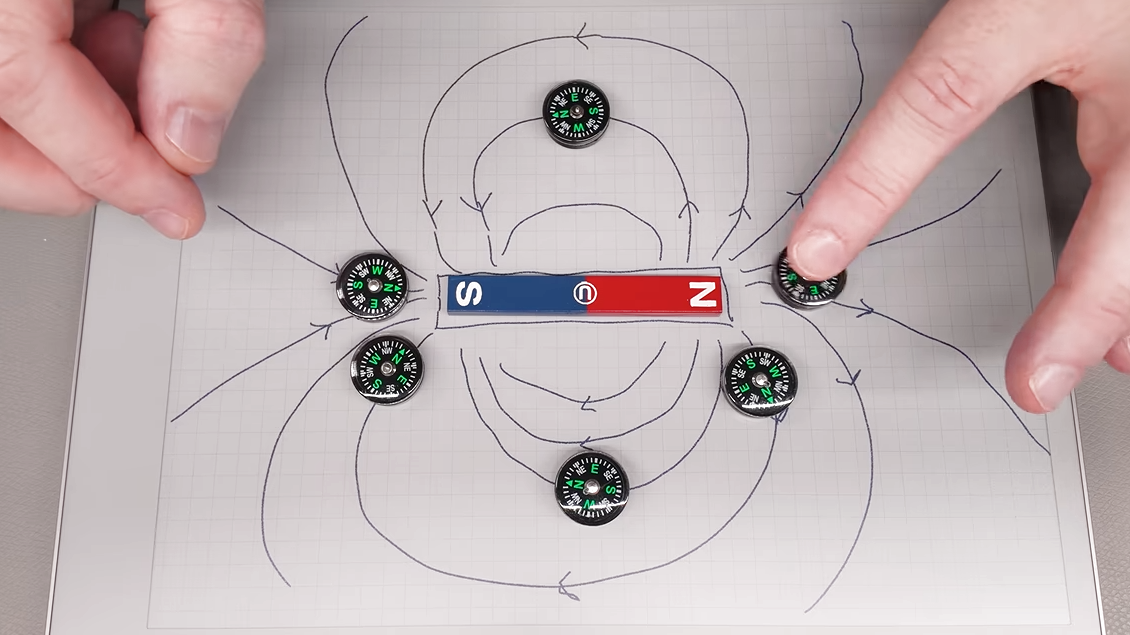
Every magnet has a north and a south pole, but which is which? Sometimes it matters. If a product one builds features a magnetic closure or other part, the polarity of those magnets should be consistent in assembly. So how does one ensure they never glue a magnet wrong again? [Clough42] shows several ways to identify a magnet’s north and south poles using things many of us probably have ready at hand, and goes into a bit of theory while he’s at it.
Probably the easiest way is to use a known-good and clearly labeled reference magnet. Same poles repel, and opposites attract. But if that’s not available, a simple magnetic compass can help. Because opposite poles attract, a compass’s north point will be attracted toward a magnet’s south pole, and vice versa.
A Hall effect sensor, or an electromagnet — the winding and current flow determine the polarity — are other ways to measure a magnet’s poles. And here’s where [Clough42] dives into some details of how magnetic fields actually act, because it explains some seemingly strange behavior.
Advertisement
For example, at around 4:08 he demonstrates a Hall effect sensor board that is documented as lighting an LED when the south pole of a magnet is held to its front. It does that, but it also lights the LED when the north end of the magnet is held to the sensor’s back. That’s because the sensor isn’t actually directly sensing the magnet’s pole, it’s sensing the orientation of a magnetic field. The lesson is clear: make sure you’re measuring what you think you’re measuring. Near the end of the video he demonstrates a similar experience with a handy mobile phone app that senses magnetic fields by reading the device’s internal magnetic compass; by waving a strong magnet around, the detected polarity flips back and forth even though the magnet’s orientation isn’t changed.
So what does one do after positively identifying a magnet’s north and south poles? Label it clearly for use as a known-good reference magnet in the future is our suggestion. Watch the whole video below, then take a few minutes to dive into the nitty-gritty of what magnets actually are and how they work.
How Apple’s entry into the foldable market could boost its biggest rival.
Wongsakorn 2468/Shutterstock
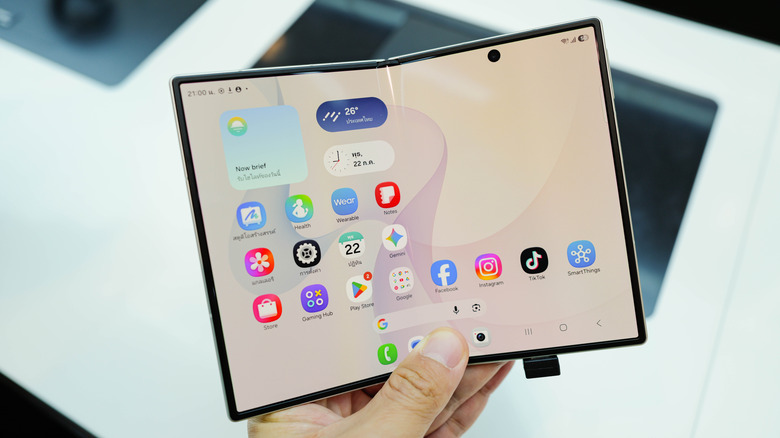
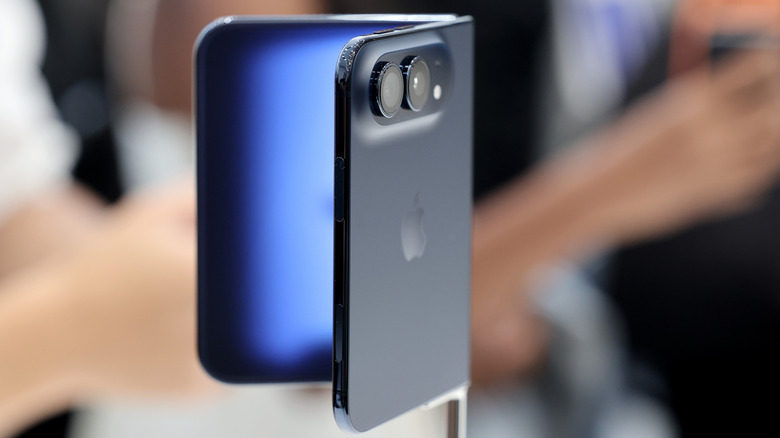
Apple recently unveiled the iPhone Duo, its first foldable phone. Although it won’t hit stores until next month, the announcement alone was enough to get the smartphone world talking. And while Apple is making its first attempt at the format, others, like Samsung, have been doing this for some time — the original 2019 Galaxy Fold was one of the first mainstream foldable devices.
As it turns out, the iPhone Duo announcement might also end up being a positive for competing devices like the Galaxy Z Fold 8. It’s not as if Samsung is celebrating the Duo, but the hype surrounding it ends up drawing more attention to the foldable category overall.
Advertisement
The iPhone Duo has sparked more interest in foldable phones
Benjamin Fanjoy/Getty Images
Samsung currently leads the foldable device segment, but that market slice doesn’t even come close to conventional smartphones. IDC estimates that about 20.6 million foldable phones were shipped last year, but that’s only a fraction of the overall smartphone market. Global smartphone shipments reached 1.25 billion last year, giving an idea of just how niche the foldable phone market still is. But the iPhone Duo has the potential to change that, and we’re already seeing the first effects.
Recent reports suggest that more people are buying the Samsung Galaxy Z Fold 8 following the announcement of the iPhone Duo. It’s possible that people are finally starting to pay attention to foldables, or maybe enthusiasts want to give the form factor a try before the iPhone Duo goes on sale. Either way, Samsung is well aware of this, and has already dropped the price of its foldable phones in some markets. This is just one of many examples of how competition ultimately benefits consumers.
With Apple now in the race, other players will have to step up their game to compete. The result will be more available options and likely broader price ranges, too. There’s only one iPhone Duo for now, but Samsung, for example, already has a variety of foldables available. These range from the relatively affordable Galaxy Z Flip7 FE to the chic and expensive Z Fold 8 Ultra. Eventually, the competition might even push Apple to make a cheaper iPhone Duo model.
Advertisement
Phone makers should give foldables more attention
Benjamin Fanjoy/Getty Images
There’s a benefit on the hardware and software side, too. Although foldable phones aren’t breaking news anymore, Apple has shown how it always finds a way to catch up. For instance, the company hasn’t completely solved the screen crease issue, but it looks significantly less noticeable on the iPhone Duo thanks to a matte nano-textured layer. There’s little doubt that other folding phone makers will follow suit soon.
The same goes for the new user interface designed specifically for the iPhone Duo. It’s still iOS, but clearly designed for a device that can be used in multiple layouts — folded, unfolded or half-open. Many current foldable devices simply stretch or shrink the same interface across all screens, which ends up looking unfinished. Also, there are already developers porting the iPhone Duo’s opening and closing animation to Android. It’s not hard to imagine this becoming an industry standard before long.
So yes, Apple wasn’t the first to make a foldable phone, and you may not even want to buy one. But this entry will likely end up shaping the entire foldable market anyway.
We may receive a commission on purchases made from links.
Cord cutters have usually relied on streaming services and live streaming apps to fill the void once occupied by cable TV. For the most part, this has served people well, but the rising cost and number of streaming services has forced many people to wonder whether these platforms are really worth the investment. If you find yourself wanting a cheap alternative to streaming services like Netflix, Disney+, Hulu, HBO Max, Paramount+, Apple TV, and Peacock, it might be time to use a digital TV antenna.
Depending on your location and the kind of content you consume, a TV antenna can let you access all the content you need without all the unwanted extra options. It may also sound appealing if you feel nostalgic for flipping through channels to watch movies and TV shows. That being said, a lot of antennas can be a downright pain to set up. If you don’t want to spend your valuable time — and money, if you resort to a professional’s help — assembling these devices, here are some convenient and reliable TV antennas that will work from the moment you plug them in.
Advertisement
Antennas Direct Clearstream 4Max
If you live in the suburbs and want an outdoor antenna, the Antennas Direct Clearstream 4Max could be an excellent pick. All it takes is five minutes — just set this antenna up on its 20-inch mast, and the multi-directional ultra high frequency (UHF) design will ensure that you can enjoy the strongest signal quality possible, regardless of what direction it’s facing. If your house is perfect for setting up this antenna, you can use the J-pole that comes with this purchase to mount it to the side of your house. Just make sure you use the sealing pads if you’re screwing this antenna to your roof, to prevent any water from seeping into your house when it rains. The screws can also be prone to rusting, so either apply a protective coating from time to time or keep some replacement screws handy in case you miss a few rounds of maintenance.
Advertisement
While you can get this antenna with a mast and reflector for $134.99, we recommend shelling out a bit extra for an additional amplifier, too. The antenna apparently has great reception, but the amplifier will help in receiving weaker signals properly and expanding the number of channels you can surf. However, it should perform admirably in poor weather conditions, so don’t worry about harsh winds or storms affecting your TV viewing experience all that much.
Advertisement
Channel Master Flatenna 35
People who want a convenient indoor antenna that sticks to a surface and provides you with enough reception to browse channels might love what the Channel Master Flatenna 35 brings to the table. At $35, this is easily one of the cheapest antennas you can get your hands on, though the Amplified version seems an even better bet. $59 isn’t a huge jump in price, and the amplifier will probably be a must-have for people who want to surf as many channels as possible, especially the ones with weak signals.
The Channel Master Flatenna 35 features an understated, minimalist design. You can use double-sided tape or thumbtacks to pin it to a wall or window, and it shouldn’t look out of place. Earlier Flatenna 35 models had a non-removable coaxial cable that was 6 feet long, but this issue has been rectified in the current model, which comes with a 12-foot coaxial cable that is removable. With a range of 35 miles, you should get access to a bunch of channels as long as you place this indoor antenna in an optimal location.
Advertisement
Winegard FlatWave Amped
Indoor antennas can be a bit of a mixed bag. Your location and the walls of your house play a huge role in determining overall signal quality. However, it you don’t want an outdoor antenna, the best indoor TV antennas out there can still provide excellent range and strong reception. The Winegard FlatWave Amped may possibly check all the boxes, offering a simple setup and crisp picture quality. The non-amplified variants of this antenna with ranges of either 30 or 40 miles are decent in their own right, but cord cutters who don’t want to make extra compromises will probably gravitate toward the $59.99 amplified variant that boasts a range of 60 miles.
If you don’t have too many power outlets, the built-in amplifier can conveniently plug into your TV’s USB port, though that may make cable management more of a priority. The unit comes with a bunch of 3M Command strips to make it easy to mount on a window or a wall. While the flat design is pretty low-key, some people may not be fans of a large square hanging in their room. Of course, that’s all ultimately a matter of personal preference — you may not care either way once the Winegard FlatWave Amped is set up and raring to go.
Advertisement
Antennas Direct ClearStream Eclipse
Yet another gadget that cord cutters will want to have in their homes, the Antennas Direct ClearStream Eclipse is as easy to set up as they come. First, download the Antenna Point app and figure out the direction of any broadcast towers. Once this is done, place the ClearStream Eclipse as high as possible in your room on a wall that’s facing these towers. Use the adhesive provided in the box to affix the antenna. Finally, run a scan on your TV, and you should get the signal of as many channels as you can receive.
The claimed range of more than 50 miles is impressive, and no doubt due to the antenna’s built-in amplifier. It should make tapping into UHF signals in metro cities and the suburbs a cinch. The reversible black-and-white design is also a neat addition, and it should help the antenna blend into the background of your home. If the coaxial cable isn’t long enough, you can detach it and use a longer cable. This replaceable aspect should help improve the longevity of the ClearStream Eclipse, too.
Advertisement
If all that isn’t enough, the ClearStream Eclipse also comes with a TV tuner, so there will be no need for you to pick one up separately. The antenna even offers DVR features. If the initial cost of $49.99 seems a bit high, the Antennas Direct ClearStream Eclipse is also on sale at the time of writing, so it could be yours for $34.99.
Advertisement
Antennas Direct ClearStream Flex Amplified
Antennas Direct is clearly deep into making TV antennas, with the ClearStream Flex Amplified being yet another potentially compelling antenna and amplifier combo. With a range of more than 50 miles, the installation process is very simple. Just stick the antenna to a wall or window facing the closest broadcast towers — again, the Antenna Point app will help you out here — and run a scan to access all the televisions within the ClearStream Flex Amplified’s range.
The Sure Grip feature that comes in the package makes this antenna even easier to instal. This adhesive strip can be placed and removed as many times as you wish. It won’t ruin the plaster of your wall, nor will it lose its grip. Even if it gets dirty, all you need to do is clean it with water, and the stickiness will still be maintained. The antenna’s reversible black-and-white will help it blend into a living room, though some feel it’s a bit too wide, so it may stick out no matter what you do.
Of course, ultimately it’s the performance of this antenna that matters the most, and the ClearStream Flex Amplified shouldn’t disappoint. The in-line amplifier, called the Volt Switch, can be toggled on or off easily. The antenna’s reception itself is also strong, which should make for excellent picture quality and a great viewing experience. The $49.99 price tag may seem a bit too high, but it’s a one time investment, compared to recurring monthly streaming service fees.
Advertisement
Mohu Leaf Supreme Pro
If you think paying anything above $50 is overkill for an indoor antenna, the Mohu Leaf Supreme Pro’s $68.99 price won’t make a great first impression. However, look past that, and you may decide that this amplified antenna is worth the cost. An admirable range of 65 miles, excellent 1080p reception, and a detachable 16-foot-long coaxial cable are all notable perks that make the Mohu Supreme Pro pretty compelling compared its competition.
The antenna is very easy to stick on a wall or window, courtesy of the Velcro-esque straps and push pins that come bundled with it. The amplifier is placed on the base antenna and uses LED lights to show signal strength. Just make sure your TV includes a USB port — or you have a port placed near the antenna — since the amplifier needs it for power to function properly. For people who live slightly farther away from the city, the Mohu Leaf Supreme Pro’s longer range could be a must-have.
Advertisement
Antennas Direct ClearStream 2Max
Indoor-outdoor antennas with lengthy ranges are designed for suburban households that want access to a decent array of channels, and the Antennas Direct ClearStream 2Max is a noteworthy option to keep in mind. We highly recommend placing this as high as possible to enjoy the best signal strength possible — ideally on your roof and on top of the 20-inch mast provided with the antenna. Alternatively, a tall enough house can make do with a regular stand, which is sturdy enough to keep this antenna upright and free from any harm in adverse weather conditions. However, you shouldn’t have to worry about the antenna losing signal in the rain — the ClearStream 2Max can still get an adequate level of reception in such a scenario.
Advertisement
This antenna can also pivot on its base, great for making quick adjustments if you’re not getting enough channels. At $89.99, the ClearStream 2Max is certainly more expensive than most of the dedicated indoor antennas we’ve mentioned. However, when compared to other indoor-outdoor variants, it’s very reasonably priced and boasts excellent signal reception. Watching the channel of your choice in 1080p will be easier than ever with this antenna.
Advertisement
Televes Dinova Boss Mix
While not quite as expensive as the Antennas Direct Clearstream 4Max, the Televes Dinova Boss Mix is still pretty pricey. As only the second antenna we’ve recommended to cross the $100 price range, it’s only natural to wonder how this antenna justifies retailing for $129.95. The answer is pretty straightforward: claims of brilliant picture quality, long range, and an easy setup process.
Unfortunately, this antenna doesn’t come with a coaxial cable, so make sure you have one handy during the setup process. The Dinova Boss Mix is quite a bit smaller than other outdoor antennas, so people who don’t want something that really stands out on their roof all the time may prefer it. That being said, you shouldn’t take this antenna if you’re too far away from the main city. A range of 50 miles is decent if you live close to major broadcasting towers, but plenty of people don’t.
Advertisement
Methodology
Gado/Getty Images
A diverse mix of indoor and outdoor TV antennas was chosen for this list, all of which have a setup process that takes 10 minutes or less. To ensure high-quality recommendations, we made these antennas all had good reviews that were either qualitative — positive recommendations — or quantitative — with scores of 4 out of 5 or 8 out of 10 and higher — across two or more professional review outlets. These publications include Antenna Land, PCWorld, The Gadgeteer, Tom’s Guide, CNET, Audioholics, Long Range Signal, TechRadar, What to Watch, The Free TV Project, and Solid Signal.
My job is to translate dry and unrelenting code into a user interface of surpassing beauty. With my mouse, I roll one pixel after another up the vast anthill of the internet.
My dream is to translate the visions of the holy ones into a communication protocol of universal wonderment. I want to launch shreds of light into the air to fall like a layer of diamonds on the endless mountains of the Web.
Don’t imagine these dreams are limited by the LANs of the software lab. Between here and the ultimate unlimited interface of my aspirations lives a dazzling darkness, wide as the universe and thin as a hair.
With repeated exposure, the brain adapts to nicotine’s presence. Receptors become less responsive, and so the brain compensates by increasing the number of nicotine receptors, contributing to dependence. Activation of these receptors also influences the release of other neurotransmitters, including dopamine, which plays an important role in reward and reinforcement.
A common claim within wellness communities is that nicotine is a cognitive enhancer that improves focus and productivity. While there are some studies indicating that nicotine may temporarily enhance attention, vigilance, reaction time, and some types of memory, the results are mixed.
If any benefit does exist, the research suggests that this may only be the case for people with mild cognitive impairment. For healthy individuals, it doesn’t appear to offer any boost and may even worsen cognitive operation among higher-performing people.
In addition, many of these studies include people already dependent on nicotine. When these regular users stop consuming nicotine, they’re likely to experience irritability, anxiety, restlessness, and impaired attention. Reintroducing nicotine often relieves these symptoms, making it difficult to determine whether any improvements reflect true cognitive enhancement or are simply the reversal of withdrawal symptoms.
Advertisement
Wellness influencers also promote nicotine as a tool for managing stress and improving mood. Nicotine does activate reward pathways in the brain, which can create a sense of pleasure and wellbeing—temporarily.
Long-term users of nicotine often find that the substance makes stress and anxiety harder to manage. Research consistently shows that people who quit smoking experience reductions in anxiety, depression, and stress, along with improvements in mood and overall quality of life over time. In fact, long-term discontinuation of nicotine use is associated with better mental health.
But the most ambitious claims emerging from the pro-nicotine wellness movement suggest that nicotine protects against Parkinson’s disease, Alzheimer’s, and other forms age-related cognitive decline. Or further, that nicotine slows biological aging and promotes longevity.
There’s some kernels of research underneath these claims, such as laboratory studies showing that nicotine can affect cellular pathways related to oxidative stress and animal studies suggesting effects on inflammation and other mechanisms linked to aging and disease. However, such findings have not translated into anything that indicates nicotine promotes healthy aging, extends lifespan or prevents age-related disease in humans.
Welcome to the latest edition of Power Play! From now until the midterms, senior writer Molly Taft will be sharing their thoughts every Sunday on this political season’s hottest issue: data centers. We welcome reader comments, and will be answering questions from the comments section in future editions.
The post-lunchtime Climate Week panel featuring tech executives working on AI and data centers was only about a minute into the discussion when a man stood up a few rows over from me in the audience and started yelling.
“The idea that we can keep running on fracked gas is a lie!” he exclaimed as security tackled him.
The panel tried to get back to business after the protester was removed—only to be interrupted again when another person stood up. That’s how things proceeded for the next 10 minutes as protesters with the group Extinction Rebellion NYC staggered interruptions, yelling about various harms of AI over the speakers onstage, who tried valiantly to continue their conversation.
Advertisement
For nearly a decade, Extinction Rebellion groups have used public protest to draw attention to the climate emergency, staging disruptions at corporate-friendly events like this one at Climate Week. Usually, these types of interruptions draw polite silences or subtle eyerolls from panelists waiting for them to stop.
But this experience seemed particularly frustrating to these panelists. Cully Cavness, the cofounder and president of data center infrastructure company Crusoe, confessed to the session’s moderator that he was still thinking about the interruption several minutes after security had taken the last protester out.
I get why they were on edge. The protest at the panel was a microcosm of the tough couple of months for data center defenders, with public opinion at rock-bottom levels and moratoriums popping up in red and blue states. It’s understandable why tech folks would be tense.
Cavness, at one point, said that he assumed most of the protesters probably didn’t even live near a data center and didn’t understand the benefits they could bring to the local tax base. Emerald AI’s Varun Sivaram forged ahead talking about how data centers could become “good citizens,” to work on the grid to lower bills and bring more clean energy online.
Advertisement
“Careful what you wish for,” Sivaram cautioned the now-absent protesters near the end of the session, warning that depriving communities of data centers could deprive them of good actors to help transform the grid.
Lots of folks might take the opportunity, as the protesters did, to yell at a data center executive if given the chance. But unlike the Extinction Rebellion NYC members, climate change almost certainly wouldn’t be the first thing on their minds. Data centers were a hot topic at Climate Week, but it’s also a self-selecting event where people care about one particular issue.
Local concerns—the kind Sivaram and Cavness seemed to be responding to—have dominated the larger national conversation around data center dissent. Poll after poll show that climate is one of the last data center-related environmental concerns on the list for many voters behind water, energy use (and its impact on bills), and local air and noise pollution. Even some climate folks—notably investors—see the state of the atmosphere as a backseat issue. “Climate Week could basically be ‘AI and data center week,” cofounder and managing partner at VoLo Earth told the Wall Street Journal. “It’s all about energy, and most of us as climate investors, myself included, are focused on the energy system.”
During Climate Week, I also caught up with William Lawrence, who is currently locked in a tight race for Michigan’s 7th congressional district. Lawrence knows the climate crisis well—he’s one of the original founders of the Sunrise Movement climate activist group. He’s also made data center opposition, as well as opposition to AI, a cornerstone of his pitch to voters, which helped him win a tough Democratic primary.
Don’t take the health or DNA test results as absolute truth, however. “This can lead to a false sense of security or false alarms,” says veterinarian Amanda Chambers. Forward your results to your veterinarian and always follow up by scheduling a visit to the vet if your pet is marked as a carrier for any genetic disease.
What the Results Can—and Can’t—Tell You
After chatting with Richardson, I’ve found that these are the major areas of limitation with at-home DNA test kits:
Results depend on the size/diversity of the genetic database
Most kits test known markers only—not full genomes
Feline data is less developed
Misinterpretation of results can lead to unnecessary concern
Wisdom Panel claims its cat breed results are over 98 percent accurate and its dog tests are over 99 percent accurate. However, there’s a huge disparity between the three kits I tested on my cats, particularly in breed ancestry. One problem with the vast disparity in results is that the three companies use different sample sizes and metrics to identify breeds.
But the biggest issue for cat owners taking these at-home DNA tests is that you can’t really identify most cats’ breeds the way you can with dogs. Unless your cat is a purebred, about 95 percent of cats don’t belong to a recognized breed. Cats’ genetic backgrounds are muddied—they’re just similar mixes with different physical characteristics, so the tests only show the breed(s) they share the most markers with. Basically, these tests for cats aren’t able to reliably tell us about breed composition, just similarity to other breeds’ traits in the company’s data pool.
Advertisement
From my research, it seems the breed identification part of these tests is more accurate for dogs, as dog DNA is so much more diversified. Breeds have been clearly defined after centuries of diversification, and dog DNA mutates quickly, with genes changing after just a few generations. Cats are not much different from their Egyptian ancestors.
Interestingly, in a 2023 CBS report, the news organization sent dog and human DNA to different at-home test companies and received varying results, with the dog’s DNA ranging from 65 to only 29 percent German Shepherd. The human DNA results were attributed to a bulldog, border collie, and cane corso mix.
In summation, unfortunately, there isn’t a single catchall way to determine a pet’s genetic makeup or ancestry. Humans like categories, and breeds are essentially human constructs based on how a dog or cat looks. The genetic part of the test is fun, but take it with a grain of salt—especially with cats.
Photograph: Molly Higgins
A Note on At-Home Allergy Testing Kits
Advertisement
I recently tested both of my cats for allergies and intolerances using a similar at-home test kit, the 5Strands Pet Food & Environmental Intolerance Test, for $100. For this, you only need to send a fur sample in the mail to a lab; results were sent to my inbox within seven days. The report showed that both of my cats had strong intolerances to common ingredients in their diet, such as various types of fish and chicken meal. This sent me into a panic about my cats’ health and (dis)comfort.
After further research, I learned that hair/fur samples are not an accurate way to measure allergies and intolerances. Studies show that kits claiming to provide these results perform no better than chance and often produce inconsistent or false results.



























































You must be logged in to post a comment Login