

Tech
Rivian and Lucid Win Right to Sell Their EVs Directly to Buyers in Washington State


The Wall Street Journal reports that Rivian “just won a yearslong battle with car dealers in Washington state that threatens the model of how cars are sold.”
After fighting to sell its vehicles directly to buyers, Rivian threatened to take its case to voters with a ballot measure to permit direct sales. The dealers blinked. The state’s dealer lobby not only dropped its opposition to a sales loophole for Rivian and rival EV-maker Lucid, but also encouraged lawmakers to approve one. The measure became law this month…
New auto entrants like Rivian, and Tesla before it, have spent years contending with long-established U.S. state laws that require new cars to be sold through independent franchised dealers. The auto startups — typically makers of EVs — argue that they can offer a better experience by selling directly to consumers, much as Apple sells iPhones through its own stores and online. Rivian CEO RJ Scaringe has said the company is committed to direct-only sales because it’s more profitable and gives the company control over how its vehicles are sold, marketed and maintained. The Washington compromise riled traditional automakers, including General Motors, Ford and Toyota, which lobbied against it, arguing it unfairly advantages startups. A trade group representing the automakers called it discriminatory and argued the exception could one day open the door to Chinese EV makers…
German automaker Volkswagen is currently facing several lawsuits from dealers over its plan to sell new Scout vehicles directly to consumers. Dealers say independent franchises are vital to the car-buying process, creating competition between dealerships that keeps prices affordable for consumers, while providing valuable services such as repairs, warranty work and financing… Yet for Washington’s dealers, the prospect of putting franchise laws up for a popular vote laid bare a tough reality: given the choice, many car buyers want the freedom to avoid dealerships. Rivian’s polling, which the company shared with lawmakers, showed nearly 70% of respondents favored allowing direct sales when asked whether they would support manufacturers selling cars directly to consumers…
The fight comes at a critical time for Rivian, which is launching a new, more affordable SUV in a bid to make consistent profits amid a downturn in U.S. EV sales… Rivian is able to directly sell cars in roughly half of U.S. states, but a number of them limit how many locations the company can operate. They can’t disclose the price, though. For that, customers must go online.
The article notes that “Following the win, Rivian executives are eyeing other states that, like Washington, ban direct sales but also allow ballot initiatives: Arkansas, Ohio, Oklahoma, Montana, Nebraska and South Dakota…” It adds that lawmakers (from both parties) in the state of Washington had said “they have long felt pulled between giving consumers more car-buying freedom and protecting dealers, essentially small-business owners who are vital to local economies — and politically powerful.”
But an executive at the Washington State Auto Dealers Association said dealers supported this new law partly because it protects them by barring future automakers from selling directly in the state, and by requiring Rivian and Lucid to adhere to the same regulations that govern how dealers operate.

Tech
DLSS 4.5 Ray Reconstruction arrives this August to make ray tracing look cleaner and more stable


Ray Reconstruction is designed to replace the hand-tuned denoisers traditionally used in ray-traced and path-traced games.
Read Entire Article
Source link

When Paramount Plus first arrived on the scene, the streaming service made a name for itself as the destination for fans of Paramount-owned brands. You could watch CBS shows such as Survivor and The Amazing Race alongside nostalgic favorites from MTV and Comedy Central, including The Challenge, South Park, Paramount films and more. Paramount Plus has expanded even more since then, becoming the home of UFC fights, Taylor Sheridan‘s Yellowstone universe and his standalone series such as Mayor of Kingstown, Tulsa King and The Madison.
This June sees the return of The Agency, the CIA thriller with a cast that can’t be beat — Michael Fassbender stars, alongside Jeffrey Wright, Jodie Turner-Smith and Richard Gere. Also arriving this month is the British dramatic thriller Wild Cherry, which binge drops on June 24. You can catch these shows, plus the return of two Tyler Perry-produced dramas, a livestream of the Tony Awards and more in the coming weeks.
Here are the new releases we’re most excited to see on Paramount Plus this June.
June 2
Devotion: Obedience or Betrayal
Why watch: People will definitely be talking about this little-known religious sect once this show comes out.
The religious community of Gloriavale in New Zealand is a small, isolated group that most people have never heard of… until now. Devotion: Obedience or Betrayal is a new three-part docuseries that reveals the secrets of the little-known community that is now being accused by many past members of abuse, control and mistreatment. The series arrives on June 2.
June 7
The 79th Annual Tony Awards
Why watch: You need a safe space to have your opinions about the Chess revival and CATS: The Jellicle Ball confirmed.
The 79th Annual Tony Awards — hosted by Pink — will honor the best of Broadway; some of this year’s biggest nominees include The Lost Boys, Schmigadoon!, and the latest revival of Death of a Salesman. The ceremony will stream live on Paramount Plus on Sunday, June 7, from 8 – 11 p.m. ET, and it will also be broadcast on CBS.
June 10
All the Queen’s Men (Season 5)
Why watch: This is the fifth and final season of the popular series with lots of loose ends to tie up.
Eva Marcille stars as as Marilyn “Madam” DeVille, the proprietor of an all-male exotic dance club in Atlanta in All the Queen’s Men. The show originally ran on BET Plus for its first four seasons and will now conclude with season 5, streaming on Paramount Plus. The first half of this season will consist of eight episodes, with more dropping later this year to conclude the series.
June 21
The Agency
Why watch: There might not be a more impressive cast than this one.
The Agency, a George Clooney-produced spy drama starring Michael Fassbender, Jeffrey Wright, Jodie Turner-Smith and Richard Gere (and Katherine Waterston and Hugh Bonneville… the list goes on), is back for season 2 this month. (The series was previously known as The Agency: Central Intelligence in its first season, just in case you were confused as to whether it was the same show.) All 10 episodes of the new season will be available to stream on Sunday, June 21. In the series, Fassbender plays an undercover CIA agent named Martian who returns to his everyday life in London after living under cover for years in Ethiopia. Soon, his two worlds start to overlap and he finds himself betrayed and betraying others who trust him.
June 24
Wild Cherry
Why watch: This BBC thriller was acclaimed when it came out in the UK and now it’s coming to the US.
All six episodes of the British thriller Wild Cherry will arrive on Paramount Plus on June 24. The limited series originally debuted on BBC One last November. In it, two mothers, played by House of the Dragon star Eve Best and The Penguin’s Carmen Ejogo, previously close friends, are forced to take sides after their teen daughters (played by Imogen Faires and Amelia May) are implicated in a shocking scandal at their private school. As a result, the facade of their perfect, tony lives is shattered, along with their relationships.
June 30
Tyler Perry’s Ruthless (Season 6)
Why watch: Tyler Perry fans rejoice: this popular show is back after a two-year break.
Like All The Queen’s Men, Tyler Perry’s Ruthless began as a series on BET and its latest season will stream exclusively on Paramount Plus. In the sixth season of the show, which premieres on June 30, Melissa L. WIlliams returns as Ruth, a member of the Rakudushi cult, a religious group with ever-changing internal alliances and often dangerous and disturbing practices. This season, the FBI is closing in on them and the future of the cult hangs in the balance.


Molly Lynch of Hollins University and Michael Weselcouch of Roanoke College approached the problem less like programmers and more like experimentalists. Instead of recreating a traditional algorithm inside Minecraft – a process that typically involves building elaborate in-game logic systems – they leaned on probability and the game’s existing mechanics…
Read Entire Article
Source link
Researchers at Stanford University and the University of California San Diego are among those who plan to use it, along with Seattle-based Ai2, ETH Zurich in Switzerland, the Stanford Robotics Center, and UC San Diego’s Advanced Robotics and Controls Laboratory. Sales, primarily to research institutions, are set to start later this year.
The robot uses Nvidia’s Isaac GR00T platform, the software and reference-hardware stack the company has been building out for humanoid development, which is the connective tissue across these partnerships rather than any single chassis.
Nvidia executives told Reuters the company intends to pursue more partnerships like the Unitree one with robotics firms outside China. They did not name the prospective US, South Korean and European partners, and spoke on condition of anonymity because the plans are not public. That is the part of the announcement worth holding lightly. A stated intention to work with unnamed companies in three regions is a direction of travel, not a deal.
The timing is hard to miss. The Unitree robot landed the same week the Chinese firm itself moved towards a public listing, having outsold rivals including Tesla on humanoid units last year. Unitree has become the most visible name in a Chinese sector that shipped roughly 90 per cent of the world’s humanoid robots in 2025, which makes it both an obvious partner for Nvidia and an awkward one. The firm shipped more humanoid units last year than any rival, Tesla included, and is preparing a listing in Shanghai alongside compatriot AgiBot.
That awkwardness is the subtext of the wider plan. Nvidia’s pitch is that it supplies the brain regardless of whose body it sits in, and lining up American, European and Korean partners alongside Unitree spreads that bet across the geopolitical map rather than concentrating it in China.
For a company whose chips are already entangled in export-control politics, a robotics strategy that does not depend on a single country has obvious appeal.
For now, the concrete thing is one research robot with a Chinese body, Singaporean hands, and a Nvidia brain, heading to a list of named universities later this year. The rest is a plan, told to a wire service by people who would not put their names to it.
Tech
AMD at Computex: Ryzen 7 5800X3D revival, 7700X3D launch, RX 9070 GRE goes global, and AM5 support through 2029


In Taiwan a few hours ago, Team Red revealed the return of the Ryzen 7 5800X3D for AM4 users, a cheaper Ryzen 7 7700X3D for AM5, and the global launch of the Radeon RX 9070 GRE.
Read Entire Article
Source link

A historian-turned-software engineer warns that “so little is ever written down” by professional programmers in a new article for Fast Company:
Perhaps there’s an early design doc, but then it turns out that everything was substantially revised before work began. Maybe there are a few wiki pages explaining known issues, some of which were solved a long time ago and others that have been left to molder in the codebase. Somebody might have left a comment in the code itself, but typically it’s a warning not to change something or else something else will break… Software engineering has an ambivalent relationship with documentation. Everyone agrees documentation matters in theory, but in practice it’s inconsistent, outdated, or missing entirely. Part of that is simple inertia. Writing documentation is usually less interesting than writing the code itself. But it’s also ideological. The Agile movement emerged in part as a reaction against the heavily documented Waterfall methodology, and one of Agile’s core values explicitly prioritizes “working software over comprehensive documentation.” In escaping bureaucratic overdocumentation, the industry also normalized underdocumentation.
High turnover at software jobs always brings “a constant drain of domain knowledge.” And he’s he’s skeptical that generative AI will be able to fill in those gaps:
[H]aving it generate documentation on the codebase itself might sound like a solution to the absence of other written information. LLMs can certainly summarize code back to you. But hold up with that idea. Beyond hallucinations, there’s a deeper problem: Writing documentation is itself part of the thinking process. Whether I’m writing history or software, putting an approach into words helps refine it before I sink hours into implementation. Documentation also captures intent. An LLM may be able to summarize what a codebase does, but it cannot reliably explain why a developer chose one approach over another, or what trade-offs shaped that decision…
An LLM can read code that I’ve written. It might even scan a large codebase and accurately summarize what it’s doing. But it can’t assess authorial intent.
Thanks to long-time Slashdot reader smooth wombat for sharing the article.

By 2025, most experts had adopted the same position. “I think everybody now agrees that long Covid is a biologic disease,” said Igho Ofotokun, of Emory University School of Medicine, in his concluding comments at the Long Covid International Conference. “It’s not in your mind. It’s real.” Ofotokun also offered an explanation for the lack of scientific progress. “The big elephant in the room is just that we don’t have a gold-standard definition for long Covid. So it really makes it difficult to do all the things we want to do. Makes designing of clinical trials extremely difficult, following outcomes in clinical trials extremely challenging.”
Part of the definitional problem for long Covid is the absence of definitive biomarkers: genes, antibodies, any unique physiological signature of the illness. To discover biomarkers, researchers must first identify patients presumed to have a specific illness, then see what they have in common beyond their symptoms. Identifying a biomarker allows for the development of disease-targeting interventions—gene therapy, antivirals—and enables the sorting of people who have a particular condition from those whose symptoms mimic the condition but are caused by something else.
Scientific experts are in charge of the search for long Covid biomarkers. But their search depends on the essential question of how to classify someone as having long Covid in the first place, the answer to which has been strongly influenced by patient advocates. Deciding who to include in a study of long Covid requires a provisional set of exclusionary criteria. If the criteria are too strict, they will exclude people who have the condition; if they are too relaxed, they will include people who don’t have the condition. Each of these poses a risk to the accuracy of the science.
But for patient advocates, strict criteria have an additional risk. If they are implemented, some sufferers who believe they have long Covid won’t “officially” have it. This risk was front and center when, not long after the outbreak, the National Academies of Sciences, Engineering, and Medicine (NASEM) took on the challenge of producing a “uniform, core definition” of long Covid. At the time, basic questions remained unanswered: Does long Covid require a prior positive SARS-CoV-2 test? What symptoms are necessary? How long must they go on?
In 2024, with a “focus on the patient perspective and interdisciplinary dialogue,” the committee produced an “intentionally inclusive” definition, to “ensure that patients who experience long Covid will be included in the definition.” Long Covid, they decided, is “an infection-associated chronic condition that occurs after SARS-CoV-2 infection and is present for at least three months as a continuous, relapsing and remitting, or progressive disease state that affects one or more organ systems.” Among the possible symptoms: shortness of breath, cough, persistent fatigue, post-exertional malaise, difficulty concentrating, memory changes, recurring headache, lightheadedness, fast heart rate, sleep disturbance, problems with taste or smell, bloating, constipation, and diarrhea.
According to the NASEM definition, a single symptom from the list is enough. It can be mild or severe. Previous infection “may have been recognized or unrecognized”—that is, a prior test for Covid is unnecessary. Put differently: If you start having trouble sleeping, on and off, for three months, and you attribute that to an unverified case of SARS-CoV-2, you have long Covid.

“Around 570 cables (plus a further 80 planned) carry between 95% and 99% of the world’s intercontinental telecommunications data,” reports CNN (since fiber cables offer speeds of terabits per second, carry much more data than satellite links). And “networks of green energy cables carrying electricity are also starting to sprawl across the world’s seabeds.”
Now to protect them, the U.S., Australia and the U.K. “are planning to develop new unmanned undersea vehicles” as part of their trilateral security partnership.
Western governments see a growing risk of Russian and Chinese sabotage of undersea cables and are also concerned that Iran may seek to exploit the many data networks running through the shallow waters of the Persian Gulf. The “seabed is a battlefield” said Australia’s Defence Minister, Richard Marles, in Singapore, calling for tougher action against so-called shadow-fleet vessels… The programme will improve the three nations’ reconnaissance and strike capabilities, “and bolster superiority in anti-submarine and anti-surface warfare,” as well as mine countermeasures, [according to a statement from their trilateral AUKUS partnership]… The new AUKUS project will sharpen all three countries’ ability to respond to threats, including those targeting underwater cables and pipelines, through a range of “cutting edge sensors and weapons systems for undersea drones,” UK Defence Secretary John Healey said.
Marles said undersea internet cables — “the arteries of modern civilization” — were being cut at an unprecedented rate, with island nations like Australia acutely vulnerable. “Over the past 18 months, we have witnessed a series of attacks against subsea critical infrastructure at a scale and frequency that is historically unprecedented,” he said. The UK government has also highlighted the vulnerability of the world’s digital highways. “Every international payment, every cross-border trade executed in milliseconds, every flow of data between businesses here in the UK and markets overseas — all travel along the seabed,” Telecoms Minister Liz Lloyd said Friday… Last month, the UK said it had tracked three Russian submarines covertly surveying undersea cables in the north Atlantic… A UK parliamentary inquiry warned last year that UK infrastructure might be targeted in a crisis, adding it was “not confident that the UK could prevent such attacks or recover within an acceptable time period.”
The UK Navy is already exploring the creation of a hybrid force that incorporates the widespread use of underwater drones to combat Russian threats in the Atlantic.
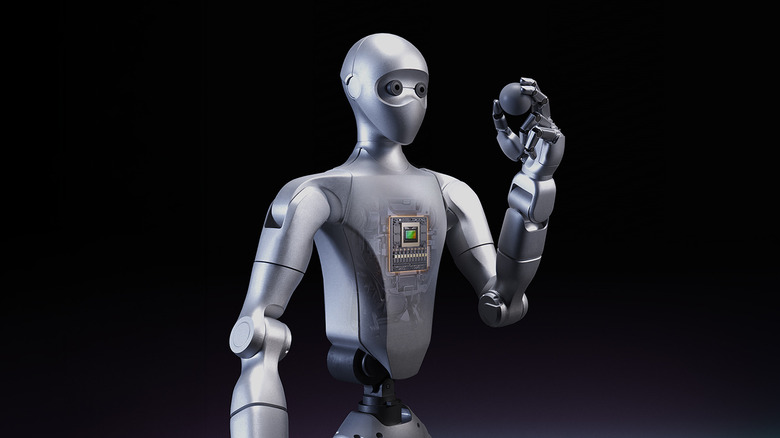
It uses a nearly 6-foot tall humanoid chassis and tactile five finger hands.
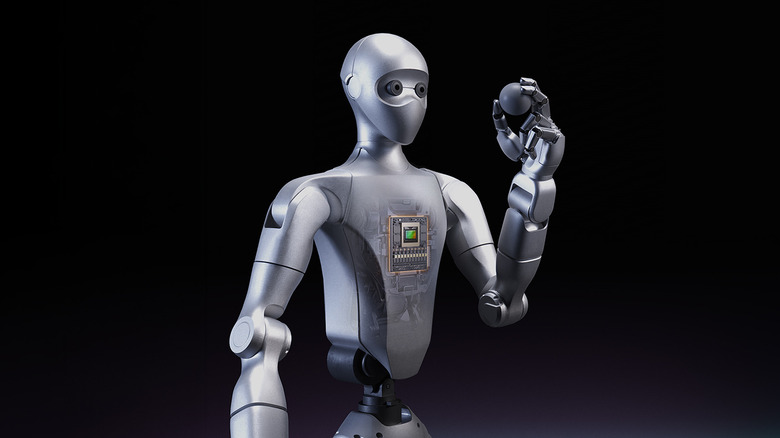
As part of his AI-palooza Computex keynote, NVIDIA’s Jensen Huang dove into the most relatable form of artificial intelligence: robots. The company announced the new Isaac Gr00t reference design humanoid robot platform that combines a Unitree H2 Plus humanoid robot, Sharpa five-fingered hands and NVIDIA Jetson Thor onboard compute. That’s tied together with NVIDIA’s Gr00t open software and models designed to help “researchers and developers accelerate humanoid development workflows.”
The platform uses a nearly 6-foot tall Unitree H2 humanoid chassis that weighs 150 pounds, with 31 degrees of freedom across the body. (The H2 model is listed on Unitree’s website for $29,900, though the company has only shown renders on its website). The Gr00t developer platform will also support the cheaper Unitree G1 humaoid robot. NVIDIA first revealed its Gr00t N1 foundational model in March.
The chassis is married to dual Sharpa Wave tactile five-finger hands with 22 degrees of freedom, multi-view sensing including a head-mounted stereo camera, wrist cameras and inertia measurement, along with whole-body control with arm torque of up to 120 Newton-meters (88 foot pounds).
Gr00t Isaac is powered by NVIDIA’s Jetson AGX Thor T5000 onboard compute with an NVIDIA Blackwell GPU, 128GB of unified memory and a configurable 40 to 130 watt power range . The 15Ah battery provides just under 1 kWh of capacity for about three hours of endurance.
As has been a theme with humanoid presentations, there was no physical robot to be seen. Rather, Huang touted Isaac Gr00t as an open foundation humanoid development platform. The company said that multiple institutions including Ai2, ETH Zurich, Stanford Robotics Center and UC San Diego will use the reference design. “Robotics moves fastest when researchers can build on open platforms, share code and test ideas on real machines,” said Stanford Robotics Center’s executive director Steve Cousins in a statement.

Apple’s long-rumored foldable iPhone may have just taken another step closer to reality – or at least another step closer to the internet’s imagination. A newly leaked replica model, believed to represent Apple’s upcoming “iPhone Ultra” foldable device, is now circulating online, revealing what could be one of the company’s boldest design shifts in years.
According to a report from Notebookcheck, the replica showcases a foldable phone with curved edges, a slim profile, and a surprisingly familiar design language that many users are already comparing to existing Android foldables.
If the leak turns out to be accurate, Apple’s first foldable iPhone may not look radically different from competitors after all.
Apple’s foldable iPhone may prioritize familiarity over reinvention
The leaked white replica model shows a book-style foldable design with rounded corners, curved side rails, and a dual rear camera setup positioned vertically on the back panel. The overall appearance has triggered immediate comparisons to devices like Samsung’s Galaxy Z Fold lineup and several foldables from Chinese brands.
That familiarity is especially interesting because Apple has historically avoided entering product categories until it believes the technology and user experience are mature enough. The company has reportedly spent years testing multiple foldable prototypes internally while delaying a commercial launch over concerns related to hinge durability, display creasing, and long-term reliability.

The “iPhone Ultra” branding attached to the leak also aligns with previous rumors suggesting Apple may reserve foldable devices for an entirely new ultra-premium category above the Pro Max lineup.
Reports over the past year have repeatedly suggested Apple’s first foldable iPhone could arrive with a large inner display, titanium construction, and a significantly thinner hinge design compared to current foldable competitors. Some analysts also believe Apple is prioritizing minimal display creasing as one of the defining features of the device.
The replica itself, however, suggests Apple may be taking a more conservative design approach externally while focusing its innovation on refinement rather than visual experimentation.
Why this matters
Foldable smartphones remain one of the few major hardware categories where Apple still has no product presence. Meanwhile, companies like Samsung, Huawei, OPPO, and Honor have spent years iterating on foldable hardware.

Apple entering the foldable market could dramatically reshape consumer interest in the category, much like the company previously did with smartwatches and tablets. At the same time, the leak raises an important question: Does Apple still need to create visually unique hardware, or is perfecting usability and ecosystem integration enough?
What happens next
Apple has not officially acknowledged the existence of a foldable iPhone, and current reports suggest the device is still at least a year or two away from launch. Multiple analysts expect Apple’s first foldable device to arrive sometime around late 2027 or beyond, likely positioned as an ultra-premium product with a very high price tag.
For now, replica leaks like this mainly offer hints about Apple’s possible design direction rather than final hardware confirmation. Still, if the rumors prove accurate, Apple’s foldable future may look less like a sci-fi experiment and more like a refined version of a category Android brands have already spent years building.

Scott McTominay’s surprise phone call from Sir Alex Ferguson inspired iconic overhead kick

Aegis Logistics shares rally 4% as Q4 profit rises 45% YoY; Board recommends dividend

Humanity (H) Surges 65% to Record High on AI Token Rally


-

 NewsBeat5 days ago
Israel says it has killed new Hamas military leader in Gaza City airstrikes
-

 Tech5 days ago
NASA taps Blue Origin to deliver lunar rovers for Moon Base initiative
-

 Politics7 days ago
Bridgerton Season 5: Cast, Release Date And Everything We Know So Far
-

 Sports6 days ago
2026 NBA Finals schedule, odds: Knicks await Thunder or Spurs after winning East
-

 News Videos5 days ago
XRP *JUST* SUCCEEDED!!!! CLARITY ACT EXPOSED!!! (SHE EXPOSED IT)
-

 News Videos3 days ago
This is BROKEN! INSANE 5x MONEY CAR WASH WEEK! The NEW GTA Online UPDATE Today! (GTA5 New Update)
-
 Crypto World6 days ago
Micron Crosses $1 Trillion Market Cap as AI Demand Reshapes Memory Sector
-
 NewsBeat7 days ago
Hottest May day ever as London hits 34.8C in 2C leap from previous records
-

 Business5 days ago
Selena Gomez Reportedly Upset Over Benny Blanco’s Comments on Her ‘Terrible’ Diet
-
 Tech6 days ago
China assigns ID codes to 28,000+ humanoid robots
-

 Business7 days ago
Nikkei 225 Surges Past 65,000 for First Time as Iran Peace Hopes Fuel Record Rally
-

 Tech7 days ago
Microsoft’s quiet Claude Code retreat and the real cost of enterprise AI
-

 Tech3 days ago
Waymo dominates autonomous vehicle registrations as Tesla trails behind
-
 Entertainment6 days ago
‘Breaking Bad’ Star’s Easy-to-Binge 6-Part Crime Series Spin-Off Is Finally Heading to Free Streaming
-

 NewsBeat7 days ago
Crowds find riverside shade in York as temperatures soar
-
Tech5 days ago
The Samsung pay deal is the moment Korean unions changed register
-
 Tech2 days ago
SpaceX just won a second Golden Dome contract. This one is $4.16 billion.
-

 Entertainment6 days ago
Days of our Lives 2-Week Spoilers May 25-June 5: Gwen Rages, Abe Confesses & 2 Tragic Anniversaries!
-

 Tech7 days ago
Westone Audio and Etymotic Acquired by Fidelity Collective in Major IEM Market Move
-
 Entertainment6 days ago
Taylor Swift Fans Label Travis Kelce’s Beer-Chugging A ‘Red Flag
You must be logged in to post a comment Login