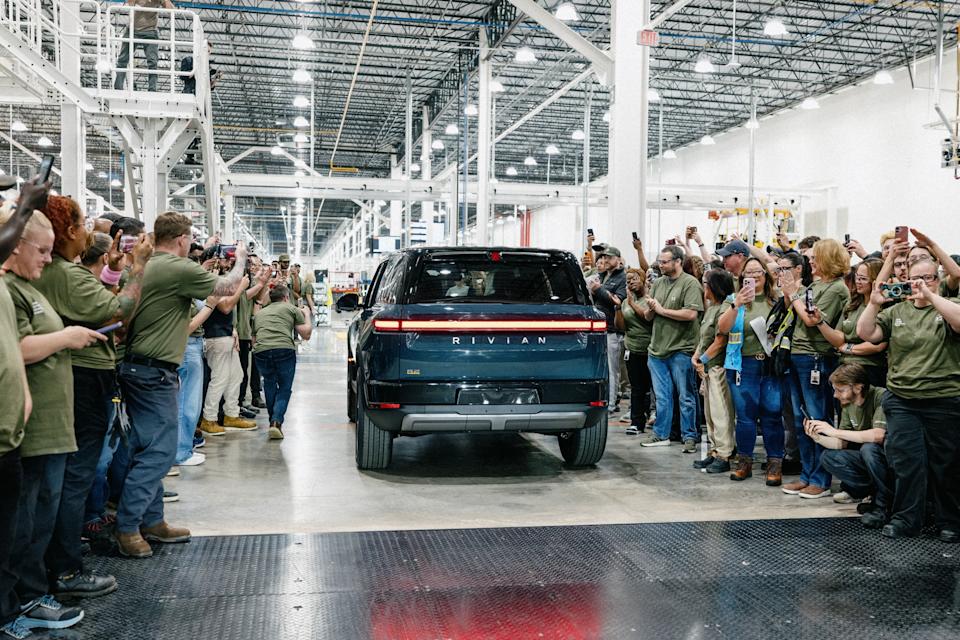
Rivian has begun production of its R2 SUV. However, you can’t get one just yet: The first customer deliveries (of the most expensive version) aren’t expected until later this spring.
On Wednesday, CEO RJ Scaringe drove the first electric SUV off the production line at the company’s Normal, IL, factory. A storage and logistics building at that factory was damaged by a tornado last weekend, with Wednesday’s rollout event seemingly designed to reassure nervous customers and investors.
“We are really excited to be producing R2 for our customers,” Scaringe is quoted as saying in a news release. However, Rivian CFO Claire McDonough toldReuters that customers won’t be able to configure their vehicle orders until June. Electrekreports that these first units rolling out now are going to Rivian employees.
Rivian
If you were drawn to the R2’s $45,000 starting price, well, Rivian won’t have any of those for a while. First off the line (this spring) is the Launch Package, starting at $57,990. A Premium trim, expected late 2026, will cost $53,990. Then, in the first half of 2027, a Standard (RWD long range) variant arrives at $48,490. And as for that headline-grabbing $45,000 base-model R2, I hope you like waiting. It won’t be here until late 2027.
Advertisement
The Rivian R2 was revealed in 2024. Smaller and lighter than the flagship R1, the company is positioning the EV as its answer to Tesla’s best-selling Model Y. All versions of the new two-row SUV are rated for at least 300 miles per charge. Each trim has a native NACS charge port. The vehicle can charge from 10 percent to 80 percent in under 30 minutes when using a DC fast charger.
Back when Netflix was proposing a takeover of Warner Brothers, you might recall that director James Cameron had no shortage of critical things to say.
Cameron went so far as to write a heavily publicized letter to Senator Mike Lee, lamenting the Netflix Warner Brothers merger (and only the Netflix merger) as “disastrous to the motion picture business.” In the letter, Cameron calls himself a “humble movie farmer,” and repeatedly insisted Netflix would shorten the 45-day theater-to-streaming window (Netflix repeatedly stated the opposite).
Here’s the weird thing: Cameron had absolutely no criticism to offer of the alternative (and now reality) $108 billion Ellison family merger of Paramount and Warner Brothers, despite the deal being exponentially worse across every possible metric.
“I know David quite well. And I know that he really cares about movies. And he’s a natural born storyteller and thinks like almost an old school entrepreneurial producer that was a storyteller that loves storytelling and loved putting on spectacular shows,” Cameron said. “He’s the right man for the job to run a major studio, and now it looks like he’s going to have two of them, you know, swept under his leadership, which doesn’t bother me at all.”
So basically Cameron likes the deal, and is willing to overlook the massive layoffs looming just over the horizon due to unprecedented consolidation, because he personally likes the Ellison family. And the Ellison family promised him that they won’t touch the 45 day delay between theatrical runs and home release.
The problem (for James and everyone else) is that pre-merger promises are utterly meaningless. Every single time Warner Brothers has merged (now four times over 20 years) it’s been an abject disaster, preceded by all sorts of empty promises about amazing new synergies. The AT&T merger alone resulted in 50,000 layoffs, and there are indications that AT&T executives could be viewed as immeasurably competent compared to what we’re seeing out of Ellison-owned Paramount and CBS News.
It’s “funny” because in Cameron’s letter to Lee, he offers this observation about Netflix:
Advertisement
“What administrative body will hold them to task if they slowly sunset their so-called commitment to theatrical releases?”
But the exact same applies to the Ellison family promises. It’s potentially worse given the Ellisons’ close ties to the administration, which will not only mean rubber-stamped federal merger approval, but less accountability later down the line (in a country where Trump has already guaranteed that corporate regulators lack the ability to do this or any other job).
It seems likely that the Ellisons promised other things to Cameron. Time will tell.
But Paramount’s debt from the CBS, MMA, and now Warner Brothers deals is so historically massive, it’s simply inevitable that this results in all manner of layoffs and corner cutting to service it. Denying that this is coming is like trying to debate physics, or have a fist fight with a river. This sort of consolidation is uniformly harmful to labor, consumers, and creatives. We literally just went through all of this.
David Ellison is telling anybody who’ll listen that this merger will be different and will magically result in a bigger, bolder Hollywood, but there’s simply no historical evidence to believe a single word he’s saying. Every Warner Brothers merger to date has been pointless and awful, but this one has the potential to be historically so.
I would love to tell you everything about my favorite game of the year so far. But that would be doing a great disservice to Titanium Court. I’m not even sure I could explain it all, anyway.
Titanium Court is a run-based game with elements of permanent progression, so it’s technically a roguelite. However, you cannot really break Titanium Court like you can with Balatro. There are multiple ways to win a run, but you have to play by the rules. Gradually learning what those are — and how the game suddenly changes them — is a big part of what makes this so effective.
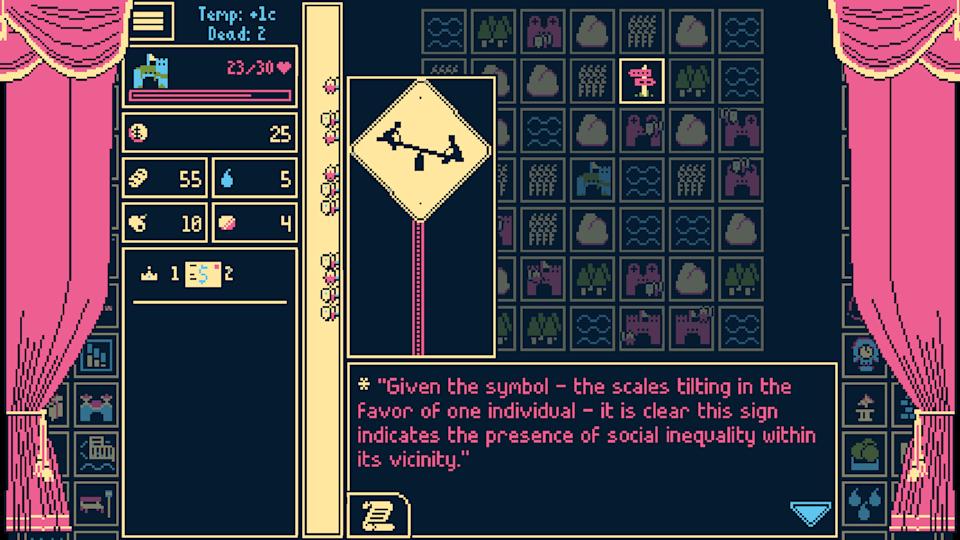
I can at least break down the core gameplay loop for you. There are two stages to each battle in every run aka a “war.” The first is a match-three segment (think Candy Crush Saga), in which you gather resources by lining up wheat fields, rivers, hills and forests. At the same time, you’re setting up the terrain and positioning your own tile (the titular court) for the second stage. For instance, water will stop foot soldiers entirely, so you can position yourself behind a barricade of rivers to block them. But you’ll need to be careful, since a chain reaction of matches can wipe out your carefully constructed defense.
At the same time, you’ll be moving around enemy strongholds. You can line up three or more matching enemy bases to eliminate them, but you don’t gain any resources from those. Plus, you can only make a limited number of moves in this phase. So that makes for an interesting risk-reward conundrum. A timeline shows you which enemies will attack and when so you can plan accordingly.
Advertisement
The second phase is where the tower defense element really takes hold. You’ll use what you’ve collected to recruit soldiers to attack enemies or defend your base, add workers that will gather more resources and maybe deliver magic attacks. You can trade at shops and markets as long as you haven’t wiped them from the grid, since they’re bonded to terrain tiles. When you’re ready to fight, you hit a play button and the battle takes place automatically.
Nothing’s as simple as it might seem at first, because this is a game that will mess with you. I was scolded for trying to buy my way to victory by trading too much, with the game calling that approach “boring” and closing the shop’s doors for the round. Perfectly fair. I chuckled the first time that happened. When I thought I was being clever by using the introspective power of self-reflection (you’ll see) to win a boss fight, I was swiftly shut down.
Between wars, you’ll explore the titular court as its newly anointed queen, trying to figure out what on Earth is going on and, ultimately, how to get home. Here, Titanium Court morphs into a blend of old-school adventure game and bizarre visual novel. This is where much of the magic lies, and where you gradually learn about the story and even how to play the game.
AP Thomson/Fellow Traveller
Developer AP Thomson’s writing is smart and funny. I lost count of the number of jokes I’ve laughed out loud at. His narrative takes you in startlingly unexpected directions. It feels like a grand performance and Thomson is the master of ceremonies. It’s a confidently authored experience that offers further evidence as to why absolutely no one needs a generative AI game platform that seeks to “kill the scripted RPG.”
Advertisement
Titanium Court won the prestigious Seumas McNally Grand Prize at the Independent Games Festival Awards earlier this year and it’s not hard to see why. Thomson and his collaborators have cooked up something really special here.
It’s a game with dragons and ballet, baseball and bike races, shower thoughts and wormholes. There are road signs in a world in which faeries believe cars are a figment of your imagination. It references Catan, the Civilization series, Jenga and A Midsummer Night’s Dream. It skewers capitalism and social inequality. I’ll let you discover the details of the job system, which completely upends how you play the game, yourself. I haven’t been this engrossed by a game since Ball x Pit. It surprises and delights at almost every turn.
Titanium Court is certainly not going to be for everyone (there’s so much reading!) and I’m going to stop here before I tell you too much about it. You can get a taste by checking out a Steam demo that’s available for PC and Mac. The full game arrived today. It usually costs $15, but it’s 20 percent off until May 7.
Meta is making another steep cut to its staff, this time to the tune of a 10 percent reduction in its workforce. About 8,000 people will be laid off and about 6,000 open jobs will also be eliminated, according to Bloomberg.
In an internal memo from Janelle Gale, Meta’s head of human resources, the latest cuts are “part of our continued effort to run the company more efficiently and to allow us to offset the other investments we’re making.” Those “other investments” are likely in artificial intelligence. Meta is building its own models and apparently training them on its own staff. Its smart glasses are also leveraging ever-more AI capabilities.
Today’s layoffs likely don’t mark the end of Meta’s current contraction. A report from March suggested that Meta was planning to downsize by up to 20 percent, although no timeline was given. The company cut hundreds of jobs, primarily in its Reality Labs division, shortly after those claims circulated. It also kicked off 2026 by slashing its metaverse operations with the closure of three VR studios.
BDX Droid figures and a talking Mandalorian headline Disney Store’s May 4 drop
Light-up gauntlets, action figures, pins, and more join the lineup
All items land on May 4, 2026, at the Disney Store
We’re just weeks out from Star Wars returning to the big screen with The Mandalorian and Grogu, and before its May 22, 2026, opening, we’ll be rolling through May the 4th, aka Star Wars Day.
As we saw a few weeks back, there are some impressive new toys and collectibles themed around the film and Star Wars at large. We already knew that the adorable, lovable BDX Droids that have graced Galaxy’s Edge at Disneyland and Walt Disney World — as well as the high seas on Disney Cruise Line — would land as figures, and now TechRadar can exclusively reveal that the BDX Droid figures, along with the other collectibles and toys below, will launch exclusively at the Disney Store on May 4, 2026.
The BDX Droids still look stunning, and considering they’ll be in The Mandalorian and Grogu, it’ll be a perfect fit for fans of Disney Parks and Star Wars. For $49.99, you get a set of four that will look great on a desk, and just like the real-life set, they’re color-matched here. You get a red, blue, green, and orange BDX unit. While these won’t move or emit sounds, they’re highly detailed. The BDX Droids are the latest drop in the Droid Factory Figures line at the Disney Store.
Article continues below
(Image credit: Disney Store)
That’s not the only product dropping, though — as teased earlier, Disney Store will also be home to two exclusive collectibles. The first, The Mandalorian Voice-Changing Helmet, looks fantastic and pretty true-to-life compared to what Din Djarin wears in the film and on the show.
It will say iconic lines from the series, and I’d bet “This is the Way” is one of them. If you’re keen to sound like The Mandalorian, there is also a voice-changing mode. This full-size replica, designed for adults, lands on May 4, 2026, and will cost $119.99.
It pairs perfectly with the other collectible drop — the $99.99 Mandalorian Gauntlets, which look highly detailed and even light up. Both of these will be exclusive to the Disney Store.
Advertisement
(Image credit: Future/Jacob Krol)
Nearly as neat as the BDX Droid figures is the 10-inch The Mandalorian Talking Action Figure, which includes scale figures of Grogu and Minch. You’ll also get a jetpack booster and a weapon for Mando in the box. Since it talks, it will say iconic phrases, including some movie-accurate lines. This figure arrives at the Disney Store for $39.99 on May 4, 2026.
Sign up for breaking news, reviews, opinion, top tech deals, and more.
If you’re a fan of Klang, Disney Store also has a detailed talking figure of the Anzellan droidsmith. He’ll play a role in The Mandalorian and Grogu, alongside two other droidsmiths, and this figure won’t just speak — it also features a motorized head, eyes, and mouth for a more immersive experience. This figure launches for $59.99 on May 4, 2026, at the Disney Store.
Image 1 of 2
Advertisement
(Image credit: Disney Store)
(Image credit: Disney Store)
It wouldn’t be a Star Wars toy lineup without some classic figures, and whether you’re excited for the film because of Mando or for the return of Zeb Orrelios — Star Wars Rebels fans know exactly what I’m talking about — this Star Wars Toybox set might be the perfect purchase. You get figures of Zeb, droid R5-D4, The Mandalorian, and Grogu in posable, stylized versions. The Mandalorian and Grogu Action Figure Set — Star Wars Toybox drops for $49.99 at the Disney Store on May 4, 2026.
Pin collectors will be happy to know that the Disney Store has a set of three arriving. The first two retail for $21.99 and are themed around one character each. A Din Djarin Pin and a Grogu Pin both arrive as limited releases with the “Star Wars Day: May the 4th Be With You 2026” logo. The Mandalorian is standing in an iconic pose, while Grogu is using the Force.
Image 1 of 3
(Image credit: Disney Store)
(Image credit: Disney Store)
(Image credit: Disney Store)
Additionally, for $34.99, Disney Store will drop the impressive Star Wars Day: May the 4th Be With You Mini Jumbo Pin, which features Ahsoka, Boba Fett, Bo-Katan, Grogu, and The Mandalorian — essentially putting the main characters from Star Wars: The Mandalorian and Star Wars: The Book of Boba Fett onto one pin. There’s also a Mythosaur icon at the bottom.
Puzzles can be pretty relaxing, and I’m especially a fan when they feature excellent artwork. Disney Store isn’t just spotlighting the two main characters here in an affordable set — it’s also a great landscape from the film. The Star Wars: The Mandalorian and Grogu Puzzle will be just $24.99 at the Disney Store on May 4, 2026.
Advertisement
(Image credit: Disney Store)
Last but not least, you can bring a bit of Galaxy’s Edge home with a mug that will instantly level up any kitchen. The Mythosaur Sculpted Mug looks fantastic and really feels like a prop that could fit perfectly on the big screen, though more likely than not, it would be found at Oga’s Cantina in Galaxy’s Edge. This mug also lands on May 4, 2026, for $22.99.
Apple Savings is now available for Apple Card users. Here’s how it compares to other high-yield savings accounts in April.
Apple Savings requires Apple Card
The finance sector isn’t new to Apple, with Apple Wallet, Apple Pay, Apple Card, Apple Pay Later, and now Apple Savings. Customers have multiple avenues to entrust vital financial processes to Apple. Apple Savings is a high-yield savings account provided by Goldman Sachs. It requires users to have an Apple Card and be over 18 years old. Otherwise, there are no minimum balances or fees associated with the account. Continue Reading on AppleInsider | Discuss on our Forums
Meta is reportedly cutting about 10% of its workforce, or roughly 8,000 jobs, while closing thousands of open roles it had intended to fill. “We’re doing this as part of our continued effort to run the company more efficiently and to allow us to offset the other investments we’re making,” said Janelle Gale, Meta’s chief people officer. The company had almost 79,000 employees at the start of the year. Quartz reports: Meta CEO Mark Zuckerberg has poured resources into building out AI capabilities, directing spending toward model development, chatbot products, and the engineering talent to support them. Meta set its 2026 capital expenditure guidance at $115 billion to $135 billion, almost double the $72 billion it spent in 2025. Employees have been encouraged to use AI agents internally for tasks such as writing code.
The early disclosure, Gale explained, was prompted by the fact that information about the cuts had already made its way into press reports before the company was ready to announce. “I know this is unwelcome news and confirming this puts everyone in an uneasy state, but we feel this is the best path forward, given the circumstances,” she wrote.
According to the memo, severance for affected workers in the United States will cover 18 months of COBRA health insurance premiums, along with a base pay component of 16 weeks that increases by two weeks for each year of service. Departing employees will have access to job placement assistance and, where applicable, help navigating immigration status. Packages outside the U.S. will vary by country. Meta cut between 10% and 15% of its Reality Labs workforce in January, shut down several VR game studios, and shed about 700 positions across at least five divisions in March.
Microsoft’s gaming division is reverting to the Xbox name after operating as “Microsoft Gaming” since 2022. (Microsoft Photo)
Microsoft is changing the way it measures success in its Xbox business, focusing on daily active players rather than longer periods of time — a tighter measure that reflects the way the biggest social media platforms have evolved to gauge engagement and retention of users.
Xbox will also reevaluate its approach to game exclusivity, the timing of releases across platforms, and the use of AI, while looking for opportunities for strategic acquisitions.
And yes, it’s the Xbox business again, not “Microsoft Gaming,” the broader name the company adopted for the division internally around the time of its giant Activision Blizzard acquisition.
Those are some of the highlights from a memo that Xbox CEO Asha Sharma and Chief Content Officer Matt Booty sent to employees Thursday, laying out a strategic vision for the division about two months into their tenure in the roles.
The memo, titled “We Are Xbox,” opens with a blunt admission that players are frustrated, and frames Xbox as a challenger with work to do.
Advertisement
“From the beginning, Xbox was built by people willing to try things that others wouldn’t,” they write. “We placed a consumer bet inside an enterprise company because we believed gaming would define the living room, and we were at risk of missing it.”
Asha Sharma and Matt Booty, the new leadership team for Microsoft Gaming. (Microsoft Photo)
The memo comes amid financial pressure on the gaming business. Revenue fell 9% in the most recent holiday quarter to $5.96 billion, with Xbox content and services coming in below internal projections. Hardware sales dropped 32%.
Earlier this week, Sharma made her first major move, cutting the price of Game Pass Ultimate from $29.99 to $22.99 a month while removing new Call of Duty games from the day-one lineup — unwinding a bundle that had driven a 50% price hike last October.
Sony’s PlayStation remains comfortably ahead in the current console generation, and Nintendo’s Switch 2 has had a strong launch.
The memo references Microsoft’s own next-generation console, Project Helix, which it unveiled at GDC in March, saying the machine will “lead in performance and play your console and PC games.” Alpha hardware is expected to go to developers in 2027.
Advertisement
Sharma took over as CEO of Microsoft Gaming in February, replacing Phil Spencer, who retired after 38 years at the company. She had been running Microsoft’s CoreAI product organization and previously served as chief operating officer at Instacart and as a vice president at Meta.
That social media background may help explain the shift to daily active players as the internal “north star,” a metric that defined how Facebook and Instagram measured their own success.
Microsoft has said its gaming ecosystem has more than 500 million monthly active users across platforms and devices. It’s not clear if Microsoft will shift to daily users in its public reporting.
The memo closes with 10 operating principles for the division, including “earn every player,” “protect our art,” “stay rebellious,” and “clarity is kindness.” They conclude, “We’re here to do the most creative and courageous work of our lives, and that’s what we’ll do together.”
Advertisement
Microsoft reports earnings for the March quarter next week, including Xbox results.
Microsoft is planning to get rid of more US employees via its first voluntary buyout program, CNBC reports. The buyout program will reportedly be offered to US employees at “the senior director level and below whose years of employment and age add up to 70 or higher,” and could cover up to 7 percent of the company’s US workforce.
With around 125,000 employees in the US as of June 2025, that could mean up to 8,750 will be offered a paid exit when Microsoft begins its program in May. That’s a smaller figure than the 15,000 or so employees the company laid off in May and July of 2025, but still significant, particularly if the majority of employees do take the buyout.
“Our hope is that this program gives those eligible the choice to take that next step on their own terms, with generous company support,” Microsoft’s executive vice president and chief people officer Amy Coleman shared in a memo viewed by CNBC.
Engadget has contacted Microsoft to confirm the existence of the voluntary buyout program and other details CNBC reported. We’ll update this article if we hear back.
Advertisement
Microsoft used its 2025 layoffs to streamline layers of management and its video game business, but these new cuts may have a lot more to do with AI. Not necessarily because the company’s adoption of AI tools has made employees redundant, but rather because Microsoft continues to aggressively spend on AI infrastructure. The company said it spent $37.5 billion in capital expenditures during Q2 2026, much of which went toward data center buildout.
After months of rumors and reports that OpenAI was developing a new, more powerful AI large language model for use in ChatGPT and through its application programming interface (API), allegedly codenamed “Spud” internally, the company has today unveiled its latest offering under the more formal name GPT-5.5.
And to likely no one’s surprise, it’s hardly a “potato” in the disparaging sense of the word: GPT-5.5 retakes the lead for OpenAI in generally available LLMs, coming ahead of rivals Anthropic’s and Google’s latest public offerings, and even beating the private Anthropic Claude Mythos Preview model narrowly on one benchmark (essentially a statistical tie).
“It’s definitely our strongest model yet on coding, both measured by benchmarks and based on the feedback that we’ve gotten from trusted partners, as well as our own experience,” explained Amelia “Mia” Glaese, VP of Research at OpenAI, in a video call with journalists ahead of the launch earlier today.
OpenAI positions GPT-5.5 as a fundamental redesign of how intelligence interacts with a computer’s operating system and professional software stacks.
Advertisement
“What is really special about this model is how much more it can do with less guidance,” said OpenAI co-founder and president Greg Brockman on the same call. “It’s way more intuitive to use. It can look at an unclear problem and figure out what needs to happen next.”
Brockman proceeded to emphasize the areas in which users can expect to see gains from using GPT-5.5 compared to OpenAI’s prior state-of-the-art model, GPT-5.4, which remains available (for now) to users and enterprises at half the API cost of its new successor.
“It’s extremely good at coding,” Brockman said of GPT-5.5. “It’s also great at broader computer work, computer use, scientific research—these kinds of applications that are very intelligent bottlenecks.”
OpenAI CEO and-cofounder Sam Altman also weighed in on the launch and the company’s philosophy in a post on X, writing, in part: “We want our users to have access to the best technology and for everyone to have equal opportunity.”
Advertisement
The model is available in two variants: GPT-5.5 and GPT-5.5 Pro, distinguished by the latter offering enhanced precision and specialized logic for handling the most rigorous cognitive demands.
While the standard version serves as the versatile flagship for general intelligence tasks, the Pro model is architected specifically for high-stakes environments such as legal research, data science, and advanced business analytics where accuracy is paramount. This premium tier provides noticeably more comprehensive and better-structured responses, supported by specialized latency optimizations that ensure high-quality performance during complex, multi-step workflows.
Unfortunately for third-party software developers, API access is not yet available for either GPT-5.5 nor GPT-5.5 Pro and will be coming “very soon,” according to the company’s announcement blog post.
“API deployments require different safeguards and we are working closely with partners and customers on the safety and security requirements for serving it at scale,” OpenAI writes.
Advertisement
For the time being, GPT-5.5 is available only to paying subscribers of the ChatGPT Plus ($20 monthly), Pro ($100-$200 monthly), Business, and Enterprise users, with GPT-5.5 Pro access starting at the Pro tier and upwards.
A focus on agency
At the core of GPT-5.5 is a focus on “agentic” performance—specifically in coding, computer use, and scientific research.
Unlike its predecessors, which often required granular, step-by-step prompting to avoid “hallucinating” a path forward, GPT-5.5 is designed to handle messy, multi-part tasks autonomously.
It excels at researching online, debugging complex codebases, and moving between documents and spreadsheets without human intervention.
Advertisement
One of the most significant technical leaps is the model’s efficiency. While larger models typically suffer from increased latency, GPT-5.5 matches the per-token latency of the previous GPT-5.4 while delivering a higher level of intelligence.
This was achieved through a deep hardware-software co-design. OpenAI served GPT-5.5 on NVIDIA GB200 and GB300 NVL72 systems, utilizing custom heuristic algorithms—written by the AI itself—to partition and balance work across GPU cores.
This optimization reportedly increased token generation speeds by over 20%.For high-stakes reasoning, the “GPT-5.5 Thinking” mode in ChatGPT provides smarter, more concise answers by allowing the model more internal “compute time” to verify its own assumptions before responding.
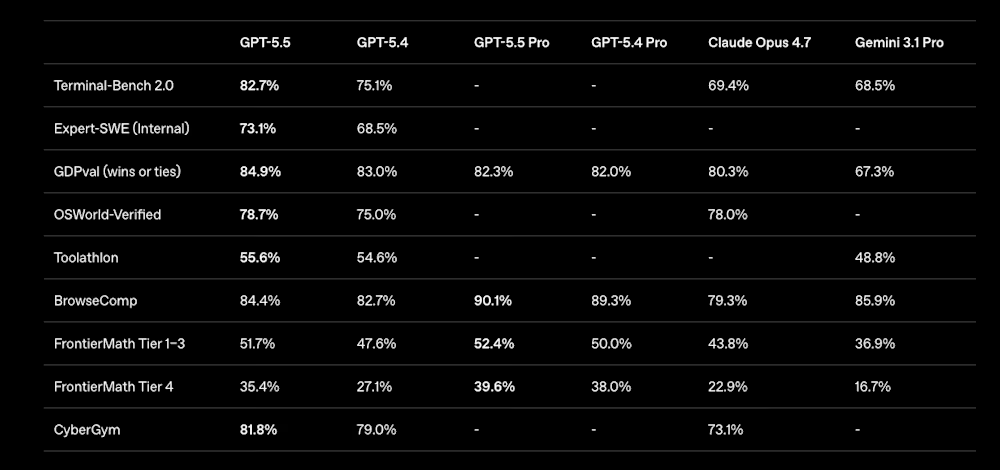
This capability is particularly visible in the model’s performance on “Expert-SWE,” an internal OpenAI benchmark for long-horizon coding tasks with a median human completion time of 20 hours. GPT-5.5 notably outperformed GPT-5.4 on this metric while using significantly fewer tokens.
Advertisement
Benchmarks show OpenAI has retaken the lead in most powerful publicly available LLM over Claude Opus 4.7 (but the unreleased Mythos still outperforms it)
The market for leading U.S.-made frontier models has become an increasingly tight race between OpenAI, Anthropic, and Google.
Literally a week ago to the date, OpenAI rival Anthropic released Opus 4.7, its most powerful generally available model, to the public, taking over the leaderboard in terms of the number of third-party benchmark tests in which it has the lead.
Yet today, GPT-5.5 has surpassed it and even Anthropic’s heavily restricted, more powerful model Claude Mythos Preview, albeit only on one benchmark, Terminal-Bench 2.0, which tests “a model’s ability to navigate and complete tasks in a sandboxed terminal environment.”
GPT-5.5 achieved 82.7% accuracy on Terminal-Bench 2.0, easily surpassing Opus 4.7 (69.4%) and narrowly beating the Mythos Preview (82.0%).
However, in multidisciplinary reasoning without tools, the landscape is more competitive. On Humanity’s Last Exam without tools, GPT-5.5 Pro scored 43.1%, trailing behind Opus 4.7 (46.9%) and Mythos Preview (56.8%).
Benchmark
GPT-5.5
Advertisement
Claude Opus 4.7
Gemini 3.1 Pro
Mythos Preview*
Terminal-Bench 2.0
Advertisement
82.7
69.4
68.5
82.0
Advertisement
Expert-SWE (Internal)
73.1
—
—
Advertisement
—
GDPval (wins or ties)
84.9
80.3
Advertisement
67.3
—
OSWorld-Verified
78.7
Advertisement
78.0
—
79.6
Toolathlon
Advertisement
55.6
—
48.8
—
Advertisement
BrowseComp
84.4
79.3
85.9
Advertisement
86.9
FrontierMath Tier 1–3
51.7
43.8
Advertisement
36.9
—
FrontierMath Tier 4
35.4
Advertisement
22.9
16.7
—
CyberGym
Advertisement
81.8
73.1
—
83.1
Advertisement
Tau2-bench Telecom (original prompts)
98.0
—
—
Advertisement
—
OfficeQA Pro
54.1
43.6
Advertisement
18.1
—
Investment Banking Modeling Tasks (Internal)
88.5
Advertisement
—
—
—
MMMU Pro (no tools)
Advertisement
81.2
—
80.5
—
Advertisement
MMMU Pro (with tools)
83.2
—
—
Advertisement
—
GeneBench
25.0
—
Advertisement
—
—
BixBench
80.5
Advertisement
—
—
—
Capture-the-Flags challenge tasks (Internal)
Advertisement
88.1
—
—
—
Advertisement
ARC-AGI-2 (Verified)
85.0
75.8
77.1
Advertisement
—
SWE-bench Pro (Public)
58.6
64.3
Advertisement
54.2
77.8
This suggests that while OpenAI is winning on “computer use” and “agency,” other models may still hold an edge in pure, zero-shot academic knowledge.
It is important to clarify that Mythos Preview is not a generally available product; Anthropic has classified it as a strategic defensive asset due to its high cybersecurity risks, restricting its access to a small, limited audience of trusted partners and government agencies.
Advertisement
Because Mythos is excluded from broad commercial use, the primary market competition remains between GPT-5.5, Gemini 3.1 Pro, and Claude Opus 4.7.
So when it comes to models that the general public can access, GPT-5.5 has retaken the crown for OpenAI, achieving the state-of-the-art across 14 benchmarks compared to 4 for Claude Opus 4.7 and 2 for Google Gemini 3.1 Pro.
It dominates in agentic computer use, economic knowledge work (GDPval), specialized cybersecurity (CyberGym), and complex mathematics (Frontier Math).
In comparison, Claude Opus 4.7 leads on software engineering and reasoning without tools, while Gemini 3.1 Pro leads in three categories, specifically excelling in academic reasoning and financial analysis.
Advertisement
Increased costs for users
The shift in intelligence comes with a significant price increase for API developers, according to material OpenAI shared ahead of the model’s public release.
OpenAI has effectively doubled the entry price for its flagship model compared to the previous generation, and again double it from there for the most-cutting edge variant of the model, GPT-5.5 Pro:
Model
Input Price (per 1M tokens)
Advertisement
Output Price (per 1M tokens)
GPT-5.4
$2.50
$15.00
Advertisement
GPT-5.5
$5.00
$30.00
GPT-5.5 Pro
Advertisement
$30.00
$180.00
To mitigate these costs, OpenAI emphasizes that GPT-5.5 is more “token efficient,” meaning it uses fewer tokens to complete the same task compared to GPT-5.4.
For users requiring speed over depth, OpenAI also introduced a Fast mode in Codex, which generates tokens 1.5x faster but at a 2.5x price premium.
Advertisement
The “mini” and “nano” tiers seen in the GPT-5.4 era (priced at $0.75 and $0.20 per 1M input tokens respectively) currently have no GPT-5.5 equivalent, though the company notes that GPT-5.5 is rolling out to all subscription tiers, including Plus, Pro, and Enterprise.
Licensing and the ‘cyber-permissive’ frontier
OpenAI’s approach to safety and licensing for GPT-5.5 introduces a novel concept: Trusted Access for Cyber. Because the model is now capable of identifying and patching advanced security vulnerabilities, OpenAI has implemented stricter “cyber-risk classifiers” for general users.
For legitimate security professionals, however, OpenAI is offering a specialized “cyber-permissive” license. This program allows verified defenders—those responsible for critical infrastructure like power grids or water supplies—to use models like GPT-5.4-Cyber or unrestricted versions of GPT-5.5 with fewer refusals for security-related prompts.
This dual-use framework acknowledges that while AI can accelerate cyber defense, it can also be weaponized. Under OpenAI’s Preparedness Framework, GPT-5.5 is classified as “High” risk for biological and cybersecurity capabilities.
Advertisement
To manage this, API deployments currently require different safeguards than the consumer-facing ChatGPT, and OpenAI is working with government partners to ensure these tools are used to strengthen—not undermine—digital resilience.
Initial reactions: losing access feels like having a ‘limp amputated’
The early feedback from power users and engineers suggests that GPT-5.5 has crossed a psychological threshold in AI utility. For developers, the model’s ability to maintain “conceptual clarity” across massive codebases is its standout feature.
“The first coding model I’ve used that has serious conceptual clarity,” noted Dan Shipper, CEO of Every.
Shipper tested the model by asking it to debug a complex system failure that had previously required a team of human engineers to rewrite; GPT-5.5 produced the same fix autonomously. Similarly, Pietro Schirano, CEO of MagicPath, described a “step change” in performance when the model successfully merged a branch with hundreds of refactor changes into a main branch in a single, 20-minute pass.Perhaps the most visceral reaction came from an anonymous engineer at NVIDIA, who had early access to the model:
“Losing access to GPT-5.5 feels like I’ve had a limb amputated”.
This sentiment is echoed in the scientific community. Derya Unutmaz, a professor at the Jackson Laboratory for Genomic Medicine, used GPT-5.5 Pro to analyze a dataset of 28,000 genes, producing a report in minutes that would have normally taken his team months.
Advertisement
Brandon White, CEO of Axiom Bio, went further, stating that if OpenAI continues this pace, “the foundations of drug discovery will change by the end of the year”.
GPT-5.5 is more than an incremental update; it is a tool designed for a world where humans delegate entire workflows rather than single prompts. While the costs are higher and the safety guardrails tighter, the performance gains in agentic work suggest that AI is finally moving from the chat box and into the operating system.
Perhaps most astonishingly of all, it’s not even hearing the end of the scaling limits — whereupon models are trained on more and more GPUs — according to researchers at the company.
“We actually still have headroom to train significantly smarter models than this,” said OpenAI chief scientist Jakub Pachocki.
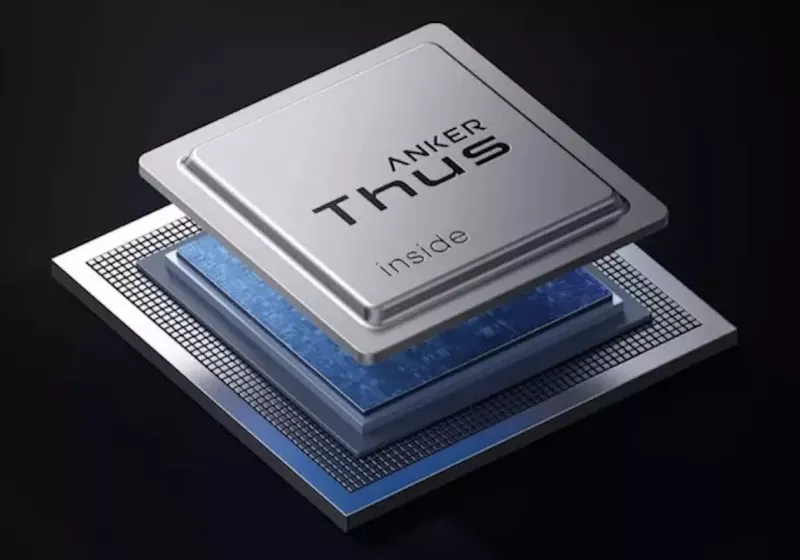
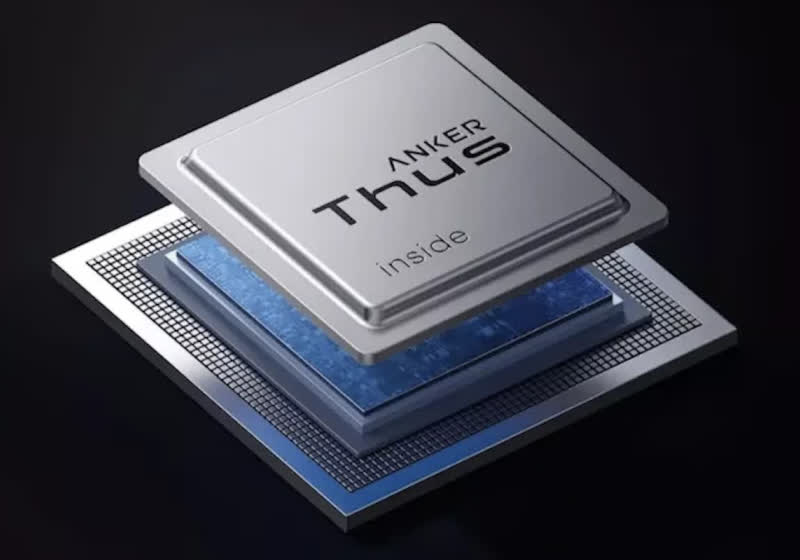
The processor’s compute-in-memory architecture departs from the conventional separation between processing and storage. Traditional chips shuttle data back and forth between memory and compute units, a process that consumes both time and energy. In Thus, computation happens directly inside the NOR flash cells themselves, so models run in the same… Read Entire Article Source link























































You must be logged in to post a comment Login