Two prominent science fiction authors have decried the impact of AI on their craft.
“I do not want or need a large language model to write my fiction for me. I write fiction compulsively – before I was published I wrote for many years as a hobbyist – so why on earth would I pay someone else to take my fun away?” wrote Charles Stross in a Saturday post. Stross graciously mentioned The Register in his Laundry Files novels.
“I maintain that any serious author should shun LLMs like the plague,” he added. “Did I mention the ‘stealing’ thing? This isn’t hyperbole: I’m one of the parties to the settlement in the class action lawsuit against Anthropic AI for pirating eBooks to train their LLMs.”
“That’s not my only grievance, either. You may have noticed this blog performing sluggishly or crapping out from time to time over the past few months. That’s because my server is old and feeble and periodically gets swarmed by Chinese and other foreign botnets scraping data for training LLMs.”
Advertisement
Stross labelled AI companies “absolute scum.”
“They’re stealing copyrighted material to train an LLM that is intended to compete for revenue with the authors of the works they stole, and they’re fine-tuning their LLMs to make them as addictive as possible in order to maximize future revenue once they pivot to token sales as their main source of income,” he wrote.
“In other words, they’re no different from a burglar who robs you one day then comes round to sell you your stuff back the next morning. Back in the 18th century we used to hang people like that and Sam Altman makes me question the wisdom of having stopped.”
Scalzi, whose best-known works include the Old Man’s War series and Hugo Award-winning novel Redshirts, on Friday commented on a recent article about a hotly tipped debut novel being pulled from publishing and film or television consideration over concerns that AI had been used to write it.
Advertisement
“The issue appears not to be that ‘AI’ material isn’t copyrightable, the issue is that ‘AI’ is trained on copyrighted material, so prose generated from it could be contested by the original copyright holders,” Scalzi wrote.
He expects publishers to look for signs of AI use, although the available detection tools are notoriously unreliable. He predicts that this will disadvantage new writers who lack a body of work dating from before the arrival of ChatGPT.
“Which is unfair,” Scalzi wrote. “It’s especially unfair when the makers of the tools writers use to write – I’m looking at you, Microsoft and Google – are frantically stuffing ‘AI’ tools into the programs writers rely on.”
Then Scalzi dispensed with the diplomatic language.
Advertisement
“No, Microsoft, I don’t fucking want Copilot to ‘help me write’ in Word, and no, Google, I don’t fucking want Gemini to ‘help me write’ in Google Docs. The very fact these ‘AI’s are hovering around my writing at all is bad enough from a provenance standpoint. These ‘AI’ tools are making it harder for all writers in this regard, not easier.”
Stross raised a related concern: “If I was crazy enough to feed the outline of a story I was working on as a prompt to ChatGPT or Claude in hope of getting the stochastic parrot to do my homework for me, then it would be only my own fault and nobody else’s if the next model from the company in question was been trained [sic] on my book outline and could reproduce part or all of it for someone else.”
Scalzi advised authors not to “incorporate ‘AI’ into any part of your publishing process, either: Don’t use ‘AI’ editing, don’t use ‘AI’ art, don’t use ‘AI’ translation, don’t use ‘AI’ anything that calls into dispute whether your work is actually yours. Using ‘AI’ cover art, for example, will immediately call into question what else in the book is ‘AI.’ Every other aspect of the book is implicitly tarred with the same ‘AI’ brush. When I say that I have it in my contracts that I require every aspect of my book production to be done by humans, it’s not just because I want to honor human work and input. It’s also because I’m protecting my own reputation by doing so.”
Stross, however, admitted he “can see some circumstances where being able to train a local model on my work could be useful to me.”
Advertisement
“I’d quite like a tool (running entirely locally on my own hardware, with no cloud service and no copyright-thieving grifters making bank on it via subscription fees) that digests a manuscript and derives a scene-by-scene timeline, that I could then query interactively and use to plan my next round of edits,” he wrote.
He also allowed that “being able to map out where and when each protagonist and minor character shows up, and see a frequency distribution heat map of names in the manuscript, would be useful.”
“But such a tool would be useful to me in the same way a spelling checker is useful – as a decision-support tool, not as a substitute for doing the hard work (and having a copy of the Oxford English Dictionary on the shelf). The value of such a tool is considerably less than the value of a well-trained brain that can do the entire job the hard way, if necessary.”
Stross has also found one use of LLMs he thinks is valid: as a device in his work. To illustrate that, he shared the following excerpt of a space opera he has written and is currently editing:
Advertisement
The events described in this account have been translated into your language from the original source material using a non-sapient large language model.
Certain terms have been approximated, where possible, by using culturally appropriate cognates. Names of individuals have been replaced by equivalents. Similarly, institutions, ranks, religions, proverbs, idioms, quotations, and other culturally-determined signifiers have been translated into terms that will be familiar to the reader.
Units of duration and distance have also been converted.
We apologize in advance for any hallucinations our LLM may have inadvertently introduced in the process of generating this rough translation.
Advertisement
Neither author mentioned the fact that George R R Martin, author of the A Song of Ice and Fire novels adapted for television as Game of Thrones, writes on a PC that has no internet connection and runs DOS plus the ancient WordStar word processor. Perhaps drafts and revision histories from such setups will become another way for authors to demonstrate that their words are their own. ®
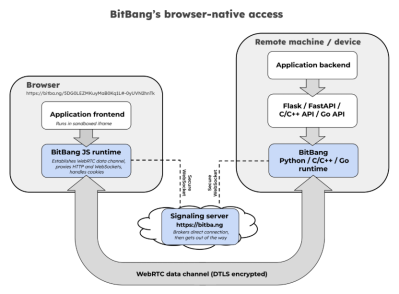
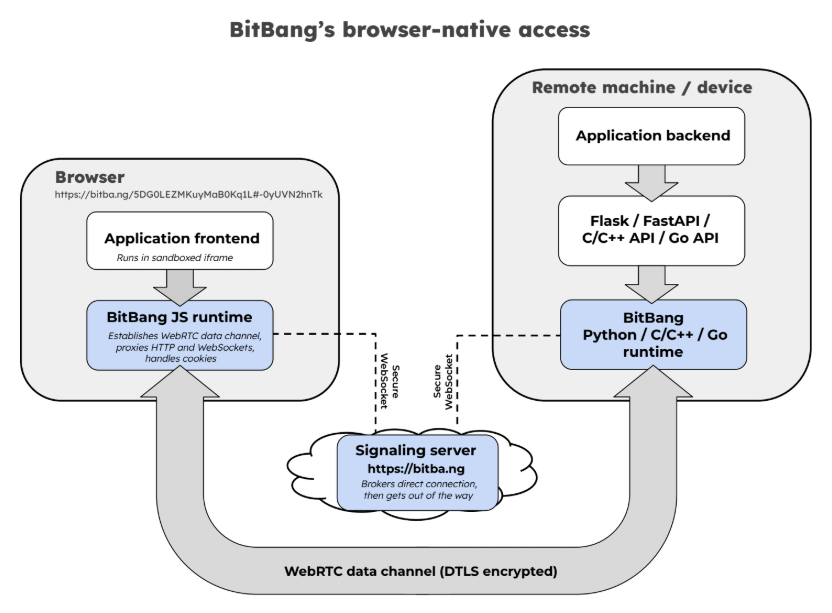
Launch a single static binary executable, send someone a QR code or URL (or failing that, text a numerical code or shout it across a room), and they’ll get an encrypted terminal in their browser. No VPN, no port forwarding, no firewall modifications, and no account setup required. It’s BitBang by [Rich LeGrand], and there is a lot to go through in this one.
The best part? It’s not actually limited to just firing off a terminal. It’s a whole open framework for establishing an encrypted peer-to-peer connection between two systems over WebRTC without needing either a trusted central authority, or any special network configuration.
The signaling server brokers the handshake, then has no further involvement. By design, it couldn’t see application data even if it wanted to. Click to enlarge.
Opening a remote terminal, transferring files, or accessing web apps on a remote machine’s network is done with bitbang-cli, an implementation of BitBang focused on providing simple, zero-config remote access.
Before we go on, we want to mention that BitBang does require a lightweight, trustless signaling server only to broker the initial connection, but more on that in a moment.
On the machine to be shared, one first downloads the binary. Easiest way to do that is to go to bitba.ng and download manually, or copy and paste the one-line installer to auto-detect one’s system, download the correct release, and verify the checksum.
Advertisement
After the binary is downloaded, simply run it in a terminal and receive a QR code to scan, a URL to copy & paste, or a numerical code if those are inconvenient. One the remote side, one accesses the signaling server and the connection is made — one gets a terminal on the target machine open in the browser tab, with added options for file sharing and accessing web applications on the target network.
The signaling server isn’t involved in authentication or encryption, and couldn’t see private data between the two ends even if it wanted to. Prefer not to use someone else’s regardless? Run your own local instance with bitbang-server.
It includes not just the remote-access tool mentioned above, but also a BitBang Octoprint plugin for cloud-free remote access to 3D printers, and bitbang-python is a library for turning local Python web applications into a URL that can be opened from anywhere.
Advertisement
We’re sure some of you are getting more than a few ideas from this. If it lets you bring a project over the finish line, let us know on our tips line.
This full-scale prototype of Interlune’s lunar excavator was developed in partnership with Vermeer in 2025. Testing as shown was done with auxiliary components. (Interlune / Vermeer Photo)
Seattle-based Interlune is expanding its partnership with Vermeer, an Iowa-based industrial equipment manufacturer, to develop construction tools for use on the moon.
The two companies forged their initial strategic partnership to further Interlune’s plans to extract helium-3 from tons of moon dirt and rocks, also known as regolith. Their full-scale prototype of a lunar excavator was unveiled a little more than a year ago.
At the time, Interlune was focused on mining helium-3 and bringing it back to Earth for applications ranging from quantum computing to medical imaging and nuclear fusion. But a major shift came in March when NASA announced a 10-year, $30 billion initiative to build the infrastructure for a moon base.
Interlune co-founder and CEO Rob Meyerson said he and his teammates realized that the partnership with Vermeer could support NASA’s plans. “We went back to Vermeer … and we decided that it made sense to formally expand the partnership to focus on all these other things that we’ve had in mind,” Meyerson told GeekWire.
For example, a lunar construction project is likely to involve building roads, compacting surfaces, digging trenches for underground utilities and moving rocks to clear space for a habitat. Heavy equipment might be needed to build protective berms around nuclear reactors.
“When I left NASA and came to work for Vermeer, my hope always was to be able to re-merge my passion for aerospace, specifically for the human exploration and human colonization of the moon and Mars, with my coming back to my family business … and use what I knew Vermeer was best at on Earth to do important work on the moon and Mars,” he told GeekWire.
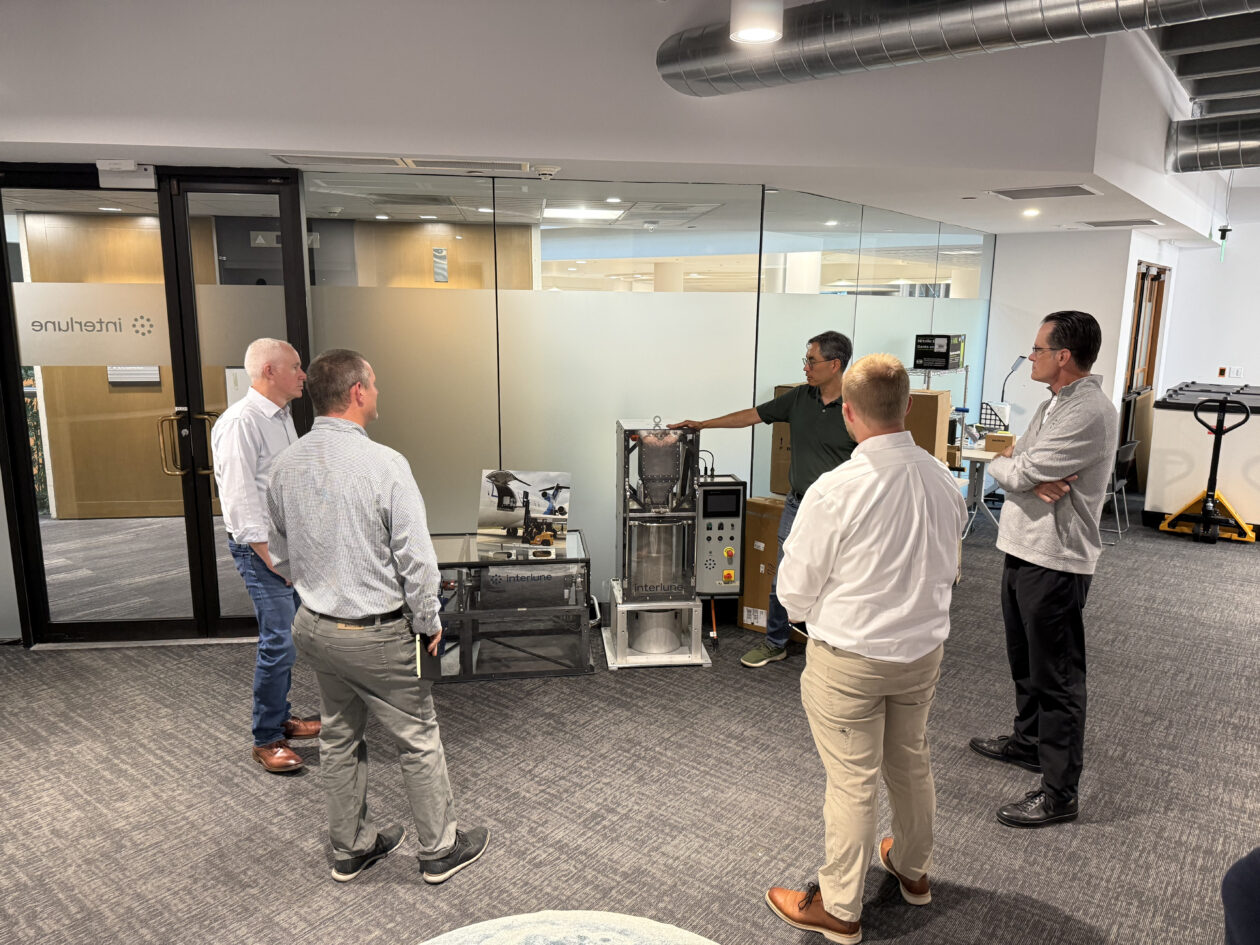
Executives get a look at a regolith-processing experiment at an Interlune lab in Seattle. Gary Lai, Interlune’s chief technology officer, is pointing at hardware. Interlune CEO Rob Meyerson is at far left, and Vermeer CEO Jason Andringa is at far right. (Interlune Photo)
“We want to really formalize the partnership so that we can start to think beyond prototypes, and think about sustainable operations, systems that are resilient to the environment,” he said. “That is what Interlune and Vermeer bring together as a team.”
Interlune will work with Vermeer to build a demonstration tool that could be put on a lunar vehicle and sent to the moon in 2028 or 2029. “It is going to be something around leveling, rock removal and compaction,” Meyerson said. “That will be the priority for the first one.”
Andringa said Vermeer would follow Interlune’s lead on the requirements for a lunar site preparation tool. “It would most likely involve what we call surface mining, which is a big drum attachment on a machine that basically mills out a level of the very top part of the regolith, and then it could be compacted,” he said. “Depending on the exact location on the moon and the exact properties of the material, you might just need to go over it with the drum one time.”
A lunar site-leveling tool could look something like the drum attachment mounted on this surface mining vehicle. (Vermeer Photo)
Over the longer term, Interlune and Vermeer would add to the toolkit. “Sometime in the future, you may have a specific-purpose machine that the two companies put together, that is specially designed just for that industrial operation, rather than the missions that NASA has in mind for the LTV,” Meyerson said.
In the meantime, Interlune is continuing work on its helium-3 mining initiative. The company’s first space mission, known as Crescent Moon, involves sending a multispectral camera to the lunar surface later this year. The camera is designed to estimate how much helium-3 is present in the soil around the landing site.
Interlune’s second mission, Prospect Moon, recently received $6.9 million in NASA funding for design and development. That mission is currently due for launch in 2028 and will test methods for extracting helium-3 and hydrogen from lunar regolith.
“We have the team in place, and things are going well,” Meyerson said. “We’re ticking through all of our milestones with the NASA team.”
Meanwhile, Vermeer is pursuing a separate partnership with Texas-based Astroport Space Technologies, which is developing its own suite of robotic systems for lunar construction projects. “Interlune and Astroport are aware of each other, and both of them feel as though there’s going to be plenty of work to go around,” Andringa said.
Andringa emphasized that the work on lunar construction equipment makes up just a small percentage of what Vermeer does. About 10 of Vermeer’s 4,500 employees are working on moon projects, and even those employees have other projects in their portfolio, he said.
Advertisement
Nevertheless, Andringa acknowledged that there’s something inspirational about extending the company’s reach beyond Earth. “It’s always going to be a small part of Vermeer, but it’s going to be a super-engaging, motivating, fun, stimulating, challenging part of Vermeer,” he said. “And you know what? What we learn to build stuff and fly stuff and operate stuff on the moon is just going to make us even better at the job sites where Vermeer machines work on Earth. That’s the reason we’re doing it.”
One of the electric Volkswagen ID. BUZZ vehicles that will serve as a free shuttle for light rail riders arriving in downtown Bellevue, Wash. (Visit Seattle Photo)
Stepping off the light rail in downtown Bellevue, Wash., is about to come with a free ride.
Visit Bellevue announced this week that it’s launching a free electric shuttle pilot program on Aug. 3 to help riders on Sound Transit’s 2 line continue their journey to other downtown destinations.
The new service is funded by Amazon and Visit Bellevue in partnership with Circuit, the City of Bellevue and Sound Transit. The pilot will run through December as an extension of the BellHop program, an on-demand electric shuttle service that started in the city in 2023.
The shuttle program will service riders at Bellevue’s downtown light rail station with two Volkswagen ID. BUZZ electric vans. Passengers can board at a designated pickup spot and request a drop-off location within the roughly 4-mile service area — no reservation or mobile app is required.
Advertisement
Riders looking to return to the light rail station can use the BellHop service by booking an on-demand ride via the Ride Circuit app.
Amazon employs roughly 14,000 corporate workers in Bellevue. The opening this spring of the Link light rail Crosslake Connection across Lake Washington was viewed as a vital new transportation option for tech workers commuting between Seattle and Eastside campuses.
“We see tremendous value in programs that improve access to public transit, support sustainable mobility, and connect people with local businesses and destinations,” Keri Pravitz, manager of Community Engagement for Amazon in Bellevue, said in a statement.
The new shuttle will operate Monday through Friday, 8 a.m. to 6 p.m. See a map of the service area below.
Advertisement
The Bellevue light rail shuttle service area. (Via Visit Bellevue)
Lava’s newly launched Virat Series received a strong response on its first day of sale. The Lava Virat V1 5G and Lava Virat V1 went out of stock on Flipkart on the first day of sale. The sale began at 12 PM IST on July 31. Lava said this was the fastest stockout for the Virat Series on a sale day. The company said the response reflects the growing number of consumers buying smartphones online. According to Lava, buyers are looking for dependable performance, a clean Android experience, and affordable smartphones. The strong demand for the Virat Series highlights this growing preference.
Virat V1 Specs
Lava Virat V1 5G includes a 6.75-inch HD+ display screen with a 120Hz refresh rate. It contains a 6000mAh battery and the UNISOC T8200 chipset. The phone comes with 64GB of internal memory, expandable up to 1TB. This phone does not have any ads or bloatware; rather, it runs on the Clean Android 16 Operating System. It also has an IP64 rating for dust and water resistance.
Another version of the Lava Virat V1 phone includes a 6.75-inch HD+ screen, a 5000mAh battery, and a UNISOC SC9863A chipset. The phone includes 64GB internal memory that is also expandable. The smartphone also carries an IP64 rating for added durability. Lava confirmed that it is working with Flipkart to restore stocks as quickly as possible. Customers who could not buy the smartphones during the first sale will get another chance once the devices are back in stock.
Right now, the Internet is drowning in articles about the Christopher Nolan’s The Odyssey – some loved it, others haven’t seen it, and a few have criticised it. Allow me to add another opinion to the heap.
I very much enjoyed watching The Odyssey, having bought my ticket for Waterloo BFI IMAX when the tickets went on sale (waiting in an online queue for about 50 minutes to do so). I went into the film avoiding the hype (which is always out of proportion), looking to enjoy the film.
And while I was sightly conflicted once the lights turned back on (a little more insight into Odysseus’ men, and a sight of people outside of kings, queens, soldiers and schemers would have rounded the world out some more). But it is an intense, surprisingly soulful, absorbing, and relentless film that exists on a huge canvas. Go see it on as big a screen as you can.
The stories of people going on their own odysseys, travelling thousands of miles to see the film on 15/70mm film, have added to the whirlwind of noise surrounding the film.
Advertisement
But with a 4K Blu-ray release certain to come out before Christmas, it had me wondering whether seeing it at home – while not the original intention of experiencing the film – might be just as good.
Advertisement
A visceral experience in the cinema
Image Credit (Trusted Reviews)
I do like an IMAX viewing, and The Odyssey being the first feature film shot in full 15/70mm is all the reason I need to head to the cinema. Living in London, we’re fortunate that we have two screens capable of 15/70mm projection. With only 41 locations that can do this on the entire planet, that’s a sign of how rare this experience is.
A case can be made about elitism given the sparsity of 15/70mm IMAX venues. This goes back at least 15 years with the appearance of the ‘lie-MAX’ screenings that claimed to offer the IMAX colour and sound in proportional sizes. I’ve never liked these smaller screens. It goes against the point of IMAX in my opinion.
I’d recommend the IMAX Laser screen at the Cineworld Leicester Square, as that might possibly offer the best picture quality of any type of IMAX venue, having talked to the former CTO of IMAX way back when.
Advertisement
But the actual experience of sitting in the auditorium and seeing the full screen, led to a few thoughts during the film and afterwards. I’d thought Row F and slap bang in the middle would be enough, but I think I miscalculated.
There have always been prime seats in IMAX – only the unfortunate who were too slow to buy a ticket or decided ‘the hell with it’ and lumbered in the A, B, C rows. I remember seeing Interstellar with a work colleague and while the experience of the film was great, craning your neck from row D is not ideal.
Advertisement
Image Credit (Universal Pictures)
And even in row F, I found the verticality of the IMAX screen close to intimidating at times. It’s utterly huge, and seeing Odysseus’s face loom over you is a spectacle in itself. There’s a physical side to watching the film you’ll never get watching at home, even if my neck felt a little bit like an F1 driver’s whizzing around a track for 90 minutes. The next time I see The Odyssey, my tickets are up higher.
At home though, this will be neutered, and it got me thinking about how, while the home experience will be a downgrade on the cinema, I’d get to enjoy the film in my own way. I won’t be craning my neck, the film won’t be slightly out of focus at times (which I can’t yet tell if that’s the film itself or the projector focus), and I’ll have the best seat in the house. I’m all for the cinema, but let’s not forget that home cinema and physical media at its best, is a great thing.
Advertisement
The version of The Odyssey that will hit home entertainment will be different from the cinema release as it won’t be a 1:1 translation. IMAX film is effectively a square (Nolan uses the taller 1.43:1 ratio rather than the wider 1.90:1 ratio) – TVs are 16 x 9 rectangular. The maths have never fitted.
A truer translation of the IMAX film would have black borders left and right (pillarboxing) in the way Zack Snyder’s Justice League does. But Nolan carries his centre crop approach to home video with the film filling out the screen, so the 4K Blu-ray and other home video versions (streaming versions of Nolan films are often 2.39:1) will be a compromise in terms of cropping the top, bottom and sides.
In a way, that makes the IMAX 15/70mm exclusive to cinema, despite the humorous memes of people watching the film’s trailer on their iPod Classic with the line “As Nolan intended”. You’ll never really see the 15/70mm film outside of an IMAX screen. Ever.
Advertisement
Advertisement
Image Credit (Trusted Reviews)
Bringing the epic home
But it’s not as if Nolan doesn’t take considerable care with his 4K Blu-rays. There are versions of the film, despite not being the version of the film, and they are crafted to reflect the intent and the way you want to see the film at home. And this is where my laboured point comes into view.
Nolan is an advocate of physical media, and as he said at the inaugural DEG Vanguard Award in 2023: “…with 4K UHD, you’re going to be able to produce a home video version of your film with a format that will actually show off to the best effect all of the effort and money put into the technical presentation of the theatrical. So, a lot of my interest in visual spectacle, in the technical aspects of filmmaking over my last few films, is definitely driven and enhanced by the idea that at the end of the day the people at home will be able to experience a very high-quality version of the film.”
And with regards to translating theatrical film to the home: “…what we would do is just project the material and then project the video and really try to match it as closely as possible and the added bandwidth the HDR, bit depth and color and so forth it really puts us in a position where we can get closer and closer to a theatrical print in the home. It’s really exciting that all that work — an increasing amount of work — carries through to the home presentation.”
This continues with the film’s soundtrack, which in the same talk Nolan has said with the 4K Blu-ray releases that they “decided to put the full theatrical sound mixes of the film” because of the quality of people’s home cinema systems.
Advertisement
Advertisement
Given I review a fair amount of home cinema systems each year, I’m not sure I’d totally agree with that assertion. Many still opt for either basic or compact (and therefore compromised) sound systems, and Nolan’s sound mixes remain challenging. You could a good sound system to get the best from his films, not helped by many soundbars and TV brands ditching support for his favour DTS audio format.
There were moments during The Odyssey where I couldn’t pick up dialogue (a common criticism of Nolan films and not entirely false). The volume levels do get thunderously loud, the relentlessness of the third act is aided by the sound mix and Ludwig Göransson almost 80s-synth like score – it’s the loudest film I’ve seen in the cinema since a critics screening of Nolan’s Dunkirk at the BFI IMAX, which in a past life I described as a “concussive, forceful experience”.
At home, I can have the volume at more palatable (but still high) levels and not feel like my head is being pounded by the full-range IMAX speakers, though The Odyssey is the type of film that’d make people shell out for a new system.
Nolan’s version of The Odyssey is visceral and exhausting, both visually and aurally, in the way he intended it to be. I’m of the firm belief that whether you like the film or not, you won’t see anything like it from any other film this year.
Advertisement
It’s very familiar if you’ve seen Nolan’s filmography – the nesting narratives, repeated imagery, and huge scale go with assured performances across the board (even in small parts).
So go see it in the cinema, as many people are currently doing – I’ll be seeing it in IMAX 15/70mm again soon – and once I’ve had my fill, I’ll be turning towards the 4K Blu-ray release, as while that won’t be the version seen in the cinemas, it’ll take the theatrical experience and translate it for home cinema as a ‘new’ version of the film in its own way.
Advertisement
And I’m looking forward to having a copy of The Odyssey in the best possible version outside of the cinema, one that’ll hopefully echo and endure like the original poem.
It’s so hard for big businesses to get AI tools working reliably that whole new organizations of forward-deployed engineers or FDEs— specialists who drop into a company to get its AI systems up and running — are springing up to help them.
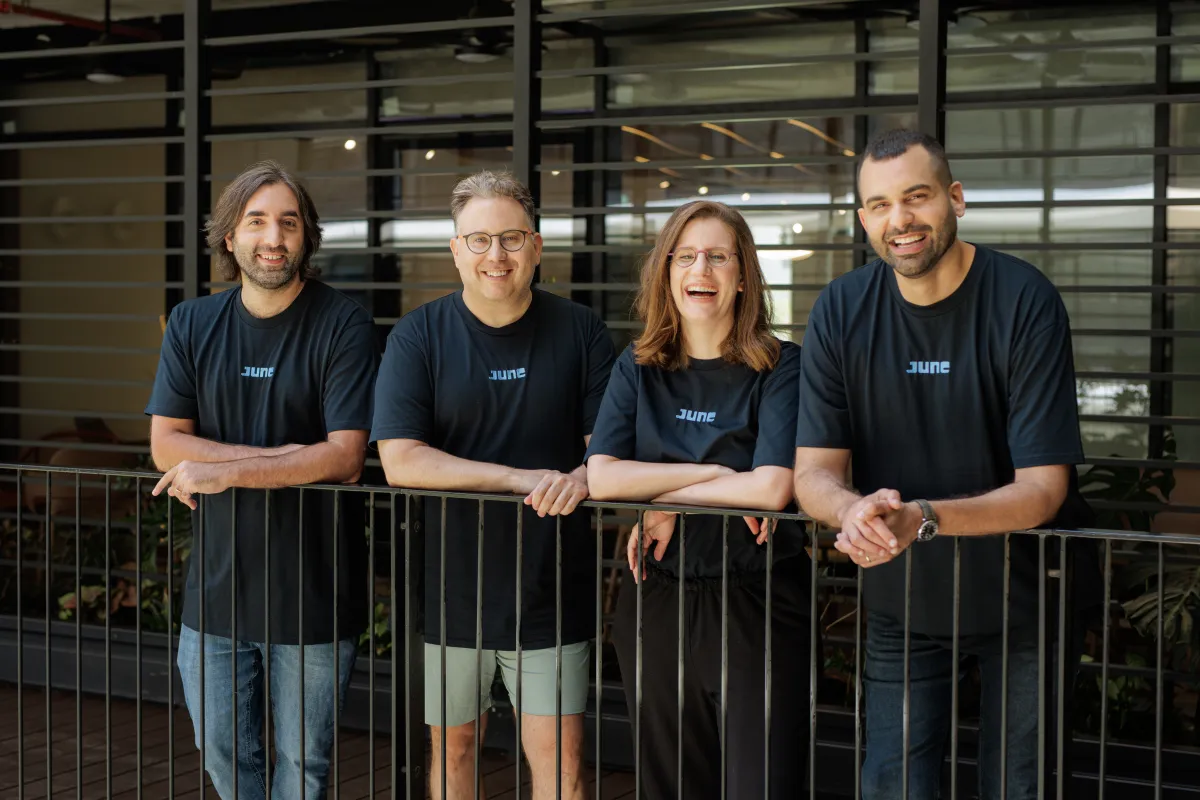
“AI, paradoxically, increases the demand for professional services,” says Efrat Rapoport, a former Salesforce executive whose new company, June, emerged from stealth Monday morning. “The industry’s answer to AI implementation is, ‘let’s hire more and more and more people.”
Rapoport and her three cofounders — Ohad Hen, Barak Goldstein, and Idan Tsitiat — have a different idea about how to bring AI into broader use. To pursue it, the company raised $20 million in pre-seed funding led by Marc Benioff’s Time Ventures, with additional backing from tech luminaries like Michael Dell, Aaron Levie and George Kurtz. The company declined to share its valuation.
The four founders previously started Bonobo AI, a pre-transformer language model company that launched a voice-to-text service in 2017. Bonobo AI was snapped up two years later by Salesforce, and the team worked for several years on the tech giant’s AI initiatives before setting out on their own again after watching customers struggle to bring AI into their existing platforms.
Advertisement
Their potential was clear enough to their investors, Rapoport says, that “we didn’t even have a deck for this raise.”
While the so-called SaaSpocalypse has software firms fearing that AI might replace them, thus far no one is vibe-coding a CRM for a Fortune 500 company. Any AI model brought into a corporate setting still has to work with Salesforce, ServiceNow, DataBricks, Workday, or any of a dozen other data-management platforms.
“Before AI can create value, someone has to deal with legacy systems,” Rapoport says. “You have fragmented data across these platforms. You have complex workflows. You have years of technical debt.”
Building an agent template is the easy part, she says. The hard part is getting it to work with the mess underneath. “How does an agent know how to operate when you have 10 duplicate [database] fields that say the same thing, and different teams are using them?”
Advertisement
June’s platform scans a company’s existing systems to understand its business processes, find bottlenecks, and then build more optimized, agent-powered processes to replace them, automatically notifying teams through the company’s comms channels.
“We give you the full roadmap automatically of what needs to happen step by step for you to actually implement this agent successfully in an enterprise environment, which is often very complex,” Rapoport said. “We give you a step by step guide. ‘Remove these duplicates. Connect to this data source.’ And then you click on ‘build’ on each task, and June starts building it for you in the organization.”
Paul Akinmade, chief strategy officer at CMG, a major U.S. mortgage lender, moved his company’s software engineering over to Claude Code quickly, but hit roadblocks trying to integrate it with Salesforce. That was a problem since he’d promised at Salesforce’s annual conference the year before that he’d return with 100 agents running, and it wasn’t looking like he’d hit that target.
Akinmade says his team spent weeks hitting a wall — meeting with architects, talking to forward-deployed engineers, consulting everybody they could — without making progress. June changed that, he says, giving his team a clear view of where to deploy agents and letting them do so safely, even before the official kickoff call between the two companies
Advertisement
Rapoport sees June as a tool that complements FDEs and consultants, but her customers may be drawn to it for the opposite reason: it lets them avoid FDEs altogether.
When Akinmade was first considering piloting the tool at CMG, he says he told her: “If your product requires FDEs, I don’t want your product. I’ve already I’ve already done that and I’m getting annoyed by it. I don’t want a black box. I don’t want something only certain people can figure out. I want an easy-to-use tool.”
Evidently, June cleared the bar.
When you purchase through links in our articles, we may earn a small commission. This doesn’t affect our editorial independence.
Apple is also prioritizing the 14-inch MacBook Pro over the MacBook Air.
Apple
Not only did MacBook Air prices recently go up from $1,099 to $1,299, but you couldn’t get one today even if you wanted to. Apple’s popular, lightweight model is currently in such short supply that if you order one today, you won’t receive it until the end of August, retail sources told Bloomberg‘s Mark Gurman. Unusually, Apple is even pushing buyers toward another model.
“Across its website and retail stores, Apple is prominently steering customers toward the base MacBook Pro instead of the Air — something it has rarely, if ever, done,” Gurman wrote. “In some marketing materials, it even includes a warning: ‘MacBook Air subject to availability.’”
Normally, Apple has no problems making enough MacBooks to feed demand, but these aren’t normal times. The MacBook Air shortage is linked in part to the ongoing “Ramageddon” memory crunch caused by the insatiable demand from new AI data centers. Apparently, Apple is also prioritizing the 14-inch MacBook Pro over the MacBook Air in order to clear stock ahead of an M6 refresh for the former lineup, according to Gurman.
Advertisement
Though Apple beat Wall Street expectations for its last earnings report, the company warned investors and buyers that supply constraints could impact earnings next quarter and force it to further raise prices. At the same time, the new Apple Upgrade program introduced last week may drive higher demand for Apple products including its MacBook lineup.
Disclaimer: Unless otherwise stated, any opinions expressed below belong solely to the author. Data sourced from Singapore’s Ministry of Manpower.
As we know, the median salary for fresh graduates in Singapore is currently S$4,500, while the figure for the entire workforce is S$5,775. However, there are some jobs that pay their young workers much better—if not straight out of school, then at least before they hit 30.
According to the data from the Ministry of Manpower, there are 30 occupations where median salaries for workers between 25 and 29 years of age are already above the national average.
S$100,000 by age 30
The list is, unsurprisingly, dominated by jobs in the tech sector (10 occupations) and finance (nine occupations), with the rest divided among medicine, management, law, and design.
In-house legal counsel (excluding judiciary, ministries and statutory boards)
S$5,834
27
Statistical officer/ Data analyst
S$5,833
28
Compliance officer/ Risk analyst (financial)
S$5,830
29
Interaction designer
S$5,829
30
Data centre engineer
S$5,798
Gross wages include the basic wage as well as any additional allowances and overtime payments./ Source: Ministry of Manpower
The boom in AI catapulted young engineers to the top, with IT companies already paying them over S$100,000 per year, outranking the usual high-earners with legal degrees.
But these earnings may see an even bigger rise in 2026, as international tech giants from the US and China are competing for local AI-graduates, with the Straits Times reporting packages worth as much as S$350,000, targeting the most qualified PhD holders.
This boom may be a boon for young talent, provided that it doesn’t lose steam and the generous offers do not turn into mass layoffs that the tech industry experienced over the past few years.
Advertisement
If that happens, though, there is hope in finding a job in one of the other occupations, which offer very good earnings to 20-somethings, putting them on track to six figure annual salaries in their 30s.
Read other articles we’ve written on Singapore’s job landscape here.
In this week’s Sunday Reboot, despite Apple making more money than in any previous Q3, it’s never enough to escape a beating from investors or analysts.
Sunday Reboot is a weekly column covering some of the lighter stories within the Apple reality distortion field from the past seven days. All to get the next week underway with a good first step.
The Maddest Money
I have been covering Apple and the tech industry in general for over ten years. I have a decent understanding of how things work in many areas, but I do have some blind spots.
I have trouble understanding the logic of analysts and investors around the time of Apple’s quarterly results.
Advertisement
Every three months, the AppleInsider editorial team has to spend a few hours analyzing a PDF spreadsheet and a press release from Apple, detailing just how much money the company made this time. In painstaking detail.
Of course, that’s followed by listening to a conference call with people asking questions of Tim Cook and Kevan Parekh. Most of the time, the responses are predictably an inability to comment on future plans or reiterating something the pair mentioned 15 minutes prior.
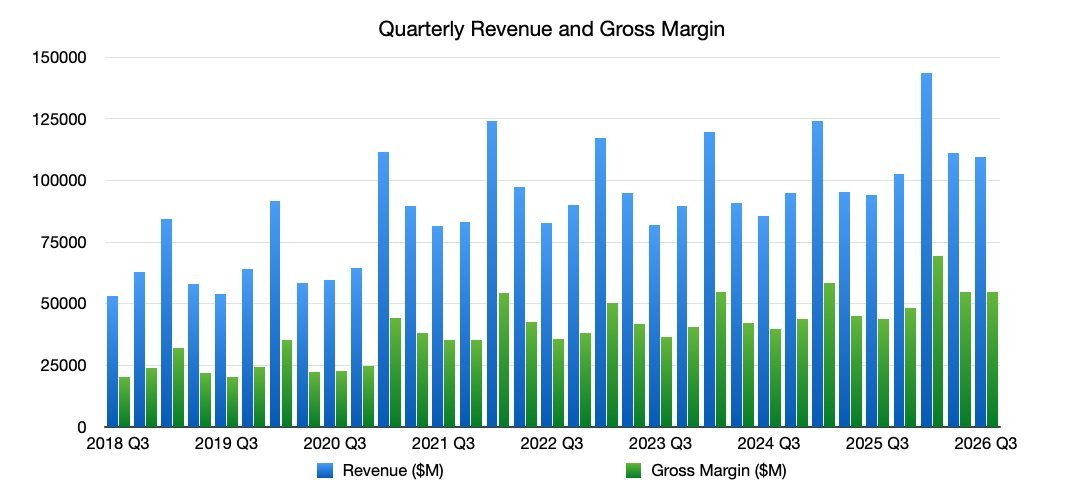
For nine quarters in a row, Apple has declared total revenue that’s a year-over-year improvement over the previous one. Q1 to Q3 2026 inclusive have year-over-year increases of around 16%.
Advertisement
Apple makes billions, but it’s never enough for analysts.
Despite repeatedly making more money than almost anyone would see in multiple lifetimes in a mere three-month period, the same pattern emerges.
Right after the results release and everyone sees Apple make deity-level bank, the share price goes down. Over the space of an hour, the price went down on July 30 from 338.45 at 4:30 P.M. Eastern to $308.03 at 5:30 P.M.
That could be explained as investors thinking they have done enough to earn that sweet $0.27 dividend and decided to shift their money right afterward. That, at least, I can get my head around.
Advertisement
Gordon Gekko meets Mean Girls
The real brain burner is the swathe of analysts who then decide that Apple didn’t do enough. Despite each of its units earning billions, as if they are major companies in their own right.
Goldman Sachs, after raising the price target to $370 just days before the results, cut the target by $10 after the call. Chiefly because of Apple’s guidance that it won’t meet demand for the next quarter.
You know, during a time period when people have to get a mortgage to afford more RAM.
To Cook’s credit, he said it was not a partner or supplier issue, and was simply one of “incredibly strong demand.” Apple has the nice problem to have of being too wanted by consumers.
Advertisement
Rosenblatt raised its price target by $24, which sounds good except it’s still underwater at $300. Cue complaints about the “volatile financial environment” and supply constraints.
Also for some reason, the iPhone 18 will be having a hard time because the iPhone 17 was such a huge success. Apparently, the high sales for the current generation mean there’s no one around to buy the next one.
More realistically, the problem here is that the iPhone 17 did really well compared to the iPhone 16, which means it’ll be harder for the iPhone 18 to show further improvement over the iPhone 17.
Growth is all-important to investors, even if they are blinkered to Apple having other products or revenue sources available.
Advertisement
Morgan Stanley did a similar trim of its price target as Goldman Sachs, from $364 to $360, citing higher memory costs and slowing Services growth.
Because Services only climbed a mere 12.7% instead of MorgStan’s expectation of 14.6% growth, that apparently means growth will slow to 9.5% next year.
The annual growth percentage of Apple’s Services arm. Still aggressively positive.
By that, Morgan Stanley believes Services will earn only $2.9 billion more revenue this time next year, when it really wants to see more than $4 billion.
Advertisement
In effect, people are somehow complaining that a company that made billions more dollars than the same time last year didn’t quite do enough. Also that it is so popular that it cannot keep up with demand, and that’s apparently equally horrific.
Then there’s JP Morgan, which also cut its price target from $345 to $340, again hammering on about the supply constraints. However, at least the analysts are realistic, pointing out that limited product availability will push revenue into later quarters, and that Services will continue to be a benefit.
It’s not as bleak as other analysts’ denouncements of Apple’s success. But it’s still a downer.
The investors and analysts probably have justifiable reasons for pointing out Apple’s deficiencies. But from here, it seems a little bit picky and weird.
Advertisement
It’s almost like they’re trying to pick any perceived fault or shortcoming to justify their salaries to investors, eager to understand Apple’s workings and to know if their investment is safe.
You may have a romanticized image of high-power investors similar to shows like “Billions” and “Succession.” Each quarter, the image that gets reinforced to me is more like “The Office” or an Aldi version of Statler and Waldorf.
I just hope that I don’t get jaded enough to downgrade that view further to “Sanford and Son.”
Last week’s Sunday Reboot talked about Apple TV moving into dating, the existence of “Matchbox The Movie,” and the hope for even more “Ted Lasso”.
Even as Hollywood performers protest and Hollywood studios sue “in their war on AI,” reports the Los Angeles Times, “the entertainment industry is deepening its dependence on it.”
Among hundreds of job postings in late June, more than one in 10 was likely connected to AI. The top studios’ public postings suggest they have been recruiting people to build AI tools. They are also recruiting teams to defend their intellectual property against unauthorized AI use. “There are plenty of studios that are hiring [for AI] but never talk about it in public,” said Yoland Yan, a co-founder of ComfyUI, a company that helps studios juggle different AI tools. Companies have been hesitant to detail how they use generative AI in film production — partly because they are concerned about consumer and union backlash. Some in Hollywood described AI use as the new cosmetic surgery, where everyone knows it is happening, but few will admit to it…
Although some companies may be shy about sharing their AI plans, big stars who don’t have to answer to others have been more open about their embrace of the new technology for storytelling. Rejecting AI is like picking a horse and buggy over a car, said “Star Wars” creator George Lucas. “Artificial intelligence means it’s much easier for us to make movies,” he told a trade magazine earlier this year. “There’s nothing you can do about it. That’s progress. It’s the future.” Some in Hollywood have a softer stance on artificial intelligence, with studios cutting deals with AI companies, and filmmakers like Martin Scorsese backing AI companies. Ben Affleck launched an AI film tech company then sold it to Netflix for half a billion dollars. When launching InterPositive, Affleck said he wanted to keep “storytelling human” by building AI tools that could fix lighting, generate missing shots and other things while “keeping creative decisions in the hands of artists….”
Disney, Netflix and Amazon had job postings that were about using AI on the creative side of the business. Universal, Paramount, Warner Bros. and Sony had job ads suggesting they were also using AI but for marketing, distribution and audience analytics. The postings suggest the Disney, Netflix and Amazon studios are building repeatable AI workflows for visual effects, animation, sound and dubbing. The companies also seem to be building in-house teams to develop custom generative-AI models, while also using third-party software.
Advertisement
None of the jobs advertised were to create AI that wrote scripts or created AI actors.
Ironically, the Times used Claude Code to build a scraper to identify the job postings, their article acknowledges.
Three Disney jobs were for “content security,” assessing AI tools and guarding against piracy, watermarking and rights-protection work. But Disney is also hiring PhD-level talent “to study ‘computer graphics and AI’ for Pixar and Disney films,” according to the article, and “people to ‘bridge the gap between research and practical studio application.’”
Disney-owned visual effects shops Industrial Light & Magic “was searching for supervisors to ‘explore emerging technologies (including AI/Machine Learning)’ to develop new production workflows.”
Audio post-production unit Skywalker Sound “seemed to be recruiting to build proprietary AI models for soundtracks, voice separation, and voice transfer, the process of taking a speaker’s tone and pitch, and applying it to new content.”
Amazon “was hiring a principal AI executive to drive AI-tool adoption across production, plus roles in operations automation and LLM content classification.”



























































You must be logged in to post a comment Login