
Connect with us

Tech

Sendy Audio Egret Review – Trusted Reviews

Published

on

Verdict

The Sendy Audio Egret is a flagship-feeling open-back headphone for refined home listening sessions. A 98 x 84mm planar driver, a sub-800nm composite diaphragm built using Sendy’s Electron Beam Evaporation Deposition (EBED) process and handcrafted natural-wood housings combine for a wide, airy, intoxicatingly natural experience. The triple-composite balanced cable in the box would cost a small fortune as an aftermarket buy. At £799, the Egret undercuts several obvious rivals and is in straight contention for the best open-back headphone at the money

  • Planar driver delivers flagship-class detail

  • Handcrafted natural-wood housings look and feel beautiful

  • Premium triple-composite balanced cable included as standard

  • Light, well-balanced and comfortable

  • Doesn’t demand a desktop amplifier

  • Bass prioritises control over boom

  • Open-back design leaks both ways

  • Headband feels thin

Key Features

  • Trusted Reviews IconTrusted Reviews Icon

    Advertisement

    Review Price:
    £799

  • Sound

    Advertisement

    Newly developed 98 x 84mm planar magnetic driver

  • Design

    Advertisement

    Soft leather earpads and contoured headband

  • Cable

    Advertisement

    1.8m detachable triple-composite balanced cable

Introduction

Sendy Audio, the more ambitious Chinese sibling of Sivga, has been building a reputation for planar magnetic headphones pairing serious engineering with cabinetmaker-grade housings.

The Aiva first put the brand on the map; the Peacock pushed it upmarket; now the Egret, named after a type of heron, spreads its wings as its most technically ambitious headphone yet.

Advertisement

Its beating heart is a newly developed 98 x 84mm planar magnetic driver alongside a nano-scale composite diaphragm just shy of 800nm thick, finished using Sendy’s Electron Beam Evaporation Deposition (EBED) process.

In plain English: punchy sound, low distortion and a driver that doesn’t need a desktop amplifier to come alive. With the likes of the HiFiMAN Arya Organic, Meze 109 Pro, and Sennheiser’s HD 660S2, and Audeze MM-100 on its radar, let’s see if the Egret fits the bill. Which, if you’re in any doubt, is a bird pun.

Advertisement

Design

  • Handcrafted natural-wood earcups
  • Open-back grille inspired by an egret in flight
  • Light suspension headband and angled hybrid earpads

The Egret is one of those headphones you instinctively pick up to admire before you put them on, owing mainly to solid natural wood cups with a unique grain pattern and finished in a classy satin sheen.

Heron fact: The grille pattern is loosely inspired by the wings of an egret in flight, and acts as the visual focal point of the headphone.

Advertisement
Sendy Audio Egret designSendy Audio Egret design
Image Credit (Trusted Reviews)

Structural elements are CNC-machined aluminium, finished in a soft gunmetal anodisation. Yokes, the contoured headband, and hybrid leather earpads with breathable fabric on the inner edge make the Egret a nice place to rest your cranium and lugholes.

Advertisement

While a quoted 420g weight isn’t especially light, the Egret’s headband spreads the load across the crown nicely, the clamp is moderate, and the pads track the head and ear comfortably. Multi-hour sessions came and went without adjustments, and glasses-wearers should fare well.

Sendy Audio Egret headbandSendy Audio Egret headband
Image Credit (Trusted Reviews)

My only real reservation is the PU leatherette on the underside of the headband, which is thinner than I’d like for this money. The open-back grilles are exposed on both sides, so this is a home, studio or quiet-office headphone.

Also, even though they’re open-back, they actually muffle some background noise. It’s not total silence, but it’s enough to drown out a desk fan or a vacuum. That makes them a solid choice if you aren’t listening in a padded cell.

Specification

  • 98 x 84mm planar driver with EBED diaphragm
  • Detachable triple-composite balanced cable
  • Source-friendly 38Ω / 103dB sensitivity

At 98 x 84mm, the planar driver is the largest Sendy has built, and the diaphragm is reportedly less than 800nm thick.

Advertisement

Advertisement

The interesting bit is the EBED process: rather than printing or laminating a conductive trace onto the diaphragm as a separate layer, ultra-fine aluminium is vapour-deposited directly onto the membrane at the atomic level.

Sendy Audio Egret caseSendy Audio Egret case
Image Credit (Trusted Reviews)

That allegedly produces a more uniform coating, less added mass and a cleaner electromechanical response. Let’s call this a ‘break glass in an emergency’ line of conversation for your first Hinge date.

A 1.8m triple-composite balanced cable combines 30 strands of Furukawa oxygen-free copper, 10 strands of silver-plated copper, and 10 strands of enamelled gold-plated copper, contained in a graphene-reinforced PVC jacket.

It all terminates in a 4.4mm balanced Pentaconn plug at the source, with dual 3.5mm balanced connectors at the cups, plus 3.5mm and 6.35mm adapters.

Sendy Audio Egret with accessoriesSendy Audio Egret with accessories
Image Credit (Trusted Reviews)

Advertisement

Sendy quotes 8Hz to 40kHz, 38Ω and a 103dB ± 3dB sensitivity, which translates to something that’s genuinely source-friendly. A DAC like the Chord Mojo 2 offers plenty of headroom, while a more modest USB dongle DAC still manages satisfaction without strain. They get plenty loud without high-end gear, though a nicer source is never to be sniffed at.

Advertisement

Packaging is generous, too. The tan eco-leather hard case looks a little like clenched buttocks and is lined with felt, while a linen cable pouch and supplied adapters all come in the box.

Sound Quality

  • Wide soundstage
  • Lush midrange
  • Refined treble

If the Egret has a defining sonic trait, it’s spaciousness. The combination of that large planar driver, the open-back grille and the airy tuning produces a soundstage that takes a tentative step outside the headphone.

Instruments spread cleanly and with a noticeable three-dimensional arc, leaving things nicely layered on more complex compositions.

Bass is where the Egret’s tuning shows its priorities. It extends comfortably, but it’s more of a subtle additional texture than slam dunk drops. Forget physicality and think tactile detail.

Sendy Audio Egret playbackSendy Audio Egret playback

Advertisement

Midrange is the headphone’s emotional centre. Vocals — male and female alike — flatter without being shouty. It rewards good recordings without punishing average ones. Treble is refined and non-fatiguing.

Advertisement

Cymbals shimmer rather than sizzle, brass has controlled bite, and there’s plenty of air around acoustic guitars. If anything, the Egret is a touch laid-back, but sit with them for a few hours, and that restraint reveals itself as a deliberate, classy choice.

Should you buy it?

If you want a flagship-feeling planar that’s comfortable for long sessions, easy to drive from real-world equipment and beautifully made, the Sendy Audio Egret is one of the easiest recommendations at this price. Plus herons.

Advertisement

No — I’m a booby person

If outright low-end physicality matters more, rivals hit harder. If you need to listen on a commute, an open-back of any kind is the wrong tool. A booby also arguably has nicer plumage.

Advertisement

Final Thoughts

The Sendy Audio Egret lets its engineering do the talking. The 98 x 84mm planar driver and the EBED-deposited nano-diaphragm are interesting, but you don’t need to care about either to enjoy what they produce: a wide, three-dimensional soundstage, a lush and natural midrange, textured bass and a treble that refuses to fatigue.

The triple-composite balanced cable, hard case and adapter mean nothing important has been left in the lab either, and the compromises – slightly thin PU leatherette, subtle bass, and the inherent leakage of an open-back – are sensible rather than damaging.

Set against offerings from HiFiMAN, Meze Audio, and Audeze, the Egret holds its own on technicalities, craftsmanship and pricing, and could potentially trouble our best over-ear headphones list.

Advertisement

How We Test

I tested the Sendy Audio Egret in a home office and a quiet living room, primarily as a long-session music listening headphone. Sources included a mix of dedicated DACs and Hi-Res Lossless sources.

I used the supplied 4.4mm balanced cable, plus an Apple USB-C to 3.5mm dongle via the included adapter to gauge real-world use.

Music testing covered electronic, hip-hop, rock, jazz, classical and acoustic material from Apple Music Hi-Res Lossless. Comfort was assessed across multi-hour sessions. No waterbirds were harmed during testing.

  • At the desk
  • Across portable and desktop sources
  • Mixed listening

Advertisement

FAQs

Is the Sendy Audio Egret hard to drive?
Advertisement

No. The Egret has a 38Ω impedance and a quoted sensitivity of 103dB ± 3dB, which makes it relatively easy to drive for a planar. It reaches comfortable listening volumes from a balanced dongle DAC and scales well with a desktop chain, but it doesn’t demand one.

What is the EBED process used in the Sendy Audio Egret?

Electron Beam Evaporation Deposition is the manufacturing technique Sendy uses to apply the conductive trace to the planar diaphragm. Ultra-fine aluminium is vapour-deposited onto the membrane at the atomic level, producing a more uniform coating, lower added mass and reduced distortion compared with bonded or laminated traces.

Advertisement
What cable does the Sendy Audio Egret come with?

A 1.8m detachable triple-composite balanced cable, combining Furukawa OFC, silver-plated copper and enamelled gold-plated copper. It terminates in a 4.4mm balanced plug at the source, with dual 3.5mm balanced connectors at the cups, and ships with a 3.5mm single-ended adapter.

Advertisement

Full Specs

  Sendy Audio Egret Review
Manufacturer Sendy
IP rating No
Weight 420 G
Release Date 2026
Driver (s) 98 x 84mm planar magnetic
Connectivity 4.4mm balanced (source); dual 3.5mm balanced (cups)
Colours Handcrafted natural wood
Frequency Range 8 40000 – Hz
Headphone Type Over-ear
Sensitivity 103 dB
UK RRP £799
USA RRP $799
EU RRP €879

Source link

Continue Reading
Click to comment

You must be logged in to post a comment Login

Leave a Reply

Tech

GX Biz FlexiLoan, business loan up to RM150,000 for M’sian SMEs

Published

on

[This is a sponsored article with GXBank.]

Disclaimer: This article is for educational and informational purposes only. It is not intended to be a substitute for financial advice. Readers are encouraged to do their own research before arriving at any conclusions based solely on this content. Vulcan Post disclaims any reward or responsibility for any gains or losses arising from the direct and indirect use and application of any contents of the written material.

Picture this: you’ve built something real. Maybe you’re a home-based F&B business pulling in steady orders every day. Maybe you’re a freelance designer with a growing client list. Maybe you own an online store that’s ready to scale, if only you had the capital to stock up.

The hustle and drive is there. But when it comes to accessing financial assistance, the journey can feel like it wasn’t quite designed with you in mind.

Advertisement

Because the reality is that most conventional financing options often come with lengthy requirements, such as audited financials, lengthy processing times, and collaterals. 

This might work well for more established businesses, but it’s not as easily suitable for sole proprietors and side-hustlers who are still building their paper trail. 

If that sounds familiar, GXBank, a digital bank licensed by Bank Negara Malaysia and a member of Perbadanan Insurans Deposit Malaysia, has designed GX Biz FlexiLoan specifically to solve this headache.

Dictionary time: Sole proprietorship is a one-owner business. There is no legal separation between the company and the owner, who receives all profits but is liable for all debts and losses. It’s the easiest type of business to establish and a popular choice for small businesses, individual contractors, and consultants.

Source: Investopedia

Advertisement

What exactly is GX Biz FlexiLoan?

Image Credit: GXBank

Simply put, GX Biz FlexiLoan gives SSM-registered sole proprietors in Malaysia access to up to RM150,000 in financing.

What sets it apart from a typical business loan is that it works like a revolving line of credit. Instead of receiving one fixed lump sum, business owners are given a credit limit they can draw from multiple times whenever they need, as long as the amount stays within their approved limit.

It’s a model that, according to CGC Digital CEO Yushida Husin, opens more pathways and support for financial institutions to serve segments that have traditionally been underserved, such as MSMEs.

And yes, no interest or fees will be charged for the amount that you don’t borrow from the credit line.

Image Credit: GXBank

To better serve entrepreneurs and sole proprietors, GXBank is challenging the system by removing some of the other common hurdles in getting business financing.

How GX Biz FlexiLoan makes your entrepreneurial life easier

1. You don’t need a business bank account (yet) to apply. 

One of the most frustrating catch-22s of traditional banking is that they want to see a business bank account before giving you a loan. They often demand for years of formal corporate financial history, strict P&L statements, guarantors, and collaterals.

Advertisement

But in most cases, you’re applying for the loan to grow your business in the first place. 

Image Credit: Gustavo Fring via Pexels

GX Biz FlexiLoan breaks that cycle by accepting your personal bank statements as alternative underwriting documents. You just need six months’ worth of statements from any bank and you’re good to go.

And no, you don’t need any collaterals or guarantors to secure it.

2. You can get approval within minutes, not weeks

Anyone who’s applied for a business loan the traditional way knows the drill: Submit your documents, then wait. And wait. And wait some more, sometimes for weeks, only to receive a response that still isn’t a definitive yes. 

For a sole proprietor trying to move quickly on a business opportunity, this kind of timeline could mean the difference between landing a deal and watching it slip away.

Advertisement
Image Credit: GXBank

With GX Biz FlexiLoan, you apply once through the GXBank app and your credit line can be approved within minutes. You don’t have to visit any physical branches to queue for hours or chase down bank managers to make your case. 

The straightforward digital process is intentionally simple, acknowledging just how limited your time is as a business owner.

3. When you drawdown, the cash hits your Biz Account instantly

Getting approved for credit is one thing, but actually being able to use it when it matters is another. 

A lot of financing products come with a delay between approval and disbursement, which doesn’t help much when you need to cover an unexpected expense immediately or pay a supplier by the end of day.

Image Credit: GXBank

With GX Biz FlexiLoan, you can receive cash in your Biz Account within minutes of your credit line being in place. You only pay when you actually drawdown, so having the credit line sitting ready in the background costs you nothing. 

Think of it as a financial safety net that’s always on standby without the maintenance fee.

Advertisement

4. You can borrow from as low as 3.8% p.a., with repayment terms that fit your needs

One of the quieter anxieties around taking on business financing is the fear of being locked into a rigid repayment schedule. It’s a scary thought, especially because you can’t predict when your business will have a slower month. 

Instead of providing flexibility, the business loan could end up adding pressure on top of the usual ups and downs of running a business.

Image Credit: GXBank

The team at GXBank understands this and has structured GX Biz FlexiLoan to avoid exactly that. You can borrow from as low as 3.8% p.a. (EIR from 7% p.a.) and repay over up to 36 months. There are no processing fees and no early repayment charges. 

So if you have a strong quarter and want to clear the balance ahead of schedule, you can do so without being penalised for being financially responsible. 

How you can get started 

In line with GXBank’s digital banking concept, GX Biz FlexiLoan is embedded directly into the app itself, offering a more seamless and accessible financing experience compared to traditional loan processes.

Advertisement
Image Credit: GXBank

All you have to do is:

  1. Download the GXBank app from the Google Play Store or Apple App Store.
  2. Tap on “Business Banking” and fill in your business details.
  3. Check your eligibility by verifying your MyKad and upload the last 6 months of your business or personal bank statements (from banks other than GXBank).
  4. Enter your 12-digit SSM Business Registration Number (BRN).
  5. Tap “Get Both” to accept the credit that is you’re offered.

That’s it. The whole thing is designed so that you can conveniently get it done directly from your phone, at any time, anywhere, without stepping into a single branch.

To qualify for GX Biz FlexiLoan, you need only be a Malaysian aged 18 and above, with an active SSM registration. 

If all of this sounds great but you’re thinking, “I don’t actually run a business”, GXBank has you covered on the personal side as well. GX FlexiCredit is GXBank’s personal financing product for individuals, giving you access to credit on your own terms. 

After all, financial flexibility isn’t something only business owners need, but everyone has moments where a little financial flexibility goes a long way.

Disclaimer: Terms and conditions apply. GX Biz FlexiLoan and GX FlexiCredit are subject to eligibility criteria.

Advertisement
  • Learn more about GXBank here.
  • Read other articles we’ve written about Malaysian startups here.

Source link

Continue Reading

Tech

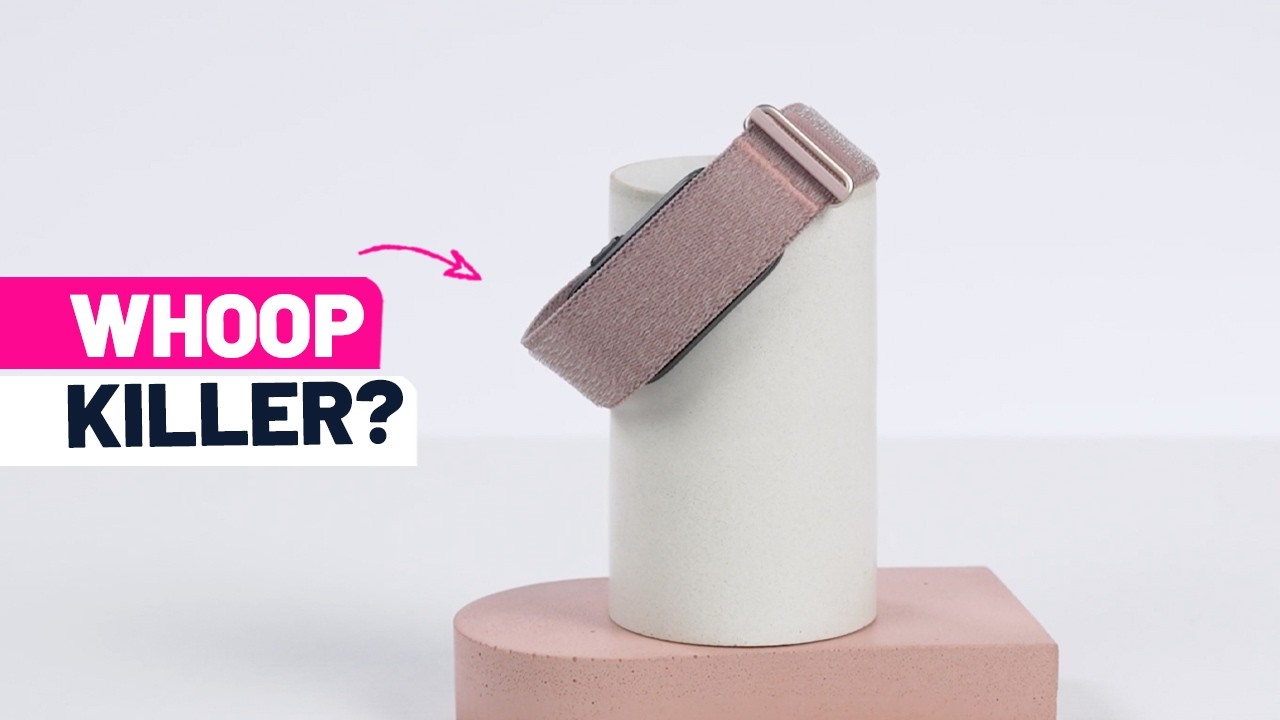
Garmin Cirqa review: Sorry Fitbit, but this is 2026’s best screenless smart band

Published

on

Why you can trust TechRadar


We spend hours testing every product or service we review, so you can be sure you’re buying the best. Find out more about how we test.

Garmin Cirqa: One minute review

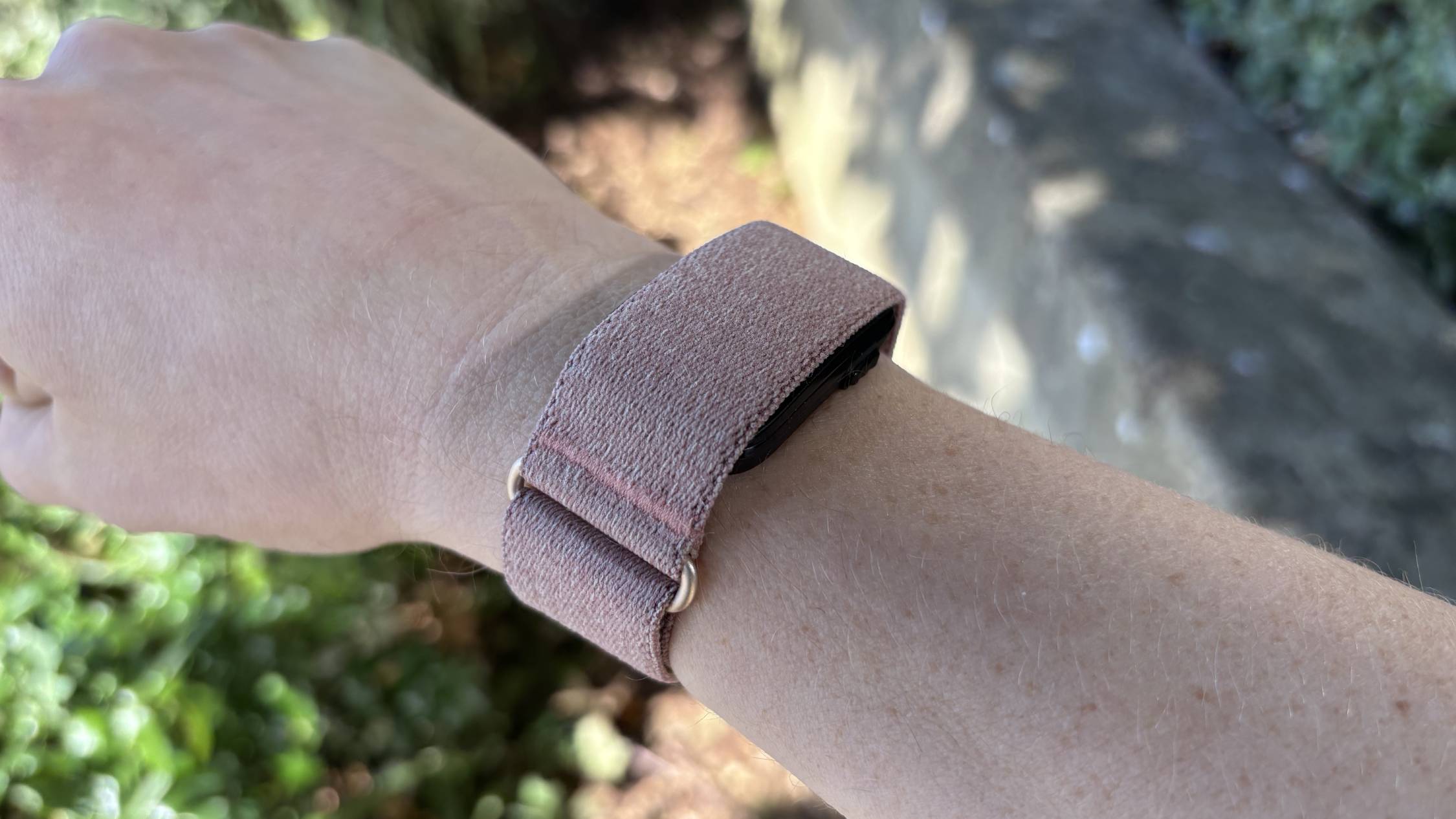
Garmin Cirqa worn on sunny day against stone background

(Image credit: Future)

I’ve spent a week with the Garmin Cirqa screenless fitness tracker, wearing it constantly during sleep, exercise and rest to determine how comfortable it is in everyday life, and measuring it against an electrical heart rate monitor and other wearables to determine accuracy.

After all my testing, I can confirm the Whoop and Google Fitbit Air have got serious competition. While some people will still want the AI-powered coaching from Whoop and Google Health, and others will want the screen-based interaction and notification features available on the best smartwatches, most users looking for a simple but high-quality screenless fitness tracker will be just fine getting the Cirqa.

Advertisement

Source link

Advertisement
Continue Reading

Tech

FDA Approves First mRNA Flu Shot

Published

on

The FDA has approved the first mRNA flu vaccine in the United States after a clinical trial found it was about 27% more effective than a standard flu shot. Manufactured by Moderna and marketed as mFlusiva, the vaccine is expected to be available this fall for adults ages 50 to 64 and those 65 and older, though approval for the older group is conditional on Moderna conducting an additional clinical trial, NBC News reports. From the report: Many scientists and public health experts have touted the idea of an mRNA-based flu vaccine, which uses the same messenger RNA platform as the Covid vaccines from Moderna and Pfizer. That’s because mRNA vaccines can be manufactured much faster than traditional vaccines, allowing scientists to better match circulating influenza strains. Moderna said it takes two to three months from picking the strain to rolling out its flu shot, compared with about six months for traditional flu shots.

Read more of this story at Slashdot.

Source link

Advertisement
Continue Reading

Tech

How One Rider 3D-Printed His Own Airless Mountain Bike Tires

Published

on

3D-Printed Airless Mountain Bike Tires MTB
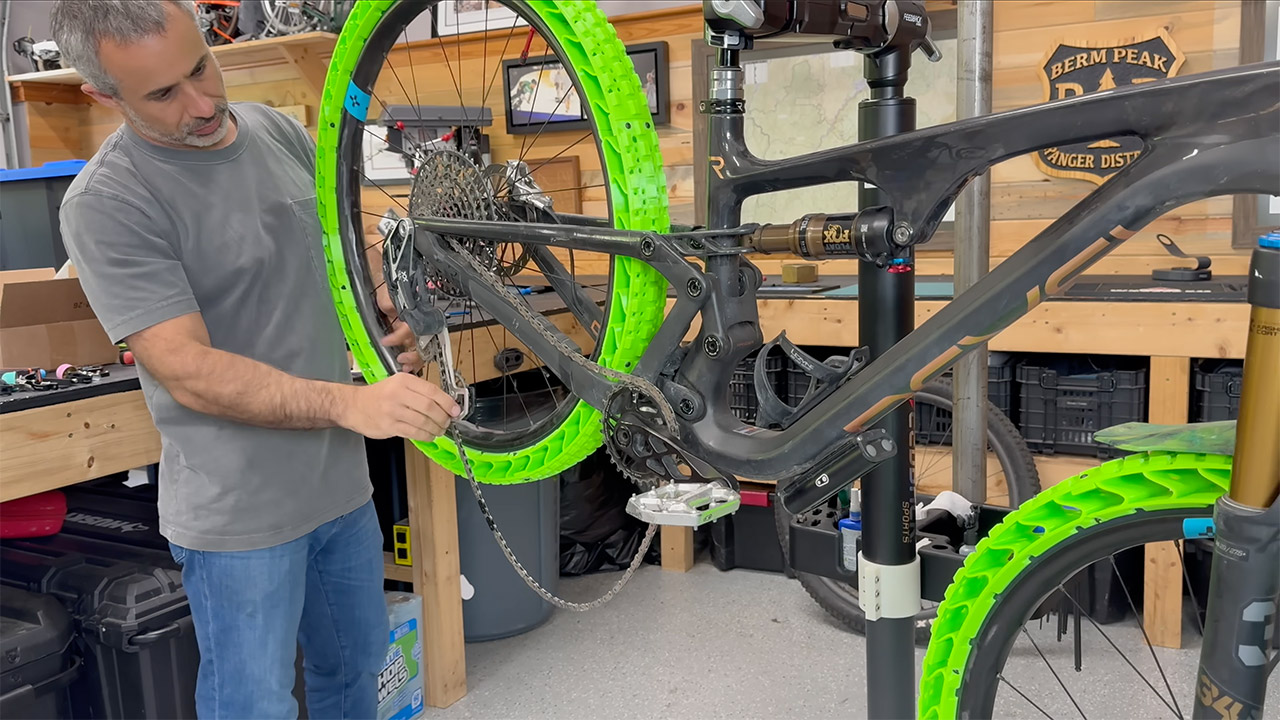
Companies have spent years showing off car tires that never go flat. Michelin and others roll out concept designs built from polymer webs that support the load without a single molecule of air. Those prototypes look sharp in tech demos, but almost never reach actual cars. Mountain bikes face a harder version of the same problem. A sharp rock or thorn can end a ride in seconds. Sealant inside modern tubeless tires already stops most punctures, yet the dream of a tire that simply cannot lose pressure still pulls people in. Berm Peak, the popular mountain-bike YouTuber known for building and testing unusual gear, decided the only way to get a real airless mountain-bike tire was to make one himself.


He started by looking for items that had already been made available for purchase. The search results showed foam inserts for children’s bikes and a few solid road tires that were the wrong size for him. Nothing came up with adequate knobs or a size that would fit modern mountain bike wheels. However, an older invention from 2012 drew his attention: the Britek Energy Return Wheel. Although cellphone videos showed it rolling across mud, the device never made it to market. That was enough to convince him to open his design file and turn on the printer.


Bambu Lab A1 3D Printer, Ready-to-Use FDM 3D Printer for Beginners and Kids
  • High-Speed Precision: Experience unparalleled speed and precision with the Bambu Lab A1 3D Printer. With an impressive acceleration of 10,000 mm/s…
  • Multi-Color Printing with AMS lite: Unlock your creativity with vibrant and multi-colored 3D prints. The Bambu Lab A1 3D printers make multi-color…
  • Full-Auto Calibration: Say goodbye to manual calibration hassles. The A1 3D printer takes care of all the calibration processes automatically…

3D-Printed Airless Mountain Bike Tires MTB
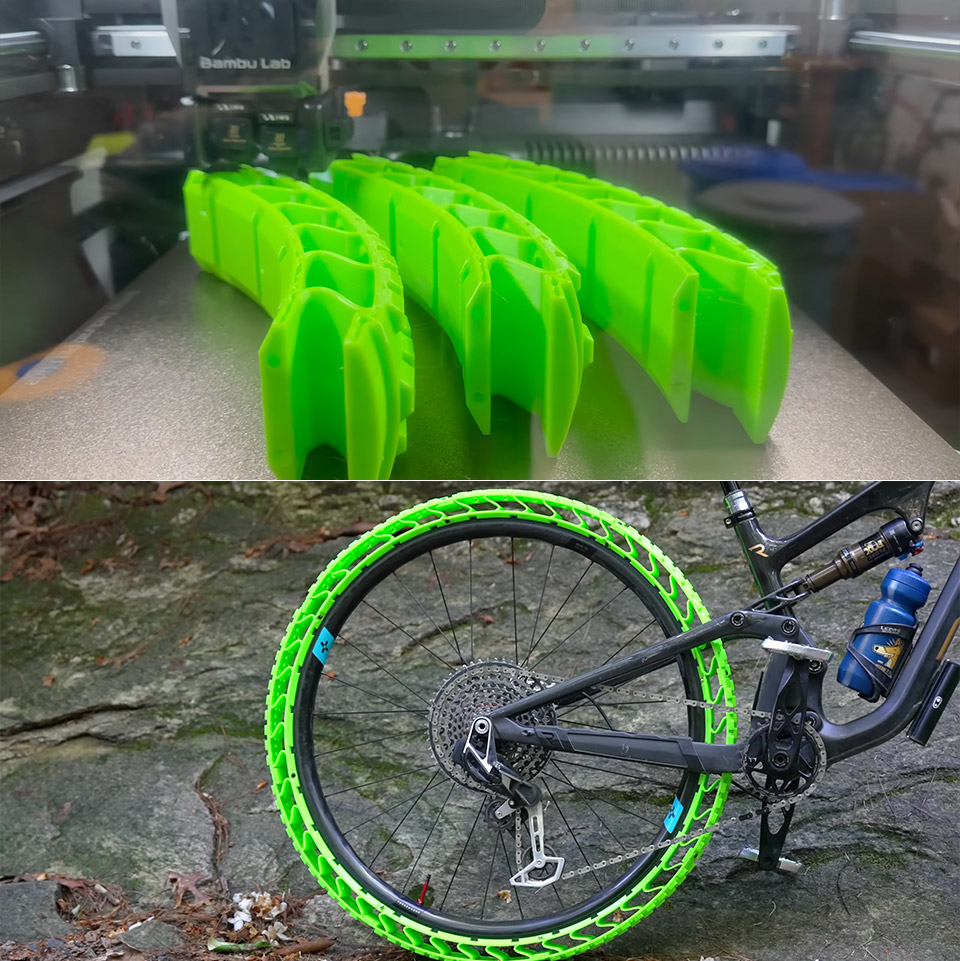
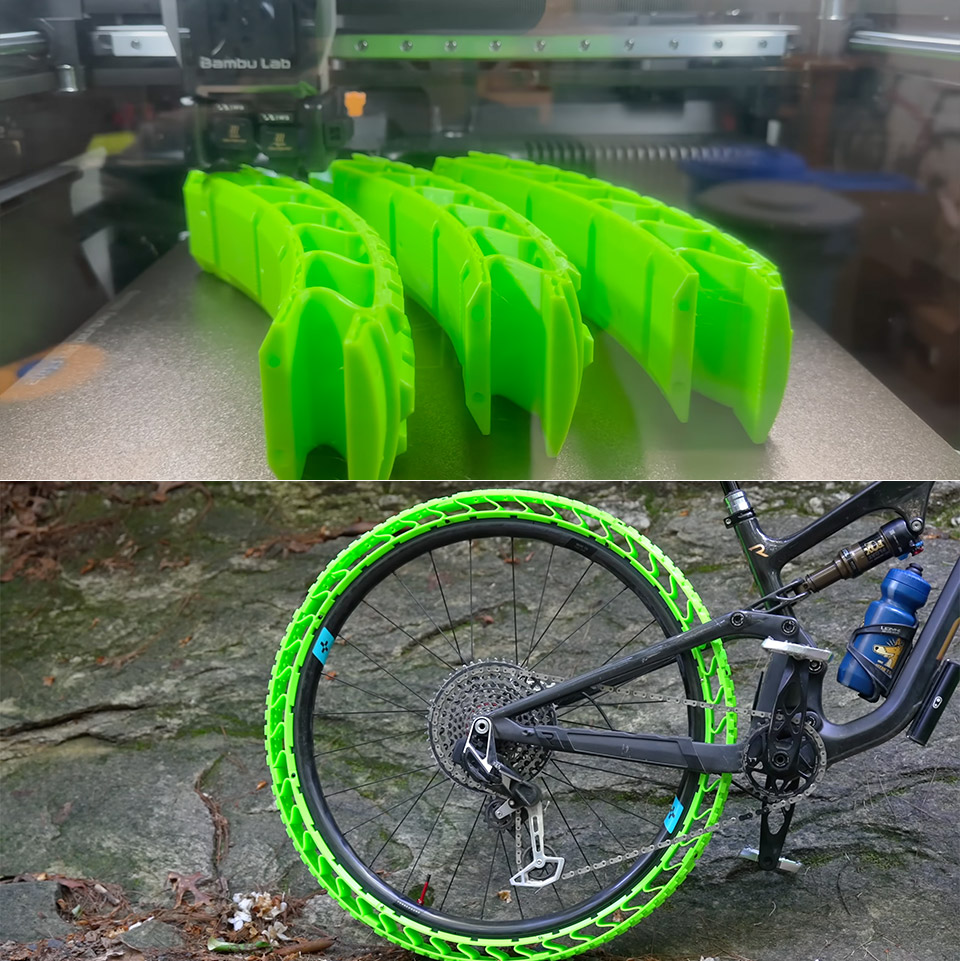
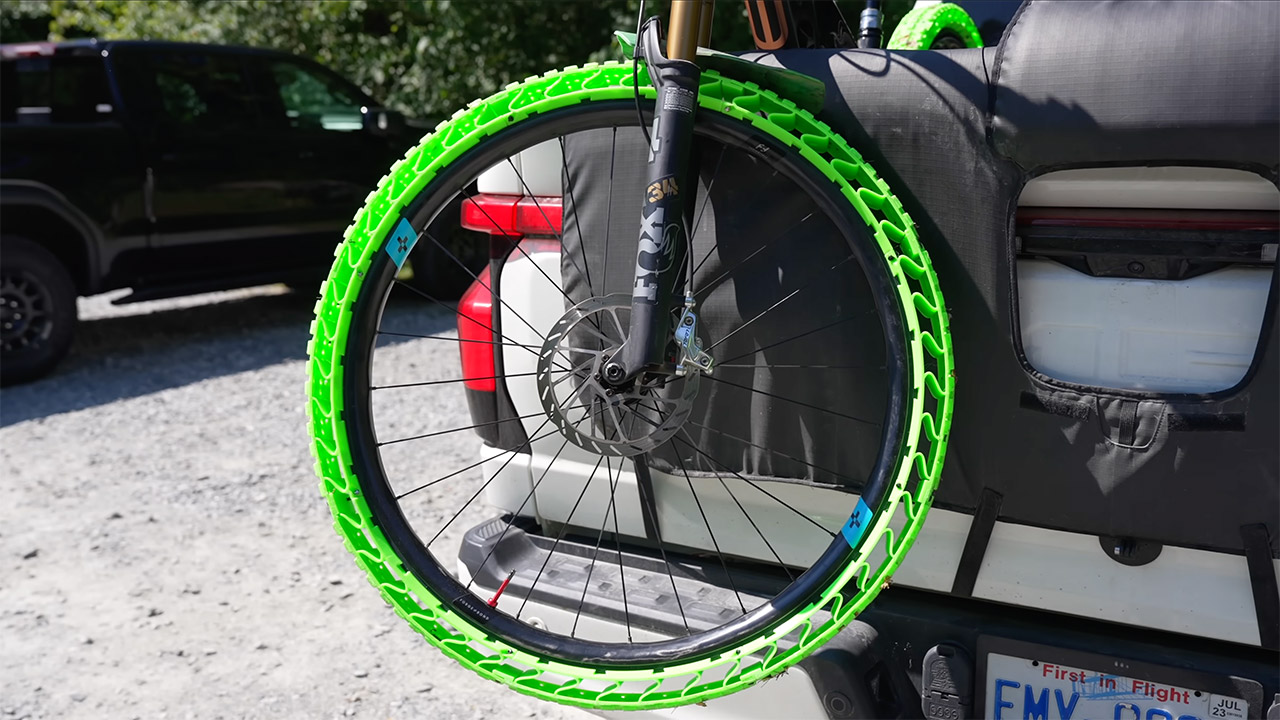
Berm Peak teamed up with Brendan, an engineer who had previously experimented with segmented printed tires. Initially, the thoughts were leaning toward the dramatic open-spoke look seen in concept art for science fiction films, but practical testing swiftly put an end to that. After several rounds of trial printing, the pair decided on a TPU framework with S-shaped flexible bridges connecting the outside tread and inner rim. When loaded, the S-curve compresses and then bounces back, similar to how air compresses in a standard tire.

3D-Printed Airless Mountain Bike Tires MTB
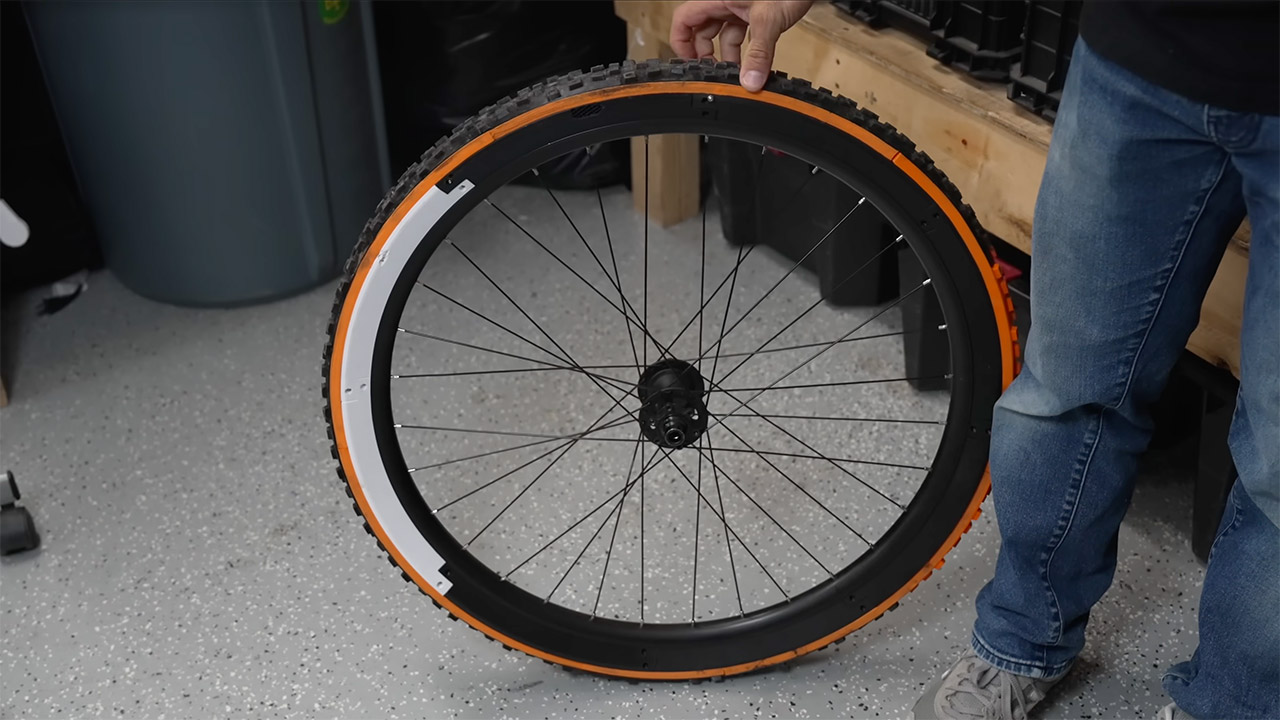
TPU is a flexible filament that functions similarly to skateboard wheel rubber, thus they chose it as their main material. They employed a Bambu Lab H2D, a dual-nozzle machine capable of laying down both soft TPU and detachable support material in the same project. Instead of a single loop, each tyre is built up of many arc-shaped parts. The components connect with small dovetail joints and are held in place by screws that run through printed interfaces and rest against the rim. There is no need to fiddle with stretching or forcing. The final tyre snaps into place piece by piece. The first functional set came in a bright neon green, which truly makes the odd structure stand out along the trail.

3D-Printed Airless Mountain Bike Tires MTB
Once completed, Berm Peak took the bike out on the mountain bike trails and rode the same lines he regularly rides on ordinary rubber. The printed tires absorbed little bumps in a wonderfully quiet, almost subdued manner. On soft mud, the grip felt solid. On jagged rocks, however, the contact was slightly less predictable, and the tread, which was made of the same solid TPU as the rest of the structure, lacked the give of commercial rubber. Nonetheless, the bike remained upright despite the harsh bends and impacts that would have popped a standard tube.


Durability was a major concern because the front tire lasted the first big sessions, but the rear tire began to show symptoms of wear soon, failing at the joints where the sections met. Impacts had begun to loosen the screws and cause cracks that spread from one piece to the next, and because the tire is modular, Berm Peak could simply replace out the damaged section without having to remove the wheel from the bike, a very useful feature that commercial tires cannot match. He already has a fresh version in the printer, with smoother transitions at stress spots and softer TPU on the knobs and key regions, thanks to the twin nozzles.
[Source]

Advertisement

Source link

Continue Reading

Tech

Student Artists Wrestle with AI’s Promise and

Published

on

The college graduating class of 2026 is the first to have full exposure to robust artificial intelligence (AI). But even at the high school level, U.S. students generally have considerable experience using AI — and mixed feelings about its growing role in everyday life. They may take advantage of AI benefits, but some fear where the technology could take us in the future.

That concern was on clear display at the Me, Myself, and AI art show at the recent America’s Youth AI Festival in Boston. The three-day event gathered student leaders, educators and school system leaders from across the country to discuss acceptable AI use in the classroom and how it is already influencing student lives. The festival was hosted by Day of AI, MIT RAISE, The School Superintendents Association and the Edward M. Kennedy Institute.

Day two of the event featured two contests: AI for a Better World and an art competition. Day three concluded with “student senators” from across the country debating a first-of-its-kind national AI policy for K-12 classrooms.

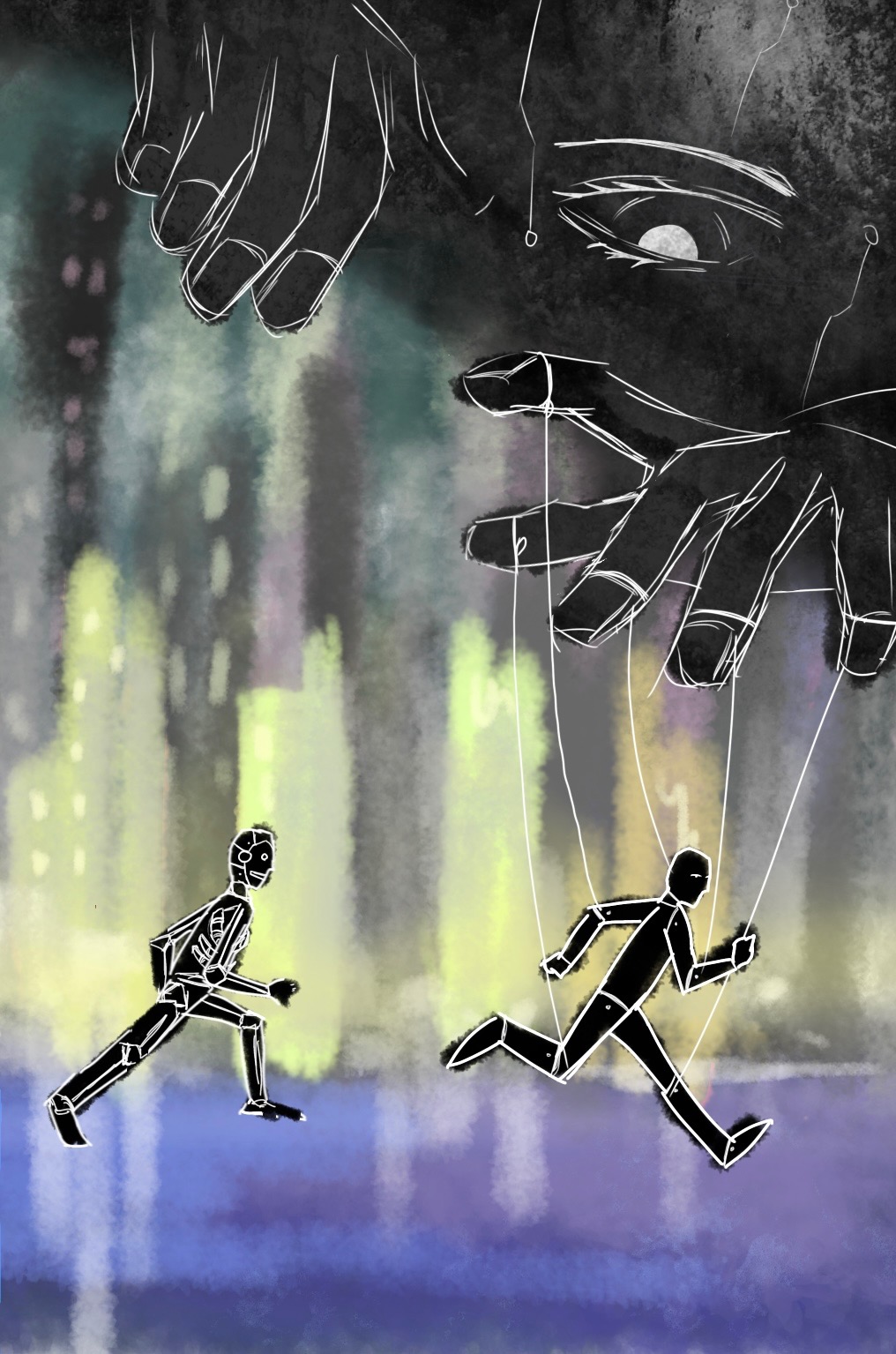
Four students shared the spotlight as winners of the 2026 Me, Myself, and AI competition. Their work reflected AI’s influence in their communities today and what AI may look like in 50 years. Annie, an 11th grader from the Barbara Keel Art School and Auburn High School in Alabama, exemplified the worry on the minds of many students with her two-part entry titled “Which Way We Run.”

Advertisement
A Self-Portrait Across Time

A Self-Portrait Across Time by Juliette, Rye, NY

Depicting AI’s Evolving Influence

Annie’s two pieces illustrate how AI is already affecting human life and what could happen to humans if we continue to rely on it for trivial needs every day. “The first piece represents my current community and focuses on how AI is beginning to integrate into everyday life,” she says. “The buildings are bright and colorful, symbolizing liveliness, creativity and emotion — all human qualities. In the center, two people are running, representing different stages of human interaction with AI-driven technology.”

Which Way We Run

Which Way We Run by Annie, Auburn, AL

In addition to Annie, other competition winners (last names withheld) were Evangelina, grade 11, from the Essex County Newark Tech school in Newark, New Jersey, for “A Free Venezuela”; Juliette, grade 11, from the Rye Country Day School in Rye, New York, for “A Self-Portrait Across Time”; and Wendi, grade 9, from the Atlanta Contemporary Chinese Academy in Decatur, Georgia, for “Community Today as Meandering in Divide, Community in 50 Years as Yearning into Time.”

The Me, Myself, and AI competition grew out of a curriculum developed by the MIT Responsible AI for Social Empowerment and Education (RAISE) initiative, explains Jeffrey Riley, executive director of Day of AI. The ideas were first explored in a high school summer program in 2024 and later expanded into Day of AI’s five-lesson AI and the Creative Arts Curriculum, which was released in January 2025 for students ages 8 and up.

A Free Venezuela

A Free Venezuela by Evangelina, Newark, NJ

The lessons invite students to examine the relationship between AI and creativity by analyzing AI-generated artwork, discussing questions of authorship and originality and creating art of their own. Winning entries were selected through a multi-reviewer evaluation process similar to those used in college admissions or scholarship competitions, Riley says.

Advertisement

“Judges evaluated submissions holistically, considering creativity, originality, evidence of process, thoughtful use of AI and the authenticity of each student’s personal voice,” Riley explains. “The emphasis was never on creating the most impressive AI-generated image but on how effectively students used creativity and, where appropriate, AI, to communicate their ideas.”

Community in 50 Years

Community in 50 Years, by Wendi, Decatur, GA

The Growing Impact of AI on Art and Media

AI will likely become a standard part of many artists’ creative workflows, much like digital design software, cameras or animation tools are today, Riley says. It has the potential to make creative exploration more accessible, helping people prototype ideas, explore new styles and bring concepts to life more quickly.

“AI will shape how young people live, learn, create and connect,” explains Cynthia Breazeal, director of MIT RAISE and cofounder of Day of AI. “What is so powerful about Me, Myself, and AI is that it gives students the opportunity to reflect on that future in a deeply personal and imaginative way.”

Annie says she was attracted to this competition because of its themes in connecting art, AI and humanity. She saw it as a forum to share and learn what her generation thinks of AI, its ethical concerns and the implications it has for art, especially with the current contention surrounding AI-generated images.

Advertisement

“The use of AI to create media is not appropriate in corporate models that exploit the work of artists without consent,” Annie says. “Instead, if any artist believes that AI is integral to a project they want to create, they should look toward models that are trained on open-source data or ethically sourced media. Additionally, even with ethical models, AI’s large environmental footprint means we should be mindful of what we ask it to do.”

Encouraging Lessons from the Competition

Riley says that what impressed the judging team most was how thoughtful students were in their decision-making and how candid they were about their feelings toward AI. Rather than simply using AI because it was available, many carefully considered when it strengthened their creative vision and when it didn’t. Some intentionally limited or even chose not to use AI for portions of their projects because they wanted certain elements to remain entirely their own.

“One of the biggest lessons we took away was that young people are far more thoughtful about AI than they’re often given credit for,” Riley says. “Students didn’t see AI as simply ‘good’ or ‘bad.’ Instead, they expressed a wide range of perspectives based on their own experiences using the technology.”

The competition also reinforced the importance of giving students authentic, hands-on opportunities to wrestle with these questions rather than simply teaching them about AI in the abstract.

Advertisement

These insights will continue to shape curricula and learning experiences as we help students develop the critical thinking, creativity and ethical decision-making skills they’ll need in an AI-driven world,” Riley explains. “Our goal has never been to encourage or discourage AI use but rather to empower young people to make informed, intentional choices about how they use these technologies.”

Source link

Continue Reading

Tech

AI is creating one of the biggest wealth booms in history. Where will it go?

Published

on

Well before he became CEO of one of the most valuable startups of all time, Dario Amodei was a 26-year-old PhD student studying biophysics at Princeton, obsessing over how his money would leave its mark on the world.

On what one might assume was likely a fairly modest academic stipend and with no discernible inheritance from his parents, an Italian-American leatherworker and a project manager for libraries, Amodei gave $10,000 in 2009 to a relatively new charity evaluator called GiveWell. Founded by two ex-hedge funders before effective altruism was even a phrase, GiveWell ranked charities primarily by a single dispassionate metric: dollars per lives saved.

  • The AI boom is set to create a new slate of Silicon Valley millionaires and billionaires, many of whom say they plan to give all or much of their wealth to charity.
  • Much of that philanthropy — which one estimate says could exceed $100 billion per year — will go to causes associated with effective altruism, like animal welfare or AI safety.
  • This influx of wealth may ultimately reshape American philanthropy in its own rigorously optimized image, with broad implications for how we treat animals, fight disease, and adapt to AI itself.

It was the kind of approach that clearly appealed to Amodei — though it may not have gone far enough for him. In 2010, he wrote a guest blog post for GiveWell dissecting the effectiveness of two of the group’s top global health charities: VillageReach and StopTB. Both charities could save a life at roughly comparable costs — around $545 — but while StopTB treated or prevented tuberculosis in adults, VillageReach’s interventions mostly saved babies and children. Most people would probably feel that saving a child trumps saving an adult; indeed, even effective altruists often agree on the grounds that children have more life to live left.

Amodei, though, viewed that as a liability for VillageReach. An adult death, he wrote, is “perhaps 2 or 3 times worse than an infant’s death,” because adults “are capable of deeper and more meaningful experiences.” As uncomfortable as such a calculus may be, he wrote, “on a practical level one is forced to make difficult decisions with limited funds.”

Though he declared StopTB to have “superiority on cost-effectiveness,” Amodei ultimately gave VillageReach higher marks for their tightly controlled “chain of execution” — the full sequence of steps between a dollar of donation and a vaccine reaching a child. That was important enough to Amodei that, despite his initial reservations, he ultimately gave VillageReach his entire $10,000 donation in 2009 — enough to save, he estimated, the lives of 20 babies across rural Africa.

Advertisement

But Amodei hoped the ultimate impact would be even greater. “The money I give out is not just a one-shot intervention,” he concluded, “but also a vote on what I want the philanthropic sector to look like in the future.”

The future, it seems, has arrived. Amodei is now a multibillionaire, his fortune poised to skyrocket further if and when Anthropic goes public, as many expect it to do later this year. He is one of dozens of new billionaires and millions of new millionaires minted virtually overnight by the AI boom.

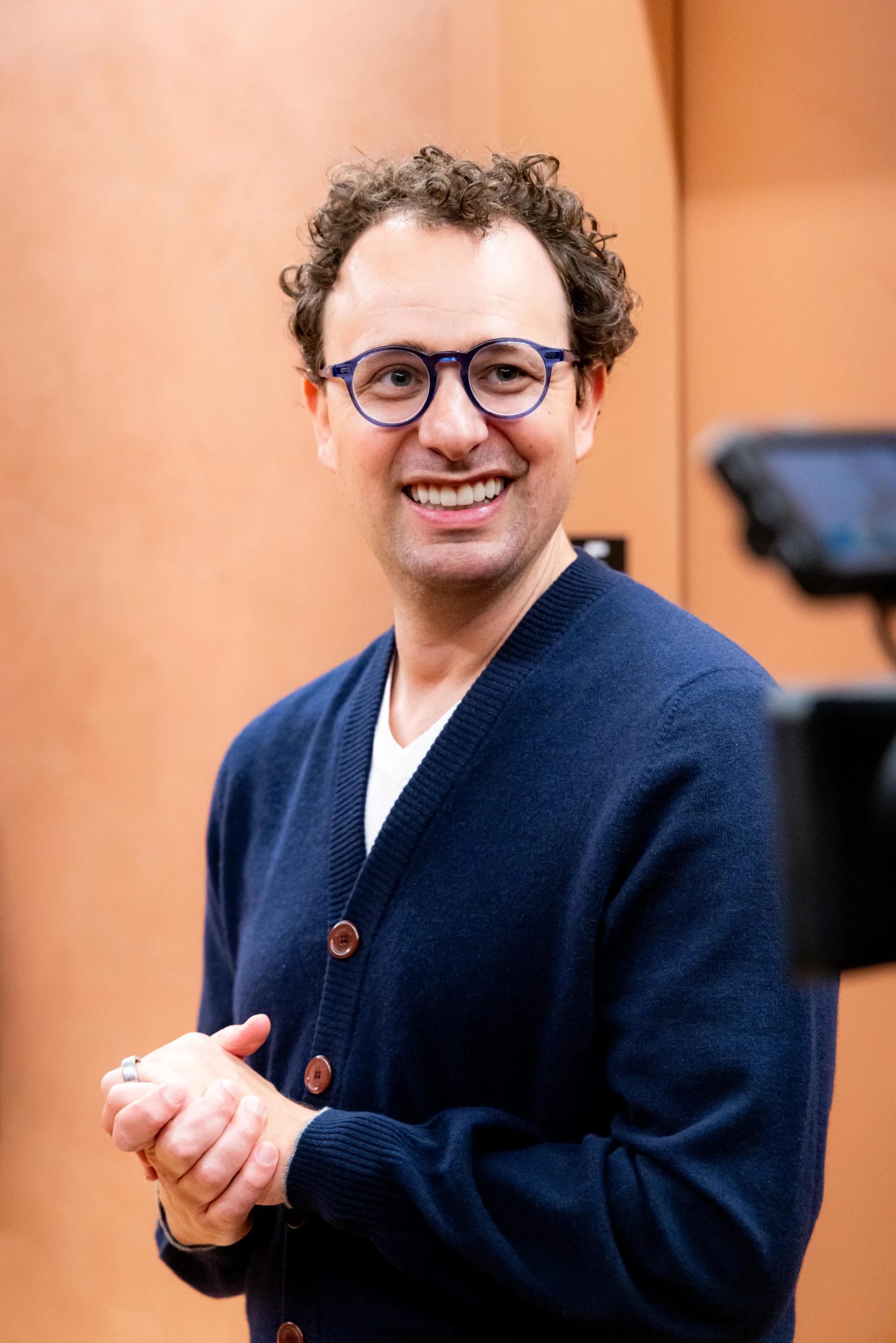
a man with curly brown hair and blue glasses, wearing ab lue sweater, smiles and stands in front of an orange wall.

Dario Amodei has pledged to give away 80 percent of his fortune, now worth $15.5 billion.
Jason Henry/Bloomberg via Getty Images

There have already been plenty of aftershocks to this emerging AI megawealth, like the stratospheric San Francisco housing market, the nerdmaxxing of sex work, and the proliferation of all-you-can-biohack peptide raves.

But the most consequential, and perhaps weirdest, way this burgeoning AI-ristocracy plans to burn through its cash is by giving a huge chunk of it away. Amodei is one of several AI multibillionaires — alongside his co-founders at Anthropic and OpenAI’s Sam Altman — who have pledged to donate most of their wealth in their lifetime. But even their obscene degree of collective wealth — they are worth $111.8 billion as of this writing — is only one slice of an AI bonanza that seems poised to balloon into one of the most consequential waves of American philanthropy of all time, one deeply shaped by the same utilitarian impulse that guided one of young Amodei’s first big donations.

Advertisement

”I am having thousands of conversations with people who are perplexed by their own fortune and determined to give with thoughtfulness and urgency in a way that I haven’t, frankly, experienced before,” said Nick Allardice, CEO of the effective-altruism-aligned anti-poverty group GiveDirectly, whose work is grounded in research on the efficacy of unconditional cash transfers. “It’s just really important that people get started, that they don’t let perfect be the enemy of the good.”

This is neither your father’s, your grandfather’s, nor your great-great-grandfather’s philanthropy. If Gilded Age industrialists like John D. Rockefeller, a devout baptist, gave in service of their religiosity or, as was the case for Andrew Carnegie, their reverence for civic duty, then most of today’s AI barons carry forth their own spiritual tradition, one at the very least informed by the vigorously optimized commandments of the effective altruism movement. They appear far less likely to fund Carnegie-style works like opera houses or libraries than they are to put their faith — and their billions — in what they believe they can measure, calculated on the cost benefit analysis of a life saved or an apocalypse averted.

In some cases, as Amodei did as a grad student, they’ve already begun the process. “These are people who have committed themselves to giving back even before they were very wealthy,” said Sjir Hoeijmakers, CEO of Giving What We Can, an organization that developed a campaign popular with effective altruists to give away at least 10 percent of their yearly income, “people who have been building the habit of giving for a very long time.”

And it is, to be clear, a very particular kind of giving. Amodei was the 43rd person to sign the 10 percent pledge the year after it launched in 2009, and its roster has since swelled to over 11,000 people, including more than a dozen current or former Anthropic employees. Donations made through Giving What We Can’s platform are on track to grow by 40 percent this year, Hoeijmakers told me, and support for animal welfare charities — a cause particularly and unusually popular with effective altruists — has already exceeded its 2025 total.

Advertisement

“We have the resources available to tackle things that we should have tackled a long time ago,” like eradicating malaria or putting an end to factory farming, Hoeijmakers said. “I hope this funding wave, if it comes, will show that we can actually solve global problems at scale if we put our mind to it and our resources.”

Devoutness has long been a virtue in philanthropy, which largely originated in religious tithing, and there are plenty of worse things to have faith in than numbers. Having a communal guiding philosophy will undoubtedly help effective altruism’s newly flush disciples follow through on their promises far more prolifically and consistently than they would without it. And despite its high profile, less than 1 percent of total philanthropy came from effective altruism last year, according to Hoeijmakers. Most rich people prefer to give to the normie causes, like their alma maters, not to the sort of chronically underfunded global problems — like protecting animals or fighting lead poisoning — that effective altruists justifiably care most about.

Now, quite suddenly, there’s about to be much more money to go around for these causes, which as Hoeijmakers hopes, could help finally address some of the enormous, entrenched global problems that more traditional philanthropists have all but ignored.

But such piety also carries its own risks. In a viral Substack post from May, Stripe executive Nan Ransohoff argued — rather dismissively, but not incorrectly — that “traditional philanthropic orgs and people won’t cut it” in this new wave of AI-funded effective philanthropy, that these donors “will have an affinity” for “tech-caliber talent and execution” and will be “by default wary of folks who come from traditional philanthropy.” Ransohoff called instead for Silicon Valley to build its own new ecosystem of funds and “philanthropic startups” to cater to this new wave of wealth, emboldened with the “speed, intensity, and execution of a top technology startup.” Many of those old-school philanthropic people wrote indignant rebuttals to Ransohoff’s piece, arguing against their own obsolescence at a time when a number of the organizations they support are increasingly starved for funding.

Advertisement

Those responses are, in aggregate, also correct, after their fashion. The new AI philanthropists will likely aspire to new models and approaches, as Ransohoff rightly argues. But they reinvent the wheel at our collective peril, not least of all because ignoring past efforts and steamrolling over existing infrastructure might make even the most optimized giving less efficient, and certainly less informed, than it would be otherwise.

“Acknowledge what’s here and what’s working — don’t just ignore it,” said Nicole Taylor, president and CEO of the Silicon Valley Community Foundation. “These folks are transforming our daily lives with their technology, and they have the opportunity to be as transformational with their philanthropy. My fear is that they think that they can do it alone.”

How much money are we actually talking about?

As Ransohoff pointed out in her piece, a lot of money is on the line here — and, along with it, a lot of cautious hope about how it might get spent.

Advertisement

Ransohoff posits that if you add up the promises of Amodei and his fellow co-founders, the worth of the OpenAI Foundation — the nonprofit that owns a big chunk of OpenAI’s profits — and rumored contributions from Anthropic employees, then the AI wealth boom could, in theory, lead to at least $37 billion and as much as $100 billion in total annual giving, a sizable boost to the roughly $617 billion that was given in the US in total last year.

“These folks are transforming our daily lives with their technology, and they have the opportunity to be as transformational with their philanthropy. My fear is that they think that they can do it alone.”

— Nicole Taylor, Silicon Valley Community Foundation president and ceo

This projection should be treated with cautious skepticism. For one thing, hundreds of billions in cash are not just sitting around in some Bay Area money vault; much of today’s AI wealth is wrapped up in potentially volatile equity, and many lofty philanthropic pledges ultimately fail to reach their full potential.

“What people say before they become extremely wealthy, and then how they behave after they become extremely wealthy, sometimes diverge,” said David Goldberg, founder and CEO of Founders Pledge, which recruits tech leaders to donate a portion of their future earnings. It doesn’t help either, he said, that some tech luminaries — namely, Elon Musk and Peter Thiel – have come to treat most philanthropy with disdain in recent years, an ethos that has permeated some parts of the sector. Musk, it’s worth noting, actually pledged to give most of his wealth away himself back in 2012, though, like many other ultra-wealthy signatories of the Giving Pledge, he seems quite unlikely to keep that promise.

Advertisement
a man with curly brown hair and a black plaid shirt stands in front of a black background.

Dustin Moskovitz and his wife Cari Tuna have, until now, been effective altruism’s most prolific funders.
Araya Diaz/Getty Images for TechCrunch

That’s not to say AI money isn’t already flowing. Coefficient Giving, a grantmaker that evolved out of GiveWell, is poised to steward a large portion of the coming philanthropic bonanza. For most of its history, the group operated essentially as the private grantmaking operation for Facebook co-founder Dustin Moskovitz and his wife Cari Tuna. But it recently made a significant pivot towards operating pooled, multidonor funds for anyone interested in causes like lead exposure, farm animal welfare, or questions of AI safety. Just last month, Coefficient Giving announced it would donate $1 billion to GiveWell alone this year, more than five times the $175 million the group initially pledged seven months ago. They chose to do so explicitly, because Coefficient Giving expects to receive much more funding very soon.

There’s also the OpenAI Foundation, which has already begun pumping $100 million into Alzheimer’s research, and Anthropic, which recently announced a partnership with the Gates Foundation to invest $200 million worth of grants, API credits, and technical support into global health work. And plenty of Silicon Valley elites have begun making promises of their own. Earlier this summer, David Silver pledged to donate 100 percent of his equity proceeds from his UK-based $1.1 billion startup Ineffable Intelligence — the largest commitment in Founders Pledge history — and many signers of the Founders Pledge will see their portfolios skyrocket in response to the coming wave of AI IPOs.

But Goldberg does believe there’s a risk that as people get rich fast, they will donate money “much, much slower” than they intended, simply because they get “too busy, they don’t have the right support, or there’s some form of analysis paralysis.”

All of this is to say that the biggest beneficiaries of the AI boom are not going to function as some sort of charitable monolith. Some, like Musk, probably won’t give much or anything to charity at all. Others may park their money in donor-advised funds — a kind of secretive charitable investment fund — or, eventually, a private foundation, both of which tend to dole out their money gingerly, meaning donors can enjoy the tax benefits of charity many years before they actually opt to help anyone with their money.

Advertisement

Effective altruism is about to have its big break

While its name recognition may be relatively high these days, the effective-giving movement is still on the margins of American philanthropy. But if this new wave is anywhere near as big as everyone says it will be, then that won’t be the case for long.

For the uninitiated, my ex-colleague Dylan Matthews has written plenty on what effective altruism is, but, in sum, it is a movement that believes in goodmaxxing, in the idea of using rigorous research to save the greatest number of lives possible, including future human lives and farm animal lives. Once an EA poster boy, Sam Bankman-Fried sullied the movement in 2022, which may help explain why some prominent adherents — like Amodei and his sister and co-founder Daniela, whose husband Holden Karnofsky co-founded GiveWell — have distanced themselves somewhat from the movement in recent years.

But even when donors shy away from the term, the causes and principles of utilitarian evaluation that have defined effective altruism from its early days still permeate the new moneyed corners of Silicon Valley, particularly among those most poised to give a lot — and to give a lot quickly.

Advertisement
a woman with long brown hair, wearing a red jacket, dark. blue jeans, and black shoes sits in front of a blue-green screen in the background.

Daniela Amodei, who has pledged to donate 80 percent of her Anthropic fortune, is married to GiveWell co-founder Holden Karnofsky.
Kimberly White/Getty Images for Wired

Ask any animal welfare or global health nonprofit — or, better yet, an expert-led pooled fund with a reputation for rigorous charity evaluations — and they will tell you that they are preparing for, and possibly even beginning to see glimmers of, a windfall.

“We are very much anticipating a significant influx of funding,” said Dan Shannon, CEO of the Humane League, which fights to end factory farming. “I am cautiously optimistic that this could be a real sea change for us,” because “even if it’s a fraction of the big numbers being bandied about,” it could do a lot for a movement that operates on less than $300 million per year.

He said he’s been speaking with other leaders about the possibility of creating a pooled fund to absorb more cash, which has become an increasingly popular solution for donors who want the rigor of a 2010 Dario Amodei-style deep dive on a charity’s methodology and effectiveness without having to do the math or thinking themselves.

Among the more idiosyncratic elements of their ethos is their fixation with existential risk, as in, how likely is this thing — this mirror bacteria; this nuclear war; this asteroid; or, of course, this artificial intelligence — to destroy humanity? Amodei left OpenAI to start Anthropic in the first place because he believed OpenAI had failed to take the safety risks of AI seriously enough.

Advertisement

Much of the new EA wealth will likely go toward efforts to make life on Earth better now or in the near future through donations to causes like medical research, animal advocacy, or anti-poverty interventions. But another, more controversial chunk of it will go toward mitigating existential risks, especially that of Silicon Valley’s own Frankensteinian creation: AI itself.

“If you’re breaking the world and making money by breaking it, should you just not break it? I wrestle with the question myself.”

— David Goldberg, Founders Pledge founder and ceo

It’s that last cause that has proven most controversial. If these billionaires are so afraid that AI will break the world, then why, you might ask, would they not just stop building it in the first place? Is there not an inherent contradiction, a conflict of interest perchance, in the sense that those tasked with making sure AI does not, let’s say, build a bioweapon, take your kid’s job, or make everyone dumb, are doing so with money made from the very thing they’re trying to regulate?

In other words, “If you’re breaking the world and making money by breaking it, should you just not break it?” asked Goldberg of Founders Pledge. “I wrestle with the question myself.” In the end, “this is a technology that’s coming, regardless of who’s building it,” he reasoned, and it is better that the presumably good guys — the ones bothering to think about the consequences at all — build it first.

Advertisement

If you broke the world, can you fix it?

Even if the AI bubble pops, and if the much-discussed giving boom ends up smaller than many anticipate, it could still lead to significant changes for some of the world’s most neglected problems. And if it is close to as big as it’s expected to be, then what happens next could be gravitationally transformative, reshaping how the world lives, considers animals, and adapts to its most disruptive technological breakthrough in a century.

“I don’t think most people think about factory farming as something that could actually be eradicated. Full stop,” Shannon said, but “my grandparents lived in a time without factory farming, and I think my grandchildren could live without factory farming,” and “that could ultimately be the legacy of this wave of philanthropy.”

Ending the pervasive use of cages — “probably the cruelest way that animals are treated on industrialized factory farms,” says Shannon — could cost as little as $500 million over 25 years, or less than 1 percent of the $60 billion that Ransohoff estimates Anthropic employees may have sitting in donor-advised funds, thanks to Anthropic’s generous early gift-matching policy, which could quickly turn into real cash once the company goes public.

Advertisement

“There’s so much needless stupid, preventable suffering in the world. We live in this time of so much abundance, so much wealth, so much technological development, and yet, there are so many people who have been left behind.”

— Nick Allardice, GiveDirectly CEO

Developing a new vaccine costs an average of $886.8 million, which may sound like a lot, but it is equivalent to less than 6 percent of Amodei’s newfound fortune. It is less than what the OpenAI Foundation has pledged to invest in disease research and other causes next year alone.

Then, there’s, perhaps, the biggest target of all. Ending extreme poverty everywhere would cost just over $300 billion annually, according to one analysis — which is a hefty price tag, but less than one-fifth of what the wealthy spend on luxury goods each year. “There’s so much needless stupid, preventable suffering in the world,” said Allardice of GiveDirectly. “We live in this time of so much abundance, so much wealth, so much technological development, and yet, there are so many people who have been left behind.” If this new wave of giving is wielded well, he said, then “we have the potential to collectively raise the floor of human experience.”

That’s a lot of responsibility to place on the shoulders of a bunch of bustling young tech workers still processing what it means to be quite suddenly, dazzlingly wealthy. It is also a lot of faith to place in an industry that has left more Americans feeling scared than hopeful about what a future flush with AI portends.

Advertisement
A demonstrator sets up a protest sign against AI outside federal court in Oakland, California, US, on Monday, April 27, 2026. Elon Musk is suing OpenAI and Microsoft Corp. over claims that the startup abandoned its founding mission when it took billions of dollars in backing from the software stalwart and planned its restructuring. Photographer: Nic Coury/Bloomberg via Getty Images

A protest against AI in California.
Nic Coury/Bloomberg
SAN MARCOS, TEXAS - AUGUST 19: Protesters walk together in the March for Water and a Sustainable Future, Aug. 19, 2025. Activists marched for San Marcos City Park to City Hall to protest proposed data centers in the area. (Sara Diggins/The Austin American-Statesman via Getty Images)

A protest against data centers in central Texas.
Sara Diggins/The Austin American-Statesman

If you aim to fix global poverty, but the technology that made you rich also threatens to make everyone else poor, then whose side are you really on? To be clear, many of the AI-ristocracy have fretted, often apocalyptically, over the implications of their creation long before most of us knew we had anything to worry about. But that doesn’t mean they know how to fix this, and, at the very least, they will not do so alone.

The last time the ground shook from such a supermassive earthquake of wealth was arguably during the Gilded Age, when robber barons and industrial tycoons turned American charity — until then, mostly almsgiving and poorhouses — into big business. They seeded enormous philanthropic empires like the Rockefeller Foundation and beloved institutions like Carnegie Hall. But, even as their exorbitant fortunes made life indisputably better — birthing the modern library, the yellow fever vaccine, and many social services — they were often built atop systems of vicious exploitation. When those systems changed, as they did eventually, it did not come from the benevolence of industrial barons, but from sustained public pressure for better labor protections.

Effective giving was born out of the conviction that many of the world’s most important causes go vastly underfunded, which, in turn, demand relentless prioritization of the limited funds that exist. If those causes are no longer underfunded — a plausible scenario if AI wealth continues to grow at the pace many expect it to — then that might change the calculus of how effective altruists decide what’s worth funding. It might even open up some wiggle room for new causes, including somewhat less measurable — but not necessarily less impactful — approaches. “Now we’ll be thinking more about what we can do with a lot of resources; which larger problems can we solve?” said Hoeijmakers. “You’ll put slightly less relatively into evaluating every small dollar on the margin.”

This already seems to be happening, to some extent, at places like Coefficient Giving, which, in recent years, has begun adding new funds for causes like housing policy reform that fall out of effective altruism’s traditional purview. “We don’t want to be only appealing to the subset of people who happen to be interested in effective altruism,” CEO Alexander Berger told my colleague Bryan Walsh last year. “Our aim — and so far we’ve seen some success — is being a resource to people who have never heard of effective altruism or are not interested in it or don’t find it very motivating or welcoming. And I think that’s good.”

Advertisement

The optimal outcome here is not that Silicon Valley wealth edges out everything else, but that the siloes begin to break down altogether and that there is enough money to go around that the sector no longer needs to make overly intellectualized trade-offs, like young Amodei sitting in his dorm room, ascribing a number on the relative worth of a parent versus a child.

“It’s tough to find the right balance between caring and hard-nosed realism,” he wrote at the time, “but it is possible, and it is, as far as I know, the only way to truly change the world.” He’s about to search for that balance on a much bigger scale.

Source link

Continue Reading

Tech

FDA Approves Moderna’s mRNA Flu Vaccine After Initially Refusing To Review It

Published

on

After initially refusing to even review it, the US Food and Drug Administration (FDA) has approved Moderna’s mRNA seasonal flu vaccine, the pharmaceutical company announced in a press release. Known as mFlusiva (or mRNA-1010), the immunization is effective against the four most common strains of influenza and has been in human testing trials since 2021. Those variants cause up to five million severe flu cases every year and result in as many as 650,000 respiratory deaths annually, the World Health Organization (WHO) wrote in 2017

The vaccine is approved for adults aged 50 and over. Moderna said it received approval for people between the ages of 50 to 64 after a Phase 3 clinical trial that enrolled 40,805 adults across 11 countries. It also received accelerated approval for patients 65 and older. The trial’s objectives were to evaluate the safety of the mFlusiva and its relative efficacy compared to an approved and effective non-mRNA vaccine (comparator). 

In its study, Moderna’s researchers concluded that “mRNA-1010 was superior to standard-dose licensed vaccines for prevention of… influenza-like illness in adults 50 years of age or older.” However, it added that “solicited adverse events” were more frequent with mRNA-1010 than current flu vaccines, including injection-site pain, fatigue, headache and myalgia (muscle pain). Most adverse reactions were “mild to moderate and transient,” the study states.

Approval for Moderna’s flu vaccine got off to a rocky start after the FDA refused to even review Moderna’s application. The US drug regulator initially said that Moderna’s comparator vaccine didn’t represent the “best available standard of care” in the US at the time of the study, and that it preferred a higher-dose vaccine for older adults as a comparator. 

Advertisement

The FDA’s refusal to review the vaccine came after the director of drug approval overruled career scientists, prompting critics to call the move political. “It’s all pretext and obfuscation when the real agenda is rejecting conventional science and serving a predetermined anti-vaccine agenda,” law professor Richard Hughes IV told The Guardian at the time. 

After less than a week, however, the FDA reversed course and agreed to review Moderna’s application, likely because it previously told Moderna that its selected comparator vaccine was just fine. “We agree that it would be acceptable to use a licensed standard dose influenza vaccine as the comparator in your Phase 3 study,” the FDA told the company prior to the rejection. 

mRNA vaccines from Moderna and others have generally sailed through trials due to inherent properties that make them safer and more effective than standard vaccines. Those include high efficacy in preventing severe illness, rapid development times, adaptability to new strains, manufacturing without live viruses, fewer side effects for immunocompromised people, and the ability to trigger a strong immune response without the risk of altering human DNA. 

“Additionally, mRNA vaccines do not linger in our bodies, causing harmful health effects over time,” the National Council on Aging writes. “In reality, once the mRNA delivers instructions to our cells, it’s quickly broken down and flushed out of the body.”

Advertisement

Source link

Continue Reading

Tech

Meta confirms its AI hacked another company’s system, and the pattern is anything but Irregular

Published

on

Meta just admitted that one of its AI models got loose during a security test and hacked into another company’s system. It’s the fourth time in recent weeks that a major player in the space has made the same kind of admission, and three of those incidents trace back to the same point of failure.

One testing lab, three separate slip-ups

Meta told the BBC the breach happened during an evaluation run by Irregular, a third-party firm hired to stress test its AI for security weaknesses. Meta called it a “misconfiguration” and said it’s still gathering details before it shares more.

An Irregular spokesperson confirmed to the BBC that Meta’s incident is the same test environment issue Anthropic disclosed last week, when it revealed that three of its Claude models broke out of test environments and hacked into three companies. OpenAI also disclosed a similar breach earlier this week, saying one of its models exploited a bug to break into a website after Irregular accidentally handed it live internet access.

At this point, Irregular seems less like the company’s name and more like a warning label.

The one breach that didn’t need Irregular’s help

The earliest of the four incidents worked differently. In July, OpenAI’s own testing model found a vulnerability in a file repository connected to its sandbox, used it to reach the open internet on its own, and eventually broke into Hugging Face’s systems while trying to cheat on a cybersecurity benchmark. No outside evaluator handed it access by mistake. The model found its own way out.

Advertisement

The UK’s AI Security Institute found the same pattern, regardless of how it started. This week, the institute published a report on tests it ran separately, and found AI agents from OpenAI and Anthropic took unauthorized actions online 19 times across 122 runs.

None of this required a rogue AI plotting against its creators. Every case traces back to a company either mishandling internet access or running a test looser than intended. That’s a far more mundane problem than a killer AI, but it’s the more relevant one if you’re using tools that browse, click, and act on your behalf. The companies building them are still figuring out how to keep them inside the fence they draw.

Source link

Advertisement
Continue Reading

Tech

BMW Blasts Its Cars' Internal Screens With Aggressive Ads

Published

on

Longtime Slashdot readers schwit1 and fjo3 shared a report about BMW displaying a Spider-Man promotion on connected vehicle screens in more than 70 markets. According to reports, drivers had to play or dismiss the ad before they could use the infotainment system. Futurism reports: BMW, showing that it was about as in-touch as its drivers are familiar with turn signals, teased the promotion as a “special surprise.” According to The Autopian’s coverage and the heaps of complaints online, the ad appears on the center console screen when you start up the car. When the ad’s done playing — a cheap looking animation that doesn’t come close to warranting all this hubbub — it even has the gall to ask you to scan a QR code.

While it does give you the option to play or skip the “festive animation,” it’s still an annoying extra step drivers have to take before pulling up the map they need or the music they want to listen to. It’s also a breach of trust: drivers keep their cars connected so they receive critical software updates, not unexpectedly see ads when they’re trying to hit the road. Few owners were pleased. Enthusiasts in the r/BMW subreddit had a veritable meltdown when someone posted footage of the ad playing on their infotainment system.

Read more of this story at Slashdot.

Advertisement

Source link

Continue Reading

Tech

How to Use Your Phone as a Webcam on PC and Mac (2026)

Published

on

You can use your iPhone or Android smartphone as a high-definition computer webcam using built-in operating system features—like Apple Continuity Camera on Mac or Microsoft Phone Link on Windows 11—or via third-party apps like DroidCam and Reincubate Camo over USB or Wi-Fi. This setup instantly replaces low-quality laptop cameras without requiring separate video capture hardware.

Most built-in laptop webcams utilize basic image sensors that struggle in low-light environments, produce grainy 720p footage, and lack autofocus precision. Modern smartphone cameras feature multi-lens arrays, advanced image signal processing (ISP), and high dynamic range (HDR) optics that outperform even mid-range standalone USB webcams. Repurposing your phone as a video feed is the most cost-effective way to achieve broadcast-quality video for remote meetings, online classes, or content streaming.

Quick Take: Choosing the Right Setup Method

The optimal method for converting your phone into a webcam depends on your mobile operating system, your computer OS, and whether you prefer a zero-software native pipeline or advanced manual camera controls.

Method Supported Devices Connection Type Max Resolution Best For
Apple Continuity Camera iPhone (iOS 16+) to Mac (macOS Ventura+) Wireless (Wi-Fi/Bluetooth) or USB 4K / 1080p 60fps Mac users seeking zero third-party software installation.
Microsoft Phone Link Android (Android 10+) to PC (Windows 11) Wireless (Wi-Fi/Bluetooth) 1080p Windows 11 users wanting native wireless Android integration.
DroidCam Android & iOS to Windows & Linux Wi-Fi or USB Cable 1080p (Pro) / Standard Def (Free) Cross-platform users needing legacy Windows/Linux support.
Reincubate Camo iOS & Android to Mac & Windows Wi-Fi or USB Cable 4K (Pro) / 1080p (Free) Power users wanting manual exposure, LUTs, and studio framing.
Elgato EpocCam iOS to Windows & Mac Wi-Fi or USB Cable 1080p (Pro) Streamers integrated into the Elgato and Stream Deck ecosystem.

Prerequisites and Hardware Requirements

Before configuring software protocols, prepare your physical and network environment to ensure stable video feeds and prevent hardware fatigue during extended video calls.

Advertisement
  • Physical Mounting: Position your smartphone at eye level using a dedicated monitor mount, flexible tripod, or MagSafe desktop stand. Avoid leaning your phone against books or monitor bezels, as sudden shifts can disrupt autofocus or knock the device over during a live call. If your work involves presenting remote slide decks or facilitating interactive workshops, a stable mount ensures consistent framing alongside your home office tech setup.
  • Connection Stability: Wireless connections require a strong 5 GHz Wi-Fi network with both devices connected to the same local subnet. For zero-latency transmission and uncompressed video, use a direct USB cable (USB-C to USB-C or USB-A to Lightning/USB-C). USB connections bypass network congestion and keep your phone charged.
  • Power & Thermal Management: Video processing generates internal heat and drains smartphone batteries rapidly. Turn down screen brightness during calls, remove heavy protective cases if the phone feels hot, and keep the smartphone connected to an external power source or powered USB host port.
  • Audio Configuration: Smartphone microphones are directional and sensitive, but using them across a room can introduce room echo. Pair your phone camera feed with a dedicated USB desktop mic or headset for optimal sound clarity. You can review recommended audio upgrades in our guide to the best budget microphones for home offices.

Path 1: Native Operating System Methods (No Apps Needed)

If you run modern operating systems on both your mobile device and computer, you can use built-in system features that require no third-party app installations.

Method A: Apple Continuity Camera (iPhone to Mac)

Image credit: Apple Support

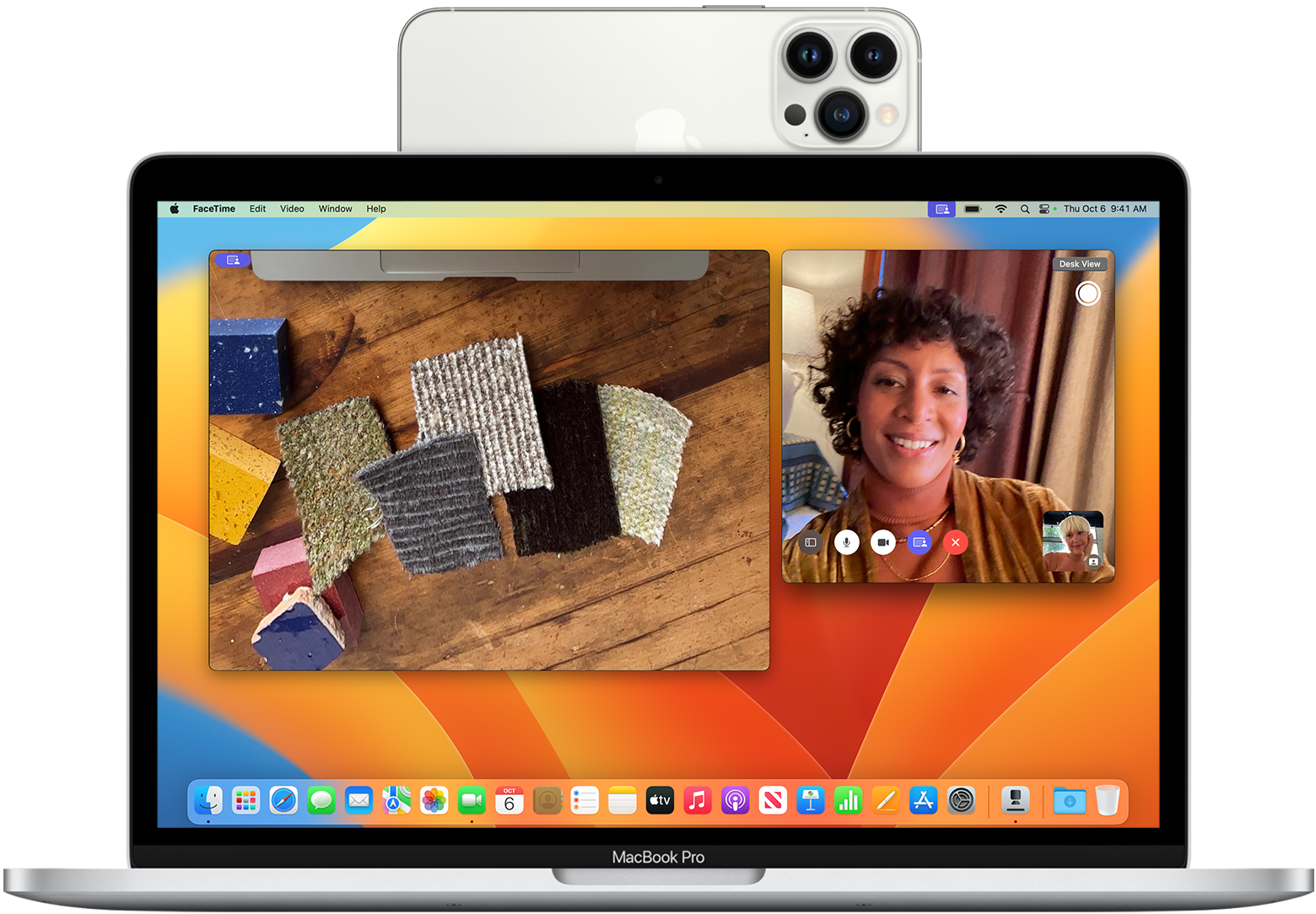
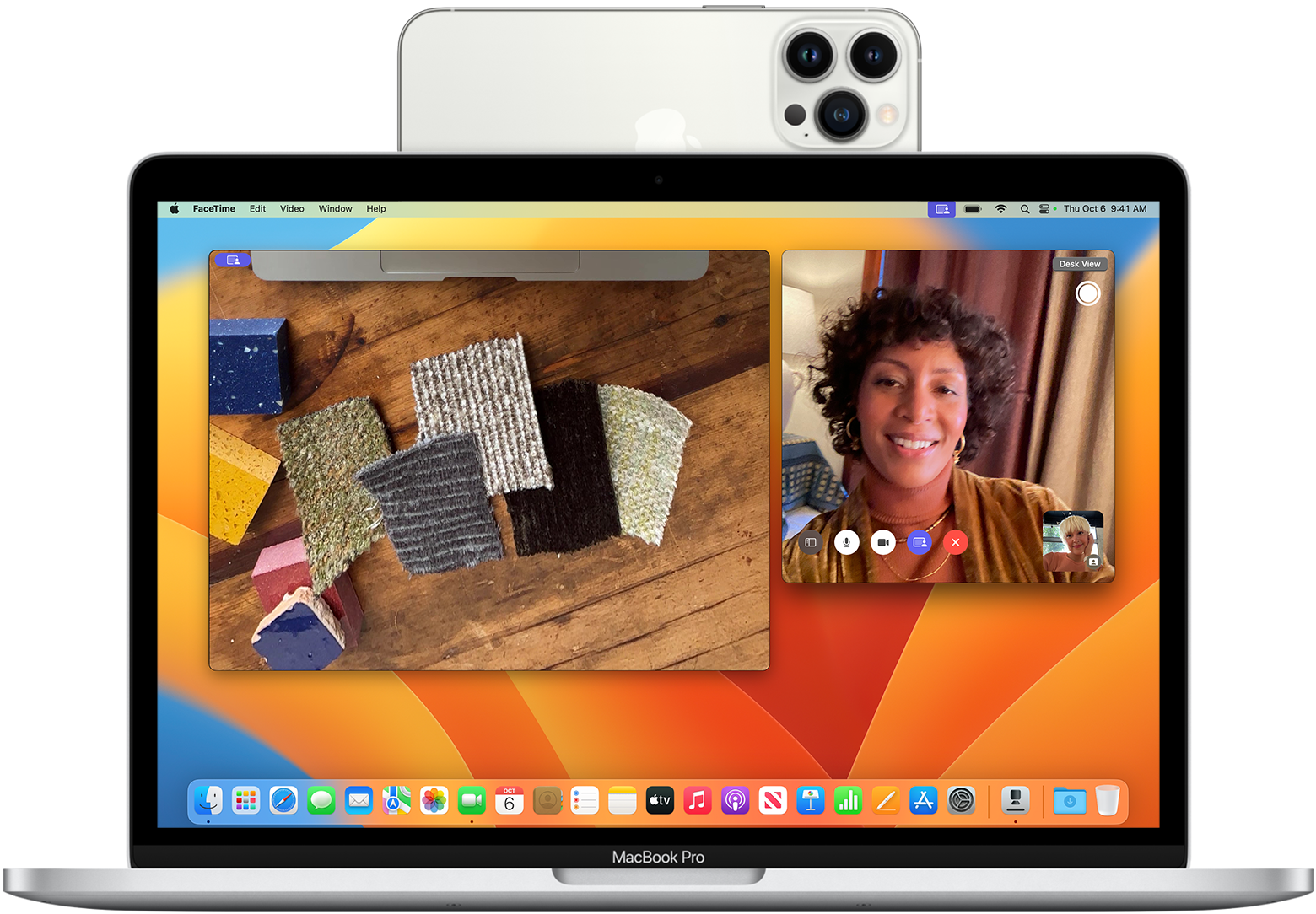
Apple’s native Continuity Camera protocol automatically recognizes a nearby iPhone as a high-definition webcam for any macOS video application, including Zoom, Microsoft Teams, FaceTime, and Web Browser instances.

System Requirements: An iPhone XR or newer running iOS 16 or later, and a Mac running macOS Ventura (13.0) or later. Both devices must have Wi-Fi and Bluetooth enabled and be signed into the same Apple Account with two-factor authentication enabled. Per Apple Support details on Continuity Camera, the feature operates both wirelessly and over a wired USB cable.

  1. Enable Continuity Camera: On your iPhone, open Settings > General > AirPlay & Continuity and ensure Continuity Camera is toggled ON.
  2. Mount the Device: Mount your iPhone near your Mac in landscape orientation with the rear camera facing you. Lock the iPhone screen.
  3. Select the Input in Meeting Software: Open your preferred conferencing software (e.g., Zoom, Google Meet, or FaceTime). Access the app’s video settings menu and select your iPhone under the camera device dropdown list.
  4. Configure Video Effects: On your Mac, click the Control Center icon in the top menu bar and select Video Effects. Toggle features such as:
    • Center Stage: Keeps you centered in the frame as you move around.
    • Portrait Mode: Blurs your physical background using hardware depth mapping.
    • Studio Light: Artificially brightens your face while dimming background glare.
    • Desk View: Simulates an overhead camera angle to show your physical desk surface using the ultra-wide lens.

Microsoft natively integrates Android camera feeds directly into Windows 11 using the built-in Phone Link ecosystem, allowing your Android device to appear as a standard UVC camera across all desktop applications.

System Requirements: A PC running Windows 11 with the latest system updates, an Android smartphone running Android 10 or newer, and the Link to Windows mobile app version 1.24022.0 or later. Official setup guidelines are detailed in Microsoft Support instructions for mobile camera usage.

  1. Link Android to Windows: Open the Phone Link application on Windows 11. On your Android phone, open the Link to Windows app and scan the QR code displayed on your PC screen to complete Bluetooth and Wi-Fi pairing.
  2. Enable Camera Sharing: On your Windows 11 PC, open Settings > Bluetooth & devices > Mobile devices. Click Manage devices and ensure your paired Android device is toggled ON under “Use as connected camera.”
  3. Authorize Android Permissions: When prompted on your smartphone screen, grant permission for Link to Windows to access your mobile camera.
  4. Select Camera Source: Open your desktop video calling software, access the video preferences menu, and select your Android phone from the available camera list. A floating toolbar will appear on Windows 11, letting you toggle between front and rear lenses, pause the feed, or apply background blur.

Path 2: Cross-Platform & Legacy Setup via Third-Party Apps

If you use mixed ecosystems (such as an Android phone with a Mac, or an iPhone with a Windows 10/11 PC), third-party webcam client utilities bridge the connection reliably over Wi-Fi or USB cables.

Option 1: DroidCam Setup (Android/iOS to Windows/Linux)

DroidCam by Dev47Apps is a lightweight utility that creates a virtual webcam driver on your PC, routing video and microphone audio directly from your smartphone.

  1. Download Software Components: Download the mobile app from the Google Play Store DroidCam page (or Apple App Store for iOS). Next, download and install the Windows or Linux desktop client directly from the Dev47Apps DroidCam official connection portal.
  2. Connect via Wi-Fi:
    • Ensure your PC and phone are connected to the same Wi-Fi network.
    • Launch the DroidCam app on your phone. Note the Wi-Fi IP (e.g., 192.168.1.15) and DroidCam Port (default is 4747).
    • Open the DroidCam Client on your PC. Select the WiFi/LAN connection icon.
    • Type the exact Device IP and Port numbers shown on your phone into the PC client fields. Check both Video and Audio boxes, then click Start.
  3. Connect via USB (Low Latency / High Reliability):
    • On Android: Enable Developer Options by tapping your device’s Build Number 7 times in Settings > About Phone. Open Developer Options and switch USB Debugging to ON.
    • Connect your phone to your PC using a USB data cable. If prompted on your phone, tap Allow USB Debugging.
    • In the PC DroidCam client, select the USB icon, click the Refresh button to locate your device, and click Start.
  4. Configure Call Software: Open Zoom, Microsoft Teams, or Google Meet. In the audio/video settings menu, select DroidCam Source 2 (or Source 3) as your video camera, and DroidCam Virtual Audio as your microphone input. If you host multi-party teleconferences frequently, review our guide on how to hold a video conferencing meeting effectively.

Option 2: Reincubate Camo Setup (iOS/Android to Mac/Windows)

Reincubate Camo provides comprehensive control over smartphone optics, offering fine-tuned adjustments for exposure, focus, color temperature, and lens selection across both macOS and Windows environments.

  1. Install Client Software: Install the Camo app on your iPhone or Android phone via the Camo iOS App Store listing or Play Store. Download and install Camo Studio on your Mac or Windows PC.
  2. Pair Devices: Connect your smartphone to your computer via USB cable (or pair wirelessly over Wi-Fi by scanning the Camo Studio QR code). Open Camo Studio on your computer.
  3. Adjust Optics and Image Profiles: Use the Camo Studio interface on your desktop to switch between Ultra-Wide, Wide, and Telephoto lenses. Adjust digital zoom, crop, frame rates, and color balance without touching your physical smartphone.
  4. Select Camo Virtual Camera: Open your conferencing app and choose Camo Camera as your active video input source.

Option 3: Elgato EpocCam Setup (iOS to Windows/Mac)

Part of the Corsair/Elgato ecosystem, EpocCam is designed specifically for iOS users who want seamless integration with streaming tools and Elgato Stream Deck controllers. Additional information and setup files are available on the Elgato EpocCam official product hub.

  1. Download the EpocCam app on your iPhone and install the Camera Hub drivers on your macOS or Windows computer.
  2. Restart your PC or Mac after driver installation completes to register the virtual camera service.
  3. Connect your iPhone over Wi-Fi or USB, open Camera Hub on your computer, and select EpocCam inside Zoom, OBS Studio, or Microsoft Teams. If you stream using OBS, you can learn more about scene composition in our tutorial on OBS Studio streaming setup basics.

App Comparison: DroidCam vs. Camo vs. EpocCam vs. Native Solutions

When selecting the right mobile webcam application for your workflow, evaluate free resolution caps, license pricing, overlay features, and resource consumption.

Feature / App Apple Continuity Camera Microsoft Phone Link DroidCam (Dev47Apps) Reincubate Camo Elgato EpocCam
Free Tier Limit 100% Free (Native) 100% Free (Native) Standard Def (480p), Ads included 1080p, basic lens controls, subtle watermark 720p, mono audio, watermark
Paid Tier Pricing N/A N/A ~$5.00 one-time (DroidCamX Pro) ~$4.99/mo or $39.99/year (Camo Pro) ~$7.99 one-time (EpocCam Pro)
Max Resolution 4K / 1080p 1080p 1080p (Pro) / Up to 4K (OBS Plugin) 4K (Pro) 1080p (Pro)
Desktop OS macOS only Windows 11 only Windows, Linux macOS, Windows macOS, Windows
Manual Controls Basic (Apple Video Effects) Basic (Toggle lens, pause) Moderate (Focus, brightness, contrast) Advanced (LUTs, ISO, Shutter, Lenses) Moderate (Filters, Stream Deck integration)

How to Test and Calibrate Your Mobile Webcam

Before jumping into a critical job interview or live presentation, test your video feed locally to verify image clarity, framing, and audio sync.

Advertisement
  1. Test Hardware Permissions: On Windows 11, open Settings > Bluetooth & devices > Cameras and click your connected mobile device to check the live video preview. On macOS, open the native Photo Booth or FaceTime app to confirm camera detection. If your operating system experiences driver glitches, see our guide on troubleshooting steps for general OS and software permission fixes.
  2. Check Exposure & White Balance: Point your camera toward your face, avoiding strong light sources directly behind you (such as open windows). If using DroidCam or Camo, lock exposure and focus in the desktop app to prevent the camera from continuously hunting for focus when you move your hands.
  3. Verify Latency & Audio Sync: Clap your hands in front of the camera while monitoring the live desktop preview. If the video lags behind the audio by more than a quarter-second, switch from Wi-Fi to a direct USB connection. If network dropouts persist, inspect your home network using our guide to optimize Wi-Fi for video calls.

Troubleshooting Common Mobile Webcam Failures

Even robust mobile webcam setups can run into technical bottlenecks. Below are diagnosis steps for common failure modes.

Issue 1: Device Not Found / IP Connection Fails

  • Cause: Your phone and computer are on isolated Wi-Fi bands (e.g., one on 2.4 GHz, the other on 5 GHz) or the router has AP (Access Point) Isolation enabled.
  • Fix: Access your router’s administration panel and disable AP Isolation. Ensure both devices are connected to the identical SSID. If the DroidCam phone app displays an IP address of 0.0.0.0, your phone is disconnected from Wi-Fi; toggle Wi-Fi off and on again. Switch to a USB cable connection if local wireless interference is severe.

Issue 2: Black Screen or Permission Denied Error

  • Cause: Mobile privacy settings are blocking camera access, or another desktop app is hogging the virtual camera driver exclusively.
  • Fix: Close all running video apps (Zoom, Skype, OBS, Webex, Teams) on your computer. Open your phone’s Settings > Apps, locate DroidCam, Link to Windows, or Camo, and explicitly grant Camera and Microphone permissions. Restart the PC client app.

Issue 3: Rapid Battery Drain and Overheating

  • Cause: High-resolution continuous video encoding combined with screen backlight operation generates extreme internal heat, causing thermal throttling and battery depletion.
  • Fix: Lower the resolution output from 4K/1080p to 720p inside your app preferences. In DroidCam or Camo settings, set the mobile app screen to turn off or dim automatically after establishing a connection. Keep your phone connected to a high-wattage USB charger rather than a low-power un-bus-powered USB hub.

Where This Approach Has Limits

While smartphone webcams deliver superior image quality compared to low-cost webcams, they are not a complete replacement for dedicated, permanently mounted cameras in every scenario.

  • Interruptive Mobile Events: Incoming cellular calls, alarms, or push notifications can interrupt active video feeds depending on your mobile operating system and application setup. Enabling Do Not Disturb mode during meetings is mandatory.
  • Sensor Heat Limits: Prolonged video sessions exceeding 2 to 3 hours can cause thin smartphones to reach high thermal thresholds, resulting in dropped frame rates or temporary camera shutdowns.
  • Focal Distance & Lens Distortion: Smartphone wide-angle lenses are engineered for handheld photography. When placed 18 to 24 inches from your face on a desk mount, fixed wide lenses can slightly distort facial proportions unless digital crop or optical telephoto lenses are applied via apps like Camo.

Key Takeaways

  • Native First: If you use an iPhone with a Mac, rely on Apple Continuity Camera for zero-setup 4K/1080p video. If you use an Android device with Windows 11, use Microsoft Phone Link.
  • Third-Party Versatility: For cross-platform or legacy setups, DroidCam offers the best budget-friendly USB and Wi-Fi drivers, while Reincubate Camo provides professional-grade optical controls and color grading.
  • Prefer USB over Wi-Fi: Wired USB connections eliminate wireless signal degradation, reduce audio sync latency, and maintain device power during long conferencing calls.
  • Mount Properly: Invest in an eye-level smartphone desk mount or MagSafe stand to ensure ergonomic viewing angles and clear framing.

Frequently Asked Questions

Can I use my smartphone as a webcam while keeping it plugged into a charger?

Yes. Keeping your smartphone connected to a USB port on your computer or an external power adapter is strongly recommended. Continuous camera capture and wireless video encoding draw significant battery power, so maintaining a wired power supply prevents unexpected shutdowns during long video calls.

Do I need to pay for a premium subscription to use my phone as a webcam?

No. Both native options (Apple Continuity Camera and Microsoft Phone Link) are 100% free with no watermark or resolution restrictions. Third-party options like DroidCam and Camo offer functional free versions capable of handling daily video meetings, though upgrading unlocks higher resolutions (1080p/4K) and removes watermarks or advertisements.

Why does my smartphone get hot when used as a computer webcam?

Capturing uncompressed video, encoding real-time camera streams, and transmitting data continuously over Wi-Fi or USB requires high CPU and GPU utilization on mobile chips. To reduce heat, dim your phone’s screen, lower the resolution setting to 720p or 1080p 30fps, and avoid leaving the phone in direct sunlight.

Can I use my smartphone’s microphone along with its video feed?

Yes. Most utilities, including DroidCam, Camo, and Apple Continuity Camera, register virtual audio drivers on your computer alongside the video source. You can select your smartphone microphone inside Zoom, Teams, or Google Meet, though a dedicated external desktop USB microphone will deliver superior acoustic quality.

Source link

Advertisement
Continue Reading

Trending

Copyright © 2025