Soundbars are popular because they’re easy to set up and provide a sonic upgrade over TV speakers, sometimes a huge upgrade. But as TVs have gotten larger – and wider – every year, soundbars have basically stayed the same size. This means the little bar may not be able to match the audio to the on-screen action in terms of its soundstage width and immersion.
Most soundbars measure in at anywhere from 2 feet wide for the compact ones to around 4.5 feet wide for the larger ones. Sony’s flagship BRAVIA Theater Bar 9 is around 52 inches wide and SONOS’ flagship ARC Ultra is around 46 inches wide. Even the average 65-inch TV is wider than both at 57 inches. And if you’re opting for a 100-inch TV, those are around 88 inches wide – that’s over seven feet wide. This means the edges of your TV may each be up to two feet or more beyond the soundbar’s outermost speakers. And this can lead to the sound seeming much smaller than the picture.
Soundbars can’t always keep up with the on-screen action when they are dwarfed by a giant flat panel TV or projection screen.
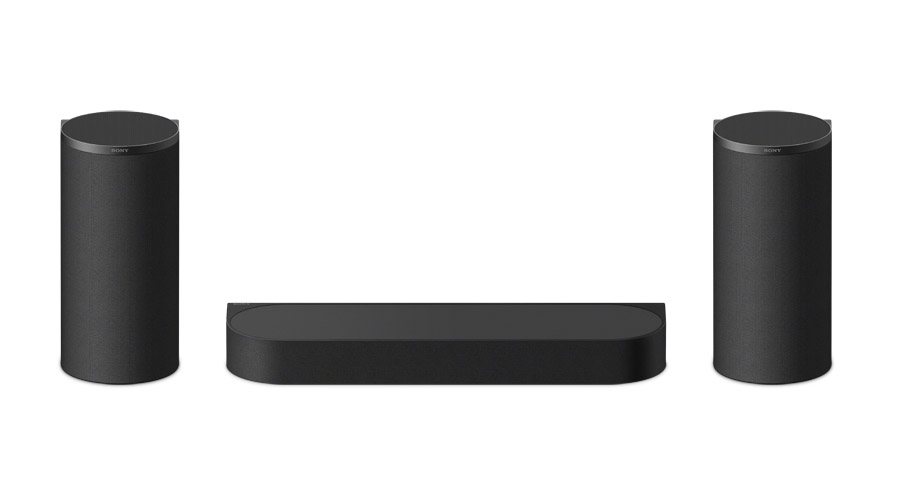
Sony just addressed this problem with their new BRAVIA Theater Trio. Also known by model number HT-A8, the Trio is a powered three-speaker system with dedicated left, center and right speakers that allows you to place your main speakers on either side of your TV or projection screen for a wider, more immersive soundstage even with the largest TV or projection screens.
The Sony BRAVIA Theater Trio comes with a dedicated center channel speaker and a pair of front speakers with front-firing and up-firing drivers.
You may say, “But wait! Doesn’t Sony already offer the BRAVIA Theater Quad for just this reason?” And the answer is “YES!” But the new Trio has something the Quad doesn’t have: a dedicated center channel speaker. And this heps to improve dialog intelligibility compared to the phantom center created by the Quad system. The Trio also supports up to two powered subwoofers, while the Quad currently only supports one.
Based on our listening tests in events in Japan and New York, we’d say the BRAVIA Theater Trio works well on its own to improve the dynamics and immersiveness of TV sound, thanks to its high quality front and up-firing drivers. But it can also be upgraded with rear speakers and one or two powered subwoofers for much more immersive surround sound with deep extended bass.
The BRAVIA Theater Trio is compatible with all of Sony’s current rear speakers and subwoofers including the Bravia Theater Rear 8 and Rear 9 surround speakers and the BRAVIA Theater Sub 7, Sub 8 and Sub 9 powered subwoofers. For best effect, we recommend adding the Rear 9 speakers as they include both front firing and top-firing drivers as well as an integrated swivel stand that allows you to point the front drivers toward your listening position.
Advertisement
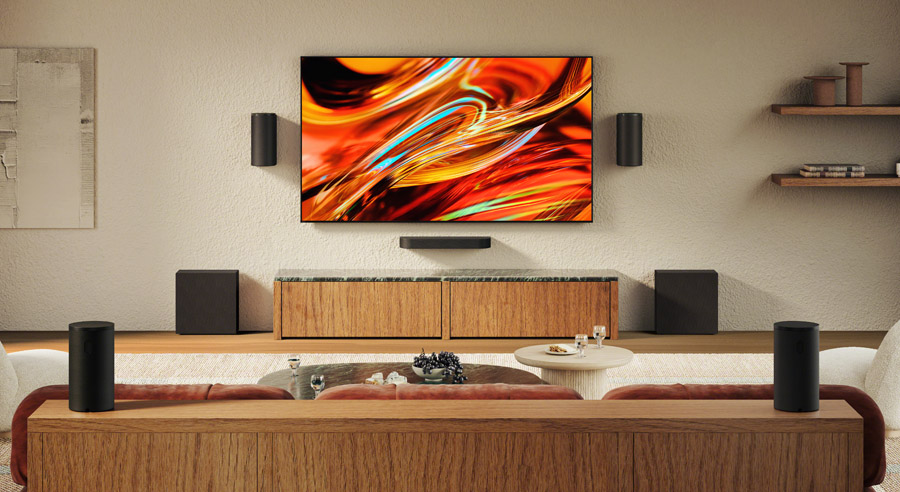
The sound of the Trio system can approach cinematic levels when upgraded with a pair of rear speakers and powered subwoofers.
Which subwoofer you pick will depend on room size and how much you love that low bass. The entry-level Sub 7 would be fine in a small apartment or listening space to fill in that bottom end without shaking the walls. But in a larger room, you may want to consider the larger Sub 8, with one 8” driver or the flagship Sub 9 which features two force-balanced 8-inch bass drivers in a larger cabinet for deeper bass extension. To even out the bass response in all parts of your room, and provide the most substantial bottom end, the BRAVIA Theater Trio supports the addition of a second subwoofer.
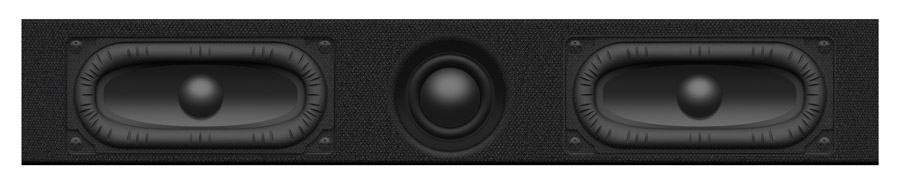
The BRAVIA Theater Trio center channel features a two-way design with a center tweeter, flanked by dual bass/midrange drivers for clear dialog reproduction.
Like a soundbar, the Trio needs no separate amplifier or receiver as it’s got the power built in. Just connect one HDMI cable from the TV or projector’s HDMI ARC/eARC port to the center channel speaker and plug it into wall power and that center speaker unit communicates wirelessly with the rest of the speakers in the system. The front speakers, and any optional rear speakers and subwoofers do need their own power connections, however, as they need electricity for both the built-in amplifiers and wireless connectivity.
All Hype? Or Is There Some Merit Here?
We got to hear a demo of the full BRAVIA Theater Trio system at Sony’s headquarters in Tokyo earlier this year. It was matched with two of the company’s flagship BRAVIA Theater Sub 9 subwoofers and a pair of the BRAVIA Theater Rear 9s in the rear. The system provided excellent, dynamic sound overall, which was more than a match for the 115-inch BRAVIA 9 II True RGB TV it was paired with. Bass was deep and extended, thanks to the dual subs, and dialog was clear and crisp. Music and effects extended nearly the full width, height and depth of the room, giving the whole experience a dynamic cinematic feel.
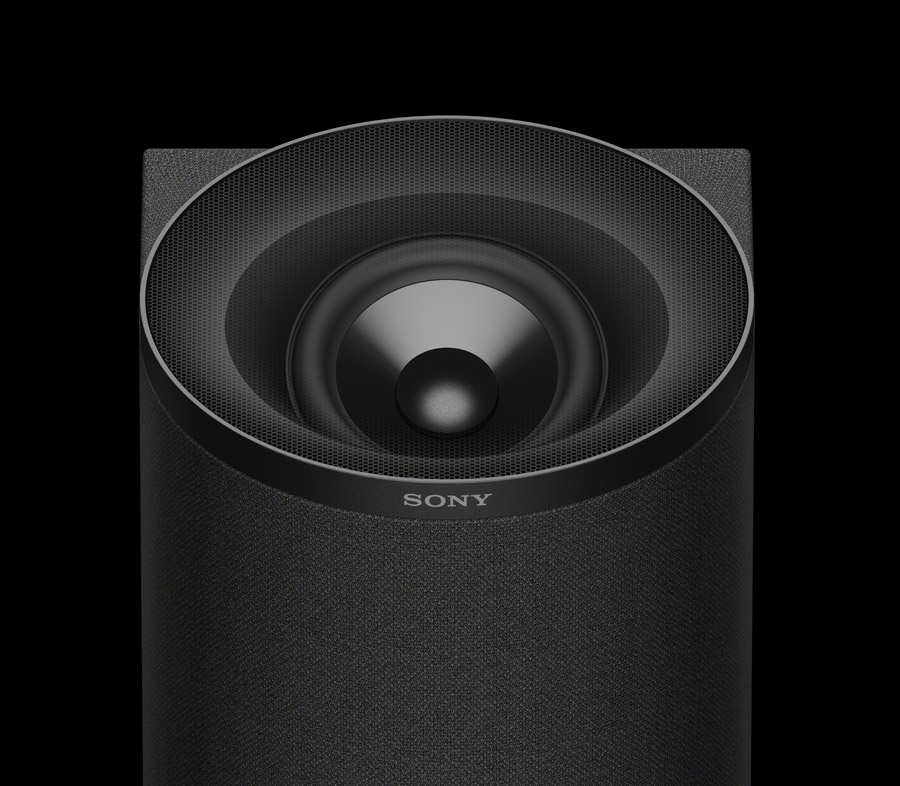
The front left and right speakers that come with the Trio system featured high quality angled up-firing drivers to reflect height channel effects off the ceiling.
The Trio isn’t replacing the Quad. It’s just providing another option for those who like the idea of variable width front left and right speakers and a dedicated center channel, without the wiring complexity of an A/V receiver and passive speakers.
Keep it in the Family (BRAVIA Family)
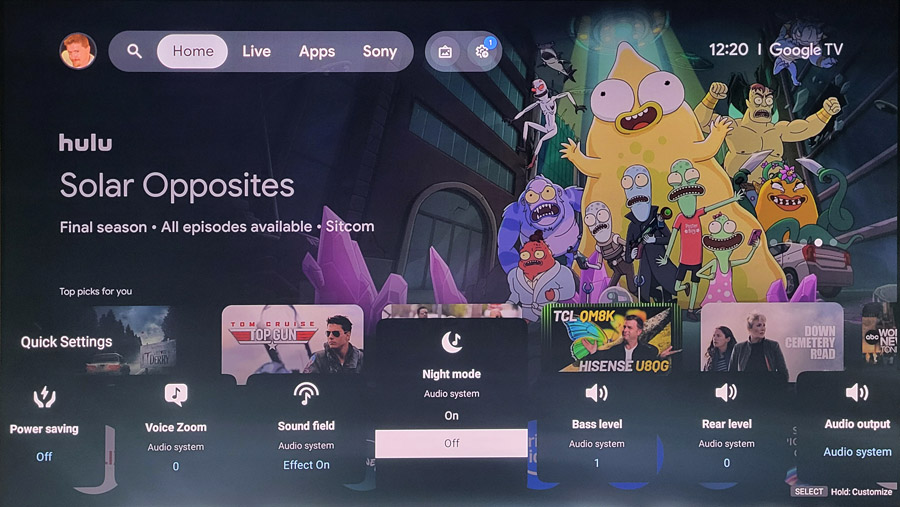
If you match the Trio up with a Sony TV, then you’ll be able to make all your audio adjustments right in the TV’s quick settings menu, and you’ll be able to take advantage of Sony’s AI-enhanced Voice Zoom 3 feature which elevates dialog without impacting the rest of the soundtrack.
Advertisement. Scroll to continue reading.
When connected to compatible Sony BRAVIA TV, you can make audio adjustments to the BRAVIA Theater Trio from the TV’s Quick Settings menu.
The Sony BRAVIA Theater Trio system can decode Dolby Atmos and DTS:X immersive surround sound, in both lossless and lossy versions. However, unlike the BRAVIA Theater Bar 8 and Bar 9 as well as the QUAD system, the Theater Trio does not support 360 Reality Audio, an immersive format for music which competes with Dolby Atmos. To be fair, the catalog of music titles available in 360RA format is pretty limited, so this omission is not likely to be a deal breaker for most buyers.
The BRAVIA Theater Trio can decode IMAX Enhanced DTS-X soundtracks like “Queen Rock Montreal” on Disney+ on select devices (including most recent Sony TVs).
The BRAVIA Theater Trio is certified IMAX Enhanced, which means it can decode the IMAX Enhanced DTS-X soundtracks on Blu-ray Disc, UHD Blu-ray and in streaming services including Disney+ and Sony Pictures Core, applying the necessary EQ to the soundtrack for maximum impact.
Advertisement
For wireless connectivity, the Theater Trio supports WiFi 6e network for high reliability as well as Bluetooth and Apple AirPlay 2.
New Improved Calibration Microphone
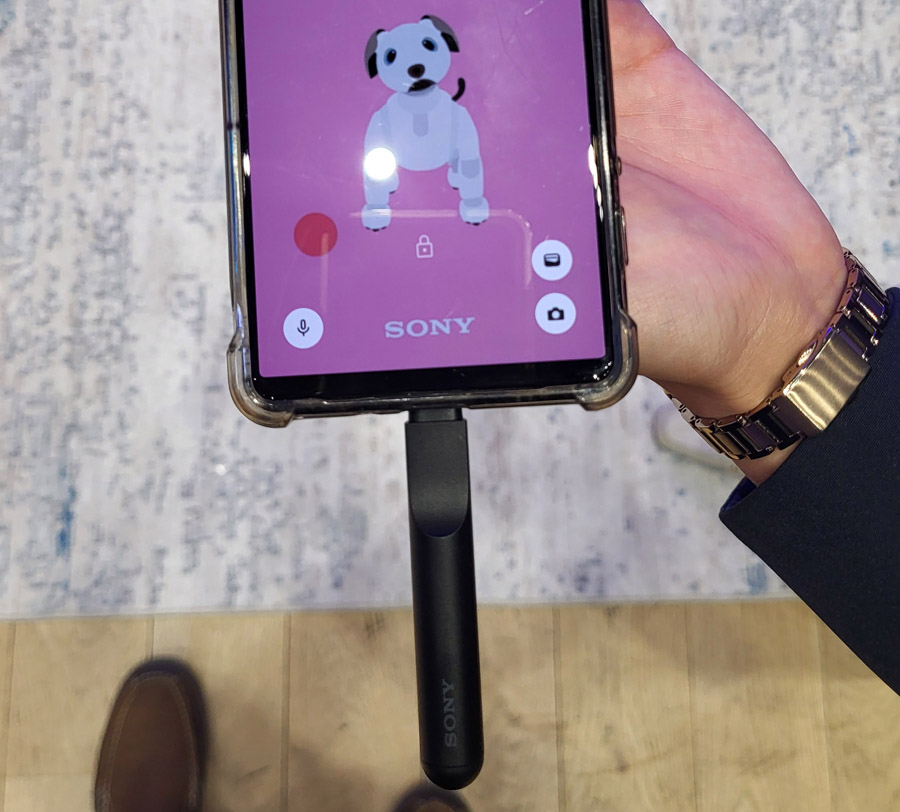
While previous Sony home theater products have used the microphone built into your phone for calibration, the BRAVIA Theater Trio comes with a dedicated high quality mic that plugs into your phone’s USB-C port for greater accuracy. This helps the system to better identify speaker positions and compensate for less-than-perfect speaker placement and room anomalies.
The BRAVIA Theater Trio comes with a new calibration microphone which plugs into the USB-C port on most recent Android and Apple phones.
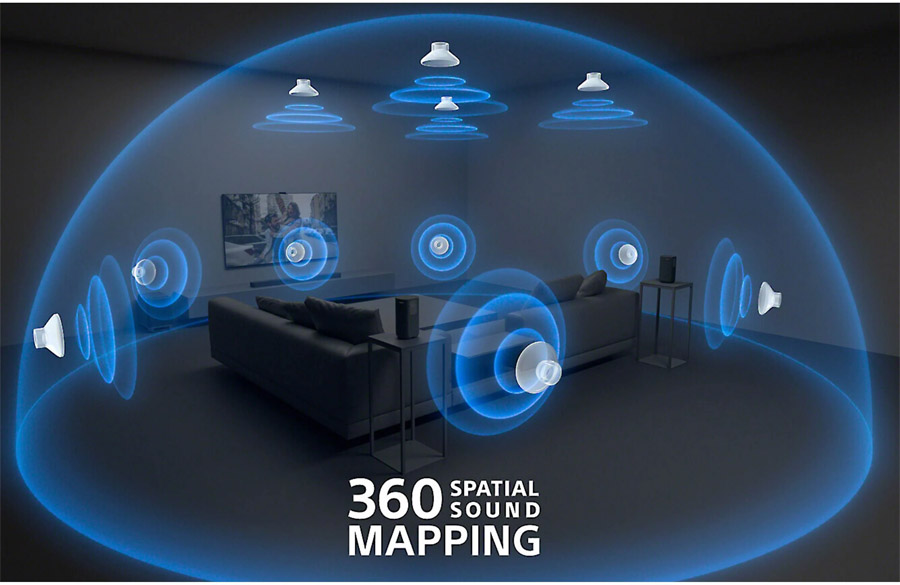
Speaking of speaker placement, the BRAVIA Theater Trio also has Sony’s 360 Spatial Sound Mapping (360 SSM) on board. This system compensates for imperfect speaker placement by creating phantom speaker channels all over the room in order to reproduce a more cohesive and expansive dome of sound.
Sony 360 Spatial Sound Mapping can compensate for less than perfect speaker placement by generating virtual speaker channels where no physical speakers exist.
What’s The Catch?
At $2,199, Sony’s BRAVIA Theater Trio is significantly more expensive than Sony’s flagship soundbar, the BRAVIA Theater 9 ($1,198 at Amazon). And if you opt for the fully loaded system, with a pair of BRAVIA Theater Sub 9 subwoofers ($899 each) and BRAVIA Theater Rear 9 speakers ($748/pair), the list price of the full TRIO system gets pretty close to $5,000 (MSRP). At that price point, you might consider putting together a full home theater system with receiver and external speakers. You’ll be able to get better bang for your buck this way, though the set-up and wiring will be more complicated.
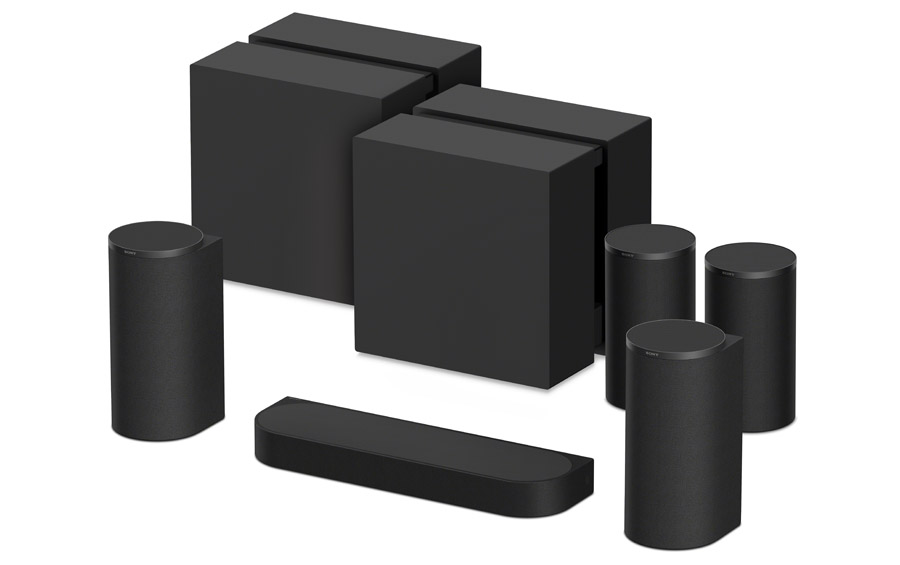
The Trio can be upgraded with rear channel speakers and up to two powered subwoofers. Shown here are the Trio with a pair of BRAVIA Theater Rear 9 speakers and two BRAVIA Theater Sub 9 subwoofers.
The Bottom Line
Apparently Sony likes to give its customers options. While soundbar-based systems offer simple set-up, the soundstage can be a bit narrow, simply due to the size of the bar. By offering an option to widen that stereo separation and keep a dedicated center channel for dialog reproduction, Sony is now giving buyers of extra large TVs and projection-based systems another potential solution. And it’s one we haven’t seen other companies match.
The Sony BRAVIA Theater Trio offers the wireless simplicity of a soundbar system with a hint at the performance of home theater separates. Its option to add not only rear speakers with up-firing height drivers but also up to two powered subwoofers gives buyers a clear upgrade path toward an audio system that can keep up with the visuals on a plus-sized TV screen. If you already own or are planning to purchase an extra large TV or home theater projection system, and the price point is within your budget, then the Sony BRAVIA Theater Trio is definitely worth a look and a listen.
Pricing & Availability
The Sony BRAVIA Theater Trio is available June 1, 2026 for $2,199.99 at authorized Sony dealers, with pre-orders being accepted now.
With new generations of AI models fueling both rapid software vulnerability discovery and the potential for faster exploitation by malicious hackers, the United States Cybersecurity and Infrastructure Security Agency released a new directive on Wednesday that requires more rapid and efficient software patching by federal civilian agencies. The “binding operational directive” (BOD) lays out a rubric for how quickly bugs must be fixed based on four assessments of urgency, with a turnaround time in critical cases of just three days.
Chris Butera, CISA’s acting executive assistant director for cybersecurity, told reporters on Wednesday that the goal of the directive is to help agencies prioritize, so they can address the most problematic vulnerabilities first while taking more time to remediate bugs that pose a less-pressing risk. The directive comes as private companies and governments have been scrambling to assess the extent of the cybersecurity reckoning that AI vulnerability and exploit development capabilities could unleash.
“Prioritizing IT and security operations attention on the most at-risk assets is particularly important now given advancements in artificial intelligence, which allow threat actors to find and exploit vulnerabilities in [federal] assets,” Butera said on Wednesday. “Defenders cannot afford to take weeks to patch systems that can be autonomously exploited en masse.”
The CISA directive’s criteria for evaluating patch urgency includes looking at whether a vulnerability is in a system that is publicly exposed, whether the bug is listed in CISA’s Known Exploited Vulnerabilities Catalog, whether an attacker could automate all of the steps to exploit the vulnerability, and how much access an attacker would get to the target if the bug were exploited. A vulnerability where all four points apply must be fixed within three days, according to the new directive, and the agency must also execute a “forensic triage” process to determine whether systems have already been compromised.
Advertisement
The directive supersedes two previous CISA orders related to patching timelines for urgent vulnerabilities—one from 2019 and one from 2021. Those established a framework in which the most critical bugs had to be patched within 15 days of detection and another class of high-urgency vulnerability had to be remediated within 30 days. And both encouraged faster patching for severe flaws when possible. Even before the AI era, in 2021, CISA wrote that “threat actors are extremely fast to exploit their vulnerabilities of choice: of those 4% of known exploited [vulnerabilities], 42% are being used on day 0 of disclosure; 50% within 2 days; and 75% within 28 days.”
US federal cybersecurity has improved significantly over the past decade, but it still often lags, thanks to funding shortfalls and competing priorities. CISA’s Butera said that the agency developed the new assessment rubric and the directive more broadly with these limitations in mind. He noted, for example, that the three-day deadline for the most urgent vulnerabilities isn’t, say, 24 hours, because such a short timeframe would not be feasible for most agencies.
New AI capabilities are already changing the landscape of vulnerability detection and bug hunting. And as this spurs new urgency in patching, many researchers have started to conclude, essentially, that no amount of patching will be enough—and that the software development community globally must work to adopt new, architectural or systemic approaches to invalidating whole classes of vulnerabilities at a time.
“CISA’s directive has its heart in the right place, but it only tackles half the challenge,” says Emily Long, CEO of the cloud security firm Edera. “If your architecture doesn’t limit what an attacker can reach after a breach, you’re just running faster on the same treadmill. Patching will always be important, but we should be talking more about containment by design.”
Advertisement
CISA’s Butera seemed to acknowledge this evolution on Wednesday. The new directive “is an initial step to counter the increased capabilities of emerging AI models,” he says. “Yet there is still more work to do.”
A man raises his phone as police move into a crowd. The video is shaky, loud, immediate. Within minutes, it is online. Within hours, it is everywhere. This is how accountability works now. Something happens, someone records it, and that footage can show what really happened, sometimes contradicting official accounts. It can empower citizens and create consequences for officials.
An ouroboros is an ancient Egyptian symbol, a snake or dragon eating its own tail. As I began to see patterns in my broader research on surveillance corporatism and governance lag, I began using the term “surveillance ouroboros” to describe this recursive pattern of observations intended to hold power accountable becoming new input for the same surveillance infrastructure.
Advertisement
Facial recognition changes accountability
During the George Floyd protests in 2020, people filmed police in real time. Phones were pointed at officers, not at each other. The goal was simple: to show what the state was doing. That footage spread quickly and became part of a much larger pool of public data.
At the same time, reporting from outlets including The New York Times and BuzzFeed News showed that law enforcement agencies were using facial recognition tools, including systems built by Clearview AI. Those systems were built from billions of images scraped from across the internet, including publicly available photos and videos.
The basic approach is now routine: People record the state, or anything else—as in the January 6 attack on the U.S. Capitol—and the state compiles that footage and data into a searchable environment, which may later be used to identify some of the same people who made the footage.
Facial-recognition systems used by law enforcement are increasingly outpacing the legal safeguards.
Advertisement
A 2024 Government Accountability Office review found that federal law enforcement agencies continued to expand their use of facial-recognition systems for criminal investigations despite ongoing concerns around training, privacy protections, civil-liberties safeguards, and oversight. Earlier GAO findings showed that agencies had conducted roughly 60,000 facial-recognition searches before formal training requirements were put in place for personnel using the systems.
The American Civil Liberties Union and other groups have warned that these tools could be used to identify people from images shared online, including protest-related footage. Concerns about facial recognition led some U.S. states and cities, including San Francisco and Boston, to restrict or ban government use of the technology, while federal agencies have continued to face scrutiny over how such systems are tested, deployed, and audited. A 2024 analysis published in Internet Policy Review warned that facial-recognition systems used by law enforcement are increasingly outpacing the legal safeguards meant to govern them, creating growing tensions around data protection, oversight, and proportional use.
The spy network that built itself
Surveillance used to require infrastructure. Cameras had to be installed and data had to be collected deliberately. That is no longer the case. People carry cameras everywhere. They record constantly and upload in real time. Events are documented from multiple angles without planning or coordination. The cumulative result is a continuous stream of usable data: faces, locations, timestamps, and interactions. The Internet of Things also waits all around us, gathering information and releasing it when people least expect it, as Andrew Guthrie Ferguson describes in a recent excerpt of his book Your Data Will Be Used Against You.
Similar dynamics are emerging globally. A recent analysis in the International Journal of Law and Information Technology examined how facial-recognition systems in China and Japan are expanding faster than the legal frameworks governing them. Reporting by The Guardian described the limited legal protections around the rapid deployment of AI-assisted surveillance infrastructure across parts of Africa.
There used to be a clear distinction between surveillance and accountability. Surveillance meant the powerful watching the people; authorities tended not to share their imagery except under duress or a court order and usually after a long delay. Accountability meant the people watching the powerful, and often publishing imagery immediately to head off or counteract official mischief. That distinction no longer holds. The same footage can serve both roles. A recording meant to expose misconduct can later be used to identify someone else entirely.
Surveillance ouroboros is not a future risk. It is already here.
This dynamic persists because people still need to record. In many places, it is one of the only tools available when formal accountability breaks down. When oversight institutions weaken or fail, public documentation becomes a substitute. In that environment, people turn to visibility. But that visibility comes with a cost. The more people that document, the more data that exists. The more data that exists, the easier it is to search, match, and store. Every video feeds the ouroboros. People are not feeding the system because they trust it. They are feeding it because the alternative is silence.
Advertisement
Most of the people in these videos are not the focus. They are in the background, passing by or standing nearby. But that distinction does not matter once the footage enters a system. Today’s facial recognition can identify even a face that passed through the corner of a frame. Someone who did nothing can still become part of a dataset without ever knowing it. As recognition systems improve, older footage becomes more useful, and invasive.
No single decision created this outcome. It emerged gradually through more cameras, better recognition, larger datasets, and easier integration. Each step made sense on its own. Together, they changed what recording means.
Public recording is still necessary. Without it, many forms of abuse would remain hidden. But recording is no longer just exposure. It is also contribution. If you published imagery or video last year, you may already have contributed to a system you have never seen, but the ouroboros has.
Surveillance ouroboros is not a future risk. It is already here. Every time someone presses publish, they are doing two things at once. They are exposing power, and they are helping build the system that the powerful will later use to track the less powerful.
After four years, we finally get a second Kingdom Hearts 4 trailer
Disney characters were few and far between, but two worlds were teased
We also didn’t get a release date
It’s tough being a Kingdom Hearts fan. The series is an all-time great, but if its platform-hopping origins weren’t frustrating enough — with entries exclusive to different consoles and even different regions for a while — we must now face the fact that Square Enix loves taking its time between entries, and between a new game’s announcement and release.
Kingdom Hearts 3 wasfirst showcased around five and a half years before its release, and it seemed Kingdom Hearts 4 might take just as long between merely its first and second trailers. That is, until we got a brand new look at the game at Nintendo Direct, saving this year’s Summer Game Fest event for me just as I had conceded the Disney meets Final Fantasy crossover would be absent yet again.
The minute and a half of footage blended combat gameplay with cutscenes of black robe-clad figures, protagonist Sora facing off against a Heartless behemoth on the streets of Tokyo, and a few new and familiar faces — including several from Kingdom Hearts’ now-defunct mobile and browser games.
Latest Videos From
Despite these more obscure inclusions, Square has said KH4 is meant as a jumping-on point for the series, with the game’s director, Tetsuya Nomura, describing the KH3 ending in a interview as a “reset” — one which “should make it even easier for newcomers to join the story starting from KH4.”
KINGDOM HEARTS IV Teaser Trailer | June 2026 – YouTube
I’m not convinced the latest trailer supports Nomura’s claims, though, as a long-time fan who has loved the series’ weird spin-offs, I’m not complaining.
Advertisement
The one other interesting detail of the trailer for me is how short it is on Disney characters. We only get the briefest glimpse of Donald and Goofy surrounded by blue flames.
Though we did get hints at two possible Disney worlds we’ll get to visit in some capacity. The first comes from those blue flames, which strongly hint at the return of Hades, the god of the underworld, from Hercules. Hercules’s world has appeared in almost every entry in the series so far, so its inclusion in 4 makes plenty of sense.
Sign up for breaking news, reviews, opinion, top tech deals, and more.
Advertisement
Further, while Sora’s fate at the end of Kingdom Hearts 3 is a little strange, it seems he has died in a way, so a god of death would likely be involved in his friend’s quest to find him. Plus, Hades’ voice actor has since teased his involvement online, saying “I might have a little bit of inside knowledge on this” and sharing the latest trailer.
I might have a little bit of inside knowledge on this. Just gonna say, it’s terrific, and maybe one of the best of the series. https://t.co/uUpFf7s2REJune 9, 2026
The other hint comes from Sora’s keyblade — a swirl of fire and water combined into one weapon. While we don’t get the best look at it while it’s swung around in combat, this feels like a clear reference to 2023’s Elemental, especially as the keyblade creates a flower effect when it hits enemies, which looks a little bit like the film’s vivisteria flowers.
Interestingly, Sora has this keyblade while battling in the realistic version of Tokyo, suggesting he’ll be world-hopping while still trapped in this alternate reality — one which didn’t experience the visceral conflict of light and darkness before his arrival, we learn in this new clip.
The only thing missing is a release date or even a release year. After four years since it was first teased, you’d hope Square Enix would be able to give us some kind of timeline for this game’s release.
My guess is sometime in late 2027 at the earliest, maybe early 2028. That’s based on a new Kingdom Hearts collection that is landing this October, and that we have the final part of the Final Fantasy VII Remake trilogy dropping in Spring next year (that’ll be sometime in March through May).
This is certainly frustrating. I can’t tell you how desperate I am to jump back into the Kingdom Hearts world, but hopefully the wait will be worth it.
Admittedly, this trailer makes me a little concerned. Perhaps it’s the wide open space of Tokyo’s streets, but the combat felt a little sparse, and something seemed a little off about Sora’s fight against the giant Heartless. Footage, so perhaps things will change come Kingdom Hearts 4’s eventual full release.
Advertisement
At least we found out it’ll be yet another multi-platform launch across PlayStation 5, Xbox Series X, PC, and the Nintendo Switch 2.
Poetic is an automation start-up servicing companies including Sofi and Chime.
OpenAI is backing automation start-up Poetic in a $50m funding round as it emerges from stealth, Bloomberg news reported today (10 June).
Poetic is developing a platform to automate time-consuming tasks using AI across wide use cases, including finance and insurance underwriting.
Advertisement
According to Bloomberg, Poetic has created a new programming language meant to help professionals use AI more efficiently.
The company was founded in 2023 as Forge by Markie Wagner, a Thiel Foundation fellow who worked as a researcher at Stanford and Waymo. Wagner also founded and led an AI consultancy called Delphi. She holds computer science degrees from the University of South California and Stanford.
According to Poetic’s website, the company is backed by Kleiner Perkins and Peter Thiel’s Founders Fund, with participation from OpenAI, First Harmonic and Genius Ventures. Its website lists American International Group, Chime and Sofi as customers. Poetic is expected to officially announce the funding round today.
“What Poetic has built is genuinely different – a platform that can execute the complex, high-stakes processes that large enterprises actually run, with accuracy that exceeds what human teams can deliver,” Leigh Marie Braswell, a partner at Kleiner Perkins told Bloomberg News.
Advertisement
Poetic is hiring for a range of roles in the US, including engineering, strategy and office management.
OpenAI’s support for Poetic comes as the company readies itself to go public. Estimates from last year suggest an IPO could value the $852bn ChatGPT maker at up to $1trn. The company’s start-up fund has backed the likes of Cursor, Harvey, Physical Intelligence and Kick.
Don’t miss out on the knowledge you need to succeed. Sign up for the Daily Brief, Silicon Republic’s digest of need-to-know sci-tech news.
No, we’re not talking about cultural appropriation of Japan’s most famous form of short poem–this is the other Haiku, the open-source descendant of BeOS, which now has a fully-native meshcore chat client called Sestriere, thanks to the efforts of one [Atomozero]. Of course you’ll need a LoRa radio to act as a modem, but anything that speaks USB serial– which is any of the ESP32-based offerings on the market–should work.
This is interesting in that we don’t see many desktop applications leveraging LoRa networks– meshtastic or meshcore– so for one to appear for the relatively-obscure BeOS derivative is just neat. It’s also a nice peice of work: the chat window is full featured, organizing your contacts, and communicating not just with text but emojis and reaction GIFs. GIFs seem a bit extravagant for LoRa bandwith, but apparently it works. There are also Codec2-based voice messages, another thing that we didn’t expect to see over LoRa, since most ‘chat’ projects restrict themselves to text messaging.
The chat window. One nice thing about Haiku APIs is that look-and-feel isn’t in question.
The software will also map all the nodes with which you are in contact, both diagrammatically and geographically, overlaid on OpenStreetMap tiles. The network map conveniently colour-codes your contacts by the link quality, but what’s even more interesting is the WireShark-inspired packet sniffer built into the software to let you keep a really close eye on traffic on the mesh network.
Neither Haiku or MeshCore are to everyone’s tastes, but as an OS it is a worthy daily driver, even if you have to jump through some hoops to install it if you have a UEFI-only system.
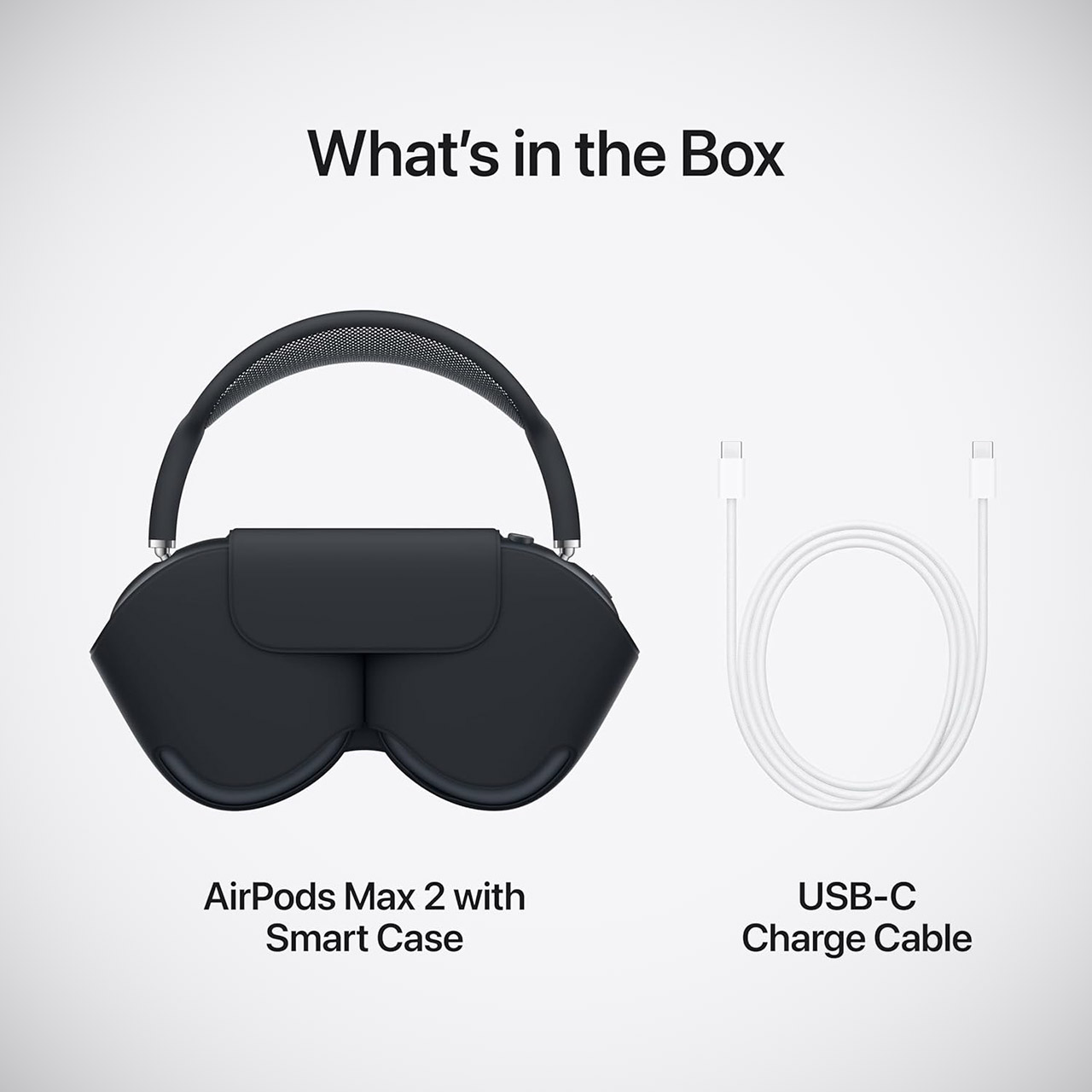
Frequent flyers and road warriors often rely on over-ear headphones to carve out personal space amid engine noise, terminal chatter, and crowded gates. Apple’s second-generation AirPods Max 2, priced at $499 (was $549), deliver a focused set of refinements that address several everyday frustrations from the first model, particularly for people who spend serious time in motion. The updates center on stronger noise blocking, modern connectivity, and software features that respond to real travel moments without demanding extra effort.
Anyone who has been stuck on a long journey knows how a low-frequency motor hum can wear down even the best intentions to sleep or focus. The new H2 chip considerably increases active noise cancellation, cutting through the seemingly never-ending drone more efficiently. User’s real-world tests show that it can handle airline engines, street noise, and general chat-din slightly better, allowing you to relax and listen to a podcast or your favorite music without being bothered by the background noise. That’s where Adaptive Audio comes in, as it works with the new chip to provide a little more awareness where it counts, eliminating the need to constantly switch between modes as the environment changes.
ULTIMATE OVER-EAR LISTENING EXPERIENCE—Powered by the H2 chip, AirPods Max 2 delivers improved high-fidelity audio with deep bass, expansive mids…
TUNE OUT THE NOISE—Up to 1.5x more Active Noise Cancellation than the previous generation, fully immersing you in every sound.*
HEAR THE WORLD AROUND YOU—Adaptive Audio automatically adjusts noise cancellation levels to suit your environment. Conversation Awareness lowers the…
Even with noise cancellation set on, the battery life lasts up to 20 hours, which is adequate for most cross-country flights or days spent bouncing between gates. On the other hand, if you are without power outlets for an extended period of time, a simple 5 minute charge will provide you with an additional 1 and a half hours of battery life, as well as the extra convenience of the Smart Case. When you put the headphones in a bag for storage, this device automatically changes them to an ultra-low-power mode, ensuring that they are ready to use even after days in a travel bag.
Advertisement
Using USB-C has a huge impact on the road. There’s no need to look for the right adapters; simply plug in a power bank, a laptop, or an airplane port and you’re set. When you plug it in, it unlocks lossless music at 24-bit / 48 kHz and ultra-low latency, making it ideal for wired listening to a laptop or a compatible entertainment system without the audio being affected by Bluetooth compression.
The new microphones and H2-powered tools also serve to improve the less glamorous parts of travel. Calls are clearer even in extremely busy airports or during boarding, and the new Conversation Awareness feature automatically reduces the level when it detects someone speaking close by. That function supplements the Live Translation feature, which provides instant language assistance when you’re abroad. The Digital Crown remains the best way to control the volume, skip songs, and access Siri without depending on those awful touch gestures that go haywire in transit.
The sound tuning has been slightly enhanced. The sound profile remains warm and has good bass response, but it does not fatigue after long periods of listening. The new Personalised Spatial Audio feature, which features dynamic head tracking, creates an immersive bubble that can help you pass the time on a long ride. Consistent frequencies and a reliable presentation allow you to easily zone out and listen without worrying about things breaking down after a few hours.
We may receive a commission on purchases made from links.
It’s inevitable that as you go about your lawn-trimming duties, your mower will get dirty. The deck arguably gets the worst of it, with dirt, grass clippings, and all kinds of yard debris caking on it and possibly gumming up the blade’s movement. Fortunately, lawn mower deck cleaning — one of the key steps in maintaining any lawn mower — is not only possible, but incredibly easy to handle at home. With that said, there are tools and equipment that can make it even easier while ensuring your mower’s deck is properly cleaned.
Before diving in, it should be explained why exactly it’s so important to keep a mower’s deck clean. Aside from aesthetics, a clean mower deck is less susceptible to rust and corrosion. Grass clippings and lawn debris stick to the deck largely thanks to accumulated moisture, which will eat away at the mower deck, the blade, and other metal components if left alone. This can also lead to mold growth and restrict airflow while the mower is in use, putting stress on the engine. Additionally, stuck-on deck debris could carry bacteria and fungus that, when exposed to cut grass, could infect and harm your lawn.
Advertisement
To avoid all of these drawbacks, routine lawn mower deck cleaning is essential. To get it done right, these are some of the most useful tools to have in your arsenal.
Advertisement
1. A fuel siphon pump
Before starting mower deck cleaning, you need to prepare the mower for the job. That means disconnecting the spark plug wire to prevent accidental starts and then emptying the gas tank if you haven’t already run it dry. This is essential because tipping a tank full of gas can cause fuel leakage and damage the mower’s internal components. The easiest way to clear out the tank without wasting gas is to use a designated fuel siphon pump, which isn’t hard to find. Better yet, it’s not a terribly expensive tool to get ahold of either, with websites like Amazon offering pumps for less than $10.
With your pump and gas can at the ready, you’re prepared to empty your mower’s fuel tank. For two-hose models, one hose connects to the tank while the other connects to the gas can. As seen above, some utilize a more syringe-like setup with only one hose. With the hose in the gas tank, simply squeeze or lift the handle to draw fuel out. Once the tank is completely drained of gas, you’re safe to remove the hose and close the tank. For syringe models, you can now release the gas into a gas can and subsequently begin lawn mower cleaning.
Advertisement
2. A lawn mower deck scraper
There are a few ways to remove thick layers of stuck-on debris from a lawn mower deck. For some, one of the most underrated home improvement tools, the simple scraper, is enough to get the bulk off. Meanwhile, others prefer to use the built-in mower deck wash port and let their garden hose do the work. If you really want to get as much caked-on grass off as you can and do so with a bit more ease, you could invest in a designated lawn mower deck scraper. As their name suggests, these scrapers are designed specifically for cleaning mower decks.
The key distinctions that make mower deck scrapers worthy investments are their size and shape. Some offer extended handles to make scraping the deck easier without too much bending or kneeling. There’s often a curvature of some kind to the heads of these scrapers, too, matching the contours of the mower deck to get bits of grass that a regular flat scraper might not reach. These tools range in price: a steel lawn mower deck scraper costs $9.69 on the Walmart website, while the Grass-Hawk dual-bladed mower scraper is on the high end at $19.38 at Home Depot.
Advertisement
3. A wire brush
With the aid of a scraper, most of the stuck-on lawn clippings will come off the mower deck. Still, this isn’t the end of the cleaning journey. From here, it’s a good idea to use another hand tool to refine your cleaning approach. A handheld wire brush is great for removing layers of dirt and grime that are too thin and stuck-on for a scraper to completely remove. Fortunately, this is another tool that doesn’t cost too much to add to your collection. An example like the Warner brass fine wire brush only costs $4.98 at Lowe’s.
As far as use, a wire brush isn’t difficult to figure out. Being mindful of the mower’s blades, just scrub the brush on the mower deck in a clockwise or counterclockwise direction until it looks nice and clean. To take it a step further, you could invest in an attachable long handle, provided your brush has screw holes or a peg to accept it. This way, you have some added reach and don’t have to get down on your hands and knees to vigorously scrub after every lawn mow. At any rate, don’t forget to clean out the bristles once you’re done to keep debris and bacteria from returning to the deck next time.
Advertisement
4. A pressure washer
Even with the majority of the debris cleared by the scraper and brush, it’s still worth taking one last pass at your mower deck before putting it away. As mentioned, the mower deck wash port can help with cleaning, but there’s another way to use water to your advantage. A pressure washer is a great final method to clear off your mower deck, removing any remaining dirt and grass that somehow made it past the previous two tools. A sufficiently powerful unit for such a task can cost well under $200, include everything you need to get started, and come from reputable brands like Greenworks and Westinghouse. This is a comparatively costly buy, but it gets the job done.
Advertisement
Just as there are pressure-washing mistakes that can ruin a car, there are some missteps to avoid when pressure-washing a mower deck. The biggest is spraying areas that shouldn’t be sprayed, like the engine. Introducing water into these areas can inhibit a mower’s function, creating a bigger issue than a dirty deck. There’s also the concern of too high a PSI, as you just want to clean, not remove paint or otherwise damage parts of the mower. To stay on the safe side, this more light-duty task calls for around 1,300 to 1,800 PSI, with anything over 2,000 moving into risky territory.
Advertisement
5. An outdoor blower
Yaroslav Litun/Getty Images
For the most part, a scraper, brush, and pressure washer should get just about everything off of your mower deck. With that said, there may be some hard-to-reach places they miss. On top of that, this job makes a mess, leaving you with an unsightly pile of lawn clippings on your driveway. On both fronts, an outdoor blower can make all the difference. Yes, even a cheaper, smaller, battery-powered unit that only costs around $50, like the one from Pulituo on the Walmart website, or the $98.24 Black and Decker unit from Home Depot.
First and foremost, a unit from any of the major blower brands is great for blowing grass and debris from areas on the mower that the other tools couldn’t reach. In fact, the aforementioned Black and Decker model even has a tapered cone for pushing air into small, narrow areas. As far as ground cleanup goes, blowers are generally intended to move grass and leaves off driveways and sidewalks. Of course, if you’re dealing with a pile of thick, wet grass, blowers below 100 mph may struggle. A higher-powered blower over 100 mph could be necessary, or at least some of the grass moved by hand first, with the blower used for a final clean.
California lawmakers are again considering A.B. 412, a bill that would require AI developers to identify and disclose copyrighted works used to train generative AI systems.
The problem this year is the same as last year: it’s practically impossible to comply with this law. The bill demands information that often does not exist, and cannot realistically be obtained.
EFF submitted an opposition letter to the California Senate Privacy Committee explaining why we continue to believe A.B. 412 is simply unworkable. To the extent developers do follow this law, it will have the effect of locking in the power of the largest companies in AI.
A Burden That Can’t Be Met
A.B. 412 sounds simple: just have AI developers create and keep a list of all the registered copyrighted works they use in AI training.
Advertisement
That may seem straightforward. In practice, it’s anything but.
There is no machine-readable “list” of copyrighted works at the U.S. Copyright Office. And many copyright holders can get a copyright without even depositing a publicly viewable sample of the work—for example, software companies may register copyright on proprietary code without revealing it to the public.
And on the open internet, copyright information is often incomplete, unavailable, or impossible to verify. One image may be registered with the copyright office, while the next is licensed under a free Creative Commons license (like the images that EFF creates), and the next is public domain. A message forum user might post an original story, photograph, or poem without any indication of ownership or registration status.
The bill effectively asks developers to continuously cross-reference massive batches of online data against a copyright system that simply wasn’t designed to do so. If California passes A.B. 412, its impact will go far beyond the large AI companies we read about in the headlines.
Advertisement
Not Just Big Tech
Supporters often frame this bill as a way to help creative workers have some leverage against Big Tech, but the bill reaches much further than the big AI companies.
Its definition of “developer” extends to anyone who makes a generative AI model available to Californians. That includes indie developers tinkering with an existing model, open-source initiatives, nonprofits, and other non-commercial efforts. Recent amendments added exemptions for universities and government entities, which is important, but that still leaves out a vast swathe of non-commercial tech work that’s done by people without full-time jobs in government or academia.
Large companies will hire compliance teams and lawyers to navigate these requirements. Smaller organizations and independent developers usually can’t. The result will be fewer opportunities for startups and new entrants. Faced with this massive compliance burden, some won’t even try.
Courts Are Already Deciding These Questions
The bill is premised on the idea that copyright owners currently don’t have good remedies if they’re mistreated by AI companies. That simply isn’t true. And the growing wave of federal court filings in this space proves it. Content companies that want to sue tech companies, large or small, have no problem doing so. Those courts are still working through important questions about fair use and transformative use. Some courts have already concluded that many AI training activities qualify as fair use. Others continue to evaluate the issue.
Advertisement
California lawmakers should not rush to impose new state regulation while those questions remain unresolved. This is why copyright is governed at the federal level: both creators and fair users benefit from a single set of nationwide rules.
At this point, the bill remains a solution in search of a problem. Rights holders already have powerful tools to protect their interests under existing federal law. What this bill adds isn’t clarity or transparency, but a costly and essentially impossible compliance burden that will discourage small developers and researchers.
California has been able to support both artistic creativity and tech innovation for decades now. But A.B. 412 does not strike the right balance.
If you are a California resident and interested in speaking out about this bill, you can find and contact your representatives through this website.
Don’t get me wrong — I’m pretty darn excited for a Legend of Zelda: Ocarina of Time remake. But boy, I would have been so much more excited for a sequel instead.
If you’ve somehow missed it, at the most recent Nintendo Direct, we saw a brief teaser for a Switch 2 version of Ocarina of Time. Admittedly, the brief trailer is light on details — merely showcasing a cinematic intro for the iconic adventure with some voice acting and vastly improved graphics over the Nintendo 64 original — but the promise to return to Hyrule later this year has left many (myself included) ecstatic with the hope this is Zelda’s Resident Evil 2 Remakeequivalent.
Anyone who has touched Ocarina of Time knows why it’s regarded as one of the best games ever made. It perfectly translated the previously 2D-only series’ sense of adventure into a 3D world, and even close to three decades later, Ocarina’s Hyrule is a delight to explore — with its dungeons to solve, monsters to slay, and songs to learn.
Advertisement
Latest Videos From
A return to this world with a graphical and gameplay overhaul — taking learnings from titles like Breath of the Wild — would be the perfect way to revisit the classic, and introduce it to a new generation.
The Legend of Zelda: Ocarina of Time – Nintendo Direct 6.9.2026 – YouTube
Though it doesn’t quite hold a candle to its direct sequel, Majora’s Mask.
The darker tone and the repeating three-day cycle create a claustrophobic aspect that pairs perfectly with the game’s expansive world and its various branching stories. You don’t have time to solve every problem at once, so you have to slowly piece together each puzzle through what you learn in previous cycles, and the items and abilities you unlock.
Majora’s Mask could easily have been a mess, but instead it pioneered the Groundhog Day-like genre, setting the bar for what time loop games should deliver.
Advertisement
Sign up for breaking news, reviews, opinion, top tech deals, and more.
Everything is perfect… but ultimately unfinished too.
The Legend of Zelda: Majora’s Mask Trailer – Nintendo 64 – Nintendo Switch Online – YouTube
Majora’s Mask picks up where Ocarina of Time ends, with Link on a quest to find his fairy companion Navi after she leaves him at the end of the first game.
While he does save yet another realm, his inciting quest doesn’t have a conclusion, as Majora’s Mask ends with Link venturing on once more to find his fairy friend.
While the Zelda series has had plenty more entries since these two games, it has long felt like there should be a third story in the Ocarina of Time duology — one that ties up this loose end adventure in some way.
So while I’m excited for a new Ocarina of Time, I am left desperately wishing we were getting a fresh follow-up instead, one that finally concludes this long-time Zelda series mystery rather than simply being the fourth Ocarina of Time re-release.
Why not both?
Wake me when Ocarina of Time 3 is here (Image credit: Nintendo)
My mixed feelings aside, this remake doesn’t rule out the possibility of a sequel. In fact, it could make one more likely as players are refamiliarized with the game’s story and finale.
Advertisement
Adding to my hope (read: cope) is that we’re coming up fast on TheLegend of Zelda: Ocarina of Time’s 30th anniversary — which lands at the tail end of 2028. Concluding this mystery would be quite the birthday treat for longtime fans of this game.
Now that would be quite a swift turnaround time, but the Zelda series does comfortably hit one entry every couple of years — since 2023, the franchise has actually had a release every year if you count the Switch 2 Editions of Breath of the Wild and Tears of the Kingdom.
We’ll have to wait and see what Nintendo has up its sleeve, but as I play through Ocarina of Time on my Switch 2 later this year, I’ll be desperately hoping a brand-new sequel to it is just around the corner.
If there’s one appliance that you should have above all in your collection, it’s one of the best air fryers as vetted by our team of experts.
Air fryers are so popular now that it feels as if everyone has got one. These compact cookers are an ingenious bit of engineering, as they can easily fit atop most kitchen counters whilst also cooking food faster than traditional ovens.
While there are plenty of options to suit the amount you have set aside to buy an air fryer, it’s also worth getting a sense of what you want an air fryer for ahead of time, as this can whittle down the selection process. For instance, if you’re only cooking for yourself, then you’ll get on just fine with a single-drawer air fryer, but if you’re trying to feed a family, then you’ll feel right at home with a dual-drawer unit.
Because they sit on your countertop, we recommend taking a quick measurement of how much space you actually have to work with ahead of time. The last thing you want is to spend money on an air fryer, wait for it to arrive and then, when it finally appears, you realise that it doesn’t fit within your kitchen.
Advertisement
As you can imagine, air fryers are far from the only kitchen appliance that our team of experts put to the test.
To help you build up a well-rounded set of devices that can cater to every type of food or drink request, be sure to read through our guides to the best coffee machines, best ovens and the best microwaves.
We cook real food in each air fryer, appropriate to each model, such as making chips, frying sausages and cooking frozen hash browns. This lets us compare quality between each air fryer that we test.
The best overall air fryer
Ninja Double Stack XL 9.5L Air Fryer SL400UK
Pros
Excellent results
Huge amount of cooking controls
Brilliant controls
Cons
Can be fiddly to turn food with dual-layer cooking
The best large air fryer
Ninja Foodi FlexDrawer Air Fryer 10.4L AF500UK
Pros
Easy to use
Excellent results
Huge amount of cooking space
Cons
Entire drawer has to be washed, even if you use half
The best air fryer for complete meals
Ninja Speedi 10-in-1 Rapid Cooker and Air Fryer ON400UK
Pros
Max complicated meals fast
Versatile range of cooking options
Steam air frying is incredible
Cons
Crisper plate fiddly to remove
Lower max temperature than some air fryers
The best oven and air fryer
Sage the Smart Oven Air Fry
Pros
Air fries, bakes and grills quickly
10 preset functions
22-litre capacity
Cons
Hard to clean by hand
Larger footprint than an air fryer
Pricey
The best air fryer for grilling
Tower T17076 10-in-1 Digital Air Fryer
Pros
Excellent selection of accessories
Easy to operate
Automatic programmes
Cons
Some accessories are fiddly
Maximum temperature 200ºC
Takes up space/storage issues
Best single-drawer air fryer
Dualit Air Fryer
Pros
Seven preset programmes
Good-sized cooking area
Dishwasher safe
Cons
Not suitable for large households
Substantial worktop footprint
Best for looks
Ninja Crispi Pro
Pros
Versatile functionality
Fast and even cooking
Clever glass dishes
Cons
More expensive than its predecessor by quite a margin
Best budget air fryer
Instant Pot Vortex Compact 5L Air Fryer
Pros
Great value
Easy to use
Cooks well
Cons
Crisper plate fits a little loosely
Best grill/air fryer
Ninja 5-in-1 Grill & Air Fryer EG351UK
Pros
High maximum temperature
Crispy air fry results
Powerful grill
Precision cooking with temperature probe
Cons
Doesn't reset interface when probe is unplugged
Best budget dual drawer
Cuisinart AirTwin XXL Dual-Zone Air Fryer AFD100
Pros
Great value
Lots of cooking modes
Crispy results
Cons
Doors a bit sticky
A little slow to cook
Best for crispy results
Instant Pot Vortex Dual Drawer 8L Air Fryer
Pros
Solid capacity
Reasonably fast and crispy results
Decent array of functions
Cons
Needs to pre-heat every time
Controls not as intuitive as rivals
Best for futuristic looks
Typhur Dome 2
Pros
Lots of cooking functions
Fast and even results
Space-age looks
Cons
Very expensive
Shallower basket can impede when cooking taller items
Advertisement
Advertisement
How important are temperature settings?
Most air fryers work at a standard temperature of 200°C, which is required to crisp the outside of your food. If you find air fryers with higher temperature settings, they can cook food faster, which can be handy when dealing with frozen foods.
Can an air fryer do everything a deep fat fryer can do?
Advertisement
Not quite. While you will see similar results for most food, air fryers aren’t very good when it comes to wet batters, such as for fish and chips. Here, you’ll find that the batter drips off and you won’t get even results. Most air fryers require you to remove the food and regularly shake it, too, in order to evenly coat food in oil. Some models have clever features and layouts to reduce this, but it’s something to keep in mind.
What accessories do I need?
Accessories vary by device. Some air fryers have optional basket separators, which let you cook different foods at the same time. Grill pans can help you cook other types of food. Some models even have muffin or cake trays, although you’ll probably find it easier to just use a regular oven.
Advertisement
Is size important?
Make sure that you buy an air fryer large enough for your needs. If you’ve got a large family, then you’ll want a model that can cook enough chips for you all. Most budget models suffer from small baskets that are good for one or two people, so you may need to up your budget to get a larger model. A larger basket also upgrades what you can cook, with some models even managing an entire chicken.













![KINGDOM HEARTS Collection [I ~ III] Announce Trailer - YouTube](https://img.youtube.com/vi/ldMqRmTwy80/maxresdefault.jpg)






















































You must be logged in to post a comment Login