Connect with us
DAPA Banner
DAPA Coin
DAPA
COIN PAYMENT ASSET
PRIVACY · BLOCKDAG · HOMOMORPHIC ENCRYPTION · RUST
ElGamal Encrypted MINE DAPA
🚫 GENESIS SOLD OUT
DAPAPAY COMING

Tech

Stats, iPhones, and AI devices are still a threat

Published

on

In this week’s “Sunday Reboot,” scientists somehow say iPhones lowered birthrates, and Musk’s AI prototype story shows that specialist hardware is coming, even if we don’t necessarily want it.

Sunday Reboot is a weekly column covering some of the lighter stories within the Apple reality distortion field from the past seven days. All to get the next week underway with a good first step.

iPhones up, birthrate down, “research” questionable

The iPhone is a mere 19 years old this week, first going on sale on June 29, 2007. It’s old enough to drink in the UK, if not quite in the United States.

Before it flies across the Atlantic to buy a brew from a bar in Basingstoke, some pesky scientists have tried to spoil the party.

Advertisement

Raised on July 1, a working paper from the National Bureau of Economic Research proposes “Is the iPhone Birth Control?” If we follow Betteridge’s law of headlines, the answer is “No.”

The paper proclaims “National-survey evidence on time use and sexual behavior is consistent with the iPhone reducing in-person interactions, increasing pornography use, and reducing sexual frequency” in the United States

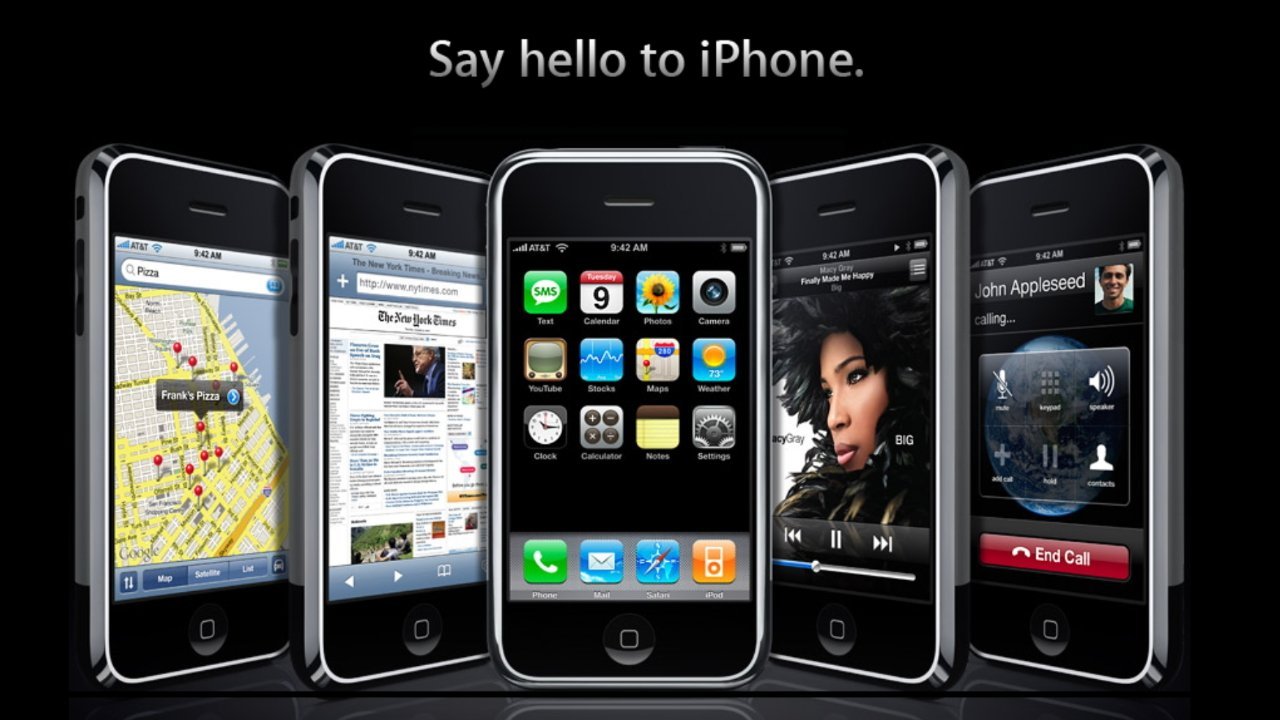
Five firstgeneration iPhones standing side by side on a black background, each displaying different screens such as maps, web browser, home screen, music, and phone call, with text Say hello to iPhone

Apple launched the iPhone in 2007. Scientists say it was too hot for the U.S. Birth Rate – image credit: Apple

Hearing that for the first time, you’d nod and agree with it. That song from the puppet musical “Avenue Q” is right, and so is the abstract.

Advertisement

However, AppleInsider William Gallagher looked into the report and realized that there are some catches to this assumption.

First, that it’s not really a phenomena associated with just the iPhone. I recall there were many different other devices on the market at the time that were capable of being used in illicit ways.

However, the writers decided to focus on data of AT&T users between 2005 and 2011. That’s two years before the iPhone and the years when it was exclusive to AT&T.

Except it doesn’t really take into account the fact that AT&T also sold many other early smartphones too. Blackberries, the HTC-based AT&T Tilt, the Nokia N75, and others were all buyable from the carrier, not just iPhones.

Advertisement

Even the report writers acknowledge this, saying they don’t claim the iPhone was the sole cause of the post-2007 decline.” Indeed, they say the estimates imply that the modern smartphone played a “sizable role” in the decline of US births.

But, before the puritan complainers can get a word in about how smartphones are evil, and demand retribution from the House of Jobs, the report goes on to work against the implied statement.

Line graph titled Search interest in porn, showing Google Trends index rising from 2004, peaking around 2013 near 100, then gradually declining and stabilizing between 40 and 60 by 2024

A graph used as proof the iPhone affected the U.S. birth rate. Except it doesn’t… – Image credit: National Bureau of Economic Research

Searches for “porn” shot up in 2014, but have gone down to almost 2009 levels again by 2024. Almost as if society had the novelty of trying to access specialist content wherever they want, then the novelty wore off.

Advertisement

It’s an odd report that tries to prove a point, but works against itself in many ways, and with too many asterisks to really be taken seriously.

In which case, was it really a clickbait way to try and secure some grant funding during some downtime? Or maybe some scientists placed bets that they could get it published.

Maybe it was an excuse to get to look at adult material while working without needing to face an investigation from HR.

Either way, Betteridge’s law is maintained once again.

Advertisement

Don’t stop believing in AI devices

People working in the tech editorial space, such as this very publication, are all too familiar with the notion of prototypes being shown to others. Especially if it’s for a future product in a category where there’s no real dominant option.

Cue a story about one of the Elon Musk companies supposedly sharing a prototype with investors for an AI device. SpaceX’s xAI apparently did that, though Musk has since called the claim “utterly false.”

Your mileage may vary on whether or not to blame the extremely rich man, but he did threaten to go all Futurama Bender on the iPhone in 2022. As someone in charge of tech companies with massive resources capable of doing just that, there was every chance that Musk would do it.

He didn’t, but the opportunity was there.

Advertisement

What the modern-day report provides in detail is minimal. It was shown to investors and was thinner than an iPhone.

While Musk’s insistence that it’s not happening puts a downer on things, it does, however, mean that there’s still an appetite for something to happen in that area.

Three small square wearable camera devices, one white in front and two black behind, each with rounded corners and a horizontal pill-shaped lens area featuring a yellow accent on the left

The Humane AI pin failed. Won’t stop others from doing the same thing – Image Credit: Humane

After the Humane AI pin’s crash and burn and the Rabbit R1’s lack of popularity with consumers, companies should be treading carefully. Those were two high-profile AI device failures, and no-one wants to pay for the third.

Advertisement

Rumors and patents certainly point to Apple continuing down the path of a more AI-focused future. Sure, there’s the questionable pendant, and the ever-present smart glasses, but it’s also looking at non-standalone items too.

We have had rumors insisting that the AirPods will get cameras, providing an environmental view for Apple Intelligence running on an iPhone.

The key bit here is that it’s all feeding back to an iPhone. Something that is obviously a device that has a lot of AI prowess, and could do the same job as Humane’s pin if you push it.

The only difference is that AirPods with cameras, or smart glasses with cameras, would enable that sort of functionality without needing to touch the iPhone at all.

Advertisement

The AirPods don’t have to be “smart” in their own right. They only have to pass along data to the iPhone as the actual “brain” of the operation.

You don’t really need a dedicated device, just a way to interface with what already exists.

So, with the hardware side “solved,” there’s the actual AI bit to cover. Again, Apple Intelligence on the iPhone comes to the rescue, but there is another way.

Humane was painful, particularly since you had to pay a $24 per month subscription for the AI bit. We may not have liked paying a subscription for questionable AI back in 2023, but in 2026, we’re intimately aware of how much people are spending on access to ChatGPT and Claude.

Advertisement

Weirdly, it only took a few years and society is perfectly fine with one of the biggest stumbling blocks that Humane ran into.

It’s not hard to imagine OpenAI releasing hardware that taps into ChatGPT’s paid services. You don’t even have to imagine, as your friendly LLM can tell you about the hardware work with Jony Ive.

Humane flopped so OpenAI and others can walk, run, or be a patronizing yes-man that really wants to explain your assumptions back at you with a more academic style.

Musk may deny the existence of an xAI hardware prototype now, but it would be astounding if one wasn’t being actively developed.

Advertisement

Putting Grok access on a device like that isn’t hard to imagine. For Musk, with an eye staring at his finance teams, it seems like a natural progression of the form, and he gets his own iPhone rival to boot.

Just hope that we don’t get headlines in 20 years time about Musk’s prototype lowering the birth rate again.

Last week’s Sunday Reboot talked about Apple TV and its fear of gameshows. That, and a reminder that it is also bad at making gameshows.

Advertisement

Source link

Continue Reading
Click to comment

You must be logged in to post a comment Login

Leave a Reply

Tech

Meta’s Kylie Jenner collab doesn’t make me feel any better about smart glasses

Published

on

It’s not often we mention the Kardashian-Jenner clan here at Trusted Reviews, but Kylie Jenner’s surprise collaboration with Meta is all I’ve been thinking about. 

In case you missed it, the youngest Jenner recently unveiled her own pair of Meta smart glasses. Coined Starfire, the oval-shaped specs are not only framed as a trendy choice but they’re fitted with Meta’s controversial features, including Meta AI and, most notably, the built-in 12MP camera.

Kylie’s collaboration with Meta is surprising and disappointing for so many reasons. Firstly, in a viral interview back in May, she recalled how scary and invasive growing up with paparazzi essentially stalking her for photos was.

Like her eldest sister, she’s known for keeping certain parts of her life private. For example, she hid her first pregnancy entirely from the media, and then later was reluctant to share photos of her second child online. This is completely understandable, as everyone has a right to privacy and absolutely shouldn’t feel any need to share images online.

Advertisement

With the above in mind, why on earth is Kylie therefore promoting smart glasses that have the power to take privacy away from pretty much anyone who has the bad luck of walking past a desperate aspiring content-creator-slash-creep?

Advertisement

Meta glasses have a terrible reputation for being a complete privacy nightmare, especially when it comes to women and girls’ safety. Back in May, the BBC reported that a woman was going about her day when a man approached her, without a camera or phone in hand. Instead, he was wearing smart glasses, and she had “no idea she was being filmed”. 

The video was then posted online and viewed thousands of times, with the woman only finding out when a friend sent it to her. 

Advertisement

While we don’t know the exact brand of smart glasses the man was wearing, Meta glasses all have a light that comes on when you’re filming, which technically should show people that they’re being filmed. However, and I’ve seen this for myself, that light literally couldn’t be any smaller. I would totally understand if someone passed off the light as a simple reflection or maybe even just a large scratch on the glasses. 

Meta Starfire Kylie EditionMeta Starfire Kylie Edition
Meta Starfire as shown on Kylie Jenner. Image Credit (Meta)

That’s not the only worrying story. As uncovered by Wired last month, Meta has recently embedded face-recognition technology into the Meta AI app. While it’s not currently accessible by users, it will identify people captured by the glasses’ camera and alert the wearer when it recognises someone. 

This has, unsurprisingly, caused concern. Experts who spoke to The Independent earlier this year feared this technology could pose a “direct and serious risk” to domestic abuse survivors as it could enable their abusers to locate and track (in other words, stalk) them, without them even knowing. 

Advertisement

Plus, the fact that anyone who walks past a Meta glasses wearer’s image will be “cropped, indexed, and saved to a folder marked ‘pending’” is incredibly unnerving. What if your neighbour or the fellow commuter who always gets the same train as you is wearing Metas? Will your image be consistently stored for them to see? Will Meta actually note that you’re a frequent passer-by and attempt to identify you? 

Advertisement

What are the merits of smart glasses?

I’ve had hands-on experience with both the Meta Ray-Bans 2 and the Oakley Meta Vanguard too. The latter I somewhat understand the purpose of more, as they’re used as sports glasses and enable you to capture your surroundings, get real-time stats and more without needing to reach for your phone. The Ray-Bans 2 and similar glasses, on the other hand, are a different story.

Ray Ban Meta 2Ray Ban Meta 2
Ray-Ban Meta 2. Image Credit (Trusted Reviews)

Yes, Meta glasses allow you to do interesting things like translate live, but so do AirPods and many of the best Android phones. And yes, the glasses also give you real-time answers with Meta AI without you needing to reach for your phone, but is anything really that urgent?

I admit, I just can’t get on board with smart glasses, and maybe it’s because I’m not the target audience. But once you factor in the high price, the limited style options and, most notably, the serious privacy concerns, the cons surely vastly outweigh the pros.

Advertisement

However, Kylie Jenner’s influence is undeniable, and Meta clearly knows this as she’s one of the most followed users on Instagram. Her collaboration with Meta is not only hypocritical from someone who publicly states how much she favours privacy, but it will undoubtedly attract a new demographic of younger users who grow to think it’s simply fine to film people without their knowledge.

Advertisement

Obviously (and very unfortunately) it’s not as easy to say “let’s just ban smart glasses”, but there undoubtedly needs to be more regulation of filming and sharing content online.

Source link

Advertisement
Continue Reading

Tech

Quordle hints and answers for Monday, July 6 (game #1624)

Published

on

Looking for a different day?

A new Quordle puzzle appears at midnight each day for your time zone – which means that some people are always playing ‘today’s game’ while others are playing ‘yesterday’s’. If you’re looking for Sunday’s puzzle instead then click here: Quordle hints and answers for Sunday, July 5 (game #1623).

Quordle was one of the original Wordle alternatives and is still going strong now more than 1,500 games later. It offers a genuine challenge, though, so read on if you need some Quordle hints today — or scroll down further for the answers.

Enjoy playing word games? You can also check out my NYT Connections today and NYT Strands today pages for hints and answers for those puzzles, while Marc’s Wordle today column covers the original viral word game.

Advertisement

Source link

Continue Reading

Tech

AI in Mathematics Is Forcing Big Questions

Published

on

In the mid-noughties, when music by the Killers and Franz Ferdinand blared out of every pub and nightclub I passed, I spent my days and nights struggling through a Ph.D. in applied mathematics. My research focused on simulating how special light waves interact in liquid crystals and using simple equations to approximate and understand those interactions. When I look back at my thesis now, liquid crystal technology is old hat, and I imagine my work could be completed with AI assistance in a matter of days—maybe hours.

But the same cannot be said for the work of the pure mathematics Ph.D. students with whom I shared a cramped office at the University of Edinburgh. At the time, I felt sorry for these colleagues, who day after day sat at their desks, seemingly tearing their hair out and making no progress. (Though I was struggling too, I was at least always making some headway.) When we finished and went our separate ways, some hadn’t even published a paper.

Now, in hindsight, I finally understand why they toiled for years on abstract mathematical problems that only a handful of people in the world care about. It wasn’t arrogance, as I thought at the time; they weren’t trying to prove their superior intelligence by being the first to solve a seemingly intractable mathematical problem. It wasn’t even a form of masochism (which was my second guess)—penance for some imagined inadequacy. I realized they derived joy, satisfaction, and meaning from the long journey toward understanding.

Advertisement

“Sometimes, understanding just strikes you as being very beautiful. Sometimes it’s a feeling of accomplishment, like completing a marathon,” muses Carnegie Mellon University mathematician Jeremy Avigad. “But it’s not quite either of those: It’s just a wonderful feeling when you’ve been thinking long and hard about something complex, difficult, and then—all of a sudden—it just comes together.”

This feeling has driven mathematicians throughout history. Likewise, the way mathematicians pursue that feeling has changed little over the centuries. They notice or imagine links, patterns, or properties in numbers, shapes, or logical structures. From this, they write conjectures—unproven statements of their speculation. They or other mathematicians then use logical reasoning and the tools of mathematics in often creative ways to prove or disprove those conjectures. Finally, yet other mathematicians verify (or challenge) the proofs.

Invariably, this process requires a whole heap of thinking time. “I went to a pure maths camp with classes where we would sit with hard maths problems for half an hour and no one would say anything—everyone was just thinking,” says Krystal Maughan, a mathematician and computer scientist about to get her Ph.D. at the University of Vermont. “But then we would work together and kind of tease out the problem.”

This is the age-old joy of math in action. But today’s AI systems are starting to make inroads into bypassing this slow, deliberative process. Taking this trend to its logical conclusion, what happens if AI makes the mathematician’s struggle completely unnecessary? Might AI even sideline humanity completely?

Advertisement

AI’s Growing Role in Mathematics

For decades, computation has accelerated mathematical progress. This began 50 years ago, when mathematicians used a computer to prove the four-color theorem, which asks whether any map can be colored using no more than four colors, with no adjacent regions sharing the same color. The answer is yes, and the computer proved it, controversially, by checking 1,936 cases in a way no human could realistically verify.

Yet throughout this computational era, even in proofs relying on massive computational resources, the role of the human mathematician has remained central. Humans propose conjectures, guided by intuition. They devise strategies to prove them, guided by creativity and experience. And humans verify whether those proofs are correct.

Now AI is challenging the status quo. In just a few years, large language models (LLMs) have evolved from “stochastic parrots,” capable of little more than regurgitating basic mathematics scraped from the internet, into advanced mathematical reasoning machines.

Last summer, systems from Google DeepMind and OpenAI reached a level equivalent to the world’s most mathematically gifted high school students, achieving gold-medal status at the International Mathematical Olympiad. In this annual competition, contestants must solve six notoriously difficult problems from various areas of mathematics.

Advertisement

Earlier this year, Google DeepMind’s experimental AI system Aletheia achieved an even more significant milestone when it autonomously produced publishable Ph.D.-level research results. While the work itself is obscure mathematically—calculating structure constants in arithmetic geometry—the significance lies in the complex reasoning it displayed in tackling an unsolved mathematical problem. And more recently, a new general-purpose AI system from OpenAI disproved an important conjecture in combinatorial geometry. This result would have been worthy of publication in a major mathematics journal if humans had been the authors, and top mathematicians hailed the feat as a milestone for AI in mathematics, demonstrating independent, original, and sophisticated thinking.

Another shift has come from combining LLMs with mathematical tools known as proof assistants, which have been around for more than a decade. These systems—such as Isabelle, Lean, and Rocq—are specialized programming languages that check mathematical proofs step-by-step, verifying their logical correctness. Traditionally, mathematicians have had to translate their theorems and proofs into this machine-readable format by hand, a laborious process known as formalization. Now, LLMs are starting to remove this bottleneck, automating the translation of informal proofs into formal code that proof assistants can verify.

Versions of such systems, sometimes called reasoning agents, are becoming highly sophisticated. In February, for example, the AI company Math, Inc. used its aspirationally named reasoning agent Gauss to formalize a proof that had earned the mathematician Maryna Viazovska, of EPFL, in Switzerland, a Fields Medal in 2022. Gauss first helped human mathematicians complete the formalization of Viazovska’s solution to the 8-dimensional sphere-packing problem in a matter of days, and then autonomously formalized the more complicated 24-dimensional case in just two weeks.

Such achievements suggest that AI is already capable of handling some mathematical tasks long considered uniquely human. As the technology advances, more of the day-to-day work of human mathematicians is likely to become fair game for AI.

Advertisement

Mathematicians Debate AI’s Role in Discovery

Person in a dark blazer with blurred face against a blue background

Gluekit

Human mathematicians could become “priests to oracles.” —Yang-Hui He, London Institute for Mathematical Sciences

In September 2025, I attended the 12th Heidelberg Laureate Forum—an annual conference that brings hundreds of young mathematicians and computer scientists together with their intellectual idols. AI dominated the conversation and, from the get-go, tension was in the air.

Speakers described a future in which superhuman AI mathematicians transcend human knowledge and capabilities: forming conjectures, searching solution spaces, proving conjectures, and finally verifying the proofs and generalizing the results, all without human involvement. If this future comes to pass, Yang-Hui He of the London Institute for Mathematical Sciences memorably declared, human mathematicians could become “priests to oracles.”

Advertisement

While such startling predictions were being voiced on stage, my gaze was drawn to the audience. Frowning, fidgeting, and exchanging furtive glances—the crowd’s unease was palpable. Trill White, a student at Australia’s Deakin University, later recalled sitting in that hall and thinking: “ ‘That’s devastating. What will people have to contribute to mathematics? Will it become something that no one understands?’ I did get a sense that this is going to change everything.”

Portrait of a long-haired person with blurred face on an orange background

Gluekit

“We certainly started realizing AI has the potential to replace us.” —Jessica Randall, Google Developer Groups

Jessica Randall, a South African mathematician for Google Developer Groups, says she sensed a collective existential dread rising among the young mathematicians. “I could feel everyone was worried, because they hadn’t thought that far ahead,” she says. “It was like a big bombshell that hit us, and we certainly started realizing AI has the potential to replace us.”

Advertisement

Some established mathematicians, including He, seem comfortable with AI taking on tasks that are currently the preserve of human mathematicians. That’s because they just want to know the answers to the biggest questions in mathematics—such as the six remaining Millennium Prize Problems—even if AI does it all. “A lot of mathematicians are pragmatic and just want to understand. They would sell their soul for the solution to a problem,” jokes Avigad. “Whatever it takes, right?”

But this “just want to know” camp is by no means the only faction: Most mathematicians do not hope or expect AI to replace them entirely. Instead, two broad alternatives are emerging. The first is a human-centric aspiration that prioritizes human understanding of mathematics and treats AI as a tool, much like a calculator. The second is a collaborative “teamwork makes the dream work” vision, where humans and AI work together to tackle problems neither could solve alone.

The Human Role in Mathematics

Portrait of a person with blurred face on pink background

Gluekit

Numbers are “a way of bringing us to agreement.” —Akshay Venkatesh, Princeton University

Advertisement

Fields Medalist and Princeton mathematician Akshay Venkatesh has been thinking about this topic from the human-centric viewpoint for years. In 2022, he used his Fields Medal Symposium to implore the mathematics community to deeply consider what AI might mean for the practice of mathematics. At the time, the idea that AI could replace mathematicians seemed far-fetched. Now, he says, “we’re reaching the point where, for at least some tasks with abstract mathematical reasoning, computers are becoming competitive with humans.”

For Venkatesh, the question is not just what computers can do, but what mathematics is for. “Sometimes I think when we use numbers, it’s not so much that we are describing phenomena that are intrinsically numerical, but that we can all agree exactly what the numbers mean,” he says. “It’s a way of bringing us to agreement.”

A photo shows a woman standing in front of a chalkboard filled with mathematical formulas.

Maia Fraser of the University of Ottawa argues that mathematics is more than finding answers. For her, the struggle to understand a problem is one of the discipline’s greatest rewards.

Markian Lozowchuk

Advertisement

Mathematician and machine learning expert Maia Fraser, of the University of Ottawa, shares this sentiment. She says the joy she derives from mathematics is something distinctly human that integrates the subconscious and conscious mind. She describes starting with an intuitive sense that a certain thing should be true and gradually bringing out something that she can express in a rigorous proof. Communicating and sharing these deep-born thoughts is “a form of collective intelligence that is something beautiful about the human spirit,” she says.

By these arguments, an AI proof of a mathematical conjecture that has stubbornly resisted human efforts would be useful only if comprehensible to humans. “That the statement can be proved by AI is already useful information,” concedes Fraser. “But then it’s still an open problem to come up with an elegant, beautiful human proof.” Even if no such proof exists, she says, searching for it “is still a valuable endeavor.”

AI and the Future of Mathematical Collaboration

A more collaborative approach to AI in mathematics comes from Terence Tao, who first competed in the math Olympiad at the age of 10. In 1986, 1987, and 1988, he won bronze, silver, and gold medals, respectively, making him the youngest winner of each of the three medals in Olympiad history. Now a Fields Medalist and professor at the University of California, Los Angeles, he has earned a reputation as one of the most gifted mathematicians alive.

Unlike some of his peers, Tao is neither dismissive of AI nor fearful. Instead, he sees it as the catalyst for a fundamental shift in the discipline—a transition toward what he calls “big mathematics.” He envisions a future of large-scale, decentralized collaborations between humans and machines, where complex mathematical tasks can be diced and sliced, with humans claiming the creative parts and AI doing the lion’s share of the technical grunt work.

Advertisement

Already, Tao is experimenting with this concept, working on problems alongside scores of online collaborators, some using AI tools. “A hundred years ago, almost every mathematics paper was single author,” he says. “But now I collaborate with people I’ve never met—and maybe in the future, I won’t even know if they are AI or real people.”

The key to Tao’s vision is uniquely mathematical: formalization. When a proof is translated into code and checked step-by-step by proof assistants, it removes any chance of human error or dishonesty. This approach changes how collaboration works, because trust is established through verification rather than reputation or rapport. An idea from an unknown researcher or even an amateur can be taken seriously if it has a formal proof.

“If it wasn’t for this formal verification layer, opening projects up without any safeguards would just be a disaster,” adds Tao. “But in math, we can completely check and verify outputs, and this really filters out a lot of the rubbish.”

The Risks of AI in Mathematics

From the young researchers at the Heidelberg Laureate Forum to some of the biggest names in the field, mathematicians all seem to agree on one point: AI has the potential to transform their discipline. But there’s far less consensus on what that transformation will mean in practice.

Advertisement

Some worry about the accessibility of AI tools. Traditionally, mathematicians have required little more than intuition, training, and a pen and paper to advance their field. If this slow, deliberative process is no longer valued by society, and particularly by research funders, then mathematics could become an elitist activity, only practiced by select organizations that can afford to work with proprietary AI models.

Another concern is motivation. As AI systems take on more of the work, the incentive to engage deeply with difficult problems may weaken. Princeton’s Venkatesh says that the long human process of formulating and understanding a proof may be hard to justify, not just to funders, but even to mathematicians themselves. “There have been times where I’ve spent years thinking about something, and I’ve slowly struggled to understand it,” he says. “If your computer can do large chunks of that for you, will you have the motivation to spend that time?”

That concern extends to the next generation. If students can use AI to jump straight to answers, they most likely will. But every time they skip the struggle, they miss an opportunity to build the foundations of their own unique intuition. Over time, some worry, the next generation of mathematicians may suffer from a form of intellectual atrophy, unable to think outside the AI box that trained them.

In response to such fears, the mathematics community is taking action. Individuals are writing essays, organizing workshops, and debating in journals, while institutions and community groups are developing guidelines for how AI should be used in research and publication. Indeed, mathematicians are applying the same rigor and curiosity that they use every day to reckon with the challenges of AI. Taken together, these efforts reflect a broad effort to try to retain control over the direction of mathematics in the era of AI.

Advertisement

So, is AI sucking the soul out of math? In one way, it is doing the opposite. It is forcing mathematicians to confront deep questions about what mathematics is, why they have devoted their lives to it, and the purpose math serves in society. At the same time, though, it is reshaping the practice of mathematics in a way that may be difficult to reverse.

“Mathematics makes me a better problem solver at normal problems, because it frames my mind to think in a very logical, rational way,” says Randall, who noted the existential dread at the Heidelberg Forum. “It helps with every aspect of my life.” As AI transforms mathematics, many researchers wonder whether future mathematicians will be able to say the same.

From Your Site Articles

Related Articles Around the Web

Advertisement

Source link

Continue Reading

Tech

Sharp, Toshiba, and the Screen That Stayed Sharp Without Constant Power Showcased on 1986 BBC Micro Live Segment

Published

on

1986 Micro Live BBC Sharp Toshiba Screens
Portable computers in the mid-1980s were finally small enough to carry, yet their screens kept pulling users back toward desks and power outlets. The BBC program Micro Live used a January 1986 episode to lay out exactly why that gap existed and what might close it.


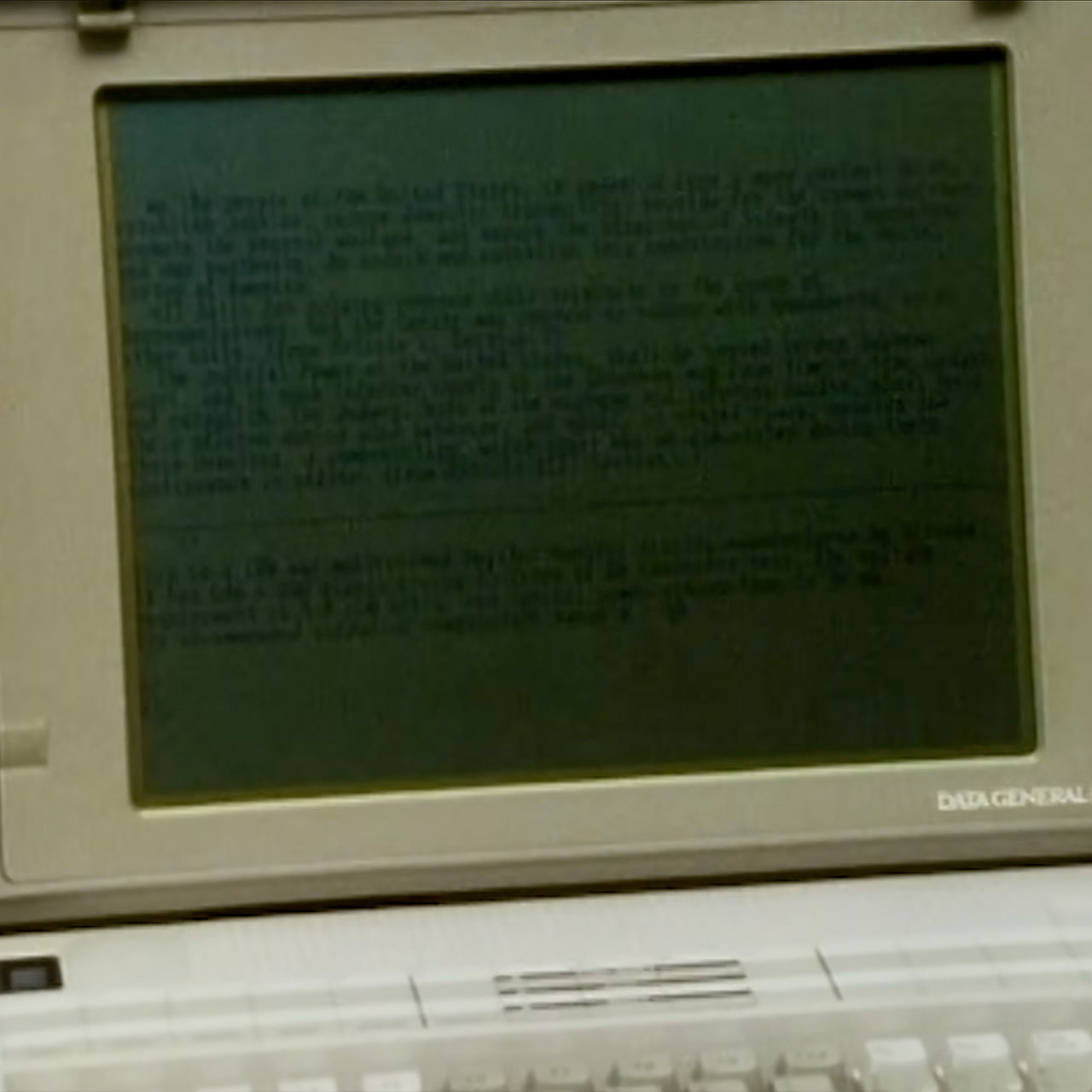
The segment began at the Which Computer Show, where two new approaches were presented side by side. Sharp provided a laptop with a backlit liquid crystal display. The extra light made the image easier to read in normal surroundings, but the underlying LCD still confined users to a narrow sweet zone directly in front of the screen. When I moved slightly to the side, the contrast collapsed. Colors and details simply disappeared. Toshiba displayed a plasma panel beside it. A fine grid of wires spanned inside the screen, illuminating a gas in bright spots when voltage crossed the lines. On camera, the image appeared clear and vivid. In actuality, the design consumed significantly more electricity than a battery could provide for an extended period of time, ran hot, and required frequent refreshing. That refresh cycle produced apparent flicker, which many users previously blamed for tired eyes after extended sessions.


MNN Portable Monitor 15.6inch FHD 1080P 60Hz USB C HDMI Gaming Ultra-Slim IPS Display w/Smart Cover…
  • Full HD Portable Monitor – MNN 15.6inch portable laptop monitor with 1920*1080 resolution, advanced IPS matte screen support 178° full viewing angle…
  • Double Type-C Port -For Plug & Play, the MNN monitor provides 2 Full Feature Type-C ports. Only One USB Type-C Cable is required to connect to the…
  • Lightweight Ultra Slim for Travel – As a portable external monitor,MNN portable laptop monitor easily accommodate to every suitcase and backpack and…

Presenters pointed out the common flaws without drama. LCDs remained cool and consumed little electricity while providing poor contrast and narrow viewing angles. Plasma screens provided more brightness and greater angles in some situations, but they required mains electricity and caused the flutter associated with constant image refreshes. Neither provided the clarity that people expected from paper or typical desk monitors. One presentation summarized the aim that everyone kept missing. What portable users actually required, he claimed, was a screen that remained vast in area while being compact overall, cost little to make, emitted no radiation, remained flicker-free, provided strong contrast, traveled smoothly, and consumed nearly no power.

1986 Micro Live BBC Sharp Toshiba Screens
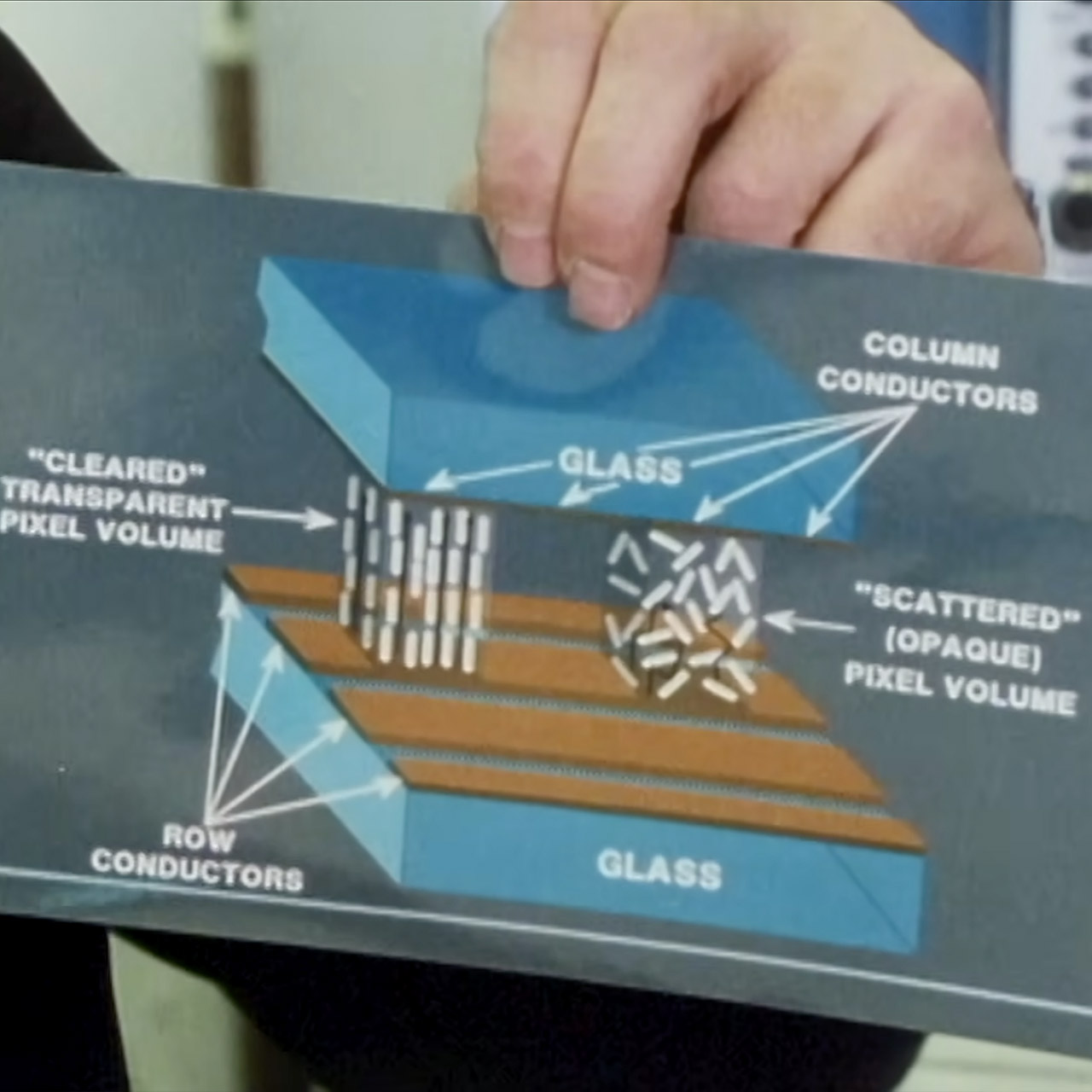
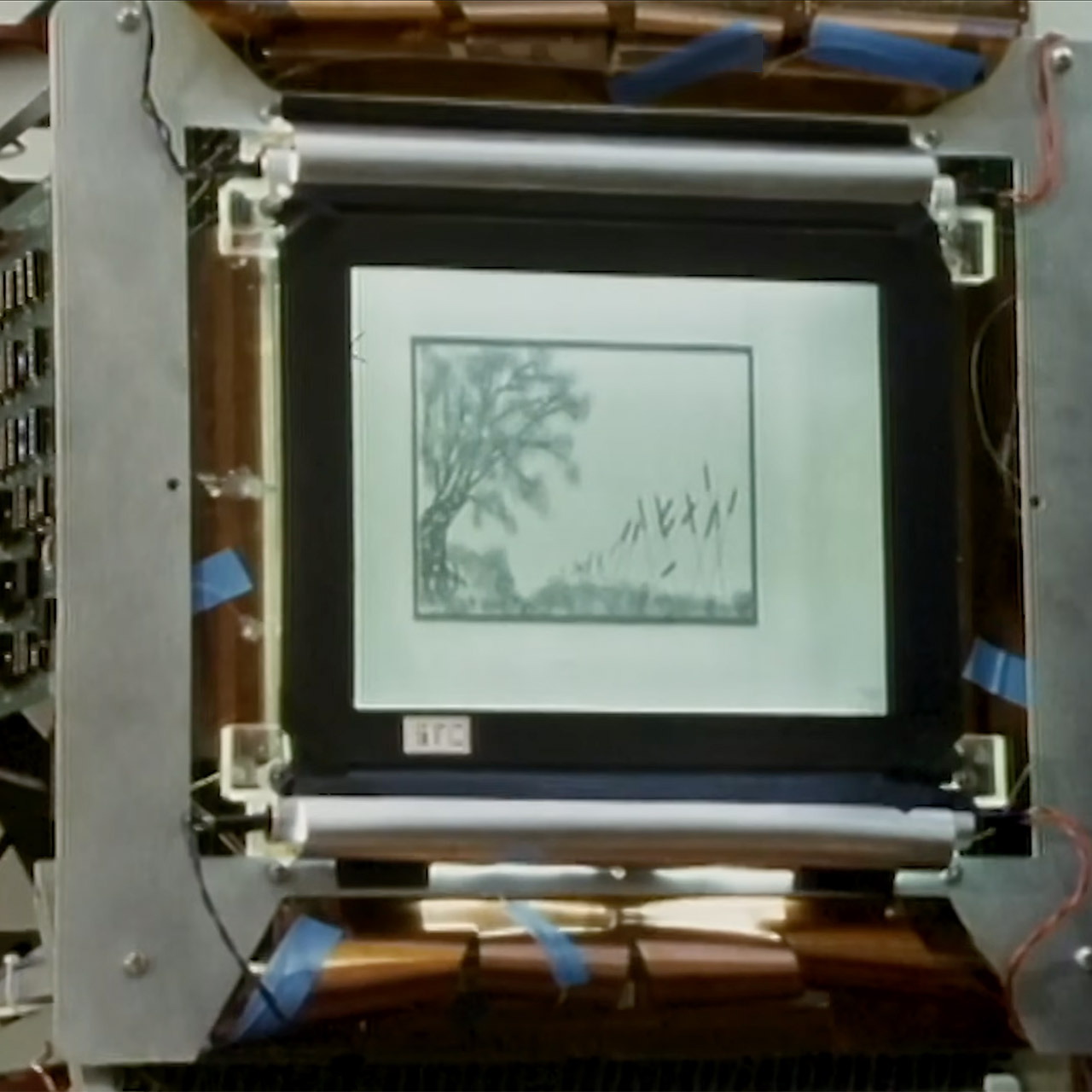
The program then moved to Harlow’s research laboratory. Engineers had created a functioning prototype that approached the refresh problem from a new perspective. Two sheets of glass were only 11 microns apart. Tiny glass threads kept the gap stable. The tight slot was filled with a unique fluid that required only a few drops to cover the entire panel. Each glass sheet had parallel lines of conductive material. Each crossing of those lines produced a controllable point on the image. The fluid behaved differently based on the electrical signal used. A high-frequency pulse aligned the molecules, allowing light to pass right through. Instead, they were scattered by a low-frequency signal, which blocked or redirected light. Once the molecules had settled into any arrangement, they remained there. No further electrical push was required to hold the image. As a result, the prototype could maintain a stable image even after power had been removed from the panel, something ordinary LCD and plasma panels could not.

1986 Micro Live BBC Sharp Toshiba Screens
Demonstrations made the difference clear, since a typical laptop screen went black when the power was turned off and lost detail as the viewer switched position. The new panel kept its image viewable and the contrast consistent across far broader angles. The effect was more like to a printed page than the flickering electrical displays most people had seen on portable devices. Because the design did not include the polarizing filters that are often required by LCD displays, construction remained easier. Fewer layers resulted in less light loss and potentially lower manufacturing costs. Once an image was saved, power consumption remained minimal because nothing needed to cycle to keep it.

1986 Micro Live BBC Sharp Toshiba Screens
Practical hurdles remained, as each pixel required approximately 200 volts to flip states, which was far more than typical logic voltage. A full-size prototype has hundreds of thousands of discrete connections along its edges. Engineers have already begun gluing special driver chips directly to the glass, reducing the number of external cables.

Advertisement

Source link

Continue Reading

Tech

Trump memecoin investors lost $3.8 billion, analysis finds

Published

on

Nearly 1 million people have lost a total of $3.8 billion after buying President Donald Trump’s $TRUMP memecoin, according to cryptocurrency analytics firm Nansen.

The New York Times reports that Nansen’s analysis is based on transactions that are publicly visible on the blockchain, showing that 988,905 accounts had lost money on the memecoin as of the end of June. That represents around two out of three $TRUMP buyers.

On Sunday, $TRUMP was trading at $1.69, down nearly 98% from its high of $75.35.

Trump announced the memecoin three days before his inauguration in 2025. He’d previously co-founded a crypto startup, World Liberty Financial, with his sons. The $WLFI coin has also declined significantly in value.

Advertisement

In a recent financial disclosure, the president revealed that he made $636 million from the $TRUMP memecoin, accounting for nearly half of the $1.4 billion that the president made from the crypto industry last year.

Under the Trump administration, the Securities and Exchange Commission has said it will not regulate memecoins as securities and has dropped a number of lawsuits against crypto companies. A White House spokesperson told the NYT, “President Trump proudly made the United States the crypto capital of the world.”

Source link

Advertisement
Continue Reading

Tech

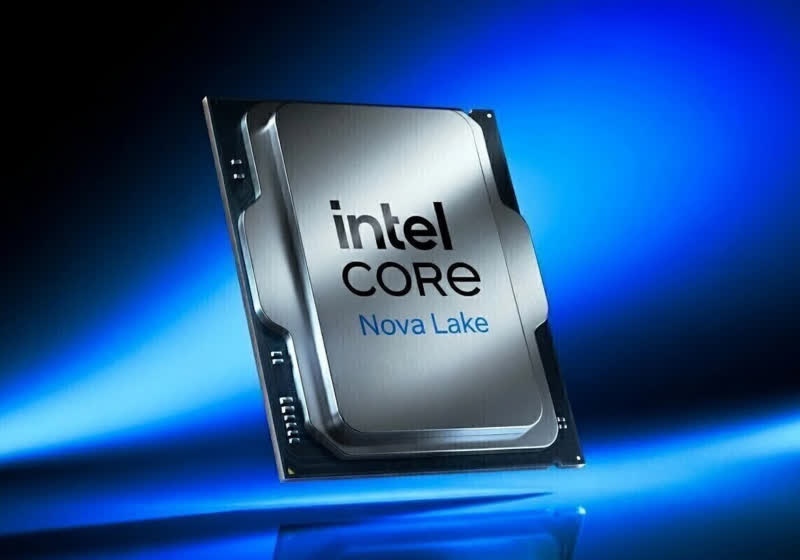
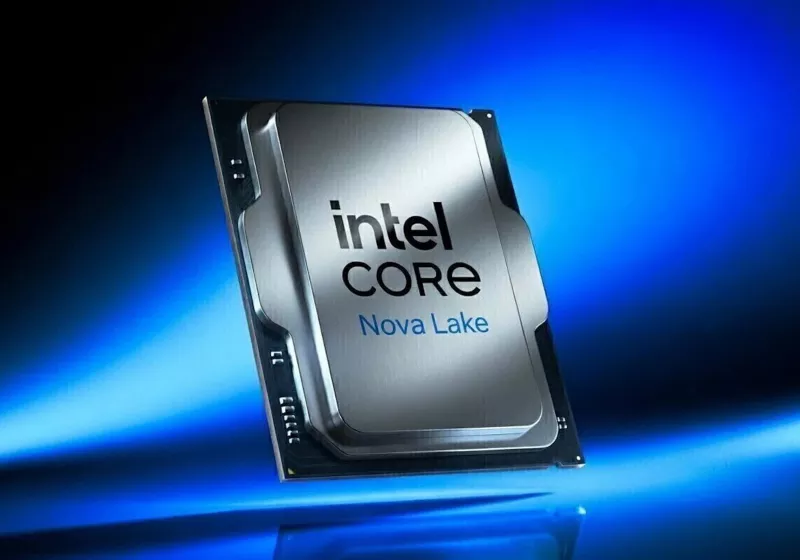
Intel Nova Lake-S midrange CPUs could be bringing AMD's X3D cache trick to more affordable chips

Published

on


According to the post, each processor combines 6 “Coyote Cove” P-cores, 12 “Arctic Wolf” E-cores, and 4 LP-E cores. That mix suggests a design that balances compute throughput with background and low-power tasks, rather than just piling on more performance cores.
Read Entire Article
Source link

Continue Reading

Tech

NYT Connections hints and answers for Monday, July 6 (game #1121)

Published

on

Looking for a different day?

A new NYT Connections puzzle appears at midnight each day for your time zone – which means that some people are always playing ‘today’s game’ while others are playing ‘yesterday’s’. If you’re looking for Sunday’s puzzle instead then click here: NYT Connections hints and answers for Sunday, July 5 (game #1120).

Good morning! Let’s play Connections, the NYT’s clever word game that challenges you to group answers in various categories. It can be tough, so read on if you need Connections hints.

What should you do once you’ve finished? Why, play some more word games of course. I’ve also got daily Strands hints and answers and Quordle hints and answers articles if you need help for those too, while Marc’s Wordle today page covers the original viral word game.

Advertisement

Source link

Advertisement
Continue Reading

Tech

iPhone Fold to spearhead 2026 rebound for foldable phone screen shipments

Published

on

Apple’s iPhone Fold is expected to be the driving force of a 2026 rebound for foldable smartphone orders, falling only just behind Samsung’s hardware.

Apple is expected to unveil its first folding iPhone in late 2026. Though the move will mark the company’s entry into new smartphone territory, the iPhone Fold could also have a significant impact on overall orders for foldable phone screens.

According to Counterpoint Research, the iPhone Fold will account for 29% of all folding smartphone display orders in 2026. Huawei, meanwhile, is expected to take 24% of the market, while Samsung will likely remain in the lead with 31% of overall orders for folding smartphone displays.

Per Wednesday’s report, Apple’s iPhone Fold orders will also drive the competition towards higher average selling prices. High-end book-style foldables have reportedly replaced value-oriented clamshell folding devices as the mainstream form factor, but “the growth of in-fold is not entirely dependent on Apple.”

Advertisement

Meanwhile, tri-fold devices like the Huawei Mate XT series and Samsung Galaxy Z TriFold reportedly won’t become mass-market products anytime soon. The yield challenges and complexities of tri-fold designs will continue to serve as factors that limit widespread adoption.

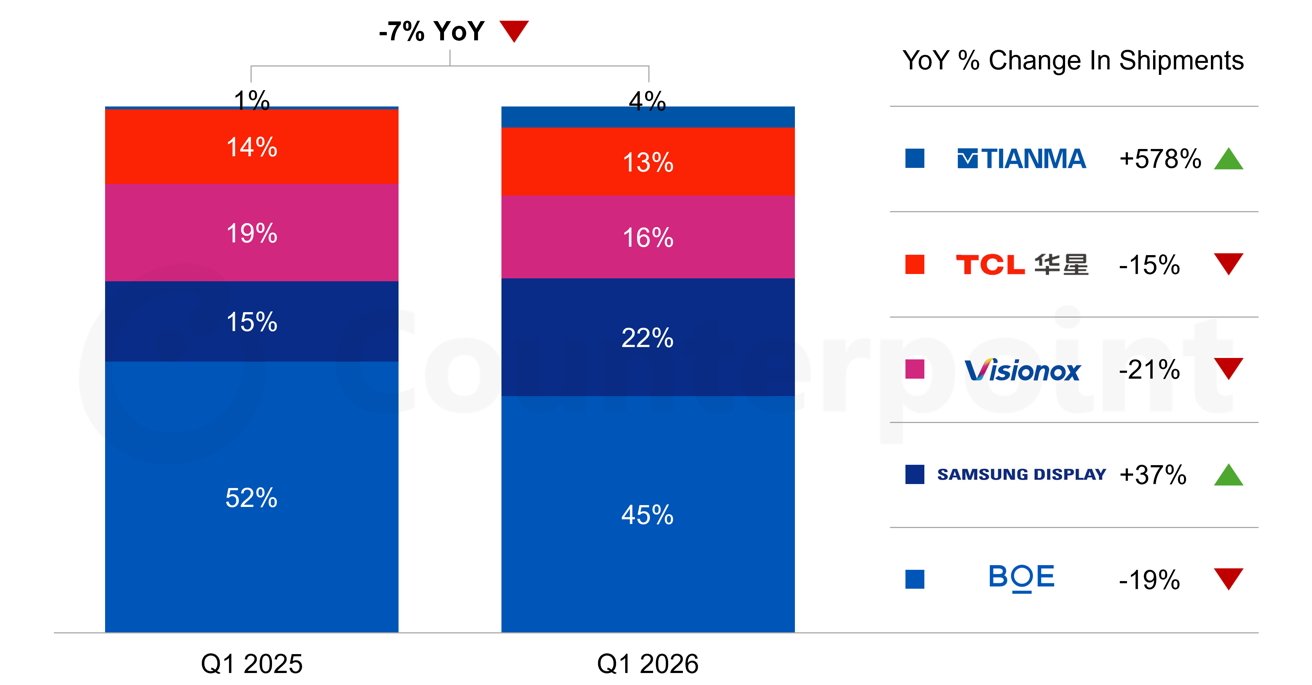
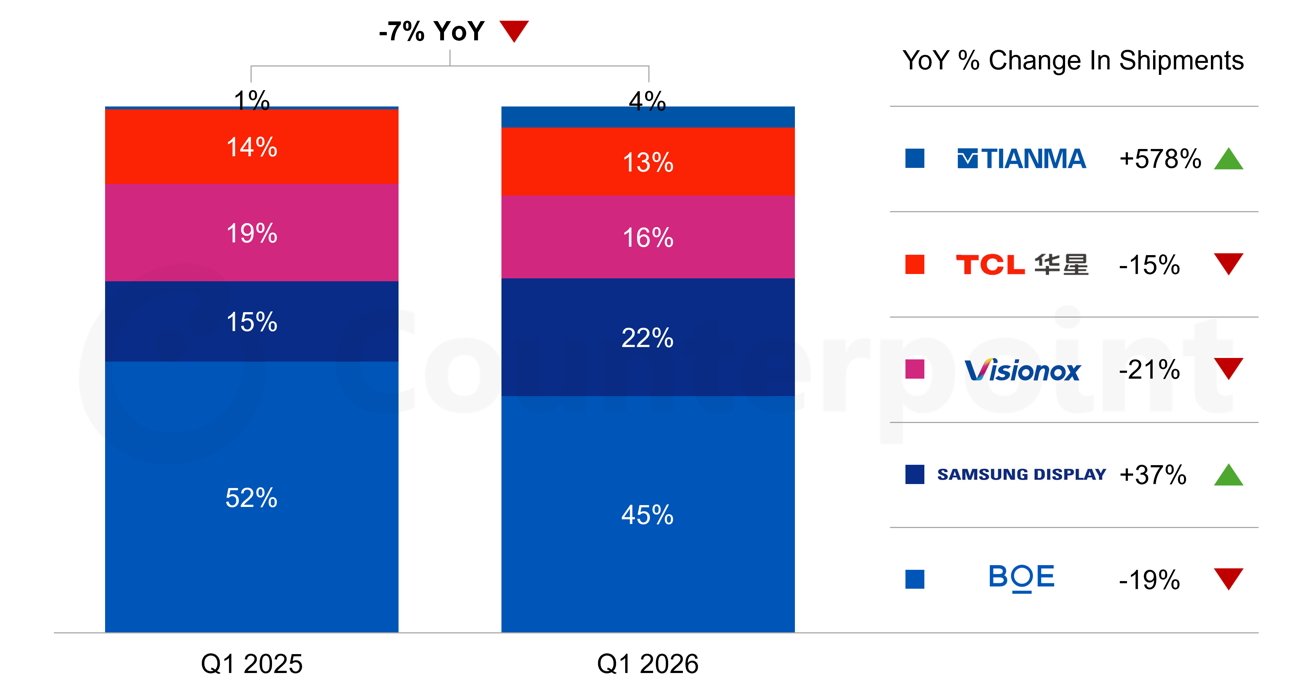
According to multiple sources and rumors, Apple’s supplier for iPhone Fold OLED panels will be Samsung Display, which held 22% of the foldable smartphone screen market in Q1 2026. This is up from 15% in Q1 2025.

Bar chart comparing Q1 2025 vs Q1 2026 display shipments by vendor, showing segment percentage shifts and right-side list of five manufacturers with year-over-year shipment changes and up or down arrows

Samsung Display’s share of foldable smartphone display shipments rose to 22% in Q1 2026, while BOE’s share decreased from 52% to 45%. Image Credit: Counterpoint Research.

Foldable smartphone screen shipments are still dominated by BOE, though, which held 45% of the market in Q1 2026, down from 52% in 2026.

Advertisement

An April 2026 rumor said that Apple had decided against using BOE OLED panels for the upcoming iPhone 18 Pro. We likely won’t see BOE hardware on the iPhone Fold either.

As a whole, though, global shipments of foldable smartphone screens are expected to reach approximately 27.5 million units for the entirety of 2026. This means orders will be up roughly 24% compared to 2025, and iPhone Fold panel orders are sure to be a key contributing factor.

Source link

Advertisement
Continue Reading

Tech

Exposure 5510 Mono Power Amplifiers Bring 200W of British Muscle to Flagship Separates

Published

on

The all-in-one amplifier has had a good run over the past 3 years. Streamer, DAC, phono stage, room correction, HDMI eARC, Bluetooth, an app that requires three software updates and a blood offering to connect properly. Useful? Sometimes. What everyone is looking for? Not always.

Exposure Electronics is taking a different route with its new 5510 Mono Power Amplifiers, completing a proper flagship separates system built around its 5510 Pre-Amplifier. Each monoblock delivers 200 watts into 8 ohms and 370 watts into 4 ohms, which should be enough to make a wide range of demanding loudspeakers sit up straight and behave themselves.

The new amplifiers are not trying to be lifestyle components. There is no streaming platform, touchscreen, HDMI input, or features list designed to impress someone who has not listened to a record since college. Exposure is betting that buyers at this level want power, low noise, strong channel separation, and a signal path that does not resemble an airport security line at Heathrow.

Related Reviews:

Advertisement

Technology

Each 5510 Mono uses a large custom toroidal transformer, screw-terminal smoothing capacitors, a fully bipolar transistor circuit, and a fully DC-coupled topology. That last part matters because Exposure is clearly aiming for speed, grip, and control without inserting unnecessary clutter into the signal path.

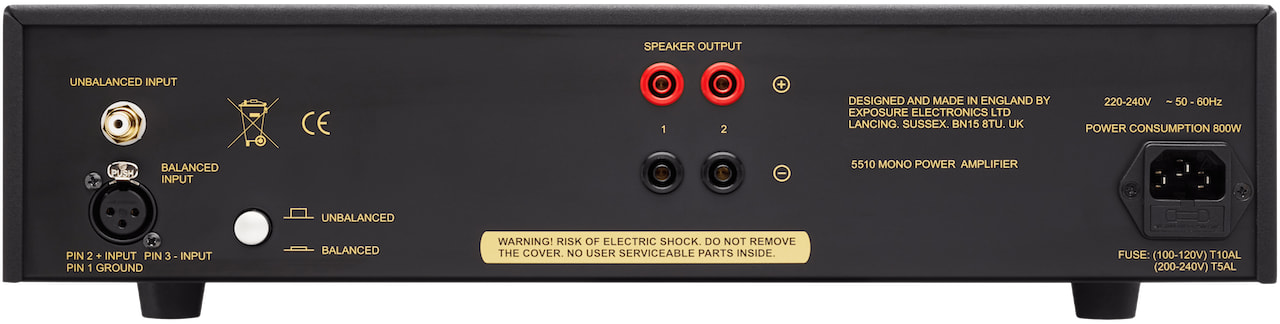
exposure-5510-mono-amplifier-rear

Balanced XLR and unbalanced RCA inputs are provided, along with bi-wire loudspeaker outputs using shrouded 4mm terminals. The chassis is all aluminum, finished in black, and incorporates both non-invasive overload protection and thermal protection. In other words, these are serious amplifiers, but not the sort that require a structural engineer and a reinforced equipment rack.

The 5510 Mono Power Amplifiers make the most sense with Exposure’s recently introduced 5510 Pre-Amplifier, which offers six line-level inputs, balanced XLR and RCA outputs, a 99-step relay-controlled volume system, and optional MM, MC, or DS Audio optical phono modules. A plug-in DAC option is also available for those who want digital playback without turning the entire system into another software ecosystem.

That creates a three-chassis 5510 system for listeners who still believe that separating signal control from power delivery has value. It also gives Exposure a more credible flagship ladder: start with the 5510 Integrated Amplifier, then move into dedicated preamp and monoblock territory when the speakers, room, and appetite for expensive speaker cable begin to evolve.

Exposure 5510 Mono Power Amplifier Specifications

  • Type: Mono power amplifier
  • Power output: 200W into 8 ohms, 370W into 4 ohms
  • Circuit topology: Fully bipolar transistor design, fully DC-coupled
  • Power supply: Large custom toroidal transformer with screw-terminal smoothing capacitors
  • Inputs: Balanced XLR and unbalanced RCA
  • Input impedance: 75kΩ at 1kHz via unbalanced input
  • Frequency response: Down 3dB at 52kHz, referenced to 1kHz
  • THD: Less than 0.015% at 1kHz, 200W into 8 ohms
  • Signal-to-noise ratio: Greater than 120dB A-weighted, referenced to 200W into 8 ohms
  • Speaker outputs: Bi-wire compatible shrouded 4mm terminals
  • Protection: Non-invasive overload protection and thermal trip
  • Power consumption: Less than 800VA into an 8-ohm load
  • Dimensions: 440 x 115 x 300mm
  • Weight: 14kg each
  • Finish: Black
  • Warranty: Three years
  • Price: £7,300 per pair including VAT
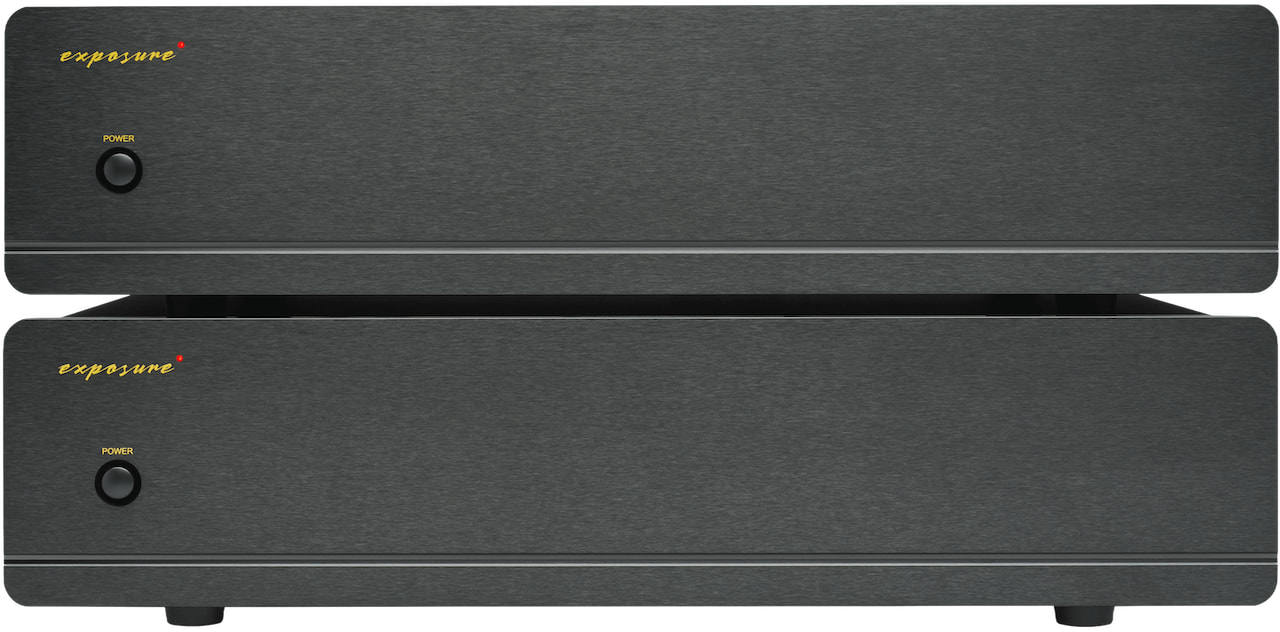
exposure-5510-mono-amplifier-front

The Bottom Line

At £7,300 per pair including VAT in the UK, the 5510 Mono Power Amplifiers are not inexpensive. U.S. and Canadian pricing has not been announced yet, so North American buyers will have to wait before deciding how much damage this particular British amplifier stack will inflict on the household budget.

What is clear is that Exposure is not chasing the compact streaming amplifier crowd. The 5510 Monos are a traditional high-end solution for listeners who want the preamp to control the music and the power amplifiers to do the heavy lifting without constantly asking for a Wi-Fi password.

Advertisement

For more information: exposurehifi.com

Advertisement. Scroll to continue reading.

Source link

Advertisement
Continue Reading

Tech

Apple’s Q3 results on July 30 could be Cook’s last

Published

on

Apple has confirmed that its financials for the third quarter of 2026 will be reported on July 30. It certainly will be an event with a lot of talking points from the quarter, and it might be the last one with Tim Cook in attendance.

Every three months, Apple issues a quarterly report revealing how well it’s performed during the period. The third quarter results arrive at the end of July.

In a notification to investors and analysts, Apple states that it will be bringing out the third quarter results on July 30. The results will be followed by Apple’s usual conference call at 5 p.m. EDT, featuring both current CEO Tim Cook and CFO Kevan Parekh to talk about the numbers.

As always, AppleInsider will be analyzing the results as they are released, as well as reporting on the questions and answers in the conference call.

Advertisement

Apple’s Q3 expectations from Q2

As part of Apple’s quarterly financial results for Q2, Parekh provided some forward-looking statements for the third quarter figures.

That included expectations of revenue growth at between 14% and 17% year-over year. That would translate into revenue going from $94 billion in Q3 2025 to a possible $110 billion for Q3 2026.

At the same time, the gross margin is anticipated to reach between 47.5% and 48.5%. Operational expenditure should lie between $18.8 billion and $19.1 billion.

Cook’s last hurrah?

The second quarter results were unusual for having a large number of events happening during the three-month period. One that was spiced up with the revelation that John Ternus will become Apple’s next CEO as Tim Cook steps down

Advertisement

That means the Q3 results will be the last that Cook will be fielding in the role as CEO. The Q4 results will happen in October, after the CEO transition takes place.

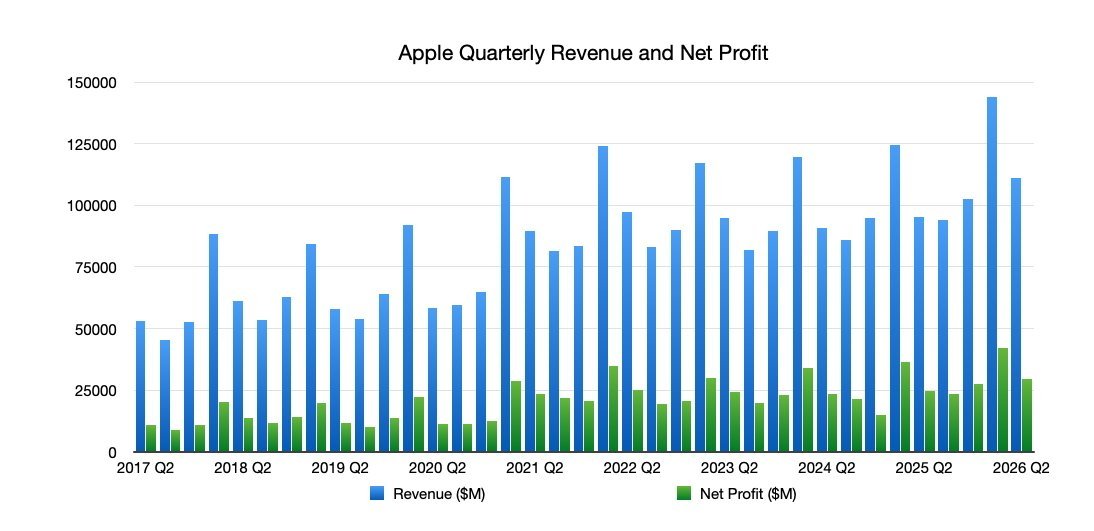
Bar chart of Apple quarterly revenue and net profit from 2017 to 2026, showing generally rising blue revenue bars and smaller green profit bars with noticeable seasonal peaks

Apple quarterly revenue and net profit, as of Q2 2026

It is unclear if Cook will hang around for the Q4 figures due to being CEO for two of those three months. But you can expect there to be some discussion about Cook’s departure from the hot seat and the expectations of the inbound Ternus.

The call will be Cook’s 90th, which would be a nice round number.

Advertisement

Product Changes

There have not been any notable product launches in Q3 that will rock the balance sheet. The only real one of note are the AirPods Max 2, but that won’t set the finances alight.

That said, it will be the first full quarter of availability for products Apple launched in March, late in the quarter. That list includes:

There is also the problem of the price rises, which Cook warned about in June. During an interview, he admitted that the price rises were “unavoidable.”

While Apple had tried to shield consumers from the increases, Cook said the situation regarding memory price rises was “unsustainable.”

Advertisement
Bar chart of Apple quarterly revenue from 2015 to 2016 showing iPhone dominating, followed by Services, then Mac, with iPad and Wearables lowest but gradually increasing over time

Apple unit revenue as of Q2 2026

Cook’s warning became a reality days later. On June 25, Apple raised the prices of its products significantly, across the range.

This included the MacBook Air going from a starting price of $1,9099 to $1,299, while the MacBook Neo jumped from $599 to $699. The MacBook Pro saw a $300 jump for its base price, with iMac going up $200 as well.

The Mac Studio was hit hard, with the base M4 Max version going from $1,999 to $2,499. The M3 Ultra version started at $3,999, but now costs from $5,299, due to its massive RAM capacity.

Advertisement

While other products also got hit, including a $200 hike on the Apple Vision Pro and $30 on the HomePod mini, it wasn’t the case for the iPhones. For the moment at least.

With the switch to the iPhone 18 generation a few months away, analysts will be keen to get hints as to what those models will cost consumers at launch.

Source link

Advertisement
Continue Reading

Trending

Copyright © 2025