The point-and-click adventure game based on the horror anthology series arrives in August.
PHL Collective/DreadXP
The Creepshow game isn’t dead after all. Though things have been quiet around the video game spin-off of Shudder’s horror anthology series since it was announced a few years ago, the Steam page just went live with a release window that’s surprisingly soon: August 2026. Creepshow is a point-and-click adventure that’s “gone all kinds of wrong,” according to developer PHL Collective. It’s being published by TheMortuary Assistant publisher, DreadXP.
In Creepshow the game, “Follow Danny and his friends as a bad day at the mall spirals into something much darker. Their search for the truth behind Danny’s father leads them to The Reader, a mysterious fortune-teller with a taste for treacherous tales.”
Advertisement
Going back to the original anthology films from the 1980s, Creepshow has always blended horror with a dash of humor, and the description indicates the video game will stick to that tone. It features “pulp-inspired visuals, dark humor, comic-book environments, horror mini-games, and endings you won’t see coming.” There’s no information on console releases, so for now it looks like it’ll only be coming to PC.
Over two years after the Apple Car program was declared dead, Apple has offloaded its 5,500-acre Arizona proving ground to Waymo. It’s a sale that recoups $220M from the $10B Apple spent on the failed project.
The Apple Car project is a program believed to have been cancelled by Apple after about a decade of research and development. In what is the surest sign of it being dead, Apple has sold off a massive parcel of land used for self-driving vehicle testing.
In a filing reported by TechCrunch dated June 5, the property at Wittman, Arizona, has been acquired by Waymo. The sale, which was confirmed by Waymo, sees a payment of $220 million being handed over to Route 14 Investment Partners LLC.
Route 14 is a Delaware shell company believed to be connected to Apple. After renting the facility for a number of years, it Route 14 acquired it for $125 million in 2021.
Advertisement
The purchase gives Waymo yet another place to test out its vehicles. It already has locations in California and Ohio, but the Arizona lot will give it a massive amount of land for testing its fleet.
A Waymo spokesperson said the Arizona facility would be used to simulate driving scenarios in a controlled environment. This is to test its self-driving system, including rider-only testing, motion control, operational training workflows, and its future testing needs.
A self-driving playground
Apple’s renting and later purchase of the facility made sense at the time. It is a location that has a lot to offer companies in the automotive business.
The 5,458-acre site was previously used by Chrysler, again as a vehicle proving ground. It was then sold to a housing developer in 2005, but was later annexed by the City of Surprise and left alone.
Advertisement
A view of the facility – Image credit: Google Earth
In 2016, the city signed a development agreement with the then-owner SFI Grand Vista LLC, under the intention that it would be used by Route 14.
Despite being over 5,000 acres in size, only a small part of the facility has been set up for testing purposes. There is a 115-acre city course, as well as a freeway course geared towards autonomous vehicle testing.
It also has a 35-acre vehicle dynamics area and a four-mile oval track.
Advertisement
The sheer size of the facility provides ample opportunity for occupiers to build out the area for extended testing. All while still maintaining a safe distance from the edge of the lot, which also helps keep the testing private.
Cash back from an expensive project
The sale of $220 million in now-unused land sounds like a lot, and so does the $95 million in value the site earned in just five years. That is, until you remember that this involves Apple.
At Apple’s scale, the proceeds of the property sale will help fund other projects, but it’s pocket change compared to its other investments.
Indeed, compared to the $10 billion Apple has been estimated to have shelled out over a decade for Project Titan, it’s barely 2% of the outlay.
Advertisement
It is, however, an attempt by Apple to shed the last vestiges of the extremely expensive failure.
It’s no longer testing its self-driving system on roads, after cancelling the Autonomous Vehicles Program Manufacturer’s Testing Permit in September 2024. Holding onto private grounds for testing doesn’t make sense if there aren’t any planned for the future.
The work wasn’t entirely a bust for Apple, as the teams and research that went into it will have been absorbed by other parts of the company. It’s not hard to imagine some of the computer vision elements being incorporated into Apple Intelligence, or elements being used to push forward its robotics efforts.
The sale, two years after a very public funeral for a very secretive project, is merely Apple getting rid of a massive site that it has no use for anymore.
Advertisement
It’s a reminder of the costly mistake that hurt its wallet and with little to prove for it.
The Leadership Effectiveness Analysis best practices report explores the qualities that differentiate high-performing tech leadership professionals from their less effective counterparts.
Leadership skills in 2026 are a critical capability that enable professionals in all industries to navigate the highs and lows of the ever-changing global working environment. Whether a job announcement, acquisition, or restructuring, there is always a challenge to be overcome, and positive leadership is often the driving force towards success or a favourable outcome in a difficult situation.
Touchstone Executive Assessment recently published the results of its Leadership Effectiveness Analysis best practices report. The company collected data from 142 senior professionals in advanced technology roles, across multiple European organisations, between March 2023 and March 2026. The aim was to determine the specific leadership attributes that differentiate highly effective and less effective leaders.
The report said: “Many years of research and practice assert a direct connection between leadership effectiveness and organisational performance.
Advertisement
“Organisations, however, differ widely in terms of their culture, history, business strategy and people. Because organisations present unique cultural signatures, there is no one best model or profile of effective leadership behaviour.”
Leading in tech has undoubtedly become more complicated as professionals are working in a landscape that is being heavily impacted by political and social instability, threats to global supply chains and mass layoffs at major organisations. With that in mind, now more than ever, it is critical that tech leaders motivate and drive positive action in the workplace. To do that, a hefty arsenal of diverse skills is necessary.
Steady skills
Among those identified by Touchstone Executive Assessment (TEA) as the most critical skills for a modern-day tech leader was significant cognitive ability. TEA’s research found that leaders depend on the ability to learn quickly, think strategically, see the bigger picture and embrace ambiguity.
The report said: “Technical knowledge and domain expertise, while important in themselves, are not the factors that differentiate the best in class from the average. It is the ability of the individual to reason under uncertainty, in real time and in a very expansive manner.”
Advertisement
In blending domain expertise with the ability to view one’s industry through a strategic lens, TEA’s report found, professionals can take into account the long-term implications of decision-making, improve business aptitude and create that big picture perspective.
The data also suggested that operational and interpersonal skills are key areas to work on for professionals in demanding technology roles.
“This is where the worlds of technology and people really come together,” the research noted.
“While execution focus and a production mindset are important, leaders in advanced technology must also be able to manage stakeholder relationships, to communicate and influence effectively, and to drive accountability and engagement across their entire landscape.
Advertisement
“This goes well beyond project management; there is a real sophistication in understanding the organisational environment, knowing the rules of the game and rallying people behind the mission as well as the person.”
Strong leaders, it said, will have the ability to understand organisational dynamics, effectively lead organisational change and deliver results.
Long-term stability
Perhaps unsurprisingly, given the current state of global instability and disruption, TEA’s report also indicated that professionals who show the ability to thrive under pressure and scrutiny perform better in leadership roles.
“This talks to the characteristics of the person, not just the person in their role. Our research indicates that personal and professional resilience are increasingly important factors, bringing an ability to sustain performance when the going gets tough and to bounce back quickly from setbacks.”
Advertisement
People in this position are, according to TEA, tenacious, determined and better able to sustain their performance in landscapes impacted by uncertainty and pressure. It found that they are unlikely to take issues personally or emotionally, as they demonstrate resilience, effective decision-making and a tolerance for ambiguity.
Commenting on the results of the study, David Ringwood, the head of assessment and executive coaching at TEA, said: “There is no single right or wrong way to lead – context is king. Technology and AI today are very different than they were 10 years ago, and leadership accordingly needs to recalibrate in line with that shifting context and the changing expectations of employees. The best technology experts don’t always make the best leaders.
“Hiring, developing and building a book of talent that includes those who have the headroom to grow is critical, not least in technology and AI where there is always competition for top talent. This is a ‘how do we’ question – how do we objectively know what predicts the greatest future potential, how do we measure what is exactly relevant and how do we know we’re being as objective as possible?
“Putting the wrong person in the wrong role or career path is an expensive way for everyone to find out. This research may contribute to the definition of what high potential looks like in the tech sector and gives organisations a much clearer sense of where to build performance for today and leadership for tomorrow.”
Advertisement
Notably, in May of this year, technology and consulting company Expleo released the results of its AI sentiment tracker, AI Pulse, for Ireland, a report which found that business leaders in Ireland, ahead of their contributing European counterparts, are far more likely to value empathy as a fundamental skill for managers in the age of AI.
Among Irish business leaders, human-centric skills were identified as the most critical abilities a manager can wield, particularly in the context of increased AI adoption.
Don’t miss out on the knowledge you need to succeed. Sign up for the Daily Brief, Silicon Republic’s digest of need-to-know sci-tech news.
“Battery breakthroughs will lessen AI’s demand on the electricity grid,” argues The Washington Post’s editoral board, arguing that GM’s latest moves “offer a fresh reminder that resource constraints can be solved by innovation.”
Or As Fortune put it, “America’s electric grid is buckling under extreme weather, aging infrastructure, and an AI build-out that is quietly rewriting U.S. power demand — and General Motors wants to turn that crisis into a business.” They describe GM’s plan as offering itself “as a distributed utility in disguise… stitching together hundreds of thousands of battery-powered cars, new grid-scale storage, and a unified charging platform into what amounts to a virtual fleet of power plants.”
The bet puts GM on a collision course with Ford’s newly branded Ford Energy unit as both Detroit rivals race to repurpose underused EV capacity for a more urgent problem: keeping the lights on in the AI era. GM’s case rests on three planks. The first is its existing fleet. GM says more than 250,000 of its EVs on U.S. roads can already charge bidirectionally — pulling electricity from the grid and sending it back. “Every evening, a quiet transformation occurs across the American landscape,” GM Energy vice president Wade Sheffer writes in an open letter to utilities and regulators, describing the EVs sitting in driveways as “a massive opportunity to aggregate energy storage capacity.”
A firmware update is rolling out to customers with GM Energy’s vehicle-to-home hardware, converting those systems into full vehicle-to-grid assets with no new hardware and turning home backup systems into grid resources when utilities need them. GM is piloting the idea in Michigan with DTE Energy at 30 employee homes, and has sketched a 2030 vision with Pacific Gas & Electric in which more than 52,000 GM EVs help balance the grid out of a projected 130,000 vehicles in the area. GM is also “seeking partnerships with utility companies nationwide to assist in offering such vehicle-to-grid services for customers,” reports CNBC, noting it’s one of two moves “meant to address concerns about rising energy costs amid an artificial intelligence boom.”
Advertisement
Forbes reports that GM’s second goal “is to leapfrog the dominant battery cell tech used for energy storage packs right now” — right past the LFP (lithium-iron phosphate) stage, “which is dominated by China.”
Sodium batteries are cheaper to use than LFP because they don’t need an additional cooling system. They also have a 20-year usable life and are made from materials that can be sourced from within the U.S., the company said at a briefing in San Francisco on Tuesday.
“Sodium-ion actually is the better chemistry for that application. And when I say sodium-ion is better, I mean GM’s version of sodium-ion,” Kurt Kelty, GM’s battery chief and a long-time Tesla battery executive, told Forbes. He said GM is seeing great results from its prototypes, even at scorching temperatures of 55 Celsius (131 Fahrenheit). “Sodium-ion-powered energy storage systems have the potential to operate without active cooling and with much less system complexity,” Kurt Kelty, GM’s vice president of battery and sustainability, said Tuesday in a blog post. “In large energy storage systems, that matters.” Not having to cool the battery cells could lead to lower upfront costs as well as operating costs, the automaker said.
TechCrunch reports on GM’s big new partnership with energy-storage startup Peak Energy to develop GM’s sodium-ion battery chemistry for grid-scale deployments: GM wouldn’t share with TechCrunch how much money it is investing in this energy-storage effort. But we do know the company has committed $900 million to commercialize new battery chemistries, an investment that includes a new battery-development center. .. The first GM cells are expected to enter trial production at the company’s Battery Cell Development Center in 2028. “Our next-generation sodium-ion cell development will drive energy density higher,” promises GM’s blog post, arguing they’re extending the company’s battery expertise and technical infrastructure “into the electrical grid itself. If we get this right, we will not just build better batteries. We will help create a more resilient, more affordable and more flexible energy future… Every improvement we make strengthens the development stack that supports both EVs and energy storage.”
“The message: GM isn’t just selling cars into a stressed grid; it’s supplying the batteries to stabilize it,” argues Fortune.
Advertisement
And GM also announced they’re augmenting their apps with an “Energy Pass” offering “seamless access to Tesla Supercharger, IONNA, Electrify America, and soon, ChargePoint and EVgo networks.” Their goal is to simplify the charging experience with an app “that covers nearly 70% of all DC fast chargers in the United States, plus many Level 2 chargers, all through one app.”
NASA this week announced the four-person crew that will lead its Artemis III mission in 2027: NASA astronauts Andre Douglas, Frank Rubio and Randy Bresnik along with ESA’s Luca Parmitano as the flight’s pilot. Plus, the Parker Solar Probe took another trip around the sun, solar energy overtook coal in May, and more. Here’s this week’s science news.
Parker Solar Probe’s 28th flyby
NASA’s Parker Solar Probe made another close pass around the sun this week, getting 3.8 million miles from the surface and reaching a speed of 430,000 mph. This marked its 28th flyby, and matched the speed and distance records the probe first set back in December 2024. It’s hit those numbers five times since. The spacecraft began its latest approach on June 3, and transmitted a beacon tone on Thursday to signal to the team that all is well.
The Parker Solar Probe has been studying our star for eight years, incrementally getting closer and closer to the surface. It launched in 2018 and made its first close approach to the sun that fall, when it came within 15 million miles of the sun’s surface. For its first flyby, it reached a maximum speed of 213,200 mph. Despite the harsh conditions in the sun’s vicinity — the heat shield reaches an estimated 1,700 degrees F when the spacecraft is closest to the sun — the Parker team says the probe still appears to be doing well after all this time. Below the heat shield, the Parker probe is protected by thermal blankets which have kept the temperature of the spacecraft itself consistent during these flybys.
“That temperature consistency is a major indicator of spacecraft health,” said John Wirzburger, Parker Solar Probe mission systems engineer at the Johns Hopkins Applied Physics Laboratory. “It tells us the heat shield isn’t degrading. If it were cracking or weakening, we’d see temperatures drift upward as more heat leaked through.”
Advertisement
Parker is observing solar wind and activity, keeping track of the changes that occur across the sun’s 11-year cycle. The space probe arrived at the sun near the quieter period known as solar minimum, and has been there long enough to see it reach solar maximum, which was confirmed in 2024. This is when solar activity peaks, giving rise to an increase in sunspots and events like solar flares and coronal mass ejections. Solar activity will soon begin to gradually decline as it moves through the next phase. The Parker probe has had a front row seat for all of this, gathering unprecedented data that will help us better understand our star and its effects on space weather.
Solar overtakes coal in the US for the first time
According to a report from the energy think tank Ember, May 2026 marked the first month on record in which solar accounted for more electricity generation than coal in the United States. Despite the Trump administration’s push to revive the coal industry, “Solar supplied a record 12.8 percent of US electricity, while coal fell to 12.2 percent, its fourth-lowest monthly share ever,” according to Ember. The total output from solar last month was a record 45.5TWh, making it the third-largest source of electricity in the country, Ember reports.
Coal was only slightly behind it at 43.4TWh in May, but this marked an 11 percent drop compared to the same time last year. And in April, it dipped to its lowest-ever monthly total on record, at 39.3TWh. “The share of coal generation in the US mix has nearly halved in the last five years, falling from 19.7 percent in May 2021 to 12.2 percent in May 2026,” according to Ember. “In contrast, solar power’s share of the mix more than doubled from 5.4 percent to 12.8 percent over the same period.”
Solar still fell behind gas and nuclear, but analysts at Ember say clean power is still ticking upward even as policy shifts in the other direction. In March, according to Ember, “renewables collectively generated more electricity than gas for the first time in the US.”
Advertisement
Enjoy this timelapse of the southern lights seen from space
Earlier this week, an astronaut on the International Space Station shared a breathtaking timelapse video of aurora australis (the southern lights). Jessica Meir, who is the spacecraft commander for NASA’s SpaceX Crew-12 mission, captured the footage from a Dragon spacecraft docked to the ISS. “As opposed to the previous aurora I’ve seen, this one danced and snaked its way directly below us, putting on quite a show,” Meir wrote on social media. “I am in awe of this y [sic] evocative phenomenon.”
A timelapse view from our @SpaceX Dragon of the spectacular southern aurora seen in yesterday’s post, a result of a recent solar event. As opposed to the previous aurora I’ve seen, this one danced and snaked its way directly below us, putting on quite a show. I am in awe of this… pic.twitter.com/ReztjH3x9H
Astronauts may have some of the best views of auroras, but viewers down on the ground have been getting a pretty good show as of late, too. The NOAA’s National Space Weather Prediction Center last week issued G2 and G3 geomagnetic storm watches, giving enthusiasts a heads up that auroras may be visible in more regions than normal. In the Northern Hemisphere, auroras were predicted to be visible across Canada and the northern US, while viewers in Australia and New Zealand had a chance to catch the southern lights.
Before you go, be sure to check out these stories too:
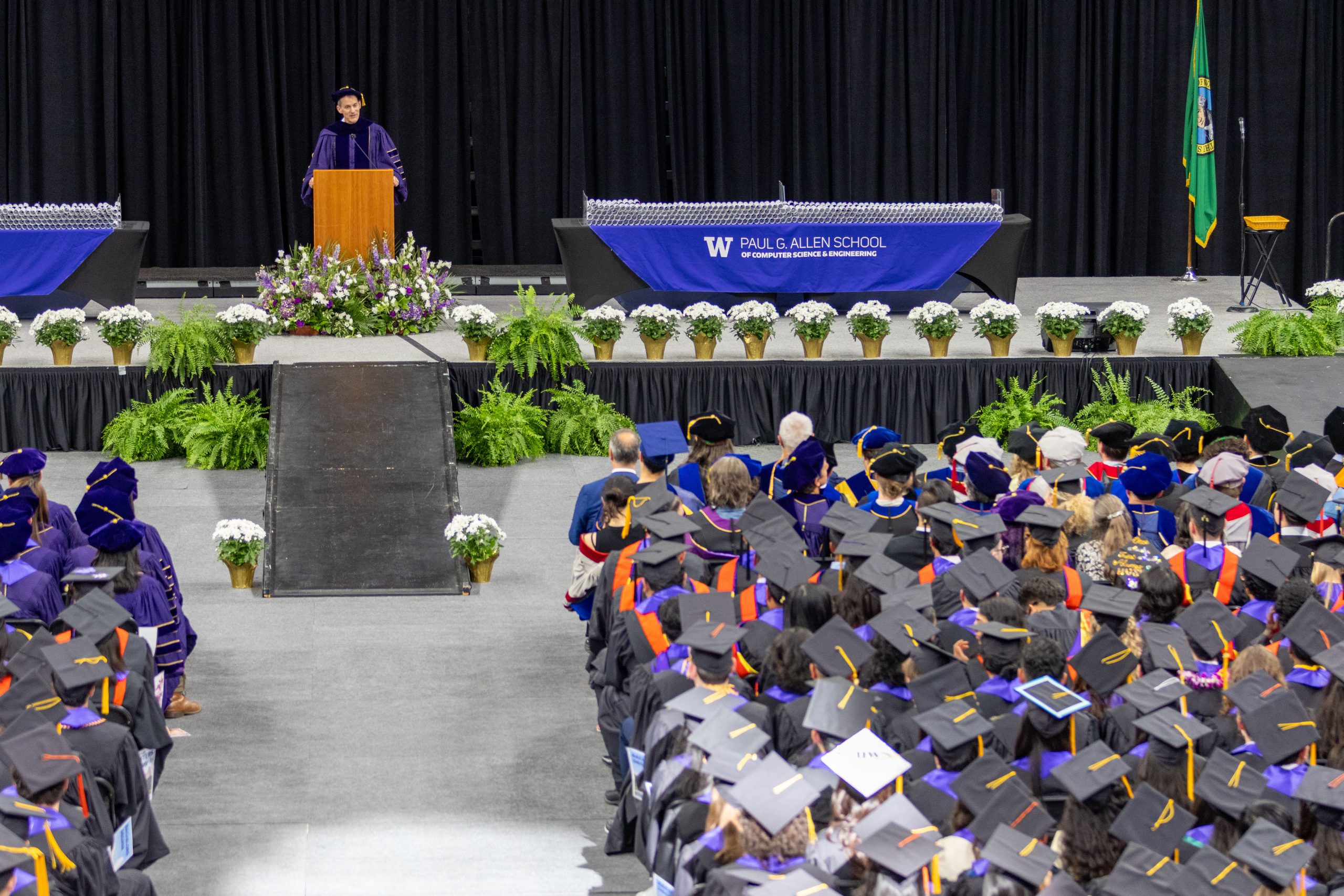
Jeff Dean, Google’s chief scientist and a UW alum, addresses Allen School graduates Friday at Alaska Airlines Arena. (UW Photo / Matt Hagen)
Jeff Dean was a University of Washington graduate student in the 1990s, optimizing software compilers for object-oriented programming languages in a trailer wedged next to the old computer science building.
On Friday evening, Dean returned to the UW’s Allen School of Computer Science & Engineering as Google’s chief scientist and a co-leader of its Gemini AI models, with a message for graduates about the technology he and his colleagues have shaped — and to which many of them will soon be contributing at places such as Anthropic, Amazon, Microsoft, Google, and Nvidia.
“AI is an incubator for ideas,” he said, “not a substitute for human ingenuity.”
Speaking to a packed audience at the Allen School commencement ceremonies at UW’s Alaska Airlines Arena, Dean told the graduates that AI technologies may be able to draft code and summarize data, but can’t replicate their experiences, their ethics, or their sense of what’s worth building. Knowing what matters, he said, “can be your superpower.”
He didn’t address the state of the tech job market, but said they’re graduating at a pivotal moment, when the world needs their fresh perspectives and sharp thinking.
Advertisement
The Allen School’s choice of graduation speaker and his focus on AI might have been a risky proposition in a different setting. But given the audience, there were cheers and applause — not booing or jeering of the sort that has made headlines at graduations around the country this spring.
It also helped that Dean’s message was clear-eyed and balanced. He acknowledged the real concerns about the technology, telling the graduates that powerful advances carry responsibility.
Jeff Dean, Google’s chief scientist and a UW alum, delivers the commencement address. (UW Photo / Matt Hagen)
“We must intentionally design safeguards and ethical boundaries,” he said, “so technology serves the broader public good, not a select few.”
He also made the case for AI as a force for good, referencing its role in scientific and medical discovery and in forecasting natural disasters. For example, he cited the use of machine learning to predict the scope of severe flooding in Somalia (where he had lived for part of his youth because of his parents’ work in global health), helping to protect communities.
He pointed the graduates toward problems worth solving. In a paper he co-authored, he and eight others laid out 18 milestones where AI could make a difference: improving health care worldwide, giving every student an individual tutor, building tools to flag misinformation, speeding up scientific discovery.
Advertisement
‘Be patient and persistent’
Dean’s path to Google ran through the UW. He arrived in 1991 to study compilers under professor Craig Chambers, finished his Ph.D. in 1996, and joined Google three years later, when the company consisted of about 20 people working above a Palo Alto storefront.
On Friday he traced that arc for graduates who have studied in modern buildings named for Microsoft’s co-founders. Dean has fond memories of working in that cramped UW trailer, nicknamed “The Chateau,” alongside fellow students who became lifelong friends and colleagues.
Be intentional about the people you keep around you, and stay in touch, he told the graduates, predicting that the relationships and memories they made at UW would shape their futures, as well.
Dean and his wife, Heidi, were drawn to Seattle and the University of Washington in part by a brochure photo of Drumheller Fountain framed by Mount Rainier on a sunny day. He joked that it was eight months before they saw the mountain clearly.
Advertisement
Earlier, as a senior at the University of Minnesota, Dean had been interested in neural networks but found they weren’t equipped at the time to address real problems. He guessed that the answer was more computing power, and he was right — it just took a while and a lot more of it than he had ever imagined. The technology needed about a million times more processing power than computers had in 1990, he said, a threshold the field didn’t cross until around 2012.
The takeaway from that: “Be patient and persistent,” he told the graduates. Something you learned long ago, he said, may later let you do what wasn’t possible before.
Honors and recognitions
The UW’s Allen School awarded more than 800 degrees this year across its undergraduate, master’s and doctoral programs. The ceremony Friday evening drew a crowd of close to 7,500 graduates, families and faculty to the arena.
Magdalena Balazinska, the Allen School’s director, opened the ceremony by telling the graduates it felt like only yesterday the school had welcomed them. “I’m glad our future is in your energetic and passionate hands,” she said.
Advertisement
Vaishnavi Vidyasagar, the Allen School’s first undergraduate speaker at commencement. (UW Photo / Matt Hagen)
The ceremony featured the school’s first undergraduate student speaker, Vaishnavi Vidyasagar, a graduating senior from Sammamish, Wash. Computer scientists, she told her classmates, aren’t just writing code but opening doors. Her own capstone project, for example, was a tool to help people with misophonia navigate a world of overwhelming sound.
The evening also included recognition of two alumni with its Alumni Impact Awards: David Dawson, a 2006 graduate and co-founder of the recycling startup Ridwell; and Nodira Khoussainova, a 2012 Ph.D. graduate who co-founded the developer tool Streamlit and now leads the coworking platform Focused Space.
The Allen School handed out its end-of-year student and faculty awards at a separate ceremony earlier in the day, recognizing standouts in service, scholarship, teaching and thesis work.
Dean closed his remarks by urging the graduates to spend their careers on what counts — to use the new tools to amplify their ideas, and to work on problems that matter. Just as important, he said, is to “always treat people with respect and kindness, and have fun in what you do.”
Creative Assembly is developing its own custom technology for Alien: Isolation 2 ‘to really fine tune the experience and create exactly the best Alien experience’
Alien: Isolation 2 will be built using Unreal Engine 5
Creative Assembly is developing its own custom lighting and audio technology
Creative director Al Hope says modern game development allows for “real-time feedback”
Creative Assembly has confirmed that Alien: Isolation 2 will be built with Unreal Engine 5, but the team is also developing custom technology for lighting and audio.
That’s according to Creative Director Al Hope, who, alongside Animation Director Simon Ridge, discussed the technological advancement of the upcoming sequel in an interview with TechRadar Gaming at Summer Game Fest (SGF) 2026.
Ridge remarked on how “incredibly proud” he is of how the first Alien: Isolation looked, but “Technology’s advanced, and so it allows more opportunities.”
Latest Videos From
“A big part of what we did last time was making sure we were providing an experience to really back up that whole immersion, I guess, on the stress, so the player never really comes out of those moments, and from our discipline, animation, that was around making sure that you were never really seeing points where you could tell it was a game,” Ridge said.
“That was a huge goal, you were watching something that was almost like a sentient creature, it was Al [Hope] mentioned many a time, a systemic system.
Advertisement
“So I think now that time’s moved on a little bit, it allows us to probably add more variety than what we could before, just due to technical advancement, and just up the quality of the assets themselves.”
Hope added that one of the biggest advantages of contemporary game development is the “real-time feedback,” with Ridge saying that working on something for a sequel and being able to see it in-engine, in context, straight away, allows the team to get “the quickest kind of representation of how it’s going to feel.”
Sign up for breaking news, reviews, opinion, top tech deals, and more.
Advertisement
The creative director continued, explaining that it “allows us to iterate much faster,” unlike during the Alien: Isolation development period. This time, the team is using Unreal Engine 5, but it will also be creating its own custom technology, which Hope calls an “evolution” of what fans are familiar with.
“I think one of the interesting things for us is obviously lighting and audio parts of the experience, and so we’re using Unreal [Engine], but for lighting and audio we’re developing our own custom technology to really enable us to really fine-tune the experience and create exactly the best Alien experience we possibly can,” Hope said.
“It’s really interesting with our audio team; it’s the same, more or less the same audio team that worked in the original, so it’s really an extension of an evolution of both the tech and the kind of creative side that worked on the original.
“I’ll blow their trumpet for them. I think they won more or less every audio award going that year for Alien: Isolation. I think that’s absolutely fantastic, people recognize that it felt like it was such a big part of the experience, and it’s just really exciting to have them working together again on this.”
Consumers are often misled by these color schemes.
Alexisaj/Shutterstock
We may receive a commission on purchases made from links.
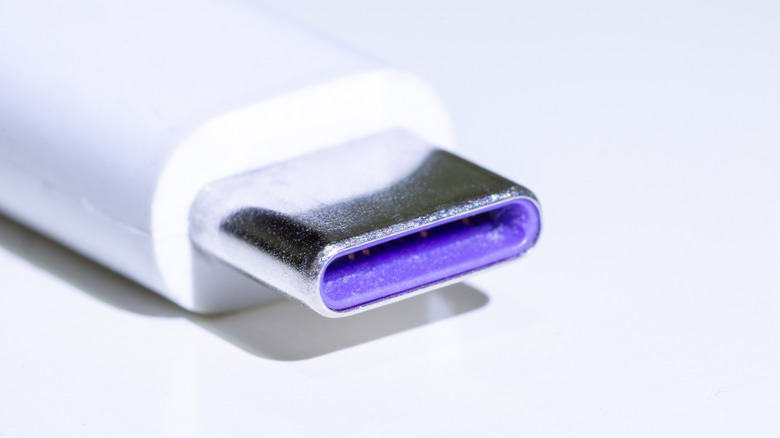
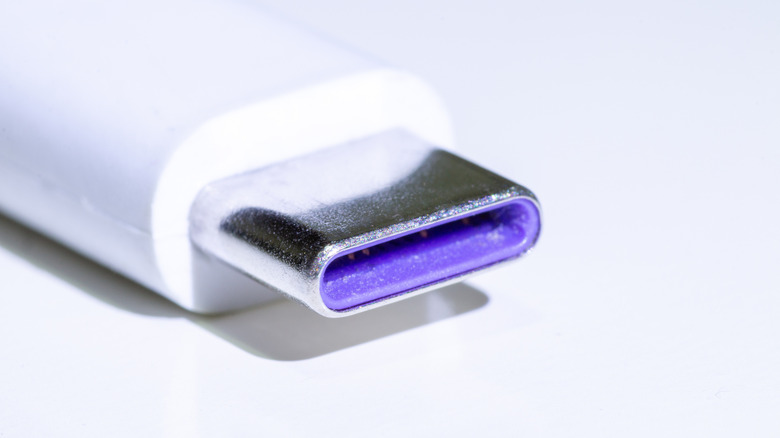
Have you ever looked at a USB connector or port and wondered, “why is this purple instead of blue or black?” It’s not because the manufacturer wanted to help you organize your cables by hue. Rather it’s about speed and charging capacity. Purple USB-C connectors are a particularly interesting case, because the color can mean more than one thing.
Before I explain, here’s a quick anecdote. I once tested an Honor Magic4 Pro smartphone that came with a 100 watt charger and USB cable with orange connectors. That color signified fast charging speeds, and it indeed boosted the Magic4 Pro’s big battery rapidly. “That’s fabulous,” I thought. “Let me charge my MacBook Air with it.” To my surprise, the charger and cable didn’t work at all on the MacBook or other phones, because it turns out that Honor’s charger and cable have limited usability outside its own ecosystem.
Advertisement
The moral of this story is that the USB port colors provide a guideline for their functionality, but that doesn’t mean cables, chargers and ports using that color will work across all devices or follow a set standard. That’s especially pertinent to purple-coded USB cables, as you’ll see.
Purple USB (unofficially) means fast charging and data speeds
The industry body that regulates USB standards, the USB Implementers Forum (USB-IF), uses three standard colors for USB: white (USB 1.0), black (USB 2.0) and blue (USB 3.0, 3.1 or SuperSpeed). “Blue is the recommended color for the USB 3.1 Standard-A receptacle… to help users distinguish it from the USB 2.0 Standard-A connector,” the company says in its legacy USB document. Any other color including green, purple or orange is not part of USB-IF standards and has no “official” meaning for ports or connectors.
Advertisement
With that said, purple does have a common, though far from universal, connotation. It’s used by Huawei’s SuperCharge high-speed system for device charging, both on Type-A and Type-C connectors and ports. Those support charging speeds at 40 watts or more, along with standard USB Power Deliver (PD) and Qualcomm’s Quick Charge protocol.
Huawei only uses that purple color on its 25W Mini Charger nowadays, promising compatibility with its own phones as well as other Android and IOS devices. Its other SuperPower Wall Chargers (100W and 66W) have orange USB-A and USB-C connectors, which also denote high-current power delivery and fast data speeds. Huawei’s 6A phone charging cables all use orange connectors, so there’s no longer a purple-coded one to be found.
Huawei smartphones can’t legally be sold in the US due to trade sanctions with China, which explains why Americans rarely see the purple connectors. The exception is that some non-Huawei USB 3.1 Gen 2 cable makers use either teal blue or purple on the connectors to denote the extra speed over USB 3.0 (10Gbps compared to 5Gbps) along with higher charging capacities.
There are a few other colors used by USB manufacturers as well, in case you weren’t confused enough by the black, white, blue, teal, orange and purple ones I’ve already mentioned. Red (desktop) or yellow (laptop, always on) ports indicate either USB 3.2 or USB 3.1 Gen 2, but are also used for charging-only ports. The other is green, which usually denotes Type-A or old-school Type-B Qualcomm Quick Charge receptacles and plugs. Razer also famously uses green for the USB ports on its laptops, to match its branding aesthetic.
Advertisement
How to be sure about a cable’s data and charging speeds
Unfortunately, consumers are often misled by these color schemes, believing they’re getting fast power delivery speeds and data rates. This has consequences for safety, energy consumption and e-waste. Choosing the wrong charger or cable could send a battery to an early retirement, for example, or even cause a fire or explosion.
With all that, buying a USB cable based on color clearly isn’t wise. Luckily, there’s a better way. Reputable manufacturers like Anker and Apple have their cables and chargers USB-IF certified for specific charging and data speeds. The latest PD 3.1 specification allows for safe power delivery well above previous specifications, with certifications for up to 140W, 180W and 240W power levels.
Advertisement
For data speeds, you’ll want to check the USB data standard, with USB 3.1 (sometimes referred to as USB 3.2 Gen 1) being the slowest at 5Gbps and USB 4 being the fastest at 40Gbps or even 80Gbs with Thunderbolt 5 compatibility. Some devices like TVs, desktop PCs, and even the MacBook Neo, have one or more ports that utilize the older USB 2.0 spec, which maxes out at 480Mbps. That’s a good fit for peripherals like mice and keyboards, but not much else. If you need both high speeds and fast charging, you’ll want to ensure both USB-IF power delivery certification and the latest USB standards. Some cables offer both fast speeds and high power delivery — and you can even get them in purple, but only on the outside.
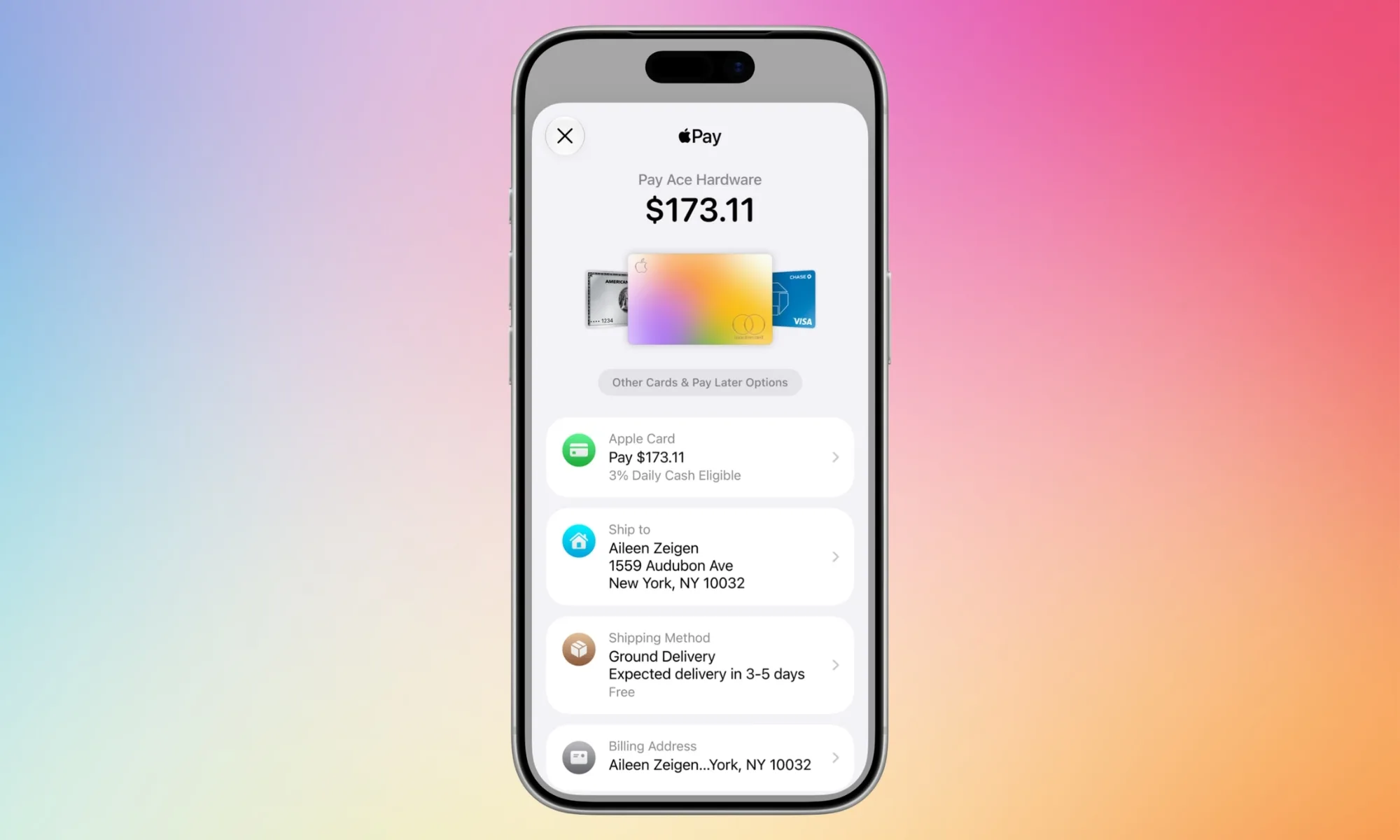
Every time someone checks out with Apple Pay, trying to tap the card shown on the payment sheet to switch to a different one, they end up getting confused. In iOS 26, that tap does not switch your card.
It opens an address-editing screen instead. The real card switcher is a different, easy-to-miss button near the bottom of the screen. If you’ve ever fumbled through Apple Pay at checkout, wondering what’s going on, Apple just fixed it with iOS 27.
Apple
So what exactly was wrong with Apple Pay’s card switcher?
The instinct to tap the card itself makes sense, but it didn’t on Apple Pay. The confusion also ended up in people paying with the wrong card.
Someone trying to switch from a debit card to a rewards card would tap, land on the address screen, go back, do the entire thing again, and end up paying with whatever was already selected.
With Apple Wallet holding debit cards, credit cards, and pay later accounts, that flaw only got more noticeable over time.
iOS 27 lets you choose between the cards on the main Apple Pay sheet, by swiping on them, the gesture people were already trying anyway. Tapping a card now opens a grid view showing every eligible card.
The new design also shows details like rewards, account balances, and pay later options, so that buyers can compare before paying. Even though merchants and developers still control the details that show up, iOS 27’s Apple Pay checkout page is much better and clear than that on iOS 26.
For those catching up, this card switcher tweak is a small piece of a much bigger Apple Wallet push from WWDC 2026, which includes bill splitting through Apple Cash using Visual Intelligence, the ability to turn physical loyalty and membership cards into digital Wallet passes, and an expanded hotel key experience with trip details and activity updates.
You may also need to upgrade your wiring and electrical panel and get permission from your local authority. In my case, here in Scotland, that meant asking my distribution network operator. The US equivalent is an electric distribution utility or local distribution company. They may have to upgrade your connection. I needed a new cut-out with a bigger fuse to handle my EV charging, battery, and air-source heat pump, but the upgrade was free. Your mileage may vary, and it can take a while to hear back. Your installer will likely handle this process for you.
You also need to choose an installer. I recommend shopping around, reading reviews, and getting multiple quotes. The Greener Energy Group installed my battery, and they were excellent. There was a site visit to discuss the work, and the installation was completed in a day. The installers need a suitable location for the battery (mine was installed in the garage, but they are weatherproof, so they can also be installed outside), and they must run cable to your main fuse board.
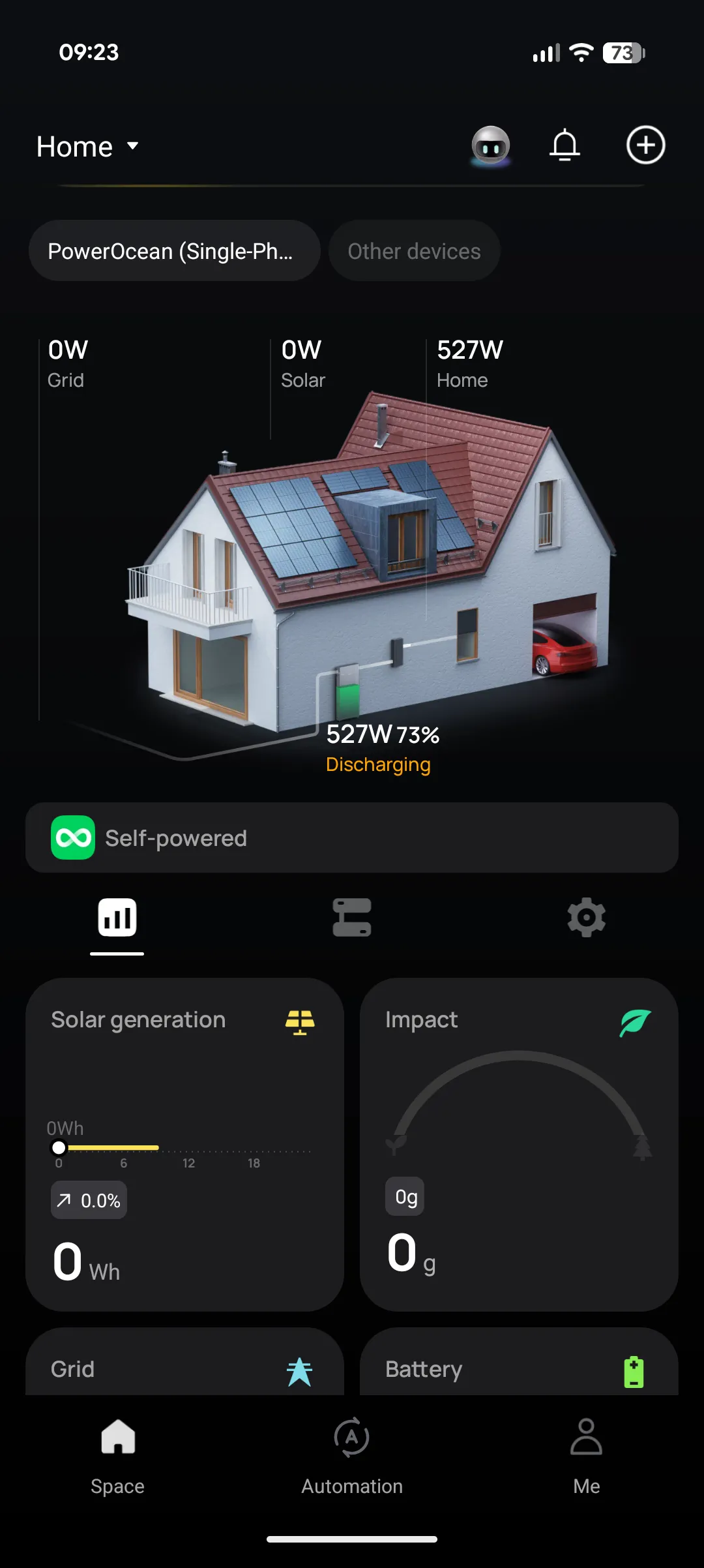
The EcoFlow PowerOcean system stood out because of its 15-year warranty, modularity (expandable to 45 kWh), stylish design, and accessible smartphone app. I went with a 6-kW hybrid inverter (thinking we may get solar panels down the line) and two 5-kWh batteries. With hindsight, I should have gone for three or four, but I’ll get into that later.
Advertisement
The EcoFlow PowerOcean sports a sleek gray metallic design, and it’s only 188 millimeters deep (around 7.5 inches). It’s pretty unobtrusive, but it’s better if you can tuck it away in a garage or basement because that will also help with operating temperatures, though the PowerOcean also has built-in heating to avoid reduced performance when it’s very cold.
Powering Up
EcoFlow via Simon Hill
EcoFlow via Simon Hill
Configuring my EcoFlow PowerOcean was a breeze. My current EV tariff (Intelligent Octopus Go) offers cheap electricity between 11:30 pm and 5:30 am, so I have the battery fill up during those hours, and it starts to discharge every morning at 5:31 am. We are a family of four, and I work from home.
We spend hours testing every product or service we review, so you can be sure you’re buying the best. Find out more about how we test.
Bluesound Pulse Cinema Mini: Two minute review
I came to this Bluesound Pulse Cinema Mini with admitted baggage. I’m not gonna sugarcoat it; I did not like Bluesound’s original Pulse Soundbar. It had an awkward design, it sounded cold and clinical, and it was very expensive when compared to alternative products.
The Bluesound Pulse Cinema Mini is company’s latest model, and is still on the pricey side, but where its predecessor disappointed, the Cinema Mini impresses. There’s powerful, rich, and detailed sound, an elegant design that will complement most rooms, and a wealth of features you won’t find from brands like Sonos and Bose.
Advertisement
Like any Dolby Atmos soundbar that tries to do immersive, 3D sound with only two channels, the Pulse Cinema Mini can’t quite deliver on the promise of overhead height channel effects, but it makes up for it with a surprisingly wide soundstage that brings Atmos and 5.1 movies to life, and does wonders for stereo.
Latest Videos From
Though physically wider than most “mini” soundbars, that’s clearly enabling its biggest strength: it gives the speaker room to house a set of woofers that deliver much bolder low-end bass than the compact category is known for.
This puts the Pulse Cinema Mini in a tricky spot for buyers. It’s priced higher than many full-sized soundbars, yet it can’t quite match the performance of those larger speakers. It’s highly versatile, yet it may be too big for truly small setups.
These contradictions mean the Bluesound Pulse Cinema Mini isn’t a no-brainer-just-buy-it product, but there’s also no doubt in my mind that if you put a high value on the things it well, you’ll be thrilled with it in your home.
Advertisement
Bluesound Pulse Cinema Mini review: Price and release date
Release date: August 27, 2025
Price: $999 / £799
Bluesound sells the Pulse Cinema Mini in many international markets, including the US, UK, and Canada. However, it hasn’t yet released the soundbar in Australia.
Sign up for breaking news, reviews, opinion, top tech deals, and more.
At $999 / £799, the Pulse Cinema Mini is considerably more expensive than its closest direct competitors, like the Bose Smart Soundbar at $499 / £499.95, and Sonos Beam Gen 2 at $499 / £499.
Advertisement
However, it boasts better performance and has several features that set it apart. The Pulse Cinema Mini includes a wall-mount bracket; it’s larger and more powerful than the Bose and Sonos models, and it includes an analog input, wired subwoofer output, USB storage access, and two-way Bluetooth with aptX Adaptive, all of which are absent on the Smart Soundbar and Beam Gen 2.
(Image credit: Future)
Bluesound Pulse Cinema Mini review: Specs
Swipe to scroll horizontally
Dimensions (W x H x D)
(W x H x D): 33.34 x 2.91 x 5.51 inches
Advertisement
Speaker channels
2.0 (2.1 with planned update)
Connections:
1x HDMI out (with eARC), optical in, RCA stereo in, USB-A, Gigabit Ethernet, RCA subwoofer-out, Wi-Fi (802.11ac), Bluetooth 5.2 (two-way, with aptX Adaptive support)
Analog, USB, subwoofer, and two-way Bluetooth connections
Expandable and multiroom compatible
Hi-res Audio and Dolby Atmos support
As is the case for a lot of small-footprint soundbars, the Bluesound Pulse Cinema Mini doesn’t has only one HDMI port, so you won’t be able to connect devices like streaming video players, Blu-ray players, or game consoles and pass through their video to your TV.
However, it also offers connections that are rarely found in this class of speaker, such as dedicated analog inputs (as well as optical digital), a wired subwoofer output, and a USB port that provides access to music stored on a hard drive.
Advertisement
Even its Bluetooth capability exceeds standard soundbar fare, with its support for Qualcomm’s high-quality aptX Adaptive codec and the ability to stream in two directions: from a phone or computer to the soundbar, or from the soundbar to a set of wireless headphones or a Bluetooth speaker.
Bluesound gets compared to Sonos a lot. Bluesound’s BluOS apps for phones and computers perform many of the same multi-room and music management functions as Sonos’ software.
Like Sonos, Bluesound makes a range of wireless audio devices from speakers to subwoofers to streamers that can all work seamlessly together in one household. The Cinema Mini can be bonded with various combinations of these speakers for a true surround sound experience, or it can simply play the same music at the same time for a synchronized house party.
Thanks to its compatibility with multiple hi-res audio formats and sample rates, many audiophiles feel that Bluesound is superior to Sonos.
Advertisement
Still, there are a few things Bluesound can’t do. You can stream Apple Music via AirPlay or Bluetooth, but neither of these gives you lossless quality, and the BluOS app doesn’t have native support for Apple Music, YouTube Music, or Spotify. Unlike Sonos, there’s no easy in-app room correction here.
It also doesn’t support support DTS, it doesn’t support Google Cast, it’s not compatible with Google Home — but Sonos also lacks these.
Currently, despite its Dolby Atmos certification, native support of Amazon Music, and Tidal Connect compatibility, there’s no way to stream Dolby Atmos Music to the Pulse Cinema Mini without the help of an HDMI-connected third-party device, such as an Apple TV 4K. Since the Mini only has one HDMI eARC port, that device will need to use your TV as a go-between.
Advertisement
Bluesound Pulse Cinema Mini review: Sound quality
(Image credit: Future)
Impressive low end and virtual surround
No dialogue mode or Low Frequency Effects (LFE) channel
Great for music, but no EQ, tone control, or Dolby Atmos Music
Before we get into sound quality, a quick note on the Bluesound Pulse Cinema Mini’s stated specifications. Bluesound says it’s a 2.1-channel system, but this isn’t entirely accurate.
According to the company, the soundbar will be capable of processing low-frequency effects (or LFE — the subwoofer part of a soundtrack) without any help from a standalone subwoofer; it’s just that, as of the time of reviewing, it doesn’t actually do so.
For now, if you want true, 2.1 sound from the Cinema Mini, you’ll need to connect a powered sub via the soundbar’s sub output, or buy the Bluesound Plus Sub+ wireless subwoofer.
Having said that, even with only two discrete channels, this is a very capable soundbar for both multichannel and stereo sound. Thanks to a pair of dedicated woofers and passive bass radiators, it pumps out surprisingly deep and resonant bass, which leads me to believe that it will have no problem with LFE channel content when and if Bluesound adds it.
For music, the Cinema Mini’s bass is powerful enough to get by without a subwoofer in smaller rooms.
Advertisement
My experience with two-channel soundbars, even those that can process Dolby Atmos, has been less than stellar. So I have to give Bluesound a lot of credit for the Cinema Mini’s acoustic design and digital signal processing (DSP). With an angled tweeter and midrange driver located at each end of the bar, it projects sound both outward and to the sides, creating a soundstage with remarkable width and detail.
It reminds me a lot of Sennheiser’s Ambeo Soundbar Mini, which also uses just six powered drivers to achieve its virtualized surround sound. Unlike the Ambeo Soundbar Mini, which suffers from a lack of low-end, the Pulse Cinema Mini has a full-range sound that won’t disappoint.
Still, when it comes to Dolby Atmos, you’ll need to temper your expectations. The Cinema Mini’s DSP has to do a lot of heavy lifting to get its two discrete channels to virtualize surround and height content. It does a decent job with the surrounds, but height effects aren’t especially distinct.
During the Aston Martin chase scene from No Time To Die, there’s a moment when the camera passes beneath a set of church bells. Well-executed height systems let you hear the bells move overhead, but the Cinema Mini’s processing just makes the sound bigger, not taller or dynamic.
Advertisement
I find this to be true of nearly all Atmos systems that lack up-firing drivers. The Sonos Beam Gen 2, for instance, doesn’t perform any better in the height department. But the Beam Gen 2 is half the price of the Pulse Cinema Mini. Sonos’ Arc Ultra, by contrast, is basically the same price as the Cinema Mini, and will win any Dolby Atmos competition, hands down.
The same is true when it comes to the Cinema Mini’s lack of an LFE channel. In that same No Time To Die scene, James Bond’s ride is riddled with machine gun fire. When you’re inside the car with Bond, the Sonos Arc Ultra renders each bullet impact viscerally — its built-in subwoofer lets you feel the concussion. It’s still an enjoyable scene via the Cinema Mini (it captures the bullet ricochets nicely), but you’ll definitely need to add a sub if you want deeper cinematic immersion.
For its wide soundstage, the Cinema Mini pays a small price in terms of dialogue clarity. I don’t want to overstate this — I had no problem making out speech — but with no central tweeter or midrange, voices don’t have the same laser-like focus that you’ll get from the Ambeo Soundbar Mini, or even the Bose Smart Soundbar.
As good as TV sound is on the Pulse Cinema Mini, the real reason for dropping a thousand dollars on this speaker is its music performance. I seldom heap praise on soundbars for music listening, but the Cinema Mini is truly superb for its class.
Advertisement
(Image credit: Future)
Stereo rendering is where Bluesound’s decision to use a two-channel architecture pays big dividends. Whether you listen with or without the optional Surround Upmixer and Virtualizer modes turned on (inside the BluOS app), the Cinema Mini produces a beautifully balanced, smooth, and detailed sound.
Sitting front and center lets you hear strong stereo imaging and a perfectly placed phantom center channel. But do yourself a favor and turn on the Surround Upmixer and Virtualizer. The purists among you may scoff, but I love the extended width these DSP filters create. The Cinema Mini grows to twice its length — maybe more — and panned stereo sounds seem to float ethereally in the upper front corners of my room.
The bass response, which I’ve come to think of as the Mini’s secret weapon, is well-managed from low to high volumes, musically anchoring tracks with its resonance and weight. Distortion is almost non-existent, and the Cinema Mini effortlessly plays at very loud levels.
If there’s one hitch in an otherwise excellent sound system, it’s that Bluesound is a bit too confident you’ll like its tuning. There are no bass/treble tone controls and no traditional equalizer, or EQ presets — with the exception of three optional listening “modes”: Movie, Music, and Late Night.
Advertisement
I’m familiar with this approach — the Cinema Mini isn’t the first Bluesound speaker I’ve reviewed — but it continues to surprise me, especially given that the company is highly regarded by audiophiles, who tend to have strong feelings about how things should sound.
Would I change much if I actually had access to these settings? Apart from de-emphasizing the highs just a tad, no, I wouldn’t make any other modifications. I really love the way the Cinema Mini sounds.
Sound quality score: 4.5 / 5
Bluesound Pulse Cinema Mini review: Design
(Image credit: Future)
Elegant, fabric-wrapped, rounded shape
Larger than many small-room soundbars
Wall-mountable with auto-orientation detection
All-plastic construction is the norm for compact soundbars. This doesn’t necessarily mean they look bad — I’d argue the Sonos Beam Gen 2 is quite handsome — but the Bluesound Pulse Cinema Mini’s fabric-wrapped and gently curved shape looks a little more upscale, and a little less speaker-ish.
At 33.3 inches wide, the Cinema Mini is bigger than most compact soundbars. By contrast, the Beam Gen 2 is 25.6 inches, and the Bose Smart Soundbar is 27.3. The Cinema Mini is also slightly taller and deeper. Still, despite this larger footprint, it won’t look out of place under any TV from 32- to 55-inches, and as I noted in the Sound Quality section, this extra size pays dividends.
Under that soft grille lies the Pulse Cinema Mini’s unusual driver arrangement: the midrange drivers and tweeters are placed at the ends, each slightly angled up and out — no front-firing units and no centrally mounted high-frequency driver for dialogue. Meanwhile, the central body is occupied by the two woofers and their matching passive radiators.
Advertisement
(Image credit: Future)
This design (plus built-in, automatically triggered EQ changes) lets the Pulse Cinema Mini sound more or less the same whether you place it on a tabletop or mount it to a wall. Unlike the Beam Gen 2 and Smart Soundbar, whose optional wall mount brackets amount to small shelves, the Pulse Cinema Mini’s included hardware lets it cling to the wall without sticking out into the room.
Like Sonos’ speakers, Bluesound doesn’t ship its products with remote controls, but the Pulse Cinema Mini has a built-in IR receiver and can be operated with any IR remote you already own by teaching the soundbar (via the BluOS app) what to do when you press certain remote buttons. Sonos can do this, too, but only when using its soundbars for TV audio.
On the top surface, you’ll find a glass panel that houses the soundbar’s touch controls. Only the central play/pause icon remains lit — the presets and volume icons light up when you approach. There’s no independent volume level indicator, something I wish more companies would offer; however, your TV will likely display an on-screen indicator when the Pulse Cinema Mini is playing TV audio via HDMI.
Advertisement
Bluesound Pulse Cinema Mini review: Setup and usability
(Image credit: Future)
Easy set up with excellent app support
App has a learning curve
Like most soundbars, getting the Bluesound Pulse Cinema Mini set up at a basic level is super easy: Plug it into your TV using the included HDMI cable, and then plug it into the wall with one of the included power cables (Bluesound puts both North American and E.U. versions in the box). You’ll immediately get great TV sound.
However, TV sound is only half of the experience with the Pulse Cinema Mini. To enjoy its awesome music capabilities, you need the BluOS app for iOS or Android. The app gets the soundbar connected to your Wi-Fi network and enables Apple AirPlay, plus it downloads and installs any available software updates, and gives you all of the deeper controls needed to customize the Pulse Cinema Mini to your liking.
The BluOS app also enables you to access multiple streaming services from a single interface and control playback across all BluOS compatible devices (which includes models from NAD, Dali, PSB Speakers, and Monitor Audio).
The BluOS app is fast and responsive, though, as with any platform that has as many features and options as BluOS, there’s a learning curve. Some things are straightforward, such as browsing music from available services, while others take some getting used to.
For instance, some of the Pulse Cinema Mini’s settings are available from the Now Playing screen or the Players tab, but others are only accessible via the Settings icon on the Home tab, and only if the soundbar is first selected in the Players tab.
Advertisement
There are loads of handy features like alarms, sleep timers, and smart playlists; however, BluOS hasn’t mastered one trick that makes Sonos, Wiim, and Denon/HEOS so appealing for those with multiple sources of music: universal search and favorites management.
If you decide to expand the Pulse Cinema Mini with Bluesound’s Pulse Sub+ and/or Pulse M/Pulse Flex speakers, these can easily be added and configured in the BluOS app.
Bluesound doesn’t integrate either Amazon Alexa or Google Assistant into its products, but if you’ve already got an Alexa smart speaker, there’s a Bluesound skill that will let Alexa control your Pulse Cinema Mini (and any other Bluesound products you add later).
Setup & usability score: 3.5 / 5
Bluesound Pulse Cinema Mini review: Value
(Image credit: Future)
Expensive, but better sound than the competition
The best small soundbar for music
Value grows if you’re planning to expand
Look, there’s no way to justify the Bluesound Pulse Cinema Mini’s price based purely on its performance as a Dolby Atmos soundbar. It’s got great sound, but it can’t hold a candle to bigger, more powerful models such as the Sonos Arc Ultra, Bose Smart Ultra Soundbar, or Sony Bravia Theater Bar 8, which are the same price (give or take $100).
However, there are several other attributes that set the Cinema Mini apart, and these may tip the value balance if you want them. Want to hook up a turntable? Do you have an existing wired subwoofer you’d like to use? Is your room just too small for a full-size soundbar, but you don’t want to compromise on audio quality — especially when it comes to music listening? Do you like the idea of connecting a set of Bluetooth headphones? And are you looking for ultimate flexibility when it comes to expanding both your home theater as well as your whole-home audio?
Advertisement
If you answered yes to any or all of these questions, the Bluesound Pulse Cinema Mini starts to look like it’s worth its nearly $1,000 asking price.
Just keep in mind that Bluesound’s other components often carry similarly high prices. Unless you get a bundle discount, adding the Pulse Sub+ will cost $899, and a pair of Pulse M surrounds adds another $998. You’re now up to $2,896, and your resulting 4.1-channel Dolby Atmos home theater system still lacks a center and height channels. Meanwhile, the same investment can get you a Sonos Arc Ultra + Sub 4 + 2x Era 300, with 9.1.4-channel sound.
Should I buy the Bluesound Pulse Cinema Mini?
(Image credit: Future)
Swipe to scroll horizontally
Section
Advertisement
Notes
Score
Features
Some great rare features, including analog, subwoofer, and 2-way Bluetooth connections. But it’s also lacking some core soundbar features you get in the competition.
Advertisement
3.5 / 5
Sound quality
Impressive low end and virtual surround given its size. Best in class when it comes to music, as well.
4.5 / 5
Advertisement
Design
It has an elegant, fabric-wrapped, rounded shape. Larger than some smaller room soundbars. You can mount it with auto-orientation detection.
4 / 5
Setup & usability
Advertisement
Easy setup here and the app support is great, although using the app does come with a learning curve.
3.5 / 5
Value
There’s no getting around the fact it’s expensive but it is excellent for music and the value grows if you’re planning to expand.
Advertisement
3 / 5
Buy it if…
Don’t buy it if…
Advertisement
Samsung HW-Q990H review: Also consider
Swipe to scroll horizontally
Header Cell – Column 0
Bluesound Pulse Cinema Mini
Sonos Beam Gen 2
Bose Smart Soundbar
Sonos Arc Ultra
Advertisement
Price (May 2026)
$999 / £799
$499 / £499 / $699
$499 / £499 / AU$799
Advertisement
$999 / £799 / AU$1,799
Dimensions
33.34 x 2.91 x 5.51 inches (W x H x D)
25.6 x 2.3 x 3.9 inches (W x H x D)
Advertisement
27.34 x 2.21 x 4.01 inches (W x H x D)
2.95 x 46.38 x 4.35 inches (75 x 1178 x 110.6mm)
Speaker channels
2.0 (2.1 with planned update) with virtual Atmos
Advertisement
3.0 with virtual Atmos
3.0.2 with virtual Atmos
9.1.4 (including virtual Atmos)
Connections
Advertisement
1x HDMI out (with eARC), optical in, RCA stereo in, USB-A, Gigabit Ethernet, RCA subwoofer-out, Wi-Fi (802.11ac), Bluetooth 5.2 (two-way, with aptX Adaptive support)
Used Bluesound Pulse Cinema Mini as main audio system for one week
Tested in basement media room
Sources include Apple TV 4K, Nvidia Shield, and streamed music from various apps
I spent a full week with the Bluesound Pulse Cinema Mini as my main audio system for watching movies, shows, and music in my basement media room.
During that time, I played a variety of Dolby Atmos test clips from movies like No Time To Die, Ford v Ferrari, Mad Max: Fury Road, Dune, and Unbroken, paying special attention to details like dialogue clarity, surround sound, and height channel impact.
I streamed most content from an Apple TV 4K connected via an LGOLED TV, which fed the MK2 from its HDMI eARC output, but I also connected an Nvidia Shield TV to an eARC extractor so I could hear the Cinema Mini’s treatment of Dolby Atmos in Dolby TrueHD.
For music, I used a variety of apps, including Tidal, Qobuz, and Amazon Music, listening to a wide range of genres. Some were played from apps on the Apple TV 4K and Nvidia Shield, while others were streamed wirelessly using AirPlay, Bluetooth, Tidal Connect, and Qobuz Connect. I tested several of these within the BluOS app as well.




























































You must be logged in to post a comment Login