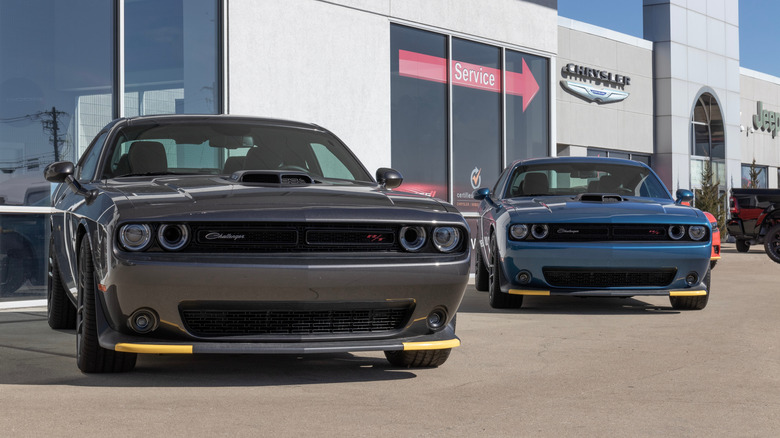
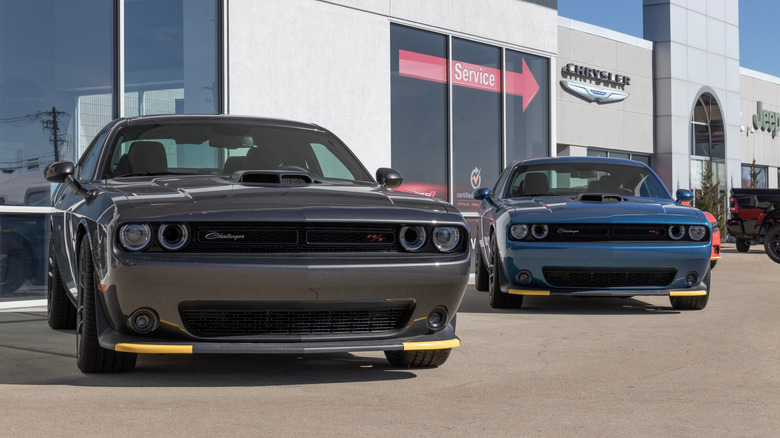

Are pickup truck engines the same as those used in normal passenger or sports cars? The answer is both yes and no. Physically, at least, there’s usually little that separates an engine in a truck’s engine bay from one in a car’s. After all, there have been plenty of times in the industry’s history when automakers have sold cars and trucks with nearly identical engines. Case in point, the legendary Chrysler slant-six engine, which came in everything from compact cars to pickup trucks and vans.
But in the modern era, especially, there can be notable differences between car and truck engines, even if their displacement and general engine architecture are the same. The modern HEMI V8 used in Dodge muscle cars and Ram pickups is a good example of this, with different versions of the same engines used in performance cars and pickups. Most of the differences between truck and car engines involve how and when the engines deliver their horsepower and torque.
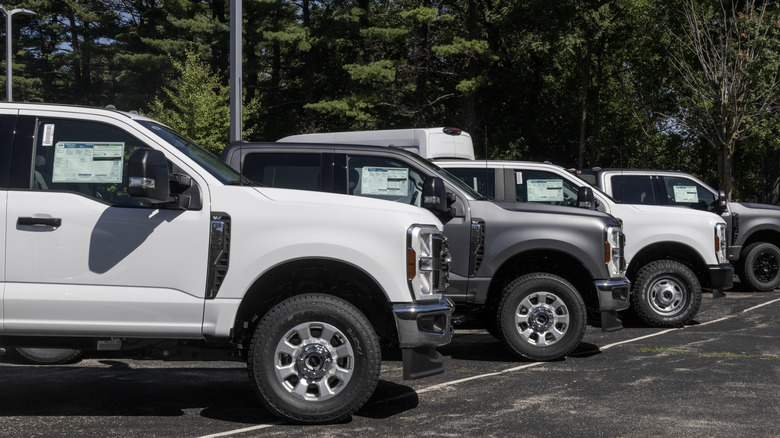
A car engine may produce more peak horsepower than an equivalent truck engine, but the truck engine will often provide more torque or deliver the same amount of torque at lower revs. Just how much difference there is between the two will vary by automaker, and some brands, like Ford, offer V8 engines designed from the ground up for trucks that share nothing with their car counterparts.
Advertisement
The different flavors of V8s
Jetcityimage/Getty Images
Ultimately, the main difference between car and truck engines is rooted in the difference between horsepower and torque. While horsepower matters in a truck, when it comes to pulling a trailer or carrying a heavy load, it’s the torque that’s important — and the lower in an engine’s powerband that torque comes, the better it is. Thus, the popularity of ultra-torquey, but relatively low-horsepower turbodiesel engines for large pickups. Peak horsepower, meanwhile, takes prominence in a sports car where engine speeds are higher.
Even within the same V8 family, there can be notable differences in car and truck engines. In GM’s V8 lineup, the 401-hp 6.6-liter L8T truck engine is designed for low-speed torque, with 464 lb-ft of torque at 4,000 RPM. The Chevrolet Corvette’s smaller, 495-hp 6.2-liter LT2 V8 is part of the same family and easily bests the L8T in peak horsepower, yet it barely edges the L8T in torque. It also needs to rev much higher to generate its torque, with its 470 lb-ft coming at 5,150 rpm.
Advertisement
Ford’s Super Duty 7.3-liter Godzilla V8 takes this concept even further. Not only is the Godzilla much larger than the 5.0 Coyote V8 in the Mustang GT, but it also uses an entirely different design with an overhead-valve, single-camshaft design compared to the 5.0’s dual overhead cams and 32 valves. At 480 hp, the 5.0 beats out the 430-horsepower Godzilla, but the 7.3 takes the torque crown, with 475 pound-feet to the Mustang’s 415 lb-ft.
Advertisement
The curious case of the Nissan 240SX
betto rodrigues/Shutterstock
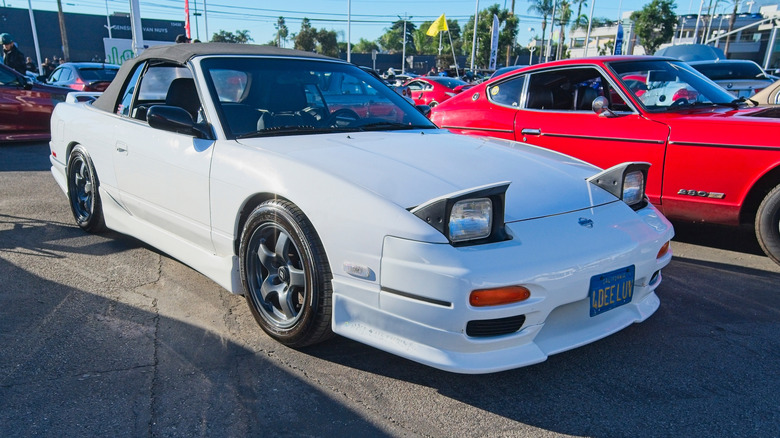
So what happens, then, if you put a pickup truck engine into a sports car? Look no further than the North American-market Nissan 240SX from the 1990s. When the S13 Nissan Silvia and 180SX debuted in the Japanese home market, the cars were available with high-horsepower turbocharged four-cylinder engines — first the 1.8-liter CA18DET and later the legendary SR20DET. This, combined with a great chassis and tons of aftermarket support, helped the S13 become a smash hit among enthusiasts.
However, when it came time to export the car to America, Nissan decided to forgo the turbo engines in favor of the naturally aspirated 2.4-liter KA24 engine used in Nissan pickup trucks. Though the USDM engine was larger than its JDM counterpart and produced a decent amount of torque for its size, the KA24 only made 140 hp and, more importantly, lacked the high-revving sports car feel many expected from the 240SX.
Fortunately, the SR20DET was an easy swap, and Nissan’s decision to go with a truck engine didn’t entirely detract from the many features that helped the 240SX become a legendary drift car in the years and decades that followed. Even then, though, one can’t help but wonder what would’ve happened had Nissan given the U.S. market 240SX the turbocharged performance engine it deserved.
We may receive a commission on purchases made from links.
Milwaukee Tool has long been celebrated by worksite professionals and staunch DIYers for producing some of the most powerful and durable devices available on the consumer market. So much so that the brand is regularly singled out as one of the best in the entire power tool arena.
Advertisement
Indeed, if power and battery life are features you value highly in cordless tools, Milwaukee is a brand that should be on your radar, as its M18 lineup of powered tools and devices has earned a reputation for delivering serious on-the-job punch. Just like many other cordless tool lines with shareable power sources, Milwaukee’s M18 shingle has several models of rechargeable Lithium-Ion battery packs to choose from.
If you’re looking to make the most of those M18 tools, the battery packs bearing the Forge label would seem to be the best way to do so, with Milwaukee claiming that those batteries are designed to deliver not just maximum power to your tool, but also provide longer running times and faster charging times than other M18 power packs. Unfortunately, Forge batteries are priced on par with those desirable capabilities. Still, shoppers looking to buy a new device with a Forge battery should know that Milwaukee offers combo packages that include both the tool and the battery at a more palatable price point. Here are a few you should be aware of.
Advertisement
1. M18 FUEL 7-1/4 in. Circular Saw Kit with One Forge Battery, Charger and Tool Bag
For the record, yes, Milwaukee’s M18 Forge battery packs are designed to outperform even the brand’s M18 High-Output offerings. When paired with the brushless motors powering many of Milwaukee’s M18 tools, those batteries can boost performance beyond even the most fervent fans’ expectations. As noted, you do pay a premium price for that 12.0 Ah power upgrade, with a single 12 Ah Forge battery selling for upwards of $229 these days.
Still, if you have a shiny new Milwaukee M18 Fuel Circular Saw on your current power tool want list, you can package it with a Forge battery at The Home Depot for $449. That package set comes with an M18 rapid charger that also works with M12 batteries, and even a handy Milwaukee Tool-branded tool bag.
As for the saw, the 7 1/4-inch cutter is, of course, fitted with an 18V brushless motor and also boasts Milwaukee Redlink Plus intelligence to bolster performance and protect against malfunction. It’s also got a Magnesium shoe and guards to increase durability, as well as an integrated dust port and vacuum adaptor. According to Milwaukee, with an M18 Forge battery on board, it can perform approximately 750 cuts on a full charge. Customers seem to back up its overall quality, rating the saw 4.7 stars and largely praising it for being powerful, lightweight, and easy to use, even as some noted concerns about power and toughness.
Advertisement
2. M18 FUEL 16 in. String Trimmer with Forge Batteries and Charger
While lawn care equipment has not, historically, been Milwaukee’s bread and butter, the brand has developed a few impressive cordless devices over the years. If its 4.8-star user rating is any indication, its M18 Fuel 16 in. String Trimmer is just such a device, particularly when it’s paired with a Forge battery. And if you’re looking to add the string trimmer to your current arsenal of lawn care gear, The Home Depot is selling a combo kit that includes the tool, a couple of 8 Ah Forge batteries, and a rapid charger for $519.
Advertisement
In terms of cost, the 2 batteries and charger alone would put you close to that total, so this looks like a pretty good deal on paper, especially given the user rating. The only real knock against this kit is that the 8 Ah battery will reportedly provide only up to 24 minutes of use for the brushless motor powering that string trimmer. Even so, a pair should provide more than enough runtime to handle most trimmer tasks you can throw at the device in your backyard. Users seem to agree, praising the trimmer for its power, performance, variable speeds from its brushless motor, and ease of use.
Many also note that the QUIK-LOK feature — which allows for 13 interchangeable heads to be attached to the power arm — is a major plus. All in, that potentially makes this one of the more versatile offerings in M18’s Forge-compatible lineup.
Advertisement
3. M18 FUEL Super Sawzall Reciprocating Saw with FORGE Battery Pack
In the annals of construction history, few power tools have proven quite as game-changing as the reciprocating saw. That is particularly true for the Milwaukee Tool brand, as the Wisconsin-based outfit actually invented that tool back in the 1950s. That cutter hit the market bearing the name of Sawzall. More than seven decades later, it still goes by that name and remains a staple in Milwaukee’s power tool lineup, and over that span, it has received all the modern upgrades you’d expect, including the ability to couple with M18 Forge battery packs.
The M18 Sawzall has been widely embraced by those who’ve purchased it, with more than 1,600 users giving it a 4.8-star rating. That number speaks volumes to the quality of the device itself, which uses a variable 5-speed brushless motor, a QUIK-LOK blade clamp, and on-off orbital action, among other features. Though a couple of users noted durability concerns, the reviews for the device are overwhelmingly positive.
They also claim that the Forge battery is a massive boon to the already popular saw, providing major upgrades in power, run time, and performance. Now for the bad news: this kit includes just the Sawzall and a single 8 Ah Forge battery, so if you don’t have a charger on hand, you’ll need to invest in one. The good news is that The Home Depot is selling the combo pack for just $528, so the price point is still pretty inviting.
Advertisement
4. M18 FUEL Hammer Drill/Impact Driver Combo Kit with Forge Battery, Red Lithium Batteries, Charger and Case
Drills and drivers are about as essential as it gets for many a pro job and backyard project. It is such that pretty much every manufacturer in the game features several types of those tools available in their stable of devices. That list obviously includes Milwaukee Tool, which offers standard power drills and drivers, as well as more heavy-duty options like a hammer drill and an impact driver. If you’re looking for those latter two tools in the M18 mold, you should know that The Home Depot is offering a combo pack of both M18 drivers for $678.
Advertisement
That pack includes more than just a Hammer Drill and an Impact Driver, of course: a pair of 5 Ah battery packs, one multi-voltage charger, and a hard-shell carrying case big enough to hold both drivers. Oh, it comes with one 12 Ah Forge battery as well, making this a pretty comprehensive set of gear. Almost 1,800 users agree, rating the set 4.7 stars and largely praising both the devices and the batteries for their overall quality.
As for the tools themselves, both drill and driver are outfitted with brushless motors. The hammer drill is also just 6.9 inches, making it suitable for use in tight spaces. So too is the impact driver at just 4.47 inches in size. Stature aside, the driver is powerful too, delivering 2,000 in-lbs of torque and up to 3,900 RPM.
Advertisement
5. M18 FUEL Dual Battery 18V Blower with M18 Mower Kit, 12.0 AH FORGE Batteries, and Chargers
Circling back to lawn care, here’s a combo kit for the big ballers out there looking to keep their green scapes in tip-top shape with Milwaukee power. First, we should tell you we weren’t kidding with the “big baller” statement, as this combo pack is selling for $1,649 through The Home Depot. It does, however, include big-ticket M18 items: a 21-inch self-propelled lawn mower, a dual-battery blower, two 12 Ah batteries, two 12 Ah Forge batteries, one rapid charger, and one six-port Packout rapid charger.
The 21-inch mower accounts for roughly half the cost of the set, but when paired with the blower — which can deliver up to 145 MPH and 600 CFM of airflow — it’ll go a long way toward keeping your green spaces looking good. And yes, the M18 Forge batteries are designed to help ensure those devices are powered up when it’s time to touch up those spaces.
We should tell you, however, that users have rated the kit at 4.3-stars. That number is hardly damning, of course, but the primary issue seems to be that Milwaukee may still have some work to do in its lawn mower makeup. More precisely, the mowers may have durability issues, with one user noting they were woefully unimpressed with their plastic components. So that is one of several factors to consider before ponying up for this kit.
The ‘Cheap Yellow Display’, or CYD, is becoming a staple in these circles, and with good reason: just like the name says, it’s cheap, it has a display, and of course an ESP32 microcontroller to give it lots of brainpower. What it doesn’t come with is a lot of RAM, which was a problem for [DynaMite]’s project. What was there to do but solder on more PSRAM so the CYD could become a mini TV for retrogaming?
Depending what you want to play, you might not need the extra memory. In [DynaMite]’s case, he wanted to run Retro-Go, which opens up a lot more than just the standard NES emulator you can run on an unmodified CYD — including 16-bit systems like the SNES and Sega Genesis/MegaDrive or even DOOM. Adding the PSRAM is just a matter of getting the little chip onto an unpopulated footprint on the board, cutting some traces, and adding a bodge wire. It’s not nothing, but it’s not impossible.
While he was slinging solder, [DynaMite] also took the time to swap some resistors in a step that apparently does great things for the CYD’s sound output, which is… not great, from stock. For really good sound, you really need to break out I2S, but for a tiny game system this is doubtless good enough.
The whole thing goes into a lovely retro TV case that takes its design cues from The Simpsons, which is available via the link as a STEP file as well as STLs. He’s also got a vibe-coded video player application — think of it like the VCR, maybe —and a launcher that will switch betwixt that and the emulator or any other applications stored as .bin files on an SD-card. Check it out in action in the demo video below.
MasterDimm AC features what Cooler Master describes as “noise-optimized” blower fans that operate relatively quietly, with a maximum noise level of 35 dB at full speed. The companies claim that the patent-pending design can reduce operating memory temperatures by up to 15°C, helping ensure sustained performance, improved signal integrity, and… Read Entire Article Source link
The race to build the next great affordable laptop is heating up, and Acer thinks it has a strong contender. The company today unveiled the Swift Air 14, a thin-and-light Windows laptop that combines a premium design, AI-ready hardware, and impressive battery claims for a starting price of just $699.
At a time when even mainstream laptops are creeping toward four-figure price tags, Acer’s latest machine feels refreshingly straightforward. It’s aimed at students, remote workers, and anyone who wants a laptop that looks and feels expensive without draining their bank account. The Swift Air 14 is powered by Intel’s new Core Series 3 processors and delivers up to 19 hours of battery life. That’s the sort of endurance that could realistically get many users through a full workday and beyond without scrambling for a charger.
Acer is focusing on things people actually notice
Laptop makers love talking about processor benchmarks, but most buyers notice other things first. How heavy is it? Does it look good? Is the screen nice to use? Can the speakers fill a room? That’s where the Swift Air 14 appears to have its priorities in order. The laptop weighs just 1.19 kg and measures only 12.9 mm at its thinnest point, all while using an aluminum chassis that should feel significantly more premium than the plastic-heavy designs common at this price point. Acer is also bringing some personality to the lineup with four color options: Sage Green, Frost Blue, Blossom Pink, and Lilac Purple.
Acer
The display sounds promising as well. Acer has equipped the Swift Air 14 with a 14-inch WUXGA panel featuring a 120Hz refresh rate and 100% sRGB color reproduction. For students, creators, and everyday users, that’s a welcome upgrade over the dull screens that often plague budget laptops. Then there’s the audio. Acer says the laptop includes a quad-speaker setup with DTS:X Ultra support, a feature rarely highlighted in this segment but one that can make a noticeable difference when streaming movies, joining video calls, or listening to music.
The Swift Spin 14 AI raises the stakes
Acer wasn’t finished with just one Swift launch. The company also introduced the Swift Spin 14 AI, a more premium convertible aimed at users who need additional flexibility and performance. Powered by up to an Intel Core Ultra 9 processor 386H, the laptop features a dedicated NPU capable of up to 50 TOPS and up to 100 platform TOPS overall. It also supports stylus input through Wacom AES 2.0 technology, making it a potentially appealing option for artists, designers, note-takers, and hybrid professionals. Its 360-degree hinge allows it to switch between laptop, tablet, presentation, and display modes, while features like Wi-Fi 7, a 5MP IR camera, Copilot+ PC capabilities, and up to 26 hours of battery life round out a very ambitious package. Still, the more fascinating device may be the cheaper one.
Advertisement
Acer
The Swift Air 14 arrives at a moment when buyers are increasingly questioning whether they need to spend MacBook money for a great everyday laptop. Acer’s answer is clear: offer a premium metal design, long battery life, AI-powered features, and a modern display at a price that feels far easier to justify. The Acer Swift Air 14 is scheduled to launch in North America in August 2026, while the Swift Spin 14 AI will arrive during the same timeframe.
Acer is going straight after the MacBook Neo crowd
The comparison to Apple’s MacBook Neo feels impossible to ignore. Both laptops are targeting the same audience: students, first-time laptop buyers, and people who want something premium without spending MacBook Air money. Apple’s answer was a $599 machine with an aluminum design, an A18 Pro chip, up to 16 hours of battery life, and the familiar advantages of the macOS ecosystem.
Nadeem Sarwar / Digital Trends
Acer, however, is taking a different route. The Swift Air 14 undercuts many of the compromises associated with entry-level laptops by offering a 120Hz display, more connectivity options, a larger battery, quad speakers, and a wider range of color choices, all while staying in the same affordability conversation. According to Acer’s specifications, the laptop packs a 70Wh battery, dual Thunderbolt 4 ports, and a 120Hz WUXGA panel — areas where it arguably looks more ambitious than Apple’s budget MacBook on paper.
The real battle here isn’t Windows versus macOS. Which company can convince buyers that spending less no longer means settling for less?
Activision is ending Call of Duty: Warzone support for PS4 and Xbox One later this year, drawing a line under the battle royale’s last-gen era at a moment when the cost of upgrading to current hardware has risen sharply for players who have held off.
The game will be removed from PS4 and Xbox One storefronts on 4 June and will no longer be available to download, with Activision removing the in-game store on both platforms on 25 June before Warzone becomes fully unplayable once Call of Duty: Modern Warfare 4 season 1 begins later this year.
The timing adds friction for remaining last-gen players, as both Sony and Microsoft have raised console prices over the past year, leaving the PS5 and Xbox Series X each sitting $150 above their original $499 launch prices.
Activision announced the Warzone changes on the same day it revealed Call of Duty: Modern Warfare 4, which will launch on PS5, Xbox Series S and X, and Nintendo Switch 2, marking the first Call of Duty title to appear on a Nintendo platform following the 10-year deal Microsoft agreed with Nintendo as part of its Activision Blizzard acquisition.
Advertisement
What happens to last-gen players
Players on PS4 and Xbox One will need to move to a PS5 or Xbox Series S or X to continue playing Warzone once season 6 of Call of Duty: Black Ops 7 concludes, with Activision confirming the full cutoff is tied to the Modern Warfare 4 season 1 launch window.
Advertisement
The deprecation reflects a broader industry shift away from last-gen hardware, with developers increasingly unwilling to maintain split builds across console generations as the PS4 and Xbox One user base continues to shrink more than four years after their successors launched.
All of that remains subject to change in terms of exact timing, however, with Activision yet to confirm a specific date for when Modern Warfare 4 season 1 will begin and last-gen support will officially end for those already playing.
SpaceX won a $4.16B Space Force contract for missile-tracking satellites. Combined with a $2.29B deal from Tuesday, it holds $6.45B in Golden Dome work.
The US Space Force awarded SpaceX a $4.16 billion contract on Friday to build satellites that track foreign aircraft and missiles. The programme is called Space-Based Advanced Moving Target Indicator, or SB-AMTI. It is part of the Trump administration’s $185 billion Golden Dome missile defence initiative.
Two days earlier, the Space Force awarded SpaceX $2.29 billion for the Space Data Network Backbone, a secure communications layer built on Starshield satellites. Combined, SpaceX now holds approximately $6.45 billion in Golden Dome contracts. That figure exceeds the combined prototype awards given to every other company in the programme.
The AMTI satellites are designed as an interconnected system combining space-based sensors, secure communications links, and AI-enabled ground processing. The system will detect, track, and alert for airborne threats from orbit. The US has historically relied on ground-based sensors and military aircraft for this function.
Advertisement
Placing detection capabilities in space eliminates potential blind spots that ground-based systems cannot cover. The Space Force described the architecture as designed to “drive closer cooperation across the government space industrial base.” SpaceX must integrate the AMTI sensors with the data transport backbone it is already building under the separate $2.29 billion contract.
The scale of SpaceX’s Golden Dome position is unprecedented for a commercial contractor. The programme has distributed more than $3.2 billion in prototype contracts across SpaceX and 11 other firms, including Anduril, Lockheed Martin, Northrop Grumman, Raytheon, and True Anomaly. SpaceX’s $4.16 billion AMTI contract alone exceeds that entire prototype pool.
SpaceX filed its IPO prospectus last week, targeting a valuation of more than $1.75 trillion. The company is expected to raise approximately $75 billion in what would be the largest IPO in history. Every new defence contract adds to the revenue narrative that underpins the listing.
The timing is notable. Two major Golden Dome contracts awarded in the same week as a Starship V3 test flight and an IPO roadshow preparation creates a cadence that looks orchestrated to maximise pre-IPO momentum. SpaceX held more than $22 billion in government contracts as of 2024. The Golden Dome awards add meaningfully to that base.
The Golden Dome programme’s total cost has risen to $185 billion, up $10 billion from the original estimate, after the programme director approved an acceleration of space-based capabilities in March. The fiscal 2027 budget request includes initial Golden Dome funding. Full-scale procurement is expected to begin post-2028.
The conflict-of-interest concerns that have surrounded SpaceX’s government contracting are amplified by the Golden Dome awards. Elon Musk is simultaneously the largest financial backer of the sitting president, the CEO of the company receiving the contracts, and the owner of a social media platform that shapes public discourse about the programme. The IPO prospectus acknowledges government contract risk but does not address the political dimensions directly.
Friday’s Starship V3 test flight demonstrated that SpaceX can deploy satellites from the vehicle, even though the Super Heavy booster was destroyed after separation. The AMTI constellation will eventually require launch capacity that only Starship can provide at scale. The contract, the IPO, and the rocket programme are three legs of the same strategy.
Two contracts, $6.45 billion, four days. SpaceX is not just participating in Golden Dome. It is becoming the programme’s commercial backbone. Whether that concentration of national security infrastructure in a single pre-IPO company is a strategic advantage or a systemic risk is a question the Space Force has implicitly answered by signing the contracts. The market will answer it again when the IPO prices in June.
Apple is preparing to overhaul Siri at WWDC 2026 in ways that go well beyond a simple feature update, and we’ve just had our first look at the redesigned UI.
Bloomberg’s Mark Gurman has published an early preview of the company’s redesign of the iPhone’s interface, placing its Gemini-powered AI agent at the centre of everyday use.
The redesign moves Siri into the iPhone’s Dynamic Island, where it will remain accessible via voice, the power button, or a new downward swipe from the top centre of the screen that opens a “Search or Ask” interface drawing on elements from iOS 26‘s existing Search experience.
That interface brings together familiar features like Siri Suggestions alongside new functionality, with Gurman reporting it will support app launches, text messages, calendar appointments, note searches, and more, with results surfacing in a rich text card that expands directly from the Dynamic Island.
Advertisement
Image Credit (Bloomberg)
Advertisement
Swiping further down opens a full chatbot-style conversation view inside a dedicated Siri app, which Apple intends to position as a direct competitor to ChatGPT and Claude, supporting text and voice input alongside photo and document uploads and persistent conversation history.
Interface and camera changes
To accommodate Siri’s new prominence, Apple is moving Notification Centre access to a pull-down from the top left of the screen, a small but consequential shift that reflects how central the assistant has become to the iPhone’s navigation logic.
Image Credit (Bloomberg)
Camera and Photos also see significant changes, with a new mode set to replace Visual Intelligence by combining Google reverse image search with third-party AI analysis, while the Photos app gains Reframe and Extend tools that use AI to alter image perspective or generate content beyond a photo’s existing frame.
Underpinning all of it is a Siri that can search the web and draw on-screen context and personal data to complete tasks, with Gurman noting the assistant will be able to cross-reference a user’s calendar availability before scheduling anything.
All of that remains subject to change, however, with Gurman noting Apple tests multiple designs internally and the final version shown at WWDC on 9 June could differ from what Bloomberg has illustrated, with a release expected as early as September.
The European Commission has announced its second fine ever against an international company for violating the Digital Services Act. Temu, the controversial Chinese online marketplace for low-cost products, was found to have played a role in the sale of illegal goods that could have harmed consumers in the European Union. Read Entire Article Source link
AI is everywhere now, or at least that is what the industry keeps telling us. It is in browsers, search engines, image editors, office suites, developer tools, Windows, phones, and soon enough, probably your toaster. But there is a difference between AI being available and AI becoming part of your… Read Entire Article Source link
The AI movie Dreams of Violets is the creation of Ash Koosha and his brother Pooya. As for the direction, writing, and production of this movie, the two brothers created the film as part of their production company Fountain 0. At the time of its production, Ash was in London, and the movie took about three months to make, with a production budget of just $2,000.
Yes, everything had been created using AI; at first, Ash recorded some temporary voices for the characters before taking various methods to translate text into an animation sequence. Kling AI had the responsibility of translating still images into video footage with the help of Claude. The twin brothers also used their own technology at Fountain 0 to keep the characters consistent throughout scenes as well as to make camera movements look natural.
Cinematic-Style Footage – Experience the power of Xtra Muse’s 1-inch CMOS sensor, capable of recording breathtaking 4K resolution videos at 120fps…
Ultra-Steady Shooting – No more shaky videos! Xtra Muse’s advanced 3-axis gimbal camera stabilizer ensures exceptional smoothness. Enjoy smooth…
Effortless Framing – Enjoy Xtra Muse’s expansive 2-inch touch screen, and switch between horizontal and vertical shooting effortlessly.
The story is set in Tehran in January 2026. It is based on actual reports, images, and accounts from persons who observed the protests, which were greeted with violent force by the authorities and resulted in major bloodshed. The film tells the narrative of five strangers who find themselves in the same dead-end alley before dawn, trapped between forces closing in on them. A soldier stumbles across them, while a child named Amir watches over them from a window in his wheelchair.
Advertisement
According to Ash Koosha, it was a very personal project for him, because he and his brother had to flee from Iran in 2009, but nowadays the news becomes really important because it’s very hard to receive trustworthy reports while you have no communications and everything around is unknown to you. The movie itself is rather a fiction based on reality, because Ash wanted to concentrate on the human aspect of the matter, and not on the chaos itself.
The Tribeca Festival elected to include Dreams of Violets in their main schedule, and it will screen in New York on June 10th as part of a run that begins June 3rd and ends June 14th. Festival co-founder Jane Rosenthal was amazed by how they were able to blend new technology with the strength of the tales being told, and she believes it’s an excellent example of how technology is being used to deliver stories that we really need to hear right now. [Source]
You must be logged in to post a comment Login