
Check your pocket. You’re probably carrying a tracking device that will allow the police — or even the Trump administration — to track every move that you make.
Tech
The Supreme Court will decide when the police can use your phone to track you, in Chatrie v. US


If you use a cellphone, you are unavoidably revealing your location all the time. Cellphones typically receive service by connecting to a nearby communications tower or other “cell site,” so your cellular provider (and, potentially, the police) can get a decent sense of where you are located by tracking which cell site your phone is currently connected with. Many smartphone users also use apps that rely on GPS to precisely determine their location. That’s why Uber knows where to pick you up when you summon a car.
Nearly a decade ago, in Carpenter v. United States (2018), the Supreme Court determined that law enforcement typically must secure a warrant before they can obtain data revealing where you’ve been from your cellular provider. On Monday, April 27, the Court will hear a follow-up case, known as Chatrie v. United States, which raises several questions that were not answered by Carpenter.
For starters, when police do obtain a warrant allowing them to use cellphone data, what should the warrant say — and just how much location information should the warrant permit the police to learn about how many people? When may the government obtain location data about innocent people who are not suspected of a crime? Does it matter if a cellphone user voluntarily opts into a service, such as the service Google uses to track their location when they ask for directions on Google Maps, that can reveal an extraordinary amount of information about where they’ve been? Should internet-based companies turn over only anonymized data, and when should the identity of a particular cellphone user be revealed?
More broadly, modern technology enables the government to invade everyone’s privacy in ways that would have been unimaginable when the Constitution was framed. The Supreme Court is well aware of this problem, and it has spent the past several decades trying to make sure that its interpretation of the Fourth Amendment, which constrains when the government may search our “persons, houses, papers, and effects” for evidence of a crime, keeps up with technological progress.
As the Court indicated in Kyllo v. United States (2001), the goal is to ensure the “preservation of that degree of privacy against government that existed when the Fourth Amendment was adopted.” More advanced surveillance technology demands more robust constitutional safeguards.
But the Court’s commitment to this civil libertarian project is also precarious. Carpenter, the case that initially established that police must obtain a warrant before using your cell phone data to figure out where you’ve been, was a 5-4 decision. And two members of the majority in Carpenter, Justices Ruth Bader Ginsburg and Stephen Breyer, are no longer on the Court (although Breyer was replaced by Justice Ketanji Brown Jackson, who generally shares his approach to constitutional privacy cases). Justice Neil Gorsuch also wrote a chaotic dissent in Carpenter, suggesting that most of the past six decades’ worth of Supreme Court cases interpreting the Fourth Amendment are wrong. So it’s fair to say that Gorsuch is a wild card whose vote in Chatrie is difficult to predict.
It remains to be seen, in other words, whether the Supreme Court is still committed to preserving Americans’ privacy even as technology advances — and whether there are still five votes for the civil libertarian approach taken in Carpenter.
Geofence warrants, explained
Chatrie concerns “geofence” warrants, court orders that permit police to obtain locational data from many people who were in a certain area at a certain time.
During their investigation of a bank robbery in Midlothian, Virginia, police obtained a warrant calling for Google to turn over location data on anyone who was present near the bank within an hour of the robbery. The warrant drew a circle with a 150-meter radius that included both the bank and a nearby church.
Google had this information because of an optional feature called “Location History,” which tracks and stores where many cellphones are located. This data can then be used to pinpoint users who use apps like Google Maps to help them navigate, and also to collect data that Google can use to determine which ads are shown to which customers.
The government emphasizes in its brief that “only about one-third of active Google account holders actually opted into the Location History service,” while lawyers for the defendant, Okello Chatrie, point out that “over 500 million Google users have Location History enabled.”
The warrant also laid out a three-step process imposing some limits on the government’s ability to use the location information it obtained. At the first stage, Google provided anonymized information on 19 individuals who were present within the circle during the relevant period. Police then requested and received more location data on nine of these individuals, essentially showing law enforcement where these nine people were shortly before and shortly after the original one-hour period. Police then sought and received the identity of three of these individuals, including Chatrie, who was eventually convicted of the robbery.
Chatrie, in other words, is not a case where police simply ignored the Constitution, or where they were given free rein to conduct whatever investigation they wanted. Law enforcement did, in fact, obtain a warrant before it used geolocation data to track down Chatrie. And that warrant did, in fact, lay out a process that limited law enforcement’s ability to track too many people or to learn the identities of the people who were tracked.
The question is whether this particular warrant and this particular process were good enough, or whether the Constitution requires more (or, for that matter, less). And, as it turns out, the Supreme Court’s previous case law is not very helpful if you want to predict how the Court will resolve Fourth Amendment cases concerning new technologies.
The Court’s 21st-century cases expanded the Fourth Amendment to keep up with new surveillance technologies
The Court’s modern understanding of the Fourth Amendment, which protects against “unreasonable searches and seizures,” begins with Katz v. United States (1967), which held that police must obtain a warrant before they can listen to someone’s phone conversations. The broader rule that emerged from Katz, however, is quite vague. As Justice John Marshall Harlan summarized it in a concurring opinion, Fourth Amendment cases often turn on whether a person searched by police had a “reasonable expectation of privacy.”
The Court fleshed out what this phrase means in later cases. Though Katz held that the actual contents of a phone conversation are protected by the Fourth Amendment, for example, the Court held in Smith v. Maryland (1979) that police may learn which numbers a phone user dialed without obtaining a warrant. The Court reasoned that, while people reasonably expect that no one will listen in on their phone conversations, no one can reasonably think that the numbers they dial are private because these numbers must be conveyed to a third party — the phone company — before that company can connect their call.
Similarly, while the Fourth Amendment typically requires police to obtain a warrant before searching someone’s home without their consent, if a police officer witnesses someone committing a crime through the window of their home while the officer is standing on a public street, the officer has not violated the Fourth Amendment. As the Court put it in California v. Ciraolo (1986), “the Fourth Amendment protection of the home has never been extended to require law enforcement officers to shield their eyes when passing by a home on public thoroughfares.”
As the sun rose on the 21st century, however, the Court began to worry that the fine distinctions it drew in its 20th-century cases no longer gave adequate protection against overzealous police.
In Kyllo, for example, a federal agent used a thermal-imaging device on a criminal suspect’s home, which allowed the agent to detect if parts of the home were unusually hot. After discovering that parts of the home were, in fact, “substantially warmer than neighboring homes,” the agent used that evidence to obtain a warrant to search the home for marijuana — the heat came from high-powered lights used to grow cannabis.
Under cases like Ciraolo, this agent had a strong argument that he could use this device without first obtaining a warrant. If law enforcement officers may gather evidence of a crime by peering into someone’s windows from a nearby street, why couldn’t they also measure the temperature of a house from that same street? But a majority of the justices worried in Kyllo that, if they do not update their understanding of the Fourth Amendment to account for new inventions, they will “permit police technology to erode the privacy guaranteed by the Fourth Amendment.”
Devices existed in 2001, when Kyllo was decided, that would allow police to invade people’s privacy in ways that were unimaginable when the Fourth Amendment was ratified. So, unless the Court was willing to see that amendment eroded into nothingness, they needed to read it more expansively. And so the Court concluded that, when police use technology that is “not in general public use” to investigate someone’s home, they need to obtain a warrant first.
Similarly, in Carpenter, five justices concluded that law enforcement typically must obtain a warrant before they can use certain cellphone location data to track potential suspects.
Under Smith, the government had a strong argument that this data is not protected by the Fourth Amendment. Much like the numbers that we dial on our phones, cellphone users voluntarily share their location data with the cellphone company. And so Smith indicates that cellphone users do not have a reasonable expectation of privacy regarding that data.
But a majority of the Court rejected this argument, because they were concerned that giving police unfettered access to our location data would give the government an intolerable window into our most private lives. Location data, Carpenter explained, reveals not only an individual’s “particular movements, but through them his ‘familial, political, professional, religious, and sexual associations.’” Before the government can track whether someone has attended a union meeting, interviewed for a new job, or had sex with someone their family or boss may disapprove of, it should obtain a warrant.
Why a cloud of uncertainty hangs over every Fourth Amendment case involving new technology
One of the most uncertain questions in Chatrie is whether the Kyllo and Carpenter Court’s concern that advancing technology can swallow the Fourth Amendment is still shared by a majority of the Court. Again, Carpenter was a 5-4 decision, and two members of the majority have since left the Court. One of those justices, Ginsburg, was replaced by the much more conservative Justice Amy Coney Barrett.
Justice Anthony Kennedy, who dissented in Carpenter, was also replaced by Justice Brett Kavanaugh. Chatrie is Kavanaugh’s first opportunity, since he joined the Court in 2018, to weigh in on whether he believes that advancing technology demands a more expansive Fourth Amendment.
And then there’s Gorsuch, who wrote a dissent in Carpenter arguing that Katz’s “reasonable expectation of privacy” framework should be abandoned, and that the right question to ask in a case about cellphone data is whether the phone user owns that data. After a long windup about Fourth Amendment theory, Gorsuch’s dissent concludes with an unsatisfying four paragraphs saying that he can’t decide who owned the cellphone data at issue in Carpenter because the defendant’s lawyers “did not invoke the law of property or any analogies to the common law.”
Because Gorsuch’s opinion focuses so heavily on high-level theory and so little on how that theory should be applied to an actual case, it’s hard to predict where he will land in Chatrie. (Though it’s worth noting that Chatrie’s lawyers do spend a good deal of time discussing property law in their brief.)
All of which is a long way of saying that the outcome in Chatrie is uncertain. We don’t know very much about how several key justices approach the Fourth Amendment. And the Court’s most recent Fourth Amendment cases suggest that lawyers can no longer rely on precedent to predict how the amendment applies to new technology.
But the stakes in this case are extraordinarily high. If the Court gives the government too much access to this information, the Trump administration could potentially gain access to years’ worth of location data on anyone who has ever attended a political protest. As the Court said in Carpenter, the government can use your cellphone to track all of your political, business, religious, and sexual relations.
At the same time, the police should be able to track down and arrest bank robbers. So, if there is a way to use cellphone data to assist law enforcement without intruding upon the rights of innocents, then the courts should allow it. The Fourth Amendment does not imagine a world without police investigations. It calls for police to obtain a warrant, while also placing limits on what that warrant can authorize, before they commit certain breaches of individual privacy.
The question is whether this Court, with its shifting membership and uncertain commitment to keeping up with new surveillance technology, can strike the appropriate balance.

Continue Reading

It’s happening. Ubisoft has scheduled a livestream for April 23 at 12PM ET to discuss the long-awaited Assassin’s Creed Black Flag remake. The showcase will be available to watch on the company’s and pages.
It’s officially called Assassin’s Creed Black Flag Resynced and has . Ubisoft ended speculation by .
We don’t know anything about how the game will play or look, as Ubisoft has only dropped some promotional art featuring protagonist Edward Kenway lounging on a boat. The livestream should feature a trailer that will answer many burning questions.
For instance, rumors have been swirling that this is a and not a simple port. That makes sense given the . It’s also been rumored that this new version will , with a total focus on pirate-themed action.
We don’t have that long to find out. Maybe the livestream will also give us some information about that upcoming mainline franchise entry, which is currently being developed . Ubisoft has promised it will be a “unique, darker, narrative-driven Assassin’s Creed experience.”


The deal is an internal Blackstone consolidation, both AirTrunk (acquired for A$24 billion in 2024) and Lumina CloudInfra (launched by Blackstone in 2022) sit within the same portfolio.
By folding Lumina into AirTrunk, Blackstone gives its Asia-Pacific data centre platform a foothold in India’s hyperscale market without a third-party acquisition. Terms were not disclosed.
AirTrunk, the Asia-Pacific data centre operator owned by Blackstone, is acquiring Lumina CloudInfra, an India-focused data centre developer, marking AirTrunk’s entry into one of the world’s fastest-growing digital infrastructure markets.
The acquisition gives AirTrunk access to Lumina’s development pipeline, customer contracts and relationships, and operational capabilities, including approximately 600 megawatts of planned capacity across India’s major cities, representing up to $5 billion of development potential. Financial terms were not disclosed.
The deal has an unusual structure: both companies are Blackstone entities. Lumina CloudInfra was launched by Blackstone in 2022 as a standalone India-focused hyperscale data centre platform, seeded with significant capital and led by local industry veterans.
AirTrunk, Asia-Pacific’s largest independent data centre operator, was acquired by Blackstone in December 2024 for A$24 billion, Blackstone’s largest ever transaction in the region.
Rather than bring in a third-party acquirer, Blackstone is consolidating its two data centre platforms under a single operating entity, giving AirTrunk a ready-built India entry point with existing land positions, customer relationships, and a management team with deep local market experience.
Post-acquisition, AirTrunk will operate across six markets: Australia, Singapore, Japan, Malaysia, Hong Kong, and India, with a combined portfolio of more than 3 gigawatts of operating and planned capacity across 20 campuses.
Lumina’s planned 600MW pipeline is spread across India’s Tier-1 cities, beginning with Mumbai and Chennai and extending to Pune, Delhi/NCR, and Hyderabad.
Lumina’s co-founder and CEO Sujeet Deshpande, a former head of Colt Data Center Services’ India operations who previously led Reliance Jio Infocomm’s integrated data centres, framed the deal as combining “local strength with global platforms.”
AirTrunk’s founder and CEO Robin Khuda described India as “one of the largest and fastest growing markets for hyperscale and AI infrastructure worldwide” and said the acquisition positions the company to “deliver the scale, speed, and performance our customers need as they expand across the APAC region.”
Peng Wei Tan, Senior Managing Director of Real Estate at Blackstone, framed it as reinforcing “one of Blackstone’s highest conviction themes, digital infrastructure,” and noted that as the world’s largest data centre investor, Blackstone is positioned to meet rising demand across Asia-Pacific’s fastest-growing economies.
India’s data centre market has attracted significant international capital in recent years as hyperscale cloud providers, AWS, Microsoft Azure, Google Cloud, and others, accelerate their buildout in the country.
Blackstone had previously committed to investing approximately $11 billion in Indian data centres, with Lumina as the primary vehicle.
Integrating Lumina into AirTrunk’s global operating platform gives those India investments access to AirTrunk’s hyperscale customer network, global design and construction standards, and Blackstone’s full capital resources, a consolidation of capabilities rather than a simple financial transaction.

There’s been a few complaints about Amazon’s drone delivery service. “The automated mailmen are dropping off packages from 10 feet in the air,” reports the New York Post, “rendering the contents of each box susceptible to crashing and smashing.”
One example? Tamara Hancock filmed a drone delivering a bottle of Torani flavoring syrup to her home in Arizona (as a test of how Amazon handled fragile items). It was delivered it in a plastic bottle — not glass — but the massive drone drops the drone from so high that the impact cracked the bottle’s cap. (In the video Hancock opens her delivery to find leaked flavoring syrup “everywhere.”)
The delivery was hard to film, Hancock says, because “If the drone sees me in the back yard, it will not drop, because it is worried about hurting humans or animals.” The Post notes Amazon’s “AI-charged fleet” of drones are “Outfitted with industry-leading ‘sense and avoid’ technology, the aerodynamic machines are equipped to drop off eligible items, weighing a maximum of five pounds, at designated areas in 60 minutes or less.”
The high-tech, however, apparently does not ensure gentle landings. Collisions, including a recent crash-and-burn into a Texas building, as well as several mid-flight malfunctions in rainy weather, have abounded since the drones’ inaugural launch….
Tasha, a separate Amazon user, spotted the drone plunging a package near the paved driveway of a neighbor’s yard. Unfortunately, its propellers caused other, previously delivered parcels to blow away, sending one into the street… In a statement to The Post, Amazon said it apologized for one of the “rare instances when products don’t arrive as expected.”
Amazon’s drone fleet has been running since late 2024, the Post adds, and are now offering “ultra-fast” shipping in U.S. states including Arizona, Florida, Michigan, Kansas and Texas.
The machines do seem massive. I’m surprised neighbors aren’t complaining about the noise…

DeanonymizedCoward writes: Engadget reports that Palantir has posted to X a summary of CEO Alex Karp and Nicholas W. Zamiska’s 2025 book, The Technological Republic, which reads like a utopian idealist doodled on a Bond villain’s whiteboard. While the post makes some decent points, it also highlights the Big-AI attitude that the AI surveillance state is in fact a good thing, and strongly implies that the Good Guys need to do war crimes before the Bad Guys get around to it. “The ability of free and democratic societies to prevail requires something more than moral appeal,” one of the 22 points states. “It requires hard power, and hard power in this century will be built on software.”
The book is billed as “a passionate call for the West to wake up to our new reality,” and other excerpts in the social media post include assertions such as: “Free email is not enough. The decadence of a culture or civilization, and indeed its ruling class, will be forgiven only if that culture is capable of delivering economic growth and security for the public”; “National service should be a universal duty”; “The postwar neutering of Germany and Japan must be undone”; and “Some cultures have produced vital advances; others remain dysfunctional and regressive.”
The statement criticizes the West’s resistance to “defining national cultures in the name of inclusivity,” as well as the treatment of billionaires and the “ruthless exposure of the private lives of public figures.”
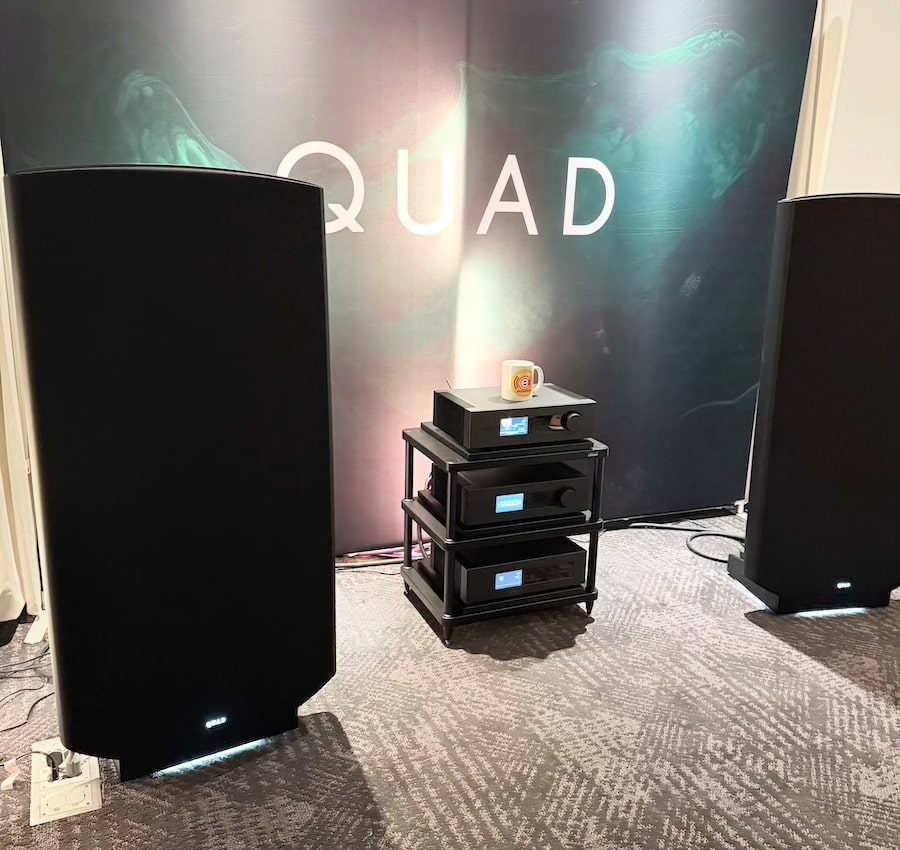
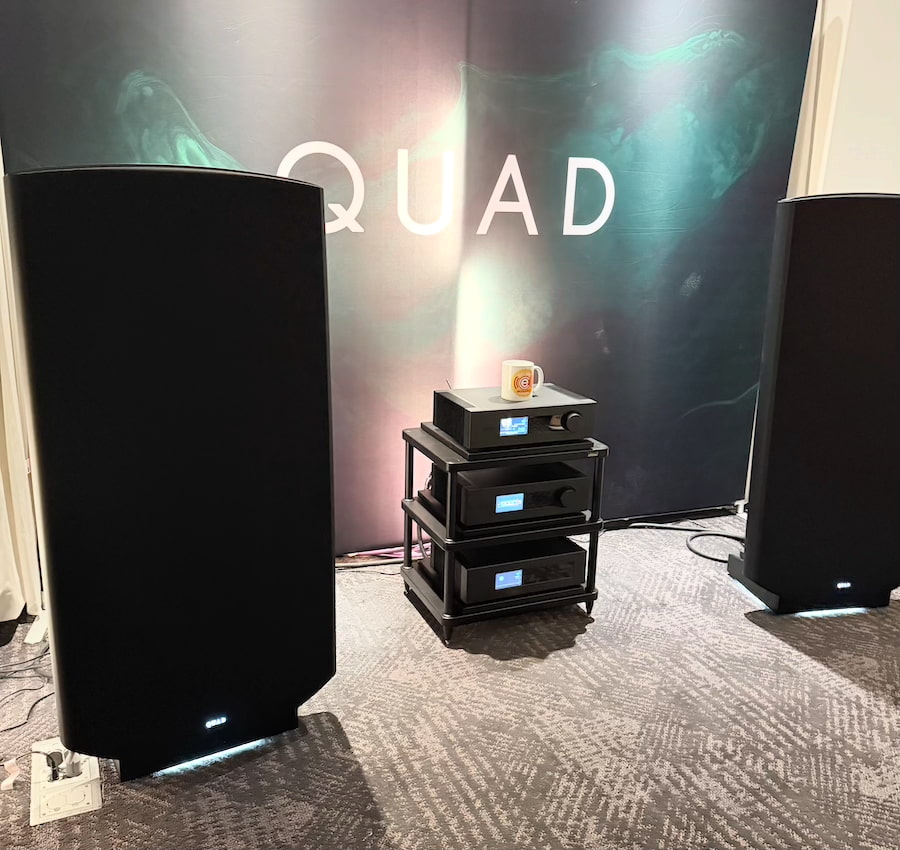
Recorded from the show floor at AXPONA 2026, this episode brings together Cornelius and Jamie O’Callaghan of the IAG Hi-Fi Division for a deep dive into the legacy and future of QUAD’s electrostatic loudspeakers, including the ESL 2912X. We break down what makes electrostatic panel speakers fundamentally different from traditional designs, why QUAD has remained committed to the technology for decades, and how the latest generation improves on transparency, dispersion, and real world usability. The conversation also explores how these iconic speakers fit into a modern hi-fi landscape increasingly dominated by compact and wireless solutions, and why QUAD continues to attract listeners who care more about realism than convenience.
This episode was recorded on April 10, 2026 (the first day of AXPONA 2026).
Where to listen:
On the Panel:
Related Links:
Credits:
Tech
Seattle-area billboard takes a page from Bay Area playbook: ‘Startup energy should be more visible’


A Bellevue, Wash.-based startup that came out of stealth last fall is really trying to get noticed now, taking a page out of a playbook that’s more prevalent in Silicon Valley.
Summation is an AI platform that helps enterprise leaders draw insights from large volumes of internal data. A bright orange billboard visible from SR 520 doesn’t say that, but it does put the company’s name in sight of drivers — many of whom potentially work in tech — heading east along the highway.
“We’re building Summation here in Bellevue, and wanted to do something a little bold and a little playful — for recruiting, for awareness, and because startup energy should be more visible around here,” CEO Ian Wong told GeekWire.
Wong is the former CTO of real estate giant Opendoor and Square’s first data scientist. He co-founded Summation in 2024 with Ramachandran “RC” Ramarathinam, who led Opendoor’s core transaction platform.
Summation raised $35 million in funding from Benchmark and Kleiner Perkins in October.
Tech company billboards are a big part of the landscape in the San Francisco Bay Area. Signs advertise a whole new era of AI-focused startup names and products. Last summer, The New York Times published a fun quiz challenging readers to decode what some of the billboards were even selling around Silicon Valley.
Wong said capturing a slice of that energy was part of the point with his company’s billboard in Bellevue, which went up about two weeks ago near the Burgermaster restaurant along Northup Way.
“In SF, startup ambition is just visible — on 101, on the sides of buildings, in every coffee shop,” he said. “The Seattle/Bellevue area has world-class technical talent, but the scene here has always been understated. We wanted to put up a small signal that ambitious things are being built on this side of the lake, too — and if you want to work on one of them, come find us.”
Bellevue-based startup Stasig used a reverse tactic back in 2024 when it launched an aggressive campaign to spread its name across the Bay Area with more than 200 billboards and posters at transit shelters and stations.
Summation employs about 35 people right now and is hiring across engineering, product, and go-to-market.
Summation’s platform sits on top of data systems and runs massive calculations automatically, testing different scenarios and using AI agents to explore different questions in parallel. The software also automates financial reconciliations, variance analysis, and management reporting.
The advertising lines up with what Wong called “a big product release” coming next week.
“Always be hiring,” he said. “And selling.”


Robert Walters research suggests that many Irish organisations are lacking a clear leadership succession plan.
Leadership often defines an organisation and Robert Walters has published data indicating that a number of companies are not as prepared for upcoming changes as they should be.
The report found that, of those who contributed their data, just 16pc of organisations have a leadership succession plan in place. More than 40pc of Irish companies have no plan in place whatsoever and 7pc are unsure whether one currently exists or not. At the same time, 72pc of Irish leaders said they have a shortage of senior talent, with half describing the shortage as significant.
“There is a clear gap between how concerned organisations are about senior talent shortages and how prepared they are for leadership change,” said Suzanne Feeney, the country manager at Robert Walters Ireland.
She added: “In many organisations, succession planning has historically been handled informally. But they are now operating in a far more complex environment than they were even a few years ago.
“Advances in artificial intelligence, geopolitical uncertainty and economic pressures are all contributing to more frequent leadership transitions. With only one in five businesses having an established succession plan, many are leaving themselves exposed to significant operational risk.”
Pipeline pressures
Securing and retaining skilled professionals is a key issue for employers in 2026. The recent Data Salaries & Job Sentiment Analysis 2026 report, published by Analytics Institute and SAS, highlighted the growing challenges being experienced by organisations looking to expand their data capabilities.
The report found that 64pc of organisations have future plans to increase the size of their data teams, whereas 70pc of professionals explained that they are unlikely to change employers this year.
Commenting on the Robert Walters report, Adam Gordon, the global head of talent development at Robert Walters, said: “Leadership continuity can be a challenge for organisations of every size, from SMEs to the world’s most recognised brands.
“Senior talent is one of the hardest resources to replace and finding the right long-term successor can take time. Interim leaders can play a valuable role here by maintaining stability and ensuring critical decisions continue to move forward while organisations assess their long-term options.”
Robert Walters’ research also points to challenges in the development of future leaders, with the report suggesting that nearly two-fifths (38pc) of participants are struggling to identify and develop strong successors within their business.
Feeney said: “Many organisations have talented people internally, but identifying future leaders early and giving them the right development opportunities takes deliberate effort.
“At its core, succession planning is about future-proofing the organisation, building a strong leadership pipeline comprising internal progression and external hiring to ensure organisations have the resilience they need for the long term.”
Undoubtedly, the working landscape for modern-day employees is evolving quickly in 2026. An earlier report from Robert Walters, at the start of the year, found that changes in remote and in-person arrangements could compel skilled employees to increase their engagement in the workplace.
More than half (59pc) of contributing Irish employees said that they want their place of employment to adopt a microshifting schedule, with Feeney noting that microshifting has the potential to increase engagement, accountability and even time spent in the office.
Don’t miss out on the knowledge you need to succeed. Sign up for the Daily Brief, Silicon Republic’s digest of need-to-know sci-tech news.

Over the weekend, hackers stole more than $290 million in cryptocurrency from Kelp DAO, a protocol that allows users to earn yields on idle crypto investments.
By Monday, LayerZero, one of the projects affected by the hack, accused North Korea of carrying out the heist. The hack is now the largest crypto theft of the year so far, following an earlier hack at crypto exchange Drift in April netted hackers around $285 million.
Per its post on X, LayerZero said the hackers exploited Kelp DAO via its LayerZero bridge, which allows different blockchains to send instructions to each other. The hackers then took advantage of Kelp’s own security configuration, which did not require multiple verifications before approving transactions. That allowed the hackers to siphon off the funds with fraudulent transactions.
The company cited “preliminary indicators” that point to North Korea as the culprit, in particular its hacking group that targets crypto known as TraderTraitor.
Kelp DAO responded to LayerZero blaming it for the theft instead.
In the last few years, North Korean hackers working for Kim Jong Un’s regime have become highly successful at stealing crypto. Last year, North Korean hackers stole more than $2 billion in crypto. Overall, since 2017, the total amount of stolen crypto by North Korea is said to be around $6 billion.

An anonymous reader quotes a report from Bloomberg, written by writer Austin Carr: Allbirds is pivoting to artificial intelligence. The San Francisco brand, whose wool running shoes were once the sneaker du jour among the tech crowd, announced last week that it was expanding into AI computing infrastructure. The bizarre strategic shift was immediately greeted with a surprising frenzy on Wall Street, where shares of Allbirds soared 582% last Wednesday before dropping the next day. […] Of course, the absurdity of Allbirds’ situation echoed familiar Silicon Valley tropes — from the endless startup pivots of the 2010s to the more recent boom-and-bust cycles of arbitrarily valued crypto coins. But it immediately reminded me of the marketing ploys of the dot-com crash. After all, some of the more iconic fails ended up being retailers such as Pets.com, Webvan, etc., riding the web wave with little to show for it beyond terrible margins.
One particular comparison from that period stands out as relevant to Allbirds: Zap.com. The holding company behind it, Zapata Corp., had a long and convoluted history, but was essentially selling fish-oil products by the time it decided to reinvent itself as an internet portal. It amassed a variety of web properties — in media, e-commerce, gaming and so on — and even once tried to acquire the search engine Excite. Spoiler alert: Zap flopped. Jen Heck, then a young employee at one of Zap’s up-and-coming portfolio entities, remembers how quickly the hype of that web 1.0 turned to hell. As absurd as Zapata’s pivot sounds today, it seemed feasible during the excitement of the internet revolution. “We went from like, ‘Wow, this life thing is just so easy,’ to it all ending so suddenly,” Heck recalls. The ones who survived that tech bubble, she says, actually had differentiated products and the right creative thinkers building them — and weren’t just cynically jumping on the latest hot trend. “‘Internet’ was the magic word then, and ‘AI’ is the magic word now,” Heck says.
The “AI has killed software” narrative has a handful of very loud beneficiaries and a lot of quiet evidence against it. The companies that will survive the next five years are the ones that refuse to treat the hyperscalers as the new gods.
Whenever I make an affirmation, I like to do my research first, and not to sound like a LinkedIn post. I wish more people in this industry did the same, as there is a prevailing mood where we think that big numbers are the whole story.
When the Black Death came among us, people probably thought it was the end. When wars came to our societies, people thought it was the end. Yet, in a strange way, we have a natural power to overcome obstacles and turn change to our advantage.
When AI started to infiltrate our work, and later our personal lives, a large group of people declared that “AI will replace people,” that this technology, not even particularly new, would conquer our brains, hearts, and work, and lead us where it wanted.
Yet we are still working; people are still writing, thinking, creating, building.

The 💜 of EU tech
The latest rumblings from the EU tech scene, a story from our wise ol’ founder Boris, and some questionable AI art. It’s free, every week, in your inbox. Sign up now!
In the last two years, more and more people have been saying that “SaaS is dead.” Of course, this phrase came from someone’s mouth, someone with enough influence to shape general opinion, and everybody was already in black, ready for the funeral.
In August 2024, Klarna’s chief executive, Sebastian Siemiatkowski, sat on an earnings call and mentioned, almost in passing, that the Swedish fintech had “shut down Salesforce.” Workday was next.
Klarna would build its own AI-driven replacements, a lightweight stack unshackled from the bloat of traditional enterprise software. The quote moved markets. Articles followed with headlines about the death of SaaS. Salesforce’s Marc Benioff, on stage at Dreamforce, was asked to respond to a customer who had apparently decided the future was AI and the past was his product. He looked, by his own admission, embarrassed.
Six months later, Siemiatkowski quietly clarified what had actually happened. Klarna had not replaced Salesforce with AI. It had replaced Salesforce with other SaaS: Deel for HR, third-party tools for CRM, the Swedish graph database Neo4j for data consolidation.
Klarna still uses Slack, which is still a Salesforce product. Siemiatkowski himself admitted on X that he was “tremendously embarrassed” by how the story had spiralled.
“No,” he wrote, “we did not replace SaaS with an LLM.”
This is the single most instructive story in enterprise software of the past two years. The distance between what was said and what was done reveals the mechanics of the entire “SaaS is dead” narrative. The headline travelled. The correction did not.
An industry of analysts, venture capitalists, and foundation model CEOs built a year of marketing on the louder half.
Start by asking who gains from the story that software-as-a-service is being replaced by artificial intelligence, because the answer is surprisingly narrow. The hyperscalers do, because AI workloads justify the $660 to $690 billion in capital expenditure the five largest US cloud and technology companies have committed for 2026, according to Futurum Group analysis, nearly double the previous year.
The foundation model labs benefit, because every dollar of enterprise software spend redirected to their APIs validates valuations that are otherwise difficult to defend. OpenAI ended 2025 at around $20 billion in annual recurring revenue. Anthropic crossed $9 billion in January 2026. These are genuinely large numbers. They are also, respectively, about three per cent and a little over one per cent of the hyperscaler capex being spent to serve them.
The venture capitalists benefit because their portfolio repricing depends on the narrative that AI-native companies will outrun the incumbents they once funded. And Nvidia, supplier and financier of the boom, benefits until it no longer does.
In March 2026, CEO Jensen Huang confirmed that his recent investments in OpenAI and Anthropic would likely be the last. The circular financing, Nvidia invests in OpenAI, OpenAI buys Nvidia chips, had reached the point where even the chipmaker was ready to stop calling it a virtuous cycle.
MIT’s Michael Cusumano, quoted by Bloomberg, put the arithmetic bluntly: “Nvidia is investing $100 billion in OpenAI stock, and OpenAI is saying they are going to buy $100 billion or more of Nvidia chips.”
You could call that demand. You could also call it bookkeeping.
The 95% number that should have ended the hype
The harder question is whether any of this is producing business results. Here the data is less generous than the pitch decks.
In July 2025, MIT’s Project NANDA published “The GenAI Divide: State of AI in Business 2025”, based on 150 executive interviews, 350 survey responses, and analysis of 300 public AI deployments. Its headline finding: despite roughly $30 to $40 billion in enterprise generative AI spending, 95% of pilots delivered no measurable impact on profit and loss. Only 5% reached production.
The response from the industry was not to recalibrate. It was to argue that the wrong metric was being used. UC Berkeley published a rebuttal suggesting ROI was an “industrial-era” measurement unsuited to a “cognitive-era transformation.”
This is what every hype cycle says in its late phase, that profit is a distraction, that what is being built is too large for ordinary standards. The same argument was made about WeWork, the metaverse, and blockchain.
Each time, the underlying assumption was that the people with capital and megaphones understood the future better than the people actually trying to run a business.
The 5% of AI projects that did succeed, MIT found, shared specific traits. They were built by specialised vendors, not attempted internally. They focused on back-office automation rather than sales theatre. They integrated deeply with existing workflows. Over half of enterprise AI budgets, meanwhile, were going to sales and marketing tools where ROI was lowest.
This is not a revolution sweeping through the enterprise. It is a lot of companies buying demo-friendly products that do not produce returns, while a minority does the unglamorous integration work that quietly extracts value.
The collapse that did not collapse
Stil, I have to admit that there are genuine signs of stress in the SaaS market. In February 2026, roughly $285 billion in market value evaporated from software stocks in a single trading session, what Wall Street christened the “SaaSpocalypse.”
ServiceNow fell 7%. Intuit dropped 11%. LegalZoom lost nearly 20%. Salesforce is down approximately 30% year-to-date. The business rationale, that per-seat pricing starts to collapse when one employee with AI tools can do the work of five, is not wrong.
But Bain & Company, looking at the broader record, has offered a useful correction: technological transitions rarely produce extinction.
They produce heterogeneity. Desktop survived mobile. Cloud did not kill on-premise so much as push it into specialised niches. The history of software is a history of layers accumulating, not replacing.
SaaS vendors are becoming agent-orchestration platforms. Salesforce has Agentforce. HubSpot has AI tools. Snowflake partners with Anthropic. The incumbents are being forced to adapt, but adaptation is not death.
IDC’s European practice framed it precisely in February: “SaaS is not dead, but it is metamorphosing.”
Pricing shifts towards outcomes. Interfaces become more agent-driven. But the real business logic, the auditing, versioning, compliance, and data gravity, remains where it was. The transformation is real. The extinction event is marketing.
The new gods are not new
Every major technology wave produces a brief period in which the companies at its centre are treated as reinventors of reality. For the cloud, it was AWS. For mobile, Apple. Before that, Microsoft.
The rhetoric around big techs like Nvidia, OpenAI, Anthropic, Meta, and xAI has the same cadence: they are building the new infrastructure of civilisation, rewriting how humans work, inevitable. There is a grain of truth in it. AI, and agentic AI in particular, is a real technological step.
The companies most likely to thrive are the ones already disciplined enough to recognise the pattern. Every enterprise that survived the dot-com crash, the mobile transition, and the cloud migration did so by adopting what was useful and ignoring what was hyped, by measuring outcomes against costs, by refusing to treat platform vendors as infallible.
The companies that went under bought the whole story: that their customers would wait while they rebuilt, that the new paradigm would reward early and total commitment.
We reported in February on a pattern now visible across dozens of SaaS companies between $20 million and $80 million in ARR: shipping AI features while net revenue retention quietly collapses.
Eighteen months after going “AI-first,” one company watched its NRR drop from 108% to 94% and lost $2.8 million in renewals, not because the product got worse, but because everyone was building the future and nobody was watching the present. The AI features were legitimately good. The existing customers churned anyway.
None of this is an argument against AI. Previous AI cycles ended with research freezes, shuttered startups, and survivors who had been quietly doing useful work while everyone else claimed the moon. This cycle will likely end similarly.
Some hype will turn out to be real. Most revenue projections will not. A handful of current “AI-native” startups will become durable businesses. Many will be absorbed or exposed as wrappers.
The companies that come through refuse both extremes. They do not miss the trend, because dismissing AI in 2026 is as serious a strategic error as dismissing mobile was in 2010. And they do not drown in it. They do not empty their engineering teams into AI-first rebrands while their existing revenue base walks out the door. They do not treat the big tech companies as gods, but as what they are: very large commercial entities with very specific interests in what you believe about the future.
Klarna, for the record, is still paying for SaaS. It is also still paying OpenAI. This is probably the honest shape of the future: not the death of anything, but a quieter rearrangement in which the winners are the operators who kept their feet on the ground while everyone else was watching the sky.
The funeral for SaaS has been extremely well-attended. The corpse, on closer inspection, is still breathing.

Crypto World6 seconds ago
Vance Heads to Pakistan Alone
Entertainment1 minute ago
Taylor Frankie Paul, Dakota Mortensen speak out after learning she won't face new domestic violence charges

Politics3 minutes ago
Reform candidates are making promises they can’t keep

NewsBeat4 weeks ago
Manchester United reach agreement with Casemiro over contract clause amid transfer speculation

NewsBeat3 weeks ago
Steven Gerrard disagrees with Gary Neville over ‘shock’ Chelsea and Arsenal claim | Football

Politics1 week ago
US brings back mandatory military draft registration

News Videos4 minutes ago
‘Financial Crisis’ Zone; Trader’s Warning For Gold, Stocks, Bitcoin | Gareth Soloway

News Videos18 minutes ago
Live Crypto And Gold Scalping Trading | 19 April 2026 #cryptoscalping #xauusdlive

News Videos39 minutes ago
They’re Lying to You About Crypto. Here’s What Comes Next.
-

 NewsBeat6 days ago
Trump and Pope Leo: Behind their disagreement over Iran war
-

 Fashion3 days ago
Weekend Open Thread: Theodora Dress
-

 Crypto World7 days ago
SEC Signals Exemption for Crypto Interfaces From Broker Registration
-

 News Videos5 days ago
Secure crypto trading starts with an FIU-registered
-

 Sports3 days ago
NWFL Suspends Two Players Over Post-Match Clash in Ado-Ekiti
-

 Crypto World7 days ago
SEC Proposes Certain Crypto Interfaces Don’t Need to Register as Brokers
-

 Business1 day ago
Powerball Result April 18, 2026: No Jackpot Winner in Powerball Draw: $75 Million Rolls Over
-

 Crypto World3 days ago
Russia Pushes Bill to Criminalize Unregistered Crypto Services
-

 Politics3 days ago
Palestine barred from entering Canada for FIFA Congress
-
 Business4 days ago
Creo Medical agree sale of its manufacturing operation
-

 Politics1 day ago
Zack Polanski demands ‘council homes not luxury flats for foreign investors’
-
 Entertainment7 days ago
Brand New Day’ Footage Reveals the Devastating Impact of ‘Now Way Home’
-

 Crypto World3 days ago
Russia Introduces Bill To Criminalize Unregistered Crypto Services
-

 Tech6 days ago
Microsoft adds Windows protections for malicious Remote Desktop files
-
 Entertainment7 days ago
Karol G’s ‘Ultra Raunchy’ Coachella Set Gave ‘Satanic Vibes’
-

 Entertainment7 days ago
How Babylon 5 Turned Brief Side Story Into Emotional Masterpiece
-

 Tech5 days ago
‘Avatar: Aang, The Last Airbender’ Leaked Online. Some Fans Say Paramount Deserves the Fallout
-
 Crypto World7 days ago
Senate Bill Faces Delay Over Stablecoin Yield Debate
-

 Tech7 days ago
What was the first ransomware attack to demand payment in Bitcoin?
-

 Tech2 days ago
Auto Enthusiast Scores Running Tesla Model 3 for Two Grand and Turns It Into Bare-Bones Go-Kart
You must be logged in to post a comment Login