Connect with us
DAPA Banner

Tech

UK Politicians Continue To Miss The Point In Latest Social Media Ban Proposal

Published

on

from the does-no-one-remember-being-a-teen? dept

The UK is moving forward with its efforts to ban social media for young people. Ahead of this week’s House of Lords debate on the topic, we’re getting you situated with a primer on what’s been happening and what it all means.

What was the last vote about? 

On 9 March, the House of Commons discussed amendments tabled by the House of Lords in the government’s flagship legislation, the Children’s Wellbeing and Schools Bill. 

The House of Lords previously tabled an amendment to “prevent children under the age of 16 from becoming or being users” of “all regulated user-to-user services,” to be implemented by “highly-effective age assurance measures,” which effectively banned under-16s from social media. When this proposal came before the House of Commons, MPs defeated it by 307 votes to 173. 

Instead, the Commons proposed its own amendment: enabling the Secretary of State to introduce provisions “requiring providers of specified internet services” to prevent access by children, under age 18 rather than 16, to specified internet services or to specified features; and to restrict access by children to specified internet services which ministers provide. 

Advertisement

Who does this give powers to?

The Commons proposal redirects power from the UK Parliament and the UK’s independent telecom regulator Ofcom to the Secretary of State for Science, Innovation and Technology, currently Liz Kendall, who will be able to restrict internet access for young people and determine what content is considered harmful…just because she can. The amendment also empowers the Secretary of State to limit VPN use for under 18s, as well as restrict access to addictive features and change the age of digital consent in the country; for example, preventing under-18s from playing games online after a certain time.  

Why is this a problem? 

This process is devoid of checks or accountability mechanisms as ministers will not be required to demonstrate specific harms to young people, which essentially unravels years-long efforts by Ofcom to assess online services according to their risks. And given the moment the UK is currently in, such as refusing to protect trans and LGBTQ+ communities and flaming hostile and racist discourses, it is not unlikely that we’ll see ministers start restricting content that they ideologically or morally feel opposed to, rather than because the content is harmful based, as established by evidence and assessed pursuant to established human rights principles. 

We know from other jurisdictions like the United States that legislation seeking to protect young people typically sweeps up a slew of broadly-defined topics. Some block access to websites that contain some “sexual material harmful to minors,” which has historically meant explicit sexual content. But some states are now defining the term more broadly so that “sexual material harmful to minors” could encompass anything like sex education; others simply list a variety of vaguely-defined harms. In either instance, this bill would enable ministers to target LGBTQ+ content online by pushing this behind an under-18s age gate, and this risk is especially clear given what we already know about platform content policies. 

How will this impact young people? 

The internet is an essential resource for young people (and adults) to access information, explore community, and find themselves. Beyond being spaces where people can share funny videos and engage with enjoyable content, social media enables young people to engage with the world in a way that transcends their in-person realm, as well as find information they may not feel safe to access offline, such as about family abuse or their sexuality. In severing this connection to people and information by banning social media, politicians are forcing millions of young people into a dark and censored world. 

Advertisement

How did each party vote? 

The initial push to ban under-16s from social media came from the Conservative Party, who have since accused the UK’s Prime Minister Keir Starmer of “dither and delay” for not committing to the ban. The Liberal Democrats have also called this “not good enough.” The Labour Party itself is split, with 107 Labour Party MPs abstaining in the vote on the House of Lords amendment. 

But we know that the issue of young people’s online safety is a polarizing topic that politicians have—and will continue to—weaponize for public support, regardless of their actual intentions. This is why we will continue to urge policymakers and regulators to protect people’s rights and freedoms online at all moments, and not just take the easy route for a quick boost in the polls.

How does this bill connect to the Online Safety Act?

The draft Children’s Wellbeing and Schools Bill that came from the Lords provided that any regulation pertaining to the well-being of young people on social media “must be treated as an enforceable requirement” with the Online Safety Act. The Commons amendment, however, starts out by inserting a new clause that amends the Online Safety Act. 

For more than six years, we’ve been calling on the UK government to pass better legislation around regulating the internet, and when the Online Safety Act passed we continued to advocate for the rights of people on the internet—including young people—as Ofcom implemented the legislation. This has been a protracted effort by civil society groupstechnologiststech companies, and others participating in Ofcom’s consultation process and urging the regulator to protect internet users in the UK.

Advertisement

The MPs amendment essentially rips this up. Technology Secretary Liz Kendall recently said that ministers intended to go further than the existing Online Safety Act because it was “never meant to be the end point, and we know parents still have serious concerns. That is why I am prepared to take further action.” But when this further action is empowering herself to make arbitrary decisions on content and access, and banning under-18s from social media, this causes much more harm than it solves. 

Is the UK alone in pushing legislation like this? 

Sadly, no. Calls to ban social media access for young people have gained traction since Australia became the first country in the world to enforce one back in December. On 5 March, Indonesia announced a ban on social media and other “high-risk” online platforms for users under 16. A few days later, new measures came into effect in Brazil that restricts social media access for under-16s, who must now have their accounts linked to a legal guardian. Other countries like Spain and the Philippines have this year announced plans to ban social media for under-16s, with legislation currently pending to implement this.

What are the next steps?

The Children’s Wellbeing and Schools Bill returns to the House of Lords on 25 March for consideration of the new Commons amendments. The bill will only become law if both Houses agree to the final draft. 

We will continue to stand up against these proposals—not only to young people’ free expression rights, but also to safeguard the free flow of information that is vital to a democratic society. The issue of online safety is not solved through technology alone, especially not through a ban, and young people deserve a more intentional approach to protecting their safety and privacy online, not this lazy strategy that causes more harm than it solves. 

Advertisement

We encourage politicians in the UK to look into what is best, not what is easy, and explore less invasive approaches to protect all people from online harms. 

Republished from the EFF’s Deeplinks blog.

Filed Under: social media, social media ban, teens, uk

Advertisement

Source link

Continue Reading
Click to comment

You must be logged in to post a comment Login

Leave a Reply

Tech

German authorities identify REvil and GangCrab ransomware bosses

Published

on

German authorities identify REvil and GangCrab ransomware bosses

The Federal Police in Germany (BKA) has identified two Russian nationals as the leaders of GandCrab and REvil ransomware operations between 2019 and 2021.

According to BKA’s disclosure, 31-year-old Daniil Maksimovich Shchukin and 43-year-old Anatoly Sergeevitsch Kravchuk acted as the heads of the two ransomware groups “from at least the beginning of 2019 until at least July 2021.”

Shchukin hid behind the monikers UNKN/UNKNOWN for years, posting on cybercrime forums and speaking as a representative of the ransomware operation.

Wiz

The German authorities say that Shchukin and Kravchuk participated in at least 130 extortion cases targeting companies in the country specifically.

Following these attacks, at least 25 victims paid Shchukin and his co-conspirators $2.2 million in ransom, while the total financial damage caused by them is estimated in excess of $40 million.

Advertisement

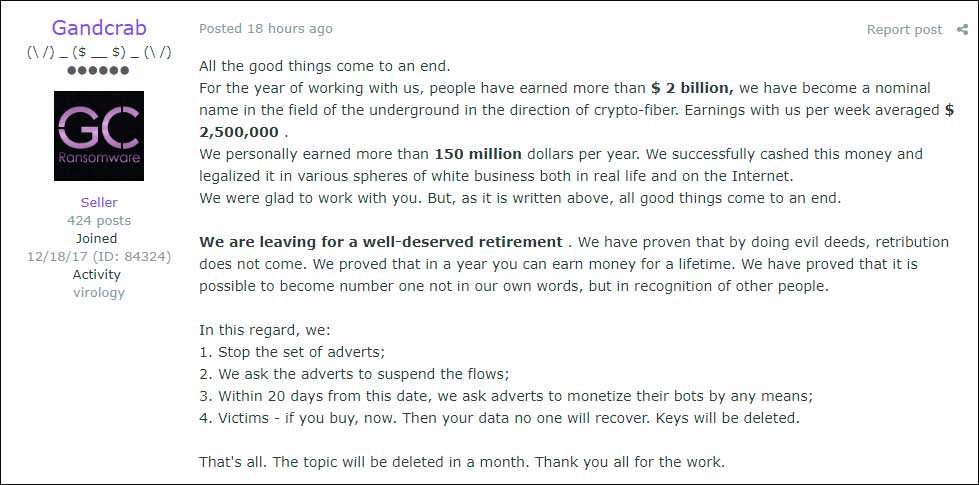
GandCrab started in early 2018, and its leader at the time decided to retire in June 2019, after claiming to have earned $2 billion from ransom payments. The leader, however, cashed out with $150 million, which they claimed to have invested in legal businesses.

GandCrab leader announcing their retirement
GandCrab leader announces retirement
source: BleepingComputer

Soon after, a new operation called REvil emerged, following the affiliate model established by GandCrab through advertising and building partnerships with cybercriminals.

REvil, also known as Sodinokibi, was formed from previous GandCrab affiliates and operators who had already learned the successful tactics and started to apply them to their operations.

REvil later added public leak sites and ran data auctions to pressure victims. Notable victims include multiple Texas local governmentscomputer giant Acer, and the Kaseya supply-chain attack that impacted around 1,500 downstream victims.

Following the massive Kaseya hack, REvil took a two-month break, during which law enforcement breached their servers and started to monitor operations.

Advertisement

Multiple infrastructure disruptions were recorded at the time, and in mid-January 2022, Russia arrested more than a dozen REvil gang members, who were released in 2025 after time served on carding charges.

It is unclear if either Shchukin or Kravchuk joined other ransomware operations following REvil’s demise in 2021.

BKA believes that Shchukin and Kravchuk are now in Russia and asks the public to share any information that could lead to their whereabouts. Relevant entries were also created on the EU’s Most Wanted portal.

The police shared several images, including tattoo photos, to help track down the two threat actors and bring them to justice.

Advertisement

Automated pentesting proves the path exists. BAS proves whether your controls stop it. Most teams run one without the other.

This whitepaper maps six validation surfaces, shows where coverage ends, and provides practitioners with three diagnostic questions for any tool evaluation.

Source link

Continue Reading

Tech

One of Our Favorite 360 Cams Is 35 Percent Off

Published

on

Tired of taking your action camera on an adventure, only to get home and find out you missed the action with a bad angle? One option is to switch to a 360-degree action cam, so you can capture all of the action and then edit down to just the good stuff later. One of our favorite options, the DJI Osmo 360, is currently available for just $390 on Amazon, a $209 discount from its usual price, and it comes with a selfie stick and an extra battery.

The DJI Osmo 360 achieves its impressive all-around video quality by leveraging a pair of 1/1.1-inch sensors, larger than some other offerings, and by supporting 10-bit color. You can really see that in the camera’s output, with colors that are vivid and bold, to the point that you may need to dial them back a bit in post if you want something more natural. With support for up to 50 frames per second at 8K when recording in 360 degrees, or 120 fps at 4K when shooting with only one sensor, you’ll have plenty of material to work with. In our testing, it ran for just shy of two hours at 30 fps, which is also around the time the internal storage had filled up anyway.

If you plan on catching any serious discussions with your Osmo 360, you’ll be pleased to know it connects directly to DJI’s line of wireless lavalier microphones, including the excellent and frequently discounted DJI Mic 2 and Mic Mini. If you want to mount it to something other than the included 1.2-meter selfie stick, it has both DJI’s magnetic attachment system and a more traditional ¼”-20 tripod mount. The DJI Mimo app lets you control the camera and adjust any settings, and there’s even a simple editor for on-the-fly production. For desktop users, DJI Studio has even more in-depth settings and editing options, in case you don’t want to pay for Premiere.

The DJI Osmo 360 is one of our favorite action cameras, and is particularly appealing at the discounted price point, but make sure to check out our full review for more info, or head over to our full roundup to see what else is available.

Advertisement

Source link

Continue Reading

Tech

The League of Legends KeSPA cup will air globally on Disney+

Published

on

Disney has inked a deal with the Korea Esports Association that will bring several gaming tournaments to the its streaming platform. Disney+ will be the global live streaming home for Esports Champions Asia Jinju 2026, the 2026 League of Legends KeSPA CUP and some preliminary events ahead of the 20th Asian Games Aichi-Nagoya 2026. This agreement expands KeSPA’s arrangement with Disney, which only streamed its esports events to viewers in Asia last year.

Esports Champions Asia is the first event on the calendar, occurring April 24-26 with professional teams from across the continent squaring up in tournaments for games including Street Fighter 6, The King of Fighters XV, TEKKEN 8 and the eFootball series. Disney+ will also be an official streamer for the PUBG Mobile and Eternal Return competitions during that weekend.

It could be helpful for western esports fans to have a single location for watching the major events happening in Asia. However, many tournaments are currently free to watch on Twitch or YouTube, so now needing a Disney+ subscription to catch some of these international competitions might feel onerous. Esports might run the risk of turning into the fragmented set of rights deals that plagues traditional sports leagues, where a game could be on one of a half dozen different paid services each night. It’s also likely going to mean co-streamers take a hit to their viewership, since Disney seems unlikely to offer the same sort of broadcast access that has made the practice popular on Twitch.

Source link

Advertisement
Continue Reading

Tech

So Expensive, A Caveman Can Do It

Published

on

A few years back a company had an ad campaign with a discouraged caveman who was angry because the company claimed their website was “so easy, even a caveman could do it.” Maybe that inspired [JuliusBrussee] to create caveman, a tool for reducing costs when using Claude Code.

The trick is that Claude, like other LLMs, operates on tokens. Tokens aren’t quite words, but they are essentially words or word fragments. Most LLM plans also charge you by the token. So fewer tokens means lower costs. However, LLMs can be quite verbose, unless you make them talk like a caveman.

For example, here is some normal output from Claude:

Sure! I’d be happy to help you with that. The issue you’re experiencing is most likely caused by your authentication middleware not properly validating the token expiry. Let me take a look and suggest a fix.

After Caveman that is reduced to:

Advertisement

Bug in auth middleware. Token expiry check use < not <=. Fix:

Turns out, you can understand the caveman output just fine.

There are a few rules. Caveman removes filler words, but knows to keep technical terms, code blocks, and error messages intact. It also outputs normal messages for things like commits.

As the website says: “Caveman not dumb. Caveman efficient. Caveman say what need saying. Then stop. If caveman save you mass token, mass money — leave mass star.”

If you want to code with an LLM, make sure you understand the terms of service. If you want to learn more about how LLMs work with tokens and other details, but want to skip the math, we can help with that.

Advertisement

Source link

Continue Reading

Tech

Apple may have scraped YouTube videos without permission for AI training

Published

on

A collection of YouTube channels are suing Apple under the provisions of the DMCA, with the company accused of scraping videos from YouTube and using them to train internal AI models.

Glowing multicolored looped ribbon forming a rounded star shape around a dark central hexagon, on a deep maroon background with subtle reflection below
Apple is accused of scraping YouTube to train its video AI models.

In a lawsuit filed on April 3 at the United States District Court for the Northern District of California, a trio of YouTube entities are suing Apple over allegations of copyright infringement. Apple is accused of violating the Digital Millennium Copyright Act (DMCA), all to collect footage to train its AI models.
The class-action lawsuit is headed up by Ted Entertainment, owners of the h3h3Productions channels and podcast. Two golf channels accompany Ted Entertainment, with MrShortGameGolf and Golfholics also involved in the legal action.
Continue Reading on AppleInsider | Discuss on our Forums

Source link

Continue Reading

Tech

Border Patrol Agents Sold Challenge Coins With ‘Charlotte’s Web’ Characters in Riot Gear

Published

on

US Border Patrol agents are raising money by selling coins that commemorate last year’s wave of immigration enforcement “operations” across the country, along with other merchandise. The funds are for nonprofit organizations that list Border Patrol buildings as their address in IRS paperwork. At least two of the organizations have dedicated US Customs and Border Protection email addresses.

The front side of one coin for sale reads, “NORTH AMERICAN TOUR 2025,” along with the acronyms for US Border Patrol and the acronym for “fuck around and find out”—a phrase that was initially popularized by the far-right group the Proud Boys and has been used by various Trump officials. In the center, the coin depicts a gas mask, a riot control smoke grenade, and a pepper ball launcher. On the other side, the coin appears to have a portrait of Border Patrol’s now retired commander-at-large, Gregory Bovino, with his arm raised in a salute, along with the text “COMING TO A CITY NEAR YOU!” It lists seven cities, many of which actually saw federal enforcement surges in 2025: Chicago, Los Angeles, Memphis, Phoenix, Portland, Charlotte, and Atlanta.

The coin is for sale by Willcox Morale Welfare and Recreation, a nonprofit that the IRS most recently declared tax-exempt during the Biden administration and whose address on IRS paperwork matches that of the Willcox Border Patrol Station in Arizona. A request for comment sent to Willcox MWR’s dedicated CBP email address went unanswered.

Employees of the Department of Homeland Security, the parent agency for Border Patrol, are allowed to start private, not-for-profit employee associations within DHS, so long as they get formally recognized by the agency and follow certain rules. According to DHS policies, officially recognized groups can fundraise using government property and create merchandise with the agency’s name and logos–but they have to receive advance approval from the agency.

Advertisement

Willcox MWR is just one of several groups across the country that cater to Border Patrol agents and refer to themselves as MWRs, a reference to the US military’s “morale, welfare and recreation” programs. The groups tend to throw holiday events and retirement parties, and sometimes raise money for the families of agents going through hard times, including those not getting paid during the current shutdown.

Following the publication of this story, CBP spokesperson Hilton Beckham told WIRED that Willcox MWR and the other non-profits identified in our story had existed under previous administrations and had “received authorization to conduct limited commercial activities on CBP-occupied property.” Beckham said that the agency was in the process of updating its policies and procedures related to MWRs.

Many MWRs also sell customized medallions known as “challenge coins” that commemorate specific teams or events. While anyone, including CBP alumni, can design and sell coins, current DHS employees are not supposed to use government resources to sell ones that use the agency’s seals or logos without permission, or ones that the agency considers inappropriate or unprofessional.

Beckham, the CBP spokesperson, said, “CBP takes its branding and recognition policies seriously.” Beckham did not say whether the agency’s Publication and Branding Review Board, which is in charge of approving branded merchandise, greenlit “North American Tour” coin design.

Advertisement

Under Willcox MWR’s Facebook post about the “North American Tour” coin, someone named Juan Diego commented, “Sign up SDC BK5 MWR for 10.”

“Shoot us an email,” someone managing the Willcox MWR account replied, giving out what appeared to be a dedicated cbp.dhs.gov email address for the group.

SDC BK5 MWR, also a registered nonprofit, lists an address on its website that matches that of a government facility in Chula Vista, California. It says on its site that it was started by San Diego Sector Border Patrol agents and sells custom merchandise “designed to raise funds for morale and relief efforts.”

Source link

Advertisement
Continue Reading

Tech

Gas prices aren’t the only factor fueling used EV sales

Published

on

The most recent electric vehicle sales data provided a grim picture — at least for new EVs. Sales of new electric vehicles took a beating in the first quarter, falling some 28% year-over-year after the Trump administration axed the $7,500 consumer tax credit, according to Cox Automotive.

Used EVs are moving in the opposite direction. And a couple of accelerants have combined to supercharge those sales.

First-quarter used EV sales increased 12% compared with the same quarter last year, according to that same Cox Automotive report. There’s a bit of momentum over a shorter term too; used EV sales popped 17% between the fourth and first quarters.

The rising cost of gas — the average price is above $4 a gallon — has helped spur interest and sales of electric vehicles. But there’s another factor at play here as consumers seek out affordable options: an abundance of expiring leases, the Financial Times reported. EV leases were a popular choice in the early 2020s, and now that they’ve expired, hundreds of thousands of pre-owned EVs are entering the marketplace. And consumers are ready for them.

Advertisement

By the end of the year, EVs will account for 15% of all off-lease vehicles, double from 7.7% in the first quarter, the FT reported.

The ol’ economic principle of supply and demand remained steadfast; the surge of pre-owned vehicles helped push prices lower, giving those sales a further boost. That’s led to price parity — or close to it — with internal combustion vehicles. According to Cox Automotive, the average price of a used EV is $34,821 compared to $33,487 for the gas engine equivalent.

Techcrunch event

San Francisco, CA
|
October 13-15, 2026

Advertisement

Source link

Advertisement
Continue Reading

Tech

Modular Mechanical Keyboard Transformed Into A Compact Workstation

Published

on

3D printing is a staple of the hacker community. From decorative items to rugged functional parts, almost anything you can think of, can be printed. [anurag.id] shows us some classic 3D printing hacks by converting his keyboard into a compact workstation.

Like any hacker project, the initial idea is small: he decides the knob on his mechanical keyboard is boring, so he designs some alternatives. First, one “retro style” knob. Then, like any good project, the scope creep begins. He makes another knob, and another… by the end he has 6 different designs! But don’t worry, the scope can get even bigger. He decides his ipad needs a good stand on his desk–and what better place to put it than on the keyboard? Now it’s starting to look like a real little workstation. Finally, as a finishing touch, he adds some magnetically-attached wrist rests for a compact, ergonomic workstation.

Video after the break.

Advertisement

P.S.: Bonus points for the good video editing.

Source link

Advertisement
Continue Reading

Tech

Are Electric Bag Resealers the Key to Chip Freshness? I Tested 2 to Find Out

Published

on

If you’re anything like me, a trip to the grocery store is a joy ride for the taste buds. As soon as I get home, I tear into my finds and determine what will take priority when the urge to snack or nosh strikes. 

The result, unfortunately, is a sea of open bags that quickly lose their crunch and freshness. Chips and pretzels, for example, become stale, while bagged produce begins to wilt and brown. 

While there are vacuum-sealed bags and accompanying air-removal devices, nothing compares to the efficiency and ease of a handheld sealer. These simple gadgets are designed to fuse the open ends of plastic containers using quick heat to prolong food’s shelf life and general tastiness. 

Advertisement
bag sealers side by side

My small cohort of bag sealers, ready for testing. 

Joey Skladany/CNET

I tested two of the highest-rated models on Amazon to determine which deserves a permanent place in my kitchen. Here’s how they stacked up. 

The devices 

Upon opening each package, I was surprised to see that both models offer additional capabilities beyond sealing. Each uses USB-C for charging (with a cable included).

Advertisement

BBDYOY three-in-one mini bag sealer 

$12.99 on Amazon

bag sealer and charger on table

This cheaper bag sealer came to temperature almost immediately.

Joey Skladany/CNET

Special Features: Compact size, bag slicer, magnet

Advertisement

The good: 

  • Compact size: This was preferred over Aedicce, which felt a bit too bulky. It also takes up less space in a drawer or shelf.
  • The sealing surface area: The compartment where you insert the bag edge is deeper, which makes the device easier to use. 
  • No preheating: Unlike the Aedicce model, the BBDYOY heats up almost instantly. 
  • The cutter: It’s sharper than the Aedicce and opens bags with ease. 
  • Comes with two freebies: The company included two resealable, backpack-shaped bags, which are quite adorable for a kid’s school lunch. 

The bad: 

  • Instructions aren’t in English: While the illustrations were easy enough to decipher, the Mandarin characters can be a bit intimidating for anyone who considers themselves tech-averse. 
  • Difficulty sealing foil-lined bags: It had trouble sealing bags with metalized film-lined interiors. 

Aedicce four-in-one mini bag sealer 

$15.99 on Amazon

bag sealer on table

The Aedicce device took longer to heat up, but worked just as well once it did.

Joey Skladany/CNET

Special Features: Bag slicer, hanging hook/bottle opener, built-in light, magnet 

The good 

  • Multiple functions: Beyond sealing, this device hangs, opens bottles and provides an emergency light, giving customers more bang for their buck. 
  • A stronger seal: While it takes longer to heat up, I did notice the seal was ever so slightly stronger than BBDYOY’s. 
  • Power indicator light: You’ll know when the battery is running low, so it doesn’t die on you mid-use. 
  • High-quality: It feels and looks more expensive than the BBDYOY model. 
bag sealer sealing plastic bag of granola

Both devices worked well for sealing plastic bags.

Advertisement

Joey Skladany/CNET

The bad

  • It’s somewhat pricey: At $16, it’s certainly a significantly higher investment than a standard bag clip. 
  • Difficulty sealing foil-lined bags: It ran into the same issue as the BBDYOY and had trouble sealing this type of bag.
slightly open bag of chips shot from above

Both devices had trouble creating a tight seal on chip bags with a layer of vaporized aluminum. 

Joey Skladany/CNET

Final thoughts 

While both models worked well with fusing standard plastic, neither successfully sealed the metalized film commonly used in chip bags. My assumption is that this material is harder to melt and, ultimately, fuse together.

Though disappointing, it wouldn’t deter me from purchasing either product, as plastic clips can only do so much to keep open bags closed and free of air. That said, the aforementioned vacuum sealer will make any handheld device pale in comparison and should be the choice for bulky items or long-term freezer storage. 

Both bag releasers I tested performed equally well, creating a tight clamp on plastic bags but struggling to seal anything with a layer of vaporized aluminum. So, you can’t go wrong with either option. Splurge a bit more for the Aedicce if you want extra tools, but the BBDYOY works just as well and fits in smaller spaces when not in use. 

Advertisement

Source link

Continue Reading

Tech

Elgato Galleon 100 SD review: Mac productivity & streamer's dream

Published

on

The Elgato Galleon 100 SD combines a keyboard with the Stream Deck, producing a two-in-one productivity-focused peripheral that Mac users should really consider.

Black Corsair mechanical keyboard with teal backlit keys, integrated right-side macro pad with small screen and icons, two control knobs, on a light wooden desk.
Elgato Galleon 100 SD

Corsair subsidiary Elgato stands out as one of the leading manufacturers of peripherals and equipment tailored to the ever-growing market of streaming. From microphones to chairs to Stream Decks, Elgato is synonymous with top-tier equipment and streams across Twitch and YouTube.
Its latest offering, the Galleon 100 SD, sees Elgato taking a leap of faith. One to fully integrate the functionality of its rock-solid Stream Decks into a sturdy mechanical keyboard for work and play, bringing an all-in-one experience to streamers and multitaskers everywhere.
Continue Reading on AppleInsider | Discuss on our Forums

Source link

Continue Reading

Trending

Copyright © 2025