





Connect with us
DAPA Banner
DAPA Coin
DAPA
COIN PAYMENT ASSET
PRIVACY · BLOCKDAG · HOMOMORPHIC ENCRYPTION · RUST
ElGamal Encrypted MINE DAPA
🚫 GENESIS SOLD OUT
DAPAPAY COMING

Tech

Users turn to jailbreaking their older Kindles as Amazon ends support

Published

on

Many people are jailbreaking their Kindles following the news that Amazon is ending technical support for older models.

On May 20, Amazon will end support for the following Kindle devices:

  • Kindle 1st Generation
  • Kindle 2nd Generation
  • Kindle DX 
  • Kindle DX Graphite
  • Kindle Keyboard
  • Kindle 4
  • Kindle 5
  • Kindle Touch
  • Kindle Paperwhite 1st Generation
  • Kindle Fire 1st Generation 
  • Kindle Fire 2nd Generation 
  • Kindle Fire HD 7 
  • Kindle Fire HD 8.9

The move means users will only be able to use their devices to read content that’s already downloaded. So, naturally, people are jailbreaking them.

Jailbreaking refers to bypassing the software restrictions imposed by Amazon on Kindle devices. This process allows users to install custom fonts, new screensavers, alternative reading apps, and even third-party tools that expand the Kindle’s functionality.

However, it’s important to note that jailbreaking a Kindle might violate Amazon’s terms of service. In many jurisdictions, jailbreaking isn’t considered a criminal offense for personal use, but it may become a crime if it involves copyright infringement, illegal software distribution, or the sale of modified devices.

Advertisement

This guide is for informational purposes only. Always comply with the law and proceed with caution.

How are people jailbreaking older Kindles? 

Many Kindle owners who opt to jailbreak view it as a method to gain control over a device they purchased that is still functional, rather than being forced to buy a new device.

However, jailbreaking is technical and carries risks, including the possibility of rendering the device unusable if something goes wrong. It also isn’t possible on every Kindle model or firmware version, so before proceeding, Kindle owners should first spend some time researching if their device is compatible.

Once an owner confirms compatibility, they will take a number of other steps:

Advertisement
  • Disable Wi-Fi or use airplane mode to prevent Amazon from updating the Kindle and closing jailbreak loopholes.
  • Download a jailbreak package from trusted online forums. Only download files from reputable sources, as there is a risk of malicious files from unknown sources. (The MobileRead Forum is widely regarded as a reliable option.)
  • Download the Kindle jailbreak zip file, which includes a hotfix to maintain the jailbreak.
  • Connect the Kindle to a computer using a USB cable. Then, copy the .bin files directly to the main folder on your Kindle. After that, either type “;log mrpi” in the search bar on the Kindle or go to the settings and select “Update Your Kindle” to start the installation process.
  • Install the Kindle Unified Application Launcher (KUAL) for managing apps and customizations on a jailbroken Kindle.
  • Users can also install KOReader, a popular open-source e-book reader for jailbroken Kindles. It offers features like support for multiple file types (including EPUB), enhanced PDF handling, and a built-in file browser.

Drawbacks to consider

Jailbreaking has its trade-offs. Running unofficial software can lead to unexpected issues, such as frequent app crashes or, in the worst case, a completely non-functional device. Additionally, jailbreaking and using third-party apps may negatively affect battery life.

For those seeking a safer alternative, you can always sideload books onto your Kindle using a USB cable and a computer without modifying the system software. 

There are also plenty of other similar devices available, such as the Boox Palma, Vivlio e-reader, and even this tiny Xteink X3 that can attach to the back of your phone.

When you purchase through links in our articles, we may earn a small commission. This doesn’t affect our editorial independence.

Source link

Advertisement
Continue Reading
Click to comment

You must be logged in to post a comment Login

Leave a Reply

Tech

Noble Debuts FoKus Apollo Pro Wireless Headphones at CanJam Singapore 2026

Published

on

Noble Audio is using CanJam Singapore 2026 to introduce the FoKus Apollo Pro, a limited run version of its hybrid wireless headphone platform. Building on the original FoKus Apollo, the Apollo Pro adds upgraded acoustic tuning, more premium fabrics and finishes, new voice prompts, and updated ear pads with two new color choices.

However, its unique driver configuration remains the key point. Most premium wireless headphones focus on ANC, app features, battery life, and codec support, but Noble is leaning harder into acoustic design with a hybrid driver platform that combines dynamic and planar magnetic technology in a wireless over-ear portable design.

Debuting May 16th and 17th, the FoKus Apollo Pro is aimed at listeners who want a more refined version of the Apollo concept. However, its limited run release suggests Noble is testing new tuning before committing to a full production roll-out, since the original Apollo model has been quite popular and won numerous industry awards.

noble-fokus-apollo-pro-headphones-red
Noble Fokus Apollo Pro

Refined Hybrid Driver Architecture

At the core of the FoKus Apollo Pro is Noble’s hybrid driver configuration, which pairs a dynamic driver with a planar magnetic driver in each earcup. The design is intended to combine the bass weight and impact typically associated with dynamic drivers with the speed, clarity, and detail retrieval often associated with planar magnetic designs.

Tuning

The Apollo Pro also introduces updated acoustic tuning intended to improve tonal balance, clarity, and overall presentation. Noble says the changes deliver deeper and tighter bass, improved detail retrieval, and a more open soundstage. Combined with Noble’s wireless platform and upgraded construction, the Apollo Pro is positioned as a more refined version of the Apollo for both home and portable listening.

Advertisement
noble-fokus-apollo-pro-headphones-red-buttons

Elevated Materials & Premium Craftsmanship

Noble has also updated the Apollo Pro’s materials and finishing details, with changes focused on appearance, comfort, and portability.

The Apollo Pro uses Italian Alcantara on the headband, revised gunmetal accents, upgraded fabric cabling, and new ear pad materials. Noble says the more breathable fabric on the ear cushions is intended to reduce heat buildup during longer listening sessions.

The packaging has also been made more compact, giving the Apollo Pro a more travel friendly footprint while preserving the premium presentation expected from a limited run release.

Voice Prompt

Apollo Pro also introduces Voice Prompt functionality, replacing traditional notification tones with spoken voice confirmations for key functions and mode changes, including ANC activation and other onboard controls.

noble-fokus-apollo-pro-headphones-red-button

Noble’s Flagship Wireless Platform

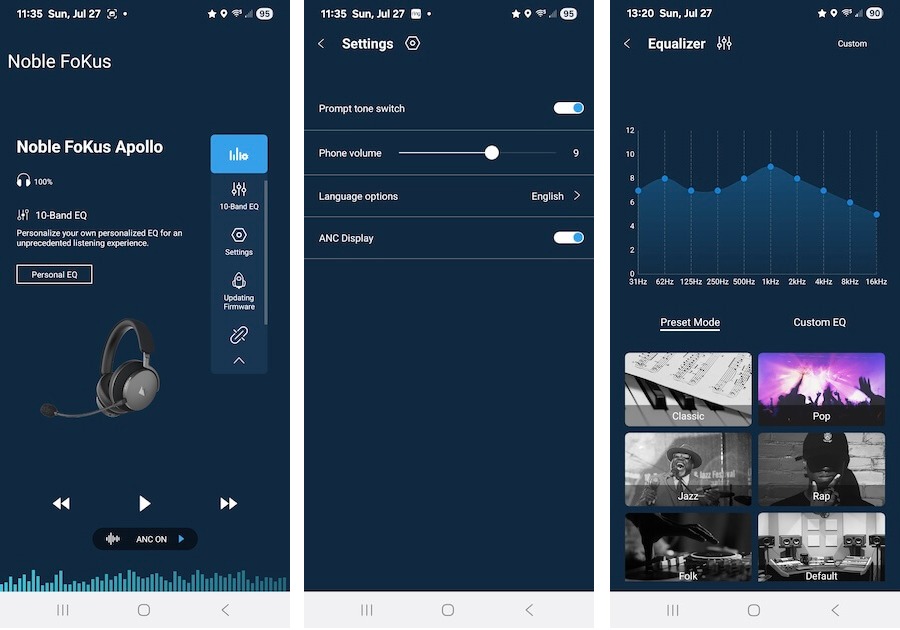
Powered by the Qualcomm QCC3084 chipset and compatible with the Noble FoKus companion app, the Apollo Pro combines high-end wireless audio performance with everyday usability and customization. With the Noble FoKus App (iOS, Android), users can manage playback settings, EQ adjustments, and access additional headphone functionality.

Wireless support includes LDAC, AAC, aptX, aptX HD, and SBC Bluetooth codecs, giving the Apollo Pro broader compatibility across Android, iOS, and other Bluetooth sources.

Advertisement
Advertisement. Scroll to continue reading.

Pro Tip: The Apollo Pro also provides wired connectivity via an included 3.5 mm cable with 6.3 mm and 4.4mm adapters.

noble-fokus-app

Comparison

Noble Model FoKus Apollo Pro (2026) FoKus Apollo (2024)
Product Type  Wireless Headphones Wireless Headphones
Price $699 $649
Drivers 40mm dynamic driver (bass)

14.5mm planar magnetic driver (mids/treble)

Advertisement
40mm dynamic driver (bass)

14.5mm planar magnetic driver (mids/treble)

Bluetooth Chipset Qualcomm QCC3084 Qualcomm QCC3084
Bluetooth Version 5.3 5.3
Audio Codecs LDAC, AAC, aptX, aptX HD, SBC LDAC, AAC, aptX, aptX HD, SBC
Noise Cancellation Hybrid ANC technology, up to -35dB. Hybrid ANC technology -20dB to -35dB
Microphones 3 microphones per side (integrated) + detachable boom microphone 3 microphones per side (integrated) + detachable boom microphone
Frequency Response 10 Hz – 40 kHz 10 Hz – 40 kHz
Impedance 32 Ohms  32 Ohms 
Connectivity Bluetooth 5.3, 3.5mm wired input, USB-C Bluetooth 5.3, 3.5mm wired input, USB-C
Pro-Specific Upgrade Enhancement Materials Premium Italian Alcantara on the headband 
Refined, more breathable, replaceable synthetic goatskin earpads
Frame Material: Anodized Aluminum
Earpads Memory foam Korean Protein leather, replaceable
Design Gunmetal Grey finish on the faceplate and frame, with a lighter, more durable anodized aluminum frame Aluminum cups, aluminum gimbals, a steel headband, and comfortable, replaceable protein leather/memory foam ear pads
Tuning Refined acoustic tuning for enhanced audio performance Not Indicated
Battery Life Up to 80 hours (ANC off) 
60 hours (ANC on) at 50% volume.
Up to 80 hours (ANC off) 
60 hours (ANC on) at 50% volume.
Included Accessories Compact carry case
Detachable boom mic
3.5mm cable
6.3mm adapter
4.4mm adapter
Airplane adapter
EVA Carrying Case
Detachable boom mic
3.5mm cable
6.3mm adapter

Airline Adapter
USB-C Cable

Advertisement
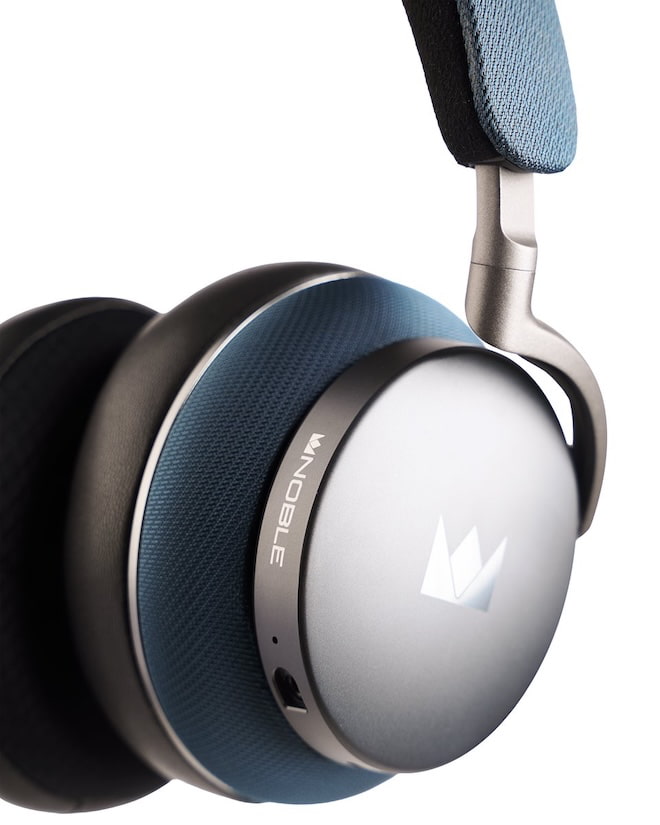
noble-fokus-apollo-pro-headphones-blue-input

The Bottom Line 

The FoKus Apollo Pro gives Noble a more serious foothold in full size wireless headphones by leaning on something most rivals are not offering: a hybrid dynamic and planar magnetic driver platform inside a Bluetooth headphone. Add LDAC, AAC, aptX, aptX HD, and SBC support, upgraded materials, revised tuning, Italian Alcantara, more breathable ear pads, and limited run positioning, and this becomes more than a cosmetic Apollo refresh.

What appears to be missing is the broader ecosystem strength of Apple, Sony, Sonos, Bowers & Wilkins, and Bose. Those brands bring deeper app integration, stronger ANC reputations, spatial audio platforms, and mainstream retail muscle. Noble’s play is different: better driver story, enthusiast credibility, premium materials, and a more focused sound-first approach. 

Price & Availability

The Noble FoKus Apollo Pro is being shown at CanJam Singapore, May 16-17, 2026. Global availability is available at NobleAudio.com and selected retailers for $699 USD / £649 / €749. However, these may not stick around long as only a limited production run was announced — not a permanent addition to the lineup.

The original Noble FoKus Apollo is available for $649 at Amazon.

Advertisement

Source link

Continue Reading

Tech

Why Is the US Job Market So Tough, Especially for Recent College Grads?

Published

on

What’s going on with the U.S. job market? “The economy is growing. Unemployment is low,” notes the Washington Post. “And yet, for millions of workers, finding a job has become harder than at almost any other point in decades,” with the hiring rate “well below pre-pandemic levels for more than a year.”

Part of the problem? “Of the net 369,000 positions added across the entire economy since the start of 2025, health care alone accounted for nearly 800,000 — meaning every other sector, taken together, shed jobs.” By the end of 2025 nearly half of college graduates ages 22 to 27 were working at jobs that didn’t require a degree, according to stats from New York’s Federal Reserve Bank.

The headline unemployment rate, at 4.2%, looks healthy. But that figure has been buoyed by a shrinking labor force: Fewer people are actively looking for work, which keeps the rate down even as hiring slows…

[Some large tech companies] are trying to recalibrate after their hiring sprees of 2021 and 2022, when many had raised pay, offered flexible schedules and signed people quickly… Higher interest rates have also made expansion more expensive, pushing many firms to invest in technology rather than headcount. Another reason hiring has slowed is uncertainty about AI. Even though the technology has not yet replaced large numbers of workers, it is already shaping how companies think about hiring. “I don’t think this is AI displacement,” said Ben Zweig, chief executive of Revelio Labs, a workforce data company. “What we’re seeing is anticipatory.” Instead of rushing to bring on new workers, some firms are waiting to see how the technology evolves and which tasks it will eventually take over.
A 39-year-old web developer tells the Post it took 453 job applications to get a handful of interviews and two offers. And a journalism school graduate said they’d sent hundreds of job applications but most led nowhere, and they’re now couch-surfing to save money.

Advertisement

But the problem seems even worse for young people. One 18-year-old told the Post that in a year and a half of job searching, they’d yet to even meet an employer in person.

The unemployment rate for people ages 22 to 27 who recently completed college hit 5.6% in the final months of 2025 — well above the 4.2% rate for all workers, according to national data from the Federal Reserve Bank of New York… At one point last summer, new workforce entrants made up a larger share of the unemployed than at any point since the late 1980s — higher even than during the Great Recession. When hiring slows, the door closes first on those without an existing foothold. For the class of 2026, the timing could hardly be worse.

“It is getting increasingly clear that young people are being more affected by AI than older workers,” Zweig said. Companies are not eliminating jobs at scale, but many are slow to hire junior workers. At the same time, older workers are staying in the labor force longer, leaving fewer openings for new arrivals. Even when jobs are available, the bar has shifted. Positions once considered entry level now often require several years of experience, technical expertise and familiarity with AI tools. With fewer openings and more applicants, companies are holding out for candidates who can do the job immediately and need little training… Employers are also looking for a different mix of skills. An analysis of millions of job postings by Indeed found that communication skills now appear in nearly 42% of all listings, while leadership skills feature in nearly a third — capabilities that are harder to prove on a résumé and harder still to demonstrate without an existing professional network. Christine Beck, a career coach who works with early-career job seekers, said employers are asking more of the people they do hire.

Source link

Advertisement
Continue Reading

Tech

The Bear season 5: release date, likely cast, plot rumors, and everything else we know about the Hulu show’s final chapter

Published

on

The Bear season 5: key information

– Releasing in late June
– Set to debut on Hulu and Disney+
– No trailer unveiled yet
– Main cast all expected to return
– Will pick up after last season’s finale
– Unclear if any spin-offs are in development

The Bear season 5 is the last course on the hit FX Networks show’s menu. Indeed, the culinary comedy-drama will bow out after serving its final meal on June 25/26, so we’ll have to savor every morsel once it’s released.

Advertisement

Source link

Advertisement
Continue Reading

Tech

Fixing A Cotton Candy Vending Machine

Published

on

Cotton candy is probably the best way to eat pure sugar, which makes having your very own cotton candy vending machine to automate making it a bit of a dream. The machine that [Block’s Retro Repairs] got should therefore make him very happy, but unfortunately it was bought as defective. After digging into the machine in an earlier video, this time around there’s some actual success and proper cotton candy to enjoy.

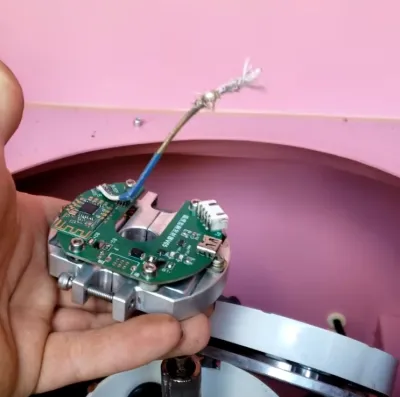
The PCB with the rather frayed temperature sensor. (Credit: Block's Retro Repairs, YouTube)
The PCB with the rather frayed temperature sensor. (Credit: Block’s Retro Repairs, YouTube)

The way that cotton candy is made involves spinning thin threads of sugar, which are created by the heating and rapid crystallization of the sweet stuff. Unfortunately this machine wasn’t even really extruding sugar any more, so it had to get a deep clean to remove probably years of crusty buildup. After this things still weren’t working right, although cranking up the temperature on the induction heated head improved the results somewhat.

To really fix the machine, this head with its clearly dodgy thermocouple had to be disassembled. This revealed that said sensor was looking rather frayed, potentially shorting out against the aluminium head and likely not in the entirely right position any more. After adding some insulation back and making sure that the thermocouple was located closer to the top of the head, it was time for more testing.

Repairing the thermocouple seems to have fixed most ills, with still some calibration of the temperature required, but finally resulting in fancy shaped cotton candy in its myriad of colors. Along with the looming hazard of potentially acquiring Type II diabetes from all the testing, there was still a problem involving the remote management feature of this Red Rabbit machine.

These $6,000 vending machines do feature an Android 7-based software with a Rockchip SoC and access to a lot of settings via its large touch screen, but features such as setting prices for the products are locked away via a remote account. The machine was sadly still linked to someone else’s account, and so far Red Rabbit support had not responded to any documentation, repair help or account unlinking requests. This has left the machine in somewhat of a pickle.

Advertisement

It was possible to dump the software of the machine, which can be fetched from Archive.org, so if anyone would like to pitch in and break this remote lock, that would be very welcome. It’s also considered to replace the cash reader with a simple button or so, but where’s the fun in that?

Source link

Advertisement
Continue Reading

Tech

Microsoft adds more former Ai2 researchers, bolstering its Superintelligence team

Published

on

A sign at the Allen Institute for AI headquarters in Seattle, with the Space Needle in the background. (GeekWire Photo / Todd Bishop)

The wave of departures from the Allen Institute for AI to Microsoft is bigger than previously known: A total of at least 10 former Ai2 staffers and researchers have joined the tech giant, including the core of the Seattle-based institute’s flagship OLMo open-source model effort.

In addition to the previously reported Microsoft hires — former Ai2 CEO Ali Farhadi, former COO Sophie Lebrecht, and research leaders Hanna Hajishirzi and Ranjay Krishna — former Ai2 researchers now at Microsoft include Luca Soldaini, Kyle Lo, Dirk Groeneveld, Pete Walsh, Matt Jordan, and Jake Poznanski.

They have joined the Superintelligence team led by Microsoft AI CEO Mustafa Suleyman, working on its core mission and AI model post-training, a Microsoft spokesperson confirmed in response to GeekWire’s inquiry. Formed in November, the team is developing what Suleyman has called “humanist superintelligence,” advanced AI systems in areas such as health care, energy, and AI companions. 

More broadly, Microsoft is working to reduce its dependence on OpenAI for its own AI models. The hiring of the Ai2 group brings Microsoft a team with deep expertise in efficient, fully open model development, an area where Ai2 has punched well above its weight. 

Ai2 confirmed that the researchers are no longer with the institute.

Advertisement

“While we saw a small number of departures earlier this year, Ai2’s mission remains unchanged,” a spokesperson said. “We remain focused on developing a fully open AI ecosystem and advancing AI for good across health, science, and environmental research.”

As evidence of Ai2’s continued momentum, the spokesperson cited a new computing cluster brought online last week as part of the $152 million initiative backed by the NSF and Nvidia, known as Open Multimodal AI Infrastructure to Accelerate Science, or OMAI.

When Farhadi’s departure as CEO was announced in March, Ai2 board chair Bill Hilf said the cost of competing at the frontier of AI as a nonprofit had become a fundamental challenge. 

“The cost to do extreme-scale open model research is extraordinary,” Hilf said at the time, adding that it’s “really hard to do extreme-scale model work inside of a nonprofit.” He said the board had to weigh whether philanthropic dollars were best spent trying to keep pace with tech giants spending billions on infrastructure to train the most advanced models. 

Advertisement

Behind the scenes, the changing nature of Ai2’s funding environment has also been playing a role in the exits, according to people with knowledge of the situation. Ai2’s primary backer is now the Fund for Science and Technology, a $3.1 billion foundation created under Allen’s instructions. The funding process has shifted from providing an overall annual budget to a proposal-based process.

A spokesperson for FFST said previously that Ai2’s “work and mission remain the same.” 

Ai2’s approach to open-source AI has set it apart in the industry. Unlike most leading AI labs, the institute releases the full weights, training data, code, and evaluation tools behind its models, allowing outside researchers to inspect, reproduce, and build on the work. 

Among the leaders remaining at Ai2 is Noah Smith, the Ai2 senior research director and University of Washington professor who leads the $152 million OMAI project.

Advertisement

The late Microsoft co-founder Paul Allen started Ai2 in 2014, with the mission of advancing AI research for the common good. Farhadi had led the institute since July 2023, succeeding founding CEO Oren Etzioni. The Ai2 board is searching for a new permanent CEO.

In a Q&A posted May 4 on the Ai2 site, interim CEO Peter Clark outlined the path forward, emphasizing longer-term research, open models, and applied AI in areas such as scientific discovery, embodied AI, and environmental science. 

“Ai2 was created to take that longer-horizon view,” Clark said in the Q&A. “From the beginning, Paul Allen’s vision was to advance AI in ways that push science forward while also delivering meaningful benefit to the world, and, critically, doing it in the open.”

He said that commitment has “become even more important in the current landscape.”

Advertisement

Source link

Continue Reading

Tech

YouTube is giving creators a new weapon against AI deepfakes

Published

on

AI-generated videos are getting so realistic now that spotting a fake version of someone online is becoming harder by the week. And for creators, that opens up a pretty uncomfortable problem: what happens when your face starts appearing in videos you never made? YouTube seems to be taking that concern seriously.

The platform is now expanding its AI likeness detection system to a much larger group of creators, giving eligible users new tools to track and report videos that digitally imitate them using artificial intelligence. The feature was previously limited to a smaller pilot group within the YouTube Partner Program, but YouTube says it will begin rolling it out to all eligible creators over 18 in the coming weeks.

YouTube wants creators to catch AI clones faster

The new system lives inside YouTube Studio and is designed to help creators identify when their face may have been used in altered or synthetic videos uploaded to the platform. This means YouTube’s detection tools scan for AI-generated content that appears to replicate a creator’s likeness. If the system finds something suspicious, creators can review the content and request removal if it violates YouTube’s privacy policies.

That matters because AI-generated impersonation is becoming a growing issue online. Deepfake-style videos can now mimic facial expressions, voices, and even speaking patterns with alarming accuracy. For creators who build trust through their online identity, fake videos can quickly become damaging or misleading. YouTube says the tool is meant to give creators more visibility into how their images are used while helping audiences avoid confusion about manipulated content.

Setting it up is fairly simple — but matches may take time

Once the feature becomes available for your account, you can set it up directly through YouTube Studio on desktop. Here’s how to do it:

  • Open YouTube Studio on desktop.
  • Go to Content Detection > Likeness > Start Now.
  • Give YouTube permission to use likeness detection.
  • Complete the one-time identity verification process.

Once setup is complete, the platform will start scanning for AI-generated or altered videos that may be using your face. If any matches are detected, you’ll be able to review the content and request removal directly through YouTube Studio.

Interestingly, YouTube also warns that creators may not immediately see flagged videos after enrolling. That doesn’t necessarily mean the feature is broken — it could simply mean there aren’t many AI-generated uploads using their face in the first place.

Advertisement

The company says the system continues working quietly in the background even when no matches appear. This rollout also highlights a bigger shift happening across online platforms right now. AI tools are evolving faster than most moderation systems can keep up with, and companies are increasingly being pushed to build safeguards around identity misuse, synthetic media, and deepfakes before those problems spiral further. For YouTube creators, this new detection system may become one of the platform’s most important AI-era safety tools yet.

Source link

Advertisement
Continue Reading

Tech

Fresh Horror From Supermassive, A Battlestar Galactica Roguelite And Other New Indie Games Worth Checking Out

Published

on

Supermassive Games (Until Dawn, The Quarry) is back with the second season of its Dark Pictures series. The first entry in said season is Directive 8020. As you might expect, this is a survival horror game with a large emphasis on narrative decisions, with your choices ultimately determining which characters survive. This time around, Supermassive is leaning into sci-fi with a story inspired by The Thing.

After a colony ship crash lands on a planet that seemed like it could be a safe haven for a dying Earth, the crew is hunted by an alien creature that can morph into other lifeforms, including humans. There are five main characters, including pilot Brianna Young, who is portrayed by Lashana Lynch (No Time to Die). You can play solo or pass the controller between a few friends in a couch co-op mode, with each taking charge of a character or two. Online multiplayer will be added later.

One thing that makes Directive 8020 distinct from other Supermassive projects is a new feature called Turning Points. This allows you to return to previous decisions and select a different option. The idea here is to make it easier for players to experience all of the outcomes in the branching narrative.

Advertisement

Directive 8020 is out now on Steam, PS5 (where you can check out a free trial) and Xbox Series X/S. It’ll run you $50.

Battlestar Galactica: Scattered Hopes is a strategy game that’s set in — surprise! — the universe of the beloved sci-fi series Battlestar Galactica. It’s said to build on developer Alt Shift’s previous game, Crying Suns, a narrative-driven, tactical roguelite that itself drew inspiration from BSG.

You’ll take charge of a fleet of ships that’s attempting to escape the destruction of the Twelve Colonies and return to the eponymous carrier ship. You’ll have to take care of disputes within your fleet, deal with bad actors in your ranks, manage resources and make upgrades and repairs.

Advertisement

However, the Cylons are hot on your trail and you’ll need to prepare yourself as best as possible for your next encounter with the deadly robots. The battles are more about survival and sustaining as little damage as possible than securing victory in all-out combat.

My colleague Igor Bonifacic tried an early build of the game last year and enjoyed it. Reviews I’ve seen are generally positive. You can try Battlestar Galactica: Scattered Hopes by picking it up on GOG or Steam (a demo is available on the latter). It’ll usually cost $25, but there’s a 20 percent discount until May 18.

The Caribou Trail looks pretty interesting. It’s a first-person walking sim set in the trenches of World War I, in which you take on the role of a young soldier who hails from Newfoundland. Said to be inspired by the true stories of troops who served in the Gallipoli campaign, the game tells a tale of friendship and survival, with some “folklore and psychological tension” mixed in.

Advertisement

The Caribou Trail, which is from Unreliable Narrators and Gambit Digital, is out now on Steam and the Epic Games Store (usually $13, 10 percent off on Steam until May 28). The developers had planned to release a PS5 version at the same time, but were unable to resolve a critical problem with that build in time. As such, they delayed the PS5 version until July 7.

I really enjoyed my time with Minos, a roguelite in which you construct a maze that takes out raiders with traps. Mazebound — from Absam Studios — is a completely different flavor of procedurally generated maze game. It’s a first-person survival horror title in which you’ll gather materials, craft weapons, hunt for nourishment and try to fend off the terrifying creatures that lie in wait.

Thankfully, you don’t have to go alone (it’s dangerous to do that, after all). You can bring friends with you in multiplayer. I would probably have to do just that.

Advertisement

Mazebound is available on Steam. It’ll usually cost $10, though it’s 20 percent off until May 20.

Source link

Advertisement
Continue Reading

Tech

Mixapps: The Mixtape Of The Internet Age

Published

on

Mixtapes used to be a way that we cultivated a personal selection of music for our own enjoyment, or to give as gifts to those we wanted to impress with a personal touch. These days, we’d typically try that with a playlist, but it’s less romantic despite also being more ephemeral. Songs fall off streaming services all the time, and few of us have the exact same subscriptions as those we’re trying to flirt with. Thus, [Hunter Irving] whipped up a more lasting solution for this modern age.

The concept is simple—it’s a collection of songs that are packaged together in a easily portable format that won’t disappear because of corporate bureaucratic nonsense. [Hunter] has termed their project Mixapps—because it’s a method of sharing music based around Progressive Web Apps (PWA). To create a custom mix, you start by running a Python script, which will then let you add tracks and reorder them as you desire. From there, you run a second script that builds the web app for you.

You can then upload the prepared app directory to a web host to share it with anyone you like. They can then save the PWA to the home screen of their mobile device, where it will live happily ever after. There’s no need to keep hosting the app online or for the user to remain connected to the Internet; everything is self contained on their device. If you’re curious, there’s a demo you can check out online.

Advertisement

It’s worth noting that there are intellectual property concerns to be had as with any form of music sharing, but what else is new? We’ve explored the magic of mixtapes in the past, anyway, to be sure. If you’re finding new ways to trade music and playlists, romantically or platonically, don’t hesitate to let us know.

Source link

Advertisement
Continue Reading

Tech

Faraday Future raised $25 million for its robotics pivot. The fine print tells a different story.

Published

on

TL;DR

Faraday Future raised $25M in convertible notes for its robotics pivot. Half is locked in investor-controlled accounts.

Faraday Future announced on Thursday that it has raised $25 million through convertible promissory notes, bringing its total financing over the past two months to $70 million. The company says the capital is sufficient to fund Phase 1 of its robotics business plan through the end of 2026. The stock, which trades on Nasdaq under the ticker FFAI, closed below $1 per share and is currently under a Nasdaq deficiency notice for failing to maintain the minimum bid price requirement.

The structure of the raise warrants attention. Of the $25 million, only $12.5 million goes directly into the company’s operating account. The remaining $12.5 million is deposited into control accounts held by the investors, and will be released to Faraday Future only upon satisfaction of certain undisclosed conditions. The press release describes “institutional investors’ confidence” in the company’s prospects but does not name any of the investors. The shares underlying the convertible notes are unregistered and subject to trading restrictions. The company’s own risk factors, filed with the SEC, acknowledge that it currently lacks sufficient share capital to execute its strategy and that obtaining stockholder approval for additional shares could result in “substantial additional dilution.

Faraday Future is pivoting from electric vehicles to what it calls “Embodied AI,” positioning itself as a physical AI company that delivers both humanoid and bionic robots. The company says it shipped 68 robots as of 30 April, with a full-year target of 1,500 units across four product lines aimed at education, security inspection, reception and guided tours, performance, and university research. Its Q1 2026 financial results reported that the robotics business achieved positive gross margins and generated ecosystem revenue, though the company did not disclose the total revenue figure in its press release.

Advertisement

The company also signed an MOU with RobotShop, a Canadian robotics e-commerce platform, as its first distribution partner for the robotics line. An MOU is a non-binding agreement and does not represent a committed order.

The 💜 of EU tech

The latest rumblings from the EU tech scene, a story from our wise ol’ founder Boris, and some questionable AI art. It’s free, every week, in your inbox. Sign up now!

The corporate history is relevant context. Faraday Future was founded in 2014 by Chinese billionaire Jia Yueting, who has been at the centre of multiple financial controversies. The company went public via SPAC merger in 2021, after which the SEC launched an investigation into matters related to the PIPE and SPAC transactions. Wells Notices were issued to the company and certain executives. The SEC concluded its investigation in March 2026 with no enforcement action, which the company described as removing a “major historical overhang.” Separately, a special committee of independent directors had conducted its own investigation beginning in October 2021.

Advertisement

The EV side of the business has struggled to reach meaningful scale. Faraday Future’s FF 91, a luxury electric vehicle priced above $300,000, has been delivered in very small numbers since its 2023 launch. The company is now developing what it calls “EAI automotive robots,” essentially AI-enhanced vehicles, alongside its humanoid and bionic robot product lines.

The humanoid robotics market is attracting serious capital in 2026. Morgan Stanley doubled its forecast for China’s humanoid robot sales to 28,000 units this year. Unitree is filing for a $7 billion IPO after outselling Tesla on humanoid robots. 1X is shipping its NEO humanoid to US homes at $20,000 per unit. Mind Robotics, Rivian’s spinoff, raised $1 billion in under a year at a $3.4 billion valuation. In that context, Faraday Future’s $70 million in convertible debt financing, half of it conditional, positions the company at the very margins of a market being defined by companies with orders of magnitude more capital, more credible production capabilities, and more established technology.

The company’s own SEC filings list risk factors that include its “reliance on a single OEM for most of its robotics products,” competition from companies “with far superior experience, funding and name recognition,” the possibility that it may not maintain its Nasdaq listing, and the fact that its strategy requires stockholder approval for additional share issuance that could be substantially dilutive.

Faraday Future says it now has the room, for the first time in years, to shift financing decisions from “liquidity-driven to capital-structure-driven.” That framing reflects a company that has historically raised money on whatever terms it could get, when it could get them. Whether $70 million in convertible notes, with conditions attached, represents a genuine strategic inflection or another chapter in a long series of optimistic announcements followed by operational difficulty, is a question the market has been asking about Faraday Future for the better part of a decade.

Advertisement

Goldman Sachs projects 50,000 to 100,000 humanoid robots shipped globally in 2026. Faraday Future’s target of 1,500 units would represent a fraction of that market, but even that modest target requires execution from a company that has consistently struggled to deliver on its production commitments. The robotics pivot may be real. The capital may be sufficient for Phase 1. But the gap between announcement and delivery is where Faraday Future’s story has historically broken down.

Source link

Advertisement
Continue Reading

Tech

Livestream FA Cup Final Soccer: Watch Chelsea vs. Man City for Free

Published

on

When to watch Chelsea vs. Man City

  • Saturday, May 16 at 10 a.m. ET (7 a.m. PT)

Where to watch Chelsea vs. Man City

  • Chelsea vs. Man City will air in the US on ESPN2, ESPN Select, ESPN Unlimited
See at ESPN
ESPN

Watch the FA Cup final in the US

Advertisement

ESPN Select

See at BBC
The logo for the BBC iPlayer on demand streaming service

Watch the FA Cup final in the UK for free

BBC

Advertisement

Chelsea will take on Manchester City at Wembley Stadium in the 145th FA Cup final on Saturday, with Calum McFarlane’s Blues standing in the way of the Cityzens claiming a rare domestic cup double. 

After a hugely disappointing season, which saw Enzo Maresca and his successor, Liam Rosenior, both sacked due to the Blues’ poor form, interim Chelsea head coach McFarlane has the opportunity to restore some pride and claim some silverware. The West Londoners have won just once since McFarlane took charge last month — a semifinal win in this competition against Leeds — with defensive weaknesses remaining an issue for the Blues.

Advertisement

City, meanwhile, comes into this final on something of a high after a 3-0 demolition of Crystal Palace in midweek — a result that keeps the pressure on English Premier League leaders Arsenal. That win also means a clean sweep of domestic honors remains in play for Pep Guardiola’s team, who lifted the English Football League Cup back in March. 

Chelsea takes on Manchester City at Wembley Stadium in North London on Saturday, May 16. Kickoff is set for 3 p.m. BST in the UK, which is 10 a.m. ET or 7 a.m. PT in the US and Canada, and 2 a.m. AEST on Sunday in Australia.

A detailed view of the FA Cup Trophy.

Chelsea will be hoping to end a 13-game winless run against Man City in today’s final. 

Advertisement

Alex Pantling/Getty Images

Livestream Chelsea vs. Man City in the US

This year’s FA Cup final will be available to watch live in the US on ESPN2 and stream via the network’s ESPN Select and ESPN Unlimited streaming packages. ESPN Plus, which carries the FA Cup, was essentially rebranded as ESPN Select and is the cheaper option at $13 a month. ESPN2 is available on live TV streaming services such as Fubo or YouTube TV.

ESPN
Advertisement

ESPN’s streaming platforms changed in 2025. The sports network now offers two tiers with its new direct-to-consumer setup: ESPN Select and ESPN Unlimited. ESPN Select is essentially what ESPN Plus used to be, with the same content available to subscribers, including FA Cup soccer, for $13 a month. If you want full access to ESPN’s networks and services, such as ESPN, ESPN2, ESPN3, ESPNews and ESPN Deportes, as well as all of ESPN Select’s (which is all of ESPN Plus’) content, then ESPN Unlimited is the way to go. It costs $30 a month.

Livestream Chelsea vs. Man City in the UK for free

Saturday’s showpiece final will be available to watch for free on BBC1 and BBC iPlayer, with coverage kicking off at 2 p.m. BST.

Viewers in the UK also have a second option for watching the final, with the game also being shown on pay-TV channel TNT Sports 1. 

You’ll be able to watch the game online for free via the network’s on-demand streaming service, BBC iPlayer.

With an app that’s available for Android and Apple mobile devices, as well as a vast array of smart TVs and streaming boxes, all you need is a valid UK TV license to stream the game.

Advertisement

TNT Sports

You can access TNT Sports via Sky Q, Virgin Media and EE TV as part of a TV package.

Alternatively, TNT Sports has a new streaming home with the launch of HBO Max in the UK. It costs £31 either way and comes in a package that includes Discovery Plus’ library of documentary content.

A bundle including HBO Max’s entertainment plan alongside TNT Sports currently costs £31 per month.

Advertisement

Livestream Chelsea vs. Man City in Canada

Canadian soccer fans looking to watch this FA Cup fixture can catch all the action live via Sportsnet.

Sportsnet

Sportsnet is available via most cable operators, but cord-cutters can subscribe to the standalone streaming service Sportsnet Plus instead, with prices starting at CA$30 per month or CA$250 per year for the standard plan.

Advertisement

Livestream Chelsea vs. Man City in Australia

Soccer fans in Australia can watch FA Cup matches live on the streaming service Stan Sport.

Stan

Stan Sport will set you back AU$20 a month, on top of a Stan subscription, which starts at AU$12. It is worth noting the streaming service is offering a seven-day free trial. On top of select FA Cup matches, a subscription gives you access to Premier League, Champions League and Europa League action, along with international rugby and Formula E.

Advertisement

Source link

Continue Reading

Trending

Copyright © 2025