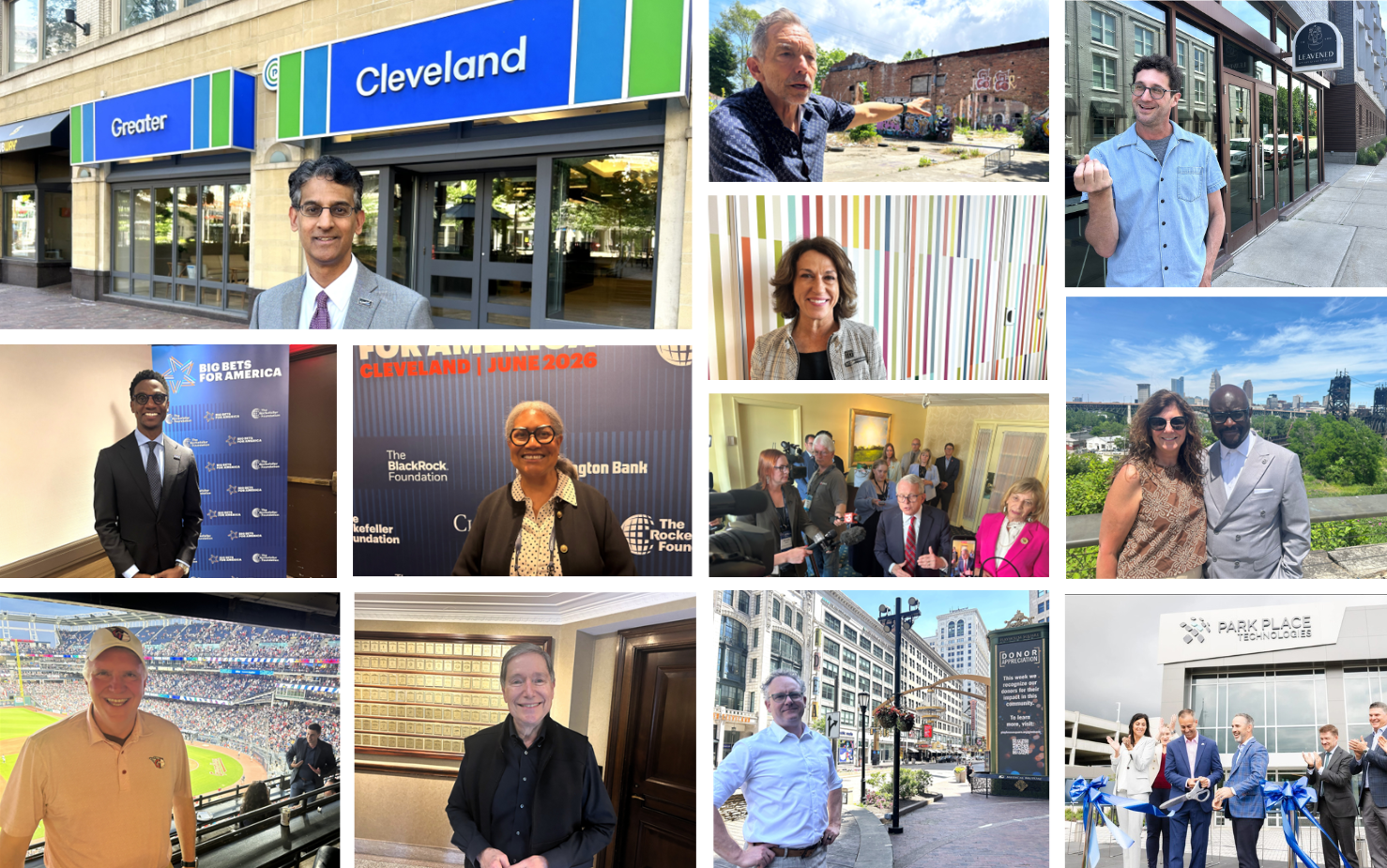
Some of the Cleveland leaders who shared their advice during GeekWire’s visit to northeast Ohio. (GeekWire Photos / John Cook)
CLEVELAND, Ohio — A century ago, this city was booming.
By 1920, it was the fifth-largest metropolis in the United States, fueled by manufacturing, immigration, industrial innovation and entrepreneurs who transformed it into a center of invention and business creation.
And then, seemingly overnight, it all changed. The economy shifted. Jobs dried up. Corporate headquarters moved.
Cleveland’s history is a cautionary tale for Seattle, which is at its own inflection point as we move from the software era to the AI era or what’s next. But the modern story of Cleveland is one of inspiration: a lesson in what becomes possible when business, civic and public leaders pull in the same direction.
That’s why GeekWire contributing columnist Charles Fitzgerald and I spent several days in Cleveland this week — speaking to philanthropists, developers, entrepreneurs and even Mayor Justin Bibb and Ohio Gov. Mike DeWine. This mini fact-finding mission started four months ago after Charles, a tech veteran and Seattle angel investor, wrote a provocative column for GeekWire titled: A warning to Seattle: Don’t become the next Cleveland.
Advertisement
Mayor Bibb was on the phone with us the next day, making the case for his city. He invited us to explore Cleveland — its rise, fall and rebirth — and get to know another story about a rebounding Midwest city.
We came to learn about Cleveland. We left with new insights about Seattle and what’s needed to foster a prosperous future.
From the moment we arrived in northeast Ohio — where Mayor Bibb’s voice welcomes airport visitors to a city built on “grit and innovation” — to the moment we left, one thing stood out. While not everyone agrees on every issue, there is a palpable sense that Clevelanders are “all in” — rowing in the same direction like a crew quietly propelling its shell along the Cuyahoga River.
Here’s what we learned from Cleveland:
Advertisement
East Cleveland Mayor Sandra Morgan at the Big Bets for America event in Cleveland. (GeekWire Photo / John Cook)
“The City of Cleveland, and by extension, East Cleveland, rode a wave of innovation and industry and growth that was unparalleled, really, just about anywhere in the country for quite a while,” she said. “And then when we took a dip and a turn, it was a pretty dramatic turn of events. And it has taken probably the better part of 50 years to right the ship and turn things around.”
For East Cleveland, she said, “that ship has yet to be righted. We’re still working on it.”
But Morgan wasn’t telling Seattle to fear growth. “Chaotic growth, it’s fun, but it’s not necessarily the best way to grow,” she said. “And always with growth comes some unforeseen issues and problems, but growth still is better than no growth, in my opinion.”
Advertisement
She also extended an invitation: “When you get tired of being in Seattle, come to East Cleveland, Ohio. We’ve got plenty of space for you.”
Ohio Gov. Mike DeWine speaks with reporters in Cleveland. (GeekWire Photo / John Cook)
Ohio Governor Mike DeWine, who has led the state since 2019, was in Cleveland announcing a $300 million workforce development program through JobsOhio.
“I don’t give advice to other areas,” he said in response to our question. “But my advice to people is, come to Ohio. Come work in Ohio. You will not find a better place, better people, quality of life. Cost of living is low compared to the two coasts.”
He pointed to the companies betting on the state. “There’s a reason why we are getting companies like Anduril that are relocating at least part of their new business to Ohio. There’s a reason why Joby is here. There is a reason why Sherwin-Williams stayed here.”
“Look, this is our time. It is the Midwest’s time in history,” DeWine said. “We do not wish anybody to not be successful, we want everybody to be successful in this country. But we know we have something special here in Ohio.”
Advertisement
Cleveland Mayor Justin Bibb at the Big Bets for America event. (GeekWire Photo / John Cook)
Justin Bibb is the 39-year-old mayor of Cleveland. When we asked him what advice he would give Seattle and its new mayor, Katie Wilson, he started with the fundamentals.
“You’ve got to focus on the basic plumbing and tackling of good city governance,” he said. “At the same time, as former mayor Pete Buttigieg always says, the job is part pothole, part vision. And that’s kind of been my duality of, hey, the cops gotta get paid, the streets have to be safe, the potholes have to be fixed. City government has to function well.”
But running the city well is only half the job, he said. “You have to chart a vision for where the city is going to go. Because in this economic environment our customers, our residents and our businesses can choose like that, so we have to make sure that our value proposition is sticky and compelling. And to me that’s the job of mayor.”
Cuyahoga County Executive Chris Ronayne at a Cleveland Guardians game at Progressive Field. (GeekWire Photo / John Cook)
Chris Ronayneis the Cuyahoga County executive, the top elected official in the county that includes Cleveland, and a former planning director for the city. His advice draws on that planning background: figure out what’s working in your community, and invest in it.
“Support what’s working. Organically grow what you got,” he said, contrasting that approach with the economic development strategy of chasing the next big company. “The cavalry’s not coming,” he said. “That’s the lesson for Cleveland, and it’s a lesson for Seattle.”
He also pointed to immigration as essential to growth, noting that immigrants have been the Cleveland region’s only source of population gains in recent years. “Metros have to lead the way on strategies to bring newcomers to your city,” he said, acknowledging that it’s “a complicated task” for any metro region in the current environment.
Advertisement
His third piece of advice: don’t fixate on the giants. Cleveland was once known for its Fortune 500 headquarters, as Seattle is now, he said, but “the real lifeblood is small business.”
John Nottingham, co-founder of Nottingham Spirk in front of the company’s wall of patents. (GeekWire Photo / John Cook)
John Nottingham is co-founder of Nottingham Spirk, the Cleveland innovation lab behind products like the Crest SpinBrush, with nearly 1,600 patents to its name. The firm operates out of a renovated former Christian Science church overlooking the city’s University Circle district.
His advice: “You have some pretty high-powered entrepreneurs in Seattle. You should appreciate your entrepreneurs.”
Nottingham reached back a century for his cautionary tale: John D. Rockefeller, who built Standard Oil into “the first multi-national company, driving everything else,” he said. But the oil baron’s success bred resentment in his hometown. “He was almost pushed out of Cleveland, and there’s a lot of stories about that.”
Rockefeller decamped to New York, and later in life directed a massive gift that built the University of Chicago. The lesson for Seattle, where prominent tech leaders have been leaving the region, wasn’t subtle.
Advertisement
Brad Whitehead of the Good Jobs Fund at the former Westinghouse light bulb factory, part of The Midline industrial district he is developing on Cleveland’s near east side. (GeekWire Photo / John Cook)
Brad Whitehead is managing director of site readiness for the Good Jobs Fund and developer of The Midline, an industrial district taking shape on Cleveland’s near east side, including the former Westinghouse light bulb factory where he gave us a tour.
Cleveland’s mistake, he said, was complacency. The city had reinvented itself so many times that its leaders trusted it would simply happen again. Seattle can learn from this.
“Where the next thing has always come along, you can’t assume that that’s going to happen,” he said. “For many years, we had this sense of who we are, and because we had the great names, that it was all going to continue to work well.”
The region learned too late that prestige and payrolls are different things. “Just because somebody has a corporate headquarters doesn’t mean that’s where they’re producing. We’ve got fabulous companies that figured out how to adapt and survive, but that meant the jobs often left and went to other places.”
Michelle Tomallo, co-founder and chief people officer of FIT Technologies, at the company’s downtown Cleveland offices. (GeekWire Photo / John Cook)
Michelle Tomallo is co-founder and chief people officer at FIT Technologies, an employee-owned IT managed service provider in downtown Cleveland.
Her advice echoed a theme we heard repeatedly: success has a way of narrowing your vision.
Advertisement
“Be very thoughtful about what the future is holding,” she said, “because I think when we have grand success, sometimes we are far away from what’s coming next.”
Josh Rosen, co-owner of Sustainable Community Associates, in Cleveland’s Tremont neighborhood. (GeekWire Photo / John Cook)
Josh Rosen is co-owner of Sustainable Community Associates, a real estate development company that’s converting abandoned gas stations, dry cleaners and industrial sites into housing in Cleveland’s Tremont neighborhood.
Looking at Seattle from the outside, Rosen sees concentration risk.
“It feels like Seattle is dependent on a sector, and in a lot of ways very few companies within that sector,” he said. “And that allows for a certain type of growth. But as things change, if you don’t develop a framework of interdependency of all the different stakeholders, that change can be sudden and not what you want it to be.”
The lesson, he said, “is to start to build an ecosystem of working together, so when there are shifts or there are changes, the community is prepared for that next phase.”
Advertisement
As a developer, he pointed to real estate as the place where that fragility shows up first. “You have all these buildings that are built based on a certain amount of income being produced. And that’s how those mortgages and those loans are being serviced. And what if that changes by 20 percent?”
Yvette Ittu, president and CEO of Cleveland Development Advisors, overlooking the city. (GeekWire Photo / John Cook)
Yvette Ittu is president and CEO of Cleveland Development Advisors, which channels investment into real estate and redevelopment projects in Cleveland’s neighborhoods.
Her advice was less about any single policy and more about how a city works together.
“The collaboration between the business community, the civic sector and the public sector are imperative for anything you are going to do in your community,” she said. “It really takes connectivity with all of those sectors, collaboration and communication.”
Nathan Kelly, president of Playhouse Square Real Estate, in Cleveland’s Playhouse Square theater district. (GeekWire Photo / John Cook)
Nathan Kelly is president of Playhouse Square Real Estate, part of the nonprofit that operates one of the country’s largest performing arts districts outside of New York.
His advice gets at a prerequisite for everything else: “I think safety, real and perceived, is the most important factor for building a place or growing a place,” he said. “And I can only impact the perception of safety. But we do it with small things, like I require all of my tenants on the retail and second level to have their lights on 24/7 so that that light sheds out onto the street. We do a lot of things with color and paint that make things feel vibrant, even if you’re alone.”
Advertisement
It’s not just cosmetic, he said. The district works with the city and economic groups on uniformed officers and safety patrols, while addressing deeper human service needs. “I know who to call when somebody is having an episode that doesn’t require a police intervention. I think that’s the most fundamental.”
Chris Adams, president and CEO of Park Place Technologies.
Chris Adams is president and CEO of Park Place Technologies, an IT infrastructure services firm with more than 500 employees at its Cleveland headquarters.
Cleveland’s problem wasn’t a lack of warning signs, he said. It was the speed of the response.
“When the world started changing, we needed to, as a community, adapt quicker. I really think it is the bureaucracy that lets people down. Your job is to provide for the constituents,” he said. “We are doing well now as a community environment, but it took some time for people to pivot.”
He described the danger this way: “You are always looking in the rearview mirror and you are riding that wave, and you don’t see the land in front of you that you are about to crash into. You can only surf the wave so long. Fundamentally, people need to look forward, not behind.”
Advertisement
“Just because it has been a boom town out there for a long time, that only gets people overconfident,” he added. “If you get too confident in what you have, you can lose it.”
Baiju Shah, president and CEO of the Greater Cleveland Partnership, in downtown Cleveland. (GeekWire Photo / John Cook)
Baiju Shah is president and CEO of the Greater Cleveland Partnership, which has organized the region’s comeback effort around a shared 10-year plan called“All In.”
His advice for Seattle is the strategy behind that name.
“You need to get your business leadership and your public leadership heavily engaged and committed. We call it ‘all in,’” he said. “There’s got to be an economic vision for the region that everyone can get aligned behind and start to work hard on these types of priorities, whatever those might be.”
Freddy Collier of the Greater Cleveland Partnership, with the Cleveland skyline behind him. (GeekWire Photo / John Cook)
Freddy Collier is senior vice president of strategy and new initiatives at the Greater Cleveland Partnership, the region’s chamber of commerce.
He pointed to the trait that carried Cleveland through its hardest decades: “One of the key things that makes Cleveland special is resilience. It continues to evolve, and reinvent itself. And that’s one of the things I love about this town. It’s a big city with a small town feel. People know each other, and people are connected.”
Advertisement
His advice for any city navigating change: invest in the things that bind people together. For Cleveland, that starts with geography: “Our natural assets I think are our superpower: our waterfront, riverfront, our trails,” he said. “And those are the things that connect people, no matter what walk of life you come from, no matter what your demographic situation is, no matter what your economic situation is.”
“We have things in this town that are unifiers, that are equalizers,” he said, “and I am really proud of that.”
Coming Saturday: John Cook and Charles Fitzgerald join the GeekWire Podcast from an abandoned Westinghouse light bulb factory in Cleveland to share what they learned, and what it means for Seattle’s future. Subscribe to GeekWire in Apple Podcasts, Spotify, or wherever you listen.
Teachers worry about students using AI to do their homework, publishers worry about novelists using AI to finish their books, but now biosecurity experts have something even bigger to worry about: AI’s ability to design dangerous biological agents. It’s enough to have major tech companies, top scientists, and national security advocates alike all worried about the same thing.
The fear is that AI systems have become capable enough to design biological molecules and assist with other complex laboratory tasks that were once reserved for highly trained specialists alone. Now executives from Microsoft to OpenAI to Anthropic have joined in the calls for Congress to do something. Specifically, the hope is that the government can require mandatory screenings of synthetic DNA and RNA orders to prevent bad actors from pursuing dangerous (potentially deadly) biological weapons.
As it stands, screening programs operated by some synthetic biology companies are largely voluntary. But supporters of drafting new legislation say these screenings need to become a requirement nationwide before AI capabilities advance even further. Lawmakers have already made some headway on similar proposals, such as the Biosecurity Modernization and Innovation Act of 2026. If passed, it would require companies selling synthetic genetic materials to screen both customers and orders while maintaining records to assist with any future investigations that emerge.
Advertisement
Scientists disagree on the best solution to the problem
ultramansk/Shutterstock
Still, opinions differ on how quickly the danger is growing, and what should be done about it. Broadly speaking, biological AI systems can already design proteins, predict viral evolution, and generate new molecular structures. That’s where a lot of the worry is coming from. Scientists are concerned that future versions could be used to engineer toxins, enhance existing pathogens, even develop novel biological threats. It’s not baseless, either. Researchers can point to studies showing that advanced language models can already help users perform specialized biological tasks at levels approaching experienced scientists.
However, designing a harmful organism on a computer is only step one. It’s important to remember that manufacturing, testing, and deploying biological agents still requires specialized equipment, technical knowledge, and various other resources that remain out of reach for most people. That’s why experts argue the most effective defense would be to strengthen oversight at the point where digital designs become physical. (That is, DNA synthesis companies.) No matter if the guardrails ultimately go up on the software or the hardware, the main point remains: industry and researchers need to move fast if they truly want to stop amateurs from mixing AI and weaponry.
Need a hinge in your 3D printed design and would prefer not to re-invent the wheel? You may find [Alex Krush]’s glue-in filament hinge useful.
This design (shown in this simple box as an example) makes a very close-fitting hinge point.
This design prints half the hinge as a separate piece — the u-shaped one in the picture to the side — that must be glued into the target object after printing. It’s a bit of extra work, but doing it this way has a couple advantages.
One is that printing some of the hinge elements separately means one no longer needs to choose between a print orientation that best suits the object, and a print orientation that works best for the hinge. Also, the length of 1.75 mm filament used as a hinge pin is held captive after assembly so there’s no need to glue the hinge pin itself.
[Alex] helpfully provides the parts in STEP format, which makes CAD tweaks and adjustments easy. While incorporating the design should be doable even if one is just using .stl or .3mf files because boolean subtraction and merging is all that’s needed, having the model in STEP format is so much better.
Advertisement
Should you need some pointers on incorporating either into FreeCAD, we have you covered.
Sam Bankman-Fried lost his appeal to overturn his FTX fraud conviction and 25-year sentence. Reuters reports: In a unanimous decision, a three-judge panel of the Manhattan-based 2nd U.S. Circuit Court of Appeals said prosecutors’ evidence against Bankman-Fried “was, conservatively stated, robust.” “While he was publicly reassuring customers, investors and regulators that FTX customer funds were safe, he was simultaneously using FTX as his own personal piggy bank, spending customer funds on real estate, political contributions, and investments,” Circuit Judge Barrington Parker wrote on behalf of the panel.
Bankman-Fried’s lawyers did not immediately respond to a request for comment. They may next ask all the active judges on the 2nd Circuit to hear the case, or ask the U.S. Supreme Court to take up the case. Bankman-Fried is also seeking a pardon from President Donald Trump, according to the Justice Department’s Office of the Pardon Attorney. Bankman-Fried was sentenced to 25 years in prison in 2024 for “masterminding one of the largest financial frauds in American history,” wrote US District Judge Lewis Kaplan. He was convicted on all charges, including wire fraud, conspiracy to commit securities fraud, commodities fraud, and money laundering.
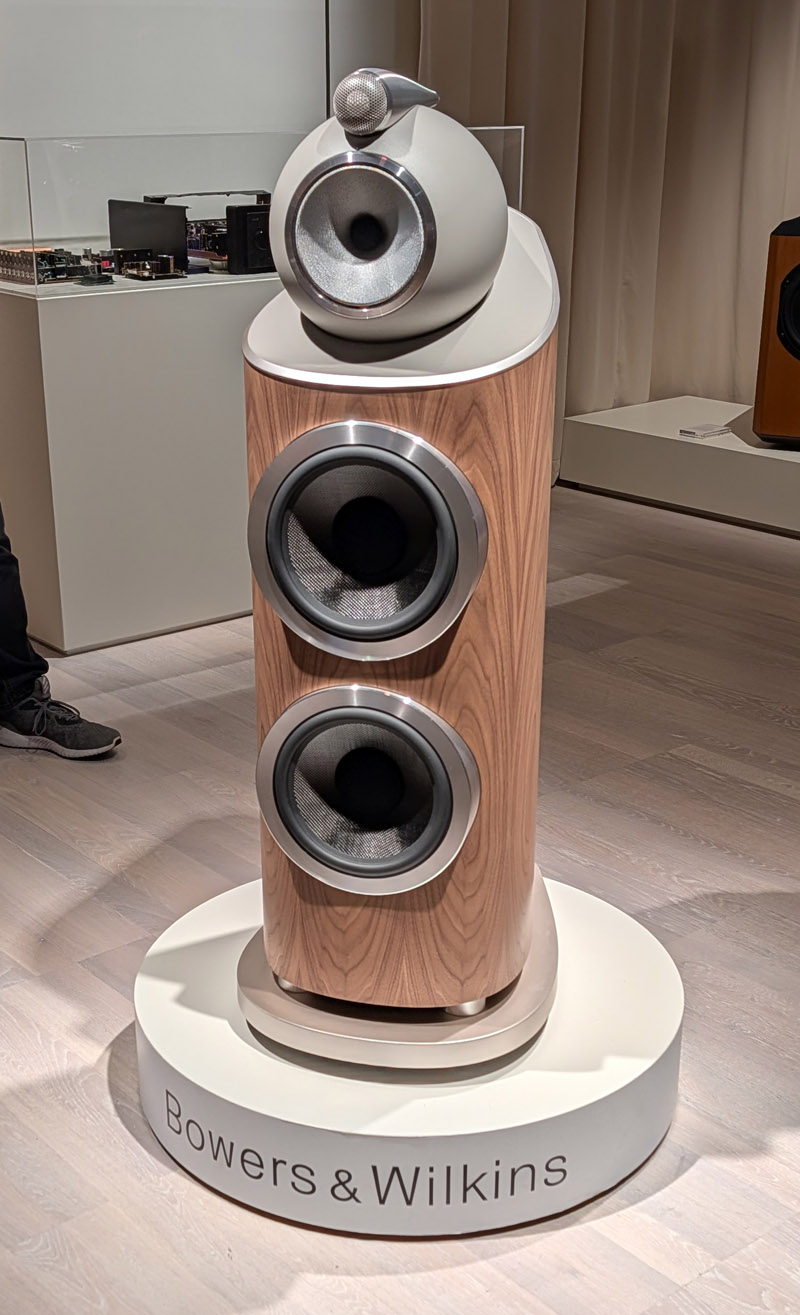
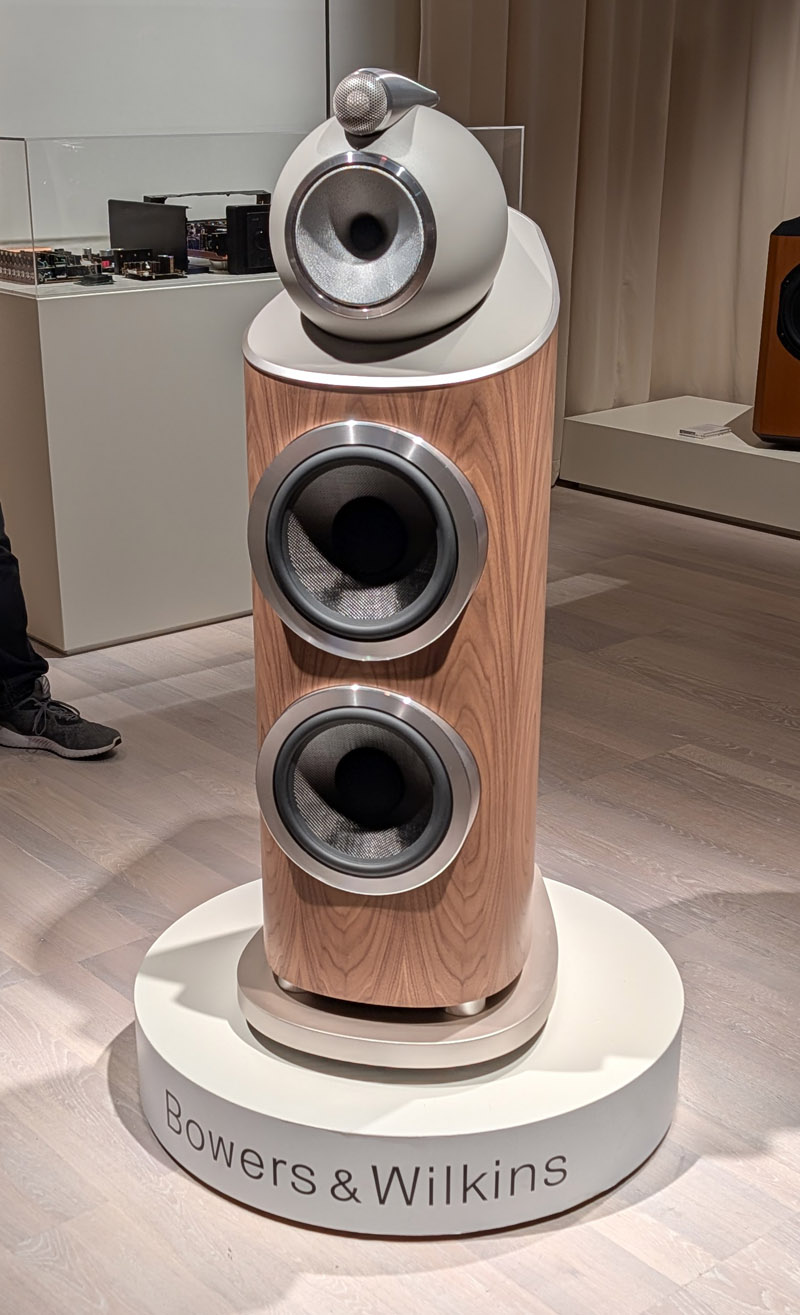
Bowers & Wilkins used High End Vienna 2026 to make a serious statement with the new 801 Diamond D5. It’s the British speaker maker’s flagship floorstanding loudspeaker in the 800 Series Diamond line-up, now in its fifth generation. The company has not been seen at this particular show for several years, but they thought it would be the most appropriate venue to unveil their new top dog. And it certainly made an impression.
Our Bowers & Wilkins 801 D5 launch preview covered the core changes, including the updated Diamond Dome tweeter implementation, revised cabinet architecture, upgraded internal bracing, new crossover network, and the broader refinements B&W says are designed to lower resonance, lower distortion and improve resolution, dynamics, and imaging.
But how do all of these refinements actually sound? Pretty damn good.
We got to hear the Bowers & Wilkins 801 D5 in a proper demo room in Vienna, which matters because show-floor impressions are usually about as reliable as hotel Wi-Fi during press day. Listening in a controlled room to a handful of songs does not turn a trade show demo into a full review, but it does give us a much better sense of what the loudspeaker can do. And this is particularly relevant when the product in question costs $65,000 per pair and sits at the top of one of the most recognizable high-end loudspeaker families in the world.
Advertisement
The 801 has always carried more weight than just its physical footprint. You might say it’s the core of Bowers & Wilkin’s’ identity. The original 801 (known then as the Series 80 Model 801) arrived in 1979 — for just $2,850/pair in those ancient dollars. It quickly became closely associated with Bowers & Wilkins’ studio-monitoring reputation, including its long connection with Abbey Road Studios. The new 801 D5 continues that lineage with an improved Diamond Dome tweeter with newly designed mesh grill, first seen in the company’s even more expensive D4 “Signature” line. In fact, many of the advancements in the D5 series first debuted in the company’s Signature line-up.
The Bowers & Wilkins 801 D5 loudspeaker in new light walnut finish, moments after being unveiled in Vienna at HIGH END 2026.
Other notable design features include Bowers & Wilkins Continuum midrange driver, distinctive tweeter-on-top and turbine-head enclosure, and substantial low-frequency architecture. From the outside, the D5 series does not look like a radical reinvention. That is not really the point. Bowers & Wilkins is playing the long game here: refinement, mechanical control, lower cabinet noise, lower resonance, better integration, and a more polished version of a formula that had already worked quite well, thank you very much.
In our first listen at High End Vienna last week, the 801 D5 sounded like a flagship speaker should: large in scale, extended, yet controlled in the bass, precise yet delicate in the highs and supremely present in the midrange. Bowers & Wilkins best sonic trick — the ability to disappear entirely and let the singers and instruments be there with you in the listening room — is still apparent in the D5 series. At least it is in the flagship, but likely in the rest of the line as well, since they share so much in technology, parts and design.
In addition to the 801 D5, Bowers & Wilkins 800 Series D5 line-up also includes (from left to right), the 802 D5, 803 D5, 804 D5 and 805 D5.
The 801 D5 sounded clean, composed, and physically effortless, with the kind of low-end authority that reminds you why full-range loudspeakers still matter when they are engineered properly. No subwoofers here. You won’t need one.
The Bottom Line
While many of the revisions in the Diamond D5 Series are invisible to the eyes, they were audible to the ears. It takes the already excellent D4 version and makes everything just a little bit better: a little cleaner, a little tighter, a little more transparent. We certainly saw (and heard) many speakers at HIGH END 2026 that cost more than the 801 D5 (some more than 10X more), but few could come close to it in sonic transparency and realism. And that’s saying something.
Advertisement
Price & Availability
The most recent previous generations of the 800 Series may still be available while supplies last:
801 D4 (2021) – $46,000/pair in Gloss Black, Satin Rosenut, Satin Walnut, or White
801 D4 Signature (2023) – $60,000/pair in Midnight Blue Metallic or California Burl Gloss
GPTZero claims only 5 of the report’s 45 citations matched their sources, raising questions about how the Big Four’s AI study was assembled
KPMG’s October 2025 report on the wonders of agentic AI has been accused of demonstrating one of the tech’s less desirable talents: making things up.
Research outfit GPTZero claims a forensic review of the Big Four firm’s October 2025 report, “Total Experience: Redefining Excellence in the Age of Agentic AI,” found that only five of its 45 citations correctly pointed to the cited source; the rest ranged from mangled and misleading to partially fabricated or too vague to verify.
GPTZero dubbed the phenomenon “vibe citing” – the citation equivalent of vibe coding – where generative AI appears to stitch together fragments of real sources, invent titles, or otherwise produce references that look convincing until someone actually clicks them.
GPTZero alleges that roughly half of the report’s factual claims were false, unsupported, or attributed to the wrong source. Several case studies highlighting supposedly cutting-edge deployments of agentic AI appear to have been particularly creative.
Among the examples highlighted by GPTZero were purported agentic AI deployments at UBS, Swiss Federal Railways, and Transport for London. According to GPTZero, the sources cited to support those case studies either did not substantiate the report’s claims or contained alterations and paraphrasing that undermined their reliability.
Advertisement
“These factual errors are not confined to the report’s footnoted passages,” GPTZero said. “On page 42, the authors claim that Emirates airline has adopted a mobile chatbot named Sara (false) that can converse directly with passengers (partially true) and change their flights (false). In fact, Sara is a robot assistant introduced by Emirates in 2023 (not a chatbot) that lacks the ability to alter flight bookings.”
Not all of the alleged problems involved external sources. GPTZero noted that the report appears to contradict KPMG’s own research, citing a figure of 55 percent of CEOs ranking AI as their top investment priority. KPMG’s 2025 CEO Outlook, released the same month, put the number at 71 percent.
KPMG has since removed the report from some of its websites while it investigates how the publication made it into the wild, according to the Financial Times.
A spokesperson at KPMG told The Register:
Advertisement
“KPMG International takes the accuracy and integrity of its published content seriously. The report has been removed and we are reviewing the circumstances surrounding its publication. We expect all our people to follow our guidelines on the responsible use of AI, including human oversight to validate content and verify independent sources.”
Consulting firms have spent years warning clients about AI hallucinations. According to GPTZero, KPMG may have just provided a live demonstration. ®
Everyone experiences these on the journey from adolescence to adulthood, but new data on the mental health of LGBTQ+ youth shows the additional pressures they face increases their risk of suicide compared to their peers.
The Trevor Project, a nonprofit focused on suicide prevention for LGBTQ+ youth, has released its most recent survey of 16,000 LGBTQ+ young people 13 to 24. Among the most concerning figures was one in 10 participants reporting that they had attempted suicide during the previous year. And more than one-third seriously considered suicide.
Experts also tell EdSurge that the strain of mental health issues and unwelcoming school settings directly harm students’ ability to thrive in, or even attend, their classes.
Advertisement
Despite the sobering results of the survey, the data also reveals solutions — including a role for schools.
“One of the most important findings is that when adults, institutions, and communities become more affirming, the suicide risk of LGBTQ+ young people goes down,” Ronita Nath, the Trevor Project’s vice president of research, says. “Schools play a life-saving support by creating environments where LGBTQ+ young people feel safe, accepted and supported.”
Feeling the Pressure
With 2026 on track to be another record-breaking year for anti-LGBTQ+ bills introduced at the state and federal levels, a vast majority of survey respondents said they felt stressed, anxious or unsafe due to the policies and the debates surrounding them.
When those young people are caught in the crossfire of heated political debates, Nath says the negative rhetoric that trickles down has real consequences. Youth who reported experiencing victimization due to their gender identity or sexual orientation — like bullying, physical harm or exposure to conversion therapy — were three times as likely to attempt suicide as their peers.
Advertisement
Those risks dropped among survey participants who said their school affirmed their identity. Support can look like adopting curriculum that counters anti-LGBTQ+ bias and increasing access to mental health services.
NEWSLETTERS
STAY AHEAD IN EDUCATION.
Sign up for EdSurge newsletters for timely news, insights and analysis.
Forty-four percent of survey participants said they couldn’t access the mental health services they needed. Some of the barriers to those services were tangible, like not being able to afford transportation to see a counselor. But many were not: they cited fear of their mental health problems not being taken seriously, not being understood by a mental healthcare provider, or past negative experiences that made young people hesitant to seek services again.
Advertisement
Nath encouraged schools to offer gender and sexuality alliances (GSAs), ensure anti-harassment policies were in place and provide professional development for educators to help ease students’ discomfort. “We know [that] not only improves mental health and well-being for LGBTQ+ youth, but for all their peers,” she says.
Strain on School Success
Research shows that well-being, engagement and a sense of belonging go hand-in-hand with students’ ability to thrive in school, according to Megan Pacheco, executive director of Challenge Success. The group is a nonprofit focused on increasing student well-being, engagement and belonging that’s based in Stanford’s Graduate School of Education.
The stress that gender-diverse students — including transgender, non-binary and gender-queer youth — experience can become an obstacle to their academic success. If they feel their identity is threatened or lack a sense of belonging, Pacheco says, they’re less likely to reach out for help.
Advertisement
“It’s going to affect their participation, how they show up in the classroom, and it’s going to affect their well-being,” she says.
Challenge Success’ large trove of survey data on the school experiences of middle and high school students reveals that students who identify as transgender, non-binary or gender diverse report more stress than their peers who identify as boys and girls, says Sarah Miles, director of research for Challenge Success.
“Instead of two or three sources of stress — family pressure, or peer relationships, or social media — it is just all the above,” Miles says. “In order to be able to function, use your working memory, be present, be engaged … if you have all those things on board that you’re worrying about, you’re just not able to attend to school in the same way.”
Among LGBTQ+ youth who are in school, about 85 percent said they had at least one adult at school who is affirming of their identity, according to the Trevor Project data. More than half of respondents said school was an affirming place, second to online spaces.
Advertisement
Matthew Rice, who chairs the science department at a New Jersey high school, tells EdSurge that students don’t judge safety by a school’s mission statement — they judge it by how adults respond to situations like harassing comments made in the hallway, classroom jokes, pronoun use and whether discipline is applied consistently among varying groups of students.
Rice has published research on the experiences of transgender and nonbinary educators, but the overall lessons gleaned from his work apply to students as well.
“Students notice who is allowed to exist authentically in schools,” Rice said via email. “Representation is not symbolic: It changes students’ perception of what futures are possible and who belongs in intellectual spaces. For many students, the first openly LGBTQ+ adult they meet is an adult at school.”
When it comes to supporting gender-diverse students, Miles of Challenge Success says she wants to dispel the belief that helping them thrive is a zero-sum game.
Advertisement
“I think there’s sometimes a misconception that if we give these students support, then other students aren’t getting support,” she says. “What’s really important is that, by giving students who identify as gender diverse support, everyone benefits, because all students then feel safe to show up — whatever their identities.”
What counts as portable is somewhat a matter of opinion, especially over the years. [Helge Fykse] has a portable spy radio of Swedish origin. For its time, it was considered very portable, crammed into a good-sized suitcase.
You can see the large crystal that sets the transmit frequency and a key to send Morse code. The receiver has a VFO, so it was more agile. Based on the regenerative knob, it appears the receiver was of the regenerative type. The suitcase had its own battery, and with tubes, it could probably put out some kind of signal if connected to anything metal, like bedsprings, a clothesline, or anything. There was a lightbulb to let you see when you were transmitting maximum power.
Speaking of tubes, there were five inside, two for the transmitter and three for the receiver. The radio had storage for spare tubes, and the agent could maintain the radio in the field.
Advertisement
You not only get a peek inside the suitcase, but a look at the schematic. The radio is a model of simplicity, but we are certain it did its job.
Last week, Elliot got his foot stepped on by a 1.5 metric ton draft horse, and boy is he glad to be back to the relative safety of podcasting! Joining him today is Jenny List, no stranger to farm life, who has been trodden by a cow. It’s going to be one of those podcasts, folks.
Another thing the two hosts have in common is a love for the mystery of the numbers station. But did you know that GPS satellites, for the last 20 years, have broadcast literally millions of secret messages to everyone on the earth with a receiver? After that bombshell, we have an ATtiny85 emulating an 8080, a primer on how to embed magnets in 3D prints, definitive proof that more than one cassette mechanism is still being manufactured, and a look at what makes home automation enthusiasts tick.
Check out the links below if you want to follow along, and as always, tell us what you think about this episode in the comments!
Recently, my kindergartner climbed onto the scale and asked me what dinosaurs also weighed 50 pounds. Thanks to Claude, we quickly learned, to my son’s delight, that he is the size of a juvenile velociraptor.
Artificial intelligence helped me with a question I couldn’t have answered on my own. But it didn’t replace me as a parent or my son’s role as a learner. A few weeks later, I had forgotten the answer, but my son didn’t. He was the keeper of knowledge, and I was the conduit.
Something like this is happening in schools and colleges, too. Information is more easily accessible than ever before. Anyone anywhere can ask an AI tool a question and receive an answer that seems reasonable, at least on the surface. It’s not surprising, then, to see predictions of the demise of traditional schools and colleges.
But education has never been only about access to information. Students need much more to become capable members of society. They need the ability to assess the quality of information, recognize strong work, and connect ideas. Students also need to grapple with the reality that not everyone agrees, and that’s ok. This kind of learning requires human relationships that expose students to the friction of life that sycophantic AI models tend to obscure.
Advertisement
The big question is how to know when AI supports real learning and when it leads to the “cognitive surrender” of accepting AI-generated answers with minimal scrutiny. Recent research findings shed some light on that.
Learning by AI Type
First, learning varies significantly based on the type of AI used. The dangers of cognitive surrender are greater when students use the standard, free versions of LLMs. Those models are designed to be helpful and therefore simply provide answers to the questions they are asked. Brain activity and retained learning are lower when students are working with AI in this way.
In contrast, tools that scaffold learning and support in-person instruction can produce outcomes even more impressive than my son’s memory of the size of teenage dinosaurs. One study of an introductory undergraduate physics course found that students using a carefully designed AI tutor had twice the learning gains of those receiving active, in-person instruction.
Advertisement
Learning Process Matters
Second, the role that AI plays in the learning process matters, and it should be off-limits at times. The authors of the physics course study cautioned that structured AI tutoring may not be appropriate for tasks “requiring complex synthesis of multiple concepts and higher-order critical thinking.” In a larger-scale example, Estonia’s education minister—who is overseeing the country’s ambitious partnership with OpenAI to provide a custom AI platform in upper secondary schools—has described a blended model. Students use handwriting to form memories early in the learning process and, later, use digital tools for feedback and AI-assisted learning. Estonia is not introducing AI in earlier grades so that students can build foundational knowledge and skills first.
Support for Educators Needed
Third, because the outcomes are so far apart between good and bad AI use in learning, educators need support to add AI to their teaching toolkit responsibly. In one study from Sierra Leone, secondary school educators completed a one-day training before adding AI tools in the learning process and only then saw math learning gains equivalent to more than a year of additional schooling.
Advertisement
Google, OpenAI, and Anthropic all offer learning modes and other supports built on these ideas. Still, those features are typically opt-in and getting harder to find for non-enterprise users. OpenAI, for example, launched “study mode” in July 2025 but quietly removed it from the standard ChatGPT interface this spring. The feature remains available to schools and systems with enterprise contracts. These contracts are expensive but drive demand for the types of AI that educators actually want, especially when leaders collaborate across systems and make similar asks of tech companies in procurement.
Schools, colleges, and educators should not be alone in navigating these waters. Philanthropy can help, for example, by supporting training that respects teachers’ expertise, conducting independent research on what works, and advancing advocacy work that counterbalances the size of tech firms. They can also help make enterprise contracts more affordable and support the development of procurement standards that protect learning, student data, and educational institutions’ sovereignty over their own systems.
This fits with philanthropy’s history of helping the benefits of new learning approaches reach everyone. For example, as compulsory schooling laws were passed at the turn of the 20th century, communities benefited from Andrew Carnegie’s 2,509 libraries (many of which served as classrooms) and Julius Rosenwald’s 5,000 schools that educated a third of Black children in the rural South.
Looking even further back in time gives me confidence that humans can weather tech-driven transitions and come out in a better place. German apprenticeship programs are strong today in part because, during the Industrial Revolution, German guilds adapted their models to fit an evolving economy rather than resisting change outright.
Advertisement
Today’s overflowing supply of information began with the printing press, which expanded access to texts and eventually reshaped who could claim expertise. I can capture and share these thoughts with you in part because, very long ago, writing transformed curriculum, credentialing, and information exchange.
Humans may not be as cool as velociraptors, but we have incredible agency and potential to evolve to meet the moment. All of us—including tech providers, educators, and philanthropy—can play an active role in shaping what’s next for students.
Baidu’s robotaxis are heading to the Alps. AmiGo, a venture between the Chinese giant’s Apollo Go robotaxi unit and Swiss Post’s PostBus, has won a special permit from Switzerland’s Federal Roads Office for Level 4 autonomous driving, Baidu said.
Level 4 means the vehicle drives itself within a defined area. Open-road trials began on 1 June across about 80 square kilometres of eastern Switzerland, in the cantons of St Gallen and the two Appenzells. For now, a safety operator still rides in each car.
What AmiGo is
AmiGo pairs Chinese self-driving technology with a Swiss public-transport operator. PostBus runs the country’s distinctive yellow postal buses; Apollo Go supplies the autonomous driving system. Riders book trips through the AmiGo app.
The cars are Apollo Go’s RT6: fully electric pods that carry up to three passengers and pack more than 30 sensors. The steering wheel is built to be removed once the service goes fully driverless. “With AmiGo, we are making automated mobility in public transport tangible,” said PostBus chief executive Stefan Regli.
Advertisement
Why the Apollo Go robotaxi permit matters
The 💜 of EU tech
The latest rumblings from the EU tech scene, a story from our wise ol’ founder Boris, and some questionable AI art. It’s free, every week, in your inbox. Sign up now!
Apollo Go is scaling fast. Baidu says the service delivered 3.2 million fully driverless rides in the first quarter of 2026, peaking above 350,000 in a single week in March. Cumulative rides passed 22 million by April, across 27 cities.
That scale is the pitch to European regulators and partners alike. But the Swiss permit is narrow and the trial zone small. The partners are clear about the path: a closed user trial, then rides with no safety operator, then regular service from 2027, in what they call the largest planned automated public-transport operation of its kind in Europe. Chinese rivals are expanding too, and Europe’s patchwork of national rules still makes every market a fresh fight. The question is whether a careful Swiss pilot becomes a template, or stays a postcard.























![[KPOP IN PUBLIC] LISA - 'MONEY' | Cover by BN DANCE TEAM FROM VIETNAM](https://wordupnews.com/wp-content/uploads/2026/02/1770893501_maxresdefault-80x80.jpg)
































You must be logged in to post a comment Login