

Tech
WhatsApp Plus is here, and you can safely ignore this subscription

WhatsApp has fiercely defended its status as a free, no-nonsense online messaging app for over a decade, but a new subscription tier is muddying the waters.
Meta is rolling out WhatsApp Plus, a paid subscription model, to a limited number of iPhone users using the latest version of the App Store.
So, what does WhatsApp Plus actually offer?
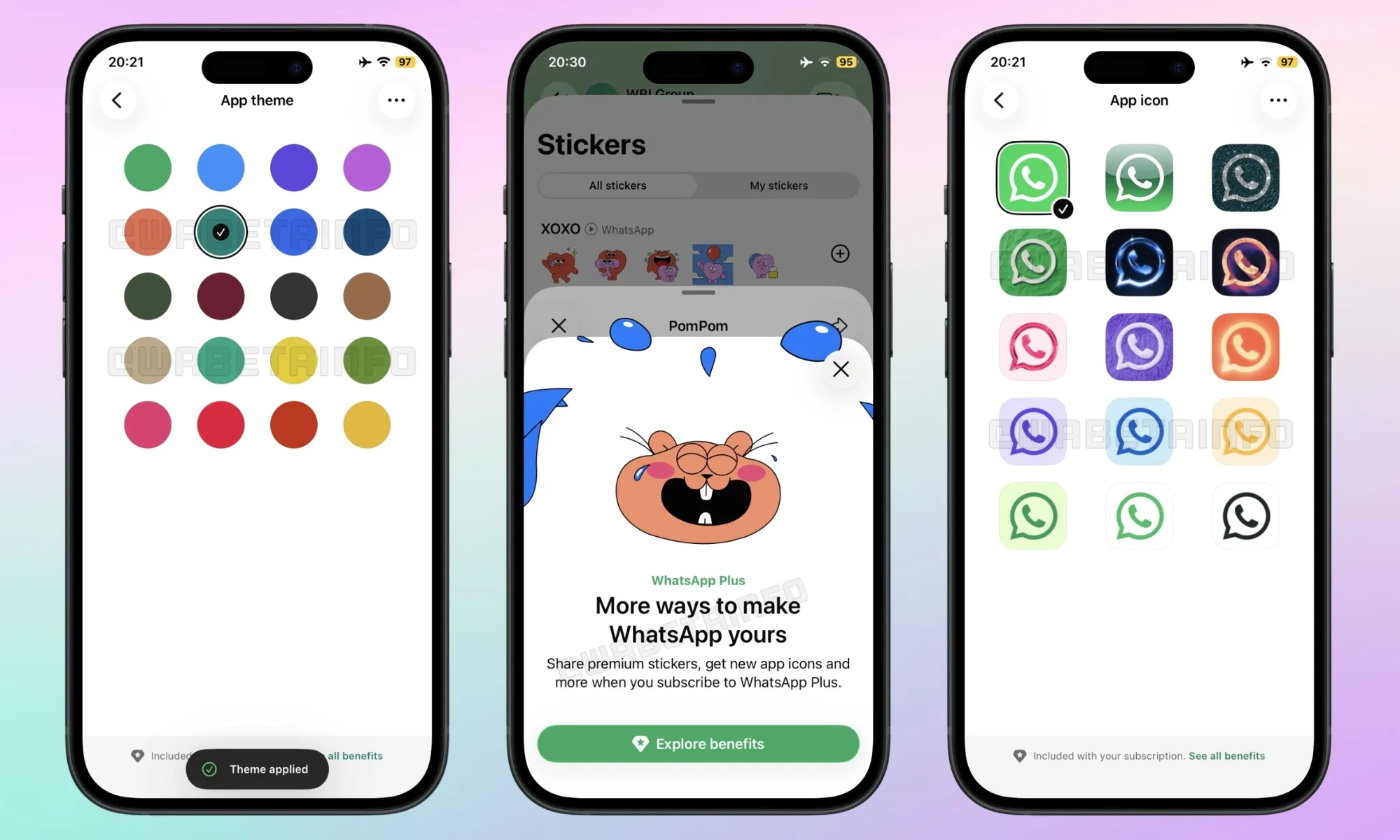
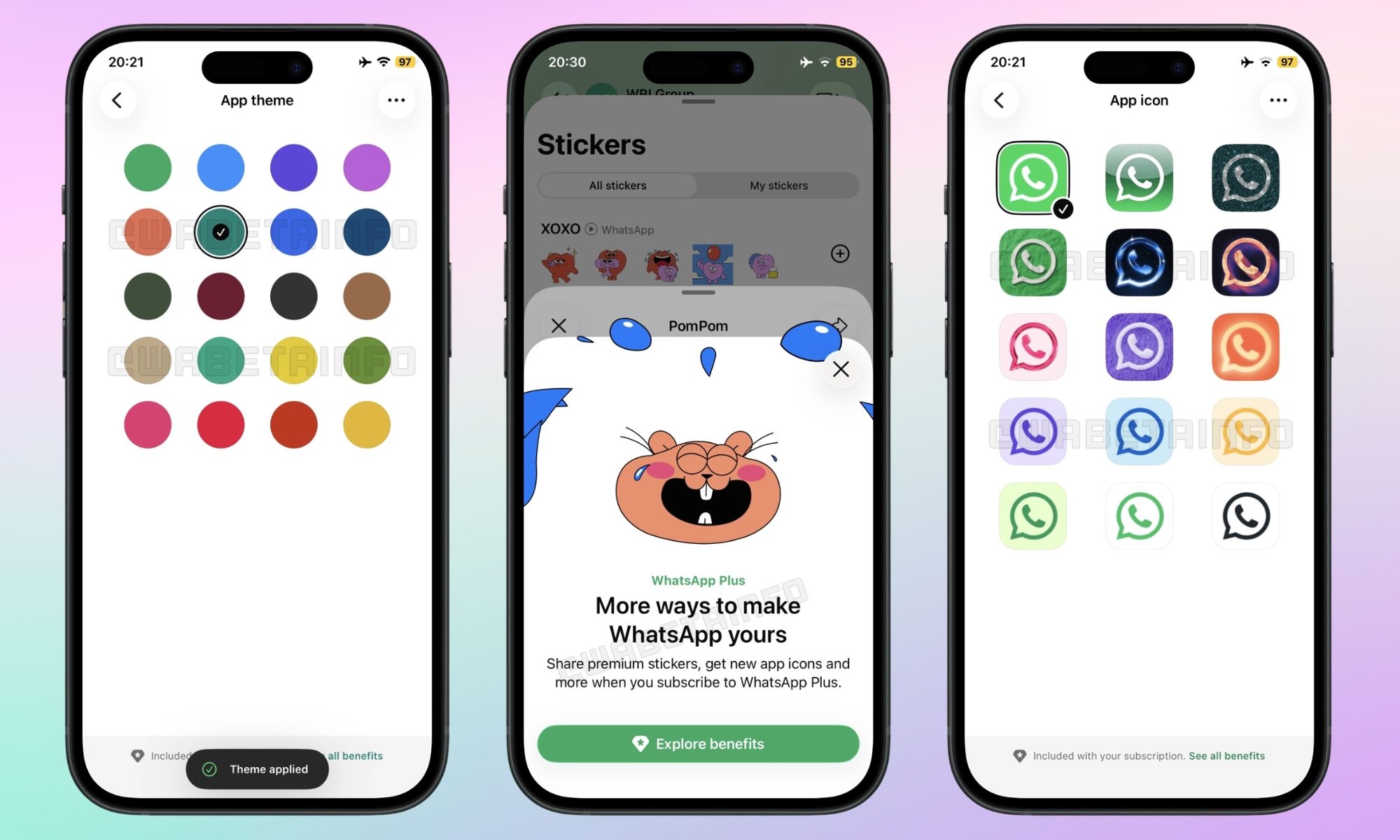
The list of benefits included as part of the WhatsApp Plus subscription sounds more like a cosmetic buffet than something useful. First, subscribers get 18 accent colors to replace the app’s signature green theme.
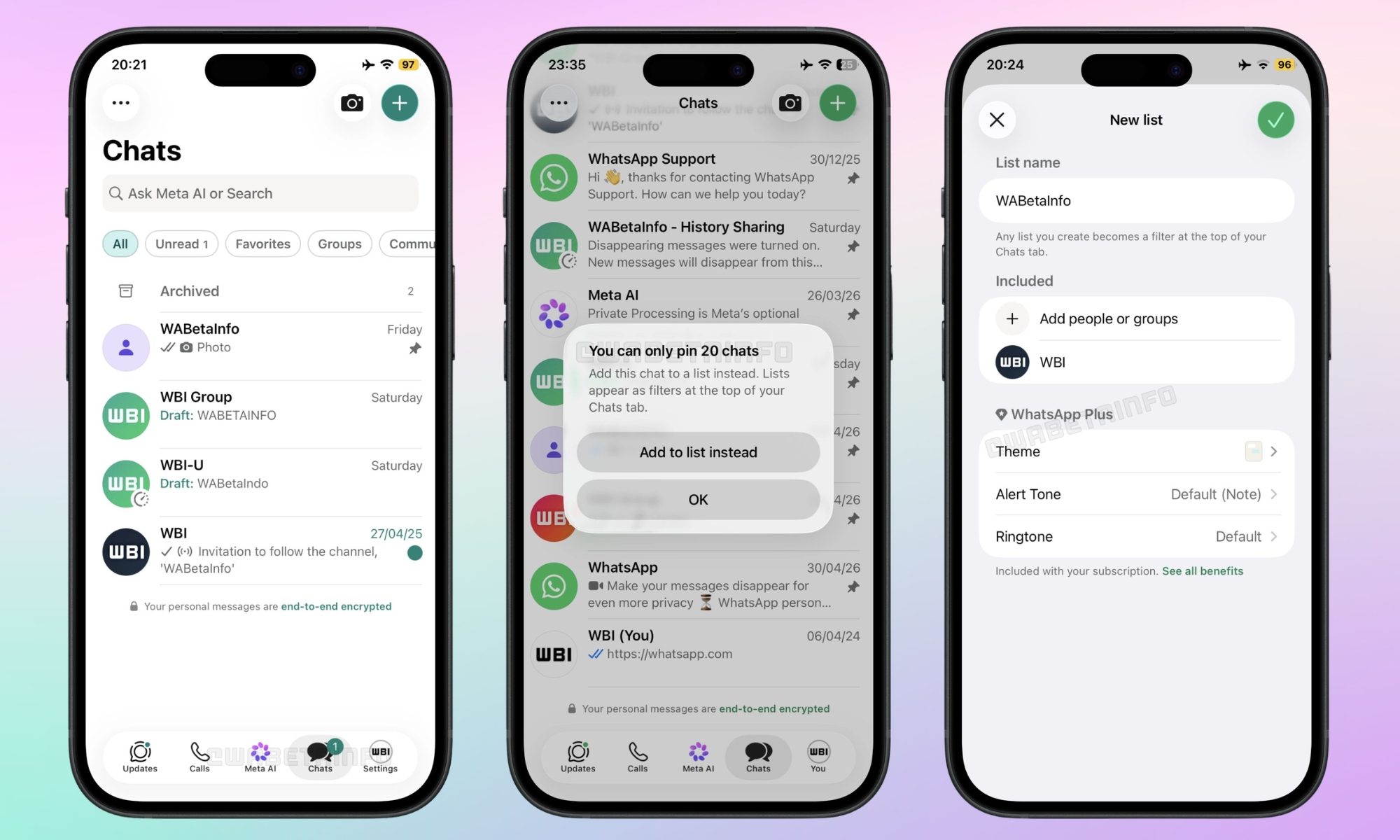
Then, there are 14 alternative home-screen icons to choose from. Additional perks include premium animated sticker packs, 10 exclusive call ringtones, and the ability to pin up to 20 chats (up from three), which is the only benefit I can imagine using.
What’s more is that subscribers can also apply unified themes and alert tones across entire chat lists, but the core WhatsApp experience, including E2EE messaging, calls, video, and status updates, remains the same.
How much does the WhatsApp Plus subscription cost?
In European markets, the subscription is priced at around €2.49 per month. While the US pricing hasn’t been revealed yet, it could land around $2.49 to $2.99. A free trial, for a week or a month, depending on the region, may also be available for eligible users.
For now, the WhatsApp Plus subscription is billed monthly via the App Store. For now, WhatsApp Business accounts can’t access the subscription, which is all the more questionable, since such users are more likely to pay for paid tiers.
What doesn’t sit well with me is that several WhatsApp Plus headline features are already available on rival messaging platforms for free; no monthly fee required.

Competitor apps offer chat background customization for free
Take the custom themes feature as an example. Telegram has already had the chat background customization feature, along with dark/light mode switching, for years, without a paid subscription.
Signal recently added a paid tier for cloud backups (removing the 45-day restriction on media storage), but even so, it lets users set custom chat wallpapers at zero cost. Apple’s native messaging service, iMessage, also offers free chat customization inside the Messages app, including per-contact photo backgrounds.
You see? What WhatsApp is charging for is already available in the base package of its competitors.
The paid tier should have included more useful features
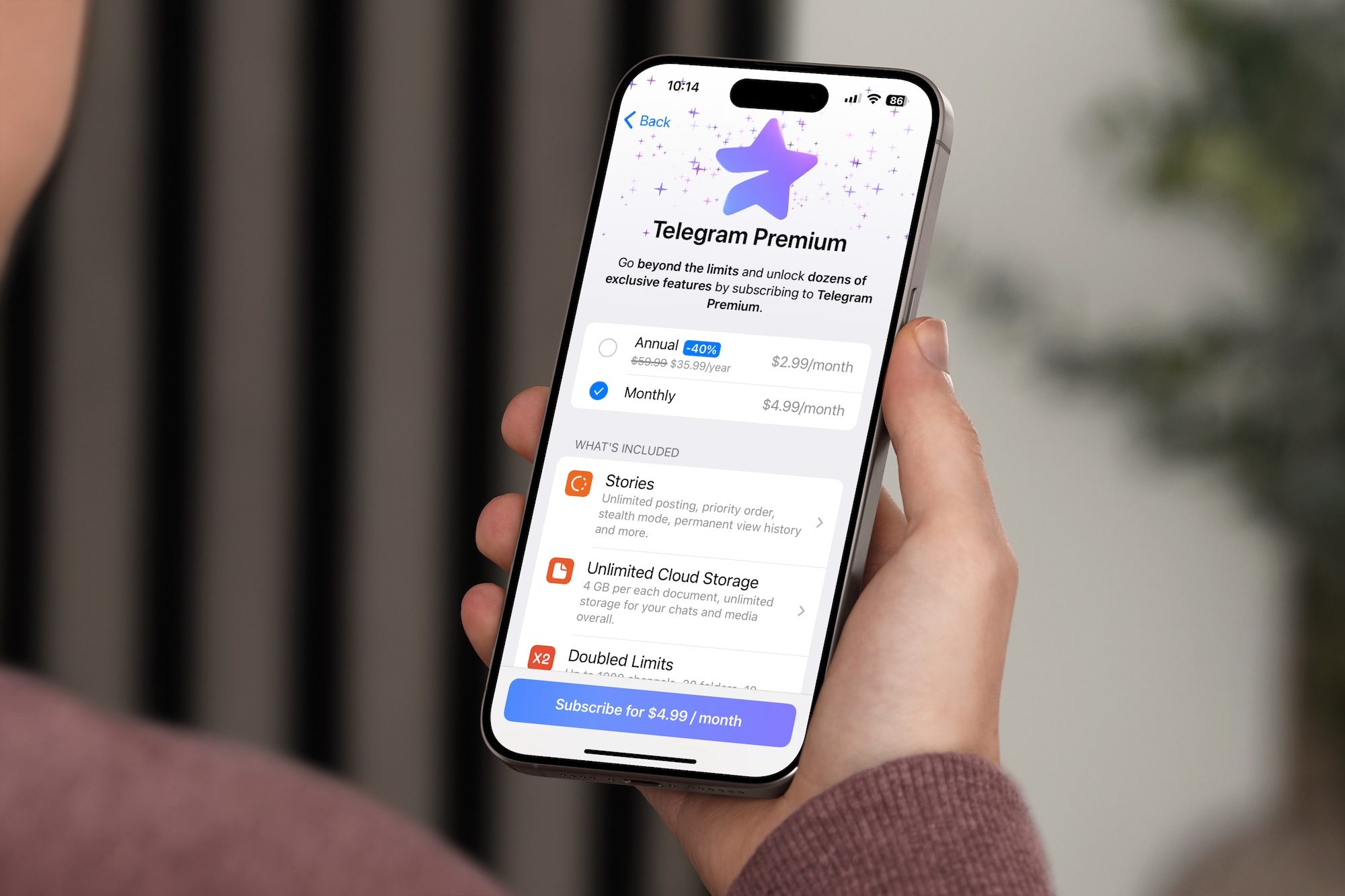
The Telegram Premium subscription, which costs $4.99 per month in the US, raises the file upload limit from 2GB to 4GB, provides voice message transcription, real-time chat translation, boosts download speeds, and allows users to join up to 1,000 Telegram channels.
These, in my opinion, are functional updates that change the way you use the app. WhatsApp Plus, however, only changes how the app looks, for the most part.
WhatsApp Plus, I’d say, isn’t a bad product. It’s a perfect add-on for enthusiasts who might want a purple app icon and animated stickers. However, for value-seeking buyers like me, the competition is offering more, either for less or nothing at all.



DevOps
Code hosting biz is trimming its global footprint and flattening its management layer
GitLab has opened the voluntary separation window and hopes an unspecified number of employees will exit the busniess to help it become “the trusted enterprise platform for software creation in the AI era.”
According to CEO Bill Staples, the company’s effort to trim its workforce differs from other AI-related layoffs.
“This restructure process is not like others you may be seeing in the news,” wrote Staples in a blog post. “Of course AI is changing the way we work and is part of our transformation plan, but this is not an AI optimization or cost cutting exercise.”
What is it then? Well, according to Staples, GitLab plans to use most of the money it saves by sacking staff to invest in its business.
We note that the five fundamental architectural bets at the heart of this business reorientation – agent-specific APIs; reworked CI/CD; a data model for surfacing context; governance; and support for human-owned, agent-assisted, and autonomous workloads – sound like infrastructure investments, the very thing other companies fuel with vacated payroll obligations.
But GitLab isn’t (so far as we can tell) returning freed funds to investors, initiating a stock buyback, larding executive bonuses, or launching an ill-advised metaverse venture that will consume $80 billion over five years. So maybe that’s the difference to which Staples alluded.
The other difference Staples cited is his company’s plan to have managers chat with employees about staying or going.
“Starting today, managers across the company are entering deeper conversations with leadership about how the restructuring principles land inside their teams,” he said. “Those conversations will inform the decision of impacted roles.”
There’s no word on the rubric for these retention-or-departure chats. Presumably employees deemed insufficiently enthused about the new direction will be encouraged to exit through the voluntary separation window. Absent that cooperation, defenestration at the hands of managers will likely follow.
While Staples has not provided target for the number of desired layoffs – details will be revealed during the company’s Q1 FY2027 financial report on June 2nd – he did set a territory footprint goal. “We’re reevaluating our operational footprint, and are planning to reduce the number of countries by up to 30 percent where we have small teams,” he said.
GitLab currently operates in 60 countries. That’s a lot of different corporate entities to run, tax laws to master, and offices to rent.
The code biz did not immediately respond to a request to clarify how “small teams” is defined. Nor does it disclose its headcount in recent annual reports. According to analytics biz Unify, GitLab has about 1,800 employees, of whom almost 1,500 work outside the US.
Another goal of the layoff plan is to reduce GitLab’s organizational layers. “We’re flattening our organization because eight layers is too deep for a company our size and management layers are slowing us down,” said Staples.
GitLab is betting heavily on its Duo Agent Platform (DAP), which entered general availability in January.
As recently as its 2025 annual report [PDF], GitLab talked up the possibility of continued hiring. “We intend to grow our international revenue by strategically increasing our investments in international sales and marketing operations, including headcount in the EMEA and APAC regions,” the biz said during a more optimistic time.
Now, not so much. Beyond other challenges like soft government business, one reason for the AI remake appears to be the company’s decision to raise prices back in 2023.
In March, during GitLab’s Q4 FY2026 [PDF] conference call for investors, Staples admitted that price-sensitive organizations didn’t much appreciate having to pay more.
“Our 50 percent Premium price increase a few years ago also coincided with rising AI code experimentation and flattish SaaS budgets,” he said.
“Simultaneously, our upmarket shift reduced technical resources at the lower end of the market. Together, these have slowed Premium growth, particularly among price-sensitive customers which we estimate at roughly 20 percent of our ARR, including the SMB weakness that we have been discussing recently.” ®
Tech
Bluesound PULSE FLEX Review: This $379 Hi-Res BluOS Speaker Has Range, But Does It Have a Pulse?
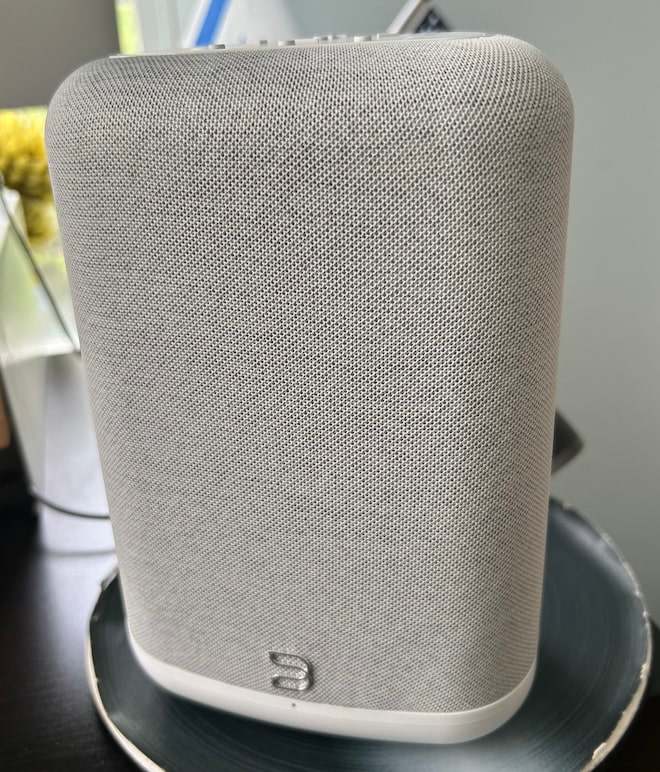
The new Bluesound PULSE FLEX P130 is the 2025 version of Bluesound’s compact BluOS wireless speaker, replacing the long running PULSE FLEX 2i. Compact wireless speakers are no longer background noise for kitchens, bedrooms, home offices, cottages, second homes, and the one shelf in the living room that somehow becomes everyone’s audio system. People buy a lot of these things, and the category has gotten a lot more serious than it used to be.
The new Bluesound PULSE FLEX arrives at $379 with BluOS streaming, hi-res and lossless audio support, Apple AirPlay 2, Bluetooth, USB-C audio, and the ability to work as a standalone speaker, part of a multi-room system, or as wireless surround channels with compatible Bluesound home theater products. That puts it directly in the path of the Sonos Era 100, WiiM Sound, and the Bose Lifestyle Ultra Speaker, which starts at $299 and rises to $349 depending on finish. We previewed the Bose last week, and our full review lands on May 15 when the embargo lifts. So yes, this fight is getting crowded. Good.
Bluesound also has something Sonos and WiiM cannot copy overnight: the Lenbrook ecosystem behind it. NAD Electronics, PSB Speakers, and BluOS give the PULSE FLEX a stronger hi-fi foundation than most compact wireless speakers chasing the same shelf space. That matters because this is not a throwaway category anymore. Build quality is improving. Sonic performance is improving. Connectivity is improving. And consumers are no longer just looking for a small speaker that makes noise while they burn toast.
The real question is whether the new PULSE FLEX actually lives up to the name. At $379, does Bluesound’s compact BluOS speaker play hard in the corners against Sonos, WiiM, and Bose, or does it merely have a pulse?
Design: Not Every Speaker Needs to Look Like Vader
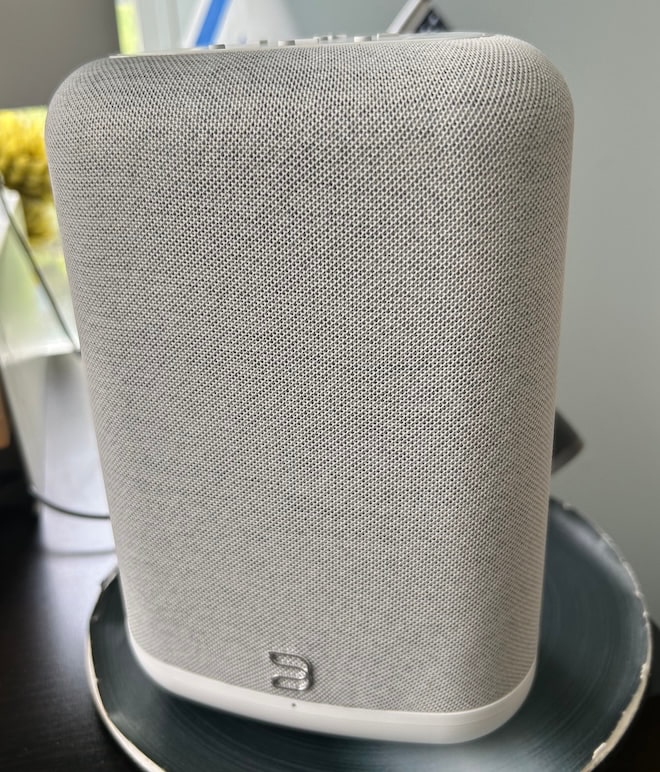
The PULSE FLEX has the kind of compact footprint that makes sense on a desk, nightstand, bookshelf, kitchen counter, or side table without announcing itself like a piece of networking gear from 2009. The rounded edges and cleaner cabinet design are a step in the right direction, and the finish options give Bluesound some needed visual flexibility.
Bluesound sent me the White Pebble Grey version, which is probably the safest choice for most homes. It is neutral enough to disappear into a lot of rooms without looking sterile, and that matters when these speakers end up in public spaces where spouses, partners, kids, guests, and people with actual taste get a vote.
The PULSE FLEX 2025 works as a standalone mono speaker, which is how many buyers will likely use it: on a desk, nightstand, bookshelf, kitchen counter, or in a home office. Add a second unit and it can run as a stereo pair, or serve as rear surrounds with compatible Bluesound home theater products.
At 5.15 x 7.73 x 4.37 inches and 3.55 pounds, it is compact enough to fit into real rooms without becoming the room. Bluesound includes 120V and 230V AC power cords, a Toslink mini adapter, safety and warranty documentation, and a quick setup guide. Not glamorous, but useful.
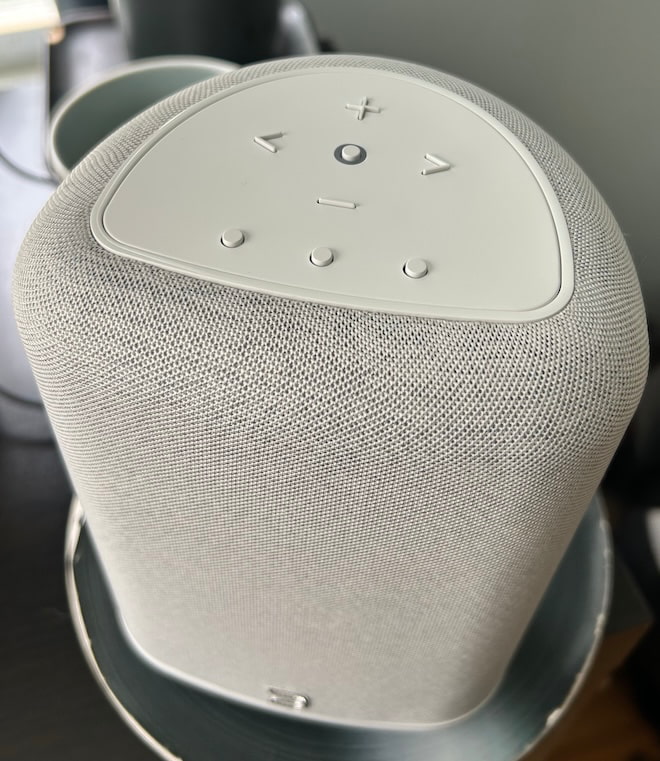
The top panel includes physical controls for play/pause, volume up/down, and track forward/back. There are also three preset buttons that can be assigned in the BluOS app to favorite radio stations, playlists, podcasts, or other commonly used sources. It is a small but useful touch, especially if the speaker ends up in a kitchen, office, or bedroom where reaching for the phone every time gets old fast.
Unlike the WiiM Sound, the PULSE FLEX does not include a touchscreen or display. Bluesound clearly expects you to control the speaker through the BluOS Controller app on your phone, tablet, or computer, with the top panel buttons handling basic playback and presets. That is not necessarily a problem, but it does make the PULSE FLEX feel more like a serious BluOS endpoint than a smart speaker trying to run the room from its own front panel.
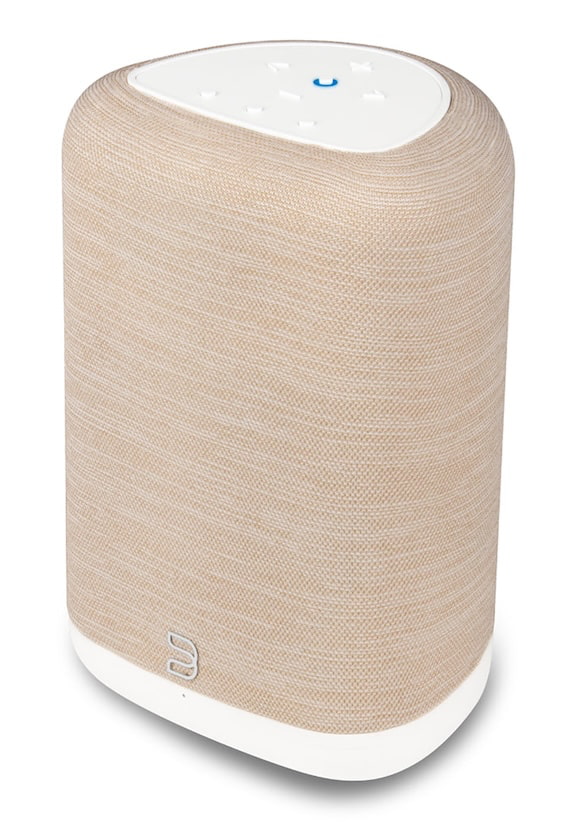
The PULSE FLEX is also available in White, Tan and Black Charcoal, with interchangeable fabric grilles in tonal weaves for those who want the speaker to blend in rather than become the room’s main character. Bluesound also offers the WM100 Wall Mount for cleaner wall installations and the FS230 Adjustable Stand for floor placement, which makes sense if you are using a pair as surrounds or trying to keep them off furniture already losing the war against charging cables.
Inside the PULSE FLEX
The Bluesound PULSE FLEX is built around a Smart DSP amplifier delivering 50 watts total system power, split between a 4-inch woofer and 0.75-inch tweeter. That makes it a compact mono wireless speaker, not a stereo miracle box pretending physics had the day off. Add a second unit and you can create a proper stereo pair, or use two as rear surrounds with compatible Bluesound home theater products.
The new FLEX supports hi-res audio up to 24-bit/192 kHz, along with FLAC, MQA, ALAC, WAV, AIFF, MPEG-4 SLS, MP3, AAC, WMA, WMA-L, OGG, and OPUS. It also supports DSD256, which gives it a stronger file support story than a lot of compact wireless speakers in this category. MQA and DSD “support” require a more detailed explanation, so let’s break down what those formats actually mean on the PULSE FLEX.
DSD256 and MQA?
DSD256 is not something most people will stream from TIDAL, Qobuz, Spotify, AirPlay 2, Bluetooth, or their phone. That is not how this works. On the PULSE FLEX, DSD support is mainly for people who already own downloaded high resolution music files and keep them on a USB drive, NAS, or computer-based music library.
Bluesound lists the USB Type-A port as being for external storage in Local Server Mode, which means you can connect a compatible USB drive with music files directly to the speaker. BluOS can also index music stored on a NAS or computer, making those files available through the BluOS Controller app. That is where DSD256 support actually matters.
The USB-C port is listed as a PC input, but Bluesound’s available information does not clearly state that it supports DSD256 playback from a computer over USB-C. Until Bluesound confirms that, it is safer not to make that claim or expect it to work. We will update if that question ever gets answered.
For most buyers, the more important formats and services will be FLAC, ALAC, WAV, Qobuz Connect, TIDAL Connect, Spotify Connect, Apple AirPlay 2, Bluetooth aptX HD, and Roon Ready.
MQA is more complicated. Lenbrook acquired MQA’s assets in 2023 and later created Lenbrook Media Group to commercialize BluOS, MQA, and SCL6 across the hi-res audio chain. But TIDAL officially removed MQA from its apps and integrations on July 24, 2024, replacing MQA content with FLAC where available.
For 99% of users, neither format will ever be part of the buying decision. But there is always one guy with a NAS, six versions of Kind of Blue, and the emotional stability of a Leafs fan in overtime, so we might as well be thorough.
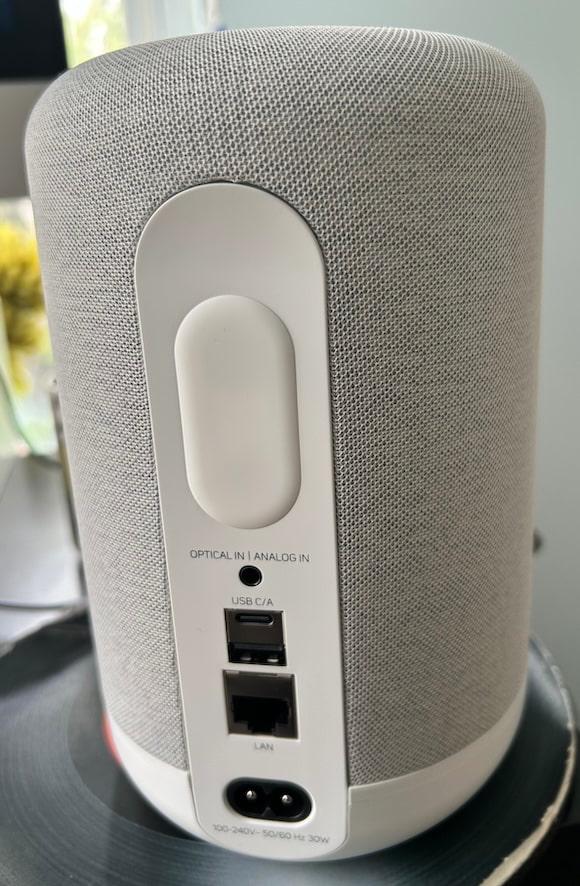
Connectivity: More Reliable Than Rogers on a Friday Morning
Connectivity is solid for a speaker this size. The PULSE FLEX includes Wi-Fi 5 dual band, Gigabit Ethernet, Bluetooth 5.3 with aptX HD, a 3.5mm optical/analog combo input, USB Type-A for external storage in Local Server Mode, and USB-C for PC input. It also offers IR learning, three onboard preset buttons, physical playback controls, and integration support for Crestron, Control4, RTI, Nice, URC, and Lutron.
The one spec that feels a step behind is Wi-Fi 5. It should be fine for most users, especially with hi-res streaming and BluOS multiroom playback, but plenty of homes have already moved to Wi-Fi 6E or Wi-Fi 7. At $379, Wi-Fi 6 would have been a welcome update.
That said, the PULSE FLEX offers more than the basics. It has useful wired and wireless options, practical control features, and enough integration support to work beyond a simple desktop or bedroom setup.
The BluOS Controller app remains one of Bluesound’s strongest advantages. It is detailed, mature, and gives users access to EQ adjustment, input level control, stereo pairing, multi-room setup, presets, music services, and system management without making the process feel like a firmware negotiation.
That matters. BluOS has had almost a decade of real world development, updates, and use across Bluesound, NAD, and other Lenbrook products. It is one of the better multiroom platforms out there, especially for listeners who care about hi-res audio, local libraries, and more serious system integration.
There are limits. EQ adjustment is fairly basic, and the PULSE FLEX does not offer room correction, which is something WiiM includes with the WiiM Sound. Voice control is available through Amazon Alexa Skills, but you will need the patience to set that up properly. Nobody said the smart home was actually smart.
I also ran the PULSE FLEX with multiple iPhones. The iPhone 14 and iPhone 17 worked without issue, but the older iPhone 11 was less consistent with BluOS. That tracks with my own experience using earlier PULSE FLEX models and other Bluesound speakers over the years: BluOS is very good, but not completely free of quirks, especially with older phones.
Listening
I came into the new PULSE FLEX with some preconceptions, mostly because I have owned and used other Bluesound speakers in the lineup. That prior experience led me to expect a somewhat bold presentation, which is not automatically a bad thing. But it can be.
Bold can work very well outside on the deck while eating char dogs with the kids and watching the dog get the zoomies across the lawn like he just stole something from a federal evidence locker.
At 5 a.m., it can be a different story.
I am a very early riser because sleep and I have a complicated arrangement, and some of my listening happens in the kitchen while I am making a pot of rooibos tea and staring into the backyard. That is usually when the fox and deer are sizing each other up like two extras in a Kurosawa film, while Tyrion the Westie scratches at the windowsill, furious that I will not let him outside to start a war he has absolutely no chance of winning.
That kind of listening tells you something useful about a compact wireless speaker. It is not just about how loud it can play, or whether it can sound impressive for 90 seconds in a demo. It is whether the tonal balance still works when the house is quiet, nobody else is awake, and you need music that has presence without behaving like it drank three espressos.
Right out of the box, after the mildly annoying LED light show that tells you whether the speaker is pairing, connecting, updating, or silently judging your Wi-Fi, it was obvious that the new PULSE FLEX does not sound like the older models.
The older Bluesound speakers I have owned leaned more bold and bass forward, with a presentation that could feel somewhat V-shaped. That is not what I heard here. The new PULSE FLEX sounds cleaner, more open, and more balanced through the midrange and treble. The tradeoff is that the lowest bass does not hit with the same weight. The sub bass has not left the building, but it definitely took the morning off.
That showed up across Nick Cave, The Orb, deadmau5, and Talking Heads. The presentation felt more spacious and better sorted, with less bass bloom getting in the way, but also less physical impact than I expected based on earlier Bluesound models.
Think less Vladdy Jr. sending one into the upper deck, and more Ernie Clement sneaking one just over the wall in left. It still counts. It just does not make the pitcher stare into the middle distance and reconsider his decision to leave Toledo.
Another positive change is that the new PULSE FLEX sounds more spacious than previous models I have used. That matters because this is still a mono speaker, and Bluesound, unlike Bose, did not send a stereo pair for evaluation. So no, it is not going to overwhelm a room with a huge wall of sound or create the kind of left/right separation you get from two properly placed speakers. Physics remains undefeated, even in Jersey.
What it does manage rather well is a sense of openness and placement within reasonable limits. The PULSE FLEX does a better job than I expected keeping vocals, percussion, and electronic textures from stacking up in one congested lump. Imaging from a single mono speaker is always going to come with an asterisk, but this version feels less boxed in than earlier Bluesound compact models. That is a meaningful improvement.
Another positive change is pacing. With less low end thickness, the PULSE FLEX sounds quicker, cleaner, and more open. There is more detail, better organization, and a little extra snap on rhythm driven tracks. It gives up some bass weight, but gains speed and clarity.
PULSE FLEX vs. Bose Lifestyle Ultra
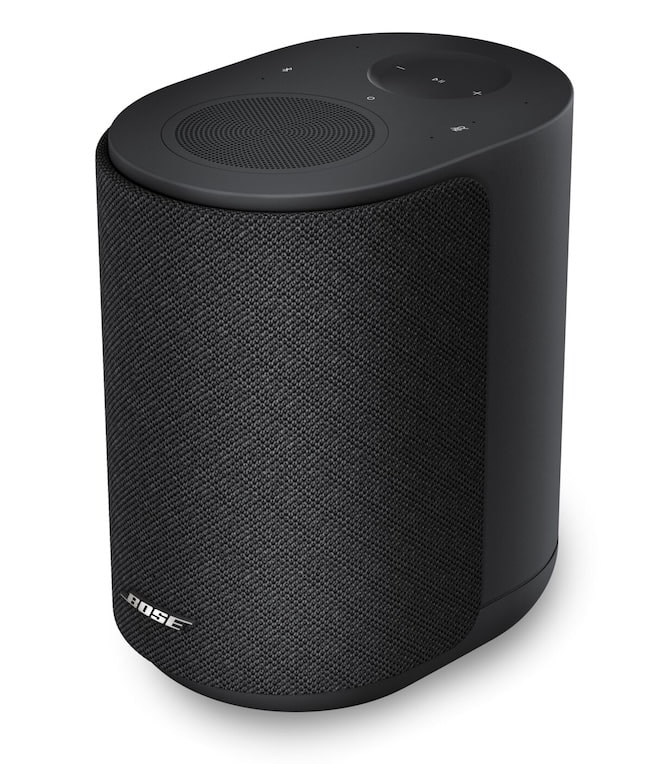
I am slightly limited in what I can say about the new Bose Lifestyle Ultra Speaker until my review publishes on May 15 under embargo, but there are too many similarities here to ignore.
Where the PULSE FLEX has the immediate advantage is software. BluOS gives Bluesound easy access to multiple streaming platforms, local libraries, multiroom playback, and system control from one app. The Bose app is more focused on setup, configuration, and system management. That is not a criticism, but it is a different approach.
The Bluesound also supports Spotify Connect, TIDAL Connect, and Qobuz Connect natively. Bose supports Spotify Connect, while TIDAL and Qobuz playback run through Apple AirPlay or Google Cast. For listeners already using Qobuz or TIDAL every day, that matters. Fewer steps. Less friction. Fewer reasons to mutter at your phone like it owes you money.
The real difference is how each speaker handles control and streaming access. Bluesound puts more of the music experience inside BluOS, especially for Qobuz Connect, TIDAL Connect, Spotify Connect, local libraries, and multiroom playback. That is a major advantage if you already use BluOS or want one app to manage everything.

But there is a counterargument. Some users do not want to live inside another control app, even a good one. They would rather open their preferred streaming app and cast directly from there. Bose leans more in that direction with Spotify Connect, Apple AirPlay, and Google Cast handling broader streaming access, while the Bose app focuses more on setup and system control.
So the PULSE FLEX has the stronger platform for serious BluOS users and local library playback. Bose may feel more natural for listeners who prefer to stay inside the apps they already use. Pick your poison: one deeper ecosystem, or fewer reasons to open another app before coffee.
The Bottom Line
The Bluesound PULSE FLEX P130 is not trying to be the loudest compact wireless speaker in the room, and that is probably a good thing. Compared to older PULSE FLEX models, the new version sounds cleaner, more open, and better paced, with improved detail and less of the bass heavy thickness that defined some previous Bluesound compact speakers. The tradeoff is impact. If you want deeper bass and more room filling weight from one small speaker, this is not the obvious first pick.
What makes the PULSE FLEX unique is the combination of BluOS, strong file support, native Spotify Connect, TIDAL Connect, Qobuz Connect, AirPlay 2, Bluetooth aptX HD, Roon Ready, real wired inputs, and the ability to work as a standalone speaker, stereo pair, multiroom endpoint, or surround channel with compatible Bluesound home theater products. That is a lot of flexibility in a speaker this small. It also helps that the build quality and finish options finally feel more appropriate for public rooms, not just a shelf in the basement next to the router.
What is missing? Room correction, deeper EQ control, Wi-Fi 6, a touchscreen or display, and true stereo playback from a single unit. The WiiM Sound has a stronger feature story in some of those areas, and the Bose Lifestyle Ultra Speaker offers a different kind of integration for users already inside that ecosystem. Bluesound’s answer is BluOS, and for the right listener, that still matters.
The PULSE FLEX is best for someone who wants a compact wireless speaker for a desk, nightstand, bookshelf, kitchen, home office, cottage, or second home, but does not want to give up real streaming flexibility or local library support. It is also a smart buy for existing Bluesound, NAD, or BluOS users who want to expand into another room without starting over. Just know what you are buying: this is a refined compact BluOS speaker with better clarity and pacing, not a tiny subwoofer with fabric on it.
Pros:
- Cleaner, more open tuning than previous PULSE FLEX models
- Better pacing, detail, and snap with less low end thickness
- BluOS remains one of the strongest multiroom platforms
- Native support for Spotify Connect, TIDAL Connect, Qobuz Connect, Apple AirPlay 2, Bluetooth aptX HD, and Roon Ready
- Strong connectivity for the size, including Gigabit Ethernet, optical/analog input, USB Type-A, and USB-C
- Compact enough for a desk, nightstand, bookshelf, kitchen counter, or home office
- More spacious presentation than earlier models, within mono speaker limits
- Can be paired with a second PULSE FLEX for stereo playback
- Can be used as surround channels with compatible Bluesound home theater products
- Strong build quality and attractive finish options, especially White Pebble Grey
Cons:
- Less bass impact than previous Bluesound compact speakers
- Still mono unless you buy a second speaker
- No room correction, unlike the WiiM Sound
- EQ controls are limited
- Wi-Fi 5 feels slightly behind the times at $379
- No touchscreen or display, unlike the WiiM Sound
- BluOS can still be quirky with older phones
- Alexa is supported through Alexa Skills, but not built-in
- Some users may not want to rely on another control app
- Wall mount and floor stand accessories cost extra
Where to buy:
Related Reading:


We love when astronomers share the images they capture with the James Webb Space Telescope because they are so dang beautiful and cool. But of course, science is about more than just pretty pictures. A research team has used the telescope to map out the cosmic web, a collection of dark matter, gas and filaments that connects larger entities in space. As the blog post from the University of California, Riverside describes it, the cosmic web “forms the underlying architecture of the cosmos, linking galaxies and clusters into a single, intricate, and far-reaching structure.” Used the James Webb Space Telescope, this team has created the most detailed map to date of this foundational structure.
“The jump in depth and resolution is truly significant, and we can now see the cosmic web at a time when the universe was only a few hundred million years old, an era that was essentially out of reach before JWST,” said Bahram Mobasher, UCR professor and an investigator on the study. “What used to look like a single structure now resolves into many, and details that were smoothed away before, are now clearly visible.”
“For the first time we can study the evolution of galaxies in cluster and filamentary structures across cosmic time, all the way from when the universe was a billion years old up to the nearby universe,” according to lead author Hossein Hatamnia, a graduate student at UCR and Carnegie Observatories.
The academic paper covering the development of this survey was published in The Astrophysical Journal.


OpenAI has just launched Daybreak, a cybersecurity initiative that’s clearly the company’s competitor to Anthropic’s Project Glasswing. If you’ll recall, Glasswing uses Anthropic’s unreleased AI model, Claude Mythos Preview, to provide its clients’ cyber defense needs. It’s been promising, so far: Mozilla revealed in April that Mythos helped it find and patch 271 vulnerabilities in the latest release of the Firefox browser. OpenAI says Daybreak uses its various AI models, including its specialized security agent Codex.
In its announcement, the company explained that Daybreak is built around the premise that cyber defense should be built into software from the start and not just revolve around finding and fixing vulnerabilities. Daybreak aims to prioritize high-impact issues and reduce hours of analysis to minutes, to generate and test patches within repositories and to send back results with audit-ready evidence to the clients’ systems. In OpenAI’s example, it asked Codex Security to scan a codebase, validate the highest-risk findings and fix them.
Find and fix vulnerabilities earlier with Daybreak pic.twitter.com/yobOSWYeWP
— OpenAI (@OpenAI) May 11, 2026
Daybreak will use GPT-5.5 for general purposes and GPT-5.5 with Trusted Access for Cyber for most defensive security workflows, including “secure code review, vulnerability triage, malware analysis, detection engineering and patch validation.” It will also rely on GPT-5.5-Cyber for “preview access for specialized workflows, including authorized red teaming, penetration testing and controlled validation.” OpenAI is already working with several partners under the initiative, including Cloudflare, Cisco, CloudStrike, Palo Alto Networks, Oracle and Akamai.


Virtualization
Analyst says modernizing applications is probably a better use of your time than hypervisor migration
Organizations that decide to reduce their VMware footprints, or quit Virtzilla entirely, will emerge with more complex and less capable infrastructure.
That’s the view of Paul Delory, a research vice president with analyst firm Gartner, who yesterday told the company’s IT Infrastructure, Operations & Cloud Strategies Conference in Sydney that there is no technical reason for VMware users to adopt a rival hypervisor, and that no vendor offers a one-for-one replacement for the virtualization pioneer’s flagship Cloud Foundation (VCF) suite.
But Delory said Broadcom’s licensing policies, which see it only sell VCF, mean VMware users’ licensing bills typically rise by 300 to 400 percent. Broadcom argues that the full-stack private clouds VCF makes it possible to build are so efficient that VCF quickly pays for itself.
The analyst told the conference he thinks those contemplating a move off VMware will do better if they instead focus on application modernization. But he said Broadcom’s price changes, and the prospect the company might hike prices again in future, mean many VMware users will look elsewhere.
Those who do, he warned, will end up with more complex infrastructure for two reasons.
One is that few organizations will be able to quit VMware entirely, as they run applications with dependencies that aren’t easy or economical to unwind. Reducing or eliminating a VMware rig therefore means adopting multiple replacements, which creates more infrastructure to manage and therefore extra complexity.
The other is that no rival hypervisor can match the efficiency or VM density possible when using VMware’s products, so moving means acquiring more hardware.
Delory said the best alternatives to VMware are the public cloud, or HCI vendors – these days that acronym denotes both hyperconverged infrastructure and hybrid cloud infrastructure.
The analyst warned that HCI vendors, with the exception of Nutanix, have weak migration tools that will leave users needing to create bespoke migration automations using “Ansible and a Rube Goldberg machine.”
Public clouds, he said, will welcome customers who move 1,000 or more VMs with free migration services.
He recommended against considering OpenStack, which he said remains “too big, too complex, and has too many moving parts for the typical IT shop to handle effectively.”
Delory also warned VMware users that migration projects are significant engineering undertakings that require extensive assessment of every application in a fleet to determine its best destination, and the work required to get it there.
He reminded VMware users that not every workload is certified to run under non-VMware hypervisors, and that some vendors now offer cloud-native versions of their wares and therefore offer an easier on-ramp to containerised applications.
Delory advised exploring those options, and not making architectural decisions that mean you can’t consider moving off VMware.
“VMware is betting that you can’t move off and they can jack the price way up,” he said. “That may be a good bet. But don’t make it easy.”
The analyst finished his talk by predicting most users will minimize their VMware footprints, rather than eliminating them, and restated Gartner’s prediction that 35 percent of workloads currently running under VMware will operate on a different platform by 2028. ®
Off-Prem
Orbital compute platform, which launched on a mission to the ISS last year, gets an immutable upgrade alongside refreshed container images
Red Hat Enterprise Linux 10.1 has powered up on board a datacenter orbiting 250 miles or about 400 km above the earth.
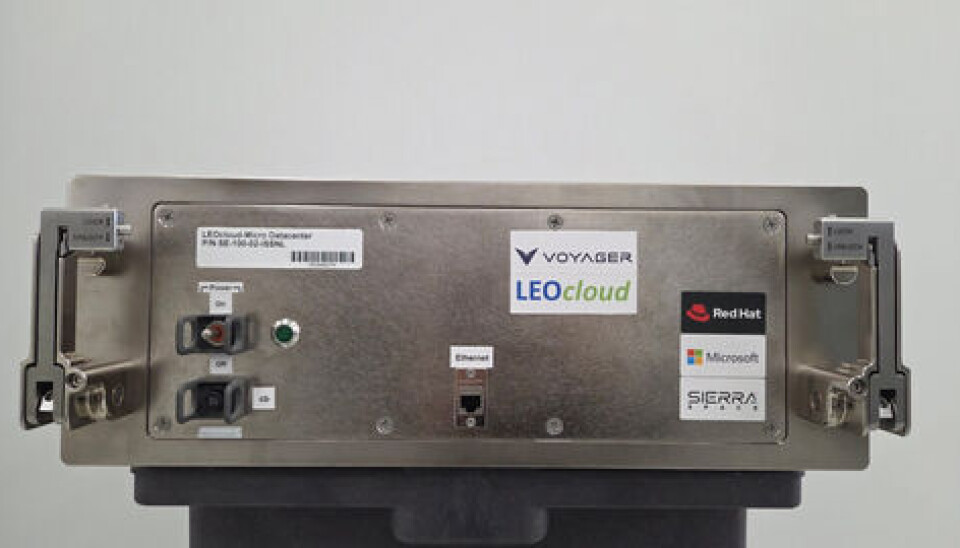
That RHEL-powered satellite is Voyager’s LEOcloud Space Edge “micro” datacenter, which launched aboard a SpaceX Falcon 9 rocket and hitched a ride on the International Space Station (ISS) back in September.
The system is designed to demonstrate the advantages of processing data gathered directly in orbit, rather than sending info back to a terrestrial conventional datacenter.
Voyager boasts the reduction in latency makes the system as much as 30x faster than sending all the data back to Earth.
Originally developed by LEOcloud prior to its acquisition by Voyager last year, Space Edge is, as its name suggests, a low-power edge compute platform for orbital data processing.
Voyager and Red Hat contend that “as commercial and government organizations increase their reliance on space-based data, the ability to process data in orbit is increasingly critical.”
And they certainly wouldn’t be the first to suggest that. Faced with power constraints, SpaceX, Amazon, Google, Nvidia and others have all announced plans to put large clusters of AI datacenters in orbit, with some designs aiming to cram 100kW worth of compute onboard a single satellite.
The company hasn’t disclosed the hardware used in Voyager’s Space Edge, stating only that it’s a “space-hardened managed cloud infrastructure.”
Hardening is certainly a concern for complex electronics operating outside Earth’s atmosphere, where charged particles and radiation can corrupt data or do permanent damage over time.
HPE’s Spacebourne compute platform demonstrated many of these challenges during its first mission aboard the ISS in 2017.
Over the course of its mission the system, which was composed of mostly off-the-shelf components, suffered several upsets including a power failure and SSDs that failed at an “alarming rate,” HPE’s Mark Fernandez said at the time.
We’ve reached out to Voyager for comment on the system and what kind of data its “micro” datacenter will process during its mission. We’ll let you know if we hear anything back.
It’s safe to assume Space Edge’s compute capacity is limited compared as promotional images show its systems are little larger than a shoebox – and therefore offer less room for components than servers used on earth.
What we do know is that RHEL 10.1, along with Red Hat’s Universal Base Image (UBI), are up and running on the ISS.
Specifically, Space Edge is running RHEL in image mode, an immutable build of the OS where changes to the most directories will reset to a known good state upon reboot.
This means that any issues related to what they call “configuration drift” can be addressed by turning the machine off and back on again, a feature we’ll sure will be popular among many in the IT crowd.
Alongside the base OS, Space Edge is also running Red Hat’s UBI container image under Podman, a container runtime interface (CRI) similar to Docker that is rootless and daemonless by default.
RHEL 10.1’s arrival in orbit comes amid renewed interest in space driven by the yearning of every great hyperscaler to boldly go and generate tokens where no one has before. Actually, they have, but not at scale.
But that’s exactly what SpaceX, Amazon and others have proposed. In pursuit of unlimited power, the two companies have independently filed to put large constellations of AI satellite compute platforms in sun-synchronous orbit.
In February, SpaceX filed an application with the Federal Communications Commission to lob a million space-based datacenters into orbit.
Meanwhile, Amazon has proposed a slightly smaller constellation with 51,600 data processing satellites.
Of course, these plans do have one small problem left to solve. How will they get those sats into orbit for less than the cost of simply building more terrestrial infrastructure? According to one space datacenter startup, the economics of orbital datacenters won’t be viable until the cost to orbit falls to around $10 per kilogram. As of writing, a rideshare aboard a Falcon 9 runs about $7,000 a kilogram. ®
Apple hasn’t abandoned spatial computing, judging by its research studies.
Apple’s interest in AI models and their applications in spatial computing shows no signs of slowing down, even as some claim the Apple Vision Pro is dead.
In April 2026, it was argued that the Apple Vision Pro was an outright failure and that, as a result, we’d never see a successor product. That rumor, though it always seemed unreasonable, has since come into question.
Even though the company’s Vision Products Group may have seen some changes, there’s ultimately still hope for a new generation of the Apple Vision Pro. Apple’s AI research suggests the company hasn’t abandoned its spatial-related projects.
On the contrary, new studies posted on the Apple Machine Learning blog explore the use of LLMs in sign language annotation, 3D head modeling, and more. Apple’s researchers also developed a new benchmarking system to evaluate the spatial-functional intelligence of LLMs.
Benchmarking spatial-functional intelligence for multimodal LLMs
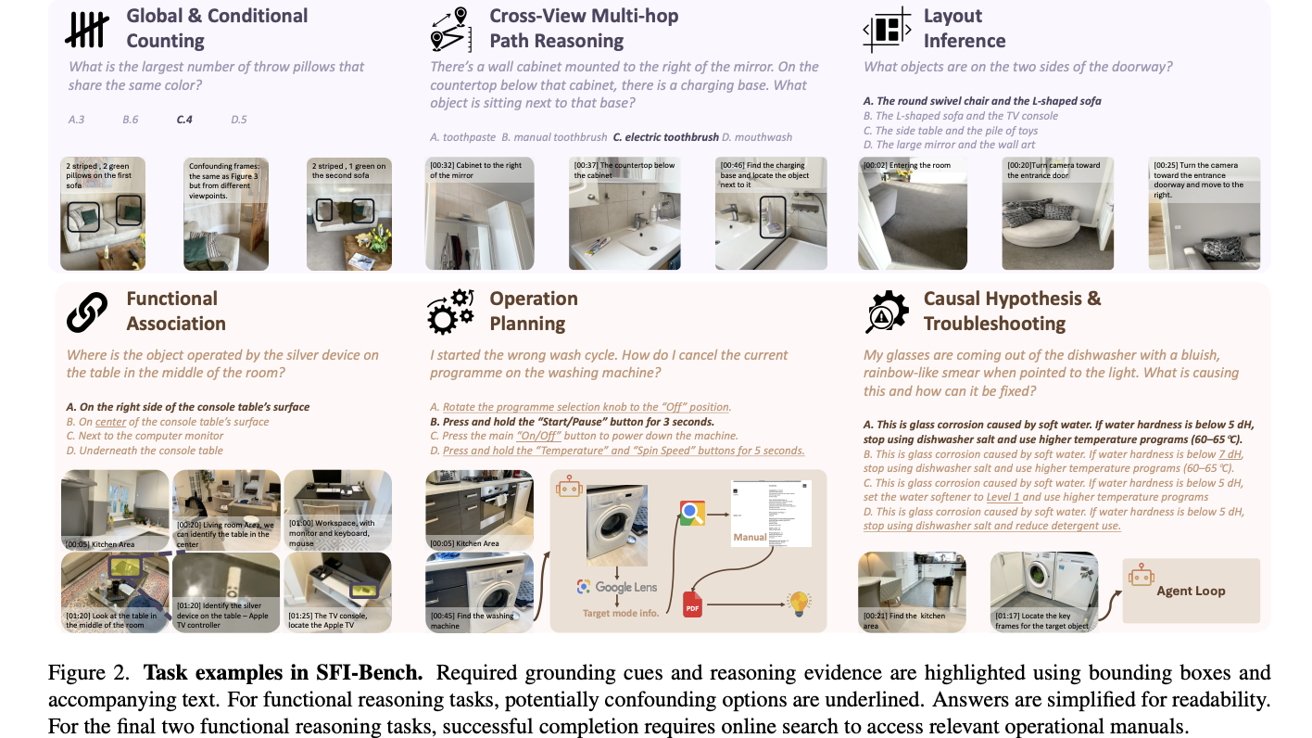
The paper titled “From Where Things Are to What They’re For: Benchmarking Spatial-Functional Intelligence for Multimodal LLMs” outlines a new testing and grading system for MLLMs.
Apple’s researchers developed a benchmarking framework that tests the spatial reasoning capabilities of MLLMs. Image Credit: Apple
As the study explains, to mimic human understanding of a space and its objects, AI models rely on two distinct structures. This includes “a spatial
representation that captures object layouts and relational structure, and a functional representation that encodes affordances, purposes, and context-dependent usage.”
In other words, a multi-modal LLM needs to understand the geometry of a particular space, along with the purpose and location of the objects inside it. Apple’s researchers say that existing benchmarking methods, such as VSI-Bench, only test the first aspect, largely ignoring the latter.
To combat this, they developed the Spatial-Functional Intelligence Benchmark, abbreviated as SFI-Bench. It’s described as a video-based benchmark with 1,555 expert-annotated questions derived from 134 indoor video scans.
As for what SFI-Bench tests specifically, the study explains this in a fairly straightforward manner:
“Beyond spatial cognition, SFI-Bench incorporates functional and knowledge-grounded reasoning, probing whether models understand what objects in the scene are for, how they are operated, and how failures can be diagnosed.”
In other words, the benchmark tests if AI models comprehend what an object is, where it’s located, how it’s used, what it’s used for, and how it can be fixed.
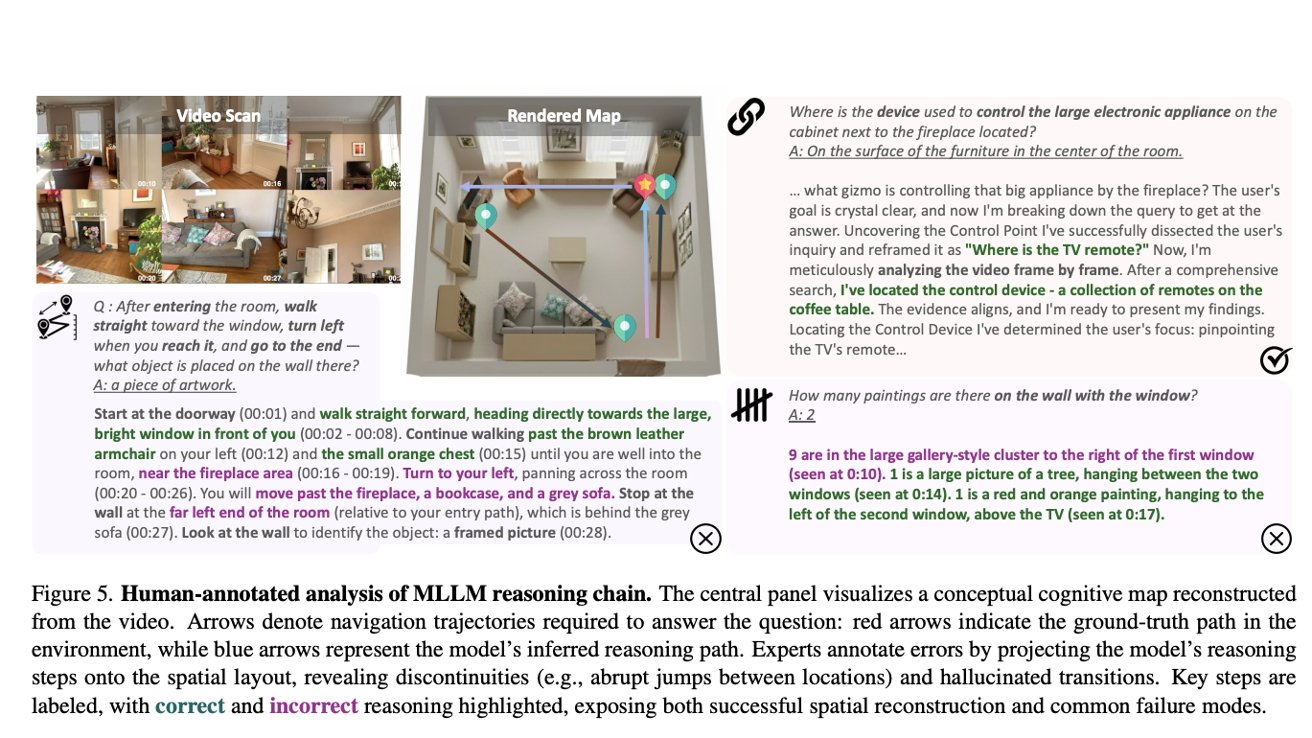
Apple’s AI researchers tested how well LLMs understand the world around them. Image Credit: Apple.
If this sounds familiar, it’s because Google has had tools with this type of spatial awareness since at least 2024. At its i/o conference that same year, Google’s AI model correctly identified an object in front of it as a record player and even suggested how to repair the device.
In practice, SFI-Bench would serve to test similar and more advanced AI models. Some of the tests mentioned include asking an LLM to identify the largest subset of the same brand bottles on a cabinet, asking it to cancel the current program on a washing machine, what a TV remote is used for, and more.
Apple’s researchers tested several open-source and proprietary AI models with their SFI-Bench framework. Unsurprisingly, Google Gemini 3.1 Pro achieved the best overall result, while Gemini-3.1-Flash-Lite placed third. OpenAI’s GPT-5.4-High scored second.
However, the study notes that “Across all models, global conditional counting emerges as a key bottleneck, revealing persistent limitations in compositional and logical reasoning.”
In other words, most current MLLMs “struggle with spatial memory, functional knowledge integration, and linking perception to external knowledge.” Still, the study noted that models with internet access performed better, relative to offline-only models.
As for potential applications within iOS, we could see Apple unveil a version of Siri with both spatial and contextual awareness. This would make sense, given that the company has partnered with Google for Apple Intelligence features.
It remains to be seen if and when that would debut, though, or how well the AI might perform.
Using AI models for sign language annotation
In a separate study, dubbed “Bootstrapping Sign Language Annotations with Sign Language Models,” Apple’s researchers explored how AI could be used to annotate sign language videos.
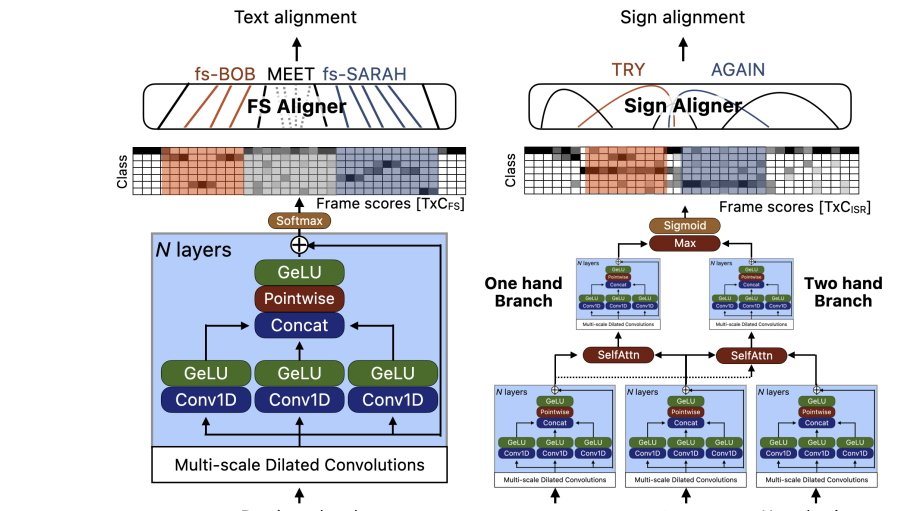
Apple’s researchers explored using AI for ASL annotation. Image Credit: Apple
The company’s research team says it developed a “pseudo-annotation pipeline that takes signed video and English as input and outputs a ranked set of likely annotations, including time intervals, for glosses, fingerspelled words, and sign classifiers.”
In doing so, they seek to reduce the time and cost of annotating hundreds of hours of sign language manually. This approach involved creating “simple yet effective baseline fingerspelling and ISR models, achieving state-of-the-art on FSBoard (6.7% CER) and on ASL Citizen datasets (74% top-1 accuracy).”
Apple’s researchers developed nearly 500 manual English-to-glossary annotations. They validated them through back translation, manual annotations, and pseudo-annotations for over 300 hours of ASL STEM Wiki and 7.5 hours of FLEURS-ASL.
For testing, Claude Sonnet 4.5 was given a gloss-to-English variation of a prompt and had to translate it from manual ASL STEM Wiki annotations to the reference English text that signers interpreted.
The study notes that “Errors were predominantly in cases where a sentence does not have any fingerspelling.” While additional work remains to be done, the researchers say their “approach for fingerspelling recognition and isolated sign recognition can be trained with modest GPU resources and could also be used for further iteration on pseudo annotation pipelines.”
As for why Apple is researching this, it could have something to do with the long-rumored camera-equipped AirPods. Perhaps the company plans to expand its Live Translation feature to include sign language.
3D gaussian head Reconstruction from multi-View captures
Another study called “Large-Scale High-Quality 3D Gaussian Head Reconstruction from Multi-View Captures” explores how head models can be made from images with the help of AI.
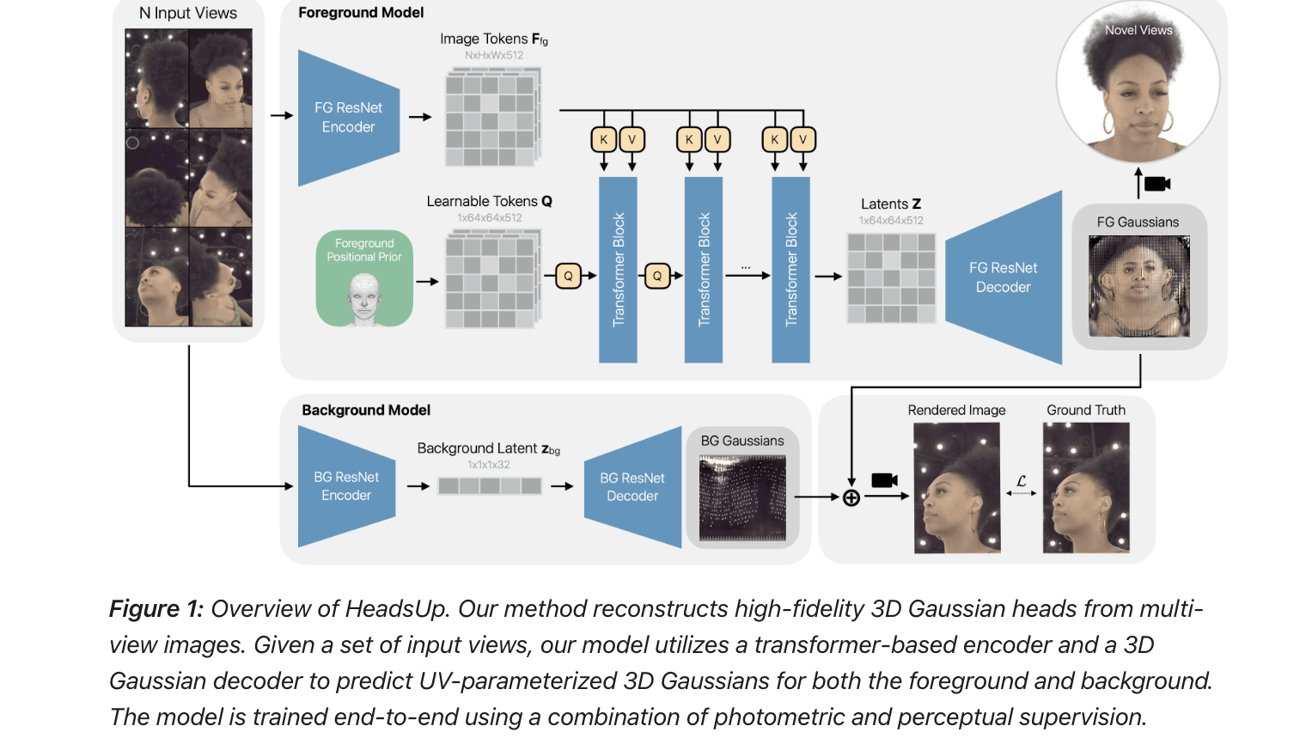
Apple’s AI researchers explored how LLMs can be used to create 3D head models from multi-view captures. Image Credit: Apple.
Apple’s researchers developed “HeadsUp, a scalable feed-forward method for reconstructing high-quality 3D Gaussian heads from large-scale multi-camera setups.”
In essence, the study explores how different head views can be converted into Gaussian blobs and then into 3D models through a series of encoders and decoders.
To test their image-to-3D-model method, those behind the study used “an internal dataset with more than 10,000 subjects, which is an order of magnitude larger than existing multi-view human head datasets.” The 3D head models were also animated using expression blendshapes.
Overall, the study explains that “HeadsUp achieves state-of-the-art reconstruction quality and generalizes to novel identities without test-time optimization.”
In terms of practical applications, the study could be related to the Apple Vision Pro and its Persona feature. Apple may be looking for ways to improve how expressions are rendered, or how faces themselves are captured and rendered within visionOS.
There may also be hardware or comfort-related applications. During the development of the headset, AppleInsider was told that the company included various 3D head types alongside Apple Vision Pro models.
Time will tell what Apple does with the information its researchers create. While we have to wait and see what its next product will be, one thing is for sure: the company isn’t backing down when it comes to AI and spatial computing.
Apple is set to announce iOS 27 and its corresponding OS updates at WWDC 2026, which will begin on June 8.
Tech
Ilya Sutskever Stands by His Role in Sam Altman’s OpenAI Ouster: ‘I Didn’t Want It to Be Destroyed’
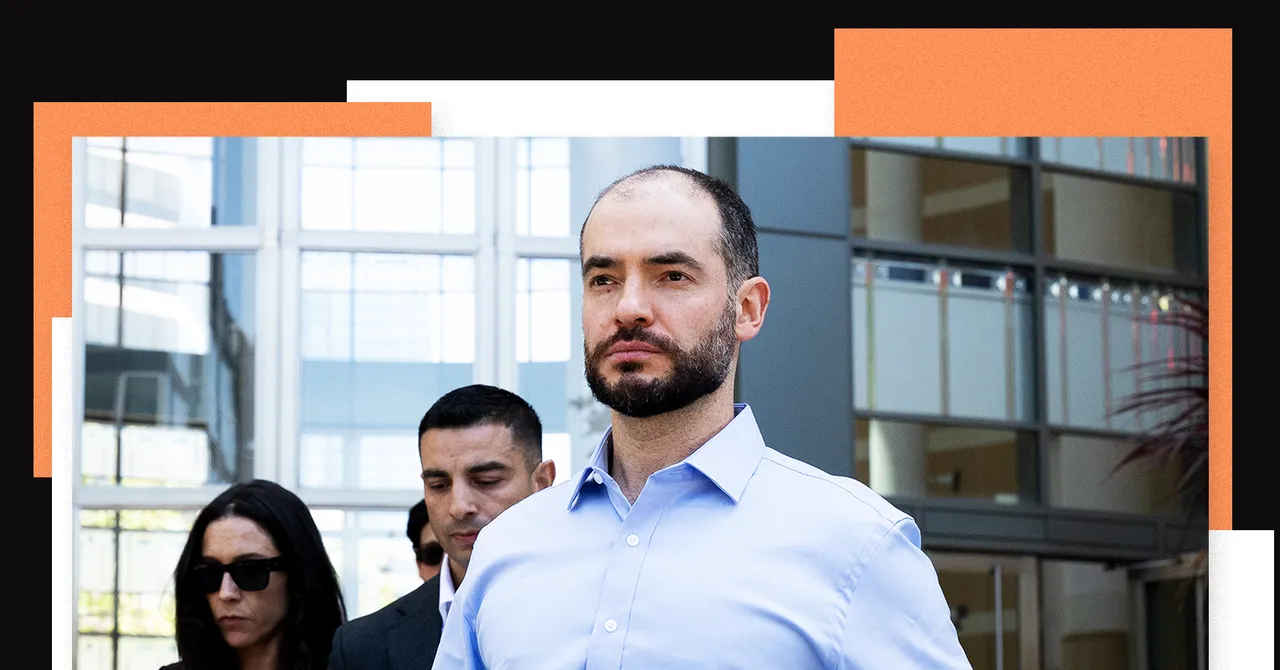
Elon Musk’s trial against OpenAI and Microsoft entered its final stretch on Monday, with testimony from Microsoft CEO Satya Nadella, former OpenAI chief scientist Ilya Sutskever, and current OpenAI chairman Bret Taylor.
Sutskever drew the spotlight, revealing an ownership stake in OpenAI’s $850-billion for-profit arm that is currently worth about $7 billion. That makes him one of the largest known individual shareholders of OpenAI. Earlier in the trial, OpenAI president Greg Brockman acknowledged for the first time that he has around $30 billion worth of OpenAI shares.
Brockman was one of the research lab’s original cofounders, and Sutskever joined shortly afterward, turning down a $6 million annual compensation offer from Google. Brockman said he and Sutskever were “joined at the hip,” until Sutskever helped lead Sam Altman’s brief removal as OpenAI CEO in 2023. Sutskever had helped collect evidence to show Altman’s alleged history of deception, and even assisted in drafting a memo to the board. Though they tried to repair the relationship, Sutskever has been estranged from Brockman and Altman ever since, a lawyer for OpenAI said on Monday.
Sutskever, who arrived in the courtroom wearing a dress shirt and slacks, the first male witness to testify without a suit jacket, appeared to be dejected about no longer being involved with OpenAI. (He left and formed a competing AI lab in 2024.) “I felt a great deal of ownership of OpenAI,” he said at one point Monday. “I felt like I put my life into it, and I simply cared for it, and I didn’t want it to be destroyed.”
Sutskever’s testimony bolstered Musk’s contention that Altman is not the right person to lead an AI lab that could create artificial general intelligence. In addition, Sutskever mentioned how the superalignment team he helped lead, which focused on the safety of future models, was doing the most important work at OpenAI “for the long term.” The team was disbanded in May 2024, shortly after Sutskever left the company.
But Sutskever also added to OpenAI’s defense that Musk never negotiated any special promises when funding the OpenAI nonprofit. Musk’s allegation that such commitments existed and that Altman and Brockman violated them by pursuing a lucrative for-profit arm are the core of his claims in the lawsuit. Sutskever said OpenAI needed “a lot of dollars” to build a computer as big as the human brain, and while seeking donations had some “reasonable success,” becoming a for-profit was the consensus way forward.
“I would describe it as the difference between an ant and a cat,” Sutskever said in response to a question from US district judge Yvonne Gonzalez Rogers about how more computing helped OpenAI level up. “If there’s no funding, there is no big computer.”
In the end, Sutskever, a prominent AI scientist who paints in his spare time, testified for about an hour, barely making eye contact with anyone during his time on the witness stand.
Musk’s legal team had unsuccessfully sought to treat Sutskever as a hostile witness because of his financial stake in OpenAI. But Gonzalez Rogers agreed to give attorneys for both Musk and OpenAI extra leeway in their questioning of Sutskever due to what she described as his “unique position” in the case.
The Blip
Much of Monday’s testimony centered around the well-covered events of Altman’s ouster and reinstatement as CEO in November 2023. Nadella described Sutskever and other board members firing Altman as “amateur city” and reiterated that he “never got clarity” about the lack of candor that led to their decision. Nadella also acknowledged during his testimony that he and colleagues discussed 14 potential board members who would join OpenAI if Altman returned, including at least two whom the Microsoft group vetoed and one who later joined. Nadella described Microsoft’s input as suggestions.
Sutskever said he supported firing Altman because an “environment where executives don’t have the correct information” is not “conducive to reach any grand goal.” But he criticized his board colleagues for rushing the process, lacking experience, and accepting “legal advice that wasn’t very good.”
Microsoft’s Bet
In his lawsuit, Musk accused Microsoft of helping to transform OpenAI into a moneymaking machine beyond what Musk intended. Nadella testified that Microsoft had first supported OpenAI with discounted cloud computing but it could no longer afford to do so “once the bill started going up.” A for-profit arm that Microsoft could invest in, in exchange for a potential financial return, was more palatable.
But as the years progressed and the bills kept rising, Microsoft wanted more out of the partnership. Microsoft “will lose 4 bil next year!!!” Nadella exclaimed in an email in 2022 to his lieutenants about the OpenAI partnership. He called for a new agreement ensuring Microsoft would also get AI “know-how” from the startup, which he kept spelling as “Open AI.”
Wacom is back with a new pen display pad, with the MovinkPad 11 aimed at artists who like to sketch and create on the go. That’s assuming that you can fit it into your workflow.
Wacom stands as one of the elder leaders in the world of graphic pen displays, producing a variety of pen displays to meet every need. As artists become more mobile in their day-to-day workflow, so grows the need for portable and versatile equipment for creatives on the go.
Wacom provided the MovinkPad 11 to use for an extended test drive, to see if its quality and execution live up to the reputation Wacom has held onto for so many years.
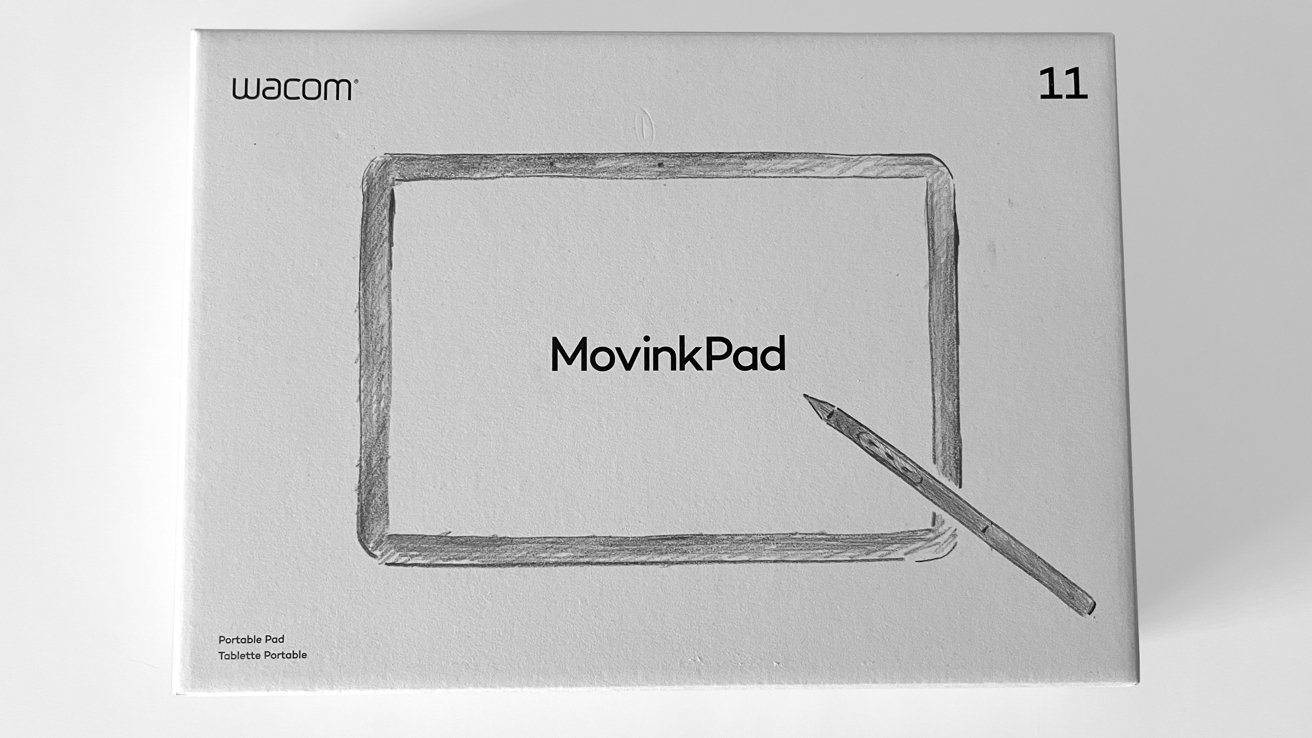
The MovinkPad 11 arrived in a padded shipping box from Wacom, with simple and vibrant sketchbook-style branding.
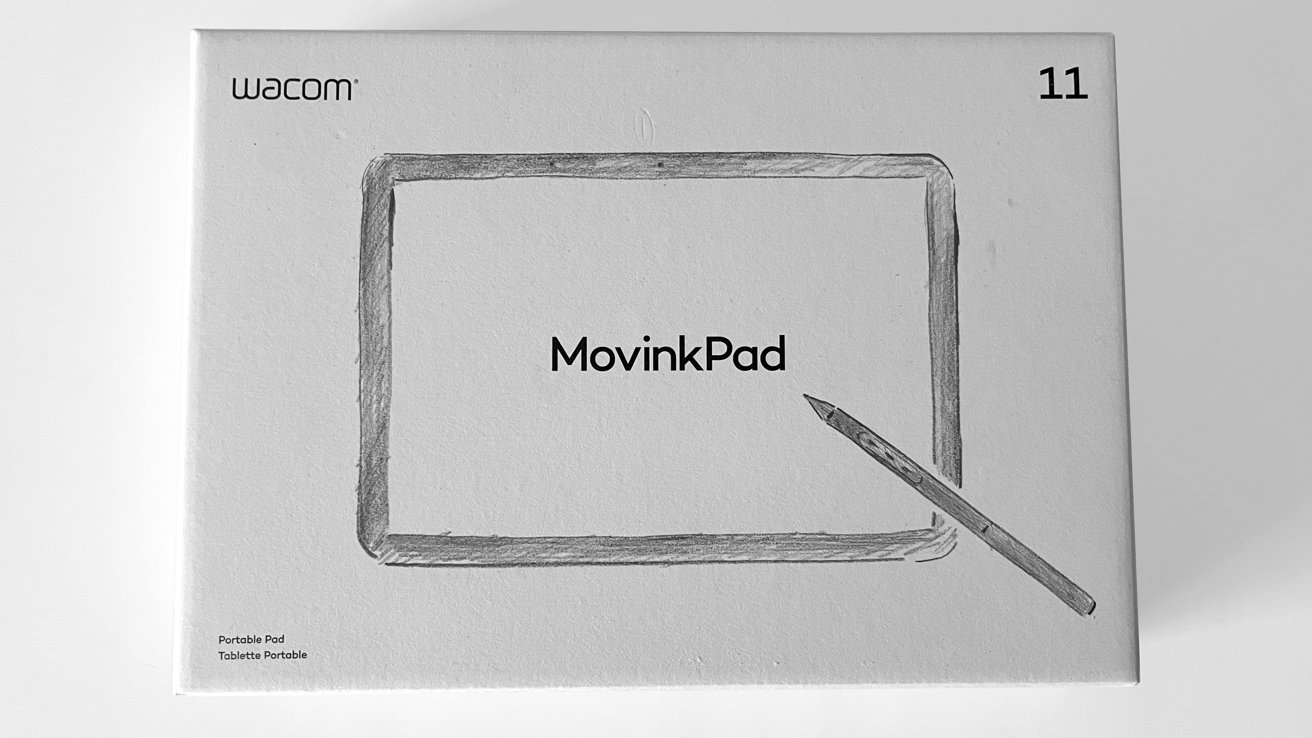
Wacom MovinkPad 11 review: Its box
Inside the box
- Wacom MovinkPad 11 (and Android driven pad with full functionality)
- Wacom Pro Pen 3 with nib holder (Felt nib x3)
- USB-C to USB-C Cable (1m/Power)
- IPI Booklet
- Regulation sheet
The Wacom MovinkPad 11 also includes complimentary software:
- Clip Studio Paint Debut (2-year license)
- ibisPaint X (180-day trial)
- Artwod (3-month trial)
- Magma (3-month trial)
- Product Dimensions (L x W x H): 266 x 182 x 7 mm / 10.5 x 7.2 x 0.3 in
- Product Weight: 588 g / 1.3 lb
- Product Color: Light Gray
- Storage Temperature and Humidity – Temperature: -10 to 60 degree C – Humidity: 30 to 90% RH (non-condensing)
- Operating Temperature and Humidity – Temperature: 5 to 40 degree C – Humidity: 30 to 80% RH (non-condensing)
- Screen Size: 11.45 in / 29 cm
- Active Area: 243 x 159 mm / 9.6 x 6.3 inch
- Display Technology: IPS
- Surface: AF + AG glass
- Direct Bonding: Yes
- Touch Technology: Projected capacitive technology
- Multi-touch: Yes – 10 fingers
- Display Resolution: 2200 x 1440 pixels
- Display Colors: 16.7 million
- Color Depth: 8bit x RGB = 24bit
- Color Gamut Coverage Ratio: sRGB 99% (CIE1931) (typ)
- Aspect Ratio: 3:2
- Viewing Angle: 170 deg. (85/85) H / 170 deg. (85/85) V (typ)
- Contrast Ratio: 1200:1 (typ)
- Brightness: 400cd/m2(typ)
- Refresh rate: 60/90 Hz
- Processor: Mediatek Helio G99
- Memory: 8GB
- Storage: 128GB
- Operating system: Android 14
- Wireless Connectivity: IEEE 802.11a/b/g/n/ac – Bluetooth 5.2
- I/O Connectors: 1x USB Type-C port (USB2.0)
- Battery Type: Lithium-ion battery
- Battery Capacity: 7700mAh (typ)
- Camera: 5M pixels (Front) / 4.7M pixels (Rear)
- Mic/ Speaker: Dual Microphones / Stereo Speaker
- Sensor: G-sensor / e-compass / Ambient light sensor
- System Requirement for Wacom MovinkPad Instant Pen Display
- Windows: Windows 11 *Windows ARM-based computers are not supported
- Mac: macOS 14 (Sonoma), 15 (Sequoia), 26 (Tahoe) *Intel Mac computers are not supported.
Pen Specs
- Wacom Pro Pen 3 with Nib holder
- Pen Technology: Electromagnetic resonance technology
- Pen Pressure Levels: 8192 levels
- Supported Pen Tilt Angle: 60 degrees
- Pen Resolution: 5080 LPI
- Pen Type: Pressure-sensitive, cordless, battery-free
- Switches: 3 side switches
The MovinkPad 11 is an incredibly well-made, lightweight all-in-one pad from top to bottom. Nothing about the MovinkPad 11 feels cheap.
In appearance, the MovinkPad 11 feels a lot like an Apple product with the gray metal case and simple design.
This is a full functionality, independent all-in-one pad, not simply a pen display that requires a desktop or laptop to drive its use. This means the MovinkPad 11 also includes all the bells and whistles of a tablet, including speakers, front and rear cameras, a native Android operating system, 8 GB of memory, 128 GB of internal storage, and wireless connectivity via Wi-Fi and Bluetooth.

Wacom MovinkPad 11 review: Unpowered
In a sign of the times for technology, the MovinkPad 11 does not include HDMI ports or USB-A ports. Wacom is fully embracing USB-C connectivity and charging.
Wacom includes the Wacom Pro Pen 3 with the MovinkPad 11, and this is a solid stylus pen. It is one of the thinner models that is closer to an actual pencil is size and feel.
Setting up the MovinkPad 11 was incredibly easy, outside of one small issue Wacom needs to address immediately.
After unboxing and charging the MovinkPad 11, I powered up the pad and was greeted with a simple and straightforward series of steps. It guided me on how to connect to my Wi-Fi, adjust settings, link my AppleInsider work Google account, and get straight into sketching via the preloaded Wacom Canvas app.
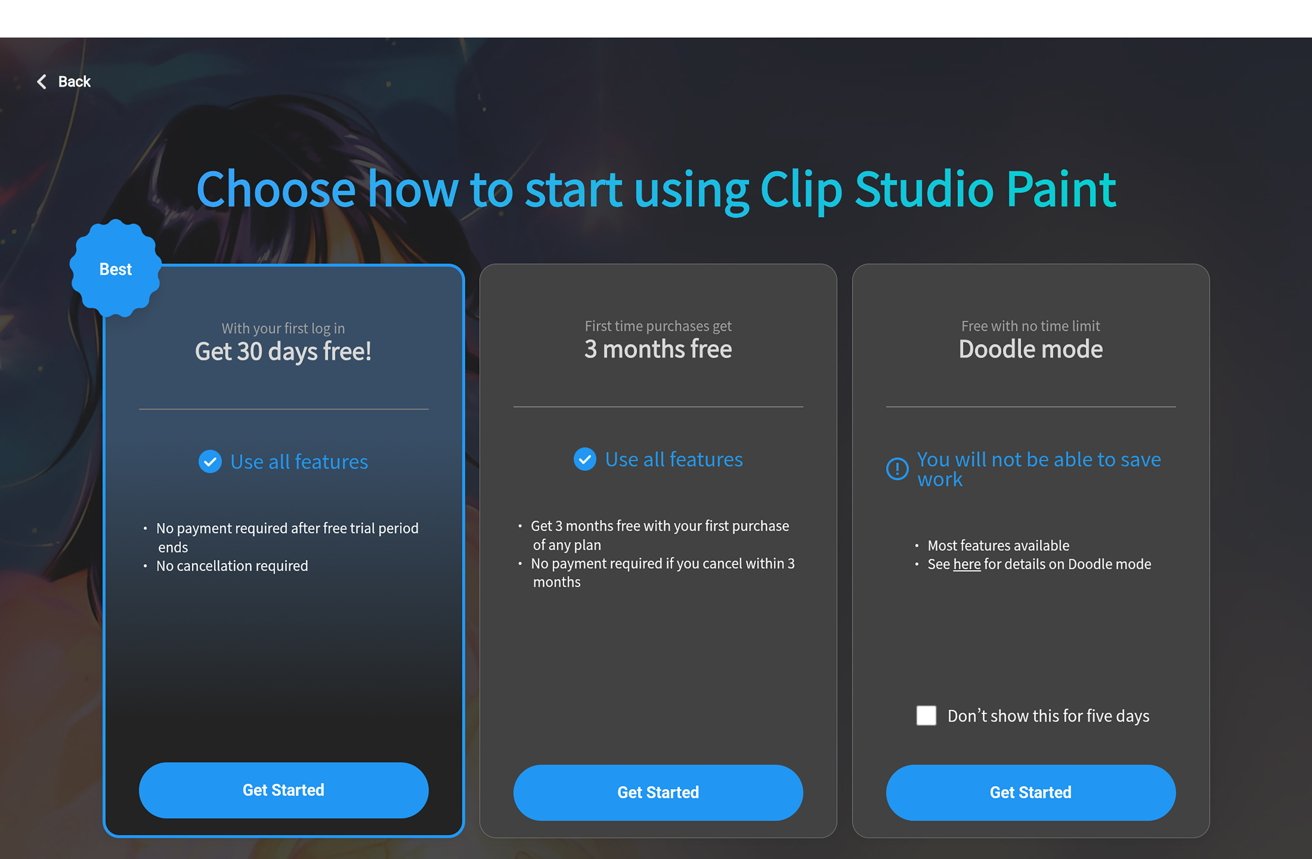
Wacom MovinkPad 11 review: Guiding through the set-up process
You can enter the OS settings easily to install new apps and make personal preference adjustments, and I did over time.
But my initial test with every pen display and all-in-one is to answer how quickly and easily I can get to work from unboxing to initial startup. In the case of the MovinkPad 11, very easily.
After setting up the MovinkPad 11, I opened a fresh Wacom Canvas document and settled in to sketch and eventually worked up a sketch for an upcoming cartography project.
Wacom includes Wacom Canvas, Wacom Shelf, and Wacom Tips apps at startup. Each of these applications work in conjunction with the MovinkPad 11 to create and save sketches, and also to adjust the preferences for their use with the MovinkPad 11.
Wacom Canvas is a lightweight sketching app with simple functionality that I enjoyed. With simple pencil-style brushes in blue and gray, an inking brush, two eraser sizes, and export functionality as PNG files or transferring straight into Clip Studio, it is a solid app with limits.
I wish Canvas provided at least 2 to 4 layer options.
The app is designed purely for sketching, but when I want to draw in blue and refine with an ink brush, the eraser tool takes everything. I would like a little separation here, as this is my standard workflow in Photoshop.
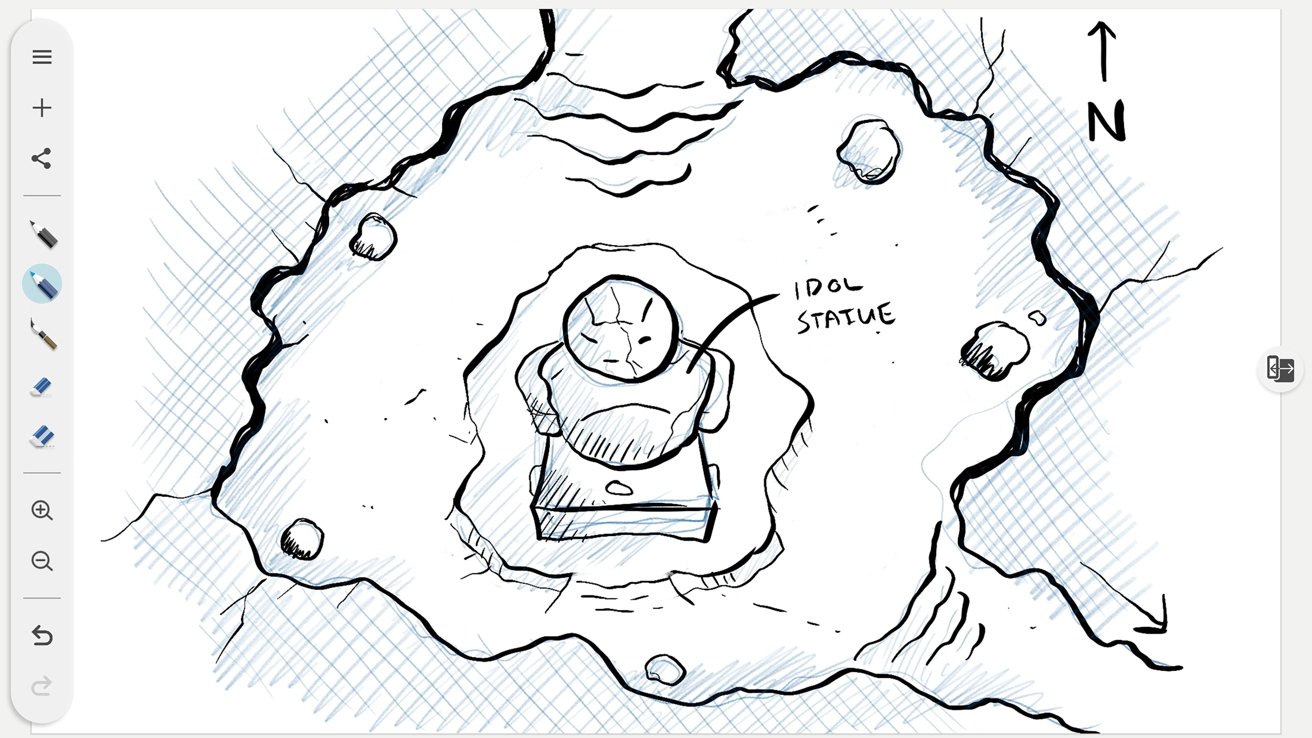
Wacom MovinkPad 11 review: Screenshot of the drawing process.
The purchase of the MovinkPad 11 from Wacom includes a 2-year Clip Studio Paint Debut license, as well as trials for the sketching app ibisPaint X (180-day trial), ArtWod (3-month trial), and Magma (3-month trial).
Outside of Photoshop, Clip Studio Paint is the go-to app for digital illustrators. The inclusion of a 2-year license is a great feature for the MovinkPad 11.
Wacom Shelf auto-saves and stores your Canvas sketches, but it takes a moment to realize that and make use of the app. It works, and it does a good job, but the initial setup did not explain this.
For someone working for an hour and accidentally clicking the new sketch button in Canvas, there will be panic.
Wacom Tips handles the preferences for the MovinkPad 11 and the stylus. However, I was shocked to see there are no options to adjust the pressure sensitivity for the stylus on the MovinkPad 11.
Pen pressure can be adjusted in some individual apps like Clip Studio, and Wacom is typically very good with their pressure sensitivity and the artist’s needs. To see it excluded with the MovinkPad 11 is surprising when hand fatigue, carpal tunnel, and arthritis affect how artists work.
I hope this will be considered in future offerings.
Wacom MovinkPad 11 review: Screenshot of the drawing process.
The Pro Pen 3 is lightweight and sturdy. It doesn’t feel flimsy, and I love the pencil-like dimensions.
The pen nibs included are the wonderful felt nibs offered by Wacom. They are always my preferred nibs for drawing with any stylus for the paper-like texture and micro resistance they provide.
During my time with the MovinkPad 11, I was relieved to see that the sharpness of the line quality and responsiveness on the display remain consistent with the drivers Wacom is famous for. Battery life for a single full charge is incredibly impressive.
Overall, drawing on the MovinkPad 11 is a lovely experience.
The MovinkPad 11 is a great all-in-one, but it does have a few drawbacks.
It is an all-in-one pad and has no angle adjustment outside of how you hold it. Or if you integrate the optional Wacom foldable stand sold in its online shop for $99.
Working on a flat surface means the tablet is flat. This did not do my posture any favors, so I moved the intended sketchbook seating posture, holding the MovinkPad 11 in my hand or lap and sketching.
It helped, but it drove home the idea that long sketching sessions with the MovinkPad 11 as-is will be tiring and cumbersome.
The MovinkPad 11 is great for short sessions and sketching on the go. But alternative approaches are required for long/more involved work.
I also do not like that the carrying case for the MovinkPad 11 is an optional extra. The pad on its own also does not include any sort of flap or covering for the screen.
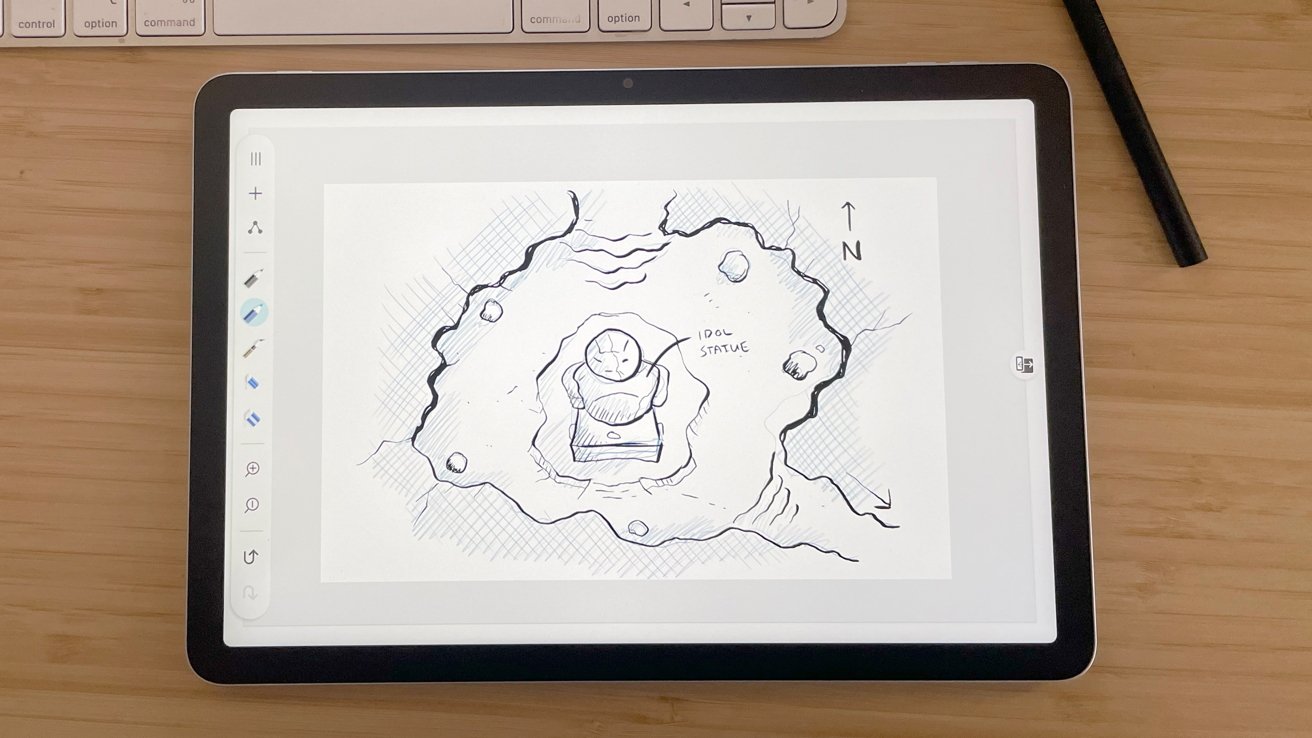
Wacom MovinkPad 11 review: A case would’ve been nice to protect the display while on the move.
The screen is durable, certainly. But, as an all-in-one advertised as something aimed at on-the-go artists, I feel my eye twitch when I think about throwing it into a laptop bag unprotected.
This is not an inexpensive piece of equipment, and I would have liked to see Wacom include some basic protection as standard.
Another downside for users in a macOS-dominant workspace is that the MovinkPad 11 is an Android native all-in-one.
This is not the end of the world by any means. But it does mean that Mac users like me will have to jump through a few extra logistical hoops to drop the MovinkPad 11 into their workspace.
The MovinkPad 11 retails in the Wacom Online shop for $449, but I have seen it on sale there for as low as $399.
The MovinkPad 11 is a solid all-in-one, but the retail cost is not a small investment, and it must be weighed against the alternatives available.
Comparatively, an iPad averages $349, and the Apple Pencil Pro retails for $129. Add Procreate for $12, and you’re set up with an all-in-one that natively runs with macOS and merges seamlessly into that workspace for $490.
At $449 vs. $490, it is all about what you need in your life and tradeoffs.
With the MovinkPad 11 you secure the incredible drivers and functionality Wacom is known for. But you sacrifice the loss of macOS and Procreate.
On the other side at $490, you spend slightly more and lose the Wacom functionality, but you gain utility with macOS.
The MovinkPad 11 is a solid offering from Wacom for artists looking for a simple and powerful digital sketching tool.
However, the native Android operating system hinders seamless integration into iOS and macOS spaces. For the same ballpark retail cost, comparable options already exist for Apple users.
Ultimately, it will come down to personal preference and what is most important for you and your workflow. That said, I do not believe there is a wrong answer.
The MovinkPad 11 is excellent. If I worked in a Windows environment, I would happily purchase one.
I don’t.
- Easy installation
- Beautiful display
- Sturdy construction
- Portable
- USB-C port
- Amazing line quality and pressure sensitivity
- A 2-year Clip Studio Debut license
- Protective travel case is a paid optional feature
- Possible additional cost for stand
- Not a “cheap” option for a casual artist
- Android all-in-one that requires extra steps for macOS users
Rating: 3.5 out of 5
The hardware is good, the use of the tablet is good. It’s better on Windows than it is on Mac, and that’s a problem.
I want to like it, it’s just hard to whole-heartedly recommend with those “extra steps” I mentioned.
The MovinkPad 11 is currently available through the Wacom online store for $399.95. It’s also available from Amazon for $399.95.


Hints about the new reservation system were found in the latest Steam update files released last week. Redditor Pepeizq, who spotted the reservation system code, also found references to at least four Steam Machine packages and two Steam Frame packages. The code also mentioned the existing Steam Controller and Steam…
Read Entire Article
Source link

Soldier on parachuting to Tristan da Cunha for Hantavirus aid

Michael Burry warns of stock crash as tech jump echoes 2000 peak

Anchorage steps back from USDG as stablecoin alliances decentralize

Manchester United reach agreement with Casemiro over contract clause amid transfer speculation

US brings back mandatory military draft registration

Steven Gerrard disagrees with Gary Neville over ‘shock’ Chelsea and Arsenal claim | Football


-
 Crypto World4 days ago
HarrisX Poll Found 52% of Registered Voters Support the CLARITY Act
-

 Fashion3 days ago
Weekend Open Thread: Marianne Dress
-

 Crypto World5 days ago
Upbit adds B3 Korean won pair as Base token gains Korea access
-
 NewsBeat5 days ago
NCP car park operator enters administration putting 340 UK sites at risk of closure
-

 Tech2 days ago
Auto Enthusiast Carves Functional Two-Stroke Engine from Solid Metal
-

 Politics5 hours ago
What to expect when you’re expecting a budget
-

 Politics3 days ago
Politics Home Article | Starmer Enters The Danger Zone
-
 Business3 days ago
Ignore market noise, India’s long-term story intact, say D-Street bulls Ramesh Damani and Sunil Singhania
-

 Fashion10 hours ago
Coffee Break: Travel Steam Iron
-

 Fashion1 day ago
What to Know Before Buying a Curling Wand or Curling Iron
-

 Crypto World7 days ago
UAE Free Zone Deploys Blockchain IDs to Verify Registered Firms
-

 Tech21 hours ago
GM Agrees To Pay $12.75 Million To Settle California Lawsuit Over Misuse Of Customers’ Driving Data
-

 Crypto World6 days ago
BlackRock CEO Larry Fink Discusses a New Asset Class
-

 Crypto World5 days ago
Robinhood says Wall Street is building onchain
-

 Entertainment5 days ago
Sarah Paulson Called Out For Met Gala ‘Hypocrisy’
-
 Sports6 days ago
NBA playoff winners and losers: Austin Reaves is not loving Lakers vs. Thunder matchup, but Chet Holmgren is
-

 Tech6 days ago
Apple and Samsung are dominating smartphone sales so thoroughly that only one other company makes the top 10
-

 Entertainment5 days ago
Bold and Beautiful Early Spoilers May 11-15: Steffy Revolted & Liam Overjoyed!
-

 Fashion5 days ago
The Best Work Pants for Women in 2026
-

 Entertainment4 days ago
General Hospital: Ric & Ava Bombshell – Ric’s Massive Secret Exposed!
You must be logged in to post a comment Login