Connect with us
DAPA Banner
DAPA Coin
DAPA
COIN PAYMENT ASSET
PRIVACY · BLOCKDAG · HOMOMORPHIC ENCRYPTION · RUST
ElGamal Encrypted MINE DAPA
🚫 GENESIS SOLD OUT
DAPAPAY COMING

Tech

Which DJI camera should I buy? Here’s our essential guide to your options, including the results of our in-depth testing

Published

on

Historically, the DJI brand has been all about drones. It remains an undisputed leader in that category, but in recent years its also solidified a name in compact cameras for content capture.

The two key ranges are the Osmo Action and the Osmo Pocket. The Action is DJI’s classic action camera, with a rugged build designed to happily capture high-quality content no matter how much you bump, drop, submerge, freeze, or generally throw it about. The Pocket is a compact, image-stabilizing gimbal camera designed for vloggers. It can easily switch between vertical and horizontal shooting, and is set up to make selfie capture easy. There are also a couple of outliers: the Osmo 360 360-degree camera and the tiny, wearable Osmo Nano.

Source link

Continue Reading
Click to comment

You must be logged in to post a comment Login

Leave a Reply

Tech

Rob Gurzeev on why AI has changed cybersecurity’s biggest blind spot

Published

on

TL;DR

AI makes it trivially easy for anyone in an organization to deploy internet-facing applications, often outside established security processes. CyCognito CEO Rob Gurzeev says the resulting blind spots are more dangerous than known vulnerabilities. His answer: continuous, outside-in attack-surface mapping that validates what is actually exploitable rather than scanning a known asset list.

Artificial intelligence is transforming how software is built, deployed, and secured. While AI has accelerated innovation across industries, it has also expanded the number of internet-facing assets organizations need to protect. According to Rob Gurzeev, CEO and Co-Founder of CyCognito, the challenge is no longer just identifying known vulnerabilities. It is understanding what is actually exposed, how those assets connect, and how attackers can exploit them.

Drawing on years of experience in cybersecurity and intelligence, Gurzeev believes many organizations still operate with an incomplete view of their attack surface. That gap, he says, is becoming more dangerous as AI makes it easier than ever to create and expose new applications.

A security mindset built on finding the unknown

Gurzeev’s path into cybersecurity began long before AI entered the picture. As a teenager, he spent time exploring computers and Internet Relay Chat (IRC) communities, where curiosity about hacking first took hold. That interest eventually led him to an intelligence unit, where he worked on reconnaissance and attack-surface operations.

Advertisement

Honestly, this work chose me more than I chose it,” Gurzeev said. He explained that the role often started with little more than a name and required finding “the path of least resistance into something that mattered.

Those experiences continue to shape how he approaches cybersecurity today. “I was taught you never actually know what reality is. You have to go find it. Validate it,” he said. “Most of the security industry was built the other way around, on the assumption that you already know where your stuff is. That gap is the whole reason CyCognito exists.

Mapping the attacker’s view

CyCognito approaches security by working from the outside in, beginning with nothing more than a company’s name. The platform maps everything exposed to the internet, including forgotten or unmanaged assets, then tests those systems to identify weaknesses that could be exploited by attackers.

In a nutshell, we map everything a company has exposed to the internet, then trace the handful of paths that actually lead to its internal networks and sensitive data,” Gurzeev explained.

Advertisement

Rather than relying solely on vulnerability scans, the platform validates which weaknesses are genuinely exploitable. According to Gurzeev, “If I had to name the one thing that makes us unique, it’s that our platform thinks like an attacker. That should be obvious. It isn’t.

The scale of today’s attack surface

Modern enterprise environments have grown far beyond what traditional security programs were designed to manage. Gurzeev estimates that a large enterprise typically exposes around 100,000 applications, devices, and cloud assets to the internet, while some organizations have significantly larger footprints.

Our single biggest customer has around 100 million things an attacker can interact with from the outside,” he said, adding that external attack surfaces change by one to three percent every day.

Despite that scale, many organizations continue to focus security efforts on only a small fraction of their environments. “Most security effort goes to a few hundred or a thousand key assets. What about the rest?” Gurzeev asked. “Guarding the front door while you leave the windows open is not a strategy.

Advertisement

AI is expanding the problem

The rapid adoption of AI has made creating and deploying applications much easier across organizations. Employees outside traditional development teams can now build internet-facing tools using AI-powered coding assistants, often without going through established security processes.

Today, anyone and everyone can deploy an app,” Gurzeev said. “Someone in HR or finance can spin up an application with a tool like Claude Code or Lovable and expose it to the internet, on purpose or by accident.

He believes AI has shifted from being a supporting technology to becoming part of organizations’ core infrastructure. “As recently as six months ago, AI was bolted onto the edge of the business. Now it runs through the core, which means these systems aren’t adjacent to the attack surface anymore. They are the attack surface.

The challenge extends beyond application growth. Gurzeev pointed to research suggesting AI-generated code introduces vulnerabilities at significantly higher rates than code written entirely by humans. More importantly, he argued that much of this software bypasses the secure development processes organizations have spent years building.

Advertisement

The honest answer is we’re defending more of something less safe, and we can’t yet measure exactly how much. That uncertainty is itself the risk,” he said.

Continuous testing for an AI-driven era

As attackers increasingly adopt AI, Gurzeev argues that periodic assessments are no longer enough. Security teams need continuous visibility into what is exposed, what can actually be exploited, and which issues require immediate remediation.

Keeping up takes three things, all continuous,” he said. “Know what you have exposed right now. Know which of it an attacker could actually break into, across all of it, not a sample. Fix what matters in hours.

CyCognito’s latest release focuses on continuous AI security testing by combining full attack surface discovery with AI-powered validation. Rather than limiting advanced testing to a small number of high-priority assets, the platform maps an organization’s entire internet-facing environment before applying AI where reasoning is needed most.

Advertisement

According to Gurzeev, the platform continuously performs more than 100,000 automated checks for known issues, allowing AI to focus on identifying complex attack paths that conventional scanners often miss. As those attack chains are validated, they become repeatable automated tests, expanding coverage over time.

Looking ahead, Gurzeev remains optimistic that defenders can regain the advantage. “The winners won’t be the ones who spend the most,” he said. “They’ll be the ones who use it most efficiently, getting the most out of every dollar of compute by pointing it with context instead of running it blind. Do that, and defenders catch up.

Source link

Advertisement
Continue Reading

Tech

The Mac Pro nearly received an M3 Extreme chip twice as powerful as M3 Ultra

Published

on

Apple discontinued the Mac Pro earlier this year, ending a 20-year run for a computer that once represented the very best of the company’s desktop lineup. However, Apple reportedly had much bigger plans for the machine before ultimately replacing it with the Mac Studio.

According to Bloomberg’s Mark Gurman, Apple developed an M3 Extreme chip that could have offered twice as many CPU and GPU cores as the M3 Ultra. The processor was intended to sit above the Ultra tier and could have finally given the Mac Pro the performance advantage it badly needed. Apple eventually abandoned the chip due to concerns over production costs and limited demand for such an expensive machine.

Apple had been working on an Extreme chip for years

Rumors about an Extreme-tier Apple chip first appeared in 2022, when Gurman reported that the company was developing an M2 Extreme for its first Apple silicon Mac Pro. The processor was expected to feature as many as 48 CPU cores and 152 GPU cores, double the rumored M2 Ultra configuration. However, it would have been extremely expensive to manufacture. Gurman estimated that an M2 Extreme Mac Pro could have cost at least $10,000 before upgrades, turning it into an extraordinarily niche product.

Engineering challenges also reportedly played a role. Apple ultimately decided that the development and production costs were difficult to justify for a computer that would sell in relatively small numbers. Bloomberg’s latest report suggests Apple later developed an M3 Extreme before cancelling that project for similar reasons.

The chip could have given the Mac Pro a reason to exist

Apple launched its first Apple silicon Mac Pro in 2023 with the same M2 Ultra chip found inside the Mac Studio. The Mac Pro offered PCIe expansion, yet it cost twice as much despite delivering nearly identical CPU and GPU performance. An M3 Extreme could have changed the equation. Gurman says the chip was designed with twice as many CPU and GPU cores as the M3 Ultra, which tops out at a 32-core CPU and an 80-core GPU.

Advertisement

Apple also reportedly developed an M3 Ultra Mac Pro that never reached the market. The Mac Pro remained stuck on its 2023 chip until Apple discontinued it in March, and it is not expected to return anytime soon.

Source link

Advertisement
Continue Reading

Tech

Android converts hold steady as iPhone owners drive new sales

Published

on

Existing iPhone owners continue to account for nearly nine in 10 surveyed U.S. purchases, showing how Apple’s enormous customer base isn’t dwindling under pressure from Google and other Android smartphone manufacturers.

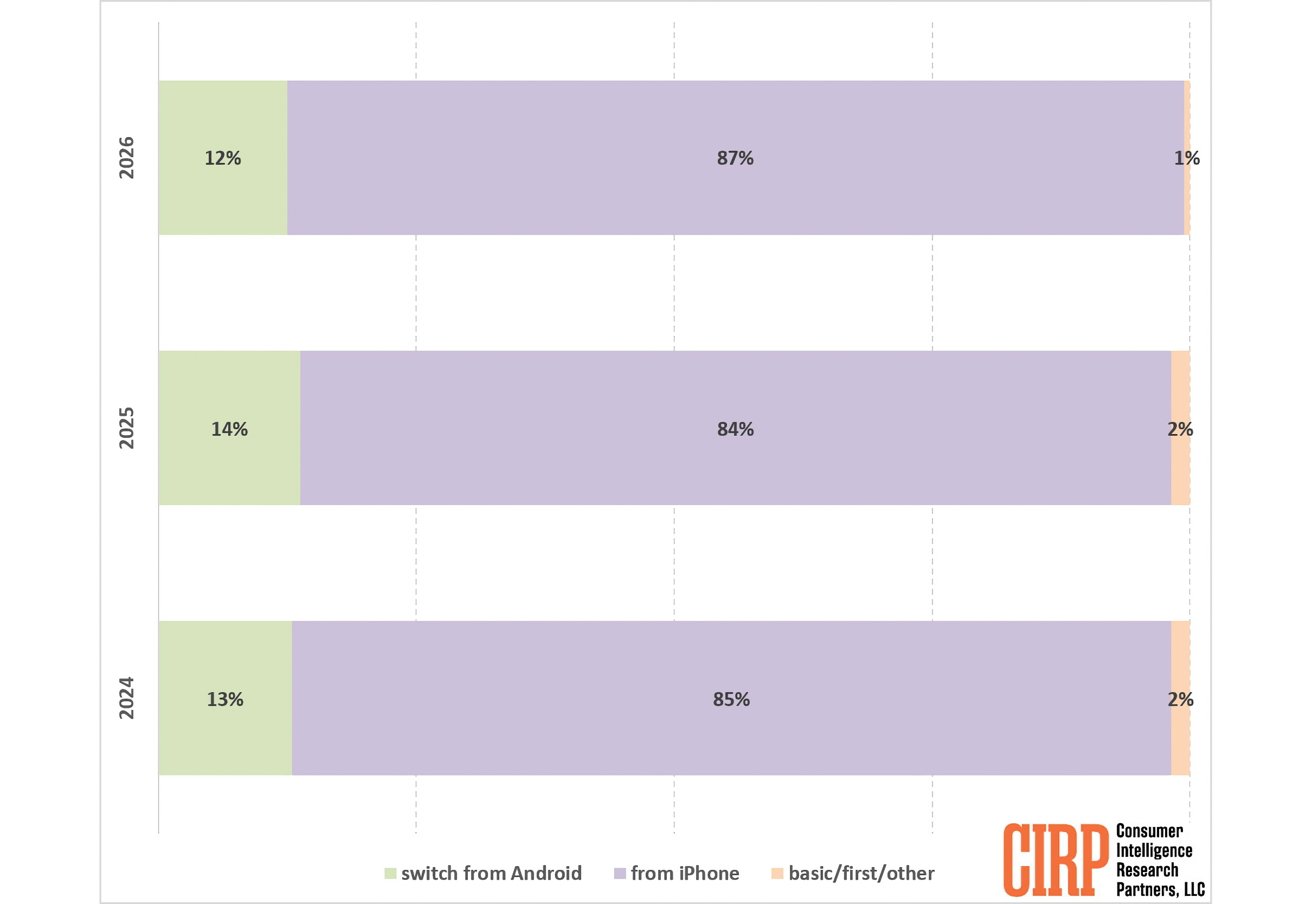
Consumer Intelligence Research Partners estimates that 87% of U.S. iPhone buyers in the March 2026 quarter came from another iPhone. The share reached its highest level in the three years covered by the report, up from 84% in 2025 and 85% in 2024.

Another 12% switched from an Android smartphone, down from 14% in 2025 and slightly below the 13% measured in 2024. The remaining 1% came from a basic phone, bought a first smartphone, or fell into another category.

The numbers point to a smartphone market in which most buyers settled on a platform years ago. Apple can still attract Android owners, but the larger opportunity comes from convincing hundreds of millions of existing customers to replace an older iPhone with a newer model.

Advertisement

Android switching remains within CIRP’s recent range

Android users have accounted for 11% to 15% of new iPhone buyers in recent years, placing the March quarter’s 12% result within CIRP’s usual range. The decline from 14% in 2025 looks more like routine movement than a major shift in Apple’s ability to attract Android owners.

Switching platforms can mean transferring years of data, replacing apps and accessories, and rebuilding familiar workflows. Existing iPhone owners face far less friction because their photos, messages, passwords, apps, and settings can move to a new model.

Horizontal stacked bar chart comparing 2014-2016 iPhone buyers: majority from iPhone (84-87%), smaller share switching from Android (12-18%), tiny portion from basic or other phones (1-2%)Previous phone used by iPhone buyers in the 12 months ending each March

A 12% share still represents a meaningful source of new customers at Apple’s scale. Apple posted record iPhone revenue as Counterpoint estimated that U.S. iPhone sales volume rose 1.3% while the overall market fell 5.7%.

The growing iPhone buyer pool also makes CIRP’s percentage harder to interpret on its own. The number of Android converts could hold steady or increase even if those buyers represent a smaller share of total iPhone purchases.

Repeat buyers give Apple a dependable sales base

The 87% figure shows why Apple doesn’t need a surge in platform switching to sustain the iPhone business. Existing owners already understand iOS, own compatible accessories, and may have years of purchases and personal data tied to Apple Services.

Advertisement

Carrier promotions and trade-in offers can make another iPhone the easiest financial and technical choice. Apple also benefits beyond the phone sale because repeat buyers may remain connected to Apple Watch, AirPods, Mac, iPad, and Services.

Apple said on January 29, 2026, that its installed base had surpassed 2.5 billion active devices worldwide, although it doesn’t disclose how many are iPhones or how many belong to unique users.

Only 1% of CIRP’s surveyed iPhone buyers came from a basic phone, bought a first smartphone, or entered through another route. Apple and Android manufacturers are therefore competing mostly for people who already own a capable device.

Winning a new customer means persuading someone to leave a familiar platform, while keeping one preserves future hardware and Services revenue. Each Android convert can also become part of Apple’s repeat-buyer pool in later upgrade cycles.

Advertisement

CIRP’s survey measures the composition of iPhone buyers rather than the total number of people switching platforms. Apple’s U.S. iPhone business still draws most heavily from existing owners, while Android converts remain a smaller but steady source of new customers.

Source link

Advertisement
Continue Reading

Tech

NASA Shares Beautiful Timelapse Of The Psyche Spacecraft’s View Over Mars

Published

on

The spacecraft made a close approach to the red planet in May on its way to explore the asteroid it’s named after.

NASA’s Psyche spacecraft is well on its way to its target in the asteroid belt after receiving a gravity assist from Mars in May, and the space agency just shared some incredible images from that brief encounter. Psyche captured thousands of images with its multispectral imager as it approached and flew past Mars. A timelapse shared by NASA on Friday stitches these images together to create a captivating video of the entire encounter, showing the crescent Mars it captured upon arrival, detailed views of the surface and the icy south pole behind it as it departed.

“The imager performed brilliantly, delivering some rarely seen views of the red planet,” said Jim Bell, the Psyche imager instrument lead at Arizona State University, in a statement. The spacecraft began its approach of Mars on May 2 and made its closest approach on May 15.

Advertisement

This maneuver gave it a speed boost and adjusted its trajectory to put it on a course for the asteroid Psyche while saving propellant for the long journey. Psyche is expected to reach the eponymous asteroid in 2029. “Besides the obvious beauty of the photos, we were also able to fully test its calibration and sensitivity to scattered light,” Bell said, “including picking out the Martian moons Phobos and Deimos from very far away as a part of a practice for the satellite search that we’ll use at the asteroid Psyche to look for any moonlets there.”

Source link

Advertisement
Continue Reading

Tech

Trump Just Made It Easier For Your ISP To Rip You Off With Bogus Fees

Published

on

from the this-is-why-we-can’t-have-nice-things dept

Here’s a short crash course in U.S. telecom policy.

Giant and very unpopular companies like Comcast, AT&T, Verizon, and Charter created regional monopolies that work tirelessly to erode all meaningful competition and oversight, resulting in high prices, spotty service, slower speeds, and abysmal customer service. They also pay a bunch of dodgy pseudo-academic “free market” think tanks to insist this is all very innovative and exciting.

Every so often a few Democrats (the handful not too timid to stand up to the telecom lobby) propose the absolute bare minimum policy “solution” that usually involves nibbling around the edges of the actual problem (unchecked monopoly power coddled by corruption). These efforts are very often highly decorative and performative, and very rarely competently enforced.

Enter Republicans, who work seamlessly with the telecom lobby to destroy even these bare-bones proposals, framing them as radical. The result: no real oversight of telecom giants, who then double down on all of their worst behaviors.

Advertisement

This just happens again and again and again in U.S. policy (privacy, net neutrality, predatory business practices). And will keep happening until the U.S. addresses its corruption problems. Which, with a minimum 2.5 years of Trumpism left, doesn’t seem likely anytime soon.

The latest case in point: back during the Biden era, the FCC under Jessica Rosenworcel proposed a new “nutrition label for broadband” that required ISPs break down each individual fee and restriction on your bill. Note it didn’t actually stop ISPs from ripping you off, it just created a mostly voluntary system whereby ISPs were politely asked to list the real price of service, including usage caps and bullshit fees.

Studies found that unsurprisingly, most ISPs didn’t comply and the FCC, even under Biden, didn’t really enforce the rules.

Despite this being, once again, a bare minimum policy effort that didn’t even actually fix the underlying problem and was never meaningfully enforced, the telecom lobby very much didn’t like the idea of having to be transparent. Or the government telling them what to do. So they’ve lobbied the Trump administration to dismantle the requirements:

Advertisement

“The Federal Communications Commission will vote to eliminate a rule that requires Internet service providers to list all of their so-called “passthrough” fees on an easily accessible broadband price label. The FCC vote could also make the price labels themselves a bit harder for consumers to find.”

Great stuff. Very populist. Who wasn’t begging the government to make it easier for big shitty companies to rip you off with bullshit surcharges and fees?

Keep in mind it took the U.S. government thirty-five years of telecom monopoly predation to finally come up with the idea “maybe we politely ask giant telecom monopolies to be semi-honest about their price.” But even that was a bridge too far for a corrupt U.S. federal government.

It should be noted that this most recent “nutrition label” approach was technically required by Congress, which was trying to ensure that the $42.5 billion in broadband subsidies in the infrastructure bill resulted in semi-decent broadband. But as I’ve been exploring, the Trump administration has hijacked that program to slather Elon Musk with subsidies, stripping all meaningful oversight in the process.

Trump FCC boss Brendan Carr’s order rolling back the rules tries to pretend they’re doing this for the sake of consumer clarity:

Advertisement

“However, the Commission’s initial rules, adopted in 2022, resulted in sometimes confusing labels that strayed beyond the statutory framework Congress created, increasing compliance costs for providers in the process. With this order, we refocus the rules on ensuring that consumers have the clear, accurate, and concise information about broadband plans that they want, making the labels a more useful shopping tool.”

That is a blatant lie. Carr is simply folding like a weakling to the demands of Comcast, AT&T and friends. There is no consumer benefit to making broadband pricing less transparent. It simply works to further obscure the real problem: regional monopoly predation, coddled by captured regulators like Carr. Comcast didn’t like having to be even semi-honest about precisely how it rips you off.

To try and avoid making it clear he’s breaking the law and ignoring Congress, Carr is pretending the labels will technically still exist. They will, of course, feature fewer requirements, be harder to find, and there will be absolutely no enforcement should ISPs balk at the rules.

Carr has more important things to do, like dismantling the First Amendment because a comedian made fun of the president’s wife, or eliminating bare-bones regulations to make life even easier on shitty robocallers, prison phone monopolies, and telecom giants.

The United States is not a serious country. It’s too corrupt to function in the public interest. And it’s become a strange combination of painful, boring, and pathetic that we have journalists, policymakers, think tankers, and regulators too feckless or captured to be honest about any of it.

Advertisement

Filed Under: brendan carr, broadband, fcc, fees, high speed internet, internet access, nutrition label, regulatory recovery fee, surcharges, usage caps

Source link

Advertisement
Continue Reading

Tech

Today’s NYT Strands Hints, Answer and Help for July 20 #869- CNET

Published

on

Looking for the most recent Strands answer? Click here for our daily Strands hints, as well as our daily answers and hints for The New York Times Mini Crossword, Wordle, Connections and Connections: Sports Edition puzzles.


Today’s NYT Strands puzzle is a tricky one, with some long answers to find. If you remember yesterday’s theme, this one is the opposite. Some of the answers are difficult to unscramble, so if you need hints and answers, read on.

I go into depth about the rules for Strands in this story

Advertisement

If you’re looking for today’s Wordle, Connections and Mini Crossword answers, you can visit CNET’s NYT puzzle hints page.

Read more: NYT Connections Turns 1: These Are the 5 Toughest Puzzles So Far

Hint for today’s Strands puzzle

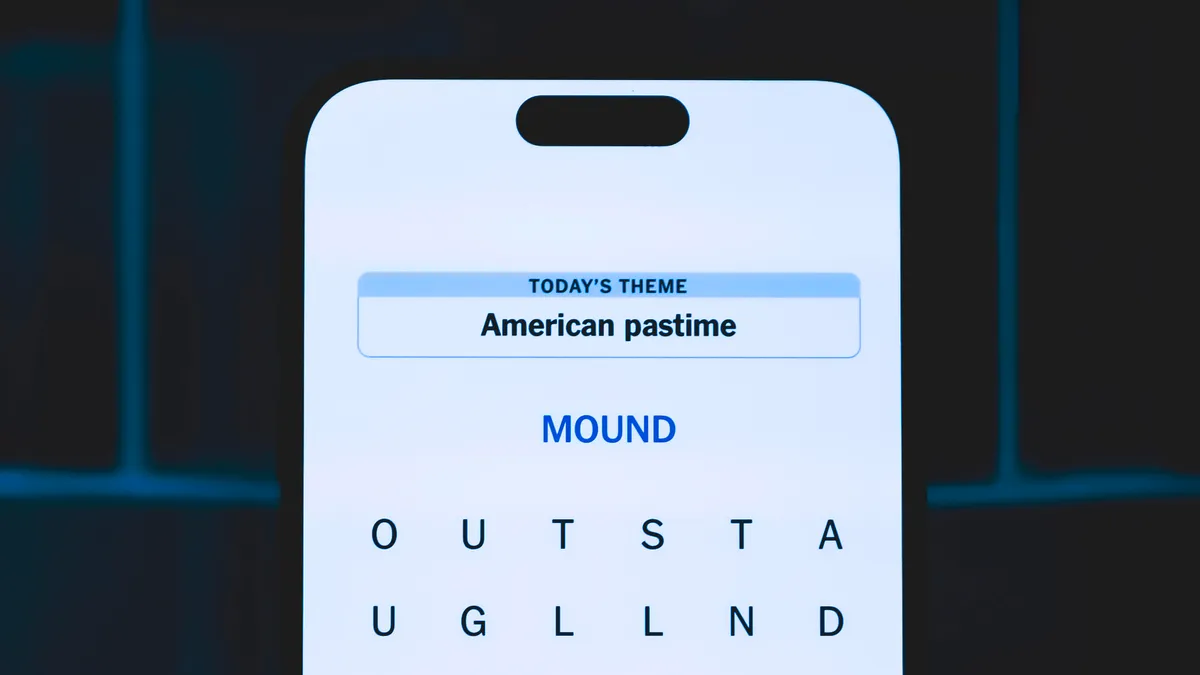
Today’s Strands theme is: Small talk.

Advertisement

If that doesn’t help you, here’s a clue: Not huge.

Clue words to unlock in-game hints

Your goal is to find hidden words that fit the puzzle’s theme. If you’re stuck, find any words you can. Every time you find three words of four letters or more, Strands will reveal one of the theme words. These are the words I used to get those hints but any words of four or more letters that you find will work:

  • ROOT, POOT, SELL, STILE, STIM, STAIN, SCUM, STEM, SUIT, CRIB

Answers for today’s Strands puzzle

These are the answers that tie into the theme. The goal of the puzzle is to find them all, including the spangram, a theme word that reaches from one side of the puzzle to the other. When you have all of them (I originally thought there were always eight but learned that the number can vary), every letter on the board will be used. Here are the nonspangram answers:

  • TINY, LITTLE, MINIATURE, MINUSCULE, MICROSCOPIC

Today’s Strands spangram

completed NYT Strands puzzle for June 20, 2026

The completed NYT Strands puzzle for June 20, 2026.

NYT/Screenshot by CNET

Today’s Strands spangram is ITSYBITSY. To find it, start with the I that is four letters down on the far-left vertical row, and wind across.

Advertisement

Source link

Continue Reading

Tech

AI advice made people three times less accurate but twice as confident, researchers found

Published

on

TL;DR

Researchers found AI advice suppressed judgment suspension from 44% to 3%, accuracy from 27% to 9%, while confidence rose from 30% to 76%. People trusted wrong AI answers.

Researchers from three French and Italian universities found that access to AI advice collapsed people’s willingness to say “I don’t know” from 44% to 3%. Accuracy dropped from 27% to 9%. Confidence, meanwhile, rose from 30% to 76%. “People became much worse, the accuracy was only one third, but they were twice as confident,” said Valerio Capraro, associate professor at the University of Milano-Bicocca.

The study, authored by Capraro with Chiara Marcoccia of École Normale Supérieure and Walter Quattrociocchi of Sapienza University of Rome, deliberately used questions where AI models typically fail: visual details from films, such as the colour of a team’s uniform in Bend It Like Beckham. The researchers used Step 3.5 Flash, a model that was usually wrong on these questions, precisely so any reduction in judgment could not be explained as sensible delegation to a reliable tool. Some participants who would have answered correctly on their own asked the AI and became wrong.

Monetary incentives helped, but not much. Willingness to admit ignorance rose from 3% to 8% and accuracy from 9% to 16%, both still well below the no-AI baselines of 44% and 27%. Wharton researchers coined the term “cognitive surrender” earlier this year to describe the same phenomenon: people accepting incorrect AI answers 80% of the time while reporting higher confidence than those working without AI. The new study adds a sharper data point. It is not just that people trust wrong AI answers. It is that the mere availability of AI suppresses the cognitive habit of recognising what you do not know.

Advertisement

The 💜 of EU tech

The latest rumblings from the EU tech scene, a story from our wise ol’ founder Boris, and some questionable AI art. It’s free, every week, in your inbox. Sign up now!

For humans, the capacity to say ‘I don’t know’ is very important because it represents the recognition of the limits of our own knowledge,” Capraro said. He is particularly concerned about children, who are growing up with these systems before they have developed critical thinking skills. Google’s AI search overhaul replaced links with confident AI-generated summaries, and Common Sense Media this week called that design an “unacceptable risk” for students. The pattern is consistent: AI products are designed to answer, never to say “I don’t know.” The humans using them are learning to do the same.

Advertisement

Source link

Continue Reading

Tech

Do you really own digital PlayStation games? Sony’s disc decision explained

Published

on

It’s not been a great few months for Sony. Not only did the company announce price hikes for the PS5 and PS5 Pro, but it has recently revealed it plans to stop the production of physical game discs from January 2028.

But what does this really mean for gamers with an extensive disc collection? Do you really own digital games and can you resell such games once you’re finished with them?

As the PS5 is easily one of the best games consoles, we’ve put this guide together to help clear up the confusion about Sony’s decision to stop physical disc production in January 2028, and whether or not you really own digital PlayStation games.

What has Sony actually announced?

Sony announced that from January 2028, physical disc production for “all new games” on PlayStation consoles will be discontinued. That means from January 2028, new PlayStation games will only be available in digital formats.

Advertisement

Sony explains that this is a “natural direction” to adapt to consumer trends as, according to the company, the “general preference for digital media significantly outpaces physical discs”. However, Sony has disclaimed that this transition has no impact on games that are already released or are releasing prior to January 2028 in disc format.

Advertisement

PS5 ProPS5 Pro
PS5 Pro. Image Credit (Trusted Reviews)

Do you own digital PlayStation games?

A key question that many are asking is whether gamers actually own digital PlayStation games, and it’s not quite as simple an answer. 

According to Sony’s terms, when you purchase or download a digital product from the PlayStation Store, be it a game, music or a movie, you’re only buying the personal license for private use of such products. That means although you have access to the game, movie or music, you do not own it.

What’s more is that if your purchasing account is suspended, deleted or closed then you may lose access to your game. 

Advertisement

Put simply – no, you don’t technically own digital PlayStation games according to Sony’s terms. Instead, you own the personal license to access and play the game.

PS5 (Slim) side standing viewPS5 (Slim) side standing view
PS5. Image Credit (Trusted Reviews)

Advertisement

What happens if a game is delisted from the PlayStation Store?

Games can be delisted for numerous reasons, whether that’s expiring copyright licenses or if servers are shut down. This shouldn’t necessarily be a major issue as, generally speaking, if you already bought or downloaded the delisted game from the PlayStation Store then it should remain available in your library and playable.

Having said that, if the game is online-only and requires multi-players or relies on external servers, then it will likely be rendered unplayable.

Can you lend, resell or pass on digital PlayStation games?

One of the biggest knock-on effects of making PlayStation games digital-only is that gamers will lose the ability to resell or exchange their discs with others. As you don’t technically own digital games, and instead own the license, you aren’t able to pass on or sell your titles.

Advertisement

What happens to existing PS5 discs and older games?

Fortunately, Sony has said that this won’t affect existing PS5 discs. Although Sony will stop production from January 2028, older discs will still be playable. 

What should PlayStation players do now?

For now, PlayStation users shouldn’t really need to worry too much as this won’t come into practise until January 2028. Having said that, there are a few things you can do to future-proof your gaming set-up.

Advertisement

Firstly, if you do prefer discs then it might make sense to stock up on physical copies of games that you want to own permanently, rather than just license. We’d also recommend upgrading your console’s storage, as being digital-only will undoubtedly require much more space than you might expect. We have a guide on how to install an SSD in your PS5 or PS5 Pro to help.

Advertisement

Source link

Continue Reading

Tech

Quordle hints and answers for Monday, July 20 (game #1638)

Published

on

Looking for a different day?

A new Quordle puzzle appears at midnight each day for your time zone – which means that some people are always playing ‘today’s game’ while others are playing ‘yesterday’s’. If you’re looking for Sunday’s puzzle instead then click here: Quordle hints and answers for Sunday, July 19 (game #1637).

Quordle was one of the original Wordle alternatives and is still going strong now more than 1,500 games later. It offers a genuine challenge, though, so read on if you need some Quordle hints today — or scroll down further for the answers.

Enjoy playing word games? You can also check out my NYT Connections today and NYT Strands today pages for hints and answers for those puzzles, while Marc’s Wordle today column covers the original viral word game.

Advertisement

Source link

Continue Reading

Tech

Zilog Z80 8-Bit CPU Turns 50, Open-source Replacement Heads To Drop-in DIP40 Silicon

Published

on

An anonymous reader shared this report from Tom’s Hardware:


The Zilog Z80 has just turned 50 years old. This iconic 8-bit processor first went on sale in July 1976 and stayed in production for 48 years until Zilog, now a Littelfuse subsidiary, stopped accepting orders in June 2024. However, there’s an open-source replacement closer than ever to shipping in the chip’s original 40-pin DIP package thanks to community-funded fabrication…

The chip powered the ZX Spectrum, TRS-80, MSX machines, Nintendo’s Game Boy, Sega’s Master System, the Pac-Man arcade cabinet, and Texas Instruments’ graphing calculators, then shipped in industrial controllers for decades after home computing moved on to more powerful successors. Zilog’s end-of-life notice, dated April 15, 2024, told customers its wafer foundry was discontinuing support for the Z84C00 family, and last-time-buy orders closed that June.

However, Renaldas Zioma’s FOSS Z80 project, launched shortly after the end-of-life notice, now has working silicon. The first version, fabbed on SkyWater’s 130nm node through Tiny Tapeout 7 on a die of just 0.064mm(2), has been confirmed as functional via the project’s GitHub repository. A QFN64 version with all 40 pins exposed followed on the Efabless CI2406 shuttle, two further runs then went through IHP’s 130nm process, and the current run targets the classic DIP40 form factor using chip-on-board assembly on GlobalFoundries’ 180nm GF180MCU node via Wafer.Space. The end goal here is to fab a drop-in replacement for machines like the ZX Spectrum and RC2014 kits…

Advertisement

Zilog is trimming the Z80’s official successor line as well. A product change notification from last October put the eZ80L92, along with several Z8F-series microcontrollers, on end-of-life, citing “little to no demand…” [T]he pipelined eZ80 architecture, introduced in 2001 and still inside TI’s current TI-84 Plus CE calculators, otherwise remains in Zilog’s catalog.
In 1999 Slashdot was calling Zilog’s updated eZ80 “one of the fastest 8-bit CPUs available today, executing code 4 times faster than a standard Z80 operating at the same clock speed.”

Slashdot headline from 2001: Zilog To File For Chapter 11.

Source link

Advertisement
Continue Reading

Trending

Copyright © 2025