
Connect with us
DAPA Banner

Tech

You can’t firewall a conversation: how AI red-teaming became mission-critical

Published

on

The explosion of AI usage since 2023 is unprecedented. In terms of adoption, AI is moving faster than cloud, faster than mobile, and certainly faster than the internet did. Research group Gartner predicts that 80% of enterprises will deploy AI tools this year.

Donnchadh Casey

VP for AI Security at F5.

Advertisement

When we classify a company’s journey through AI adoption, we see maturity falling into four categories:

  • Category 1 is general purpose AI and productivity – think employees using ChatGPT, Gemini, CoPilot, etc
  • Category 2 is when organizations have internal use cases, building custom chatbots for HR or IT, for example
  • Category 3 includes external use cases like building public-facing GenAI applications, like customer service chatbots
  • Category 4 is agentic workflows which are made up of complex systems that take actions autonomously on behalf of users

Source link

Advertisement
Continue Reading
Click to comment

You must be logged in to post a comment Login

Leave a Reply

Tech

Major Homebuilder To Test Placing Mini Data Centers in Suburban Backyards

Published

on

NewtonsLaw writes: According to Realtor.com, a California startup called Span plans to partner with Nvidia, PulteGroup, and other homebuilders to equip new homes with mini-data centers, so as to relieve the need to build and power much larger traditional centers. The article states the company “can install 8,000 XFRA units about six times faster and at five times lower cost than the construction of a typical centralized 100 megawatt data center of the same size.” Could this be the solution to at least some of the problems hindering the rollout of greater data-center capacity for AI systems? “One big reason the XFRA model works is that the average American home only uses about 40 percent of its electrical capacity,” Span said. “As big data center developers struggle to find power sources and distribution capacity, XFRA uses capacity that’s already available.”

The startup says they will launch a 100-home proof of concept within the year to see if the idea is viable.

Source link

Continue Reading

Tech

In 2026, what does a career in data engineering look like?

Published

on

IAS’ Declan Gowran explores his role in the data engineering space and how leaders create cohesive environments.

Senior staff data ops engineer at IAS Declan Gowran’s journey into the data engineering world evolved organically from a broader IT infrastructure and cloud background.

He told SiliconRepublic.com, “Early in my career, I worked extensively on enterprise infrastructure, virtualisation and cloud deployments across multiple platforms, which exposed me to large scale systems and the complexities of managing data at scale. Over time, I became increasingly fascinated with the ways structured and unstructured data can drive decision making and AI applications. 

“That led me to roles at Optum and IAS where I could focus on building secure, scalable data platforms, integrating DevOps, MLOps and data governance frameworks, and supporting enterprise AI workloads. Essentially, my path was shaped by a mix of curiosity, technical challenges and opportunities to work at the intersection of cloud, data, and analytics.”

Advertisement
What is the current data engineering landscape like in Ireland?

Ireland’s data engineering landscape is vibrant and rapidly maturing. With the strong presence of multinational tech companies and data driven organisations, there is a growing demand for engineers who can not only manage cloud infrastructure but also design modern, scalable data platforms. Organisations are increasingly adopting cloud native architectures, Kubernetes based platforms and MLOps frameworks. There’s also an emphasis on governance, compliance and data mesh strategies, particularly for companies handling sensitive or regulated data.

What are the biggest challenges currently impacting the data engineering sector and how might they be addressed?

Data governance and trust at scale. As data powers AI and decision-making, ensuring quality, lineage and secure access, while meeting regulations like GDPR, is critical. This requires strong governance frameworks and centralised metadata to maintain consistency and control. Complexity across distributed environments. Most organisations operate across multi-cloud and hybrid systems, which makes integration, standardisation and orchestration difficult. The focus here is simplifying architectures and using scalable, interoperable platforms to reduce fragmentation. Scaling for real-time and AI-driven workloads. There’s increasing demand for low-latency data and reproducible AI pipelines. This means investing in streaming, automation and reliable infrastructure that can handle both batch and real-time use cases. Overall, the solution isn’t just tooling, it’s aligning these capabilities to clear business outcomes, so data engineering drives measurable value rather than just technical capability.

What are you currently working on and what is its potential?

I’m currently leading the development of a secure, cost-optimised enterprise data platform at IAS, built on Databricks and Kubernetes. It’s designed to centralise governance while enabling scalable, self-serve access to data across the business. In parallel, we’re building AI gateways and services to support secure deployment of LLM and AI workloads, ensuring we can scale these capabilities responsibly. The potential is twofold. Internally, it significantly improves efficiency, teams can access trusted data faster and experiment more easily. Externally, it enables better products and outcomes, from more effective ad campaigns to improved transparency and performance.

What goes into creating a sturdy, cohesive team in data and engineering?

Creating a high performing data and engineering team requires balancing technical expertise with collaboration, culture and shared values. I am a strong believer in investing in people and fostering a positive team environment. It’s not enough for team members to just understand the technology, they also need to get along, communicate effectively and support one another. I focus on mentorship and development, clear communication, aligning the team, cross functional collaboration, breaking down silos, analytics, empowerment and autonomy. As well as providing engineers with the right tools and frameworks to innovate while maintaining accountability. By prioritising people and culture, we create an environment where trust, communication and collaboration are strong, allowing innovation and high performance to become natural outcomes.

Advertisement
How can leaders in dynamic spaces create productive and cohesive working environments?

Leaders need to provide clarity, trust and structured autonomy. This involves setting clear goals, fostering a culture of feedback and encouraging innovation without micromanaging. Leveraging agile practices, automated workflows and transparent dashboards also helps teams measure progress and stay aligned. Equally important is supporting professional development, celebrating achievements and ensuring psychological safety so that team members can collaborate openly and take calculated risks.

Have you any predictions for how the data engineering space might evolve over the course of the next nine months?

Over the next nine months, I anticipate several key trends shaping the data engineering landscape. Firstly, the wider adoption of data mesh and governance frameworks, particularly for enterprises managing AI and agentic workloads, with a strong focus on data lineage, provenance and integrity knowing where data comes from, how it changes and why. The Increased emphasis on data quality and protection against data poisoning, as organisations recognise that “garbage in, garbage out” can compromise AI and agentic model outcomes. The Greater adoption of cloud native and serverless architectures, enabling scalable, flexible and cost efficient platforms capable of supporting large AI workloads, agentic processes and seamless connectivity across systems. 

The Expansion of retrieval augmented generation vector databases and connected pipelines, supporting advanced AI and agentic use cases while ensuring embeddings, knowledge sources, and real time data remain accurate, auditable, and interoperable. A stronger focus on observability, performance, and compliance, with distributed monitoring, automated validation and lineage tracking becoming standard to maintain trust in both traditional data and AI outputs. Lastly the standardisation of AI model deployment and MLOps practices, enabling enterprises to scale foundation models, agentic workloads and intelligent workflows while maintaining governance, reproducibility and operational reliability.

Don’t miss out on the knowledge you need to succeed. Sign up for the Daily Brief, Silicon Republic’s digest of need-to-know sci-tech news.

Advertisement

Source link

Continue Reading

Tech

Amazon cuts S’pore roles, phases out Amazon Fresh & local fulfilment operations

Published

on

The firm will help affected staff find new roles within the company

Amazon is cutting roles in Singapore as it shifts resources toward expanding its international store selection in the market.

In a post on its website, the firm said that a “small number” of roles will be impacted, and Amazon will help affected staff find new roles within the company. Those unable to secure an internal transfer will receive transition support, including severance payments and career services.

“Amazon remains deeply committed to Singapore and our investments across our retail, Global Selling, entertainment, devices, and AWS business lines, employing 2,500 people in the country,” said the company in the post.

At the same time, Amazon is also phasing out its local fulfilment operations in Singapore, including Amazon Fresh and its grocery partner network. The e-commerce giant said it is working with vendors and sellers on alternative ways to continue serving customers in the country.

Advertisement

These changes form part of Amazon’s broader effort to adapt to growing customer demand in Singapore for products from its international stores in the US, Japan and Germany.

“We’re seeing strong demand for products from international stores, and we’re responding by increasing our investment in what customers tell us they want most: great value selection from around the world with fast, reliable delivery,” said Peter Li, Amazon Singapore Country Manager.

Vulcan Post has reached out to Amazon for comment.

  • Read other articles we’ve written on tech giants here.

Featured Image Credit: Jaap Arriens via NurPhoto

Advertisement

Source link

Continue Reading

Tech

How To Better Enjoy VR On Linux

Published

on

Linux folks are used to having to roll many of their own solutions, and better Linux desktop usability is a goal of the WayVR project, which aims to provide desktop control and app launching from within a VR session.

VR applications can already stream from Linux to standalone headsets with projects like WiVRn, but what WayVR does is let one launch programs and access desktop screens within VR. Put another way, instead of the headset being limited to acting as a pseudo-monitor that only receives the output of an already-running VR application, the headset and controllers can now be used to interact with one’s computer as if one were physically sitting at it. Controls and user interface are highly flexible and help users to do anything they need — including clicking, typing, and launching applications. It’s a considerable step forward for convenience and general usability.

Naturally, when it comes to using a computer from within VR there is plenty of unexplored territory regarding user interfaces. It’s fertile ground for experimentation in everything from DIY headsets to ways to input text without a keyboard, so if you enjoy working on the frontiers of such things, it’s a good scene to dive into.

Advertisement

Source link

Advertisement
Continue Reading

Tech

How I Fixed My Webcam Lighting for Zoom Calls (2026)

Published

on

Here’s the problem. We have two young kids at home, and we live in the city in a townhouse that isn’t exactly large. With that comes a lot of “shared space”—also known as partially controlled chaos. The room that we have colloquially named the “office” is hardly a dedicated work space. I couldn’t survive without the blur background function in Zoom and Teams. The closet is a storage space, and in addition to our standing desk, which is typically filled with laptops, monitors, laptop stands, and various peripherals I’m testing, we also have some nonwork items throughout the room. Some of those include a play kitchen, bins of toy food, an entire crate of Duplos, a modular play couch, and an ssortment of other pokey things that hurt to step on.

Moving isn’t an option—at least, not an easy one. I could certainly close the blinds, but that’s also where my 5-year-old displays his Lego creations. And doing so also leaves me exclusively with terrible track lighting on the ceiling—which, again, is behind me. It’s a mixed-use room, and I’m sure some of you can relate to the limitations that creates.

I’m back to buying a webcam. After all, an external webcam doesn’t have to stuff all its parts into a tiny camera module that’s squeezed into the top bezel of a screen. Maybe it’s wrong to expect much from these tiny laptop cameras in the first place. I gathered every possible webcam I could find. There are tons of options out there, ranging from cheap 1080p cameras up to spending hundreds of dollars on 4K options with AI features. But I was less concerned with specs like resolution, megapixels, aperture, and field of view, and simply found myself wanting to improve the dismal situation I faced in my office.

Lights, Camera, Action

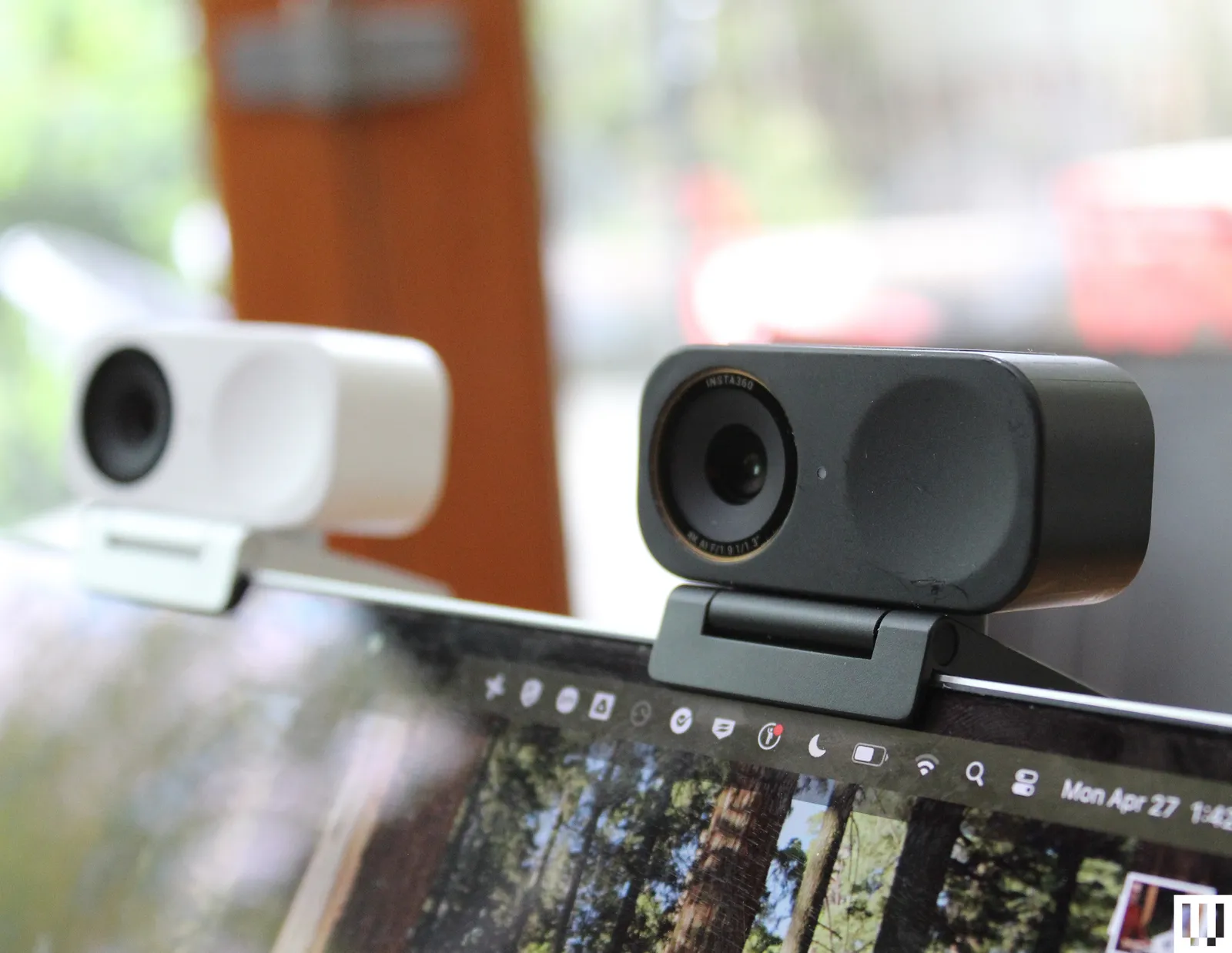
Two small rectangular webcams clipped to the top of a laptop screen one in white and the other black

Insta360 Link 2C (left); Insta360 Link 2C Pro (right)

Advertisement

Photograph: Luke Larsen

Nearly all of the dozen webcams I tried out looked great while under ideal lighting. I spent some time working in a different room next to a window, and the upgrade to an external camera felt significant. With all that light to work with, the higher-end cameras with a larger 1/1.3-inch image sensor handled the situations beautifully. It didn’t need to blow out the direct natural light to get details in my face, showing a wider dynamic range of shadows and highlights. Having more natural light in the room improved just about every webcam I tried, but they also better showcased just how powerful some of these higher-end cameras really are, such as the Insta360 Link 2C Pro or Obsbot Tiny 3. These are the scenarios most webcams are tested in, leaving them all looking more or less adequate.

Source link

Continue Reading

Tech

AirAsia to start a new airline despite fuel crisis

Published

on

The announcement comes after a recent US$19 billion purchase of 150 Airbus A220 planes

AirAsia X co-founder Tony Fernandes is preparing to launch a new airline, betting that expanding amid the aviation industry’s turmoil from high oil prices will pay off in the future, Bloomberg reported.

The new airline will be announced in the next month or two, Fernandes said in a video interview from Montreal late Wed (May 6). The low-cost Southeast Asian carrier group is already moving planes for the venture, though he declined to share further details.

The expansion follows AirAsia’s US$19 billion order for Canadian-made commercial aircraft—what Prime Minister Mark Carney called the largest such purchase ever. The order covers 150 Airbus A220 planes. These are smaller, nimbler jets Fernandes plans to deploy across all corners of Asia.

“Why waste a crisis? There are opportunities in a crisis,” Fernandes said.

Advertisement

We can’t control what happens in the Middle East, but we have to take a view that it’s not going to last for two years.

Tony Fernandes

It’s a bold bet, even by AirAsia’s unconventional standards. The carrier’s refusal to hedge fuel costs has helped send shares tumbling roughly 35% since the Iran war began, making it the worst performer on the Bloomberg World Airlines index during the period.

Fernandes remained defiant on hedging fuel costs, predicting oil prices will eventually come back down.

“Obviously people who hedge now are in the money, but over a longer period, hedging never really works,” Fernandes said. “So we continue to not hedge like many American airlines, and we feel oil is bearish.”

Advertisement

To fund expansion, AirAsia is preparing to sell up to US$600 million in bonds and is negotiating with Malaysian banks for a “quite a large” refinancing loan to cut interest costs, Fernandes said. 

He’s also planning to meet with Canadian pension funds to attract investors, he said. 

Currently, the airline is expecting short-term pain. Fernandes said the company will soon announce it will miss its initial profit target, though revenue should land “more or less” where predicted.

AirAsia has also explored expanding in Vietnam, people familiar with the matter have said.

Advertisement

The group currently operates across Malaysia, Thailand, and Indonesia with a fleet of roughly 250 mostly single-aisle Airbus aircraft. The latest order will grow its backlog to around 550 single-aisle jets.

On another note, AirAsia has announced it’s going to launch flights from Bahrain, with the goal of launching a local unit based in the Gulf island nation.

  • Read other articles we’ve written on Singaporean businesses here.

Featured Image Credit: Getty Images

Advertisement

Source link

Continue Reading

Tech

The ITSM complexity crisis and how to control it

Published

on

The IT Service Management (ITSM) platform market has evolved beyond an operational, IT-centric back-office niche into one of the most strategic tiers of enterprise technology.

Platforms such as ServiceNow, Atlassian JSM, and BMC Helix ITSM power everything from incident response to digital workflows that connect IT operations, security, HR, facilities, and customer service.

Source link

Advertisement
Continue Reading

Tech

How Do The Two Tires Compare?

Published

on


Getting the right set of tires for your vehicle is crucial for a safe, quiet, and smooth ride. For tackling all kinds of weather and road conditions, digging through the best all-season tires on the market is in your best interest before settling on your next set. Two notable all-season tires from tenured, reliable brands are the Michelin CrossClimate 2 and the Goodyear WeatherReady 2. While they do overlap in some areas, like the fact that they’re both all-season tires with V-shaped treads and 60,000 mile warranties that start at well over $100 each, make no mistake; these tires aren’t exactly the same.

These specific Michelin and Goodyear tires deviate in a few key areas. The CrossClimate 2s claim to be the longer-lasting of the two tires, providing around 23,000 more miles of drive time than the WeatherReady 2s. Thermal Adaptive Tread is included as well to prevent the tire from becoming brittle when faced with cold roads and low temperatures. Meanwhile, Goodyear’s tires are advertised as including a built-in Wear Gauge to track tread depth, AquaTred technology for improved traction in wet and slushy road conditions, and Evolving Traction Grooves to maintain tire grip on the road throughout the tire’s lifespan.

Advertisement

While this is all well and good, the big question is how do these tires actually compare when in use? Here’s what testing has shown about the CrossClimate 2 and the WeatherReady 2 when put through the same conditions.

Advertisement

How the CrossClimate 2 and the WeatherReady 2 perform

The only true way to know how the Michelin CrossClimate 2 and the Goodyear WeatherReady 2 tires stack up is to put them through their paces. That’s exactly what Jack Talks Tires on YouTube got the opportunity to do, using both sets of tires on a closed course. They were taken through wet and dry patches alike, around tight turns, and in quick braking scenarios. Overall, they did well and were pretty evenly-matched in their handling and braking. Still, there were a few areas where the WeatherReady 2 turned out to have a slight edge over the CrossClimate 2.

The area where the WeatherReady 2 proved its worth was the rough road simulation. On uneven, bumpy road, the WeatherReady 2 was noticeably quieter, likely thanks to Goodyear’s Comfort Flex technology: Sidewalls that flex to absorb road impact and create a smoother, quieter driving experience on bump and pothole-filled roads. The Evolving Traction Grooves also turned out to be a difference-maker for grip and handling, and Jack Talks Tires noted that the tire’s integrated Wear Gauge is a nice touch that the average driver will surely appreciate.

Of the major tire brands currently on the scene, few are at the level of Michelin and Goodyear. Thus, it’s not too surprising that the CrossClimate 2 and WeatherReady 2 are both durable, capable all-season tires that have a lot to offer drivers in need of a tire refresh. While the WeatherReady 2 scored a narrow victory over the CrossClimate 2 in some regards, odds are you’ll experience a similarly smooth and safe ride with either type.

Advertisement


Source link

Advertisement
Continue Reading

Tech

Pure-play MEMS foundry Silex prices Stockholm IPO

Published

on

The Bure Equity- and Creades-backed pure-play MEMS foundry priced at SEK 81 per share, with the offering oversubscribed several times. Cornerstone investors, including Capital Research, Fidelity, AFA, AP2, AP3, AP4, Swedbank Robur, and Carnegie, took roughly three-quarters of the deal.


Silex Microsystems opened sharply higher on its Nasdaq Stockholm debut on Wednesday, with the chipmaker’s shares climbing in early trade after the IPO priced at SEK 81 a share. The offering had been oversubscribed several times in the bookbuild and was placed almost entirely with institutional cornerstones, leaving little float for retail demand on opening day.

The deal raised approximately SEK 1.99bn ($217m) on a 24.6-million-share offering, with the equity valuation at IPO around SEK 8.9bn. The trading symbol is SILEX. Settlement is scheduled for 11 May.

Silex describes itself as the world’s leading pure-play MEMS foundry. The company manufactures micro-electromechanical systems for customers in automotive, industrial, life sciences, and consumer electronics, operating from a single fab in Järfälla, just outside Stockholm, on 200mm wafer production.

Advertisement

The pure-play model means Silex builds chips designed by other companies rather than designing its own product, the equivalent of TSMC’s relationship with fabless semiconductor designers but in the much smaller MEMS niche.

The financials behind the listing are unusually clean for a recent European chip IPO. Net sales for the year ended 31 December 2025 reached SEK 1,385m, with EBIT of SEK 368m, an operating margin around 27 per cent. First-quarter 2026 numbers were stronger still, with SEK 375m of revenue and SEK 128m of EBIT, an operating margin above 34 per cent. Those are the kind of figures that make a pure-play foundry attractive to the institutional cornerstone investors that took most of the deal.

The cornerstone slate is the part of the announcement that sets the stock’s likely trading dynamic. Cornerstones together purchased ordinary shares for approximately SEK 1.501bn, representing about 75 per cent of the offering. The list spans Creades, AFA Insurance, Tredje AP-fonden, Capital Research Global Investors, Swedbank Robur Fonder, Fjärde AP-fonden, Andra AP-fonden, Fidelity International, and Carnegie Fonder.

The combination of three Swedish national pension funds, two of the country’s largest fund managers, two major US institutional investors, and the largest insurance company in Sweden is an unusually deep cornerstone book for a Stockholm chip listing.

Post-IPO ownership stays concentrated. Bure Equity retains roughly 34.2 per cent of the outstanding ordinary shares, and Creades holds about 10.1 per cent. The two firms led the original investor consortium that acquired Silex from its previous Chinese-state-aligned owner in 2023, a transaction that returned the company to Swedish ownership after roughly seven years under Sai MicroElectronics.

Advertisement

That ownership transition is the relevant backstory: Silex spent the latter half of the 2010s as a Swedish-domiciled fab inside a Chinese-controlled corporate structure, until the geopolitical realignment of 2022 and 2023 made that arrangement commercially and politically untenable.

The MEMS market itself has been growing on AI-adjacent demand. Recent contracted volume includes a high-volume manufacturing partnership with Norwegian audio specialist sensiBel for studio-quality MEMS microphones, a category where the underlying processor demand is being driven by the same on-device AI workloads scaling through the broader semiconductor industry.

Silex’s customer base is broader than any single end-market, but the same demand pattern that has supported foundry capacity additions globally is part of why a pure-play MEMS operator is now able to clear a Stockholm IPO at this multiple.

Two questions are unresolved on the public record. The first is the magnitude of Wednesday’s debut-day move; Bloomberg’s framing was that shares soared, but the precise percentage is not yet in the secondary coverage. The second is what Silex does with the IPO proceeds.

Advertisement

The prospectus indicates capacity expansion at the Järfälla facility and balance-sheet flexibility for selective acquisitions in the broader MEMS supply chain. Whether the company can deploy the capital faster than the wider AI-driven demand cycle holds up will be the first thing investors look for in the company’s quarterly disclosures.

For now, the listing has done what it set out to do. Silex has cleared a public-market valuation around SEK 8.9bn enterprise value, attracted a deep cornerstone book, and given Bure Equity and Creades a partial path to monetisation while keeping a controlling combined stake. The next checkpoint is the Q2 print, which will be the first reporting cycle in which Silex operates as a public company.

Source link

Advertisement
Continue Reading

Tech

Matt Taibbi Loses His Vexatious SLAPP Suit As Judge Explains What A ‘Metaphor’ Means

Published

on

from the does-the-vampire-squid-have-a-lawyer? dept

Perhaps Matt Taibbi’s most famous bit of writing ever was his takedown of Goldman Sachs in Rolling Stone (and then in a book that followed) that opened with the highly evocative metaphor:

The world’s most powerful investment bank is a great vampire squid wrapped around the face of humanity, relentlessly jamming its blood funnel into anything that smells like money.

Even now, if you ask anyone about Taibbi’s writing, the phrase “great vampire squid”* is probably the most likely response.

* For what it’s worth, contrary to the what you might think given the name, vampire squids are (1) not actually squids, (2) not bloodsucking as they’re actually described as gentle scavengers, and (3) pretty small.

So, a question: how do you think that Matt Taibbi (who claims to be a giant free speech supporter) would react if Goldman Sachs had sued him back then claiming that they were not, literally, a cephalopod?

Advertisement

I think he would have been rightly outraged at the abuse of the courts to attack his free speech for his use of a metaphor.

So it was pretty shocking back in January when Taibbi sued author Eoin Higgins over his (excellent) book, Owned: How Tech Billionaires on the Right Bought the Loudest Voices on the Left. The crux of Taibbi’s argument was that he wasn’t literally “owned” by billionaires, and thus it was defamatory:

The Book’s title and subtitle “Owned: How Tech Billionaires on the Right Bought the Loudest Voices on the Left” falsely state that Plaintiff was “owned” and “bought” by billionaires.

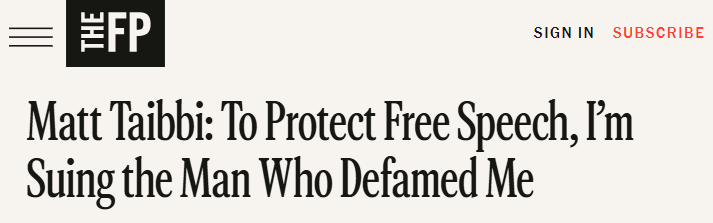
Even more ridiculously, Taibbi took to the pages of Bari Weiss and David Ellison’s The Free Press to claim that he was suing a journalist for his reporting “to protect free speech.”

Yeah, sure man, whatever you have to tell yourself to sleep at night.

But, no, vexatious SLAPP suits don’t protect free speech; they do the exact opposite. Higgins wrote a thorough and sharp critique of how a bunch of people, like Taibbi, who had been formerly associated with left-leaning views, seemed in recent years to have drifted sharply rightward — frequently with the financial and institutional backing of right-wing tech billionaires.

Advertisement

Taibbi’s lawsuit was weak from the start, repeatedly insisting that obviously metaphorical statements were defamatory because he wasn’t literally “owned” or that he didn’t make that much money by cozying up to Elon Musk with his ridiculously misleading Twitter Files. Even Taibbi’s amended complaint was laughably bad, whining that because he took no direct payments or “financial inducement” from Elon Musk, that it was unfair to associate him with Elon Musk. This despite Taibbi getting the first exclusive batch of internal Twitter documents, which he did discuss on Twitter (this is pre-X) but absolutely used to burnish his own reputation and that of his Substack newsletter.

Thankfully, Higgins and his publisher, Bold Type Books (a Hachette imprint) had strong representation: Elizabeth McNamara and Leena Charlton from Davis Wright Tremaine — McNamara in particular is well known in media and First Amendment circles as one of the best in the business — and the court has issued a pretty quick and pretty thorough dismissal of the case.

Over and over again, the judge, George B. Daniels, patiently explains to Taibbi that metaphors and opinion are not defamatory. Which, you know, is the kind of thing you’d hope a famous writer like Taibbi would have understood already. Alas.

The Book’s Cover and Jacket

None of the statements Plaintiff identifies on the Book’s cover and jacket, standing alone, are actionable. Statements 1 and 2, the words “Owned” and “Bought” on the Book’s front cover, are susceptible to both literal and metaphorical meanings depending on the surrounding context. Plaintiff acknowledges, however, that the contents of the Book cannot support a literal reading, stating that the “[t]he Book contains no evidence of any financial transaction, payment, contract, or quid pro quo involving Plaintiff.” (Opp. at 4.) In this context, “Owned” and “Bought” naturally read as attention-grabbing rhetoric used to signify Higgin’s opinions and the Book’s conclusions. Aside from the scattered words and phrases discussed below, Plaintiff does not dispute the accuracy of the vast majority of the Book’s factual content that informs these views or point to language suggesting the opinions are based on facts other than those disclosed in the book. See Levin v. McPhee, 119 F.3d 189, 197 (2d Cir. 1997) (noting that “hypothesis or conjecture… may yet be actionable if they imply that the speaker’s opinion is based on the speaker’s knowledge of facts that are not disclosed to the reader”). Plaintiff may not like Higgins’s subjective conclusions, or agree with their accuracy, but that does not make them actionable defamation.

Advertisement

And for all of Taibbi’s “but Elon didn’t give me any money!” whining, that doesn’t matter. That’s not how defamation law works. Because if it did work that way lots of journalists wouldn’t be able to report on anything, for fear of vexatious SLAPP suits like the one Taibbi filed. As the judge explains:

Statement 3, that Plaintiff was in “the snug patronage of billionaires,” is also a nonactionable opinion. Just like “Owned” and “Bought,” the language “snug patronage” does not have a readily understood precise meaning, so there is no way for a reader to determine whether the statement is true or false. The statement also appears as a reviewer comment on the back cover under the heading “Praise for Owned.” From this context, a reader would likely intuit this statement as an opinion of the reviewer, supported by the facts disclosed in the Book, and not a statement of fact about Plaintiff. See Hammer v. Amazon.com, 392 F. Supp. 2d 423, 431 (E.D.N.Y. 2005) (“[T]he average person understands that [book reviews] are the reviewer’s interpretation and not ‘objectively verifiable’ false statements of facts.” (quoting Hammer v. Trendl, No. CV 02- 2462 (ADS), 2003 WL 21466686, at *3 (E.D.N.Y. Jan. 18, 2003)).

Rhetorical statements and opinions cannot be defamatory. Just like calling Goldman Sachs a vampire squid couldn’t be. Just like saying you’re someone’s “crony.” Incredibly, there was even an earlier ruling in the very same district specifically on whether or not calling someone a crony was defamatory. A good lawyer would have known that before suing over the word “crony.”

Statement 4 is a passage from the Book’s left flap that states that Plaintiff was one of the right-wing technology billionaires “cronies.” (Am. Compl. 20.) Courts in this district have previously held that calling someone a “crony,” without more, is nonactionable rhetorical hyperbole. See Cassava Scis., Inc. v. Heilbut, 2024 WL 553806, at *5 (S.D.N.Y. Jan. 5, 2024), report and recommendation adopted sub nom. Cassava Scis., Inc. v. Bredt, 2024 WL 1347362 (S.D.N.Y. Mar. 28, 2024) (holding that a presentation which labeled individuals as “cronies” was nonactionable opinion); cf. Biro, 883 F. Supp. 2d at 463 (“[T]he use of the terms ‘shyster,’ ‘con man,’ and finding an ‘easy mark’ is the type of ‘rhetorical hyperbole’ and ‘imaginative expression’ that is typically understood as a statement of opinion.”) (internal citation omitted). The same is true here. The assertion that Plaintiff is a billionaire’s crony is the sort of excessive, unverifiable language that signals to a reasonable reader that they are reading the speaker’s opinion, and not a statement of fact.

Also a fail: claiming that more general statements not directly about Taibbi could be defamatory about Taibbi. In this case, Taibbi claimed that Higgins book flap saying that the book “follows the money, names names” is somehow defamatory to Taibbi, despite not being directly about him. Again, making claims about general statements like that is a hallmark of vexatious, speech-suppressing SLAPP suits. As the judge notes:

Statement 5 also appears on the left flap and states that the Book “follows the money, names names,” and is a “biting expose of journalistic greed.” (Am. Compl. 24-25.) Plaintiff alleges that “follows the money” and “names names” “represents to readers that the author has traced actual financial relationships and identified specific recipients of improper payments or patronage.” (Id.24.) “In New York, a plaintiff cannot sustain a libel claim if the allegedly defamatory statement is not ‘of and concerning plaintiff but rather only speaks about a group of which the plaintiff is a member.” Chau, 771 F.3d at 129 (internal citation omitted). Statement 5 does not indicate that it is “of and concerning” Plaintiff it describes Higgins’s investigative process for all the Book’s subjects, not only Plaintiff. A reasonable reader would, therefore, not interpret “follows the money” and “names names” as a false statement of fact about Plaintiff.

It’s also not defamatory (and obviously opinion) to call someone “greedy.” You would think that the author of a supposed exposé on Goldman Freaking Sachs would know that. Alas. The judge has to explain it to Taibbi.

Advertisement

Statement 6 states that the Book is an “exposé of journalistic greed,” which Plaintiff alleges “asserts professional dishonesty and unethical conduct.” (Id. 25.) But whether someone is motivated out of greed or ambition is a subjective determination that is not capable of being proven true or false. See Rosa v. Eaton, No. 23 CIV. 6087 (DEH), 2024 WL 3161853 (S.D.N.Y. June 25, 2024) (“[C]ourts have recognized that words like… ‘greedy crooks’ are vague, imprecise statements of hyperbole considered nonactionable opinion.”) Further, the context surrounding the statement, including its placement on the left flap of the Book’s cover, clearly implies that the facts on which this opinion is based can be found within the Book. Cf. Graham v. UMG Recordings, Inc., 806 F. Supp. 3d 454 (S.D.N.Y. 2025) (holding that an album’s cover art shares the same overall context as the recording itself because the cover is “designed to reinforce the message of the [recording.” (internal citation and quotation marks omitted)).

As a kind of SLAPP Hail Mary, Taibbi’s lawyer had admitted that even if all of these statements were protected opinion, you could still claim defamation on the theory of “yeah, but if you lump them all together, people might jump to false and defamatory conclusions” and the judge has to explain that that, for that to be the case, you have to actually show that the statements are really intended to show such a defamatory meaning. And Taibbi’s lawyer couldn’t do that. Because it does not appear to be true.

Plaintiff acknowledges that these statements “might be protected opinion standing alone.” (Opp. at 11.) But he claims that when viewed together, the statements on the Book’s cover and jacket “become implied factual assertions that the accused was actually paid.” (Id.at 12.) Plaintiff is correct that otherwise nonactionable statements may create “false suggestions, impressions, and implications,” and that these false implications can serve as the basis of a defamation claim. See Armstrong v. Simon & Schuster, 85 N.Y.2d 373, 380-81 (1995). But plaintiffs alleging defamation by implication must “make a rigorous showing that the language of the communication as a whole can be reasonably read both to impart a defamatory inference and to affirmatively suggest that the author intended or endorsed that inference.” Stepanov v. Dow Jones & Co., 987 N.Y.S.2d 37, 44 (N.Y. App. Div. 2014) (emphasis added).

Even assuming that Plaintiff has affirmatively alleged a defamation by implication claim-despite not labeling his sole cause of action as such-Plaintiff has failed to allege facts showing that Defendants intended or endorsed the defamatory inference. As stated above, Plaintiff admits that “the Book contains no evidence whatsoever that Plaintiff received payments, sponsorship, or financial inducement from Elon Musk or any other billionaire.” (Am. Compl. 29.) Instead of endorsing the alleged defamatory implication, the Book argues that Plaintiff’s central reason for agreeing to participate in the Twitter Files was to “gain access.” Higgins, supra at 182. Plaintiff also claims that Higgins “admitted contemporaneously that readers expecting proof of who was ‘bought’ would be disappointed.” (Am. Compl. 62.) In short, the Book’s contents and Higgins contemporaneous statements distance the Book from the defamatory implication Plaintiff alleges. See Henry v. Fox News Network LLC, 629 F.Supp.3d 136, 150 (S.D.N.Y. 2022) (finding that a corporate statement did not endorse a defamatory implication because the statement intentionally included “nebulous” phrasing). Without any additional facts pointing to Defendants’ intent, Plaintiff’s defamation by implication claim fails.

There’s more. Taibbi sued Higgins over the phrase “cash in” but the judge points out that doesn’t need to literally mean getting cash:

This context makes clear that the Book’s reference to “cash in” is not referring to literal money, but rather the idea that Plaintiff traded his reputation for access to the Twitter Files. This sort of loose, figurative language would naturally lead a reasonable reader to interpret this as a statement of opinion.

Hilariously, Taibbi had tried to argue that Higgins claiming that Taibbi got a bunch of new Substack followers because of the Twitter Files was defamatory, but Taibbi’s lawyer had to admit during oral arguments that “getting a bunch of new Substack subscribers” is not the kind of statement that injures your reputation. Oh, and also, it turned out to be true.


Advertisement

Similarly, statement 8 is a nonactionable subjective determination. Statement 8 claims that Plaintiff’s Substack “gained thousands of subscriptions” following his work on the Twitter Files, which translated to a “financial windfall.” But as Plaintiff’s counsel acknowledged during oral argument, this statement, “in the abstract,” is not defamatory because it does not tend to injure Plaintiff’s reputation. Oral Arg. Tr. at 44:13-17; see also Chau, 771 F.3d at 127 (“To be actionable … the statement must do more than cause discomfort or affront; the statement is measured not by the sensitivities of the maligned, but the critique of reasonable minds that would think the speech attributes odious or despicable characterizations to its subject.”) And even if one could read a defamatory meaning into these words, Plaintiff admits that he did in fact gain thousands of Substack subscribers following the Twitter Files reporting. (See Am. Compl. 11 38-39 (“The ‘thousands of new subscribers Owned claims Plaintiff gained after publication represented only a small percentage of Plaintiff’s overall readership.”) Whether this “small percentage” of increased subscribers represented a “financial windfall” is a subjective determination.

In other words, the entire case was a garbage, vexatious attack on Higgins’ own speech — and should put to rest forever the idea that Taibbi was ever a true supporter of free speech. He spent years falsely implying that protected speech activities of private companies were an attack on free speech, and now he’s moved on to actually attacking the free speech of others — abusing the power of the courts to cost them time, money, and attention to fight off a vexatious lawsuit.

Honestly, it seems that, if anything, the small, cuddly, vampire squid would likely have a stronger case against Taibbi than Taibbi had against Higgins.


Filed Under: 1st amendment, defamation, elon musk, eoin higgins, free speech, matt taibbi, metaphor, opinion, rhetorical hyperbole, vampire squid

Companies: hachette

Advertisement

Source link

Continue Reading

Trending

Copyright © 2025