




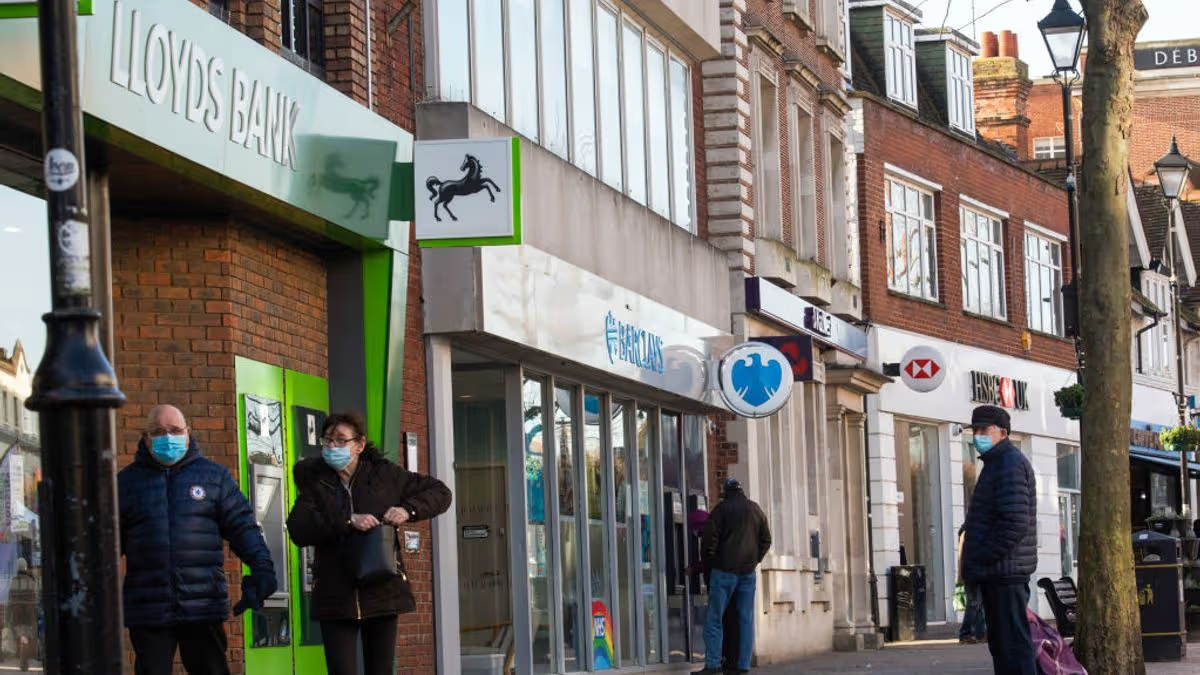
The closures are blamed on customers ‘shifting towards mobile services’
Eight Greater Manchester branches are among nearly 250 banks that are due to close in 2026 as the major banks continue their withdrawal from the high street.
By the start of this month, 138 banks had closed across the UK in 2026. June is set to be the most destructive month so far, with 82 branches due to close this month alone, and more to follow throughout the year.
In total, closure dates have been fixed for 245 branches of the major banks by the end of this year. That includes eight Greater Manchester banks – four in Manchester, two in Trafford, and one each in Rochdale and Tameside.
Click here to get the biggest stories straight to your inbox in our Daily Newsletter
Three of those branches closed this month, with the Halifax branch on Wilmslow Road, Didsbury, scheduled to shut today (Wednesday, June 10).
The Lloyds branch in Stamford New Road, Altrincham, was expected to close yesterday (Tuesday, June 9), and the Halifax in Ashton-under-Lyme at the start of this month. All the other closures took place earlier in the year.
You can check whether your local branch is due to close using our interactive map.
The closures affect every part of the UK, with 31 branches due to shutter in Scotland, 16 in Wales, and four in Northern Ireland, with the rest spread across England.
Lloyds customers have been hardest hit, with 82 Lloyds branches already shut or scheduled to close this year, along with 43 branches of Halifax and 28 branches of Bank of Scotland.
That comes after Lloyds Banking Group announced it would close 166 branches in 2026 and 2027, including branches of Halifax, Bank of Scotland, and Lloyds Bank.
The decision was blamed on customers shifting away from in-person banking to using mobile services. Meanwhile, Santander is closing 54 branches this year, and NatWest is closing 35 banks.
Since February 2022, when all major banking groups committed to a voluntary agreement to assess the impact of each closure, a total of 2,167 branches have either shut down or announced plans to close – an average of nearly 10 closures each week.
The LINK initiative was established to scrutinise each closure. When closures leave communities without any local bank, banking hubs or free ATMs are set up to fill the gap. So far, LINK has recommended the opening of 277 bank hubs.
In May, the Government announced an independent review into access to banking, to be led by Richard Lloyd, the ex-Director General of Which? and the former interim Chair of the Financial Conduct Authority.
As part of the review, Mr Lloyd has launched a consultation on the impact of branch closures and their implications for the future.Currently, closure assessments focus on cash access and the potential gap left by a branch closure.
But this assessment could be extended to include access to banking, which could mean recommending new banking hubs at branches that have already been assessed for closure, as well as at future sites.
Experts believe the previous commitment of 350 hubs could increase to 550 if these changes are implemented.
Nick Quin, Chief Corporate Affairs Officer, LINK, said: “More people are choosing to bank and pay for things digitally. Many people rely entirely on their smartphones when they leave the home, and don’t carry cash or even a wallet.
“That means cash use is falling too, but it remains critical, and over £76bn was withdrawn from LINK cash machines last year.
“Whenever a bank branch does close, LINK will assess the impact to see if additional cash services are required. We’re committed to protecting the cash infrastructure for the millions of people who still rely on it.”


















































You must be logged in to post a comment Login