

Crypto World
Bitcoin tends to outperform gold and stocks after global shocks, Mercado Bitcoin finds

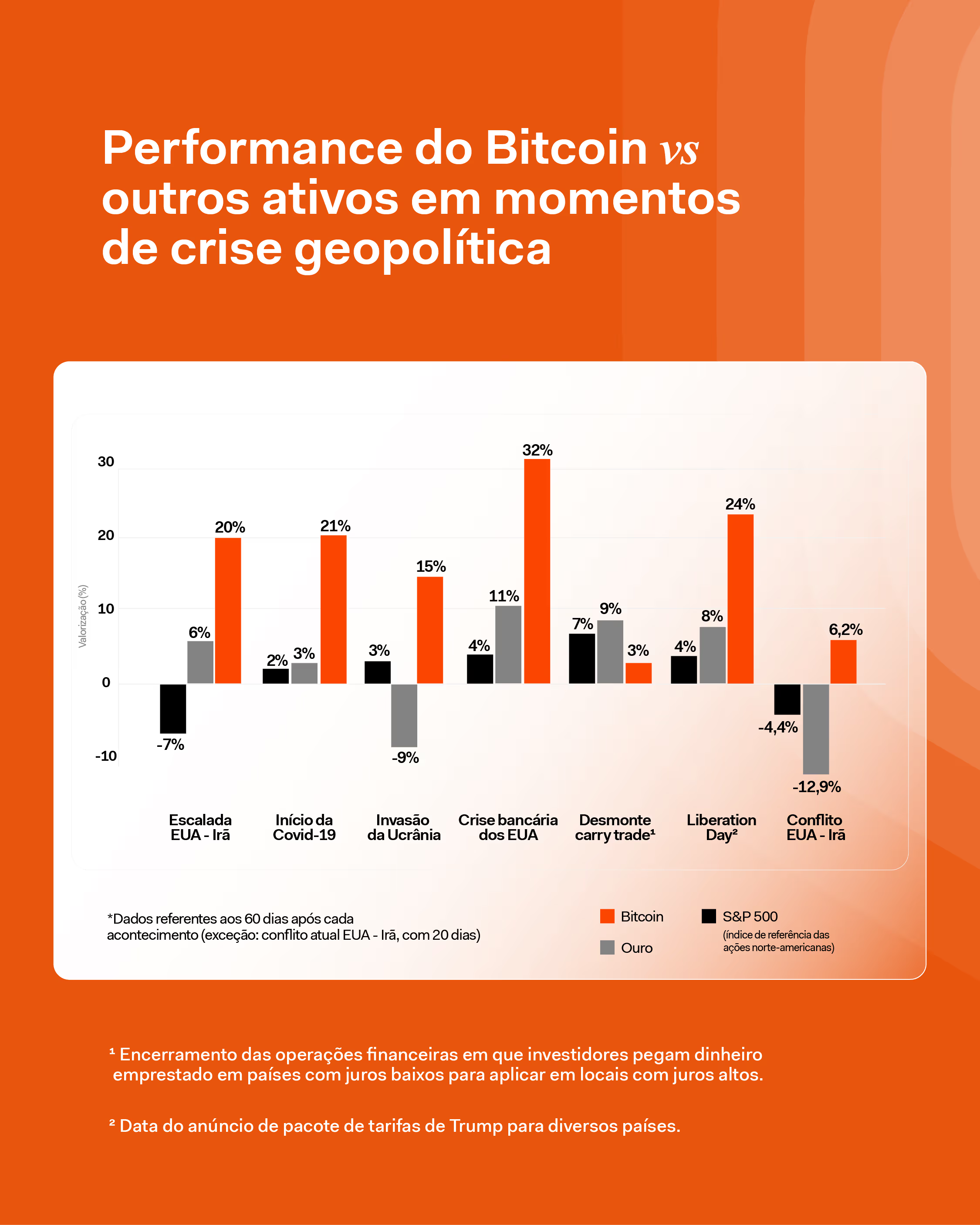
Bitcoin tends to outperform traditional safe haven assets like gold in the two months following major global crises, according to new analysis from Brazilian crypto exchange Mercado Bitcoin.
The study, led by Rony Szuster, head of research at the Latin American crypto platform, examined 60-day windows after economic or geopolitical shocks such as the COVID-19 outbreak and U.S. tariff escalations. Bitcoin posted stronger returns than both gold and the S&P 500 in each of the periods analyzed.
In April last year, after the Trump administration announced sweeping tariffs, the price of bitcoin jumped 24% over the following 60 days. Gold rose 8%, and the S&P 500 gained 4%, the firm found.
A similar pattern emerged at the onset of the COVID-19 pandemic in March 2020, when BTC rose 21%, while the other assets trailed.

Szuster cautioned that judging bitcoin’s performance too soon after a crisis can be misleading.
“It’s like watching the first few minutes of a movie and thinking you already know how it ends,” he said. “In moments like this, investors sell positions to reduce risk or raise cash, and even defensive assets can fall.”
That happens as investors scramble for liquidity, yet bitcoin has consistently bounced back, the firm found. The pattern appears to be repeating in the current U.S.-Iran conflict, where bitcoin is the only one of the three assets in positive territory so far, according to Szuster.
Data backs this up. Since the war started, bitcoin has risen by more than 2.2%, from around $65,800 to $67,300 at the time of writing. Gold, the traditional safe haven, has meanwhile dropped around 11%, while the S&P lost 4.4% of its value in the index’s steepest monthly drop since 2022.
Despite its volatility, bitcoin was the best-performing asset over the past decade, he added.
Read more: Bitcoin’s recent crash to $60,000 warned stocks first – now they’re following

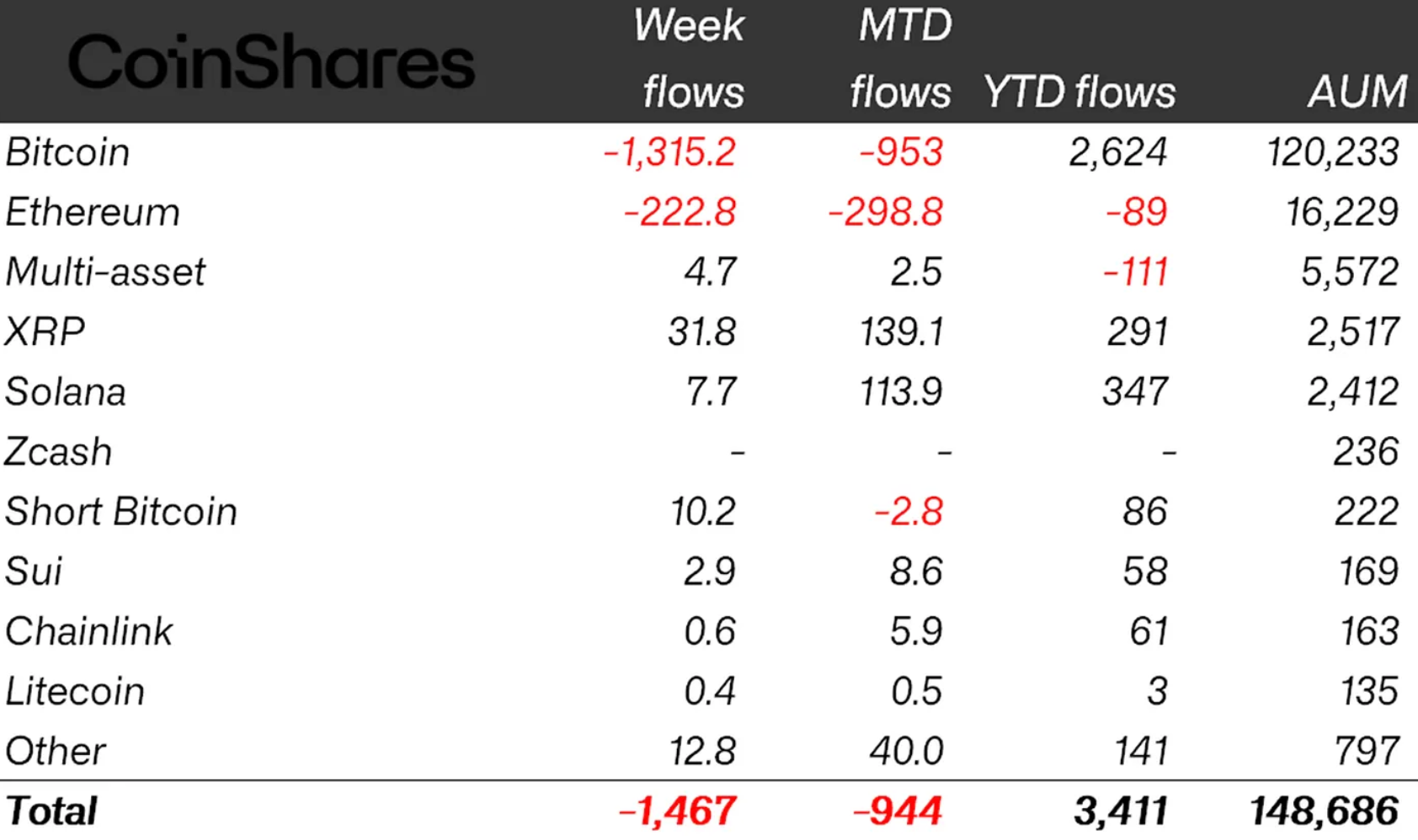
Crypto investment products recorded $1.47 billion in outflows last week, extending a second straight week of withdrawals as Bitcoin funds led the decline, according to CoinShares.
Crypto exchange-traded products (ETPs) extended the prior week’s $1.07 billion in withdrawals, CoinShares reported Tuesday.
Bitcoin products accounted for roughly $1.3 billion of the outflows, their largest weekly withdrawal of 2026, while Ether funds lost $223 million, the asset manager said.
Total assets under management in crypto ETPs stood at around $148.7 billion, with Bitcoin funds accounting for 80% with $120.2 billion.
CoinShares head of research James Butterfill said the selling reflected deepening Iran-related risk-off sentiment despite continued progress on the CLARITY Act.
Nine assets post inflows above $1 million
Altcoin ETPs still recorded notable gains despite the broader downturn, with at least nine assets seeing inflows above $1 million, Butterfill said.
XRP (XRP) led altcoin inflows with $31.8 million, while Solana (SOL) followed with $7.7 million.
Separately, data from SoSoValue showed Hyperliquid (HYPE) exchange-traded funds (ETFs) recorded $72.3 million in inflows.
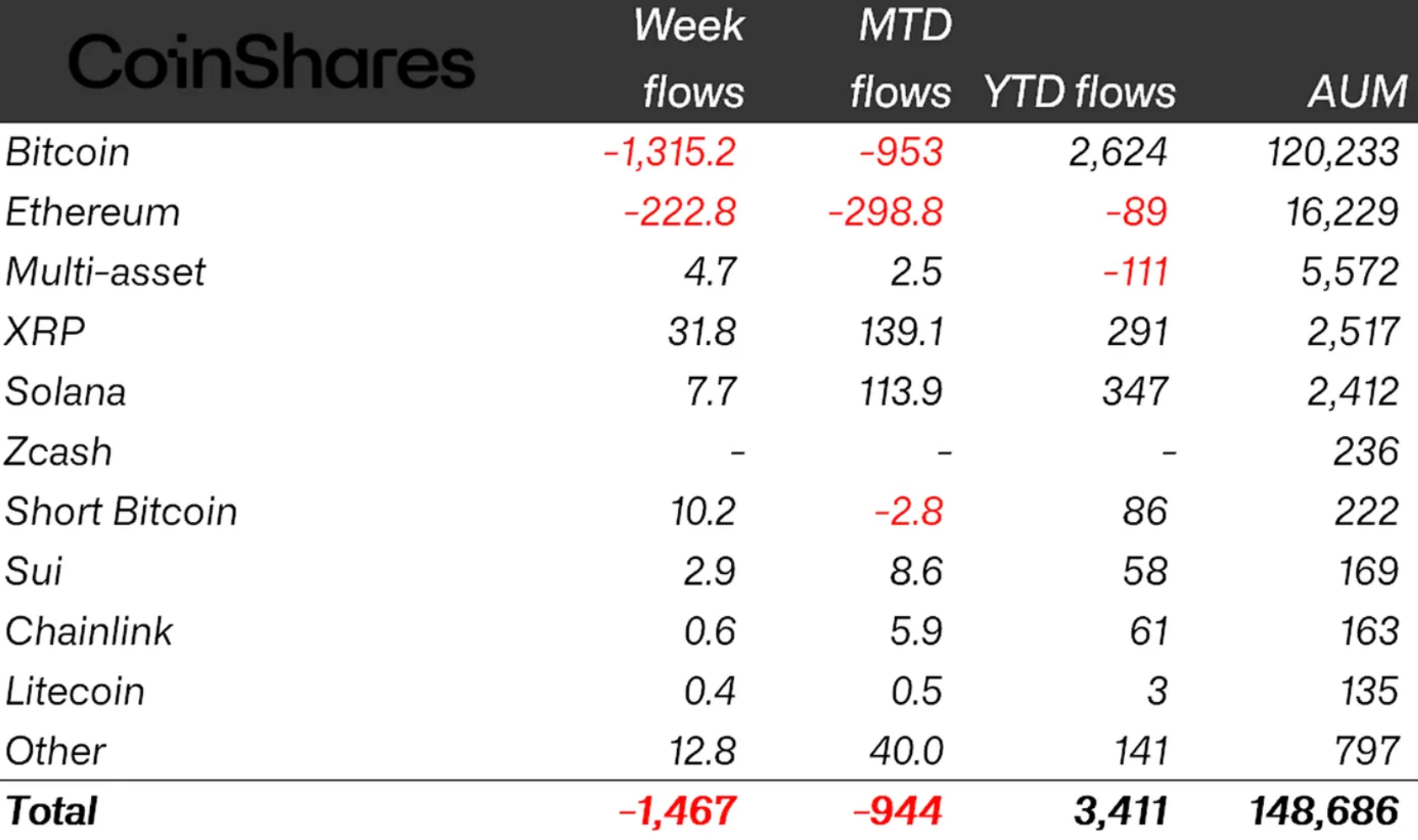
Crypto ETP flows by asset (in millions of US dollars). Source: CoinShares
Smaller inflows were also recorded in Sui (SUI) and Chainlink (LINK), at $600,000 and $400,000, respectively. Short Bitcoin products added $10.2 million, aligning with broader risk-off sentiment.
Related: $1.26B Bitcoin ETF outflows spark ‘contrarian’ buy signal: Santiment
Total assets under management in crypto ETPs stood at about $148.7 billion by the end of the week, with Bitcoin funds making up 80% at $120.2 billion.
Crypto ETP outflows spread globally as US leads losses
Outflows broadened across global crypto ETP markets last week, reversing the prior week’s relative “European resilience,” the report said.
The United States led with $1.43 billion in outflows, including $1.26 billion from US-listed spot Bitcoin ETFs, according to SoSoValue.
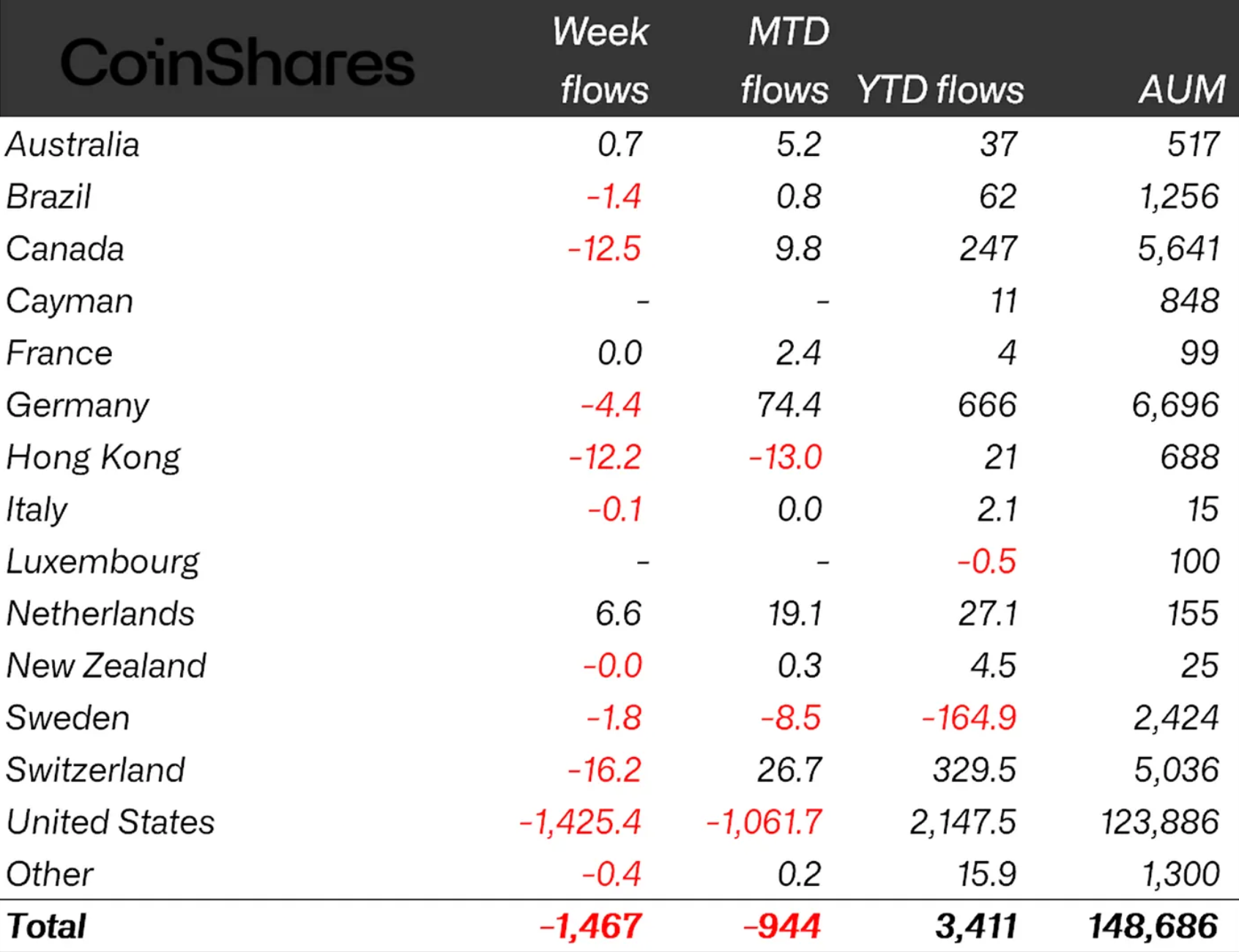
Crypto ETP flows by country (in millions of US dollars). Source: CoinShares
More losses were recorded in Switzerland at $16.2 million and Canada at $12.5 million. Hong Kong and Germany also saw outflows of $12.2 million and $4.4 million, respectively.
The Netherlands was the only country to see notable inflows at $6.6 million, while Australia followed with $700,000 of inflows.
Magazine: ETH bears growling, Tom Lee’s buying, XRP to ‘explode’: Market Moves
Crypto World
Bitcoin Unable to Resume Rally Above $77K but This AI Coin Soars 25% Daily: Market Watch
Bitcoin’s price has failed to resume its rally, and it appears that the market has calmed down, or rather stalled, at about $77,000. This comes as legacy products like the S&P 500 continue to reach new all-time highs.
Elsewhere, some altcoins are having a field day, with Worldcoin (AI) – a project associated with the founder of OpenAI, Sam Altman – exploding by 25% daily.
Hopes for Bitcoin Price Rally Fade
At the time of this writing, Bitcoin’s price is trading at slightly below $77,000. The cryptocurrency is down 0.6% for the past 24 hours and mostly flat for the week. This comes after a relatively calm 24 hours, during which BTC oscillated between $76.5K and $77K.
It remains in correction mode, with price trending below the descending 200-day moving average near $80,000 and continuing to struggle to regain bullish momentum. After being rejected in the $82K area recently, BTC has returned to the support zone between $74K and $75K, where we see a convergence of prior demand, local lows, and the 100-day moving average.
All of this comes amid rising stock market prices and tumbling oil, which just returned to $90 per barrel – a level we hadn’t seen in the past 20 days.
It’s interesting to see how Bitcoin will fare in the current geopolitical environment, which is largely shaped by the war between the US, Israel, and Iran.

Worldcoin Leads Altcoin Markets, Soars 25% Daily
Large-cap altcoins such as ETH, BNB, XRP, SOL, TRX, and others remain largely flat for the day, with movements in the -0.5% to +0.5% range.
That said, AI-associated altcoins marked a notable move throughout the past 24 hours, with Sam Altman-related Worldcoin (WLD) up 28% so far. This brings its total gains to 60% for the week. The coin is followed by Render, up 16%, and the Artificial Superintelligence Alliance (FET), up by the same amount.
This could be a beta trade in an AI-oriented infrastructure play against the popular DRAM ETF, which became the fastest-growing ETF in history, as reported by CryptoPotato yesterday.

The post Bitcoin Unable to Resume Rally Above $77K but This AI Coin Soars 25% Daily: Market Watch appeared first on CryptoPotato.
Crypto World
Inside Ibiza Tech Forum 2026: Stablecoins, RWA and the State of Post-MiCA European Crypto
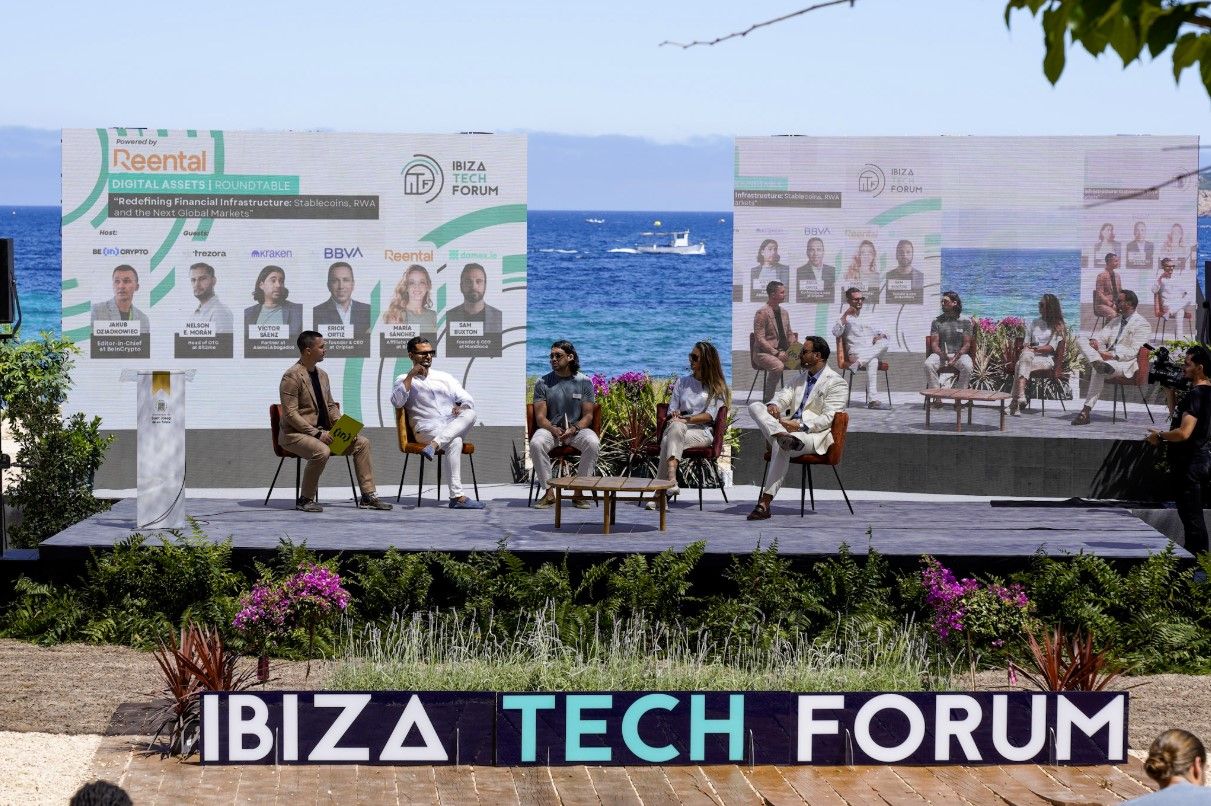
The fourth edition of Ibiza Tech Forum unfolded between May 19 and May 22 across the south of the island, splitting its programme between the Caló de s’Oli Auditorium, Romeos Hotel, Hotel Bonito Ibiza, Es Jardins de Fruitera and Cova Santa.
Across four days, the forum stitched six tracks together — AI, Bank & Fintech, Smart Islands & Smart Mobility, Health Tech, Web3 & Blockchain, and SportTech — but for the digital assets industry, the gravity of the event sat squarely on Thursday, May 21.
That was the day BeInCrypto stepped on the main stage.

Ibiza Tech Forum: Two panels, one through-line
BeInCrypto Poland Editor-in-Chief Jakub Dziadkowiec hosted two of the day’s headline sessions, both at the Caló de s’Oli Auditorium.
The first, “On-Chain and Unfiltered,” was billed as a Stelar Fireside Chat and ended up being precisely that: a candid, sometimes blunt exchange with Evan Luthra (General Partner at KOL Capital) and Yana Makhnyk (CBDO at Generis) about influence, wealth, community and what Web3 actually got right. The conversation refused to flatter the room. It pushed against a comfortable narrative of the industry as a meritocracy and instead asked who actually moves capital, who builds influence, and what survives once the noise drops out.

The second was a Digital Assets roundtable — “Redefining Financial Infrastructure: Stablecoins, RWA and the Next Global Markets” — and it brought to the table the people building the rails: Sam Buxton (Founder & Chairman, Damex), Víctor Sáez (Director, Expansion & Strategic Partnerships, Kraken), Nelson Enrique Moran (Founder & Chief Innovation Officer, Trezora), María Sánchez (Investor Relations Specialist, Reental), Erick Ortiz (Blockchain Advisor, BBVA), and Christopher Siedentopf (Founder of CRS Advisory & Head of Sales at Qapture Investments).
The discussion moved past the usual stablecoin talking points and into what the infrastructure actually has to deliver — settlement guarantees, regulatory alignment, real-world asset onboarding — before the next wave of capital trusts the plumbing.
What Thursday told us about European crypto in 2026
Thursday’s programme read like an inventory of where the European crypto industry is post-MiCA. The earlier roundtable on the main stage — pointedly titled “Lost at sea no more: How Europe’s Crypto Industry Survived to See MiCA” — gathered MoonPay, Bit2me, Criptan, Bitvavo and Mandioca alongside legal counsel from Asensi Abogados. The shared subtext, audible across the day, was that European operators have stopped treating regulation as an existential threat and started treating it as a moat.
That shift showed up in adjacent sessions too. “The New Financial Backbone,” the exchanges-led panel that followed BeInCrypto’s roundtable, brought together Bitget, Bybit EU, Solana Foundation, TradingView and FX Street — the kind of lineup that would have read as aspirational two years ago and now reads as the working order. And Dynex CEO Daniela Herrmann’s quantum-computing keynote earlier in the morning underlined that the industry’s frontier is no longer “will crypto survive?” but “what stack comes next?”

Ibiza Tech Forum 2026: A different kind of conference floor
The substance of the panels was only half of what made ITF 2026 work. The island shaped the rest.
Day one’s opening at Romeos Hotel doubled as the semi-final of The Next Unicorn startup contest, and set a register the rest of the event maintained: structured by day, social by evening. Day two — anchored by Spanish-language panels on smart mobility, AI in business, predictive cities and personal branding for founders — gave way to a SportTech afternoon, a TradingView trading competition at Hotel Bonito Ibiza, and a rooftop dinner on the same property.

Day three’s networking lunch at Es Jardins de Fruitera and the Female Founders & Investors session bridged the formal programme into the closing dinner at Cova Santa, a venue whose acoustics and topography do a lot of the work that name-brand venues elsewhere have to manufacture.
The fourth day was reserved for the smallest, most senior group: a boat trip to Formentera, lunch on board, and a swim in water clear enough to make the previous 72 hours feel like a different event entirely. That contrast is the design of ITF — it gives senior operators a reason to stay through Friday, and it gives the conversations begun on stage a frame to continue in.

What BeInCrypto walked away with
Beyond the two stage appearances, BeInCrypto conducted roughly nine on-the-ground interviews and built out more than thirty C-level relationships across exchanges, infrastructure providers, asset managers and adjacent verticals — fintech, sport, longevity, AI:
- Teresa Castagnino — CEO and co-Founder at Like Group Management; Head Forbes of Mexican Caribbean
- Yossi Goldsmith and Cristo Millar — IKAL
- Iñaki Zubeldia — CEO and co-Founder at Yoseyomo and Inheritans, and Mayte Clara — Investor & Strategic Partner at Yoseyomo
- Oleg Morgunov — Head of Growth & Partnerships, Europe & LATAM, TradingView
- Jordi Urbea — CEO at Ogilvy Spain
- Javier Pastor — Head of OTC at Bit2me
- Georg Harer — Co-CEO at Bybit EU
- Daniela Herrmann — CEO and co-Founder at Dynex
- María Sánchez — Wealth Manager at Reental

Those conversations will surface in BeInCrypto coverage over the coming weeks, and several of them tracked directly back to the questions raised on Thursday’s main stage: what the post-MiCA European stack actually looks like in practice, where stablecoin and RWA infrastructure goes next, and which institutional partners are ready to operate on-chain in 2026 rather than in slide decks.
The verdict from BeInCrypto’s seat is straightforward. Ibiza Tech Forum 2026 was small enough that you could speak to whoever you wanted to speak to, serious enough that the conversations were worth having, and Mediterranean enough that the people you most wanted to follow up with were still on the island three days later. That combination is rarer than the event circuit makes it look.
For the digital assets industry, the question after MiCA is no longer whether to show up in Europe. It’s where in Europe to show up. Ibiza, on this evidence, just made its case.
The post Inside Ibiza Tech Forum 2026: Stablecoins, RWA and the State of Post-MiCA European Crypto appeared first on BeInCrypto.


- RENDER surged 18% to $2.35 on strong volume and activity.
- Wallet growth, open interest, and EMA breakout drive momentum.
- Break below $2.18 support or above $2.50 resistance will define the next price direction.
Render (RENDER) has recorded a sharp upward move, rising about 18.1% in 24 hours to around $2.35 and outperforming the broader crypto market.
The rally is supported by a combination of stronger on-chain activity, rising derivatives demand, and a clear technical breakout that has shifted market momentum in its favour.
Trading activity over the past 24 hours has increased significantly, with volume reaching nearly $295 million, showing that the move is backed by real participation rather than thin liquidity conditions.
On-chain growth and derivatives activity fuel RENDER demand
One of the strongest drivers behind the recent move has been a noticeable increase in network usage.
Daily active addresses have climbed to 394, marking a 12-week high, while new wallet creation has reached 118, also the highest level in the same period.
📈 Render’s on-chain activity has seen a major breakout in late May, jumping back above $2.25 for the first time in over 4 months. Daily active addresses climbed to 394 in a single day with 118 new wallets created, both hitting their highest marks in 12 weeks. These two metrics… pic.twitter.com/gFJAl2ipJj
— Santiment Intelligence (@SantimentData) May 26, 2026
This increase in activity suggests that more users are interacting with the Render network during the price surge rather than after it.
At the same time, derivatives markets have shown a sharp rise in speculative interest.
Open interest has increased by 47%, while derivatives trading volume has surged by 126%, indicating a rapid buildup of leveraged positions.
This combination of higher user activity and rising futures participation has strengthened the momentum behind the rally.
The increase in both on-chain activity and derivatives positioning shows that the move is being driven by both real network engagement and speculative trading demand at the same time, a combination that often leads to faster price expansion phases in crypto markets.
Descending triangle breakout strengthens bullish momentum
The RENDER token price has broken above a descending triangle pattern, a formation that typically signals a shift from downward pressure to upward momentum once resistance is cleared.

In addition, Render’s price is currently positioned above all major daily exponential moving averages, including the 10-day, 20-day, 50-day, 100-day, and 200-day EMAs.
This full alignment of moving averages below the price indicates a strong bullish structure, where each previous resistance zone is now acting as potential support.
Momentum indicators, however, show that the move is already stretched.
The 14-day RSI is reading around 74, placing it in overbought territory.
This RSI level has historically been associated with periods where profit-taking begins to build, especially after sharp short-term rallies.
Market sentiment
Alongside technical and on-chain signals, Render has also gained traction within broader market narratives.
The token is among the top 10 most discussed AI-focused crypto projects, as attention around artificial intelligence (AI) and decentralised compute infrastructure continues to grow.
The AI compute and DePIN (decentralised physical infrastructure networks) narratives have been key themes driving interest in Render, especially as traders rotate capital into projects linked to GPU rendering and distributed computing demand.
This increased attention has contributed to faster inflows during breakout phases, reinforcing the upward price movement.
RENDER price forecast
Looking at the charts, short-term resistance is forming around the $2.37 to $2.38 region, which also represents a near-term pivot zone.
If buying pressure continues and price holds above the breakout support area between $2.17 and $2.18, the next key upside level remains $2.50, which is viewed as the immediate technical target based on recent momentum structure.
However, there is a likelihood of a pullback happening, especially seeing that the RSI is already in the overbought region.
If the correction takes place, a drop below the $2.18 support zone would weaken the current breakout structure and could open the door for a pullback toward the $1.99 to $2.00 range, where previous consolidation has occurred.
Deeper support remains aligned with the broader moving average structure, particularly around the 200-day EMA near $1.93, which continues to define the long-term trend boundary.

A new research paper reframes security for AI-powered agents as a system-wide problem, arguing that protections must extend beyond the model itself to harden the entire workflow. Published in amended form on May 20 by researchers from Google, Gray Swan AI, EmbraceTheRed, and several universities, the work contends that AI agents should be treated as untrusted components within a broader security architecture, warning that focusing solely on model robustness leaves ecosystems vulnerable to attacks and failures.
“Towards this end, we propose viewing agent security as an instance of computer security. This domain has long dealt with powerful attackers and motivated decades of research on principles and techniques that deal with such adversaries,” the researchers wrote in the paper. The framing shifts the emphasis from merely stiffening an agent’s inner workings to protecting the entire chain—from data inputs and instructions to the permissions the agent holds and the destinations data may reach. The authors argue that this systems-oriented stance is especially relevant as AI agents become more embedded in crypto applications, including autonomous trading and wallet interactions.
“Through this lens, efforts to increase model robustness, the dominant viewpoint in the community, are insufficient on their own. Instead, we must complement existing efforts with techniques from the systems security domain.”
The paper notes that AI agents are already gaining traction among crypto users, with industry executives speculating about rapid adoption. Circle CEO Jeremy Allaire, for example, has projected that billions of AI agents could operate on users’ behalf within five years, underscoring the pace at which autonomous tooling could become a standard element of crypto workflows.
Key takeaways
- Security for AI agents should treat the agent as an untrusted component within a larger system, not as a trusted, isolated module.
- Three mechanisms could block a large fraction of attacks: distinguish between instructions and untrusted data, grant only the minimum permissions needed, and control data flows to prevent leakage to unsafe destinations.
- Real-world incidents, including crypto trading bots and wallet interfaces, illustrate how an attacker could exploit AI-enabled tooling if system-wide safeguards are not in place.
- In crypto, AI agents are being used to build applications, automate trades, and interact with protocols, raising the stakes for robust, end-to-end security design.
- Industry voices advocate for context-aware, sandboxed prompts and rigorous governance around what actions an AI agent may perform, especially when wallets or private keys are involved.
Security as a systems problem for AI agents
The core argument of the amended paper is that embedding security solely in the AI model’s robustness is insufficient. Instead, AI agents should be designed and operated as components within a larger, defended system. The researchers emphasize that standard security practice distinguishes between trusted and untrusted components, and AI should be treated as untrusted by design. By doing so, defenders can apply decades of computer security insights to arguments about threat models, adversaries, and defense-in-depth.
As part of this framework, the authors outline three mechanisms that could eliminate a large portion of potential attacks. First, there must be a clear separation between instructions given to an agent and the data the agent processes. By preventing adversaries from embedding malicious instructions within seemingly innocuous data, agents become harder to deceive via data-driven manipulation. Second, agents should operate with the minimum set of permissions necessary for a task, reducing the blast radius if an attacker compromises the agent. Third, the broader system should govern sensitive information flows, restricting where data can travel and ensuring that the agent cannot exfiltrate or redirect data to unsafe destinations.
The paper’s emphasis on data handling and permission discipline aligns with established security principles used to manage risk in other domains. In short, even a highly capable AI agent can be safe if the surrounding system controls are robust and well-defined, and the agent’s ability to act is carefully bounded.
Crypto real-world tensions: incidents and design patterns
The discussion comes against a backdrop of real-world incidents involving AI-enabled crypto tools. In May, the AI-powered trading assistant Bankr reportedly disabled transactions after an attacker gained access to at least 14 wallets, a development that security researchers linked to potential abuse of the bot. While the exact mechanism of compromise remains under discussion, the episode underscores the vulnerability surface when agents are granted operational control over wallets or trading actions.
Industry voices emphasize that the risk is not theoretical. As crypto platforms experiment with AI agents for tasks such as front-running detection, contract auditing, balance checks, and even automated payments, the potential for systemic damage grows if security is not engineered into the entire lifecycle—data ingestion, decision logic, and execution controls.
Aaron Ratcliff, attribution lead at Merkle Science, highlighted the paradox of integrating AI into trustless ecosystems. He told Cointelegraph that giving an agent access to a wallet can be safe if the system enforces strong boundaries and verification. “I’d want proof that the AI can catch front-running, apply slippage limits, spot scam tokens, and audit contracts in real time before it makes a trade. It should also sandbox prompts, prevent injection, and block man-in-the-middle access,” he said.
Sean Ren, co-founder of Sahara AI, agreed that model-context protocols play a crucial role in safety when configured correctly. Yet he cautioned that users must remain vigilant about every action an AI agent performs. “They essentially act as a gatekeeper between the AI model and your wallet. The agent can only perform specific, approved actions—such as checking balances or preparing a payment for you to confirm—rather than freely moving funds or changing wallet settings,” Ren noted.
Implications for Web3 developers and users
The study’s systems-security framing has practical implications for developers building AI-enabled Web3 applications. It suggests a shift in architecture toward explicit permissioning, verifiable data provenance, and enforced data flows that separate the agent’s decision-making from wallet control. For users, the message is one of guarded optimism: AI agents can unlock convenient automation and faster interactions with DeFi protocols, but only within a design that constrains risk through separation of duties, sandboxing, and robust monitoring.
As crypto platforms increasingly explore AI-powered assistants, the debate is likely to pivot from “can we automate more?” to “how can we do so safely?” The emphasis on treating agents as untrusted components may lead to more rigorous security reviews, standardized context protocols, and greater emphasis on prompt governance and prompt-injection defenses in production systems.
Researchers from the collaboration also point to broader industry momentum. The adoption of AI agents in crypto tooling—ranging from trading automation to proactive risk checks and contract analysis—could accelerate if builders adopt a shared safety framework that mirrors established computer-security practices. The outcome could be a crypto ecosystem that leverages AI’s productivity gains while maintaining strong protections against manipulation, leakage, and unintended actions.
Looking ahead, the authors of the study advocate for practical steps that exchanges, wallet providers, and DeFi developers can take now. These include enforcing strict separation of instructions and data, applying the principle of least privilege, and implementing system-level controls that govern where information can go. The overarching aim is to embed a defense-in-depth mindset that scales with increasingly autonomous AI agents, rather than relying solely on model hardening.
For readers monitoring the convergence of AI and crypto, the key takeaway is clear: as autonomous agents become more capable, the design principles governing their operation must evolve. The field is moving toward a holistic security paradigm that treats agents as components within a larger, defendable system, with consequences that reach wallets, trading bots, and on-chain automation alike. The next several quarters are expected to reveal whether the industry can translate this systems-security philosophy into concrete standards, safer defaults, and verifiable safeguards for end users.
Crypto World
Bitcoin Price Prediction: BTC Nears Critical Support as $70K Realized Price Band Comes Into Focus
Bitcoin’s recent price action suggests the market is approaching an important decision zone where multiple technical and on-chain support levels converge. This raises the possibility of a short-term bullish reaction before the market determines its next larger directional move.
The behavior around the $74K-$75K support and deeper demand regions will likely shape Bitcoin’s medium-term outlook.
Bitcoin Price Analysis: The Daily Chart
On the daily timeframe, BTC continues to trade below the descending 200-day MA near $80K, struggling to build bullish momentum. Following rejection from the $82K resistance area, sellers pushed the market back toward the first major support zone at $74K-$75K.
This region is especially important because it aligns with prior demand and recent local lows, and it sits above the 100-day MA near $73K. Historically, overlapping support levels often generate temporary stabilization or corrective rebounds.
The immediate scenario favors a pullback toward the $74K-$75K demand zone. If buyers defend this region successfully, Bitcoin may attempt another corrective move toward $78K-$80K. However, losing the $74K support could expose the next key level around $70K-$71K, followed by the stronger structural support near $65K-$66K.
At this stage, price remains in correction mode rather than a confirmed trend reversal.

BTC/USDT 4-Hour Chart
The lower timeframe highlights increasing indecision near support. Bitcoin recently reacted positively from the $74K-$75K order block and briefly recovered toward $77K, suggesting buyers remain active around this area.
Still, bullish momentum has remained weak, with rebounds repeatedly failing to reclaim higher resistance levels. This indicates that current upward movements may represent temporary relief rallies rather than renewed trend continuation.
The short-term support sits at $74K-$75K. Holding above this zone could encourage another recovery attempt toward the $78K-$80K region. Conversely, a confirmed breakdown below $74K may accelerate selling toward the next major demand area around $70K-$71K.
Therefore, the reaction at current support levels remains critical to determining whether Bitcoin enters a stabilization phase or another bearish leg.

On-Chain Analysis
The UTXO Realized Price Bands provide additional context by tracking the average acquisition cost of different investor cohorts. These levels often serve as psychological support or resistance because they indicate where holders become profitable or begin to experience losses.
Currently, the realized price for the 1M–3M cohort sits near $70K, while the 18M–2Y cohort remains around $63K. Meanwhile, longer-term holders between 12M–18M and 3M–6M maintain realized prices closer to the $90K region.
The significance lies in the confluence between technical supports and realized price bands. Bitcoin’s first major support zone around $ 70K–$71 K aligns closely with the realized price of younger holders (1M–3M), strengthening the likelihood of demand emerging in this area.
A deeper decline toward $63K-$65K would also coincide with the realized price of longer-term cohorts around $63K, alongside an important historical support zone visible on the daily chart.
This suggests that if Bitcoin continues correcting, support levels at $74K-$75K, $70K-$71K, and eventually $63K-$65K may attract increasing buying activity. The market’s reaction around these zones will likely determine whether the current pullback evolves into accumulation or transitions into a broader bearish continuation.
For now, the data point to short-term support potential rather than an immediate trend recovery.

The post Bitcoin Price Prediction: BTC Nears Critical Support as $70K Realized Price Band Comes Into Focus appeared first on CryptoPotato.
Bitwise has launched the Bitwise Canton ETP on Deutsche Börse Xetra, giving European investors exchange-traded exposure to Canton Network’s native token, CC.
Summary
- Bitwise launched BWCC on Deutsche Börse Xetra, offering exchange-traded exposure to Canton Coin.
- The Canton ETP tracks Kaiko’s reference rate and carries a 0.85% annual fee.
- Related reports show 21Shares recently launched TCAN, giving U.S. investors Canton Coin ETF access.
The product trades under the ticker BWCC and carries the ISIN DE000A4ARTH9. In a Tuesday statement, Bitwise said BWCC tracks the Kaiko CANTO Reference Rate LDNLF index and carries a total expense ratio of 0.85% per year.
The firm added that the ETP is fully backed by CC tokens held in cold storage and can be bought or sold through traditional brokerage accounts without requiring investors to use a crypto wallet.
Canton targets capital markets
Canton Network is a privacy-enabled blockchain built for capital markets. Bitwise said the network was developed with participation from institutions including Goldman Sachs, BNP Paribas, Deutsche Börse, and Broadridge.
The network is designed to let financial institutions issue, trade, and settle assets digitally while keeping sensitive transaction details private. Bitwise said this differs from public blockchains where all activity is visible to all users.
Bradley Duke, Managing Director and Head of Europe at Bitwise, said “The Bitwise Canton ETP is a timely addition to our growing suite of European crypto ETPs.” He added that Canton combines privacy, interoperability, and programmability for institutional compliance needs.
U.S. Canton ETF adds context
The European listing comes weeks after 21Shares launched the 21Shares Canton Network ETF on Nasdaq under the ticker TCAN. As previously reported by crypto.news, TCAN gives U.S. investors exposure to Canton Coin through brokerage accounts rather than direct token custody.
TCAN began with a 0.50% gross expense ratio and an inception date of May 7, 2026. The same crypto.news report said Canton targets institutional settlement, privacy, and tokenized markets, with participation from banks and technology firms.
21Shares said institutions including Goldman Sachs, Microsoft, and Deutsche Bank had participated in Canton-related testing, validator activity, or governance work. 21Shares also said those names should not be treated as endorsements of TCAN, Canton Coin, or the network.
Institutional tokenization push grows
Canton has also gained attention from tokenization-focused investors. crypto.news recently reported that Canton price rallied after Societe Generale’s SG-FORGE deployed its regulated euro and dollar stablecoins on Canton for institutional collateral and repo financing use cases.
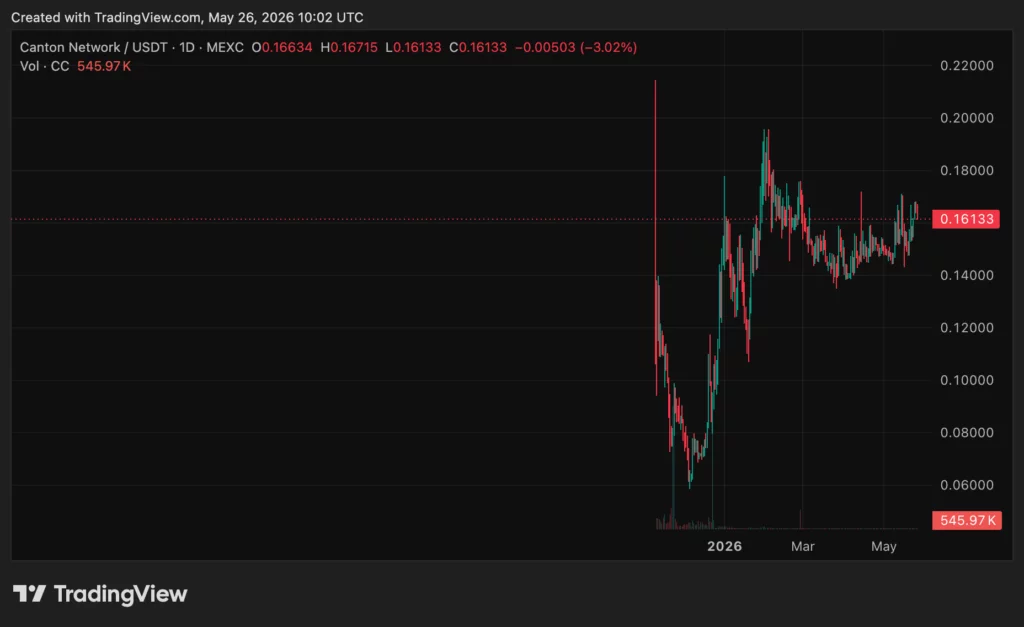
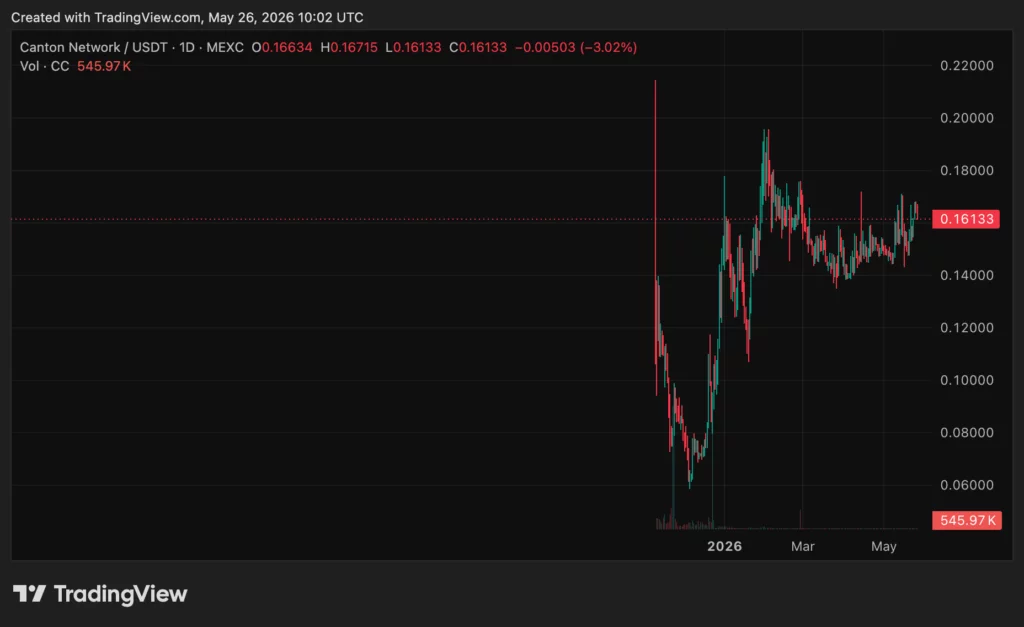
The same report said TCAN strengthened regulated access to Canton, while institutional demand helped CC break above $0.16 at the time. crypto.news data showed CC near $0.16 at press time, with a market cap of about $6.23 billion.
The BWCC launch now adds another regulated product for investors seeking exposure to blockchain infrastructure built for financial markets.
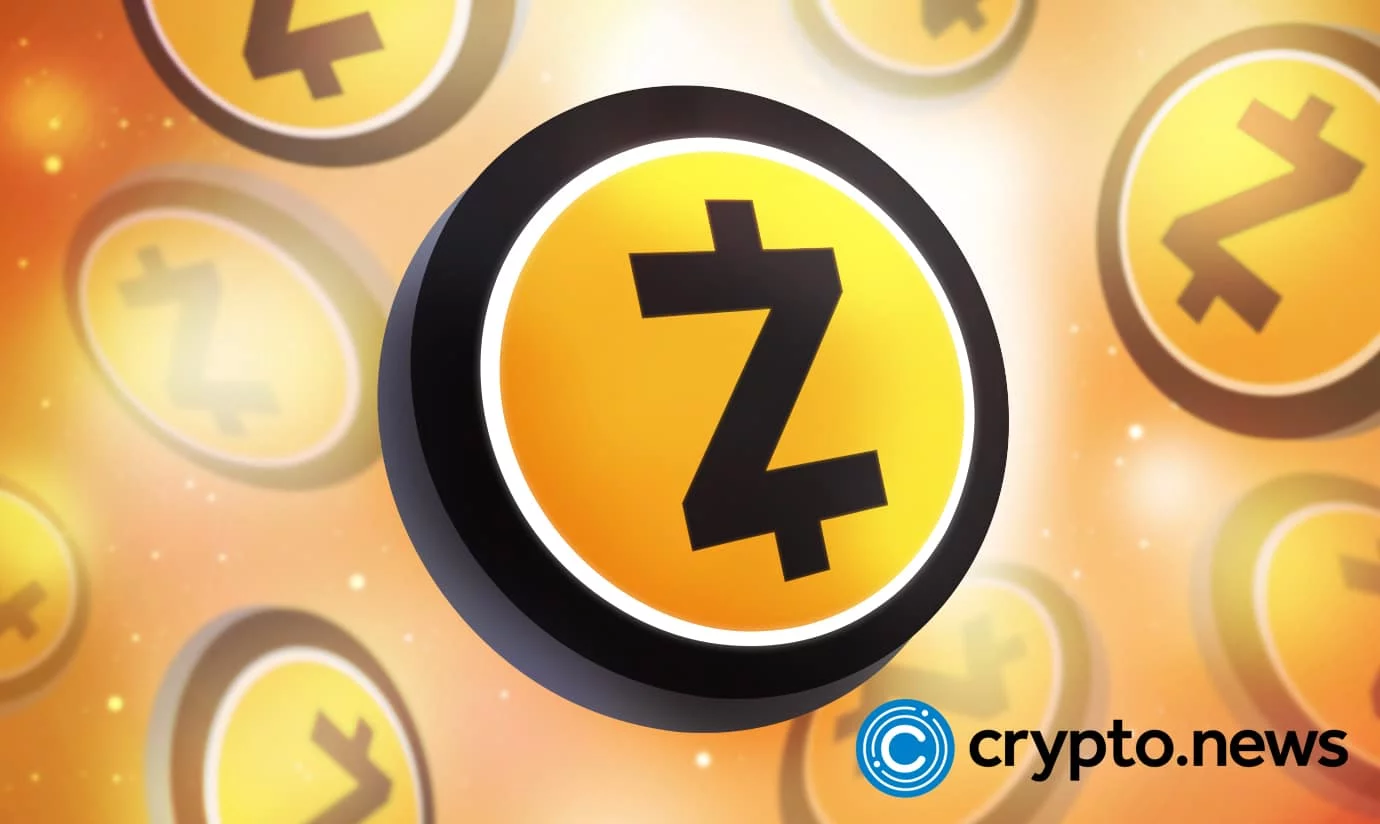
Zcash (ZEC) hit $642.18 on May 9, 2026, marking the peak of a 650-1,000% rally from 2024 lows that crowned it the largest privacy coin by market cap, overtaking Monero. The catalysts driving this performance are different in kind from previous Zcash cycles. Grayscale filed Form S-3 to convert its Zcash Trust into the first US spot privacy coin ETF (ticker ZCSH) on NYSE Arca on May 12, 2026. The SEC closed its nearly two-year investigation into the Zcash Foundation on January 15, 2026, without enforcement action, removing the regulatory overhang that suppressed institutional participation for years.
Summary
- Zcash’s May 2026 rally to $642 was tied to Grayscale’s ETF filing, SEC clearance, Multicoin Capital’s position, and shielded pool growth.
- The bull case sees ZEC reaching $800 to $1,800 by 2030 if ETF approval, institutional demand, and FCMP++ deployment align.
- The bear case puts ZEC at $180 to $350 by 2030 if ETF rejection, regulatory pressure, or privacy coin competition weighs on adoption.
Multicoin Capital disclosed a “significant position” in (ZEC) on May 5, accumulated quietly since February 2024. Approximately 30% of the ZEC supply is now locked in shielded pools, up from 8% in 2024. The November 2024 halving cut inflation from 4% to 2% annually. The FCMP++ upgrade, promising 300% throughput improvement, is targeted for 2026 deployment. The “Privacy is Normal” narrative has shifted institutional perception from privacy coins as evasion tools to privacy coins as essential infrastructure for compliant commercial confidentiality. ZEC is currently trading around $522 after cooling from the May peak.
The honest read is Zcash is one of the more interesting setups in crypto for 2026-2030: real structural catalysts (ETF filing, shielded pool growth, FCMP++ upgrade, SEC clearance), real institutional interest (Grayscale, Multicoin Capital, growing whale accumulation), real risks (ETF approval uncertainty, governance disputes, competitive pressure from Monero and Railgun). This piece walks through actual mechanics, the bull case ($800-$1,800 by 2030), the base case ($400-$700), and the bear case ($180-$350), with the specific variables determining outcome.
Why Zcash is at $522 right now
The current Zcash price reflects a narrative shift that competitors keep missing. Most price prediction articles treat ZEC as just another privacy coin with generic supply-and-demand dynamics. The actual story is more specific and analytically important.
The starting point: ZEC traded around $20 in early 2024, having declined steadily from 2021 highs as the broader crypto market shifted away from privacy coins amid regulatory pressure. Multiple major exchanges delisted privacy coins through 2023-2024 in response to MiCA’s pending deployment in the EU and broader regulatory caution. The Zcash narrative was widely considered structurally damaged.
The rally that produced the current $522 price (and the May peak of $642) wasn’t speculation. It was driven by five specific catalysts arriving in sequence:
The November 2024 halving cut block rewards in half, reducing ZEC inflation from approximately 4% annually to approximately 2%. This is a big deal for a 21-million-supply asset where shielded pool accumulation removes supply from liquid markets. The halving plus shielded growth created the supply dynamics for the subsequent rally.
The shielded pool grew from approximately 8% of total supply in 2024 to approximately 30% of total supply by mid-2026. This is approximately 4.5 million ZEC moved from transparent (liquid) to shielded (illiquid for trading purposes) pools. The shielded pool growth represents both ideological commitment to privacy use and supply reduction in liquid markets. Most analyses treat shielded pool growth as a usage metric. It’s also a supply absorption mechanism comparable in effect to corporate Bitcoin treasury accumulation.
The SEC closed its nearly two-year investigation into the Zcash Foundation on January 15, 2026 without recommending enforcement action. The foundation had received a subpoena in August 2023 related to crypto asset offerings inquiries. The investigation closure removed a regulatory overhang that had suppressed institutional participation for years.
The immediate market response was a 3+ percent rally with ZEC briefly exceeding $427. The longer-term impact was institutional investors gaining confidence that Zcash specifically would not face SEC enforcement.
Multicoin Capital’s position disclosure on May 5, 2026 was the catalyst that triggered the May rally to $642. Co-founder and Managing Partner Tushar Jain disclosed via X that the firm had built a “significant position” in ZEC, accumulated quietly since February 2024. Jain framed the thesis as “a return to the cypherpunk ideals crypto was founded on” and argued that growing government scrutiny of visible crypto holdings makes Bitcoin’s transparent balances increasingly problematic for sophisticated holders. The Multicoin disclosure gave institutional validation that compounded the broader privacy narrative.
Grayscale’s Form S-3 filing on May 12, 2026 to convert its Zcash Trust into a spot ETF (ticker ZCSH) on NYSE Arca represents the first US spot privacy coin ETF filing in history. The trust currently holds approximately 391,103 ZEC ($99.4 million as of March 31, 2026 quarter-end). If approved, the ETF would provide regulated institutional access to ZEC similar to how spot Bitcoin and Ethereum ETFs changed those assets’ accessibility. The filing alone validated the institutional thesis even before approval is decided.
The combined effect of these five catalysts arriving in sequence produced the rally from approximately $20 in early 2024 to the May 2026 peak of $642 (a 30x+ move). The post-peak consolidation to current $522 levels reflects normal post-rally profit-taking and futures market unwinding (futures open interest fell 30% from peak to approximately $1.05 billion) rather than a fundamental thesis breakdown.
What the rally is fundamentally signaling: the “Privacy is Normal” narrative has gained genuine institutional traction. The same regulatory environment that pressured privacy coins in 2023-2024 (MiCA deployment, SEC enforcement concerns) has evolved through 2025-2026 (SEC enforcement pullback under Atkins, CLARITY Act framework, institutional adoption of crypto generally). Privacy infrastructure that was institutionally radioactive 18 months ago is becoming institutionally palatable for specific use cases (corporate confidentiality, regulatory compliance with selective disclosure, protected commercial transactions).
The bull case: $800-$1,800 by 2030
The bull case for Zcash requires specific catalyst conditions and represents the scenario where the “Privacy is Normal” narrative achieves full institutional acceptance.
The ETF approval catalyst: Grayscale’s ZCSH ETF approval is the single most important bull case variable. The pathway: SEC review completes by Q3 2026, exchange listing approval secured, ETF begins trading with $500M-$2B in initial inflows over the first 12 months. The precedent from Bitcoin and Ethereum ETF launches suggests this level of institutional capital flowing into a smaller asset like ZEC could produce a significant price impact. With a circulating supply of approximately 16 million ZEC and 30% already in shielded pools (effectively illiquid), the liquid float available for ETF accumulation is constrained.
The shielded pool supply absorption: continued growth from 30% to 40-50% of total supply removes another 1.5-3 million ZEC from liquid markets over the bull scenario timeframe. Plus ETF accumulation, the supply reduction would be significant. The bull case assumes shielded pool growth accelerates as FCMP++ deployment improves throughput and reduces the costs of shielded transactions.
The FCMP++ deployment: the upgrade targeting 300% throughput improvement for shielded transactions, planned for 2026 deployment, would address one of Zcash’s persistent technical limitations. Reduced shielded transaction costs would enable broader use cases (institutional settlements, commercial transactions, DeFi integrations) currently constrained by performance. A successful FCMP++ deployment would unlock the institutional use cases the privacy narrative requires.
The privacy narrative expansion: the bull case assumes the broader “Privacy is Normal” narrative gains traction beyond just crypto-native investors. Specific developments that would support this: major corporations adopting privacy infrastructure for commercial transactions, traditional finance integrating privacy-preserving technologies, regulators developing frameworks distinguishing compliant privacy from illicit use, and growing public awareness of financial surveillance concerns driving demand for privacy options.
The competitive positioning: Zcash bull case assumes it holds its position as the institutionally-preferred privacy coin, while Monero and Railgun serve different (less institutional) use cases. The differentiation: Zcash offers selective disclosure (institutions can prove compliance while keeping commercial details private), Monero offers mandatory privacy (which institutional investors find harder to navigate), and Railgun offers DeFi-native privacy (which serves different use cases). Zcash’s institutional positioning would be reinforced by ETF approval and Grayscale’s institutional distribution.
The Midnight integration: the Midnight Cardano privacy companion chain (covered in the Midnight long read) creates additional institutional infrastructure leveraging privacy primitives. While Midnight is technically separate from Zcash, the broader privacy ecosystem maturation benefits all institutional privacy infrastructure, including Zcash. Successful Midnight deployment with major partners (Google Cloud, MoneyGram) validates the broader privacy infrastructure investment thesis.
If all bull case conditions materialize, the price targets are:
2026 year-end: $700-1,000
2027 year-end: $850-1,300
2028 year-end: $1,000-1,500
2029 year-end: $1,200-1,700
2030 year-end: $800-1,800
The wide range at 2030 reflects uncertainty about how aggressively institutional adoption scales and whether broader market dynamics support sustained altcoin appreciation. The lower end of the bull range ($800) represents successful ETF launch with moderate institutional adoption. The upper end ($1,800) requires the privacy narrative achieving mainstream institutional acceptance comparable to how Bitcoin achieved mainstream institutional acceptance over 2024-2025.
The base case: $400-$700 by 2030
The base case assumes mixed outcomes across the catalyst variables, with Zcash maintaining institutional relevance but not achieving big adoption.
The ETF approval scenario: in the base case, Grayscale’s ZCSH ETF is eventually approved but the approval is delayed beyond initial Q3 2026 expectations. The SEC review process extends into 2027 or 2028. When approved, initial inflows are more modest ($200-500M rather than the bull case $500M-2B). The institutional adoption pathway opens but the impact is gradual rather than big.
The shielded pool growth scenario: continued moderate growth from 30% to 35-40% of total supply. The growth provides ongoing supply absorption but not the dramatic supply shock the bull case envisions. The shielded pool serves both privacy users and structural HODLers without achieving the broader commercial adoption the bull case requires.
The FCMP++ deployment outcome: the upgrade deploys successfully but the throughput improvement is more modest than projected, or deployment is delayed. The technical capability improvement happens but doesn’t unlock the dramatic institutional use case expansion the bull case requires.
The competitive landscape: Zcash holds its position as the largest institutional-grade privacy coin but faces growing competition from Monero (for non-institutional privacy users), Railgun (for DeFi-native privacy), and emerging privacy infrastructure (Midnight, Aztec, others). The competitive pressure limits Zcash’s pricing power without fundamentally undermining its position.
The regulatory environment: the broader crypto regulatory environment continues evolving under CLARITY Act deployment, but specific regulatory clarity for privacy coins stays ambiguous. Exchange delistings continue in some jurisdictions while listings expand in others. The mixed regulatory picture limits institutional adoption acceleration without forcing a Zcash-specific crackdown.
The “Privacy is Normal” narrative: the narrative continues developing but doesn’t achieve the mainstream institutional acceptance the bull case requires. Specific use cases (compliant corporate confidentiality, regulatory selective disclosure) gain traction in niche applications without becoming default institutional infrastructure. The narrative supports continued ZEC relevance without driving big growth.
Base case targets:
2026 year-end: $500-700
2027 year-end: $450-650
2028 year-end: $400-600
2029 year-end: $400-650
2030 year-end: $400-700
The base case represents moderate price appreciation from current levels plus periodic volatility around specific catalyst developments. The structural floor is meaningfully higher than pre-2026 levels because the SEC investigation closure and institutional accumulation have shifted the asset’s investor base toward longer-term holders.
The bear case: $180-$350 by 2030
The bear case requires either specific Zcash setbacks or broader privacy coin headwinds disrupting the thesis.
The ETF rejection scenario: the SEC rejects Grayscale’s ZCSH application, citing concerns about privacy coin oversight, market manipulation potential, or insufficient surveillance-sharing agreements. The rejection would close the institutional pathway that the bull case requires. Without ETF access, institutional accumulation would be limited to direct purchases through more cumbersome processes, reducing the capital pool available for ZEC investment.
The regulatory crackdown scenario: privacy coins broadly face renewed regulatory pressure as governments respond to growing crypto adoption. Specific risks: CLARITY Act deployment includes explicit privacy coin restrictions, EU MiCA enforcement targeting Zcash beyond current scope, US regulatory action restricting exchange listings, or major jurisdictions deploying privacy coin bans. Any of these would directly impact ZEC accessibility and adoption.
The exchange delisting cascade: in 2023-2024, multiple major exchanges delisted privacy coins amid regulatory uncertainty. A renewed cascade triggered by new regulatory pressure or specific privacy coin incidents could reduce ZEC trading liquidity and accessibility. The bear case assumes this dynamic returns and intensifies, with exchanges including some currently listing ZEC choosing to delist.
The competitive disruption: Monero, Railgun, or emerging privacy infrastructure captures the use cases Zcash currently serves. Monero retains hardcore privacy users who view selective disclosure as a compromise. Railgun captures DeFi-native privacy demand. New entrants (potentially Midnight, Aztec, others) capture institutional use cases through different technical approaches. Zcash’s positioning between institutional and crypto-native privacy could fail to capture either segment effectively.
The shielded pool stagnation: shielded pool growth slows or reverses as users find shielded transaction costs prohibitive or move to alternative privacy infrastructure. Without continued shielded pool expansion, the supply absorption mechanism weakens. ZEC becomes more liquid in markets, removing one of the key supply-side supports for current price levels.
The FCMP++ failure: the upgrade encounters technical problems, is significantly delayed, or fails to deliver projected throughput improvements. The technical limitations that have constrained Zcash’s broader adoption would persist, limiting institutional use case expansion.
The governance and foundation issues: Zcash has faced periodic governance disputes between the foundation and broader community. A major governance crisis or foundation funding shortfall could disrupt development momentum and institutional confidence. The Q1 2026 operating expenses of approximately $817K and treasury of $36.7M provide near-term stability but represent ongoing burn rates requiring sustainable funding mechanisms.
Bear case targets:
2026 year-end: $250-400
2027 year-end: $200-350
2028 year-end: $180-320
2029 year-end: $180-340
2030 year-end: $180-350
The bear case represents significant downside from current levels but assumes ZEC retains some institutional and crypto-native investor base. Complete failure scenarios (price below $100) would require more severe disruption than even the bear case envisions.
The five variables that determine outcome
Five specific variables determine which scenario materializes. Readers can monitor these directly rather than relying on price action alone.
Variable 1: Grayscale ZCSH ETF approval status.
The single most important variable. Approval timeline expectations: Q3 2026 (bull case), late 2026-2027 (base case), 2028+ or rejection (bear case).
Monitor: SEC docket updates for ZCSH filing, Grayscale public statements on approval expectations, related crypto ETF approval patterns (Solana ETF dynamics provide useful precedent), and CFTC-SEC coordination on privacy coin oversight.
Variable 2: Shielded pool supply percentage.
Currently 30% of total ZEC supply. Bull case requires growth to 40-50%. Base case assumes 35-40%. Bear case assumes stagnation or decline.
Monitor: Zcash shielded pool dashboard, FCMP++ deployment status (which would reduce shielded transaction costs and likely accelerate growth), and institutional accumulation patterns (institutions may shield holdings for both privacy and supply absorption purposes).
Variable 3: FCMP++ deployment timeline and success.
Targeted for 2026 deployment, promising 300% throughput improvement. Successful deployment unlocks institutional use cases requiring better performance.
Monitor: Zcash development updates, testnet performance data, deployment timeline announcements, and post-deployment shielded transaction volume metrics.
Variable 4: Privacy coin regulatory environment.
The broader regulatory framework for privacy coins continues evolving.
Specific developments to monitor: CLARITY Act deployment details affecting privacy coins, MiCA enforcement actions in EU, US Treasury or SEC privacy coin guidance, exchange listing/delisting patterns, and major jurisdictional decisions (UK, Singapore, Japan privacy coin policies).
Variable 5: Competitive positioning vs Monero, Railgun, and emerging privacy infrastructure.
ZEC’s bull case assumes it captures institutional use cases, while Monero serves hardcore privacy users and Railgun serves DeFi-native applications.
Monitor: Monero adoption metrics, Railgun TVL and transaction volume, emerging privacy projects (Midnight, Aztec) development progress, and institutional preference signals (which privacy infrastructure major institutions choose for specific use cases).
The five variables interact in important ways. ETF approval would likely accelerate shielded pool growth as institutions accumulate. FCMP++ deployment success would strengthen competitive positioning vs Monero. Regulatory clarity favoring compliant privacy would benefit ZEC specifically. Successful competitive positioning would justify higher institutional valuations. Readers monitoring all five variables get a more complete picture than focusing on price action alone.
What this means for Zcash holders and traders
For current ZEC holders, the practical implication is the thesis has shifted from speculative to fundamentally supported. The May 2026 rally to $642 wasn’t driven primarily by speculation. It was driven by specific institutional catalysts (Grayscale filing, Multicoin Capital position, and SEC investigation closure). The current $522 level reflects post-rally consolidation rather than thesis breakdown. The five variables framework provides a way to evaluate whether holding makes sense based on which scenario is materializing.
For potential ZEC buyers, the practical implication is current entry levels are significantly higher than pre-2026 levels, but the institutional thesis is more developed than at any previous point. The risk-reward calculation depends on the assessment of whether ETF approval and continued institutional adoption will materialize. The five variables provide objective signals to monitor rather than relying on price-based timing decisions.
For traders specifically, the practical implication is ZEC’s volatility profile combines structural support (institutional accumulation, shielded pool growth) with catalyst-driven moves (ETF approval news, regulatory developments, competitor dynamics). The support provides a downside cushion that purely speculative privacy coins lack. The catalyst-driven moves create asymmetric upside opportunities around specific events.
For institutional investors evaluating privacy coin allocation, the practical implication is that ZEC offers a more conventional risk-reward profile than alternative privacy coins. Selective disclosure capability addresses regulatory compliance concerns that mandatory privacy (Monero) makes difficult to navigate. Institutional infrastructure (Grayscale Trust, eventual ETF) provides accessibility that DeFi-native privacy (Railgun) lacks. The institutional positioning is the structural differentiation.
For the broader privacy coin ecosystem, the practical implication is that Zcash’s success or failure influences institutional perception of privacy infrastructure generally. ETF approval would validate institutional privacy investment broadly. ETF rejection would reinforce institutional caution. The outcome affects not just ZEC price but also Monero, Railgun, Midnight, and other privacy infrastructure development trajectories.
Connection to broader market dynamics
Zcash’s price story connects to several broader narratives we have previous covered on crypto.news.
The institutional-driven crypto dynamics explain why ZEC has performed strongly during a period of broad retail capitulation. Multicoin Capital’s institutional accumulation, Grayscale’s ETF filing, and the SEC investigation closure are all institutional dynamics that drive price action independently of retail attention.
The CLARITY Act framework provides regulatory clarity that distinguishes compliant privacy infrastructure from illicit use. Zcash’s selective disclosure capability fits this framework better than mandatory privacy alternatives. The framework’s deployment timeline (2027-2028 compliance deadlines) creates ongoing regulatory development that benefits ZEC’s positioning.
The Midnight Cardano privacy companion chain represents a broader institutional infrastructure for privacy primitives. While technically separate, Midnight’s success with Google Cloud and MoneyGram partnerships validates the institutional thesis for privacy infrastructure generally, which benefits ZEC by extension.
The Zcash shielded pool growth is one of the structural variables on which this prediction depends. The continued shielded pool expansion is both a usage metric and a supply absorption mechanism that supports ZEC price levels.
The Grayscale Zcash ETF dynamics represent the institutional pathway that determines whether the bull case materializes. The ETF approval pathway, fee structures, distribution mechanisms, and competitive dynamics all affect ZEC’s institutional adoption trajectory.
The honest bottom line
Zcash spent five years as a structurally damaged privacy coin. Then four things happened in twelve months: the SEC closed its Foundation probe with no enforcement, Multicoin Capital disclosed a quiet 15-month accumulation, Grayscale filed the first US privacy-coin ETF, and the shielded pool quietly grew from 8% to 30% of supply. The May rally to $642 wasn’t speculation. It was the market pricing in a thesis that no longer requires hand-waving.
The catalysts that drove the May 2026 rally are real: Grayscale’s ZCSH ETF filing, Multicoin Capital’s accumulated position disclosure, the SEC investigation closure, shielded pool growth to 30% of supply, the November 2024 halving’s inflation reduction, and the broader “Privacy is Normal” institutional narrative shift.
The main risks are real and material: ETF approval uncertainty, broader privacy coin regulatory pressure, exchange delisting risks, competitive pressure from Monero and Railgun, governance and foundation funding sustainability, and FCMP++ deployment execution risk.
The 2030 price range across scenarios is wide: $180-1,800, depending on how the structural variables resolve. The base case ($400-700) represents the most probable outcome assuming mixed catalyst outcomes. The bull case ($800-1,800) requires sustained institutional adoption plus ETF approval. The bear case ($180-350) assumes adverse regulatory or competitive developments.
ZEC holders own a different asset than they owned 18 months ago, and that’s the part that matters. Pre-2026 ZEC was a speculative privacy coin with limited institutional access. Post-Grayscale filing ZEC is an institutional privacy coin candidate with a clear regulatory pathway. The shift is significant even if specific outcomes (ETF approval, adoption magnitude) remain uncertain.
The ETF approval question is the most important catalyst variable. Approval would likely produce significant price appreciation through institutional capital flows colliding with constrained liquid supply (70% of ZEC is not in shielded pools, but a substantial portion of that is held by long-term holders rather than actively traded). Rejection would limit but not remove the institutional thesis.
The competitive positioning vs Monero and Railgun is the most important strategic variable. Zcash’s selective disclosure capability is fundamentally differentiated for institutional use cases. The competitive dynamics determine whether ZEC captures the institutional privacy market or whether different infrastructure (potentially Midnight, potentially Aztec, potentially others) becomes the institutional standard.
The shielded pool growth is the most important supply variable. Continued growth removes ZEC from liquid markets, supporting price levels. The pool’s growth from 8% to 30% over 2024-2026 represents supply absorption. Future growth depends on FCMP++ deployment, improving transaction economics.
For 2026 specifically, expect ZEC to continue trading in elevated ranges relative to historical levels, with significant volatility around ETF approval news, regulatory developments, and broader privacy coin dynamics. The $400-700 range represents the support given current institutional positioning. The upside ($700-1,000) depends on ETF approval timing. The downside ($300-450) depends on adverse regulatory or competitive developments.
For 2027-2030, the structural variables compound. Sustained execution across ETF launch, shielded pool growth, FCMP++ deployment, and competitive positioning produces the bull case trajectory. Deterioration across these variables produces the bear case. The base case assumes mixed outcomes producing moderate price appreciation.
The Zcash story is ultimately about whether privacy infrastructure can be institutionally palatable in 2026 and beyond. The early evidence is strongly positive. The structural catalysts are real. The institutional capital is positioning. The remaining variables are largely external (regulatory developments, competitive dynamics) and partially within Zcash’s control (development execution, governance stability, ecosystem development).
The “Privacy is Normal” narrative is being tested in real-time. Zcash is the asset whose price action provides the clearest signal of whether the narrative succeeds. The next 18-24 months will likely determine whether privacy infrastructure achieves institutional acceptance or remains a specialized crypto-native use case.
Frequently asked questions
- What is driving Zcash’s 2026 rally?
Five specific catalysts: the SEC closing its investigation of the Zcash Foundation on January 15, 2026 without enforcement action; Grayscale filing Form S-3 on May 12, 2026 for the first US spot privacy coin ETF (ZCSH); Multicoin Capital’s May 5 disclosure of a “significant position” accumulated since February 2024; shielded pool growth to 30% of total supply; and the November 2024 halving cutting inflation from 4 to 2%.
- Will Grayscale’s Zcash ETF actually get approved?
The approval is uncertain but the filing itself is a big deal. Form S-3 filings for crypto ETFs have a track record of approval over time (Bitcoin and Ethereum ETFs followed similar pathways). The SEC’s January 2026 closure of the Zcash Foundation investigation suggests reduced regulatory friction. Potential approval timeline: Q3 2026 (bull case) to 2028+ (bear case). Approval would likely produce $500M-$2B in initial institutional inflows.
- Can Zcash reach $1,000 by 2030?
$1,000 is within the bull case range ($800-$1,800 by 2030). Required conditions: ETF approval with substantial institutional adoption, FCMP++ successful deployment, shielded pool growth to 40-50% of supply, sustained “Privacy is Normal” narrative driving institutional acceptance, and Zcash keeping position as the largest institutional-grade privacy coin. The base case for 2030 is $400-$700.
- What is the FCMP++ upgrade and why does it matter?
FCMP++ is a planned Zcash upgrade targeting 300% throughput improvement for shielded transactions. The upgrade matters because shielded transaction performance has been a persistent limitation that has constrained Zcash’s broader institutional adoption. Successful deployment would reduce shielded transaction costs and enable broader use cases (institutional settlements, commercial transactions, DeFi integrations). Deployment is targeted for 2026.
- How does Zcash compare to Monero in 2026?
Zcash has overtaken Monero as the largest privacy coin by market cap, having risen 650-1,000% from 2024 lows. The differentiation: Zcash offers selective disclosure (institutions can prove compliance while keeping commercial details private), Monero offers mandatory privacy (which institutional investors find harder to navigate). Zcash is positioned for institutional adoption (ETF filing, Grayscale Trust), Monero stays positioned for crypto-native privacy users. Different use cases, different investor bases.
- What are the main risks to the Zcash thesis?
Five primary risks: (1) Grayscale ZCSH ETF rejection or extended delay, (2) broader privacy coin regulatory crackdown under CLARITY Act or MiCA, (3) exchange delisting cascade similar to 2023-2024, (4) competitive disruption from Monero, Railgun, or emerging privacy infrastructure (Midnight, Aztec), (5) FCMP++ deployment failure or significant delay, (6) Zcash governance or foundation funding sustainability issues.
- Should I buy Zcash now or wait for a pullback?
This piece does not provide investment advice. The structural analysis suggests ZEC’s current price reflects substantial institutional thesis development, but the asset carries specific risks that buyers should evaluate against their risk tolerance. The five variables framework provides objective signals to monitor. Current $522 level reflects post-rally consolidation from $642 May peak rather than thesis breakdown. ETF approval timing is the most important near-term catalyst variable.
- How does the CLARITY Act affect Zcash?
The CLARITY Act framework distinguishes compliant privacy infrastructure from illicit use, which structurally favors Zcash’s selective disclosure capability over mandatory privacy alternatives. The Act’s deployment through 2027-2028 will determine specific regulatory clarity for privacy coins. Zcash’s positioning between institutional adoption and crypto-native privacy use makes CLARITY deployment generally favorable, though specific provisions targeting privacy coins could create either bullish or bearish dynamics depending on how the framework develops.
This article is for informational purposes and does not constitute financial or investment advice. Cryptocurrency markets are highly volatile, and price predictions are inherently speculative. The figures and analysis described reflect data available as of late May 2026. Always do your own research and consult with qualified financial professionals before making investment decisions.


XRP Ledger, the Layer 1 blockchain that uses the XRP token to facilitate multi-currency transactions, is slated to implement a major maintenance and bug-fixing upgrade Wednesday.
If you run a node, a computer that helps verify transactions on the network, you need update to the latest version by the deadline, or face disconnection from the network entirely. For regular users who just hold XRP in a wallet or on an exchange, you don’t need to do anything.
The upgrade, called the fixCleanup3_1_3 amendment, patches the following key bugs and inefficiencies that have built up over time. Here’s what each one does.
Removing expired NFT offers automatically
On the XRP Ledger, people create and trade non-fungible tokens, or digital collectible and gaming items. When a user lists an NFT for sale, it creates an “offer” on the network.
As of now, if an offer expires or just sits there without anyone accepting it, it stays on the ledger forever, taking up storage space. The impending fix will automatically delete such expired offers. Think of it like a classified ad in a newspaper: once the listing expires, the system tears it up instead of letting it pile up in the archives.
Protecting restricted settings from accidental changes
The XRP Ledger offers “Permissioned Domains,” or controlled environments where only approved accounts can access specific assets, order books, or services and change their special settings.
But, there was a bug where even if a transaction failed, it could still accidentally change these restricted settings.
Enforcing limits on vault withdrawals
The XRP Ledger has “Vaults,” which are secure storage containers for tokens. When you withdraw tokens from a vault to send them to another account, the receiving account has a limit on how many tokens it can accept, called a “trust line limit.” Imagine a bank account that can only hold up to $10,000.
The bug: the system wasn’t checking this limit when processing vault withdrawals. So you could potentially send more tokens than the receiving account could hold. The fix ensures the system now respects these limits, preventing overdrafts.
Fixing loan accounting that wasn’t updating
Like Ethereum or other smart contract blockchains, the XRP Ledger supports decentralized lending, where people can borrow and lend cryptocurrency without a bank.
When a loan gets defaulted or impaired, the system is supposed to update all the related records: the loan itself, the lender’s records, and the vault holding collateral. The process, however, has been buggy sometimes with records not updating correctly and hence, balances got stale.
The impending fix ensures that when a loan’s status changes, all the connected ledger entries update properly. It’s like making sure that when you pay off part of your credit card, both your statement and the bank’s internal records reflect that immediately.
Loan overpayment and safety check for LoanBrokers
If someone tries to overpay a loan that doesn’t allow overpayments, the system now returns a clear “no permission” error (tecNO_PERMISSION) instead of a generic invalid flag. This makes the rejection cleaner and easier for apps and users to understand.
Further, it adds a safety check for LoanBrokers, special entities that handle lending pools, to ensure the “CoverAvailable” amount they advertise exactly matches the actual assets sitting in their protected pseudo-account. This strengthens accounting accuracy and prevents any mismatch that could create confusion or risk in the lending system. CoverAvailable is the first-loss capital deposited to protect lenders if borrowers default.
Slated for activation Wednesday
These measures will be activated on the ledger Wednesday.
Validators and node operators need to upgrade their servers before activation or they’ll get amendment-blocked and fall out of sync. A large portion of the network has reportedlty already updated.
XRP continues to trade between $1.30 and $1.40 for the fourth straight day, according to CoinDesk data.
Crypto World
Snowflake (SNOW) Earnings Preview: What Investors Need to Know Before Wednesday’s Report

Quick Overview
- Q1 FY27 earnings arrive Wednesday, May 27, following the closing bell.
- Analyst consensus projects earnings per share of $0.32 (33.3% year-over-year jump) and revenues near $1.32 billion, reflecting approximately 27% growth.
- Shares have climbed 19.3% in the last month but remain down roughly 22% for 2025, trading at $172.02.
- The options market anticipates approximately 13.52% volatility in either direction post-results.
- Analyst community maintains a Strong Buy rating with a mean target of $224.32, suggesting around 30% potential appreciation.
The cloud data warehouse provider approaches Wednesday’s financial disclosure trading at $172.02 — notably beneath Wall Street’s consensus valuation of $224.32.
The enterprise data management specialist will unveil its fiscal first quarter 2027 performance after trading concludes on May 27. The Street anticipates revenues around $1.32 billion, translating to roughly 27% annual expansion.
This projection edges out the 25.7% revenue acceleration Snowflake delivered during the comparable period twelve months earlier.
Per-share earnings are forecast at $0.32, representing a 33.3% improvement versus the prior-year quarter.
During the previous reporting period, the company exceeded expectations with $1.28 billion in revenue, marking 30.1% yearly growth. Snowflake also surpassed projections for billings and EBITDA while onboarding 45 additional enterprise clients spending above $1 million per year. This premium customer segment now totals 733.
Despite recent operational strength, the stock has declined approximately 22% since January. Investor concerns center on margin compression from substantial AI infrastructure spending and uncertainty about how autonomous AI agents might disrupt conventional enterprise software models.
Recent weeks have witnessed a recovery, however, with shares advancing 19.3% over the trailing 30-day period.
Wall Street Analyst Perspectives
TD Cowen analyst Derrick Wood maintained his Buy recommendation alongside a $255 valuation target. His channel checks with ecosystem partners indicate robust quarterly performance, fueled by core data warehouse workloads, competitive customer wins, and accelerating artificial intelligence implementation.
Wood is particularly focused on developments surrounding Cortex Code (CoCo), the company’s AI coding agent, and anticipates more significant upside surprises compared to recent quarters.
Benchmark’s Yi Fu Lee elevated his target to $200 from $190 while retaining a Buy stance. Lee projects Snowflake will “highly likely to comfortably” exceed consensus forecasts for product revenue and operational profitability.
Lee anticipates sustained growth momentum from Snowflake Intelligence, Cortex Code, and Observe — three offerings he identifies as catalyzing AI integration across more than 9,000 customer accounts.
Derivatives Markets Point to Substantial Volatility
Options pricing suggests approximately 13.52% movement potential in either direction following the announcement. This exceeds SNOW’s four-quarter average post-earnings swing of 11.85%.
The analyst community maintains a decidedly optimistic stance. The aggregate rating stands at Strong Buy, comprising 28 Buy recommendations and two Hold ratings. The average target price of $224.32 indicates roughly 30% upside from present trading levels.
Comparable companies in the data infrastructure sector provide encouraging context. DigitalOcean delivered 22.4% revenue expansion last quarter while exceeding forecasts by 3.3%. Commvault posted 13.3% growth and beat estimates by 1.6%.
Market sentiment across the category has been constructive, with peer group equities appreciating approximately 10% on average during the past month.


What is Vinnie Jones’ net worth?

Crypto ETP Outflows Hit $1.47B as Bitcoin Leads Losses

Jacob Elordi Addresses Euphoria Season 3’s Shocking Nate Twist


-

 Crypto World5 days ago
Blockchain.com files with SEC for U.S. IPO
-

 Fashion4 days ago
Holiday Weekend Open Thread – Corporette.com
-

 Business4 days ago
Dell Technologies DELL Stock Surges 15% on AI Server Momentum and Analyst Upgrades in 2026
-
 Crypto World4 days ago
Bitcoin Accumulation Weakens as BTC Realized Losses Hit $600M
-

 Crypto World4 days ago
Space X IPO Is ‘Bad News’ for Tech Stocks: But What About Bitcoin?
-

 Politics4 days ago
Makerfield: a tale of two social-media histories
-

 Crypto World3 days ago
Robinhood crypto COO Tanya Denisova exits
-

 Business2 days ago
NYT Strands Answers May 24 2026 Revealed for Puzzle No. 812 Theme Summer Essentials
-
 Crypto World4 days ago
MicroStrategy’s Saylor Says Miners No Longer Set Bitcoin Price, Another Force Has Taken Over
-

 Crypto World4 days ago
AI infrastructure race heats up as IREN pitches full-stack strategy, WhiteFiber lands $160M deal
-
 Tech4 days ago
A 0.12% parameter add-on gives AI agents the working memory RAG can’t
-

 Tech4 days ago
WhatsApp ads could make Irish debut after discussions with DPC
-

 Tech4 days ago
You Can Now Add ChatGPT To PowerPoint
-

 Business4 days ago
Trump Invests $1M-$5M in Kura Sushi USA Chain With 27 California Locations
-
 NewsBeat5 days ago
Charity run by Reform leader Malcolm Offord accused of ‘law breaking’ over Scottish registration
-

 Sports4 days ago
2026 CJ Cup Byron Nelson leaderboard: Brooks Koepka finds putting stroke in Round 1
-

 Crypto World6 days ago
Exa Labs raises $250 million in funding led by a16z
-
Business4 days ago
Goldman Sachs reinstates Ageas stock coverage with neutral rating
-

 Crypto World4 days ago
Trump Media’s Bitcoin Stash Shrinks Again as 2,650 BTC Lands on Crypto.com
-
 Crypto World4 days ago
Verus Bridge Hacker Returns $8.5M ETH, Keeps $2.8M as Bounty
You must be logged in to post a comment Login