Connect with us
DAPA Banner

Business

7 stocks where DIIs are trimming their stakes in March quarter – stocks

Published

on

7 stocks where DIIs are trimming their stakes in March quarter - stocks
IRFC Share Price 101.72 -39.3% 03:59 PM | 15 Apr 2026 2.8(2.84%) Upside Suzlon Energy Share Price 49.13 37.4% 04:00 PM | 15 Apr 2026 3.28(7.14%) Upside IREDA Share Price 126.45 45.9% 03:59 PM | 15 Apr 2026 3.11(2.52%) Upside Tata Motors PV Share Price 357.9 10.9% 03:59 PM | 15 Apr 2026 12.4(3.59%) Upside YES Bank Share Price 19.36 3.7% 03:59 PM | 15 Apr 2026 0.49(2.55%) Upside HDFC Bank Share Price 809.9 41.6% 03:59 PM | 15 Apr 2026 15.2(1.92%) Upside NHPC Share Price 80.58 11.7% 03:59 PM | 15 Apr 2026 2.93(3.76%) Upside RVNL Share Price 287.06 -4.9% 03:59 PM | 15 Apr 2026 15.27(5.62%) Upside SBI Share Price 1071.5 13.0% 03:59 PM | 15 Apr 2026 7.96(0.75%) Upside Tata Power Share Price 421.85 0.8% 03:59 PM | 15 Apr 2026 12.31(3.01%) Upside Tata Steel Share Price 208.72 2.8% 03:59 PM | 15 Apr 2026 2.34(1.13%) Upside Adani Power Share Price 183.43 -4.4% 03:59 PM | 15 Apr 2026 2.09(1.15%) Upside PayTM Share Price 1140.1 24.2% 03:59 PM | 15 Apr 2026 33.4(3.02%) Upside PNB Share Price 113.08 15.6% 03:59 PM | 15 Apr 2026 2.35(2.13%) Upside Eternal Share Price 246.67 54.0% 03:59 PM | 15 Apr 2026 10.45(4.43%) Upside BEL Share Price 447.65 10.7% 03:59 PM | 15 Apr 2026 6.1(1.39%) Upside BHEL Share Price 292.5 -11.7% 03:58 PM | 15 Apr 2026 4.74(1.65%) Upside Infosys Share Price 1305.3 29.3% 03:59 PM | 15 Apr 2026 28.5(2.24%) Upside IRCTC Share Price 553.55 44.5% 03:59 PM | 15 Apr 2026 15.65(2.91%) Upside ITC Share Price 302.05 21.1% 03:59 PM | 15 Apr 2026 3.41(1.14%) Upside Jio Financial Services Share Price 242.66 31.5% 03:59 PM | 15 Apr 2026 4.98(2.1%) Upside LIC Share Price 842.15 35.9% 03:59 PM | 15 Apr 2026 38.5(4.8%) Upside RIL Share Price 1344.1 30.8% 03:59 PM | 15 Apr 2026 29.0(2.21%) Upside HAL Share Price 4239.2 23.7% 03:59 PM | 15 Apr 2026 139.31(3.4%) Upside JP Power Share Price 18.85 null% 03:59 PM | 15 Apr 2026 1.68(9.73%) Upside NBCC Share Price 91.0 55.7% 03:59 PM | 15 Apr 2026 2.35(2.66%) Upside TCS Share Price 2554.9 19.2% 03:59 PM | 15 Apr 2026 82.31(3.33%) Upside Vedanta Share Price 766.05 13.5% 03:59 PM | 15 Apr 2026 13.5(1.8%) Upside Wipro Share Price 209.75 16.9% 03:59 PM | 15 Apr 2026 6.79(3.35%) Upside Indian Oil Corp. Share Price 145.22 26.7% 03:59 PM | 15 Apr 2026 4.14(2.94%) Upside Ircon Intl. Share Price 141.37 10.0% 03:58 PM | 15 Apr 2026 6.21(4.59%) Upside SAIL Share Price 166.95 -15.4% 03:59 PM | 15 Apr 2026 -0.94(-0.56%) Upside SJVN Share Price 75.26 29.0% 03:59 PM | 15 Apr 2026 2.78(3.83%) Upside GAIL Share Price 156.12 24.9% 03:59 PM | 15 Apr 2026 2.41(1.57%) Upside HUDCO Share Price 189.28 45.8% 03:59 PM | 15 Apr 2026 1.32(0.7%) Upside REC Share Price 352.65 35.1% 03:59 PM | 15 Apr 2026 5.65(1.63%) Upside Reliance Power Share Price 28.94 null% 03:59 PM | 15 Apr 2026 2.84(10.84%) Upside Tata Technologies Share Price 575.7 4.7% 03:59 PM | 15 Apr 2026 15.36(2.74%) Upside Vodafone Idea Share Price 9.44 5.7% 03:59 PM | 15 Apr 2026 0.19(2.06%) Upside Adani Ent. Share Price 2144.4 26.4% 03:59 PM | 15 Apr 2026 15.41(0.73%) Upside Adani Green Share Price 1096.05 9.5% 03:58 PM | 15 Apr 2026 10.6(0.98%) Upside Adani Ports SEZ Share Price 1511.8 24.7% 03:59 PM | 15 Apr 2026 46.5(3.18%) Upside Ashok Leyland Share Price 175.48 13.0% 03:59 PM | 15 Apr 2026 3.42(1.99%) Upside Bank of Baroda Share Price 279.07 18.3% 03:59 PM | 15 Apr 2026 3.35(1.22%) Upside BSE Share Price 3390.7 2.8% 03:59 PM | 15 Apr 2026 87.1(2.64%) Upside Canara Bank Share Price 141.71 14.3% 03:59 PM | 15 Apr 2026 2.94(2.12%) Upside CDSL Share Price 1339.8 9.5% 03:59 PM | 15 Apr 2026 49.21(3.82%) Upside Coal India Ltd Share Price 435.8 1.0% 03:59 PM | 15 Apr 2026 0.7(0.17%) Upside HFCL Share Price 88.12 null% 03:59 PM | 15 Apr 2026 2.13(2.47%) Upside IDFC First Bank Share Price 66.91 28.3% 03:59 PM | 15 Apr 2026 2.05(3.17%) Upside Load more..
Continue Reading
Click to comment

You must be logged in to post a comment Login

Leave a Reply

Business

Ford EV leader leaving automaker amid new restructuring efforts

Published

on

Ford EV leader leaving automaker amid new restructuring efforts

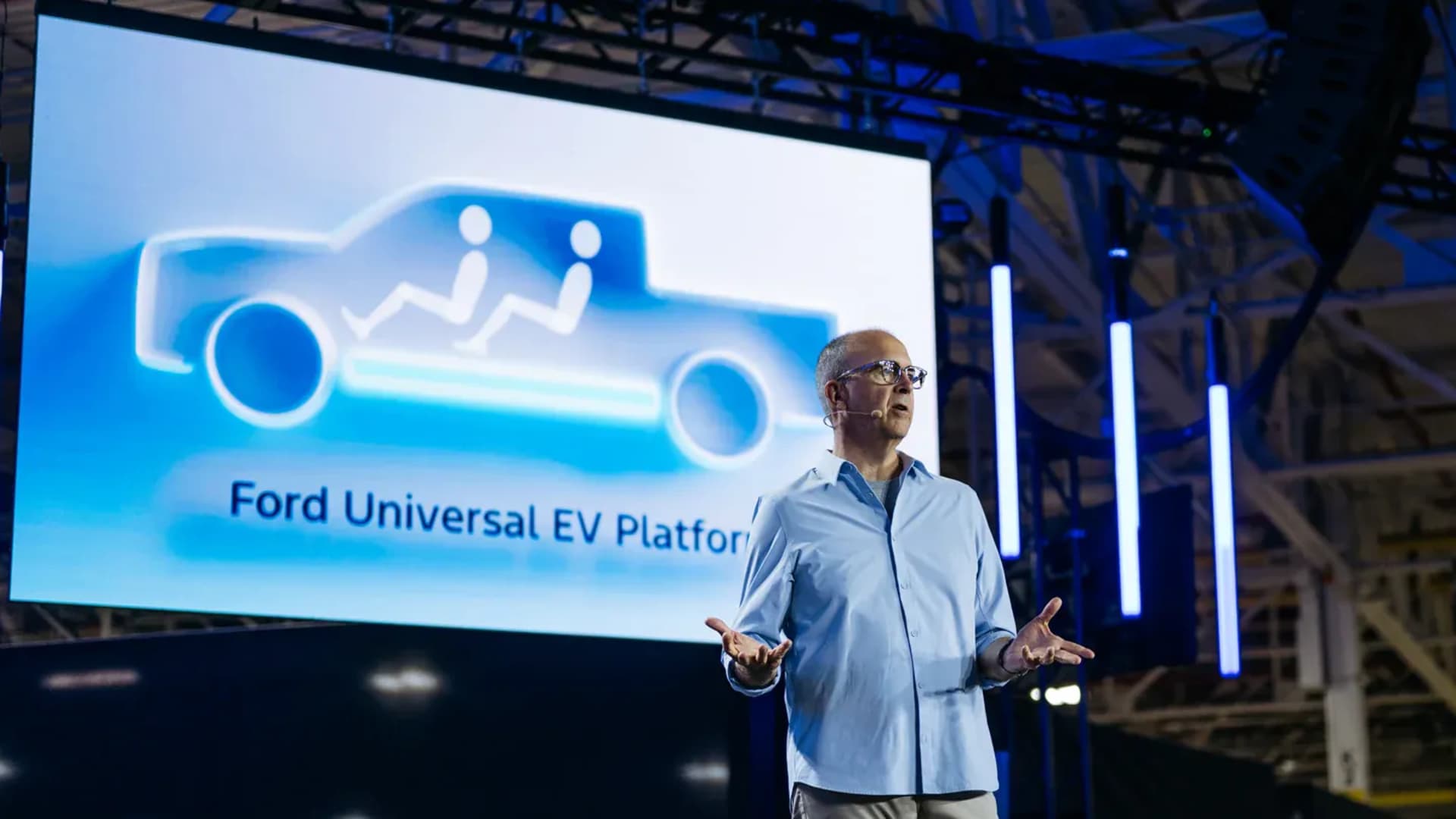
Doug Field, the chief EV, digital and design officer at Ford Motor, speaks at Louisville Assembly Plant as Ford shares its plans to design and assemble its “Universal Electric Vehicle” platform on August 11, 2025.

Courtesy Ford

DETROIT — Ford Motor‘s head of electric vehicles and software is leaving the automaker as it restructures its executives and operations.

Advertisement

Ford on Wednesday said Doug Field — chief EV, digital and design officer — has “elected to leave the company after a transition over the next month.” A release announcing the move mentioned a “next chapter” for Field, but the executive declined to disclose specific plans on a Wednesday call with media.

Field’s departure was announced in conjunction with Ford detailing a new executive structure that includes the establishment of a “Product Creation and Industrialization” organization at the company that will be led by Ford veteran and Chief Operating Officer Kumar Galhotra.

Ford said the new structure will integrate Field’s responsibilities with the company’s global Industrial System group to help the automaker hit certain goals, such as its target of an 8% adjusted EBIT margin by 2029.

There will not be a direct replacement for Field. Ford executives praised Field when the automaker brought him to the company in 2021 after previous leadership positions with U.S. EV leader Tesla and Apple. Ford CEO Jim Farley called his hiring a “watershed moment.”  

Advertisement

His departure comes as Ford is preparing to launch a next generation of electric vehicles that Farley has said are as important as the company’s famed Model T.

Farley and Field on the call with media said the upcoming vehicle — a midsize pickup built on Ford’s “Universal Electric Vehicle,” or UEV, platform that’s due out next year — was in a solid position to continue in the new unit without Field.

Product Creation and Industrialization

Ford on Wednesday described the new Product Creation and Industrialization unit as an “end-to-end organization” that aims to “deliver one of the most intensive product, software, and services rollouts in Ford’s history.”

The automaker plans to refresh 80% of its North American portfolio by volume and 70% of its global portfolio by volume by 2029, the company said. That includes the UEV pickup truck, next-generation F-150 and larger F-Series Super Duty lineup.

Advertisement

That turnaround of products also will include new powertrain offerings and software, Ford said Wednesday.

By 2030, the company is planning for 90% of its global nameplates to offer electrified powertrains, including hybrids, extended-range electric vehicles and full EVs. It is also aiming to have 90% of its Ford’s vehicles by volume feature updated “electrical architectures, in-house developed user experiences and hardware, and next-generation over-the-air capabilities for continuous improvement in experiences and services.”

Ford said the new technologies will enable “the rapid rollout” of advancements to its digital experience for customers and BlueCruise advanced driver assistance system, with a “scalable path” toward a 2028 Ford goal to achieve eyes-off “Level 3 autonomous driving.”

SAE International, formerly known as the Society of Automotive Engineers, has characterized automated driving for vehicles from Level 0 to Level 5. The highest, Level 5, is a fully autonomous vehicle, with each stage from Level 0 adding more technologies and enabling human drivers to be more “out of the loop.”

Advertisement

Ford currently offers a Level 2 advanced driver assistance system, or ADAS, known as BlueCruise. 

Leadership shakeup

Farley on the media call Wednesday with Field and Galhotra spoke fondly of Field’s work, calling him an “invaluable partner” who “has built a world-class team at Ford.”

However, many of Ford’s initiatives involving software and EVs did not perform as expected. Most notably, the automakers reported significant shortfalls in generation of software revenue and in December announced it would write down $19.5 billion related to a pullback in EVs and realignment of business priorities.

While several automakers have announced such impacts due to EVs, Ford’s write-down was much larger than its closest rival General Motors, which has announced roughly $7.6 billion in such charges.

Advertisement

In addition to Field leaving the company, Ford announced a series of other changes to its advanced vehicle development products and European manufacturing plans.

Choose CNBC as your preferred source on Google and never miss a moment from the most trusted name in business news.
Continue Reading

Business

How you could get free electricity for doing your washing

Published

on

How you could get free electricity for doing your washing

You could get free or cheaper electricity from your energy company for running appliances during periods of excess supply, such as sunny weekends.

Continue Reading

Business

HubSpot, Inc. (HUBS) Discusses 2026 Strategy and AI-Driven Innovations for Growth Companies Prepared Remarks Transcript

Published

on

OneWater Marine Inc. (ONEW) Q1 2026 Earnings Call Transcript

Charles MacGlashing
Corporate Treasure & Senior Director of IR

Good morning, and welcome to HubSpot’s Spring 2026 Spotlight Investor Webinar. I’m Chuck MacGlashing, and I’m here with Yamini Rangan, our Chief Executive Officer; and Duncan Lennox, our Chief Product and Technology Officer.

Today, we’ll walk through HubSpot’s 2026 strategy and how the new products and innovations we released at Spring Spotlight yesterday are making AI work for growth companies. I’ll also share an update on how HubSpot is transforming how it builds, grows and operates with AI.

Before we start, I’d like to draw your attention to our safe harbor statement. Statements made during this webinar that are not historical facts may be considered forward-looking within the meaning of the federal securities laws. These statements reflect our views only as of today involve risks and uncertainties, and we undertake no obligation to update them. Please refer to our most recent SEC filings for a discussion of the relevant risk factors.

Advertisement

Now it’s my pleasure to turn it over to HubSpot’s Chief Executive Officer, Yamini Rangan.

Yamini Rangan
CEO, President and Director

Thank you so much, Chuck. Welcome. Hello, everybody, and thanks so much for taking the time today to join us in this investor webinar. Look, the pace of innovation is just accelerating. There is a lot happening in the industry in just a matter of weeks, and there’s a lot happening at HubSpot. We just had our spring spotlight yesterday and a lot of exciting updates. So we wanted to provide a product and strategy update.

Advertisement
Continue Reading

Business

Buy the Dip or Sell the Rally as Turnaround Gains Traction?

Published

on

Dow Jones

NEW YORK — Starbucks Corp. shares have climbed more than 15 percent year-to-date in 2026, trading near $98 in mid-April as investors weigh early signs of a turnaround under new CEO Brian Niccol against lingering pressures from cautious consumers and a complex China market.

At around $98.47 on April 15, 2026, SBUX stock sits well above its recent lows but remains far below the all-time highs above $120 seen in prior years. The company’s market capitalization hovers near $110 billion after a volatile stretch marked by declining traffic in key markets and aggressive cost-cutting efforts. Year-to-date gains outpace the broader market modestly, reflecting guarded optimism around the “Back to Starbucks” strategy launched after Niccol’s arrival from Chipotle in late 2024.

Wall Street’s consensus leans toward cautious optimism. Across roughly 40 analysts, the average 12-month price target stands near $101 to $104, implying modest single-digit upside from current levels. Ratings tilt toward Hold with a sprinkling of Buy recommendations, though some firms have nudged targets higher following positive Q1 signals. The highest targets reach $165 in optimistic scenarios, while bears see downside risks toward $74 if momentum stalls.

Fiscal first-quarter 2026 results released in late January offered the clearest evidence yet that Niccol’s plan is gaining traction. Global comparable store sales rose 4 percent, driven by positive U.S. transaction growth for the first time in eight quarters. Revenue climbed 5 percent to approximately $9.9 billion, beating estimates, though adjusted earnings per share of $0.56 missed consensus slightly amid higher labor investments and one-time items.

Advertisement

The company introduced full-year fiscal 2026 guidance calling for global comparable sales growth of 3 percent or better, with similar revenue expansion. Non-GAAP earnings per share are projected in a range of $2.15 to $2.40, and Starbucks plans to open 600 to 650 net new stores worldwide. Executives described the turnaround as “ahead of schedule,” highlighting menu simplification, improved store operations and a renewed focus on the core coffeehouse experience.

Niccol has emphasized returning Starbucks to its roots — faster service, friendlier baristas and a stronger sense of community — after years of over-reliance on digital orders and drive-thru efficiency that some critics said eroded the brand’s soul. Early moves included trimming the menu by 25 to 30 percent to reduce complexity and waste, enhancing in-store ambiance and retraining staff. U.S. traffic trends have stabilized, with transaction growth turning positive amid targeted promotions and value offers.

International markets present a more mixed picture. China, once a high-growth engine with plans to reach 20,000 stores through a partnership with Boyu Capital, continues facing headwinds from intense local competition and a sluggish consumer environment. While the company maintains long-term ambitions in the region, near-term traffic remains soft. Starbucks closed a strategic deal in China earlier in 2026, aiming to accelerate expansion while sharing risk.

Analysts credit Niccol’s operational discipline for margin stabilization efforts even as investments in labor and store refreshes weigh on near-term profitability. Operating margins contracted in Q1 but executives expect slight improvement for the full year through efficiency gains and disciplined pricing. Free cash flow generation remains solid, supporting the company’s quarterly dividend of about $0.61 per share, which yields roughly 2.5 percent at current prices.

Advertisement

The stock’s valuation sparks debate. Trading at a forward price-to-earnings multiple in the high 30s to low 40s based on 2026 estimates, SBUX commands a premium that assumes successful execution of the turnaround. Bulls argue the multiple is justified by Starbucks’ powerful global brand, loyal customer base and potential for mid-single-digit long-term growth as digital, ready-to-drink products and new store development compound. Bears counter that the premium leaves limited room for error if U.S. consumer spending weakens further or China recovery lags.

Next earnings for the fiscal second quarter are scheduled for late April, with investors eager for updates on U.S. traffic trends, China performance and progress on store renovations. Any positive surprises on same-store sales or margin trajectory could fuel further gains, while softer commentary might trigger profit-taking.

Competition remains fierce. Rivals such as Dutch Bros, local coffee chains and even fast-food players offering premium beverages continue chipping away at market share, particularly among price-sensitive younger customers. Starbucks has responded with value bundles, seasonal drinks and loyalty program enhancements designed to boost frequency without deep discounting that could erode margins.

Longer-term catalysts include international expansion beyond China, growth in the Global Coffee Alliance and ready-to-drink beverages, and potential innovation in plant-based or premium offerings. The company also continues investing in technology, including mobile order improvements and data-driven personalization, to enhance the customer experience.

Advertisement

For investors debating buy or sell decisions in 2026, Starbucks represents a classic turnaround story in the consumer discretionary space. Optimists see an attractive entry point after years of underperformance, with Niccol’s proven track record at Chipotle providing credibility. The current dividend yield and share repurchase activity add appeal for income-oriented portfolios. At depressed levels relative to historical peaks, the stock offers asymmetric upside if the “Back to Starbucks” plan restores mid-single-digit growth and expands margins toward pre-pandemic levels.

Skeptics highlight structural challenges: a maturing U.S. market, persistent inflation pressures on discretionary spending and geopolitical risks in China. Execution risk remains high as the company balances cost discipline with investments in people and stores. If traffic gains prove temporary or new store openings fall short, the premium valuation could compress quickly.

Portfolio considerations matter. Defensive qualities in the consumer staples-adjacent sector make Starbucks appealing during economic uncertainty, yet its sensitivity to discretionary spending ties it more closely to cyclical trends. Dividend growth history and strong balance sheet provide some downside protection.

As spring advances, attention will focus on summer beverage sales, back-to-school traffic and any updates on China operations or new product launches. Broader economic factors — interest rates, employment trends and consumer confidence — will influence results.

Advertisement

At current levels near $98, Starbucks offers a blend of recovery potential and income. Short-term traders may await the April earnings reaction for clearer direction, while longer-term investors can lean on the brand’s resilience and Niccol’s strategic shifts. Those with high conviction in a U.S. traffic rebound and successful China navigation see room for the stock to climb toward the $110-$120 range by year-end.

The coming months will test whether early positive trends translate into sustained momentum. Strong Q2 results, accelerating U.S. transactions and credible progress on margins could validate the bullish case and support multiple expansion. Any signs of renewed softness, however, might pressure shares toward the lower end of the 52-week range.

Starbucks built its empire on the simple promise of a welcoming third place between home and work. Under Niccol, the company is rediscovering that heritage while adapting to a more competitive, cost-conscious environment. Whether 2026 marks the inflection point for renewed growth or another transitional year will shape shareholder returns for years ahead.

For now, the data point to a Hold with upward bias for those willing to tolerate volatility. The golden siren has weathered storms before. If the turnaround delivers, patient investors could be rewarded as Starbucks reclaims its position as a premium growth name in the restaurant sector. Execution will be everything in the months ahead.

Advertisement
Continue Reading

Business

HORNBACH Holding AG & Co. KGaA (HBBHF) Presents at Mwb Research Online Conference German Select VII Transcript

Published

on

OneWater Marine Inc. (ONEW) Q1 2026 Earnings Call Transcript

HORNBACH Holding AG & Co. KGaA (HBBHF) Mwb Research Online Conference German Select VII April 13, 2026 8:00 PM EDT

Company Participants

Antje Kelbert – Head of Investor Relations

Presentation

Advertisement

Unknown Analyst

Good afternoon, everybody. We are down to the last presentation, the 11th presentation of our German Select Conference. And the slot goes, last but not least, to HORNBACH Holding, which will be presented by Antje Kelbert, Head of IR. As always, we’ll have a 30-minute slot, 20 minutes roughly a presentation, 10 minutes Q&A. If you have questions in the presentations before, please use the chat box to enter them and we will address them during the following Q&A after the presentation. And in case you did like this format, please feel free to join us on April 23 for our Austrian Select Conference. We will share the link to that shortly in the chat box as well.

That’s all I have, and I will now hand it over to you, Antje, to share your insights on HORNBACH Holding.

Advertisement

Antje Kelbert
Head of Investor Relations

Well, thank you very much for your kind introduction, and good afternoon, ladies and gentlemen. It’s a pleasure to welcome you today here and to present HORNBACH Holding to you. So HORNBACH is a company characterized by resilient business model, sustainable growth prospects and continuous innovation.

As said, my name is Antje Kelbert, and I’m Head of Investor Relations. So here’s some disclaimer remarks, but now jumping directly, what are we doing and who are we? HORNBACH is one of European’s leading brand when it comes to home improvement and the DIY sector. And many of you, I’m probably sure, are already familiar with HORNBACH, whether through your own projects you’ve made or also our marketing and advertising activities.

In the capital

Advertisement
Continue Reading

Business

Iran conflict, oil prices threaten to dent cruise line profits

Published

on

Iran conflict, oil prices threaten to dent cruise line profits

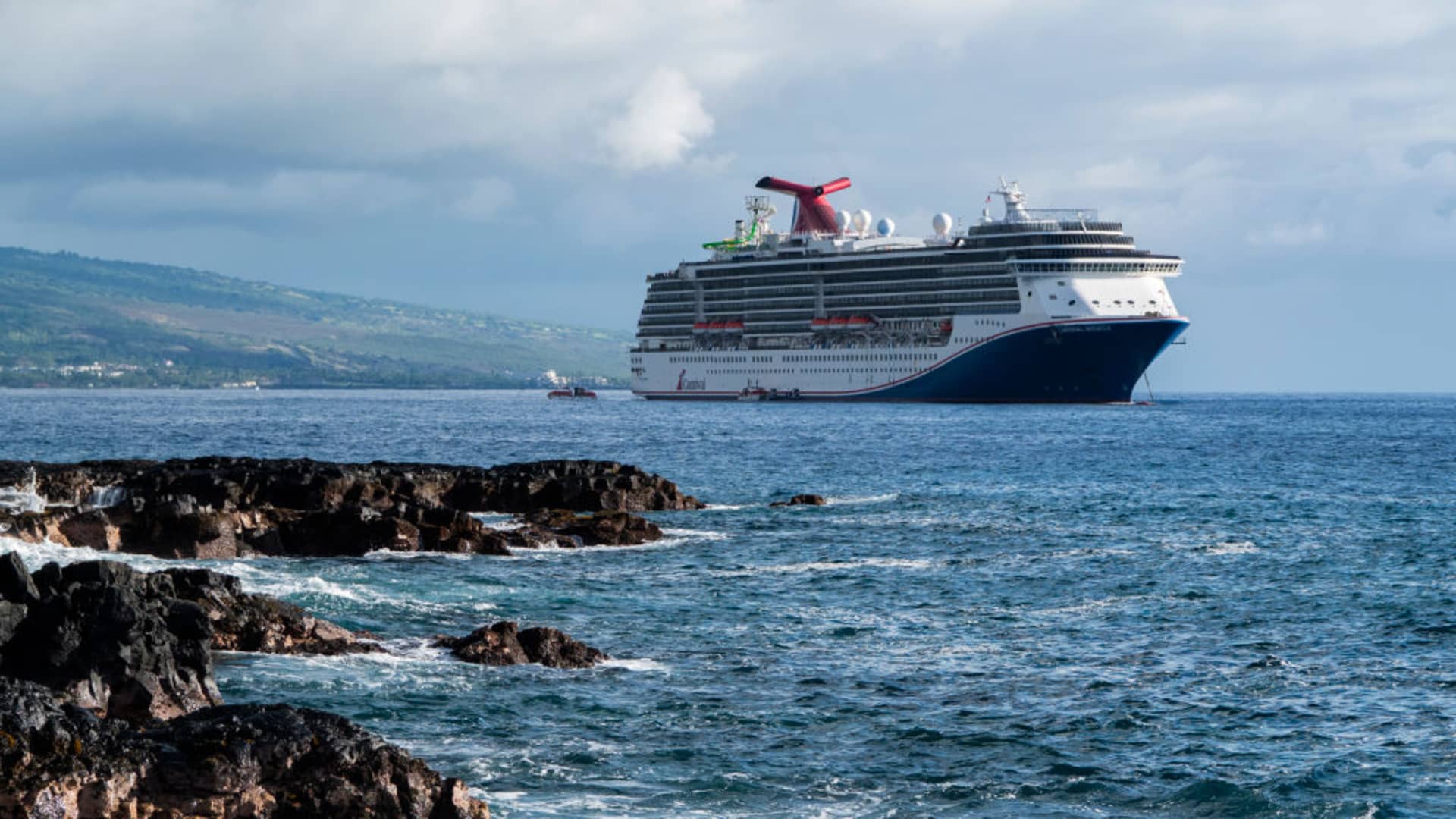
The Carnival Miracle cruise ship is anchored in the Pacific Ocean near Kailua Bay during a 15-day cruise, in Kailua-Kona, Hawaii, on Jan. 14, 2024.

Kevin Carter | Getty Images

The global cruise industry is reporting record demand and renewed consumer enthusiasm, but the leaders helming the world’s largest cruise companies say the sector is also facing some of the most complex challenges it has seen in decades.

Advertisement

“We are not an alternative vacation anymore. We are a vacation,” Carnival Corporation CEO Josh Weinstein said during a keynote panel Tuesday at Seatrade Global, a cruise industry conference.

As demand rises, passengers are getting younger; one-third of cruise travelers are now under 40, according to the 2026 State of the Cruise Industry report released by Cruise Lines International Association (CLIA). One-third of trips are multi-generational, often families traveling together. And nearly a third of cruisers take vacations by ship multiple times a year, according to the report.

The cruise industry hosted 37 million passengers worldwide last year and anticipates reaching 42 million annually by 2029, CLIA found.

“That mainstream demand sets us up very well for volatility,” Weinstein said.

Advertisement

A resilient business in an uncertain world

At least six cruise ships remain stranded in the Persian Gulf by the impasse at the Strait of Hormuz. One of them is the MSC Euribia.

Though roughly 1,500 passengers were safely evacuated amid Dubai airport shutdowns and missile warnings after the U.S. and Israel launched an attack on Iran in late February, there are still some crew on board to maintain the vessel.

“Obviously, we live day by day. The situation is very fluid,” said MSC Cruises Executive Chairman Pierfrancesco Vago during the Seatrade Global keynote.

Already the shutdown of marine traffic in the Strait has disrupted itineraries in the Middle East and southern Europe. Threats of blockades, mines on the sea floor and on-and-off-again negotiations are keeping cruise executives guessing about when they can move their ships.

Advertisement

“Morning is one thing, lunchtime is another, dinner is another again,” Vago said of the numerous and often conflicting announcements from government leaders. “We need to stay cool and actually be ready to move out as soon as the possibility and opportunity comes back.”

Despite these challenges, cruise executives argue the industry has never been better positioned to absorb shocks.

“Every crisis we’ve faced — financial, geopolitical or health-related — we adapted,” Carnival’s Weinstein said. “There’s no reason to believe it will be different this time.”

Fuel costs, sustainability and the push to use less

Fuel price volatility has once again put energy strategy front and center for the cruise industry, particularly for Carnival, which does not hedge fuel prices.

Advertisement

“Nobody asks us about hedging when prices are low,” Weinstein said. “But our strategy has been consistent: use less fuel.” 

The cruise industry aims to have net zero emissions by 2050, but CEOs agree that they can’t achieve that goal solely by conserving fuel.

Industry leaders see biofuels, green methanol and synthetic liquid natural gas (produced by combining captured carbon with hydrogen) as the most promising solutions to meet their fuel needs.

Fincantieri CEO Pierroberto Folgiero on ship building in America

Royal Caribbean Group CEO Jason Liberty said cruise lines are already investing hundreds of millions of dollars annually in technology and energy innovation, but availability of alternative fuels remains the bottleneck.

“It’s not about what we want to use,” Liberty said. “It’s about what’s scalable and available.” 

Advertisement

“We’re going to have heavy competition with other sectors for those fuels as well. There’s no guarantee we get them,” added Bud Darr, president and CEO of Cruise Lines International Association.

Tailwinds for growth

Even as the industry navigates choppy seas, cruise companies are looking for their next avenues for growth.

Technological advances in artificial intelligence are being used to reduce food waste, plot routes and itineraries and increase efficiency. Cruise line executives say the most important application is to reduce friction in the guest experience.

“A more flexible work environment has been a big demand driver for us,” Liberty said. Most Royal Caribbean ships now host a Starlink connection for fast internet aboard.

Advertisement

Private destinations, the exclusive ports or islands owned or controlled by a cruise line, continue to be a priority for investment. Royal Caribbean, for instance, currently has three private destinations on its itineraries but will have eight by 2028.

It’s developing a major land-based hub in Puerto Williams, Chile, to reduce or eliminate the amount of time passengers to Antarctica have to spend transiting the punishing seas of the Drake Passage.

And the luxury segment, though a small percentage of the overall industry, is growing rapidly. Customers are increasingly interested in exploring health, wellness and longevity — and those trends are showing up in their vacation habits, too.

Smaller ships and river cruising accommodate specialized interests in eco-tourism, off-the-beaten path (not yet discovered by social media influencers) locales and culinary or artistic aficionados.

Advertisement

Social-media driven demand in tourism has also sparked backlash from some destinations, overwhelmed by the crowds. The cruise industry is working with destinations on what it calls managed, predictable tourism.

Vago said MSC worked with Dubrovnik, Croatia, for example, to coordinate the flow of visitors to the medieval town, which wants the tourism spending but without destruction of quality of life for residents.

“Many of these coastal communities actually appreciate that. We plan in advance. We create itineraries three years in advance,” Vago said.

“The strength of this industry is its ability to evolve without losing its soul,” Liberty said. “That soul is hospitality.”

Advertisement

Leadership change and fresh perspective

At Norwegian Cruise Line Holdings, the challenge for new CEO John Chidsey is righting the ship.

In his first earnings call, just days after taking the helm, Chidsey acknowledged the company had committed numerous missteps.

Margins are under pressure. Shares have been volatile. Critics have questioned a push to expand cruise itineraries in the Caribbean before Norwegian’s private island was fully completed.

Earlier this year, Elliott Investment Management took an activist stake in Norwegian, which may have provided impetus for the board to make a leadership change.

Advertisement

Chidsey told CNBC Elliott’s goals align with his own and that he intends to create a culture of accountability and urgency where teams are working together rather than separated into silos.

New Norwegian Cruise Line CEO John Chidsey on taking the helm

The Seatrade conference was a cruise industry debut for Chidsey, formerly the CEO of Subway, Burger King and Avis.

When asked what a “sandwich guy knows about cruising,” Chidsey didn’t miss a beat, insisting he’s a “turnaround guy not a sandwich guy.”

“I knew nothing about fast food when I went there. I think having a fresh set of eyes is really what Norwegian needs. And it’s all about execution,” he said.

Choose CNBC as your preferred source on Google and never miss a moment from the most trusted name in business news.
Advertisement
Continue Reading

Business

Costco debuts new high-demand product as fans eye price edge over rivals

Published

on

Costco debuts new high-demand product as fans eye price edge over rivals

Costco has rolled out a new milk product in select locations that lactose-intolerant customers say they had long been “waiting for Costco to put out,” marking a release that shoppers are calling long overdue and highly anticipated.

An ultra-filtered, high-protein, low-calorie 2% fat milk has appeared in Texas stores, according to an early April Reddit post by a user in Georgetown.

Advertisement

FOX Business has confirmed the item has been stocked in select Austin-area stores, with more locations expecting to receive it soon.

Customers can purchase the product in three half-gallon cartons under the Kirkland Signature label for $10.59.

COSTCO TO OPEN ITS FIRST STAND-ALONE GAS STATION WITH SECOND LOCATION COMING NEXT YEAR

several blue boxes of kirkland signature milk sitting at costco shelves

Cartons of Kirkland Signature high-protein lactose-free 2% milk are displayed on a Costco shelf in Cedar Park, Texas, on April 15, 2026. (Bonny Chu for Fox News Digital / Fox News)

According to users on social media, the new product has not yet expanded to East Coast locations and is currently part of a West Coast–focused testing phase.

Advertisement

The warehouse addition, product no. 1975527, comes at a convenient time, consumers said, as many users have reported noticing higher prices and intermittent shortages in comparable products sold at competing retailers, including Aldi’s Fairlife line, one of the first major brands to popularize ultra-filtered milk.

“This is exactly what I’ve been waiting for Costco to put out!” one Reddit user said in a post. “I buy the Aldi one but this should be cheaper still. Hope it hits my warehouse soon.”

While 2% lactose-free milk is already available at Costco, including the Kirkland Organic Lactose Free, the new product offers 50% less sugar, 50% more protein, and an increased level of daily vitamins.

It contains 120 calories and 13 grams of protein per cup, compared with roughly 130 calories and 8 grams of protein in similar alternatives.

Advertisement

COSTCO SAYS YOUR NEXT CHECKOUT COULD TAKE UNDER 10 SECONDS THANKS TO NEW AUTOMATED PAY STATIONS

split image of blue-colored boxes displaying "ultra-filtered reduced fat milk 2%"

Costco’s new Kirkland Signature 2% milk is a lactose-free product featuring 50% higher protein and 50% less sugar compared to similar alternatives.  (Bonny Chu for Fox News Digital / Fox News)

Users also praised the new product, priced at $10.59 for a total of 1.5 gallons, as a steep discount, with some shoppers noting that Fairlife milk can cost about $5.32 for 0.4 gallons, or more than $10 for less than a gallon at local grocery stores.

“Fair life is $5.32 for .4 gallon at my local grocery store,” one user said. “That’s a pretty solid discount!”

“Woah, I stopped buying the 2% Costco milk and replaced it with the Aldi fair life dupe ($3.89 for 57oz) about 8 months ago, but if this shows up at mine, I’m buying this instead,” another user said. 

Advertisement
Ticker Security Last Change Change %
COST COSTCO WHOLESALE CORP. 983.96 +9.15 +0.94%

The lactose-free, high-protein milk is made possible through an ultra-filtration process that separates milk into components and recombines them for higher protein and lower sugar while reducing lactose. 

While Fairlife milk pioneered and patented a specific multi-stage filtration system, other manufacturers, including Costco, can still use broader filtration methods to concentrate protein and produce lactose-free milk products.

CLICK HERE TO READ MORE ON FOX BUSINESS

customer enters costco fridge

A customer enters a fridge unit at a Costco warehouse in Azusa, Los Angeles County, California, the United States.  (Gao Shan/Xinhua / Getty Images)

The process also creates a thicker, creamier product that is often lactose-free, high in macronutrients, and more shelf-stable, according to shoppers.

Advertisement

“I love the flavor, and I really love the expiration date,” another Reddit user said. “Unopened, they last for weeks, so it’s nice to have something that has a fresher taste, but does not expire in two weeks. The shelf stable milk lasts longer unopened, but doesn’t taste fresh.”

If sales perform well in its initial markets, the item could be rolled out to additional locations, which is consistent with Costco’s typical approach of testing private-label products in select regions before scaling distribution chain-wide based on consumer demand.

Continue Reading

Business

Xanadu Quantum Stock Explodes 54% on Nvidia AI Models as Photonic Pioneer Surges in 2026

Published

on

Facebook

NEW YORK — Xanadu Quantum Technologies Limited shares rocketed more than 54 percent in midday trading Wednesday, surging to around $22.68 as investors piled into the newly public photonic quantum computing company amid a sector-wide rally triggered by Nvidia Corp.’s launch of open-source AI models designed to accelerate quantum research and development.

Xanadu Quantum Stock Explodes 54% on Nvidia AI Models as
Xanadu Quantum Stock Explodes 54% on Nvidia AI Models as Photonic Pioneer Surges in 2026

At approximately 12:29 p.m. EDT on April 15, 2026, XNDU stock had climbed $8.07, or 54.42 percent, from Tuesday’s close of $14.83 on heavy volume exceeding 4.5 million shares — far above recent averages. The Canadian company’s market capitalization swelled toward $7.9 billion intraday, reflecting explosive enthusiasm for quantum plays just weeks after its March 27 Nasdaq and TSX debut via a $302 million de-SPAC transaction with Crane Harbor Acquisition Corp.

The catalyst came from Nvidia’s announcement of a new family of open-source AI models, including Ising, explicitly built to speed advances in quantum computing. The move signaled growing integration between classical AI infrastructure and quantum technologies, lifting the entire sector. Xanadu, D-Wave Quantum, IonQ, Rigetti Computing and others posted double-digit gains, with XNDU leading the charge as one of the freshest pure-play names available to retail and institutional investors.

Xanadu specializes in photonic quantum computing, an approach that uses particles of light rather than superconducting circuits or trapped ions. This room-temperature technology promises easier scaling and compatibility with existing fiber-optic networks, potentially giving it an edge in building fault-tolerant systems. The company’s flagship software platform, PennyLane, has become a popular open-source tool for quantum machine learning and hybrid quantum-classical algorithms, with average monthly downloads growing 161 percent to about 160,000 in 2025.

Fiscal 2025 results released April 9 showed revenue of $4.6 million, up 188 percent from $1.6 million the prior year, driven by expanded customer contracts and services. The company posted a net loss of $70.7 million, widening from $46 million as it ramped research and development and incurred costs tied to the public listing. Cash stood at $16.2 million at year-end 2025, but the de-SPAC injected substantial fresh capital to fund hardware scaling and commercialization efforts.

Advertisement

CEO Dr. Christian Weedbrook highlighted technical milestones in the earnings release. Xanadu introduced Aurora, described as the world’s first modular, networked photonic quantum computer with real-time error correction. Researchers demonstrated 12 logical Gottesman-Kitaev-Preskill (GKP) qubits with error correction, published in the journal Nature. Optical loss was reduced by 60 percent during the year, a 20-fold improvement over three years, addressing a key barrier to scalable photonic systems.

The company advanced in government programs, reaching Stage B of DARPA’s Quantum Benchmarking Initiative for up to $15 million and earning selection for Canada’s Quantum Champions Program with up to CAD $23 million. Negotiations continue for up to CAD $390 million under Project OPTIMISM to build domestic semiconductor and photonic manufacturing infrastructure in Ontario.

Xanadu opened a $10 million photonic packaging facility and forged new partnerships with entities including the U.S. Air Force Research Laboratory, Mitsubishi Chemical, Rolls-Royce, AMD, Lockheed Martin and others. PennyLane integrations with tools from AMD, NVIDIA’s cuQuantum and the Munich Quantum Toolkit continue expanding its software ecosystem, allowing researchers to simulate and optimize quantum algorithms on classical GPUs before deploying on actual hardware.

Wall Street coverage remains limited in the stock’s early public life, but the broader quantum sector commands attention as investors hunt for exposure to technologies that could eventually crack encryption, accelerate drug discovery, optimize logistics and enhance AI capabilities. Analysts note Xanadu’s photonic approach differentiates it from superconducting leaders like IBM or ion-trap players like IonQ, while PennyLane provides a software moat that reaches developers worldwide.

Advertisement

Yet risks abound. Xanadu remains pre-revenue at commercial scale, with significant operating losses and heavy dependence on continued government and private funding. Quantum computing as an industry faces formidable technical hurdles on the path to fault tolerance, with useful, large-scale machines likely still years away. Competition is intense, and execution on manufacturing scale-up will prove critical.

The stock’s 52-week range stretches from a low near $6.97 to an intraday high approaching $25 on Wednesday, underscoring extreme volatility typical of early-stage deep-tech names. Short interest and retail enthusiasm, amplified by social media chatter around quantum and AI convergence, have fueled sharp moves since the March debut, when shares popped 15 percent on the first trading day.

For investors debating positions in 2026, Xanadu represents a high-risk, high-reward bet on the quantum revolution. Bulls point to the $302 million war chest, strong technical progress, PennyLane’s growing adoption and potential government backing as foundations for long-term value. The Nvidia-driven sector tailwind adds near-term momentum, with some models projecting substantial upside if Xanadu hits roadmap targets such as hundreds of logical qubits by the end of the decade.

Skeptics caution that current valuations embed aggressive assumptions about commercialization timelines. With minimal revenue and ongoing cash burn, dilution risks remain if additional capital is needed. Broader economic conditions, regulatory shifts around quantum technologies and geopolitical competition — particularly with China’s quantum ambitions — could influence sentiment.

Advertisement

Next catalysts include updates on Project OPTIMISM funding, further PennyLane releases, hardware demonstrations and any partnerships leveraging the new Nvidia quantum AI tools. The company’s road map targets meaningful progress toward fault-tolerant systems in the 2029-2030 timeframe, aligning with industry forecasts that the quantum computing market could exceed $11 billion by 2030.

As a newly listed name, Xanadu offers pure-play exposure to photonic quantum hardware and software at a time when AI leaders like Nvidia are explicitly bridging the two fields. Its Toronto headquarters and Canadian government ties add a North American diversification angle within a sector often dominated by U.S. players.

Retail traders have driven much of the recent volume, drawn by the narrative of quantum supremacy potentially disrupting everything from cybersecurity to materials science. Institutional interest appears to be building, though many funds remain on the sidelines pending clearer commercial traction.

At current levels near $22.68, the stock trades at a significant premium to its recent post-IPO range, reflecting both sector excitement and the inherent speculation in frontier technologies. Short-term momentum traders may ride the Nvidia wave, while longer-term believers focus on execution milestones and the eventual transition from research prototypes to revenue-generating systems.

Advertisement

Xanadu’s story blends cutting-edge science with the classic challenges of bringing transformative technology to market. Its photonic platform, open software strategy and fresh public capital position it as a notable contender in the quantum race. Whether Wednesday’s surge marks the start of sustained momentum or another volatile chapter will depend on delivering against ambitious technical and commercial goals in the quarters ahead.

The broader quantum sector continues to capture imagination as AI’s limits push interest toward complementary computing paradigms. For Xanadu, the Nvidia boost provides validation and visibility at a pivotal moment. Investors will watch closely for signs that the company’s hardware-software combination can translate scientific breakthroughs into real-world advantage in an increasingly competitive field.

Continue Reading

Business

Mark Mobius, pioneer of emerging markets investing, dies at 89

Published

on

Mark Mobius, pioneer of emerging markets investing, dies at 89
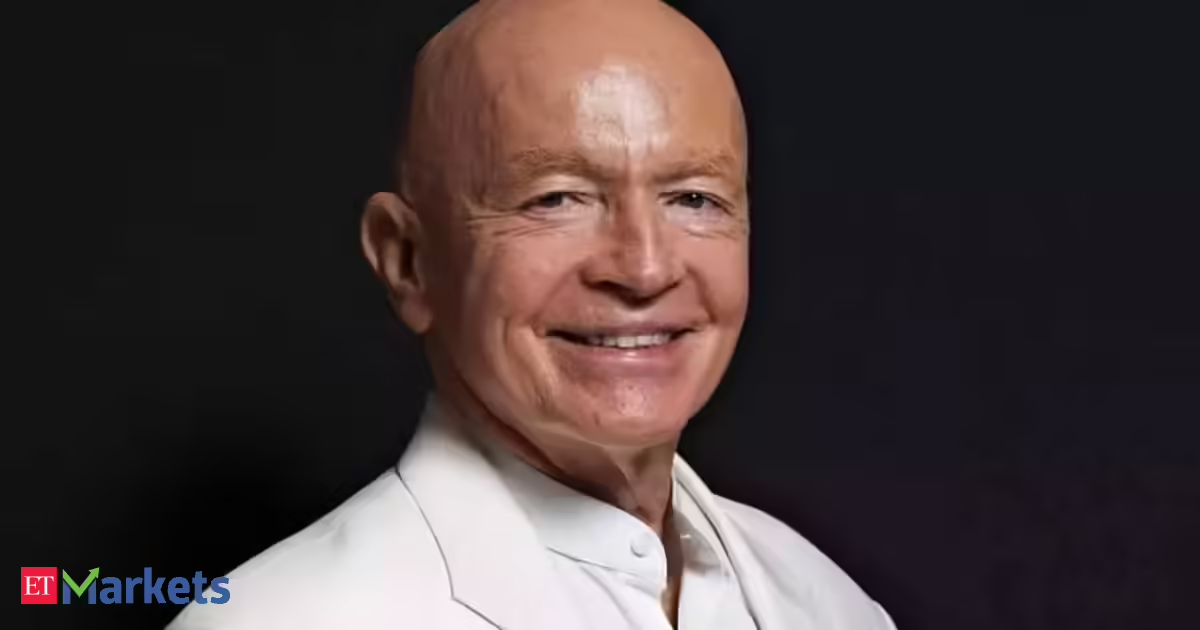
Mark Mobius, who put emerging markets on investors’ radar with on-the-ground insights over more than four peripatetic decades, has died. He was 89.

He died today, according to a post on his LinkedIn page attributed to his spokeswoman, Kylie Wong. John Ninia, a partner at Mobius Investments, said he died in Singapore.

In more than 30 years with Franklin Templeton Investments, officially Franklin Resources Inc., Mobius became an evangelist for money-making opportunities in Africa, Asia, Eastern Europe and Latin America. In a crowd of investing advisers, he was distinctive in part for his impeccably shaved head, which inspired the nickname Bald Eagle.

Hired in 1987 by John Templeton, a pioneer in leading American investors to companies abroad, Mobius started one of the first mutual funds dedicated to rapidly developing new markets. He oversaw the Templeton Emerging Markets Group until 2016, was lead manager of its flagship Templeton Emerging Markets Investment Trust until 2015 and retired in January 2018.

Advertisement

From 1989 until his retirement, the closed-end fund returned 13.4% a year on average, according to Morningstar Direct. From 2001, when the MSCI Emerging Markets Index was introduced, the Templeton fund beat that benchmark by 1.9% a year on average, according to Morningstar.


“Mark Mobius is to emerging market investing what Colonel Sanders is to fried chicken,” Peter Douglas, a principal at the Singapore chapter of the Chartered Alternative Investment Analyst Association, said when Mobius stepped aside as portfolio manager. “He is the icon of the industry and has been the global cheerleader of emerging markets.”
Partly based in Singapore, Mobius traveled 250 to 300 days a year in a Gulfstream IV private jet, visiting factories and distributors in remote corners of the globe to identify investment opportunities. He correctly predicted the start of a bull market that began in 2009, snapped up bargains during the Asian financial crisis after Thailand floated its currency in 1997 and bought Russian stocks as panic selling took hold in Russia in 1998. He was also one of the first institutional investors to identify Africa as a promising frontier market, setting up the Templeton Africa Fund in 2012.

‘Kicking the Tires’

“I believe in getting out and kicking the tires,” he wrote in 2015. “I would rather see with my own eyes what’s happening in a company or country. Lies can be as revealing as truth, if you know what the cues are.”

Just last month, via his Substack column, he shared his thoughts on the war in Iran and its impact on equity markets.

Mobius founded London-based Mobius Capital Partners in 2018 and oversaw actively managed funds investing in emerging market equities. He left there in late 2023 but continued to seek out investing opportunities, setting up a new venture in Dubai, where he had lived for three years.

Advertisement

Franklin Resources Inc. was founded in 1947 and is based in San-Mateo, California. It acquired John Templeton’s investment firm — Templeton, Galbraith & Hansberger Ltd. — in 1992 to create Franklin Templeton Investments.

Joseph Bernhard Mark Mobius was born on Aug. 17, 1936, in Bellmore, on New York’s Long Island. His German father, Paul Mobius, was a ship’s cook and baker. His mother, the former Maria Louisa Colon, was Puerto Rican. With his two brothers, Hans and Paul, Mobius grew up with German and Spanish spoken at home.

In 1955, Mobius received a scholarship to study dramatic arts at Boston University and worked as a pianist in a nightclub to help pay for his education. He earned a bachelor’s degree in fine arts and a master’s in communications.

Studied in Kyoto

He successfully applied for a scholarship to learn Japanese culture and the Japanese language in Kyoto, triggering his desire to live and work in Asia. After earning a Ph.D. in political science and economics from Massachusetts Institute of Technology, in 1964, he took a job with International Research Associates, conducting surveys and other consumer research in Thailand and Korea for a year each.

Advertisement

He ended up in Hong Kong, where he started his own industrial research consulting firm. One project — a report on the Hong Kong stock market — was his entre into securities analysis. His Yul Brynner hairstyle, as he described it, was conceived at this time after a fire in his apartment damaged his hair and he shaved the rest off, according to his 1997 memoir.

He was hired by Vickers Da Costa, a UK stock brokerage, to start a Taiwanese fund management company, International Investment Trust. He traveled to the Bahamas to present investment opportunities to Templeton, who in 1986 asked if he would be interested in running an emerging markets fund. The following year they raised $100 million in capital, listed their fund on the New York Stock Exchange and opened a small office in Hong Kong for Mobius and two Chinese analysts. They began investing in six places: Hong Kong, Philippines, Singapore, Malaysia, Mexico and Thailand.

“You must remember, in those days, most countries did not welcome foreign investment,” Mobius recalled in a 2022 interview with Barry Ritholz for Bloomberg’s Masters in Business podcast series. “They were also either socialist or communist like China and Russia. Eastern Europe was out of the question, of course. So we had only six markets in which to invest, and then we started expanding. Gradually, markets opened up. And eventually we were investing in something like 70 different countries around the world.”

1987 Crash

After losing a third of his fund’s value in the October 1987 stock market crash during his first year with Templeton, Mobius diversified to other markets including Argentina, Mexico, Indonesia and Russia.

Advertisement

Mobius wrote more than a dozen books on investing and economics, including The Investor’s Guide to Emerging Markets (1994) and Passport to Profits (1999). He shared rules and aphorisms including, “If you see the light at the and of the tunnel, it’s too late to buy.”

In 1999, he was tapped to serve on the World Bank’s Global Corporate Governance Forum as a co-chairman of a task force on investor responsibility.

Mobius never married. In Passport to Profits, he wrote that there were costs and benefits to being a “full-time nomad — an endangered species I’ve long admired for their fierce independence, their refusal to abide by conventional norms, their desperate desire for freedom.”

“Though some people probably pity me for having no home, no family, no domestic life to speak of,” he wrote, “my somewhat eccentric lifestyle offers untold opportunities for variety, stimulation and creativity.”

Advertisement
Continue Reading

Business

Bringing Throne Sport Coffee to the mainstream

Published

on

Bringing Throne Sport Coffee to the mainstream

Functional coffee brand recently named Julia Perez as its chief marketing officer. 

Continue Reading

Trending

Copyright © 2025