
Business
Meta reportedly plans to cut around 8,000 jobs, or 10%, starting May 20


Meta President & Vice Chairman Dina Powell McCormick joins ‘Mornings with Maria’ to discuss how AI-powered smart glasses are transforming lives, restoring independence to blinded veterans and fueling explosive company growth.
Meta is preparing to cut thousands of jobs as early as next month, with deeper layoffs expected later this year, according to a report.
The tech giant intends to slash roughly 10% of its global workforce — or nearly 8,000 employees — in an initial round of cuts on May 20, sources told Reuters.
The company is also planning additional layoffs in the second half of the year, though details including timing and scope remain unclear, the outlet reported.
The report follows earlier Reuters reporting that Meta was weighing cuts that could affect at least 20% of its workforce as it seeks to offset rising artificial intelligence costs.
ADL WARNS META POLICY SHIFT COULD HURT AD REVENUE AS REPORT NOTES RISE IN HATEFUL, EXTREMIST CONTENT

Meta CEO Mark Zuckerberg leaves the federal courthouse in downtown Los Angeles after defending the company in a landmark social media addiction trial in Los Angeles Feb. 19, 2026. (Jon Putman/Anadolu via Getty Images / Getty Images)
When reached by FOX Business, Meta declined to comment.
Previously, a Meta spokesperson told FOX Business the earlier Reuters report was “a speculative report about theoretical approaches.”
The cuts come as Meta looks to offset the cost of AI infrastructure and streamline operations with AI-assisted workers.
META VOWS APPEAL OF ‘LANDMARK’ SOCIAL MEDIA VERDICTS, WARNS OF FREE SPEECH EROSION

Signage outside Meta headquarters in Menlo Park, Calif., April 20, 2023. (David Paul Morris/Bloomberg via Getty Images / Getty Images)
CEO Mark Zuckerberg has invested billions of dollars in artificial intelligence as the company pivots toward the technology.
Meta has also reorganized teams within its Reality Labs division and moved engineers into a new Applied AI group focused on developing AI agents capable of writing code and performing complex tasks, according to Reuters.
Meta employed nearly 79,000 people as of Dec. 31, according to its latest filing.
META’S BAY AREA LAYOFFS AFFECT ROUGHLY 200 WORKERS AS COMPANY POURS BILLIONS INTO AI INFRASTRUCTURE

Mark Zuckerberg, CEO of Meta Platforms Inc., appears during the Meta Connect event in Menlo Park, Calif., Sept. 17, 2025. (David Paul Morris/Bloomberg via Getty Images / Getty Images)
A 20% reduction would mark Meta’s largest restructuring since 2022 and early 2023.
The company laid off 11,000 workers in November 2022 — about 13% of its workforce — and cut another 10,000 jobs months later.
Other major companies, including Amazon, have also announced layoffs linked to AI developments.
GET FOX BUSINESS ON THE GO BY CLICKING HERE
Amazon said in January it would cut around 16,000 jobs after previously announcing about 14,000 white-collar layoffs in October, bringing total reductions to roughly 30,000 roles.
Reuters contributed to this report.



Analysis-The Iran war has revealed Trump’s pressure point: the economy


Trump says he has ’good news’ on Iran, offers no clarity on peace deal
Business
AU Small Finance Bank, ICICI Bank top picks as banking sector shows resilience: Siddhartha Khemka

On the liability side, deposit growth also witnessed a meaningful surge, rising to 13.5% YoY compared to 10.8% in the preceding fortnight. The system added approximately INR12 trillion in deposits in the last two weeks of March alone, indicating an aggressive mobilization push by banks to support balance sheet expansion. Despite this improvement, the gap between credit and deposit growth remains elevated at 2.6%, though it has moderated from earlier levels.
This easing is reflected in key liquidity indicators. The system-level loan-to-deposit ratio (LDR) declined to 81.4% from 83% in the prior fortnight, while incremental LDR dropped sharply to 81% from 101%, marking one of the lowest levels since August 2025. The moderation suggests some relief in funding pressures, albeit within a still tight liquidity environment.
Banks have increasingly relied on wholesale funding avenues to bridge the gap. Certificate of Deposit (CD) issuances rose to INR14.3 trillion in FY26, up from INR11.7 trillion in FY25, with nearly 30% of issuances concentrated in February and March. Notably, peak CD rates touched 8.2% in March despite a lower policy repo rate of 5.25%, highlighting persistent tightness in system liquidity and elevated marginal cost of funds.
Structurally, regulatory frameworks such as Liquidity Coverage Ratio ad Net Stable Funding Ratio optimization offer headroom for balance sheet expansion, with potential for further improvement in credit-deposit ratios. This, coupled with strong second-half momentum, positions the sector for sustained growth.

Looking ahead, the sector is expected to maintain a steady growth trajectory, with credit growth projected at a 14% CAGR over FY27–28. However, the interplay between deposit mobilization, funding costs, and liquidity conditions will remain critical. While demand-side fundamentals remain intact, the ability of banks to efficiently manage liabilities will be key to sustaining margins and supporting future growth.
AU Small Finance Bank: Buy| Target Rs 1250
AU Small Finance Bank is actively pursuing a universal banking licence, which would significantly expand its liability franchise, reduce cost of funds, and unlock access to a much larger customer base. This transition, if successful, would re-rate the bank meaningfully, positioning it closer to established private sector peers in terms of valuation and business scale. AU SFB’s core strength lies in serving the underbanked and MSME segments across Rajasthan, Gujarat, and tier 2-3 markets; a space with decades of growth ahead. As financial inclusion deepens and credit penetration rises in these geographies, AU is structurally positioned to compound its loan book at a healthy 25-30% CAGR over the long term. Unlike most small finance banks, AU has demonstrated an exceptional ability to build a retail deposit base; a critical differentiator for long-term sustainability.
ICICI Bank: Buy| Target Rs 1750
ICICI Bank continues to deliver a well-rounded performance, supported by improving loan growth, a strong liability franchise and resilient asset quality. Growth remains well diversified, with SME and business banking expected to sustain high-teen expansion, supported by improving demand conditions and a healthy enquiry pipeline. We estimate the loan book to grow at ~16% CAGR over FY26–28.On the liabilities front, the bank maintains a stable and granular deposit base, with deposits growing ~9% YoY and CASA ratios holding steady at ~40–41%. Asset quality remains a core strength, with strong underwriting and adequate provision buffers ensuring stability. Credit costs are expected to remain contained at ~45–50 bps, while GNPA/NNPA ratios are likely to improve further. Overall, ICICI Bank is well positioned to deliver steady earnings growth, with PPoP/PAT CAGR of ~18%/16% over FY26–28, supporting RoA/RoE of ~2.3%/16.4%.
(The author is Siddhartha Khemka, Head of Research – Wealth Management, Motilal Oswal Financial Services)
(Disclaimer: Recommendations, suggestions, views, and opinions given by experts are their own. These do not represent the views of the Economic Times)

AIER educates Americans on the value of personal freedom, free enterprise, property rights, limited government and sound money. Our ongoing scientific research demonstrates the importance of these principles in advancing peace, prosperity and human progress. www.aier.orgFounded in 1933, AIER is a donor-based non-profit economic research organization. We represent no fund, concentration of wealth, or other special interests, and no advertising is accepted in our publications. Financial support is provided by tax-deductible contributions, and by the earnings of our wholly owned investment advisory organization, American Investment Services, Inc. (https://www.americaninvestment.com/)

Australia extends fuel-quality waivers as supply chain strains persist
Business
Gold demand set to remain resilient ahead of Akshaya Tritiya; Bullion remains preferred safe-haven for wealth creation

Despite elevated price levels, the festival continues to serve as a primary driver for the precious metals market, supported by a year where gold delivered gains exceeding 60 per cent.
Experts indicated that while the volume of jewellery purchases may stay moderate, the overall value of demand remains strong due to the metal’s role as a hedge against global uncertainties.
Sachin Jain, Regional CEO, India, World Gold Council, noted that the festival remains a significant occasion for purchases, symbolising prosperity and long-term value.
“Akshaya Tritiya is the second-largest gold-buying festival in India and continues to be a significant occasion for gold purchases, symbolising prosperity and long-term value. While price movements earlier this year led to some cautious sentiment, demand fundamentals remain resilient, with gold prices up around 14-16% year-to-date. Recent geopolitical tensions have driven intermittent volatility, reinforcing gold’s safe-haven appeal,” Jain said.
The market also sees a shift in consumer behavior as younger buyers gravitate towards lightweight and contemporary jewellery. Jain explained that while traditional demand remains, there is an increasing preference for 22k and 18k options alongside digital gold and gold ETFs.
“However, prices have seen phases of stability and mild correction, offering a balanced entry point for retail consumers, with an upward trend expected towards the end of April. We are seeing consumers continue to support traditional jewellery demand, while younger buyers are increasingly gravitating towards lightweight, contemporary 22k and 18k gold jewellery as both an aspirational and accessible investment choice. We are also expecting continued growth in digital gold and gold ETFs, reflecting evolving investment preferences. Overall, we anticipate positive momentum in gold buying this Akshaya Tritiya,” Jain added. A report from Kotak Neo Research stated that investment-oriented products like coins and small bars see strong traction. This reflects a gradual evolution in consumption patterns in India, moving towards investing rather than merely holding physical gold for ornamental purposes.
The report stated that gold demand is expected to remain firm in value terms, although jewellery volumes may stay moderate due to elevated prices. “Investment-oriented products such as coins and small bars are likely to see strong traction, continuing the shift toward practical and liquidity-friendly formats,” the report noted.
India’s deep-rooted affinity for gold remains intact, with consumption patterns gradually evolving towards investing rather than holding the physical gold.
The broader outlook for bullion remains supported by central bank diversification away from fiat assets and persistent fiscal imbalances. Short-term volatility offers an opportunity for gradual accumulation, with a gold allocation of 8-15 per cent for portfolio stability.
From a broader perspective, gold continues to be supported by persistent global uncertainties, including fiscal imbalances, geopolitical tensions, and ongoing diversification by central banks away from fiat assets.
“Short-term volatility, driven by shifting interest rate expectations and liquidity conditions, should be viewed as an opportunity for gradual accumulation rather than a deterrent. For retail investors, maintaining a gold allocation of 8-15% remains a prudent strategy for portfolio stability. Additionally, this year presents a compelling case to include silver as a tactical allocation,” the report noted.
As per the Kotak report, on the MCX, gold has rebounded about 30 per cent from its March lows to trade above Rs 1,50,000. While technical resistance stands between Rs 1,60,000 and Rs 1,75,000, the underlying trend for bullion remains positive as the festival begins.


Trump ballroom construction allowed for now, US appeals court says

Krane Funds Advisors, LLC is the investment manager for KraneShares ETFs. KraneShares offers innovative investment solutions tailored to three key pillars: China, Climate, and Uncorrelated Assets. Our team is determined to provide industry-leading, differentiated, and high-conviction investment strategies that offer access to key market trends. Our mission is to empower investors with the knowledge and tools necessary to capture the importance of these themes as an essential element of a well-designed investment portfolio.

Patient engagement plays a vital role in preventive care and achieving improved health outcomes, especially within the Asia-Pacific region. While healthcare has traditionally been reactive, modern medicine emphasizes the need for proactive participation.
Cultural factors significantly influence a patient’s willingness to interact with healthcare systems, and many Asia-Pacific nations are shifting from paternalistic models to patient-centric approaches.
This shift fosters trust, encourages early screenings, and improves adherence to medical advice, ultimately leading to longer, healthier lives and reduced healthcare costs. Enhanced engagement requires building trust and fostering deeper patient-provider relationships.
- Patient engagement is central to healthcare improvement in the Asia-Pacific region, especially for preventative care and better outcomes.
- Traditional reactive models are shifting toward proactive, patient-centric approaches.
- Cultural factors play a major role in how patients interact with healthcare systems, influencing trust and participation.
- Moving away from paternalistic models fosters stronger patient-provider relationships, encourages early screenings, and improves adherence to medical advice.
- Benefits include longer, healthier lives and reduced healthcare costs, driven by trust and active involvement.
- Building trust and deeper relationships between patients and providers is essential to sustain engagement.
Why patient engagement matters in Asia-Pacific
While the ability to engage with the healthcare sector is determined by the availability, accessibility, and efficiency of healthcare systems and infrastructure, people’s willingness to engage with them is tied to culture, trust and beliefs.
In most cases, the challenges in healthcare are seen as access issues – a measure of the supply or availability of healthcare resources – and therefore receive the bulk of stakeholder attention. But in fact, simply making resources available cannot solve the dilemma most health systems face today, of growing patient populations, higher costs as well as insufficient resources.
This is where patient engagement becomes critical. Asia-Pacific bears much of the global infectious disease burden, such as tuberculosis, HIV, malaria, hepatitis and diarrhoeal diseases, while witnessing a rise in non-communicable diseases such as cardiovascular diseases, diabetes and various cancers.
Greater patient engagement creates demand for resources or services available within the health system earlier rather than later. Providing them encourages patients to have an interest in, commitment to and reliance on healthcare resources. All of this in turn helps prevent the onset of serious illnesses, increases the quality and length of patients’ lives, lowers the long-term cost of healthcare, and alleviates the associated economic burden in a given society.
Other People are Reading

The IT major had announced the buyback at a 19% premium to its previous closing price of ₹210 on Thursday. But the move did little to enthuse investors, with the stock falling as much as 4% earlier in the day. It ended at ₹204.30, down 2.8%.
Brokerages said that the effective benefit of the share buyback to shareholders could be limited, with the premium translating into less meaningful upsides.
 Agencies
Stock falls on earnings miss; brokerages flag revenue, margin hit as IT firm lags peers
India’s fourth-largest IT services company posted a 2% decline in consolidated net profit at ₹3,502 crore for the March quarter from the same period a year ago.
Most brokerages struck a cautious note. Goldman Sachs flagged a weaker-than-expected performance and said guidance indicates continued revenue contraction in the near term.
“While Wipro’s margin delivery has been strong, we expect revenue headwinds to translate into a near-term subdued EBIT margin profile,” said the brokerage in a client note. “We see limited signs of Wipro’s revenue underperformance gap closing with peers in the near term, particularly in a subdued macro environment.”
Kotak Institutional Equities said the company continues to lose ground to peers, with deal wins yet to translate into meaningful growth and the gap with competitors remaining wide. “We retain a cautious stance despite cheap valuations, given continued underperformance,” it said.
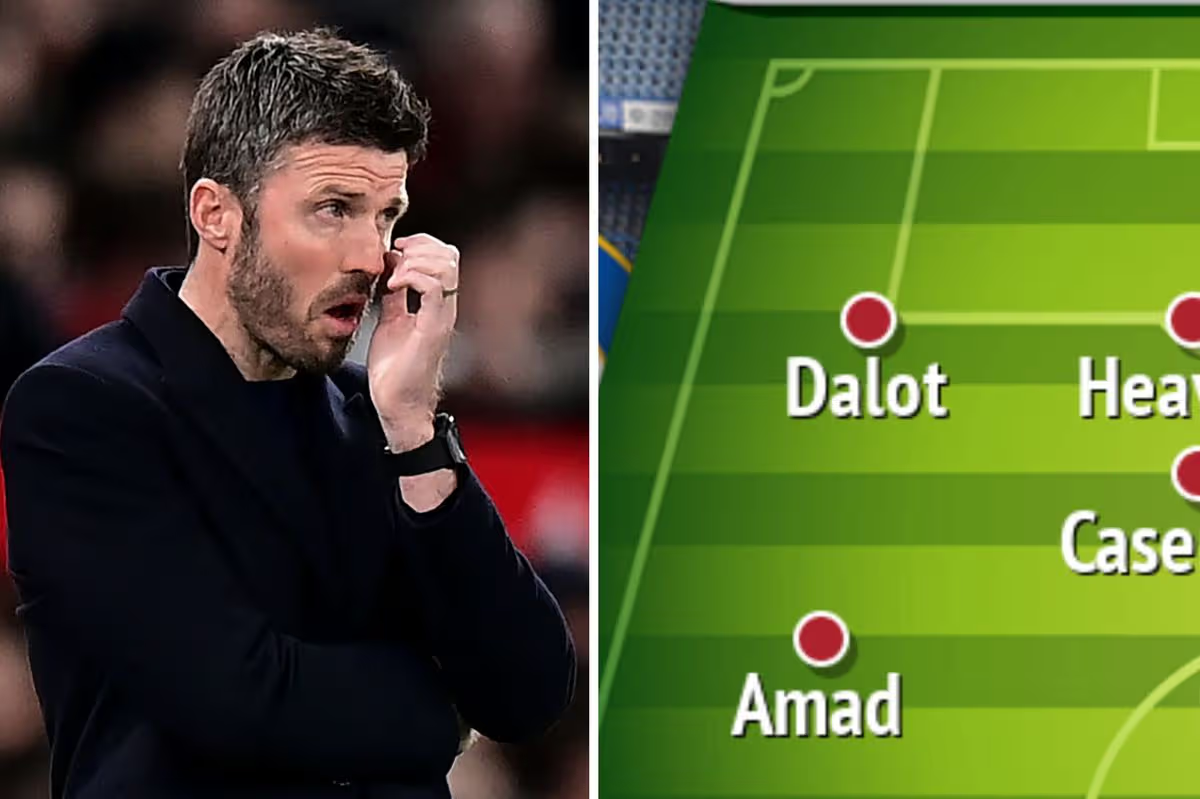
How Manchester United should line up vs Chelsea in Premier League fixture
Uber will now send a courier to your door to return your shopping for $5

Radio 1 DJ and Live Aid presenter Andy Kershaw dies aged 66


-
 NewsBeat5 days ago
Pep Guardiola and Gary Neville agree over Arsenal title problem that benefits Man City
-

 Crypto World4 days ago
The SEC Conditionalises DeFi Platforms to Be Avoided for Broker Registration
-

 Politics6 days ago
World Cup exit makes Italy enter crisis mode
-

 Crypto World4 days ago
SEC Signals Exemption for Crypto Interfaces From Broker Registration
-

 News Videos3 days ago
Secure crypto trading starts with an FIU-registered
-

 Sports20 hours ago
NWFL Suspends Two Players Over Post-Match Clash in Ado-Ekiti
-

 Crypto World4 days ago
SEC Proposes Certain Crypto Interfaces Don’t Need to Register as Brokers
-

 Fashion11 hours ago
Weekend Open Thread: Theodora Dress
-

 Business7 days ago
Ireland Fuel Protests Enter Day 5 as Blockades Spark Shortages and Government Prepares Support Package
-

 NewsBeat4 days ago
Trump and Pope Leo: Behind their disagreement over Iran war
-
 NewsBeat6 days ago
JD Vance announces ‘no agreement’ with Iran over nuclear weapons fear
-

 Crypto World7 hours ago
Russia Pushes Bill to Criminalize Unregistered Crypto Services
-
Sports6 days ago
Dexter Lawrence, Stefon Diggs, Trading for De’Von Achane
-

 Crypto World5 days ago
Trump whales load up ahead of Mar-a-Lago luncheon.
-
 Crypto World5 days ago
Sei Network Enters Quiet Reset Phase as On-Chain Metrics Signal a Slowdown in 2026
-
Business5 days ago
Kering slides after Morgan Stanley downgrade, Gucci woes loom
-
 Entertainment4 days ago
Karol G’s ‘Ultra Raunchy’ Coachella Set Gave ‘Satanic Vibes’
-
 Business1 day ago
Creo Medical agree sale of its manufacturing operation
-

 Sports5 days ago
NWFL opens Pathway for new Clubs ahead of 2026 Season
-
 Entertainment4 days ago
Brand New Day’ Footage Reveals the Devastating Impact of ‘Now Way Home’
You must be logged in to post a comment Login