The North Korean hacker group APT37 has been delivering an Android version of a backdoor called BirdCall in a supply-chain attack through a video game platform.
While BirdCall is a known backdoor for Windows systems, APT37, also known as ScarCruft and Ricochet Chollima, has developed a variant for Android that doubles as spyware.
According to researchers at cybersecurity company ESET, the threat actor created BirdCall for Android around October 2024 and developed at least seven versions.
The attacks that ESET observed delivered the malware through sqgame[.]net, a Chinese site hosting games for Android, iOS, and Windows. However, the researchers found that only Android and Windows are targeted by the ScarCruft attacks.
Advertisement
The particular platform caters to Koreans in the autonomous Yanbian region in China, which acts as a crossing point for North Korean defectors and refugees.
Games on the compromised platform Source: ESET
BirdCall spyware
BirdCall is a known malware family associated with ScarCruft and documented since 2021. The Windows version can record keystrokes, take screenshots, steal from the clipboard, exfiltrate files, and execute commands.
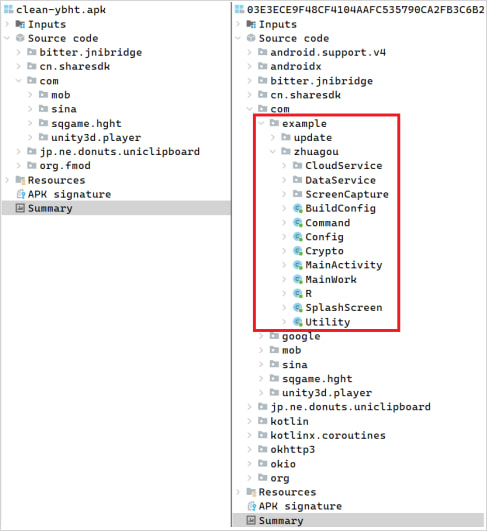
The campaign identified by ESET introduces a previously undocumented version of BirdCall developed for Android, which was delivered by trojanizing APKs on sqgame[.]net.
Trojanized version (right) vs clean APK (left) Source: ESET
The Android variant of BirdCall has the following capabilities:
Extracts IP geolocation information
Collects contact list, call log, and SMS
Collects device OS, kernel, rooted status, IMEI number, MAC address, IP address, and network info
Sends to C2 info about battery temperature, RAM, and storage, cloud configuration, backdoor version, and file extensions of interest (.jpg, .doc, .docx, .xls, .xlsx, .ppt, .pptx, .txt, .hwp, .pdf, .m4a, and .p12)
Periodically takes screenshots
Records audio via the microphone from 7 pm to 10 pm local time
Plays a silent MP3 in a loop to prevent the suspension of its process
Exfiltrates files from a specified directory
ESET’s analysis shows that the Android version of BirdCall does not feature all the commands present in the Windows version yet.
Missing capabilities on Android include shell command execution, traffic proxying, targeting data from browsers and messenger apps, file deletion and dropping, and process killing.
On Windows systems, the infection chain begins with the installation of a trojanized DLL (mono.dll) that downloads and executes RokRAT, which then deploys the Windows version of BirdCall.
Advertisement
ScurCraft is notorious for using a broad range of custom malware, including THUMBSBD, which targets air-gapped Windows systems, the KoSpy Android malware that previously infiltrated Google Play, the M2RAT malware used in targeted espionage attacks, and the Dolphin mobile backdoor.
To minimize the risk of malware infections, users are advised to only download software from official marketplaces and trusted publisher sites.
AI chained four zero-days into one exploit that bypassed both renderer and OS sandboxes. A wave of new exploits is coming.
At the Autonomous Validation Summit (May 12 & 14), see how autonomous, context-rich validation finds what’s exploitable, proves controls hold, and closes the remediation loop.
An incredible update, Alexa+ throws away the stilted conversations of the old and introduces a voice assistant that simply understands what you’re asking. Better at general responses, able to disseminate information from emails and charts, and capable of building smart home routines quickly, Alexa+ is light years ahead of the competition. It can be a bit over-friendly at times and quite verbose, but the beauty of this system is that you can tell Alexa+ what you do and don’t like to get it working the way you want. The only real downside is that the local business search is terrible, but everything else is so much better that it’s got me talking more and using my phone less.
Understands context and learns your preferences
You can use natural language
Capable of building complicated routines
Can pull information from emails, photos and documents
Responses can be a long-winded until tweaked
Local business directory isn’t very good
Key Features
Advertisement
Free for now
No cost during the Early Access service, then bundled with Amazon Prime.
Advertisement
Works with most Echo speakers
All speakers bar some first generation models support Alexa+.
SQUIRREL_PLAYLIST_10208358
Advertisement
Introduction
Amazon Alexa was a magical concept at launch. It finally felt as though the future that Star Trek promised us was here, with a personal assistant you could talk to. As good as it was, clunky interactions via ‘Alexa Speak’ and several limitations ended up with Alexa (and its competition) feeling slightly more niche. Amazon Alexa+ fixes that.
The GenAI-powered voice assistant is miles ahead of the original, and miles ahead of the competition. I wrote about my initial thoughts after a week with the service, describing what Alexa+ was good at (and what it needed to improve), but I’ve had more time with the system, so read my full review to find out why it’s the best.
Advertisement
Availability and compatibility
To get Alexa+, you need to sign up for the Early Access programme, which is currently by invitation. The quickest way to jump up the queue is to get a new Alexa device, but eventually, the system will be rolled out to everyone. Most devices (bar a few first-generation ones) are supported, although the new versions have dedicated chips that help with the processing.
Advertisement
My guide on how to enable Alexa+ goes into more detail on how to get the system, and which devices are compatible. Currently, Alexa+ is free while on early access, and then it will be bundled with Amazon Prime, although you can pay £19.99 a month to have the service. Clearly, Amazon Prime is a much better way of getting it.
General conversations and information
Understands general speech
Much better at context
Can be over-friendly
Although Alexa+ works in the same way as standard Alexa (you say, “Alexa”, followed by your request), the new system operates in a completely different way. Gone is the need for ‘Alexa Speak’ (saying things in a specific way to get Alexa to understand), replaced with natural conversation. And, the replies are more natural, too, with Alexa understanding and building context, as it goes.
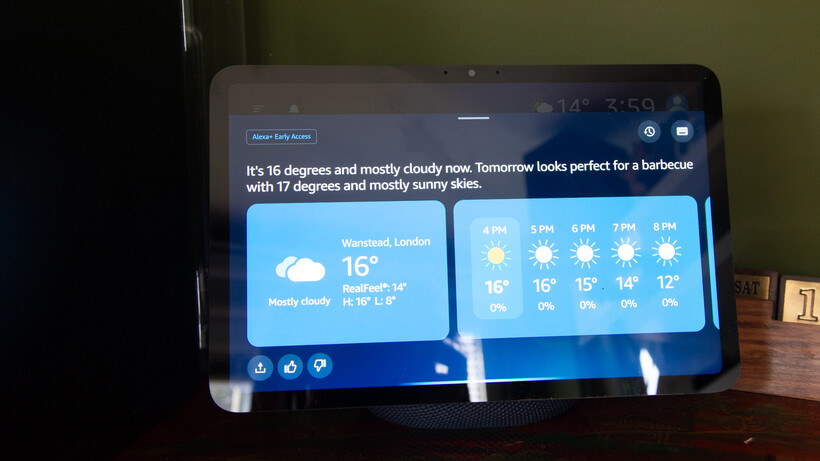
More natural conversations make it a lot easier to talk to Alexa. Sure, I can have the standard interaction, such as “Alexa, weather”, to find out what the upcoming weather is like. But, I can also ask, “When’s a good day to have a BBQ?” or, “Is the weather going to be consistently nice this week?” and not only does Alexa understand, but it gives sensible answers.
Image Credit (Trusted Reviews)
Advertisement
Alexa+ is also much better at context. By default, it stays listening after a reply, so you can follow up with another question. But if you go silent, you can follow up with another question at any point. In my example about the BBQ, I followed up 20 minutes later with, “Alexa, and what about next week?”
That’s limited context, but Alexa+ also builds up information about you, both explicitly (when you first get the service, it asks some basic questions, such as what your favourite type of music is) and through inference, such as by learning that you like a specific football team.
Advertisement
That’s surprisingly powerful. Once Alexa+, for example, has learned which of your friends are vegetarian, it will adjust the recipe ideas it suggests if any of them are coming around.
Alexa+ can also moderate its responses, adjusting emotion based on the news it gives you. As a Spurs fan, Alexa’s replies about the latest game are usually said with a slightly sad voice, although a recent win came with a more excited response.
It feels much more natural to talk to Alexa+ than to Alexa. Although there are still some oddities. Sometimes, when a reply consists of multiple sentences, the pause between each is a little off. Rather than flowing naturally, a second sentence starts abruptly, almost before the first sentence has finished. It sounds a little like Alexa+ is interrupting itself.
In terms of replies, it helps that the new service can retrieve information from a wider range of sources. All too often with standard Alexa (and pretty much all of the time with Siri), I’d hit the limit of capability, with questions that can’t be answered.
Advertisement
Advertisement
That doesn’t happen often at all with Alexa+. I asked if the recent tube strikes were going ahead, and Alexa+ told me they were, when they’d start, when they’d end and how trains could be affected after people started to return to work.
Generally, if you want to know the answer to something, Alexa+ can give you the answer in a way that makes sense.
But, it does need tweaking. Asking about the tube strike, Alexa+ was almost excited to tell me it was going ahead, and needed reminding that this was bad news and to tone it down.
Advertisement
Similarly, I don’t like some of the out-of-the-box responses, as they feel forced. Ask about football, and Alexa likes to say ‘mate’ a lot, a bit like it’s been programmed by watching poorly-written football beer adverts. I told Alexa+ not to call me ‘mate’ and it has stopped.
Often, Alexa+ can be too verbose, trying to be chatty, but in an unconvincing and slightly odd way. I’ve told it to be brief and to-the-point with answers, and it’s much better.
All of that’s important, as Alexa+ can be tweaked: what you get at the start and what you get weeks later are quite different. Just remember to keep tweaking and feeding back to get Alex+ to behave the way that you want it to.
Advertisement
Advertisement
For all the tweaking that you can do, there are some issues and obstacles that can’t be overcome. Asking Alexa+ about Spurs on my Echo Show 11 has the response on screen, along with some extra information that runs across the bottom. Only, the snippets of information are about the San Antonio Spurs, which isn’t very helpful.
Image Credit (Trusted Reviews)
Local business search is also, quite frankly, rubbish. Amazon says it’s working on it, and boy, does it need to. “Alexa, what’s the nearest French restaurant?” I asked. The answer was Le Marmiton, Wanstead. Not only is that restaurant an eight-minute walk from my house (so not the closest one), but, the main issue is that Le Marmiton shut down in 2023.
On my Echo Show, the response says, “It’s open today from 5pm to 9pm”, but the snippet below from TripAdvisor clearly shows that the restaurant is closed today (and, in fact, forever).
Image Credit (Trusted Reviews)
Restaurants that still exist and are on OpenTable can be booked via voice. It’s a neat system that makes Alexa+ do the hard work of finding a table for the number of people you want, at the time you want. One limitation is that you can’t book restaurants that require a credit card, although this is being worked on, too.
Advertisement
Documents, calendars and more
Can read documents and create tasks and calendar entries
Work accounts not supported
AI is very good at understanding structured data. That, combined with email and calendar management, means that Alexa+ can be a kind of personal assistant. Well, provided you don’t pay for your email. I use hosted Exchange for my personal email, but this type of account isn’t supported, nor is a Google Workspace account. That’s a little annoying, as it means creating a free Gmail or similar account for the time being.
What is very good is that via the app or by sending emails to [email protected] from a registered email address (set via the Alexa app), Alexa+ can pull out information, create reminders and calendar appointments.
Advertisement
Sending an email with a PDF containing information on my daughter’s upcoming DoFE expedition, the Alexa app pinged a few minutes later to tell me it had found some appointments and tasks, all spot-on, and all ready to go straight into the calendar.
Trying to go through the appallingly formatted term dates page on my daughter’s school is a nightmare, but I used the Alexa app to take a photo of it, and it quickly worked out when the inset days were and the holidays, letting me add them to my calendar. Cleverly, as we’re partway through a school year, Alexa+ ignored everything that’s already passed.
With full email support, I can see Alexa+ become core to managing everything – please, Amazon, hurry up and add work accounts!
Advertisement
Advertisement
Smart home control
Smarter responses
Can build Routines using voice
The same old basic commands work, such as turning on lights, or setting them to a specific temperature. But, Alexa+ is also smarter and makes it much easier to interact with.
Tell Alexa+ that it’s cold, and it will boost the heating around you. With standard Alexa, I’d need to ask what the temperature was and then ask again to set the heating to a temperature above that. Tell Alexa+ that it’s dark, and it can turn the lights on for you.
Thanks to better language processing, Alexa+ mostly understands what I want it to do, and I don’t have to phrase requests in a specific way.
Alexa+ can also build routines for you, via voice, which can be tweaked and edited in the app. I find that it’s often faster to do things this way, rather than the old app-based one.
More complicated commands can also be turned into one-time Routines. “Alexa, turn off the office lights in 10 minutes’ time” does just that.
Advertisement
Advertisement
It’s possible to string together a series of commands for a one-time run, too, such as turning the lights on, waiting for 10 minutes, and then turning them off again. These commands can often go a bit wrong.
“Alexa, set Dave officer heater to 25° and then after five minutes turn it off,” I said. This then got Alexa+ to create a routine that did what I’d described, only the command to trigger the routine was the exact, lengthy phrase that I’d said above. That’s clearly not what I wanted, but Alexa+ is getting there, making the complex much easier.
Image Credit (Trusted Reviews)
SQUIRREL_PLAYLIST_10208358
Should you buy it?
Advertisement
You want a smarter assistant
Much more powerful than its competition, Alexa+ is the voice assistant to use.
Advertisement
You don’t want a smart assistant
There’s no real comparison between this and its rivals, so only avoid if you don’t want a smart assistant.
Advertisement
Final Thoughts
I’d practically stopped using standard Alexa for anything more than basic requests: timers, turning a specific light on, or setting an alarm clock. Alexa+ changes that.
Yes, there are areas that need improvement (Routines and local business search are two good examples), but the general interactions are so much better. When I want the answer to a question, I now tend to ask Alexa+ rather than digging out my phone – and it helps me avoid getting trapped in doomscrolling along the way. The ability to tweak Alexa+ to understand your preferences and learn your context makes it even more powerful.
There’s simply no competition at the moment: when it comes to everyday life, general questions and smart home control, Alexa+ is so far ahead of the competition.
Advertisement
Advertisement
FAQs
Do you have to pay for Alexa+?
Alexa+ is free during Early Access, but it will eventually be bundled with Amazon Prime, or it will alternatively cost £19.99 a month.
Advertisement
Can I get Alexa+ now?
The short answer is yes, but you have to sign up for the invite, and people who have bought a more recent Echo speaker will get priority access.
There’s something about the ESP32 family of microcontrollers and timekeeping. We probably see it in clocks as often as we do anything else; we also probably see more clocks with one as the beating heart than any of the many other possible timekeeping options.
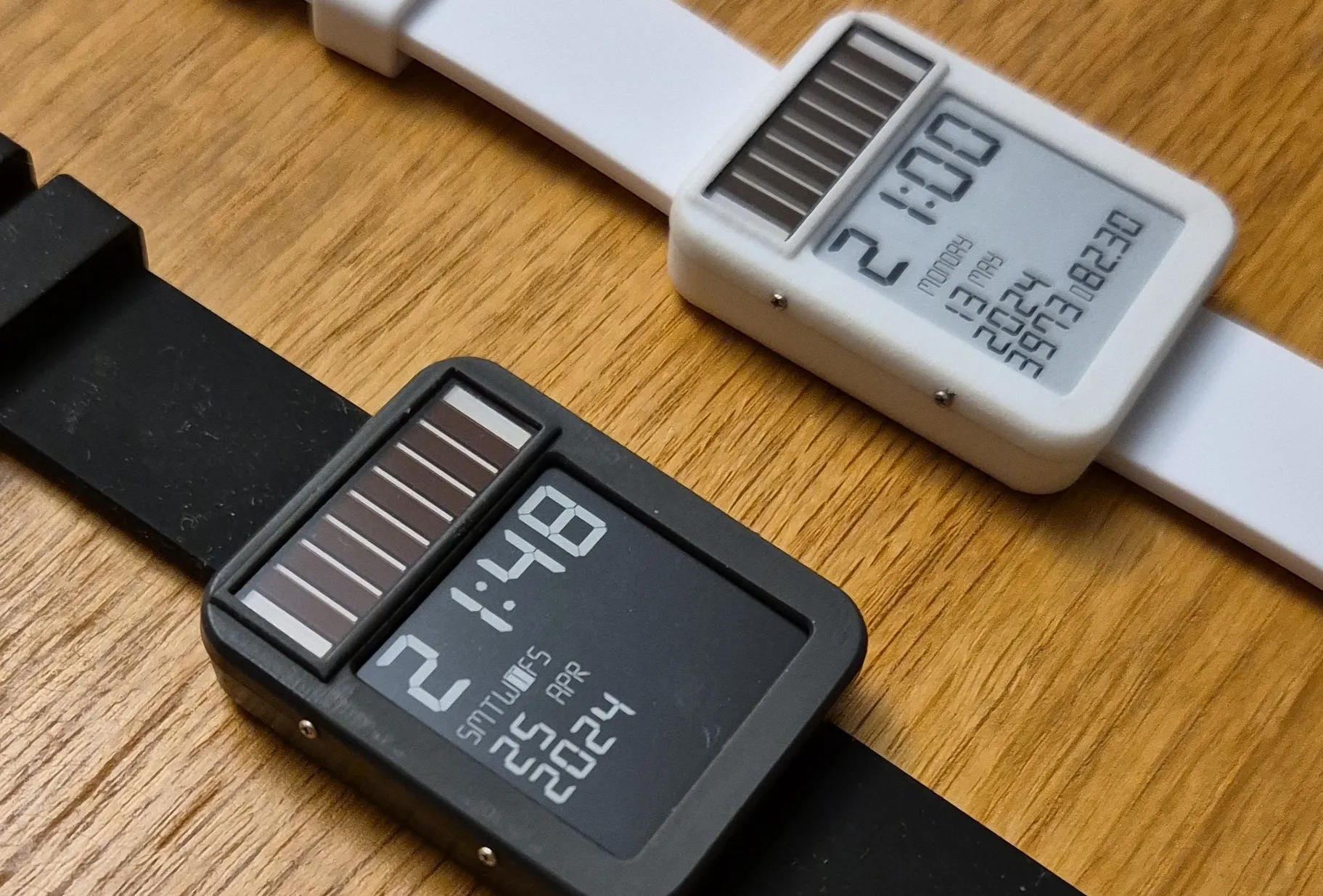
[Daniel Ansorregui]’s LightInk watch is no different in that regard — but it is very different in one important detail, because like any other smartwatch, you won’t have to worry about battery life. Outside of gloomiest Gotham, its built-in solar panel should be able to keep it charged.
That’s for a few reasons. The obvious one is the e-ink display, which only takes a sip of power during updates. That’s hardly unique to [Daniel]’s projec t– he quite explicitly calls out the Watchy project, which we featured previously, as where he got the idea of putting e-ink and an ESP32-PICO together on his wrist. What is unique is the delightful hack [Daniel] is using to minimize power usage, which is our favorite part.
Obviously while the display isn’t updating and there’s no input from the touchscreen, the microcontroller should be in deep sleep. So, [Daniel] sets wake-up timers and an interrupt for the touch input and it’s all good, right? Well, yes, but when the ESP32 ran through a normal startup, [Daniel] clocked 28 mS to boot — and a whole milli-amp-second of juice out of the battery. That was pretty much down to the need to write the code from flash into RAM, and good luck power-optimizing that. Instead [Daniel] found a way to skip it, using the RTC.
Advertisement
The RTC has its own memory, which the ESP32 can start from in a microsecond or so. It turned out large enough to squeeze everything needed for these fast updates, including the SPI display driver. Since around two thirds of the watch’s power consumption was just booting up, slicing that doubled the energy efficiency, making solar power possible. Well, as long as you don’t get too excited using the fancier “smart” features like GPS and LoRA too often. Relatively speaking, those are power hogs. There are actually a lot of features, but we’ll let you check them out in the demo video below if you’re really interested.
Considering its raw power, the Hoover HF6 TurboSense is quite a bargain, costing far less than its flagship rivals. Cleaning performance is generally very good, although edge performance was a bit behind the competition. It’s a little bulky in the hand, but this vacuum isn’t too heavy, and it does stand up by itself, which is a useful trick when you need to temporarily pause cleaning. Overall, if you want a lot of power but don’t want to pay a huge amount of money, this vacuum is great value.
Good battery life
Can stand up by itself
Lots of power
Good cleaning for the price
Weight not that well balanced
Edge cleaning could be better
Key Features
Introduction
The more recent Hoover vacuum cleaners have been good, but straightforward mid-range models. With the HF6 TurboSense, the company has a cordless cleaner that’s quite a bit more powerful than its others, with some clever tech built in, including automatic floor detection.
Advertisement
Despite the advance, the HF6 remains excellent value. So, should you go for this over one of the big rivals? Read on to find out.
Advertisement
Design and features
Stands up by itself
A little fiddly to empty
Detects the floor type automatically
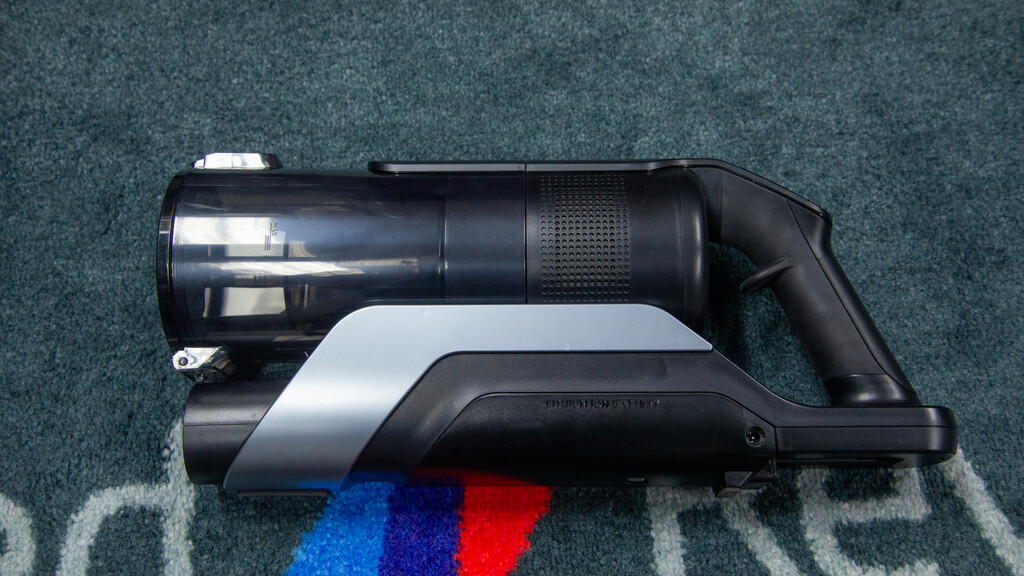
An all-black finish gives the Hoover HF6 TurboSense an air of quality and makes it look like the high-end vacuum cleaner that it is. It’s a very sleek vacuum cleaner, with the handheld unit streamlined with few bits sticking out.
Image Credit (Trusted Reviews)
It comes with a wand that plugs into the handheld unit, and then into the accessories or the floor head.
For me, weight is often as much about balance as it is about how much something actually weighs. Due to the way that the weight is distributed, the Hoover HF6 TurboSense naturally wants to point down. That’s good when you’re using the floor head or are vacuuming around the floor using the crevice tool; if you do want to clean higher up, say snagging cobwebs, then that’s a bit harder.
Advertisement
Advertisement
Lifting the Hoover HF6 TurboSense up with one hand, I found it hard to hold it steady, and needed a second hand to stabilise it. For most jobs this isn’t an issue, but there are rivals that have better balance for handheld use.
Image Credit (Trusted Reviews)
However, part of the reason the weight is positioned as it is is that the Hoover HF6 TurboSense can temporarily stand upright on its own. That’s great when vacuuming, as I could lock the cleaner upright, and then move some furniture around, before getting back to cleaning.
In the box, Hoover provides a crevice tool, dusting brush and floor head. The latter, Hoover promises, is an anti-hair-wrap model that won’t get tangled with hair.
Image Credit (Trusted Reviews)
Floor detection is also built in, and the Hoover HF6 TurboSense can work out if it’s on carpet or a hard floor, adjusting the spin speed of the brush bar and changing the colour of the lights (white for carpet and blue for hard floor). It’s a nice visual indicator, but floor detection is an important technology, helping to avoid flicking debris around on hard floors or missing dust on carpet.
Advertisement
Advertisement
There’s no dust detection built in, so you’ll need to use the three available power modes on the back, using the ‘+’ and ‘-‘ buttons to cycle through them. There’s also a separate power button.
Image Credit (Trusted Reviews)
Battery life is displayed on the screen, with four bars that extinguish one at a time. I do prefer a screen that shows live battery life in minutes, as with the Dyson V16 Piston Animal, but you have to pay a lot more for that feature.
Charging can be done in two ways. The easiest, in my view, is to fit the wall dock and then hang the vacuum cleaner when you’re done to charge it. If you can’t do that, then the power adaptor can be plugged straight into the vacuum cleaner.
Image Credit (Trusted Reviews)
Advertisement
There’s a removable battery on this model, so should it fail, you can buy a replacement from Hoover and quickly replace it yourself.
Image Credit (Trusted Reviews)
Dirt is sucked into the 0.7-litre bin. To empty it, you point the vacuum at your bin, hit the eject button and the flap at the front opens to let the dust out. Typically, doing this creates a bit of a mess, and it’s hard to empty cleanly. Bigger bits of fluff tend to need a bit of a bang to help them out.
Image Credit (Trusted Reviews)
You can remove the entire bin by opening both sides so you can rinse it out. Doing this lets you access the washable filter, too.
I did find it hard to get the bin back into place. In the end, I had to remove the wand, place the handheld unit on the floor, and gently push the bin back into place until it clipped into place.
Advertisement
Advertisement
Performance
Good on carpet and hard floor
Doesn’t get tangled with hair
Edge performance is a bit more basic
I like to measure the raw suction performance of vacuum cleaners at the handle to see how much power they really have. I measured the Hoover HF6 TurboSense at 28AW on its lowest setting (good enough for very basic jobs), and a more usable 125AW on the mid setting (suitable for most jobs), going to a massive 336AW on the highest setting.
In terms of raw performance, that maximum is similar to that of the Shark IA3241UKT and not too far off the Dyson V16 Piston Animal.
Image Credit (Trusted Reviews)
High suction is typically useful for picking up bigger bits of debris with handheld tools from a distance, such as when cleaning out a wardrobe or vacuuming a car. To demonstrate this, I measure how far from the crevice tool a vacuum can collect grains of rice. In this case, it’s a whopping 2.9cm – that shows that handheld jobs will be fast.
Advertisement
Next, I moved on to the standard tests, starting by adding 20g of flour to the floor. I used the middle setting to move through the mess and was pleased to see clean, sharp lines.
Advertisement
I then finished off vacuuming until the carpet looked clean and gave it a burst of the top power mode for good measure.
Image Credit (Trusted Reviews)
Overall, I found that 89.40% of the dirt made it into the bin. A good score for the price, but a little behind the best in the business. On close inspection, the carpet shows no signs of dust, so some of the mess could be in the wand or floor head.
Next, I tried the edge test, adding 10g of flour to the skirting board. Running the vacuum cleaner along this on its maximum mode, I recorded that 78.6% was picked up. I had to finish the job with the crevice tool.
Advertisement
I then moved to the hard floor test, adding 20g of rice to the hard floor. All of this spill was collected without any mess dropping back out.
Advertisement
Cat hair, combed into the test carpet, was removed easily, with a single forward/backward swipe over the top.
I finished off with my human hair test. I’m pleased to say that no hair strands were wrapped around the brush bar at the end of pickup.
Advertisement
Battery life is up to 100 minutes on the lowest power setting, but you’ll need to use higher power settings than that. On the Boost setting I saw battery life of 16m 50s, which is impressive.
Advertisement
Sound-wise, I registered the Hoover HF6 TurboSense at between 67.5dB and 73.8dB, which compares well with other vacuum cleaners: loud, for sure, but not annoyingly so.
Should you buy it?
You want a powerful vacuum cleaner at a reasonable price
Exceptional value, the Hoover HF6 TurboSense is powerful and cleans well on most surfaces.
Advertisement
If you want a vacuum that can auto empty or one with a dust sensor to adjust power on the fly, look for a different model.
Advertisement
Final Thoughts
There are vacuum cleaners that can pick up more mess and that have more features, such as dust sensors (you can see these in my guide to the best cordless vacuum cleaners), but they’re also a lot more expensive. At the recommended price, the Hoover HF6 TurboSense is a lot of vacuum for the money, but you can frequently find it for less, making it a bargain.
Advertisement
How We Test
We test every vacuum cleaner we review thoroughly over an extended period of time. We use industry standard tests to compare features properly. We’ll always tell you what we find. We never, ever, accept money to review a product.
Advertisement
Find out more about how we test in our ethics policy.
Used as our main vacuum cleaner for the review period
Tested for at least a week
Tested using tools to measure actual suction performance
Tested with real-world dirt in real-world situations for fair comparisons with other vacuum cleaners
FAQs
What auto-detection features does the Hoover HF6 TurboSense have?
It can detect the floor type it’s on, adjusting the brush bar speed automatically for hard floors and carpet.
Bloomberg reports Apple is in early-stage discussions with Intel and Samsung about producing some of its M-series chips. The talks are exploratory; the signal is significant.
Apple’s silicon strategy has, for nearly a decade, run on a single foundry relationship. Bloomberg reported on Tuesday that the company is now exploring early-stage discussions with Intel and Samsung Electronics about manufacturing some of its M-series processors, in a quiet move to diversify production away from Taiwan Semiconductor Manufacturing Company. 9to5Mac confirmed the reporting on the same day, framing it as the most concrete signal yet that Apple is taking foundry concentration risk seriously enough to act on it.
Apple is not, on the available reporting, planning to walk away from TSMC. The discussions are at an early stage, no orders have been placed, and Apple has internal concerns about whether non-TSMC technology can match the yield, performance, and timing the company has come to depend on.
The most likely scenario, by AppleInsider’s analysis, is that Apple uses Intel or Samsung for its lower-end M-series parts, the chips that ship in MacBook Air, iPad Pro, and similar mid-volume products, while keeping its highest-performance silicon on TSMC nodes. Initial shipments of any non-TSMC part are not expected until the second or third quarter of 2027.
Advertisement
The strategic logic is two-track. The first track is geopolitical: TSMC’s continued concentration in Taiwan is a known supply-chain risk in any scenario involving a Chinese move on the island, and Apple has been quietly diversifying around that question for years. The second track is commercial.
The 💜 of EU tech
The latest rumblings from the EU tech scene, a story from our wise ol’ founder Boris, and some questionable AI art. It’s free, every week, in your inbox. Sign up now!
Intel’s foundry services have been rebuilding under Lip-Bu Tan’s leadership, with Apple as one of the customer relationships Intel has reportedly pursued most aggressively. Samsung’s foundry, while a step behind TSMC on leading-edge nodes, has historical capability and excess capacity. Both companies want Apple business badly. Apple, by extension, has unusual leverage.
Advertisement
The challenge nobody has fully solved
The hard problem is yield. Industry analysts at Semiwiki have tracked the gap between TSMC’s leading-edge nodes and Intel’s and Samsung’s equivalents through 2026, and the consensus is that both alternative foundries are closer to TSMC’s quality than they have been in years, but neither has fully closed the gap. For Apple, which has historically shipped tens of millions of M-series units per year and demands consistent performance across that volume, even a small yield difference compounds into meaningful product-cost and customer-experience differences.
The supply context also matters. TNW reported last week that Apple raised the entry-level Mac mini’s starting price from $599 to $799 after AI-driven demand depleted inventory at higher configurations. That kind of demand pressure makes any foundry diversification more urgent, but also riskier: a yield problem at a new manufacturing partner would amplify, not relieve, the supply constraint Apple is currently dealing with.
Tuesday’s reporting is, in itself, unlikely to change Apple’s near-term product roadmap. The longer-term signal is more consequential. Apple has, for the first time in its modern silicon era, publicly hinted that the TSMC relationship is no longer treated as singular. Whether the eventual outcome is a partial second-source arrangement, a long-running negotiating posture, or no change at all, the fact that Apple is publicly signalling diversification interest changes the bargaining table for all three foundries.
The next signal will come not from Apple but from Intel and Samsung. If either announces a leading-edge process win that includes Apple as a customer over the next 12 to 24 months, the diversification thesis will have moved from exploration to commercial reality. If neither does, the discussions will be remembered as one of the smaller chess moves in Apple’s longer game with its most important supplier.
Singapore’s labour market has continued to expand, but locals aren’t driving most of the growth
In Mar, Singapore’s Ministry of Manpower (MOM) released its quarterly Labour Market report, highlighting job trends in the city-state, including employment growth and workforce composition.
Since the fourth quarter of 2021, the labour market has continued to expand, and for the full year of 2025, total employment grew by 55,500, up from 44,500 in 2024.
However, of these 55,500 jobs, 79% (or 43,900) went to non-residents, while just 11,600 were taken up by residents (citizens and permanent residents).
This works out to roughly a four-to-one ratio—meaning that for every new job secured by a resident last year, about four went to a foreign worker.
Advertisement
Where the jobs went
A closer look at the data reveals that resident job growth is not only smaller in scale, but also more narrowly concentrated.
In 2025, most gains among residents were clustered in higher-skilled sectors such as financial services and health and social services.
Non-resident employment, on the other hand, was driven largely by sectors with more labour-intensive demands. Construction stood out as a key industry, continuing its reliance on foreign manpower to support infrastructure and building projects.
In the fourth quarter of 2025, both resident and non-resident employment rose in administrative & support services and retail trade, largely driven by seasonal hiring for events and the year-end holiday period.
Advertisement
Not a one-off trend
2025 was not an outlier. This year’s figures are simply the latest in a pattern that has played out consistently over the past few years.
Year
Total Employment Growth
Resident
Non-resident
2023
+88,400
+4,900
+83,500
2024
+44,500
+8,800
+35,700
2025
+55,500
+11,600
+43,900
Source: Singapore’s Ministry of Manpower
In each of the past three years, non-resident employment growth has significantly outpaced resident growth. In 2023, a strong year for total employment growth, residents accounted for less than 6% of all new jobs.
Even in 2025, a year that saw a notable increase in resident employment, non-residents still accounted for close to four in five of all new jobs created.
The reasons for this shift are partly structural, and the Ministry of Manpower has been fairly direct about why.
Advertisement
In its Q4 2025 Labour Market Report, MOM noted that Singapore’s resident labour force participation rate is already high, leaving limited scope for further expansion of the local workforce.
For those aged 25 to 64, the figure stands at 85.9%, one of the highest in the world. Most people who can work and want to work are already in the workforce—there simply are not many residents left on the sidelines to bring in, which naturally limits how much further resident employment can expand.
At the same time, businesses continue to face manpower needs, whether for growth, replacement, or sector-specific demands, that cannot be fully met by the resident pool alone. Non-resident workers help fill these gaps, particularly in industries that struggle to attract or retain local workers.
Looking ahead, the Ministry of Manpower expects these trends to persist.
Advertisement
For 2026, resident employment is projected to grow at a similar or slightly slower pace than in 2025.
Non-resident employment, on the other hand, is expected to continue expanding alongside economic demand, particularly in sectors such as construction and other manpower-intensive industries, where hiring has remained strong in recent years.
Read other articles we’ve written on job trends here.
Featured Image Credit: Shadow of light/ Shutterstock
Caption: Microsoft CEO Satya Nadella discusses the company’s Copilot initiatives. A new Microsoft study finds that the biggest barrier to AI at work isn’t the technology — it’s the organizations around it. (GeekWire File Photo / Kevin Lisota)
[Editor’s Note: Agents of Transformation is an independent GeekWire series, underwritten by Accenture, exploring the adoption and impact of AI and agents. See coverage of our related event.]
A new Microsoft study of 20,000 artificial intelligence users in workplaces around the world concludes that the biggest barrier to getting real value from AI isn’t the technology or the workers themselves — it’s the ingrained culture of the organizations where they work.
That “Transformation Paradox” is one of the central findings from Microsoft’s annual Work Trend Index, released Tuesday morning, which paints a picture of employees eager to reshape their jobs and organizations that aren’t really in a position to make it happen.
Sixty-five percent of the AI users surveyed said they fear falling behind if they don’t adopt AI quickly. But only 13% said they’re rewarded for using and experimenting with AI in their jobs.
“Employees are ready to reinvent how they work, but the system around them—metrics, incentives, and norms—continues to reinforce the old way,” Microsoft says in the report.
Advertisement
The takeaway: For companies to truly capitalize on the AI revolution, leaders need to fundamentally overhaul how work is structured, managed, and rewarded, rather than simply handing workers new tools and expecting them to figure it out.
Matt Firestone, general manager of Microsoft’s Frontier Firm initiative, said the message to leaders has changed. Two years ago, executives were under pressure from their boards to unlock value from AI. Now, he said, the message is that their people are already there.
It’s the job of leaders to “re-architect work,” Firestone said in an interview ahead of the report’s release. “Your job is to convert the individual agency and capacity and abilities of your people to unlock that and apply it to increase business value for the enterprise.”
Leaders who encourage employees to experiment with AI and share their experiences create “these incredible systems of learning that drive us forward into the agentic era,” he said.
Advertisement
Of course, this also serves Microsoft’s interests: the company is betting heavily on agents for the next phase of its outsized AI product ambitions, and a report that says organizations need to change how they work is also a pitch for more tools, training, and licenses.
Alongside the report, Microsoft is announcing new capabilities for Copilot Cowork, including a mobile app and a plugin ecosystem for connecting to third-party business systems.
This year’s Work Trend Index was narrower, covering 20,000 workers across 10 countries, down from 31,000 across 31 countries in recent years. The survey was conducted by Edelman Data x Intelligence. In a new twist, it also excluded anyone who doesn’t already use AI at work.
Advertisement
As it has in the past, Microsoft also analyzed trillions of anonymized productivity signals from Microsoft 365. The company partnered with Harvard Business School and in-house organizational psychologists to interpret the findings.
Nearly half of all Copilot interactions involve analysis, decision-making, and problem-solving. (Microsoft Graphic, click to enlarge.)
New this year was an analysis of more than 100,000 Copilot chats, classified by the type of work involved. That analysis found that 49% of all Copilot interactions involved cognitive work — analyzing information, solving problems, and thinking creatively — rather than simpler tasks like summarizing documents or finding information.
Microsoft is using that data point to assert that AI is not just making workers faster but expanding the types of work people can accomplish.
The rise of ‘Frontier Professionals’
Fifty-eight percent of AI users surveyed said they are producing work they couldn’t have a year ago, rising to 80% among a group the report calls “Frontier Professionals” — the 16% of AI users who routinely use agents for multi-step workflows, redesign how their work gets done, and share what they learn with their teams.
These Frontier Professionals are also more deliberate about when not to use AI: 43% said they intentionally do some work without it to keep their skills sharp.
Advertisement
The largest group of AI users in the study (42%) sat in what Microsoft called the “emergent” middle, where both individual skills and organizational support are still taking shape.
On the organizational side, the report found that culture, manager support, and talent practices account for more than twice the AI impact of individual factors like mindset and behavior.
When managers actively modeled AI use, employees reported a 17-point increase in the value they got from AI and a 30-point boost in trust in agents, according to a separate Microsoft study of 1,800 workers. But only one in four AI users said their leaders are clearly aligned on AI.
Emerging AI adoption patterns
The report also includes Microsoft’s first Work Trend Index data on AI agents, showing a 15x year-over-year increase in active agents on Microsoft 365, rising to 18x in large enterprises. Microsoft did not disclose the baseline, making it difficult to assess the actual scale of adoption.
Advertisement
The new report says adoption patterns vary by industry. As would be expected, software and technology companies showed the broadest use of agents across job functions.
But Microsoft said it was surprised by the depth of adoption in manufacturing, where fewer companies were using agents but those that did were deploying them heavily in specific tasks. Banking and capital markets, retail, and education also showed significant agent adoption.
In a blog post accompanying the report, Jared Spataro, Microsoft’s chief marketing officer for AI at Work, described four emerging patterns for how humans and AI agents work together:
Author: The worker produces the work, calling on AI for help as needed.
Reviewer: The worker sets the intent and AI creates a first draft to edit and approve.
Director: The worker hands off entire tasks for AI to execute and signs off on the outcome.
Orchestrator: The worker designs a system where multiple agents run in parallel, flagging exceptions back to the human.
Firestone compared the current moment in AI to the early days of mobile apps, when people were building apps before app stores and permission models existed.
“People are building agents. They’re hobbyists,” he said. “Their personal knowledge is extending the professional workplace. This is a new wave of technology, but all of the fundamental instincts of how to transform the workplace haven’t changed.”
The anti-vaccine sugar rush that has infected some portions of the country, largely thanks to the profane appointment of RFK Jr. to head HHS, is incredibly frustrating. That makes it all the more important when the movement receives not just pushback when trying to enact absurd policy based on conspiracy theories, but specifically when that pushback comes from the same party engaging in the absurdity.
Earlier this year, flanked by Ron DeSantis, Florida’s Surgeon General, Joseph Ladapo, announced that the state government was seeking to end all vaccine requirements for school children in the state. And, because Ladapo is a hack, he postured this move in the silliest way possible.
Ladapo said the Florida Department of Health would be working with Gov. Ron DeSantis’ office to end all mandates in state law, at the event at Grace Christian School in Valrico, located just east of Tampa.
“Every last one of them is wrong and drips with disdain and slavery,” Ladapo said of vaccine mandates.
Equating vaccine mandates to slavery may well be one of the dumbest analogies a human being has ever come up with. Vaccines save lives, prevent illness, and go a long way toward staving off the long term effects of many infectious diseases. Suggesting that any of that is akin to the slave trade reveals far more about the person making such a silly accusation than it does about our vaccination programs.
Advertisement
DeSantis, for his part, stated that some vaccine requirements could be removed immediately, while others would require state legislation. But the legislation drawn up to achieve that has hit a major roadblock, and that roadblock is Florida’s House GOP.
Just minutes into a special session on Tuesday, Florida House Speaker Daniel Perez announced that the Republican-led chamber would not take up a proposal from DeSantis to allow children to opt out of certain school vaccination requirements. The move effectively killed the proposal, which had been backed by the Senate.
Perez, a father from Miami with three young children, said he was concerned by the idea of “children being in school without measles and mumps and polio and chickenpox vaccines that have been working for decades,” according to The New York Times, which reported from the State Capitol. “That was something that I was uncomfortable with.”
Thank the universe for sane, thinking members of the GOP, in this case. Perez is precisely correct: vaccines have worked for a long, long time and removing their requirement in public schools serves to only make more children more sick. It ignores our collective responsibility for the health of those around us, some of which have underlying conditions that mean they can’t get vaccines they would otherwise desire. Why in the world should someone in that unfortunate situation have to literally risk their lives in order to go to school? What are those kids supposed to do, just because someone bought into the vaccine misinformation?
None of these anti-vaccine goobers ever seem to want to answer that question. Instead, they retreat to their “Don’t Tread On Me” slogans, or other talking points. As for DeSantis, sane questions like this are pure political games, apparently.
Advertisement
On social media, DeSantis responded to the House’s rejection by calling it “typical political shenanigans.”
Ladapo also responded, saying: “The governor’s agenda to defend freedom, whether from medical tyranny or tech oligarchs, is something Floridians and Americans everywhere want and value. Members of the Florida House should be leading that effort, not standing in the way.”
Those House members are representing their districts, Mr. Surgeon General. Better than you are, I would argue. And does anyone actually read these boot-licking comments from Ladapo and conclude that any of it represents sincerely held beliefs, rather than a sincere desire to remain in power?
Certainly not this writer, I can tell you. This is more pandering for politics on the part of Ladapo. And he will eventually have the blood of children on his hands if he gets his way.
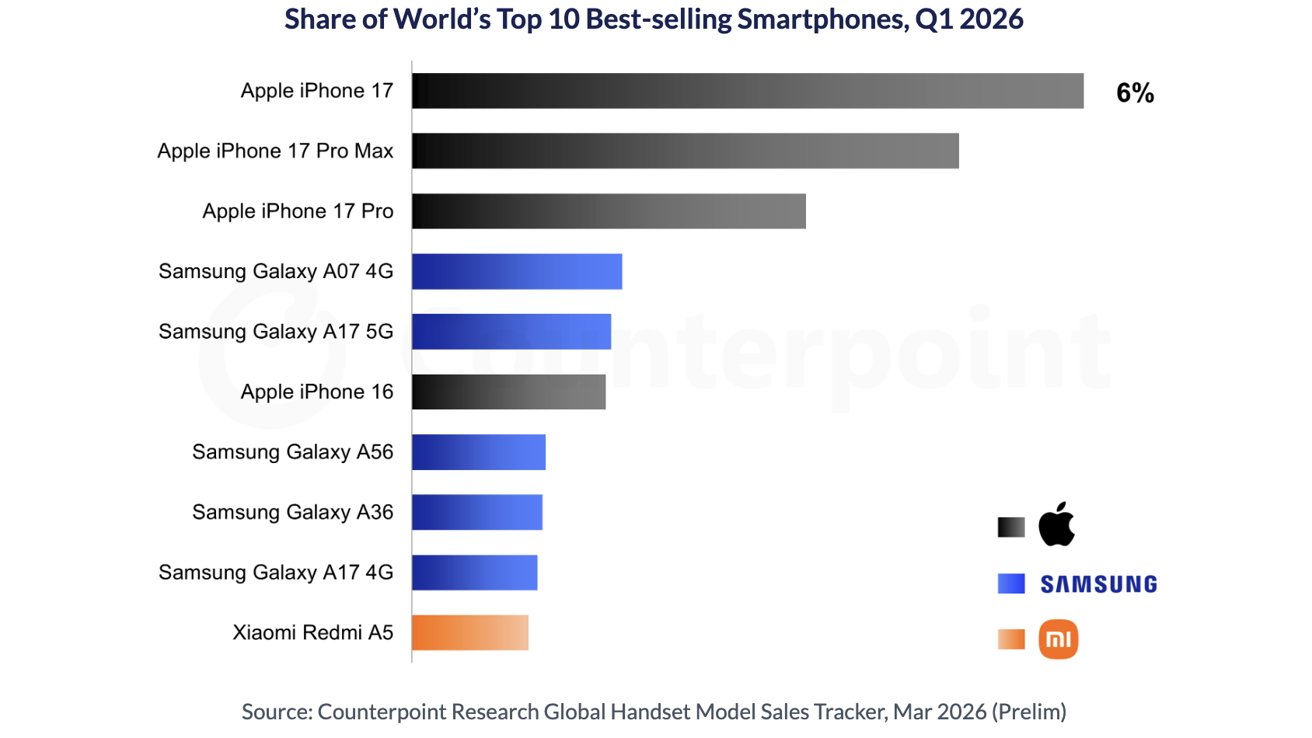
The standard iPhone 17 was the world’s top-selling smartphone during Q1 2026.
During Q1 2026, the base iPhone 17 became the world’s top-selling smartphone, outdoing not only the competition but also the premium iPhone models.
Across the world, and especially in key markets like China and the United States, the iPhone 17 range has proven to be quite popular with consumers. Apple made that clear when it revealed its record-breaking March quarter results.
Apple experienced a 20% increase in iPhone sales in China during Q1 2026, while iPhone revenue grew to $85.3 billion, up from $69.1 a year prior. The driving force during the quarter, according toCounterpoint Research, was the base model iPhone 17, with the iPhone 17 Pro Max and iPhone 17 Pro following.
Advertisement
The standard iPhone 17 accounted for 6% of all new smartphones sold in Q1 2026, making it the best-selling smartphone in the world.
While the iPhone 17 Pro and iPhone 17 Pro Max dominated the smartphone upgrade wave in Q4 2025, the more affordable model is now in the lead. This is typical for the iPhone.
After the debut of new models in September, Apple enthusiasts get the latest and greatest premium models first. That demand dies down early the following year, and the sales trend towards the more affordable models.
The standard iPhone 17 led global smartphone sales during Q1 2026. Image Credit: Counterpoint Research
Advertisement
That demand cycle could be one of the driving factors towards Apple moving to a twice-a-year release cycle. The Pro models are expected in the fall starting with iPhone 18 Pro, then standard models in the spring of 2027.
The standard iPhone 17 now has compelling ‘Pro’ features
In 2026, there’s even less of a reason to go for the high-end iPhone models. The standard iPhone 17 now features ProMotion, and it offers the same screen size as the iPhone 17 Pro Max.
The two devices are now closer than ever, with the absence of a telephoto camera being practically the only thing to differentiate the iPhone 17 from its Pro counterpart. That and price.
For most smartphone buyers, it looks as though the base model iPhone 17 offers a good balance of cost and features.
Advertisement
The iPhone Air, meanwhile, isn’t even among the top 10 best-selling smartphones in the world for Q1 2026. Apple’s ultra-thin iPhone has been called a failure, even though it’s demonstrably not the case. According to Monday’s report, though, it’s not exactly much of a success, either.
The iPhone 17 offers features like ProMotion, which was previously exclusive to high-end models.
Behind the iPhone 17 range sits Samsung, with its Galaxy A07 5G and Galaxy A17 5G. In sixth place is the standard iPhone 16, followed by two more phones from Samsung and the Xiaomi Redmi A5.
Overall, it’s not much of a surprise that the base model iPhone 17 is doing so well, given iPhone purchase patterns over the years. Enthusiasts and Apple fans generally go for the feature-packed, high-end models, while the base iPhone reaches its full potential later in the year.
Advertisement
However, the situation is expected to change in the first quarter of 2027.
A different strategy starting in the fall
It’s been said that the iPhone 18 will debut alongside the iPhone 18e in the spring of 2027. That means it most likely won’t be available for purchase during Q1 2027, meaning the quarter will be dominated by another model.
Rumors suggest Apple’s first foldable phone will launch either in September 2026 or maybe even as late as December of the same year. Even if the iPhone Fold reaches upgraders later than the usual September release, it won’t have much effect on the quarterly results or overall demand.
The iPhone 18 Pro and iPhone 18 Pro Max will sell well to those that already purchase premium iPhones in the fall. The challenge that Apple will face is how customers respond to a lack of a new low-end model in the same time period.
Last Crumb’s cookies are expensive. But they’re so damn delicious. I love the luxe gift-box packaging and cheeky branding (for example, a 24-pack is called a DiCaprio), but I love the cookies even more. There are 12 flavors in the Core Collection, with additional flavors coming around as limited-edition offerings. They can be microwaved or heated in the oven before eating, and the individually wrapped, sealed cookies can be kept on the counter for two weeks or in the freezer for two months.
I tried Last Crumb cookies in Everything but the Candles (a birthday cake flavor bursting with rich vanilla icing and tons of sprinkles); The Floor is Lava (a chocolate lava cake that’s sweet but cocoa-forward, slightly bitter, and best enjoyed over the course of a few hours, one bite at a time); and What the Velvet, which was my favorite of the bunch. The red velvet confection was sticky, gooey, chewy, chocolatey goodness, complete with a cream cheese center that elicited noises I won’t describe here. The cookies are thick and decadent, and they’re made with high-quality ingredients like slow-churned Plugrà butter with an 82 percent butterfat content, premium chocolate from Barry Callebaut, and freshly ground Tahitian vanilla beans. I’ve eaten a lot of cookies in my life. I’ve never eaten a cookie like this before.
There are special, seasonal, limited-edition bundles available from time to time. For Mother’s Day, you can check out The Mom Edit, which has six different varieties ranging from banana cream pie to blueberry muffin.
Shipping Speeds and Costs
2-day delivery and custom date delivery is $25. Overnight delivery is $40. Overnight delivery is only available if you place an order Monday-Thursday by noon Pacific time. Shipping is free on orders over $100.
Additional Shipping Details
Cookies are not packed in a cooler box. They’re baked to order and individually sealed.
A make-or-break pivot changed everything for Chix Hot Chicken
Singapore is not short of fried chicken joints, from Korean fried chicken to American fast food. But amid this sea of options, there is one homegrown chicken brand that claims to be the first and go-to option for Nashville chicken burgers—and that’s Chix Hot Chicken.
The brand was initially best known as the chicken spot owned by Singaporean singer-songwriter Taufik Batisah. Over the years, however, it has carved out its own identity, becoming one of Singapore’s popular fried chicken joints, particularly among younger diners.
Vulcan Post spoke with the trio behind Chix Hot Chicken: Taufik Batish, 45, Ismail Bober, 40, and Shehzad Hussein, 46, who shared how they grew a local Nashville hot chicken concept into a brand that has sold over a million chicken burgers.
A recipe for something bigger
Image Credit: Chix Hot Chicken
As early as 2013, Taufik had been looking to embark on a new venture, alongside his work in interior design, real estate, and a music career spanning more than a decade.
He approached his long-time friend Ismail, who had spent 10 years in the nightlife business. At the time, Ismail was also running a New Orleans-style Southern restaurant, Life is Beautiful Kitchen & Bar, with Shehzad, who had nearly two decades of experience in F&B.
Advertisement
In 2014, Ismail and Shehzad introduced a Southern fried chicken dish at the restaurant that proved to be unexpectedly popular. This sparked an idea for Taufik to turn that single dish into a larger halal fried chicken concept.
Ismail travelled around Nashville to try authentic fried chicken places like Prince’s Hot Chicken and Hattie B’s Hot Chicken, and came back to Singapore to make his own renditions./ Image Credit: Chix Hot Chicken
After Life is Beautiful Kitchen & Bar closed in 2015 due to high rent, Ismail leaned into the idea. Drawing from frequent family trips to Louisiana, he travelled across South America, sampling as much fried chicken as he could.
[As I] ate at various Nashville chicken joints and learned from the masters… I thought to myself, this is something Southeast Asia hasn’t seen yet.
Ismail Bober, co-founder of Chix Hot Chicken
While Ismail and Taufik were fully on board, Shehzad was initially sceptical about launching yet another fried chicken brand in Singapore’s saturated market. “But when they mentioned Nashville, and the name Chix Hot Chicken, I thought that was brilliant, with the name and the food creating curiosity,” he added.
Pivot or risk closing
Chix Hot Chicken’s outlet at Jalan Pisang./ Image Credit: Chix Hot Chicken/ Widya Yuniarti via Google Reviews
In 2018, the trio officially launched Chix Hot Chicken, tucked away at a 1,000 sqft shophouse along Jalan Pisang.
While it stayed loosely true to its Nashville roots, the brand introduced its own twist—fried chicken seasoned with a dry rub rather than drenched in an oil-based hot sauce.
Advertisement
At the time, the menu was intentionally simple. Alongside the fried chicken, Chix Hot Chicken also offered just one burger: the Soul Slider.
Chix Hot Chicken originally offered chicken parts dusted in their signature Nashville dry rub and served with a house-made chilli sauce./ Image Credit: Chix Hot Chicken
Ironically, that single burger consistently outsold the chicken parts, despite the latter being the focus of the menu. It was also the star of the menu that helped the brand break even within two years of opening in the midst of COVID-19, the founders said.
This performance led the founders to question their original direction—should chicken still be the main focus of their menu despite the success of its burger?
At the same time, chicken parts were becoming more expensive to produce and came with thinner margins. When customers inevitably compared them to mainstream chains like Popeyes or KFC, Chix struggled to compete on price while maintaining its commitment to quality.
After about two years, the founders made the painful call to drop the chicken parts entirely. It came down to a stark choice: either commit fully to the new direction or risk closing in the next few months, forcing a complete pivot to keep the business alive.
Advertisement
(Left): Chix Hot Chicken’s classic Soul Slider has become an inspiration for many other burgers Ismail created./ Image Credit: Nigel Kaw via Google Reviews, Extra-Farmer0 via Reddit
But going all-in on chicken burgers turned out to be the making of the brand. “The minute we listened to the customers, we became unique,” Shehzad said.
That shift propelled the brand’s growth. Today, Chix Hot Chicken has sold over a million chicken burgers and expanded in 2025 to a second location—a 3,000 sq ft space at Prinsep Street, three times larger than its original Jalan Pisang outlet.
Turning up the heat
Chix Hot Chicken’s flagship outlet at Prinsep Street./ Image Credit: Chix Hot Chicken
Today, Chix Hot Chicken’s menu has expanded to 12 burgers, including three waffle sandwiches that wrap around Chix Hot Chicken’s classic meat, with seven additional in-house sauces to choose from. Each burger starts from S$9.90 ala carte.
The burger buns are intentionally small, while the fried chicken portions are deliberately oversized—a visual signature Ismail conceived early on. “When you post a chicken burger, it always looks the same,” he explained. “But when you see a small bun and a big chicken, that’s Chix Hot Chicken.”
Image Credit: Chix Hot Chicken
The brand is known for its spice levels, and it’s serious business.
The brand originally launched with three tiers—mild, hot, and insane—but the team quickly realised the middle tier was already too intense for most customers. They eventually expanded the range to six levels, adding milder options at the lower end, including a no-spice option, and introducing Atomic at the top.
Atomic is made using Carolina Reapers, long considered one of the world’s hottest chillies. The trio claims Chix Hot Chicken is not only the first restaurant in Singapore to use Carolina Reapers, but possibly the only one in Asia applying them in a dry rub format.
Advertisement
Customers ordering the Atomic level must sign an indemnity form. “We have seen people collapse. Ambulances came,” Shehzad said.
Ismail personally sources the peppers from the US and the Caribbean, a supply chain he guards so closely that even his co-founders are not fully aware of its origins.
Establishing more outlets & expanding across Asia
Today, the Chix Hot Chicken team stands at around 30 people, including the three founders, who are still regularly on the ground.
The trio operate with clearly defined roles. Taufik leads marketing and drives customer traffic as the public face of the brand. Ismail is solely responsible for the food, with every item on the menu originating from him. Shehzad oversees operations and the day-to-day running of the business.
“We call it the trinity,” Taufik said. The rule is simple: anyone can share an opinion, but the person with the relevant expertise makes the final call. “I have to respect that that is his contribution to the team. That is how we have been functioning for the past eight years.”
Advertisement
For Taufik, one of his favourite milestones is also a surprisingly simple one—walking into either outlet and not being recognised. “Chix Hot Chicken is now living on its own. It has transcended beyond me being the guy bringing people in. Now the team is bringing people in on their own,” he said.
Looking ahead, the founders aim to establish outlets across Singapore, particularly in the east and west. “It took us eight years to expand,” Shehzad said. “There’s a reason for that, and why we turn down venture capitalists. We want to tighten our processes and operations, and make sure this is the menu we want to present to people.”
Beyond Singapore, the trio is also setting their sights on regional franchising, with plans to bring their take on Nashville fried chicken burgers across Asia.
A lot of people think that F&B is the place to make a quick buck. They are very mistaken. It takes time and a long-term plan to build a food business and to get through hard times.



























































You must be logged in to post a comment Login