Connect with us
DAPA Banner
DAPA Coin
DAPA
COIN PAYMENT ASSET
PRIVACY · BLOCKDAG · HOMOMORPHIC ENCRYPTION · RUST
ElGamal Encrypted MINE DAPA
🚫 GENESIS SOLD OUT
DAPAPAY COMING

Tech

Denon Home series speakers review: Siri & superior sound

Published

on

Denon Home series speakers review: These new smart speakers support Siri & Apple Home with premium audio

Denon’s new line of Siri-enabled Apple Home smart speakers may be what users are looking for in the absence of updated HomePod and HomePod mini. Let’s take a listen.

Japanese audio brand Denon is out with its latest range of speakers: the Denon Home 200, Denon Home 400, and Denon Home 600. While all different sizes and price points, the entire line caters to Apple users with support for conversing with Siri and AirPlay.

The new devices launch in what has been a prolonged pause in Apple’s HomePod product cycle. The second-generation full-sized HomePod launched in 2023, and HomePod mini has gone even longer without an update, hitting shelves in 2020.

Advertisement

This makes Denon’s new lineup even more enticing with few alternatives available. I’ve been testing both the Denon Home 200 and Denon Home 400 for the last couple of months.

Let’s see how they perform and compare to HomePod.

Denon Home speakers review: Design

All three speakers in the range share a clear identity. They’re wrapped in mesh fabric, with obvious buttons and metal accents.

Smart speaker on a wooden dresser beside framed wedding photos and a small jar, against a light-colored wall with a white electrical switch visible

Denon Home series speakers review: The smaller, Denon Home 200 looks sleek and elegant

Advertisement

The Denon Home 200 and Denon Home 400 are most similar, with a curved anodized aluminum base and the mesh-covered top. The tops are flat, with buttons on the top or side and extra IO on the back.

The Denon Home 600 is the biggest departure as the contoured speaker body appears to sit angled on top of the base. This provides better sound direction for spatial support, sending audio up, to the sides, and forward.
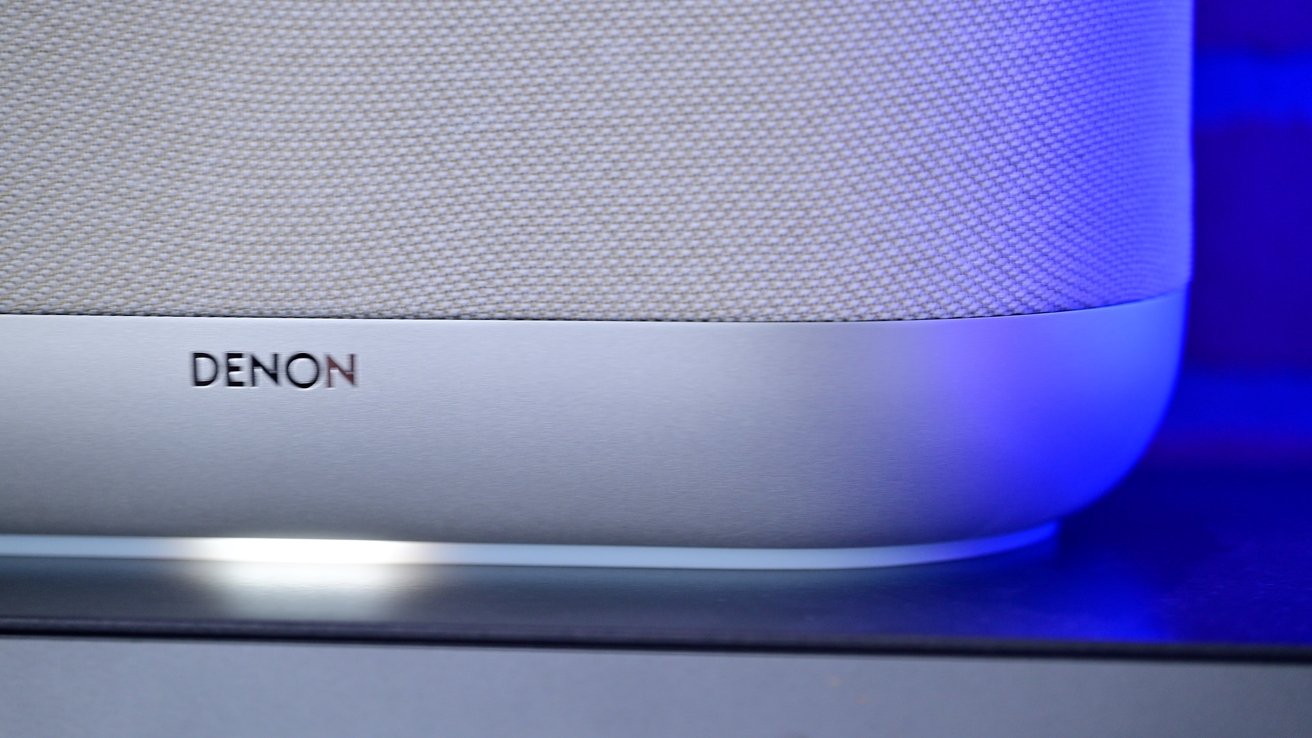
Close-up of a Denon smart speaker with a light gray fabric body, white base, and soft blue accent lighting glowing beneath it on a dark surface

Denon Home series speakers review: Status light on the bottom of the Denon Home 400

I love the metal accents in particular, as they create an elegant upscale look beyond the HomePod. They’re available in both light grey and black, with the former being shown here.
Advertisement
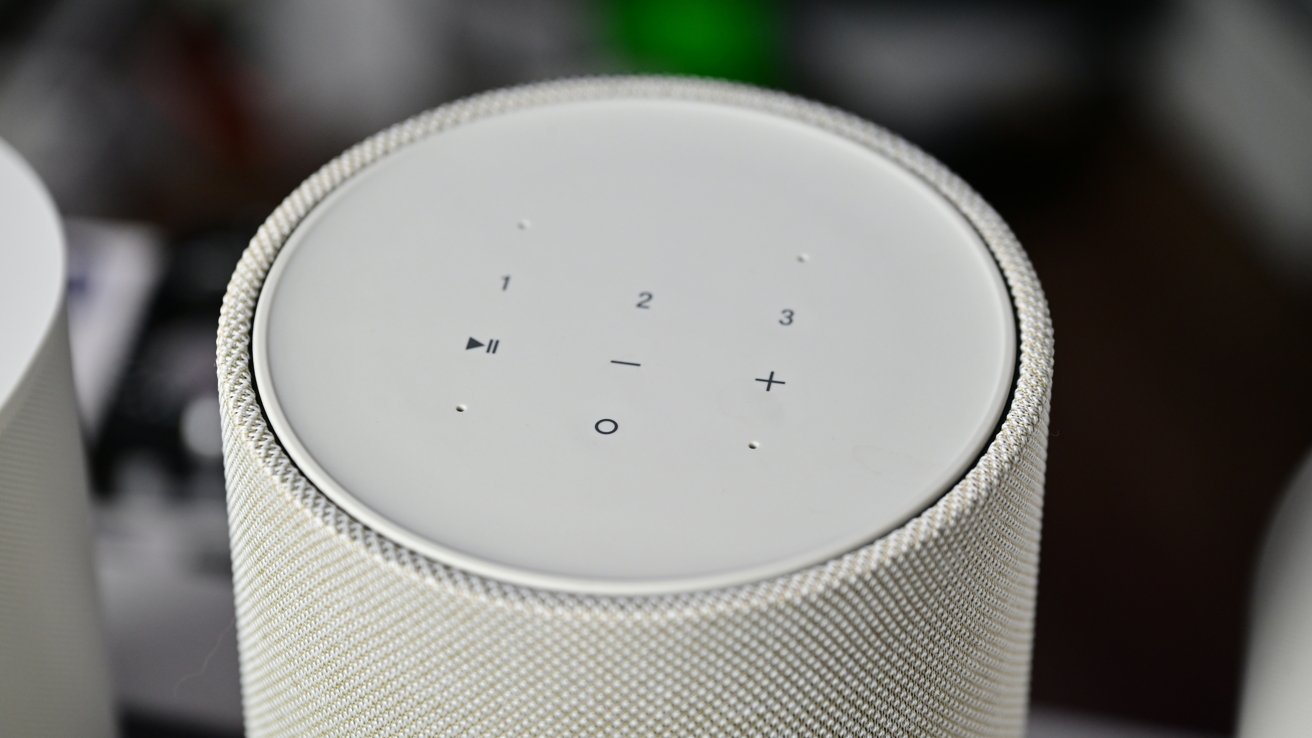
Close-up of a cylindrical smart speaker with fabric sides and a smooth top surface featuring touch controls for play, pause, volume, and numbered buttons against a blurred background.

Denon Home series speakers review: Controls on the top of the Denon Home 200

Unlike with HomePod that has a touch-sensitive surface, the buttons are physical and have a subtle *click* when depressed. There’s a combo play/pause button, volume controls, three user-designated shortcuts, and a multi-function button that can invoke your virtual assistant of choice.
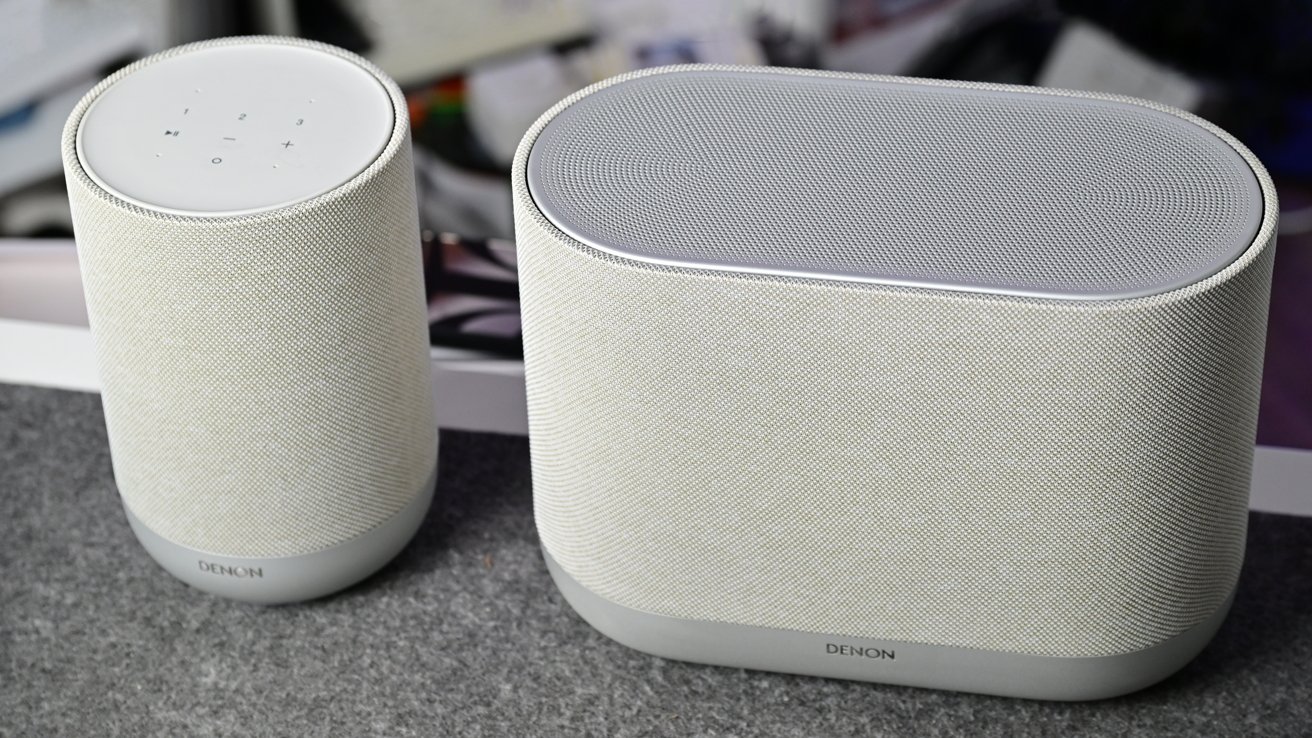
Two modern smart speakers in light gray fabric on a desk, one tall and cylindrical, the other wider and oval-shaped, with subtle controls on top and blurred background electronics

Denon Home series speakers review: Differences in design between the Denon Home 200 and Denon Home 400

The Denon Home 400 is just over twice as wide and instead of the buttons on the top, has a metal grille that helps with Spatial Audio. The buttons are relocated to the ride side for easy access but you don’t see them from the front.
Advertisement
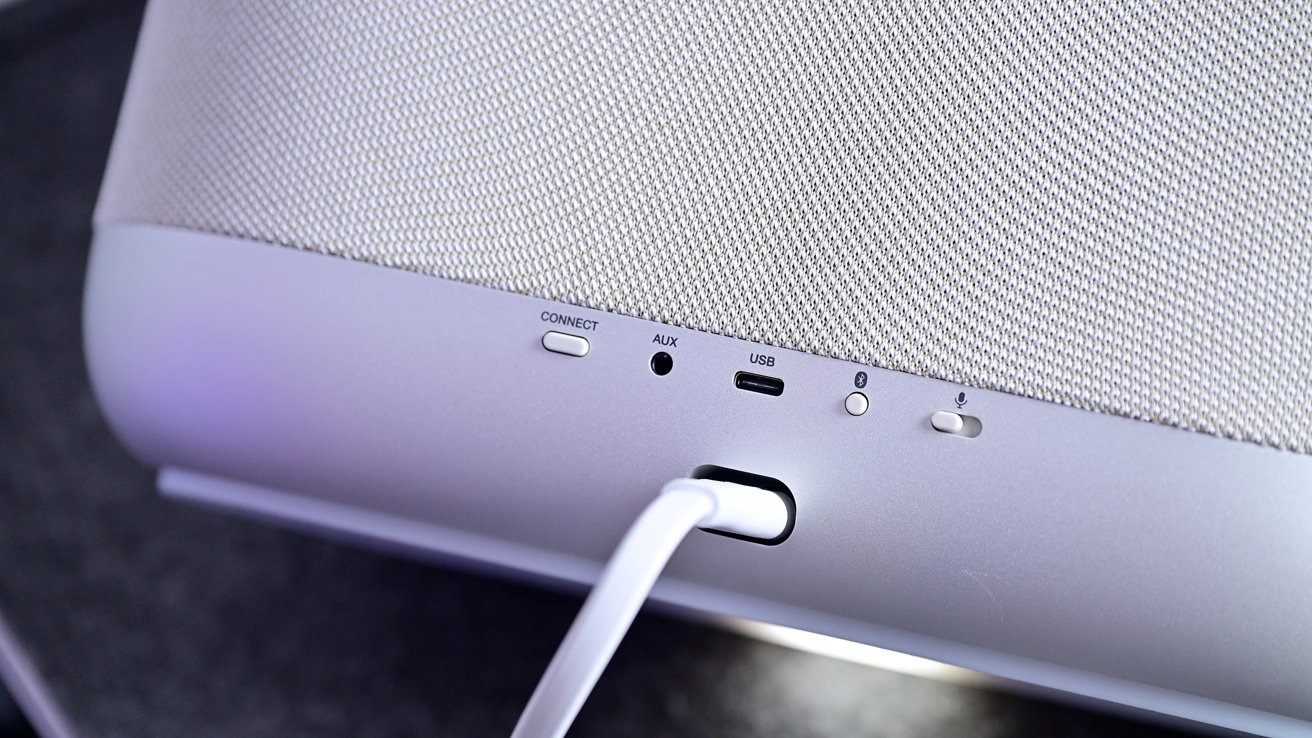
Close-up of a modern speaker's back panel showing connected power cable, USB-C port, AUX jack, control buttons, and mesh fabric grille on a smooth metallic surface

Denon Home series speakers review: Rear ports shared across the Denon home speaker line

For the bonus IO, there are both USB-C and auxiliary audio inputs, a Bluetooth toggle, and a physical toggle that will disable the mic if you don’t want a smart speaker listening in.

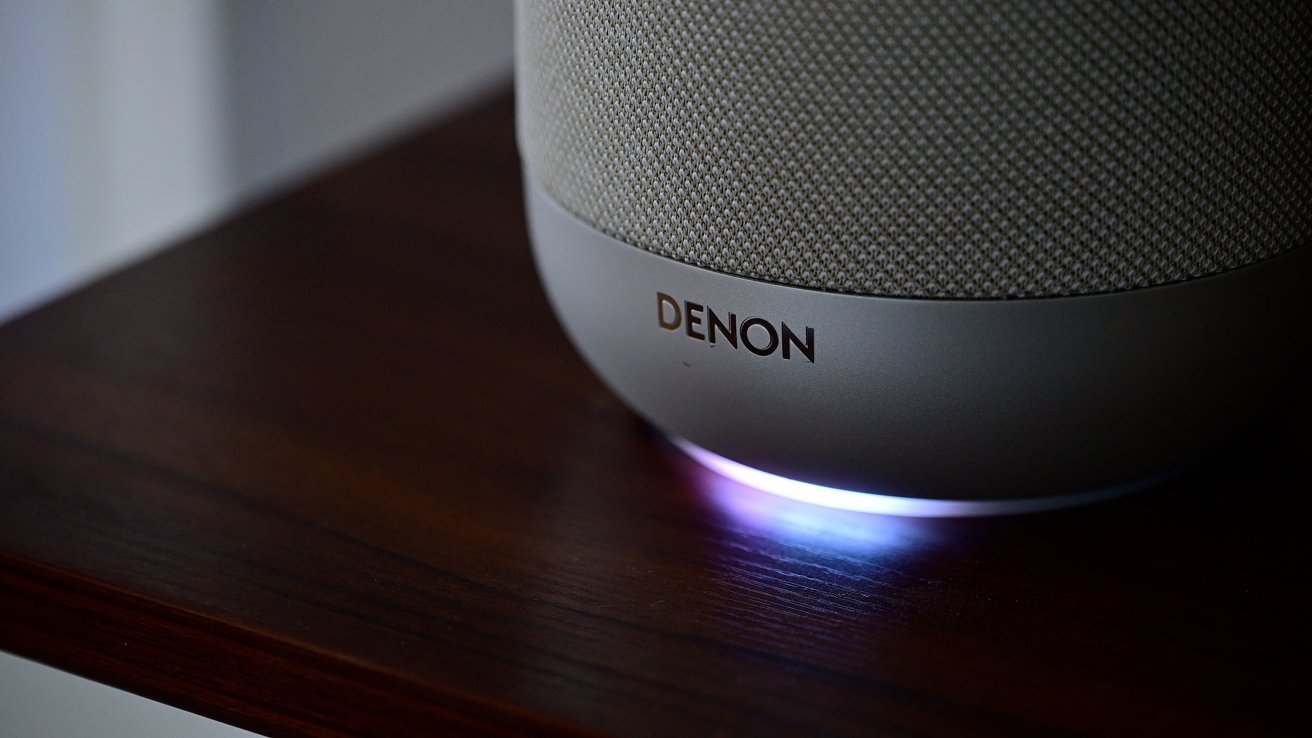
Finally, the speakers have a soft light that glows out of the bottom. It acts as a bit of a status light and can change color.

Denon Home speakers review: Easy setup for Apple users

There are multiple methods of setup for the new Denon speakers. I think for Apple users, though, it’s easiest when using Apple Home.

Advertisement

The speakers can be set up just like any other Apple Home accessory. You open the Home app, tap the + button, and scan the pairing code on the speaker.
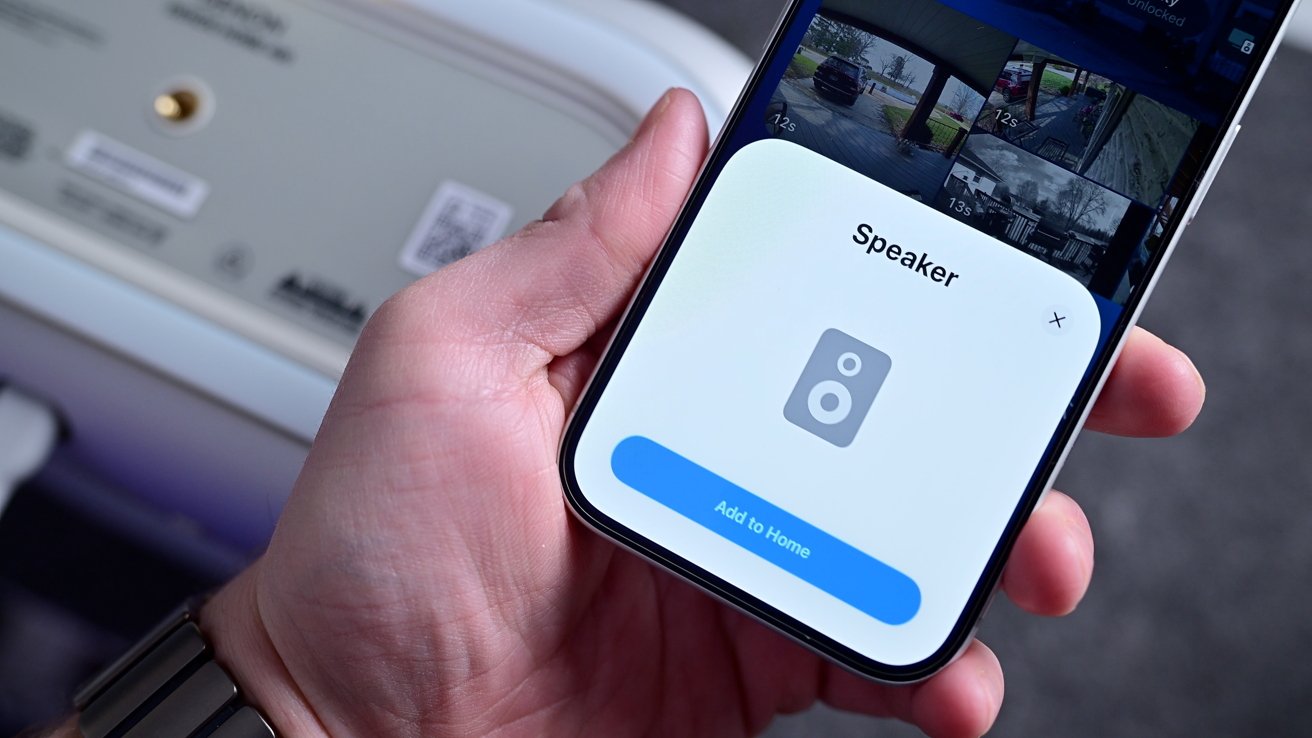
Hand holding a smartphone showing a smart home app screen, highlighting a Speaker device setup card with an Add to Home button, against a blurred indoor background

Denon Home series speakers review: Scan the pairing code to add to the Home app

This opens a popup modal at the bottom of the screen to walk you through the onboarding process, like giving the speaker a name and assigning it a room in your home. Behind the scenes, it also adds your Wi-Fi credentials.

I’d say this is basically an ideal setup process. You don’t need to do some convoluted pairing process where you connect to a temporary network, download any third-party apps, or even manually enter any credentials.

Advertisement

The only way Denon could have made this any easier would be if they used NFC for commissioning rather than scanning the QR code. That means the whole setup process could be started with a tap versus opening the Home app first.

That’s something still seldom seen, even on dedicated smart home products. Companies probably skip it due to the added cost of the NFC chip that’s used merely once during that initial setup process.
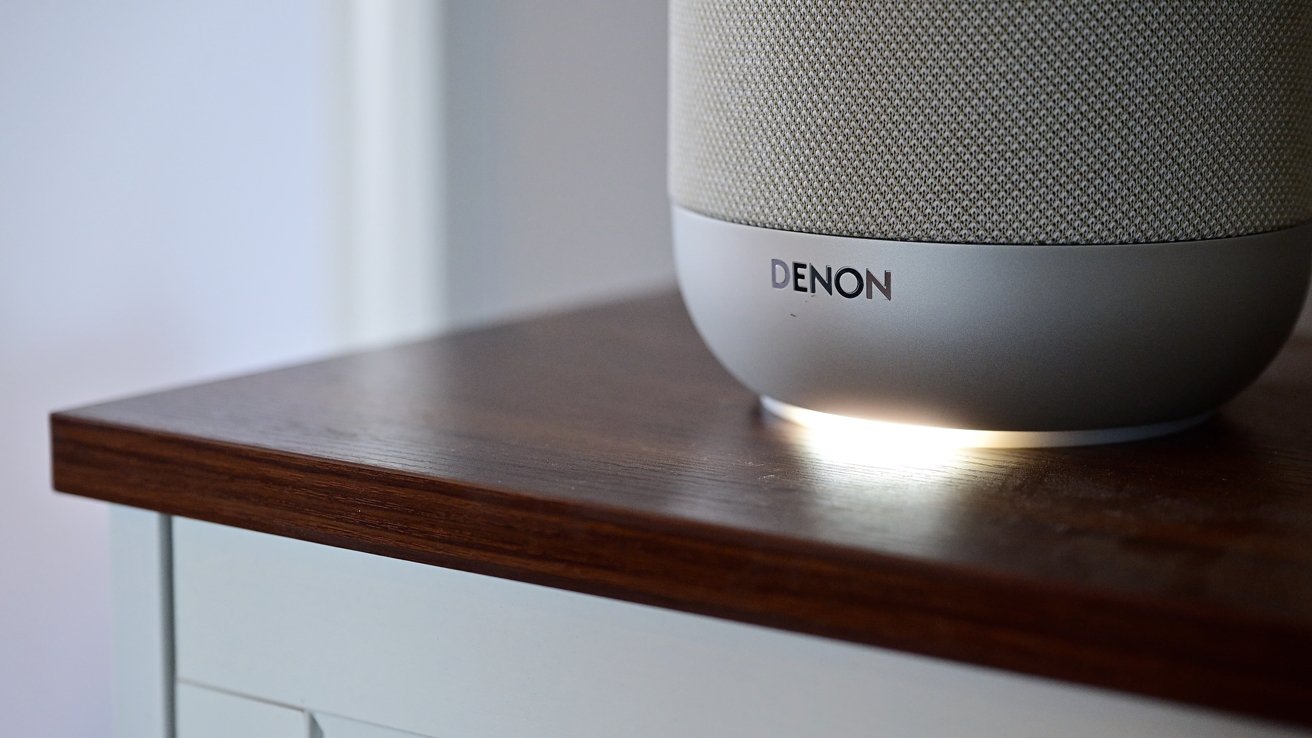
Close-up of a Denon smart speaker with a glowing light at its base, sitting on a wooden tabletop above a light-colored cabinet in a modern, minimal room

Denon Home series speakers review: The status light can change colors

While we’re talking about the setup and wireless, so far in my testing, I’ve not encountered any instances of the speakers going offline. Both speakers have remained online, available, and responsive when I cast audio to them.

Advertisement

The speakers support Wi-Fi 6, including not only 2.4GHz and 5GHz, but 6GHz, too. With strong Wi-Fi in my home, I was able to enable the high-fidelity mode for uncompressed high bitrate audio that used during multi-room playback.

Denon Home speakers review: Smart home powers

What makes these speakers so appealing to me compared to others in their weight class is that they support Apple Home. This doesn’t just make the setup process easier, but allows them to act almost identical to a HomePod.

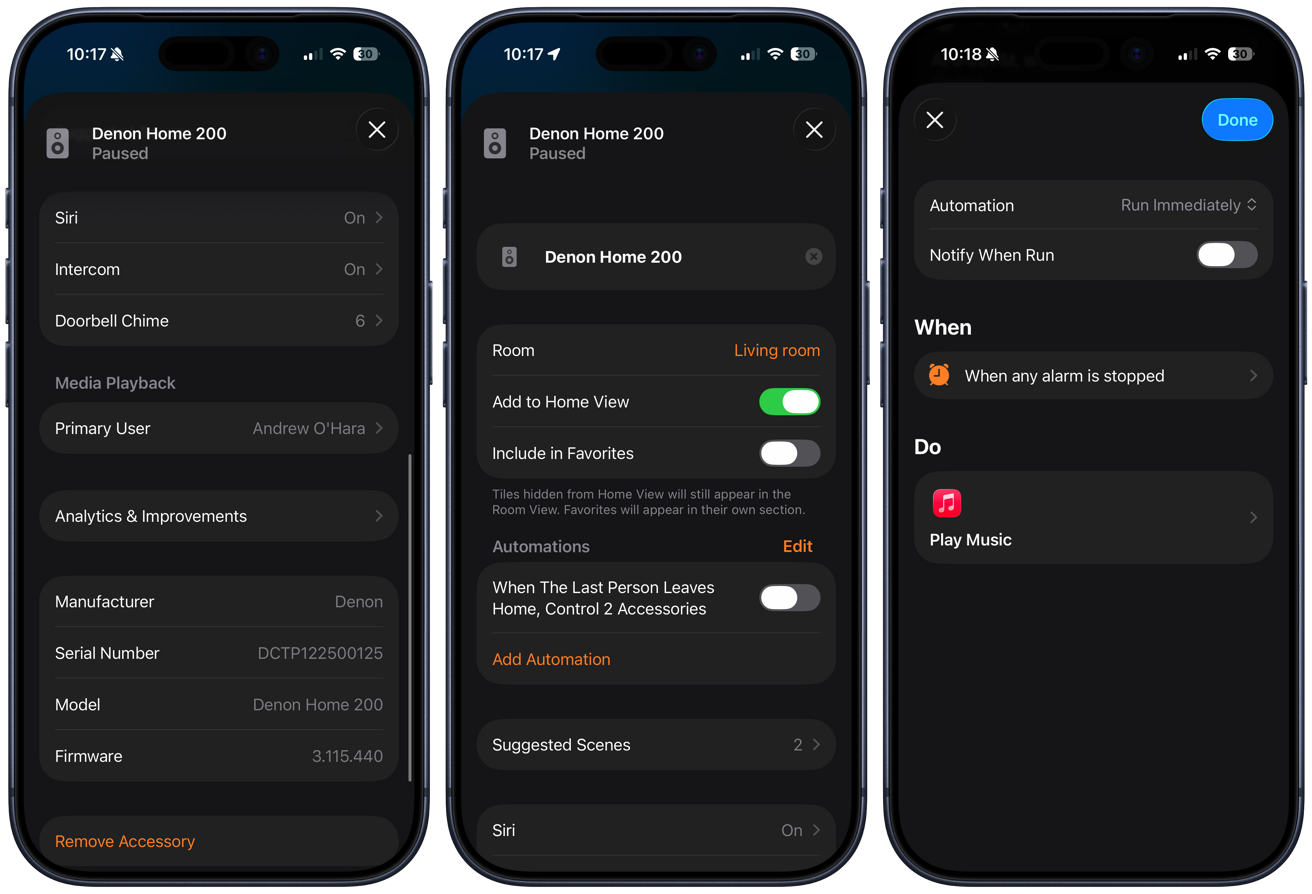
Since it appears in the Home app as a Home accessory, you can include it in your home automations. Simple ones, for example, like automatically pausing audio playback when you or the last person leaves the home, are quite useful.

These speakers can be used in more complex scenes and automations, too. You could have the speakers play your “get ready” playlist in the morning when your alarm goes off, you could have a “pump up” playlist when you set a workout scene, or play white noise with a sleep timer when setting your “Goodnight” scene.
Advertisement
Screenshots of the Denon Home 200 speaker in the Apple Home app

Denon Home series speakers review: The Denon Home 200 showing in the Home app

Another benefit is that it can be used as an intercom with other Apple Home speakers, including HomePods. If I’m in my studio, my partner can call me over the intercom from the kitchen HomePod to my studio Denon Home 400, and I can talk back to them.

If you have an Apple Home doorbell, the Denon Home speakers can act as wireless chimes. That way, if someone presses the doorbell on the front door, the Denon speaker down in the studio can chime to let me know someone is there.
iPhone displaying a smart home control screen with multiple room speakers listed, resting on a colorful background of teal, light blue, and bright pink overlapping shapes

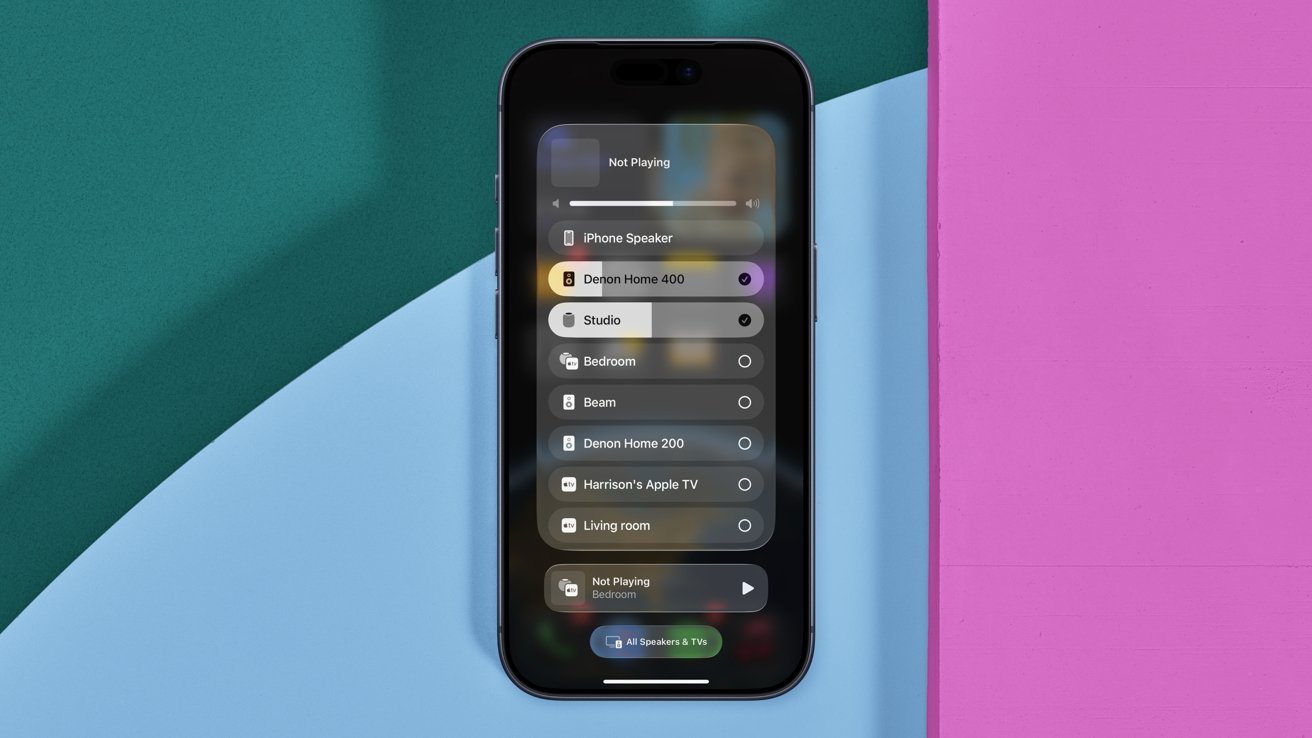
Denon Home series speakers review: Use AirPlay to cast audio to the Denon speakers, including multiple at once

Advertisement

This brings support for AirPlay, too. You can cast audio from nearly any Apple device to the Denon Home speakers.

That’s what allows Apple-native multi-room support. You can play to multiple AirPlay speakers at once, which can be any combination from HomePods and third-party speakers.
Hand holding an iPhone displaying a Speak to Siri setup screen with a large blue Turn On button, against a blurred indoor background with electronics in soft lighting

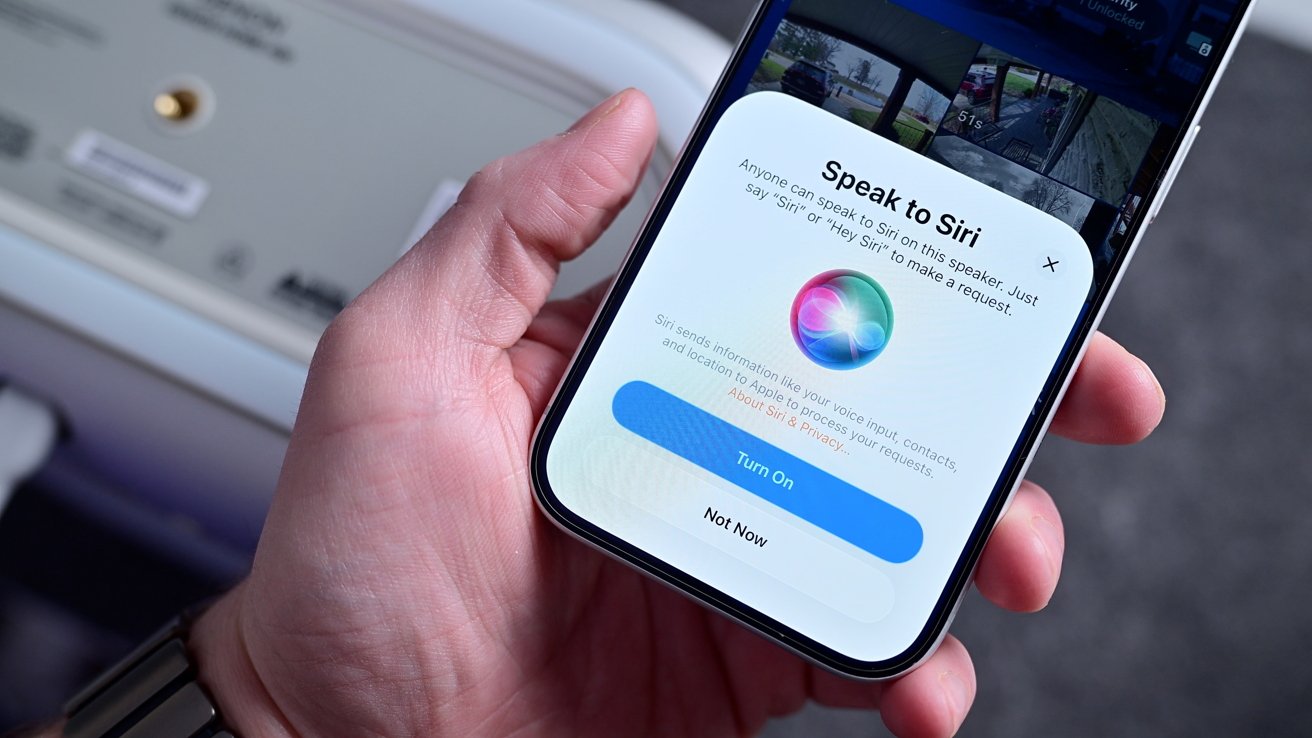
Denon Home series speakers review: During setup, you can turn on Siri on the speakers

My favorite is just using Siri for this. I can ask Siri on my iPhone to play my Jams playlist on the Denon Home 400, or if I say to play in a certain room, it will go to all speakers in that location.

Advertisement

Biggest of all is full support for Siri, though the implementation is a little confusing. Apple does allow third-party speakers to build in Siri, but so far, Denon and Ecobee are the only major players to do so.

Denon Home speakers review: Siri, but not on HomePod

The catch with Siri support is that the queries aren’t processed directly on the third-party speaker, but instead require a HomePod or HomePod mini. What happens is that when you ask Siri a question, it listens on that third-party speaker, routes the question to a nearby HomePod, then gives you the answer back on the original speaker.

This major caveat is likely why some of the big players, like Sonos, prefer to cozy up to other virtual assistants like Amazon Alexa, Google Assistant, or its own assistants instead. They don’t want you to have to buy a HomePod, but rather you buy more of their speakers.
Close-up of a Denon smart speaker on a wooden surface, its lower edge glowing with a soft blue and purple light, emphasizing the brand logo and textured fabric exterior

Denon Home series speakers review: The status light can change to Siri colors when you invoke Apple’s assistant

Advertisement

For many Apple users, they likely already have some version of HomePod or two in the Home, so I don’t consider this a huge downside. It is something to be aware of though, before purchasing the speaker with the anticipation of using Siri.

As far as utility, Siri is basically in feature parity with HomePod. Anything you can ask a HomePod, you can ask your Denon speaker.

You can ask it to control your smart home accessories, to text someone, to check the weather, convert units of measurement, and more. That said, there are some ways that they differ.
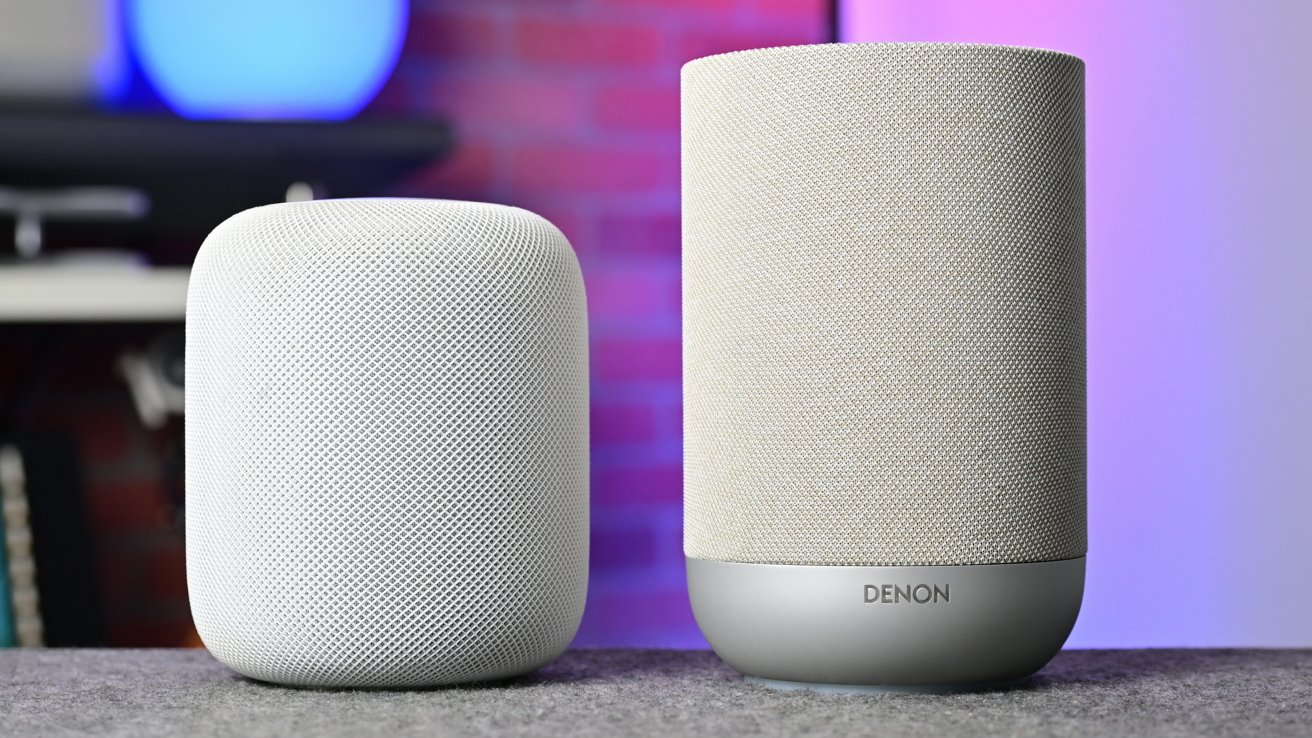
Two modern smart speakers on a gray surface, one rounded white mesh speaker beside a taller cylindrical Denon speaker, with a softly lit, colorful blurred background.

Denon Home series speakers review: Denon Home 200 is still larger than the base HomePod

Advertisement

HomePod, for example, can act as a full Home Hub. A Home Hub helps run scenes and automations when you aren’t at home and is a Thread Border Router.

Apple’s HomePod has handoff using ultra-wideband to automatically transfer audio as your phone approaches. The Denon still gets suggested in the Dynamic Island when you open the Music app nearby, though.

A Home Hub is also what processes the AI video for HomeKit Secure Video, such as people, car, or package detection. Plus, HomePod and HomePod mini have built-in environmental sensors for temperature and humidity.

This is a bit of reading the tea leaves, but because of how Siri works on third-party speakers, I expect Apple Intelligence to arrive sooner rather than later.

Advertisement

Apple has been working on these next-generation HomePod and HomePod mini for seemingly quite some time. If they do launch in the fall of 2026 as expected, Apple Intelligence will certainly be supported.

Again, another leap here, but that would mean if you purchased a new HomePod or HomePod mini with Apple Intelligence, Siri on your Denon speaker would be upgraded. Hopefully, that isn’t wishful thinking, but it’s not a big jump to make.

While I do strongly believe that’s how it will play out, I also strongly caution against buying a product today with the promise of an update in the future. If you buy these speakers now, be comfortable with how they work now, and count future upgrades as a bonus.

Denon Home speakers review: HEOS app

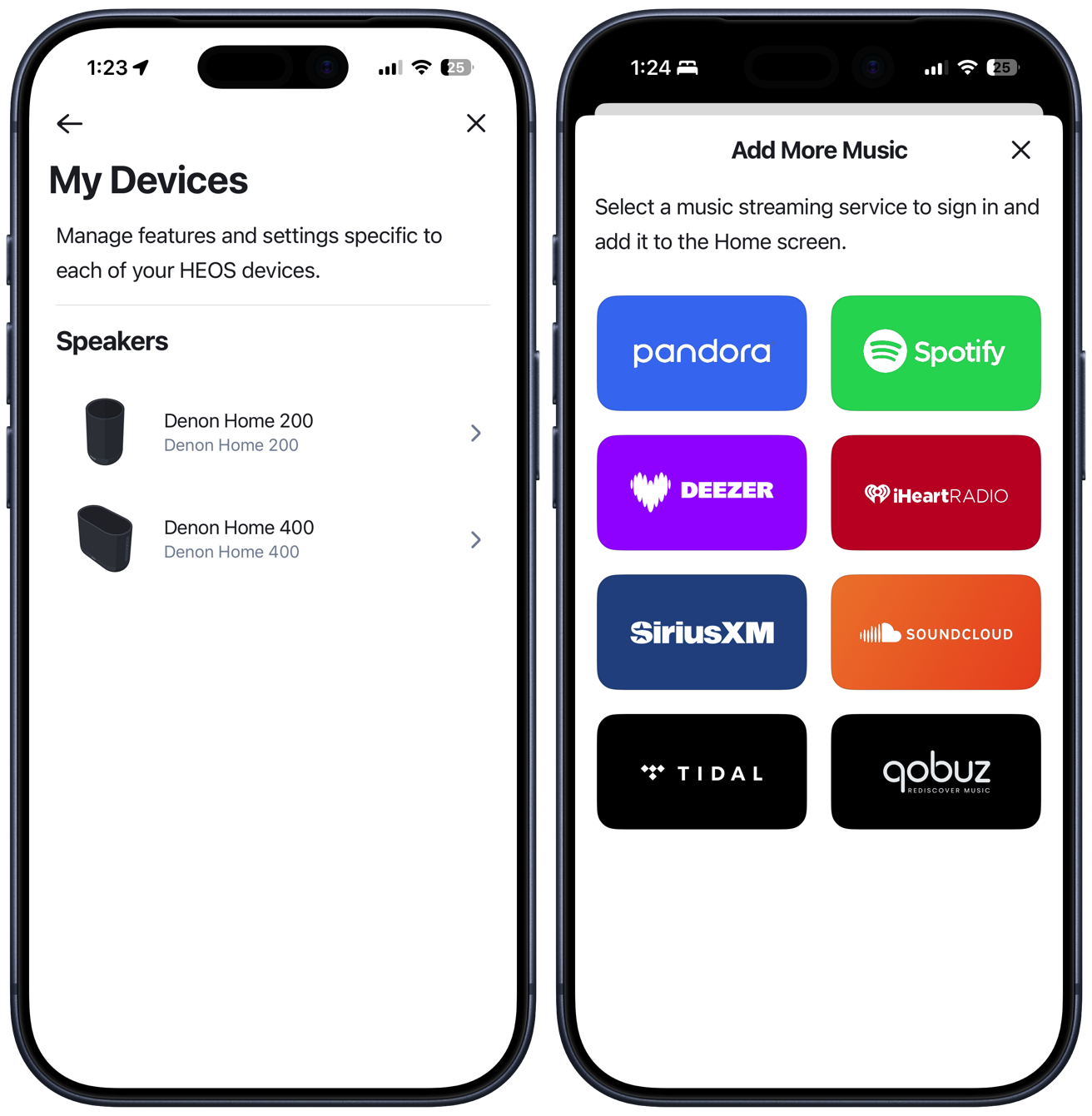
To be crystal clear, users can absolutely set up and use these speakers without any extra apps. But the Denon HEOS app has some added benefits for users that want to use it.
Advertisement
Two smartphone screens showing a HEOS app: one listing Denon Home speakers under My Devices, the other displaying Add More Music with selectable streaming service buttons like Pandora, Spotify, and others

Denon Home series speakers review: The Denon HEOS app has more controls and direct streaming options

This app can guide through a bit more of a convoluted setup process for non-Apple users, plus has direct streaming from various platforms. Users can directly stream from a number of different services, including Tidal, Spotify, Deezer, iHeartRadio, and more.

You can stream from these services, adjust volume, perform updates, and adjust the track queue. It’s similar to the Sonos experience, though maybe a bit more limiting.
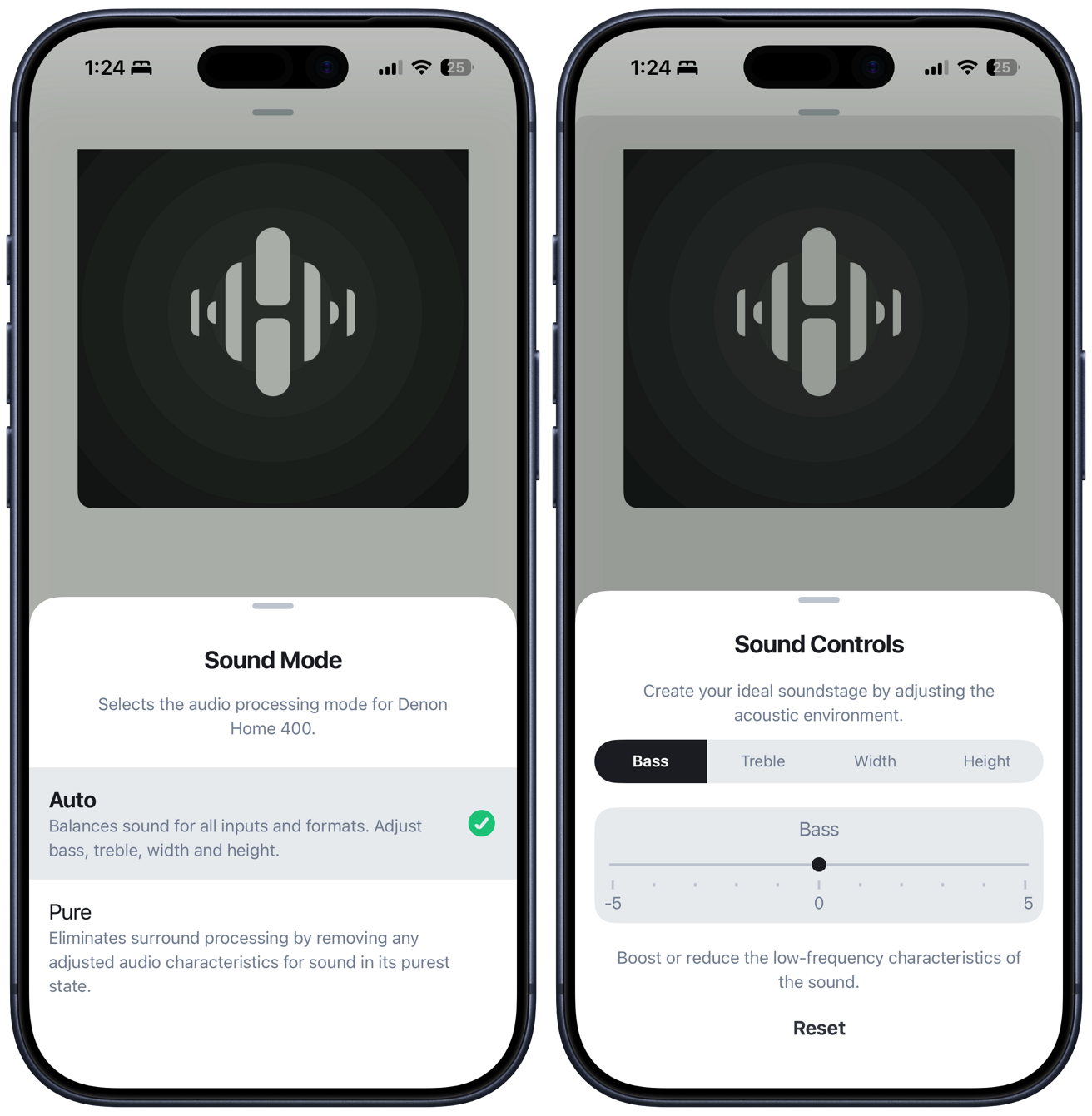
Two smartphone screens display a sound settings app, showing Sound Mode options like Auto and Pure on the left, and adjustable Bass, Treble, Width, and Height sound controls on the right

Denon Home series speakers review: You can adjust audio quality and balance from the HEOS app

Advertisement

Within HEOS, there are sound controls for the speakers. You can turn on “pure” mode to remove any processing or get into the weeds and manually adjust the bass, treble, or width (physical spaciousness of the soundstage).

Denon Home speakers review: Audio quality

As we turn to audio quality, I want to make sure to split it between the two that I have on hand to test. I also want to compare them to the competition, such as Apple and Sonos.

Starting with the smaller of the two, the Denon Home 200 has three drivers. There are two smaller drivers positioned towards the top that angle slightly outwards and a 4-inch front-facing woofer.

Compared directly to HomePod, which is available for $100 less, the Denon Home 200 absolutely sounds better. It’s fuller, with a larger emphasis on the midrange.
Advertisement
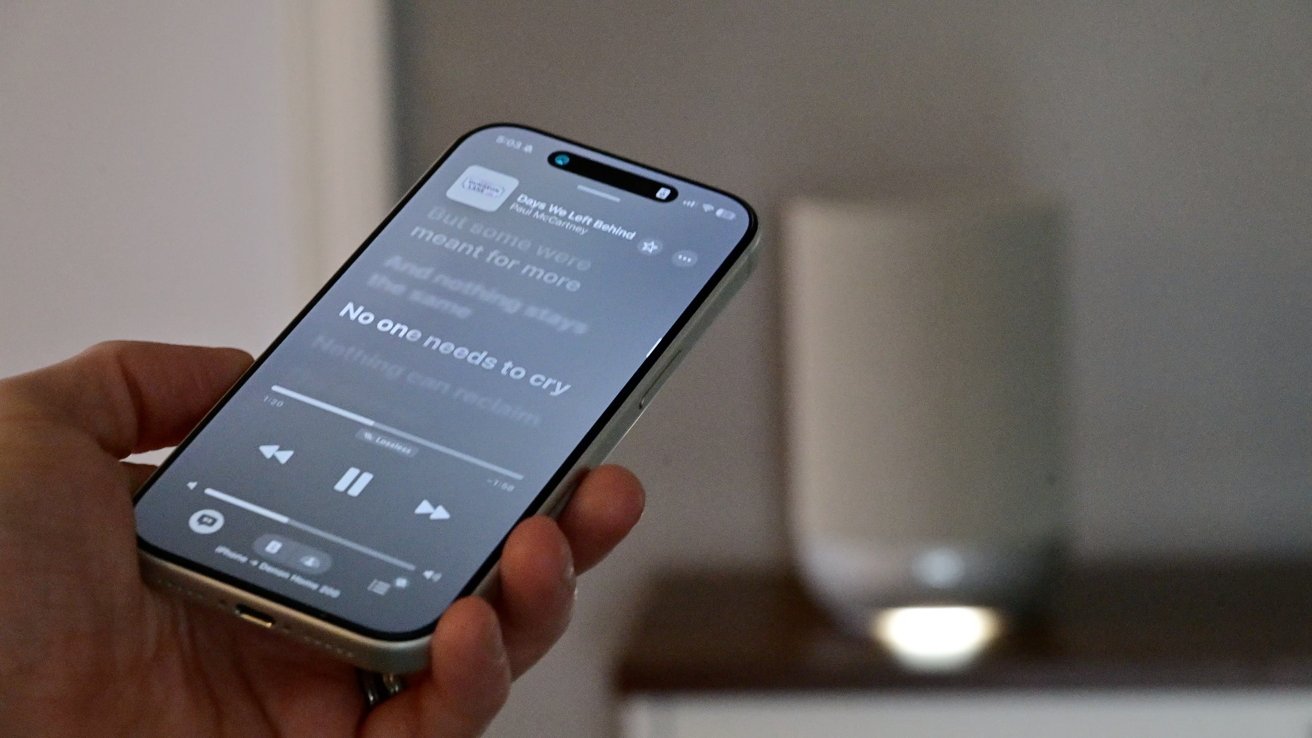
Hand holding a smartphone showing a music player screen with song controls, in front of a blurred smart speaker on a wooden surface in a softly lit room.

Denon Home series speakers review: Controlling audio playback direct from Apple Music

Personally, at times, I find the bass on HomePod to be a bit overpowering or even sloppy, and I think Denon did an excellent job at filling out the midrange.

That isn’t to say the bass is lacking in any way on the 200. Both Denon and Apple speakers have 4-inch woofers, and it definitely puts out some oomph. It’s also much higher volume than the HomePod, with it being arguably too loud in my home to ever go past 75%.

The best way I can describe the sound is very warm, which is something I like. It also maintains this consistency, even at the high volumes.
Advertisement
Three modern smart speakers on a gray surface, two Sonos speakers and one Denon, against a softly lit background with blue and pink hues and a blurred brick wall

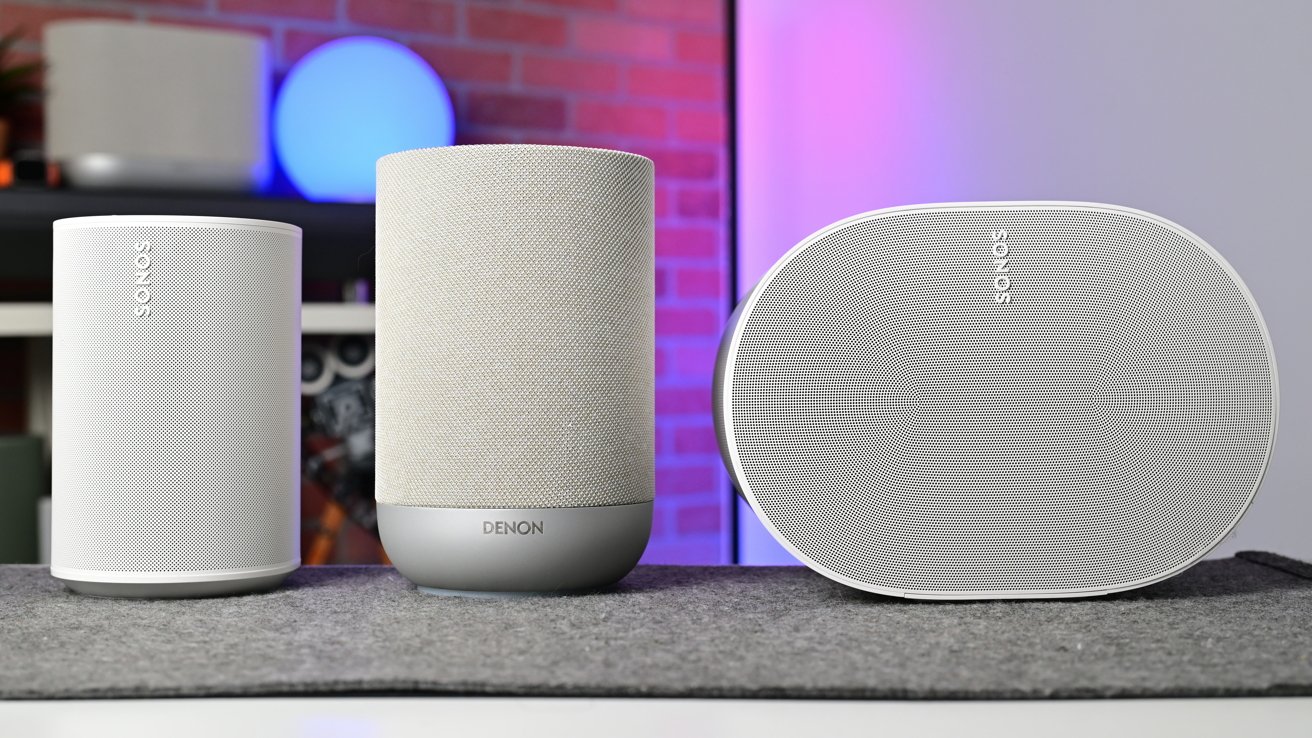
Denon Home series speakers review: Comparing the Denon Home 200 against the Sonos Era 100 and Sonos Era 300

I’d also say that the Denon Home 200 sounds better than the Sonos Era 100, though there isn’t a perfect comparison to Sonos. This performance should be expected, given the significantly higher price tag of the Denon.

Personally, I even preferred the Denon Home 200 to the Sonos Era 300, to a degree. The Era 300 is larger and more expensive, but I think the Denon Home 200 has a warmer profile that I liked and has a smaller footprint.

Again, the comparison is tough. The Denon Home 200 lacks the upward-firing driver of the Sonos Era 300, but if you move to the Denon Home 400, it’s far more expensive, while being even bigger still.

Advertisement

Listening to “The Mountain Song” by Tophouse, I can very much feel the music build and swell with that full, wide sound. Similarly, “World’s Smallest Violin” by AJR has a ton of detail as the music morphs between musical instruments that make the song very cool to listen to.
Modern Denon smart speaker on a shelf, flanked by a potted plant and a glowing orb lamp, with a smartwatch resting nearby against a pink brick wall backdrop

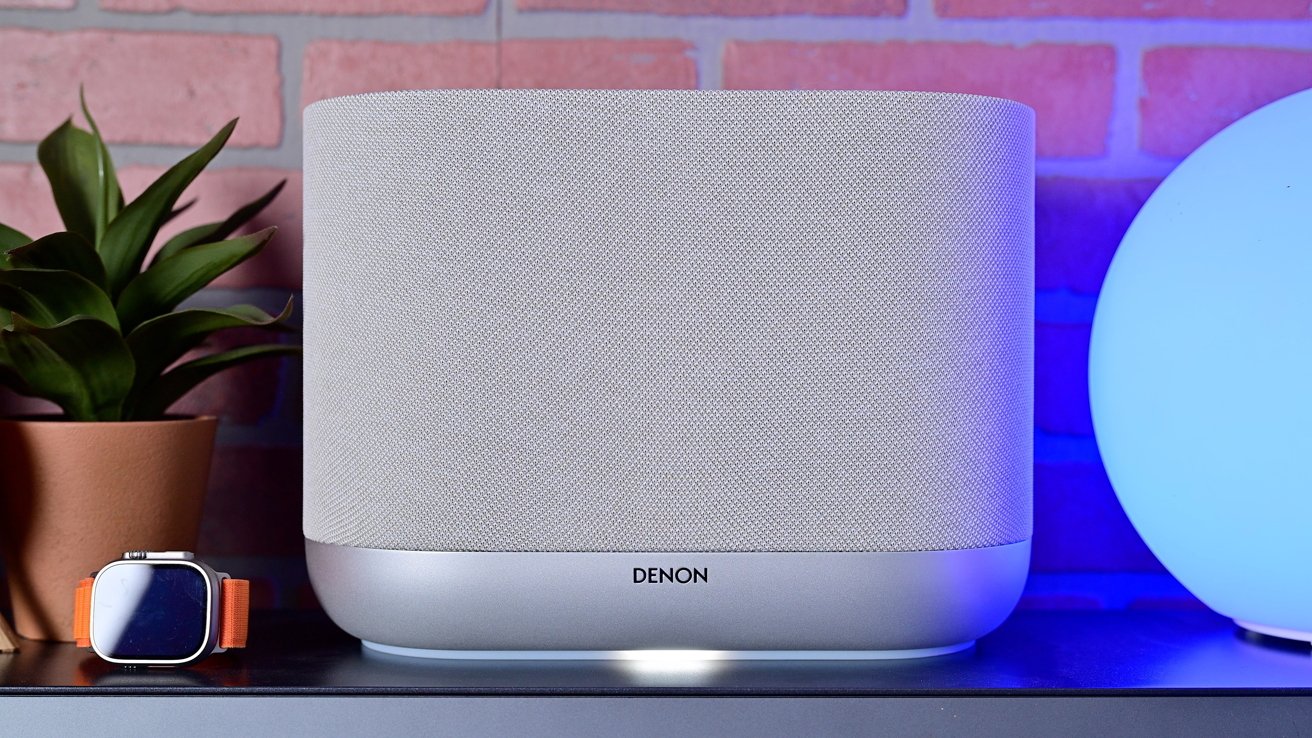
Denon Home series speakers review: Denon Home 400 on a shelf in my studio

Moving to the Denon Home 400, it has six total drivers. There are two outward-firing tweeters, dual 4.5-inch woofers, and two more upward-firing drives.

This one gets even louder and is overkill for any small to medium room. It has better stereo separation as well and a broader soundstage.

Advertisement

I can’t emphasize how much this can really fill out a room. Thinking about the Denon Home 600, that must be wild.

When I first started listening to the Denon Home 400, the most noticeable change was the bass. It was far more powerful, but still tightly controlled.

You can feel this bass in your chest before even having to turn up the volume. It was amazing.

Theoretically, the Denon Home 400 will provide more accurate Dolby Atmos Spatial Audio than the 200. I say theoretically because I wasn’t able to test it.
Advertisement
Close-up of the back panel of a Denon Home 400 speaker showing the brand name, model label, a central gold threaded mounting insert, and a small white barcode sticker

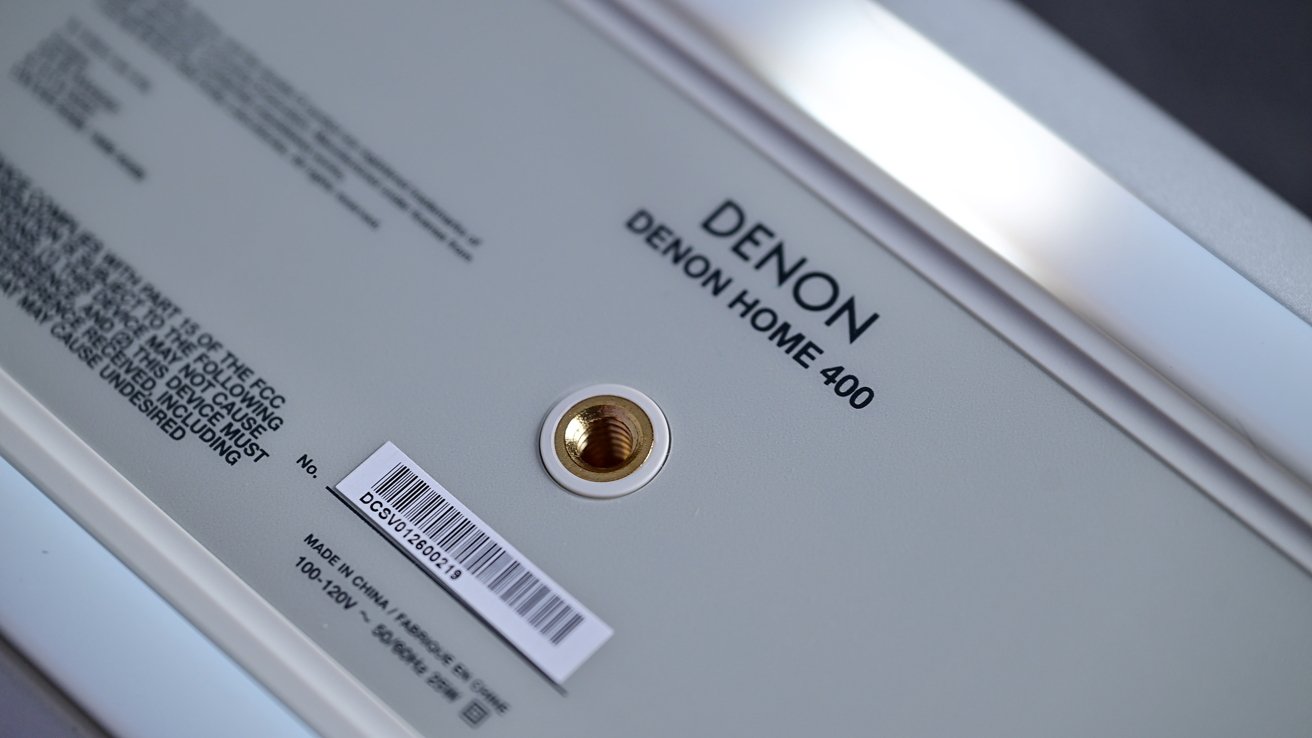
Denon Home series speakers review: The bottom of the speaker has a silicone foot and a thread for mounting on a traditional speaker stand or bracket

Currently, Dolby Atmos content is only supported when streaming directly from Tidal or Amazon Music Ultra HD. I don’t subscribe to either of these as an Apple Music listener.

Denon says it is working on Apple Music Dolby Atmos support, but there’s no promise on when that feature will be delivered.

Denon Home speakers review: Siri-ous audio quality for Apple users

In an increasingly competitive space, Denon has excelled here. I’m very pleased with the entire ecosystem.

Advertisement

The base model, while more expensive than a HomePod, has notably better audio quality. It also offers better on-device controls, multiple wired inputs, and still retains Siri support.
Smart speakers, a small orange speaker on wooden legs, a potted plant, and a smartwatch on a shelf against a red brick wall with soft blue accent lighting

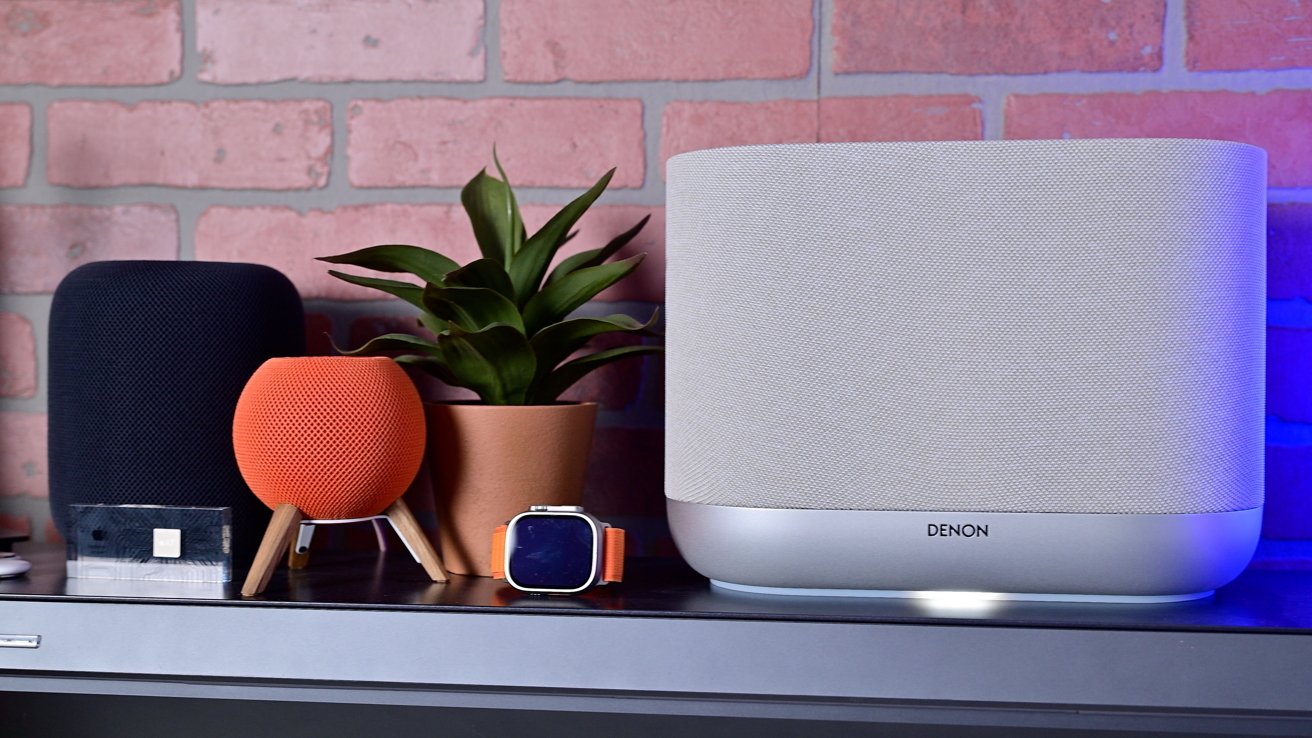
Denon Home series speakers review: Denon Home 400 is an amazing-sounding premium speaker with Siri support

Moving up the lineup, users can choose the speaker that suits their environment, upgrading to the larger, more powerful, and louder models. If you ever found that HomePod wasn’t loud enough or the audio wasn’t good enough, there were zero alternatives that let you keep Siri.

While I’m a massive Sonos fan, the Denon Home 200, 400, and 600 offer more than competitive audio quality with native Apple features. As an Apple user, Denon is offering a better experience.

Advertisement

Small points are subtracted for having a HomePod as a requirement for a full experience, but that onus lies on Apple, not Denon. With so few alternatives here, Denon did the absolute best it was able to, all around.

Right now, I think Denon put out the best all around smart speaker, if you’re willing to pony up for superior sound. For Apple users, it’s the premium option to choose, at least while we wait for the possibility of a refreshed HomePod.

Denon Home speakers review: Pros

  • Sleek, premium, modern designs
  • Built-in Siri, and smart home features like doorbell chime, and intercom
  • Fantastic audio quality
  • Dolby Atmos support
  • Easy setup through Apple Home

Denon Home speakers review: Cons

  • Requires HomePod or HomePod mini for Siri
  • Somewhat expensive
  • No Dolby Atmos via Apple Music yet

Denon Home 200 & Denon Home 400 Rating: 4 out of 5 stars

Where to buy Denon Home 200 & Denon Home 400

The Denon Home 200 sells for $399 and can be ordered from Amazon and B&H Photo, while the Denon Home 400 retails for $599.

That model, which comes in your choice of Charcoal or Stone, can also be purchased at Amazon and B&H Photo.

Advertisement

The robust Denon 600, meanwhile, will run you $799 at Amazon and B&H.

Source link

Advertisement
Continue Reading
Click to comment

You must be logged in to post a comment Login

Leave a Reply

Tech

John Roberts Is The Driver Who Wants Credit For All The People He Didn’t Run Over

Published

on

from the unkicked-puppies dept

John Roberts has a point: the Supreme Court—even this Supreme Court—sometimes gets things right. Maybe one could even fairly say it often gets things right. After all, just recently it produced good decisions in Case v. Montana, Cox v. Sony, and First Women’s Choice Centers v. Davenport, and arguably even Chiles v. Salazar, along with plenty more that have quietly taken their place in the annals of American jurisprudence with little fanfare but the staying power we look to the Court’s opinions for, to continue to speak well into the future about the contours of our law. These were decisions where there was significant accord among all the justices because the legal questions before them were just not that hard to resolve. Either statutory language, constitutional text, or previous precedent required certain results, and Roberts is correct: this Court is fully capable of producing them.

The issue, however, is that it doesn’t always. And when it doesn’t it is not because it’s getting tripped up by close calls where either the precedent or guiding text isn’t clear, or the facts are so unfortunate that they obscure what the law requires. The issue is that the law is as equally clear in cases where the Court produces deviant results as in the cases where the Court gets things right; it just doesn’t care to follow it consistently. If it wants a different result than what the law directs then that is the result it will find the votes for.

Roberts is of course also right that non-lawyers often can’t tell what the law indeed requires; the general public is much more likely to judge a decision based on how it affects the interests they favor. Which is why Roberts has a fair point to think the Court may be unfairly criticized in decisions like Chiles, First Women’s Choice Centers, or even 303 Creative, cases where interests many understand to be harmful to others nevertheless apparently prevailed. It is difficult, for instance, for non-lawyers to see how a win for those who discriminate is nevertheless a win for those who are discriminated against, because while a win for the former may seem like a loss for the latter in the short term, it’s the rationale being upheld by the decision that will ultimately amount to a more important gain for the vulnerable in the long term.

But one reason people are struggling to see these controversial but correct decisions as fortifications of their own future freedom is because they don’t believe that when their interests are at stake the Supreme Court will still apply the same principles this time in their favor. They fear that the Court will instead find a way to advance the interests it prefers, and it’s a fear that is eminently reasonable. The hypocrisy the justices regularly display in their jurisprudence when one of their favored interests is at stake forecloses any rational person having any faith in them as neutral jurists ably applying the law, even if it’s true that sometimes they are.

Advertisement

Roberts only has himself and his Court to blame for so many having that view. They have made it impossible for anyone to believe the Court will uphold principle and precedent because of how often it has not. It is happy to change the rules that we must all play by whenever it suits it, redrawing the rights we depend on as well as the ability to use the courts to shape them. And it’s not just laypeople who’ve noticed the problem but legal professionals. It’s lawyers, including members of the Supreme Court Bar who practice before them. It’s law professors, including those who have been teaching new generations of law students what were supposed to be timeless principles of American jurisprudence, which the Court so regularly and casually upends. It’s legal commentators, including those who specialize in watching this court. It is people who are experienced, if not expert—and if not at least as expert as anyone on the Court—in the American legal tradition who are calling foul. They are noticing how the Court keeps inventing arbitrary and imaginary rules, if not also facts, in order to arrive not where the law points but where the conservative justices steering the Court’s majority instead prefer to go.

It might be one thing if it were the rare case here and there in its busy docket where the Court has simply been sloppy in its jurisprudence. But the cases where the conservative majority has refused to produce jurisprudentially conservative results, instead elevating preferred outcomes over precedential reasoning, are hardly the exception; at this point it has become the apparently deliberate rule that when certain issues are on the table—partisan politics, reproductive freedom, LGBTQ+ rights, race relations, to name just a few areas where the conservative justices have particularly strong views—the Roberts Court will eagerly jump in to advance them, regardless of whether either substance or procedure—or consistency—even invites such an intervention, let alone their favored result. In fact it is fairly shocking to encounter the rare occasion where the Court has instead restrained itself—although it is certainly glad to when other interests the conservative majority is less dogmatically interested in advancing are instead on the table.

Furthermore, that its docket is so busy is entirely because the Court has abdicated any pretense of restraint, greedily helping itself to matters that historically would have been regarded as unripe for its consideration. In fact, it is a bit rich for Roberts to complain how the Supreme Court is being unfairly disrespected given the extent to which its new practice of aggressively insinuating itself in substantive adjudication of matters before there even is a lower court ruling or record ready for review has itself undercut the respect due the lower courts. What the Court has been doing, particularly with its Shadow Docket, goes far beyond the appellate review it is normally entitled to do. Not only does the Supreme Court’s incessant snatching of matters away from the lower courts prematurely arbitrarily diminish the lower courts’ power to render considered opinions on the questions before them, but it has also been having the practical effect of undermining their ability to speak with any authority on the law at all, let alone enforce it. Would only Roberts shed the same tears for the insult the lower courts have actually suffered as he does for himself as the cause of it.

Instead, and apparently without any capacity for introspection or self-reflection, he protests that the criticism increasingly directed at the Court is not also increasingly deserved. We should, he insists, be judging his Court based on what it gets right. But we do not celebrate a reckless driver for all the people he didn’t run over, or careless chef for all the diners he didn’t poison, or distracted doctor for all the patients he didn’t kill. In the American legal tradition we judge harshly those who cause injury to the public well-being, especially with behavior beyond the bounds of what law allows.

Advertisement

And with the Roberts Court there is so much to judge.

Filed Under: consistency, john roberts, partisanship, supreme court

Source link

Advertisement
Continue Reading

Tech

Apple TV exec leaving to start his own production company

Published

on

Morgan Wandell, who has been with Apple TV since before its launch, is now departing the streaming service in favor of launching his own production company.

In 2017, Apple poached Wandell from Amazon Studios to join its team at Apple Worldwide Video. When Apple TV launched in 2019, his title became Head of International Content Development.

While at Apple, Wandell developed and oversaw production of “Monarch: Legacy of Monsters,” “Tehran,” “Disclaimer,” “Masters of the Air,” and “The New Look.”

Now, it seems as though he’s got other plans. Wandell plans on leaving Apple TV to found his own production company, Kismet.

Advertisement

Kismet will develop and produce premium scripted series for the global marketplace. Its offerings will focus on high-end culturally rooted storytelling.

While he is technically leaving his executive role behind, it seems that he may not be leaving Apple TV entirely. He’s currently in talks with Apple to stay on as a producer on some of his existing projects.

“Helping to build Apple TV’s international slate has been the privilege of my career,” Wandell told Deadline.

“I’m deeply grateful to Jamie [Erlicht], Zack [Van Amburg], and all my colleagues at Apple, and to the extraordinary creators we’ve partnered with around the world. It was a hard personal decision to make this leap from a company as terrific as Apple, but I have always wanted to build a company of my own.”

Advertisement

Matt Cherniss, Apple TV’s Head of Programming and Domestic Development, will take over the Monarch franchise and other series that were under Wandell’s purview. Cherniss currently oversees other hit series, such as “Ted Lasso,” “Severance,” “The Studio,” and “Pluribus.”

Jay Hunt, Apple TV’s creative director, Europe, will see her role expand to oversee international and local-language originals. She is in charge of British staples “Slow Horses” and “Hijack”, among others.

Before his tenure at Apple, Wandell worked as Head of International Series and Head of Drama Series at Amazon Studios for four years. Before that, he acted as Senior Vice President of Drama at ABC studios, overseeing series including “Lost,” “Grey’s Anatomy,” “Brothers and Sisters,” “Ugly Betty,” and “Criminal Minds.”

Advertisement

Source link

Continue Reading

Tech

Microsoft reveals another way it’s making Windows 11 faster, with more performance boosts promised for the likes of File Explorer

Published

on


  • Microsoft is working to make WinUI 3 speedier
  • This is the contemporary framework for the user interface of the OS
  • With WinUI 3 being employed more widely across Windows 11, and tweaked for better performance, it’s another key way in which the OS could be made faster

We’ve learned more about Microsoft‘s efforts to make Windows 11 faster, discovering another front that the company is working on to ensure the operating system becomes more performant in terms of core interface elements.

Windows Central reports that the big drive for better performance — which is part of the broader campaign to fix Windows 11 — doesn’t just involve transitioning elements of the Windows 11 interface to use WinUI 3, but actually speeding up WinUI itself.

Source link

Advertisement
Continue Reading

Tech

AI customer service bots get rolled back at 74% of firms

Published

on

AI + ML

AI rollback rates hit 81% at firms with mature guardrails, suggesting enterprises are struggling to manage the systems in production, says Sinch

If you’re thinking you can replace your human call center staff with a server farm of bots, think again. Nearly three-quarters of enterprises that deploy AI customer communications agents later roll them back or shut them down, according to new research suggesting the systems are far harder to manage reliably in production than the AI hype implied.

Swedish comms-as-a-service firm Sinch surveyed more than 2,500 AI decision makers from various countries and industries for its AI Production Paradox study. The starkest finding is undoubtedly the 74 percent rollback or shutdown rate for deployed AI customer communications agents tied to governance failures, but that’s not the only sign enterprise AI deployments are falling short of expectations. 

Advertisement

AI rollback rates, which Sinch told us specifically refer to AI projects that were deployed and pulled from live service rather than projects that failed before launch, actually rise to 81 percent among organizations that it describes as having “fully mature guardrails.” That, says Sinch Chief Product Officer Daniel Morris, suggests governance alone is not fixing the problem. 

“The most advanced organizations aren’t failing less; they’re seeing failures sooner. Higher rollback rates reflect better monitoring and control, not weaker performance,” Morris said in a press release. “If governance was the fix, the most mature teams would roll back less, not more. Our data points to a deeper issue.”

According to the findings, 84 percent of AI engineering teams are spending at least half their time on safety infrastructure, leaving little time to develop AI. This is exacerbated by the fact that most firms said spending on AI trust, security, and compliance ranks ahead of AI development itself.

“When 75% put trust, security, and compliance in that top three — ahead of AI development itself at 63% — that’s a finding about where the priority sits within their AI customer communications programs,” a Sinch spokesperson told us in an email. In other words, it seems like most organizations realize that their biggest issue with AI isn’t getting it working properly – it’s getting it to just work safely in the first place. 

Advertisement

“The operational cost of running AI safely at scale is much larger than most organizations expect,” the Sinch representative explained.

The numbers don’t change based on organizational size or budget, either, Sinch told us. 

“The rollback rate holds consistently across every region and every industry in the study, which suggests size isn’t a meaningful protective factor,” the company said. “Rollback isn’t a symptom of under-investment or being too small to afford proper guardrails.” 

Of course, as a business communications service provider, Sinch linked its results back to AI customer service agents not being properly deployed on comms infrastructure designed for AI agents, a problem it’s naturally positioned to offer a fix for. 

Advertisement

Regardless, that three-quarter rollback figure doesn’t seem too out of place when you consider recent customer service automation news. 

As we’ve reported on multiple occasions, replacing customer service staff with AI hasn’t gone to plan for many businesses. Gartner said in June 2025 that half of organizations expecting AI to significantly reduce customer service headcount would abandon those plans by 2027. Sinch’s numbers suggest the problem may extend beyond staffing cuts to the AI agents themselves. Not that far-fetched when Gartner was already warning last year that fully agentless contact centers were not practical in the real world.

“Our vendor evaluations reveal that a agentless contact center is not yet technically feasible, nor is it operationally desirable,” Brian Weber, VP analyst in the Gartner Customer Service & Support practice, told The Register, adding that unexpected costs and unintended results were contributing to abandonment plans – just like what Sinch is reporting now. ®

Source link

Advertisement
Continue Reading

Tech

OpenAI Brings Its Ass to Court

Published

on

Wednesday’s episode of the Musk v. Altman trial kicked off on Wednesday with a unique proposition: OpenAI wanted to bring its ass into the courtroom, and lay it bare before the jury. It’s a good thing lady justice wears that blindfold.

A lawyer for Sam Altman’s AI behemoth, Bradley Wilson, approached US district judge Yvonne Gonzalez Rogers and handed her a small gold statue with a white stone base. It depicted the rear end of a donkey—with two legs, a butt, and a tail—and was inscribed with the message, “Never stop being a jackass for safety.”

OpenAI lawyers claim a small group of employees presented the gift to chief futurist Joshua Achiam, who started at the company as an intern in 2017 and now leads its work studying how society is changing in response to AI. Wilson said that Achiam interrupted Elon Musk’s parting speech from OpenAI in 2018 to warn that the billionaire’s desire to develop AGI at Tesla could come at the expense of safety. Wilson added that the trophy commemorates some “strong language” that Musk used toward Achiam in response—allegedly, calling him a jackass.

OpenAI requested to present the physical object during Achiam’s testimony on Wednesday, arguing that it adds to their case. While Musk’s team said the statue was irrelevant, Judge Gonzalez Rogers said she will consider allowing it when it’s referenced to corroborate the story. However, she seemed less than thrilled about accepting it as official evidence, which would put it in the court’s possession. “I don’t want it,” she said.

Advertisement

Representatives for Musk and OpenAI did not immediately respond to a request for comment about the ass.

Musk’s lawsuit accuses OpenAI of effectively stealing a charity, misusing his $38 million in donations to build an $850 billion business. In response, OpenAI has argued that Musk has always cared more about controlling a top-tier AGI lab than funding a nonprofit.

Earlier in the trial, Musk lawyer Steven Molo asked him if he ever called an OpenAI employee a “jackass.” Musk said “it’s possible” he did at some point, but that he didn’t mean for it to be offensive. “Sometimes you have to use language that gets people out of their comfort zone, if we’re going in the wrong direction,” Musk said.

OpenAI has long been proud of its jackass. When The Wall Street Journal asked about the statue in 2023, Altman told them, “You’ve got to have a little fun … This is the stuff that culture gets made out of.”

Advertisement

Source link

Continue Reading

Tech

Harvard Votes On Limiting ‘A’ Grades

Published

on

Harvard faculty are voting on a proposal (PDF) to curb grade inflation by limiting solid A grades to 20% of students in a class, plus four additional A’s per course. Axios reports: Grade inflation is at a tipping point at Harvard. A move to make A grades harder to come by at one of the world’s leading universities could influence grading debates at peer institutions. Solid A’s account for nearly two-thirds of all undergraduate letter grades. That’s up from roughly a quarter 20 years ago. More than 50 members of last year’s class graduated with perfect GPAs.

[…] Faculty are voting on three separate provisions. Each requires a simple majority to pass. A cap to limit solid-A grades to 20% of enrolled students in a class, plus four additional A’s per course. Changes to how internal honors are calculated, moving from traditional grade point average scoring to an average percentile rank. Allowing courses to use new “satisfactory” or “unsatisfactory” marks with a “satisfactory-plus” distinction.

A pre-vote faculty poll showed around 60% of the 205 respondents favored the 20-plus-four formula over an alternative. Supporters of the cap argue it’s intentionally modest as it places no restrictions on A-minuses. The four-grade buffer is designed to protect small seminars where a higher proportion of students may succeed. […] If passed, changes would take effect in fall 2027, followed by a mandatory three-year review.

Source link

Advertisement
Continue Reading

Tech

Meta launches Incognito Chat on WhatsApp, the first AI mode it says even Meta cannot read

Published

on

The new mode runs Meta AI on WhatsApp inside the company’s Private Processing enclave, with conversations deleted by default and no server-side record retained.

Meta has launched an Incognito Chat mode for Meta AI on WhatsApp and the Meta AI app, an effort to address the awkward fact that its assistant, like every other major AI chatbot, has until now been able to read the conversations users have with it.

The new mode, the company announced on Tuesday, processes user messages inside what Meta describes as a secure environment that even Meta cannot see, with conversations deleted by default once the session ends.

The technical foundation is WhatsApp’s Private Processing system, the architecture the company published in April 2025 to let AI features run on encrypted data inside Trusted Execution Environments on Meta’s servers.

Advertisement

Inside that enclave, the model can read and respond to a query, but the contents are not accessible to Meta’s engineers, its logging systems, or any of its commercial pipelines.

Other apps offer what they call incognito modes for AI conversations, but Meta’s framing in the announcement is pointed: “they can still see the questions coming in and the answers going out.”

The launch responds directly to a category-wide privacy concern. AI chatbots have become a default tool for the sort of question users would once have asked a doctor, a lawyer, or a partner, with all the data exposure that implies.

OpenAI, Google, and Anthropic each store conversation histories by default, with varying user controls. Apple Intelligence routes some queries through Apple’s Private Cloud Compute, an enclave architecture that is the clearest existing analogue to what Meta is now shipping inside WhatsApp.

Advertisement

Two product details follow from the design. First, the conversations are not saved server-side at all; users cannot pull up Incognito Chat history later because there is nothing to pull up.

Second, the disappearing-by-default behaviour means even a compromised device leaks less, since the chat residue clears between sessions.

Meta has published a technical whitepaper describing the cryptographic architecture for outside review.

A second feature is on the way. Sidechat with Meta AI, also protected by Private Processing, will let users get AI help inside an existing WhatsApp conversation, with the assistant aware of the chat’s context but its responses kept invisible to the other participants.

Advertisement

Meta said Sidechat will arrive on WhatsApp “in the coming months,” without a firmer date.

The launch’s commercial logic is straightforward. WhatsApp has been built for a decade around end-to-end encryption as a selling point, and Meta’s pitch for AI on the platform has had to find a way around the central tension that a conversational AI assistant needs to read your messages to be useful.

Private Processing is the company’s attempt at squaring that circle. The Incognito Chat product is the first time the architecture has been put behind a user-facing feature on this scale.

Whether the implementation holds under scrutiny is a separate question. Trusted Execution Environment-based AI systems have been audited and criticised across the industry, with researchers periodically demonstrating side-channel attacks against similar architectures from Apple, Google, and the hyperscalers.

Advertisement

Meta has invited external review of its Private Processing design, and the new whitepaper extends that posture, but the model’s resistance to subpoena, in particular, has not yet been tested in court.

Incognito Chat with Meta AI begins rolling out on WhatsApp and the Meta AI app this week, with broader availability over the coming months.

The launch lands at the end of a difficult fortnight for Meta on the privacy front, with US employees protesting the company’s new mouse-tracking software on Monday and the company a week out from layoffs of roughly 8,000 staff.

Inside Meta, the bet appears to be that consumer-facing privacy moves like this one will outweigh the internal-surveillance optics.

Advertisement

Source link

Continue Reading

Tech

How to Use Amazon Seller Central Reports to Scale Your Brand

Published

on

Amazon Seller Central offers a layered reporting suite — with access determined by selling plan, fulfillment method, and Brand Registry status. In most organizations, these reports serve a single purpose — confirming what has already occurred: sales reconciled, fees reviewed, inventory checked. That operational function is necessary, but it represents only a fraction of what these reports are built to deliver. The same reports hold intelligence that directly determines how a brand scales:

Conversion signals that reveal listing degradation before it erodes rank

Acquisition quality data that separates genuine brand growth from retargeting spend

Product feedback loops that surface quality and listing gaps before they compound in reviews

SKU-level margin intelligence that identifies which products can sustain paid investment and which cannot

Advertisement

The gap is not access — it is how the data is leveraged.

This blog provides a structured approach to leveraging five core Seller Central report categories — Business, Advertising, Fulfillment, Return, and Payments — for measurable brand growth. It covers best practices for leveraging reports effectively, the structural limitations every brand team needs to account for before acting on the data, and how Amazon account management helps.  

The Core Categories: How Amazon Seller Central Reports Are Structured

Report
Category

Advertisement

Key
Reports

Role
in Brand Growth

Business Reports

Sales Dashboard, Detail Page Sales and
Traffic by Child ASIN, Brand Performance Report

Advertisement

Conversion health, traffic trends,
listing-level performance

Advertising Reports

Search Term Report, Placement Report,
Sponsored Brands/Display Reports

Search demand, new-to-brand acquisition,
placement efficiency

Advertisement

Fulfillment Reports

Inventory Ledger, Stranded Inventory, Inbound
Performance, Inventory Performance Index (IPI)

Inventory health, stockout prevention,
inbound accuracy

Return Reports

Advertisement

FBA Customer Returns Report, Returns Trend
Analysis

Product quality feedback, brand equity
signals

Payments Reports

Transaction View, Fee Preview Report

Advertisement

SKU-level margin clarity for reinvestment
decisions


How to Use Amazon Seller Central Reports for Brand Growth

Step 1: Audit Business Reports for Brand Performance Signals

1. Detail Page Sales and Traffic by Child ASIN: Read session count, page views, Unit Session Percentage (conversion rate), and Featured Offer percentage at the variation level. Track these metrics weekly per ASIN — a sustained downward trend in Unit Session Percentage is your leading indicator of listing degradation before it erodes rank. 

2. Brand Performance Report: Review Average Customer Review, Number of Customer Reviews, Sales Rank, and Featured Offer percentage together for each ASIN. These four metrics form a direct snapshot of brand health at the listing level. Flag metric combinations that signal brand risk rather than reading each metric in isolation.

Advertisement

3. Sales Dashboard: Review weekly and monthly trend lines across weekly and monthly windows to gauge whether brand momentum is accelerating or declining. Use the Compare Sales feature to layer on year-over-year context — this helps separate genuine trajectory shifts from recurring seasonal patterns. 

Cross-reference sessions against Unit Session Percentage: falling sessions signal a visibility problem; falling conversion with stable sessions signals a listing or pricing issue. 

Note: Business Reports are available only to sellers on a Professional selling plan, and historical data is retained for up to two years.

Step 2: Extract Brand Acquisition Insights from Advertising Reports

Advertisement

Advertising Reports address two brand growth questions that Business Reports cannot answer. The first is which channels and keywords drive new demand into the brand. The second is what proportion of that demand represents genuinely new-to-brand customers versus returning buyers.

1. Search Term Reports: Review the actual queries customers typed before clicking an ad.

Negate: Any term that spends money with zero conversions over 30 days is added as a negative keyword. This is the single fastest way to improve ACoS without changing bids.

Harvest: Any search term that converts at or below your target ACoS is added as an exact match keyword.

Advertisement

For brands managing large campaign portfolios, use the Bulk Operations feature in Campaign Manager to download a custom spreadsheet with Sponsored Products and Sponsored Brands Search Term data. Edit keyword additions and negations directly in the file and upload to update campaigns in a single operation. 

2. Sponsored Brands and Sponsored Display Reports: Isolate the New-to-Brand (NTB) metric inside these campaign types to separate new customer acquisition from repeat buyers. Monitor NTB percentage, NTB order cost, and NTB sales separately from overall ROAS to measure true brand expansion, not branded retargeting.

3. Placement Reports: Compare conversion and spend distribution across top-of-search, product pages, and rest-of-search. Redirect budget toward placements with the strongest NTB and conversion performance. Top-of-search placements carry disproportionate brand visibility and deserve priority investment when NTB indicators support it.

Step 3: Protect Brand Momentum with Fulfillment Reports

1. Inventory Ledger Report: Consolidate inventory movement across Amazon warehouses — adjustments, receipts, and shipments — in a single view. Monitor inventory accuracy and act on discrepancies before stockouts hit high-velocity ASINs.

Advertisement

2. Stranded Inventory Report: Identify stock held in FBA warehouses but unsellable due to listing issues. Each stranded ASIN represents a direct revenue leak. Recover these listings weekly, before the associated search rank decays.

3. Inbound Performance Report: Track the efficiency of FBA shipments, including missing units, incorrect labeling, and receiving delays. Address recurring inbound issues at the source before they escalate into repeat offenses, as persistent issues extend reimbursement cycles and delay restock.

4. Inventory Performance Index (IPI): Monitor IPI as a brand growth prerequisite, not a warehouse KPI. Calculated from fulfillment data, the score directly affects FBA storage limits. A low IPI restricts scalability and caps paid acquisition ceilings.

Step 4: Read Return Reports as Product Quality Feedback

1. FBA Customer Returns Report: Mine return reasons, order IDs, and SKU-level detail for recurring patterns. Aggregate return reasons by ASIN to reveal product issues that would otherwise appear only in individual customer reviews.

Advertisement

2. Return Trend Monitoring: Flag ASINs with rising return rates as a signal of either a product quality issue, a listing accuracy issue, or both. Each failure mode damages brand equity and search rank. Address the root cause visible in return reasons, rather than treating the symptom through returns management.

For example, when the most frequent return reason on an ASIN is “not as described,” the listing content itself is driving the returns. An updated, accurate listing reduces future returns, improves conversion rate, and reinforces brand trust — three outcomes from a single fix.

3. Schedule Report Generation: Set up daily schedules for All Returns and Prime returns, instead of pulling them manually. Three operational constraints to note:

One active schedule per report type

Advertisement

Maximum of 30 reports in the Scheduled Reports section

Schedule changes require deletion and recreation

Reports can be scheduled by return date for both FBA and seller-fulfilled orders to track return reasons and item condition across fulfillment channels.

Step 5: Use Payments Reports to Inform Brand Reinvestment

1. Transaction View: Break down every order into referral fees, FBA fees, promotional rebates, and net proceeds. Surface ASIN-level margin visibility to identify which products can sustain paid acquisition pressure and which cannot.

Advertisement

2. Fee Preview Report: Project FBA fulfillment, storage, and referral fees across existing FBA inventory. Review the report to identify ASINs where upcoming fee changes or aged-inventory surcharges will compress margin. Adjust pricing or inventory planning before the fees hit the bottom line.

Limitations & Challenges of Amazon Seller Central Reports

#1 No Built-in Competitive Benchmarks

Seller Central Reports show only your own performance data. There is no native view of how your brand performs against category peers or direct competitors. External benchmarking requires third-party data or Brand Registry-gated reports.

#2 Data Latency Varies Across Reports

Advertisement

Business Reports refresh daily, while Fulfillment and Payments reports often run on weekly or delayed cycles. This inconsistency complicates cross-report analysis when precise attribution windows matter, particularly for reconciling paid performance against organic results within the same reporting period.

#3 Limited Brand-Level Insights Without Brand Registry

Deeper brand-growth tools sit outside the standard Reports tab. These include Brand Analytics dashboards (Search Query Performance, Market Basket Analysis, Customer Loyalty Analytics), the Brand Dashboard, and Voice of the Customer. Brand Registry enrollment unlocks these additional layers.

#4 Attribution Gaps Between Advertising and Organic

Advertisement

Advertising Reports attribute sales to campaigns, while Business Reports track total sales. Reconciliation between the two requires careful segmentation, especially when paid campaigns and organic traffic overlap on the same keywords.

#5 Report Siloing Across Tabs

Seller Central Reports live across multiple tabs — Reports, Advertising, Returns, Payments — with inconsistent naming and export formats. Cross-report analysis almost always requires careful manual reconciliation.

Best Practices for Using Seller Central Reports Effectively

1. Standardize Date Ranges Across Reports 

Advertisement

Different reports operate on different default time windows. Business Reports default commonly to 30 days, while granular Advertising Reports — including Search Term and Purchased Product Reports — are subject to a hard 90-day lookback limit, not a display default. Manually aligning date ranges across reports before cross-referencing ensures comparisons reflect the same performance window and eliminates attribution mismatches.

2. Benchmark Week-Over-Week, Not Day-Over-Day

Single-day metrics are statistically volatile, particularly on low-velocity SKUs where marginal order volume can produce significant conversion rate variance. Weekly benchmarking normalizes daily fluctuations while keeping the reporting window tight enough to surface trends before they compound.

3. Cross-Reference Reports for Root-Cause Analysis

Advertisement

A conversion decline in Business Reports frequently correlates with a Buy Box shift, a pricing change, or a stranded listing in Fulfillment Reports. Isolating a single metric without cross-report validation increases the risk of misdiagnosis and misdirected corrective action.

4. Export and Archive Reports Externally

Business Reports retain data for up to two years. Granular Advertising Reports, including those referenced above, are capped at a 90-day lookback window with no native recovery option beyond that threshold. Once the window closes, that data is permanently removed from Seller Central — brands that need historical context must export it on a defined schedule.  

5. Align Reporting Depth with Organizational Role

Advertisement

Operational teams require weekly tactical reviews covering stockouts, suppressed listings, and Buy Box performance. Brand leadership requires monthly and quarterly trend analysis focused on category share and customer retention. Calibrating reporting depth to the decision-making level of each function reduces analysis fatigue and maintains actionable review cycles across the organization.

The Business Imperative: Seller Central Reports provide the data. Translating that data into consistent brand decisions — across listings, advertising, inventory, returns, and margins — requires operational discipline that compounds over time.

For brands managing catalog depth, multi-channel fulfillment, and active advertising simultaneously, cross-report analysis, weekly metric reviews, search term management, inventory reconciliation, and fee audits each demand specialization and bandwidth that most in-house teams cannot sustain at the required cadence.

Amazon account management services bring the field-level expertise and technical infrastructure to close that gap — identifying signals early, connecting them across report categories, and converting them into decisions before they compound into performance issues.

Advertisement

As catalog scale increases, inconsistent report review compounds directly into rank loss, wasted ad spend, stranded inventory, and missed reinvestment signals — each one a measurable cost to brand performance. The question is not whether these gaps exist. The question is how long your brand can afford to leave them unaddressed. 

Source link

Advertisement
Continue Reading

Tech

Trump Already Has His ‘Get Out Of Jail Free’ Card. Now He Wants A ‘Get Out Of IRS Audits’ Card

Published

on

from the nice-work-if-you-can-get-it dept

In a ruling that will clearly be remembered as one of the worst in the history of the Supreme Court, two years ago, the court gave Donald Trump a get out of jail free card, which he appears to be trying to take full advantage of with all the criming in his second term. But, as always with this guy, it’s never enough.

We’ve already covered in detail the ridiculous situation in which Donald Trump acting in his supposed personal capacity, while still being the president, sued his own IRS for $10 billion, because a contractor leaked his tax returns a while back (that contractor is currently in prison for doing so). Again, there is zero indication of any actual harm. Every president — and nearly all major candidates — for the past 50 years released their tax returns to the public. Except Trump.

A decade ago he claimed that it was because he was being audited, and promised to release them once the audit was over. But he’s never done anything. And, as many people have noted, when President Richard Nixon started this tradition of releasing the president’s tax returns, he was actually being audited by the IRS, and was able to release his returns without a problem.

Either way, a contractor (not an IRS employee) leaked some of Trump’s returns to ProPublica and the NY Times, which resulted in a few stories before the news cycle moved on within days. It certainly didn’t stop Trump from being elected in 2024. And even though the returns were leaked in 2019 and 2020, Trump waited until he was back in the White House (and, in charge of the IRS and the DOJ) to file this $10 billion lawsuit.

Advertisement

We’ve covered the ridiculous claim that the “two sides” (there aren’t two sides) were “negotiating a settlement” and how the judge in the case has tried to call timeout, noticing that since Trump is effectively negotiating with himself there’s no cause or controversy, and thus there may be no jurisdiction for the court to hear the case. There’s still briefing going on over that, but the NY Times reports that the supposed (not really) “negotiations” have continued, with Trump apparently proposing that the settlement include the IRS dropping audits of Trump, his businesses, and his family, which would just be a shocking level of corruption from an administration that has spent its first year and a half in office trying to be as blatantly corrupt as possible.

One of the settlement options the Justice Department and White House officials are reviewing is the possibility of the I.R.S. dropping any audits of Mr. Trump, his family members or businesses, according to two of the people.

Again, even though the news cycle moved on quickly, perhaps it should return to exactly what those leaked tax returns showed: which is that at a time when Trump was publicly claiming to be rolling in cash, he basically paid effectively no income taxes and was racking up massive losses — figures that raise serious questions about his financial entanglements and what he stood to gain from his first term in office.

To have the audits of what happened during those years completely dropped — and not just for him, but for his entire family and related businesses — is another form of a get out of jail free card. Call it a “tax cheat for life” card.

To do this at a time when the public is struggling, due almost entirely to Donald Trump’s ridiculous policies — tariffs driving up inflation massively, an illegal war quagmire in Iran driving up energy prices — is even more insulting to the public that Donald Trump is supposed to be working for. The same day this story came out, Trump was asked about whether he was thinking about the impact of his out-of-control war on Americans’ financial situation, and he responded “not even a little bit” and that “I don’t think about Americans financial situation. I don’t think about anybody.”

Advertisement

Well, except himself, apparently.

Filed Under: audits, corruption, donald trump, irs, tax returns

Source link

Advertisement
Continue Reading

Tech

KDE Receives $1.4 Million Investment From Sovereign Tech Fund

Published

on

The German Sovereign Tech Fund has invested 1.2 million euros ($1.4 million USD) in KDE Plasma technologies to help strengthen the structural reliability and security of the desktop environment’s core infrastructure, including Plasma, KDE Linux, and the frameworks underlying its communication services. Longtime Slashdot reader jrepin shares an excerpt from the announcement: For 30 years, KDE has been providing the free and open-source software essential for digital sovereignty in personal, corporate, and public infrastructures: operating systems, desktop environments, document viewers, image and video editors, software development libraries, and much more.

KDE’s software is competitive, publicly auditable, and freely available. It can be maintained, adapted, and improved in-house or by local software companies. And modifications (along with their source code) can be freely distributed to all users and departments within an organization.

KDE will use Sovereign Tech Fund’s investment to push its essential software products to the next level, providing every individual, business, and public administration with the opportunity to regain their privacy, security, and control over their digital sovereignty. Slashdot reader Elektroschock also shared a statement from Fiona Krakenburger, Technical Director at the Sovereign Tech Agency.

“We have long invested in desktop technologies for a reason: they are the primary way people access and use digital services in everyday life,” says Krakenburger. “The desktop holds personal data and mediates nearly every service we depend on, from booking the next medical appointment, to education, to the way we work. We are investing in KDE because it is one of the two major desktop environments used across Linux and plays a key role in how millions of people experience open technology. Strengthening KDE’s testing infrastructure, security architecture, and communication frameworks is how we invest in the resilience and reliability of the core digital infrastructure that modern society depends on.”

Advertisement

Source link

Continue Reading

Trending

Copyright © 2025