

Crypto World
XRP price slips 2% on profit taking



XRP price dropped 2% on May 18, sliding to $1.3865 as traders sold aggressively into the $1.42 resistance zone.
Summary
- XRP fell from $1.4138 to $1.3865 as 144.3 million in volume pushed the token down from the $1.42 area during the May 17 23:00 UTC session.
- The token remains inside a multi-month symmetrical triangle, with analysts warning the setup is compressing toward a decisive breakout point.
- Key support sits at $1.38, with a failure below that level opening a path toward $1.30, while a close above $1.42 would signal sellers are losing grip.
XRP fell as traders took profits aggressively after another failed push above $1.42, knocking the token back below $1.40 in the 24-hour session ending May 18.
The sharpest move came during the May 17 23:00 UTC session, when 144.3 million in volume pushed price from the $1.42 area to lows near $1.378. Buyers stepped in around $1.38 to limit the loss, and XRP recovered partially into the close.
The rejection is technically significant. As crypto.news reported, roughly 1.24 billion XRP tokens are held by investors who entered between $1.45 and $1.47, creating a structural supply wall that absorbs buying on every approach to that level.
XRP price locked in triangle compression
Analysts have pointed to a months-long symmetrical triangle compressing XRP’s price action, with the apex tightening toward a resolution in late May. The pattern is approaching a decisive breakout point, with sellers still controlling the $1.42 upper edge even as buyers defend $1.38 on each test.
Standard Chartered analyst Geoffrey Kendrick has projected that Senate Banking Committee advancement of the CLARITY Act could unlock $4 to $8 billion in additional XRP ETF inflows, making that vote the primary binary catalyst for any breakout above $1.45. As crypto.news documented, XRP ETFs recorded $81.63 million in net inflows in April, the best month of 2026, yet price failed to sustain momentum despite consistent institutional demand.
What happens if $1.38 breaks
A clean breakdown below $1.38 removes the floor under the current consolidation and opens the path toward $1.30. Traders who entered at higher levels have been the primary selling force on each recovery attempt. The crypto.news XRP price page shows the token trading at roughly a 62% discount to its July 2025 all-time high of $3.65.
A close above $1.42 would be the first signal that sellers are losing their grip on the upper range. Until then, the symmetrical triangle continues to compress toward a resolution that technical analysts warn could be sharp in either direction.



Bitwise will devote 10% of its HYPE ETF management fee to buying HYPE on its balance sheet.
Summary
- Bitwise announced it will devote 10% of its BHYP Hyperliquid ETF management fee to purchasing and holding HYPE tokens on its balance sheet.
- The BHYP ETF launched on NYSE on May 15 with a 0.34% sponsor fee, the first US product to offer in-house staking through Bitwise Onchain Solutions.
- Combined with 21Shares’ THYP product, the two Hyperliquid ETFs have accumulated over $5.6 million in net inflows since launching last week.
Bitwise Asset Management announced that it will devote 10% of the management fee from its Bitwise Hyperliquid ETF (NYSE: BHYP) to holding HYPE on its balance sheet. The firm said the move mirrors Hyperliquid’s own tokenomics, which routes roughly 99% of protocol revenue through its Assistance Fund to repurchase HYPE.
“Hyperliquid’s token is explicitly designed so that rising trading activity on the Hyperliquid platform directly benefits token holders,” said Matt Hougan, Chief Investment Officer of Bitwise. “This has translated into historically strong returns. We think it’s one of the most exciting assets in crypto.”
HYPE ETF structure and the buyback signal
BHYP launched on NYSE on May 15 with a 0.34% sponsor fee, waived for the first month on the fund’s first $500 million in assets. It is the only US-listed Hyperliquid product to stake HYPE through the issuer’s own infrastructure rather than a third party. As crypto.news reported, HYPE rebounded toward $46 following the launch and has recovered roughly 65% since the start of 2026.
The 10% fee commitment adds a second capital channel into HYPE beyond staking. Bitwise stakes the fund’s holdings through Bitwise Onchain Solutions, with rewards flowing back into the fund after a 15% fee. Adding balance sheet purchases from management fees means institutional capital flows into HYPE through two parallel mechanisms.
Competing with BHYP is 21Shares’ THYP product, which launched on Nasdaq earlier in the week and drew approximately $1.2 million in inflows on its first day. Together, the two HYPE ETFs have accumulated more than $5.6 million in total net inflows.
Why the fee model matters for HYPE
Hyperliquid saw $2.9 trillion in trading volume in 2025, up more than 400% year on year, and currently commands roughly 60% of all on-chain derivatives open interest globally. HYPE’s market cap stands above $11 billion, making it the tenth-largest crypto asset by market capitalisation.
As crypto.news documented in its April filing update, Bloomberg ETF analyst Eric Balchunas flagged the addition of the BHYP ticker and fee details as signs the fund was approaching launch.
The fee-to-buyback pledge aligns Bitwise’s incentives directly with Hyperliquid’s community-first model. Every dollar of management fee generates a fraction of HYPE that sits permanently on Bitwise’s balance sheet, creating a demand mechanism that scales with fund AUM alongside ETF inflow growth.

According to Bitmine Chairman Tom Lee, rising oil prices are the biggest reason Ethereum (ETH) has been struggling, and he says the inverse correlation between the two assets has hit the highest level ever recorded.
His observation has come at a time when ETH is trading near $2,100, down roughly 3% in 24 hours and 12% over the past month.
The Oil Connection
Lee laid out his thinking in a post on X on May 18, saying that as oil prices climbed over the past six weeks, ETH fell in step. “Rising oil prices is the biggest headwind,” he wrote, noting that the ETH-oil inverse correlation was at its “highest ever.” According to him, the implication is straightforward. Should oil reverse lower, ETH is likely to recover.
However, Lee was careful to frame this as short-term noise rather than a structural problem. The longer-term case, in his view, still rests on two things: tokenization of real-world assets and agentic AI.
“These structural drivers are in place,” he wrote. “Thus, we expect ETH prices to be stronger as we move through 2026.”
The timing of his comments matters. ETH has been grinding lower for weeks, and the drop accelerated on May 18 after fresh geopolitical pressure came from US President Donald Trump, who warned Iran that its “clock is ticking” in a Truth Social post.
BTC slid to around $76,700 in response, its lowest level since early May, while over $660 million in leveraged positions were liquidated across the market, with ETH accounting for $256 million of that wipeout, according to data from CoinGlass.
The sell-off on Binance and OKX was particularly aggressive, with figures shared by analyst Amr Taha showing that taker sell volume on Binance crossed $1.1 billion as ETH pushed toward $2,100.
A Market Cleared of Longs
What the liquidation data shows is a market that has been largely flushed of bullish leverage. According to market observer CW, only about $600 million in high-leverage ETH long positions remain, while short positions have reached $6.3 billion, more than ten times the size of the long side.
They also noted that a new CME gap has formed around $2,200 and that three unfilled CME gaps now sit between the current price and $3,200, removing a layer of downside technical risk.
Another trader, Crypto Ed, said both Bitcoin and Ethereum had entered what he described as “green box” support zones, though he still expected another leg lower before any sustained recovery. ETH hit a 10-month low against BTC over the weekend, with the ETH/BTC pair falling under 0.028, a level not seen since the middle of last year.
The post Tom Lee Links Ethereum Weakness to Rising Oil Prices appeared first on CryptoPotato.
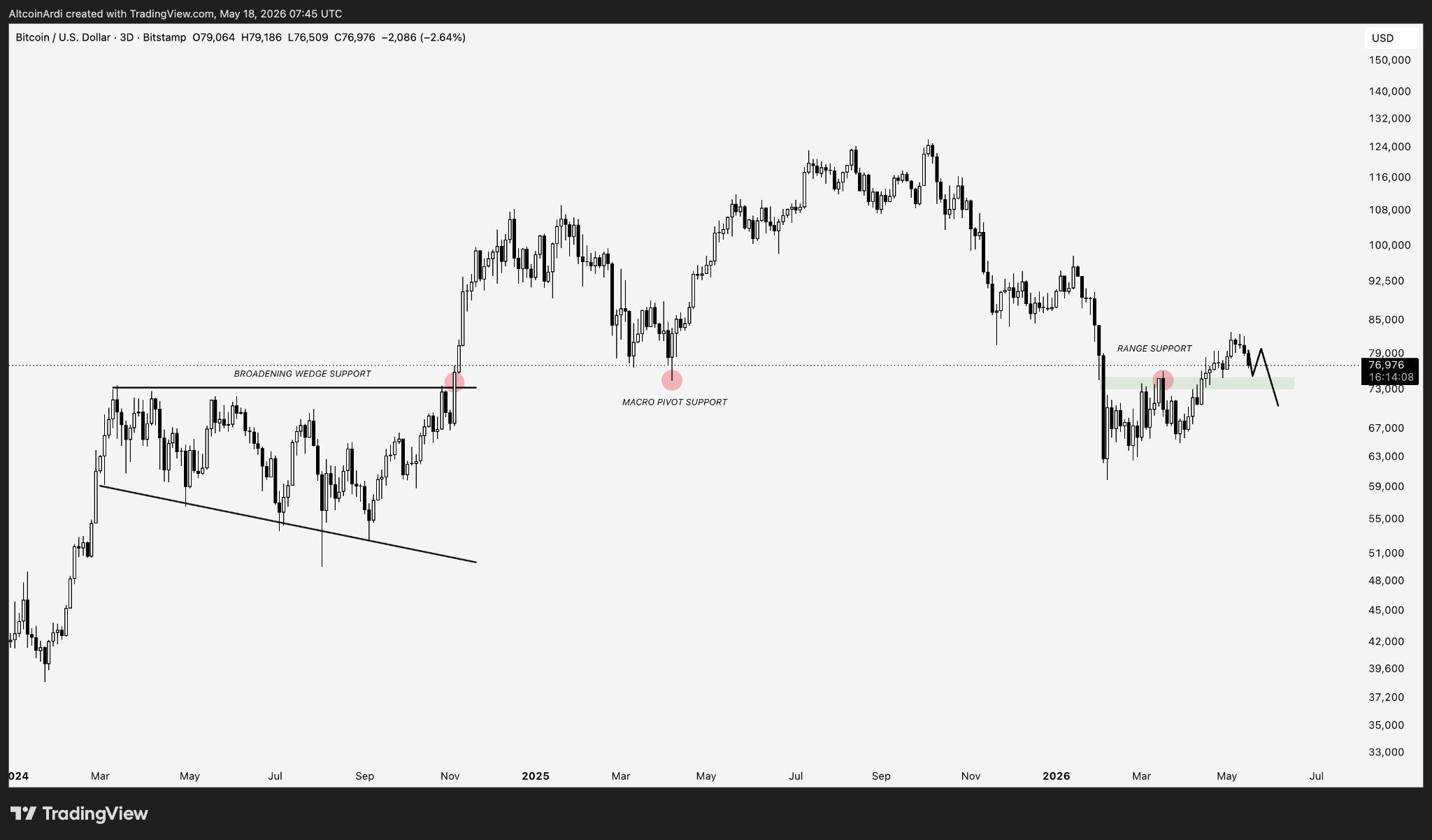
Bitcoin (BTC) lost its hold on the $80,000 level over the weekend, and data suggest that the cryptocurrency needs to trade above the $74,000-$75,000 range, as it has repeatedly served as key support over the last two years.
Crypto analyst Ardi said the next retest of the $74,000-$75,000 range could become the most important support test of the current bear market.
The analyst pointed to the role that the price range played during the last two years. In 2024, Bitcoin struggled to break above the range during a seven-month-long consolidation. In Q1 2025, the same area held as support before BTC rallied toward its cycle highs at $126,000.
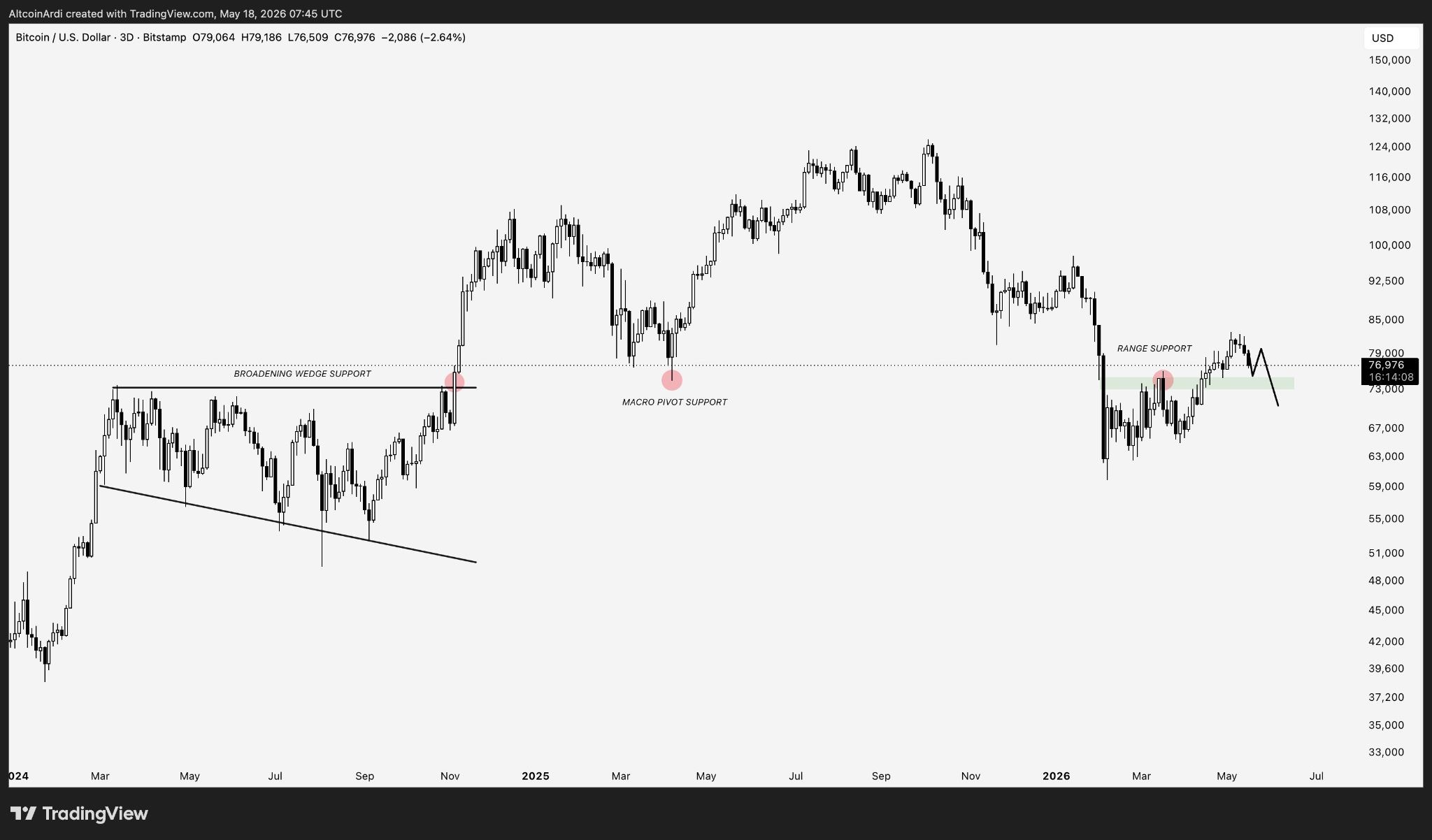
BTC/USD, one-day chart analysis by Ardi. Source: X
Bitcoin is now approaching this level after its 5.78% weekly correction to $77,900. Ardi said the zone carries added weight because several major price pivots formed at $74,000-$75,000 across multiple time frames.
Crypto trader Alex Wacy focused on the $70,000 level. Wacy said holding that area could support a move back toward $85,000-$90,000. Losing it could open the door to a larger decline toward the $50,000-$60,000 range.
Related: BTC price ‘bull trap’ at $76.5K? Five things to know in Bitcoin this week
Bitcoin market signal weakens again
Bitcoin researcher Axel Adler Jr. said the Bitcoin bull-bear structure index turned bearish again after BTC failed to stay above $82,000 earlier this month.
It tracks six indicators linked to exchange-traded fund (ETF) demand, trader activity, exchange flows, and short-term price momentum. A positive reading indicates buyers are in control, while a negative reading points to growing seller pressure.
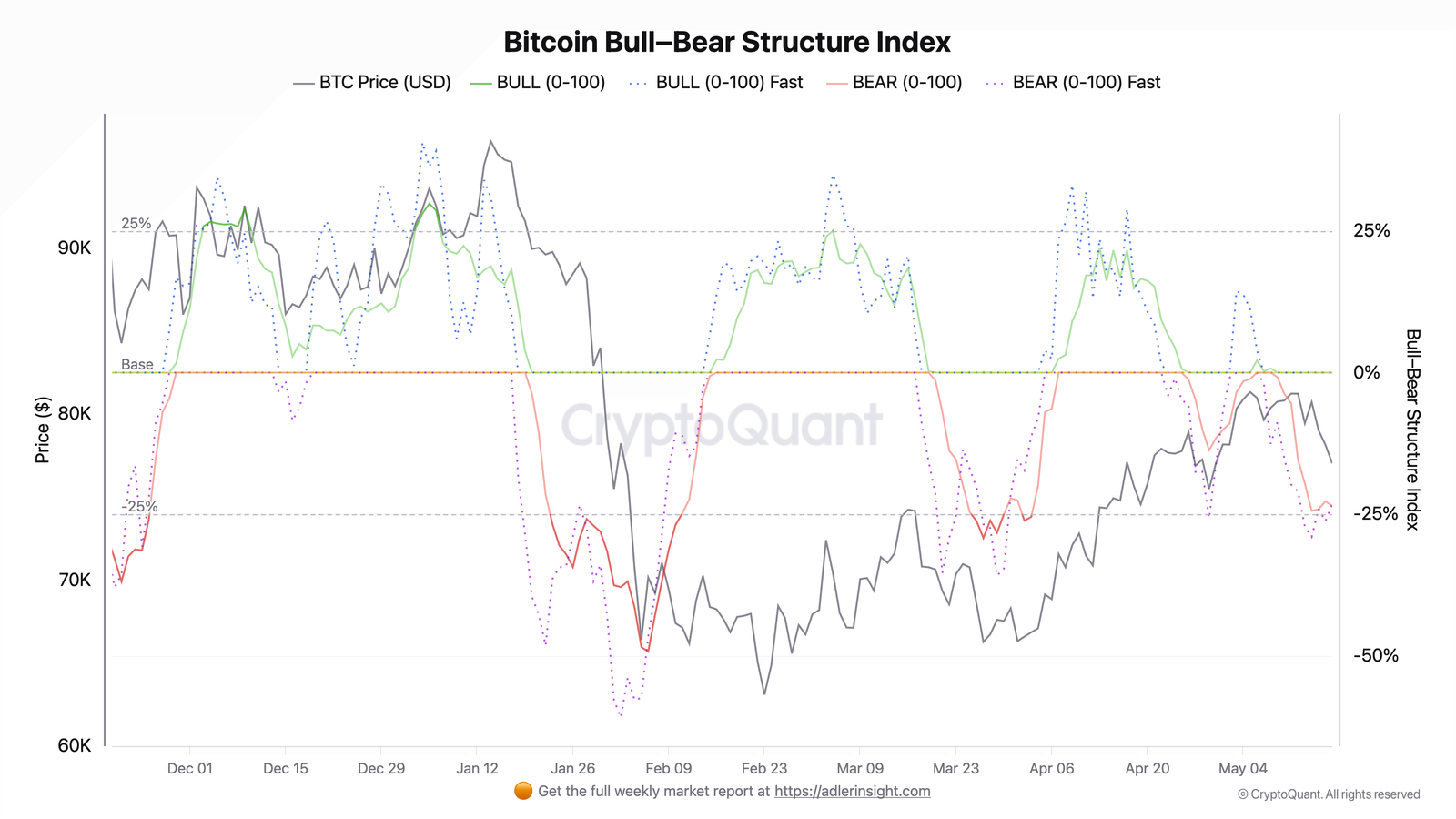
Bitcoin bull-bear structure index. Source: CryptoQuant
The bullish signal lasted less than three trading days. On May 6, the index briefly turned positive as Bitcoin climbed near $82,000. By May 17, the reading had dropped to -23.49, indicating that sellers quickly regained control.
Meanwhile, CryptoQuant data showed more Bitcoin moving onto exchanges from investors who bought BTC six to 12 months ago. The average buying price was around $110,851, meaning many are now sitting on large unrealized losses after the latest drop.
The share of older coins moving to exchanges also surged to 10.54%, far above its usual level below 1%, with market analyst Easy On Chain stating,
“Historically, this reflects investors locking in major losses and exiting the market, creating severe spot-market selling pressure.”
Related: Saylor’s Strategy scoops $2B Bitcoin, holdings reach 843,738 BTC


Citi warned Monday that Bitcoin faces an outsized quantum computing threat, with up to 6.9 million BTC already vulnerable.
Summary
- Citi’s May 18 digital asset research note says quantum computing advances are compressing the timeline for when machines could break Bitcoin’s encryption.
- Bitcoin is particularly exposed because its decentralised governance makes protocol upgrades slow and difficult to coordinate, unlike proof-of-stake networks.
- An estimated 6.5 to 6.9 million BTC have public keys already exposed on-chain, representing roughly one-third of circulating supply valued at around $450 billion.
Citi analyst Alex Saunders warned in a May 18 digital asset research note that accelerating quantum computing advances are shortening the timeline for risks to Bitcoin and broader internet infrastructure.
The bank said Bitcoin is particularly exposed because its conservative governance structure makes protocol upgrades slow and difficult to coordinate.
The Citi Institute has been tracking quantum risk to financial systems throughout 2026, estimating that a quantum-enabled attack on a major US bank could put $2 to $3.3 trillion of GDP at risk, as reported by The Quantum Insider in February.
“While large-scale quantum attacks remain a medium-term concern, the pace of progress has shortened the horizon and warrants closer attention from investors,” Saunders wrote in the note.
Bitcoin’s governance is its quantum weakness
Citi identified vulnerabilities tied to public keys already exposed on-chain. Older Bitcoin addresses using pay-to-public-key outputs left public keys permanently visible, including wallets believed to belong to Bitcoin’s pseudonymous creator Satoshi Nakamoto. The bank estimates 6.5 to 6.9 million BTC hold already-exposed keys, worth roughly $450 billion at current prices.
The report flagged a “harvest now, decrypt later” risk, where attackers collect encrypted data today for future quantum-enabled decryption. Proof-of-stake networks such as Ethereum may be better positioned to respond because they upgrade protocols more frequently, Citi said.
However, the bank warned they present a larger attack surface. The crypto.news Bitcoin price page shows Bitcoin currently trading at around $76,900.
How far away is the actual threat?
The bank said it remains constructive on crypto’s long-term ability to adapt through post-quantum cryptography. Proposed Bitcoin upgrades including BIP-360 and BIP-361 are in development but require broad consensus among miners and node operators, a process that historically takes years.
Broader Bitcoin ecosystem context matters here: as crypto.news reported in its Q1 2026 mining sector coverage, the Bitcoin network is navigating simultaneously rising energy costs, the AI pivot among miners, and now growing institutional scrutiny of its long-term cryptographic resilience.
JPMorgan has separately noted that miners pivoting to AI face high capital needs and potential shareholder dilution, underlining that the broader Bitcoin infrastructure is undergoing structural stress from multiple directions at once.


The bank said accelerating advances in quantum computing are compressing the timeline for risks to crypto and broader internet infrastructure, with Bitcoin seen as particularly exposed.


HIVE Digital is pivoting from Bitcoin mining to a CAD 3.5b, 320 MW Toronto AI “super factory” hosting 100,000+ GPUs, sending its stock up over 35% on the news.
Summary
- HIVE Digital plans to build a 320 MW AI infrastructure park near Toronto, pitched as one of Canada’s largest sovereign AI “super factories,” sending its stock up more than 35% at Monday’s open.
- The CAD 3.5 billion (about $2.55 billion) project, advanced by HIVE’s BUZZ high‑performance computing unit, is designed to host over 100,000 GPUs and begin operations in the second half of 2027.
- The move deepens HIVE’s pivot from Bitcoin mining toward AI and high‑performance computing, following earlier GPU and data center expansions in Paraguay and Sweden.
HIVE Digital Technologies, long known as a Bitcoin (BTC) mining company, has unveiled plans for a 320 MW AI infrastructure park in the Greater Toronto Area, a move that sent its shares up more than 35% at the open after the news broke on Monday, according to The Block. The company described the project as an AI “super factory” and said it aims to create one of Canada’s largest sovereign AI campuses at a time when demand for data center power and GPUs is exploding.
HIVE said the buildout will be led by its high‑performance computing subsidiary BUZZ, with total capital expenditure expected to reach roughly CAD 3.5 billion, or about $2.55 billion at current exchange rates. Once fully completed, the site is expected to support more than 100,000 GPUs across multiple large‑scale data halls dedicated to training and running AI models, putting the project in the same power class as some US hyperscale campuses.
320 MW campus targets 2027 go‑live
The company is targeting the second half of 2027 for initial operations at the Toronto‑area AI park, suggesting a multi‑year construction and power‑procurement timeline that aligns with typical hyperscale data center projects. Management framed the site as “sovereign” AI infrastructure, signaling that HIVE wants to position the campus as a Canadian‑controlled alternative to US cloud and chip majors for governments, enterprises, and local AI startups.
HIVE did not disclose detailed financing plans in the initial announcement but indicated the CAD 3.5 billion budget includes land, power infrastructure, cooling, data center construction, and GPU hardware. Given the scale, the company is likely to lean on a mix of equity, debt, and potential partnerships with hardware vendors or cloud customers to lock in anchor tenants ahead of the 2027 launch.
From Bitcoin miner to AI infra player
The Toronto project marks the most aggressive step yet in HIVE’s ongoing shift away from pure Bitcoin mining toward AI and high‑performance computing infrastructure. In recent years, the firm has expanded GPU clusters and AI‑oriented data center operations in Paraguay and Sweden, effectively using its expertise in energy‑intensive mining to bootstrap a different kind of compute business.
That strategic pivot has taken place against a backdrop of rising competition and margin compression in Bitcoin mining, while GPU‑rich AI infrastructure has become one of the hottest capital‑markets stories of the cycle. By tying its future to a 320 MW “super factory” capable of hosting over 100,000 GPUs on Canadian soil, HIVE is betting that investors will reward it more as an AI data center operator than as a cyclical crypto miner — a bet Monday’s 35%+ share price pop suggests the market is, at least initially, willing to entertain.


Minnesota established the midwest’s first unified digital asset safety net for banks and credit unions.


SpaceX Bitcoin holdings stand at $637m, on-chain data shows, making it the fourth largest known corporate holder.
Summary
- SpaceX holds 8,285 BTC worth approximately $637m in Coinbase Prime custody, per Arkham Intelligence data, with the position unchanged since June 2022.
- The company ranks fourth among known private corporate Bitcoin holders, trailing Block.one, Tether Holdings, and Stone Ridge Holdings Group.
- SpaceX is targeting a June 12 Nasdaq debut under ticker SPCX, which will require public disclosure of the Bitcoin position under FASB fair-value accounting rules for the first time.
SpaceX holds 8,285 BTC worth approximately $637 million in Coinbase Prime custody, according to on-chain data from Arkham Intelligence as analyzed by Finbold on May 18.
The position has been unchanged since June 2022, when the company trimmed its holdings from a peak of roughly 28,000 coins over a three-week period, a reduction of approximately 70% from its peak.
The $637 million valuation places SpaceX as the fourth-largest known private corporate Bitcoin holder, trailing Block.one, Tether Holdings Limited, and Stone Ridge Holdings Group. Arkham data shows the company sitting on an unrealized profit of more than $360 million on the position at current prices.
SpaceX Bitcoin position to go public with IPO
SpaceX is targeting a June 12 Nasdaq debut under the ticker SPCX, with its public S-1 expected as early as May 20 and the roadshow kicking off the week of June 8. The company filed its confidential draft registration with the SEC on April 1, targeting a raise of approximately $75 billion at a $1.75 trillion valuation.
Once listed, the Bitcoin position will appear in quarterly filings under the FASB fair-value accounting rules that took effect in late 2025, making it visible to all investors for the first time. The crypto.news Bitcoin price page tracks the asset anchoring that treasury position in real time.
Whether SpaceX characterises Bitcoin as a strategic reserve or a tradeable position in its S-1 language will signal how seriously the company views crypto as part of its long-term financial strategy. For a company preparing the largest IPO in history, the framing of a $637 million crypto holding carries material investor interest.
SpaceX held Bitcoin through a $5b loss
SpaceX generated $18.5 billion in revenue in 2025 but reported a loss of nearly $5 billion after absorbing costs from its February 2026 acquisition of Elon Musk’s AI venture xAI. The company made no moves to liquidate its Bitcoin position despite the balance-sheet pressure.
As crypto.news reported on American Bitcoin’s Q1 2026 results, publicly traded mining companies are similarly holding or expanding Bitcoin treasury positions even as they pivot infrastructure toward AI.
Corporate Bitcoin accumulation has accelerated broadly in 2026. When SpaceX lists publicly, it will bring a potential $1.75 trillion valuation into the corporate Bitcoin holder cohort, adding institutional weight to the asset class that crypto.news has tracked across its ongoing coverage of institutional Bitcoin positioning.


Circle’s USYC tokenized Treasury bill fund has reached $2.9 billion in market cap, becoming the largest T-Bill fund deployment across blockchain networks.

Bitcoin (BTC) gave up the $80,000 level over the weekend and now faces a historically significant battle around $74,000-$75,000. This zone has repeatedly served as a critical support floor over the past two years, and analysts say the next test could be pivotal for the ongoing bear market.
Analyst Ardi notes that the $74,000-$75,000 region has anchored BTC’s price action in multiple phases. In 2024, the zone helped cap a seven-month consolidation, and in early 2025 it provided support before Bitcoin ascended to cycle highs near $126,000. As BTC approaches this crucial band after posting a 5.78% weekly correction to roughly $77,900, the weight of the zone is reinforced by several major price pivots formed there across different timeframes.
Key takeaways
- BTC is testing a long-standing support band around $74k-$75k after dipping below $80k, a level that has repeatedly defined price stability in recent years.
- Analysts see the next retest of this zone as potentially decisive for the current bear market, given its historical role as a support anchor across multiple cycles.
- The Bitcoin market-signal framework known as the bull-bear structure index has shifted back to bearish territory after BTC failed to sustain above $82k, signaling renewed selling pressure.
- On-chain activity highlights a shift of long-term holders’ coins to exchanges, with a rising share of older BTC moving on-chain and toward selling, amplifying near-term downside risk.
- If BTC can hold the $70k-$75k neighborhood, traders see potential for a relief rally toward the mid-to-high $80k range; a break below the zone could widen the downside toward $50k-$60k.
Critical price zone under scrutiny
As BTC approaches the $74,000-$75,000 corridor, market observers emphasize the zone’s weight as a potential fulcrum for the bear market. Ardi explains that this area has repeatedly functioned as a technical anchor, shaping strategic decisions for traders looking for the next directional impulse. The recurrence of pivotal pivots near this level across multiple timeframes adds to the sense that a robust defense here could extend the downtrend, while a durable hold might set the stage for a fresh leg higher once demand returns.
Bitcoin’s recent price action—trading around $77,900 after a weekly decline—puts the market in a position where a decisive hold in the $74k-$75k zone could calm near-term downside risks and pave the way for new momentum if buyers reemerge. The narrative hinges on whether buyers can sustain a floor in this band or if sellers gain the upper hand and drive BTC into deeper correction territory.
Bearish signals strengthen as price stalls above $82k
Market signals tracking BTC’s structural balance offer a sobering read. Bitcoin researcher Axel Adler Jr. notes that the Bitcoin bull-bear structure index turned bearish again after BTC failed to maintain a run above $82,000 earlier this month. The metric aggregates six indicators—spanning ETF demand proxies, trader activity, exchange flows, and short-term momentum—to gauge whether buyers or sellers currently control the market. A positive reading points to buyer dominance, while a negative one signals growing selling pressure.
The bullish tilt proved fleeting. The index turned positive for less than three trading days, around early May when BTC flirted with $82,000. By May 17, the reading had collapsed to -23.49, underscoring a swift reversal toward seller control. This shift aligns with a broader view that fading upside momentum could be accompanied by renewed selling pressure, particularly if price fails to sustain critical levels.
On-chain dynamics reinforce this sentiment. CryptoQuant data show more BTC flowing onto exchanges from investors who bought BTC six to twelve months ago, a cohort that typically sits on significant unrealized losses when prices retreat. The analysis notes the average cost basis among this cohort sits around $110,851, suggesting many holders are vulnerable to realizing losses as prices pull back.
Historically, this reflects investors locking in major losses and exiting the market, creating severe spot-market selling pressure.
Additionally, the share of older coins moving to exchanges spiked to about 10.54%, far above the usual sub-1% threshold. Easy On Chain highlighted this pattern as a potential sign that longer-held positions are being liquidated, adding to near-term selling pressure and challenging the odds of a rapid rebound until demand returns.
For context, recent coverage around Bitcoin’s price action has also looked at potential near-term traps and the broader supply/demand balance. A linked analysis from Cointelegraph discussed a bullish trap around the mid-$70k range, underscoring how fragile the market’s immediate upside can be when tested at key levels.
What happens next: scanning the two likely paths
Traders are watching the $70,000 level as a more decisive floor. Alex Wacy, another market observer cited in the coverage, framed the possible outcomes as a bifurcation: holding the $70k zone could underpin a return to the $85,000–$90,000 range, rekindling bullish expectations if demand reasserts itself. Conversely, losing the $70k area—and notably breaking below the $74k-$75k support band—could open a path toward deeper losses, potentially targeting the $50,000–$60,000 region if the selling pressure persists and momentum fails to recover.
These scenarios reflect a market navigating a delicate balance between macro uncertainty, fading upside momentum, and shifting on-chain behavior. If buyers manage to stablize above the pivotal zone, workflow from traders, funds, and miners could align toward a renewed attempt at higher highs, possibly drawing in fresh participation and forcing a reappraisal of risk in a market that has struggled to sustain meaningful rallies since mid-2024.
The broader context remains important. The interaction between price action, on-chain movements, and market sentiment indicators suggests a market that could see either a short-lived relief rally or a renewed leg lower depending on whether buyers respond decisively around the $74k-$75k zone. As always, traders will be parsing every retail and institutional signal, while analysts emphasize that a broad macro backdrop—ranging from central bank policies to global risk appetite—will continue to shape BTC’s trajectory.
Readers should monitor the next price action near the $74k-$75k support and the $82k threshold for momentum. The next few weeks could reveal whether the bear market finds a durable floor or slides further as longer-term holders reassess risk and exit positions into strength or weakness in the spot market. For ongoing analysis and updates, keep an eye on market commentary that connects price levels with on-chain signals and fund flows, as these elements collectively illuminate the risk-reward landscape for Bitcoin in the near term.
Related reading: BTC price ‘bull trap’ at $76.5K? Five things to know in Bitcoin this week
Form 13D/A SAFE BULKERS For: 18 May

Bitwise HYPE ETF pledges 10% fees to buybacks

12 Years Later, One of the Greatest Action Thriller Franchises Is a Streaming Hit

Manchester United reach agreement with Casemiro over contract clause amid transfer speculation

US brings back mandatory military draft registration

Steven Gerrard disagrees with Gary Neville over ‘shock’ Chelsea and Arsenal claim | Football


-

 Crypto World3 days ago
BloFin War of Whales 2026 Grand Prix opens registration for $5M trading championship
-

 Fashion3 days ago
Weekend Open Thread: Theory – Corporette.com
-

 Crypto World3 days ago
E-Estate Announces 1 Year Live: Washington DC Summit as Real Estate Tokenization Enters Its Next Phase
-

 Politics7 days ago
What to expect when you’re expecting a budget
-

 Tech4 days ago
Tech Moves: Microsoft AI leader jumps to OpenAI; former AI2 exec joins Meta; and more
-
Crypto World6 days ago
Bitcoin Suisse expands with Digital Asset License and Investment Business Act Registration Approval in Bermuda
-

 Tech7 days ago
GM agrees to $12.75M California settlement over sale of drivers’ data
-

 Politics6 days ago
Pakistan to enter Chinese capital market as war inflation bites
-

 Crypto World6 days ago
Bitcoin Suisse expands with Digital Asset License and Investment Business Act Registration Approval in Bermuda
-
 Crypto World4 days ago
Google’s Gemini AI Predicts Incredible Solana Price by the End of 2026
-

 Business3 days ago
H&R Real Estate Investment Trust (HR.UN:CA) Q1 2026 Earnings Call Transcript
-

 Tech3 days ago
Google reimburses Register sources who were victims of API fraud
-

 Sports3 days ago
Napoleonic enters 2026 Doomben 10,000 field via Abounding withdrawal
-

 Politics7 days ago
The geopolitics behind the UK’s South Atlantic hantavirus rescue mission
-

 NewsBeat6 days ago
Comment on Keir Starmer surviving the day as Prime Minister like a turd that wont flush
-

 Politics7 days ago
The Board of Deputies just smeared Polanski to suck up to Farage
-

 Fashion6 days ago
The Best-Kept Makeup Secret for a More Defined Face
-
 Entertainment4 days ago
Zara Larsson Has Blunt Response To Chris Brown Diss
-

 Politics6 days ago
The Trial of Majid Freeman, Verdict
-
 Tech6 days ago
Why AI is making typography a boardroom conversation
You must be logged in to post a comment Login