Connect with us
DAPA Banner
DAPA Coin
DAPA
COIN PAYMENT ASSET
PRIVACY · BLOCKDAG · HOMOMORPHIC ENCRYPTION · RUST
ElGamal Encrypted MINE DAPA
🚫 GENESIS SOLD OUT
DAPAPAY COMING

Tech

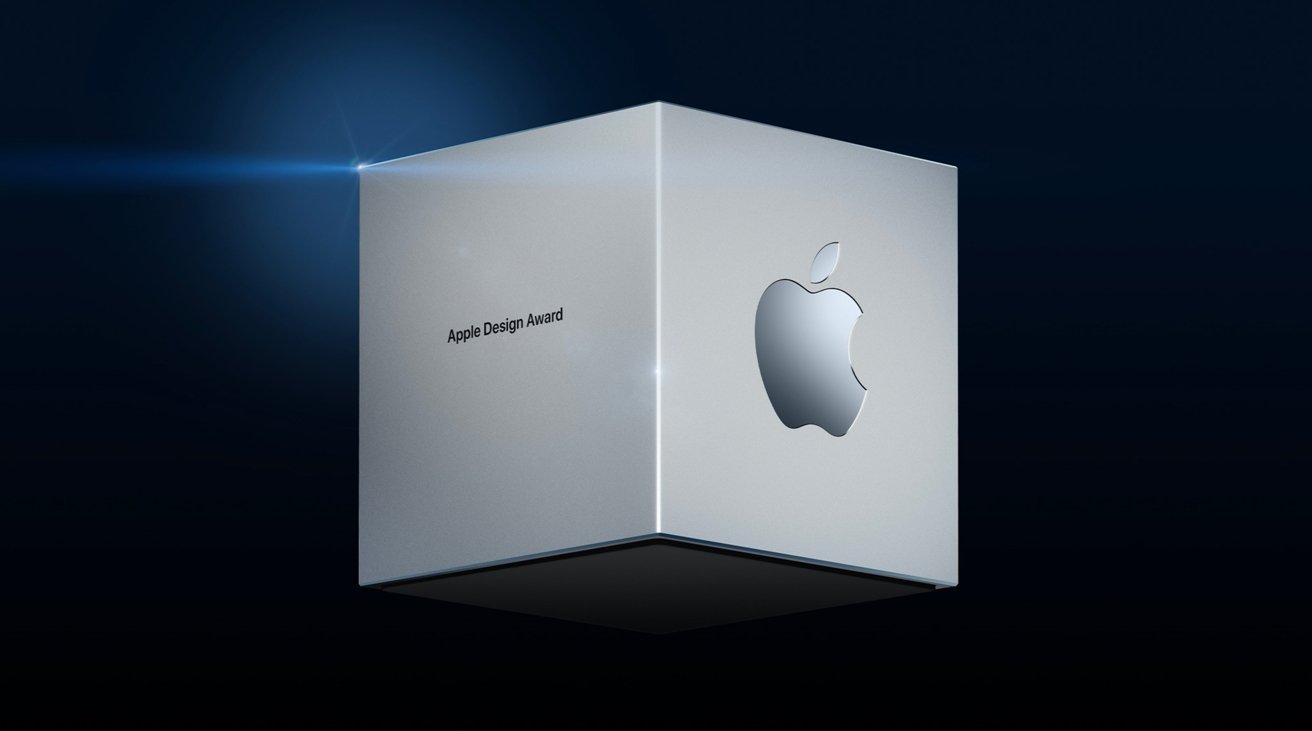
Apple Design Awards finalists for 2026 revealed

Published

on

Apple has announced the finalists for its 2026 Design Awards.

With WWDC 2026 just weeks away, the apps and games nominated for the 2026 Apple Design Awards have been revealed.

Every year, Apple recognizes App Store applications that demonstrate genuine innovation and ingenuity. Through its annual Apple Design Awards, the company highlights its top picks across several app categories, celebrating developers and their creative efforts.

On Monday, all apps that were nominated for the 2026 Apple Design Awards were highlighted. Finalists are organized based on the design aspects Apple deemed particularly impressive, with three apps and three games nominated for each category.

Advertisement

Delight and Fun

“Finalists in this category provide memorable, engaging, and satisfying experiences enhanced by Apple technologies,” explains the company’s website.

Apps

Games

Inclusivity

The Inclusivity category celebrates App Store applications that “provide a great experience for all by reflecting a variety of backgrounds, abilities, and languages.”

Apps

Games

Innovation

Finalists chosen for the Innovation category “provide a state-of-the-art experience through a novel use of Apple technologies that sets them apart in their genre.”

Apps

Games

Interaction

Apple says that apps and games nominated for the Interaction category “deliver intuitive interfaces and effortless controls that are perfectly tailored to their platform.”

Advertisement

Apps

Games

Social Impact

“Finalists in this category improve lives in a meaningful way and shine a light on crucial issues,” explains Apple.

Apps

Games

Visuals and Graphics

Apple says finalists in the Visuals and Graphics category “feature stunning imagery, skillfully drawn interfaces, and high-quality animations with a distinctive and cohesive theme.”

Apps

Games

Triple-A titles like Cyberpunk 2077 and Civilization VII are among the titles nominated for an Apple Design Award. Some applications, like TR-49 and Sago Mini Jinja’s Garden, were recognized as finalists in two categories.

Though Apple no longer has a dedicated “Spatial Computing” category, visionOS software like Pickle Pro and D-Day: The Camera Soldier still have a chance of winning. Apps for the iPhone, iPad, Mac, and other platforms were also nominated.

Advertisement

The winners will be revealed at WWDC 2026, which begins on June 8. One app and one game from each category will win a 2026 Apple Design Award.

Source link

Advertisement
Continue Reading
Click to comment

You must be logged in to post a comment Login

Leave a Reply

Tech

The viral Ninja Crispi glass air fryer is 31% off right now

Published

on

Most air fryers solve one problem and create another, taking up permanent counter space in kitchens that were already short of it before a second appliance muscled its way in.

The Ninja CRISPi is built around a different idea entirely, and it’s currently down from £149.99 to £104, saving you just under £46 on one of the more genuinely novel kitchen gadgets released this year.

Ninja Crispi on a pink and blue backgroundNinja Crispi on a pink and blue background

A fresh 31% price drop hits the Ninja Crispi portable air fryer

The Ninja CRISPi is great for anyone who’s wanted an air fryer without loosing the shelf space, and at £104 this deal is well worth a look.

Advertisement

View Deal

The concept is a 1700W PowerPod that clips onto interchangeable glass containers rather than a fixed, cavernous basket you have to scrub clean every night after dinner.

Advertisement

Two CleanCrisp glass containers are included in the box: a 3.8-litre version large enough to cook a 1.2kg chicken, and a 1.4-litre container suited to sides, snacks, or cooking a smaller portion without heating a vessel twice the size you need.

Both containers are PFAS-free, dishwasher safe, and thermally shock resistant, which matters in practice because you can pull one straight from the fridge and put it under the PowerPod without waiting for it to adjust to room temperature.

Advertisement

The Whatsapp LogoThe Whatsapp Logo

Get Updates Straight to Your WhatsApp

Advertisement

Join Now

The 1.4-litre container also comes with a snap-lock, leak-resistant lid, so what you cook in it can go directly into a bag for work or school the next morning without decanting into a separate box.

Advertisement

Four cooking modes are available across Air Fry, Roast, Keep Warm, and Recrisp, with the last one doing the job of bringing yesterday’s leftovers back to something worth eating rather than something you settle for.

When it’s not in use, the PowerPod nests directly into the glass containers for storage, which means the whole system takes up far less cupboard space than a conventional air fryer of equivalent cooking capacity.

The Ninja CRISPi is the right fit for smaller households, student kitchens, or anyone who’s wanted air fryer results without committing a permanent shelf to the hardware, and at £104 that case is considerably easier to make than it was at full price.

If you want to see how the CRISPi stacks up against the competition before committing, our best air fryers guide covers the full field, with hands-on verdicts from our testing team across a wide range of price points.

Advertisement

Advertisement

SQUIRREL_PLAYLIST_10148964


Source link

Advertisement
Continue Reading

Tech

Electroplating 3D Prints Without Requiring A Big Vat

Published

on

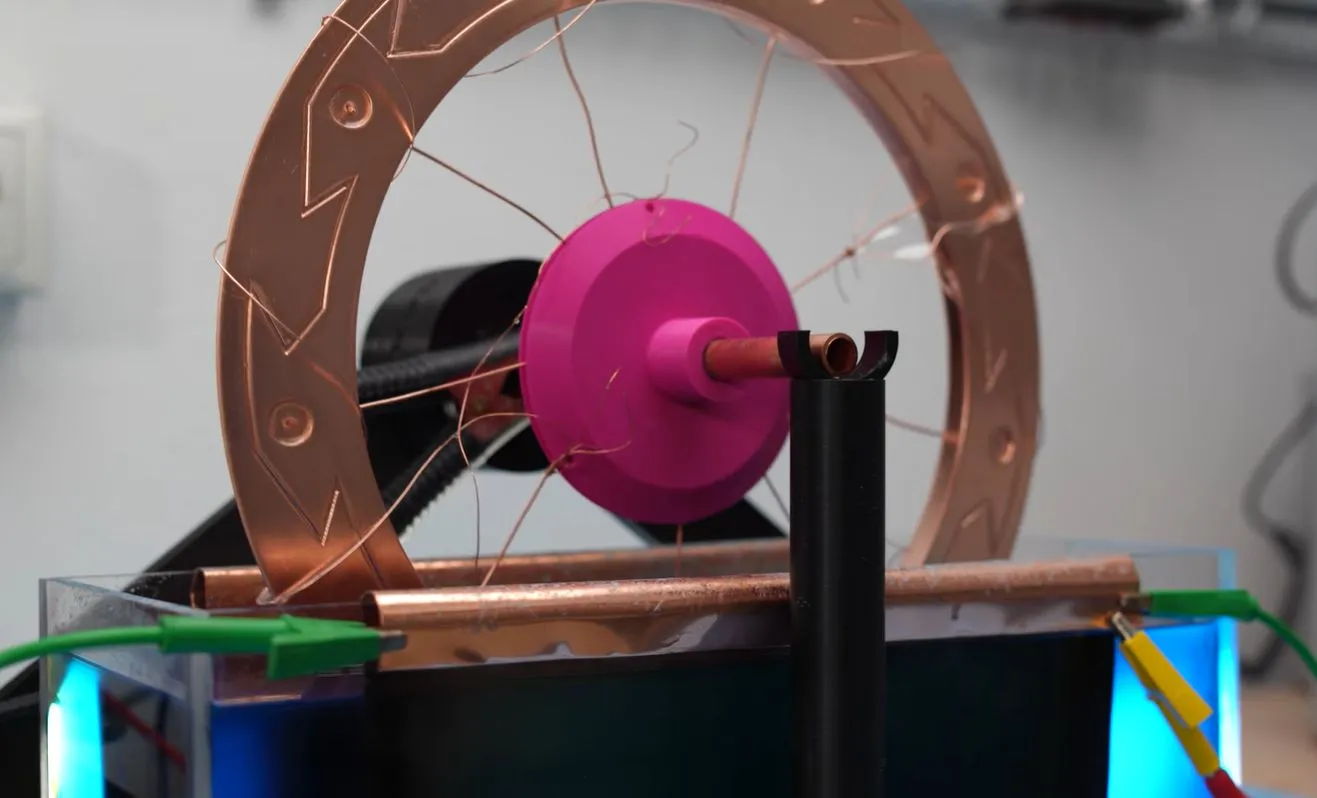
Electroplating 3D prints is a good way to get a pretty nice coating on even a basic PLA part, but generally you’re expected to dunk the entire part into a big vat with electrolyte after coating it with the requisite conductive paint layer. This is great for small parts, like a ring you’d put on a finger, but gets rather silly when it’s a much larger part, such as the one in [Hendrik]’s recent video. Out of curiosity he tried to see whether rotating the part through a much smaller vat would still get you an even coating, or not.

Perhaps ironically this process required building a custom vat out of acrylic, as well as an entire rig to hold up the part and gently rotate it. This highlights the main disadvantage of this approach, in that unless you’re doing a small production run or otherwise get to re-use the rig a lot it’s a lot of extra effort.

That said, the rotation is controlled by an ESP32 and a stepper motor along with a requisite stepper driver, with the most exotic part being the whole custom PCB and enclosure, all of which can be used repeatedly. With all of that tested and confirmed working, the part to be plated was sanded, sprayed with conductive paint and hooked up to the rotating rig for an overnight run.

Advertisement

Following that the part’s new copper coating was polished before more layers of electroplating were applied to get the desired two different colors from different metals. Along the way no issues were found with this method of rotating electroplating, so if you regularly struggle with oversized parts to electroplate, this would seem to be a viable method.

Advertisement

Source link

Continue Reading

Tech

Rumored return to titanium after the aluminum iPhone 17 Pro

Published

on

A new leak claims Apple may bring titanium back to future Pro iPhones after moving the iPhone 17 Pro to aluminum, a reversal that could reintroduce many of the material’s old tradeoffs.

A May 17 Weibo post from leaker “Instant Digital” claimed Apple is researching improved titanium alloys for future iPhones rather than abandoning the material entirely. The post also claimed Apple is still exploring liquid metal and glass for future premium iPhone designs.

Instant Digital has a mixed track record with Apple leaks, though earlier reports correctly pointed to features like Camera Control before Apple announced them.

Apple hasn’t publicly discussed material changes for future iPhones, and the leak offers little evidence beyond claims about Apple’s internal thinking.

Advertisement

Apple has repeatedly changed materials when priorities shifted

Apple’s hardware history shows a pattern of moving between materials based on engineering and manufacturing goals instead of long-term attachment to a specific premium finish.

Aluminum replaced plastic across much of the Mac lineup because it improved rigidity and overall build quality. Stainless steel later became the defining material for premium iPhones because it delivered a denser and more polished feel than aluminum.

Titanium replaced stainless steel on the iPhone 15 Pro to cut weight without giving up durability. Apple heavily promoted the material during the iPhone 15 Pro launch cycle as a major part of the phone’s design.

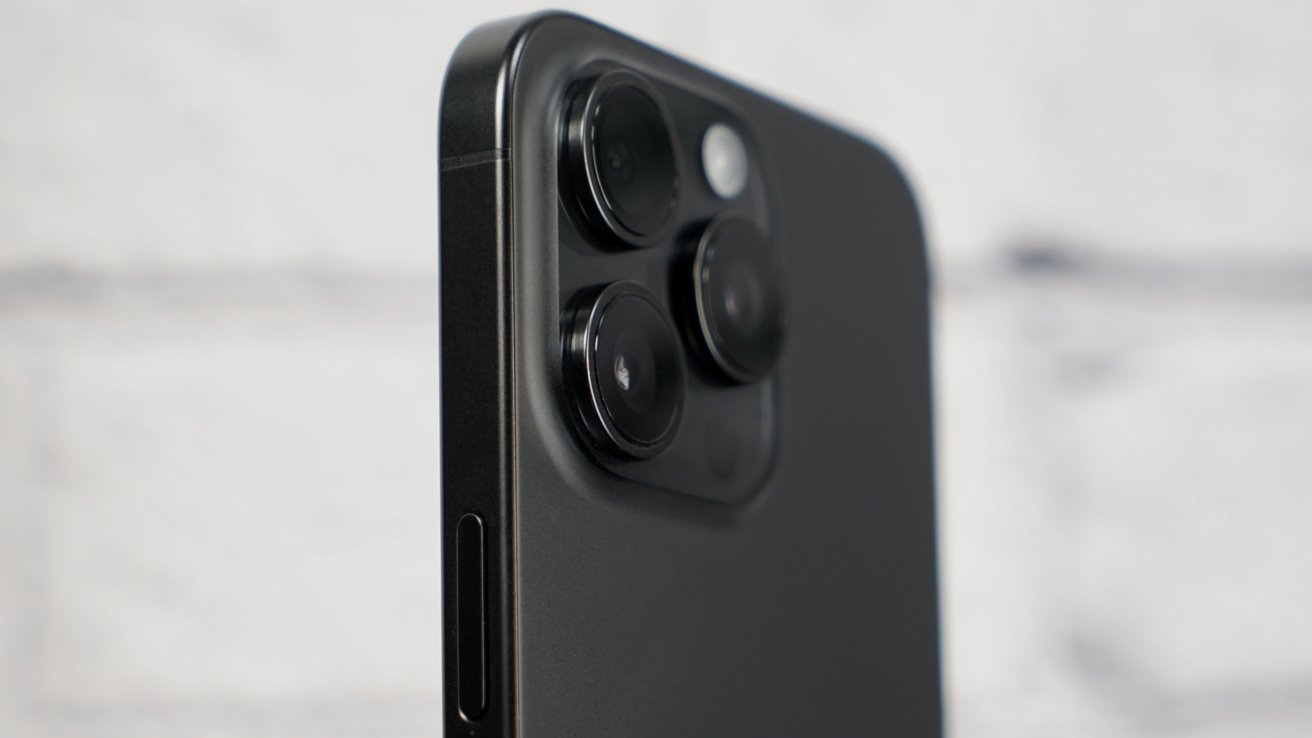
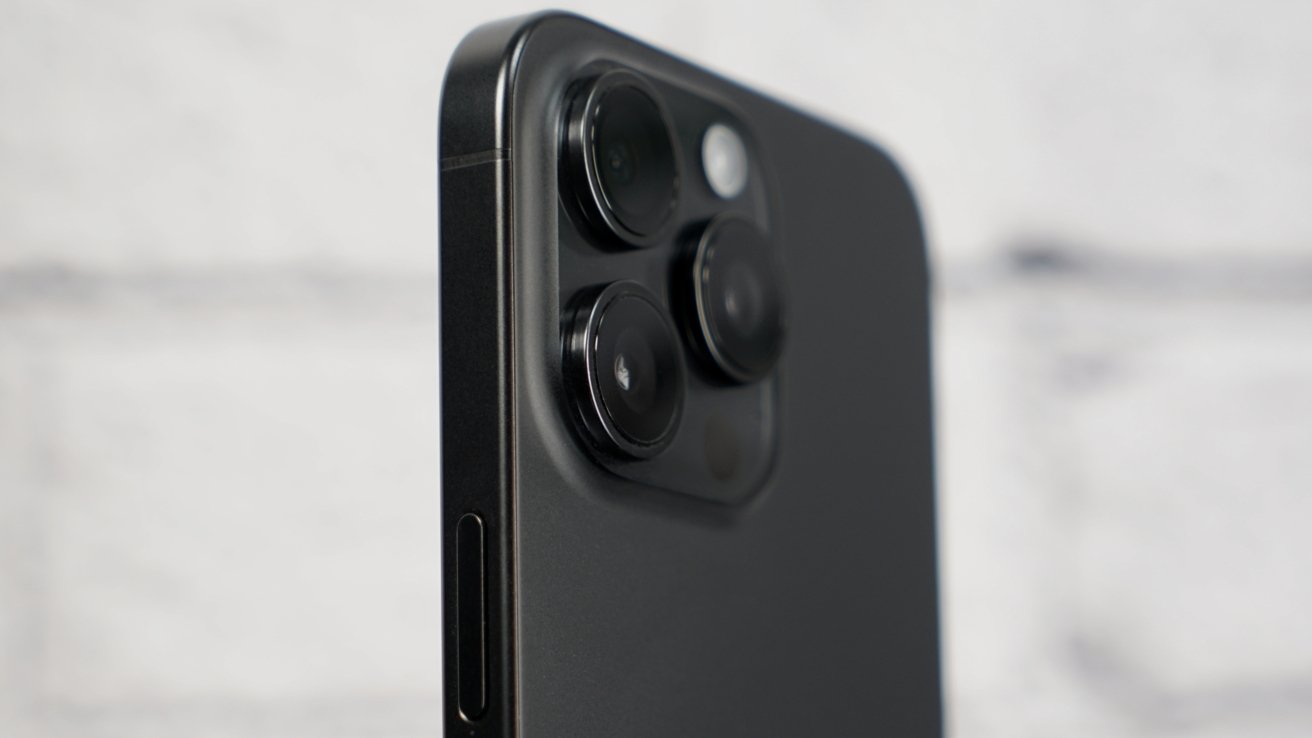
Close-up of an iPhone 15 Pro Max showing three large rear camera lenses and flash on a raised square module against a soft, out-of-focus light background

Apple briefly used titanium on the outer edge of iPhones

Advertisement

Apple has repeatedly abandoned heavily promoted hardware decisions once the tradeoffs stopped making sense.

Butterfly keyboards, the Touch Bar, and FineWoven accessories all launched with major marketing support before Apple shifted direction. Titanium also carries real engineering drawbacks alongside its advantages.

Titanium is harder to machine, costs more to produce at scale, and transfers heat less efficiently than aluminum. Heat complaints surrounding the iPhone 15 Pro pushed more attention onto thermal performance across Apple’s lineup.

Apple later said software conditions and some third-party apps contributed heavily to overheating reports affecting the iPhone 15 lineup.

Advertisement

Modern iPhones face growing thermal demands from gaming, photography, video processing, and on-device processing features. Sustained performance increasingly depends on how efficiently a device can move heat away from internal components.

Aluminum remains one of the industry’s most practical materials for thermal management. It’s also easier to recycle, easier to manufacture consistently at Apple’s scale, and potentially more flexible for thinner or lighter designs.

A return to titanium wouldn’t necessarily mean Apple views aluminum as a failure. It would likely mean the company believes it has solved enough of titanium’s thermal and weight drawbacks to justify bringing the material back.

Future-material claims remain much harder to verify

The leak also claims Apple is still researching liquid metal and glass for future high-end iPhone designs. The company has experimented with liquid metal alloys for years and holds multiple patents involving the material.

Advertisement
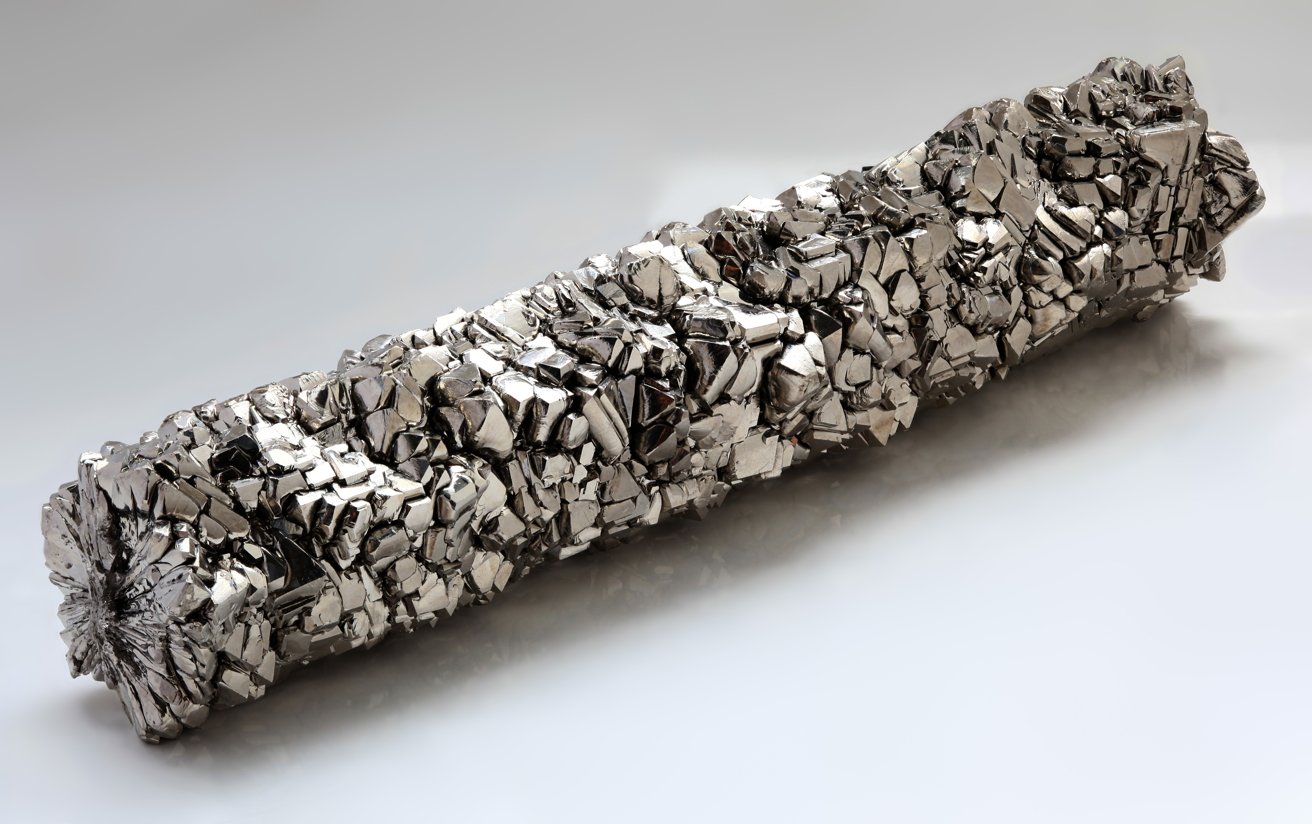
Shiny metallic rod covered in jagged, reflective crystal chunks, resting on a smooth light gray surface with soft shadowsTitanium. Image credit: Wikipedia

Moving liquid metal from small internal parts to full iPhone frames would still require major manufacturing advances. The post itself acknowledges those production challenges.

Large-scale liquid metal manufacturing would create difficult durability, molding, and repairability problems. The leak’s foldable iPhone claim is easier to believe.

Foldable hinges require extremely durable materials in compact spaces, making liquid metal a more realistic candidate there than for a complete external chassis.

Glass frame claims remain even more speculative. Glass could potentially improve wireless performance and industrial design flexibility, but durability and repair concerns would create obvious obstacles for a mass-market smartphone frame.

Battery size, cooling systems, and internal packaging now shape smartphone hardware decisions more than exterior materials alone.

Advertisement

Users are more likely to notice lower weight, cooler temperatures, or longer battery life than the specific metal surrounding a phone’s frame. If Apple moves the iPhone 18 Pro or a later model back to titanium, the decision would likely require solving many of the thermal and weight tradeoffs that pushed the company toward aluminum in the first place.

Source link

Advertisement
Continue Reading

Tech

Voltmeter Clock Has The Time Dialled In

Published

on

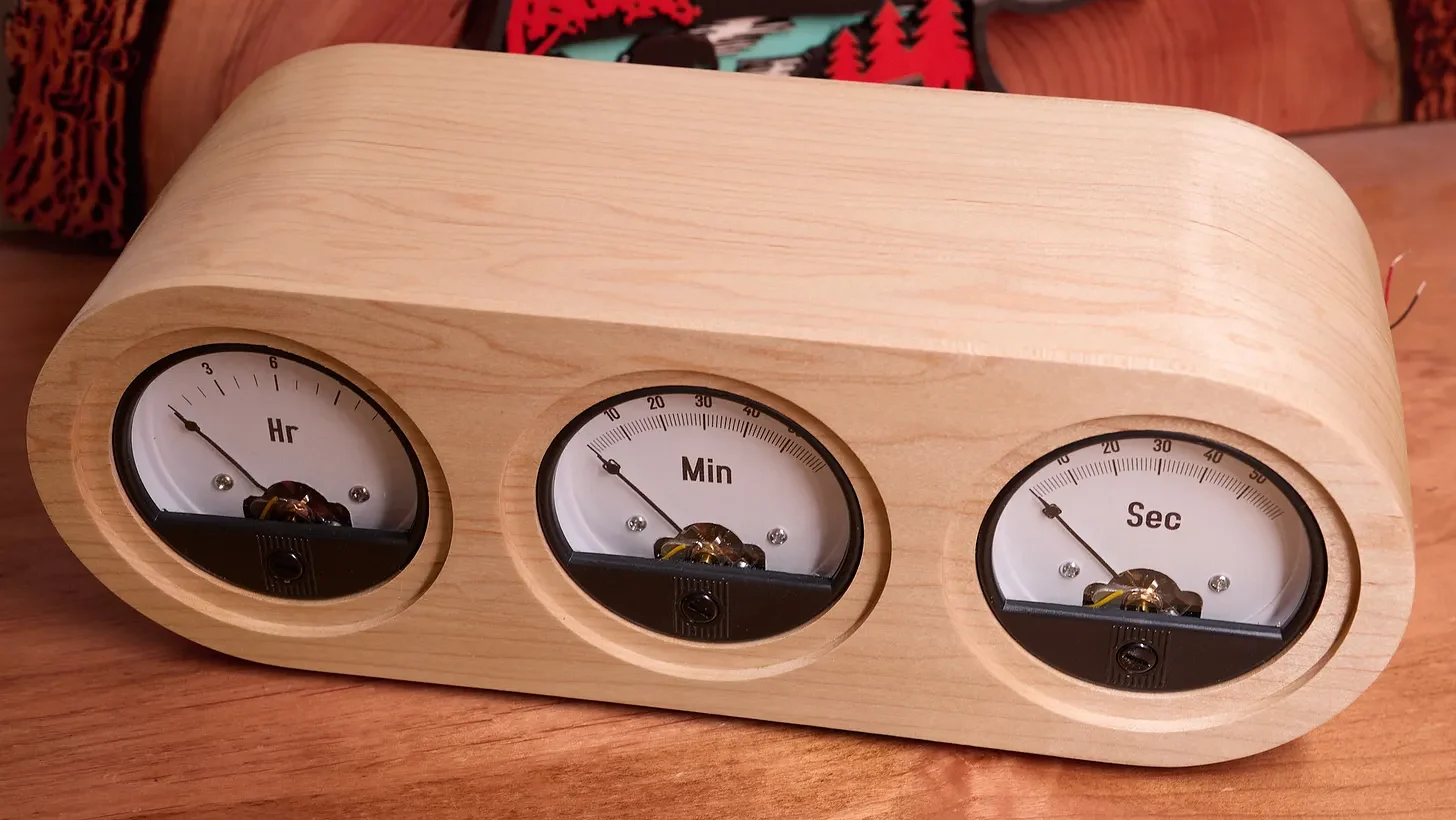
You could make a clock with three hands spinning about nested central shafts. If you did that, we probably wouldn’t publish it on Hackaday unless you really found a way to make it interesting. Make a clock out of voltmeters, however, and that usually catches our eye. [lcamtuf] has done just that.

The heart of the build is an AVR128DB28 microcontroller, an 8-bit microcontroller that is still currently in production. It runs at 8MHz, and drives a series of three Baomain 65C5 voltmeters to display hours, minutes, and seconds. Each has a custom printed face with the correct number of 13 or 61 divisions as needed. The voltmeters are driven by a continuous stream of 1-bit pulses with a software-controlled duty cycle determining exactly how far the needle moves. Yes, it’s using simple pulse width modulation, coded by hand by [lcamtuf] to do the job. All the components are wrapped up in a beautiful wooden case, with delicately kerf-bent panels to create the attractive curved lines.

We’ve featured similar builds before, too. As it turns out, hackers just really love clocks and old-school dials. Video after the break, which is worth watching for the rollover behaviour alone.

Advertisement

Source link

Advertisement
Continue Reading

Tech

Terraria celebrates 15 years of crafting, mining, and survival

Published

on


Terraria can be played alone or online with others. It originated on the PC but was eventually ported to consoles and mobile devices. Gameplay is accentuated by a stellar soundtrack and above all else, it’s a blast to play. Those needing proof of that need look no further than the…
Read Entire Article
Source link

Continue Reading

Tech

OSHA probing worker death at SpaceX’s Starbase site

Published

on

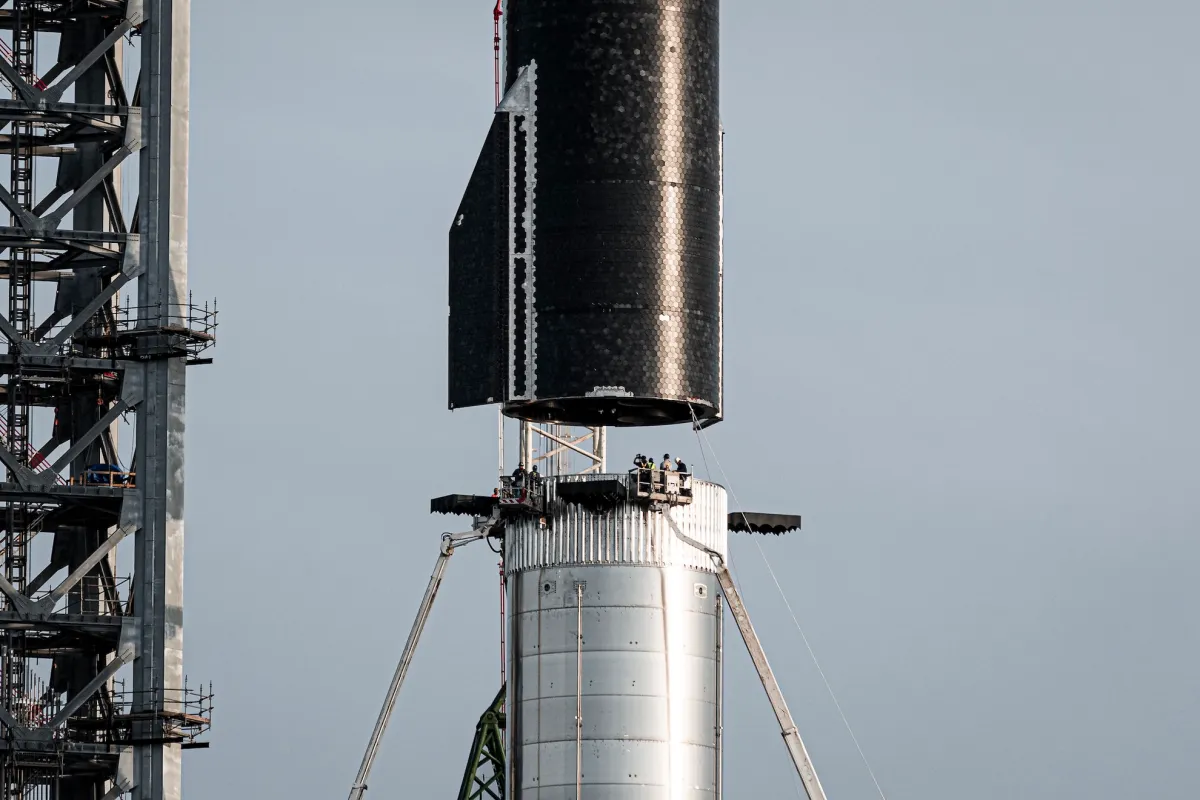
A worker died at SpaceX’s Starbase launch site in South Texas on Friday, and the Occupational Health and Safety Administration (OSHA) has opened an investigation.

The San Antonio Express-News reported Monday that the unidentified victim died at around 4:17 a.m. local time on May 15, citing OSHA and local officials. The Wall Street Journal later reported that the county sheriff confirmed to the outlet that a worker died. OSHA confirmed to TechCrunch that it is investigating the apparent accident.

Representatives for the nearby Brownsville police and fire departments did not respond to requests for comment. SpaceX and the newly-incorporated City of Starbase did not respond to requests for comment.

The circumstances of the worker’s death are not immediately clear. OSHA told TechCrunch that it won’t release more information until its investigation is complete, which could take months.

Advertisement

The death comes just a few days ahead of the first planned launch of SpaceX’s upgraded Starship rocket. Elon Musk’s spaceflight company is also reportedly releasing the detailed prospectus for its initial public offering this week, which is expected to be the biggest ever when that transaction takes place next month.

SpaceX has long dealt with worker safety problems at its Starbase site, which handles Starship prototype launches and is an active construction zone.

In 2025, TechCrunch analyzed OSHA data and determined the Texas launch site had an injury rate that far outpaced those of industry rivals, and was the most dangerous of SpaceX’s worksites. A 2023 Reuters investigation uncovered dozens of previously-unreported injuries and a worker death in 2014 at SpaceX’s McGregor, Texas test site.

In January, OSHA hit SpaceX with seven “serious” safety violations for, among other things, not properly inspecting a crane before it collapsed at Starbase last June. The safety agency dealt SpaceX the maximum financial penalty on six of those seven violations, totaling $115,850. SpaceX is contesting those penalties, federal records show.

Advertisement

The company has been hit with multiple lawsuits related to injuries sustained at Starbase in recent years. In December, an employee of one of SpaceX’s subcontractors sued after he was crushed by a large metal support dropped from a crane. The worker, Eduardo Cavazos, suffered a broken hip, knee, and tibia, and OSHA opened a “rapid response investigation,” as TechCrunch first reported in December.

OSHA has since closed that rapid response investigation without taking any punitive action, according to a TechCrunch public records request. And the lawsuit was recently dropped because his employee, the subcontractor, has workers compensation insurance that prevents it from being sued, according to Cavazos’ attorney.

When you purchase through links in our articles, we may earn a small commission. This doesn’t affect our editorial independence.

Source link

Advertisement
Continue Reading

Tech

Peter Steinberger’s 100 AI agents racked up $1.3 million in OpenAI tokens in 30 days building OpenClaw

Published

on

TL;DR

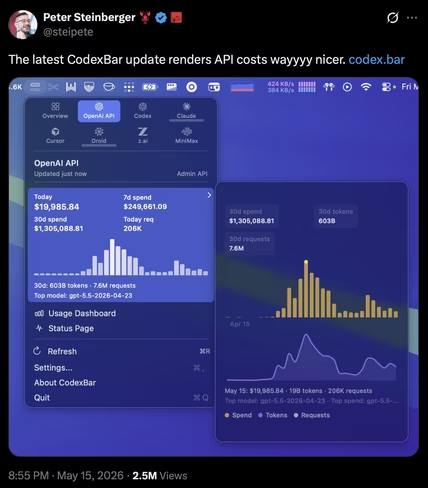
OpenClaw creator Peter Steinberger spent $1.3 million in OpenAI API tokens in 30 days running 100 Codex instances on his open-source project. The bill, covered by OpenAI where Steinberger now works, represents 603 billion tokens across 7.6 million requests and provides the most concrete public data point on the cost of autonomous AI coding at scale.

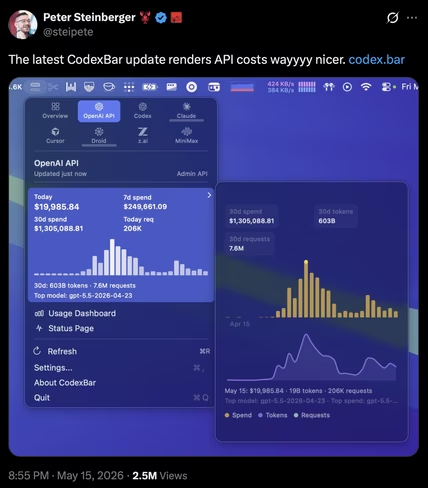
Peter Steinberger, the creator of OpenClaw and an engineer at OpenAI, racked up $1.3 million in API costs in a single month by running approximately 100 Codex instances simultaneously on his open-source project. The bill, which covered 603 billion tokens across 7.6 million requests over 30 days, is the most visible demonstration yet of what happens when AI-powered software development is run without budget constraints, and of how quickly costs escalate when autonomous agents operate continuously at scale.

Advertisement

Steinberger posted a screenshot of the bill on X, showing $1,305,088.81 charged to the OpenAI API, with GPT-5.5 as the primary model. OpenAI is covering the cost: Steinberger joined the company in February 2026, and the spending is treated as a research investment in understanding what software development looks like when token economics are not a limiting factor.

Peter Steinberger x post

Peter Steinberger X Post – source: X

What the agents actually do

The 100 Codex instances are not simply generating code. Steinberger’s three-person team has built an autonomous development pipeline in which AI agents perform a range of tasks that would ordinarily require a much larger engineering organisation. The agents review pull requests, scan commits for security vulnerabilities, deduplicate GitHub issues, write fixes, and open new pull requests based on the project’s broader roadmap. Others monitor performance benchmarks and flag regressions to the team’s Discord server. Some agents, according to The Decoder, even attend meetings and generate pull requests for features that come up in conversation.

The 💜 of EU tech

Advertisement

The latest rumblings from the EU tech scene, a story from our wise ol’ founder Boris, and some questionable AI art. It’s free, every week, in your inbox. Sign up now!

The team also uses Clawpatch.ai, Vercel’s Deepsec, and Codex Security for additional bug and security analysis. The result is a development operation in which three humans oversee a fleet of AI agents that collectively perform the work of what would traditionally be a mid-sized engineering team.

The cost question

Steinberger has been transparent about the economics. He clarified that the $1.3 million figure reflects Codex’s “Fast Mode” pricing, which consumes credits at a significantly higher rate than standard execution. Disabling Fast Mode alone would reduce the raw API cost to approximately $300,000 per month, a 70 per cent reduction. At standard pricing, the operation would still cost $3.6 million a year, but the gap between the headline figure and the underlying economics illustrates how pricing tiers and execution modes can dramatically inflate reported costs.

When asked about return on investment, Steinberger said everything his team builds is open source and works with leading proprietary models as well as open-weight alternatives. “I’d say pretty high,” he said.

Advertisement

The figure is useful precisely because vendor marketing around AI coding tools rarely discloses raw spend and token volumes at this scale. Most enterprise teams planning agentic development tooling are working from projections and estimates. Steinberger’s bill is a concrete, public data point: 100 agents running continuously for 30 days on a large open-source codebase costs between $300,000 and $1.3 million per month depending on execution speed, before any optimisation.

Who is Peter Steinberger

Steinberger is not a newcomer to building developer tools at scale. The Austrian engineer founded PSPDFKit in 2011, bootstrapping a PDF rendering and annotation framework that became the standard for mobile document handling. By 2021, apps built on PSPDFKit were running on more than one billion devices worldwide, and the company raised $116 million from Insight Partners, its first outside investment after a decade of profitable, self-funded growth.

After leaving PSPDFKit, Steinberger began experimenting with AI agents as a personal project. OpenClaw, a self-hosted autonomous AI assistant that runs entirely on users’ own hardware, became the fastest-growing open-source project in GitHub history, crossing 302,000 stars by April 2026, overtaking React, Vue.js, and TensorFlow in a fraction of the time those projects took to reach similar milestones. The framework connects to tools people already use, including email, calendars, browsers, and messaging platforms from Slack and Discord to WhatsApp and iMessage, and allows AI agents to execute shell commands, manage files, and automate web tasks locally.

When Steinberger joined OpenAI, he announced that OpenClaw would move to an independent foundation to preserve its open-source character. “I want to change the world, not build a large company,” he wrote. “Teaming up with OpenAI is the fastest way to bring this to everyone.”

Advertisement

What it reveals about AI coding economics

The $1.3 million bill arrives at a moment when the economics of AI-powered development are a central preoccupation of the software industry. OpenAI recently opened ChatGPT subscriptions to OpenClaw’s 3.2 million users, allowing them to run autonomous agents through the Codex endpoint for $23 per month. Anthropic, by contrast, blocked Claude Pro and Max subscribers from using OpenClaw and other third-party agent frameworks, concluding that the compute demands of autonomous agents running thousands of API calls per day were economically unsustainable under flat-rate subscription pricing.

The divergence between those two approaches reflects an unresolved tension in AI pricing. Subscription models are designed for human-speed interaction: a person typing queries into a chat window generates a predictable, manageable volume of API calls. An autonomous agent fleet generates orders of magnitude more, and the gap between subscription pricing and actual compute costs is the subsidy that either the provider absorbs or the user pays.

Steinberger’s bill makes that gap visible. At $1.3 million for 100 agents, the per-agent cost is roughly $13,000 per month, far more than any subscription plan covers. Even at the optimised $300,000, each agent costs approximately $3,000 per month. For enterprise teams evaluating whether to deploy agentic coding tools at scale, these numbers provide a baseline that no vendor’s marketing page will offer.

The broader pattern

OpenClaw’s trajectory, from a personal experiment to the most-starred project on GitHub to an OpenAI-sponsored research platform, reflects a broader shift in how software is being built. AI coding agents from DeepMind, OpenAI, and Anthropic are moving from proof-of-concept demonstrations to production deployment, and the question is no longer whether AI will write significant amounts of code but how much it will cost and who will pay for it.

Advertisement

The rise of AI-assisted development, from individual coding copilots to fully autonomous agent fleets, is compressing the timeline between a three-person team’s ambition and a large engineering organisation’s output. Steinberger’s setup, three humans and 100 agents, is an extreme version of what many companies will attempt at smaller scales over the next year.

The $1.3 million bill is not a cautionary tale. It is a receipt from the future, showing what it costs when AI development tools are used at full capacity, without the budget constraints that currently limit most teams to a fraction of what the technology can do. Whether that future is affordable depends on how quickly model inference costs decline, how efficiently agent orchestration frameworks manage token usage, and whether the security and quality challenges of AI-generated code can be managed at the speed these agents produce it.

Source link

Advertisement
Continue Reading

Tech

ArXiv will ban researchers for a year if they submit papers with AI slop

Published

on


The arXiv (pronounced “archive”) team recently announced a significant update to its official code of conduct. The popular open-access repository of research papers awaiting peer review will now seek to deter AI-generated “slop” by enforcing stricter accountability rules, including a one-year ban for violations. The team said that using LLMs…
Read Entire Article
Source link

Continue Reading

Tech

Meta cuts 8,000 jobs amid record $56B quarterly revenue as Zuckerberg bets $145 billion on AI infrastructure

Published

on

TL;DR

Meta will begin cutting 8,000 jobs on 20 May while reporting record quarterly revenue of $56.31 billion, as the company raises AI infrastructure spending to as much as $145 billion in 2026. Employee morale has cratered, with internal protests over surveillance software, declining compensation, and the expectation of further layoffs through the autumn.

Meta will begin cutting approximately 8,000 jobs on 20 May, the largest single round of layoffs the company has undertaken since its 2023 restructuring, in a move that lays bare the scale of Mark Zuckerberg’s bet that artificial intelligence infrastructure is worth more than the people it replaces. The company is also cancelling 6,000 open requisitions, bringing the effective headcount reduction to 14,000 positions.

Advertisement

The cuts arrive not during a downturn but during a period of record financial performance. Meta reported first-quarter 2026 revenue of $56.31 billion and net income of $26.8 billion. Full-year 2025 revenue was $201 billion, up 22 per cent year over year, with free cash flow of $43.6 billion. The company is not shrinking because it is struggling. It is shrinking because it has decided that the return on AI infrastructure exceeds the return on human labour, and it is converting one into the other on a scale that no technology company has attempted before.

The financial arithmetic

Meta has raised its 2026 capital expenditure guidance to between $125 billion and $145 billion, up from $72.2 billion in 2025 and $39.2 billion in 2024. Nearly all of the increase is directed at data centres, Nvidia GPUs, custom silicon, and infrastructure to support the company’s Llama model ecosystem and recommendation systems. In the first quarter alone, Meta added $107 billion in new contractual commitments for cloud and infrastructure deals, and it has committed $27 billion to a joint venture with Nebius for a gigawatt-scale AI data centre campus in Louisiana.

Bank of America has estimated that the layoffs could generate $7 billion to $8 billion in annualised savings, a fraction of the capital expenditure plan but a meaningful contribution to the operating margin that CFO Susan Li has pledged to protect. Li told investors during the Q1 earnings call that the company believed a leaner operating model would allow it to move more quickly while helping to offset its infrastructure investments. She also acknowledged that executives “don’t really know what the optimal size of the company will be in the future,” a remarkable admission from a CFO whose company is simultaneously reporting record profits.

The 💜 of EU tech

Advertisement

The latest rumblings from the EU tech scene, a story from our wise ol’ founder Boris, and some questionable AI art. It’s free, every week, in your inbox. Sign up now!

The arithmetic is blunt: Meta is spending more on AI infrastructure in a single year than the combined annual revenue of most Fortune 500 companies, and it is funding part of that spending by eliminating the jobs of people who helped build the business that generates the revenue in the first place.

What is happening inside the company

The financial case for the restructuring is coherent. The human experience of it is considerably less so. Meta’s record quarterly results were reported three weeks before the layoff notifications are scheduled to go out, a sequence that has produced what employees and industry observers have described as a particularly corrosive form of corporate dissonance.

Zuckerberg held a company-wide town hall on 30 April to address the cuts directly. He was explicit about one thing: AI tools were not driving the job losses. “Getting everyone internally to use AI tools and getting to do the work more efficiently is not the thing that’s driving layoffs,” he said. He did not, however, identify what was driving them, and the silence has fuelled anxiety across the company.

Advertisement

Meanwhile, Meta has been cutting compensation for the broader workforce while dramatically increasing it for AI researchers. Median total compensation at Meta fell from $417,400 in 2024 to $388,200 in 2025. The stock portion of annual raises was cut by 5 per cent in February 2026, on top of a 10 per cent reduction the previous year. At the same time, Zuckerberg has been personally recruiting AI researchers with compensation packages reportedly reaching $100 million to staff Meta Superintelligence Labs, the division he launched last year under former Scale AI chief executive Alexandr Wang.

The gap between those two realities, shrinking pay for most employees and nine-figure packages for a select few, has produced what multiple reports describe as an atmosphere of resignation. Employees have built at least three countdown websites tracking the days until 20 May, one of which carries the header “Big Beautiful Layoff.” Data from Blind, an anonymous professional network that requires work email verification, shows Meta’s overall employee rating has declined 25 per cent from its peak in the second quarter of 2024, with a 39 per cent drop in its culture rating. In every category other than compensation, Meta now underperforms Amazon, Google, and Netflix.

The surveillance question

Compounding the mood is a programme called the Model Capability Initiative, which Meta deployed on US employees’ work laptops in April. The software captures mouse movements, clicks, keystrokes, and screenshots across a designated set of work applications. Meta has said the data is used to teach AI agents how humans navigate software, not as a general surveillance tool. Employees at several US offices have responded with visible protest, distributing flyers that described the programme as an “Employee Data Extraction Factory” and citing the National Labour Relations Act. Workers have characterised the tool as “dystopian” and created an online petition urging Zuckerberg to shut it down, with some reporting that their work computers have slowed noticeably since the programme was installed.

The objection is not merely about privacy. It is about the implication: Meta is asking its remaining employees to generate the training data that will teach AI systems to replicate the computer-use patterns of the very roles being eliminated. The programme may well be a legitimate research initiative, but its timing, weeks before mass layoffs, has made it impossible for employees to read it as anything other than a preview of their own obsolescence.

Advertisement

The restructuring pattern

Including the May round, Zuckerberg has now overseen the elimination of roughly 33,000 positions since 2022. The 2022 cuts corrected pandemic-era over-hiring. The 2023 round was framed as a “year of efficiency.” Early 2025 cuts were presented as performance management. The January and March 2026 reductions, which removed approximately 1,700 employees from Reality Labs, recruiting, and other divisions, were targeted. The May round is different: it is a company-wide structural reorganisation that touches every major business unit, with teams being reconstituted into AI-focused “pods” under Wang’s Superintelligence Labs division.

More layoffs are expected this year, including a potential round in August and another in the autumn, according to people with knowledge of the plans. Earlier reporting suggested the total reduction could eventually reach 20 per cent of the workforce.

Meta is not alone in converting payroll into AI capital expenditure. Microsoft announced its first-ever voluntary retirement programme the same week, offering buyouts to roughly 7 per cent of its US workforce. Oracle cut an estimated 30,000 employees in March. Amazon eliminated 16,000 corporate roles in the first quarter. Across the technology sector, almost 110,000 jobs have been lost at 137 companies so far in 2026, according to Layoffs.fyi, after roughly 125,000 cuts in all of 2025.

The bet

The theory behind Meta’s restructuring is that a smaller number of highly talented people working alongside powerful AI systems can accomplish what previously required entire departments. Zuckerberg has described the vision as developing AI-powered products that amount to a kind of “personal superintelligence” for billions of users. The Superintelligence Labs division, the AI-focused pods, and the massive infrastructure spending are all oriented toward that goal.

Advertisement

Whether the bet pays off depends on whether the AI systems that Meta is building at a cost of more than $100 billion a year can generate enough incremental revenue, through improved advertising targeting, content recommendations, and new AI-powered products, to justify both the infrastructure spending and the loss of institutional knowledge that comes with eliminating 10 per cent of the workforce in a single month.

The human cost of the technology industry’s AI pivot is not evenly distributed. The roles being eliminated at Meta are concentrated in recruiting, sales, middle management, and non-AI-adjacent product work, areas where the skills gap between what employees currently do and what the company now needs is too wide for incremental retraining to bridge. The roles the company is actively hiring for, at salaries between $62,000 for entry-level positions and $240,000 or more for senior AI research scientists, are almost entirely in machine learning, infrastructure engineering, computer vision, and natural language processing.

Zuckerberg has been through this before. The 2023 efficiency programme, which produced 21,000 job cuts across two waves, was followed by a period of exceptional financial performance that silenced critics and sent the stock to record highs. This time, the market has been less forgiving: Meta’s stock is down roughly 7 per cent year to date, underperforming every megacap peer except Microsoft. The broader pattern across Big Tech in 2026 suggests that investors are rewarding the same playbook at every company that adopts it: cut headcount, redirect the savings to AI infrastructure, and let the stock price validate the decision.

For the 8,000 people receiving notifications this week, the validation will be someone else’s. For Zuckerberg, the question is whether personal superintelligence, a product that does not yet exist, can justify a restructuring whose costs are immediate, measurable, and borne by people who did nothing wrong except work in roles that an algorithm has not yet learned to perform.

Advertisement

Source link

Continue Reading

Tech

Trump Just Created An Unconstitutional $1.776 Billion Loyalty Rewards Program For MAGA

Published

on

from the 10-insurrections-get-your-11th-free dept

We discussed the rumor of this on Friday, but it’s now real: Donald Trump has handed himself a $1.776 billion fund of taxpayer money — unappropriated by Congress — to dole out to friends in the MAGA movement who claim they were mistreated by the Biden administration, but with no judicial review over such claims.

The Fund will have the power to issue formal apologies and monetary relief owed to claimants. Submission of a claim is voluntary. There are no partisan requirements to file a claim.  Any money left when the Fund ceases operations will revert to the Federal Government.

The Fund will receive $1.776 billion and will come from the judgment fund, which is a perpetual appropriation allowing DOJ to settle and pay cases. On a quarterly basis, the Fund shall send a report to the Attorney General outlining who has received relief and what form of relief was awarded.

What will the fund be used for? To pay anyone on Team MAGA — including, in theory, January 6th insurrectionists — who claim the Biden administration “weaponized” the government to target them. Many of these claims are simply not true. January 6th insurrectionists were arrested and convicted for actually breaking the law. But now they get to ask Trump for money, and the evidentiary standard appears to be “trust me, bro” and a red MAGA hat.

Let’s first dispense with the most obvious bit of the charade: the idea that this is actually related to the “settlement” of Trump’s already corrupt bullshit lawsuit against the IRS. That’s how this is being presented, but this is entirely separate. Trump needed to drop that lawsuit in order to end it before a judge called bullshit on the fact that he was negotiating with himself to take $10 billion from American taxpayers.

Advertisement

As for the actual “fund” everything about it is about as corrupt as you can imagine. This is impeachment-worthy — and not in a partisan way. Republicans should be as offended by this as anyone else, if they actually (I know… I know…) believe in things like rule of law and fiscal responsibility.

The actual details here should raise so many red flags. First, as part of this illegal attempt to route around Congress’ power of the purse, they’re taking the money out of the Treasury Department’s “Judgment Fund.” But that fund is clearly designed to pay out the results of duly litigated court cases against the government — not a board of Trump’s friends deciding who gets a check. But here, it’s just a group of MAGA insiders who get to choose:

The Fund will consist of five members appointed by the Attorney General. One Member will be chosen in consultation with congressional leadership. The President can remove any member, but a replacement must be chosen the same way as the replaced member was selected.

So, the fund is clearly in service of Donald Trump’s whims, not anyone else’s. We already have his personal lawyer (who has shown a long history of obeying Trump’s orders) as the acting Attorney General, and the fact that Congress only gets to “consult” on one member of the committee, and anyone can be removed by Trump at any moment makes it abundantly clear that this fund is solely around to pay off Trump’s loyal fans, who have a long history of claiming imagined grievances against the Biden administration, which they will now seek to cash in on.

The fund also, notably, will be put into a private account that (according to the settlement) the US government has no control over and no liability for.

Advertisement

Once the funds are deposited into the Designated Account, the United States has no liability whatsoever for the protection or safeguarding of those funds, regardless of bank failure, fraudulent transfers, or any other fraud or misuse of the funds.

This appears to be setting things up so that a future government (or a court) cannot claw back the money once it is delivered from the Treasury into this slush fund, let alone after it is then handed out to anyone on Team MAGA who makes a claim from the fund.

Also, the fund is set up to “close” before the next administration comes into office. How convenient.

The Fund shall cease processing claims no later than December 1, 2028.

The DOJ is claiming that this fund is no different than the Keepseagle fund under the Obama administration:

There is legal precedent for such a Fund, most notably the “Keepseagle” case where the Obama Administration created a $760 million fund to redress various claims alleging racism against the federal government over a period of decades.

In Keepseagle, hundreds of millions of dollars remaining in the fund were distributed to non-profits and NGOs that never made claims, whereas any money remaining in The Anti-Weaponization Fund will revert to the federal government. The Obama DOJ settled by putting $680 million from the judgment fund into a bank account for a single claims administrator to dole out. In Keepseagle the remaining money—which ended up being over $300 million—was distributed to the entities that had not even submitted claims.

Advertisement

This is blatantly revisionist history. The Keepseagle settlement was approved by a court in response to a class action lawsuit. Here, this fund, is being created in a manner deliberately to avoid having the court review it. It also paid people out for a specific, and verifiable harm: Native American farmers who were denied a farm loan from the USDA during a specific period of time who were eligible for that loan. The lawsuit was because the USDA had deliberately denied those loans to Native American farmers, while giving them to white farmers.

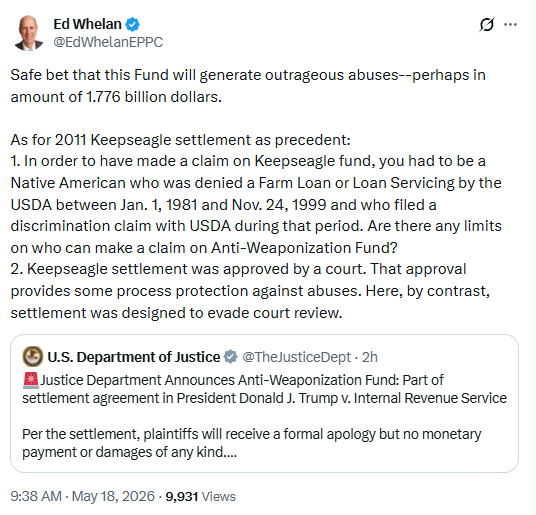
In that case, there was a clear harm, a clear way to delineate who was harmed, and court oversight of the process. In this case, there is literally none of that. Anyone arguing that Keepseagle is the same thing as this slush fund is either being deliberately dishonest or hasn’t read the basic facts. Even well known conservative lawyers like Ed Whelan (a former Scalia clerk) is calling out that this fund is highly questionable:

The fund itself is an abuse of power and clearly unconstitutional. As constitutional lawyer (and now Representative) Jamie Raskin noted last week in an interview with the New Republic, if the fund is used to pay off January 6 insurrectionists, it also likely violates the Fourteenth Amendment, which has a prohibition on the US government paying for those who engaged in insurrection or rebellion against the US:

There’s still more. Raskin notes that the Fourteenth Amendment prohibits the government from assuming any “obligation incurred in aid of insurrection or rebellion against the United States.” Raskin said that if this fund hands money to the January 6 rioters, Trump will be “using federal taxpayer dollars to compensate people who participated in insurrection.”

The “imagine if Biden did this” test is almost beside the point here (though, seriously, just imagine how people, including Democrats, would react). We’re past the moment where consistency of principle was the relevant standard. What matters is that $1.776 billion in unappropriated taxpayer money is being routed through a board of Trump loyalists, into an account the government has explicitly disclaimed responsibility for, on a clock that runs out before the next administration takes office.

The “settlement” framing is just the bow on top. The $1.776 billion slush fund for MAGA’s worst is the point.

Advertisement

Filed Under: anti-weaponization fund, congress, corruption, donald trump, ed whelan, insurrection, irs, jamie raskin, slush fund, weaponization

Source link

Advertisement
Continue Reading

Trending

Copyright © 2025