

Crypto World
Galaxy Wins New York BitLicense for Institutional Crypto Services

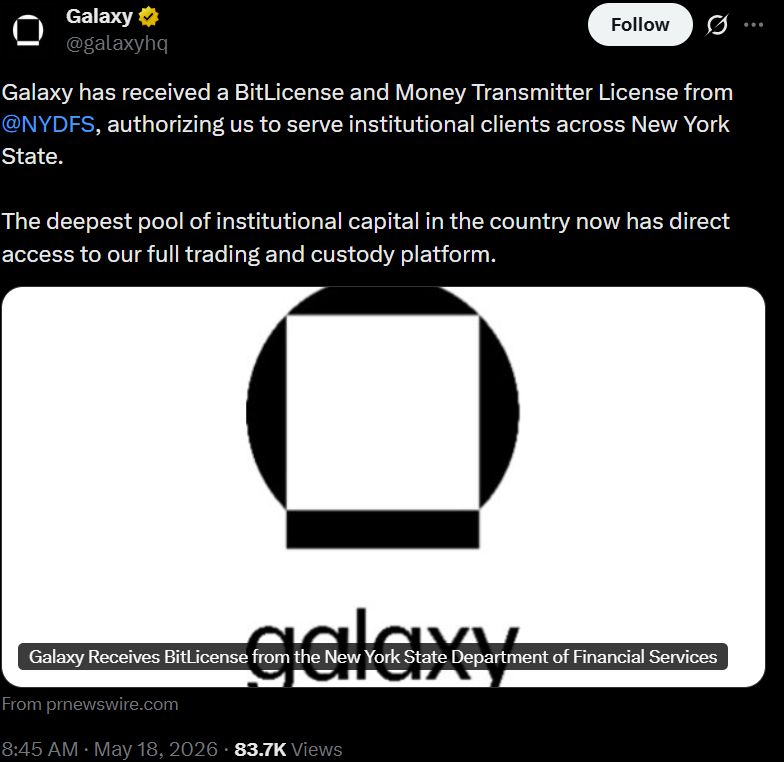
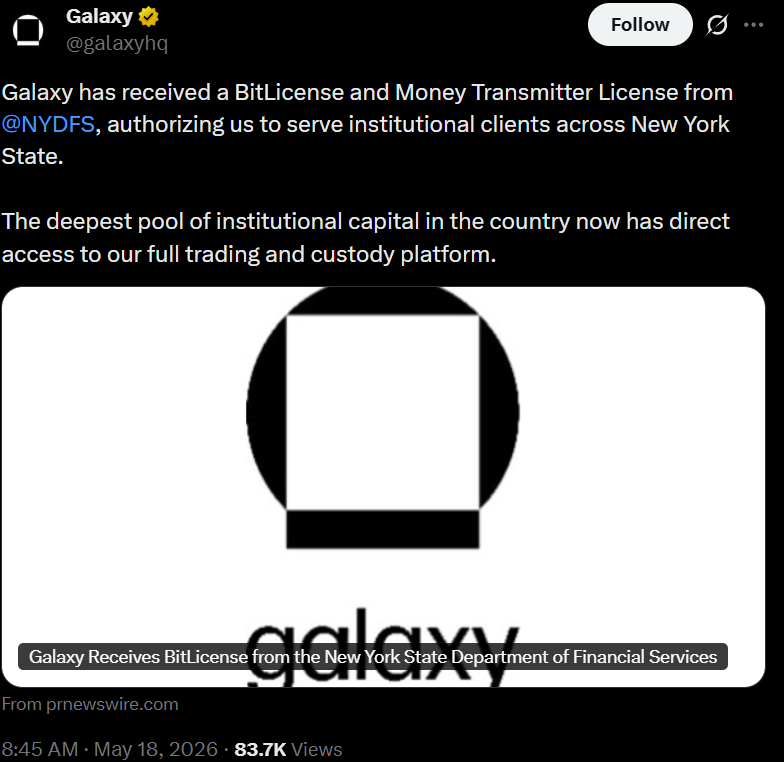
Galaxy Digital, a crypto-focused financial services company led by Mike Novogratz, has received a BitLicense and Money Transmission License from the New York State Department of Financial Services (NYDFS), allowing it to expand regulated digital asset services to institutional clients in the state.
The company said Monday that the approvals were granted to its subsidiary, GalaxyOne Prime NY, which provides trading and financing services to institutional investors.
The licenses extend Galaxy’s regulatory reach into New York, one of the most tightly regulated jurisdictions for cryptocurrency businesses in the United States.
In a statement, Novogratz said New York represents the “deepest pool of institutional capital in the country,” and that the approvals will help broaden institutional access to digital assets.
Introduced in 2015, New York’s BitLicense is widely considered one of the most difficult regulatory approvals for crypto companies to obtain because it requires extensive compliance controls related to anti-money laundering, cybersecurity, capital reserves and consumer protection.
Source: Galaxy
As Cointelegraph recently reported, Jack Mallers’ Strike was among the latest high-profile crypto companies to receive approval from the NYDFS, allowing the firm to offer Bitcoin services to residents and businesses in the state.
Related: Crypto funds see $1B in outflows as Iran tensions revive risk-off sentiment
Galaxy posts Q1 loss as data center business expands
The regulatory milestone comes as Galaxy continues to navigate a volatile digital asset market. The company last month reported a net loss of $216 million in the first quarter ended March 31, driven largely by lower digital asset prices, though the result was better than analyst expectations.
Gross revenue totaled $10.2 billion for the quarter, down from $12.9 billion in the same period a year earlier.
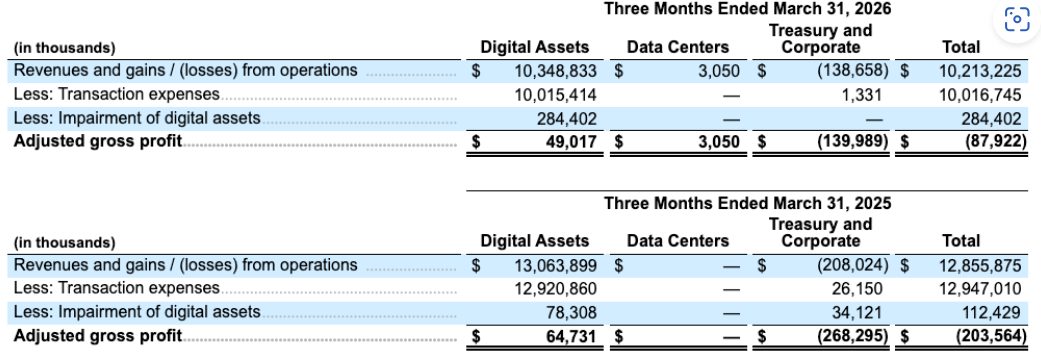
Galaxy’s Q1 2026 financial statement. Source: Galaxy
According to its Q1 earnings report, Galaxy expects growth to accelerate beginning in the current quarter as revenue from its data center business increases.
Like several other companies in the digital asset industry, Galaxy has expanded beyond cryptocurrency trading and investing into data center infrastructure. The company said future growth will be supported by its Helios Data Center campus in Texas and revenue tied to artificial intelligence and high-performance computing workloads.
Related: Galaxy, Sharplink plan $125M institutional DeFi yield fund backed by ETH treasury


European Union officials are reportedly preparing revisions to the Markets in Crypto-Assets (MiCA) regulatory framework as they respond to growing pressure from the United States’ push for stablecoin legislation.
Euronews reported on Wednesday that EU regulators plan to reassess proposed MiCA changes in 2027, with particular attention on how non-EU companies that issue stablecoins could be brought within the EU’s rules. The reported shift also points to potential updates covering tokenized payments and deposits—areas MiCA has not yet fully detailed for cross-border implementation.
Key takeaways
- EU officials are considering MiCA revisions in 2027, including measures that could better address non-EU stablecoin issuers.
- The reported changes are framed as part of the EU’s response to the US GENIUS Act, which could alter regulatory expectations for stablecoins.
- MiCA’s cross-EU service requirement means crypto firms serving EU users must be licensed as Crypto-Asset Service Providers (CASPs) under one member-state regulator.
- MiCA is also expected to face scrutiny in adjacent areas, with regulators reportedly weighing rules that extend beyond stablecoins into tokenized payments and deposits.
- Separately, ESMA plans to review custody-related operational resilience for CASPs between July 2026 and the first half of 2027.
Why MiCA could be updated after the GENIUS Act
The reported EU review comes in the context of the US Guiding and Establishing National Innovation for US Stablecoins (GENIUS) Act. According to the coverage cited in the report, the US measure is influencing how EU authorities think about stablecoin oversight and cross-border regulatory alignment.
Under MiCA, crypto firms offering services to customers in the EU across its 27 member states must obtain authorization as CASPs—an approach designed to create a harmonized baseline for market participants. While the licensing requirement took effect on July 1, the EU has already been working on the regulatory mechanics around stablecoins and related services, including through earlier consultations.
Euronews’ report frames the 2027 revisit as a practical response: EU regulators want clearer guidance on how a US stablecoin issuer could be treated within member states, especially once US rules start to solidify expectations for issuance, compliance, and oversight.
What could change: broader MiCA scope and “MiCA 2.0” discussions
The reported EU officials are expected to consider expanding MiCA’s scope beyond the current stablecoin-centric approach. Euronews said the debate includes whether MiCA should incorporate rules for tokenized payments and deposits, which would extend the framework into segments closely tied to everyday financial activity.
The idea of an expanded “MiCA 2.0” has circulated as authorities assess gaps that appear once firms attempt to operationalize compliance across multiple jurisdictions. However, while the framework is reportedly open for comment until Aug. 31, legal timelines remain uncertain.
Miroslav Durić, a senior associate at Taylor Wessing, told Cointelegraph in June that it is unlikely any concrete legislative proposals will be adopted before 2028. That distinction matters for market participants: even if the EU signals a direction of travel in 2027, firms may have a prolonged compliance runway before any formal changes take effect.
Compliance clock continues under MiCA’s CASP licensing model
MiCA’s central operating feature is licensing. For crypto companies that provide services to EU-based users, authorization as a CASP is now a key requirement, supervised by a regulator in one member state—after which the authorization can be recognized across the EU under the framework’s structure.
The EU licensing requirement took effect on July 1, but regulators have been balancing implementation with input channels for potential amendments. The timing of consultations—paired with the new US stablecoin law push—suggests EU authorities are trying to avoid a scenario where compliance expectations diverge significantly between regions.
For crypto businesses, the practical implication is that market access planning may need to account for two simultaneous processes: ongoing adherence to current MiCA obligations and the possibility of future regulatory refinements related to stablecoins, tokenized money-like instruments, and cross-border issuers.
ESMA to test custody resilience for CASPs
Alongside stablecoin-focused rulemaking discussions, EU supervision is also turning toward operational risk. On Wednesday, the European Securities and Markets Authority (ESMA)—a regulator involved in supporting MiCA implementation—announced it plans to review the operational resilience of CASPs licensed under the recently enacted framework.
ESMA’s review period runs from July through the first half of 2027, with regulators examining how crypto firms manage custody-related operational risks. The emphasis on operational resilience is significant because custody failures can expose firms not only to compliance issues but also to user harm and systemic confidence concerns across regulated market infrastructure.
For CASPs, this means compliance may increasingly be measured against resilience and risk-handling capability, not just authorization status. Firms should expect scrutiny around backup and recovery, incident response, and continuity measures—particularly in custody arrangements that are foundational to user assets and institutional workflows.
US market-structure bill discussions add another layer
In parallel with GENIUS-related developments, US lawmakers have reportedly continued discussions on a separate market-structure proposal known as the Digital Asset Market Clarity (CLARITY) Act. Cointelegraph reported that the bill has advanced through two key committees in the preceding 12 months and is expected to move to a Senate vote in July before the chamber enters a month-long state work period.
While CLARITY is not directly part of the EU’s MiCA text, the broader pattern matters: both regions are attempting to define stablecoin oversight and market rules in ways that can affect cross-border companies’ compliance strategies.
Readers should watch for two near-term signals: whether EU authorities provide clearer guidance on non-EU stablecoin issuers during the comment window ending Aug. 31, and how ESMA’s custody resilience review findings influence expectations for operational controls under MiCA. Together, these developments could shape how quickly firms can translate licensing into durable, cross-border-ready compliance.


Flash loans let anyone borrow tens of millions of dollars with no collateral, no credit check, and no identity, on one condition: the loan must be repaid within the same transaction that created it. This guide explains how that is even possible, what flash loans are legitimately used for, how attackers weaponize them, and why the strangest loan in finance is also one of its most honest.
Summary
- Flash loans are possible because blockchain transactions are atomic: they either fully complete or fully revert.
- The lender does not need collateral because the loan cannot survive unless it is repaid inside the same transaction.
- Most legitimate flash-loan activity involves arbitrage, collateral swaps, refinancing, and DeFi liquidations.
- Flash loans usually do not create vulnerabilities; they provide temporary capital to exploit weak oracle, governance, or logic design.
- The main cost for failed flash-loan attempts is gas, while profitable opportunities are heavily competed by bots and MEV searchers.
Imagine walking into a bank and asking to borrow $50 million. You have no collateral, no credit history, and you decline to give your name. In traditional finance the conversation ends there. In decentralized finance, the loan is approved instantly, at a fee of a few basis points, by a lending pool that has never heard of you and never will. The only condition is the strange one: you must pay the entire loan back before you leave the building, and if you cannot, it will be as if you never entered at all.
That is a flash loan, and it is one of the few financial primitives that genuinely could not exist before blockchains. Flash loans have funded some of the most elegant arbitrage trades in crypto and some of its most devastating exploits, including attacks that drained protocols of tens or hundreds of millions of dollars in a single block. They are cited in nearly every post-mortem of a DeFi disaster, which has given them a sinister reputation, and they are also used thousands of times a day for entirely mundane purposes that make markets more efficient.
This guide explains flash loans from the ground up: the property of blockchains that makes an uncollateralized loan safe for the lender, the mechanics of a flash loan transaction step by step, the four legitimate jobs flash loans do, a worked example of how an attack actually uses one, why the loan itself is almost never the vulnerability, what they cost and where they live, and the honest debate about whether DeFi would be better off without them.
The trick that makes it possible: atomicity
Everything about flash loans follows from one property of blockchain transactions called atomicity. A transaction on a network like Ethereum is all-or-nothing: either every operation inside it completes successfully, or the entire transaction fails and the chain’s state reverts to what it was before, as if the transaction had never been attempted. There is no such thing as a half-finished transaction. The word comes from the Greek atomos, indivisible, and it is the same guarantee that prevents a token transfer from debiting your wallet without crediting the recipient’s.
Now consider what atomicity does for a lender. In ordinary finance, a lender demands collateral because of time: between the moment money leaves the lender and the moment it returns, days or years pass in which the borrower can default, disappear, or go bankrupt. Collateral is a hostage against that passage of time. But what if the loan and its repayment happened inside a single atomic transaction? Then there is no passage of time in which anything can go wrong. The lending contract checks, at the end of the transaction, whether the borrowed amount plus fee has been returned. If it has, the transaction completes and everything inside it becomes permanent. If it has not, the entire transaction reverts, including the original lending step, and the pool’s money never actually left. The lender is not trusting the borrower; it is trusting mathematics. Default is not forbidden; it is impossible, because a defaulted flash loan is a transaction that never happened.
This is why flash loans need no collateral, no credit check, and no identity. All the machinery banks use to manage repayment risk exists because repayment is uncertain, and atomicity deletes the uncertainty. The trade-off is equally absolute: a flash loan cannot outlive its transaction. You cannot borrow via flash loan to buy something and repay next week. Whatever you intend to do with the money, borrowing it, using it, and repaying it, must all fit inside one transaction, which on Ethereum means inside roughly twelve seconds of block time and, more precisely, inside a single bundle of code execution.
Anatomy of a flash loan, step by step
A flash loan transaction is a small program the borrower writes and submits, and its skeleton is always the same five steps.
Step one, the request: the borrower’s smart contract calls a lending protocol, such as Aave, and requests a loan, say 10 million USDC. Step two, the transfer: the protocol sends the full amount to the borrower’s contract, optimistically, before any repayment. Step three, the payload: the borrower’s contract does whatever it came to do with the money, and this is the only step that varies; it might buy a token on one exchange and sell it on another, repay a loan on a second protocol, or swap collateral. Step four, the repayment: the borrower’s contract returns the 10 million USDC plus the fee, on Aave about 0.05%, so $5,000 on this loan, to the lending pool. Step five, the check: the protocol verifies the repayment landed; if yes, the transaction finalizes and the borrower keeps whatever profit the payload generated; if no, everything reverts and the borrower has lost only the network gas fee for the failed attempt.
Notice what the borrower risked: gas, typically a few dollars to a few hundred depending on complexity and congestion. Notice what the lender risked: nothing, by construction. And notice the skill that actually matters: writing the payload. Flash loans are permissionless, but they are not point-and-click for most purposes; using one means deploying a contract that orchestrates every step, which is why their users are overwhelmingly bots, developers, and MEV searchers, not casual traders, and why several services now sell no-code flash-loan tooling of wildly varying quality.
What flash loans are actually for
Four legitimate jobs account for the vast majority of flash-loan volume, and each exists because DeFi is a fragmented landscape of pools and protocols whose prices and terms drift apart.
The first is arbitrage. If ETH trades at $1,780 on one decentralized exchange and $1,790 on another, anyone who can buy on the first and sell on the second captures the spread, and the profit scales with size. Flash loans remove the capital barrier: a trader with $500 can borrow $5 million, execute both legs, repay, and keep the difference, minus fees and the slippage that large orders inevitably incur. This is the wholesome face of flash loans; arbitrageurs doing this thousands of times daily are the reason prices across DeFi venues stay closely aligned, an alignment everyone else gets for free.
The second is collateral swapping. Suppose you have a loan on a lending protocol backed by ETH and you want the collateral to be staked ETH instead, without closing the position. A flash loan lets you borrow enough to repay the loan, withdraw your ETH collateral, swap it, redeposit the new collateral, reborrow, and repay the flash loan, all atomically, converting a multi-step, risk-exposed process into one indivisible action.
The third is self-liquidation and refinancing. A borrower approaching liquidation can flash-borrow the repayment amount, close their own position, recover their collateral, sell a portion to repay the flash loan, and keep the remainder, escaping the liquidation penalty that a third-party liquidator would otherwise have taken. Similarly, debt can be moved from a protocol charging 8% to one charging 5% in a single transaction.
The fourth is liquidations themselves. The keeper bots that enforce solvency across DeFi lending, repaying underwater borrowers’ debts in exchange for their collateral at a discount, routinely fund those repayments with flash loans, which means the entire liquidation apparatus of decentralized lending runs substantially on borrowed-for-twelve-seconds money. Without flash loans, liquidations would depend on the working capital of a handful of well-funded firms; with them, anyone with a good bot can compete, which makes the system faster and more decentralized at once.
The dark side: how a flash-loan attack actually works
Flash loans became famous for the other thing they do, which is supply attack capital. The crucial point, the one every serious post-mortem makes and every headline obscures, is that the flash loan is almost never the vulnerability. It is the funding. The vulnerability is elsewhere, usually in how a protocol measures prices or counts votes, and the flash loan merely lets an attacker with pocket change exploit a flaw that would otherwise require a whale’s balance sheet.
Walk through the classic price-manipulation pattern. A lending protocol decides how much you can borrow by valuing your collateral, and suppose it values a token by checking the token’s spot price in one decentralized exchange pool. An attacker flash-borrows an enormous amount of one asset, dumps it into that pool, and momentarily distorts the price the protocol reads, making the attacker’s collateral appear far more valuable than it is. Against that inflated collateral, the attacker borrows heavily from the lending protocol, then reverses the pool trade, repays the flash loan, and walks away with the borrowed funds, all in one transaction. The protocol is left holding collateral worth a fraction of the debt against it. The flaw was the naive price oracle; the flash loan just made the flaw affordable to exploit.
The second classic pattern is governance. In 2022, an attacker used a flash loan to momentarily acquire a supermajority of Beanstalk protocol’s governance tokens, voted through a proposal sending the treasury to themselves, and repaid the loan, netting around $76 million from a protocol that allowed same-block voting. The defense, requiring tokens to be held or locked before voting power activates, is now standard, and the episode sits alongside slower-motion treasury raids in the genre of governance attacks this publication has anatomized, where the lesson is identical: if momentary token possession equals power, someone will rent the tokens for one block.
Cumulative losses to flash-loan-assisted exploits run well into the billions across DeFi’s history, with individual incidents ranging from six figures to the hundreds of millions. The defenses that matter are all oracle and logic hygiene: time-weighted average prices instead of spot readings, multiple independent price sources, borrowing caps, same-block action restrictions, and vote-locking. Protocols that do these things are not meaningfully threatened by flash loans; protocols that do not are exploitable by anyone patient enough to read their code, flash loans merely lower the capital requirement from millions to gas money.
A worked example, dollar by dollar
Abstractions hide the arithmetic, so walk through one realistic arbitrage from end to end.
Suppose a mid-cap token trades at $2.00 in a large Uniswap pool and $2.03 in a smaller pool on another venue, a 1.5% gap opened by a burst of one-sided buying. A searcher’s bot spots the spread and assembles a flash-loan transaction. Step one, it borrows 1,000,000 USDC from Aave, incurring a 0.05% fee obligation of $500. Step two, it buys the token in the cheap pool; a purchase that size moves the pool’s price, so the average fill is not $2.00 but roughly $2.006, price impact eating a slice of the edge, and the bot receives about 498,500 tokens. Step three, it sells those tokens into the expensive pool, where its own selling pushes the price down from $2.03, filling at an average around $2.022 for proceeds of roughly $1,008,000. Step four, it repays Aave 1,000,500 USDC. What remains, about $7,500, minus the gas fee, call it $150 for a complex transaction, and minus any priority fee paid to win the block position, perhaps a few thousand in a competitive auction, is profit, banked in twelve seconds with zero capital at risk beyond gas.
Now run the counterfactual that shows why atomicity matters. If, between the bot’s simulation and its execution, another searcher closed the gap first, step three returns less than the repayment requires, the final check fails, and the entire transaction reverts: no tokens bought, no loan outstanding, nothing lost but gas. The bot did not take a risk and lose; it took no risk and paid a small fee to discover that. Multiply this loop by thousands of bots and every venue pair in DeFi, and you have the invisible janitorial service that keeps a fragmented market’s prices coherent, funded entirely by the gaps it closes.
The same arithmetic explains why casual users rarely profit. The gross edge in the example was 1.5%; price impact took roughly a third of it, fees a fixed slice, and the priority auction, where competing bots bid away their expected profit to validators for first execution, takes most of the rest. Flash-loan arbitrage is a real business with real margins, and those margins have been competed down to the point where infrastructure, latency, and auction strategy decide who earns them.
Where flash loans came from
The idea is younger than it feels. The first named implementation arrived in 2018 with the Marble protocol, whose creator described it as a bank for the flash-loan age; Aave popularized the primitive at scale in early 2020, and within weeks the bZx incidents, a pair of exploits in February 2020 that used flash loans to manipulate thin markets for six-figure profits, introduced the wider world to the attack pattern and set the template for hundreds of imitations. The years since have run an arms race in miniature: attackers found protocols reading spot prices or counting same-block votes, protocols adopted time-weighted oracles and vote-locking, attack sizes peaked with nine-figure incidents, and the survivor population grew steadily harder to rob. Along the way the legitimate uses quietly institutionalized, arbitrage desks, liquidation keepers, and treasury managers folding flash loans into ordinary operations, until the primitive that headlines still call a hacking tool became, by volume, mostly plumbing.
Costs, venues, and limits
Flash loans live wherever there are large idle pools and smart contracts to guard them. Aave is the canonical venue, charging 0.05% on flash-loan principal; Uniswap V3 offers the sibling concept of flash swaps from its trading pools; Balancer, dYdX historically, and a range of smaller protocols offer variants with fees from zero to a few basis points. The size limit is simply pool liquidity: you can flash-borrow whatever the pool holds, which on major assets means nine-figure loans are routinely available to anyone. Fees flow to the pools’ liquidity providers, making flash loans a small but real income stream layered on top of the fee-and-risk economics providers already juggle.
The practical constraints are computational and adversarial rather than financial. Everything must fit within a block’s gas limit, complex multi-protocol payloads are expensive to execute and brutal to debug, and a failed transaction still burns its gas. Above all, profitable flash-loan opportunities are the most contested territory in crypto: arbitrage and liquidation payloads compete in the public mempool where sophisticated MEV searchers observe, copy, and front-run them, which is why serious operators submit through private relays and why the naive dream of easy flash-loan riches dies, for most people, on first contact with the competition.
One boundary worth drawing precisely: flash loans are native to single-chain atomicity. The guarantee dissolves across chains, because moving assets between blockchains takes minutes and trust, not one atomic breath, which is why there is no such thing as a cross-chain flash loan and why claims to the contrary should be read as marketing.
A note on nomenclature before the verdict, because two neighbors are often confused with flash loans. A flash swap is the exchange-native sibling: a trading pool sends you tokens first and lets you pay, in either asset, by the end of the transaction, which enables the same atomic patterns from a different venue. A flash mint goes further still, protocols that will create unlimited amounts of their own token for the duration of one transaction, since tokens that must be destroyed before the block closes cost the issuer nothing. All three run on the same atomicity guarantee, differ only in where the temporary liquidity comes from, and collapse into the same rule: whatever exists only inside one transaction is free to create, because it is impossible to steal.
The honest verdict
It is tempting to sort flash loans into good and evil and demand the evil half be banned, and the temptation misunderstands what they are. A flash loan is capital with the time dimension removed, and removing time removes the advantages that capital size normally confers. Whales could always manipulate thin oracles and buy governance outcomes; flash loans democratized the attack, which sounds terrible until you notice it also democratized the defense-testing. Every protocol now ships knowing that any flaw exploitable with money will be exploited by someone with almost none, a brutal but effective form of natural selection that has made surviving DeFi protocols measurably harder targets.
The equilibrium the ecosystem has reached is roughly this: flash loans as infrastructure are permanent, their legitimate uses quietly dominate their volume, their role in attacks is that of an amplifier for flaws that were always fatal, and the security burden sits, correctly, on protocol design rather than on restricting the primitive. For a user, the practical takeaways are smaller: flash loans explain how attackers with no visible wealth drain nine-figure protocols, they are part of why DEX prices track each other so tightly, and if a yield product ever advertises returns powered by flash-loan magic with no legible strategy, the magic is being performed on you.
A final perspective worth keeping: flash loans are the purest expression of what smart contracts changed about finance. Every other DeFi primitive, lending, trading, stablecoins, has a traditional ancestor it improves on; the flash loan has none, because its enabling condition, provable atomicity, does not exist in a world of couriers, clearing days, and courts. That is why traditional finance cannot copy it, why its risks are novel instead of imported, and why understanding it repays the effort even for readers who will never deploy one: it is the clearest available demonstration that programmable settlement does not just speed up old finance but permits transactions that were previously not merely impractical but conceptually impossible. Whatever else DeFi becomes, the flash loan is its signature invention, and knowing how it works is knowing what the technology is actually for.
Disclaimer: This article is for educational purposes only and does not constitute investment advice. Interacting with DeFi protocols carries significant risk, including total loss of funds. Details are current as of July 8, 2026. Always do your own research.
Frequently asked questions
What is a flash loan in simple terms?
A flash loan is a crypto loan with no collateral that must be borrowed and fully repaid within a single blockchain transaction. If the repayment does not happen, the entire transaction is automatically cancelled, so the lender’s funds never actually leave. It exists to give anyone temporary access to large capital for operations that complete instantly, like arbitrage.
How can a loan require no collateral?
Because default is impossible by construction. Blockchain transactions are atomic, meaning all their steps succeed together or fail together. The lending contract checks for repayment at the end of the same transaction that issued the loan, and if the money is not back, the loan itself is reversed as though it never happened. The lender needs no collateral because there is no moment in time when the funds are at risk.
How much does a flash loan cost?
Fees are small: Aave charges 0.05% of the borrowed amount, and some venues charge less or nothing. The real costs are the network gas fee, which is owed even if the transaction fails, and the engineering effort of writing the payload contract that uses the borrowed funds.
Are flash loans legal?
Flash loans are a neutral feature of public DeFi protocols and using one is not, in itself, unlawful. Using a flash loan to manipulate prices, drain protocols, or hijack governance can constitute fraud, market manipulation, or theft under existing law, and prosecutors have pursued flash-loan attackers on exactly those grounds. The tool is legal; several of its uses are not.
What was the biggest flash loan attack?
Among the most cited is the April 2022 Beanstalk governance attack, in which an attacker flash-borrowed enough tokens to pass a malicious proposal and extracted roughly $76 million in one transaction. Larger exploits have involved flash loans as one component, and cumulative losses across all flash-loan-assisted attacks run into the billions of dollars.
Can ordinary users take flash loans?
Technically yes, practically rarely. Executing a flash loan requires deploying a smart contract that orchestrates the borrow, the strategy, and the repayment in one transaction, so nearly all volume comes from bots and developers. No-code tools exist but vary widely in quality and safety, and profitable opportunities are fiercely contested by professional operators.
Do flash loans make DeFi more dangerous?
They amplify existing flaws rather than create new ones. A protocol with a manipulable price oracle or same-block governance was always exploitable by anyone wealthy; flash loans extend that ability to anyone at all. Well-designed protocols using time-weighted oracles, borrowing caps, and vote-locking are not meaningfully endangered, and flash loans simultaneously power the arbitrage and liquidations that keep DeFi markets healthy.
Can you do a flash loan across two blockchains?
No. The atomicity guarantee that makes flash loans safe only exists within a single chain’s transaction. Moving assets between chains takes time and introduces trust assumptions, which breaks the all-or-nothing structure, so genuine cross-chain flash loans do not exist.
Disclosure: This article does not represent investment advice. The content and materials featured on this page are for educational purposes only.


Kalshi is appealing a New York federal judge’s rejection of its bid to block state gambling officials from enforcing local laws against the prediction market platform’s sports-related event contracts.
In a notice filed on Tuesday in the US District Court for the Southern District of New York (SDNY), Kalshi said it would take the case to the US Court of Appeals for the Second Circuit. The appeal followed a same-day opinion and order denying the platform operator’s motion for a preliminary injunction against officials at the New York State Gaming Commission.
The appeal escalates a growing legal fight over whether sports prediction markets are federally regulated derivatives or state-regulated gambling products. This question has already split courts across the United States.
Judge Analisa Torres earlier Tuesday rejected that argument at the preliminary injunction stage, finding that New York gambling laws, as applied to Kalshi’s sports-event contracts, were not preempted by the US Commodity Exchange Act. The court said Kalshi had not made a “clear or substantial showing” that it was likely to succeed on the merits.
The order also noted that other jurisdictions have had split opinions on similar requests from Kalshi. Some have granted injunctions against state enforcement, while others have denied the company’s motions.
“Major loss for Kalshi in the nation’s financial capital, with likely knock-on effects in other cases (esp. Connecticut and other SDNY lawsuits),” wrote lawyer Daniel Wallach, whose Florida law firm is devoted principally to sports wagering and gaming law in the US.
Kalshi’s US legal fight widens
Kalshi’s appeal comes as prediction market platforms face mounting pressure from state regulators over their sports event contracts.
In May, the Commodity Futures Trading Commission (CFTC) backed Kalshi in an Ohio federal appeals court fight after the platform challenged efforts to restrict its prediction market offerings. The CFTC’s filing came after it had sued five states, including Wisconsin, New York, Arizona, Connecticut and Illinois, to assert jurisdiction over prediction markets.
On June 25, Kalshi sued Illinois officials over a state law it said “expressly bans sports event contracts” unless prediction market platforms obtain local licenses. The platform argued that the law usurped the CFTC’s authority over federally regulated derivatives markets.
Related: Kalshi June trading volume tops $9B as World Cup fuels prediction markets
State regulators have also cracked down on other platforms. In April, Wisconsin sued Robinhood, Coinbase, Polymarket, Crypto.com, as well as Kalshi, over sports event contracts. The state alleged that the platforms facilitated illegal sports betting.
Nevada regulators have pursued similar actions against prediction market firms, including Kalshi, Coinbase and Polymarket
Magazine: Has Bitcoin bottomed for this cycle? Analysts say ‘not yet’

Pay for the premium tier of any centralized AI platform, and rate limits still hit during peak hours. That’s not a bug. It’s the ceiling every centralized AI platform eventually reaches, because one company’s data centers can only handle so much demand at once, no matter how much money gets thrown at the problem.
Arbitrum, Internet Computer, and Kaspa each tackle a different piece of crypto’s scaling puzzle, yet none were built specifically to solve AI’s compute bottleneck. For anyone tracking the next 100x crypto, that’s the gap Stargate LLM’s Grid is aimed at.
What Happens When One Company’s Servers Aren’t Enough
The problem isn’t unique to any one AI platform. Rate limits during peak hours are the ceiling every centralized system eventually hits, because a single company’s data centers can only absorb so much demand regardless of the price tag attached to the premium tier. Stargate LLM‘s Grid takes a different structural approach: crowdsourcing compute from a distributed network of contributors instead of concentrating it inside one company’s server farms, so capacity grows as more people join rather than staying fixed to one balance sheet.
This is the pitch for power users and businesses who’ve personally hit a rate limit or a slowdown on a paid tier, an experience that’s rarely discussed publicly but genuinely frustrating: paying full price for capacity that isn’t reliably there the moment demand spikes. Stargate LLM’s chat, image generation, video generation, private search, and agent marketplace all sit on top of that distributed compute layer rather than a single data center somewhere.
The presale runs across ten pricing stages, from $0.0005 to $0.0125, on the way to a confirmed $0.025 launch price. Stage 1 carries a 50x ratio to that target, the widest gap in the entire structure. Total supply is fixed at 150 billion tokens. Of that, 96% goes to community, ecosystem, and presale participants, and just 1% sits with the core team.
For anyone genuinely hunting the next 100x crypto, a decentralized compute layer paired with a presale still priced before the wider market has weighed in is a different kind of bet than a token riding purely on speculation.
LG’s Enterprise Bet on Arbitrum Hasn’t Reached the Price Yet
LG Electronics partnered with Arbitrum to build a custom Layer 2 blockchain for automating digital advertising transactions, completing a pilot with a Japanese advertising agency and evaluating a commercial rollout before the end of 2026.LG Electronics partnered with Arbitrum to develop a custom Layer 2 blockchain designed to automate the buying and selling of digital advertising, completing a pilot with a Japanese advertising agency.
That’s a real enterprise validation of Layer 2 technology. ARB trades near $0.08, roughly 97% below its all-time high of $2.40 set in January 2024, and a scheduled token unlock on July 16 will release close to 93 million ARB, adding fresh supply pressure right as the enterprise story is still building momentum.
A Trillion-Dollar Ambition, a $1.2 Billion Reality
Internet Computer positions itself as sovereign, decentralized cloud infrastructure capable of hosting entire applications on-chain, aimed squarely at the trillion-dollar cloud computing market currently dominated by centralized providers.
The Internet Computer is a decentralized cloud blockchain that pursues the $1+ trillion cloud market, hosting apps, websites, and enterprise systems fully onchain. The ambition is genuinely large. The market cap isn’t. ICP trades near $2.14 to $2.18, with a total valuation just over $1.2 billion, sitting roughly 99.7% below its all-time high near $700.
Kaspa Rallied on Real News. Its Own Miners Sold Into the Move.
Kaspa is trading near $0.030, with a market cap around $830 million, after a recent smart contract hard fork and network upgrade triggered a short-term price surge. As of Jul 7, 2026, Kaspa (KAS) is trading at $0.0302 with a market cap of $830.20M, having recently experienced short-term volatility due to a network upgrade and smart contract hard fork.

That surge has since run into resistance, and heavy miner distribution is adding sell pressure right as the technical setup tries to hold its gains.
Final Say
A real enterprise partnership, a trillion-dollar ambition, and a genuine network upgrade, Arbitrum, Internet Computer, and Kaspa each have something legitimate behind this week’s price action, even if none of it has fully shown up in the charts yet.
None of the three was purpose-built to solve AI’s specific compute ceiling, which is exactly what Stargate LLM’s decentralized Grid is aimed at. Stage 1 remains open before the price steps up through nine more stages.
Four different bets on the same underlying question: whose infrastructure is actually built to scale with what comes next.
Disclaimer: This is a Press Release provided by a third party who is responsible for the content. Please conduct your own research before taking any action based on the content.

Bitcoin’s price faced another rejection following the renewed strikes in the Middle East and Trump’s latest statement, going from over $64,000 to under $62,000 in hours.
Most altcoins have joined the ride south, with ETH sliding below $1,750, while XRP has dropped beneath $1.10. PI has marked another all-time low.
BTC Dips Below $62K
The start of July has been a mini rollercoaster for the primary cryptocurrency. It dipped below $58,000 on July 1 for the first time in nearly two years, but began its gradual recovery immediately and surged to over $63,000 over the weekend. After a minor retracement there, it jumped to $64,000 on Monday morning for the first time in two weeks.
However, Strategy’s new and much bigger BTC sale drove it south again, as the asset dumped to $61,200 in a FUD-induced move. While many expected another leg down, bitcoin went in the opposite direction and jumped past $64,600 within hours. This was another short-lived rally, though, and it slipped to $62,600 yesterday.
Another leg up followed, driving the cryptocurrency to $64,200, where it was rejected again after the US and Iran launched new strikes against each other. The landscape worsened hours ago after Trump said he believes the MoU with Iran is ‘over.’ BTC dumped further, dropping below $62,000 for the second time this week.
Its market cap has retreated to $1.240 trillion, while its dominance over the alts remains at 56.6% on CG.

PI’s New ATL, LAB’s Crash
Pi Network’s native token continues to be among the poorest performers during this cycle. It keeps dropping to new all-time lows, and it hit a new one earlier today. Despite the new updates from the team, PI plummeted by over 8% and crashed to $0.101 (on CoinGecko) to set a new low. It’s down by over 96.5% since its ATH in February 2025.
LAB has dumped the most over the past 24 hours. The token has lost over 80% of its value and now struggles below $2.30. PUMP, BEAT, and JUMP complete the double-digit losers club today.
Ethereum and Binance Coin have lost over 2% of value, while XRP, SOL, HYPE, and DOGE are down by 4-5%. XLM, NEAR, ADA, and CC have dropped by more than 5% daily. ZEC is among the few exceptions in the green now after the recent update from founder Zooko Wilcox-O’Hearn.
The total crypto market cap has shed $50 billion in a day and is below $2.2 trillion on CG now.

The post Pi Network’s Pi Crumbles to New ATL, Bitcoin (BTC) Halted at $64K: Market Watch appeared first on CryptoPotato.


Google has updated its Chrome Web Store rules to prohibit prediction market extensions that facilitate real-money transactions, with enforcement set to begin on Aug. 1, 2026.
Summary
- Google will ban Chrome extensions that enable real-money prediction market transactions from Aug. 1, 2026.
- The policy update comes as Kalshi and other prediction market platforms face growing legal scrutiny in the U.S.
- A New York court allowed the state’s lawsuit against Kalshi to proceed over sports-related event contracts.
According to Google’s latest update to its Developer Program policies, browser extensions that “facilitate or enable real money transactions on predictive outcomes” will no longer be permitted on the Chrome Web Store.
The company said developers have until Aug. 1, 2026, to comply, after which non-compliant extensions could face enforcement action, including removal from the marketplace.
The policy revision comes at a time when prediction market operators are facing growing legal and regulatory pressure in the United States, particularly over sports-related contracts. Platforms including Kalshi and Polymarket have increasingly found themselves at the center of disputes involving state gambling laws and the classification of event-based contracts.
Google has expanded restrictions on prediction market products
Alongside several updates to its Developer Program policies, Google explicitly added prediction market extensions to its list of prohibited products. While the company did not mention any specific platform by name, the revised language directly targets extensions that allow users to conduct real-money transactions tied to future events.
Google said enforcement will begin on Aug. 1, warning that extensions remaining out of compliance after that date may face action through the Chrome Web Store.
The policy change arrives shortly after prediction markets attracted attention outside financial regulation. As crypto.news previously reported, music streaming company Spotify challenged Polymarket and Kalshi after discovering its branding had been used in connection with prediction markets despite no partnership existing between the companies.
Spotify also said it had removed more than 500,000 artificial streams that falsely boosted Malcolm Todd’s song Earrings on its platform. Kalshi later settled a prediction market tied to those manipulated streaming numbers, drawing additional scrutiny to the event contract.
Kalshi continues to face legal challenges in New York
Meanwhile, legal pressure on Kalshi has continued to build in New York after the state secured a court victory in its dispute with the prediction market operator.
Following the ruling, New York Governor Kathy Hochul said, “Gamble with our laws and you’re going to lose. Just ask Kalshi.” Her comments came after New York’s Attorney General accused the company of attempting to bypass state gambling laws, a position that survived Kalshi’s effort to block the case.
As previously reported by crypto.news, Judge Analisa Torres denied Kalshi’s request for a preliminary injunction against New York. The court determined that the state’s gambling laws apply to Kalshi’s sports-related event contracts, allowing New York’s lawsuit to move forward.
State officials have maintained that prediction markets offering sports-based contracts can fall within existing gambling regulations when they operate without state authorization. Hochul added that her administration and the Attorney General would continue pursuing gambling platforms, including prediction markets, that they believe violate New York law.
Regulatory scrutiny has also extended beyond Kalshi. New York has filed legal action against Coinbase and Gemini, alleging that their prediction market offerings function as unlicensed gambling businesses under state law.
Google has not linked its Chrome policy update to any individual enforcement case. However, the timing places the new restrictions alongside mounting legal disputes involving prediction market platforms, leaving developers offering real-money event contract extensions with less than a month to comply before the Aug. 1 enforcement deadline.

Bank of England Governor Andrew Bailey has denied that lobbying or political pressure from Nigel Farage affected the central bank’s thinking on a potential UK central bank digital currency (CBDC), according to a report by The Guardian. Bailey’s remarks reportedly come in a letter obtained by the publication after a meeting between the two in which cryptocurrencies were among the topics discussed.
At the same time, the Bank of England continues its work on the proposed “digital pound,” stressing that it is still in the design stage and that no decision has been made about whether to introduce it. The juxtaposition of ongoing CBDC research with intensifying scrutiny of political figures underscores how UK crypto policy is increasingly intertwined with public trust and governance questions.
Key takeaways
- Bailey reportedly said the BoE has mechanisms to recognize attempts to influence policymaking and that no policy changes followed any interventions by Farage.
- Farage, a long-standing CBDC critic, resigned his parliamentary seat this week amid reports about accepted “gifts” connected to the crypto industry.
- The Bank of England reiterated that it has not decided whether to launch a digital pound and that any move would require further analysis and public consultation.
- Earlier this year, the BoE launched a six-month pilot exploring tokenized asset settlement using central bank money.
Bailey denies Farage influence on CBDC policy
In its Wednesday report, The Guardian said it obtained a letter written by Bailey following his meeting with Farage. The governor’s message, as described by the outlet, indicates that Bailey believes the BoE is “able to spot” efforts to sway central bank decision-making.
Bailey also reportedly addressed what (if anything) changed after the meeting. He wrote that it was a discussion covering “a range of topics, including cryptocurrencies,” and said he was “happy to confirm that no policy changes have taken place as a result of interventions” by Farage.
The reported denial arrives amid broader political controversy around Farage. Earlier this week, Farage resigned his parliamentary seat, with reports citing claims that he accepted “gifts” from individuals with ties to the crypto industry. Cointelegraph has previously covered the resignation in connection with those allegations.
Separately, Farage has maintained that he did not break the law, according to an X livestream in which he stated he had “not broken the law in any way at all,” as referenced in his post.
BoE maintains that the digital pound is not decided
While the political noise grows, the Bank of England’s stance on CBDC development remains consistent: it is exploring the digital pound without committing to implementation.
In a recent update, the central bank said that “no decision has been made on whether to introduce a digital pound.” The BoE also emphasized that any future launch would depend on further work, including analysis and public consultation, according to the bank’s digital pound update referenced in the article.
This matters for markets and users because CBDCs—unlike purely speculative technology projects—depend heavily on institutional design choices and regulatory guardrails. Even when a central bank is actively experimenting, it can still decide not to proceed after weighing privacy, financial stability, and operational feasibility.
Pilot work on tokenized settlement continues
The BoE’s digital pound timeline remains tied to experimentation rather than deployment. Earlier this year, the Bank launched a six-month pilot aimed at understanding how tokenized assets could be settled using central bank money.
As described in the source, the pilot involved 18 companies and was designed to test practical components of a future framework for on-chain settlement—part of a broader push to modernize UK financial infrastructure. Earlier coverage from Cointelegraph noted the BoE’s decision to select Chainlink for its synchronization lab to support the work.
For investors and builders, this type of pilot is significant because it can clarify which technical approaches are viable when the “asset” being moved is paired with central bank settlement rather than commercial bank money. It also helps explain how tokenized systems might interact with existing market practices—an area where many real-world asset tokenization efforts have struggled to translate concepts into resilient infrastructure.
At the same time, the BoE’s public messaging leaves room for uncertainty. Research pilots can inform future decisions, but they do not automatically translate into a CBDC launch. The key question moving forward will be whether the BoE concludes that the digital pound’s benefits outweigh the risks and whether the public consultation process produces sufficient confidence.
Political scrutiny widens beyond CBDC debate
The report detailing Bailey’s denial comes as the UK government’s crypto-adjacent political controversy expands beyond CBDC opinions. The Guardian also reported that the UK’s National Crime Agency is investigating transactions involving other senior Reform UK figures over suspected money laundering.
That broader context is relevant to how CBDC narratives may develop in the UK. Even if policymakers insist that central bank decisions are made independently, public trust can be affected when high-profile political figures are connected to allegations involving the crypto industry. This can influence how comfortable lawmakers and the public feel about the governance and oversight of any future digital currency.
What to watch next is whether the BoE provides more detail on how it evaluates influence attempts and governance risks in its CBDC process, and how the ongoing investigations and Farage-related claims evolve alongside the Bank’s experimental work toward the digital pound’s potential role in the UK financial system.
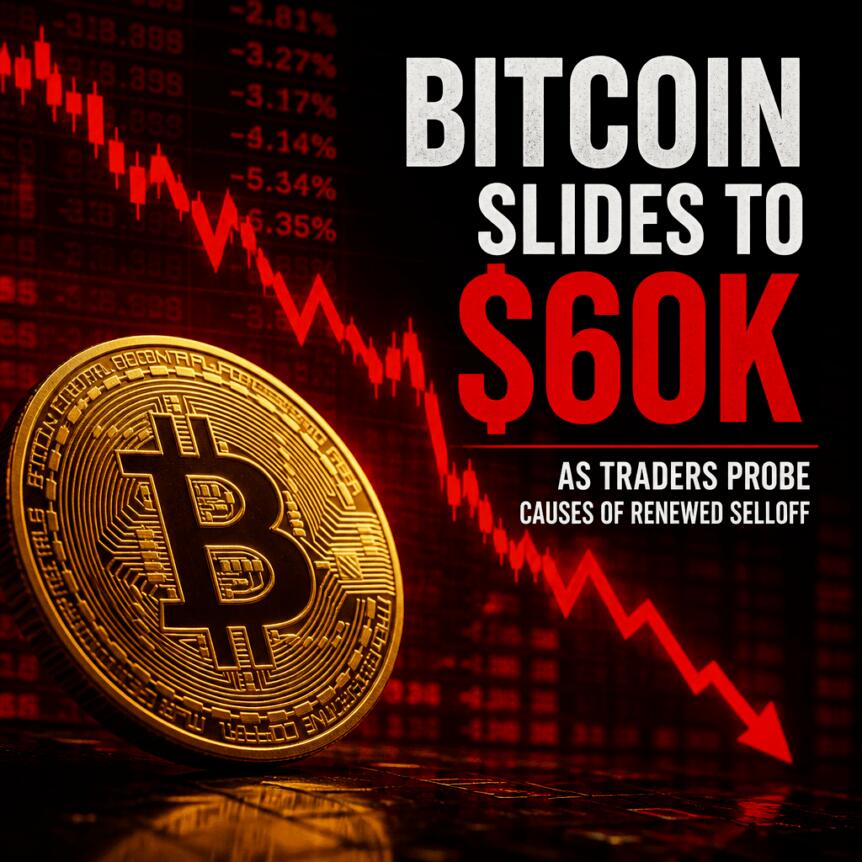
Bitcoin is once again trading under pressure as broader markets shift toward risk-off positioning amid rising geopolitical uncertainty and higher energy prices. On Wednesday, BTC fell about 3.5% after new developments related to the US–Iran conflict pushed Brent crude higher and renewed stress in parts of global bond markets.
While some of the equity damage appeared to stabilize later in the session, Bitcoin’s inability to rebound—after failing to reclaim the $64,500 area earlier in the week—has traders focusing on factors specific to crypto. The latest concern: how continued spot selling from MicroStrategy’s corporate arm, Strategy (MSTR US), could weigh on sentiment, especially as the market watches the $60,000 support zone.
Key takeaways
- BTC dropped roughly 3.5% on Wednesday as geopolitical risk drove oil prices higher and pressured broader risk appetite.
- Brent crude rose to around $74 (from about $68 the prior week), increasing inflation concerns and reducing the odds of near-term Fed rate cuts.
- Traders are recalibrating expectations after Strategy’s reported $216 million Bitcoin sales, with extra attention on whether those sales fall outside its main Monetization Program.
- Concerns about tighter global regulatory posture—highlighted by policy signals from India—add a second layer of downside risk for crypto sentiment.
- With sentiment fragile, a retest of the $60,000 support level is increasingly seen as plausible.
Geopolitics, oil, and why “higher-for-longer” risk matters for BTC
The immediate catalyst for Wednesday’s broad de-risking was the renewed escalation between the US and Iran, which also fed into energy markets. The article notes Brent crude rose to about $74 after the official breakdown of a US–Iran memorandum of understanding. US President Donald Trump said the deal was “over” after US strikes targeted Iranian sites in response to vessel attacks.
Higher oil prices can quickly translate into wider inflation risk. That matters for Bitcoin in a practical way: if inflation worries strengthen, the market tends to push back expectations for Federal Reserve easing. In turn, risk assets often face less support from liquidity expectations.
The direction of rate expectations appears to have shifted. According to the CME FedWatch Tool referenced in the article, traders were pricing roughly 69% odds of interest rate hikes by September—up from 42% about a month earlier. With Bitcoin still not widely treated as a hedge in the way traditional investors sometimes expect gold to function, tighter monetary expectations tend to weigh more directly on BTC demand.
Bitcoin lags the rebound: a sign of extra crypto-specific pressure
Earlier in the week, Bitcoin struggled near the $62,000 region and failed to reclaim the $64,500 level on Monday. The piece highlights that the Nasdaq-100, a tech-heavy benchmark, was also in a downtrend around that time, linking Bitcoin’s underperformance to broader risk behavior.
However, the key difference on Wednesday was that markets later appeared to stabilize, while Bitcoin still couldn’t mount a durable bounce. The article interprets that divergence as evidence that additional forces—beyond just equities—are contributing to the current weakness.
Those forces center on two themes: the possibility of continued Bitcoin selling pressure from Strategy, and the perception that global regulation could tighten further rather than ease.
Strategy’s $216 million sales renew selling fears
Strategy (MSTR US) disclosed Bitcoin sales totaling about $216 million on Monday, according to coverage referenced in the article from Cointelegraph. The sell size itself drew attention, but the timing and structure of those sales raised additional questions among traders.
The piece notes that many investors were surprised to learn the sales took place outside Strategy’s core $1.25 billion Monetization Program. The cited 8-K filing states that the program accounts only for proceeds used to fund the company’s cash reserves.
That distinction matters because it changes how the market models future flows. If selling is occurring outside a clearly defined monetization framework, investors may struggle to predict whether supply pressure is temporary or could persist as Strategy manages cash needs and debt obligations.
The article also points to Strategy’s financing commitments: it cites total annual dividends of $1.76 billion and notes the company holds more than $3.8 billion in convertible debt, with the earliest call date before April 2027. Together, those elements reinforce the idea that Strategy’s treasury management could continue to affect BTC supply and price sensitivity—particularly during periods of macro stress.
Regulatory signals and global uncertainty add to downside risk
Macro pressure isn’t the only negative input. The article also highlights regulatory developments outside the United States, citing signals from India. It points to documents described as showing India’s central bank backing policies that lean toward prohibiting crypto activities, including barring banks from any exposure to virtual assets intended to safeguard financial stability. It also notes that the India tax department highlighted risks associated with evasion.
For Bitcoin traders, the relevance is straightforward: when oversight expectations rise across major jurisdictions, market participants often discount risk premia more aggressively. Even if policy changes take time to translate into enforceable outcomes, the sentiment impact can show up quickly in trading behavior.
Layer on top of that renewed economic uncertainty connected to geopolitical decisions at the NATO summit—along with stress in parts of the bond market, particularly Japan as described in the article—and the result is a market that appears less willing to absorb negative BTC-specific headlines.
What to watch around $60,000
With sentiment described as fragile and multiple headwinds converging—monetary expectations shifting toward tighter conditions, renewed focus on Strategy’s ongoing Bitcoin liquidity needs, and regulatory tightening signals—traders are increasingly treating the $60,000 support level as the next key test. The near-term question is whether macro pressure eases enough for BTC to reclaim momentum, or whether continued selling risk and tightening policy expectations push another move below that threshold.
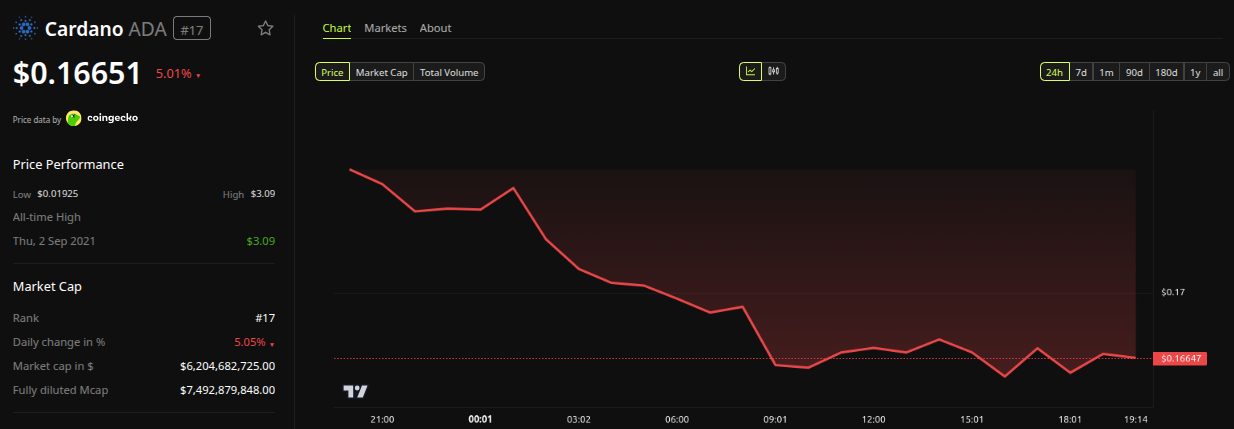
The price of Cardano (ADA) plunged roughly 5% in 24 hours after the founding entity EMURGO stepped down from the Pentad governance group. The company said the SecondFi exploit forced it to redirect its resources.
Here is why EMURGO left, how the hack triggered the move, and what it means for Cardano’s governance.
What EMURGO’s Exit From the Pentad Means
The Pentad is Cardano’s key governance body, a collaborative structure that guides strategic decisions across the ecosystem (includes Input Output Global, the Cardano Foundation, Intersect, the Midnight Foundation, and EMURGO).
EMURGO, one of Cardano’s three founding entities, confirmed on X that it formally notified relevant parties of its decision to exit. The reason ties directly to the SecondFi exploit. EMURGO said its immediate priority is now the SecondFi recovery process for affected users.
As a result, the company chose to concentrate its resources where they are needed most.
Follow us on X to get the latest news as it happens.
The hack was significant in scale. The SecondFi exploit reportedly involved around $2.4 million and impacted hundreds of wallet users. Furthermore, EMURGO framed the departure as reflecting the accountability standard it holds as a founding entity.
Recovery efforts are already underway. EMURGO activated a quarantine mode this week, allowing users to check affected addresses and submit tickets. Moreover, a secure wallet export feature is planned for next week to enable safe asset transfers.
“Our intention is that next week, the secure wallet export will be deployed to help affected users safely move assets to a new wallet. On asset recovery, we continue to make progress with the recovery tool, initiated through a portal, that keeps users in control while protecting their information,” EMURGO said on X.
EMURGO is among the founding entities alongside Input Output and the Cardano Foundation. Consequently, its exit raises questions about how responsibilities will be redistributed across Cardano’s evolving decentralized governance model going forward.
ADA Drops 5% From a Mix of Bearish Catalysts
ADA’s price reflects sentiment, and a founding entity leaving governance over a major hack can quickly shake investor confidence. Market observers note that EMURGO’s SecondFi-driven announcement directly contributed to the negative mood surrounding the token.
The numbers show the stress clearly. ADA trades near $0.1665 with a market cap of around $6.2 billion, according to BeInCrypto data. Furthermore, trading volume surged above $340 million, signaling heightened activity as investors reacted quickly.

Broader market conditions also amplified the drop. Renewed US-Iran tensions rattled global risk appetite, pressuring crypto across the board. However, the timing of EMURGO’s SecondFi announcement appears to be the primary catalyst behind ADA’s steeper decline.
Community reactions have been mixed across social media. Some praised EMURGO for prioritizing the recovery of SecondFi. Meanwhile, others demanded greater transparency, including audits of past spending and clarity on Genesis ADA allocations.
Questions also emerged about EMURGO’s other roles. These include its wallet development work on Yoroi and its status as a Delegated Representative. Consequently, the exit reflects the growing pains of decentralized governance during a security crisis.
Subscribe to our YouTube channel to watch leaders and journalists provide expert insights.
The post ADA Price Plunges 5% After Another Cardano Governance Mess appeared first on BeInCrypto.
Crypto World
Palantir (PLTR) Stock Tumbles 5% Amid Political Scrutiny Over Government Contracts Worth $2.2B

Key Takeaways
- Shares of Palantir closed approximately 4.8% lower at $127.88 on Wednesday, halting a seven-session rally that had driven the stock up 25%.
- Concerns emerged following a Financial Times article discussing potential political opposition to Palantir’s government work from Democratic legislators.
- Federal contract revenues reached approximately $2.2 billion in the twelve months since Trump’s presidential return, marking a 65% annual increase.
- The stock continues to trade beneath both its 100-day and 200-day moving averages, maintaining a Death Cross pattern established in February.
- Wall Street maintains a Buy consensus rating with a $174.10 average price target; the company’s next earnings release is projected for August 3.
Palantir Technologies (PLTR) experienced a significant decline Wednesday, ending a seven-session upward momentum. Shares retreated approximately 4.8% to close at $127.88, positioning the data analytics firm among the S&P 500’s weakest performers for the trading day.
Palantir Technologies Inc., PLTR
The downturn followed publication of a Financial Times piece highlighting internal company discussions and suggesting Democratic legislators might leverage subpoena authority to investigate Palantir’s federal government engagements should they reclaim House majority control.
DA Davidson’s Gil Luria spoke with Barron’s, attributing the price movement directly to the Financial Times coverage. Luria contested the political risk thesis, emphasizing that Palantir has maintained Defense Department relationships through five different administrations spanning both major political parties.
“Each successive administration has expanded its reliance on Palantir’s capabilities beyond what came before,” Luria noted.
The timing carries significance. PLTR had concluded Tuesday’s session precisely at its 50-day moving average near $134. Wednesday’s reversal indicates the stock encountered resistance at that technical threshold before retreating.
Palantir declined to provide commentary when contacted.
Congressional Concerns and Federal Revenue Exposure
While political controversy surrounding Palantir isn’t unprecedented, the Financial Times piece elevated these concerns prominently. The company has faced ongoing criticism regarding its contracts with U.S. immigration authorities, defense entities, and involvement in Israel’s Gaza operations.
The heightened attention carries weight given the financial stakes involved. Federal contract revenues approached $2.2 billion during the twelve-month period following Trump’s presidential inauguration—representing a 65% year-over-year surge. Meanwhile, commercial segment revenues more than doubled during this timeframe.
Any material interruption to these government agreements would represent substantive business impact beyond mere reputational considerations.
Notably, investor Michael Burry has established a short position against PLTR, contending that Anthropic represents competitive pressure in the artificial intelligence domain. Chief Executive Alex Karp has countered this perspective, asserting that large-scale AI models generate challenges that Palantir’s solutions are specifically designed to address for enterprise clients.
Technical Analysis of PLTR
The broader technical landscape remains challenging. PLTR currently trades 18.6% beneath its 200-day moving average of $157.31 and 7.9% under its 100-day moving average at $139.05. The Death Cross pattern—where the 50-day average crosses below the 200-day average—materialized in February and persists.
Year-to-date in 2026, Palantir shares have declined 29% and remain 39% off the all-time closing peak of $207.18 reached November 3, 2025.
The recent seven-day advance provided temporary respite. Following a June 25 trough at $107.27, PLTR rallied 25% across seven consecutive sessions. This momentum stemmed partially from an announced collaboration with Nvidia focused on developing specialized AI architectures for federal government applications, complemented by DA Davidson’s rating upgrade to Buy with a $175 price objective.
Wednesday’s retreat disrupted this positive trajectory.
Investors now turn attention toward the company’s upcoming earnings announcement, anticipated for August 3. Analyst projections call for earnings per share of 33 cents, double the 16 cents reported in the year-ago quarter, alongside revenue expectations of $1.81 billion versus $1.00 billion previously.
Wall Street maintains a consensus Buy recommendation on the shares with an average twelve-month price target of $174.10.

EU Officials Plan MiCA Revisions to Regulate Non-EU Stablecoin Issuers

Ireland Chasing European Glory at 2026 Co-ed Slowpitch Championship

NATO’s AI ‘Kill Web’ on its eastern flank


-

 Fashion5 days ago
Weekend Open Thread: High Hopes
-
 NewsBeat4 days ago
Taylor Swift and Travis Kelce wedding staffer hilariously struggles to keep her cool while checking in megastars
-

 Fashion2 days ago
Open Thread: What Great Books Have You Read Recently?
-

 Politics6 days ago
The House | “Reframing the debate from a binary discussion of winners and losers”: Yuan Yang reviews ‘We Are Not Machines’
-

 Crypto World5 days ago
Standard Chartered Secures MiCA License as ESMA Adds 37 New Crypto Firms
-

 News Videos2 days ago
Whats Hidden Inside This Cash Register? #treasure #reselling #money
-
 Tech2 days ago
Anthropic’s new “J-lens” reveals a silent workspace inside Claude that mirrors a leading theory of consciousness
-

 Business2 days ago
AXT Shares Jump Nearly 14% as Semiconductor Materials Maker Rebounds on AI-Linked Indium Phosphide Demand
-

 Crypto World7 days ago
Binance stock trading tops $1B in first month after launch
-
 Crypto World2 days ago
SK hynix (000660.KS) Stock Dips as $28B Nasdaq ADR Offering Drives AI Memory Expansion
-

 Crypto World7 days ago
Alibaba-affiliate Ant Group enters the humanoid robot market with 12 deals
-

 Crypto World3 days ago
South Africa proposes crypto tax guidance under existing rules
-

 News Videos2 days ago
Best Time to Enter Small Caps Right Now? Another Bull Run? | Financially Free
-

 Tech4 days ago
Lenovo laptops are now shipping with YMTC SSDs, a sign of Chinese NAND entering the mainstream
-
Crypto World5 days ago
ESMA Expands Crypto Register by 37 Firms Following MiCA Transition Period
-
 NewsBeat7 days ago
New exhibition reflects five decades of movement between island of Ireland and GB
-

 Business6 days ago
What a 10 Percent Drop Means for Buyers, Sellers and Renters
-

 Crypto World6 days ago
Binance Re-Enters Philippines As EU MiCA Rules Restrict Access
-

 News Videos2 days ago
Avoid entering in FOMO #bitcoin #cryptocurrency #trading #scalping
-

 Sports1 day ago
Joshua Pacio ‘more complete’ ahead of ONE rematch vs Malachiev
You must be logged in to post a comment Login