Connect with us
DAPA Banner
DAPA Coin
DAPA
COIN PAYMENT ASSET
PRIVACY · BLOCKDAG · HOMOMORPHIC ENCRYPTION · RUST
ElGamal Encrypted MINE DAPA
🚫 GENESIS SOLD OUT
DAPAPAY COMING

Tech

The viral Ninja Crispi glass air fryer is 31% off right now

Published

on

Most air fryers solve one problem and create another, taking up permanent counter space in kitchens that were already short of it before a second appliance muscled its way in.

The Ninja CRISPi is built around a different idea entirely, and it’s currently down from £149.99 to £104, saving you just under £46 on one of the more genuinely novel kitchen gadgets released this year.

Ninja Crispi on a pink and blue backgroundNinja Crispi on a pink and blue background

A fresh 31% price drop hits the Ninja Crispi portable air fryer

The Ninja CRISPi is great for anyone who’s wanted an air fryer without loosing the shelf space, and at £104 this deal is well worth a look.

Advertisement

View Deal

The concept is a 1700W PowerPod that clips onto interchangeable glass containers rather than a fixed, cavernous basket you have to scrub clean every night after dinner.

Advertisement

Two CleanCrisp glass containers are included in the box: a 3.8-litre version large enough to cook a 1.2kg chicken, and a 1.4-litre container suited to sides, snacks, or cooking a smaller portion without heating a vessel twice the size you need.

Both containers are PFAS-free, dishwasher safe, and thermally shock resistant, which matters in practice because you can pull one straight from the fridge and put it under the PowerPod without waiting for it to adjust to room temperature.

Advertisement

The Whatsapp LogoThe Whatsapp Logo

Get Updates Straight to Your WhatsApp

Advertisement

Join Now

The 1.4-litre container also comes with a snap-lock, leak-resistant lid, so what you cook in it can go directly into a bag for work or school the next morning without decanting into a separate box.

Advertisement

Four cooking modes are available across Air Fry, Roast, Keep Warm, and Recrisp, with the last one doing the job of bringing yesterday’s leftovers back to something worth eating rather than something you settle for.

When it’s not in use, the PowerPod nests directly into the glass containers for storage, which means the whole system takes up far less cupboard space than a conventional air fryer of equivalent cooking capacity.

The Ninja CRISPi is the right fit for smaller households, student kitchens, or anyone who’s wanted air fryer results without committing a permanent shelf to the hardware, and at £104 that case is considerably easier to make than it was at full price.

If you want to see how the CRISPi stacks up against the competition before committing, our best air fryers guide covers the full field, with hands-on verdicts from our testing team across a wide range of price points.

Advertisement

Advertisement

SQUIRREL_PLAYLIST_10148964


Source link

Advertisement
Continue Reading
Click to comment

You must be logged in to post a comment Login

Leave a Reply

Tech

Palantir’s CEO spent $200M on properties nobody can find

Published

on

TL;DR

Palantir CEO Alex Karp has assembled a $200M+ real estate portfolio centred on seclusion, from a 3,700-acre Colorado monastery to a Miami compound. The privacy-obsessed lifestyle contrasts sharply with the surveillance software his company sells to governments.

Alex Karp, the co-founder and chief executive of Palantir Technologies, has quietly assembled a real estate portfolio worth more than $200 million across a reported 20 properties worldwide. The common thread is seclusion: a former monastery in the Colorado mountains, a rural compound in New Hampshire, and a pair of mansions on a gated Miami island.

Advertisement

Karp, whose net worth stood at $14.4 billion as of early July according to the Bloomberg Billionaires Index, has said he never learned to drive because he was once “too poor” and is now “too rich.” The fortune that funds his acquisitions comes from Palantir, whose revenue hit $1.63 billion in Q1 2026, up 85% year over year, driven by surging demand for its AI and data analytics platforms from governments and defence agencies.

The monastery

In December 2025, Karp paid $120 million for the Saint Benedict’s Monastery ranch, a 3,700-acre property in the Capitol Creek Valley near Snowmass, Colorado, about 15 miles north of Aspen. The deal, transacted through an entity called Espen LLC, set a record for Pitkin County and was one of the largest residential sales in Colorado history.

Trappist monks of the Cistercian Order of the Strict Observance had stewarded the land since 1956, supporting themselves through farming and candy sales. Their numbers dwindled over the decades until only five remained, and the order’s General Chapter voted to close the monastery in the autumn of 2022.

The property was listed for $150 million in April 2024 before selling for $30 million below asking. The compound includes a chapel, monks’ living quarters, a retreat centre, 1,200 acres of irrigated meadows with senior water rights, and three creek systems stretching more than five miles.

Karp is an avid cross-country skier who reportedly trains 12 to 15 miles daily. A 3,700-acre property in the Elk Mountains is a fitting base for someone whose fitness regime is better described as vocational.

Advertisement

The Miami compound

In June 2025, a Delaware entity called Hibiscus East LLC purchased a nearly 10,000-square-foot waterfront mansion at 55 East San Marino Drive for $46 million. Business Insider reported that the LLC is linked to a New Hampshire attorney and accounting firm that have appeared on documents tied to Karp’s previous transactions.

Karp then bought the house next door at 29 East San Marino Drive for $28.5 million, bringing his total investment on the island to nearly $75 million. The second property was listed at $30 million and went under contract in eight days.

Together, the two lots total more than 0.8 acres with 265 feet of waterfront, and The Real Deal reported that the acquisitions appear to be the start of a compound. San Marino is one of six man-made Venetian Islands in Biscayne Bay, an exclusive enclave whose past and present residents include basketball player Dwyane Wade and singer Gloria Estefan.

The Miami purchases predated Palantir’s decision to relocate its headquarters from Denver to Aventura, a Miami-area suburb, in February 2026. The company is currently operating from a co-working space while searching for permanent offices in areas including Wynwood, Brickell, and Coral Gables.

Advertisement

The New Hampshire compound

Karp’s reported primary residence is a 500-acre estate in Lyman, New Hampshire, part of which he purchased for $825,000 in 2019. He has been known to work from the property’s barn.

Lyman is a rural town in Grafton County with fewer than 600 residents, nearly two hours south of Manchester. Despite running one of the most closely watched companies in the defence technology sector, Karp chose a near-invisible town as home base, a pattern that extends across every significant property in his portfolio.

What Palantir builds

The seclusion of Karp’s lifestyle is striking because of what Palantir does. The company took over Project Maven, the Pentagon’s AI drone analysis programme that Google abandoned after employee protests, and its platforms power surveillance systems used by ICE, the military, and hundreds of local law enforcement agencies across the United States.

Karp has defended this work as essential to national security, arguing that democracies need tools powerful enough to compete with authoritarian adversaries. The company continues to expand its government footprint, competing for contracts including the FAA’s predictive air traffic AI system, and its stock has risen more than 600% since the start of 2024.

Advertisement

The pattern

Karp’s net worth fluctuates with Palantir’s share price, which has traded between $106 and $208 over the past year, meaning the Bloomberg figure is a snapshot rather than a fixed number. The reported 20-property portfolio has not been independently confirmed in its entirety.

What is confirmed is the scale of his recent purchases: $120 million in Colorado, $75 million in Miami, and a 500-acre estate in one of the least populated towns in New Hampshire. Together, they form a portfolio designed around a single principle that Karp’s own company has made a $75 billion business out of undermining: the right to be left alone.

Source link

Advertisement
Continue Reading

Tech

Macy’s 4th of July Fireworks Special 2026: How to Watch From Anywhere

Published

on

73% off with 2yr plan (+4 free months). Now only $3.49/month


See more details

Advertisement
People watch as fireworks light up the sky above the Brooklyn Bridge during Macy's 4th of July fireworks show on July 4, 2025 in New York City.

Adam Gray/Getty Images

With a dual celebration to mark, the 2026 Macy’s fourth of July Fireworks special is all set to light up the sky like never before. If you’ve not managed to score a prime spot to view the display or are away from the Big Apple, you can tune in to catch the show on TV.

The New York institution is now in its 50th year, a landmark which dovetails nicely with this year’s July Fourth celebrations marking America’s 250th birthday. With launch sites on the lower East River in the Seaport District, the lower Hudson River and the iconic Brooklyn Bridge, this year’s display is set to feature over 85,000 shells — its biggest number ever — as well as ground-breaking laser elements. 

Read on for details on how to watch the Macy’s 4th of July Fireworks show from anywhere.

Advertisement

What time does the Macy’s 4th of July Fireworks Special start?

The two-hour TV special will air live on Saturday, July 4, at 8 p.m. ET/PT on NBC and Peacock. 

Brooklyn Nine-Nine’s Terry Crews will be hosting for the first time, while there’s a star-studded musical lineup that sees Noah Kahan, Post Malone, Salt-N-Pepa, Bebe Rexha, Shaboozey and Blake Shelton all performing. 

Rounding out the show will be the much-anticipated fireworks display, which is set to be soundtracked by a score by Grammy Award-winning composer Jason Howland that will feature live vocals by The Voice season 29 winner Alexia Jayy. 

Advertisement

Stream the Macy’s 4th of July Fireworks Special on Peacock

For those looking for an alternative to NBC, the event is streaming live as a simulcast on Peacock

Peacock/CNET

Peacock currently costs $11 per month for the ad-supported Peacock Premium plan and $17 per month for the ad-free Peacock Premium Plus plan. 

Advertisement

Watch the Macy’s 4th of July Fireworks Special on a live TV streaming service

If you’ve ditched cable, you can still catch this year’s event with a subscription to a live TV streaming service like YouTube TV, Hulu with Live TV, Fubo or Sling. Note that NBC is available only in select cities with Sling Blue or Sling Blue + Orange subscriptions.  

Sarah Tew/CNET

How to watch the Macy’s 4th of July Fireworks Special using a VPN

If you’re traveling abroad and want to watch the event while away from home, a VPN can help enhance your privacy and security when streaming. 

It encrypts your traffic and prevents your internet service provider from throttling your speeds. Additionally, it can be helpful when connecting to public Wi-Fi networks while traveling, providing an extra layer of protection for your devices and logins. VPNs are legal in many countries, including the US and Canada, and can be used for legitimate purposes such as improving online privacy and security. 

However, some streaming services may have policies restricting VPN use to access region-specific content. If you’re considering a VPN for streaming, check the platform’s terms of service to ensure compliance. 

Advertisement

If you choose to use a VPN, follow the provider’s installation instructions to ensure you’re connected securely and in compliance with applicable laws and service agreements. Some streaming platforms may block access when a VPN is detected, so verifying if your streaming subscription allows VPN use is crucial.

James Martin/CNET

Price $78 for two yearsLatest Tests No DNS leaks detected, 18% speed loss in 2025 testsJurisdiction British Virgin IslandsNetwork 3,000 plus servers in 105 countries

Advertisement

ExpressVPN is our current best VPN pick for people who want a reliable and safe VPN, and it works on a variety of devices. It’s normally $120 a year for its most popular plan (Advanced), but if you sign up for an annual subscription right now, you’ll save $45.

Advertisement
73% off with 2yr plan (+4 free months). Now only $3.49/month

Source link

Continue Reading

Tech

Amazon’s Fire HD 10 Tablet Just Got A Refresh With A Bit More RAM

Published

on

We may receive a commission on purchases made from links.

Amazon’s mid-tier Fire HD 10 tablet just got a surprise refresh. The big news here is that the RAM has increased from 3GB to 4GB. This model has had 3GB of RAM for years and actually launched with just 2GB way back in 2017.

Otherwise, the specs remain the same. It features a 2GHz octa-core processor, a 10.1-inch FHD touchscreen and a battery that lasts for around 13 hours. This new model does seem to charge a bit quicker, as it can juice up in four hours instead of five.

There are a few caveats. The new Fire HD 10 is only available with 32GB of storage, and the old models were available in both 32GB and 64GB. We reached out to Amazon to ask if it plans to add a 64GB model in the future.

Advertisement

Also, it’s 2026. There’s no such thing as a free RAM lunch. This tablet costs $155, which is around $15 more than the previous gen. Finally, you can only buy it with lockscreen ads. I have a Kindle and a Fire tablet and have never found the ads to be that annoying, and I typically loathe that kind of thing.

This isn’t quite a budget tablet, but it doesn’t quite have the juice for intensive creative applications. The Fire HD 10 is a good device for laying in bed and watching stuff and it’s even safe around kids, as these things are pretty durable in my experience.

Advertisement

Source link

Continue Reading

Tech

This KVM runs a P4 instead of a Pi.

Published

on

If you asked us to build you a KVM last week, we’d likely have reached for a Raspberry Pi. Now, thanks to [JonathanRowny], we’d seriously consider an ESP32-P4, because his IP KVM seems pretty capable.

He’s using the P4 hardware to its fullest, getting the supported 1080p graphics, and doing so in an interesting way– he’s got a commercial adapter board to try and translate HDMI signals to the camera input on his dev board. Conveniently enough, it’s the same ribbon-cable pinout as the RPi, which is not guaranteed by the CSI standard. Writing a driver to take that signal proved the hardest part– aside from the usual chip revision confusion that plagues this chip– and we can’t help but wonder if the client on the other side of the KVM-IP link might have an easier time doing the image processing that was required for a good image. Regardless, he’s got the code as it is now up on GitHub under the Apache license. 

As of this this writing, there’s no audio, and ironically for an ESP32 project networking is wired-only– but much more importantly, there is no security. So it’s a work in progress, but great to see the P4 in the wild doing something other than emulation. Not that we haven’t seen the P4 at work before–the Tanmatsu handheld also makes use of Expressif’s most powerful chip for a handy little terminal. Between the KVM and the handhelds, we cannot help but wonder how many of the projects that were once the provenance of a Pi will get squeezed into these overpowered microcontrollers. Sure, they can’t even match the original Pi in horsepower, never mind a modern Pi5, but how many times have you seen a Linux SBC seriously under-taxed in a project like this?

If you’re swapping Pi for P4– or doing anything else interesting– please let us know on the tips line.

Advertisement

Source link

Continue Reading

Tech

Cisco finally confirms attackers exploiting Unified CM flaw

Published

on

Cisco

Cisco confirmed that attackers are now exploiting a Unified Communications Manager (Unified CM) vulnerability patched in early June.

Unified CM (formerly known as Cisco CallManager) is the central control system for Cisco IP telephony systems, handling call routing, device management, and telephony features.

Threat actors without privileges can exploit the vulnerability (CVE-2026-20230) remotely in low-complexity server-side request forgery (SSRF) attacks by sending a crafted HTTP request.

image

Cisco said on June 3, when it released security patches to address this issue, that its Product Security Incident Response Team (PSIRT) was aware of publicly available proof-of-concept exploit code for CVE-2026-20230 but had no evidence of active exploitation.

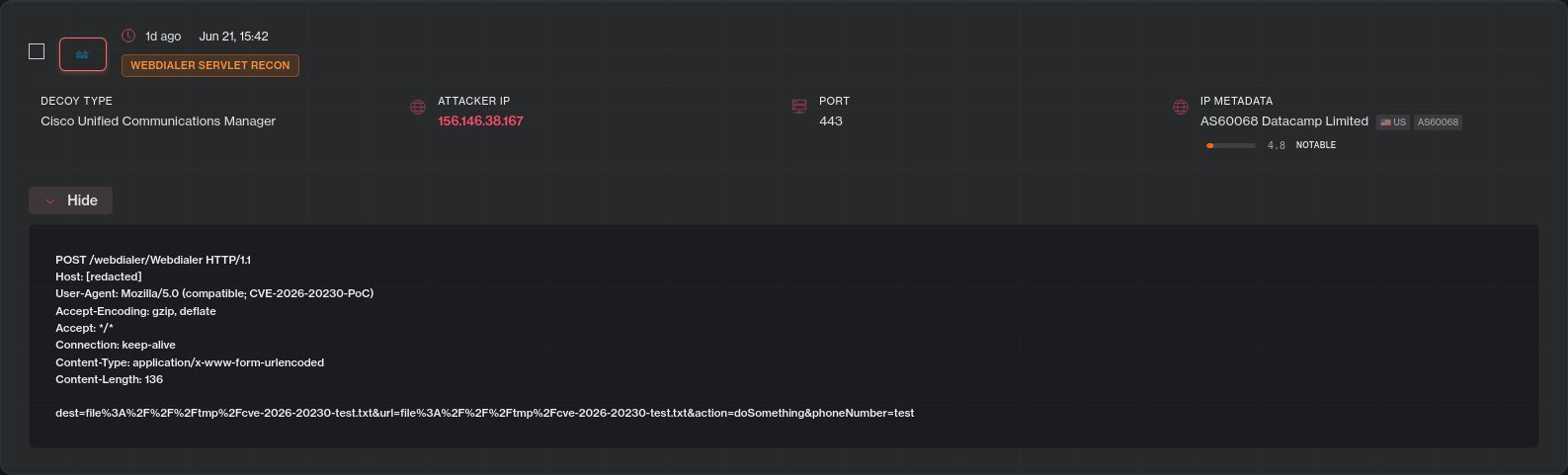
However, roughly three weeks later, on June 22, threat intelligence firm Defused revealed that attackers had begun exploiting the flaw using properly constructed file:// payloads to create files on targeted devices.

Advertisement
CVE-2026-20230 exploitation
CVE-2026-20230 exploitation (Defused)

One day later, SSD Secure also published a technical write-up that included a proof-of-concept exploit and explained how the vulnerability works.

BleepingComputer contacted Cisco at the time to ask whether they were also seeing the flaw actively exploited in attacks and whether they could share any IOCs with defenders, but we have yet to receive a response.

The company finally confirmed this Wednesday that attackers are now exploiting CVE-2026-20230 and urged customers to secure their systems against ongoing exploitation.

“The Cisco PSIRT is aware that proof-of-concept exploit code is available for the vulnerability that is described in this advisory,” Cisco notes in an update to the original advisory.

“In June 2026, the Cisco PSIRT became aware of active exploitation of this vulnerability. Cisco continues to strongly recommend that customers upgrade to a fixed software release to remediate this vulnerability.”

Advertisement

Cisco has also shared mitigation measures for admins and security teams who can’t immediately install Cisco Unified CM versions 14SU6 or 15SU5 (Sep 2026 or COP), advising them to disable the vulnerable WebDialer service until a patch is applied to block incoming CVE-2026-20230 attacks.

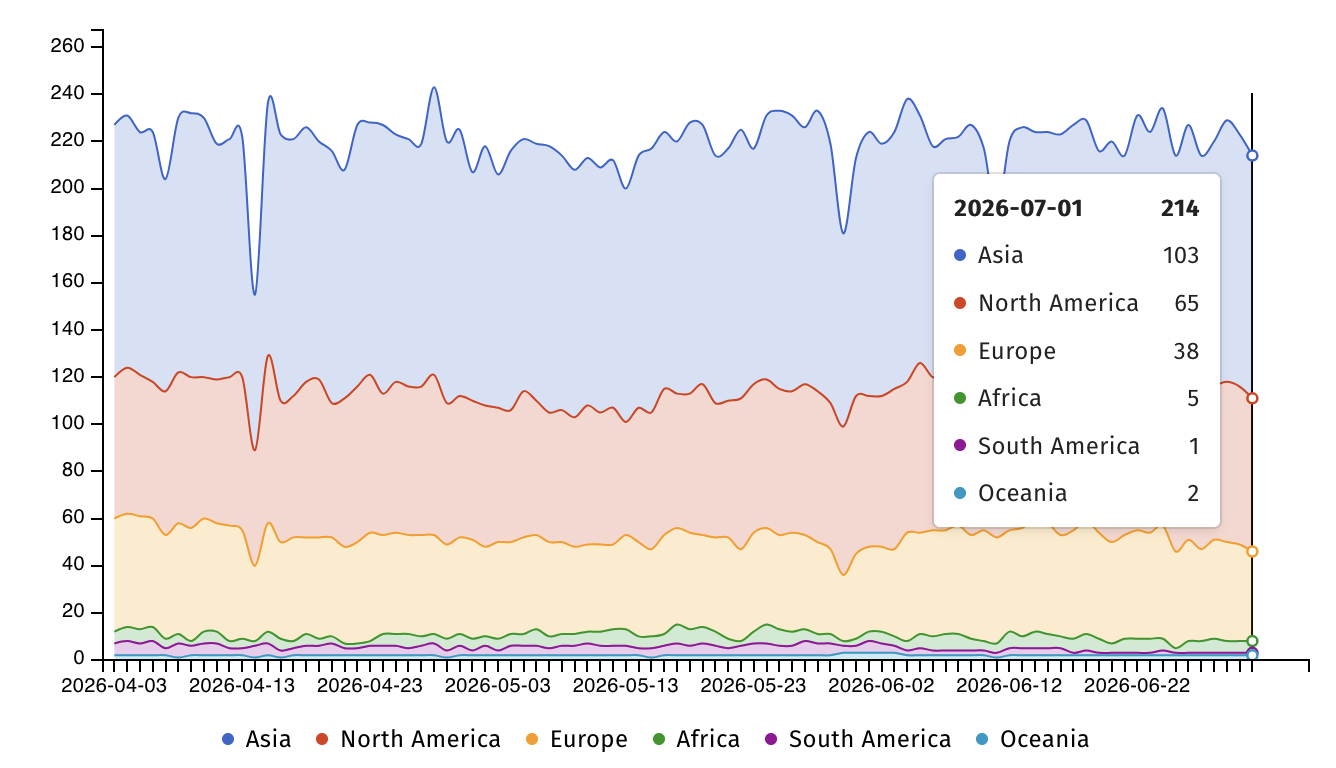
Internet security watchdog Shadowserver is currently tracking over 200 Cisco Unified CM instances exposed online, most of them in Asia and North America, but there are no details regarding how many have been secured against ongoing CVE-2026-20230 attacks.

Cisco Unified CM instances exposed online.png
Cisco Unified CM instances exposed online (Shadowserver)

​In recent years, Cisco has also patched two Unified CM flaws (CVE-2024-20253 and CVE-2025-20309) that enabled threat actors to gain root privileges and another Unified CM flaw (CVE-2026-20045) that has been actively exploited as a zero-day to gain remote code execution.

The U.S. Cybersecurity and Infrastructure Security Agency (CISA) tagged 93 Cisco vulnerabilities as actively exploited in the wild since November 2021, six of which have been abused in ransomware attacks.


article image

Security teams log 54% of successful attacks and alert on just 14%. The rest move through your environment unseen.

The Picus whitepaper shows how breach and attack simulation tests your SIEM and EDR rules so threats stop slipping by detection.

Advertisement

Get the whitepaper

Source link

Continue Reading

Tech

Jensen Huang's signed leather jacket could sell for up to $60,000 at charity auction

Published

on


Sotheby’s, which has been behind several iconic tech auctions over the years, will begin accepting bids on the black leather jacket starting on July 7. Titled The Jensen Jacket: Jensen Huang’s Tom Ford Leather Jacket, the auction notes that it is associated with some of the most consequential moments in…
Read Entire Article
Source link

Continue Reading

Tech

The only AI glossary you’ll need this year

Published

on

Artificial intelligence is rewriting the world, and simultaneously inventing a whole new language to describe how it’s doing it. Sit in on any product meeting, pitch, or panel these days, and you’ll hear people toss around LLMs, RAG, RLHF, and a dozen other terms that can make even very smart people in the tech world feel a little insecure. This glossary is our attempt to fix that: pain-English definitions of the AI terms you’re most likely to actually run into, whether you’re building with this stuff, investing in it, or just trying to keep up by reading TechCrunch or listening to related podcasts. We update it regularly as the field evolves, so consider it a living document, much like the AI systems it describes.


Artificial general intelligence, or AGI, is a nebulous term. But it generally refers to AI that’s more capable than the average human at many, if not most, tasks. OpenAI CEO Sam Altman once described AGI as the “equivalent of a median human that you could hire as a co-worker.” Meanwhile, OpenAI’s charter defines AGI as “highly autonomous systems that outperform humans at most economically valuable work.” Google DeepMind’s understanding differs slightly from these two definitions; the lab views AGI as “AI that’s at least as capable as humans at most cognitive tasks.” Confused? Not to worry — so are experts at the forefront of AI research.

An AI agent refers to a tool that uses AI technologies to perform a series of tasks on your behalf — beyond what a more basic AI chatbot could do — such as filing expenses, booking tickets or a table at a restaurant, or even writing and maintaining code. However, as we’ve explained before, there are lots of moving pieces in this emergent space, so “AI agent” might mean different things to different people. Infrastructure is also still being built out to deliver on its envisaged capabilities. But the basic concept implies an autonomous system that may draw on multiple AI systems to carry out multistep tasks.

Think of API endpoints as “buttons” on the back of a piece of software that other programs can press to make it do things. Developers use these interfaces to build integrations — for example, allowing one application to pull data from another, or enabling an AI agent to control third-party services directly without a human manually operating each interface. Most smart home devices and connected platforms have these hidden buttons available, even if ordinary users never see or interact with them. As AI agents grow more capable, they are increasingly able to find and use these endpoints on their own, opening up powerful — and sometimes unexpected — possibilities for automation.

Advertisement

Given a simple question, a human brain can answer without even thinking too much about it — things like “which animal is taller, a giraffe or a cat?” But in many cases, you often need a pen and paper to come up with the right answer because there are intermediary steps. For instance, if a farmer has chickens and cows, and together they have 40 heads and 120 legs, you might need to write down a simple equation to come up with the answer (20 chickens and 20 cows).

In an AI context, chain-of-thought reasoning for large language models means breaking down a problem into smaller, intermediate steps to improve the quality of the end result. It usually takes longer to get an answer, but the answer is more likely to be correct, especially in a logic or coding context. Reasoning models are developed from traditional large language models and optimized for chain-of-thought thinking thanks to reinforcement learning.

(See: Large language model)

This is a more specific concept that an “AI agent,” which means a program that can take actions on its own, step by step, to complete a goal. A coding agent is a specialized version applied to software development. Rather than simply suggesting code for a human to review and paste in, a coding agent can write, test, and debug code autonomously, handling the kind of iterative, trial-and-error work that typically consumes a developer’s day. These agents can operate across entire codebases, spotting bugs, running tests, and pushing fixes with minimal human oversight. Think of it like hiring a very fast intern who never sleeps and never loses focus — though, as with any intern, a human still needs to review the work.

Advertisement

Although somewhat of a multivalent term, compute generally refers to the vital computational power that allows AI models to operate. This type of processing fuels the AI industry, giving it the ability to train and deploy its powerful models. The term is often a shorthand for the kinds of hardware that provides the computational power — things like GPUs, CPUs, TPUs, and other forms of infrastructure that form the bedrock of the modern AI industry.

A subset of self-improving machine learning in which AI algorithms are designed with a multi-layered, artificial neural network (ANN) structure. This allows them to make more complex correlations compared to simpler machine learning-based systems, such as linear models or decision trees. The structure of deep learning algorithms draws inspiration from the interconnected pathways of neurons in the human brain.

Deep learning AI models are able to identify important characteristics in data themselves, rather than requiring human engineers to define these features. The structure also supports algorithms that can learn from errors and, through a process of repetition and adjustment, improve their own outputs. However, deep learning systems require a lot of data points to yield good results (millions or more). They also typically take longer to train compared to simpler machine learning algorithms — so development costs tend to be higher.

(See: Neural network)

Advertisement

Diffusion is the tech at the heart of many art-, music-, and text-generating AI models. Inspired by physics, diffusion systems slowly “destroy” the structure of data — for example, photos, songs, and so on — by adding noise until there’s nothing left. In physics, diffusion is spontaneous and irreversible — sugar diffused in coffee can’t be restored to cube form. But diffusion systems in AI aim to learn a sort of “reverse diffusion” process to restore the destroyed data, gaining the ability to recover the data from noise.

Distillation is a technique used to extract knowledge from a large AI model with a ‘teacher-student’ model. Developers send requests to a teacher model and record the outputs. Answers are sometimes compared with a dataset to see how accurate they are. These outputs are then used to train the student model, which is trained to approximate the teacher’s behavior.

Distillation can be used to create a smaller, more efficient model based on a larger model with a minimal distillation loss. This is likely how OpenAI developed GPT-4 Turbo, a faster version of GPT-4.

While all AI companies use distillation internally, it may have also been used by some AI companies to catch up with frontier models. Distillation from a competitor usually violates the terms of service of AI API and chat assistants.

Advertisement

This refers to the further training of an AI model to optimize performance for a more specific task or area than was previously a focal point of its training — typically by feeding in new, specialized (i.e., task-oriented) data. 

Many AI startups are taking large language models as a starting point to build a commercial product but are vying to amp up utility for a target sector or task by supplementing earlier training cycles with fine-tuning based on their own domain-specific knowledge and expertise.

(See: Large language model [LLM])

A GAN, or Generative Adversarial Network, is a type of machine learning framework that underpins some important developments in generative AI when it comes to producing realistic data — including (but not only) deepfake tools. GANs involve the use of a pair of neural networks, one of which draws on its training data to generate an output that is passed to the other model to evaluate.

Advertisement

The two models are essentially programmed to try to outdo each other. The generator is trying to get its output past the discriminator, while the discriminator is working to spot artificially generated data. This structured contest can optimize AI outputs to be more realistic without the need for additional human intervention. Though GANs work best for narrower applications (such as producing realistic photos or videos), rather than general purpose AI.

Hallucination is the AI industry’s preferred term for AI models making stuff up — literally generating information that is incorrect. Obviously, it’s a huge problem for AI quality. 

Hallucinations produce GenAI outputs that can be misleading and could even lead to real-life risks — with potentially dangerous consequences (think of a health query that returns harmful medical advice).

The problem of AIs fabricating information is thought to arise as a consequence of gaps in training data. Hallucinations are contributing to a push toward increasingly specialized and/or vertical AI models — i.e. domain-specific AIs that require narrower expertise — as a way to reduce the likelihood of knowledge gaps and shrink disinformation risks.

Advertisement

Inference is the process of running an AI model. It’s setting a model loose to make predictions or draw conclusions from previously seen data. To be clear, inference can’t happen without training; a model must learn patterns in a set of data before it can effectively extrapolate from this training data.

Many types of hardware can perform inference, ranging from smartphone processors to beefy GPUs to custom-designed AI accelerators. But not all of them can run models equally well. Very large models would take ages to make predictions on, say, a laptop versus a cloud server with high-end AI chips.

[See: Training]

Large language models, or LLMs, are the AI models used by popular AI assistants, such as ChatGPT, Claude, Google’s Gemini, Meta’s AI Llama, Microsoft Copilot, or Mistral’s Le Chat. When you chat with an AI assistant, you interact with a large language model that processes your request directly or with the help of different available tools, such as web browsing or code interpreters.

Advertisement

LLMs are deep neural networks made of billions of numerical parameters (or weights, see below) that learn the relationships between words and phrases and create a representation of language, a sort of multidimensional map of words.

These models are created from encoding the patterns they find in billions of books, articles, and transcripts. When you prompt an LLM, the model generates the most likely pattern that fits the prompt.

(See: Neural network)

Memory cache refers to an important process that boosts inference (which is the process by which AI works to generate a response to a user’s query). In essence, caching is an optimization technique, designed to make inference more efficient. AI is obviously driven by high-octane mathematical calculations and every time those calculations are made, they use up more power. Caching is designed to cut down on the number of calculations a model might have to run by saving particular calculations for future user queries and operations. There are different kinds of memory caching, although one of the more well-known is KV (or key value) caching. KV caching works in transformer-based models, and increases efficiency, driving faster results by reducing the amount of time (and algorithmic labor) it takes to generate answers to user questions.   

Advertisement

(See: Inference)  

Model Context Protocol, or MCP, is an open standard that lets AI models connect to outside tools and data — your files, databases, or apps like Slack and Google Drive — without a developer building a custom connector for every single pairing. Think of it as a USB-C port for AI. Anthropic introduced MCP in 2024 and later handed it over to the Linux Foundation, and it’s since been adopted by OpenAI, Google, and Microsoft, making it one of the fastest-spreading standards in recent AI history.

Mixture of Experts is a model architecture that splits a neural network into many smaller specialized sub-networks, or “experts,” and only activates a handful of them for any given task. Rather than routing every request through the entire model — like calling in your whole office for every question — an MoE model has a built-in “router” that picks just the right specialists for the job. This makes it possible to build enormous models that stay relatively fast and cheap to run, since only a fraction of the network is doing work at any one time. Mistral AI’s Mixtral model is a well-known example; OpenAI’s newer GPT models are also widely believed to use some version of this approach, though the company has never officially confirmed it.

(See: Neural network, Deep learning)

Advertisement

A neural network refers to the multi-layered algorithmic structure that underpins deep learning — and, more broadly, the whole boom in generative AI tools following the emergence of large language models. 

Although the idea of taking inspiration from the densely interconnected pathways of the human brain as a design structure for data processing algorithms dates all the way back to the 1940s, it was the much more recent rise of graphical processing hardware (GPUs) — via the video game industry — that really unlocked the power of this theory. These chips proved well suited to training algorithms with many more layers than was possible in earlier epochs — enabling neural network-based AI systems to achieve far better performance across many domains, including voice recognition, autonomous navigation, and drug discovery.

(See: Large language model [LLM])

Open source refers to software — or, increasingly, AI models — where the underlying code is made publicly available for anyone to use, inspect, or modify. In the AI world, Meta’s Llama family of models is a prominent example; Linux is the famous historical parallel in operating systems. Open source approaches allow researchers, developers, and companies around the world to build on top of one another’s work, accelerating progress and enabling independent safety audits that closed systems cannot easily provide. Closed source means the code is private — you can use the product but not see how it works, as is the case with OpenAI’s GPT models — a distinction that has become one of the defining debates in the AI industry.

Advertisement

Parallelization means doing many things at the same time instead of one after another — like having 10 employees working on different parts of a project at the same time instead of one employee doing everything sequentially. In AI, parallelization is fundamental to both training and inference: modern GPUs are specifically designed to perform thousands of calculations in parallel, which is a big reason why they became the hardware backbone of the industry. As AI systems grow more complex and models grow larger, the ability to parallelize work across many chips and many machines has become one of the most important factors in determining how quickly and cost-effectively models can be built and deployed. Research into better parallelization strategies is now a field of study in its own right.

RAMageddon is the fun new term for a not-so-fun trend that is sweeping the tech industry: an ever-increasing shortage of random access memory, or RAM chips, which power pretty much all the tech products we use in our daily lives. As the AI industry has blossomed, the biggest tech companies and AI labs — all vying to have the most powerful and efficient AI — are buying so much RAM to power their data centers that there’s not much left for the rest of us. And that supply bottleneck means that what’s left is getting more and more expensive.

That includes industries like gaming (where major companies have had to raise prices on consoles because it’s harder to find memory chips for their devices), consumer electronics (where memory shortage could cause the biggest dip in smartphone shipments in more than a decade), and general enterprise computing (because those companies can’t get enough RAM for their own data centers). The surge in prices is only expected to stop after the dreaded shortage ends but, unfortunately, there’s not really much of a sign that’s going to happen anytime soon.  

Like AGI, recursive self-improvement is a threshhold for how smart AI can get, and how little it may rely on humans. In the RSI scenario, AI models start improving themselves without human intervention, leading to a huge acceleration in capabilities and autonomy. In some tellings, this would be a cataclysmic moment akin to the singularity, a moment when AI models become immune to outside intervention. But RSI also describes a basic capability — can an AI model design its own successor? — which makes it much easier for engineers to try to build it. A number of recent AI startups have set out to build recursively self-improving models, but most of them dismiss the apocalyptic implications, presenting RSI as simply the next frontier for research.

Advertisement

Reinforcement learning is a way of training AI where a system learns by trying things and receiving rewards for correct answers — like training your beloved pet with treats, except the “pet” in this scenario is a neural network and the “treat” is a mathematical signal indicating success. Unlike supervised learning, where a model is trained on a fixed dataset of labeled examples, reinforcement learning lets a model explore its environment, take actions, and continuously update its behavior based on the feedback it receives. This approach has proven especially powerful for training AI to play games, control robots, and, more recently, sharpen the reasoning ability of large language models. Techniques like reinforcement learning from human feedback, or RLHF, are now central to how leading AI labs fine-tune their models to be more helpful, accurate, and safe.

When it comes to human-machine communication, there are some obvious challenges — people communicate using human language, while AI programs execute tasks through complex algorithmic processes informed by data. Tokens bridge that gap: they are the basic building blocks of human-AI communication, representing discrete segments of data that have been processed or produced by an LLM. They are created through a process called tokenization, which breaks down raw text into bite-sized units a language model can digest, similar to how a compiler translates human language into binary code a computer can understand. In enterprise settings, tokens also determine cost — most AI companies charge for LLM usage on a per-token basis, meaning the more a business uses, the more it pays.

So again, tokens are the small chunks of text — often parts of words rather than whole ones — that AI language models break language into before processing it; they are roughly analogous to “words” for the purposes of understanding AI workloads. Throughput refers to how much can be processed in a given period of time, so token throughput is essentially a measure of how much AI work a system can handle at once. High token throughput is a key goal for AI infrastructure teams, since it determines how many users a model can serve simultaneously and how quickly each of them receives a response. AI researcher Andrej Karpathy has described feeling anxious when his AI subscriptions sit idle — echoing the feeling he had as a grad student when expensive computer hardware wasn’t being fully utilized — a sentiment that captures why maximizing token throughput has become something of an obsession in the field.

Developing machine learning AIs involves a process known as training. In simple terms, this refers to data being fed in in order that the model can learn from patterns and generate useful outputs. Essentially, it’s the process of the system responding to characteristics in the data that enables it to adapt outputs toward a sought-for goal — whether that’s identifying images of cats or producing a haiku on demand.

Advertisement

Training can be expensive because it requires lots of inputs, and the volumes required have been trending upwards — which is why hybrid approaches, such as fine-tuning a rules-based AI with targeted data, can help manage costs without starting entirely from scratch.

[See: Inference]

A technique where a previously trained AI model is used as the starting point for developing a new model for a different but typically related task — allowing knowledge gained in previous training cycles to be reapplied. 

Transfer learning can drive efficiency savings by shortcutting model development. It can also be useful when data for the task that the model is being developed for is somewhat limited. But it’s important to note that the approach has limitations. Models that rely on transfer learning to gain generalized capabilities will likely require training on additional data in order to perform well in their domain of focus

Advertisement

(See: Fine tuning)

Validation loss is a number that tells you how well an AI model is learning during training — and lower is better. Researchers track it closely as a kind of real-time report card, using it to decide when to stop training, when to adjust hyperparameters, or whether to investigate a potential problem. One of the key concerns it helps flag is overfitting, a condition in which a model memorizes its training data rather than truly learning patterns it can generalize to new situations. Think of it as the difference between a student who genuinely understands the material and one who simply memorized last year’s exam — validation loss helps reveal which one your model is becoming.

Weights are core to AI training, as they determine how much importance (or weight) is given to different features (or input variables) in the data used for training the system — thereby shaping the AI model’s output. 

Put another way, weights are numerical parameters that define what’s most salient in a dataset for the given training task. They achieve their function by applying multiplication to inputs. Model training typically begins with weights that are randomly assigned, but as the process unfolds, the weights adjust as the model seeks to arrive at an output that more closely matches the target.

Advertisement

For example, an AI model for predicting housing prices that’s trained on historical real estate data for a target location could include weights for features such as the number of bedrooms and bathrooms, whether a property is detached or semi-detached, whether it has parking, a garage, and so on. 

Ultimately, the weights the model attaches to each of these inputs reflect how much they influence the value of a property, based on the given dataset.

This article is updated regularly with new information.

When you purchase through links in our articles, we may earn a small commission. This doesn’t affect our editorial independence.

Advertisement

Source link

Continue Reading

Tech

Amazon Leo says its latest launch gives it enough satellites to start broadband internet service

Published

on

An Atlas 5 rocket lifts off from its Florida launch pad, sending 29 Amazon Leo satellites into orbit. (United Launch Alliance Photo)

Amazon says the overnight launch of 29 satellites should clear the way for its Amazon Leo network to start offering commercial high-speed internet service from space this year, in direct competition with SpaceX’s Starlink network.

United Launch Alliance’s Atlas 5 rocket sent the satellites into low Earth orbit from Cape Canaveral Space Force Station at 12:30 a.m. ET today (9:30 p.m. PT Wednesday).

This was the last of eight Atlas 5 launches that Amazon reserved for its satellites. Going forward, ULA will use its next-generation Vulcan rocket to support Amazon Leo’s years-long deployment schedule. Amazon has also made launch reservations with Blue Origin, Arianespace and SpaceX.

The latest liftoff boosts Amazon Leo’s constellation to 396 operational satellites. That will be enough to support continuous connectivity in the initial latitudes targeted for commercial service, according to Chris Weber, vice president of business and product for Amazon Leo.

“Still lots of work ahead — including raising all these new satellites to their assigned altitude — but we’ve completed enough launches for initial service this year, and future missions just add coverage and capacity,” Weber said in a LinkedIn post.

Advertisement

Amazon has been beta-testing the service for months with a select group of customers, but connectivity hasn’t been continuous due to sparse orbital coverage. Amazon Leo’s business plan calls for launching commercial service within a limited zone concentrated at mid-northern and mid-southern latitudes, and gradually expanding the service area as more satellites go up.

“With hundreds of flight-ready satellites standing by at the Cape and a new, dedicated vertical integration facility ready to support Leo Vulcan 1 and subsequent missions, we have a clear path to increase launch and deployment cadence, helping us quickly expand network coverage following an initial service rollout later this year,” Melissa Wuerl, Amazon Leo’s director of launch systems, said in a statement released after the latest launch.

Amazon hasn’t yet announced pricing for satellite broadband service. The first-generation constellation, consisting of 3,232 satellites, is due to reach full deployment in mid-2029 — and Amazon has received regulatory approval for an even larger second-generation constellation.

When Amazon Leo begins commercial service, it will still trail far behind SpaceX’s Starlink satellite network, which has more than 10,000 satellites in orbit and 12 million subscribers. The satellites for both Starlink and Amazon Leo are built in the Seattle area.

Advertisement

In the years ahead, SpaceX plans to beef up Starlink’s capabilities in the emerging market for direct-to-device satellite services. Amazon is aggressively targeting that same market through its recent acquisition of Globalstar. Under a separate agreement tied to the deal, Amazon Leo will start powering Apple’s iPhone satellite services starting in 2028.

Source link

Continue Reading

Tech

NetNut proxy network disrupted, 2 million infected devices cut off

Published

on

NetNut residential proxy network disrupted after hijacking 2 million devices

A joint operation involving Google has disrupted NetNut, a residential proxy network that gave access to millions of compromised Android devices, including smart TVs and streaming boxes.

Also known as Popa, the NetNut botnet allowed cybercriminals and espionage groups to hide behind legitimate home internet addresses when launching attacks.

According to the Google Threat Intelligence Group (GTIG), the residential proxy botnet is estimated to comprise at least two million compromised devices.

image

“GTIG estimates Netnut controls at least 2 million infected devices globally (including smart TVs and streaming boxes), powered by trojanized applications and botnets like Badbox 2.0 that package proxy plugins,” Google told BleepingComputer.

Residential proxy networks work by compromising home systems and selling access to them, allowing threat actors to conceal malicious traffic by routing it through the victims’ residential IP addresses.

Advertisement

Typically, home devices become part of the botnet after being infected with malware that is either pre-installed before purchase or added via malicious or trojanized applications downloaded by the user.

As a result, infected consumer devices serve as exit nodes in the botnet, routing unauthorized network traffic through their residential IP addresses, which can cause the devices to be flagged as suspicious or blocked by internet service providers or online services.

Dismantling the NetNut botnet involved a coordinated effort that included Google, the FBI, Lumen Technologies, The Shadowserver Foundation, and other industry partners.

FBI seized domain used by the NetNut residential proxy network
source: BleepingComputer

The malicious proxy service is considered one of the largest networks in the world, being used by hundreds of threat actors.

It uses multiple domains, including netnut.com, which was taken down by the FBI.

Advertisement

“I checked with the disruption team and confirmed .com domain was also used by them along with other domains taken down,” Mark Karayan, Communications Manager at Mandiant, told BleepingComputer.

GTIG said that in one week last month it “observed 316 distinct threat clusters using suspected NetNut exit nodes, including cybercriminal and espionage groups.”

According to the researchers, threat actors used NetNut to access their own infrastructure, conduct password-spraying attacks, and to reach victim environments.

On its part, Google disabled the accounts and services on its infrastructure that NetNut operators used for malware command-and-control (C2), thus blocking access to “critical backend infrastructure.”

Advertisement

The company protected users by automatically warning them and disabling infected applications using Google Play Protect, the built-in security mechanism on Android.

Additionally, Google shared technical details on NetNut’s software development kits (SDKs) and backend command-and-control (C2) infrastructure with platform providers, law enforcement agencies, and cybersecurity researchers.

Google expects disrupting NetNut to have a broader impact in the proxy industry as the botnet “has a robust reseller program that allows whitelabeling of its network” and many of the popular residential proxy services are fueled by NetNut.

Karayan told BleepingComputer that disrupting one proxy service often prompts operators to purchase replacement capacity from competing providers, turning them into a reseller.

Advertisement

“The proxy industry is deeply interconnected where operators constantly buy and resell each other’s botnet capacity, and Netnut is among the largest and most popular residential proxy networks in the world.”

The action against NetNut is part of Google’s commitment to dismantle residential proxy botnets and follows the disruption of IPIDEA earlier this year.


article image

Security teams log 54% of successful attacks and alert on just 14%. The rest move through your environment unseen.

The Picus whitepaper shows how breach and attack simulation tests your SIEM and EDR rules so threats stop slipping by detection.

Get the whitepaper

Source link

Advertisement
Continue Reading

Tech

Today’s NYT Wordle Hints, Answer and Help for July 4 #1841

Published

on

Looking for the most recent Wordle answer? Click here for today’s Wordle hints, as well as our daily answers and hints for The New York Times Mini Crossword, Connections, Connections: Sports Edition and Strands puzzles.


Today’s Wordle puzzle is a fun, tasty word, but it includes a repeated letter that is one I almost never guess. If you need a new starter word, check out our list of which letters show up the most in English words. If you need hints and the answer, read on.

Read more: New Study Reveals Wordle’s Top 10 Toughest Words of 2025

Advertisement

Today’s Wordle hints

Before we show you today’s Wordle answer, we’ll give you some hints. If you don’t want a spoiler, look away now.

Wordle hint No. 1: Repeats

Today’s Wordle answer has one repeated letter.

Wordle hint No. 2: Vowels

Today’s Wordle answer has two vowels.

Wordle hint No. 3: First letter

Today’s Wordle answer begins with P.

Advertisement

Wordle hint No. 4: Last letter

Today’s Wordle answer ends with A.

Wordle hint No. 5: Meaning

Today’s Wordle answer refers to a tasty dish consisting of dough, sauce, cheese and toppings.

TODAY’S WORDLE ANSWER

Today’s Wordle answer is PIZZA.

Advertisement

Yesterday’s Wordle answer

Yesterday’s Wordle answer, July 3, No. 1840, was BATON.

Recent Wordle answers

June 29, No. 1836: CRUDE

June 30, No. 1837: PUPPY

July 1, No. 1838: DEMUR

Advertisement

July 2, No. 1839: MAVEN

Source link

Advertisement
Continue Reading

Trending

Copyright © 2025